
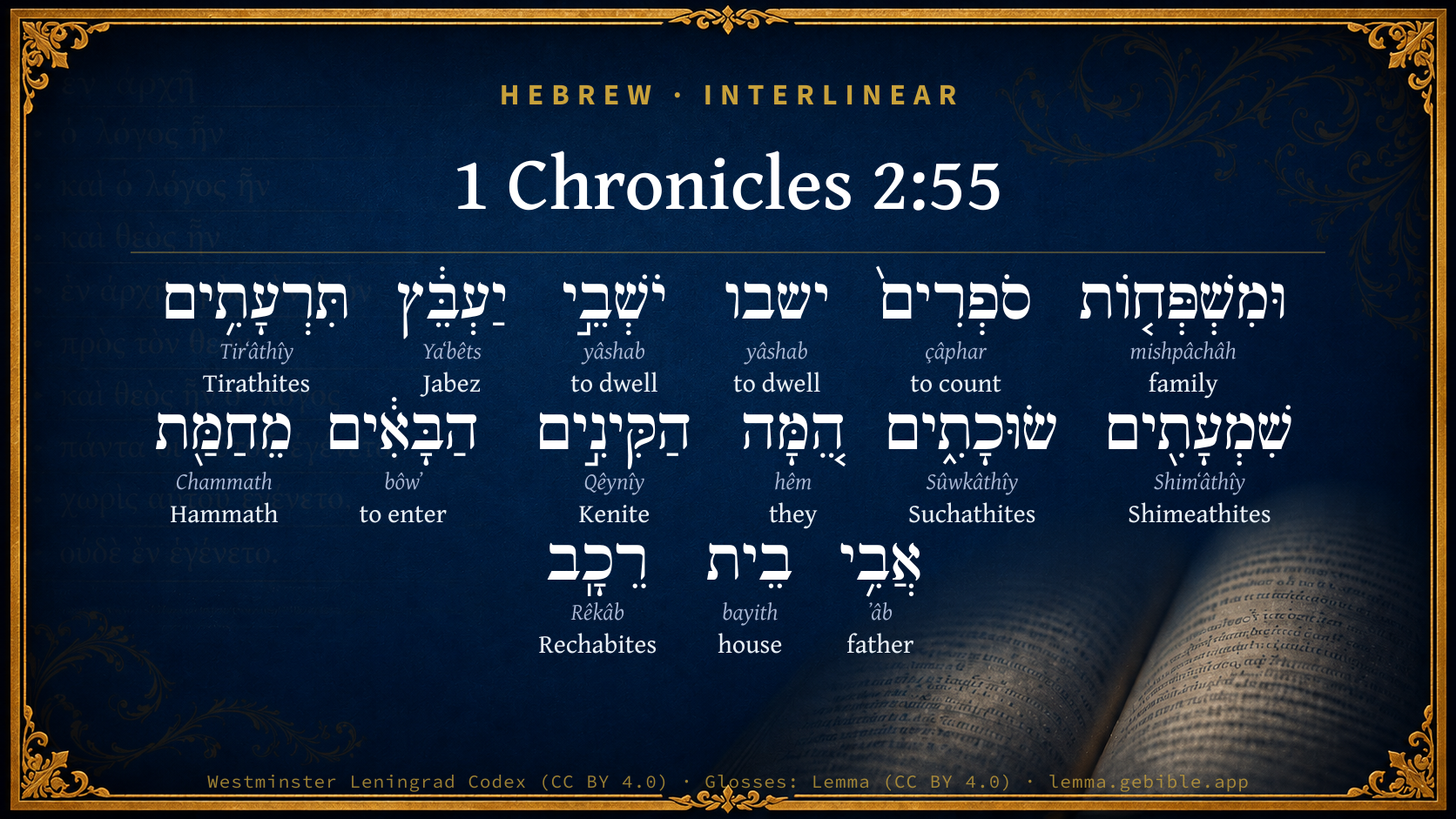
1 Chronicles 2:55

Hebrew (Westminster Leningrad Codex) 1 Chronicles 2:55 appears in the Hebrew Old Testament. The text above is from the Westminster Leningrad Codex. Each word links to its Strong’s number, a concise gloss, and parsing drawn from the Open Scriptures Hebrew Bible morphology. Click any word for its full Brown-Driver-Briggs (BDB) entry.
Download image
Cite this verse

1 Chronicles 2:55 (World English Bible). Public Domain. Lemma interlinear Bible study tool, https://lemma.gebible.app/v/1-chronicles/2/55.

Show BibTeX & RIS
BibTeX
RIS
English Translation
The families of scribes who lived at Jabez: the Tirathites, the Shimeathites, the Sucathites. These are the Kenites who came of Hammath, the father of the house of Rechab.
World English Bible · Public Domain
Highlights
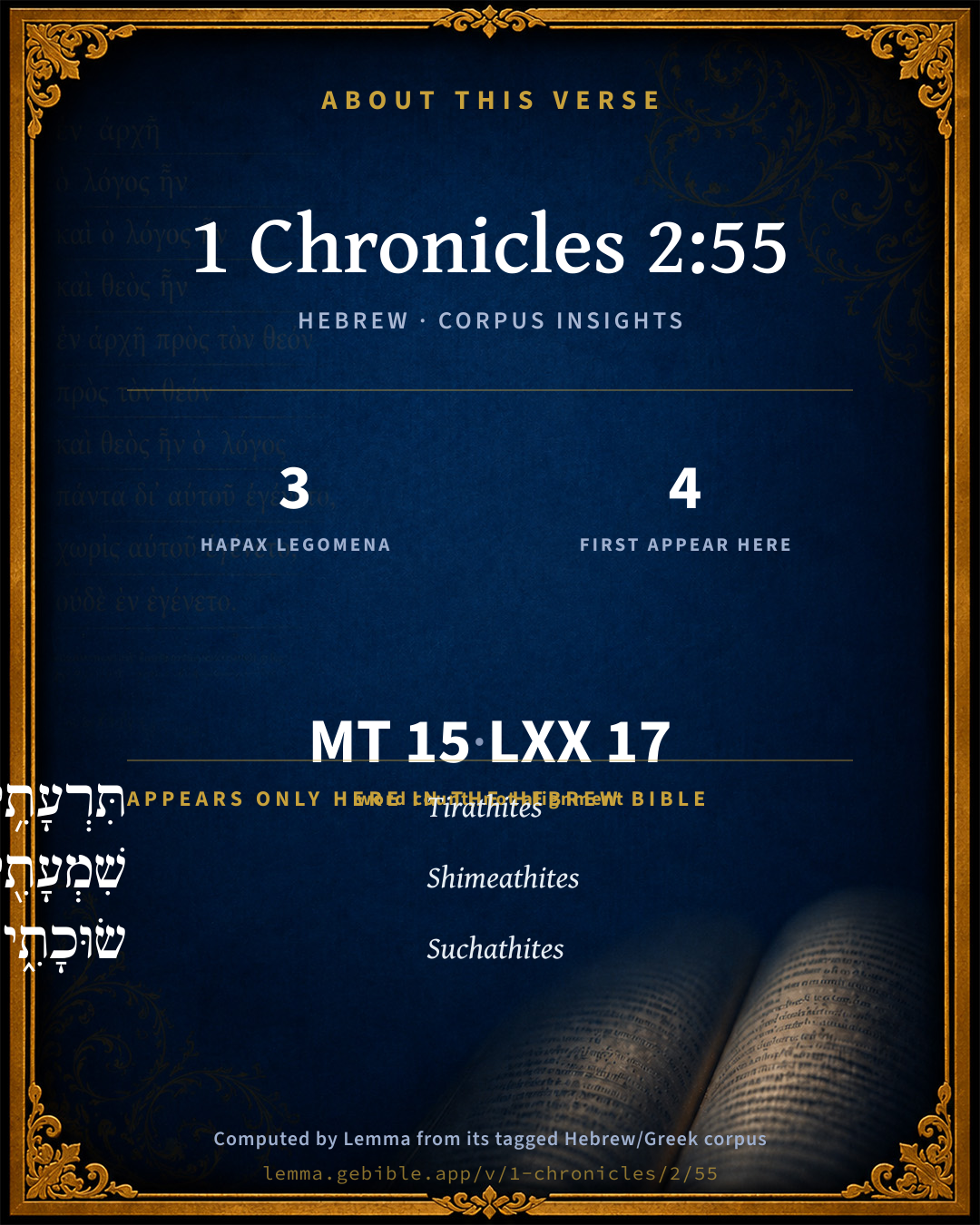
  • 3 hapax legomena — only here in the Hebrew Bible
  • 4 first appearances in the Hebrew Bible
Full analysis ↓
Download a study sheet

One document with this verse’s original text, its word-by-word gloss line, the meaning frame, cross-references with their text, attributed commentary, and full source and license credits — printable, and it pastes into notes with its structure intact.

This verse Autodidact and up

Study sheet (.html) Plain text (.txt)

A passage Seminary Student

Up to 50 verses in one chapter. A passage sheet keeps up to 6 commentary sources and 12 cross-references per verse, in the order this page ranks them, and says so on the sheet whenever that leaves anything out. Ask for a single verse and you get the Autodidact verse sheet above.

Everything on this page stays free to read, with no account — the sheet is a download of what is already on screen, not access to it.

Want to remove ads? Support Godless Engineer
Compare translations 3

The same verse in 3 English versions, stacked beneath the original-language interlinear above. Click any original word for its lexicon entry.

Each is an independent rendering of the whole verse — the interlinear is not word-aligned to these translations.

Highlighted words mark where these versions differ — a whole-verse word diff, not a word-by-word alignment.

  • World English Bible Public Domain
    The families of scribes who lived at Jabez: the Tirathites, the Shimeathites, the Sucathites. These are the Kenites who came of Hammath, the father of the house of Rechab.
  • King James Version Public Domain
    And the families of the scribes which dwelt at Jabez; the Tirathites, the Shimeathites, and Suchathites. These are the Kenites that came of Hemath, the father of the house of Rechab.
  • unfoldingWord Literal Text CC BY-SA 4.0
    and the clans of the scribes living Jabez: the Tirathites, the Shimeathites, the Sucathites. These the Kenites having come from Hammath, the father of the house of Rechab.

unfoldingWord Literal Text — © unfoldingWord, licensed CC BY-SA 4.0. Word-aligned USFM3 via Door43 (git.door43.org/unfoldingWord/en_ult).

Versions to compare (up to 4)

3 of 4 selected

Show all 18 translations

Every available English version of this verse, each an independent rendering of the whole verse.

  • World English Bible Public Domain
    The families of scribes who lived at Jabez: the Tirathites, the Shimeathites, the Sucathites. These are the Kenites who came of Hammath, the father of the house of Rechab.
  • Berean Standard Bible Public Domain
    and the clans of the scribes who lived at Jabez—the Tirathites, Shimeathites, and Sucathites. These are the Kenites who came from Hammath, the father of the house of Rechab.
  • Majority Standard Bible Public Domain
    and the clans of the scribes who lived at Jabez—the Tirathites, Shimeathites, and Sucathites. These are the Kenites who came from Hammath, the father of the house of Rechab.
  • King James Version Public Domain
    And the families of the scribes which dwelt at Jabez; the Tirathites, the Shimeathites, and Suchathites. These are the Kenites that came of Hemath, the father of the house of Rechab.
  • American Standard Version (1901) Public Domain
    And the families of scribes that dwelt at Jabez: the Tirathites, the Shimeathites, the Sucathites. These are the Kenites that came of Hammath, the father of the house of Rechab.
  • Revised Version (1885) Public Domain
    And the families of scribes which dwelt at Jabez; the Tirathites, the Shimeathites, the Sucathites. These are the Kenites that came of Hammath, the father of the house of Rechab.
  • Geneva Bible (1599) Public Domain
    And the families of the Scribes dwelling at Iabez, the Tirathites, the Shimmeathites, the Shuchathites, which are the Kenites, that came of Hammath the father of the house of Rechab.
  • Douay-Rheims (1899) Public Domain
    And the families of the scribes that dwell in Jabes, singing and making melody, and abiding in tents. These are the Cinites, who came of Calor (Chamath) father of the house of Rechab,
  • Young's Literal Translation Public Domain
    and the families of the scribes the inhabitants of Jabez: Tirathites, Shimeathites, Suchathites. They `are' the Kenites, those coming of Hammath father of the house of Rechab.
  • Literal Standard Version CC BY-SA 4.0
    and the families of the scribes, the inhabitants of Jabez: Tirathites, Shimeathites, Suchathites. They [are] the Kenites, those coming of Hammath father of the house of Rechab.
  • Unlocked Literal Bible CC BY-SA 4.0
    the clans of the scribes who lived at Jabez: the Tirathites, Shimeathites, and Sucathites. These were the Kenites who descended from Hammath, the ancestor of the Rekabites.
  • unfoldingWord Literal Text CC BY-SA 4.0
    and the clans of the scribes living Jabez: the Tirathites, the Shimeathites, the Sucathites. These the Kenites having come from Hammath, the father of the house of Rechab.
  • Darby Bible Public Domain
    and the families of the scribes who dwelt at Jabez: the Tireathites, the Shimeathites, the Suchathites. These are the Kenites that came of Hammath, the father of the house of Rechab.
  • World Messianic Bible Public Domain
    The families of scribes who lived at Jabez: the Tirathites, the Shimeathites, and the Sucathites. These are the Kenites who came from Hammath, the father of the house of Rechab.
  • Webster's Bible Public Domain
    And the families of the scribes who dwelt at Jabez; the Tirathites, the Shimeathites, and Suchathites. These are the Kenites that came of Hemath, the father of the house of Rechab.
  • Free Bible Version CC BY-SA 4.0
    and the families of scribes who lived at Jabez: the Tirathites, Shimeathites, and Sucathites. These are the Kenites who descended from Hammath, the father of the house of Recab.
  • Bible in Basic English Public Domain
    And the families of scribes who were living at Jabez: the Tirathites, the Shimeathites, the Sucathites. These are the Kenites, the offspring of Hammath, the father of the family of Rechab.
  • JPS Tanakh (1917) Public Domain
    And the families of scribes that dwelt at Jabez: the Tirathites, the Shimeathites, the Sucathites. These are the Kenites that came of Hammath, the father of the house of Rechab.

Literal Standard Version (2020), Covenant Press — licensed CC BY-SA 4.0. Text via the HelloAO Bible API (eBible.org). Unlocked Literal Bible (unfoldingWord) — licensed CC BY-SA 4.0. Text via the HelloAO Bible API (eBible.org). unfoldingWord Literal Text — © unfoldingWord, licensed CC BY-SA 4.0. Word-aligned USFM3 via Door43 (git.door43.org/unfoldingWord/en_ult). Free Bible Version, Dr. Jonathan Gallagher — licensed CC BY-SA 4.0. Text via the HelloAO Bible API (eBible.org).

Word by word

More ways to search: Search by grammar → Find every occurrence → Compare this word →

Practice this passage: Drill this verse → Learn its vocabulary →

תִּרְעָתִ֥ים
Tirʻâthîy
H8654
“Tirathites”
Noun, Gentilic, Masculine, Plural, Absolute
Part of Speech
Noun
Type
Gentilic
Gender
Masculine
Number
Plural
State
Absolute
Full BDB Definition

Origin: patrial from an unused name meaning gate

TWOT: None

Tirathites = "men of the gate" - one of the 3 families of Kenite scribes living at Jabez
  1. וּמִשְׁפְּח֤וֹת mishpâchâh H4940 “and · families of” Conjunction + Noun, Common, Feminine, Plural, Construct
  2. סֹפְרִים֙ çâphar H5608 “scribes” Noun, Common, Masculine, Plural, Absolute
  3. ישבו yâshab H3427 “to dwell” Verb, Qal, Perfect, 3rd Person, Common, Plural
  4. יֹשְׁבֵ֣י yâshab H3427 “dwelling” Verb, Qal, Participle Active, Masculine, Plural, Construct
  5. יַעְבֵּ֔ץ Yaʻbêts H3258 “Jabez” Noun, Proper
  6. שִׁמְעָתִ֖ים Shimʻâthîy H8101 “Shimeathites” Noun, Gentilic, Masculine, Plural, Absolute
  7. שׂוּכָתִ֑ים Sûwkâthîy H7756 “Suchathites” Noun, Gentilic, Masculine, Plural, Absolute
  8. הֵ֚מָּה hêm H1992 “they” Pronoun, Personal, 3rd Person, Masculine, Plural
  9. הַקִּינִ֣ים Qêynîy H7017 “the · Kenites” Particle, Definite Article + Noun, Gentilic, Masculine, Plural, Absolute
  10. הַבָּאִ֔ים bôwʼ H935 “the · entering” Particle, Definite Article + Verb, Qal, Participle Active, Masculine, Plural, Absolute
  11. מֵחַמַּ֖ת Chammath H2575 “from · Hammath” Preposition + Noun, Proper
  12. אֲבִ֥י ʼâb H1 “father of” Noun, Common, Masculine, Singular, Construct
  13. בֵית bayith H1004 “house of” Noun, Common, Masculine, Singular, Construct
  14. רֵכָֽב Rêkâb H7394 “Rechabites” Noun, Proper

About this verse

These counts appear in no published source. They are computed here, from the morphology-tagged text and Lemma’s own curated glosses. What Lemma adds →

15
words
14
distinct lemmas
Historical
section

Notable vocabulary

3 hapax legomena — words that appear only here in the entire Hebrew Bible:

  • תִּרְעָתִ֥ים Tirathites H8654
  • שִׁמְעָתִ֖ים Shimeathites H8101
  • שׂוּכָתִ֑ים Suchathites H7756

First appearance in Scripture

These words make their first canonical appearance in the Hebrew Bible here:

  • יַעְבֵּ֔ץ Jabez H3258
  • תִּרְעָתִ֥ים Tirathites H8654
  • שִׁמְעָתִ֖ים Shimeathites H8101
  • שׂוּכָתִ֑ים Suchathites H7756

Shared distinctive vocabulary

מֵחַמַּ֖ת Hammath H2575 occurs in 2 verses of the Hebrew Bible. Also found in:

Grammatical profile

  • 3 verbs
  • 11 nouns
  • 1 pronoun

Verb forms

  • ישבו Qal · Perfect
  • יֹשְׁבֵ֣י Qal · Participle Active
  • הַבָּאִ֔ים Qal · Participle Active

Repetition

A word recurs within this verse — often emphatic in Hebrew:

  • ישבו to dwell H3427 ×2

Hebrew & Septuagint length

In English translation the verse runs 29 words from the Hebrew and 28 from the Septuagint (LXX English) — closely comparable.

A rough comparison of the two English renderings, which tokenize alike — not a word-level alignment.

Word counts can differ between the Hebrew and the Greek without any difference in meaning — e.g. the Hebrew direct-object marker אֵת has no separate Greek word, and Greek often adds the article ὁ.

In the original languages it is 15 Hebrew tokens and 17 Greek tokens — but the two are counted differently (Hebrew bundles its prefixes and suffixes into one token; the Greek is in lemma form), so that isn’t a like-for-like length.

Cross-references

9

Topical passages linked to 1 Chronicles 2:55 in the Treasury of Scripture Knowledge — connected by theme and wording, ordered by reader-vote popularity; previews shown in the World English Bible.

  • Judges 1:16 The children of the Kenite, Moses' brother-in-law, went up out of the city of palm trees with the children of Judah into the wilderness of Judah, which is in the south of Arad; and they went and lived with the people.
  • 2 Kings 10:15 When he was departed there, he lighted on Jehonadab the son of Rechab coming to meet him; and he greeted him, and said to him, Is your heart right, as my heart is with your heart? Jehonadab answered, It is. If it be, give me your hand. He gave him his hand; and he took him up to him into the chariot.
  • Judges 4:11 Now Heber the Kenite had separated himself from the Kenites, even from the children of Hobab the brother-in-law of Moses, and had pitched his tent as far as the oak in Zaanannim, which is by Kedesh.
  • Jeremiah 35:2–8 Go to the house of the Rechabites, and speak to them, and bring them into the house of Yahweh, into one of the chambers, and give them wine to drink.
  • Jeremiah 35:19 therefore thus says Yahweh of Hosts, the God of Israel: Jonadab the son of Rechab shall not want a man to stand before me forever.
  • 1 Samuel 15:6 Saul said to the Kenites, Go, depart, get you down from among the Amalekites, lest I destroy you with them; for you shown kindness to all the children of Israel, when they came up out of Egypt. So the Kenites departed from among the Amalekites.
  • 1 Chronicles 4:9–10 Jabez was more honorable than his brothers: and his mother named him Jabez, saying, Because I bore him with sorrow.
  • Ezra 7:6 this Ezra went up from Babylon: and he was a ready scribe in the law of Moses, which Yahweh, the God of Israel, had given; and the king granted him all his request, according to the hand of Yahweh his God on him.
  • Jeremiah 8:8 How do you say, We are wise, and the law of Yahweh is with us? But, behold, the false pen of the scribes has worked falsely.

Cross-references courtesy of OpenBible.info (CC BY 4.0).

Hebrew and Greek witnesses Masoretic Hebrew ↔ Greek Septuagint

The same verse in the two great witnesses to the Old Testament, shown verse-for-verse.

These are two independent witnesses, not word-aligned to each other, and the Septuagint is shown in lemma (dictionary) form.

Hebrew 1 Chronicles 2:55 Masoretic · Westminster Leningrad Codex

וּמִשְׁפְּח֤וֹת סֹפְרִים֙ ישבו יֹשְׁבֵ֣י יַעְבֵּ֔ץ תִּרְעָתִ֥ים שִׁמְעָתִ֖ים שׂוּכָתִ֑ים הֵ֚מָּה הַקִּינִ֣ים הַבָּאִ֔ים מֵחַמַּ֖ת אֲבִ֥י בֵית רֵכָֽב

The families of scribes who lived at Jabez: the Tirathites, the Shimeathites, the Sucathites. These are the Kenites who came of Hammath, the father of the house of Rechab.

World English Bible · Public Domain

Greek LXX 1 Chronicles 2:55 Septuagint · lemma form

πατριά γραμματεύς καταοἰκέω ιαβες θαργαθιιμ σαμαθιιμ σωκαθιιμ οὗτος ὁ κιναῖοι ὁ ἔρχομαι ἐκ μεσημα πατήρ οἶκος ρηχαβ

The families of the scribes dwelling in Jabis; Thargathiim, and Samathiim, and Sochathim, these are the Kinaeans that came of Hemath, the father of the house of Rechab.

LXX2012 (modern English Septuagint) · Public Domain

On this verse, Haydock's Catholic Bible Commentary discusses the Septuagint’s reading. Read the note in Commentary ↓

Hebrew: Westminster Leningrad Codex (CC BY 4.0). Greek: Septuagint (public domain); English from LXX2012 (modern English Septuagint) (Public Domain). How the Septuagint differs from the Hebrew →

Commentary

Notes on 1 Chronicles 2:55 from classic Christian and Jewish commentators (each source and its license shown beneath its notes). The classic Christian expositions comment on the surrounding passage and are grouped to its opening verse, so a note may address several verses; the Jewish commentaries on the Tanakh (Rashi and others) are per-verse, so they appear only where the commentator wrote on this verse.

Lemma curates 59 commentaries, every one of them public domain or Creative Commons licensed, each selected and text-cleaned for this edition rather than reprinted as found. About our sources →

Trapp's Complete Commentary

John Trapp

1Ch 2:55 And the families of the scribes which dwelt at Jabez; the Tirathites, the Shimeathites, [and] Suchathites. These [are] the Kenites that came of Hemath, the father of the house of Rechab.

Ver. 55. And the families of the scribes.] These were public notaries: or, as some think, Text men, who took the literal interpretation, as distinct from Wise, that is, teachers of traditions, and from Disputers, that is, teachers of allegories and mysteries. See 1Co 1:20 Jer 8:9 Ezr 7:6. The first were the best of the three, and of these were the Rechabites, who being Shuchathites, that is, dwellers in tents, might dwell where they pleased: and now dwelt at Jabez, a place which seemeth to have taken its name from that good Jabez of Judah, who prayed so hard, {1Ch 4:10} having, haply, the help of these holy Kenites, the posterity of Jethro. See Jdg 1:16.

John Trapp, A Commentary or Exposition upon All the Books of the Old and New Testament (1647–1656) — public domain. Text from a community e-Sword module.

The Biblical Illustrator

Joseph S. Exell

1Ch_2:55

And the families of the Scribes which dwelt at Jabez

Scribes

I.

A noble calling. To study and expound sacred books, inform society, and spread the will of God.

II. A family calling. The families of the scribes. mere ditary pursuits in all communities.

III. A needful calling. A literary profession useful to society. A learned ministry the want of the times. (James Wolfendale.)

The Biblical Illustrator, edited by Joseph S. Exell (c. 1880s–1900s) — public domain. Text from a community e-Sword module.

Joseph Benson's Commentary

1Ch 2:55. The families of the scribes — Either civil, who were public notaries, that wrote and signed legal instruments; or ecclesiastical. And these were either Levites or Simeonites, or rather Kenites, and are here mentioned not as if they were of the tribe of Judah, but because they dwelt among them, and probably were allied to them by marriages, and so in a manner incorporated with them.

Joseph Benson's Commentary on the Old and New Testaments (1811–1818) — public domain. Text from a community e-Sword module.

Geneva Bible (1599)

Geneva Bible translators

Read Num. 10:29; Judg. 1:16.

Which were men learned and expert in the law.

Geneva Bible (1599) marginal notes — public domain. Text via Bolls.life.

Jamieson, Fausset & Brown

Robert Jamieson, A. R. Fausset & David Brown

the families of the scribes--either civil or ecclesiastical officers of the Kenite origin, who are here classed with the tribe of Judah, not as being descended from it, but as dwelling within its territory, and in a measure incorporated with its people.

Jabez--a place in Judah (Ch1 4:9).

Kenites that came of Hemath--who settled in Judah, and were thus distinguished from another division of the Kenite clan which dwelt in Manasseh (Jdg 4:11).

Next: 1 Chronicles Chapter 3

Jamieson, Fausset & Brown — Commentary Critical and Explanatory on the Whole Bible (1871) — public domain (CC PDM 1.0). Text via the HelloAO Bible API.

Adam Clarke's Commentary

Verse 55. The families] "The families of the Rechabites, the sons of Eliezer the son of Misco, the disciple of Jabez; he was Othniel, the son of Kenaz. And he was called Jabez, because in his council he instituted a school of disciples; they were called Tirathim, because in their hymns their voice was like trumpets; and Shimathim, because in hearing they lifted up their faces, i.e., in prayer; and Suchathim, because they were overshadowed by the Spirit of prophecy. These Salmaei were the children of Zipporah, who were numbered among the Levites who came from the stock of Moses, the master of Israel, whose righteousness profited them more than chariots and horses." - T. See on 1Ch 4:9-10.

Is the above explanation of Tirathites, Shimeathites, and Suchathites, the Targumist refers to the import of the Hebrew roots, whence these names are derived. See 1Ch 4:10. In this chapter many names of cities are given as the names of men.

Adam Clarke's Commentary on the Bible (1810–1826) — public domain. Text from a community e-Sword/MySword module.

The Cambridge Bible for Schools and Colleges

gen. ed. J. J. S. Perowne

55. at Jabez] Jabez occurs as the name of a man of the tribe of Judah in 1Ch_4:9.

the Kenites that came] Render, the Kenites who came in, i.e. attached themselves to Israel.

of Hemath] Render, who were of Hammath.

the house of Rechab] The Rechabites (2Ki_10:15; Jer_35:2 ff.) are here traced to a non-Israelite source. On the incorporation of non-Israelites into Israel see Hastings’ Dictionary of the Bible, ii. 508 a.

The Cambridge Bible for Schools and Colleges (gen. ed. J. J. S. Perowne; Cambridge University Press, 1878–1918) — public domain. Text from a community e-Sword module.

Albert Barnes' Notes on the Bible

Kenites - It is remarkable that Kenites - people of a race quite distinct from the Israelites Gen 15:19 - should be attached to, and, as it were, included in the descendants of Judah. It seems, however, that the friendly feeling between the two tribes - based on the conduct of the Kenites at the time of the Exodus Exo 18:10-19; Num 10:29-32; 1Sa 15:6 - led to their intermixture and almost amalgamation with the Israelites, Kenite families not only dwelling among them but being actually regarded as of one blood with them.

Albert Barnes' Notes on the Bible (1834–1885) — public domain. Text from a community e-Sword/MySword module.

Haydock's Catholic Bible Commentary

Scribes, learned in the law. (Menochius) --- Singing, &c. The different professions of the Rechabites are here given, instead of proper names, (Calmet) which the Vatican Septuagint retains. --- Thargathiim and Samathiim, Sochathim. --- Hebrew Tirhatim, "porters;" (Chaldean) Shimhathim, "the obedient;" Sucathim, "the inhabitants of tents;" Calor, "the heat," as the Hebrew Chamath (Protestants, Hemath) signifies. The Cinites dwelt on the south of Juda, for which reason they are probably here mentioned, though some of them also inhabited Jabes Galaad, while the Rechabites dwelt in tents, (Haydock) and were perhaps employed as porters in the temple. (Calmet) (Jeremias xxxv. 5, 19.)

George Leo Haydock (1774–1849), Haydock's Catholic Family Bible and Commentary, 1859 edition — public domain. Excludes Psalms (Douay-Rheims chapter numbering differs from Protestant) and Deuterocanonical books (Catholic canon only).

Matthew Poole's English Annotations

The scribes; either civil, who were public notaries, who wrote and signed legal instruments; or ecclesiastical. And these were either Levites, or Simeonites, or rather Kenites, and are here mentioned not as if they were of the tribe of Judah, but because they dwelt among them, and probably were allied to them by marriages, and so in a manner incorporated with them.

Which dwelt, or rather, dwelt; Heb. were dwellers. For the other translation, which dwelt, may seem to insinuate that these were descendants of Judah, which they were not; but this translation only signifies their cohabitation with them, for which cause they are here named with them.

At Jabez; a place in Judah, so named probably from that famous Jabez of that tribe, 1Ch 4:9.

The Kenites that came of Hemath; who dwelt in Judah, Jdg 1:16. Thus they are distinguished from the other branch of the Kenites, who dwelt in the tribe of Manasseh, Jdg 4:11.

Matthew Poole's English Annotations on the Holy Bible (1683–1685) — public domain. Text from a community e-Sword/MySword module.

The Pulpit Commentary

Ver. 55 should not have been separated from the last word of the previous verse. The families of the scribes is linked on by the conjunction and (which has coupled the former sons of Salma also two and two) with "the Zorites." This sixth set of descendants from Salma is exhibited to us in the shape of a trio of scribe families, the heads of which will have been, presumably, Tira, Shimea, and Suchah. They are said to have dwelt at Jabez , a place not ascertained; and scarcely to be put into connection with the Jabez of 1Ch_4:9. The Vulgate has translated the names of these three families: Canentes et resonantes et in tabernaculis commorantes;" and Bertheau advocates the interpretation. These families, it appears, were not purely of Judah; but very interesting it is that, though of the people whose land and possessions were to yield to the descendants of Abraham, (Gen_15:18-21) yet friendship and intermarriage had found them apparently a lasting place in Judah, (Jud_1:16) while Saul was careful to urge them to save themselves when he was about to smite the Amalekites. (1Sa_15:6) Though nothing is known of the link of connection given here in the name Hemath (of which the Vulgate gives the rendering, Qui venerunt de celose patris), yet the house of the Rechabites is well known (2Ki_10:15, 2Ki_10:23; Jer_35:2, Jer_35:5, Jer_35:18; and cf. 2Sa_4:2, particularly 3).

3. In ver. 51 Hareph (prej;) only here; though pyirh; found Neh_7:24; Neh_10:20; Ezr_2:18, may possibly he connected with it. There is nothing further said of any people derived from him except that he was father of Beth-gader. The identification of this place is not certain. Gesenius thinks it perhaps the same with Gederah, (Jos_15:36) but it is more probably the Gedor of same chapter (fifty-eighth verse), on the road between Hebron and Jerusalem. The families of the scribes.

These Books of Chronicles may have been the work of Ezra, the prince of scribes. In any case, they bear traces of the handiwork of that profession. As learned men, whose learning was devoted to the exposition of the Law of Moses, they were peculiarly suitable to preserve the records of the theocracy.

I Observe the OCCUPATION of the scribes. It was to study and to expound the sacred books of the nation, to read these writings in public, and to write probably to write copies of the Law, and commentaries upon its letter and spirit. The civil and sacred Law were alike their theme. All legal and religious documents were entrusted to their care.

II Remark the PROFESSIONAL POSITION Of the scribes. The text speaks of "the families of the scribes." Occupations have a tendency to transmit themselves from father to son. Hereditary pursuits are observable in all communities. Traditions and habits are thus maintained and perpetuated. These learned Hebrew families seem to have dwelt in certain fixed places, forming, it may be, colleges of studious, scholarly, literary men.

III Notice the GROWTH AND PROGRESS AND HISTORY Of the scribes. As a class they date from the close of the Captivity; and from that time onward they appear to have exercised great and growing influence over the national life and religion. In the time of our Saviour they were evidently a very important class of the community. In their two grades the lower, the interpreters of the classic Hebrew into the colloquial Aramaic; the higher, the doctors learned in the Pentateuch they supplied to Israel much of the intellectual and moral element in the national life. Jesus admitted the excellence of their work when he denominated his ministers "scribes instructed unto the kingdom of heaven;" he pointed out their defects when he required of his followers a higher righteousness than theirs. And the Evangelists contrast the professional formalism of the Jewish scholars with the freshness and authority of the Great and Divine Teacher.

PRACTICAL LESSONS.

1. A literary profession may be of great service to the cause of religion.Ignorance is a foe to truth. Christianity will be the more appreciated the

2. more it is studied, the more the light of cultivated intellects is brought to bear upon it.

3. A profession devoted to the advancement of religious learning is not without its perils. There is danger lest the form displace the substance, and the letter the spirit. True and fervent piety alone can correct these tendencies and avert these perils. T. The mission of the Kenites.

This people is first mentioned in Gen_15:19. They were a nomadic tribe, and their principal seat seems to have been the rocky tracts in the south and south-west of Palestine, near the Amalekites. (see Num_24:21, Num_24:22) Jethro was a Kenite. Jael was wife of Heber the Kenite. Saul spared them in his expedition against the Amalekites. (1Sa_15:6) David maintained friendly relations with them. (1Sa_30:29) The house of the Rechabites belonged to this tribe. The friendly feeling between the two tribes, based on the conduct of the Kenites at the time of the Exodus (Exo_18:10-19; Num_10:29-32) led to their intermixture and almost amalgamation with the Israelites Kenite families not only dwelling among them, but being actually regarded as of one blood. Their semi-monastic austerity is their chief feature. They preserved their nomadic life and customs even when dwelling in the midst of the cities of Israel. Dean Stanley thus pictures a colony of them, that of Heber, the husband of Jael: "Between Hazor, the capital of Jabin, and Kedesh-Naphtali, birthplace of Barak each within a day"s journey of the other lies, raised high above the plain of Merom, amongst the hills of Naphtali, a green plain. This plain is still and was then studded with massive terehinths. Underneath the spreading branches of one of them there dwelt, unlike the inhabitants of the surrounding villages, a settlement of Bedouins, living, as if in the desert, with their tents pitched and their camels and asses around them, whence the spot had acquired the name of "The Terebiuth," or "Oak," of the Unloading of Tents." It is from this peculiarity of the Kenites that we learn their mission.

I THEIR NOMADIC LIFE REMINDED ISRAEL OF GOD"S MERCIES. For they had once been what the Kenites then were a mere tribe or aggregation of tribes. But God had, in a most glorious and gracious way, made them a nation, and given them a land. Such a reminder brought home to them the claims of Jehovah, and should have renewed their devotion and allegiance to him. Compare the witness made by the hermits in the times of the early Church.

II THEIR STRICT OBEDIENCE TO RULE REPROACHED ISRAEL FOR THE NEGLECT OF THE COVENANT. They were loyal to the customs and rules of their founder, whatever disabilities such loyalty might seem to entail. Illustrate by the story of testing the Rechabites with the offer of wine, given in Jer 35. Impress that we need still the witness of virtue and excellence in those who are not with us; who are among us, but not of our party. And in this we may see some good in the association together in one nation of differing religious sects. Each may teach the others some valuable lessons, and find effective expression of some essential virtue. Our Lord, in his teachings, even ventured to draw lessons from the quick-witted example of the bad man. We may learn something of God and duty from all those with whom we are brought into even casual contact. R.T.

The Pulpit Commentary (1880–1919), ed. H.D.M. Spence-Jones & Joseph S. Exell — public domain. Text from a community e-Sword module.

John Wesley's Explanatory Notes

Scribes - Either civil, who were public notaries, that wrote and signed legal instruments: or ecclesiastical. And these were either Levites, or Simeonites, or rather Kenites, and are here mentioned not as if they were of the tribe of Judah, but because they dwelt among them, and probably were allied to them by marriages, and so in a manner incorporated with them.

John Wesley, Explanatory Notes Upon the Whole Bible (1754–1765) — public domain. Text via the GEBible commentary corpus.

Rashi

Rabbi Shlomo Yitzchaki (Rashi)

And the families of scholars, those who dwelt with Jabez Jabez’s company, over whom he ruled, as is written below (4:9): “And Jabez was more esteemed than his brothers.”

Tirathites, Shimathites, Suchathites All of these are names of their father’s house.

they are the Kinites And where do they live? They are surely the inhabitants of Cain, a name of a place, as is written (Jos. 15:57): “Cain, Gibeah, and Timnah; ten cities...”

who were descended from Hammath, the father of the house of Rechab who were descended from Hammath, who was of the house of Rechab, and they settled in Cain. Another interpretation: Jabez is the name of a city which belonged to Issachar, as it is written (Jos. 19:20): “And Rabbith and Kishion, and Ebez.”

they are the Kinites silversmiths. (Jud. 16:4) “... and she gave it to the silversmith.” The Targum renders צוֹרֵף as קִינָאָה.

Rashi on the Tanakh — English translations: “The Judaica Press complete Tanach with Rashi, translated by A. J. Rosenberg” (CC BY 4.0); “Pentateuch with Rashi's commentary by M. Rosenbaum and A.M. Silbermann, 1929-1934” (public domain); “The Metsudah Tanach series, Lakewood, N.J” (CC BY 4.0); and “The Book of Joshua, Metsudah Publications, 1997” (CC BY 4.0). Text via Sefaria.

Lesson kit

Teaching starters — assembled from the data on this page, not authored interpretation. Every prompt links to the verse data it draws on. Edit before teaching.

1 Chronicles, in the Historical, opens this verse with 15 words (14 distinct Hebrew lemmas). Its most distinctive word is Tirʻâthîy (“Tirathites”). A historical commentator’s framing appears above. Read the whole chapter for the surrounding context.

Discussion questions

  1. What does “Tirathites” (Tirʻâthîy) contribute to the verse as a whole?
  2. 3 words here appear nowhere else in the Hebrew Bible. Why might the author reach for such rare wording?
  3. 4 words make their first appearance in Scripture here. What does this debut establish?
  4. How does Joshua 19:35, which shares the word «Hammath», read alongside this verse?
  5. What does the repetition of “to dwell” (2× in this one verse) do in this verse?
  6. The translations on this page render this verse differently — a whole-verse word diff, not a word-by-word alignment. What might account for the different wordings?
  7. «ישבו» is a Qal Perfect verb. How does that grammatical form shape the action described?
  8. Compare how Trapp's Complete Commentary and The Biblical Illustrator read this verse. Where do they agree or differ?

Things to notice

  • 3 words in this verse appear nowhere else in the Hebrew Bible.
  • 4 words make their first canonical appearance in Scripture here.
  • This verse counts 15 Hebrew ↔ 17 Greek words.
  • These translations choose different wording for 14 words in this verse.
  • “to dwell” occurs 2× in this single verse.

Reading settings

Reading text

Shown beneath each verse's original-language words.

Old Testament
Old Testament edition

Read the OT as the Masoretic Hebrew (MT) or the Greek Septuagint (LXX).

English shown for the Greek Septuagint (in the Hebrew ↔ Greek comparison).

Comparing translations? Open the Compare panel on any verse page to stack up to four side by side.