Psalms 78:6

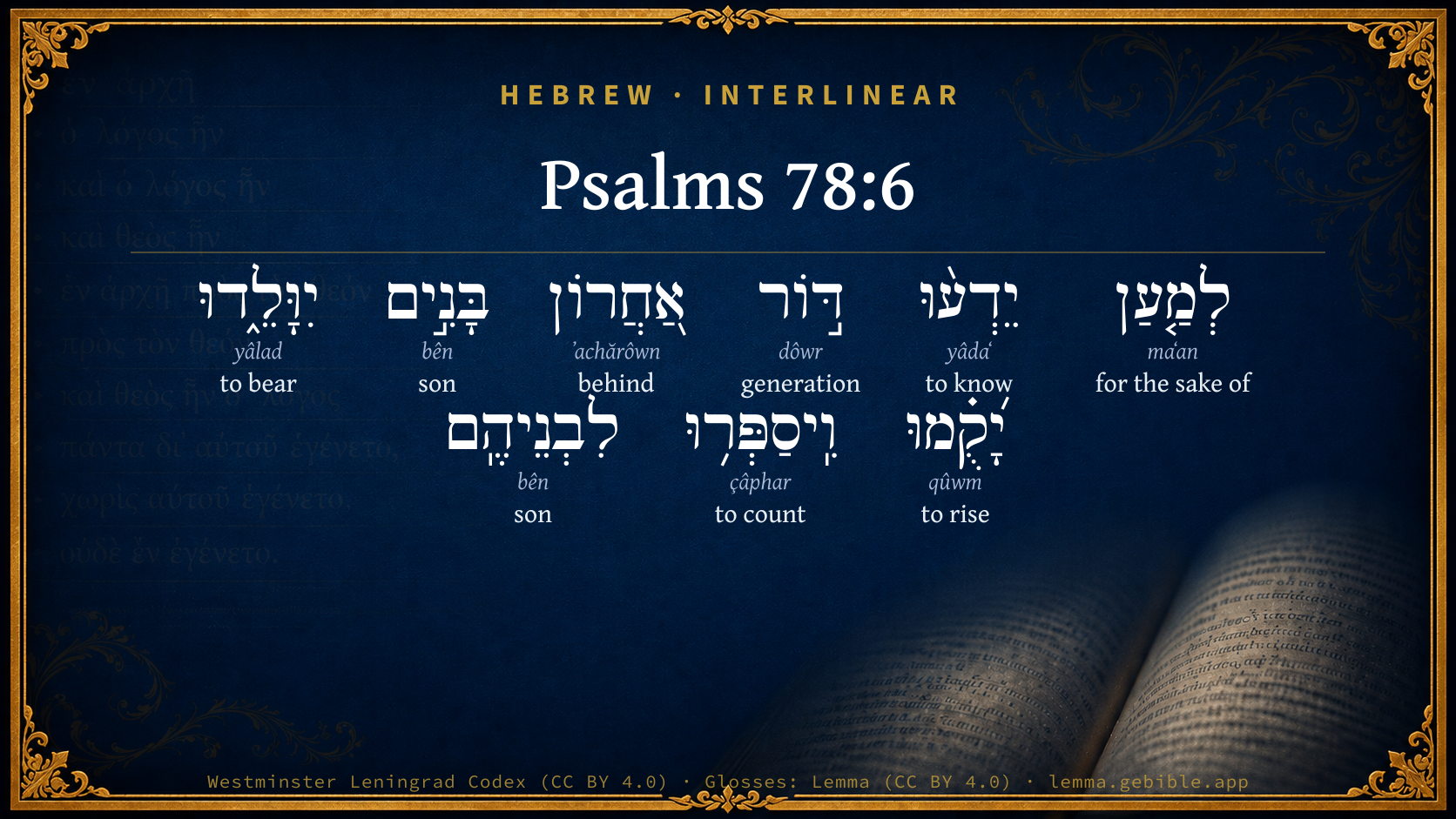
Hebrew (Westminster Leningrad Codex) Psalms 78:6 appears in the Hebrew Old Testament. The text above is from the Westminster Leningrad Codex. Each word links to its Strong’s number, a concise gloss, and parsing drawn from the Open Scriptures Hebrew Bible morphology. Click any word for its full Brown-Driver-Briggs (BDB) entry.
Download image
Cite this verse

Psalms 78:6 (World English Bible). Public Domain. Lemma interlinear Bible study tool, https://lemma.gebible.app/v/psalms/78/6.

Show BibTeX & RIS
BibTeX
RIS
English Translation
That the generation to come might know, even the children who should be born; Who should arise and tell their children,
World English Bible · Public Domain
Download a study sheet

One document with this verse’s original text, its word-by-word gloss line, the meaning frame, cross-references with their text, attributed commentary, and full source and license credits — printable, and it pastes into notes with its structure intact.

This verse Autodidact and up

Study sheet (.html) Plain text (.txt)

A passage Seminary Student

Up to 50 verses in one chapter. A passage sheet keeps up to 6 commentary sources and 12 cross-references per verse, in the order this page ranks them, and says so on the sheet whenever that leaves anything out. Ask for a single verse and you get the Autodidact verse sheet above.

Everything on this page stays free to read, with no account — the sheet is a download of what is already on screen, not access to it.

Want to remove ads? Support Godless Engineer
Compare translations 3

The same verse in 3 English versions, stacked beneath the original-language interlinear above. Click any original word for its lexicon entry.

Each is an independent rendering of the whole verse — the interlinear is not word-aligned to these translations.

Highlighted words mark where these versions differ — a whole-verse word diff, not a word-by-word alignment.

  • World English Bible Public Domain
    That the generation to come might know, even the children who should be born; Who should arise and tell their children,
  • King James Version Public Domain
    That the generation to come might know them, even the children which should be born; who should arise and declare them to their children:
  • unfoldingWord Literal Text CC BY-SA 4.0
    So that the later generation might know, the children yet to be born, and they will rise up and tell to their children.

unfoldingWord Literal Text — © unfoldingWord, licensed CC BY-SA 4.0. Word-aligned USFM3 via Door43 (git.door43.org/unfoldingWord/en_ult).

Versions to compare (up to 4)

3 of 4 selected

Show all 18 translations

Every available English version of this verse, each an independent rendering of the whole verse.

  • World English Bible Public Domain
    That the generation to come might know, even the children who should be born; Who should arise and tell their children,
  • Berean Standard Bible Public Domain
    that the coming generation would know them—even children yet to be born—to arise and tell their own children
  • Majority Standard Bible Public Domain
    that the coming generation would know them—even children yet to be born—to arise and tell their own children
  • King James Version Public Domain
    That the generation to come might know them, even the children which should be born; who should arise and declare them to their children:
  • American Standard Version (1901) Public Domain
    That the generation to come might know `them', even the children that should be born; Who should arise and tell `them' to their children,
  • Revised Version (1885) Public Domain
    That the generation to come might know them, even the children which should be born; who should arise and tell them to their children:
  • Geneva Bible (1599) Public Domain
    That the posteritie might knowe it, and the children, which should be borne, should stand vp, and declare it to their children:
  • Douay-Rheims (1899) Public Domain
    that another generation might know them. The children that should be born and should rise up, and declare them to their children.
  • Young's Literal Translation Public Domain
    So that a later generation doth know, Sons who are born, do rise and recount to their sons,
  • Literal Standard Version CC BY-SA 4.0
    So that a later generation knows, || Sons who are born, rise and recount to their sons,
  • Unlocked Literal Bible CC BY-SA 4.0
    He commanded this so that the generation to come might know his decrees, the children not yet born, who should tell them in turn to their own children.
  • unfoldingWord Literal Text CC BY-SA 4.0
    So that the later generation might know, the children yet to be born, and they will rise up and tell to their children.
  • Darby Bible Public Domain
    That the generation to come might know [them], the children that should be born; that they might rise up and tell [them] to their children,
  • World Messianic Bible Public Domain
    that the generation to come might know, even the children who should be born; who should arise and tell their children,
  • Webster's Bible Public Domain
    That the generation to come might know them, even the children who should be born; who should arise and declare them to their children:
  • Free Bible Version CC BY-SA 4.0
    so that the next generation—children yet to be born—would understand and grow up to teach their children.
  • Bible in Basic English Public Domain
    So that the generation to come might have knowledge of them, even the children of the future, who would give word of them to their children;
  • JPS Tanakh (1917) Public Domain
    That the generation to come might know them, even the children that should be born; who should arise and tell them to their children,

Literal Standard Version (2020), Covenant Press — licensed CC BY-SA 4.0. Text via the HelloAO Bible API (eBible.org). Unlocked Literal Bible (unfoldingWord) — licensed CC BY-SA 4.0. Text via the HelloAO Bible API (eBible.org). unfoldingWord Literal Text — © unfoldingWord, licensed CC BY-SA 4.0. Word-aligned USFM3 via Door43 (git.door43.org/unfoldingWord/en_ult). Free Bible Version, Dr. Jonathan Gallagher — licensed CC BY-SA 4.0. Text via the HelloAO Bible API (eBible.org).

Word by word

More ways to search: Search by grammar → Find every occurrence → Compare this word →

Practice this passage: Drill this verse → Learn its vocabulary →

אַ֭חֲרוֹן
ʼachărôwn
H314
“behind”
Adjective, Adjective, Masculine, Singular, Absolute
Part of Speech
Adjective
Type
Adjective
Gender
Masculine
Number
Singular
State
Absolute
Full BDB Definition

Origin: from H309

TWOT: 68e

behind, following, subsequent, western - behind, hindermost, western (of location) - later, subsequent, latter, last (of time)
  1. לְמַ֤עַן maʻan H4616 “for the sake of” Preposition
  2. יֵדְע֨וּ yâdaʻ H3045 “to know” Verb, Qal, Imperfect, 3rd Person, Masculine, Plural
  3. דּ֣וֹר dôwr H1755 “generation” Noun, Common, Masculine, Singular, Absolute
  4. בָּנִ֣ים bên H1121 “sons” Noun, Common, Masculine, Plural, Absolute
  5. יִוָּלֵ֑דוּ yâlad H3205 “to bear” Verb, Niphal, Imperfect, 3rd Person, Masculine, Plural
  6. יָ֝קֻ֗מוּ qûwm H6965 “to rise” Verb, Qal, Imperfect, 3rd Person, Masculine, Plural
  7. וִֽיסַפְּר֥וּ çâphar H5608 “and · to count” Conjunction + Verb, Piel, Imperfect, 3rd Person, Masculine, Plural
  8. לִבְנֵיהֶֽם bên H1121 “to/for · sons · their” Preposition + Noun, Common, Masculine, Plural, Construct + Suffix, Personal, 3rd Person, Masculine, Plural

About this verse

These counts appear in no published source. They are computed here, from the morphology-tagged text and Lemma’s own curated glosses. What Lemma adds →

9
words
8
distinct lemmas
Wisdom
section

Shared distinctive vocabulary

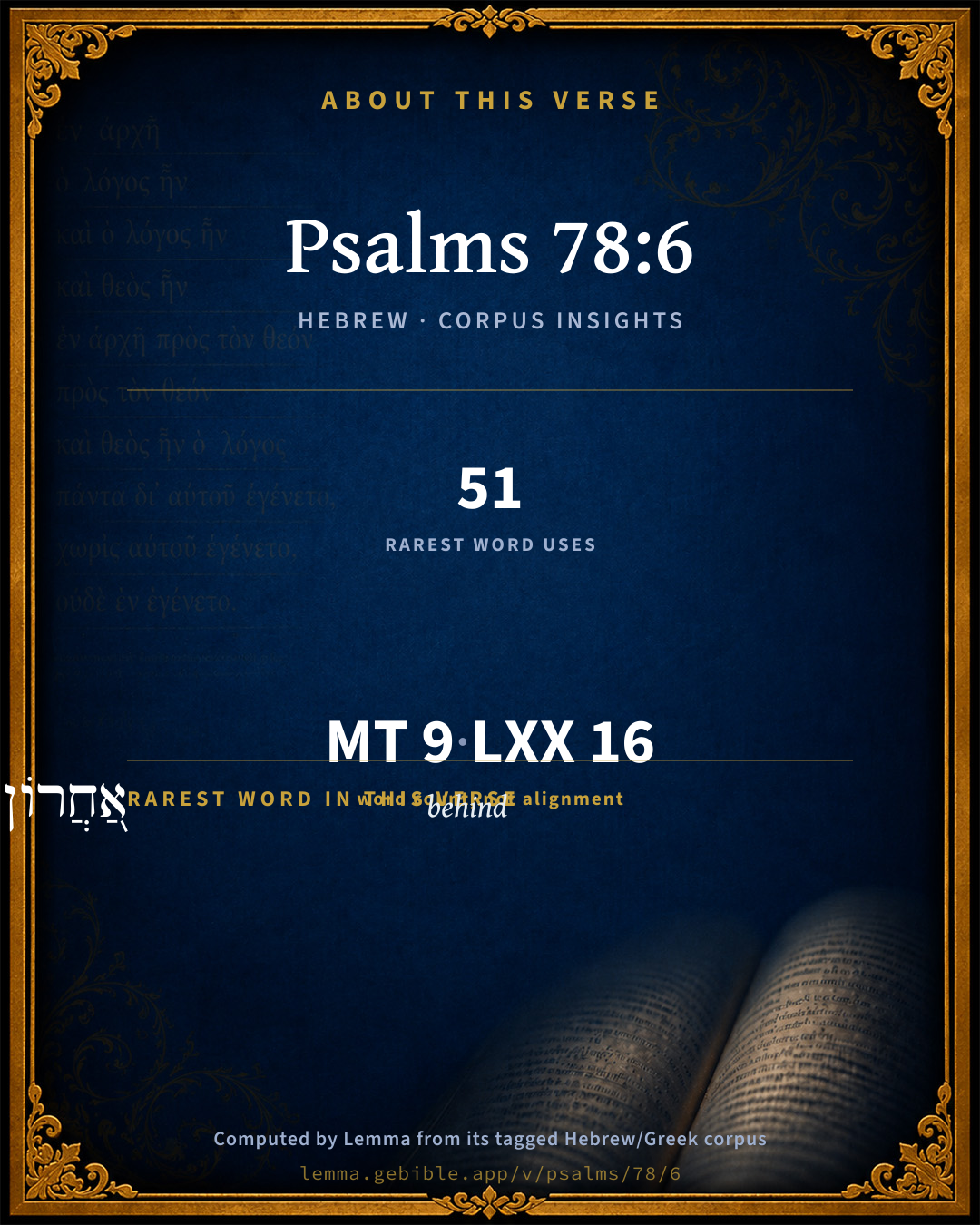
אַ֭חֲרוֹן behind H314 occurs in 48 verses of the Hebrew Bible. Also found in:

Grammatical profile

  • 4 verbs
  • 3 nouns
  • 1 adjective
  • 1 preposition

Verb forms

  • יֵדְע֨וּ Qal · Imperfect
  • יִוָּלֵ֑דוּ Niphal · Imperfect
  • יָ֝קֻ֗מוּ Qal · Imperfect
  • וִֽיסַפְּר֥וּ Piel · Imperfect

Repetition

A word recurs within this verse — often emphatic in Hebrew:

  • בָּנִ֣ים son H1121 ×2

Hebrew & Septuagint length

In English translation the verse runs 21 words from the Hebrew and 22 from the Septuagint (LXX English) — closely comparable.

A rough comparison of the two English renderings, which tokenize alike — not a word-level alignment.

Word counts can differ between the Hebrew and the Greek without any difference in meaning — e.g. the Hebrew direct-object marker אֵת has no separate Greek word, and Greek often adds the article ὁ.

In the original languages it is 9 Hebrew tokens and 16 Greek tokens — but the two are counted differently (Hebrew bundles its prefixes and suffixes into one token; the Greek is in lemma form), so that isn’t a like-for-like length.

Cross-references

10

Topical passages linked to Psalms 78:6 in the Treasury of Scripture Knowledge — connected by theme and wording, ordered by reader-vote popularity; previews shown in the World English Bible.

  • Psalms 102:18 This will be written for the generation to come. A people which will be created will praise Yah.
  • Joel 1:3 Tell your children about it, And have your children tell their children, And their children, another generation.
  • Esther 9:28 and that these days should be remembered and kept throughout every generation, every family, every province, and every city; and that these days of Purim should not fail from among the Jews, nor the memory of them perish from their seed.
  • Psalms 22:31 They shall come and shall declare his righteousness to a people that shall be born, For he has done it.
  • Psalms 90:16 Let your work appear to your servants; Your glory to their children.
  • Psalms 145:4 One generation will commend your works to another, And will declare your mighty acts.
  • Deuteronomy 4:10 the day that you stood before Yahweh your God in Horeb, when Yahweh said to me, Assemble me the people, and I will make them hear my words, that they may learn to fear me all the days that they live on the earth, and that they may teach their children.
  • Joshua 22:24–25 and if we have not [rather] out of carefulness done this, [and] of purpose, saying, In time to come your children might speak to our children, saying, What have you to do with Yahweh, the God of Israel?
  • Psalms 48:13 Mark well her bulwarks. Consider her palaces, That you may tell it to the next generation.
  • Psalms 71:18 Yes, even when I am old and gray-haired, God, don't forsake me, Until I have declared your strength to the next generation, Your might to everyone who is to come.

Cross-references courtesy of OpenBible.info (CC BY 4.0).

Hebrew and Greek witnesses Masoretic Hebrew ↔ Greek Septuagint

The same verse in the two great witnesses to the Old Testament, shown verse-for-verse.

You’re reading Greek Psalm 77 (Hebrew Psalm 78). The Septuagint counts the superscription, so verse numbers can differ from the Hebrew — chapter-level alignment, not verse-by-verse. Numbering follows Rahlfs.

These are two independent witnesses, not word-aligned to each other, and the Septuagint is shown in lemma (dictionary) form.

Hebrew Psalms 78:6 Masoretic · Westminster Leningrad Codex

לְמַ֤עַן יֵדְע֨וּ דּ֣וֹר אַ֭חֲרוֹן בָּנִ֣ים יִוָּלֵ֑דוּ יָ֝קֻ֗מוּ וִֽיסַפְּר֥וּ לִבְנֵיהֶֽם

That the generation to come might know, even the children who should be born; Who should arise and tell their children,

World English Bible · Public Domain

Greek LXX Greek Psalm 77:6 Septuagint · lemma form

ὅπως ἄν γιγνώσκω γενεά ἕτερος υἱός ὁ τίκτω καί ἀναἵστημι καί ἀποἀγγέλλω αὐτός ὁ υἱός αὐτός

that another generation might know, even the sons which should be born; and they should arise and declare them to their children.

LXX2012 (modern English Septuagint) · Public Domain

Hebrew: Westminster Leningrad Codex (CC BY 4.0). Greek: Septuagint (public domain); English from LXX2012 (modern English Septuagint) (Public Domain). How the Septuagint differs from the Hebrew →

Commentary

Notes on Psalms 78:6 from classic Christian and Jewish commentators (each source and its license shown beneath its notes). The classic Christian expositions comment on the surrounding passage and are grouped to its opening verse, so a note may address several verses; the Jewish commentaries on the Tanakh (Rashi and others) are per-verse, so they appear only where the commentator wrote on this verse.

Lemma curates 59 commentaries, every one of them public domain or Creative Commons licensed, each selected and text-cleaned for this edition rather than reprinted as found. About our sources →

Trapp's Complete Commentary

John Trapp

Psa 78:6 That the generation to come might know [them, even] the children [which] should be born; [who] should arise and declare [them] to their children:

Ver. 6. Who shall arise and declare them] i.e. Succeed their parents both in their place and office of teaching their posterity; not suffering the truth which is after godliness {Tit 1:1} to fail and fall in the streets, Isa 59:14-15, or if it do, raising it up again, and restoring it to their utmost.

John Trapp, A Commentary or Exposition upon All the Books of the Old and New Testament (1647–1656) — public domain. Text from a community e-Sword module.

J. A. Alexander on Psalms

Joseph Addison Alexander

6. (Psa 78:6) In order that the after generation might know, sons be born, arise, and tell (it) to their own sons. This prolonged reiteration of the same thing seems intended to preclude the thought or feeling, that the things about to be recounted were mere relics of antiquity, without interest or use to the contemporary race.

Joseph Addison Alexander, The Psalms Translated and Explained (1850) — public domain. Text from a community e-Sword module.

Geneva Bible (1599)

Geneva Bible translators

He showeth wherein the children should be like their fathers: that is, in maintaining God’s pure Religion.

Geneva Bible (1599) marginal notes — public domain. Text via Bolls.life.

John Calvin's Commentaries

6. That the generation to come might know them. In this verse, the Psalmist confirms what he had said concerning the continued transmission of divine truth. It greatly concerns us to know, that the law was given not for one age only; but that the fathers should transmit it to their children, as if it were their rightful inheritance, in order that it might never be lost, but be preserved to the end of the world. This is the reason why Paul, in 1 Timothy 3:15, asserts that “the Church is the pillar and ground of the truth;” by which he does not mean that the truth of itself is weak, and stands in need of foreign supports, but that God extends and diffuses it by the instrumentality of his ministers, who when they faithfully execute the office of teaching with which they are invested, sustain the truth, as it were, upon their shoulders. Now, the prophet teaches us, that it is our bounden duty to use our endeavors that there may be a continual succession of persons to communicate instruction in divine truth. It is said of Abraham before the law was written, Genesis 18:19,

“I know him, that he will command his children and his household after him, and they shall keep the way of the Lord to do justice and judgment;”

and after his death, this was enjoined upon the patriarchs as a necessary part of their duty. No sooner was the law delivered, than God appointed priests in his Church to be public masters and teachers. He has also testified by the prophet Isaiah, that the same is to be observed under the New Testament dispensation, saying,

“My Spirit that is upon thee, and my words which I have put in thy mouth, shall not depart out of thy mouth, nor out of the mouth of thy seed, nor out of the mouth of thy seed’s seed, from henceforth and for ever.” (Isaiah 59:21)

In the passage before us, however, a particular injunction is given to the fathers on this point — each of them is enjoined diligently to instruct his own children, and all without distinction are taught, that their exertions in transmitting the name of God to their posterity will be most acceptable to Him, and receive his highest approbation. By the words, That the children to be born should arise, is not denoted a small number of individuals; but it is intimated, that the preachers of divine truth, by whose efforts pure religion may flourish and prevail for ever, will be as numerous as those who are born into the world.

John Calvin's Commentaries (1540-1563) — public domain. Text from the Calvin Translation Society English edition (1840s-50s) via the Christian Classics Ethereal Library (ccel.org). Calvin's coverage is partial (roughly two-thirds of the Bible); uncommented books and verses are honest gaps, never fabricated. The 19th-century editor's footnotes and remarks are omitted so the notes are faithfully Calvin's own voice.

The Cambridge Bible for Schools and Colleges

gen. ed. J. J. S. Perowne

6. The A.V. follows the Massoretic division of the verse; but it is better to connect the clauses thus:

That another generation might know,

That sons which should be born might arise and tell their sons.

The Cambridge Bible for Schools and Colleges (gen. ed. J. J. S. Perowne; Cambridge University Press, 1878–1918) — public domain. Text from a community e-Sword module.

John Gill's Exposition

That the generation to come might know them,.... Not only notionally, but spiritually and experimentally; which is the case, when human teachings are attended with the spirit of wisdom and revertion in the knowledge of divine truths; for the truths of the Gospel are unknown to men; the Gospel is hidden wisdom, the wisdom of God in a mystery; the Bible is a sealed book, the doctrines of it are riddles and dark sayings; the ministry of the word is the means of knowledge, which become effectual when attended with the Spirit and power of God:

even the children which should be born, who should arise and declare them to their children; and so be transmitted from age to age: it is the will of God, that, besides private instructions, there should be a standing ministry kept up in all ages, to the end of the world; and he will have some that shall receive the Gospel, and profess his name; there has been and will be a succession of regenerate persons; instead of the fathers come up the children, a seed to serve the Lord, accounted to him for a generation; the seed and the seed's seed of the church, from whose mouth the word of God shall never depart; but they shall declare it one to another, by which means it shall be continued to the latest posterity, Psa 22:30.

John Gill's Exposition of the Whole Bible (1746–1763) — public domain (CC PDM 1.0). Text via the HelloAO Bible API.

Albert Barnes' Notes on the Bible

That the generation to come might know them ... - That people in future times might enjoy the benefit of them as their fathers had done, and that they should then send them forward to those who were to succeed them.

Who should arise and declare them to their children - Who, as they appeared on the stage of life, should receive the trust, and send it onward to future ages. Thus the world makes progress; thus one age starts where the previous one left off; thus it enters on its own career with the advantage of all the toils, the sacrifices, the happy thoughts, the inventions of all past times. It is designed that the world shall thus grow wiser and better as it advances; and that future generations shall be enriched with all that was worth preserving in the experience of the past. See the notes at Psa 71:18.

Albert Barnes' Notes on the Bible (1834–1885) — public domain. Text from a community e-Sword/MySword module.

The Treasury of David

Charles H. Spurgeon

Ver. 6. That the generation to come might know them, even the children which should be born. As far on as our brief life allows us to arrange, we must industriously provide for the godly nurture of youth. The narratives, commands, and doctrines of the word of God are not worn out; they are calculated to exert an influence as long as our race shall exist.

Who should arise and declare them to their children. The one object aimed at is transmission; the testimony is only given that it may be passed on to succeeding generations.

Ver. 6. Children should earnestly hearken to the instruction of their parents that they themselves may afterwards be able to tell the same to their sons, and so a golden chain be formed, wherewith being bound together, the whole family may seek the skies. Whilst the father draws the son, the son the grandson, the grandson his children to Christ, as the magnet of them all, that they all may be made one. Thomas Le Blanc.

Ver. 6. Care for the rising generation and for future posterity.

Psalms 78:7*

Charles H. Spurgeon's The Treasury of David (1869–1885) — public domain. Psalms only. Text from a community e-Sword/MySword module.

The Pulpit Commentary

That the generation to come might know them. "The generation to come" is the next generation, that immediately following those to whom the command was directly given. Even the children which should be born. Their actual sons and daughters. Who should arise and declare them to their children. The first generation were to hand the knowledge on to the second, the second to the third, and so on. This is the way in which the hulk of human knowledge actually passes on. Not much is learnt from books without a teacher. (see Act_8:31)

The Pulpit Commentary (1880–1919), ed. H.D.M. Spence-Jones & Joseph S. Exell — public domain. Text from a community e-Sword module.

Lesson kit

Teaching starters — assembled from the data on this page, not authored interpretation. Every prompt links to the verse data it draws on. Edit before teaching.

Psalms, in the Wisdom, opens this verse with 9 words (8 distinct Hebrew lemmas). Its most distinctive word is ʼachărôwn (“behind”). A historical commentator’s framing appears above. Read the whole chapter for the surrounding context.

Discussion questions

  1. What does “behind” (ʼachărôwn) contribute to the verse as a whole?
  2. How does Genesis 33:2, which shares the word «behind», read alongside this verse?
  3. What does the repetition of “son” (2× in this one verse) do in this verse?
  4. The translations on this page render this verse differently — a whole-verse word diff, not a word-by-word alignment. What might account for the different wordings?
  5. «יֵדְע֨וּ» is a Qal Imperfect verb. How does that grammatical form shape the action described?
  6. Compare how Trapp's Complete Commentary and J. A. Alexander on Psalms read this verse. Where do they agree or differ?

Things to notice

Reading settings

Reading text

Shown beneath each verse's original-language words.

Old Testament
Old Testament edition

Read the OT as the Masoretic Hebrew (MT) or the Greek Septuagint (LXX).

English shown for the Greek Septuagint (in the Hebrew ↔ Greek comparison).

Comparing translations? Open the Compare panel on any verse page to stack up to four side by side.