Isaiah 33:18

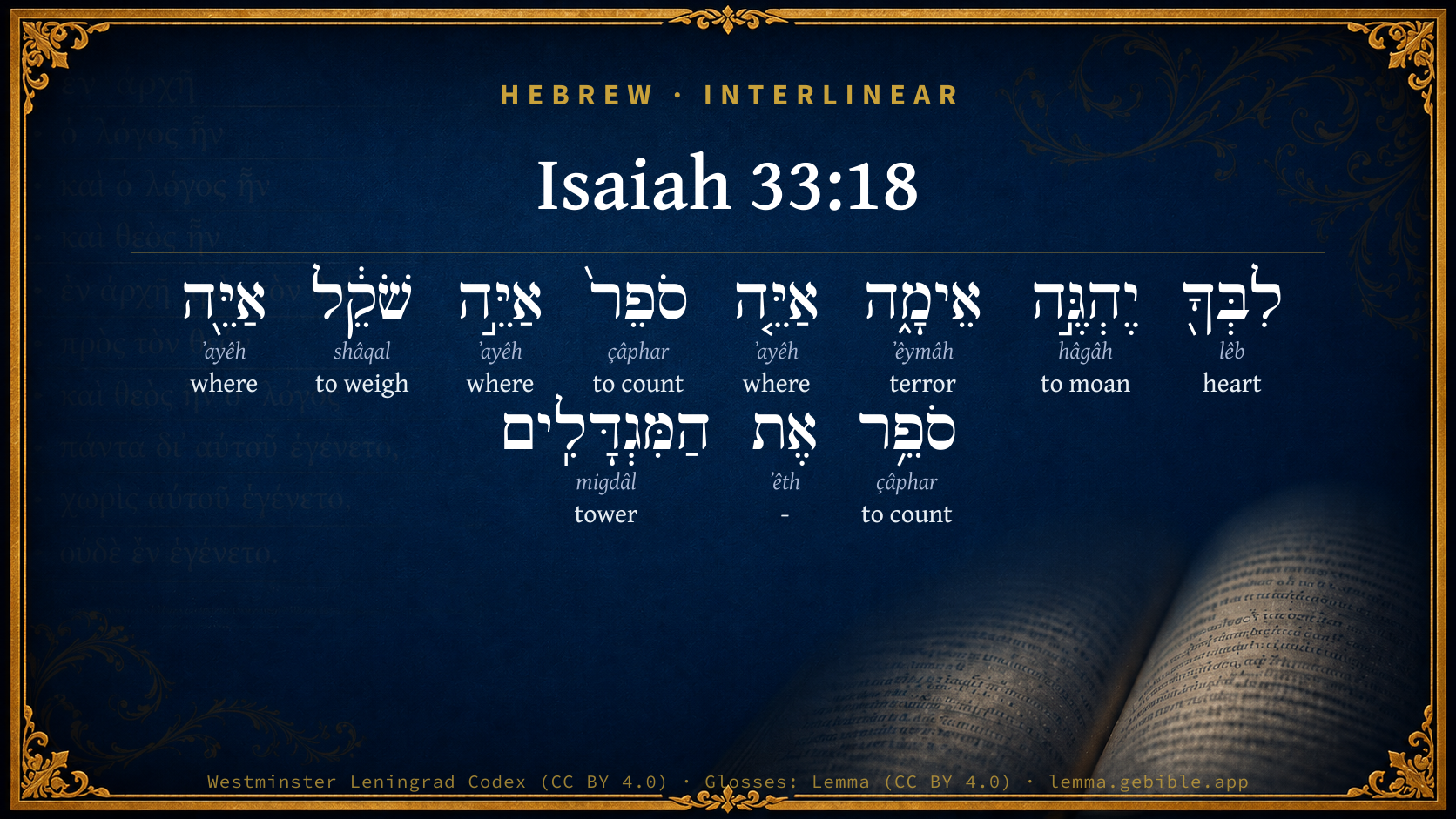
Hebrew (Westminster Leningrad Codex) Isaiah 33:18 appears in the Hebrew Old Testament. The text above is from the Westminster Leningrad Codex. Each word links to its Strong’s number, a concise gloss, and parsing drawn from the Open Scriptures Hebrew Bible morphology. Click any word for its full Brown-Driver-Briggs (BDB) entry.
Download image
Cite this verse

Isaiah 33:18 (World English Bible). Public Domain. Lemma interlinear Bible study tool, https://lemma.gebible.app/v/isaiah/33/18.

Show BibTeX & RIS
BibTeX
RIS
English Translation
Your heart shall muse on the terror: Where is he who counted, where is he who weighed [the tribute]? where is he who counted the towers?
World English Bible · Public Domain
Download a study sheet

One document with this verse’s original text, its word-by-word gloss line, the meaning frame, cross-references with their text, attributed commentary, and full source and license credits — printable, and it pastes into notes with its structure intact.

This verse Autodidact and up

Study sheet (.html) Plain text (.txt)

A passage Seminary Student

Up to 50 verses in one chapter. A passage sheet keeps up to 6 commentary sources and 12 cross-references per verse, in the order this page ranks them, and says so on the sheet whenever that leaves anything out. Ask for a single verse and you get the Autodidact verse sheet above.

Everything on this page stays free to read, with no account — the sheet is a download of what is already on screen, not access to it.

Want to remove ads? Support Godless Engineer
Compare translations 3

The same verse in 3 English versions, stacked beneath the original-language interlinear above. Click any original word for its lexicon entry.

Each is an independent rendering of the whole verse — the interlinear is not word-aligned to these translations.

Highlighted words mark where these versions differ — a whole-verse word diff, not a word-by-word alignment.

  • World English Bible Public Domain
    Your heart shall muse on the terror: Where is he who counted, where is he who weighed [the tribute]? where is he who counted the towers?
  • King James Version Public Domain
    Thine heart shall meditate terror. Where is the scribe? where is the receiver? where is he that counted the towers?
  • unfoldingWord Literal Text CC BY-SA 4.0
    Your heart will meditate terror: “Where the one counting? Where the one weighing? Where the one counting towers?”

unfoldingWord Literal Text — © unfoldingWord, licensed CC BY-SA 4.0. Word-aligned USFM3 via Door43 (git.door43.org/unfoldingWord/en_ult).

Versions to compare (up to 4)

3 of 4 selected

Show all 18 translations

Every available English version of this verse, each an independent rendering of the whole verse.

  • World English Bible Public Domain
    Your heart shall muse on the terror: Where is he who counted, where is he who weighed [the tribute]? where is he who counted the towers?
  • Berean Standard Bible Public Domain
    Your mind will ponder the former terror: “Where is he who tallies? Where is he who weighs? Where is he who counts the towers?”
  • Majority Standard Bible Public Domain
    Your mind will ponder the former terror: “Where is he who tallies? Where is he who weighs? Where is he who counts the towers?”
  • King James Version Public Domain
    Thine heart shall meditate terror. Where is the scribe? where is the receiver? where is he that counted the towers?
  • American Standard Version (1901) Public Domain
    Thy heart shall muse on the terror: Where is he that counted, where is he that weighed `the tribute'? where is he that counted the towers?
  • Revised Version (1885) Public Domain
    Thine heart shall muse on the terror: where is he that counted, where is he that weighed the tribute? where is he that counted the towers?
  • Geneva Bible (1599) Public Domain
    Thine heart shall meditate feare, Where is the scribe? where is the receiuer? where is hee that counted the towres?
  • Douay-Rheims (1899) Public Domain
    Thy heart shall meditate fear: where is the learned? where is he that pondereth the words of the law? where is the teacher of little ones?
  • Young's Literal Translation Public Domain
    Thy heart doth meditate terror, Where `is' he who is counting? Where `is' he who is weighing? Where `is' he who is counting the towers?
  • Literal Standard Version CC BY-SA 4.0
    Your heart meditates [on] terror, || Where [is] he who is counting? Where [is] he who is weighing? Where [is] he who is counting the towers?
  • Unlocked Literal Bible CC BY-SA 4.0
    Your heart will recall the terror; where is the scribe, where is he who weighed the money? Where is he who counted the towers?
  • unfoldingWord Literal Text CC BY-SA 4.0
    Your heart will meditate terror: “Where the one counting? Where the one weighing? Where the one counting towers?”
  • Darby Bible Public Domain
    Thy heart shall meditate on terror: Where is the scribe? where is the receiver? where is he that counted the towers?
  • World Messianic Bible Public Domain
    Your heart will meditate on the terror. Where is he who counted? Where is he who weighed? Where is he who counted the towers?
  • Webster's Bible Public Domain
    Thy heart shall meditate terror. Where is the scribe? where is the receiver? where is he that counted the towers?
  • Free Bible Version CC BY-SA 4.0
    In your mind you will think about the terrifying things that were expected, and then ask yourself, “Where are the enemy officials—the scribes who were to record events, the treasurers who were to weigh the looted money, the surveyors who were to count and destroy the towers?”
  • Bible in Basic English Public Domain
    Your heart will give thought to the cause of your fear: where is the scribe, where is he who made a record of the payments, where is he by whom the towers were numbered?
  • JPS Tanakh (1917) Public Domain
    Thy heart shall muse on the terror: 'Where is he that counted, where is he that weighed? Where is he that counted the towers?'

Literal Standard Version (2020), Covenant Press — licensed CC BY-SA 4.0. Text via the HelloAO Bible API (eBible.org). Unlocked Literal Bible (unfoldingWord) — licensed CC BY-SA 4.0. Text via the HelloAO Bible API (eBible.org). unfoldingWord Literal Text — © unfoldingWord, licensed CC BY-SA 4.0. Word-aligned USFM3 via Door43 (git.door43.org/unfoldingWord/en_ult). Free Bible Version, Dr. Jonathan Gallagher — licensed CC BY-SA 4.0. Text via the HelloAO Bible API (eBible.org).

Word by word

More ways to search: Search by grammar → Find every occurrence → Compare this word →

Practice this passage: Drill this verse → Learn its vocabulary →

About this verse

These counts appear in no published source. They are computed here, from the morphology-tagged text and Lemma’s own curated glosses. What Lemma adds →

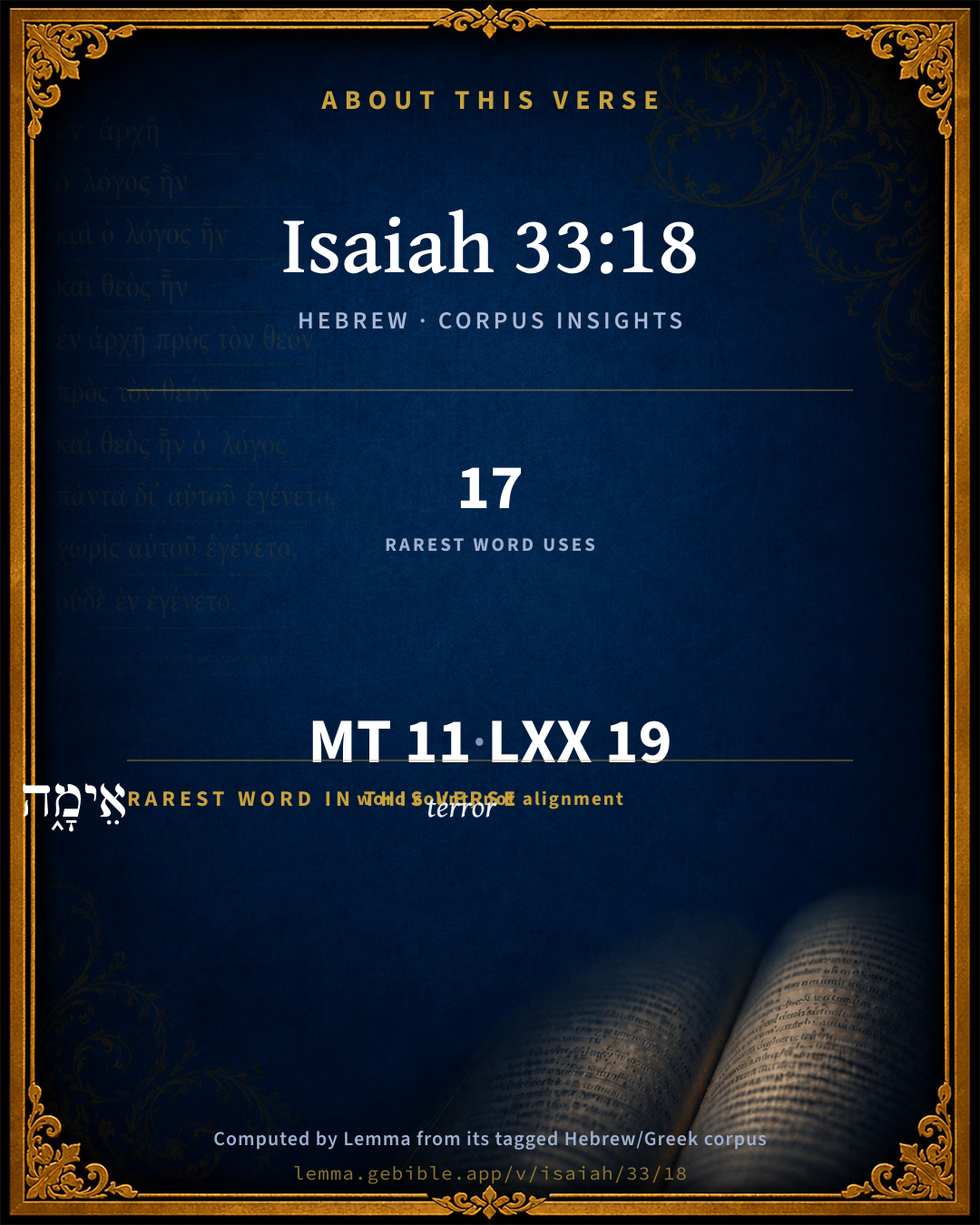
11
words
8
distinct lemmas
Prophets
section

Notable vocabulary

The rarest word here is אֵימָ֑ה terror H367 — appearing just 17 times in the whole Hebrew Bible.

Shared distinctive vocabulary

אֵימָ֑ה terror H367 occurs in 17 verses of the Hebrew Bible. Also found in:

Grammatical profile

  • 4 verbs
  • 3 nouns
  • 4 particles

Verb forms

  • יֶהְגֶּ֣ה Qal · Imperfect
  • סֹפֵר֙ Qal · Participle Active
  • שֹׁקֵ֔ל Qal · Participle Active
  • סֹפֵ֥ר Qal · Participle Active

Repetition

Words recur within this verse — often emphatic in Hebrew:

  • אַיֵּ֤ה where H346 ×3
  • סֹפֵר֙ to count H5608 ×2

Hebrew & Septuagint length

In English translation the verse runs 26 words from the Hebrew and 23 from the Septuagint (LXX English) — closely comparable.

A rough comparison of the two English renderings, which tokenize alike — not a word-level alignment.

Word counts can differ between the Hebrew and the Greek without any difference in meaning — e.g. the Hebrew direct-object marker אֵת has no separate Greek word, and Greek often adds the article ὁ.

In the original languages it is 11 Hebrew tokens and 19 Greek tokens — but the two are counted differently (Hebrew bundles its prefixes and suffixes into one token; the Greek is in lemma form), so that isn’t a like-for-like length.

Cross-references

15

Topical passages linked to Isaiah 33:18 in the Treasury of Scripture Knowledge — connected by theme and wording, ordered by reader-vote popularity; previews shown in the World English Bible.

  • 1 Corinthians 1:20 Where is the wise? Where is the scribe? Where is the lawyer of this world? Hasn't God made foolish the wisdom of this world?
  • Genesis 23:16 Abraham listened to Ephron. Abraham weighed to Ephron the silver which he had named in the audience of the children of Heth, four hundred shekels of silver, according to the current merchants' standard.
  • 1 Samuel 25:33–36 and blessed be your discretion, and blessed be you, that have kept me this day from blood guiltiness, and from avenging myself with my own hand.
  • 1 Samuel 30:6 David was greatly distressed; for the people spoke of stoning him, because the soul of all the people was grieved, every man for his sons and for his daughters: but David strengthened himself in Yahweh his God.
  • 2 Kings 15:19 There came against the land Pul the king of Assyria; and Menahem gave Pul one thousand talents of silver, that his hand might be with him to confirm the kingdom in his hand.
  • 2 Kings 18:14 Hezekiah king of Judah sent to the king of Assyria to Lachish, saying, I have offended; return from me: that which you put on me will I bear. The king of Assyria appointed to Hezekiah king of Judah three hundred talents of silver and thirty talents of gold.
  • 2 Kings 18:31 Don't listen to Hezekiah: for thus says the king of Assyria, Make your peace with me, and come out to me; and eat you everyone of his vine, and everyone of his fig tree, and everyone drink the waters of his own cistern;
  • Psalms 31:7–8 I will be glad and rejoice in your loving kindness, For you have seen my affliction. You have known my soul in adversities.
  • Psalms 31:22 As for me, I said in my haste, "I am cut off from before your eyes." Nevertheless you heard the voice of my petitions when I cried to you.
  • Psalms 71:20 You, who have shown us many and bitter troubles, You will let me live. You will bring us up again from the depths of the earth.
  • Isaiah 10:16–19 Therefore will the Lord, Yahweh of Hosts, send among his fat ones leanness; and under his glory there shall be kindled a burning like the burning of fire.
  • Isaiah 17:14 At evening, behold, terror; [and] before the morning they are no more. This is the portion of those who despoil us, and the lot of those who rob us.
  • Isaiah 38:9–22 The writing of Hezekiah king of Judah, when he had been sick, and was recovered of his sickness.
  • 2 Corinthians 1:8–10 For we don't desire to have you uninformed, brothers, concerning our affliction which happened to us in Asia, that we were weighed down exceedingly, beyond our power, so much that we despaired even of life.
  • 2 Timothy 3:11 persecutions, and sufferings: those things that happened to me at Antioch, Iconium, and Lystra. I endured those persecutions. Out of them all the Lord delivered me.

Cross-references courtesy of OpenBible.info (CC BY 4.0).

Hebrew and Greek witnesses Masoretic Hebrew ↔ Greek Septuagint

The same verse in the two great witnesses to the Old Testament, shown verse-for-verse.

These are two independent witnesses, not word-aligned to each other, and the Septuagint is shown in lemma (dictionary) form.

Hebrew Isaiah 33:18 Masoretic · Westminster Leningrad Codex

לִבְּךָ֖ יֶהְגֶּ֣ה אֵימָ֑ה אַיֵּ֤ה סֹפֵר֙ אַיֵּ֣ה שֹׁקֵ֔ל אַיֵּ֖ה סֹפֵ֥ר אֶת הַמִּגְדָּלִֽים

Your heart shall muse on the terror: Where is he who counted, where is he who weighed [the tribute]? where is he who counted the towers?

World English Bible · Public Domain

Greek LXX Isaiah 33:18 Septuagint · lemma form

ὁ ψυχή σύ μελετάω φόβος ποῦ εἰμί ὁ γραμματικός ποῦ εἰμί ὁ συνβουλεύω ποῦ εἰμί ὁ ἀριθμέω ὁ τρέφω

Your soul shall meditate terror. Where are the scribes? where are the counselors, where is he that numbers them that are growing up,

LXX2012 (modern English Septuagint) · Public Domain

On this verse, Albert Barnes' Notes on the Bible discusses the Septuagint’s reading. Read the note in Commentary ↓

Hebrew: Westminster Leningrad Codex (CC BY 4.0). Greek: Septuagint (public domain); English from LXX2012 (modern English Septuagint) (Public Domain). How the Septuagint differs from the Hebrew →

Targum (Aramaic paraphrase)

1

The Targum is the ancient Jewish Aramaic paraphrase of the Hebrew Scriptures — an interpretive translation, not the Hebrew text itself. Onkelos (literal) and Pseudo-Jonathan (expansive) render the Torah, and Jonathan the Prophets. Coverage is partial: where no permissively-licensed English translation exists for a verse, only the Aramaic is shown. This is verse-level text, not a word-by-word alignment to the Hebrew.

  1. Targum Jonathan Prophets (Joshua–Malachi)
    לִבָּךְ יַחְשָׁב רַבְרְבָן אֵיכָא סַפְרַיָא אֵיכָא רַבְרְבַיָא אֵיכָא חֲשָׁבַיָא יֵתוּן אִם יֵכְלוּן לְחַשָׁבָא מִנְיָן קְטִילֵי רֵישֵׁי מַשִׁרְיַת גִבָּרַיָא:

    Thy heart shalt meditate great things: where are the scribes? where are the rulers? where are the mathematicians? let them come, if they are able to count the number of the slain of the chief of the camp of the mighty.

    Targum Jonathan — Aramaic: “Mikraot Gedolot” (public domain). English: “Sefaria Community Translation” (CC0 1.0 (public-domain dedication)); “London "Chaldee Paraphrase," 1871” (public domain). Text via Sefaria.

Commentary

Notes on Isaiah 33:18 from classic Christian and Jewish commentators (each source and its license shown beneath its notes). The classic Christian expositions comment on the surrounding passage and are grouped to its opening verse, so a note may address several verses; the Jewish commentaries on the Tanakh (Rashi and others) are per-verse, so they appear only where the commentator wrote on this verse.

Lemma curates 59 commentaries, every one of them public domain or Creative Commons licensed, each selected and text-cleaned for this edition rather than reprinted as found. About our sources →

Trapp's Complete Commentary

John Trapp

Isa 33:18 Thine heart shall meditate terror. Where [is] the scribe? where [is] the receiver? where [is] he that counted the towers?

Ver. 18. Thine heart shall meditate terror.] But thou shalt now think of it as "waters that are past," calling to mind what speeches among those late distractions had fallen from thee. {a}

Where is the scribe?] Or, The muster master of the Assyrian army? Verba sunt insultantium et exultantium, saith Piscator; they are the words of God’s people insulting over the enemy, now overthrown and dispersed. See the like done by the apostle. {1Co 1:10}

{a} Olim haec meminisse iuvabit.

John Trapp, A Commentary or Exposition upon All the Books of the Old and New Testament (1647–1656) — public domain. Text from a community e-Sword module.

Tyndale Open Study Notes

Tyndale Open Resources

33:18 Assyrian officers brought great terror to Judah when the Assyrians defeated various cities around Jerusalem (2 Kgs 18:13).

Tyndale Open Study Notes — © Tyndale Open Resources, licensed CC BY-SA 4.0. Text via the HelloAO Bible API.

Geneva Bible (1599)

Geneva Bible translators

Before that this liberty cometh thou shalt think that thou art in great danger: for the enemy shall so sharply assail you, that one shall cry, where is the clerk that writeth the names of them that are taxed? another, Where is the receiver? another shall cry for him that valueth the rich houses, but God will deliver you from this fear.

Geneva Bible (1599) marginal notes — public domain. Text via Bolls.life.

Jamieson, Fausset & Brown

Robert Jamieson, A. R. Fausset & David Brown

meditate--on the "terror" caused by the enemy, but now past.

where, &c.--the language of the Jews exulting over their escape from danger.

scribe--who enrolled the army [MAURER]; or, who prescribed the tribute to be paid [ROSENMULLER]; or, who kept an account of the spoil. "The principal scribe of the host" (Kg2 25:19; Jer 52:25). The Assyrian records are free from the exaggerations of Egyptian records. Two scribes are seen in every Assyrian bas-relief, writing down the various objects brought to them, the heads of the slain, prisoners, cattle, sheep, &c.

receiver--"weigher," Margin. LAYARD mentions, among the Assyrian inscriptions, "a pair a scales for weighing the spoils."

counted . . . towers--he whose duty it was to reconnoitre and report the strength of the city to be besieged.

Jamieson, Fausset & Brown — Commentary Critical and Explanatory on the Whole Bible (1871) — public domain (CC PDM 1.0). Text via the HelloAO Bible API.

Adam Clarke's Commentary

Verse 18. Where is the scribe?] The person appointed by the king of Assyria to estimate their number and property in reference to their being heavily taxed.

Where is the receiver?] Or he who was to have collected this tribute.

Where is he that counted the towers?] That is, the commander of the enemy's forces, who surveyed the fortifications of the city, and took an account of the height, strength, and situation of the walls and towers, that he might know where to make the assault with the greatest advantage; as Capaneus before Thebes is represented in a passage of the Phoenissae of Euripides, which Grotius has applied as an illustration of this place: -

Εκεινος ἑπτα προσβασεις τεκμαιρεται

Πυργων, ανω τε και κατω τειχη μετρων.

Ver. 187.

"To these seven turrets each approach he marks;

The walls from their proud summit to their base

Measuring with eager eye."

He that counted the towers - "Those who were ordered to review the fortified places in Judea, that they might be manned and provisioned for the king of Assyria. So sure was he of gaining Jerusalem and subduing the whole of Judea, that he had already formed all these arrangements." - Dodd's notes.

Adam Clarke's Commentary on the Bible (1810–1826) — public domain. Text from a community e-Sword/MySword module.

Ellicott's Commentary for English Readers

(18) Thine heart shall meditate terror—i.e., shall recall the memory of the past evil days, as a dream that had passed away, leaving behind it the thankful joy which rises out of such recollections.

Where is the scribe?—Then, in those times of panic, each Assyrian official was an object of dread. There was the “scribe,” who fixed the amount of tribute to be paid by each village or landowner; the “receiver” (literally, weigher), who weighed the gold and silver as it was brought in for payment; the “counter of towers,” who formed his plans for the operation of the “siege.” In Psa_48:13 the same phrase is used of those who defend the city.

A Bible Commentary for English Readers, edited by Charles John Ellicott (1878–1897) — public domain. Text from a community e-Sword module.

The Cambridge Bible for Schools and Colleges

gen. ed. J. J. S. Perowne

18. shall meditate terror] Or, better, shall muse on the terror (R.V.),—strive to realise its various circumstances which have so completely disappeared.

Where is the scribe?… receiver] Render with R.V. where is he that counted, where is he that weighed; the officers who exacted the tribute.

that counted the towers] calculating the strength of the city with a view to attack it.

18, 19. In those days it will require an effort of imagination to recall the dangers of the present, from which the nation shall have been so suddenly and so marvellously saved.

The Cambridge Bible for Schools and Colleges (gen. ed. J. J. S. Perowne; Cambridge University Press, 1878–1918) — public domain. Text from a community e-Sword module.

John Gill's Exposition

Thine heart shall meditate terror,.... shall recollect, and think of with pleasure and thankfulness, the terror they were formerly seized with, when surrounded and oppressed by their enemies, particularly at the time of the slaying of the witnesses, which will be a terrible time to the church and people of God; but when that is over, they will call it to mind with gratitude, for deliverance from it (e). This is commonly understood of the terror and consternation the Jews were in when besieged by the Assyrian army; and so the following words,

Where is the scribe? where is the receiver? where is he that counted the towers? are taken to be either the words of the Jews in their distress, calling for such and such officers to go to their respective posts, and do their duty; as the "scribe", or muster master, to see that he has his full quota of men; the "receiver" or treasurer, and paymaster of the soldiers, to give the men money and wages, that they may be encouraged to fight; and "the counter of towers", or engineer, to take care of the fortifications, and give directions about them: or else, as now insulting the Assyrians after the defeat of them, inquiring where were now such and such officers in their army, whom before they dreaded, signifying they were all perished and gone. The apostle cites these words, or at least alludes to them, Co1 1:20 when he says, "where is the wise? where is the scribe? where is the disputer of this world?" triumphing over the wise doctors of the Jews, and the philosophers of the Gentiles, as not being able to face and withstand the power and wisdom of the Gospel; See Gill on Co1 1:20. So here, when the people of God will be recovered from their fright, and be brought out of their low estate, and will have ascended into heaven, or be come into a glorious church state, they will then triumph over their enemies, who will be no more, and say, where are the pope and his clergy? his cardinals, archbishops, bishops, priests, monks, friars, &c.; what are become of them? they are all gone, and will be no more. The Targum is,

"thine heart shall think of great things; where are the scribes? where are the princes? where are the counters? let them come, if they can count the numbers of the slain, the heads of mighty armies;''

which may well enough be illustrated by Rev 11:13.

(e) So Ben Melech interprets it,

"thine heart, which was meditating terror before this.''

John Gill's Exposition of the Whole Bible (1746–1763) — public domain (CC PDM 1.0). Text via the HelloAO Bible API.

Albert Barnes' Notes on the Bible

Thine heart - The heart of the people of Jerusalem.

Shall meditate terror - This is similar to the expression in Virgil:

- forsan et haec olim meminisse jurabit.

AEn. ii. 203.

The sense here is, ‘You shall hereafter think over all this alarm and distress. When the enemy is destroyed, the city saved, and the king shall reign in magnificence over all the nation then enjoying peace and prosperity, you shall recall these days of terror and alarm, and shall then ask with gratitude and astonishment, Where are they who caused this alarm? Where are now they who so confidently calculated on taking the city? They are all gone - and gone in a manner suited to excite astonishment and adoring gratitude.’ ‘Sweet is the recollection,’ says Rosenmuller, ‘of dangers that are passed.’

Where is the scribe? - How soon, how suddenly has he vanished! The word scribe here (ספר sı̂phēr) evidently refers to some prominent class of officers in the Assyrian army. It is from ספר sâphar, to count, to number, to write; and probably refers to a secretary, perhaps a secretary of state or of war, or an inspector-general, who had the charge of reviewing an army 2Ki 25:19; Jer 37:15; Jer 52:25.

Where is the receiver? - Margin, as in Hebrew, ‘Weigher.’ Vulgate, ‘Where is he that ponders the words of the law?’ The Septuagint, ‘Where are the counselors (ουμβουλεύοντες sumbouleuontes)?’ Probably the word refers to him who weighed the tribute, or the pay of the Soldiers; and means, doubtless, some officer in the army of the Assyrian; probably one whose office it was to have charge of the military chest, and to pay the army.

Where is he that counted the towers? - That is, who made an estimate of the strength of Jerusalem - either Sennacherib, or someone appointed by him to reconnoitre and report on the means which the city bad of defense (compare Isa 36:4).

Albert Barnes' Notes on the Bible (1834–1885) — public domain. Text from a community e-Sword/MySword module.

Haydock's Catholic Bible Commentary

Ones. These questions were put by the people, when the enemy approached; or they now rejoice that their severe masters were gone.

George Leo Haydock (1774–1849), Haydock's Catholic Family Bible and Commentary, 1859 edition — public domain. Excludes Psalms (Douay-Rheims chapter numbering differs from Protestant) and Deuterocanonical books (Catholic canon only).

Matthew Poole's English Annotations

Thine heart shall meditate terror: this is either,

1. A premonition concerning a future judgment, as if he said, Before these glorious promises shall be accomplished, thou shalt be brought into great straits and troubles. Or rather,

2. A thankful acknowledgment of deliverance from a former danger; as if he had said, When thou art delivered, thou shalt, with pleasure and thankfulness, recall to mind thy former terrors and miseries.

Where is the scribe, & c.? these words are either,

1. Words of gratulation, and insultation over the enemy. Thou shalt then say, Where are the great officers of the Assyrian host? They are no where, they are not, they are dealt or slain. Or rather,

2. The words of men dismayed and confounded, such as proceeded from the Jews in the time of their distress, and are here remembered to aggravate the present mercy. For the officers here mentioned seem not to be those of the Assyrian army, who were actually fighting against the Jews and Jerusalem, (for then he would rather have mentioned the captains of the host, as the Scripture commonly doth in these cases, than the scribes and receivers, &c.,) but rather of the Jews in Jerusalem who, upon the approach of Sennacherib, began to make military preparations for the defence of the city, and to choose such officers as were necessary and usual for that end; such as these were, to wit,

the scribe, whom we call muster-master, who was to make and keep a list of the soldiers, and to call them together, as occasion required.

The receiver; who received and laid out the money for the charges of the war; and he

that counted the towers, who surveyed all the parts of the city, and considered what towers or fortifications were to be made or repaired for the security of the city. And unto these several officers the people resorted, with great distraction and confusion, to acquaint them with all occurrences, or to quicken them to their several works, or to transact matters with them, as occasion required.

Matthew Poole's English Annotations on the Holy Bible (1683–1685) — public domain. Text from a community e-Sword/MySword module.

Whedon's Commentary on the Bible

Daniel D. Whedon

18, 19. Meditate terror — So joyous may the people now be, that the dreadful past is a fact to be thought of (meditated upon) as long since having transpired, and to be recalled by effort of memory. Thoughts recently so engrossing about the scribe, or manager of funds for the war — about the receiver, or the weigher of the moneys — or about him who counted, that is, examined the strength of the towers — are now all vanished amid the present joy.

Not see a fierce people… stammering tongue — No more are the rough Assyrians, a people of barbarous dialect, or a wretched, ill sounding Semitic patois, to be seen around Jerusalem.

Daniel D. Whedon (gen. ed.), Commentary on the Old and New Testaments (1874–1909) — public domain. Text from a community e-Sword module.

The Pulpit Commentary

Thine heart shall meditate terror; i.e. "thou shalt look back upon the past time of terror, the dreadful period of the siege, and contrast it with thy present happiness." Mr. Cheyne quotes as an illustration, appositely enough, Virgil"s "Et haec olim meminisse juvabit." Where is the scribe... the receiver?.... he that counted the towers? Where now are the Assyrian officials the scribe, who registered the amount of the tribute and booty ("Ancient Monarchies," vol. 1. p. 476); the receiver, who weighed the gold and silver carefully in a balance (Layard, "Nineveh and its Remains," vol. 2. p. 377); and the engineer officer who surveyed the place to be besieged, estimated its strength, and counted its towers? All have perished or have fled away in dismay.

Vers. 18-24. Happy times.

A very pleasant picture is this of a nation or of a Church on which the full blessing of God is resting. There are several elements in its prosperity.

I A SENSE OF THE DIVINE MERCY. "The people... shall be forgiven their iniquity" (ver. 24). A sense of pardoned sin and of reconciliation to God is at the foundation of all true peace, all sacred joy, and all holy usefulness.

II THE MAINTENANCE or DEVOTIONAL HABITS. Zion is to be always known as "the city of solemnities" (ver. 20). There reverent prayer and grateful praise and earnest inquiry of the Lord are to be continually found.

III THE ABIDING PRESENCE AND GREAT POWER OF GOD. The word that will most commonly be heard on the lips, because most frequently rising from the soul, will be "the Lord." "Jehovah is our Judge." "Jehovah is," etc. (ver. 22). Everything is to suggest him, is to be referred to his will, is to be ascribed to his grace.

IV A PLEASANT RECOLLECTION OF EVILS THAT ARE OVER. (Ver. 18.) Happy the Church or the man when the dark days that have been and are gone are sufficiently removed from present experience to make the memory of them a source of joy and not of pain. Such a time does often come, and we may well rejoice and be glad in it. The home is the dearer and the more delightful for the privations that have been passed through on the way.

V ABUNDANCE FOR EVERY PURE DESIRE. The "glorious Lord" will secure bountiful supplies for every imaginable need, even as the broad river and outstretching streams provide verdure and grain over all the surface of the well-watered land, even as the affrighted and fleeing army leaves prey which even the halt and the lame will be strong enough to take. In the day of God"s blessing there will be nourishment for the thoughtful, and also for those who feel more than they think; truth for the wise and for the simple, for the mature of mind and for the little child; posts of service for the advanced Christian and also for those who have just begun their course; such fullness, even to overflow, of all that meets the wants and cravings of the heart, that the weakest as well as the strongest shall find his place and take his share.

VI DIVINE GUARDIANSHIP. Prosperity is dangerous, but, with God"s Spirit in the Church, it shall not be harmful. On the broad river of success and satisfaction the sails of the spiritual enemy shall not be seen (ver. 21). "The sun shall not smite by day;" it will illumine and warm, but will not scorch and wither. Consequently, there shall be

VII SOUNDNESS AND SECURITY. The inhabitant will not be sick (ver. 24); "Jerusalem will be a quiet habitation," etc. (ver. 20). Spiritual soundness, moral integrity, purity of heart, shall prevail. Anal this abounding, there will be no abatement of prosperity; the stakes will not be removed, the tent will remain; there will be no need for any going into exile; there will be a happy permanence and fixedness of abode. The picture is one that is ideal rather than actual; it is what every Church should aim to present. Only the favor of God can possibly secure it. The vital question is How is that favor to be won? And that question resolves itself into other questions Is there occasion for humiliation and a change of spirit and of behavior? Is there need for more internal union? (Psa_133:3) or for more prayer? (Luk_18:1 Jam_4:3) or for more love both of Christ and man? (1Co_13:1 Rev_2:4) or for more zeal? C. (Rev_3:15)

The Pulpit Commentary (1880–1919), ed. H.D.M. Spence-Jones & Joseph S. Exell — public domain. Text from a community e-Sword module.

John Wesley's Explanatory Notes

Thine heart - This is a thankful acknowledgment of deliverance from their former terrors and miseries. Where - These words they spoke in the time of their distress. The scribe, whom we call muster-master, was to make and keep a list of the soldiers, and to call them together as occasion required: the receiver, received and laid out the money for the charges of the war; and he that counted the towers, surveyed all the parts of the city, and considered what towers or fortifications were to be made or repaired. And unto these several officers the people resorted, with great distraction and confusion.

John Wesley, Explanatory Notes Upon the Whole Bible (1754–1765) — public domain. Text via the GEBible commentary corpus.

Keil & Delitzsch

C. F. Keil & F. Delitzsch

The tribulation has passed away like a dream. "Thy heart meditates upon the shuddering. Where is the valuer? where the weigher? where he who counted the towers? The rough people thou seest no more, the people of deep inaudible lip, of stammering unintelligible tongue." The dreadful past is so thoroughly forced out of mind by the glorious present, that they are obliged to turn back their thoughts (hâgâh, meditari, as Jerome renders it) to remember it at all. The sōphēr who had the management of the raising of the tribute, the shōqēl who tested the weight of the gold and silver, the sōpher 'eth hammigdâl who drew up the plan of the city to be besieged or stormed, are all vanished. The rough people (נועז עם, the niphal of עזז, from יעז), that had shown itself so insolent, so shameless, and so insatiable in its demands, has become invisible. This attribute is a perfectly appropriate one; and the explanation given by Rashi, Vitringa, Ewald, and Frst, who take it in the sense of lō‛ēz in Psa 114:1, is both forced and groundless. The expressions ‛imkē and nil‛ag refer to the obscure and barbarous sound of their language; misshemōă to the unintelligibility of their speech; and בּינה אין to the obscurity of their meaning. Even if the Assyrians spoke a Semitic language, they were of so totally different a nationality, and their manners were so entirely different, that their language must have sounded even more foreign to an Israelite than Dutch to a German.

Keil & Delitzsch — Biblical Commentary on the Old Testament (1861–1891) — public domain (CC PDM 1.0). Text via the HelloAO Bible API. (Old Testament only.)

J. A. Alexander on Isaiah

Joseph Addison Alexander

“Thy heart shall meditate terror.” This does not mean, it shall conceive or experience present terror, but reflect on that which is already past. What follows may be understood as the triumphant exclamation of the people when they found themselves so suddenly delivered from their enemies. “Where is he that counted? where is he that weighed? where is he that counted the towers?” The counting and weighing may be either that of tribute or of military wages. The towers are the fortifications of Jerusalem. By counting them some understand surveying them, either with a view to garrisoning or dismantling; others the act of reconnoitering them from without, which some ascribe particularly to Rabshakeh or Sennacherib himself. The general meaning of the verse is plain, as an expression of surprise and joy, that the oppressor or besieger had now vanished. The Apostle Paul, in 1Co 1:20, has a sentence so much like this, in the threefold repetition of the question where, and in the use of the word scribe, that it cannot be regarded as a mere fortuitous coincidence. It is probable, that the structure of the one passage suggested the other. The expression it is written, in the preceding verse of the epistle, introduces a quotation from Isa 29:14, but does not necessarily extend to the next verse, which may therefore be regarded as a mere imitation, as to form and diction, of the one before us.

Joseph Addison Alexander, The Prophecies of Isaiah (1846–1847; New York: Scribner, 1870–1878) — public domain. Text from a community e-Sword module.

Rashi

Rabbi Shlomo Yitzchaki (Rashi)

Your heart shall meditate [in] fear When you see the princes and the savants of the heathens, who ruled during their lifetime, and who are now being judged in Gehinnom, your heart will meditate in terror, and you will say, “Where is the wisdom and the greatness of these men? Where is the one who, during his lifetime, would count and weigh every word of wisdom, for they would ask him every counsel of the kingdom?

Where is he who counts the towers This too is a matter of the kingdom. He is appointed over the houses of the kingdom, how many they are, and how many towers a certain city requires. Comp. (Ps. 48:13) “Encircle Zion and surround it, count its towers,” how many towers it requires.

Rashi on the Tanakh — English translations: “The Judaica Press complete Tanach with Rashi, translated by A. J. Rosenberg” (CC BY 4.0); “Pentateuch with Rashi's commentary by M. Rosenbaum and A.M. Silbermann, 1929-1934” (public domain); “The Metsudah Tanach series, Lakewood, N.J” (CC BY 4.0); and “The Book of Joshua, Metsudah Publications, 1997” (CC BY 4.0). Text via Sefaria.

Ibn Ezra

Rabbi Abraham ibn Ezra

Thine heart shall meditate, etc. These are the prophet’s own words.

סופר The scribe who writes down, how much every one shall contribute.

סופר He that counted. Comp. מספר the number, He that counted the towers. They taxed even the towers.

Ibn Ezra on the Tanakh — English translations: “Sefaria Community Translation” (CC0 1.0 (public-domain dedication)); “Yalkut, Sifsei Chachomim Chumash, Metsudah Publications, 2009” (CC BY 4.0); and “Commentary of Ibn Ezra on Isaiah - trans. by M. Friedlander, 1873” (public domain). Text via Sefaria.

Lesson kit

Teaching starters — assembled from the data on this page, not authored interpretation. Every prompt links to the verse data it draws on. Edit before teaching.

Isaiah, in the Prophets, opens this verse with 11 words (8 distinct Hebrew lemmas). Its most distinctive word is ʼêymâh (“terror”). A historical commentator’s framing appears above. Read the whole chapter for the surrounding context.

Discussion questions

  1. How does “terror” (ʼêymâh) shape what this verse is saying?
  2. Genesis 15:12 shares the word «terror» with this verse. How do the two illuminate each other?
  3. “where” occurs 3× in this one verse. What is the effect of the repetition?
  4. These translations render this verse differently. What is at stake in choosing one wording over another?
  5. The verb «יֶהְגֶּ֣ה» is Qal Imperfect. How does its form color the action?
  6. Reading how Trapp's Complete Commentary and Tyndale Open Study Notes read this verse, where do the two commentators agree and where do they part?

Things to notice

Reading settings

Reading text

Shown beneath each verse's original-language words.

Old Testament
Old Testament edition

Read the OT as the Masoretic Hebrew (MT) or the Greek Septuagint (LXX).

English shown for the Greek Septuagint (in the Hebrew ↔ Greek comparison).

Comparing translations? Open the Compare panel on any verse page to stack up to four side by side.