Genesis 40:9

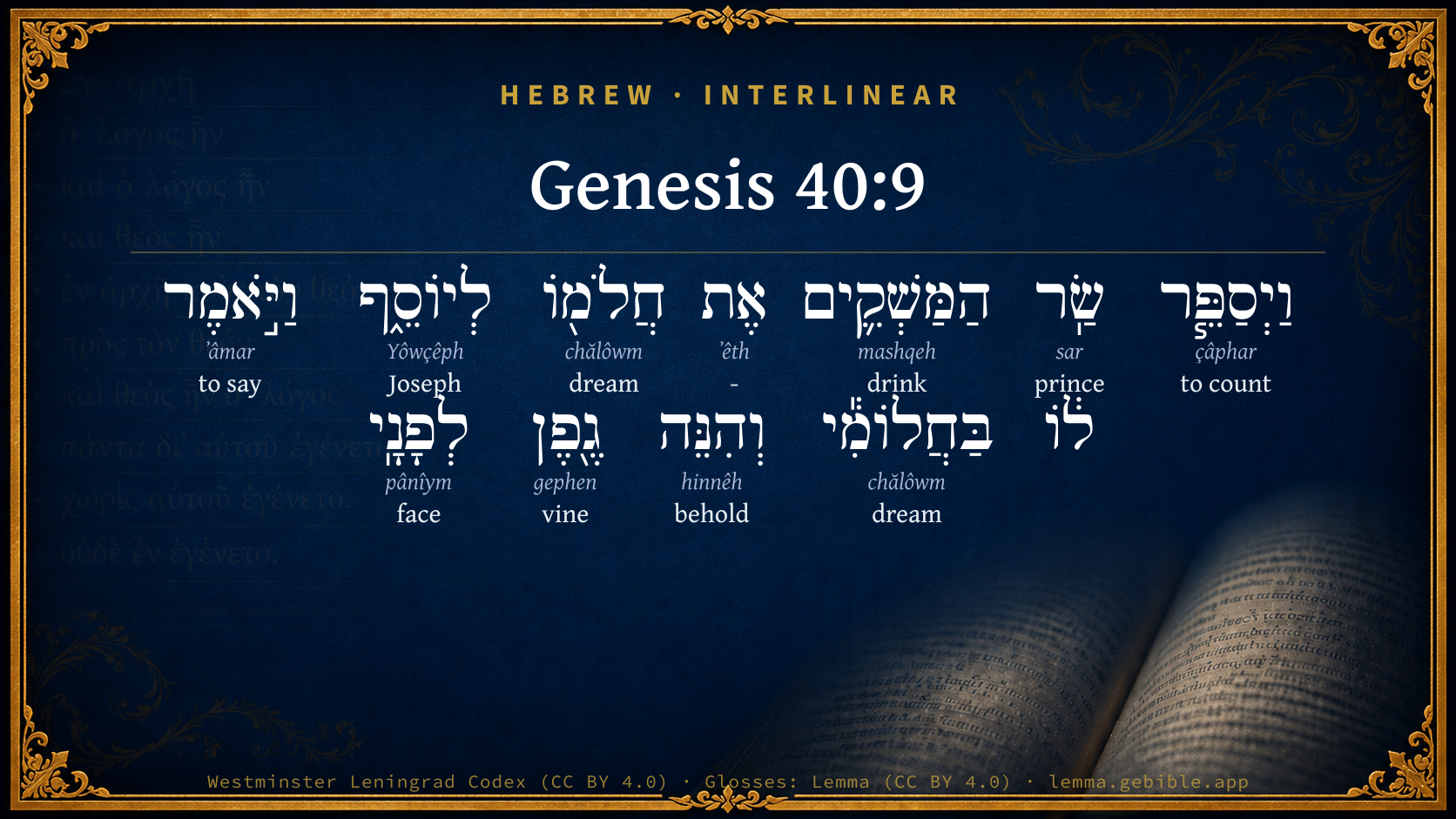
Hebrew (Westminster Leningrad Codex) Genesis 40:9 appears in the Hebrew Old Testament. The text above is from the Westminster Leningrad Codex. Each word links to its Strong’s number, a concise gloss, and parsing drawn from the Open Scriptures Hebrew Bible morphology. Click any word for its full Brown-Driver-Briggs (BDB) entry.
Download image
Cite this verse

Genesis 40:9 (World English Bible). Public Domain. Lemma interlinear Bible study tool, https://lemma.gebible.app/v/genesis/40/9.

Show BibTeX & RIS
BibTeX
RIS
English Translation
The chief cupbearer told his dream to Joseph, and said to him, "In my dream, behold, a vine was in front of me,
World English Bible · Public Domain
Highlights
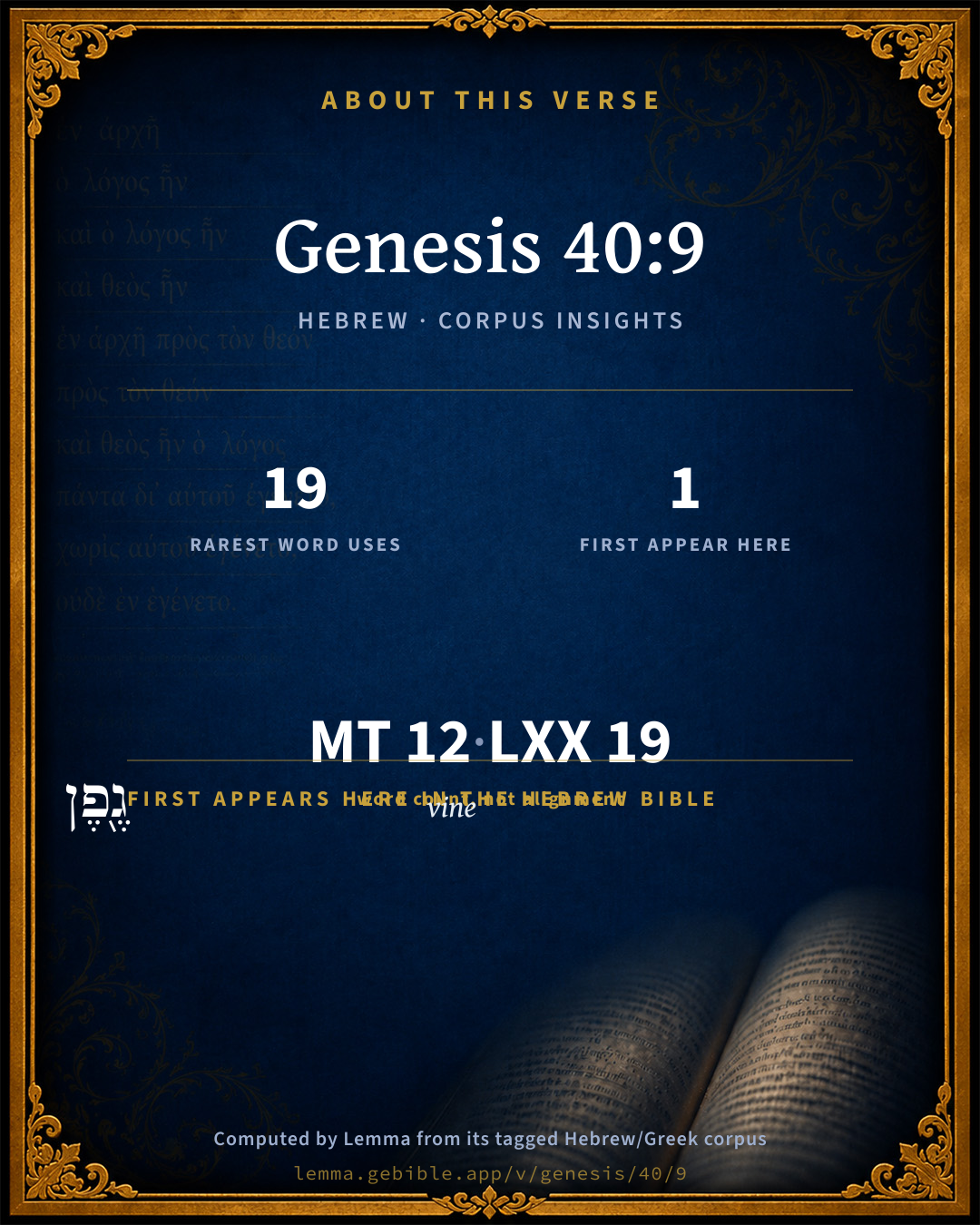
  • 1 first appearance in the Hebrew Bible
Full analysis ↓
Download a study sheet

One document with this verse’s original text, its word-by-word gloss line, the meaning frame, cross-references with their text, attributed commentary, and full source and license credits — printable, and it pastes into notes with its structure intact.

This verse Autodidact and up

Study sheet (.html) Plain text (.txt)

A passage Seminary Student

Up to 50 verses in one chapter. A passage sheet keeps up to 6 commentary sources and 12 cross-references per verse, in the order this page ranks them, and says so on the sheet whenever that leaves anything out. Ask for a single verse and you get the Autodidact verse sheet above.

Everything on this page stays free to read, with no account — the sheet is a download of what is already on screen, not access to it.

Want to remove ads? Support Godless Engineer
Compare translations 3

The same verse in 3 English versions, stacked beneath the original-language interlinear above. Click any original word for its lexicon entry.

Each is an independent rendering of the whole verse — the interlinear is not word-aligned to these translations.

Highlighted words mark where these versions differ — a whole-verse word diff, not a word-by-word alignment.

  • World English Bible Public Domain
    The chief cupbearer told his dream to Joseph, and said to him, "In my dream, behold, a vine was in front of me,
  • King James Version Public Domain
    And the chief butler told his dream to Joseph, and said to him, In my dream, behold, a vine was before me;
  • unfoldingWord Literal Text CC BY-SA 4.0
    Then the chief of the cupbearers told his dream to Joseph and said to him, “And behold, in my dream a grapevine before me,

unfoldingWord Literal Text — © unfoldingWord, licensed CC BY-SA 4.0. Word-aligned USFM3 via Door43 (git.door43.org/unfoldingWord/en_ult).

Versions to compare (up to 4)

3 of 4 selected

Show all 17 translations

Every available English version of this verse, each an independent rendering of the whole verse.

  • World English Bible Public Domain
    The chief cupbearer told his dream to Joseph, and said to him, "In my dream, behold, a vine was in front of me,
  • Berean Standard Bible Public Domain
    So the chief cupbearer told Joseph his dream: “In my dream there was a vine before me,
  • Majority Standard Bible Public Domain
    So the chief cupbearer told Joseph his dream: “In my dream there was a vine before me,
  • King James Version Public Domain
    And the chief butler told his dream to Joseph, and said to him, In my dream, behold, a vine was before me;
  • American Standard Version (1901) Public Domain
    And the chief butler told his dream to Joseph, and said to him, In my dream, behold, a vine was before me;
  • Revised Version (1885) Public Domain
    And the chief butler told his dream to Joseph, and said to him, In my dream, behold, a vine was before me;
  • Geneva Bible (1599) Public Domain
    So the chiefe butler tolde his dreame to Ioseph, and said vnto him, In my dreame, behold, a vine was before me,
  • Young's Literal Translation Public Domain
    And the chief of the butlers recounteth his dream to Joseph, and saith to him, `In my dream, then lo, a vine `is' before me!
  • Literal Standard Version CC BY-SA 4.0
    And the chief of the butlers recounts his dream to Joseph and says to him, “In my dream, then behold, a vine [is] before me!
  • Unlocked Literal Bible CC BY-SA 4.0
    The chief of the cupbearers told his dream to Joseph. He said to him, “In my dream, behold, a vine was in front of me.
  • unfoldingWord Literal Text CC BY-SA 4.0
    Then the chief of the cupbearers told his dream to Joseph and said to him, “And behold, in my dream a grapevine before me,
  • Darby Bible Public Domain
    Then the chief of the cup-bearers told his dream to Joseph, and said to him, In my dream, behold, a vine was before me;
  • World Messianic Bible Public Domain
    The chief cup bearer told his dream to Joseph, and said to him, “In my dream, behold, a vine was in front of me,
  • Webster's Bible Public Domain
    And the chief butler told his dream to Joseph, and said to him, In my dream, behold, a vine was before me;
  • Free Bible Version CC BY-SA 4.0
    So the chief cupbearer told Joseph his dream. “In my dream there was a vine right in front of me,” he explained.
  • Bible in Basic English Public Domain
    Then the chief wine-servant gave Joseph an account of his dream, and said, In my dream I saw a vine before me;
  • JPS Tanakh (1917) Public Domain
    And the chief butler told his dream to Joseph, and said to him: 'In my dream, behold, a vine was before me;

Literal Standard Version (2020), Covenant Press — licensed CC BY-SA 4.0. Text via the HelloAO Bible API (eBible.org). Unlocked Literal Bible (unfoldingWord) — licensed CC BY-SA 4.0. Text via the HelloAO Bible API (eBible.org). unfoldingWord Literal Text — © unfoldingWord, licensed CC BY-SA 4.0. Word-aligned USFM3 via Door43 (git.door43.org/unfoldingWord/en_ult). Free Bible Version, Dr. Jonathan Gallagher — licensed CC BY-SA 4.0. Text via the HelloAO Bible API (eBible.org).

Word by word

More ways to search: Search by grammar → Find every occurrence → Compare this word →

Practice this passage: Drill this verse → Learn its vocabulary →

הַמַּשְׁקִ֛ים
mashqeh
H4945
“the · drinks”
Particle, Definite Article + Noun, Common, Masculine, Plural, Absolute
Part of Speech
Particle + Noun
Type
Common
Gender
Masculine
Number
Plural
State
Absolute
Full BDB Definition

Origin: from H8248

TWOT: 2452c

irrigation, drink - irrigation - drink, drinking vessels - butlership (office of butler) - butler, cup-bearer
  1. וַיְסַפֵּ֧ר çâphar H5608 “and · to count” Conjunction + Verb, Piel, Sequential Imperfect, 3rd Person, Masculine, Singular
  2. שַֽׂר sar H8269 “prince of” Noun, Common, Masculine, Singular, Construct
  3. אֶת ʼêth H853 “-” Particle, Direct Object
  4. חֲלֹמ֖וֹ chălôwm H2472 “dream · his” Noun, Common, Masculine, Singular, Construct + Suffix, Personal, 3rd Person, Masculine, Singular
  5. לְיוֹסֵ֑ף Yôwçêph H3130 “to/for · Joseph” Preposition + Noun, Proper
  6. וַיֹּ֣אמֶר ʼâmar H559 “and · to say” Conjunction + Verb, Qal, Sequential Imperfect, 3rd Person, Masculine, Singular
  7. בַּחֲלוֹמִ֕י chălôwm H2472 “in/at · dream · my” Preposition + Noun, Common, Masculine, Singular, Construct + Suffix, Personal, 1st Person, Common, Singular
  8. וְהִנֵּה hinnêh H2009 “and · behold” Conjunction + Particle, Demonstrative
  9. גֶ֖פֶן gephen H1612 “vine” Noun, Common, Both, Singular, Absolute
  10. לְפָנָֽי pânîym H6440 “to/for · face(s) · my” Preposition + Noun, Common, Both, Plural, Construct + Suffix, Personal, 1st Person, Common, Singular

About this verse

These counts appear in no published source. They are computed here, from the morphology-tagged text and Lemma’s own curated glosses. What Lemma adds →

12
words
10
distinct lemmas
Pentateuch
section

Notable vocabulary

The rarest word here is הַמַּשְׁקִ֛ים drink H4945 — appearing just 19 times in the whole Hebrew Bible.

First appearance in Scripture

This word makes its first canonical appearance in the Hebrew Bible here:

  • גֶ֖פֶן vine H1612

Shared distinctive vocabulary

הַמַּשְׁקִ֛ים drink H4945 occurs in 18 verses of the Hebrew Bible. Also found in:

Grammatical profile

  • 2 verbs
  • 7 nouns
  • 1 preposition
  • 2 particles

Verb forms

  • וַיְסַפֵּ֧ר Piel · Sequential Imperfect
  • וַיֹּ֣אמֶר Qal · Sequential Imperfect

Repetition

A word recurs within this verse — often emphatic in Hebrew:

  • חֲלֹמ֖וֹ dream H2472 ×2

Hebrew & Septuagint length

In English translation the verse runs 23 words from the Hebrew and 19 from the Septuagint (LXX English) — closely comparable.

A rough comparison of the two English renderings, which tokenize alike — not a word-level alignment.

Word counts can differ between the Hebrew and the Greek without any difference in meaning — e.g. the Hebrew direct-object marker אֵת has no separate Greek word, and Greek often adds the article ὁ.

In the original languages it is 12 Hebrew tokens and 19 Greek tokens — but the two are counted differently (Hebrew bundles its prefixes and suffixes into one token; the Greek is in lemma form), so that isn’t a like-for-like length.

Cross-references

5

Topical passages linked to Genesis 40:9 in the Treasury of Scripture Knowledge — connected by theme and wording, ordered by reader-vote popularity; previews shown in the World English Bible.

  • Genesis 37:5–10 Joseph dreamed a dream, and he told it to his brothers, and they hated him all the more.
  • Judges 7:13–15 When Gideon had come, behold, there was a man telling a dream to his fellow; and he said, Behold, I dreamed a dream; and, behold, a cake of barley bread tumbled into the camp of Midian, and came to the tent, and struck it so that it fell, and turned it upside down, so that the tent lay flat.
  • Daniel 2:31 You, O king, saw, and, behold, a great image. This image, which was mighty, and whose brightness was excellent, stood before you; and the aspect of it was awesome.
  • Daniel 4:8 But at the last Daniel came in before me, whose name was Belteshazzar, according to the name of my god, and in whom is the spirit of the holy gods: and I told the dream before him, [saying],
  • Daniel 4:10–18 Thus were the visions of my head on my bed: I saw, and, behold, a tree in the midst of the earth; and the height of it was great.

Cross-references courtesy of OpenBible.info (CC BY 4.0).

Hebrew and Greek witnesses Masoretic Hebrew ↔ Greek Septuagint

The same verse in the two great witnesses to the Old Testament, shown verse-for-verse.

These are two independent witnesses, not word-aligned to each other, and the Septuagint is shown in lemma (dictionary) form.

Hebrew Genesis 40:9 Masoretic · Westminster Leningrad Codex

וַיְסַפֵּ֧ר שַֽׂר הַמַּשְׁקִ֛ים אֶת חֲלֹמ֖וֹ לְיוֹסֵ֑ף וַיֹּ֣אמֶר ל֔וֹ בַּחֲלוֹמִ֕י וְהִנֵּה גֶ֖פֶן לְפָנָֽי

The chief cupbearer told his dream to Joseph, and said to him, "In my dream, behold, a vine was in front of me,

World English Bible · Public Domain

Greek LXX Genesis 40:9 Septuagint · lemma form

καί διαἡγέομαι ὁ ἀρχιοινοχόος ὁ ἐνύπνιον αὐτός ὁ ιωσηφ καί εἶπον ἐν ὁ ὕπνος ἐγώ εἰμί ἄμπελος ἐναντίον ἐγώ

And the chief cupbearer related his dream to Joseph, and said, In my dream a vine was before me.

LXX2012 (modern English Septuagint) · Public Domain

On this verse, The Pulpit Commentary discusses the Septuagint’s reading. Read the note in Commentary ↓

Hebrew: Westminster Leningrad Codex (CC BY 4.0). Greek: Septuagint (public domain); English from LXX2012 (modern English Septuagint) (Public Domain). How the Septuagint differs from the Hebrew →

Targum (Aramaic paraphrase)

2

The Targum is the ancient Jewish Aramaic paraphrase of the Hebrew Scriptures — an interpretive translation, not the Hebrew text itself. Onkelos (literal) and Pseudo-Jonathan (expansive) render the Torah, and Jonathan the Prophets. Coverage is partial: where no permissively-licensed English translation exists for a verse, only the Aramaic is shown. This is verse-level text, not a word-by-word alignment to the Hebrew.

  1. Targum Onkelos Torah (Genesis–Deuteronomy)
    וְאִשְׁתָּעִי רַב שָׁקֵי יָת חֶלְמֵהּ לְיוֹסֵף וַאֲמַר לֵה בְּחֶלְמִי וְהָא גּוּפְנָא קֳדָמָי

    (no public-domain English translation for this verse)

    Targum Onkelos — Aramaic: “Onkelos Genesis” (public domain); “Onkelos Exodus” (public domain); “Onkelos Leviticus” (public domain); “Onkelos Numbers” (public domain); “Onkelos Deuteronomy” (public domain). English: “Sefaria Community Translation” (CC0 1.0 (public-domain dedication)); “J.W. Etheridge. The Targums of Onkelos and Jonathan Ben Uzziel on the Pentateuch. London: Longmans, Green, 1862” (public domain). Text via Sefaria.

  2. Targum Pseudo-Jonathan Torah (Genesis–Deuteronomy)
    וְאִשְׁתְּעֵי רַב מְזוֹגַיָא יַת חֶלְמֵיהּ לְיוֹסֵף וַאֲמַר לֵיהּ חָמֵי הֲוִית בְּחֶלְמִי וְהָא גוּפְנָא קֳדָמָי

    And the chief of the butlers related his dream to Joseph, and said to him, I saw in my dream, and, behold, a vine was before me.

    Targum Pseudo-Jonathan — Aramaic: “Targum Jonathan on Genesis” (public domain); “Targum Jonathan on Exodus” (public domain); “Targum Jonathan on Leviticus” (public domain); “Targum Jonathan on Numbers” (public domain); “Targum Jonathan on Deuteronomy” (public domain). English: “The Targum of Jonathan ben Uzziel, trans. J. W. Etheridge, London, 1862” (public domain). Text via Sefaria.

Commentary

Notes on Genesis 40:9 from classic Christian and Jewish commentators (each source and its license shown beneath its notes). The classic Christian expositions comment on the surrounding passage and are grouped to its opening verse, so a note may address several verses; the Jewish commentaries on the Tanakh (Rashi and others) are per-verse, so they appear only where the commentator wrote on this verse.

Lemma curates 59 commentaries, every one of them public domain or Creative Commons licensed, each selected and text-cleaned for this edition rather than reprinted as found. About our sources →

Jamieson, Fausset & Brown

Robert Jamieson, A. R. Fausset & David Brown

THE BUTLER'S DREAM. (Gen 40:9-15)

In my dream, behold, a vine was before me--The visionary scene described seems to represent the king as taking exercise and attended by his butler, who gave him a cooling draught. On all occasions, the kings of ancient Egypt were required to practice temperance in the use of wine [WILKINSON]; but in this scene, it is a prepared beverage he is drinking, probably the sherbet of the present day. Everything was done in the king's presence--the cup was washed, the juice of the grapes pressed into it; and it was then handed to him--not grasped; but lightly resting on the tips of the fingers.

Jamieson, Fausset & Brown — Commentary Critical and Explanatory on the Whole Bible (1871) — public domain (CC PDM 1.0). Text via the HelloAO Bible API.

Trapp's Complete Commentary

John Trapp

Gen 40:9 And the chief butler told his dream to Joseph, and said to him, In my dream, behold, a vine [was] before me;

Ver. 9. Behold, a vine was before me.] God, of his infinite grace and wisdom, gives men such signs as excellently answer and agree to the thing thereby signified; those two sacraments of the New Testament, for instance; which the Greek fathers (in the apostle’s sense, Heb 9:24) call αντιτυπα, signs and symbols of better things, signified and sealed up thereby to the believer. The Lord, saith venerable Beza, knowing well the vanity of our natures, prone to idolatry, hath appointed us two sacraments only; and those consisting also of most simple signs and rites. For signs, he gave us water, bread, and wine. The rites are no more than to sprinkle, eat, drink (things of most common use); and a very little of these too, that men may not too much doat on the elements, or external acts in the sacrament, but be wholly raised up to the mystery, and by faith mount up to Christ thereby set forth and exhibited - fetching him down, as it were, that we may feed on him. Hence the outward sign is no further used than may serve to mind us of the inward grace. {a} The minister also stirs up the people to look higher than to what they see, with Sursum corda; Lift up your hearts. A thing in use among the primitive Christians. {b}

{a} Nempe ne miseri mortales in istorum mysteriorum usu in rebus terrestribus haereant, et obstupescant. - Bez. Confess.

{b} Sacerdos parat fratrum mentes, dicendo, Sursum corda. - Cyprian.

John Trapp, A Commentary or Exposition upon All the Books of the Old and New Testament (1647–1656) — public domain. Text from a community e-Sword module.

Tyndale Open Study Notes

Tyndale Open Resources

40:9-19 Joseph listened to the dreams and offered their interpretations. These dreams were not trivial; they were ominous warnings from God about what everyone was going to face. These two dreams prepared for Pharaoh’s two dreams, which revealed the periods of life and death that the nation would soon experience.

Tyndale Open Study Notes — © Tyndale Open Resources, licensed CC BY-SA 4.0. Text via the HelloAO Bible API.

John Gill's Exposition

And the chief butler told his dream to Joseph,.... He listened to what Joseph said, and paid a regard to it, and began to think he might be able to interpret his dream, and therefore was forward, and the first to tell him it at once; whereas the chief baker did not seem disposed to do it, until he observed the good interpretation given of the butler's dream, Gen 40:16,

and said unto him, in my dream, behold, a vine was before me; it appeared to him in his dream, as if a vine sprung up at once, and stood before him; which was very suitable to his office as a butler, wine being the fruit of the vine, which he provided for the king his master, and presented to him at table.

John Gill's Exposition of the Whole Bible (1746–1763) — public domain (CC PDM 1.0). Text via the HelloAO Bible API.

Whedon's Commentary on the Bible

Daniel D. Whedon

9. Behold, a vine — Notably the butler dreams of vines, and the baker of the food (Gen_40:17) he was wont to prepare for the king. “Herodotus denies the existence of vines in ancient Egypt, and says that the Egyptian wine was made of barley. 2:77. Yet Herodotus himself, (ii, 42, 48:144,) and Diodorus, (i, 11,) identify Osiris with the Greek Bacchus, the discoverer of the vine, and Diodorus (i, 15) expressly ascribes to Osiris the first cultivation of the vine. But it now appears from the monuments, that both the cultivation of grapes and the art of making wine were well known in Egypt from the time of the Pyramids.” — Speaker’s Commentary.

Daniel D. Whedon (gen. ed.), Commentary on the Old and New Testaments (1874–1909) — public domain. Text from a community e-Sword module.

The Pulpit Commentary

Vers. 9-11. And the chief butler told his dream to Joseph, and said to him, In my dream, behold, a vine was before me literally, in my dream (sc. I was), and behold a vine (gephen, from the unused root gaphan, to be bent, a twig, hence a plant which has twigs, especially a vine; cf. (Jud_1:9:13; Isa_7:4 Isa_24:7) before me. The introduction of the vine into the narrative, which has been pronounced (Bohlen) an important factor in proof of its recent composition, since, according to Herodotus (ii. 77), the vine was not cultivated in Egypt, and, according to Plutarch ("De Is. et Osir.," 6), it was not till after Psammetichus, i.e. about the time of Josiah, that the Egyptians began to drink wine, has now by more accurate study been ascertained to be in exact accordance, not only with Biblical statements. (Num_20:5; Psa_78:47 Psa_105:33) but likewise with the testimony of Herodotus, who affirms (2:37) that wine (oinov ajmpelenov) was a privilege of the priestly order, and with the representations on the monuments of vines and grapes, and of the entire process of wine-making (vide Havernick"s "Introduction," Wilkinson"s "Ancient Egyptians," 1:379, et seqq. 430, 431, ed. 1878; Hengstenberg, "Egypt," p. 13; Rawlinson, "Hist. Illus.," p. 49; Thornley Smith, "Joseph and his Times," p. 58). And in the vine were three branches: sarigim, tendrils of a vine, from sarag, to intertwine; (ver. 12Joh_1:7) and it was as though it budded, and her blossoms shot forth; literally, as it budded (Murphy); or, as though blossoming (Rosenm Keil, Kalisch); it shot forth its blossom (Keil); or, its blossoms shot forth (Rosenm Kalisch, Murphy)and the clusters thereof brought forth ripe grapes: more correctly, its stems caused to ripen, or matured, clusters, the lKova, being the stalk of a cluster, as distinguished from the or clusters themselves (Gesenius, "Lex.," p. 85), though interpreters generally (Kalisch, Keil, Murphy) regard the first as the unripe, and the second as the ripe, clusterand Pharaoh"s cup szOK, a receptacle or vessel, either contracted from Sg,ke, like vyai for vg,ae (Gesenius), or derived from aWK, to conceal, to receive, to keep, connected with the idea of bringing together, collecting into a thing (Furst)was in my hand: and I took the grapes, and pressed them ejxeqliya (LXX), expressi (Vulgate), a translation adopted by the most competent authorities (Gesenius, Furst, Rosenm Keil, Kalisch, et alii), though the sense of diluting with water is advocated by Dathe, Havernick ("Introd.," and others as the most appropriate signification of fjv; which occurs only here. That Pharaoh is represented as drinking the expressed juice of grapes is no proof that the Egyptians were not acquainted with fermentation, and did not drink fermented liquors. In numerous frescoes the process of fermentation is distinctly represented, and Herodotus testifies that though the use of grape wine was comparatively limited, the common people drank a wine made from barley: oinw d ejk kriqewn pepoihmenw (2:77) into Pharaoh"s cup, and I gave the cup into Pharaoh"s hand literally, I placed the cup upon Pharaohs palm, pK, used of Jacob"s thigh-socket, (Gen_32:26) meaning something hollowed out.

The Pulpit Commentary (1880–1919), ed. H.D.M. Spence-Jones & Joseph S. Exell — public domain. Text from a community e-Sword module.

Keil & Delitzsch

C. F. Keil & F. Delitzsch

The cup-bearer gave this account: "In my dream, behold there was a vine before me, and on the vine three branches; and it was as though blossoming, it shot forth its blossom (נצּהּ either from the hapax l. נץ = נצּה, or from נצּה with the fem. termination resolved into the 3 pers. suff.: Ewald, 257d), its clusters ripened into grapes. And Pharaoh's cup was in my hand; and I took the grapes and pressed them into Pharaoh's cup, and gave the cup into Pharaoh's hand." In this dream the office and duty of the royal cup-bearer were represented in an unmistakeable manner, though the particular details must not be so forced as to lead to the conclusion, that the kings of ancient Egypt drank only the fresh juice of the grape, and not fermented wine as well. The cultivation of the vine, and the making and drinking of wine, among the Egyptians, are established beyond question by ancient testimony and the earliest monuments, notwithstanding the statement of Herodotus (2, 77) to the contrary (see Hengstenberg, Egypt and the Books of Moses, pp. 13ff.).

Keil & Delitzsch — Biblical Commentary on the Old Testament (1861–1891) — public domain (CC PDM 1.0). Text via the HelloAO Bible API. (Old Testament only.)

Kretzmann's Popular Commentary

Paul E. Kretzmann

The Interpretation of the Dreams

v. 9. And the chief butler told his dream to Joseph, and said to him, In my dream, behold, a vine was before me;

v. 10. and in the vine were three branches; and it was as though it budded, and her blossoms shot forth; and the clusters thereof brought forth ripe grapes;

v. 11. and Pharaoh’s cup was in my hand; and I took the grapes, and pressed them into Pharaoh’s cup, and I gave the cup into Pharaoh’s hand. It was a very vivid dream, one in which events ordinarily of long duration were pressed together into the space of a few moments. The grapevine was before butler, its three branches grew, it seemed that the blossoms budded forth, that they ripened into berries, into grapes. And, the cup belonging to the king being in his hand, he immediately pressed out the grapes and offered the cup with the juice to the king, thus performing the work which he had always been doing.

v. 12. And Joseph said unto him, This is the interpretation of it: The three branches are three days;

v. 13. yet within three days shall Pharaoh lift up thine head, and restore thee unto thy place; and thou shalt deliver Pharaoh’s cup into his hand, after the former manner when thou wast his butler. God revealed this interpretation to Joseph, and the latter told it in just that way. Pharaoh would lift up the head of the butler out of the disgrace of his imprisonment, have him fetched from prison, grant him the former prosperity and honor, and give him back his former office.

v. 14. But think on me when it shall be well with thee, and show kindness, I pray thee, unto me, and make mention of me unto Pharaoh, and bring me out of this house;

v. 15. for indeed I was stolen away out of the land of the Hebrews; and here also have I done nothing that they should put me into the dungeon. Joseph’s plea may well be understood, when he asks the butler to keep him in favorable memory. He explains that he did not flee from his home country on account of some crime, but that he had been abducted by force. The expression shields his brothers, so far as their share in his present plight was concerned, and is altogether consistent, for Joseph undoubtedly informed the Ishmaelites that bought him of his station. He speaks with the same caution in referring to his imprisonment, merely stating that he was guilty of no crime which would have merited his being placed into this pit.

v. 16. When the chief baker saw that the interpretation was good, he said unto Joseph, I also was in my dream, and, behold, I had three white baskets on my head, three baskets with white bread;

v. 17. and in the uppermost basket there was of all manner of bake-meats for Pharaoh, fine things to eat of bakery goods; and the birds did eat them out of the basket upon my head. In his eagerness to obtain a favorable interpretation for himself, the chief baker overlooked the significant difference in the end of the dream.

v. 18. And Joseph answered and said, This is the interpretation thereof: The three baskets are three days;

v. 19. yet within three days shall Pharaoh lift up thy head from off thee, and shall hang thee on a tree; and the birds shall eat thy flesh from off thee. In this one point there was the great distinction between the two dreams: it was not Pharaoh that took bread or fine pastry from the hand of the baker, but the birds seized upon his bakery-ware. He was to be put to death, hung upon a stake or gallows, and his flesh given to the birds of heaven to eat. Although the interpretation seems so simple, it is clear that God Himself here drew aside the veil of the future.

Paul E. Kretzmann, Popular Commentary of the Bible (1921–1924) — public domain. Text from a community e-Sword module.

unfoldingWord translationNotes

Door43 World Missions Community

The chief of the cupbearers

The most important person who brings drinks to the king. See how you translated this in Genesis 40:2.

In my dream, behold, a vine was in front of me

"In my dream, I saw a vine in front of me!" The cupbearer uses word "behold" here to show that he was surprised by what he saw in his dream and to alert Joseph to pay attention.

the clusters of grapes ripened

"its clusters ripened into grapes"

squeezed them

This means that he squeezed the juice out of them. AT: "squeezed the juice from them" (See: Assumed Knowledge and Implicit Information)

translationWords

dream

Joseph (OT)

vine

grape

Pharaoh

unfoldingWord translationNotes — © Distant Shores Media and the Door43 World Missions Community, licensed CC BY-SA 4.0. Source: git.door43.org/Door43/en_tn.

Radak

Rabbi David Kimhi (Radak)

בחלומי, “I saw in my dream.”

Radak on the Tanakh — English translations: “Sefaria Community Translation” (CC0 1.0 (public-domain dedication)); “Eliyahu Munk, HaChut Hameshulash” (CC BY 4.0); “Rabbi Mike Feuer, Jerusalem Anthology” (CC BY 4.0); and “R. David Kimhi on the first book of Psalms, Translated by R.G. Finch, London, 1919” (public domain). Text via Sefaria.

Lesson kit

Teaching starters — assembled from the data on this page, not authored interpretation. Every prompt links to the verse data it draws on. Edit before teaching.

Genesis, in the Pentateuch, opens this verse with 12 words (10 distinct Hebrew lemmas). Its most distinctive word is mashqeh (“drink”). A historical commentator’s framing appears above. Read the whole chapter for the surrounding context.

Discussion questions

  1. How does “drink” (mashqeh) shape what this verse is saying?
  2. This is the first place “vine” appears in Scripture (first appears here). What does its debut here establish?
  3. How does Genesis 13:10, which shares the word «drink», read alongside this verse?
  4. What does the repetition of “dream” (2× in this one verse) do in this verse?
  5. These translations render this verse differently; the difference is in the English rendering, not the original. What questions does that raise?
  6. «וַיְסַפֵּ֧ר» is a Piel Sequential Imperfect verb. How does that grammatical form shape the action described?
  7. Compare how Jamieson, Fausset & Brown and Trapp's Complete Commentary read this verse. Where do they agree or differ?

Things to notice

Reading settings

Reading text

Shown beneath each verse's original-language words.

Old Testament
Old Testament edition

Read the OT as the Masoretic Hebrew (MT) or the Greek Septuagint (LXX).

English shown for the Greek Septuagint (in the Hebrew ↔ Greek comparison).

Comparing translations? Open the Compare panel on any verse page to stack up to four side by side.