Nehemiah 12:26

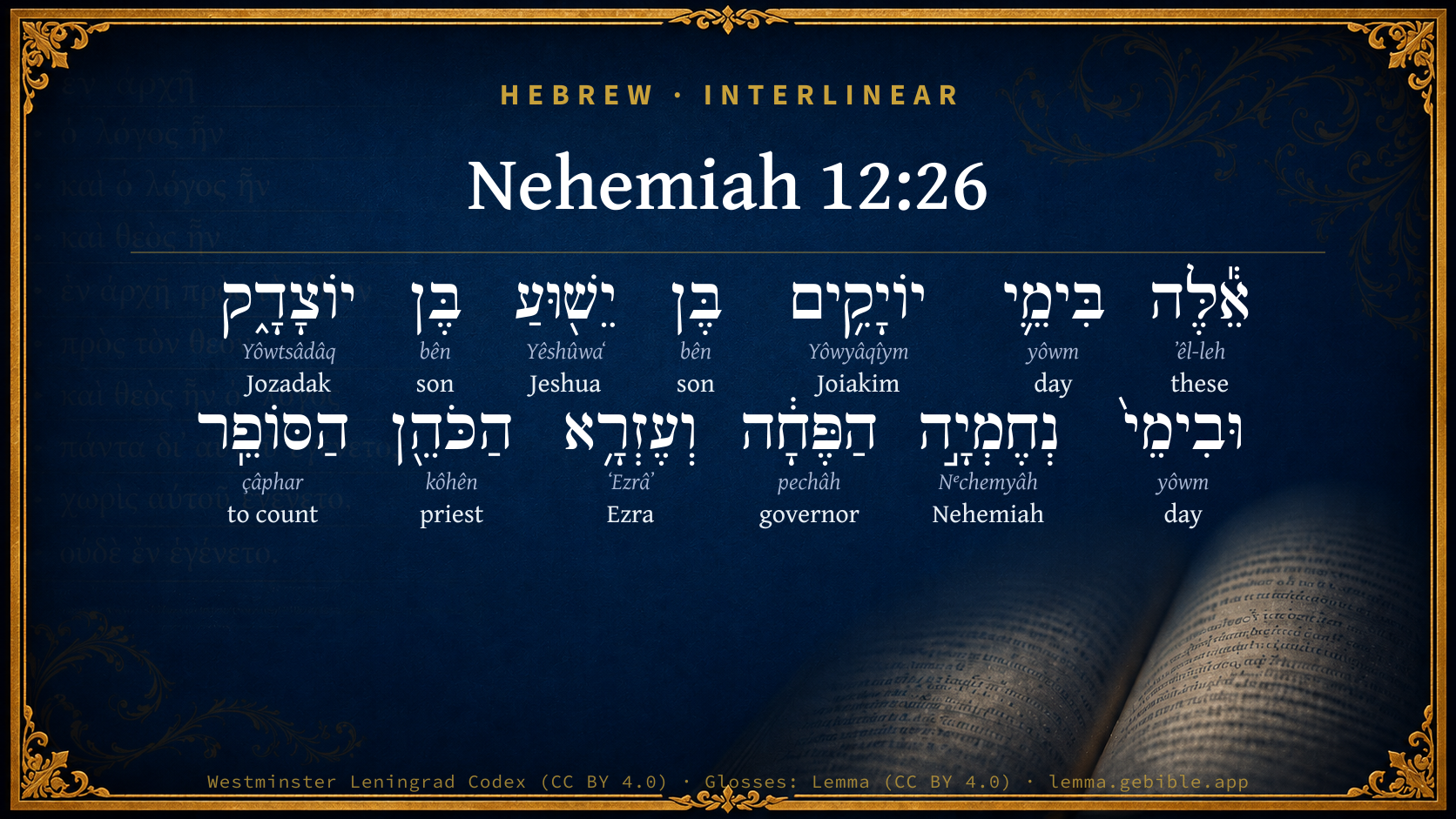
Hebrew (Westminster Leningrad Codex) Nehemiah 12:26 appears in the Hebrew Old Testament. The text above is from the Westminster Leningrad Codex. Each word links to its Strong’s number, a concise gloss, and parsing drawn from the Open Scriptures Hebrew Bible morphology. Click any word for its full Brown-Driver-Briggs (BDB) entry.
Download image
Cite this verse

Nehemiah 12:26 (World English Bible). Public Domain. Lemma interlinear Bible study tool, https://lemma.gebible.app/v/nehemiah/12/26.

Show BibTeX & RIS
BibTeX
RIS
English Translation
These were in the days of Joiakim the son of Jeshua, the son of Jozadak, and in the days of Nehemiah the governor, and of Ezra the priest the scribe.
World English Bible · Public Domain
Download a study sheet

One document with this verse’s original text, its word-by-word gloss line, the meaning frame, cross-references with their text, attributed commentary, and full source and license credits — printable, and it pastes into notes with its structure intact.

This verse Autodidact and up

Study sheet (.html) Plain text (.txt)

A passage Seminary Student

Up to 50 verses in one chapter. A passage sheet keeps up to 6 commentary sources and 12 cross-references per verse, in the order this page ranks them, and says so on the sheet whenever that leaves anything out. Ask for a single verse and you get the Autodidact verse sheet above.

Everything on this page stays free to read, with no account — the sheet is a download of what is already on screen, not access to it.

Want to remove ads? Support Godless Engineer
Compare translations 3

The same verse in 3 English versions, stacked beneath the original-language interlinear above. Click any original word for its lexicon entry.

Each is an independent rendering of the whole verse — the interlinear is not word-aligned to these translations.

Highlighted words mark where these versions differ — a whole-verse word diff, not a word-by-word alignment.

  • World English Bible Public Domain
    These were in the days of Joiakim the son of Jeshua, the son of Jozadak, and in the days of Nehemiah the governor, and of Ezra the priest the scribe.
  • King James Version Public Domain
    These were in the days of Joiakim the son of Jeshua, the son of Jozadak, and in the days of Nehemiah the governor, and of Ezra the priest, the scribe.
  • unfoldingWord Literal Text CC BY-SA 4.0
    These were in the days of Joiakim, the son of Jeshua, the son of Jozadak, and in the days of Nehemiah the governor and Ezra, the priest, the scribe.

unfoldingWord Literal Text — © unfoldingWord, licensed CC BY-SA 4.0. Word-aligned USFM3 via Door43 (git.door43.org/unfoldingWord/en_ult).

Versions to compare (up to 4)

3 of 4 selected

Show all 18 translations

Every available English version of this verse, each an independent rendering of the whole verse.

  • World English Bible Public Domain
    These were in the days of Joiakim the son of Jeshua, the son of Jozadak, and in the days of Nehemiah the governor, and of Ezra the priest the scribe.
  • Berean Standard Bible Public Domain
    They served in the days of Joiakim son of Jeshua, the son of Jozadak, and in the days of Nehemiah the governor and Ezra the priest and scribe.
  • Majority Standard Bible Public Domain
    They served in the days of Joiakim son of Jeshua, the son of Jozadak, and in the days of Nehemiah the governor and Ezra the priest and scribe.
  • King James Version Public Domain
    These were in the days of Joiakim the son of Jeshua, the son of Jozadak, and in the days of Nehemiah the governor, and of Ezra the priest, the scribe.
  • American Standard Version (1901) Public Domain
    These were in the days of Joiakim the son of Jeshua, the son of Jozadak, and in the days of Nehemiah the governor, and of Ezra the priest the scribe.
  • Revised Version (1885) Public Domain
    These were in the days of Joiakim the son of Jeshua, the son of Jozadak, and in the days of Nehemiah the governor, and of Ezra the priest the scribe.
  • Geneva Bible (1599) Public Domain
    These were in the dayes of Ioiakim, the sonne of Ieshua, the sonne of Iozadak, and in the dayes of Nehemiah the captaine, and of Ezra the Priest and scribe.
  • Douay-Rheims (1899) Public Domain
    These were in the days of Joacim the son of Josue, the son of Josedec, and in the days of Nehemias the governor, and of Esdras the priest and scribe.
  • Young's Literal Translation Public Domain
    These `are' in the days of Joiakim son of Jeshua, son of Jozadak, and in the days of Nehemiah the governor, and of Ezra the priest, the scribe.
  • Literal Standard Version CC BY-SA 4.0
    These [are] in the days of Joiakim son of Jeshua, son of Jozadak, and in the days of Nehemiah the governor, and of Ezra the priest, the scribe.
  • Unlocked Literal Bible CC BY-SA 4.0
    They served in the days of Joiakim son of Jeshua son of Jozadak, and in the days of Nehemiah the governor and of Ezra the priest and scribe.
  • unfoldingWord Literal Text CC BY-SA 4.0
    These were in the days of Joiakim, the son of Jeshua, the son of Jozadak, and in the days of Nehemiah the governor and Ezra, the priest, the scribe.
  • Darby Bible Public Domain
    These were in the days of Joiakim the son of Jeshua the son of Jozadak, and in the days of Nehemiah the governor, and of Ezra the priest, the scribe.
  • World Messianic Bible Public Domain
    These were in the days of Joiakim the son of Yeshua, the son of Jozadak, and in the days of Nehemiah the governor, and of Ezra the priest and scribe.
  • Webster's Bible Public Domain
    These were in the days of Joiakim the son of Jeshua, the son of Jozadak, and in the days of Nehemiah the governor, and of Ezra the priest, the scribe.
  • Free Bible Version CC BY-SA 4.0
    They served in the time of Joiakim, son of Jeshua, son of Jozadak, and in the time of Nehemiah the governor and Ezra the priest and scribe.
  • Bible in Basic English Public Domain
    These were in the days of Joiakim, the son of Jeshua, the son of Jozadak, and in the days of Nehemiah the ruler and of Ezra the priest, the scribe.
  • JPS Tanakh (1917) Public Domain
    These were in the days of Joiakim the son of Jeshua, the son of Jozadak, and in the days of Nehemiah the governor, and of Ezra the priest the scribe.

Literal Standard Version (2020), Covenant Press — licensed CC BY-SA 4.0. Text via the HelloAO Bible API (eBible.org). Unlocked Literal Bible (unfoldingWord) — licensed CC BY-SA 4.0. Text via the HelloAO Bible API (eBible.org). unfoldingWord Literal Text — © unfoldingWord, licensed CC BY-SA 4.0. Word-aligned USFM3 via Door43 (git.door43.org/unfoldingWord/en_ult). Free Bible Version, Dr. Jonathan Gallagher — licensed CC BY-SA 4.0. Text via the HelloAO Bible API (eBible.org).

Word by word

More ways to search: Search by grammar → Find every occurrence → Compare this word →

Practice this passage: Drill this verse → Learn its vocabulary →

יוֹיָקִ֥ים
Yôwyâqîym
H3113
“Joiakim”
Noun, Proper
Part of Speech
Noun
Type
Proper
Full BDB Definition

Origin: a form of H3079 , cf. H3137

TWOT: None

Joiakim or Jehoiakim = "Jehovah raises up" - a priest and son of Jeshua the high priest
  1. אֵ֕לֶּה ʼêl-leh H428 “these” Pronoun, Demonstrative, Common, Plural
  2. בִּימֵ֛י yôwm H3117 “in/at · days of” Preposition + Noun, Common, Masculine, Plural, Construct
  3. בֶּן bên H1121 “son of” Noun, Common, Masculine, Singular, Construct
  4. יֵשׁ֖וּעַ Yêshûwaʻ H3442 “Jeshua” Noun, Proper
  5. בֶּן bên H1121 “son of” Noun, Common, Masculine, Singular, Construct
  6. יוֹצָדָ֑ק Yôwtsâdâq H3136 “Jozadak” Noun, Proper
  7. וּבִימֵי֙ yôwm H3117 “and · in/at · days of” Conjunction + Preposition + Noun, Common, Masculine, Plural, Construct
  8. נְחֶמְיָ֣ה Nᵉchemyâh H5166 “Nehemiah” Noun, Proper
  9. הַפֶּחָ֔ה pechâh H6346 “the · governor” Particle, Definite Article + Noun, Common, Masculine, Singular, Absolute
  10. וְעֶזְרָ֥א ʻEzrâʼ H5830 “and · Ezra” Conjunction + Noun, Proper
  11. הַכֹּהֵ֖ן kôhên H3548 “the · priest” Particle, Definite Article + Noun, Common, Masculine, Singular, Absolute
  12. הַסּוֹפֵֽר çâphar H5608 “the · scribe” Particle, Definite Article + Noun, Common, Masculine, Singular, Absolute

About this verse

These counts appear in no published source. They are computed here, from the morphology-tagged text and Lemma’s own curated glosses. What Lemma adds →

13
words
11
distinct lemmas
Historical
section

Notable vocabulary

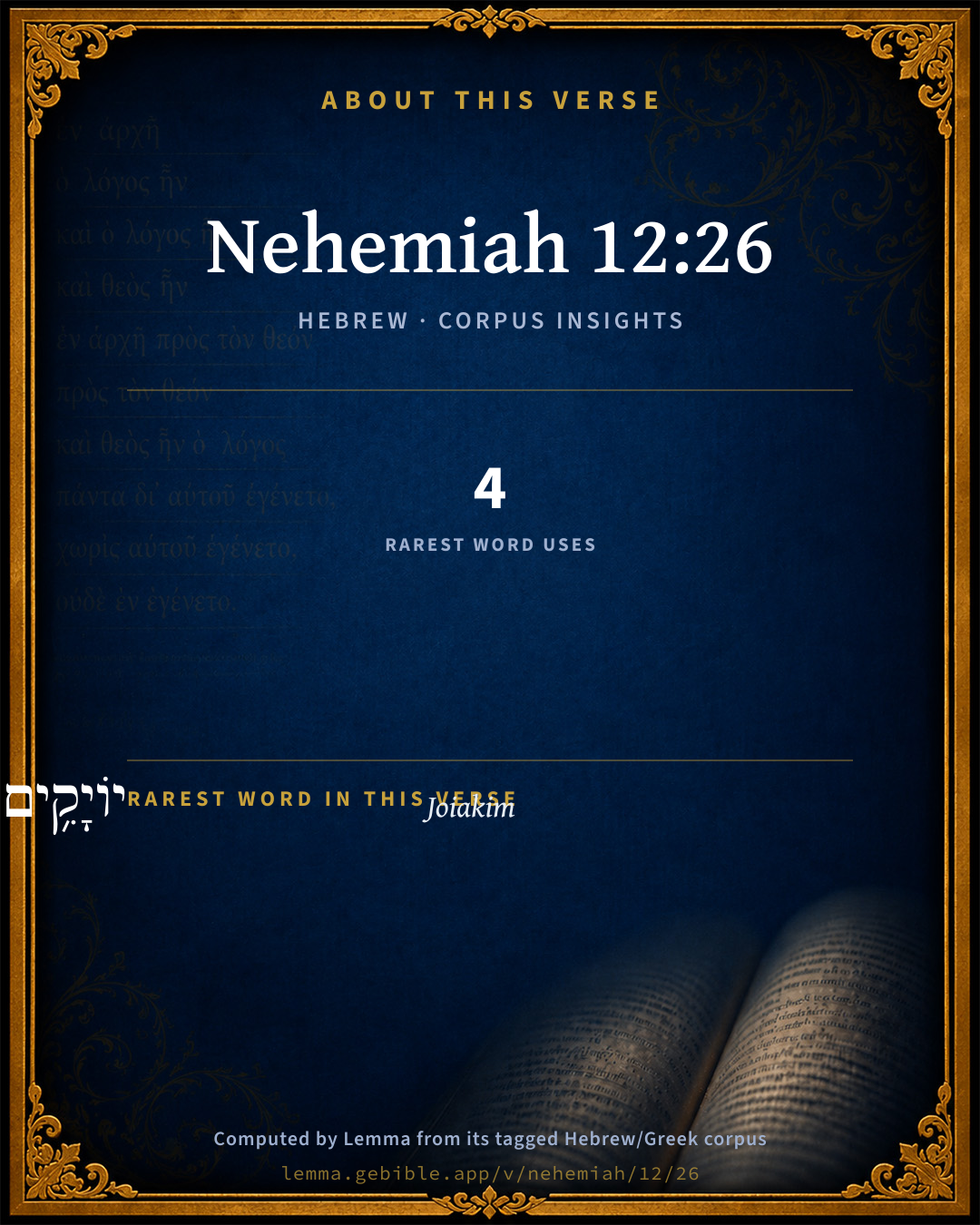
The rarest word here is יוֹיָקִ֥ים Joiakim H3113 — appearing just 4 times in the whole Hebrew Bible.

Shared distinctive vocabulary

יוֹיָקִ֥ים Joiakim H3113 occurs in 3 verses of the Hebrew Bible. Also found in:

Grammatical profile

  • 12 nouns
  • 1 pronoun

Repetition

Words recur within this verse — often emphatic in Hebrew:

  • בִּימֵ֛י day H3117 ×2
  • בֶּן son H1121 ×2

Cross-references

3

Topical passages linked to Nehemiah 12:26 in the Treasury of Scripture Knowledge — connected by theme and wording, ordered by reader-vote popularity; previews shown in the World English Bible.

  • Nehemiah 8:9 Nehemiah, who was the governor, and Ezra the priest the scribe, and the Levites who taught the people, said to all the people, This day is holy to Yahweh your God; don't mourn, nor weep. For all the people wept, when they heard the words of the law.
  • Ezra 7:6 this Ezra went up from Babylon: and he was a ready scribe in the law of Moses, which Yahweh, the God of Israel, had given; and the king granted him all his request, according to the hand of Yahweh his God on him.
  • Ezra 7:11 Now this is the copy of the letter that the king Artaxerxes gave to Ezra the priest, the scribe, even the scribe of the words of the commandments of Yahweh, and of his statutes to Israel:

Cross-references courtesy of OpenBible.info (CC BY 4.0).

Hebrew and Greek witnesses Masoretic Hebrew ↔ Greek Septuagint

The same verse in the two great witnesses to the Old Testament, shown verse-for-verse.

These are two independent witnesses, not word-aligned to each other, and the Septuagint is shown in lemma (dictionary) form.

Hebrew Nehemiah 12:26 Masoretic · Westminster Leningrad Codex

אֵ֕לֶּה בִּימֵ֛י יוֹיָקִ֥ים בֶּן יֵשׁ֖וּעַ בֶּן יוֹצָדָ֑ק וּבִימֵי֙ נְחֶמְיָ֣ה הַפֶּחָ֔ה וְעֶזְרָ֥א הַכֹּהֵ֖ן הַסּוֹפֵֽר

These were in the days of Joiakim the son of Jeshua, the son of Jozadak, and in the days of Nehemiah the governor, and of Ezra the priest the scribe.

World English Bible · Public Domain

Greek LXX Structure differs

The Septuagint has no separate book of Nehemiah. Its Greek text is the second half of Esdras B (2 Esdras), chapters 11–23; Ezra is the first half (1–10).

A verse-for-verse comparison isn’t shown here because the chapters and verses don’t line up. Switch to the LXX edition with the MT / LXX toggle above to read the Greek directly.

Hebrew: Westminster Leningrad Codex (CC BY 4.0). Greek: Septuagint (public domain); English from a public-domain English Septuagint. How the Septuagint differs from the Hebrew →

Commentary

Notes on Nehemiah 12:26 from classic Christian and Jewish commentators (each source and its license shown beneath its notes). The classic Christian expositions comment on the surrounding passage and are grouped to its opening verse, so a note may address several verses; the Jewish commentaries on the Tanakh (Rashi and others) are per-verse, so they appear only where the commentator wrote on this verse.

Lemma curates 59 commentaries, every one of them public domain or Creative Commons licensed, each selected and text-cleaned for this edition rather than reprinted as found. About our sources →

Keil & Delitzsch

C. F. Keil & F. Delitzsch

Neh 12:26 is the final subscription of the two lists in Neh 12:12-21 and Neh 12:24, Neh 12:25.

Keil & Delitzsch — Biblical Commentary on the Old Testament (1861–1891) — public domain (CC PDM 1.0). Text via the HelloAO Bible API. (Old Testament only.)

The Cambridge Bible for Schools and Colleges

gen. ed. J. J. S. Perowne

26. These were in the days of Joiakim &c.] As Neh_12:22-23 refer to a later period than that here mentioned, this summary probably refers to the list contained in Neh_12:12-21. Whether it also refers to 24–25 is a doubtful point. But the awkwardness of the verse in its present position, lends some colour to the view that Neh_12:22-23 are an interpolation by the compiler.

It will be observed that two periods are mentioned, the period of Joiakim (circ. 500 b.c.), and that of Nehemiah and Ezra (460–430 b.c.). The verse was clearly written at a date considerably later than Nehemiah’s lifetime.

The Cambridge Bible for Schools and Colleges (gen. ed. J. J. S. Perowne; Cambridge University Press, 1878–1918) — public domain. Text from a community e-Sword module.

John Gill's Exposition

And at the dedication of the wall of Jerusalem,.... In which many priests and Levites assisted, and seems to be the reason of the above account of them; the dedication of the wall takes in the whole city, gates, and houses, Neh 12:30, and if a new house was to be dedicated, much more a new city, and especially the holy city, in which stood the temple of the Lord, see Deu 20:5, this dedication was made by prayer and songs of praise, as follow, and no doubt by sacrifices, and was kept as a festival; and indeed, according to the Jewish writers (q), it was annually observed on the seventh of Elul, or August; it was on the twenty fifth of that month that the wall was finished, Neh 6:15, but the gates were not set up, and all things for the dedication were not ready till Elul, or August, following; and then all being finished, they made and served the seventh of that month as a festival:

they sought the Levites out of all their places, to bring them to Jerusalem, to keep the dedication with gladness; to assist in the solemnity of the day both with vocal and instrumental music, as follows:

both with thanksgiving and with singing; with songs of praise and thankfulness vocally, that they had been able, notwithstanding all the malice of their enemies, to build the wall in so short a time; or with a song, perhaps the thirtieth psalm was sung on this occasion:

with cymbals, psalteries, and with harps; some playing on one, and some on another, which were the three principal instruments of music used by them, see Ch1 15:16.

(q) Megillath Thainith, c. 3. apud Selden. de Synedr. l. 3. c. 13. sect. 12.

John Gill's Exposition of the Whole Bible (1746–1763) — public domain (CC PDM 1.0). Text via the HelloAO Bible API.

Haydock's Catholic Bible Commentary

Scribe. Could these records have any greater authority than Nehemias himself? It seems, therefore, that this had been added by a later hand, whose testimony is perfectly authentic and inspired. (Calmet) --- Nehemias might also refer to some records which he, or some other, had drawn up. (Haydock)

George Leo Haydock (1774–1849), Haydock's Catholic Family Bible and Commentary, 1859 edition — public domain. Excludes Psalms (Douay-Rheims chapter numbering differs from Protestant) and Deuterocanonical books (Catholic canon only).

Rashi

Rabbi Shlomo Yitzchaki (Rashi)

These were in the days of Joiakim These were the gate sentries in the days of Joiakim.

Rashi on the Tanakh — English translations: “The Judaica Press complete Tanach with Rashi, translated by A. J. Rosenberg” (CC BY 4.0); “Pentateuch with Rashi's commentary by M. Rosenbaum and A.M. Silbermann, 1929-1934” (public domain); “The Metsudah Tanach series, Lakewood, N.J” (CC BY 4.0); and “The Book of Joshua, Metsudah Publications, 1997” (CC BY 4.0). Text via Sefaria.

Lesson kit

Teaching starters — assembled from the data on this page, not authored interpretation. Every prompt links to the verse data it draws on. Edit before teaching.

Nehemiah, in the Historical, opens this verse with 13 words (11 distinct Hebrew lemmas). Its most distinctive word is Yôwyâqîym (“Joiakim”). A historical commentator’s framing appears above. Read the whole chapter for the surrounding context.

Discussion questions

  1. What does “Joiakim” (Yôwyâqîym) contribute to the verse as a whole?
  2. Nehemiah 12:10 shares the word «Joiakim» with this verse. How do the two illuminate each other?
  3. “day” occurs 2× in this one verse. What is the effect of the repetition?
  4. Reading how Keil & Delitzsch and The Cambridge Bible for Schools and Colleges read this verse, where do the two commentators agree and where do they part?

Things to notice

Reading settings

Reading text

Shown beneath each verse's original-language words.

Old Testament
Old Testament edition

Read the OT as the Masoretic Hebrew (MT) or the Greek Septuagint (LXX).

English shown for the Greek Septuagint (in the Hebrew ↔ Greek comparison).

Comparing translations? Open the Compare panel on any verse page to stack up to four side by side.