

Jeremiah 37:20

Hebrew (Westminster Leningrad Codex) Jeremiah 37:20 appears in the Hebrew Old Testament. The text above is from the Westminster Leningrad Codex. Each word links to its Strong’s number, a concise gloss, and parsing drawn from the Open Scriptures Hebrew Bible morphology. Click any word for its full Brown-Driver-Briggs (BDB) entry.
Download image
Cite this verse

Jeremiah 37:20 (World English Bible). Public Domain. Lemma interlinear Bible study tool, https://lemma.gebible.app/v/jeremiah/37/20.

Show BibTeX & RIS
BibTeX
RIS
English Translation
Now please hear, my lord the king: please let my supplication be presented before you, that you not cause me to return to the house of Jonathan the scribe, lest I die there.
World English Bible · Public Domain
Download a study sheet

One document with this verse’s original text, its word-by-word gloss line, the meaning frame, cross-references with their text, attributed commentary, and full source and license credits — printable, and it pastes into notes with its structure intact.

This verse Autodidact and up

Study sheet (.html) Plain text (.txt)

A passage Seminary Student

Up to 50 verses in one chapter. A passage sheet keeps up to 6 commentary sources and 12 cross-references per verse, in the order this page ranks them, and says so on the sheet whenever that leaves anything out. Ask for a single verse and you get the Autodidact verse sheet above.

Everything on this page stays free to read, with no account — the sheet is a download of what is already on screen, not access to it.

Want to remove ads? Support Godless Engineer
Compare translations 3

The same verse in 3 English versions, stacked beneath the original-language interlinear above. Click any original word for its lexicon entry.

Each is an independent rendering of the whole verse — the interlinear is not word-aligned to these translations.

Highlighted words mark where these versions differ — a whole-verse word diff, not a word-by-word alignment.

  • World English Bible Public Domain
    Now please hear, my lord the king: please let my supplication be presented before you, that you not cause me to return to the house of Jonathan the scribe, lest I die there.
  • King James Version Public Domain
    Therefore hear now, I pray thee, O my lord the king: let my supplication, I pray thee, be accepted before thee; that thou cause me not to return to the house of Jonathan the scribe, lest I die there.
  • unfoldingWord Literal Text CC BY-SA 4.0
    But now listen, my master the king! Let my pleas come before you. Do not return me to the house of Jonathan the scribe, or I will die there.”

unfoldingWord Literal Text — © unfoldingWord, licensed CC BY-SA 4.0. Word-aligned USFM3 via Door43 (git.door43.org/unfoldingWord/en_ult).

Versions to compare (up to 4)

3 of 4 selected

Show all 18 translations

Every available English version of this verse, each an independent rendering of the whole verse.

  • World English Bible Public Domain
    Now please hear, my lord the king: please let my supplication be presented before you, that you not cause me to return to the house of Jonathan the scribe, lest I die there.
  • Berean Standard Bible Public Domain
    But now please listen, O my lord the king. May my petition come before you. Do not send me back to the house of Jonathan the scribe, or I will die there.”
  • Majority Standard Bible Public Domain
    But now please listen, O my lord the king. May my petition come before you. Do not send me back to the house of Jonathan the scribe, or I will die there.”
  • King James Version Public Domain
    Therefore hear now, I pray thee, O my lord the king: let my supplication, I pray thee, be accepted before thee; that thou cause me not to return to the house of Jonathan the scribe, lest I die there.
  • American Standard Version (1901) Public Domain
    And now hear, I pray thee, O my lord the king: let my supplication, I pray thee, be presented before thee, that thou cause me not to return to the house of Jonathan the scribe, lest I die there.
  • Revised Version (1885) Public Domain
    And now hear, I pray thee, O my lord the king: let my supplication, I pray thee, be accepted before thee; that thou cause me not to return to the house of Jonathan the scribe, lest I die there.
  • Geneva Bible (1599) Public Domain
    Therefore heare nowe, I pray thee, O my lorde the King: let my prayer be accepted before thee, that thou cause mee not to returne to the house of Iehonathan the scribe, least I die there.
  • Douay-Rheims (1899) Public Domain
    Then king Sedecias commanded that Jeremias should be committed into the entry of the prison: and that they should give him daily a piece of bread, beside broth, till all the bread in the city were spent: and Jeremias remained in the entry of the prison.
  • Young's Literal Translation Public Domain
    And now, hearken, I pray thee, my lord, O king, let my supplication fall, I pray thee, before thee, and cause me not to return `to' the house of Jonathan the scribe, that I die not there.'
  • Literal Standard Version CC BY-SA 4.0
    And now, please listen, O my lord the king; please let my supplication fall before you, and do not cause me to return [to] the house of Jonathan the scribe, that I do not die there.”
  • Unlocked Literal Bible CC BY-SA 4.0
    But now listen, my master the king! Let my pleas come before you. Do not return me to the house of Jonathan the scribe, or I will die there.”
  • unfoldingWord Literal Text CC BY-SA 4.0
    But now listen, my master the king! Let my pleas come before you. Do not return me to the house of Jonathan the scribe, or I will die there.”
  • Darby Bible Public Domain
    And now hear, I pray thee, my lord, O king: let my supplication, I pray thee, come before thee; and cause me not to return into the house of Jonathan the scribe, lest I die there.
  • World Messianic Bible Public Domain
    Now please hear, my lord the king: please let my supplication be presented before you, that you not cause me to return to the house of Jonathan the scribe, lest I die there.”
  • Webster's Bible Public Domain
    Therefore hear now, I pray thee, O my lord the king: let my supplication, I pray thee, be accepted before thee; that thou cause me not to return to the house of Jonathan the scribe, lest I die there.
  • Free Bible Version CC BY-SA 4.0
    Now please listen to me, my lord the king, and respond positively to my request. Don't send me back to prison in the house of Jonathan the scribe, otherwise I'll die there.”
  • Bible in Basic English Public Domain
    And now be pleased to give ear, O my lord the king; let my prayer for help come before you, and do not make me go back to the house of Jonathan the scribe, for fear that I may come to my death there.
  • JPS Tanakh (1917) Public Domain
    And now hear, I pray thee, O my lord the king: let my supplication, I pray thee, be presented before thee; that thou cause me not to return to the house of Jonathan the scribe, lest I die there.'

Literal Standard Version (2020), Covenant Press — licensed CC BY-SA 4.0. Text via the HelloAO Bible API (eBible.org). Unlocked Literal Bible (unfoldingWord) — licensed CC BY-SA 4.0. Text via the HelloAO Bible API (eBible.org). unfoldingWord Literal Text — © unfoldingWord, licensed CC BY-SA 4.0. Word-aligned USFM3 via Door43 (git.door43.org/unfoldingWord/en_ult). Free Bible Version, Dr. Jonathan Gallagher — licensed CC BY-SA 4.0. Text via the HelloAO Bible API (eBible.org).

Word by word

More ways to search: Search by grammar → Find every occurrence → Compare this word →

Practice this passage: Drill this verse → Learn its vocabulary →

תְחִנָּתִי֙
tᵉchinnâh
H8467
“supplication · my”
Noun, Common, Feminine, Singular, Construct + Suffix, Personal, 1st Person, Common, Singular
Part of Speech
Noun
Type
Common
Gender
Feminine
Number
Singular
State
Construct
Full BDB Definition

Origin: from H2603

TWOT: 694f

favour, supplication, supplication for favour - favour - supplication for favour
  1. וְעַתָּ֕ה ʻattâh H6258 “and · now” Conjunction + Adverb
  2. שְֽׁמַֽע shâmaʻ H8085 “hear” Verb, Qal, Imperative, 2nd Person, Masculine, Singular
  3. נָ֖א nâʼ H4994 “please” Particle, Exhortation
  4. אֲדֹנִ֣י ʼâdôwn H113 “lord · my” Noun, Common, Masculine, Singular, Construct + Suffix, Personal, 1st Person, Common, Singular
  5. הַמֶּ֑לֶךְ melek H4428 “the · king” Particle, Definite Article + Noun, Common, Masculine, Singular, Absolute
  6. תִּפָּל nâphal H5307 “to fall” Verb, Qal, Jussive, 3rd Person, Feminine, Singular
  7. נָ֤א nâʼ H4994 “please” Particle, Exhortation
  8. לְפָנֶ֔יךָ pânîym H6440 “to/for · face(s) · your” Preposition + Noun, Common, Both, Plural, Construct + Suffix, Personal, 2nd Person, Masculine, Singular
  9. וְאַל ʼal H408 “and · not” Conjunction + Particle, Negative
  10. תְּשִׁבֵ֗נִי shûwb H7725 “to return · me” Verb, Hiphil, Jussive, 2nd Person, Masculine, Singular + Suffix, Personal, 1st Person, Common, Singular
  11. בֵּ֚ית bayith H1004 “house of” Noun, Common, Masculine, Singular, Construct
  12. יְהוֹנָתָ֣ן Yᵉhôwnâthân H3083 “Jonathan” Noun, Proper
  13. הַסֹּפֵ֔ר çâphar H5608 “the · scribe” Particle, Definite Article + Noun, Common, Masculine, Singular, Absolute
  14. וְלֹ֥א lôʼ H3808 “and · not” Conjunction + Particle, Negative
  15. אָמ֖וּת mûwth H4191 “to die” Verb, Qal, Imperfect, 1st Person, Common, Singular
  16. שָֽׁם shâm H8033 “there” Adverb

About this verse

These counts appear in no published source. They are computed here, from the morphology-tagged text and Lemma’s own curated glosses. What Lemma adds →

17
words
16
distinct lemmas
Prophets
section

Notable vocabulary

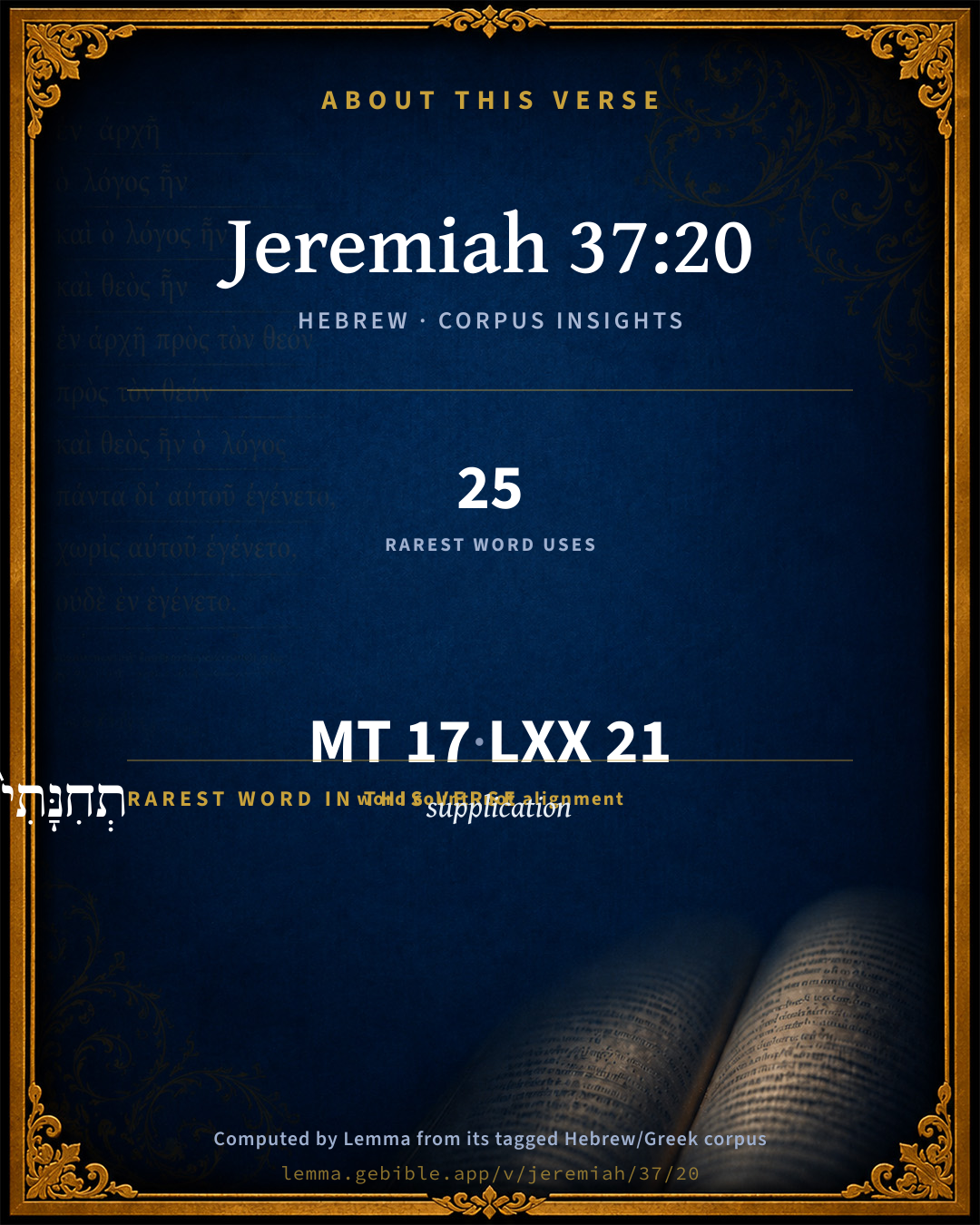
The rarest word here is תְחִנָּתִי֙ supplication H8467 — appearing just 25 times in the whole Hebrew Bible.

Shared distinctive vocabulary

תְחִנָּתִי֙ supplication H8467 occurs in 24 verses of the Hebrew Bible. Also found in:

Grammatical profile

  • 4 verbs
  • 7 nouns
  • 2 adverbs
  • 4 particles

Verb forms

  • שְֽׁמַֽע Qal · Imperative
  • תִּפָּל Qal · Jussive
  • תְּשִׁבֵ֗נִי Hiphil · Jussive
  • אָמ֖וּת Qal · Imperfect

Repetition

A word recurs within this verse — often emphatic in Hebrew:

  • נָ֖א please H4994 ×2

Hebrew & Septuagint length

In the original languages it is 17 Hebrew tokens and 21 Greek tokens — but the two are counted differently (Hebrew bundles its prefixes and suffixes into one token; the Greek is in lemma form), so that isn’t a like-for-like length.

Cross-references

7

Topical passages linked to Jeremiah 37:20 in the Treasury of Scripture Knowledge — connected by theme and wording, ordered by reader-vote popularity; previews shown in the World English Bible.

  • Jeremiah 36:7 It may be they will present their supplication before Yahweh, and will return everyone from his evil way; for great is the anger and the wrath that Yahweh has pronounced against this people.
  • Jeremiah 26:15 Only know for certain that, if you put me to death, you will bring innocent blood on yourselves, and on this city, and on the inhabitants of it; for of a truth Yahweh has sent me to you to speak all these words in your ears.
  • Jeremiah 38:6–9 Then took they Jeremiah, and cast him into the dungeon of Malchijah the king's son, that was in the court of the guard: and they let down Jeremiah with cords. In the dungeon there was no water, but mire; and Jeremiah sank in the mire.
  • Jeremiah 38:26 then you shall tell them, I presented my supplication before the king, that he would not cause me to return to Jonathan's house, to die there.
  • Acts 23:16–22 But Paul's sister's son heard of their lying in wait, and he came and entered into the barracks and told Paul.
  • Acts 25:10–11 But Paul said, "I am standing before Caesar's judgment seat, where I ought to be tried. I have done no wrong to the Jews, as you also know very well.
  • Acts 28:18–19 who, when they had examined me, desired to set me free, because there was no cause of death in me.

Cross-references courtesy of OpenBible.info (CC BY 4.0).

Hebrew and Greek witnesses Masoretic Hebrew ↔ Greek Septuagint

The same verse in the two great witnesses to the Old Testament, shown verse-for-verse.

These are two independent witnesses, not word-aligned to each other, and the Septuagint is shown in lemma (dictionary) form.

Hebrew Jeremiah 37:20 Masoretic · Westminster Leningrad Codex

וְעַתָּ֕ה שְֽׁמַֽע נָ֖א אֲדֹנִ֣י הַמֶּ֑לֶךְ תִּפָּל נָ֤א תְחִנָּתִי֙ לְפָנֶ֔יךָ וְאַל תְּשִׁבֵ֗נִי בֵּ֚ית יְהוֹנָתָ֣ן הַסֹּפֵ֔ר וְלֹ֥א אָמ֖וּת שָֽׁם

Now please hear, my lord the king: please let my supplication be presented before you, that you not cause me to return to the house of Jonathan the scribe, lest I die there.

World English Bible · Public Domain

Greek LXX Structure differs

In the Septuagint, Jeremiah is about an eighth shorter than the Hebrew and arranges its material differently — the Oracles Against the Nations (Hebrew chapters 46–51) appear in the middle of the Greek book, after 25:13. Because the chapter and verse boundaries do not line up, a verse-for-verse comparison with the Hebrew is not shown.

A verse-for-verse comparison isn’t shown here because the chapters and verses don’t line up. Switch to the LXX edition with the MT / LXX toggle above to read the Greek directly.

On this verse, Haydock's Catholic Bible Commentary discusses the Septuagint’s reading. Read the note in Commentary ↓

Hebrew: Westminster Leningrad Codex (CC BY 4.0). Greek: Septuagint (public domain); English from a public-domain English Septuagint. How the Septuagint differs from the Hebrew →

Targum (Aramaic paraphrase)

1

The Targum is the ancient Jewish Aramaic paraphrase of the Hebrew Scriptures — an interpretive translation, not the Hebrew text itself. Onkelos (literal) and Pseudo-Jonathan (expansive) render the Torah, and Jonathan the Prophets. Coverage is partial: where no permissively-licensed English translation exists for a verse, only the Aramaic is shown. This is verse-level text, not a word-by-word alignment to the Hebrew.

  1. Targum Jonathan Prophets (Joshua–Malachi)
    וּכְעַן שְׁמַע כְּעַן רִבּוֹנִי מַלְכָּא תִּתְקַבֵּיל כְּעַן בָּעוּתִי קֳדָמָךְ וְלָא תְתִיבִינַנִי לְבֵית יְהוֹנָתָן סַפְרָא וְלָא אֵימוּת תַּמָן:

    (no public-domain English translation for this verse)

    Targum Jonathan — Aramaic: “Mikraot Gedolot” (public domain). English: “Sefaria Community Translation” (CC0 1.0 (public-domain dedication)); “London "Chaldee Paraphrase," 1871” (public domain). Text via Sefaria.

Commentary

Notes on Jeremiah 37:20 from classic Christian and Jewish commentators (each source and its license shown beneath its notes). The classic Christian expositions comment on the surrounding passage and are grouped to its opening verse, so a note may address several verses; the Jewish commentaries on the Tanakh (Rashi and others) are per-verse, so they appear only where the commentator wrote on this verse.

Lemma curates 59 commentaries, every one of them public domain or Creative Commons licensed, each selected and text-cleaned for this edition rather than reprinted as found. About our sources →

Trapp's Complete Commentary

John Trapp

Jer 37:20 Therefore hear now, I pray thee, O my lord the king: let my supplication, I pray thee, be accepted before thee; that thou cause me not to return to the house of Jonathan the scribe, lest I die there.

Ver. 20. Therefore hear now I pray thee, O my lord the king.] As stout as he was and impartial in delivering God’s message, in supplicating for himself he is very submiss and humble to his sovereign, not daring to "speak evil of dignities," though he had wrongfully suffered much from them.

John Trapp, A Commentary or Exposition upon All the Books of the Old and New Testament (1647–1656) — public domain. Text from a community e-Sword module.

Geneva Bible (1599)

Geneva Bible translators

Hebrew, fall.

Geneva Bible (1599) marginal notes — public domain. Text via Bolls.life.

Jamieson, Fausset & Brown

Robert Jamieson, A. R. Fausset & David Brown

be accepted--rather, "Let my supplication be humbly presented" (see on Jer 36:7), [HENDERSON].

lest I die there--in the subterranean dungeon (Jer 37:16), from want of proper sustenance (Jer 37:21). The prophet naturally shrank from death, which makes his spiritual firmness the more remarkable; he was ready to die rather than swerve from his duty [CALVIN].

Jamieson, Fausset & Brown — Commentary Critical and Explanatory on the Whole Bible (1871) — public domain (CC PDM 1.0). Text via the HelloAO Bible API.

Adam Clarke's Commentary

Verse 20. Cause me not to return to the house of Jonathan] He had been ill used in this man's custody, so as to endanger his life, the place being cold, and probably unhealthy.

Adam Clarke's Commentary on the Bible (1810–1826) — public domain. Text from a community e-Sword/MySword module.

John Calvin's Commentaries

This verse shews that Jeremiah was not destitute of human feelings, for he, as other men, dreaded death. But yet he could so control himself, that no fear made him to turn aside from his duty. Fear, then, did not dishearten him, as the boldness which we have noticed was a manifest proof of his constancy. The Prophet therefore overcame, as to his work, every anxiety and the fear of death; and yet he did not disregard his life, but sought, as far as he could, deliverance from his evils. He asked for some alleviation from the king. We hence see that the Prophets were not logs of wood, nor had iron hearts; but though subject to human feelings, yet they elevated themselves to an invincible courage as to their work, so as to fulfill their office.

As to the words, Let my prayer fall before thee, they mean a humble supplication; it is a mode of expression derived, as we have before seen, from what was done by men in prostrating themselves in prayer, and is transferred here from God to mortals. The Prophet then humbly asked, that he might not be cast again into that horrid prison where he had been confined — and why? that he might not die We see that he shunned death, for this was natural; and yet he was prepared to die, whenever necessary, rather than to turn aside in the least from discharging the duty imposed on him by God.

John Calvin's Commentaries (1540-1563) — public domain. Text from the Calvin Translation Society English edition (1840s-50s) via the Christian Classics Ethereal Library (ccel.org). Calvin's coverage is partial (roughly two-thirds of the Bible); uncommented books and verses are honest gaps, never fabricated. The 19th-century editor's footnotes and remarks are omitted so the notes are faithfully Calvin's own voice.

Ellicott's Commentary for English Readers

(20) That thou cause me not to return to the house of Jonathan the scribe . . .—The petition shows the cruelty with which the prophet had been treated. Half-starved, and thrust into a foul and fœtid dungeon, he felt that to return to it would be death.

A Bible Commentary for English Readers, edited by Charles John Ellicott (1878–1897) — public domain. Text from a community e-Sword module.

The Cambridge Bible for Schools and Colleges

gen. ed. J. J. S. Perowne

20. be accepted] lit. fall. See on Jer_36:7.

The Cambridge Bible for Schools and Colleges (gen. ed. J. J. S. Perowne; Cambridge University Press, 1878–1918) — public domain. Text from a community e-Sword module.

John Gill's Exposition

Therefore hear now, one pray thee, O my lord the king,.... When the prophet spoke in the name of the Lord, and the words of the Lord, it was with great boldness and majesty; but when he spoke for himself, and on his own behalf, it was with great submission, as it became a subject to his king; and whom he owns as his sovereign lord, though a wicked prince, and whose destruction he knew was at hand:

let my supplication be accepted before thee; or, "fall before thee": see Jer 36:7; which was as follows:

that thou cause me not to return to the house of Jonathan the scribe; but that he might be discharged from his confinement; or however be removed into another prison, not so uncomfortable and disagreeable as this man's house or prison was; and which perhaps was still the worse through his cruel and ill natured carriage to him; and which all together endangered his life: wherefore he adds,

lest I die there; for though he had continued there many days, yet the place was so exceedingly noisome, that he thought he could not long continue there, was he remanded back to it.

John Gill's Exposition of the Whole Bible (1746–1763) — public domain (CC PDM 1.0). Text via the HelloAO Bible API.

Haydock's Catholic Bible Commentary

Entry, where he had been already, chap. xxxii. 1., and xxxiv. 1, 7. --- Piece. Roll, sufficient for a day’s maintenance. (Calmet) --- Protestants, "a piece of bread (Septuagint, a loaf) out of the baker’s street." (Haydock)

George Leo Haydock (1774–1849), Haydock's Catholic Family Bible and Commentary, 1859 edition — public domain. Excludes Psalms (Douay-Rheims chapter numbering differs from Protestant) and Deuterocanonical books (Catholic canon only).

Matthew Poole's English Annotations

Though Jeremiah had dealt very faithfully with the king and princes, and they had dealt very hardly and cruelly with him, casting him for no just cause into a nasty prison, and Jeremiah knew well enough that Zedekiah was very soon to be disarmed of his power; yet (to learn us our duty) he speaks with all due respect and reverence to his sovereign, though a very bad man, and one who had dealt very ill with him. This petition of Jeremiah speaks the prison he was in was in a very inconvenient place, where he was in danger of his life.

Matthew Poole's English Annotations on the Holy Bible (1683–1685) — public domain. Text from a community e-Sword/MySword module.

The Pulpit Commentary

"Out of weakness made strong. This verse an utterance, not of a sturdy invincible soul, but one of a gentle, shrinking, and often timid nature. Note

I THE PROPHET JEREMIAH belonged to the company of those who, out of weakness, God has made strong.

1. By nature and temperament he was the reverse of strong. Proof in this verse. Suffering was ever terrible to him. Hence he piteously pleads for the king"s help. And passim we have indications of the gentleness of his nature Jer_1:6, "Ah, Lord, I cannot;" and homily on Jer_4:19-30, "The fellowship of Christ"s sufferings, (vol. 1. p. 100). But:

2. Notwithstanding this, see how strong he became. When it came to the test, how he endured! (cf. Jer_1:10, Jer_1:17, Jer_1:18) Nothing would induce him to alter his word towards the king, the prophets, and the people generally. He softened not one line of his message, although it would have been so much to his advantage to have done so. Now

II THIS IS THE GLORY OF GOD"S GRACE ALWAYS. There will be glory by and by, an outward glory on every child of God. "Eye hath not seen," etc. But the present glory of God"s grace is this, that out of weakness it makes its recipients strong. See what it did for the apostles, and especially for St. Peter they the recreants and the denier of the Lord, but afterwards his valiant and undaunted witnesses. And grace has done the same for not a few in prospect of suffering and trial from which beforehand they would have utterly shrunk away. Women and children were amongst the number of the martyrs; and in the moral martyrdoms of this softer age they are so still. God strengthens his servants "with might by his Spirit in the inner man? And this is the glory of his grace. Not the numbers of the Church, nor her wealth, rank, gifts, or aught of such sort, but the spiritual strength that characterizes her. "I can do all things," said St. Paul, "through Christ which strengtheneth me." And it will be so yonder in the better world hereafter. The glory of that day will not be the golden streets, the gates of pearl, the foundations of precious stones; not the vast throng of the redeemed, nor aught that belongs only to their circumstances, happy as they will be; but it will be the character of them all. And this will be their security also. The defences of that condition of the redeemed will not be outward, but inward. They, having been strengthened with might by the Spirit of God in the inner man, will have come to be rooted like the giant oak, which no tempest can uproot from the ground and grounded like the deep-laid foundation of the temple, which naught can overthrow in love, and so Christ will dwell in their hearts. Yes, their glory will be their defence also.

CONCLUSION. Seek, therefore, this grace of Divine strength. Bow your "knees to the God and Father of our Lord Jesus Christ," that, "according to the riches of his glory," he would grant you this. Then, though weak and wavering by nature, steadiness and strength shall be given to your will, your heart, and so God will make you as he did his prophet as "a defenced city, an iron pillar, a brazen wall". C. (Jer_1:18)

The Pulpit Commentary (1880–1919), ed. H.D.M. Spence-Jones & Joseph S. Exell — public domain. Text from a community e-Sword module.

Lesson kit

Teaching starters — assembled from the data on this page, not authored interpretation. Every prompt links to the verse data it draws on. Edit before teaching.

Jeremiah, in the Prophets, opens this verse with 17 words (16 distinct Hebrew lemmas). Its most distinctive word is tᵉchinnâh (“supplication”). A historical commentator’s framing appears above. Read the whole chapter for the surrounding context.

Discussion questions

  1. How does “supplication” (tᵉchinnâh) shape what this verse is saying?
  2. How does Joshua 11:20, which shares the word «supplication», read alongside this verse?
  3. What does the repetition of “please” (2× in this one verse) do in this verse?
  4. These translations render this verse differently. What is at stake in choosing one wording over another?
  5. «שְֽׁמַֽע» is a Qal Imperative verb. How does that grammatical form shape the action described?
  6. Compare how Trapp's Complete Commentary and Geneva Bible (1599) read this verse. Where do they agree or differ?

Things to notice

Reading settings

Reading text

Shown beneath each verse's original-language words.

Old Testament
Old Testament edition

Read the OT as the Masoretic Hebrew (MT) or the Greek Septuagint (LXX).

English shown for the Greek Septuagint (in the Hebrew ↔ Greek comparison).

Comparing translations? Open the Compare panel on any verse page to stack up to four side by side.