Numbers 13:27

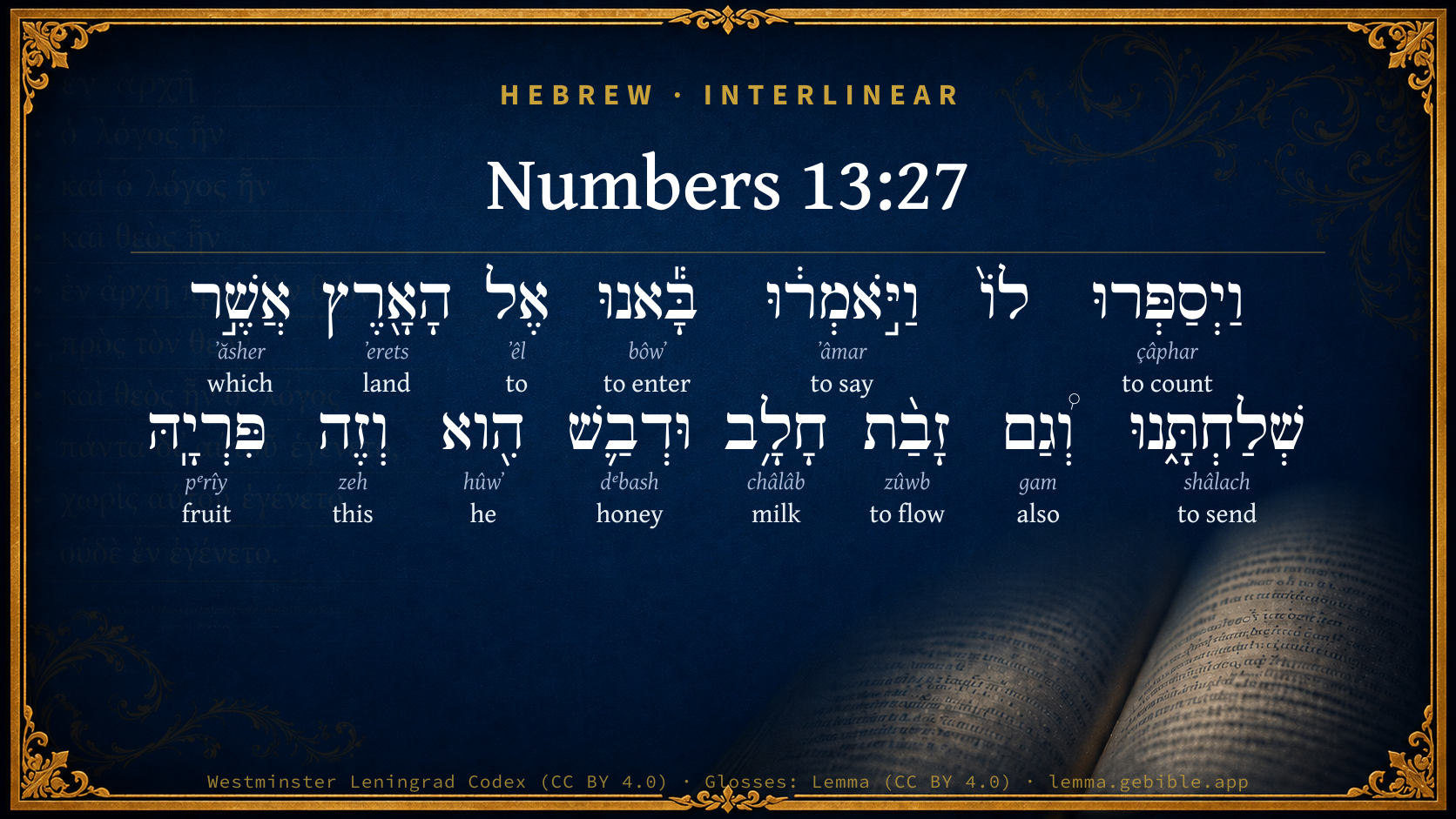
Hebrew (Westminster Leningrad Codex) Numbers 13:27 appears in the Hebrew Old Testament. The text above is from the Westminster Leningrad Codex. Each word links to its Strong’s number, a concise gloss, and parsing drawn from the Open Scriptures Hebrew Bible morphology. Click any word for its full Brown-Driver-Briggs (BDB) entry.
Download image
Cite this verse

Numbers 13:27 (World English Bible). Public Domain. Lemma interlinear Bible study tool, https://lemma.gebible.app/v/numbers/13/27.

Show BibTeX & RIS
BibTeX
RIS
English Translation
They told him, and said, We came to the land where you sent us; and surely it flows with milk and honey; and this is the fruit of it.
World English Bible · Public Domain
Download a study sheet

One document with this verse’s original text, its word-by-word gloss line, the meaning frame, cross-references with their text, attributed commentary, and full source and license credits — printable, and it pastes into notes with its structure intact.

This verse Autodidact and up

Study sheet (.html) Plain text (.txt)

A passage Seminary Student

Up to 50 verses in one chapter. A passage sheet keeps up to 6 commentary sources and 12 cross-references per verse, in the order this page ranks them, and says so on the sheet whenever that leaves anything out. Ask for a single verse and you get the Autodidact verse sheet above.

Everything on this page stays free to read, with no account — the sheet is a download of what is already on screen, not access to it.

Want to remove ads? Support Godless Engineer
Compare translations 3

The same verse in 3 English versions, stacked beneath the original-language interlinear above. Click any original word for its lexicon entry.

Each is an independent rendering of the whole verse — the interlinear is not word-aligned to these translations.

Highlighted words mark where these versions differ — a whole-verse word diff, not a word-by-word alignment.

  • World English Bible Public Domain
    They told him, and said, We came to the land where you sent us; and surely it flows with milk and honey; and this is the fruit of it.
  • King James Version Public Domain
    And they told him, and said, We came unto the land whither thou sentest us, and surely it floweth with milk and honey; and this is the fruit of it.
  • unfoldingWord Literal Text CC BY-SA 4.0
    and they recounted to him, and they said, “We went to the land where you sent us, and indeed it is flowing milk and honey, and this its fruit.

unfoldingWord Literal Text — © unfoldingWord, licensed CC BY-SA 4.0. Word-aligned USFM3 via Door43 (git.door43.org/unfoldingWord/en_ult).

Versions to compare (up to 4)

3 of 4 selected

Show all 18 translations

Every available English version of this verse, each an independent rendering of the whole verse.

  • World English Bible Public Domain
    They told him, and said, We came to the land where you sent us; and surely it flows with milk and honey; and this is the fruit of it.
  • Berean Standard Bible Public Domain
    And they gave this account to Moses: “We went into the land to which you sent us, and indeed, it is flowing with milk and honey. Here is some of its fruit!
  • Majority Standard Bible Public Domain
    And they gave this account to Moses: “We went into the land to which you sent us, and indeed, it is flowing with milk and honey. Here is some of its fruit!
  • King James Version Public Domain
    And they told him, and said, We came unto the land whither thou sentest us, and surely it floweth with milk and honey; and this is the fruit of it.
  • American Standard Version (1901) Public Domain
    And they told him, and said, We came unto the land whither thou sentest us; and surely it floweth with milk and honey; and this is the fruit of it.
  • Revised Version (1885) Public Domain
    And they told him, and said, We came unto the land whither thou sentest us, and surely it floweth with milk and honey; and this is the fruit of it.
  • Geneva Bible (1599) Public Domain
    And they went and came to Moses and to Aaron and vnto al the Congregation of the children of Israel, in the wildernesse of Paran, to Kadesh, and brought to the, and to all the Congregation tydings, and shewed them the fruite of the lande.
  • Douay-Rheims (1899) Public Domain
    And came to Moses and Aaron and to all the assembly of the children of Israel to the desert of Pharan, which is in Cades. And speaking to them and to all the multitude, they shewed them the fruits of the land:
  • Young's Literal Translation Public Domain
    And they recount to him, and say, `We came in unto the land whither thou hast sent us, and also it `is' flowing with milk and honey -- and this `is' its fruit;
  • Literal Standard Version CC BY-SA 4.0
    And they recount to him, and say, “We came to the land to where you have sent us, and it is indeed flowing with milk and honey—and this [is] its fruit;
  • Unlocked Literal Bible CC BY-SA 4.0
    They told Moses, “We reached the land to which you sent us. It certainly flows with milk and honey. Here is some produce from it.
  • unfoldingWord Literal Text CC BY-SA 4.0
    and they recounted to him, and they said, “We went to the land where you sent us, and indeed it is flowing milk and honey, and this its fruit.
  • Darby Bible Public Domain
    And they told him, and said, We came to the land to which thou didst send us, and surely it floweth with milk and honey; and this is the fruit of it.
  • World Messianic Bible Public Domain
    They told him, and said, “We came to the land where you sent us. Surely it flows with milk and honey, and this is its fruit.
  • Webster's Bible Public Domain
    And they told him, and said, We came to the land whither thou sentest us, and surely it floweth with milk and honey; and this is the fruit of it.
  • Free Bible Version CC BY-SA 4.0
    This is the report they gave to Moses: “We went and explored the country you sent us to, and it is definitely very productive, as if it was flowing with milk and honey. Just look at some of its fruit!
  • Bible in Basic English Public Domain
    And they said, We came to the land where you sent us, and truly it is flowing with milk and honey: and here is some of the produce of it.
  • JPS Tanakh (1917) Public Domain
    And they told him, and said: 'We came unto the land whither thou sentest us, and surely it floweth with milk and honey; and this is the fruit of it.

Literal Standard Version (2020), Covenant Press — licensed CC BY-SA 4.0. Text via the HelloAO Bible API (eBible.org). Unlocked Literal Bible (unfoldingWord) — licensed CC BY-SA 4.0. Text via the HelloAO Bible API (eBible.org). unfoldingWord Literal Text — © unfoldingWord, licensed CC BY-SA 4.0. Word-aligned USFM3 via Door43 (git.door43.org/unfoldingWord/en_ult). Free Bible Version, Dr. Jonathan Gallagher — licensed CC BY-SA 4.0. Text via the HelloAO Bible API (eBible.org).

Word by word

More ways to search: Search by grammar → Find every occurrence → Compare this word →

Practice this passage: Drill this verse → Learn its vocabulary →

זָבַ֨ת
zûwb
H2100
“flowing”
Verb, Qal, Participle Active, Feminine, Singular, Construct
Part of Speech
Verb
Stem
Qal
Form
Participle Active
Gender
Feminine
Number
Singular
State
Construct
Full BDB Definition

Origin: a primitive root

TWOT: 534

to flow, gush, issue, discharge - (Qal) - to flow, gush - to die, pine away (figuratively) - to flow (of issue from woman), have an issue, flux - flowing (participle)
  1. וַיְסַפְּרוּ çâphar H5608 “and · to count” Conjunction + Verb, Piel, Sequential Imperfect, 3rd Person, Masculine, Plural
  2. וַיֹּ֣אמְר֔וּ ʼâmar H559 “and · to say” Conjunction + Verb, Qal, Sequential Imperfect, 3rd Person, Masculine, Plural
  3. בָּ֕אנוּ bôwʼ H935 “to enter” Verb, Qal, Perfect, 1st Person, Common, Plural
  4. אֶל ʼêl H413 “to” Preposition
  5. הָאָ֖רֶץ ʼerets H776 “the · land” Particle, Definite Article + Noun, Common, Both, Singular, Absolute
  6. אֲשֶׁ֣ר ʼăsher H834 “which” Particle, Relative
  7. שְׁלַחְתָּ֑נוּ shâlach H7971 “to send · us” Verb, Qal, Perfect, 2nd Person, Masculine, Singular + Suffix, Personal, 1st Person, Common, Plural
  8. וְ֠גַם gam H1571 “and · also” Conjunction + Particle, Accusative
  9. חָלָ֥ב châlâb H2461 “milk” Noun, Common, Masculine, Singular, Absolute
  10. וּדְבַ֛שׁ dᵉbash H1706 “and · honey” Conjunction + Noun, Common, Masculine, Singular, Absolute
  11. הִ֖וא hûwʼ H1931 “he” Pronoun, Personal, 3rd Person, Feminine, Singular
  12. וְזֶה zeh H2088 “and · this” Conjunction + Pronoun, Demonstrative, Masculine, Singular
  13. פִּרְיָֽהּ pᵉrîy H6529 “fruit · her” Noun, Common, Masculine, Singular, Construct + Suffix, Personal, 3rd Person, Feminine, Singular

About this verse

These counts appear in no published source. They are computed here, from the morphology-tagged text and Lemma’s own curated glosses. What Lemma adds →

15
words
14
distinct lemmas
Pentateuch
section

Shared distinctive vocabulary

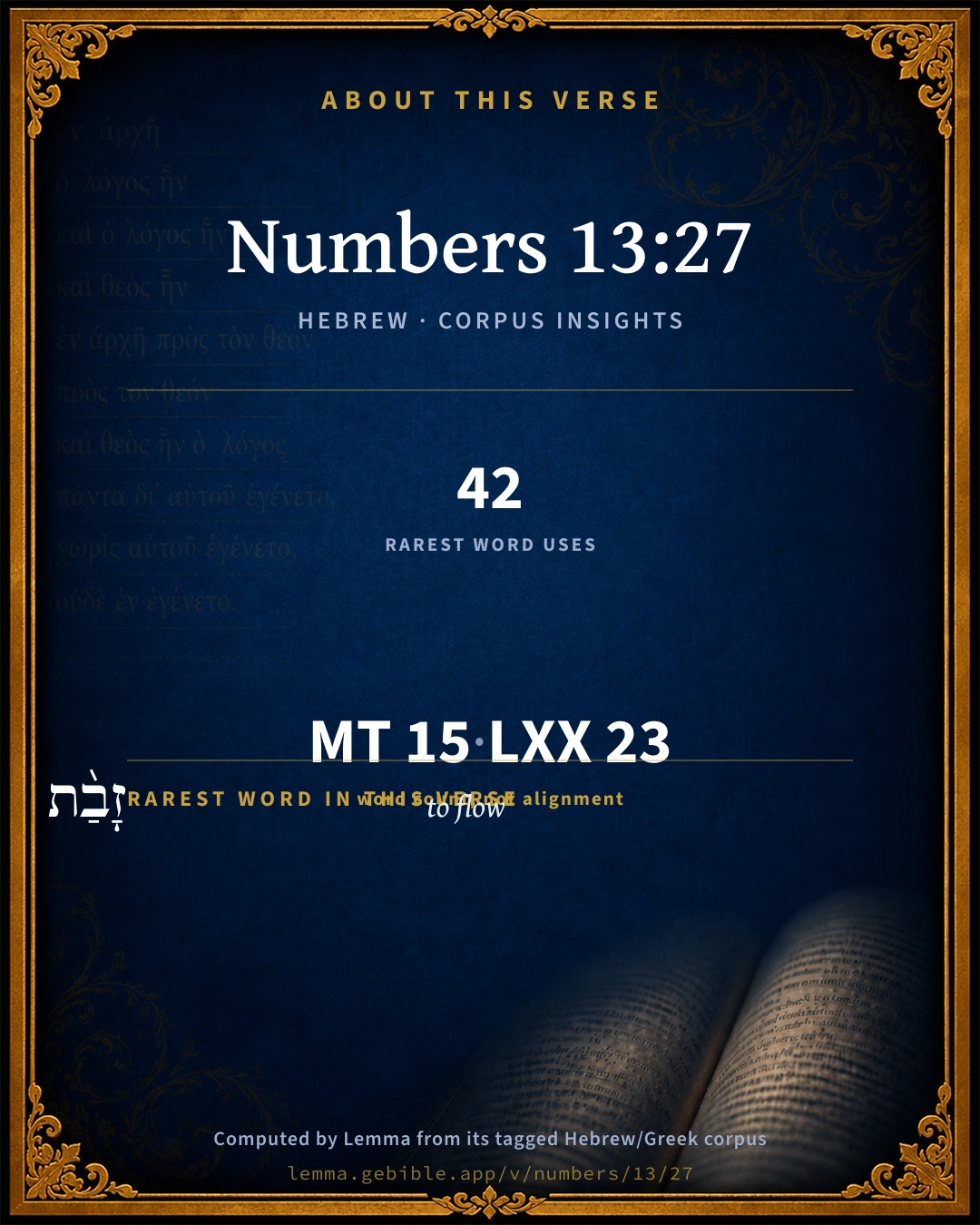
זָבַ֨ת to flow H2100 occurs in 41 verses of the Hebrew Bible. Also found in:

Grammatical profile

  • 5 verbs
  • 4 nouns
  • 2 pronouns
  • 2 prepositions
  • 2 particles

Verb forms

  • וַיְסַפְּרוּ Piel · Sequential Imperfect
  • וַיֹּ֣אמְר֔וּ Qal · Sequential Imperfect
  • בָּ֕אנוּ Qal · Perfect
  • שְׁלַחְתָּ֑נוּ Qal · Perfect
  • זָבַ֨ת Qal · Participle Active

Hebrew & Septuagint length

In English translation the verse runs 29 words from the Hebrew and 43 from the Septuagint (LXX English) — the Septuagint runs noticeably longer here. See the side-by-side →

A rough comparison of the two English renderings, which tokenize alike — not a word-level alignment.

Word counts can differ between the Hebrew and the Greek without any difference in meaning — e.g. the Hebrew direct-object marker אֵת has no separate Greek word, and Greek often adds the article ὁ.

In the original languages it is 15 Hebrew tokens and 23 Greek tokens — but the two are counted differently (Hebrew bundles its prefixes and suffixes into one token; the Greek is in lemma form), so that isn’t a like-for-like length.

Cross-references

18

Topical passages linked to Numbers 13:27 in the Treasury of Scripture Knowledge — connected by theme and wording, ordered by reader-vote popularity; previews shown in the World English Bible.

  • Exodus 3:8 I have come down to deliver them out of the hand of the Egyptians, and to bring them up out of that land to a good and large land, to a land flowing with milk and honey; to the place of the Canaanite, the Hittite, the Amorite, the Perizzite, the Hivite, and the Jebusite.
  • Exodus 3:17 and I have said, I will bring you up out of the affliction of Egypt to the land of the Canaanite, the Hittite, the Amorite, the Perizzite, the Hivite, and the Jebusite, to a land flowing with milk and honey."'
  • Exodus 13:5 It shall be, when Yahweh shall bring you into the land of the Canaanite, and the Hittite, and the Amorite, and the Hivite, and the Jebusite, which he swore to your fathers to give you, a land flowing with milk and honey, that you shall keep this service in this month.
  • Exodus 33:3 to a land flowing with milk and honey: for I will not go up in the midst of you, for you are a stiff-necked people, lest I consume you in the way."
  • Deuteronomy 1:25–33 They took of the fruit of the land in their hands, and brought it down to us, and brought us word again, and said, It is a good land which Yahweh our God gives to us.
  • Deuteronomy 26:9 and he has brought us into this place, and has given us this land, a land flowing with milk and honey.
  • Deuteronomy 31:20 For when I shall have brought them into the land which I swore to their fathers, flowing with milk and honey, and they shall have eaten and filled themselves, and grown fat; then will they turn to other gods, and serve them, and despise me, and break my covenant.
  • Numbers 14:8 If Yahweh delight in us, then he will bring us into this land, and give it to us; a land which flows with milk and honey.
  • Deuteronomy 6:3 Hear therefore, Israel, and observe to do it; that it may be well with you, and that you may increase mightily, as Yahweh, the God of your fathers, has promised to you, in a land flowing with milk and honey.
  • Deuteronomy 11:9 and that you may prolong your days in the land, which Yahweh swore to your fathers to give to them and to their seed, a land flowing with milk and honey.
  • Deuteronomy 26:11–15 and you shall rejoice in all the good which Yahweh your God has given to you, and to your house, you, and the Levite, and the foreigner who is in the midst of you.
  • Deuteronomy 27:3 and you shall write on them all the words of this law, when you are passed over; that you may go in to the land which Yahweh your God gives you, a land flowing with milk and honey, as Yahweh, the God of your fathers, has promised you.
  • Leviticus 20:24 But I have said to you, "You shall inherit their land, and I will give it to you to possess it, a land flowing with milk and honey." I am Yahweh your God, who has separated you from the peoples.
  • Joshua 5:6 For the children of Israel walked forty years in the wilderness, until all the nation, even the men of war who came forth out of Egypt, were consumed, because they didn't listen to the voice of Yahweh: to whom Yahweh swore that he wouldn't let them see the land which Yahweh swore to their fathers that he would give us, a land flowing with milk and honey.
  • Jeremiah 11:5 that I may establish the oath which I swore to your fathers, to give them a land flowing with milk and honey, as at this day. Then answered I, and said, Amen, Yahweh.
  • Jeremiah 32:22 and gave them this land, which you did swear to their fathers to give them, a land flowing with milk and honey;
  • Ezekiel 20:6 in that day I swore to them, to bring them forth out of the land of Egypt into a land that I had searched out for them, flowing with milk and honey, which is the glory of all lands.
  • Ezekiel 20:15 Moreover also I swore to them in the wilderness, that I would not bring them into the land which I had given them, flowing with milk and honey, which is the glory of all lands;

Cross-references courtesy of OpenBible.info (CC BY 4.0).

Hebrew and Greek witnesses Masoretic Hebrew ↔ Greek Septuagint

The same verse in the two great witnesses to the Old Testament, shown verse-for-verse.

Here the Septuagint runs noticeably longer than the Hebrew — LXX2012 (modern English Septuagint) 43 words vs World English Bible 29. A rough length comparison of the two English translations, not a word-level alignment — read both below.

These are two independent witnesses, not word-aligned to each other, and the Septuagint is shown in lemma (dictionary) form.

Hebrew Numbers 13:27 Masoretic · Westminster Leningrad Codex

וַיְסַפְּרוּ לוֹ֙ וַיֹּ֣אמְר֔וּ בָּ֕אנוּ אֶל הָאָ֖רֶץ אֲשֶׁ֣ר שְׁלַחְתָּ֑נוּ וְ֠גַם זָבַ֨ת חָלָ֥ב וּדְבַ֛שׁ הִ֖וא וְזֶה פִּרְיָֽהּ

They told him, and said, We came to the land where you sent us; and surely it flows with milk and honey; and this is the fruit of it.

World English Bible · Public Domain

Greek LXX Numbers 13:27 Septuagint · lemma form

καί διαἡγέομαι αὐτός καί εἶπον ἔρχομαι εἰς ὁ γῆ εἰς ὅς ἀποστέλλω ἐγώ γῆ ῥέω γάλα καί μέλι καί οὗτος ὁ καρπός αὐτός

And they proceeded and came to Moses and Aaron and all the congregation of the children of Israel, to the wilderness of Pharan Cades; and they brought word to them and to all the congregation, and they showed the fruit of the land:

LXX2012 (modern English Septuagint) · Public Domain

Hebrew: Westminster Leningrad Codex (CC BY 4.0). Greek: Septuagint (public domain); English from LXX2012 (modern English Septuagint) (Public Domain). How the Septuagint differs from the Hebrew →

Targum (Aramaic paraphrase)

2

The Targum is the ancient Jewish Aramaic paraphrase of the Hebrew Scriptures — an interpretive translation, not the Hebrew text itself. Onkelos (literal) and Pseudo-Jonathan (expansive) render the Torah, and Jonathan the Prophets. Coverage is partial: where no permissively-licensed English translation exists for a verse, only the Aramaic is shown. This is verse-level text, not a word-by-word alignment to the Hebrew.

  1. Targum Onkelos Torah (Genesis–Deuteronomy)
    וְאִשְׁתָּעִיאוּ לֵהּ וַאֲמָרוּ אֲתֵינָא לְאַרְעָא דִי שְׁלַחְתָּנָא וְאַף עַבְדָא חֲלַב וּדְבַשׁ הִיא וְדֵין אִבַּהּ

    (no public-domain English translation for this verse)

    Targum Onkelos — Aramaic: “Onkelos Genesis” (public domain); “Onkelos Exodus” (public domain); “Onkelos Leviticus” (public domain); “Onkelos Numbers” (public domain); “Onkelos Deuteronomy” (public domain). English: “Sefaria Community Translation” (CC0 1.0 (public-domain dedication)); “J.W. Etheridge. The Targums of Onkelos and Jonathan Ben Uzziel on the Pentateuch. London: Longmans, Green, 1862” (public domain). Text via Sefaria.

  2. Targum Pseudo-Jonathan Torah (Genesis–Deuteronomy)
    וְאִשְׁתָּעִיוּ לֵיהּ וְאָמָרוּ אָתָאנָא לְאַרְעָא דְשָׁדַרְתָּנָא וְאוּף עַבְדָא חֲלַב וּדְבָשׁ הִיא וְדֵין אִבָּהּ

    And they recounted to him, and said: We went into the country to which thou didst send us; and it indeed produceth milk and honey, and this is the fruit of it.

    Targum Pseudo-Jonathan — Aramaic: “Targum Jonathan on Genesis” (public domain); “Targum Jonathan on Exodus” (public domain); “Targum Jonathan on Leviticus” (public domain); “Targum Jonathan on Numbers” (public domain); “Targum Jonathan on Deuteronomy” (public domain). English: “The Targum of Jonathan ben Uzziel, trans. J. W. Etheridge, London, 1862” (public domain). Text via Sefaria.

Commentary

Notes on Numbers 13:27 from classic Christian and Jewish commentators (each source and its license shown beneath its notes). The classic Christian expositions comment on the surrounding passage and are grouped to its opening verse, so a note may address several verses; the Jewish commentaries on the Tanakh (Rashi and others) are per-verse, so they appear only where the commentator wrote on this verse.

Lemma curates 59 commentaries, every one of them public domain or Creative Commons licensed, each selected and text-cleaned for this edition rather than reprinted as found. About our sources →

Trapp's Complete Commentary

John Trapp

Num 13:27 And they told him, and said, We came unto the land whither thou sentest us, and surely it floweth with milk and honey; and this [is] the fruit of it.

Ver. 27. And this is the fruit of it.] Plutarch {a} tells of the Gauls, that after they had once a taste of the sweet wine of the grapes that grew in Italy, they inquired in what country such sweet wine was: and after they had understood where such grapes grew, they would never be at rest, till they had got that country. Sextus Rufus, writing of Cyprus, saith, Cyprus famosa divitiis, paupertatem populi Rom. ut occuparetur, solicitavit, Cyprus by her wealth tempted the Romans to seize it into their hands. The pearls usually cast out with the flood, and gathered with the ebb, drew Caesar’s affection for the conquest of Britain, as Suetonius {b} saith: God hath given us here a grape of the heavenly Canaan, to edge our desires.

{a} In Vita Camilli.

{b} In Vita Caesar.

John Trapp, A Commentary or Exposition upon All the Books of the Old and New Testament (1647–1656) — public domain. Text from a community e-Sword module.

The Biblical Illustrator

Joseph S. Exell

Num_13:27

It floweth with milk and honey.

A land flowing with milk and honey

The idea suggested is, that the true disciples of the Lord Jesus are expected to show to the world some illustration of the nature of the heavenly country to which they are journeying. In a sense they have been there, and have come back. But in what sense?

1. The idea with many persons is, that the future condition of man is so completely different from this, that it is out of the question to attempt to form a conception of it. Now, it is true, St. Paul tells us, that eye hath not seen, nor ear heard, neither have entered into the heart of man, the things which God hath prepared for them that love Him. But it is also true, as the apostle goes on to say, that God hath revealed them unto us by His Spirit. Some people, then, are in a position to understand what the heavenly kingdom is like. They have true ideas about it--foretastes. In fact, heaven is really the expansion of a life begun here below. He that hath the Son hath life.

2. What, then, has the true disciple to show as specimens of the produce of this unseen and unknown country? Briefly, the character of Christ reproduced in him, by the power of the Holy Spirit. It is faintly, imperfectly reproduced; still it is reproduced (see 2Co_1:21, Hath Christed us). There is the strength which overcometh the world, the peace which passeth understanding, the blessedness of communion with God, the soul-thirst for God ever renewed and ever satisfied.

3. It is by the presentation of these fruits of the land that souls are won. No doubt there are some persons in the world to whom Christ and everything belonging to Christ, are only repulsive; and these will scrutinise the disciple with an unfriendly eye, and rejoice if ever they find, or fancy they find, any inconsistency in his conduct. But there are also many others of a different temper. They are halting between two opinions. They say, not of course in words, but by their feelings and manner, Be Christ to us; let us see in you and through you what the Divine Master is, and how He will treat us if we venture to apply to Him--or, to express it differently, Show us the fruits of the heavenly land, of which you think so much and speak so much. You are amongst us as a citizen of the heavenly city (Php_3:20). Enable us to gather from your conduct what are the characteristics of that noble land, of that bright and glorious companionship.

4. And lastly, what is the practical conclusion to be drawn from the whole subject thus discussed? Surely it is this--that we, who profess to serve the Lord Jesus Christ, should be careful to recognise the responsibility laid upon us to give a good report, like Caleb and Joshua, and not a bad report, like the ten other spies, of the unseen land. We shall give a bad report if our lives are not attractive, and are not consistent. We shall give a good report if our characters glow, even feebly, with the inner light of the life of Christ; and if, by deed as well as by word, we cry, The conflict may be a formidable one, but it is not too formidable; and if we trust as we should do, and may do, that we shall be more than conquerors through Him that loved us. (G. Calthrop, M. A.)

The Biblical Illustrator, edited by Joseph S. Exell (c. 1880s–1900s) — public domain. Text from a community e-Sword module.

Joseph Benson's Commentary

Num 13:27-29. They told him — In the audience of the people. The Amalekites in the south — Where we are to enter the land; and they who were so fierce against us that they came into the wilderness to fight with us, will, without doubt, oppose us when we come close by their land, the rather, to revenge themselves for their former loss. Therefore they mention them, though they were not Canaanites. In the mountains — In the mountainous country, in the south-east part of the land, so that you cannot enter there without great difficulty, both because of the noted strength and valour of those people, and because of the advantage they have from the mountains. By the sea — Not the mid-land sea, which is commonly understood by that expression, but the Salt or Dead sea; as appears, 1st, Because it is that sea which is next to Jordan; 2d, Because the Canaanites dwelt principally in those parts, and not near the mid-land sea. So these guard the entrance on the east side, as the others do on the south.

Joseph Benson's Commentary on the Old and New Testaments (1811–1818) — public domain. Text from a community e-Sword module.

Tyndale Open Study Notes

Tyndale Open Resources

13:27 The Promised Land is often described as a land flowing with milk and honey. Milk and dairy products constituted a major part of the diet in biblical times, and “milk” is used in figurative language for abundance (see Deut 32:14; Isa 55:1; Joel 3:18). Honey provided sweetness (see Pss 19:10; 119:103; Ezek 3:3; Rev 10:9-10). The phrase thus refers to a highly desirable destination, a land with an abundance of food and resources (cp. Num 16:13-14; see also Exod 3:8; Deut 6:3; 26:15; Jer 11:4-5; Ezek 20:6). The New Testament emphasizes the spiritual nature of God’s promises, pointing to a promised inheritance in heaven (see Rom 9:6-8; Gal 6:14-16; Rev 21:1-2).

Tyndale Open Study Notes — © Tyndale Open Resources, licensed CC BY-SA 4.0. Text via the HelloAO Bible API.

Geneva Bible (1599)

Geneva Bible translators

Called also Kadesh Barnea.

Geneva Bible (1599) marginal notes — public domain. Text via Bolls.life.

Jamieson, Fausset & Brown

Robert Jamieson, A. R. Fausset & David Brown

they told him, and said, We came unto the land whither thou sentest us, and surely it floweth with milk and honey--The report was given publicly in the audience of the people, and it was artfully arranged to begin their narrative with commendations of the natural fertility of the country in order that their subsequent slanders might the more readily receive credit.

Jamieson, Fausset & Brown — Commentary Critical and Explanatory on the Whole Bible (1871) — public domain (CC PDM 1.0). Text via the HelloAO Bible API.

Adam Clarke's Commentary

Verse 27. We came unto the land, &c.] It is astonishing that men so dastardly as these should have had courage enough to risk their persons in searching the land. But probably though destitute of valour they had a sufficiency of cunning, and this carried them through. The report they brought was exceedingly discouraging, and naturally tended to produce the effect mentioned in the next chapter. The conduct of Joshua and Caleb was alone magnanimous, and worthy of the cause in which they were embarked.

Adam Clarke's Commentary on the Bible (1810–1826) — public domain. Text from a community e-Sword/MySword module.

John Gill's Exposition

And there we saw the giants,.... Not throughout the land, and yet it is so expressed, and in such connection with what goes before, that it might be so understood, and as they might choose it should; that as there were men everywhere of an uncommon size, and were generally so, there were some larger than they in all places, of a prodigious size, of a gigantic stature; and yet this was only in Hebron where they saw them:

the sons of Anak; whose names are given, Num 13:22; and there were but three of them:

which came of the giants; they, were of the race of giants; for not only Anak their father, but Arba their grandfather was one; Jos 14:15,

and we were in our own sight as grasshoppers; little diminutive creatures in comparison of them; an hyperbolical exaggeration of the greatness of the giants, and of their own littleness:

and so we were in their sight; but this they could not be so certain of, and could only make conjectures by their neglect or supercilious treatment of them. Jarchi makes them to speak of them more diminutively still, as that they heard those giants saying one to another,"there are ants in the vineyards like men.''

Next: Numbers Chapter 14

John Gill's Exposition of the Whole Bible (1746–1763) — public domain (CC PDM 1.0). Text via the HelloAO Bible API.

Haydock's Catholic Bible Commentary

Cades. The desert of Pharan, or of Cades, is the same. (Haydock) --- The town is sometimes called Cades-barne, or Recem, (Chaldean) which is Petra, the capital of the stony Arabia, and lies rather nearer to the Dead Sea than to the Mediterranean. It was on the high road from the Red Sea to Hebron. In one part of the desert of Cades, the people murmured for want of water, chap. xx. 1. But there was plenty near the city. Moses continued here a long time after the return of the spies, Deuteronomy i. 19, 46. (Calmet)

George Leo Haydock (1774–1849), Haydock's Catholic Family Bible and Commentary, 1859 edition — public domain. Excludes Psalms (Douay-Rheims chapter numbering differs from Protestant) and Deuterocanonical books (Catholic canon only).

Matthew Poole's English Annotations

They told him in the audience of the people, as appears from Num 13:30. They craftily begin their relation with commendations, that their following slanders might be more easily believed.

Matthew Poole's English Annotations on the Holy Bible (1683–1685) — public domain. Text from a community e-Sword/MySword module.

Whedon's Commentary on the Bible

Daniel D. Whedon

27. Milk and honey — See Num_14:8, note. Thus far the report of the twelve is unanimous; they all commend the richness and fruitfulness of the soil. It is a common way with calumniators to begin by saying something good of the person or plan they wish to injure and to end by speaking evil of him or that they had first commended.

Daniel D. Whedon (gen. ed.), Commentary on the Old and New Testaments (1874–1909) — public domain. Text from a community e-Sword module.

The Pulpit Commentary

It floweth with milk and honey. According to the promise of God in his first message of deliverance to the people. (see on Exo_3:8)

The Pulpit Commentary (1880–1919), ed. H.D.M. Spence-Jones & Joseph S. Exell — public domain. Text from a community e-Sword module.

John Wesley's Explanatory Notes

They told him - In the audience of the people.

John Wesley, Explanatory Notes Upon the Whole Bible (1754–1765) — public domain. Text via the GEBible commentary corpus.

unfoldingWord translationNotes

Door43 World Missions Community

It certainly flows with milk and honey

"Milk and honey certainly flow there." They spoke of the land being good for animals and plants as if the milk and honey from those animals and plants were flowing through the land. AT: "It is certainly excellent for raising livestock and growing crops" or "It is certainly very fertile land" (See: Metaphor and Metonymy)

milk

Since milk comes from cows and goats, it represents livestock and the food produced from the livestock. AT: "food from livestock" (See: Metonymy)

honey

Since honey is produced from flowers, it represents crops and the food produced from the crops. AT: "food from crops" (See: Metonymy)

translationWords

honey

stronghold

descend

Amalek

Negev

Hittite

Jebus

Amorite

Canaan

the sea

Jordan River

unfoldingWord translationNotes — © Distant Shores Media and the Door43 World Missions Community, licensed CC BY-SA 4.0. Source: git.door43.org/Door43/en_tn.

Rashi

Rabbi Shlomo Yitzchaki (Rashi)

זבת חלב ודבש [WE CAME INTO THE LAND … AND SURELY] IT FLOWETH WITH MILK AND HONEY — They stated this because no fabricated statement in which one does not say at least some true words at first can in the end be maintained (Sotah 35a).

Rashi on the Tanakh — English translations: “The Judaica Press complete Tanach with Rashi, translated by A. J. Rosenberg” (CC BY 4.0); “Pentateuch with Rashi's commentary by M. Rosenbaum and A.M. Silbermann, 1929-1934” (public domain); “The Metsudah Tanach series, Lakewood, N.J” (CC BY 4.0); and “The Book of Joshua, Metsudah Publications, 1997” (CC BY 4.0). Text via Sefaria.

Ramban (Nachmanides)

Rabbi Moshe ben Nachman (Ramban / Nachmanides)

AND SURELY IT FLOWETH WITH MILK AND HONEY. Since Moses had commanded them to see what the Land is, whether it is fat or lean the spies reported to him that it is fat, and surely it floweth with milk and honey. And in answer to his question whether there are trees therein or not they reported to him, and this is its fruit for so he had commanded them, to show it to him. Now in all this they said the truth, and gave a report about those matters which they had been commanded [to find out], therefore they should [indeed] have said [as in fact they did] that the people that dwell in the Land are fierce and the cities are fortified; for it was their duty to bring back words of truth to them that sent them, and Moses had commanded them [to see] whether they are strong or weak, [and what cities they are that they dwell in], whether in camps, or in strongholds. But the wickedness of the spies consisted in saying the word ephes [“nevertheless” — ‘Nevertheless’ the people that dwell in the Land are fierce], which signifies something negative and beyond human capability, something impossible of achievement, under any circumstances, similar to the expressions: ‘Ha’aphes’ lanetzach chasdo (Is His mercy ‘clean gone’ for ever?); and there is none else; ‘ephes’ (there is no other) G-d. Thus the spies told Moses that the Land is fertile and surely it floweth with milk and honey and the fruits are good, but it is impossible to fight against the people because they are fierce, and the cities are fortified, and very great; and moreover we saw the children of Anak there.

Ramban (Nachmanides) on the Tanakh — English translation: “Commentary on the Torah by Ramban (Nachmanides). Translated and annotated by Charles B. Chavel. New York, Shilo Pub. House, 1971-1976” (CC BY 4.0). Text via Sefaria.

Lesson kit

Teaching starters — assembled from the data on this page, not authored interpretation. Every prompt links to the verse data it draws on. Edit before teaching.

Numbers, in the Pentateuch, opens this verse with 15 words (14 distinct Hebrew lemmas). Its most distinctive word is zûwb (“to flow”). The Greek Septuagint runs longer here. A historical commentator’s framing appears above. Read the whole chapter for the surrounding context.

Discussion questions

  1. How does “to flow” (zûwb) shape what this verse is saying?
  2. How does Exodus 3:8, which shares the word «to flow», read alongside this verse?
  3. The Septuagint runs longer here than the Hebrew. What might account for the difference?
  4. These translations render this verse differently. What is at stake in choosing one wording over another?
  5. «וַיְסַפְּרוּ» is a Piel Sequential Imperfect verb. How does that grammatical form shape the action described?
  6. Compare how Trapp's Complete Commentary and The Biblical Illustrator read this verse. Where do they agree or differ?

Things to notice

Reading settings

Reading text

Shown beneath each verse's original-language words.

Old Testament
Old Testament edition

Read the OT as the Masoretic Hebrew (MT) or the Greek Septuagint (LXX).

English shown for the Greek Septuagint (in the Hebrew ↔ Greek comparison).

Comparing translations? Open the Compare panel on any verse page to stack up to four side by side.