
1 Kings 4:3

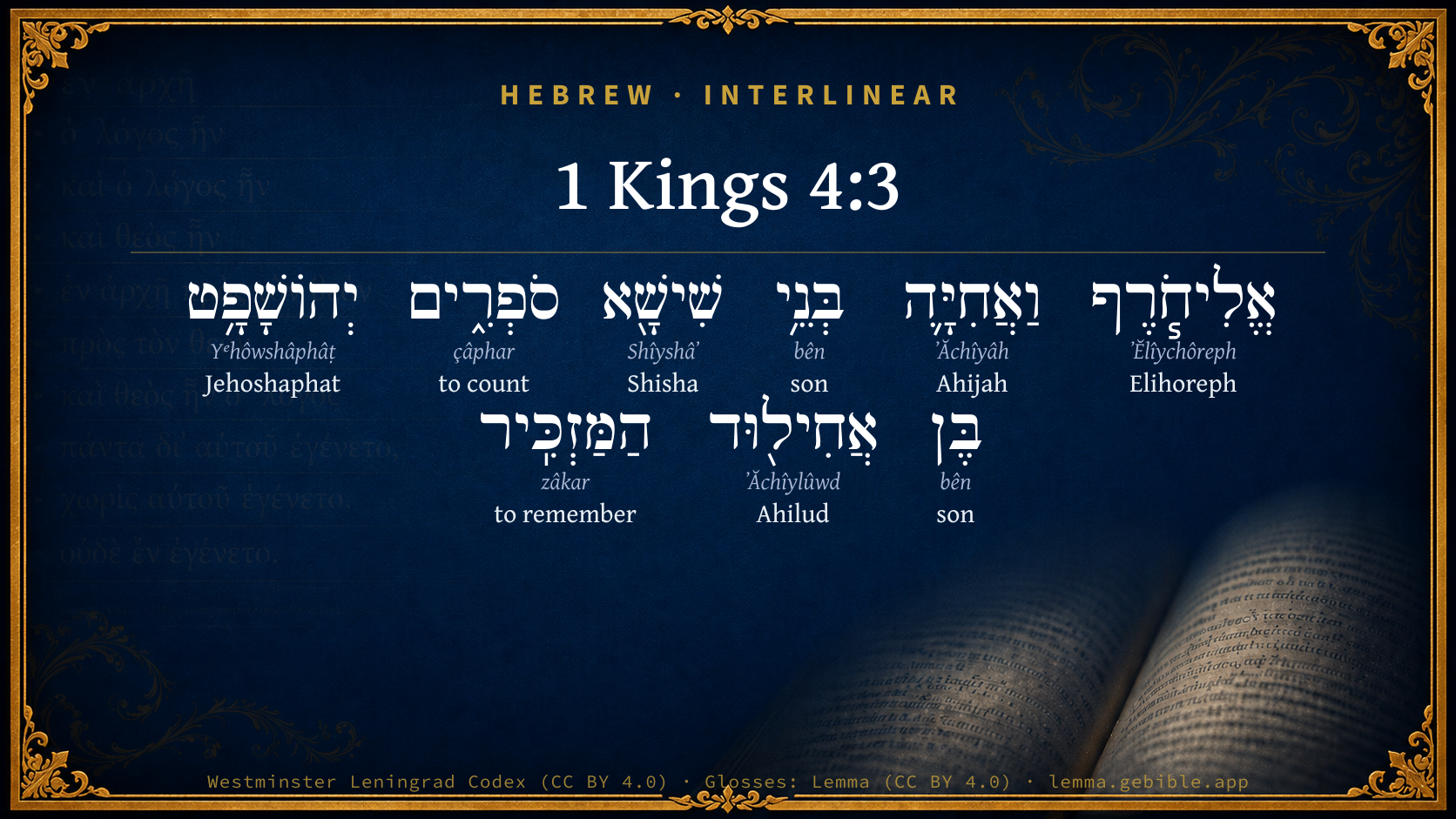
Hebrew (Westminster Leningrad Codex) 1 Kings 4:3 appears in the Hebrew Old Testament. The text above is from the Westminster Leningrad Codex. Each word links to its Strong’s number, a concise gloss, and parsing drawn from the Open Scriptures Hebrew Bible morphology. Click any word for its full Brown-Driver-Briggs (BDB) entry.
Download image
Cite this verse

1 Kings 4:3 (World English Bible). Public Domain. Lemma interlinear Bible study tool, https://lemma.gebible.app/v/1-kings/4/3.

Show BibTeX & RIS
BibTeX
RIS
English Translation
Elihoreph and Ahijah, the sons of Shisha, scribes; Jehoshaphat the son of Ahilud, the recorder;
World English Bible · Public Domain
Highlights
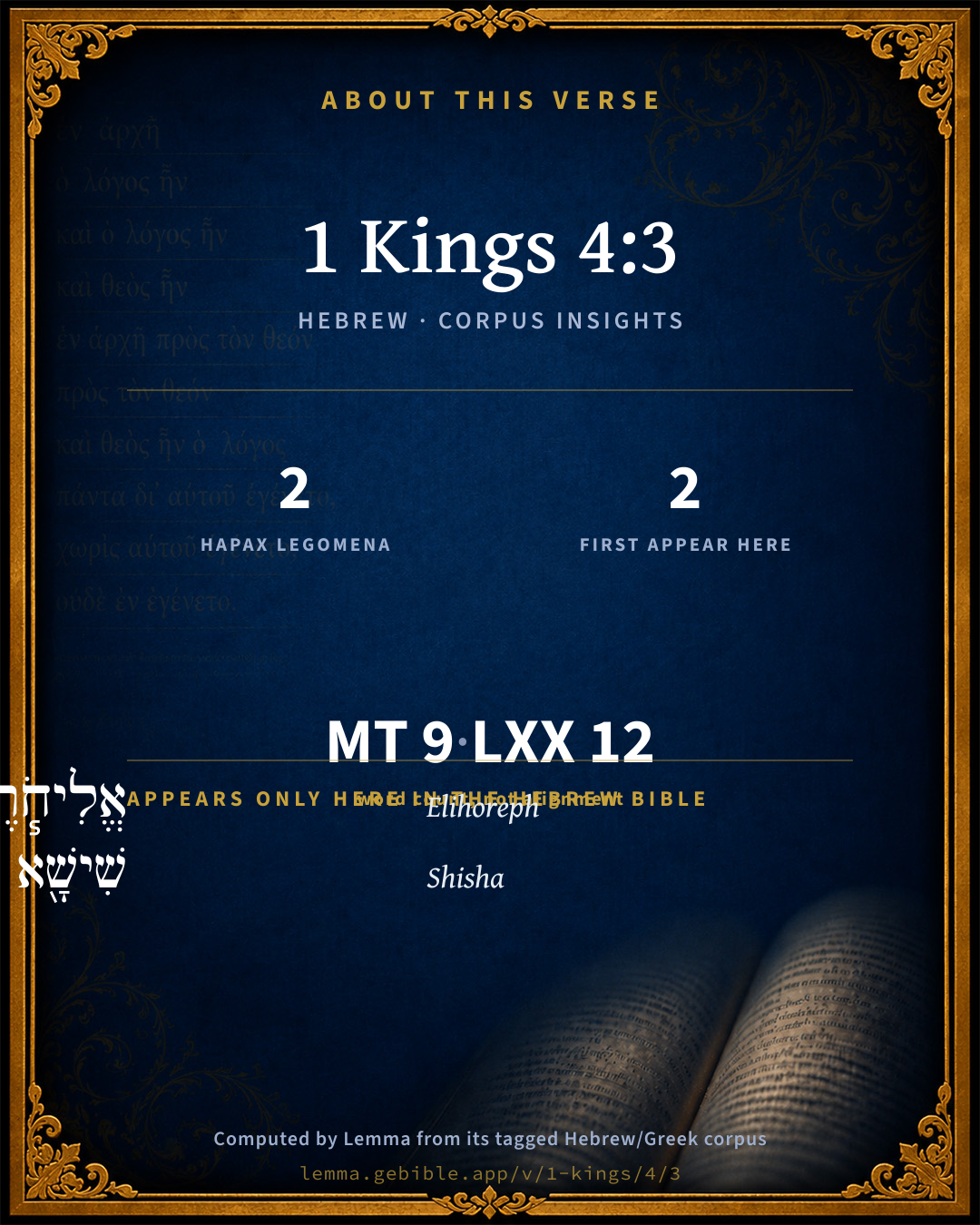
  • 2 hapax legomena — only here in the Hebrew Bible
  • 2 first appearances in the Hebrew Bible
Full analysis ↓
Download a study sheet

One document with this verse’s original text, its word-by-word gloss line, the meaning frame, cross-references with their text, attributed commentary, and full source and license credits — printable, and it pastes into notes with its structure intact.

This verse Autodidact and up

Study sheet (.html) Plain text (.txt)

A passage Seminary Student

Up to 50 verses in one chapter. A passage sheet keeps up to 6 commentary sources and 12 cross-references per verse, in the order this page ranks them, and says so on the sheet whenever that leaves anything out. Ask for a single verse and you get the Autodidact verse sheet above.

Everything on this page stays free to read, with no account — the sheet is a download of what is already on screen, not access to it.

Want to remove ads? Support Godless Engineer
Compare translations 3

The same verse in 3 English versions, stacked beneath the original-language interlinear above. Click any original word for its lexicon entry.

Each is an independent rendering of the whole verse — the interlinear is not word-aligned to these translations.

Highlighted words mark where these versions differ — a whole-verse word diff, not a word-by-word alignment.

  • World English Bible Public Domain
    Elihoreph and Ahijah, the sons of Shisha, scribes; Jehoshaphat the son of Ahilud, the recorder;
  • King James Version Public Domain
    Elihoreph and Ahiah, the sons of Shisha, scribes; Jehoshaphat the son of Ahilud, the recorder.
  • unfoldingWord Literal Text CC BY-SA 4.0
    Elihoreph and Ahijah, the sons of Shisha, were scribes. Jehoshaphat, the son of Ahilud, was the recorder.

unfoldingWord Literal Text — © unfoldingWord, licensed CC BY-SA 4.0. Word-aligned USFM3 via Door43 (git.door43.org/unfoldingWord/en_ult).

Versions to compare (up to 4)

3 of 4 selected

Show all 18 translations

Every available English version of this verse, each an independent rendering of the whole verse.

  • World English Bible Public Domain
    Elihoreph and Ahijah, the sons of Shisha, scribes; Jehoshaphat the son of Ahilud, the recorder;
  • Berean Standard Bible Public Domain
    Elihoreph and Ahijah, the sons of Shisha, were secretaries; Jehoshaphat son of Ahilud was the recorder;
  • Majority Standard Bible Public Domain
    Elihoreph and Ahijah, the sons of Shisha, were secretaries; Jehoshaphat son of Ahilud was the recorder;
  • King James Version Public Domain
    Elihoreph and Ahiah, the sons of Shisha, scribes; Jehoshaphat the son of Ahilud, the recorder.
  • American Standard Version (1901) Public Domain
    Elihoreph and Ahijah, the sons of Shisha, scribes; Jehoshaphat the son of Ahilud, the recorder;
  • Revised Version (1885) Public Domain
    Elihoreph and Ahijah, the sons of Shisha, scribes; Jehoshaphat the son of Ahilud, the recorder;
  • Geneva Bible (1599) Public Domain
    Elihoreph and Ahiah the sonnes of Shisha scribes, Iehoshaphat the sonne of Ahilud, the recorder,
  • Douay-Rheims (1899) Public Domain
    Elihoreph, and Ahia, the sons of Sisa, scribes: Josaphat the son of Ahilud, recorder:
  • Young's Literal Translation Public Domain
    Elihoreph and Ahiah sons of Shisha `are' scribes; Jehoshaphat son of Ahilud `is' remembrancer;
  • Literal Standard Version CC BY-SA 4.0
    Elihoreph and Ahiah sons of Shisha [are] scribes; Jehoshaphat son of Ahilud [is] remembrancer;
  • Unlocked Literal Bible CC BY-SA 4.0
    Elihoreph and Ahijah sons of Shisha, were secretaries. Jehoshaphat son of Ahilud was the recorder.
  • unfoldingWord Literal Text CC BY-SA 4.0
    Elihoreph and Ahijah, the sons of Shisha, were scribes. Jehoshaphat, the son of Ahilud, was the recorder.
  • Darby Bible Public Domain
    Elihoreph and Ahiah, the sons of Shisha, scribes; Jehoshaphat the son of Ahilud, chronicler;
  • World Messianic Bible Public Domain
    Elihoreph and Ahijah, the sons of Shisha, scribes; Jehoshaphat the son of Ahilud, the recorder;
  • Webster's Bible Public Domain
    Elihoreph and Ahiah, the sons of Shisha, scribes; Jehosaphat the son of Ahilud, the recorder.
  • Free Bible Version CC BY-SA 4.0
    Elihoreph and Ahijah, sons of Shisha, were the king's secretaries. Jehoshaphat, son of Ahilud, kept the royal records.
  • Bible in Basic English Public Domain
    Elihoreph and Ahijah, the sons of Shisha, were scribes; Jehoshaphat, the son of Ahilud, was the recorder;
  • JPS Tanakh (1917) Public Domain
    Elihoreph and Ahijah, the sons of Shisha, scribes; Jehoshaphat the son of Ahilud, the recorder;

Literal Standard Version (2020), Covenant Press — licensed CC BY-SA 4.0. Text via the HelloAO Bible API (eBible.org). Unlocked Literal Bible (unfoldingWord) — licensed CC BY-SA 4.0. Text via the HelloAO Bible API (eBible.org). unfoldingWord Literal Text — © unfoldingWord, licensed CC BY-SA 4.0. Word-aligned USFM3 via Door43 (git.door43.org/unfoldingWord/en_ult). Free Bible Version, Dr. Jonathan Gallagher — licensed CC BY-SA 4.0. Text via the HelloAO Bible API (eBible.org).

Word by word

More ways to search: Search by grammar → Find every occurrence → Compare this word →

Practice this passage: Drill this verse → Learn its vocabulary →

About this verse

These counts appear in no published source. They are computed here, from the morphology-tagged text and Lemma’s own curated glosses. What Lemma adds →

9
words
8
distinct lemmas
Historical
section

Notable vocabulary

2 hapax legomena — words that appear only here in the entire Hebrew Bible:

  • אֱלִיחֹ֧רֶף Elihoreph H456
  • שִׁישָׁ֖א Shisha H7894

First appearance in Scripture

These words make their first canonical appearance in the Hebrew Bible here:

  • אֱלִיחֹ֧רֶף Elihoreph H456
  • שִׁישָׁ֖א Shisha H7894

Shared distinctive vocabulary

אֲחִיל֖וּד Ahilud H286 occurs in 5 verses of the Hebrew Bible. Also found in:

Grammatical profile

  • 1 verb
  • 8 nouns

Verb forms

  • הַמַּזְכִּֽיר Hiphil · Participle Active

Repetition

A word recurs within this verse — often emphatic in Hebrew:

  • בְּנֵ֥י son H1121 ×2

Hebrew & Septuagint length

In English translation the verse runs 15 words from the Hebrew and 13 from the Septuagint (LXX English) — closely comparable.

A rough comparison of the two English renderings, which tokenize alike — not a word-level alignment.

Word counts can differ between the Hebrew and the Greek without any difference in meaning — e.g. the Hebrew direct-object marker אֵת has no separate Greek word, and Greek often adds the article ὁ.

In the original languages it is 9 Hebrew tokens and 12 Greek tokens — but the two are counted differently (Hebrew bundles its prefixes and suffixes into one token; the Greek is in lemma form), so that isn’t a like-for-like length.

Cross-references

5

Topical passages linked to 1 Kings 4:3 in the Treasury of Scripture Knowledge — connected by theme and wording, ordered by reader-vote popularity; previews shown in the World English Bible.

  • 2 Samuel 8:16 Joab the son of Zeruiah was over the host; and Jehoshaphat the son of Ahilud was recorder;
  • 2 Samuel 20:24–25 and Adoram was over the men subject to forced labor; and Jehoshaphat the son of Ahilud was the recorder;
  • 1 Chronicles 18:6 Then David put [garrisons] in Syria of Damascus; and the Syrians became servants to David, and brought tribute. Yahweh gave victory to David wherever he went.
  • 1 Chronicles 18:15 Joab the son of Zeruiah was over the host; and Jehoshaphat the son of Ahilud was recorder;
  • Isaiah 62:6 I have set watchmen on your walls, Jerusalem; they shall never hold their peace day nor night: you who call on Yahweh, take no rest,

Cross-references courtesy of OpenBible.info (CC BY 4.0).

Hebrew and Greek witnesses Masoretic Hebrew ↔ Greek Septuagint

The same verse in the two great witnesses to the Old Testament, shown verse-for-verse.

These are two independent witnesses, not word-aligned to each other, and the Septuagint is shown in lemma (dictionary) form.

Hebrew 1 Kings 4:3 Masoretic · Westminster Leningrad Codex

אֱלִיחֹ֧רֶף וַאֲחִיָּ֛ה בְּנֵ֥י שִׁישָׁ֖א סֹפְרִ֑ים יְהוֹשָׁפָ֥ט בֶּן אֲחִיל֖וּד הַמַּזְכִּֽיר

Elihoreph and Ahijah, the sons of Shisha, scribes; Jehoshaphat the son of Ahilud, the recorder;

World English Bible · Public Domain

Greek LXX 1 Kings 4:3 Septuagint · lemma form

καί ελιαρεφ καί αχια υἱός σαβα γραμματεύς καί ιωσαφατ υἱός αχιλιδ ὑπομιμνήσκω

Eliaph, and Achia son of Seba, scribes; and Josaphat son of Achilud, recorder.

LXX2012 (modern English Septuagint) · Public Domain

Hebrew: Westminster Leningrad Codex (CC BY 4.0). Greek: Septuagint (public domain); English from LXX2012 (modern English Septuagint) (Public Domain). How the Septuagint differs from the Hebrew →

Targum (Aramaic paraphrase)

1

The Targum is the ancient Jewish Aramaic paraphrase of the Hebrew Scriptures — an interpretive translation, not the Hebrew text itself. Onkelos (literal) and Pseudo-Jonathan (expansive) render the Torah, and Jonathan the Prophets. Coverage is partial: where no permissively-licensed English translation exists for a verse, only the Aramaic is shown. This is verse-level text, not a word-by-word alignment to the Hebrew.

  1. Targum Jonathan Prophets (Joshua–Malachi)
    אֱלִיחוֹרֶף וַאֲחִיָה בְּנֵי שִׁישָׁא סַפְרַיָא יְהוֹשָׁפָט בַּר אֲחִילוּד מְמַנָא עַל דָכְרָנַיָא:

    (no public-domain English translation for this verse)

    Targum Jonathan — Aramaic: “Mikraot Gedolot” (public domain). English: “Sefaria Community Translation” (CC0 1.0 (public-domain dedication)); “London "Chaldee Paraphrase," 1871” (public domain). Text via Sefaria.

Commentary

Notes on 1 Kings 4:3 from classic Christian and Jewish commentators (each source and its license shown beneath its notes). The classic Christian expositions comment on the surrounding passage and are grouped to its opening verse, so a note may address several verses; the Jewish commentaries on the Tanakh (Rashi and others) are per-verse, so they appear only where the commentator wrote on this verse.

Lemma curates 59 commentaries, every one of them public domain or Creative Commons licensed, each selected and text-cleaned for this edition rather than reprinted as found. About our sources →

Trapp's Complete Commentary

John Trapp

1Ki 4:3 Elihoreph and Ahiah, the sons of Shisha, scribes; Jehoshaphat the son of Ahilud, the recorder.

Ver. 3. Elihoreph and Ahiah, the sons of Shisha.] Otherwise called Sheva, {2Sa 20:25} as Martyr thinketh, trained up by their father in his own calling, and therein employed by Solomon, who had two scribes for his father’s one, according to the amplitude of his dominion and state affairs.

Jehoshaphat the son of Ahilud, the recorder.] Or, Remembrancer, or, chronicler, historiographer. He had the same office in David’s days. {2Sa 8:16; 2Sa 20:24}

John Trapp, A Commentary or Exposition upon All the Books of the Old and New Testament (1647–1656) — public domain. Text from a community e-Sword module.

Joseph Benson's Commentary

1Ki 4:3-4. Scribes — That is, secretaries of state. He chose two, whereas David had but one, either because he observed some inconveniences in trusting all the important matters of his government in one band; or because he had now more employment than David had, this being a time of great peace and prosperity, and his empire being enlarged, and his correspondences with foreign princes more frequent. Zadok and Abiathar were the priests — That is, the high-priests, namely, successively, first Abiathar, and then Zadok.

Joseph Benson's Commentary on the Old and New Testaments (1811–1818) — public domain. Text from a community e-Sword module.

Tyndale Open Study Notes

Tyndale Open Resources

4:3 The court secretaries were state officials and Solomon’s private secretaries. Shisha, the father of Elihoreph and Ahijah, had served David in this capacity (2 Sam 8:17; 20:25; 1 Chr 18:16). • The royal historian functioned as chief of protocol for palace affairs and ceremonies. As in ancient Egypt and Mesopotamia, such officials often represented the king in important negotiations (see 2 Kgs 18:18; 2 Chr 34:8).

Tyndale Open Study Notes — © Tyndale Open Resources, licensed CC BY-SA 4.0. Text via the HelloAO Bible API.

Jamieson, Fausset & Brown

Robert Jamieson, A. R. Fausset & David Brown

scribes--that is, secretaries of state. Under David, there had been only one [Sa2 8:17; Sa2 20:25]. The employment of three functionaries in this department indicates either improved regulations by the division of labor, or a great increase of business, occasioned by the growing prosperity of the kingdom, or a more extensive correspondence with foreign countries.

recorder--that is, historiographer, or annalist--an office of great importance in Oriental courts, and the duties of which consisted in chronicling the occurrences of every day.

Jamieson, Fausset & Brown — Commentary Critical and Explanatory on the Whole Bible (1871) — public domain (CC PDM 1.0). Text via the HelloAO Bible API.

Adam Clarke's Commentary

Verse 3. Elihoreph and Ahiah - scribes] Secretaries to the king.

Jehoshaphat - recorder] Historiographer to the king, who chronicled the affairs of the kingdom. He was in this office under David see 2Sa 20:24.

Adam Clarke's Commentary on the Bible (1810–1826) — public domain. Text from a community e-Sword/MySword module.

Ellicott's Commentary for English Readers

(3) Sons of Shisha.—In 1Ch_18:16 “Shavsha,” and in 2Sa_20:25 “Sheva,” is mentioned as the scribe of David. Probably these are variations of the same name, and the office may have become virtually hereditary. The “scribe,” or (see Margin) “secretary,” is constantly referred to as a high officer, issuing the king’s edicts and letters, and acting in his name, like our “Secretaries of State.”

Jehoshaphat the son of Ahilud is named in 2Sa_8:16; 2Sa_20:24, and 1Ch_18:15 as having been under David also the “recorder” or “remembrancer”—probably the annalist who drew up and preserved the archives of the kingdom.

A Bible Commentary for English Readers, edited by Charles John Ellicott (1878–1897) — public domain. Text from a community e-Sword module.

The Cambridge Bible for Schools and Colleges

gen. ed. J. J. S. Perowne

3. Shisha] This name appears as Shavsha (1Ch_18:16) and as Sheva (2Sa_20:25). A comparison of those verses with 2Sa_8:17, shews that the person meant was also called Seraiah, from which word the other forms are probably copyists’ corruptions. Seraiah’s office had descended to his sons, as was so often the case among the Jews. With the growth of the kingdom since David’s time the duties of the royal scribe, or secretary, would have been much increased; we can therefore understand that two persons were needed for the office instead of one.

Jehoshaphat] He had held the same office in the days of David. See 2Sa_8:16; 2Sa_20:24. The duties of the recorder, or remembrancer, were to keep records of such events as were important in the history of the country. Such annals have afforded, no doubt, a good deal of the matter for Kings and Chronicles. Such was the ‘book of records of the Chronicles’ (Est_6:1) in which Mordecai’s service was registered, and from which it was read out to Ahasuerus.

The Cambridge Bible for Schools and Colleges (gen. ed. J. J. S. Perowne; Cambridge University Press, 1878–1918) — public domain. Text from a community e-Sword module.

John Gill's Exposition

And Benaiah the son of Jehoiada was over the host,.... General of the army in the room of Joab, Kg1 2:35;

and Zadok and Abiathar were the priests; so they were when Solomon came to the throne; but Abiathar was deposed by him after some time, though he might retain the name afterwards, and be employed, as Ben Gersom thinks, in case of necessity, in the room of Zadok, or, however, be employed as a common priest at Jerusalem, upon a reconciliation with Solomon; though Kimchi thinks another Abiathar is meant, which is not so likely.

John Gill's Exposition of the Whole Bible (1746–1763) — public domain (CC PDM 1.0). Text via the HelloAO Bible API.

Albert Barnes' Notes on the Bible

Shisha, or Shavsha 1Ch 18:16, seems also to have been called Sheva 2Sa 20:25, and Seraiah 2Sa 8:17.

The “scribes” were probably royal “secretaries” (margin), who drew up the king’s edicts, wrote his letters, and perhaps managed his finances 1Ki 12:10. They were among his most influential councillors.

By “recorder” or “remembrancer” (margin), we must understand “court annalist” (marginal reference “a”).

Albert Barnes' Notes on the Bible (1834–1885) — public domain. Text from a community e-Sword/MySword module.

Haydock's Catholic Bible Commentary

Sisa. Perhaps the same with Siva, who was under David. --- Recorder. Historiographer; (Calmet) the presenter of petitions. (Grotius) (2 Kings viii. 16.)

George Leo Haydock (1774–1849), Haydock's Catholic Family Bible and Commentary, 1859 edition — public domain. Excludes Psalms (Douay-Rheims chapter numbering differs from Protestant) and Deuterocanonical books (Catholic canon only).

Matthew Poole's English Annotations

Scribes, i.e. secretaries of state. He chose two, whereas David had but one; either because he observed some inconveniences in trusting all those matters in one hand; or because he had now much more employment than David had, this being a time of great peace and prosperity, and his empire enlarged, and his correspondencies with foreign princes more frequent.

The recorder; of which See Poole "2Sa 8:16".

Matthew Poole's English Annotations on the Holy Bible (1683–1685) — public domain. Text from a community e-Sword/MySword module.

Whedon's Commentary on the Bible

Daniel D. Whedon

3. Scribes… recorder — On these words see notes at 2Sa_8:16-17. Solomon had different scribes, but the same recorder as his father David. Shisha was probably the same as Seraiah; (compare the reading in 1Ch_18:16;) so that his sons succeeded him in the office of scribe. See note on 2Sa_20:25.

Daniel D. Whedon (gen. ed.), Commentary on the Old and New Testaments (1874–1909) — public domain. Text from a community e-Sword module.

The Pulpit Commentary

Elihoreph and Ahiah, the sons of Shisha probably the same person who is mentioned in 2Sa_20:25 as Sheva; in 2Sa_8:17, as Seraiah; and in 1Ch_18:16, as Shavsha, David"s scribe. The office thus descended from father to sons. The variations in this name are instructive. Compare Kishi and Kushaiah, Abijah and Abijam, Michaiah and Maachah, Absalom and Abishalom, etc. Names written ex ore dictantis are sure to differ. See below on ver. 12, scribes the scribes, were Secretaries of State: they wrote letters and proclamations, drew up edicts, and apparently kept the accounts. (2Ki_12:10) Their position in the list indicates their importance; Jehoshaphat the son of Ahilud, the recorder. He held the same office under David, and is mentioned in all three lists (2Sa_8:17 2Sa_20:25; 1Ch_18:15) The recorder or "remembrancer" (marg.) was, perhaps, "chancellor" (Keil), or keeper of the king"s conscience, rather than, as is generally supposed, chronicler of public events, and keeper of the archives. See Introduction, sect. 6.

The Pulpit Commentary (1880–1919), ed. H.D.M. Spence-Jones & Joseph S. Exell — public domain. Text from a community e-Sword module.

John Wesley's Explanatory Notes

Scribes - That is, secretaries of state. He chose two, whereas David had but one: either, because he observed some inconveniences in trusting all those matters in one hand: or, because he had now much more employment than David had, this being a time of great peace and prosperity, and his empire enlarged.

John Wesley, Explanatory Notes Upon the Whole Bible (1754–1765) — public domain. Text via the GEBible commentary corpus.

Rashi

Rabbi Shlomo Yitzchaki (Rashi)

Scribes. To write the [king’s] chronicles.

The secretary. [To record] which legal case came before him first that he might rule on it first. Thus have I heard.

Rashi on the Tanakh — English translations: “The Judaica Press complete Tanach with Rashi, translated by A. J. Rosenberg” (CC BY 4.0); “Pentateuch with Rashi's commentary by M. Rosenbaum and A.M. Silbermann, 1929-1934” (public domain); “The Metsudah Tanach series, Lakewood, N.J” (CC BY 4.0); and “The Book of Joshua, Metsudah Publications, 1997” (CC BY 4.0). Text via Sefaria.

Lesson kit

Teaching starters — assembled from the data on this page, not authored interpretation. Every prompt links to the verse data it draws on. Edit before teaching.

1 Kings, in the Historical, opens this verse with 9 words (8 distinct Hebrew lemmas). Its most distinctive word is ʼĔlîychôreph (“Elihoreph”). A historical commentator’s framing appears above. Read the whole chapter for the surrounding context.

Discussion questions

  1. How does “Elihoreph” (ʼĔlîychôreph) shape what this verse is saying?
  2. This verse holds 2 words here found nowhere else in the Hebrew Bible. What might the rare words draw attention to?
  3. 2 words here appear for the first time in Scripture. What is being introduced at this debut?
  4. 2 Samuel 8:16 shares the word «Ahilud» with this verse. How do the two illuminate each other?
  5. “son” occurs 2× in this one verse. What is the effect of the repetition?
  6. The translations on this page render this verse differently — a whole-verse word diff, not a word-by-word alignment. What might account for the different wordings?
  7. The verb «הַמַּזְכִּֽיר» is Hiphil Participle Active. How does its form color the action?
  8. Reading how Trapp's Complete Commentary and Joseph Benson's Commentary read this verse, where do the two commentators agree and where do they part?

Things to notice

  • 2 words in this verse appear nowhere else in the Hebrew Bible.
  • 2 words make their first canonical appearance in Scripture here.
  • This verse counts 9 Hebrew ↔ 12 Greek words.
  • These translations choose different wording for 2 words in this verse.
  • “son” occurs 2× in this single verse.

Reading settings

Reading text

Shown beneath each verse's original-language words.

Old Testament
Old Testament edition

Read the OT as the Masoretic Hebrew (MT) or the Greek Septuagint (LXX).

English shown for the Greek Septuagint (in the Hebrew ↔ Greek comparison).

Comparing translations? Open the Compare panel on any verse page to stack up to four side by side.