Ezra 1:8

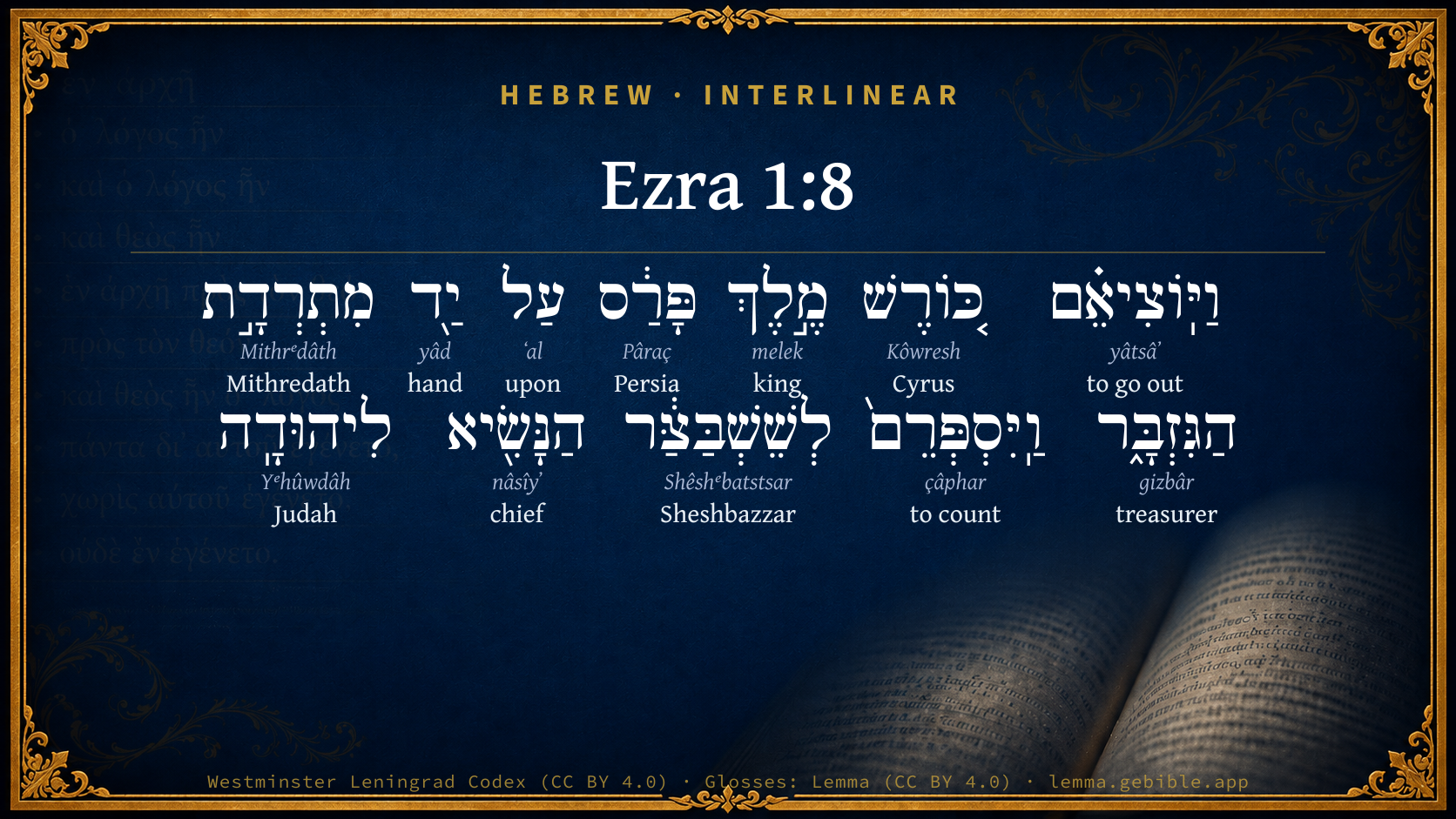
Hebrew (Westminster Leningrad Codex) Ezra 1:8 appears in the Hebrew Old Testament. The text above is from the Westminster Leningrad Codex. Each word links to its Strong’s number, a concise gloss, and parsing drawn from the Open Scriptures Hebrew Bible morphology. Click any word for its full Brown-Driver-Briggs (BDB) entry.
Download image
Cite this verse

Ezra 1:8 (World English Bible). Public Domain. Lemma interlinear Bible study tool, https://lemma.gebible.app/v/ezra/1/8.

Show BibTeX & RIS
BibTeX
RIS
English Translation
even those did Cyrus king of Persia bring forth by the hand of Mithredath the treasurer, and numbered them to Sheshbazzar, the prince of Judah.
World English Bible · Public Domain
Highlights
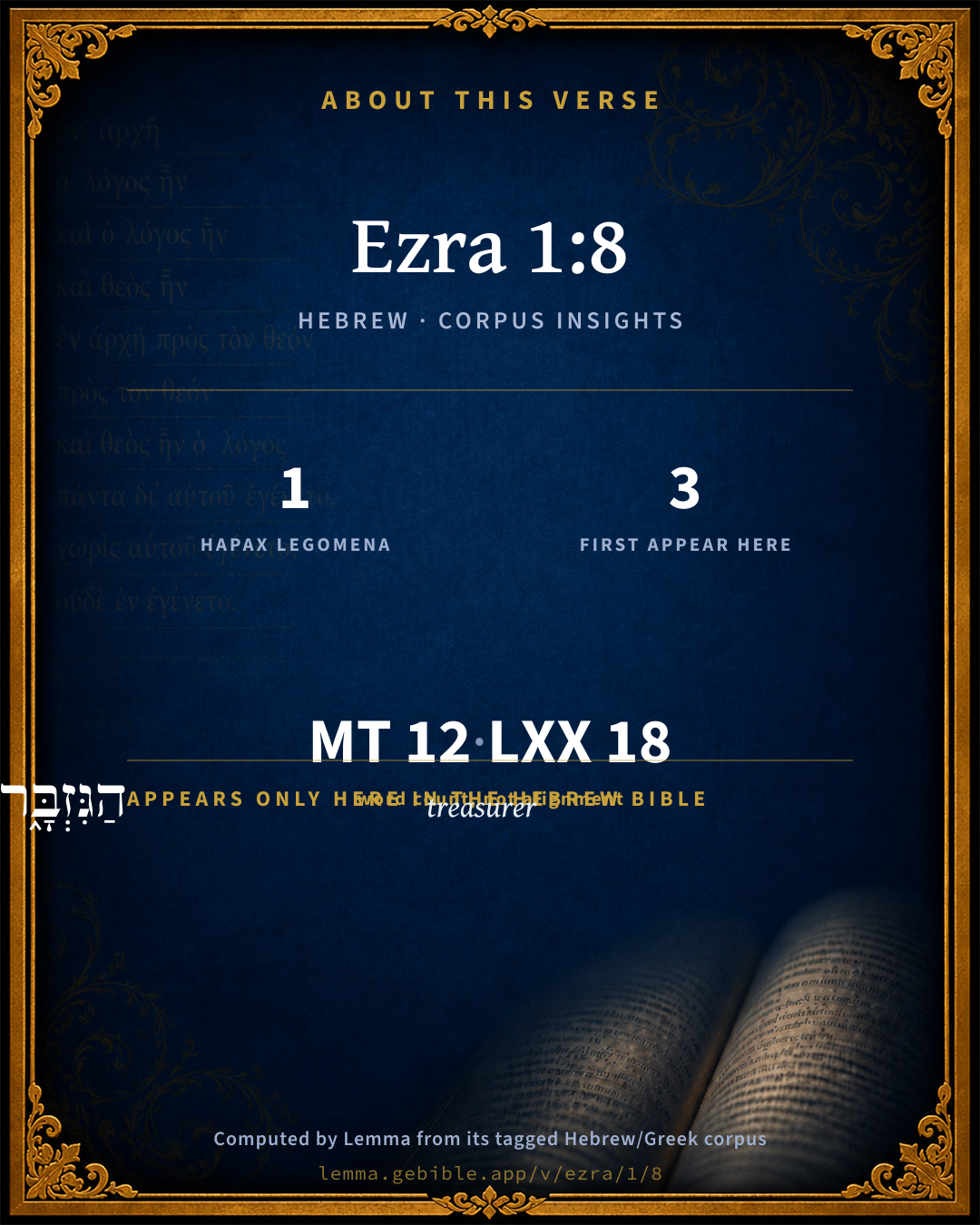
  • 1 hapax legomenon — only here in the Hebrew Bible
  • 3 first appearances in the Hebrew Bible
Full analysis ↓
Download a study sheet

One document with this verse’s original text, its word-by-word gloss line, the meaning frame, cross-references with their text, attributed commentary, and full source and license credits — printable, and it pastes into notes with its structure intact.

This verse Autodidact and up

Study sheet (.html) Plain text (.txt)

A passage Seminary Student

Up to 50 verses in one chapter. A passage sheet keeps up to 6 commentary sources and 12 cross-references per verse, in the order this page ranks them, and says so on the sheet whenever that leaves anything out. Ask for a single verse and you get the Autodidact verse sheet above.

Everything on this page stays free to read, with no account — the sheet is a download of what is already on screen, not access to it.

Want to remove ads? Support Godless Engineer
Compare translations 3

The same verse in 3 English versions, stacked beneath the original-language interlinear above. Click any original word for its lexicon entry.

Each is an independent rendering of the whole verse — the interlinear is not word-aligned to these translations.

Highlighted words mark where these versions differ — a whole-verse word diff, not a word-by-word alignment.

  • World English Bible Public Domain
    even those did Cyrus king of Persia bring forth by the hand of Mithredath the treasurer, and numbered them to Sheshbazzar, the prince of Judah.
  • King James Version Public Domain
    Even those did Cyrus king of Persia bring forth by the hand of Mithredath the treasurer, and numbered them unto Sheshbazzar, the prince of Judah.
  • unfoldingWord Literal Text CC BY-SA 4.0
    And Cyrus, the king of Persia, brought them out by the hand of Mithredath the treasurer. And he counted them out to Sheshbazzar, the ruler of Judah.

unfoldingWord Literal Text — © unfoldingWord, licensed CC BY-SA 4.0. Word-aligned USFM3 via Door43 (git.door43.org/unfoldingWord/en_ult).

Versions to compare (up to 4)

3 of 4 selected

Show all 18 translations

Every available English version of this verse, each an independent rendering of the whole verse.

  • World English Bible Public Domain
    even those did Cyrus king of Persia bring forth by the hand of Mithredath the treasurer, and numbered them to Sheshbazzar, the prince of Judah.
  • Berean Standard Bible Public Domain
    Cyrus king of Persia had them brought out by the hand of Mithredath the treasurer, who counted them out to Sheshbazzar the prince of Judah.
  • Majority Standard Bible Public Domain
    Cyrus king of Persia had them brought out by the hand of Mithredath the treasurer, who counted them out to Sheshbazzar the prince of Judah.
  • King James Version Public Domain
    Even those did Cyrus king of Persia bring forth by the hand of Mithredath the treasurer, and numbered them unto Sheshbazzar, the prince of Judah.
  • American Standard Version (1901) Public Domain
    even those did Cyrus king of Persia bring forth by the hand of Mithredath the treasurer, and numbered them unto Sheshbazzar, the prince of Judah.
  • Revised Version (1885) Public Domain
    even those did Cyrus king of Persia bring forth by the hand of Mithredath the treasurer, and numbered them unto Sheshbazzar, the prince of Judah.
  • Geneva Bible (1599) Public Domain
    Euen them did Cyrus King of Persia bring forth by the hand of Mithredath the treasurer, and counted them vnto Sheshbazzar the Prince of Iudah.
  • Douay-Rheims (1899) Public Domain
    Now Cyrus king of Persia brought them forth by the hand of Mithridates the son of Gazabar, and numbered them to Sassabasar the prince of Juda.
  • Young's Literal Translation Public Domain
    yea, Cyrus king of Persia bringeth them out by the hand of Mithredath the treasurer, and numbereth them to Sheshbazzar the prince of Judah.
  • Literal Standard Version CC BY-SA 4.0
    indeed, Cyrus king of Persia brings them out by the hand of Mithredath the treasurer, and numbers them to Sheshbazzar the prince of Judah.
  • Unlocked Literal Bible CC BY-SA 4.0
    Cyrus put them into the hand of Mithredath the treasurer, who counted them out for Sheshbazzar, Judea's leader.
  • unfoldingWord Literal Text CC BY-SA 4.0
    And Cyrus, the king of Persia, brought them out by the hand of Mithredath the treasurer. And he counted them out to Sheshbazzar, the ruler of Judah.
  • Darby Bible Public Domain
    And Cyrus king of Persia brought them forth by the hand of Mithredath the treasurer, who counted them out to Sheshbazzar the prince of Judah.
  • World Messianic Bible Public Domain
    even those, Cyrus king of Persia brought out by the hand of Mithredath the treasurer, and counted them out to Sheshbazzar the prince of Judah.
  • Webster's Bible Public Domain
    Even those did Cyrus king of Persia bring forth by the hand of Mithredath the treasurer, and numbered them to Sheshbazzar, the prince of Judah.
  • Free Bible Version CC BY-SA 4.0
    Cyrus had Mithredath the treasurer retrieve them, who counted them and gave them to Sheshbazzar, the leader of Judah.
  • Bible in Basic English Public Domain
    Even these Cyrus made Mithredath, the keeper of his wealth, get out, and he gave them, after numbering them, to Sheshbazzar, the ruler of Judah.
  • JPS Tanakh (1917) Public Domain
    even those did Cyrus king of Persia bring forth by the hand of Mithredath the treasurer, and numbered them unto Sheshbazzar, the prince of Judah.

Literal Standard Version (2020), Covenant Press — licensed CC BY-SA 4.0. Text via the HelloAO Bible API (eBible.org). Unlocked Literal Bible (unfoldingWord) — licensed CC BY-SA 4.0. Text via the HelloAO Bible API (eBible.org). unfoldingWord Literal Text — © unfoldingWord, licensed CC BY-SA 4.0. Word-aligned USFM3 via Door43 (git.door43.org/unfoldingWord/en_ult). Free Bible Version, Dr. Jonathan Gallagher — licensed CC BY-SA 4.0. Text via the HelloAO Bible API (eBible.org).

Word by word

More ways to search: Search by grammar → Find every occurrence → Compare this word →

Practice this passage: Drill this verse → Learn its vocabulary →

הַגִּזְבָּ֑ר
gizbâr
H1489
“the · treasurer”
Particle, Definite Article + Noun, Common, Masculine, Singular, Absolute
Part of Speech
Particle + Noun
Type
Common
Gender
Masculine
Number
Singular
State
Absolute
Full BDB Definition

Origin: of foreign derivation

TWOT: 334

treasurer
  1. וַיּֽוֹצִיאֵ֗ם yâtsâʼ H3318 “and · to go out · them” Conjunction + Verb, Hiphil, Sequential Imperfect, 3rd Person, Masculine, Singular + Suffix, Personal, 3rd Person, Masculine, Plural
  2. כּ֚וֹרֶשׁ Kôwresh H3566 “Cyrus” Noun, Proper
  3. מֶ֣לֶךְ melek H4428 “king of” Noun, Common, Masculine, Singular, Construct
  4. פָּרַ֔ס Pâraç H6539 “Persia” Noun, Proper
  5. עַל ʻal H5921 “upon” Preposition
  6. יַ֖ד yâd H3027 “hand of” Noun, Common, Both, Singular, Construct
  7. מִתְרְדָ֣ת Mithrᵉdâth H4990 “Mithredath” Noun, Proper
  8. וַֽיִּסְפְּרֵם֙ çâphar H5608 “and · to count · them” Conjunction + Verb, Qal, Sequential Imperfect, 3rd Person, Masculine, Singular + Suffix, Personal, 3rd Person, Masculine, Plural
  9. לְשֵׁשְׁבַּצַּ֔ר Shêshᵉbatstsar H8339 “to/for · Sheshbazzar” Preposition + Noun, Proper
  10. הַנָּשִׂ֖יא nâsîyʼ H5387 “the · chief” Particle, Definite Article + Noun, Common, Masculine, Singular, Absolute
  11. לִיהוּדָֽה Yᵉhûwdâh H3063 “to/for · Judah” Preposition + Noun, Proper

About this verse

These counts appear in no published source. They are computed here, from the morphology-tagged text and Lemma’s own curated glosses. What Lemma adds →

12
words
12
distinct lemmas
Historical
section

Notable vocabulary

1 hapax legomenon — a word that appears only here in the entire Hebrew Bible:

  • הַגִּזְבָּ֑ר treasurer H1489

First appearance in Scripture

These words make their first canonical appearance in the Hebrew Bible here:

  • מִתְרְדָ֣ת Mithredath H4990
  • הַגִּזְבָּ֑ר treasurer H1489
  • לְשֵׁשְׁבַּצַּ֔ר Sheshbazzar H8339

Shared distinctive vocabulary

מִתְרְדָ֣ת Mithredath H4990 occurs in 2 verses of the Hebrew Bible. Also found in:

Grammatical profile

  • 2 verbs
  • 9 nouns
  • 1 preposition

Verb forms

  • וַיּֽוֹצִיאֵ֗ם Hiphil · Sequential Imperfect
  • וַֽיִּסְפְּרֵם֙ Qal · Sequential Imperfect

Hebrew & Septuagint length

In English translation the verse runs 25 words from the Hebrew and 27 from the Septuagint (LXX English) — closely comparable.

A rough comparison of the two English renderings, which tokenize alike — not a word-level alignment.

Word counts can differ between the Hebrew and the Greek without any difference in meaning — e.g. the Hebrew direct-object marker אֵת has no separate Greek word, and Greek often adds the article ὁ.

In the original languages it is 12 Hebrew tokens and 18 Greek tokens — but the two are counted differently (Hebrew bundles its prefixes and suffixes into one token; the Greek is in lemma form), so that isn’t a like-for-like length.

Cross-references

7

Topical passages linked to Ezra 1:8 in the Treasury of Scripture Knowledge — connected by theme and wording, ordered by reader-vote popularity; previews shown in the World English Bible.

  • Ezra 5:14 The gold and silver vessels also of the house of God, which Nebuchadnezzar took out of the temple that was in Jerusalem, and brought into the temple of Babylon, those did Cyrus the king take out of the temple of Babylon, and they were delivered to one whose name was Sheshbazzar, whom he had made governor;
  • Ezra 1:11 All the vessels of gold and of silver were five thousand and four hundred. All these did Sheshbazzar bring up, when they of the captivity were brought up from Babylon to Jerusalem.
  • Ezra 5:16 Then came the same Sheshbazzar, and laid the foundations of the house of God which is in Jerusalem: and since that time even until now has it been in building, and yet it is not completed.
  • Haggai 1:1 In the second year of Darius the king, in the sixth month, in the first day of the month, the Word of Yahweh came by Haggai, the prophet, to Zerubbabel, the son of Shealtiel, governor of Judah, and to Joshua, the son of Jehozadak, the high priest, saying,
  • Haggai 1:14 Yahweh stirred up the spirit of Zerubbabel, the son of Shealtiel, governor of Judah, and the spirit of Joshua, the son of Jehozadak, the high priest, and the spirit of all the remnant of the people; and they came and worked on the house of Yahweh of Hosts, their God,
  • Haggai 2:2–4 "Speak now to Zerubbabel, the son of Shealtiel, governor of Judah, and to Joshua, the son of Jehozadak, the high priest, and to the remnant of the people, saying,
  • Zechariah 4:6–10 Then he answered and spoke to me, saying, "This is the word of Yahweh to Zerubbabel, saying, 'Not by might, nor by power, but by my Spirit,' says Yahweh of Hosts.

Cross-references courtesy of OpenBible.info (CC BY 4.0).

Hebrew and Greek witnesses Masoretic Hebrew ↔ Greek Septuagint

The same verse in the two great witnesses to the Old Testament, shown verse-for-verse.

These are two independent witnesses, not word-aligned to each other, and the Septuagint is shown in lemma (dictionary) form.

Hebrew Ezra 1:8 Masoretic · Westminster Leningrad Codex

וַיּֽוֹצִיאֵ֗ם כּ֚וֹרֶשׁ מֶ֣לֶךְ פָּרַ֔ס עַל יַ֖ד מִתְרְדָ֣ת הַגִּזְבָּ֑ר וַֽיִּסְפְּרֵם֙ לְשֵׁשְׁבַּצַּ֔ר הַנָּשִׂ֖יא לִיהוּדָֽה

even those did Cyrus king of Persia bring forth by the hand of Mithredath the treasurer, and numbered them to Sheshbazzar, the prince of Judah.

World English Bible · Public Domain

Greek LXX Ezra 1:8 Septuagint · lemma form

καί ἐκφέρω αὐτός κῦρος βασιλεύς πέρσης ἐπί χείρ μιθραδάτης γασβαρηνός καί ἀριθμέω αὐτός ὁ σασαβασαρ ἄρχων ὁ ἰουδά

And Cyrus king of the Persians brought them out by the hand of Mithradates the treasurer, and he numbered them to Sasabasar, the chief man of Juda.

LXX2012 (modern English Septuagint) · Public Domain

In the Septuagint this is one book — Esdras B (2 Esdras): Ezra is chapters 1–10, Nehemiah 11–23.

Hebrew: Westminster Leningrad Codex (CC BY 4.0). Greek: Septuagint (public domain); English from LXX2012 (modern English Septuagint) (Public Domain). How the Septuagint differs from the Hebrew →

Commentary

Notes on Ezra 1:8 from classic Christian and Jewish commentators (each source and its license shown beneath its notes). The classic Christian expositions comment on the surrounding passage and are grouped to its opening verse, so a note may address several verses; the Jewish commentaries on the Tanakh (Rashi and others) are per-verse, so they appear only where the commentator wrote on this verse.

Lemma curates 59 commentaries, every one of them public domain or Creative Commons licensed, each selected and text-cleaned for this edition rather than reprinted as found. About our sources →

Trapp's Complete Commentary

John Trapp

Ezr 1:8 Even those did Cyrus king of Persia bring forth by the hand of Mithredath the treasurer, and numbered them unto Sheshbazzar, the prince of Judah.

Ver. 8. Even those did Cyrus king of Persia] So styled, because, though he was monarch of many countries, yet Persia was his hereditary kingdom, and Persepolis the place of his residence; which great city was afterwards burnt by Alexander the Great, at the motion and by the request of a base harlot.

By the hand of Mithredath the treasurer] Heb. Gizhar; Inde Gasper, saith one. Mithridates, king of Pontus, was famous in later ages, or, rather infamous, for his craft in saving himself, and his cruelty to the Roman merchants, trading through his territories, killing eighty thousand of them with one letter (Val. Max.).

And numbered them unto Sheshbazzar] Joy in tribulation, this is the signification of the word; a fit name for a prince, who should be Deliciae orbis, as Titus the emperor, of whom it is said, that he never sent away any suitor sad or discontented, Neminem a se dimisit tristem (Sueton.); and remembering on a day that he had not done any poor man good, he cried out to his friends, Hodie non regnavimus: Amici, diem perdidi, accounting that day lost wherein he had not showed some man courtesy. Such a gracious prince was Job, Job 29:12, "I delivered the poor that cried," saith he, "and the fatherless, and him that had none to help him." The Great Turk styleth himself, The world’s refuge; professing that all that lament unto him shall have redress and help. James V of Scotland was called "The poor man’s king," for his readiness to right and relieve the afflicted. Zerubbabel, however he came by this name Sheshbazzar for that he was the man I take for granted, Ezr 5:16; Ezr 3:8 Zec 4:9, though Junius thinks otherwise), he deserved it doubtless; and of him it might well be said, as the historian Vopiscus doth of Probus the emperor, Si probi nomen non haberet, habere cognomen posset, pity he had been called anything but Probus, so honest a prince he was: think the like here. The parliament here held A.D. 1376 was called The Good Parliament; and another not long after Parlamentum benedictum, The Blessed Parliament. God grant us such a one next (this was written, May 18, 1653); for at present we are without any, but not without cause to cry out, as those in Jer 8:20; Jer 8:22, The harvest is past, the summer is ended, and we are not helped. "Is there no balm in Gilead; is there no physician there? why then is not the health of the daughter of my people recovered? We looked for peace, but no good came; and for a time of health, and behold trouble!" Jer 8:15

John Trapp, A Commentary or Exposition upon All the Books of the Old and New Testament (1647–1656) — public domain. Text from a community e-Sword module.

Joseph Benson's Commentary

Ezr 1:8. And numbered them — Caused them to be delivered to the Jews by number; unto Sheshbazzar, the prince of Judah — The captain and governor of these returning Jews, Ezr 2:2. The sceptre, therefore, was not yet departed from Judah. This person’s name was originally Zerubbabel, but it was common for the great men of Judah, at the time of the captivity, to have two names, one of their own country, which was domestic, and another of the Chaldeans, which was used at court. “Zerubbabel was born at Babylon, and his name, which signifies an exile, or stranger in Babylon, implies the misery of the people of Israel at that time; but Sheshbazzar, which is a compound of two words, signifying fine linen and gold, seems to be a name of better omen, and to denote their future and more flourishing condition. So Bishop Patrick. Dr. Trapp, however, says that Sheshbazzar signifies joy in tribulation. Some are of opinion, that among the sacred things which Cyrus ordered to be restored, the ark of the covenant was one; but it nowhere appears that this ark was carried from Jerusalem to Babylon. They tell us, indeed, that in the second temple sacrifices were offered as in the first, and all solemn days observed, especially the great day of expiation, when the law ordained that the blood should be sprinkled before the mercy-seat, and the mercy-seat, say they, was part of the ark; but besides that the ark, without the Shechinah, (which was then certainly withdrawn,) would have been of no great significance, the Jews universally acknowledge that the ark was one of the five things which were wanting in the second temple.” — Dodd.

Joseph Benson's Commentary on the Old and New Testaments (1811–1818) — public domain. Text from a community e-Sword module.

Tyndale Open Study Notes

Tyndale Open Resources

1:8 Sheshbazzar was the Persian-appointed governor of Judah who laid the foundation of the Temple (5:14-16). Some believe that Zerubbabel (3:2, 8) was the same person with a new name (cp. Dan 1:7). However, both names are Babylonian, so it is more likely that these two leaders worked together on the Temple foundation and that Zerubbabel later took over as governor when Sheshbazzar died.

Tyndale Open Study Notes — © Tyndale Open Resources, licensed CC BY-SA 4.0. Text via the HelloAO Bible API.

Geneva Bible (1599)

Geneva Bible translators

So the Chaldeans called Zerubbabel who was the chief governor, so that the preeminence still remained in the house of David.

Geneva Bible (1599) marginal notes — public domain. Text via Bolls.life.

Jamieson, Fausset & Brown

Robert Jamieson, A. R. Fausset & David Brown

Shesh-bazzar, the prince of Judah--that is, Zerubbabel, son of Salathiel (compare Ezr 3:8; Ezr 5:16). He was born in Babylon, and called by his family Zerubbabel, that is, stranger or exile in Babylon. Shesh-bazzar, signifying "fire-worshipper," was the name given him at court, as other names were given to Daniel and his friends. He was recognized among the exiles as hereditary prince of Judah.

Jamieson, Fausset & Brown — Commentary Critical and Explanatory on the Whole Bible (1871) — public domain (CC PDM 1.0). Text via the HelloAO Bible API.

Adam Clarke's Commentary

Verse 8. Sheshbazzar, the prince of Judah.] This was probably the Chaldean name of him who was originally called Zerubbabel: the former signifies joy in affliction; the latter, a stranger in Babylon. The latter may be designed to refer to his captive state; the former, to the prospect of release. Some think this was quite a different person, a Persian or Chaldean, sent by Cyrus to superintend whatever officers or men Cyrus might have sent to assist the Jews on their return; and to procure them help in the Chaldean provinces, through which they might be obliged to travel.

Adam Clarke's Commentary on the Bible (1810–1826) — public domain. Text from a community e-Sword/MySword module.

The Cambridge Bible for Schools and Colleges

gen. ed. J. J. S. Perowne

8. by the hand of] So A.V. and R.V. This phrase in the original is a little difficult. It occurs Ezr_8:26, ‘I even weighed into their hand &c.’, 33, ‘was the silver and the gold and the vessels weighed into the hand of, &c. (marg. ‘by’), Est_6:9, ‘let the apparel and the horse be delivered to the hand of one of the king’s most noble princes’. It seems better here to render ‘into the hand of’. The vessels were brought out and given into the charge of Mithredath, who was to superintend their numbering.

Mithredath the treasurer] This is the Hebrew form of the old Persian name ‘Mithradata’, familiar to us as Mithridates. On coins we find the more correct transliteration ‘Mithradates’. It was a very common name among the Medo-Persians, cf. Ezr_4:7. It is derived from ‘Mithras’, the name of the Persian sun-god, and the root ‘da’ = to give, and has been differently understood to mean either ‘given by Mithras’, or ‘given, i.e. dedicated, to Mithras’. Of these the former is the preferable Cf. Hormisdas = ‘given by Ormuzd’, Theodotus = ‘given by God’.

the treasurer] The word in the original is a Persian, not a Hebrew word, and occurs again Ezr_7:21; Dan_3:2-3. The ‘gizbar’, Old Persian ‘gazabara’, mentioned here seems to have been the king’s Privy Purse, the bearer or dispenser of the royal treasure. The Persian word will remind the student of the Hellenistic ‘gaza’ (γάζα) = ‘treasure’ adopted from the Persian. The Ethiopian Eunuch, chamberlain to queen Candace, was ‘over all her treasure’, ἐπὶ πάσης τῆς γάζης αὐτῆς (Act_8:27). The word for ‘the treasury’, used in the gospels, means “the place for keeping the ‘gaza’,” γαζοφυλάκιον (cf. Mar_12:41; Luk_21:1; Joh_8:20).

and numbered them] so A.V. R.V. Better, and he numbered them. The king made the gift; his officer had the charge of its disposition and valuation.

unto Sheshbazzar, the prince of Judah] There seems to be no good reason to doubt that the Sheshbazzar mentioned here and in Ezr_5:14; Ezr_5:16 is the same as Zerubbabel. For although Zerubbabel (Ezr_3:2; Ezr_3:8, Ezr_4:3, Ezr_5:2) is not designated by any official title in our book, still (1) the manner in which he is regarded as the representative of the Jewish returned exiles in Ezr_4:2, (2) the fact that his name, as that of the chief layman and of the head of the Davidic line, is associated with that of the High-priest Jeshua in the general administration, Ezr_3:2; Ezr_3:8, Ezr_4:3, Ezr_5:2; Hag_1:1; Zec_3:4, (3) the title of ‘governor (pekhah) of Judah’ given him by the prophet Haggai (Ezr_1:1, Ezr_2:2; Ezr_2:21), and given also to Sheshbazzar (Ezr_5:14) make it reasonable to suppose that Sheshbazzar was another name of Zerubbabel, just as Belteshazzar, Shadrach, Meshach, and Abednego, were the names given in the Captivity to Daniel, Hananiah, Mishael, and Azariah (Dan_1:6-7). To this view the objection has fairly been raised that in Daniel we find a Babylonish by the side of a Hebrew name, but that in this case both Sheshbazzar and Zerubbabel are considered to be Babylonish names, and that it is very strange to find the same man called in a Jewish book by two foreign names. This objection may possibly be met by regarding Zerubbabel as the name, though of foreign origin, which he took as prince among his own people, Sheshbazzar as the name by which he was known at the court of the Persian king. At any rate Sheshbazzar is here called ‘the prince of Judah’ and in Ezr_5:14 he is mentioned as conveying the sacred vessels and laying the foundation of the Temple. See also the Introduction, § 6.

the prince of Judah] The ‘nasi’ of Judah. In two passages he is given the title of ‘Tirshatha’, the Persian equivalent of the Assyrian ‘pekhah’ (Ezr_2:63, Neh_7:65; Neh_7:70). He is called ‘pekhah’ or ‘Tirshatha” in relation to the Persian government. In relation to his own people, he is called ‘nasi’ or prince either as head of the great tribe of Judah (cf. the title ‘nasi’ of the ‘princes’ of the tribes in Numbers 7, Num_34:22-28), or as the representative of the royal house of David (cf. especially the frequent use of this term in Ezekiel, chaps. 45, 46, 48). In later days this title was taken by Simon, the brother of Judas the Maccabee, whose coins contain the legend ‘Simon the prince (nasi) of Israel’. Sheshbazzar is mentioned here alone. The prominence of the High-priest seems to date from the arrival at Jerusalem.

The Cambridge Bible for Schools and Colleges (gen. ed. J. J. S. Perowne; Cambridge University Press, 1878–1918) — public domain. Text from a community e-Sword module.

John Gill's Exposition

Even these did Cyrus king of Persia bring forth by the hand of Mithredath the treasurer,.... Or Mithridates, a name common with the Persians, from their god Mithras, the sun they worshipped:

and numbered them unto Sheshbazzar prince of Judah; delivered them by tale to him; who, according to the Jewish rabbins, as Jarchi says, was Daniel, who was so called, because he stood in six tribulations; but it does not appear that Daniel went up to Jerusalem with the captivity, as this man did, but remained at Babylon; rather, with Aben Ezra, it is best by him to understand Zerubbabel, who did go up, and was the prince of Judah; and Cyrus, in his letter (q) to the governors of Syria, expressly says, that he delivered the vessels to Zerubbabel, the prince of the Jews. He had two names, Sheshbazzar, which signifies he rejoiced in tribulation, and Zerubbabel, which signifies either the seed of Babylon, being born there, or dispersed, or a stranger there, as others.

(q) Apud Joseph. Antiqu. l. 11. c. 1. sect. 3.

John Gill's Exposition of the Whole Bible (1746–1763) — public domain (CC PDM 1.0). Text via the HelloAO Bible API.

Albert Barnes' Notes on the Bible

Mithredath - Or, “Mithridates.” The occurrence of this name, which means “given by Mithra” or “dedicated to Mithra,” is an indication that the sun-worship of the Persians was at least as old as the time of Cyrus.

Sheshbazzar - i. e., Zerubbabel. On his royal descent, see 1Ch 3:19 note.

Albert Barnes' Notes on the Bible (1834–1885) — public domain. Text from a community e-Sword/MySword module.

Haydock's Catholic Bible Commentary

Gazabar means, "the treasurer." (Hebrew; Syriac; Calmet; Protestants; 3 Esdras ii. 19.) (Haydock) --- Son is not in Hebrew, &c., (Menochius) and must be omitted. (Tirinus) --- Sassabasar. This was another name for Zorobabel, (Challoner) given by the Chaldeans, as they changed the name of Daniel into Baltassar. (Eusebius, Præp. Evan. xi. 3.) (Tirinus) --- But others think that this was the Persian "governor (Junius) of Judea," (3 Esdras) as one reside at Jerusalem, till the days of Nehemias, 2 Esdras v. 14. It does not appear that Zorobabel was invested with this dignity, before the reign of Darius Hystaspes, Aggeus ii. 24. (Calmet)

George Leo Haydock (1774–1849), Haydock's Catholic Family Bible and Commentary, 1859 edition — public domain. Excludes Psalms (Douay-Rheims chapter numbering differs from Protestant) and Deuterocanonical books (Catholic canon only).

Matthew Poole's English Annotations

Numbered them, i.e. he caused them to be delivered to the Jews by number.

Unto Sheshbazzar, i.e. Zorobabel, as appears by comparing Ezr 3:8, with Ezr 5:16, to whom the Persians, or rather the Chaldeans, had given this name of Sheshbazzar, as they gave other names to Daniel and his companions, Dan 1:7.

The prince of Judah, and the captain and governor of these returning Jews, Ezr 2:2. So the sceptre is not yet departed from Judah.

Matthew Poole's English Annotations on the Holy Bible (1683–1685) — public domain. Text from a community e-Sword/MySword module.

Whedon's Commentary on the Bible

Daniel D. Whedon

8. Sheshbazzar — The Chaldee or Persian name of the prince of Judah, who is elsewhere called Zerubbabel. Ezr_2:2; Ezr_3:2; Ezr_3:8; Ezr_4:2, etc.; compare Ezr_5:16, and Zec_4:9. He was the leader and captain of this first band of exiles that returned to Jerusalem, as well as the chief director and superintendent of the rebuilding of the temple.

Daniel D. Whedon (gen. ed.), Commentary on the Old and New Testaments (1874–1909) — public domain. Text from a community e-Sword module.

The Pulpit Commentary

Mithredath the treasurer. Not "Mithridates, the son of Gazabar," as the Vulgate renders. The Hebrew gizbar represents a Persian word, gazabara or ganzabara, which had no doubt the meaning of "treasurer," literally treasure-bearer. " We have here the first occurrence of the famous name, borne by so many great kings, of Mithridates. The name is thoroughly Persian, and is excellently rendered by the Hebrew td; ytmi. It means either given by Mithra" or dedicated to Mithra," and is distinct evidence of the worship of Mithra by the Persians as early as the time of Cyrus. Mithra was the sun, and was venerated as Mitra by the early Vedic Indians. His worship in later Persia is clearly established; but, except for the name of Mithredath in this place, it would have been doubtful whether he was as yet an object of religious veneration to the Iranians. Sheshbazzar. It is generally allowed that this was the Chaldaean or court name of Zerubbabel. (The chief evidence of this is to be found in Ezr_5:16 compared with Ezr_3:8) What the name signified is uncertain. The prince of Judah. Zerubbabel was the son of Pedaiah, brother of Salathiel, who was the legal heir of Jehoiachin, king of Judah. He appears to have been adopted by Salathiel as his son, and to have been recognized as the legitimate heir to the throne of David. Thus he did not owe his appointment to the mere favour of Cyrus, but was the natural leader of the people.

The Pulpit Commentary (1880–1919), ed. H.D.M. Spence-Jones & Joseph S. Exell — public domain. Text from a community e-Sword module.

John Wesley's Explanatory Notes

Sheshbazzar - Zerubbabel; the Chaldeans called him Sheshbazzar, that is, Joy in tribulation, but among his own people he was called Zerubbabel, a stranger in Babylon. So he looked upon himself, tho' (Josephus says) he was captain of the life- guard.

John Wesley, Explanatory Notes Upon the Whole Bible (1754–1765) — public domain. Text via the GEBible commentary corpus.

Rashi

Rabbi Shlomo Yitzchaki (Rashi)

by the hand of Mithderath the treasurer such was the name of Cyrus’s treasurer, and Cyrus commanded [him] to take them out.

and he counted them out This treasurer counted them and delivered them to Sheshbazzar, so that he would carry them and transport them to Jerusalem. Our Rabbis said: “Sheshbazzar is identical with Daniel, and why was he called Sheshbazzar? Because he endured six troubles (שֵּׁשּׁ צָרוֹת).”

the prince of Judah He is the prince of the tribe of Judah.

Rashi on the Tanakh — English translations: “The Judaica Press complete Tanach with Rashi, translated by A. J. Rosenberg” (CC BY 4.0); “Pentateuch with Rashi's commentary by M. Rosenbaum and A.M. Silbermann, 1929-1934” (public domain); “The Metsudah Tanach series, Lakewood, N.J” (CC BY 4.0); and “The Book of Joshua, Metsudah Publications, 1997” (CC BY 4.0). Text via Sefaria.

Lesson kit

Teaching starters — assembled from the data on this page, not authored interpretation. Every prompt links to the verse data it draws on. Edit before teaching.

Ezra, in the Historical, opens this verse with 12 words (12 distinct Hebrew lemmas). Its most distinctive word is gizbâr (“treasurer”). A historical commentator’s framing appears above. Read the whole chapter for the surrounding context.

Discussion questions

  1. What does “treasurer” (gizbâr) contribute to the verse as a whole?
  2. 1 word here appears nowhere else in the Hebrew Bible. Why might the author reach for such rare wording?
  3. 3 words make their first appearance in Scripture here. What does this debut establish?
  4. How does Ezra 4:7, which shares the word «Mithredath», read alongside this verse?
  5. These translations render this verse differently; the difference is in the English rendering, not the original. What questions does that raise?
  6. «וַיּֽוֹצִיאֵ֗ם» is a Hiphil Sequential Imperfect verb. How does that grammatical form shape the action described?
  7. Compare how Trapp's Complete Commentary and Joseph Benson's Commentary read this verse. Where do they agree or differ?

Things to notice

Reading settings

Reading text

Shown beneath each verse's original-language words.

Old Testament
Old Testament edition

Read the OT as the Masoretic Hebrew (MT) or the Greek Septuagint (LXX).

English shown for the Greek Septuagint (in the Hebrew ↔ Greek comparison).

Comparing translations? Open the Compare panel on any verse page to stack up to four side by side.