
Psalms 22:17

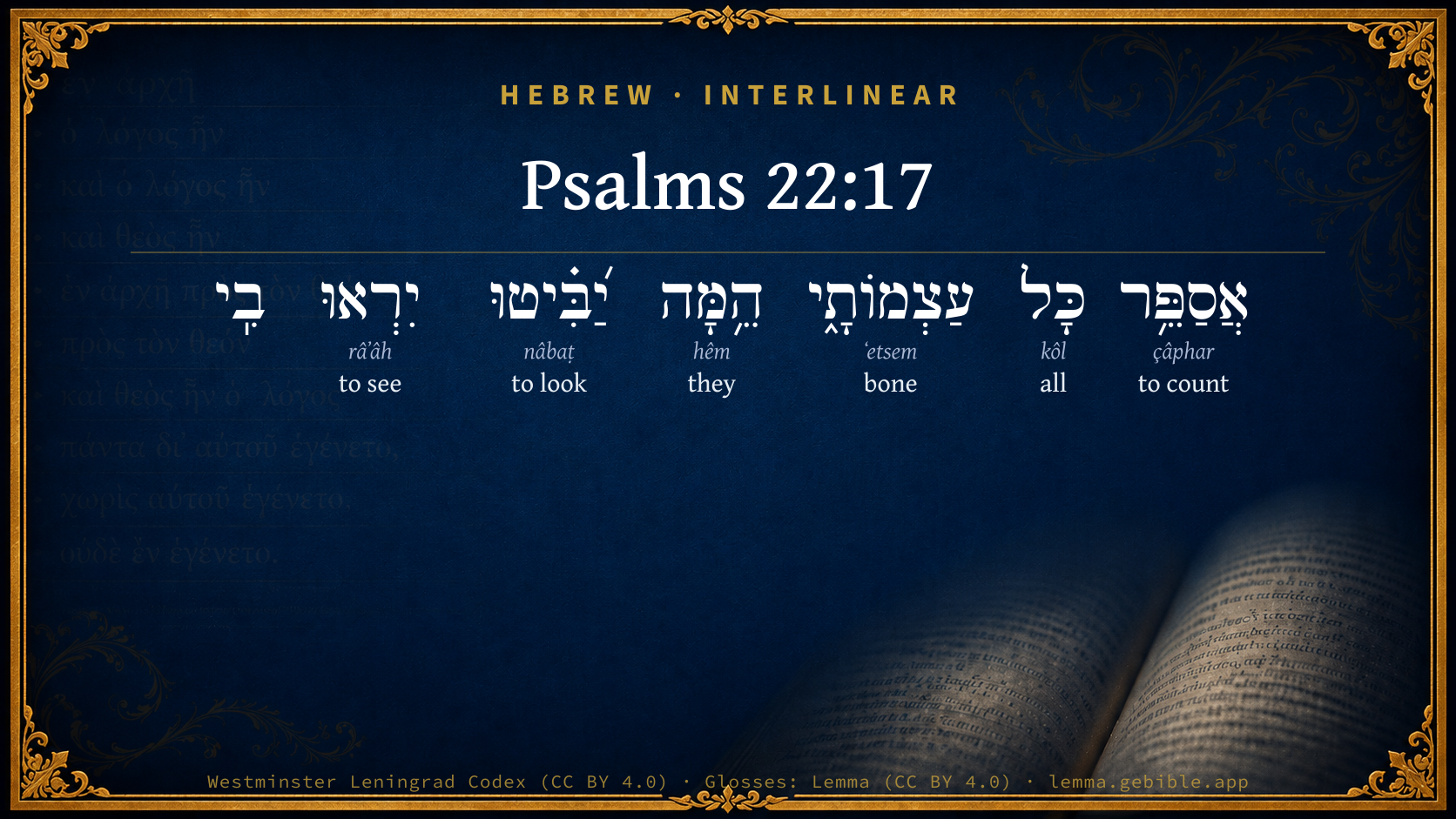
Hebrew (Westminster Leningrad Codex) Psalms 22:17 appears in the Hebrew Old Testament. The text above is from the Westminster Leningrad Codex. Each word links to its Strong’s number, a concise gloss, and parsing drawn from the Open Scriptures Hebrew Bible morphology. Click any word for its full Brown-Driver-Briggs (BDB) entry.
Download image
Cite this verse

Psalms 22:17 (World English Bible). Public Domain. Lemma interlinear Bible study tool, https://lemma.gebible.app/v/psalms/22/17.

Show BibTeX & RIS
BibTeX
RIS
English Translation
I can count all of my bones. They look and stare at me.
World English Bible · Public Domain
Download a study sheet

One document with this verse’s original text, its word-by-word gloss line, the meaning frame, cross-references with their text, attributed commentary, and full source and license credits — printable, and it pastes into notes with its structure intact.

This verse Autodidact and up

Study sheet (.html) Plain text (.txt)

A passage Seminary Student

Up to 50 verses in one chapter. A passage sheet keeps up to 6 commentary sources and 12 cross-references per verse, in the order this page ranks them, and says so on the sheet whenever that leaves anything out. Ask for a single verse and you get the Autodidact verse sheet above.

Everything on this page stays free to read, with no account — the sheet is a download of what is already on screen, not access to it.

Want to remove ads? Support Godless Engineer
Compare translations 3

The same verse in 3 English versions, stacked beneath the original-language interlinear above. Click any original word for its lexicon entry.

Each is an independent rendering of the whole verse — the interlinear is not word-aligned to these translations.

Highlighted words mark where these versions differ — a whole-verse word diff, not a word-by-word alignment.

  • World English Bible Public Domain
    I can count all of my bones. They look and stare at me.
  • King James Version Public Domain
    I may tell all my bones: they look and stare upon me.
  • unfoldingWord Literal Text CC BY-SA 4.0
    I can count all of my bones. They look they stare at me.

unfoldingWord Literal Text — © unfoldingWord, licensed CC BY-SA 4.0. Word-aligned USFM3 via Door43 (git.door43.org/unfoldingWord/en_ult).

Versions to compare (up to 4)

3 of 4 selected

Show all 18 translations

Every available English version of this verse, each an independent rendering of the whole verse.

  • World English Bible Public Domain
    I can count all of my bones. They look and stare at me.
  • Berean Standard Bible Public Domain
    I can count all my bones; they stare and gloat over me.
  • Majority Standard Bible Public Domain
    I can count all my bones; they stare and gloat over me.
  • King James Version Public Domain
    I may tell all my bones: they look and stare upon me.
  • American Standard Version (1901) Public Domain
    I may count all my bones; They look and stare upon me.
  • Revised Version (1885) Public Domain
    I may tell all my bones; they look and stare upon me:
  • Geneva Bible (1599) Public Domain
    I may tell all my bones: yet they beholde, and looke vpon me.
  • Douay-Rheims (1899) Public Domain
    For many dogs have encompassed me: the council of the malignant hath besieged me. They have dug my hands and feet.
  • Young's Literal Translation Public Domain
    I count all my bones -- they look expectingly, They look upon me,
  • Literal Standard Version CC BY-SA 4.0
    I count all My bones—they look expectingly, || They look on Me,
  • Unlocked Literal Bible CC BY-SA 4.0
    I can count all my bones. They look and stare at me.
  • unfoldingWord Literal Text CC BY-SA 4.0
    I can count all of my bones. They look they stare at me.
  • Darby Bible Public Domain
    I may count all my bones. They look, they stare upon me;
  • World Messianic Bible Public Domain
    I can count all of my bones. They look and stare at me.
  • Webster's Bible Public Domain
    \\22:16\\For dogs have compassed me: the assembly of the wicked have inclosed me: they pierced my hands and my feet.
  • Free Bible Version CC BY-SA 4.0
    I'm so thin I can count all my bones. People stare at me and gloat.
  • Bible in Basic English Public Domain
    I am able to see all my bones; their looks are fixed on me:
  • JPS Tanakh (1917) Public Domain
    (22-18) I may count all my bones; they look and gloat over me.

Literal Standard Version (2020), Covenant Press — licensed CC BY-SA 4.0. Text via the HelloAO Bible API (eBible.org). Unlocked Literal Bible (unfoldingWord) — licensed CC BY-SA 4.0. Text via the HelloAO Bible API (eBible.org). unfoldingWord Literal Text — © unfoldingWord, licensed CC BY-SA 4.0. Word-aligned USFM3 via Door43 (git.door43.org/unfoldingWord/en_ult). Free Bible Version, Dr. Jonathan Gallagher — licensed CC BY-SA 4.0. Text via the HelloAO Bible API (eBible.org).

Word by word

More ways to search: Search by grammar → Find every occurrence → Compare this word →

Practice this passage: Drill this verse → Learn its vocabulary →

About this verse

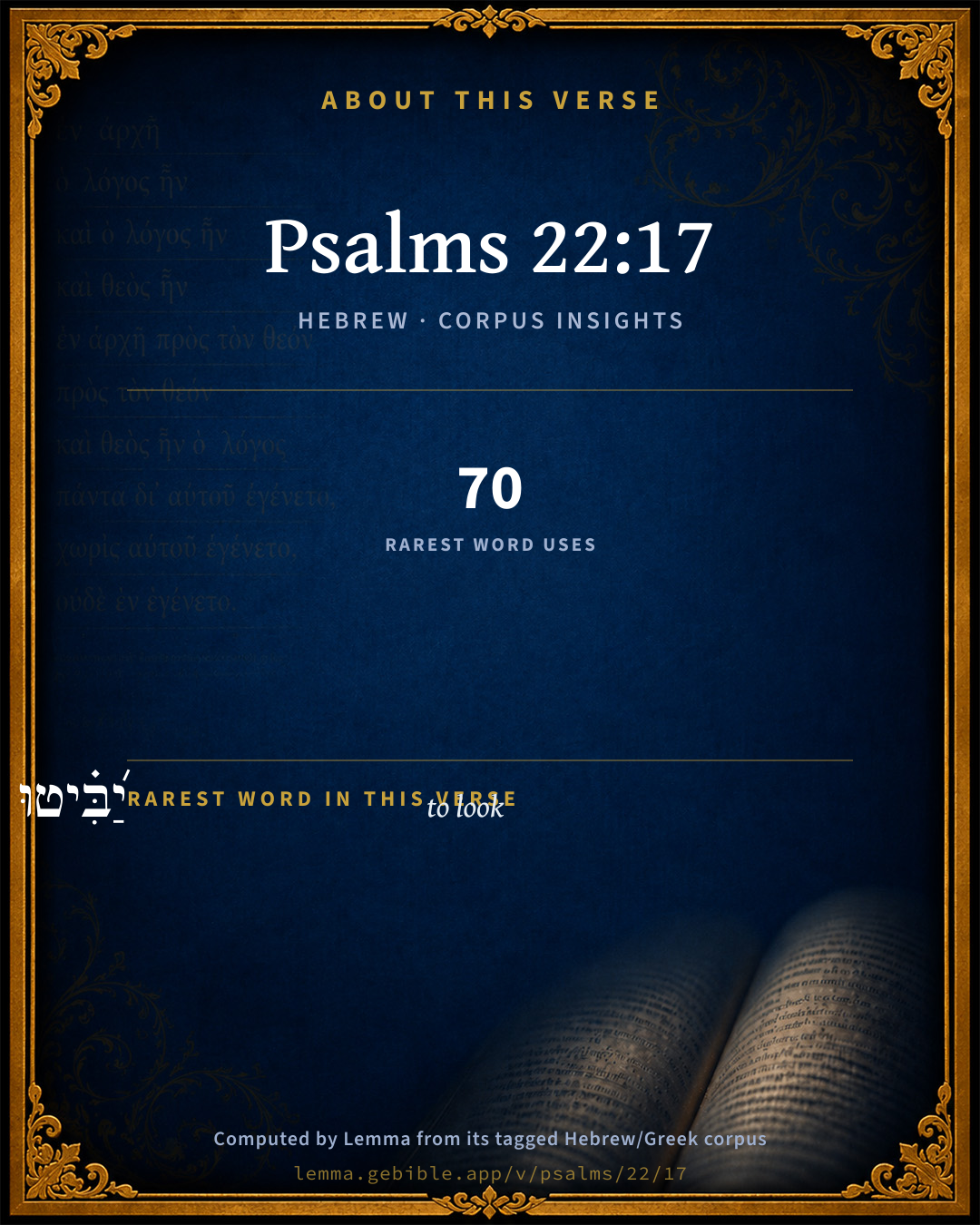
These counts appear in no published source. They are computed here, from the morphology-tagged text and Lemma’s own curated glosses. What Lemma adds →

7
words
6
distinct lemmas
Wisdom
section

Grammatical profile

  • 3 verbs
  • 2 nouns
  • 1 pronoun
  • 1 preposition

Verb forms

  • אֲסַפֵּ֥ר Piel · Imperfect
  • יַ֝בִּ֗יטוּ Hiphil · Imperfect
  • יִרְאוּ Qal · Imperfect

Hebrew & Septuagint length

In English translation the verse runs 13 words from the Hebrew and 12 from the Septuagint (LXX English) — closely comparable.

A rough comparison of the two English renderings, which tokenize alike — not a word-level alignment.

Word counts can differ between the Hebrew and the Greek without any difference in meaning — e.g. the Hebrew direct-object marker אֵת has no separate Greek word, and Greek often adds the article ὁ.

Cross-references

8

Topical passages linked to Psalms 22:17 in the Treasury of Scripture Knowledge — connected by theme and wording, ordered by reader-vote popularity; previews shown in the World English Bible.

  • Luke 23:35 The people stood watching. The rulers with them also scoffed at him, saying, "He saved others. Let him save himself, if this is the Christ of God, his chosen one!"
  • Job 33:21 His flesh is so consumed away, that it can't be seen; His bones that were not seen stick out.
  • Isaiah 52:14 Like as many were astonished at you (his visage was so marred more than any man, and his form more than the sons of men),
  • Matthew 27:39–41 Those who passed by blasphemed him, wagging their heads,
  • Luke 23:27 A great multitude of the people followed him, including women who also mourned and lamented him.
  • Mark 15:29–32 Those who passed by blasphemed him, wagging their heads, and saying, "Ha! You who destroy the temple, and build it in three days,
  • Psalms 102:3–5 For my days consume away like smoke. My bones are burned as a firebrand.
  • Matthew 27:36 and they sat and watched him there.

Cross-references courtesy of OpenBible.info (CC BY 4.0).

Hebrew and Greek witnesses Masoretic Hebrew ↔ Greek Septuagint

The same verse in the two great witnesses to the Old Testament, shown verse-for-verse.

You’re reading Greek Psalm 21 (Hebrew Psalm 22). The Septuagint counts the superscription, so verse numbers can differ from the Hebrew — chapter-level alignment, not verse-by-verse. Numbering follows Rahlfs.

These are two independent witnesses, not word-aligned to each other, and the Septuagint is shown in lemma (dictionary) form.

Hebrew Psalms 22:17 Masoretic · Westminster Leningrad Codex

אֲסַפֵּ֥ר כָּל עַצְמוֹתָ֑י הֵ֥מָּה יַ֝בִּ֗יטוּ יִרְאוּ בִֽי

I can count all of my bones. They look and stare at me.

World English Bible · Public Domain

Greek LXX Greek Psalm 21:17 Septuagint · lemma form

ὅτι κυκλόω ἐγώ κύων πολύς συναγωγή πονηρεύομαι περιἔχω ἐγώ ὀρύσσω χείρ ἐγώ καί πούς

They counted all my bones; and they observed and looked upon me.

LXX2012 (modern English Septuagint) · Public Domain

On this verse, John Gill's Exposition discusses the Septuagint’s reading. Read the note in Commentary ↓

Hebrew: Westminster Leningrad Codex (CC BY 4.0). Greek: Septuagint (public domain); English from LXX2012 (modern English Septuagint) (Public Domain). How the Septuagint differs from the Hebrew →

Commentary

Notes on Psalms 22:17 from classic Christian and Jewish commentators (each source and its license shown beneath its notes). The classic Christian expositions comment on the surrounding passage and are grouped to its opening verse, so a note may address several verses; the Jewish commentaries on the Tanakh (Rashi and others) are per-verse, so they appear only where the commentator wrote on this verse.

Lemma curates 59 commentaries, every one of them public domain or Creative Commons licensed, each selected and text-cleaned for this edition rather than reprinted as found. About our sources →

Trapp's Complete Commentary

John Trapp

Psa 22:17 I may tell all my bones: they look [and] stare upon me.

Ver. 17. I may tell all my bones] Now especially, when stretched out upon the cross, Quando pendens extentus erat in ligno, saith Austin. Derident maciem meam, saith Kimchi.

They look and stare upon me] Aspiciunt, id est, despiciunt, ut Son 1:6, saith Kimchi, they feed their eyes and passions with my misery, as Luk 23:35. This απιχαιρεκακια is the devil’s disease, and declareth a devilish disposition, sc. for a man to make himself merry in other men’s misery.

John Trapp, A Commentary or Exposition upon All the Books of the Old and New Testament (1647–1656) — public domain. Text from a community e-Sword module.

Joseph Benson's Commentary

Psa 22:17-21. I may tell all my bones — Theodoret observes, that when Christ was extended, and his limbs distorted, on the cross, it might be easy for a spectator literally to tell all his bones. They — Namely, my enemies; look and stare at me — With delight and complacency, at my calamities, and I am a spectacle to earth and heaven. They part my garments among them — This also cannot be applied to David, without a strained and unprecedented metaphor, but was literally fulfilled in Christ, Mat 27:35; Joh 19:24. Deliver my soul from the sword — That is, from the rage and violence of mine enemies, as the next clause explains it, and, as the sword is often to be taken in Scripture. My darling — Hebrew, my one, or only one, namely, his soul, as he now said, which he so terms, because it was very dear to him, or because it was left alone, and destitute of friends and helpers. From the power of the dog — “The ravening fury of the dog,” says Dr. Horne, “the lion, and the unicorn, or oryx, (a fierce and untameable creature of the stag kind,) is made use of to describe the rage of the devil, and his instruments, whether spiritual or corporeal. From all these Christ supplicates the Father for deliverance. How great need have we to supplicate for the same through him!”

Joseph Benson's Commentary on the Old and New Testaments (1811–1818) — public domain. Text from a community e-Sword module.

J. A. Alexander on Psalms

Joseph Addison Alexander

18. (Psa 22:17). I tell all my bones (while) they look and stare upon me. The pronoun of the last clause is expressed in Hebrew, which removes the ambiguity of the construction, by shewing that the subject of the following verbs is not the bones of the preceding clause, but something more remote, namely, the sufferer's enemies and persecutors. The ambiguity of the English word tell corresponds to that of the Hebrew, which means both to number and to relate, to count and to recount. Some suppose, not improbably, that this verse presents the sufferer as stripped by his enemies, and looking with grief and wonder at his own emaciation, while they gaze at it with delight, as the Hebrew phrase implies. See below, on Psa 27:13.

Joseph Addison Alexander, The Psalms Translated and Explained (1850) — public domain. Text from a community e-Sword module.

Tyndale Open Study Notes

Tyndale Open Resources

22:17-18 I can count all my bones: The psalmist’s enemies have utterly shamed him by taking his garments. Jesus also suffered this disgrace (see Matt 27:35). • stare at me and gloat: Enemies make the psalmist the object of their scorn (see Pss 35:24, 26; 38:16; 55:3; cp. 59:10). • throw dice: Literally cast lots. The casting of lots was sometimes a way for godly people to find God’s direction (Lev 16:8; Num 27:21; Acts 1:24-26). Here, the lots are thrown simply as a game of chance. The soldiers threw dice for Jesus’ clothing after the crucifixion (Matt 27:35; Mark 15:24; Luke 23:34; John 19:24).

Tyndale Open Study Notes — © Tyndale Open Resources, licensed CC BY-SA 4.0. Text via the HelloAO Bible API.

Jamieson, Fausset & Brown

Robert Jamieson, A. R. Fausset & David Brown

His emaciated frame, itself an item of his misery, is rendered more so as the object of delighted contemplation to his enemies. The verbs, "look" and "stare," often occur as suggestive of feelings of satisfaction (compare Psa 27:13; Psa 54:7; Psa 118:7).

Jamieson, Fausset & Brown — Commentary Critical and Explanatory on the Whole Bible (1871) — public domain (CC PDM 1.0). Text via the HelloAO Bible API.

Adam Clarke's Commentary

Verse 17. I may tell all my bones] This may refer to the violent extension of his body when the whole of its weight hung upon the nails which attached his hands to the transverse beam of the cross. The body being thus extended, the principal bones became prominent, and easily discernible.

Adam Clarke's Commentary on the Bible (1810–1826) — public domain. Text from a community e-Sword/MySword module.

John Calvin's Commentaries

17. I will number. The Hebrew word עצמות, atsmoth which signifies bones, is derived from another word, which signifies strength; and, therefore, this term is sometimes applied to friends, by whose defense we are strengthened, or to arguments and reasons which are, as it were, the sinews and the strength of the defense of a cause. Some, therefore, put this meaning upon the passage, — I will profit nothing by reckoning up all my arguments in self-vindication; for my enemies are fully determined to destroy me by some means or other, whether fair or foul, without having any regard to the dictates of justice. Others explain it thus: Although I should gather together all the aids which might seem to be capable of affording me succor, they would avail me nothing. But the exposition which is more generally received seems to me to be also the more simple and natural, and, therefore, I embrace it the more readily. It is this - that David complains that his body was so lean and wasted, that the bones appeared protruding from all parts of it; for he adds immediately after, that his enemies took pleasure in seeing him in so pitiable a condition. Thus the two clauses of the verse are beautifully connected together. The cruelty of his enemies was so insatiable, that beholding a wretched man wasted with grief, and as it were pining away, they took pleasure in feeding their eyes with so sad a spectacle.

John Calvin's Commentaries (1540-1563) — public domain. Text from the Calvin Translation Society English edition (1840s-50s) via the Christian Classics Ethereal Library (ccel.org). Calvin's coverage is partial (roughly two-thirds of the Bible); uncommented books and verses are honest gaps, never fabricated. The 19th-century editor's footnotes and remarks are omitted so the notes are faithfully Calvin's own voice.

The Cambridge Bible for Schools and Colleges

gen. ed. J. J. S. Perowne

17. I may tell] i.e. I can count. He is reduced to a living skeleton. Cp. Job_33:21.

they look &c.] While they—they gaze &c. The original expresses the malicious delight with which these monsters of cruelty feast their eyes upon the sorry spectacle.

The Cambridge Bible for Schools and Colleges (gen. ed. J. J. S. Perowne; Cambridge University Press, 1878–1918) — public domain. Text from a community e-Sword module.

John Gill's Exposition

I may tell all my bones,.... For what with the stretching out of his body on the cross, when it was fastened to it as it lay on the ground, and with the jolt of the cross when, being reared up, it was fixed in the ground, and with the weight of the body hanging upon it, all his bones were disjointed and started out; so that, could he have seen them, he might have told them, as they might be told by the spectators who were around him; and so the Septuagint, Vulgate Latin, Arabic, and Ethiopic versions render it, "they have numbered all my bones"; that is, they might have done if: the Targum is, "I will number all the scars of my members", made by the blows, scourges, and wounds he received;

they look and stare upon me; meaning not his bones, but his enemies; which may be understood either by way of contempt, as many Jewish interpreters explain it: so the Scribes and elders of the people, and the people themselves, looked and stared at him on the cross, and mocked at him, and insulted him; or by way of rejoicing, saying, "Aha, aha, our eye hath seen", namely, what they desired and wished for, Psa 35:21; a sight as was enough to have moved an heart of stone made no impression on them; they had no sympathy with him, no compassion on him, but rejoiced at his misery: this staring agrees with their character as dogs.

John Gill's Exposition of the Whole Bible (1746–1763) — public domain (CC PDM 1.0). Text via the HelloAO Bible API.

Albert Barnes' Notes on the Bible

I may tell all my bones - That is, I may count them. They are so prominent, so bare, that I can see them and count their number. The idea here is that of emaciation from continued suffering or from some other cause. As applied to the Redeemer, it would denote the effect of long protracted suffering and anxiety on his frame, as rendering it crushed, weakened, emaciated. Compare the notes at Isa 52:14; Isa 53:2-3. No one can prove that an effect such as is here referred to may not have been produced by the sufferings of the Redeemer.

They look and stare upon me - That is, either my bones - or, my enemies that stand around me. The most obvious construction would refer it to the former - to his bones - as if they stood out prominently and stared him in the face. Rosenmuller understands it in the latter sense, as meaning that his enemies gazed with wonder on such an object. Perhaps this, on the whole, furnishes the best interpretation, as there is something unnatural in speaking of a man’s own bones staring or gazing upon him, and as the image of his enemies standing and looking with wonder on one so wretched, so crushed, so broken, is a very striking one. This, too, will better agree with the statement in Isa 52:14, “Many were astonished at thee;” and Isa 53:2-3, “He hath no form nor comeliness, and when we shall see him, there is no beauty that we should desire him;” “we hid, as it were, our faces from him; he was despised, and we esteemed him not.” It accords also better with the statement in the following verse; “they,” that is, the same persons referred to, “part my garments amoung them.”

Albert Barnes' Notes on the Bible (1834–1885) — public domain. Text from a community e-Sword/MySword module.

Matthew Poole's English Annotations

I may tell all my bones; partly through my leanness, caused by excessive grief, which is much more credible of Christ than of David; and partly by my being stretched out upon the cross.

They look and stare upon me, to wit, with delight and complacency in my calamities, as this phrase is used, Psa 35:21; 37:34; 54:7; 59:10; Oba 1:12. Compare Luk 23:35.

Matthew Poole's English Annotations on the Holy Bible (1683–1685) — public domain. Text from a community e-Sword/MySword module.

The Treasury of David

Charles H. Spurgeon

Ver. 17. So emaciated was Jesus by his fastings and sufferings that he says,

I may tell all my bones. He could count and recount them. The posture of the body on the cross, Bishop Horne thinks, would so distend the flesh and skin as to make the bones visible, so that they might be numbered. The zeal of his Father's house had eaten him up; like a good soldier he had endured hardness. Oh that we cared less for the body's enjoyment and ease and more for our Father's business! It were better to count the bones of an emaciated body than to bring leanness into our souls.

They look and stare upon me. Unholy eyes gazed insultingly upon the Saviours's nakedness, and shocked the sacred delicacy of his holy soul. The sight of the agonizing body ought to have ensured sympathy from the throng, but it only increased their savage mirth, as they gloated their cruel eyes upon his miseries. Let us blush for human nature, and mourn in sympathy with our Redeemer's shame. The first Adam made us all naked, and therefore the second Adam became naked that he might clothe our naked souls.

Ver. 17. I may tell all my bones: they look and stare upon me. The skin and flesh were distended by the posture of the body on the cross, that the bones, as through a thin veil, became visible, and might be counted. George Horne.

Ver. 17. I may tell all my bones. For, as the first Adam by his fall, lost the robe of innocence, and thenceforth needed other garments, so the second Adam vouchsafed to be stripped of his earthly vestments, to the end it might hereafter be said to us, "Bring forth the first robe, and put it on him." Lu 15:22. Gerhohus, quoted by J. M. Neale.

Ver. 17. They look and stare upon me. Sensitively conscious of his condition upon the cross, the delicate feelings of the holy Saviour were sorely pained by the gaze of the multitude. With impudent face they looked upon him. To view him better they halted as they walked. With deliberate insolence they collected in groups, and made their remarks to each other on his conduct and appearance. Mocking his naked, emaciated, and quivering body, they "looked and stared upon him." John Stevenson.

Ver. 17. They look and stare upon me. Oh, how different is that look which the awakened sinner directs to Calvary, when faith lifts up her eye to him who agonized, and bled, and died, for the guilty! And what gratitude should perishing men feel, that from him that hangs upon the accursed tree there is heard proceeding the inviting sound, "Look unto me, and be ye saved, all ye ends of the earth, for I am God, and besides me there is none else." John Morison.

Charles H. Spurgeon's The Treasury of David (1869–1885) — public domain. Psalms only. Text from a community e-Sword/MySword module.

Whedon's Commentary on the Bible

Daniel D. Whedon

17. I may tell all my bones—In Psa_22:14 : “All my bones are out of joint.” The protrusion of the bones, so that one could count them, is not merely the effect of a wasting suffering. but of violent and unnatural treatment, as the crucifixion.

They look and stare upon me—They closely watch me. Compare the watching of Jesus, Mat_27:36-54. The idea of satisfaction is also suggested. They feast their eyes upon me. They behold me not only with indifference, but are regaled at the sight of my misery.

Daniel D. Whedon (gen. ed.), Commentary on the Old and New Testaments (1874–1909) — public domain. Text from a community e-Sword module.

The Pulpit Commentary

I may tell all my bones. Our Lord"s active life and simple habits would give him a spare frame, while the strain of crucifixion would accentuate and bring into relief every point of his anatomy. He might thus, if so minded, "tell all his bones." They look and stare upon me. (comp. Luk_23:35, "And the people stood beholding

The Pulpit Commentary (1880–1919), ed. H.D.M. Spence-Jones & Joseph S. Exell — public domain. Text from a community e-Sword module.

John Wesley's Explanatory Notes

May tell - By my being stretched out upon the cross.

John Wesley, Explanatory Notes Upon the Whole Bible (1754–1765) — public domain. Text via the GEBible commentary corpus.

Rashi

Rabbi Shlomo Yitzchaki (Rashi)

like a lion, my hands and feet As though they are crushed in a lion’s mouth, and so did Hezekiah say (in Isa. 38:13): “like a lion, so it would break all my bones.”

Rashi on the Tanakh — English translations: “The Judaica Press complete Tanach with Rashi, translated by A. J. Rosenberg” (CC BY 4.0); “Pentateuch with Rashi's commentary by M. Rosenbaum and A.M. Silbermann, 1929-1934” (public domain); “The Metsudah Tanach series, Lakewood, N.J” (CC BY 4.0); and “The Book of Joshua, Metsudah Publications, 1997” (CC BY 4.0). Text via Sefaria.

Radak

Rabbi David Kimhi (Radak)

For there have surrounded me: – They are the enemies, and I am in the midst of them like one who is surrounded by

dogs: – from whom there is no way of escape. And (the clause) For dogs have surrounded me is to be explained after a figurative manner; and the metaphorical interpretation is

The assembly of evil-doers have encircled me like a lion my hands and my feet: – for they have encircled me like the lion which makes a circuit with his tail in the forest, and no creature which sees that circle moves out thence for fear of the lion and the terror he inspires, but they fold their hands and their feet, and the lion finds his prey in the midst of his circle. So we in exile are in the midst of a circle from which we cannot emerge lest we fall into the hand of the spoilers; for if we should escape from the power of the Mohammedans we should fall into the power of the uncircumcised, and so we fold our hands and feet and stand fearful and terror-stricken before them; for we have no power either to escape on foot or to fight with our hands. Behold, it is just as if our hands and feet were in fetters!

Radak on the Tanakh — English translations: “Sefaria Community Translation” (CC0 1.0 (public-domain dedication)); “Eliyahu Munk, HaChut Hameshulash” (CC BY 4.0); “Rabbi Mike Feuer, Jerusalem Anthology” (CC BY 4.0); and “R. David Kimhi on the first book of Psalms, Translated by R.G. Finch, London, 1919” (public domain). Text via Sefaria.

Lesson kit

Teaching starters — assembled from the data on this page, not authored interpretation. Every prompt links to the verse data it draws on. Edit before teaching.

Psalms, in the Wisdom, opens this verse with 7 words (6 distinct Hebrew lemmas). Its most distinctive word is nâbaṭ (“to look”). A historical commentator’s framing appears above. Read the whole chapter for the surrounding context.

Discussion questions

  1. The word nâbaṭ carries the sense “to look.” How does it shape the verse?
  2. Luke 23:35 shares this passage’s theme. How do the two illuminate each other?
  3. These translations render this verse differently; the difference is in the English rendering, not the original. What questions does that raise?
  4. The verb «אֲסַפֵּ֥ר» is Piel Imperfect. How does its form color the action?
  5. Reading how Trapp's Complete Commentary and Joseph Benson's Commentary read this verse, where do the two commentators agree and where do they part?

Things to notice

Reading settings

Reading text

Shown beneath each verse's original-language words.

Old Testament
Old Testament edition

Read the OT as the Masoretic Hebrew (MT) or the Greek Septuagint (LXX).

English shown for the Greek Septuagint (in the Hebrew ↔ Greek comparison).

Comparing translations? Open the Compare panel on any verse page to stack up to four side by side.