

Psalms 88:11

Hebrew (Westminster Leningrad Codex) Psalms 88:11 appears in the Hebrew Old Testament. The text above is from the Westminster Leningrad Codex. Each word links to its Strong’s number, a concise gloss, and parsing drawn from the Open Scriptures Hebrew Bible morphology. Click any word for its full Brown-Driver-Briggs (BDB) entry.
Download image
Cite this verse

Psalms 88:11 (World English Bible). Public Domain. Lemma interlinear Bible study tool, https://lemma.gebible.app/v/psalms/88/11.

Show BibTeX & RIS
BibTeX
RIS
English Translation
Is your loving kindness declared in the grave? Or your faithfulness in Destruction?
World English Bible · Public Domain
Download a study sheet

One document with this verse’s original text, its word-by-word gloss line, the meaning frame, cross-references with their text, attributed commentary, and full source and license credits — printable, and it pastes into notes with its structure intact.

This verse Autodidact and up

Study sheet (.html) Plain text (.txt)

A passage Seminary Student

Up to 50 verses in one chapter. A passage sheet keeps up to 6 commentary sources and 12 cross-references per verse, in the order this page ranks them, and says so on the sheet whenever that leaves anything out. Ask for a single verse and you get the Autodidact verse sheet above.

Everything on this page stays free to read, with no account — the sheet is a download of what is already on screen, not access to it.

Want to remove ads? Support Godless Engineer
Compare translations 3

The same verse in 3 English versions, stacked beneath the original-language interlinear above. Click any original word for its lexicon entry.

Each is an independent rendering of the whole verse — the interlinear is not word-aligned to these translations.

Highlighted words mark where these versions differ — a whole-verse word diff, not a word-by-word alignment.

  • World English Bible Public Domain
    Is your loving kindness declared in the grave? Or your faithfulness in Destruction?
  • King James Version Public Domain
    Shall thy lovingkindness be declared in the grave? or thy faithfulness in destruction?
  • unfoldingWord Literal Text CC BY-SA 4.0
    Will your covenant faithfulness be recounted in the grave, your faithfulness in Abaddon?

unfoldingWord Literal Text — © unfoldingWord, licensed CC BY-SA 4.0. Word-aligned USFM3 via Door43 (git.door43.org/unfoldingWord/en_ult).

Versions to compare (up to 4)

3 of 4 selected

Show all 18 translations

Every available English version of this verse, each an independent rendering of the whole verse.

  • World English Bible Public Domain
    Is your loving kindness declared in the grave? Or your faithfulness in Destruction?
  • Berean Standard Bible Public Domain
    Can Your loving devotion be proclaimed in the grave, Your faithfulness in Abaddon?
  • Majority Standard Bible Public Domain
    Can Your loving devotion be proclaimed in the grave, Your faithfulness in Abaddon?
  • King James Version Public Domain
    Shall thy lovingkindness be declared in the grave? or thy faithfulness in destruction?
  • American Standard Version (1901) Public Domain
    Shall thy lovingkindness be declared in the grave? Or thy faithfulness in Destruction?
  • Revised Version (1885) Public Domain
    Shall thy lovingkindness be declared in the grave? or thy faithfulness in Destruction?
  • Geneva Bible (1599) Public Domain
    Shall thy louing kindenes be declared in the graue? or thy faithfulnes in destruction?
  • Douay-Rheims (1899) Public Domain
    Wilt thou shew wonders to the dead? or shall physicians raise to life, and give praise to thee?
  • Young's Literal Translation Public Domain
    Is Thy kindness recounted in the grave? Thy faithfulness in destruction?
  • Literal Standard Version CC BY-SA 4.0
    Is Your kindness recounted in the grave? Your faithfulness in destruction?
  • Unlocked Literal Bible CC BY-SA 4.0
    Will your covenant faithfulness be proclaimed in the grave, your loyalty in the place of the dead?
  • unfoldingWord Literal Text CC BY-SA 4.0
    Will your covenant faithfulness be recounted in the grave, your faithfulness in Abaddon?
  • Darby Bible Public Domain
    Shall thy loving-kindness be declared in the grave? thy faithfulness in Destruction?
  • World Messianic Bible Public Domain
    Is your loving kindness declared in the grave? Or your faithfulness in Destruction?
  • Webster's Bible Public Domain
    \\88:10\\Wilt thou show wonders to the dead? shall the dead arise and praise thee? Selah.
  • Free Bible Version CC BY-SA 4.0
    Your faithful love—is it mentioned in the grave? Your trustworthiness—is it discussed in the place of destruction?
  • Bible in Basic English Public Domain
    Will the story of your mercy be given in the house of the dead? will news of your faith come to the place of destruction?
  • JPS Tanakh (1917) Public Domain
    (88-12) Shall Thy mercy be declared in the grave? or Thy faithfulness in destruction?

Literal Standard Version (2020), Covenant Press — licensed CC BY-SA 4.0. Text via the HelloAO Bible API (eBible.org). Unlocked Literal Bible (unfoldingWord) — licensed CC BY-SA 4.0. Text via the HelloAO Bible API (eBible.org). unfoldingWord Literal Text — © unfoldingWord, licensed CC BY-SA 4.0. Word-aligned USFM3 via Door43 (git.door43.org/unfoldingWord/en_ult). Free Bible Version, Dr. Jonathan Gallagher — licensed CC BY-SA 4.0. Text via the HelloAO Bible API (eBible.org).

Word by word

More ways to search: Search by grammar → Find every occurrence → Compare this word →

Practice this passage: Drill this verse → Learn its vocabulary →

About this verse

These counts appear in no published source. They are computed here, from the morphology-tagged text and Lemma’s own curated glosses. What Lemma adds →

5
words
5
distinct lemmas
Wisdom
section

Notable vocabulary

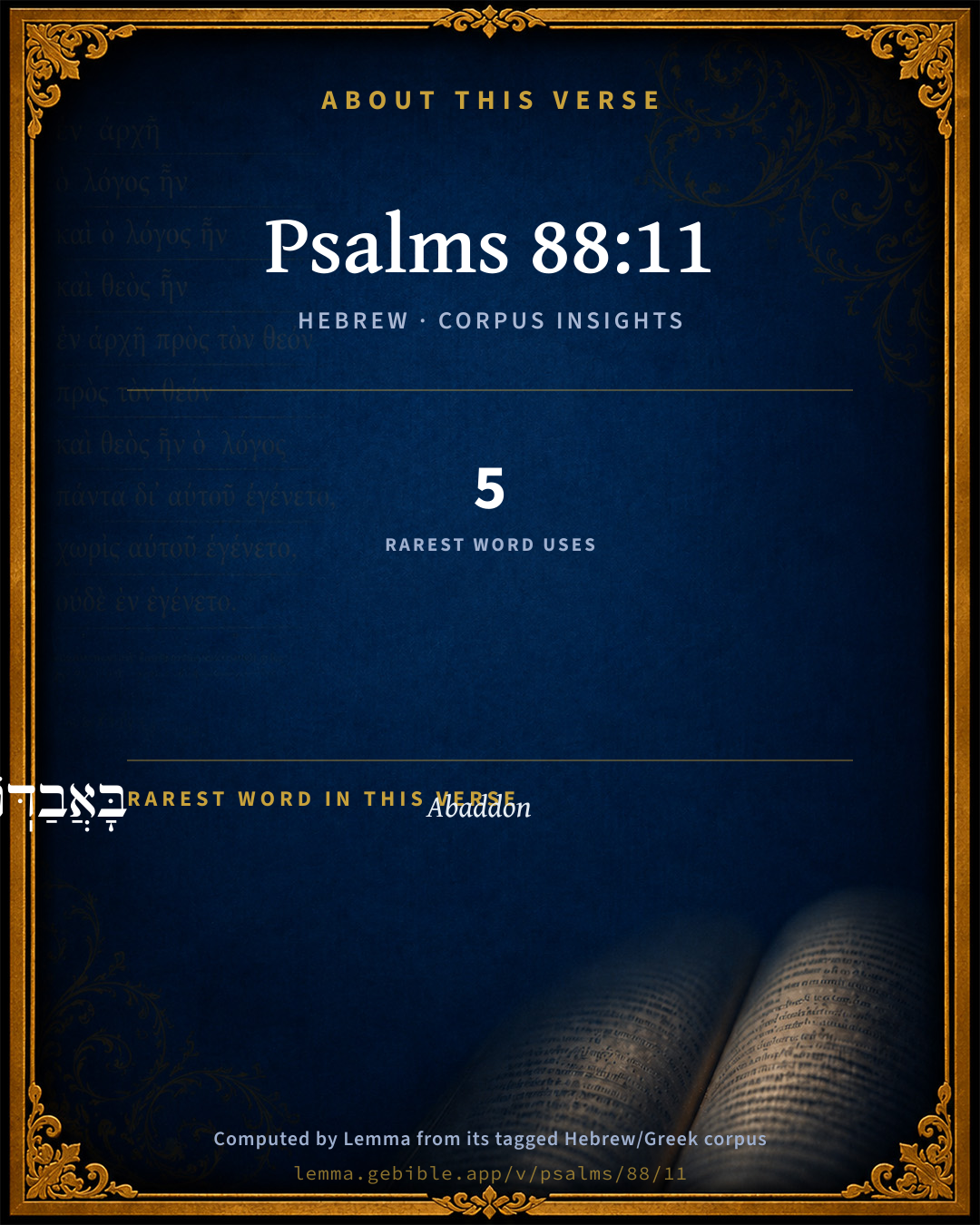
The rarest word here is בָּאֲבַדּֽוֹן Abaddon H11 — appearing just 5 times in the whole Hebrew Bible.

Shared distinctive vocabulary

בָּאֲבַדּֽוֹן Abaddon H11 occurs in 5 verses of the Hebrew Bible. Also found in:

Grammatical profile

  • 1 verb
  • 4 nouns

Verb forms

  • הַיְסֻפַּ֣ר Pual · Imperfect

Hebrew & Septuagint length

In English translation the verse runs 13 words from the Hebrew and 14 from the Septuagint (LXX English) — closely comparable.

A rough comparison of the two English renderings, which tokenize alike — not a word-level alignment.

Word counts can differ between the Hebrew and the Greek without any difference in meaning — e.g. the Hebrew direct-object marker אֵת has no separate Greek word, and Greek often adds the article ὁ.

Cross-references

8

Topical passages linked to Psalms 88:11 in the Treasury of Scripture Knowledge — connected by theme and wording, ordered by reader-vote popularity; previews shown in the World English Bible.

  • Job 21:30 That the evil man is reserved to the day of calamity? That they are led forth to the day of wrath?
  • Job 26:6 Sheol is naked before God, And Abaddon has no covering.
  • Psalms 55:23 But you, God, will bring them down into the pit of destruction. Bloodthirsty and deceitful men shall not live out half their days, But I will trust in you.
  • Psalms 73:18 Surely you set them in slippery places. You throw them down to destruction.
  • Proverbs 15:11 Sheol and Abaddon are before Yahweh-- How much more then the hearts of the children of men!
  • Matthew 7:13 "Enter in by the narrow gate; for wide is the gate and broad is the way that leads to destruction, and many are those who enter in by it.
  • Romans 9:22 What if God, willing to show his wrath, and to make his power known, endured with much patience vessels of wrath made for destruction,
  • 2 Peter 2:1 But there also arose false prophets among the people, as among you also there will be false teachers, who will secretly bring in destructive heresies, denying even the Master who bought them, bringing on themselves swift destruction.

Cross-references courtesy of OpenBible.info (CC BY 4.0).

Hebrew and Greek witnesses Masoretic Hebrew ↔ Greek Septuagint

The same verse in the two great witnesses to the Old Testament, shown verse-for-verse.

You’re reading Greek Psalm 87 (Hebrew Psalm 88). The Septuagint counts the superscription, so verse numbers can differ from the Hebrew — chapter-level alignment, not verse-by-verse. Numbering follows Rahlfs.

These are two independent witnesses, not word-aligned to each other, and the Septuagint is shown in lemma (dictionary) form.

Hebrew Psalms 88:11 Masoretic · Westminster Leningrad Codex

הַיְסֻפַּ֣ר בַּקֶּ֣בֶר חַסְדֶּ֑ךָ אֱ֝מֽוּנָתְךָ֗ בָּאֲבַדּֽוֹן

Is your loving kindness declared in the grave? Or your faithfulness in Destruction?

World English Bible · Public Domain

Greek LXX Greek Psalm 87:11 Septuagint · lemma form

μή ὁ νεκρός ποιέω θαυμάσιος ἤ ἰατρός ἀναἵστημι καί ἐκὁμολογέω σύ

Shall any one declare your mercy in the tomb? and your truth in destruction?

LXX2012 (modern English Septuagint) · Public Domain

Hebrew: Westminster Leningrad Codex (CC BY 4.0). Greek: Septuagint (public domain); English from LXX2012 (modern English Septuagint) (Public Domain). How the Septuagint differs from the Hebrew →

Commentary

Notes on Psalms 88:11 from classic Christian and Jewish commentators (each source and its license shown beneath its notes). The classic Christian expositions comment on the surrounding passage and are grouped to its opening verse, so a note may address several verses; the Jewish commentaries on the Tanakh (Rashi and others) are per-verse, so they appear only where the commentator wrote on this verse.

Lemma curates 59 commentaries, every one of them public domain or Creative Commons licensed, each selected and text-cleaned for this edition rather than reprinted as found. About our sources →

Trapp's Complete Commentary

John Trapp

Psa 88:11 Shall thy lovingkindness be declared in the grave? [or] thy faithfulness in destruction?

Ver. 11. Shall thy loving kindness, &c.] The same again, and Psa 88:12 a third time, pro more dolentium. See Psa 6:5; Psa 30:9.

John Trapp, A Commentary or Exposition upon All the Books of the Old and New Testament (1647–1656) — public domain. Text from a community e-Sword module.

J. A. Alexander on Psalms

Joseph Addison Alexander

12. (Psa 88:11) Shall thy mercy be recounted in the grave, thy faithfulness in destruction? The last word (Abaddon) appears elsewhere in conjunction with the grave and death, as a poetical equivalent. See Pro 15:11, Job 26:6; Job 28:22.

Joseph Addison Alexander, The Psalms Translated and Explained (1850) — public domain. Text from a community e-Sword module.

Adam Clarke's Commentary

Verse 11. Or thy faithfulness in destruction?] Faithfulness in God refers as well to his fulfilling his threatenings as to his keeping his promises. The wicked are threatened with such punishments as their crimes have deserved; but annihilation is no punishment. God therefore does not intend to annihilate the wicked; their destruction cannot declare the faithfulness of God.

Adam Clarke's Commentary on the Bible (1810–1826) — public domain. Text from a community e-Sword/MySword module.

John Calvin's Commentaries

13. But to thee have I cried, O Jehovah! There may have been a degree of intemperateness in the language of the prophet, which, as I have granted, cannot be altogether vindicated; but still it was a sign of rare faith and piety to persevere as he did with never-failing earnestness in prayer. This is what is meant when he says, that he made haste in the morning; by which he would have us not to imagine that he slowly and coldly lingered till he was constrained by dire necessity. At the same time, he modestly intimates by these words, that his pining away in long continued miseries was not owing to his own sluggishness, as if he had not sought God. This is an example particularly worthy of notice, that we may not become discouraged if it happen sometimes that our prayers are for a time unsuccessful, although they may proceed from the heart, and may be assiduously persevered in.

John Calvin's Commentaries (1540-1563) — public domain. Text from the Calvin Translation Society English edition (1840s-50s) via the Christian Classics Ethereal Library (ccel.org). Calvin's coverage is partial (roughly two-thirds of the Bible); uncommented books and verses are honest gaps, never fabricated. The 19th-century editor's footnotes and remarks are omitted so the notes are faithfully Calvin's own voice.

Ellicott's Commentary for English Readers

(11) Lovingkindness.—Better here, covenant grace. The grave knew nothing of this. Death severed the covenant relationship. So “faithfulness,” “wonders,” “righteousness” are all used in their limited sense as determined by the covenant.

(11, 12) In these verses appear three prominent features of the Hebrew conception of the underworld. It is a place of “destruction” (comp. Job_26:6; Job_28:22), of “darkness” (comp. Psa_88:6), and of “forgetfulness,” which may imply not only that the dead are forgotten, both of God and men (comp. Psa_31:12 with Psa_88:5), but that they themselves have, to borrow the heathen figure, drunk of the water of Lethe. (Comp. Psa_6:5; Psa_30:9, and for both ideas combined Ecc_9:5-10.)

A Bible Commentary for English Readers, edited by Charles John Ellicott (1878–1897) — public domain. Text from a community e-Sword module.

The Cambridge Bible for Schools and Colleges

gen. ed. J. J. S. Perowne

11. To proclaim God’s lovingkindness and faithfulness is the delight of His people (Psa_40:10; Psa_92:2), but in the grave they will neither have cause nor power to do it. These two attributes, so often coupled together, are the keynote of Psalms 89.

‘Destruction,’ Heb. Abaddon, is almost a proper name for Sheol as the place of ruin: elsewhere only in the ‘Wisdom literature,’ Job_26:6; Job_28:22; Job_31:12; Pro_15:11; Pro_27:20. Cp. Rev_9:11, where it is the name of “the angel of the abyss,” Gk. Apollyon, ‘the Destroyer.’

The Cambridge Bible for Schools and Colleges (gen. ed. J. J. S. Perowne; Cambridge University Press, 1878–1918) — public domain. Text from a community e-Sword module.

John Gill's Exposition

Shall thy lovingkindness be declared in the grave?.... Where he saw himself now going, and where should he be detained, and not raised out of it, the lovingkindness of God to him, as his Son, and as man and Mediator, and to his people in the gift and mission of him to be their Saviour and Redeemer, how would that be declared and made known? now it is, Christ being raised, and his ministers having a commission from him to preach the Gospel, in which the lovingkindness of God is abundantly manifested:

or thy faithfulness in destruction? the grave, so called from dead bodies being cast into it, and wasted, consumed, and destroyed in it: the meaning may be, that should he be laid in the grave, and there putrefy and rot, and not be raised again, where would be the faithfulness of God to his purposes, to his covenant and promises, to him his Son, and to his people?

John Gill's Exposition of the Whole Bible (1746–1763) — public domain (CC PDM 1.0). Text via the HelloAO Bible API.

Albert Barnes' Notes on the Bible

Shall thy loving-kindness be declared in the grave? - Thy goodness; thy mercy. Shall anyone make it known there? shall it there be celebrated?

Or thy faithfulness in destruction? - In the place where destruction seems to reign; where human hopes perish; where the body moulders back to dust. Shall anyone there dwell on the fidelity - the truthfulness - of God, in such a way as to honor him? It is implied here that, according to the views then entertained of the state of the dead, those things would not occur. According to what is now made known to us of the unseen world it is true that the mercy of God will not be made known to the dead; that the Gospel will not be preached to them; that no messenger from God will convey to them the offers of salvation. Compare Luk 16:28-31.

Albert Barnes' Notes on the Bible (1834–1885) — public domain. Text from a community e-Sword/MySword module.

Matthew Poole's English Annotations

I am not without hopes that thou hast a true kindness for me, and wilt faithfully perform thy gracious promises made to me, and to all that love thee and call upon thee in truth. But then this must be done speedily, or I shall be utterly incapable of such a mercy.

Matthew Poole's English Annotations on the Holy Bible (1683–1685) — public domain. Text from a community e-Sword/MySword module.

The Treasury of David

Charles H. Spurgeon

Ver. 11. Shall thy lovingkindness be declared in the grave? Thy tender goodnesswho shall testify concerning it in that cold abode where the worm and corruption hold their riot? The living may indite "meditations among the Tombs", but the dead know nothing, and therefore can declare nothing.

Or thy faithfulness in destruction? If the Lord suffered his servant to die before the divine promise was fulfilled, it would be quite impossible for his faithfulness to be proclaimed. The poet is dealing with this life only, and looking at the matter from the point of view afforded by time and the present race of men; if a believer were deserted and permitted to die in despair, there could come no voice from his grave to inform mankind that the Lord had rectified his wrongs and relieved him of his trials, no songs would leap up from the cold sod to hymn the truth and goodness of the Lord; but as far as men are concerned, a voice which loved to magnify the grace of God would be silenced, and a loving witness for the Lord removed from the sphere of testimony.

Ver. 11. In the grave. Here is a striking figure of what a living soul feels under the manifestations of the deep corruptions of his heart. All his good words, once so esteemed; and all his good works, once so prized; and all his prayers, and all his faith, and hope, and love, and all the imaginations of his heart, are not merely paralysed and dead, not merely reduced to a state of utter helplessness, but also in soul feeling turned into rottenness and corruption. When we feel this we are spiritually brought where Heman was, when he said, "Shall thy lovingkindness be declared in the grave?" What! wilt thou manifest thy love to a stinking corpse? What! is thy love to be shed abroad in a heart full of pollution and putrefaction? Is thy lovingkindness to come forth from thy glorious sanctuary, where thou sittest enthroned in majesty, and holiness, and purity, is it to leave that eternal abode of ineffable light and glory, and enter into the dark, polluted, and loathsome "grave"? What! is thy lovingkindness to come out of the sanctuary into the charnel house? Shall it be "declared" there revealed therespoken theremanifested theremade known there? For nothing else but the declaration of it there will do. He does not say, "Shall thy lovingkindness be declared in the Scriptures?" "Shall thy lovingkindness be declared in Christ?" ..."Shall thy lovingkindness be declared by the mouth of ministers?" "Shall thy lovingkindness be declared in holy and pure hearts?" but he says, "Shall thy lovingkindness be declared", uttered, spoken, revealed, manifested, "in the grave?" where everything is contrary to it, where everything is unworthy of it, the last of all places fit for the lovingkindness of an all pure God to enter. J.C. Philpot.

Ver. 11. Thy faithfulness in destruction. You will see God's faithfulness to have been manifested most, in destruction. You will see God's faithfulness to his covenant most clearly evidenced in destroying your false religion, in order to set up his own kingdom in your soul; in destroying everything which alienated and drew away your affections from him, that he alone might be enshrined in your hearts; and you will say, when the Lord leads you to look at the path he has led you, in after years, "Of all God's mercies his greatest have been those that seemed at the time to be the greatest miseries; the richest blessings which he has given us, are those which came wrapped up in the outside covering of curses; and his faithfulness has been as much or more manifested in destruction, than in restoration." J.C. Philpot.

Ver. 11. It is not by leaving man in the "destruction" which sin and death produce, that God will declare his "faithfulness" to his promises which have flowed out of his "lovingkindness"; for instance, his promise that the woman's seed should bruise the serpent's head (Ge 13:15 and Ho 13:14). A.R. Faussett.

Psalms 88:12*

Charles H. Spurgeon's The Treasury of David (1869–1885) — public domain. Psalms only. Text from a community e-Sword/MySword module.

Whedon's Commentary on the Bible

Daniel D. Whedon

11. Destruction—The Hebrew word is simply parallel to grave in the previous line; equal to sheol, place of the dead. There is no allusion whatever to annihilation. These poetical descriptions must always be construed phenomenally, as they appear to the eye with reference to living men, never in the abstract or metaphysical sense.

Daniel D. Whedon (gen. ed.), Commentary on the Old and New Testaments (1874–1909) — public domain. Text from a community e-Sword module.

The Pulpit Commentary

Shall thy loving kindness be declared in the grave? Wilt thou wait till I am in my grave before thou showest any mercy upon me? or, Will not that be too late? Can thy faithfulness to thy promises be shown in destruction? literally, in Abaddon; i.e. "perdition a name of Sheol. (cf. Job_26:6 Job_28:22)

The Pulpit Commentary (1880–1919), ed. H.D.M. Spence-Jones & Joseph S. Exell — public domain. Text from a community e-Sword module.

unfoldingWord translationNotes

Door43 World Missions Community

Will your covenant faithfulness be proclaimed in the grave, your loyalty in the place of the dead?

Both questions mean the same thing. The writer uses questions to emphasize that a dead person is not able to praise God's faithfulness. The abstract nouns "faithfulness" and "loyalty" can be translated as adjectives. This can be stated in active form. AT: "Nobody will proclaim your covenant faithfulness or loyalty from the grave." or "Nobody will proclaim from the grave that you are faithful to your covenant and loyal to your people" (See: Parallelism and Rhetorical Question and Active or Passive)

the grave ... the place of the dead ... in the darkness ... the place of forgetfulness

All of these represent the place where people go after they die.

your loyalty in the place of the dead?

This can be translated as a separate sentence. AT: "Will your loyalty be proclaimed in the place of the dead?" or "Those who are dead will not proclaim your loyalty." (See: Ellipsis and Rhetorical Question)

Will your wonderful deeds be known in the darkness, or your righteousness in the place of forgetfulness?

Both questions mean the same thing. The writer uses questions to emphasize that those who are dead are not able to experience or proclaim the great things God does. This can be stated in active form. AT: "People will not talk about your wonderful deeds and righteousness in the dark place of the forgotten dead." (See: Parallelism and Rhetorical Question and Active or Passive)

or your righteousness in the place of forgetfulness?

This can be translated as a separate sentence. AT: "Will your righteousness be known in the place of forgetfulness?" or "Those who are in the place of forgetfulness will not know about the righteous things you do." (See: Ellipsis and Rhetorical Question)

translationWords

covenant faithfulness

preach

grave

die

works

darkness

righteous

unfoldingWord translationNotes — © Distant Shores Media and the Door43 World Missions Community, licensed CC BY-SA 4.0. Source: git.door43.org/Door43/en_tn.

Rashi

Rabbi Shlomo Yitzchaki (Rashi)

Will You perform a wonder for the dead? Do You perform a wonder and miracles for the wicked, who are called dead even in their lifetime?

Will the shades rise and thank You Heb. רפאים, lit. the weak. Will the nations that weakened their [Israel’s] hands from Your service rise and thank You? This is a wonder.

Rashi on the Tanakh — English translations: “The Judaica Press complete Tanach with Rashi, translated by A. J. Rosenberg” (CC BY 4.0); “Pentateuch with Rashi's commentary by M. Rosenbaum and A.M. Silbermann, 1929-1934” (public domain); “The Metsudah Tanach series, Lakewood, N.J” (CC BY 4.0); and “The Book of Joshua, Metsudah Publications, 1997” (CC BY 4.0). Text via Sefaria.

Lesson kit

Teaching starters — assembled from the data on this page, not authored interpretation. Every prompt links to the verse data it draws on. Edit before teaching.

Psalms, in the Wisdom, opens this verse with 5 words (5 distinct Hebrew lemmas). Its most distinctive word is ʼăbaddôwn (“Abaddon”). A historical commentator’s framing appears above. Read the whole chapter for the surrounding context.

Discussion questions

  1. What does “Abaddon” (ʼăbaddôwn) contribute to the verse as a whole?
  2. Job 26:6 shares the word «Abaddon» with this verse. How do the two illuminate each other?
  3. These translations render this verse differently; the difference is in the English rendering, not the original. What questions does that raise?
  4. The verb «הַיְסֻפַּ֣ר» is Pual Imperfect. How does its form color the action?
  5. Reading how Trapp's Complete Commentary and J. A. Alexander on Psalms read this verse, where do the two commentators agree and where do they part?

Things to notice

Reading settings

Reading text

Shown beneath each verse's original-language words.

Old Testament
Old Testament edition

Read the OT as the Masoretic Hebrew (MT) or the Greek Septuagint (LXX).

English shown for the Greek Septuagint (in the Hebrew ↔ Greek comparison).

Comparing translations? Open the Compare panel on any verse page to stack up to four side by side.