
Psalms 107:22

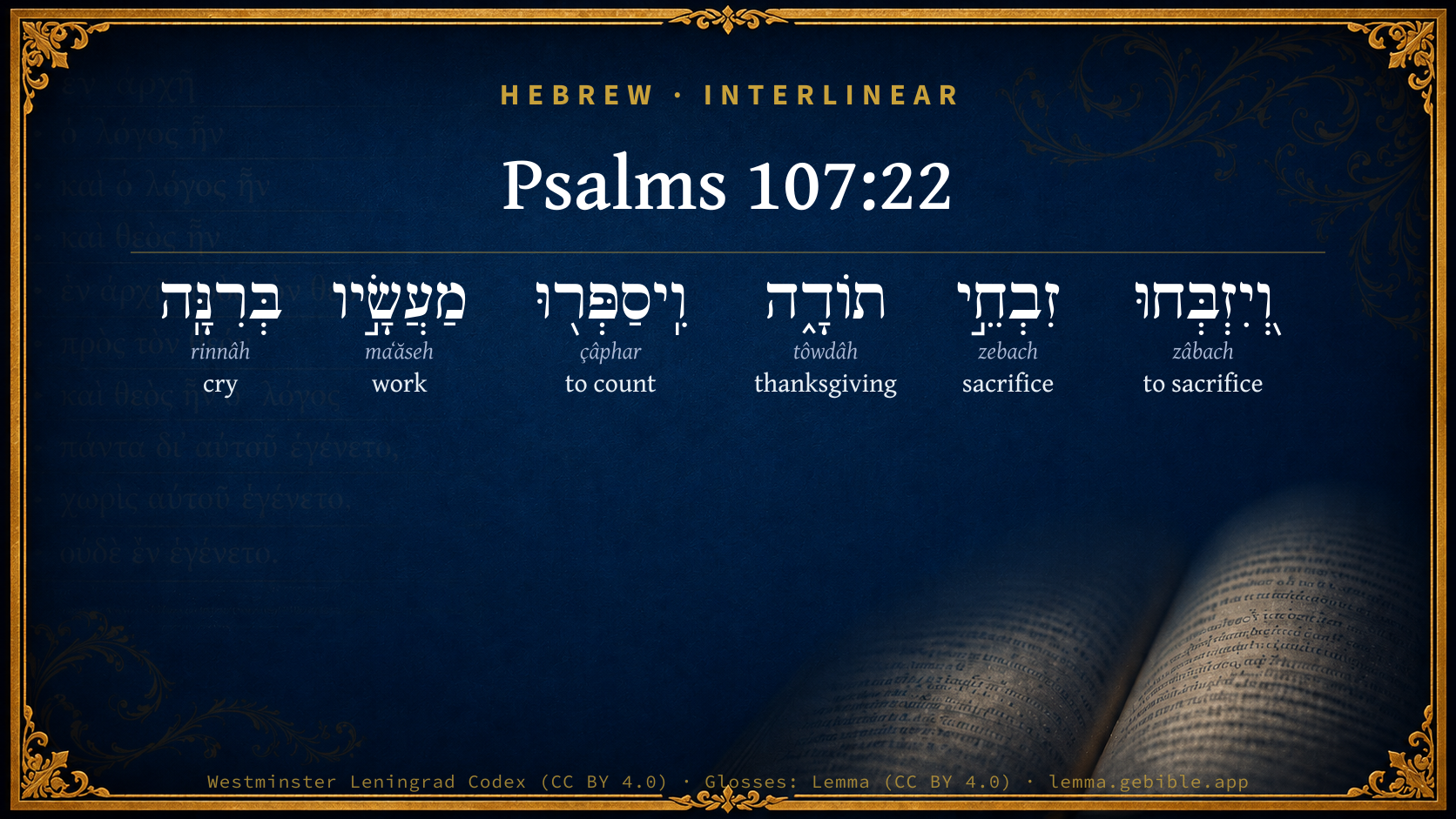
Hebrew (Westminster Leningrad Codex) Psalms 107:22 appears in the Hebrew Old Testament. The text above is from the Westminster Leningrad Codex. Each word links to its Strong’s number, a concise gloss, and parsing drawn from the Open Scriptures Hebrew Bible morphology. Click any word for its full Brown-Driver-Briggs (BDB) entry.
Download image
Cite this verse

Psalms 107:22 (World English Bible). Public Domain. Lemma interlinear Bible study tool, https://lemma.gebible.app/v/psalms/107/22.

Show BibTeX & RIS
BibTeX
RIS
English Translation
Let them offer the sacrifices of thanksgiving, And declare his works with singing.
World English Bible · Public Domain
Download a study sheet

One document with this verse’s original text, its word-by-word gloss line, the meaning frame, cross-references with their text, attributed commentary, and full source and license credits — printable, and it pastes into notes with its structure intact.

This verse Autodidact and up

Study sheet (.html) Plain text (.txt)

A passage Seminary Student

Up to 50 verses in one chapter. A passage sheet keeps up to 6 commentary sources and 12 cross-references per verse, in the order this page ranks them, and says so on the sheet whenever that leaves anything out. Ask for a single verse and you get the Autodidact verse sheet above.

Everything on this page stays free to read, with no account — the sheet is a download of what is already on screen, not access to it.

Want to remove ads? Support Godless Engineer
Compare translations 3

The same verse in 3 English versions, stacked beneath the original-language interlinear above. Click any original word for its lexicon entry.

Each is an independent rendering of the whole verse — the interlinear is not word-aligned to these translations.

Highlighted words mark where these versions differ — a whole-verse word diff, not a word-by-word alignment.

  • World English Bible Public Domain
    Let them offer the sacrifices of thanksgiving, And declare his works with singing.
  • King James Version Public Domain
    And let them sacrifice the sacrifices of thanksgiving, and declare his works with rejoicing.
  • unfoldingWord Literal Text CC BY-SA 4.0
    May they sacrifice sacrifices of thanksgiving and recount his deeds with a shout!

unfoldingWord Literal Text — © unfoldingWord, licensed CC BY-SA 4.0. Word-aligned USFM3 via Door43 (git.door43.org/unfoldingWord/en_ult).

Versions to compare (up to 4)

3 of 4 selected

Show all 18 translations

Every available English version of this verse, each an independent rendering of the whole verse.

  • World English Bible Public Domain
    Let them offer the sacrifices of thanksgiving, And declare his works with singing.
  • Berean Standard Bible Public Domain
    Let them offer sacrifices of thanksgiving and declare His works with rejoicing.
  • Majority Standard Bible Public Domain
    Let them offer sacrifices of thanksgiving and declare His works with rejoicing.
  • King James Version Public Domain
    And let them sacrifice the sacrifices of thanksgiving, and declare his works with rejoicing.
  • American Standard Version (1901) Public Domain
    And let them offer the sacrifices of thanksgiving, And declare his works with singing.
  • Revised Version (1885) Public Domain
    And let them offer the sacrifices of thanksgiving, and declare his works with singing.
  • Geneva Bible (1599) Public Domain
    And let them offer sacrifices of praise, and declare his workes with reioycing.
  • Douay-Rheims (1899) Public Domain
    And let them sacrifice the sacrifice of praise: and declare his works with joy.
  • Young's Literal Translation Public Domain
    And they sacrifice sacrifices of thanksgiving, And recount His works with singing.
  • Literal Standard Version CC BY-SA 4.0
    And they sacrifice sacrifices of thanksgiving, || And recount His works with singing.
  • Unlocked Literal Bible CC BY-SA 4.0
    Let them offer the sacrifices of thanksgiving and proclaim his deeds in singing.
  • unfoldingWord Literal Text CC BY-SA 4.0
    May they sacrifice sacrifices of thanksgiving and recount his deeds with a shout!
  • Darby Bible Public Domain
    And let them offer the sacrifices of thanksgiving, and declare his works in joyful song.
  • World Messianic Bible Public Domain
    Let them offer the sacrifices of thanksgiving, and declare his deeds with singing.
  • Webster's Bible Public Domain
    And let them sacrifice the sacrifices of thanksgiving, and declare his works with rejoicing.
  • Free Bible Version CC BY-SA 4.0
    Let them present thank offerings and sing with joy about what he has done.
  • Bible in Basic English Public Domain
    Let them make offerings of praise, giving news of his works with cries of joy.
  • JPS Tanakh (1917) Public Domain
    And let them offer the sacrifices of thanksgiving, and declare His works with singing.

Literal Standard Version (2020), Covenant Press — licensed CC BY-SA 4.0. Text via the HelloAO Bible API (eBible.org). Unlocked Literal Bible (unfoldingWord) — licensed CC BY-SA 4.0. Text via the HelloAO Bible API (eBible.org). unfoldingWord Literal Text — © unfoldingWord, licensed CC BY-SA 4.0. Word-aligned USFM3 via Door43 (git.door43.org/unfoldingWord/en_ult). Free Bible Version, Dr. Jonathan Gallagher — licensed CC BY-SA 4.0. Text via the HelloAO Bible API (eBible.org).

Word by word

More ways to search: Search by grammar → Find every occurrence → Compare this word →

Practice this passage: Drill this verse → Learn its vocabulary →

About this verse

These counts appear in no published source. They are computed here, from the morphology-tagged text and Lemma’s own curated glosses. What Lemma adds →

6
words
6
distinct lemmas
Wisdom
section

Shared distinctive vocabulary

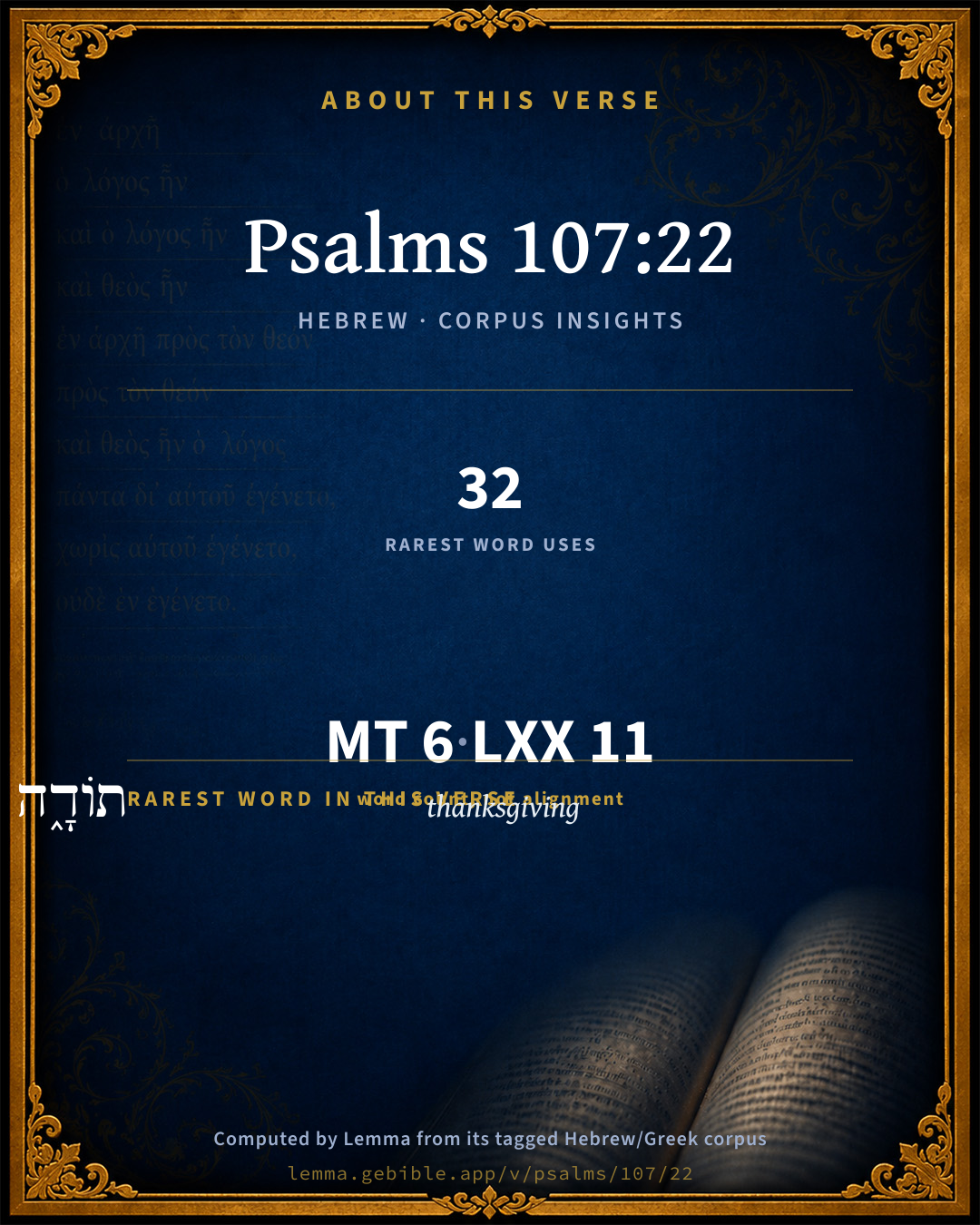
תוֹדָ֑ה thanksgiving H8426 occurs in 30 verses of the Hebrew Bible. Also found in:

Grammatical profile

  • 2 verbs
  • 4 nouns

Verb forms

  • וְ֭יִזְבְּחוּ Qal · Imperfect
  • וִֽיסַפְּר֖וּ Piel · Imperfect

Hebrew & Septuagint length

In English translation the verse runs 13 words from the Hebrew and 16 from the Septuagint (LXX English) — closely comparable.

A rough comparison of the two English renderings, which tokenize alike — not a word-level alignment.

Word counts can differ between the Hebrew and the Greek without any difference in meaning — e.g. the Hebrew direct-object marker אֵת has no separate Greek word, and Greek often adds the article ὁ.

In the original languages it is 6 Hebrew tokens and 11 Greek tokens — but the two are counted differently (Hebrew bundles its prefixes and suffixes into one token; the Greek is in lemma form), so that isn’t a like-for-like length.

Cross-references

12

Topical passages linked to Psalms 107:22 in the Treasury of Scripture Knowledge — connected by theme and wording, ordered by reader-vote popularity; previews shown in the World English Bible.

  • Psalms 50:14 Offer to God the sacrifice of thanksgiving. Pay your vows to the Most High.
  • Psalms 9:11 Sing praises to Yahweh, who dwells in Zion, And declare among the people what he has done.
  • Psalms 118:17 I will not die, but live, And declare Yah's works.
  • Hebrews 13:15 Through him, then, let us offer up a sacrifice of praise to God continually, that is, the fruit of lips which make confession to his name.
  • Psalms 105:1–2 Give thanks to Yahweh! Call on his name! Make his doings known among the peoples.
  • Psalms 116:17 I will offer to you the sacrifice of thanksgiving, And will call on the name of Yahweh.
  • Leviticus 7:12 If he offers it for a thanksgiving, then he shall offer with the sacrifice of thanksgiving unleavened cakes mixed with oil, and unleavened wafers anointed with oil, and cakes mixed with oil.
  • Psalms 73:28 But it is good for me to come close to God. I have made the Lord Yahweh my refuge, That I may tell of all your works.
  • Isaiah 12:4 In that day you will say, "Give thanks to Yahweh! Call on his name. Declare his doings among the peoples. Proclaim that his name is exalted!
  • Psalms 116:12 What will I give to Yahweh for all his benefits toward me?
  • 1 Peter 2:5 You also, as living stones, are built up as a spiritual house, to be a holy priesthood, to offer up spiritual sacrifices, acceptable to God through Jesus Christ.
  • 1 Peter 2:9 But you are a chosen race, a royal priesthood, a holy nation, a people for God's own possession, that you may show forth the excellencies of him who called you out of darkness into his marvelous light:

Cross-references courtesy of OpenBible.info (CC BY 4.0).

Hebrew and Greek witnesses Masoretic Hebrew ↔ Greek Septuagint

The same verse in the two great witnesses to the Old Testament, shown verse-for-verse.

You’re reading Greek Psalm 106 (Hebrew Psalm 107). The Septuagint counts the superscription, so verse numbers can differ from the Hebrew — chapter-level alignment, not verse-by-verse. Numbering follows Rahlfs.

These are two independent witnesses, not word-aligned to each other, and the Septuagint is shown in lemma (dictionary) form.

Hebrew Psalms 107:22 Masoretic · Westminster Leningrad Codex

וְ֭יִזְבְּחוּ זִבְחֵ֣י תוֹדָ֑ה וִֽיסַפְּר֖וּ מַעֲשָׂ֣יו בְּרִנָּֽה

Let them offer the sacrifices of thanksgiving, And declare his works with singing.

World English Bible · Public Domain

Greek LXX Greek Psalm 106:22 Septuagint · lemma form

καί θύω θυσία αἴνεσις καί ἐκἀγγέλλω ὁ ἔργον αὐτός ἐν ἀγαλλίασις

And let them offer to him the sacrifice of praise, and proclaim this works with exultation.

LXX2012 (modern English Septuagint) · Public Domain

Hebrew: Westminster Leningrad Codex (CC BY 4.0). Greek: Septuagint (public domain); English from LXX2012 (modern English Septuagint) (Public Domain). How the Septuagint differs from the Hebrew →

Commentary

Notes on Psalms 107:22 from classic Christian and Jewish commentators (each source and its license shown beneath its notes). The classic Christian expositions comment on the surrounding passage and are grouped to its opening verse, so a note may address several verses; the Jewish commentaries on the Tanakh (Rashi and others) are per-verse, so they appear only where the commentator wrote on this verse.

Lemma curates 59 commentaries, every one of them public domain or Creative Commons licensed, each selected and text-cleaned for this edition rather than reprinted as found. About our sources →

Trapp's Complete Commentary

John Trapp

Psa 107:22 And let them sacrifice the sacrifices of thanksgiving, and declare his works with rejoicing.

Ver. 22. And let them sacrifice, &c.] If they have escaped sickness, let them offer a passover; and if they have recovered, a thankoffering. Heathens in this case praised their Esculapius; Papists their Sebastian, Valentine, Apollonia, &c. Ears of wax they offer to the saint, who, as they suppose, cureth the ears; eyes of wax to the saint that cureth the eyes, &c. But it is Jehovah only who healeth us.

And declare his works, &c.] Memorize and magnify them.

John Trapp, A Commentary or Exposition upon All the Books of the Old and New Testament (1647–1656) — public domain. Text from a community e-Sword module.

Geneva Bible (1599)

Geneva Bible translators

Praise and confession of God’s benefits are the true sacrifices of the godly.

Geneva Bible (1599) marginal notes — public domain. Text via Bolls.life.

Adam Clarke's Commentary

Verse 22. And let them sacrifice] For their healing they should bring a sacrifice; and they should offer the life of the innocent animal unto God, as he has spared their lives; and let them thus confess that God has spared them when they deserved to die; and let them declare also "his works with rejoicing;" for who will not rejoice when he is delivered from death?

Adam Clarke's Commentary on the Bible (1810–1826) — public domain. Text from a community e-Sword/MySword module.

John Calvin's Commentaries

And let them sacrifice This clause is subjoined by way of explanation, the more strongly to express how God is robbed of his due, if in the matter of sacrifice his providence be not recognised. Even nature itself teaches that some kind of homage and reverence is due to God; this is acknowledged by the heathens themselves, who have no other instructor than nature. We know too, that the practice of offering sacrifices has obtained among all nations; and doubtless it was by the observance of this ritual, that God designed to preserve in the human family some sense of piety and religion. To acknowledge the bounty and beneficence of God, is the most acceptable sacrifice which can be presented to him; to this subject, therefore, the prophet intends to recall the attention of the insensate and indifferent portion of men. I do not deny that there may be also an allusion to the ceremonial law; but inasmuch as in the world at large sacrifices formed part of the religious exercises, he charges those with ingratitude, who, after having escaped from some imminent peril, forget to celebrate the praises of their Great Deliverer.

John Calvin's Commentaries (1540-1563) — public domain. Text from the Calvin Translation Society English edition (1840s-50s) via the Christian Classics Ethereal Library (ccel.org). Calvin's coverage is partial (roughly two-thirds of the Bible); uncommented books and verses are honest gaps, never fabricated. The 19th-century editor's footnotes and remarks are omitted so the notes are faithfully Calvin's own voice.

John Gill's Exposition

For he commandeth, and raiseth the stormy wind,.... Winds are not raised by men, nor by devils, nor by angels, but by the Lord himself; who has created them, holds them in his fist, brings them out of his treasures, and sends them forth to do his will; if he speaks the word, gives but the order, a storm arises at once, and executes what he pleases, Psa 148:8.

Which lifteth up the waves thereof; that is, the waves of the sea; it comes down into it, and causes surges; which rise above the ship, and sometimes cover it, and ready to sink it; yea, even they are lifted up to the heavens, as it follows.

John Gill's Exposition of the Whole Bible (1746–1763) — public domain (CC PDM 1.0). Text via the HelloAO Bible API.

Albert Barnes' Notes on the Bible

And let them sacrifice - As in the cases before Psa 107:9, Psa 107:16, this is connected with the preceding part of the psalm, or is a “continuation” of the thought which had been interrupted by the prayer, “Oh that men would praise the Lord.” The particular idea here is, that they who have been sick, and who have been restored to health, should offer the sacrifice of thanksgiving; or, that they are the proper persons to praise the Lord. The word “sacrifice” here is used in a large sense to denote worship or adoration. Let them worship God with thanks or praises.

The sacrifices of thanksgiving - Hebrew, “praise.” Let them offer praise.

And declare his works with rejoicing - Margin, as in Hebrew, “singing.” Let them set forth his “doings” in songs. Compare Psa 9:11.

Albert Barnes' Notes on the Bible (1834–1885) — public domain. Text from a community e-Sword/MySword module.

Matthew Poole's English Annotations

Sacrifices of thanksgiving; either properly so called; or praises and thanksgivings to God, which in Scripture are called sacrifices, because they are no less acceptable to God than costly sacrifices.

Matthew Poole's English Annotations on the Holy Bible (1683–1685) — public domain. Text from a community e-Sword/MySword module.

The Treasury of David

Charles H. Spurgeon

Ver. 22. And let them sacrifice the sacrifices of thanksgiving. In such a case let there be gifts and oblations as well as words. Let the good Physician have his fee of gratitude. Let life become a sacrifice to him who has prolonged it, let the deed of self denying gratitude be repeated again and again: there must be many cheerful sacrifices to celebrate the marvellous boon.

And declare his works with rejoicing. Such things are worth telling, for the personal declaration honours God, relieves ourselves, comforts others, and puts all men in possession of facts concerning the divine goodness which they will not be able to ignore.

Ver. 22. And let them sacrifice. For their healing they should bring a sacrifice; and they should offer the life of the innocent animal unto God, as he has offered their lives; and let them thus confess that God has spared them when they deserved to die; and let them declare also "his works with rejoicing"; for who will not rejoice when he is delivered from death? Adam Clarke.

Psalms 107:23*

Charles H. Spurgeon's The Treasury of David (1869–1885) — public domain. Psalms only. Text from a community e-Sword/MySword module.

The Pulpit Commentary

And let them sacrifice the sacrifices of thanksgiving; compare the expression, "the calves of our lips", (Hos_14:2) and see also Heb_13:15. And declare his works with rejoicing; i.e. joyfully pro claim the great things that God has done for them.

Thanksgiving when prayer is answered.

Men are much more ready to pray than to give thanks; to express their desires than to recognize the response made to their desires. Men fail in gratitude rather than in petition. Therefore do the apostles specially urge this grace, and require its cultivation by the Christian disciples. (see Php_4:6 Col_4:2 Heb_13:15) The call to thanksgiving is the refrain of the palm. Man is seen to gain no blessing save through the ministry of him who is the "Author and Giver of every good and perfect gift." And man"s sin is seen to be restraining his lips, and failing to make due recognition of "grace abounding." A life full of God"s benedictions should be a life full of God"s praise. In this text the general duty is presented under two figures.

I THANKSGIVING AS A SACRIFICE. The peculiarity of a sacrifice is that it is a silent act. It is something a man does which has its own voice, and need not be accompanied with any words. When the old Jew brought his animal to the priest, according to the rules of the Mosaic ritual, he did not need to say anything by way of explanation. The priest perfectly understood what he meant. Some act of Divine mercy was filling him with thankfulness, and his offering found for it expression. Philip Henry puts this sharply: "Thanksgiving is a good thing, thanksgiving is a better." The self-offered in sacrifice speaks our gratitude to the listening ear of God. A man can show himself grateful by his manner of life. Bouar prays"Fill thou my life, O Lord my God, In every part with praise, That my whole being may proclaim Thy Being and thy Ways. "Not for the lip of praise alone, Nor e"en the praising heart, I ask but for a life made up Of praise in every part.

"I beseech you therefore that ye present your bodies a living sacrifice;" so says St. Paul. And it is to be a sacrifice of thanksgiving.

II THANKSGIVING AS A TESTIMONY. "Tell out his works with gladness." Here thanksgiving is a voiceful act. "I will not refrain my lips, O Lord, thou knowest." "Praise is the only employment in which self finds no part. In praise we go out of ourselves, and think only of him to whom we offer it. It is the most purely disinterested of all services. R.T.

The Pulpit Commentary (1880–1919), ed. H.D.M. Spence-Jones & Joseph S. Exell — public domain. Text from a community e-Sword module.

Lesson kit

Teaching starters — assembled from the data on this page, not authored interpretation. Every prompt links to the verse data it draws on. Edit before teaching.

Psalms, in the Wisdom, opens this verse with 6 words (6 distinct Hebrew lemmas). Its most distinctive word is tôwdâh (“thanksgiving”). A historical commentator’s framing appears above. Read the whole chapter for the surrounding context.

Discussion questions

  1. How does “thanksgiving” (tôwdâh) shape what this verse is saying?
  2. Leviticus 7:12 shares the word «thanksgiving» with this verse. How do the two illuminate each other?
  3. The translations on this page render this verse differently — a whole-verse word diff, not a word-by-word alignment. What might account for the different wordings?
  4. The verb «וְ֭יִזְבְּחוּ» is Qal Imperfect. How does its form color the action?
  5. Reading how Trapp's Complete Commentary and Geneva Bible (1599) read this verse, where do the two commentators agree and where do they part?

Things to notice

Reading settings

Reading text

Shown beneath each verse's original-language words.

Old Testament
Old Testament edition

Read the OT as the Masoretic Hebrew (MT) or the Greek Septuagint (LXX).

English shown for the Greek Septuagint (in the Hebrew ↔ Greek comparison).

Comparing translations? Open the Compare panel on any verse page to stack up to four side by side.