
Jeremiah 36:26

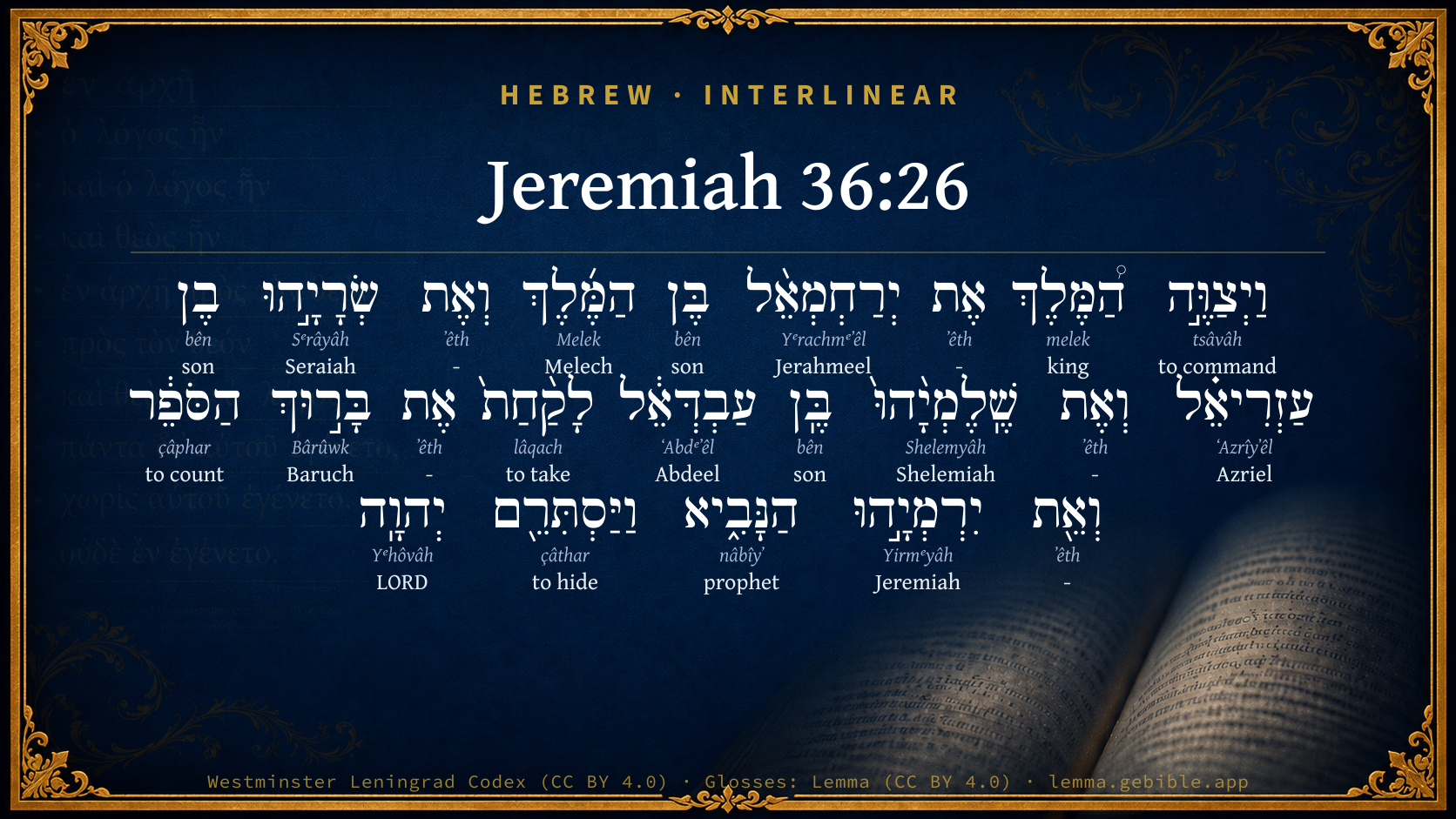
Hebrew (Westminster Leningrad Codex) Jeremiah 36:26 appears in the Hebrew Old Testament. The text above is from the Westminster Leningrad Codex. Each word links to its Strong’s number, a concise gloss, and parsing drawn from the Open Scriptures Hebrew Bible morphology. Click any word for its full Brown-Driver-Briggs (BDB) entry.
Download image
Cite this verse

Jeremiah 36:26 (World English Bible). Public Domain. Lemma interlinear Bible study tool, https://lemma.gebible.app/v/jeremiah/36/26.

Show BibTeX & RIS
BibTeX
RIS
English Translation
The king commanded Jerahmeel the king's son, and Seraiah the son of Azriel, and Shelemiah the son of Abdeel, to take Baruch the scribe and Jeremiah the prophet; but Yahweh hid them.
World English Bible · Public Domain
Highlights
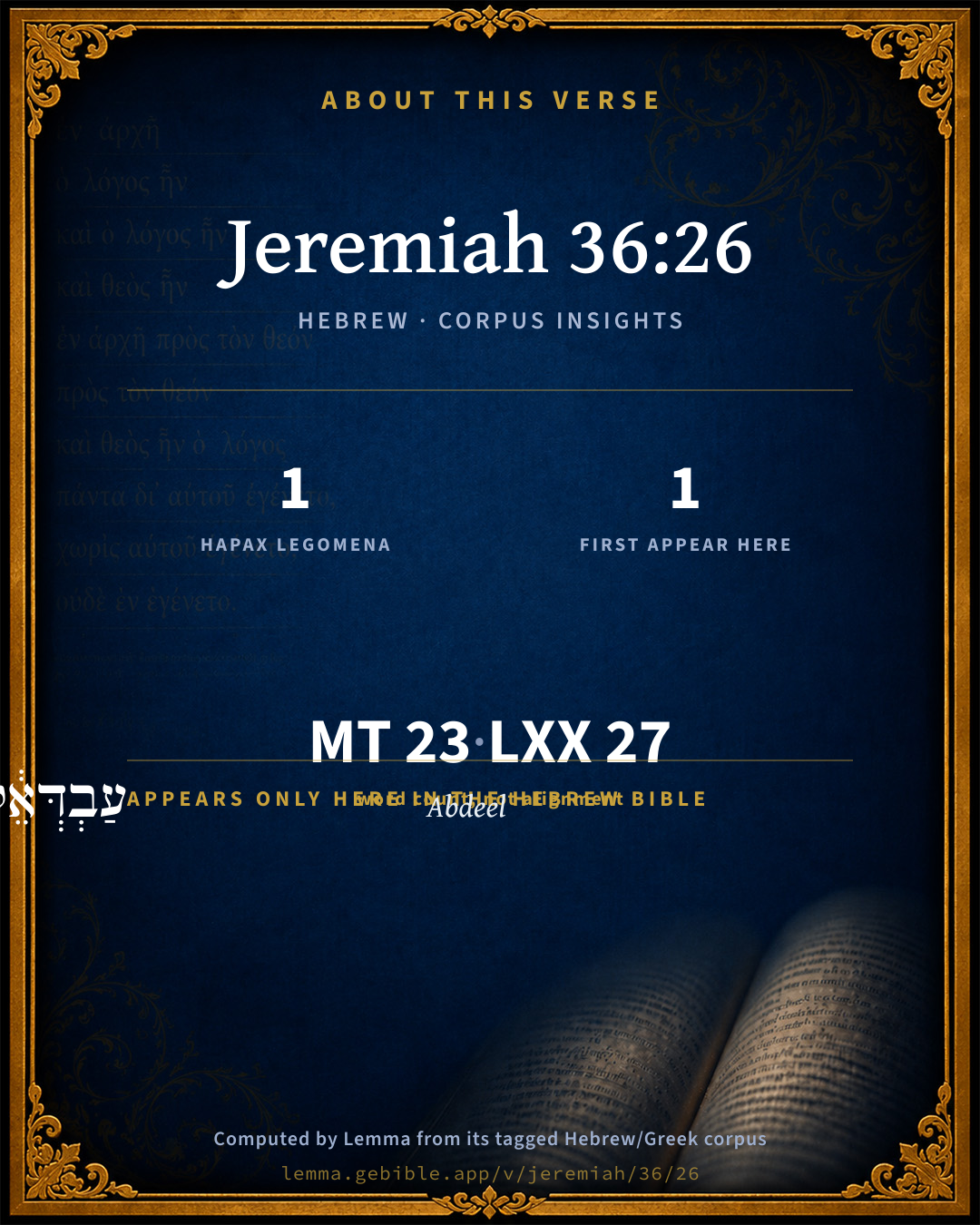
  • 1 hapax legomenon — only here in the Hebrew Bible
  • 1 first appearance in the Hebrew Bible
Full analysis ↓
Download a study sheet

One document with this verse’s original text, its word-by-word gloss line, the meaning frame, cross-references with their text, attributed commentary, and full source and license credits — printable, and it pastes into notes with its structure intact.

This verse Autodidact and up

Study sheet (.html) Plain text (.txt)

A passage Seminary Student

Up to 50 verses in one chapter. A passage sheet keeps up to 6 commentary sources and 12 cross-references per verse, in the order this page ranks them, and says so on the sheet whenever that leaves anything out. Ask for a single verse and you get the Autodidact verse sheet above.

Everything on this page stays free to read, with no account — the sheet is a download of what is already on screen, not access to it.

Want to remove ads? Support Godless Engineer
Compare translations 3

The same verse in 3 English versions, stacked beneath the original-language interlinear above. Click any original word for its lexicon entry.

Each is an independent rendering of the whole verse — the interlinear is not word-aligned to these translations.

Highlighted words mark where these versions differ — a whole-verse word diff, not a word-by-word alignment.

  • World English Bible Public Domain
    The king commanded Jerahmeel the king's son, and Seraiah the son of Azriel, and Shelemiah the son of Abdeel, to take Baruch the scribe and Jeremiah the prophet; but Yahweh hid them.
  • King James Version Public Domain
    But the king commanded Jerahmeel the son of Hammelech, and Seraiah the son of Azriel, and Shelemiah the son of Abdeel, to take Baruch the scribe and Jeremiah the prophet: but the LORD hid them.
  • unfoldingWord Literal Text CC BY-SA 4.0
    Then the king commanded Jerahmeel, a relative, Seraiah son of Azriel, and Shelemiah son of Abdeel to arrest Baruch the scribe and Jeremiah the prophet, but Yahweh had hidden them.

unfoldingWord Literal Text — © unfoldingWord, licensed CC BY-SA 4.0. Word-aligned USFM3 via Door43 (git.door43.org/unfoldingWord/en_ult).

Versions to compare (up to 4)

3 of 4 selected

Show all 18 translations

Every available English version of this verse, each an independent rendering of the whole verse.

  • World English Bible Public Domain
    The king commanded Jerahmeel the king's son, and Seraiah the son of Azriel, and Shelemiah the son of Abdeel, to take Baruch the scribe and Jeremiah the prophet; but Yahweh hid them.
  • Berean Standard Bible Public Domain
    Instead, the king commanded Jerahmeel, a son of the king, as well as Seraiah son of Azriel and Shelemiah son of Abdeel, to seize Baruch the scribe and Jeremiah the prophet. But the LORD had hidden them.
  • Majority Standard Bible Public Domain
    Instead, the king commanded Jerahmeel, a son of the king, as well as Seraiah son of Azriel and Shelemiah son of Abdeel, to seize Baruch the scribe and Jeremiah the prophet. But the LORD had hidden them.
  • King James Version Public Domain
    But the king commanded Jerahmeel the son of Hammelech, and Seraiah the son of Azriel, and Shelemiah the son of Abdeel, to take Baruch the scribe and Jeremiah the prophet: but the LORD hid them.
  • American Standard Version (1901) Public Domain
    And the king commanded Jerahmeel the king's son, and Seraiah the son of Azriel, and Shelemiah the son of Abdeel, to take Baruch the scribe and Jeremiah the prophet; but Jehovah hid them.
  • Revised Version (1885) Public Domain
    And the king commanded Jerahmeel the king’s son, and Seraiah the son of Azriel, and Shelemiah the son of Abdeel, to take Baruch the scribe and Jeremiah the prophet: but the LORD hid them.
  • Geneva Bible (1599) Public Domain
    But the King commanded Ierahmeel the sonne of Hammelech, and Seraiah the sonne of Azriel, and Shelemiah the sonne of Abdiel, to take Baruch the scribe, and Ieremiah the Prophet, but the Lord hid them.
  • Douay-Rheims (1899) Public Domain
    And the king commanded Jeremiel the son of Amelech, and Saraias the son of Ezriel, and Selemias the son of Abdeel, to take up Baruch the scribe, and Jeremias the prophet: but the Lord hid them.
  • Young's Literal Translation Public Domain
    And the king commandeth Jerahmeel son of Hammelek, and Seraiah son of Azriel, and Shelemiah son of Abdeel, to take Baruch the scribe, and Jeremiah the prophet, and Jehovah doth hide them.
  • Literal Standard Version CC BY-SA 4.0
    And the king commands Jerahmeel son of Hammelek, and Seraiah son of Azriel, and Shelemiah son of Abdeel, to take Baruch the scribe and Jeremiah the prophet, and YHWH hides them.
  • Unlocked Literal Bible CC BY-SA 4.0
    Then the king commanded Jerahmeel, a relative, Seraiah son of Azriel, and Shelemiah son of Abdeel to arrest Baruch the scribe and Jeremiah the prophet, but Yahweh had hidden them.
  • unfoldingWord Literal Text CC BY-SA 4.0
    Then the king commanded Jerahmeel, a relative, Seraiah son of Azriel, and Shelemiah son of Abdeel to arrest Baruch the scribe and Jeremiah the prophet, but Yahweh had hidden them.
  • Darby Bible Public Domain
    And the king commanded Jerahmeel the son of Hammelech, and Seraiah the son of Azriel, and Shelemiah the son of Abdeel, to take Baruch the scribe and Jeremiah the prophet; but Jehovah hid them.
  • World Messianic Bible Public Domain
    The king commanded Jerahmeel the king’s son, and Seraiah the son of Azriel, and Shelemiah the son of Abdeel, to arrest Baruch the scribe and Jeremiah the prophet; but the LORD hid them.
  • Webster's Bible Public Domain
    But the king commanded Jerahmeel the son of Hammelech, and Seraiah the son of Azriel, and Shelemiah the son of Abdeel, to take Baruch the scribe and Jeremiah the prophet: but the LORD hid them.
  • Free Bible Version CC BY-SA 4.0
    In fact the king ordered Jerahmeel, one of the princes, as well as Seraiah son of Azriel and Shelemiah son of Abdeel, to go and arrest Baruch and Jeremiah. But the Lord hid them.
  • Bible in Basic English Public Domain
    And the king gave orders to Jerahmeel, the king's son, and Seraiah, the son of Azriel, and Shelemiah, the son of Abdeel, to take Baruch the scribe and Jeremiah the prophet: but the Lord kept them safe.
  • JPS Tanakh (1917) Public Domain
    And the king commanded Jerahmeel the king's son, and Seraiah the son of Azriel, and Shelemiah the son of Abdeel, to take Baruch the scribe and Jeremiah the prophet; but the LORD hid them.

Literal Standard Version (2020), Covenant Press — licensed CC BY-SA 4.0. Text via the HelloAO Bible API (eBible.org). Unlocked Literal Bible (unfoldingWord) — licensed CC BY-SA 4.0. Text via the HelloAO Bible API (eBible.org). unfoldingWord Literal Text — © unfoldingWord, licensed CC BY-SA 4.0. Word-aligned USFM3 via Door43 (git.door43.org/unfoldingWord/en_ult). Free Bible Version, Dr. Jonathan Gallagher — licensed CC BY-SA 4.0. Text via the HelloAO Bible API (eBible.org).

Word by word

More ways to search: Search by grammar → Find every occurrence → Compare this word →

Practice this passage: Drill this verse → Learn its vocabulary →

עַבְדְּאֵ֔ל
ʻAbdᵉʼêl
H5655
“Abdeel”
Noun, Proper
Part of Speech
Noun
Type
Proper
Full BDB Definition

Origin: from H5647 and H410

TWOT: None

Abdeel = "servant of God" - father of Shelemiah of Judah in the time of Jeremiah
  1. וַיְצַוֶּ֣ה tsâvâh H6680 “and · to command” Conjunction + Verb, Piel, Sequential Imperfect, 3rd Person, Masculine, Singular
  2. הַ֠מֶּלֶךְ melek H4428 “the · king” Particle, Definite Article + Noun, Common, Masculine, Singular, Absolute
  3. אֶת ʼêth H853 “-” Particle, Direct Object
  4. יְרַחְמְאֵ֨ל Yᵉrachmᵉʼêl H3396 “Jerahmeel” Noun, Proper
  5. בֶּן bên H1121 “son of” Noun, Common, Masculine, Singular, Construct
  6. הַמֶּ֜לֶךְ Melek H4429 “the · Melech” Particle, Definite Article + Noun, Common, Masculine, Singular, Absolute
  7. וְאֶת ʼêth H853 “and · -” Conjunction + Particle, Direct Object
  8. שְׂרָיָ֣הוּ Sᵉrâyâh H8304 “Seraiah” Noun, Proper
  9. בֶן bên H1121 “son of” Noun, Common, Masculine, Singular, Construct
  10. עַזְרִיאֵ֗ל ʻAzrîyʼêl H5837 “Azriel” Noun, Proper
  11. וְאֶת ʼêth H853 “and · -” Conjunction + Particle, Direct Object
  12. שֶֽׁלֶמְיָ֨הוּ֙ Shelemyâh H8018 “Shelemiah” Noun, Proper
  13. בֶּֽן bên H1121 “son of” Noun, Common, Masculine, Singular, Construct
  14. לָקַ֨חַת֙ lâqach H3947 “to take” Preposition + Verb, Qal, Infinitive Construct
  15. אֶת ʼêth H853 “-” Particle, Direct Object
  16. בָּר֣וּךְ Bârûwk H1263 “Baruch” Noun, Proper
  17. הַסֹּפֵ֔ר çâphar H5608 “the · scribe” Particle, Definite Article + Noun, Common, Masculine, Singular, Absolute
  18. וְאֵ֖ת ʼêth H853 “and · -” Conjunction + Particle, Direct Object
  19. יִרְמְיָ֣הוּ Yirmᵉyâh H3414 “Jeremiah” Noun, Proper
  20. הַנָּבִ֑יא nâbîyʼ H5030 “the · prophet” Particle, Definite Article + Noun, Common, Masculine, Singular, Absolute
  21. וַיַּסְתִּרֵ֖ם çâthar H5641 “and · to hide · them” Conjunction + Verb, Hiphil, Sequential Imperfect, 3rd Person, Masculine, Singular + Suffix, Personal, 3rd Person, Masculine, Plural
  22. יְהוָֽה Yᵉhôvâh H3068 “LORD” Noun, Proper

About this verse

These counts appear in no published source. They are computed here, from the morphology-tagged text and Lemma’s own curated glosses. What Lemma adds →

23
words
17
distinct lemmas
Prophets
section

Notable vocabulary

1 hapax legomenon — a word that appears only here in the entire Hebrew Bible:

  • עַבְדְּאֵ֔ל Abdeel H5655

First appearance in Scripture

This word makes its first canonical appearance in the Hebrew Bible here:

  • עַבְדְּאֵ֔ל Abdeel H5655

Shared distinctive vocabulary

עַזְרִיאֵ֗ל Azriel H5837 occurs in 3 verses of the Hebrew Bible. Also found in:

Grammatical profile

  • 3 verbs
  • 15 nouns
  • 5 particles

Verb forms

  • וַיְצַוֶּ֣ה Piel · Sequential Imperfect
  • לָקַ֨חַת֙ Qal · Infinitive Construct
  • וַיַּסְתִּרֵ֖ם Hiphil · Sequential Imperfect

Repetition

A word recurs within this verse — often emphatic in Hebrew:

Hebrew & Septuagint length

In the original languages it is 23 Hebrew tokens and 27 Greek tokens — but the two are counted differently (Hebrew bundles its prefixes and suffixes into one token; the Greek is in lemma form), so that isn’t a like-for-like length.

Cross-references

28

Topical passages linked to Jeremiah 36:26 in the Treasury of Scripture Knowledge — connected by theme and wording, ordered by reader-vote popularity; previews shown in the World English Bible.

  • 1 Kings 17:3 Get you hence, and turn you eastward, and hide yourself by the brook Cherith, that is before the Jordan.
  • 1 Kings 19:1–3 Ahab told Jezebel all that Elijah had done, and withal how he had slain all the prophets with the sword.
  • 1 Kings 19:10 He said, I have been very jealous for Yahweh, the God of hosts; for the children of Israel have forsaken your covenant, thrown down your altars, and slain your prophets with the sword: and I, even I only, am left; and they seek my life, to take it away.
  • 1 Kings 19:14 He said, I have been very jealous for Yahweh, the God of hosts; for the children of Israel have forsaken your covenant, thrown down your altars, and slain your prophets with the sword; and I, even I only, am left; and they seek my life, to take it away.
  • Psalms 91:1 He who dwells in the secret place of the Most High Will rest in the shadow of the Almighty.
  • Psalms 27:5 For in the day of trouble he will keep me secretly in his pavilion. In the covert of his tent he will hide me. He will lift me up on a rock.
  • Psalms 64:2 Hide me from the conspiracy of the wicked, From the noisy crowd of the ones doing evil;
  • Isaiah 26:20 Come, my people, enter you into your chambers, and shut your doors about you: hide yourself for a little moment, until the indignation be past.
  • Acts 12:11 When Peter had come to himself, he said, "Now I truly know that the Lord has sent out his angel and delivered me out of the hand of Herod, and from everything the Jewish people were expecting."
  • 1 Kings 18:4 for it was so, when Jezebel cut off the prophets of Yahweh, that Obadiah took one hundred prophets, and hid them by fifty in a cave, and fed them with bread and water.)
  • Psalms 32:7 You are my hiding place. You will preserve me from trouble. You will surround me with songs of deliverance. Selah.
  • Psalms 57:1 Be merciful to me, God, be merciful to me, For my soul takes refuge in you. Yes, in the shadow of your wings, I will take refuge, Until disaster has passed.
  • Jeremiah 15:20–21 I will make you to this people a fortified brazen wall; and they shall fight against you, but they shall not prevail against you; for I am with you to save you and to deliver you, says Yahweh.
  • Jeremiah 36:5 Jeremiah commanded Baruch, saying, I am shut up; I can't go into the house of Yahweh:
  • Jeremiah 36:19 Then said the princes to Baruch, Go, hide you, you and Jeremiah; and let no man know where you are.
  • John 8:20 Jesus spoke these words in the treasury, as he taught in the temple. Yet no one arrested him, because his hour had not yet come.
  • 1 Kings 17:9 Arise, get you to Zarephath, which belongs to Sidon, and dwell there: behold, I have commanded a widow there to sustain you.
  • 1 Kings 18:10–12 As Yahweh your God lives, there is no nation or kingdom, where my lord has not sent to seek you: and when they said, He is not here, he took an oath of the kingdom and nation, that they didn't find you.
  • Jeremiah 1:19 They shall fight against you; but they shall not prevail against you: for I am with you, says Yahweh, to deliver you.
  • Jeremiah 2:30 In vain have I struck your children; they received no correction: your own sword has devoured your prophets, like a destroying lion.
  • Jeremiah 26:21–23 and when Jehoiakim the king, with all his mighty-men, and all the princes, heard his words, the king sought to put him to death; but when Uriah heard it, he was afraid, and fled, and went into Egypt:
  • Matthew 23:34–37 Therefore, behold, I send to you prophets, wise men, and scribes. Some of them you will kill and crucify; and some of them you will scourge in your synagogues, and persecute from city to city;
  • Matthew 26:47–50 While he was still speaking, behold, Judas, one of the twelve, came, and with him a great multitude with swords and clubs, from the chief priest and elders of the people.
  • John 7:32 The Pharisees heard the multitude murmuring these things concerning him, and the chief priests and the Pharisees sent officers to arrest him.
  • John 8:59 Therefore they took up stones to throw at him, but Jesus was hidden, and went out of the temple, having gone through the midst of them, and so passed by.
  • John 11:57 Now the chief priests and the Pharisees had commanded that if anyone knew where he was, he should report it, that they might seize him.
  • 2 Kings 6:18–20 When they came down to him, Elisha prayed to Yahweh, and said, Please smite this people with blindness. He struck them with blindness according to the word of Elisha.
  • Psalms 121:8 Yahweh will keep your going out and your coming in, From this time forth, and forevermore.

Cross-references courtesy of OpenBible.info (CC BY 4.0).

Hebrew and Greek witnesses Masoretic Hebrew ↔ Greek Septuagint

The same verse in the two great witnesses to the Old Testament, shown verse-for-verse.

These are two independent witnesses, not word-aligned to each other, and the Septuagint is shown in lemma (dictionary) form.

Hebrew Jeremiah 36:26 Masoretic · Westminster Leningrad Codex

וַיְצַוֶּ֣ה הַ֠מֶּלֶךְ אֶת יְרַחְמְאֵ֨ל בֶּן הַמֶּ֜לֶךְ וְאֶת שְׂרָיָ֣הוּ בֶן עַזְרִיאֵ֗ל וְאֶת שֶֽׁלֶמְיָ֨הוּ֙ בֶּֽן עַבְדְּאֵ֔ל לָקַ֨חַת֙ אֶת בָּר֣וּךְ הַסֹּפֵ֔ר וְאֵ֖ת יִרְמְיָ֣הוּ הַנָּבִ֑יא וַיַּסְתִּרֵ֖ם יְהוָֽה

The king commanded Jerahmeel the king's son, and Seraiah the son of Azriel, and Shelemiah the son of Abdeel, to take Baruch the scribe and Jeremiah the prophet; but Yahweh hid them.

World English Bible · Public Domain

Greek LXX Structure differs

In the Septuagint, Jeremiah is about an eighth shorter than the Hebrew and arranges its material differently — the Oracles Against the Nations (Hebrew chapters 46–51) appear in the middle of the Greek book, after 25:13. Because the chapter and verse boundaries do not line up, a verse-for-verse comparison with the Hebrew is not shown.

A verse-for-verse comparison isn’t shown here because the chapters and verses don’t line up. Switch to the LXX edition with the MT / LXX toggle above to read the Greek directly.

On this verse, Ellicott's Commentary for English Readers discusses the Septuagint’s reading. Read the note in Commentary ↓

Hebrew: Westminster Leningrad Codex (CC BY 4.0). Greek: Septuagint (public domain); English from a public-domain English Septuagint. How the Septuagint differs from the Hebrew →

Targum (Aramaic paraphrase)

1

The Targum is the ancient Jewish Aramaic paraphrase of the Hebrew Scriptures — an interpretive translation, not the Hebrew text itself. Onkelos (literal) and Pseudo-Jonathan (expansive) render the Torah, and Jonathan the Prophets. Coverage is partial: where no permissively-licensed English translation exists for a verse, only the Aramaic is shown. This is verse-level text, not a word-by-word alignment to the Hebrew.

  1. Targum Jonathan Prophets (Joshua–Malachi)
    וּפַקֵיד מַלְכָּא יַת יְרַחְמְאֵל בַּר מַלְכָּא וְיַת שְׂרָיָה בַר עַזְרִיאֵל וְיַת שְׁלֶמְיָה בַּר עַבְדִיאֵל לְמִדְבַּר יַת בָּרוּךְ סַפְרָא וְיַת יִרְמְיָה נְבִיָא וְאַגִין עֲלֵיהוֹן יְיָ:

    (no public-domain English translation for this verse)

    Targum Jonathan — Aramaic: “Mikraot Gedolot” (public domain). English: “Sefaria Community Translation” (CC0 1.0 (public-domain dedication)); “London "Chaldee Paraphrase," 1871” (public domain). Text via Sefaria.

Commentary

Notes on Jeremiah 36:26 from classic Christian and Jewish commentators (each source and its license shown beneath its notes). The classic Christian expositions comment on the surrounding passage and are grouped to its opening verse, so a note may address several verses; the Jewish commentaries on the Tanakh (Rashi and others) are per-verse, so they appear only where the commentator wrote on this verse.

Lemma curates 59 commentaries, every one of them public domain or Creative Commons licensed, each selected and text-cleaned for this edition rather than reprinted as found. About our sources →

Trapp's Complete Commentary

John Trapp

Jer 36:26 But the king commanded Jerahmeel the son of Hammelech, and Seraiah the son of Azriel, and Shelemiah the son of Abdeel, to take Baruch the scribe and Jeremiah the prophet: but the LORD hid them.

Ver. 26. But the king commanded Jerahmeel the son of Hammelech.] Or, The king’s son, whom he might employ against these two servants of God; as once the King of France sent his son and heir with an army against the Waldenses. It is not for nothing, therefore, that the curse is denounced against Jehoiakim and his posterity. {Jer 36:30-31}

But the Lord hid them,] i.e., He provided for them a hiding place in some good man’s house, and there safeguarded them from these bloodhounds who hunted after their precious lives. There is no fence but flight, nor counsel but concealment, to secure an innocent subject against an enraged sovereign.

John Trapp, A Commentary or Exposition upon All the Books of the Old and New Testament (1647–1656) — public domain. Text from a community e-Sword module.

The Biblical Illustrator

Joseph S. Exell

Jer_36:26

But the Lord hid him.

Hidden, but radiant

The Lord hid him. What that precisely means it is impossible to say: Was there a John of Gaunt for this Wycliff, an Elector of Saxony for this Luther? Did Ahikam, who had before interposed on his behalf, or his sons--Gemariah, who lent Jeremiah his room in the Temple for the reading of his roll, and Gedaliah, who became Governor of Judah after Zedekiahs deportation--take the prophet under their care? Or was this hiding something more Divine and blessed still? These Divine hidings are needed by us all. We must obey the voice that cries to us, as it did to Elijah, Get thee hence, and turn thee eastward, and hide thyself. We are too prominent, too self-important, too conscious of ourselves. And God must sometimes hide us in the sick-chamber, the valley of shadow, the cleft of the rock. He calls us to Zarephath, or Carmel, to the privacy of obscurity, or of solitude. It is stated that on one occasion when the dragoons of Claverhouse were scouring the mountains of Scotland in search of the Covenanters, a little party of these godly folk, gathered on the hillside for prayer, must have fallen into their hands had not a cloud suddenly settled, down, effectually concealing them from their pursuers. Thus the Son of God still interposes for His own.

II. He re-edited his prophecies. To this period we may refer the Divine injunction: Thus speaketh the Lord, the God of Israel, saying, Write thee all the words that I have spoken unto thee in a book (Jer_36:2). It may be that throughout, this period Baruch continued to act as his faithful amanuensis and scribe. He, at least, was certainly included in the Divine hidings (Jer_36:26-32). It was at great cost to his earthly prospects. He came of a good family, his brother being Seraiah, who held high office under King Zedekiah, and he cherished the ambition of distinguishing himself amongst his compeers. He sought great things for himself. But he was reconciled to the lot of suffering and sorrow to which his close identification with Jeremiah led him, by a special revelation assuring him of the speedy overthrow of the State; and that, in the general chaos, he would escape with his life (45). By the aid of this faithful friend, Jeremiah gathered together the prophecies which he had uttered on various occasions, and put them in order, specially elaborating the predictions given in the fourth year of Jehoiakim against the surrounding nations. The word of the Lord came to him concerning the Philistines, and Moab, and the children of Ammon and Edom, Damascus and Kedar. This time of Jeremiahs seclusion was therefore not lost to the world. It was fruitful as Bunyans in Bedford Gaol; Luthers in the Wartburg; Madame Guyons in the Bastille. Unseen, the prophet busied himself, as the night settled down on his country, in kindling the sure light of prophecy, that should cast its radiant beams over the dark waters of time, until the day should dawn, and the day-star glimmer out in the eastern sky. (F. B. Meyer,. B. A.)

The Biblical Illustrator, edited by Joseph S. Exell (c. 1880s–1900s) — public domain. Text from a community e-Sword module.

Tyndale Open Study Notes

Tyndale Open Resources

36:26 Once the Lord had hidden them, no one betrayed Jeremiah and Baruch. The Lord can protect his servants.

Tyndale Open Study Notes — © Tyndale Open Resources, licensed CC BY-SA 4.0. Text via the HelloAO Bible API.

Geneva Bible (1599)

Geneva Bible translators

Thus we see the continual care, that God hath ever over his to preserve them from the rage of the wicked.

Geneva Bible (1599) marginal notes — public domain. Text via Bolls.life.

Jamieson, Fausset & Brown

Robert Jamieson, A. R. Fausset & David Brown

Hammelech--not as Margin, "of the king." Jehoiakim at this time (the fifth year of his reign) had no grown-up son: Jeconiah, his successor, was then a boy of eleven (compare Kg2 23:36, with Kg2 24:8).

hid them-- (Psa 31:20; Psa 83:3; Isa 26:20).

Jamieson, Fausset & Brown — Commentary Critical and Explanatory on the Whole Bible (1871) — public domain (CC PDM 1.0). Text via the HelloAO Bible API.

Adam Clarke's Commentary

Verse 26. But the Lord hid them.] They had, at the counsel of some of the princes, hidden themselves, Jer 36:19. And now, though a diligent search was made, the Lord did not permit them to be found.

Adam Clarke's Commentary on the Bible (1810–1826) — public domain. Text from a community e-Sword/MySword module.

John Calvin's Commentaries

Here is described the madness of the king, which was so great, that he vented his rage against the Prophet and his scribe; and he chose no doubt those whom he thought to be most ready to obey him. He would have never taken such ministers as Elnathan or Delaiah or Gemariah, for he knew how much they abhorred such a nefarious deed; but he sent those whom he thought most adapted for such a service as that of killing Jeremiah and Baruch.

It is not improperly conjectured from this passage and a previous one, that Jeremiah was not detained in prison, but that he had been restrained by God from proclaiming his prophecies to the king and from reading thmn to the people. But as the word עצור, otsur, is taken elsewhere for a captive or one bound, we may indeed draw a different conclusion. However, I will not contend on such a point. I have already explained what I most approve, — that Jeremiah was prohibited by a secret revelation, as Paul was forbidden to go to Bithynia. (Acts 16:7) It is certainly not probable that he could escape from the king’s prison, except it be said, that he was not so confined but that he thought himself free to escape when he saw that it was God’s will, or that though Jeremiah would not have departed from prison, he yet privately escaped from the present rage of the king, because he was forced.

However this may have been, we ought to notice the words, that God hid them Jeremiah no doubt accepted the counsel given to him, to take care of his life; he however now acknowledges that he had been preserved by God’s kindness, as though he had said, that though there may be many ways by which we may escape from our present dangers, yet our life is in God’s hand, so that he hides and conceals us; for we ourselves would run headlong unto death, were we not covered by the shadow of his hand. But the rest to-morrow.

John Calvin's Commentaries (1540-1563) — public domain. Text from the Calvin Translation Society English edition (1840s-50s) via the Christian Classics Ethereal Library (ccel.org). Calvin's coverage is partial (roughly two-thirds of the Bible); uncommented books and verses are honest gaps, never fabricated. The 19th-century editor's footnotes and remarks are omitted so the notes are faithfully Calvin's own voice.

Ellicott's Commentary for English Readers

(26) But the king commanded Jerahmeel . . .—Instead of “the son of Hammelech,” we have to read, if we take the usual meaning of the words, “the king’s son,” as, indeed, the LXX. rightly renders it. The term would not imply more than that he belonged to the “royal house.” Jehoiakim was only twenty-five when he came to the throne, and could not have had a son old enough to execute the orders given to Jerahmeel. Of Seraiah nothing more is known. He is clearly not identical with the “quiet prince,” the son of Neriah, in Jer_51:59. The name of Shelemiah appears in Jer_37:3, as the father of Jehucal, who is first sent by Zedekiah to consult the prophet, and who afterwards arrested him (Jer_38:1). It is probable in the nature of the case that they belonged to the party of the prophet’s enemies. The counsel of Jer_36:19 had fortunately been given in time, and the attempt to seize the prophet and his scribe was, as we say, providentially frustrated.

A Bible Commentary for English Readers, edited by Charles John Ellicott (1878–1897) — public domain. Text from a community e-Sword module.

The Cambridge Bible for Schools and Colleges

gen. ed. J. J. S. Perowne

26. the king’s son] mg. (less well) the son of Hammelech. It probably means simply one of the royal house. So in Jer_38:6. See A. B. Davidson on Zep_1:8 (C.B.).

The Cambridge Bible for Schools and Colleges (gen. ed. J. J. S. Perowne; Cambridge University Press, 1878–1918) — public domain. Text from a community e-Sword module.

John Gill's Exposition

But the king commanded Jerahmeel the son of Hammelech,.... Or, "the king's son", as the Targum; though it rather seems to be the proper name of a person, one of the king's servants; since it is not probable he would send his own son on such an errand; and had he, he would rather have been called his own son than the king's son; besides, Jeconiah, who succeeded him, seems to be his eldest son, and yet he now could not be more than twelve years of age; whereas this Jerahmeel must be a man grown; and had he been an elder son, as he must, he would have succeeded him, unless it can be thought that he died before his father:

and Seraiah the son of Azriel, and Shelemiah the son of Abdeel, to take Baruch the scribe and Jeremiah the prophet; in order to bring them before the king, or to imprison them, or put them to death, for which they might have the king's warrant; the one for prophesying, and the other for writing out and reading his prophecies; though Baruch may be called a scribe, not for being the amanuensis of Jeremiah; but because he was one of the scribes of the law, or doctors of the people:

but the Lord hid them; the princes advised them to hide themselves, and they did, very probably in a house of some of their friends; but this would not have been sufficient, had not the Lord took them under his protection; there was no doubt a special providence concerned for them; but by what means this preservation was is not known. Kimchi suggests that these messengers sought for them in the very place where they were, and could not find them; and conjectures that the Lord set darkness about them, or weakened the visive faculty of those that searched for them, that they could not see them.

John Gill's Exposition of the Whole Bible (1746–1763) — public domain (CC PDM 1.0). Text via the HelloAO Bible API.

Albert Barnes' Notes on the Bible

Hammelech - Either a proper name or a prince of the blood royal (see the margin; Jer 38:6; 1Ki 22:26).

Albert Barnes' Notes on the Bible (1834–1885) — public domain. Text from a community e-Sword/MySword module.

Haydock's Catholic Bible Commentary

Hid them, and prevented any one from betraying them. (Calmet) --- He did not remove them to a place different from what they had chosen by his direction. (Worthington)

George Leo Haydock (1774–1849), Haydock's Catholic Family Bible and Commentary, 1859 edition — public domain. Excludes Psalms (Douay-Rheims chapter numbering differs from Protestant) and Deuterocanonical books (Catholic canon only).

Matthew Poole's English Annotations

The king was not satisfied with burning the roll, but gives order to apprehend both Jeremiah and Baruch, and commandeth the three persons named in this verse to do it; but God by his providence kept them both out of their hands. How the Lord hid them we are not told; the princes (as we read before) advised Baruch that they should both hide themselves. This phrase (probably) imports no more than that God directed them to find such a place of recess as the king’s messengers could by no means find out, nor understand where they were, till the king’s passion was a little over.

Matthew Poole's English Annotations on the Holy Bible (1683–1685) — public domain. Text from a community e-Sword/MySword module.

Whedon's Commentary on the Bible

Daniel D. Whedon

26. The Lord hid them — See Psa_31:20; Psa_83:3; Isa_26:20. PUNISHMENT DENOUNCED AGAINST JEHOIAKIM, 27-32.

Daniel D. Whedon (gen. ed.), Commentary on the Old and New Testaments (1874–1909) — public domain. Text from a community e-Sword module.

The Pulpit Commentary

The son of Hammelech; rather, a royal prince. (we should render similarly in Jer_38:6 1Ki_22:26 2Ki_11:1,zep 2Ki_1:8) We have seen already that the number of such royal princes was very large; (see on Jer_17:9) any one, in fact, who had a king among his ancestors was a "royal prince." The Lord hid them; i.e. saved them from discovery.

"The Lord hid them.

I TO WHAT STRAITS THE CAUSE OF GOD IS SOMETIMES REDUCED! Those in high position are opposed to it, and its advocates and representatives have to seek concealment. No open ministry was, therefore, possible. Self-preservation had to be first attended to. There have been times when religion was tolerated, but as under apology; this was an instance of utter exclusion. How good men must have despaired and bad men triumphed! All that God could do for his servants seemed to be to hide them. At the same time, how easy it would be to miscalculate the moral power of the Word! Is not persecution better than languid indifference?

II HOW HOPELESS THEIR EFFORTS WHO CONTEND WITH GOD! With seeming ease and yet mysterious skill, the secrets of nature are made to subserve his will. And even that which is, as it were, an extremity a last resource is so mysteriously effected as to convey the impression of infinite skill and endless resources.

1. They are baffled at the very outset. There seems to have been some interposition of the Divine in making the concealment of the prophet and his companion so inscrutable; and it impressed men. All the means at their disposal were exhausted in their efforts to discover them, but in vain. It is:

2. With an apparent ease. It is but one move on the great chessboard, but it is effectual and sufficient. It is even conceivable that the pursued took no special pains to conceal themselves, but left it in the hand of him whom they served.

3. And with significant gentleness. Some grander deliverance he might have effected, but this is enough. And it simply prevents the wicked king and his court from adding further to their guilt. How thankful ought wicked men to be that they are not suffered to carry out all their evil designs! So God sometimes "prevents," that he may not have to pursue and destroy.

III HOW SECURE GOD"S SERVANTS ARE WHEN HE UNDERTAKES FOR THEM! It is merely said he "hid them," that their concealment was effectual and inviolate being understood without further words. Elijah (1Ki_17:2) and his successor (2Ki 6) were so hidden. The Lord of the universe knows its every secret.

1. In temporal things. The children of God will not escape misfortune or sorrow. Persecutions are amongst the promises. But the true evil of evil will not reach them. They cannot know it. He hides them in his "secret place" until the storm and fury are overpast. Nay, in distress his tenderness will be the more conspicuous and manifest. "Hide me under the shadow of thy wings"; (Psa_17:8) "I flee unto thee to hide me". (Psa_143:9) There is an inward, inaccessible peace, which is the gift of every true disciple. (Joh_14:27)

2. In things spiritual. Isaiah spoke of the day when "a man shall be as a hiding place from the wind," etc. (Isa_32:2) And we know that our "life is hid with Christ in God". (Col_3:3) When the unpardoned shall call upon the rocks to fall on them, and the hills to cover them from his wrath, they that believe shall be safe in the keeping of their Lord.

3. And this is so because the saints are precious in his sight. He keeps them as the apple of his eye. Not a hair of their head shall fall to the ground without their Father. They are the firstfruits of his Son"s agony and sacrifice, and bear his likeness. All the resources of his kingdom are held in readiness for their salvation. M.

The Lord"s hidden ones.

"But the Lord hid them." He has many such, and in all manner of unthought of places. If we read the history of the world aright, how continually God is bringing forth his hidden ones to render service to their fellow men! "Oh how great is thy goodness, which thou hast laid up for them that fear thee!" Think of some of these hidden ones.

I SUCH AS THE PROPHET HERE TOLD OF. And how God has hidden his people from the rage of men! "In the secret of his tabernacle shall he hide me." Let the records of the martyr Churches in Rome, Switzerland, and wherever God"s saints have been persecuted let all these tell how he has often hidden his servants. Moses was hidden three months when an infant; then again with Jethro in Midian afterwards. How God hid David again and again from Saul!

II THOSE DESTINED FOR GREAT SERVICE. How often, when a Church seems to have been brought to its lowest, God raises up some one who is the means of reviving it! David amongst the sheepfolds. Gideon and the judges. Our Lord at Nazareth. In all unlikeliest places God has his hidden ones, whom in due time he will manifest to the surprise and joy of his Church.

III SUCH AS ARE NOT YET IN THE VISIBLE CHURCH. Amongst those whom we deem outside the Church, God has his chosen, whom one day he will call. Who, looking on the murderers of St. Stephen, would have thought that amongst them God had one of his choicest servants? This is the dispensation, not of universal conversion that is to come but of calling out those who shall be the instruments of the universal ingathering. God is blessing his Church that "his way may be known upon earth." etc. We are therefore to despair of no nation, community, class, family, or neighbourhood. In all God has his hidden ones. O grace, into unlikeliest hearts It is thy wont to come.

IV THE BLESSED DEAD. There is to be a manifestation of the sons of God. Meanwhile their "life is hid with Christ in God." "Wherefore comfort one another with these words. C.

Jehovah hiding his servants.

I THE NEED OF SUCH INTERPOSITION. Baruch and Jeremiah had already been told by the princes to hide (ver. 19); but what was any effort purely of their own likely to avail? Indeed, it is only as we appreciate the uselessness of a purely human effort for this purpose that we shall see the need of a Divine intervention. God does not mean miracles and special providences to do the work of man"s prudence. But when it is made evident that man can do little or nothing, then God"s action appears manifest and admonitory. It may be too much to say that this action of God was intended as an answer to Jehoiakim"s audacity in burning the roll; but it was an answer nevertheless.

II THE MANNER OF THE INTERPOSITION. This is left untold. Either Jeremiah could not explain the manner of his hiding, or it was purposely left unexplained to heighten the impressiveness of the fact. It may have been through a marvellous combination of human kindness and sympathy, such as showed a Divine directing hand; or there may have been miracle. God is an effectual hider. How much there is hidden away in the very things we see, so that knowledge may be kept from all but the humble and obedient! God could not be the revealer that he is, unless he were also an effectual hider. The great end was gained if people of the right sort in Jerusalem were made to feel that this hiding was in no sort the work of man, and could only be explained by the intervention of a higher power.

III THE RESULT OF THE INTERPOSTION. Jeremiah was hidden and preserved because his work was not yet done. HIS words had to be put down in writing; and it is interesting to notice that the second copy was an improvement on the first. All that was in the first was also in the second, and many like words were added. God never does wonders for the mere sake of doing wonders. When he hides his servants, or delivers them from prison, it is soon made manifest that he had a purpose in view. We have to remember this in reading such a book as the Acts of the Apostles. Stephen is left to be stoned to death, while Peter has an angel to take him out of prison. The fact was Stephen had the greatest work of his life to do in the hour of his death. "Man is immortal till his work is done." Whatsoever God has clearly given us to do, we must go on with it boldly, yet prudently, sure that he will take care of us who hid Jeremiah in the hour of his danger. Y.

Vers. 27-32. Punishment denounced against Jehoiakim, and second writing of the former prophecy.

Vers. 27-32. The rewriting of the roll.

Under the inspiration of God Jeremiah requires Baruch to write another roll, containing all that was in the burnt roll and also some additional matter. We may take the following points connected with the rewriting of the roll

I THE FRUSTRATION OF ALL ATTEMPTS TO SUPPRESS DIVINE TRUTH. Jehoiakim is a king and a tyrant. But there is a limit to his power. It is vain for him to attempt to hinder the declaration of God"s truth. If one roll is burnt another can be written. If one prophet were killed another could be raised up. Truth is eternal. It will survive all enmity, and it will find its way ultimately to the light. He who is against it plays a losing game.

II THE PERSISTENCE OF GOD"S DESIGNS. They are not to be set aside by all the scheming and all the violence of men. God does not change because we oppose his will. There is something awful in the thought of that great, inflexible will, firm as granite against all the raging of man"s foolish passions. By opposition we can only bring ourselves into collision with it to our hurt, as the waves dash themselves to spray on the rock they cannot break. We cannot stay its invincible progress"Though the mills of God grind slowly, Yet they grind exceeding small.

If we wish to find God"s will working with us and for our good, we must submit to it. We cannot expect the great God to change his plans to suit our inclinations.

III THE CONTINUANCE OF GOD"S MERCY. Why should the roll be rewritten? The threats it contained could be executed without any reissue of them. If all fair warnings were disregarded, no more could be required. True, and no more were required, Yet out of his great, long suffering grace God issued his warnings afresh. This is the deeper truth that underlies the command to write out the prophecies once more. The same truth is illustrated in all the history of the Jews. God sent a succession of prophets, "rising up early and sending," to impress upon the people the same unheeded lessons. The continuance of revelation with us is a reminder of God"s forbearing mercy.

Vers. 27-32. The Word of God: wherein it can and wherein it cannot be destroyed.

I WHEREIN IT CAN BE DESTROYED.

1. In its outward form and medium. The roll; inspired records; religious institutions and means of grace; individual believers and Churches.

2. As a vehicle of blessing to a man"s own soul. Jehoiakim deliberately cut off his own salvation, and, destroying the roll, he caused his name to be blotted out of the book of life. To him it brought no blessing. We can destroy the Word of God in this way for ourselves, by heedlessness, unbelief, disrespect, enmity.

II WHEREIN IT CANNOT BE DESTROYED. Even over the material embodiment and vehicle of the Word shall we not believe that Providence watches? God restores, enlarges, multiplies his Word. But:

1. The spiritual Word cannot be destroyed. It is independent of stone, or parchment, or paper; is continually renewed by the Divine Spirit in its communications with the children of men. Even at the worst there is a "law written upon the heart." It cannot be too strongly impressed upon men"s minds that, were all the Bibles and manuscripts in the world destroyed, God would restore his Word and continue to reveal himself; like that temple which, destroyed, would be raised in three days again.

2. The consequences of God"s Word, whether these be good or evil. What he willeth will be, and his Word stands sure. "Heaven and earth shall pass away, but my word shall not pass away," etc.; i.e. what it foretells and declares will remain certain and will fulfil itself. It secures to the saint an indestructible life and inheritance, and to the sinner the reward of his transgression. The true escape from the threatenings of the Divine Word is not to destroy it, but to obey its teachings and yield ourselves to the discipline and grace of Christ. M.

Disaster not defeat.

What dismay must have filled the minds of those who saw the book destroyed, and of those who heard of it Baruch, Jeremiah, and others!

I IT WAS GREAT DISASTER. The book was most precious. See its gracious intent. See how it had already moved many for good. What might not be expected from it?

II AND IT SEEMED IRRETRIEVABLE. There was no copy of it kept. No human memory could reproduce it. The word had not sunk into the hearts of the people so as to render it no longer needed.

III BUT THE DISASTER WAS NOT DEFEAT. God interposed, commanded the prophet to write again, enabled him to do so, supplied him with many more like words.

IV BY MEANS OF IT MORE GOOD WAS WROUGHT. What endorsement of the Word did its remarkable reproduction supply! How it would show the vanity of all human rage against the Divine will! How the faith of the godly would be strengthened, whilst the daring of the wicked would be rebuked!

V AND THIS INSTANCE IS BUT ONE OUT OF MYRIADS MORE. Read the history of the Church, and see how perpetually out of seeming disaster God has brought real good and increased good. And so in our own personal histories, providential and spiritual alike. "Trust thou in the Lord at all times. C.

The Pulpit Commentary (1880–1919), ed. H.D.M. Spence-Jones & Joseph S. Exell — public domain. Text from a community e-Sword module.

John Wesley's Explanatory Notes

Hid them - God by his providence kept them both out of their hands; directing them to find such a place of recess as the kings messengers could not find out.

John Wesley, Explanatory Notes Upon the Whole Bible (1754–1765) — public domain. Text via the GEBible commentary corpus.

Lesson kit

Teaching starters — assembled from the data on this page, not authored interpretation. Every prompt links to the verse data it draws on. Edit before teaching.

Jeremiah, in the Prophets, opens this verse with 23 words (17 distinct Hebrew lemmas). Its most distinctive word is ʻAbdᵉʼêl (“Abdeel”). A historical commentator’s framing appears above. Read the whole chapter for the surrounding context.

Discussion questions

  1. The word ʻAbdᵉʼêl carries the sense “Abdeel.” How does it shape the verse?
  2. This verse holds 1 word here found nowhere else in the Hebrew Bible. What might the rare word draw attention to?
  3. The word “Abdeel” first appears here in Scripture. What is being introduced at this debut?
  4. 1 Chronicles 5:24 shares the word «Azriel» with this verse. How do the two illuminate each other?
  5. “son” occurs 3× in this one verse. What is the effect of the repetition?
  6. The translations on this page render this verse differently — a whole-verse word diff, not a word-by-word alignment. What might account for the different wordings?
  7. The verb «וַיְצַוֶּ֣ה» is Piel Sequential Imperfect. How does its form color the action?
  8. Reading how Trapp's Complete Commentary and The Biblical Illustrator read this verse, where do the two commentators agree and where do they part?

Things to notice

  • 1 word in this verse appears nowhere else in the Hebrew Bible.
  • 1 word makes its first canonical appearance in Scripture here.
  • This verse counts 23 Hebrew ↔ 27 Greek words.
  • These translations choose different wording for 10 words in this verse.
  • “son” occurs 3× in this single verse.

Reading settings

Reading text

Shown beneath each verse's original-language words.

Old Testament
Old Testament edition

Read the OT as the Masoretic Hebrew (MT) or the Greek Septuagint (LXX).

English shown for the Greek Septuagint (in the Hebrew ↔ Greek comparison).

Comparing translations? Open the Compare panel on any verse page to stack up to four side by side.