
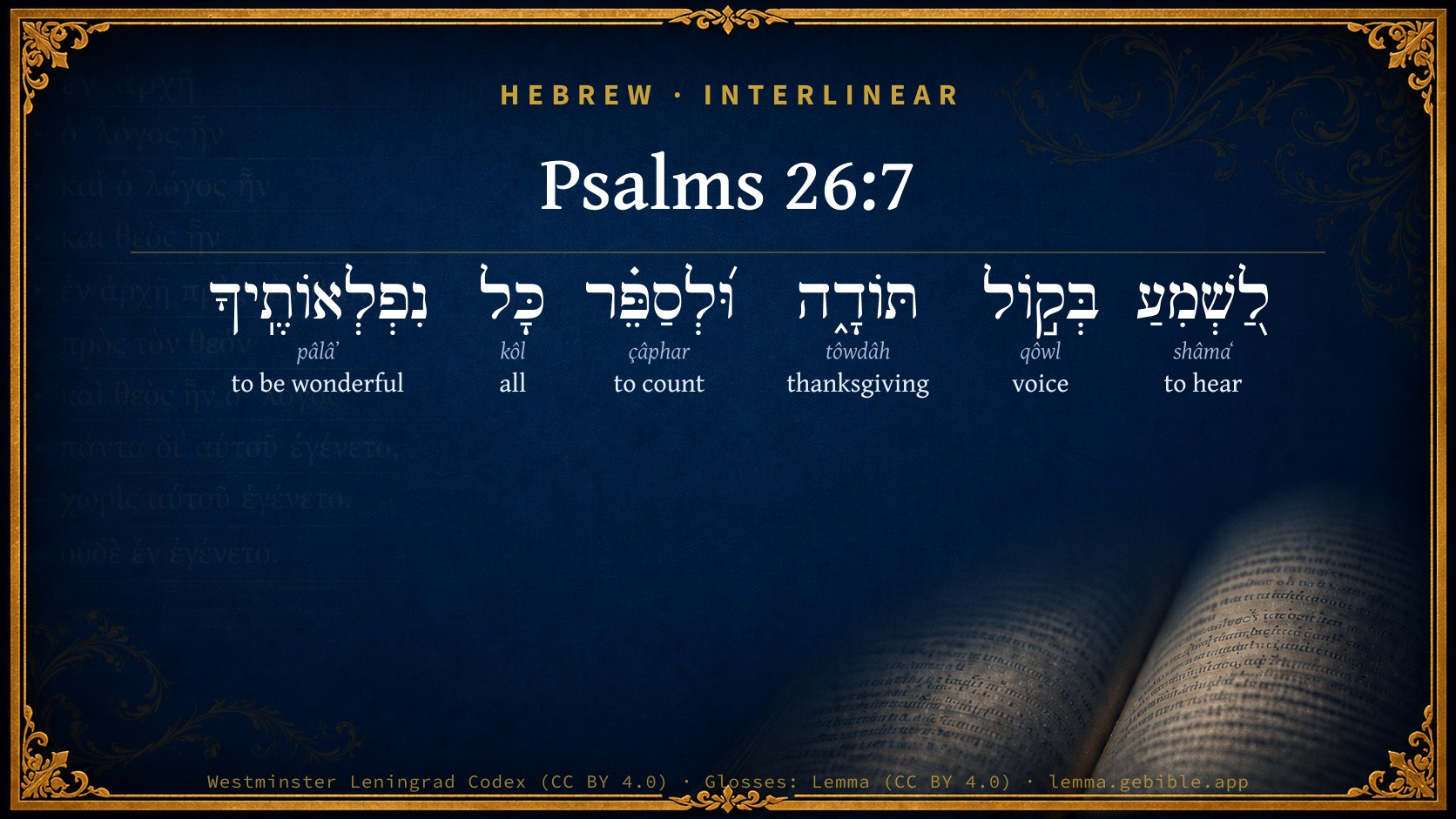
Psalms 26:7

Hebrew (Westminster Leningrad Codex) Psalms 26:7 appears in the Hebrew Old Testament. The text above is from the Westminster Leningrad Codex. Each word links to its Strong’s number, a concise gloss, and parsing drawn from the Open Scriptures Hebrew Bible morphology. Click any word for its full Brown-Driver-Briggs (BDB) entry.
Download image
Cite this verse

Psalms 26:7 (World English Bible). Public Domain. Lemma interlinear Bible study tool, https://lemma.gebible.app/v/psalms/26/7.

Show BibTeX & RIS
BibTeX
RIS
English Translation
That I may make the voice of thanksgiving to be heard, And tell of all your wondrous works.
World English Bible · Public Domain
Download a study sheet

One document with this verse’s original text, its word-by-word gloss line, the meaning frame, cross-references with their text, attributed commentary, and full source and license credits — printable, and it pastes into notes with its structure intact.

This verse Autodidact and up

Study sheet (.html) Plain text (.txt)

A passage Seminary Student

Up to 50 verses in one chapter. A passage sheet keeps up to 6 commentary sources and 12 cross-references per verse, in the order this page ranks them, and says so on the sheet whenever that leaves anything out. Ask for a single verse and you get the Autodidact verse sheet above.

Everything on this page stays free to read, with no account — the sheet is a download of what is already on screen, not access to it.

Want to remove ads? Support Godless Engineer
Compare translations 3

The same verse in 3 English versions, stacked beneath the original-language interlinear above. Click any original word for its lexicon entry.

Each is an independent rendering of the whole verse — the interlinear is not word-aligned to these translations.

Highlighted words mark where these versions differ — a whole-verse word diff, not a word-by-word alignment.

  • World English Bible Public Domain
    That I may make the voice of thanksgiving to be heard, And tell of all your wondrous works.
  • King James Version Public Domain
    That I may publish with the voice of thanksgiving, and tell of all thy wondrous works.
  • unfoldingWord Literal Text CC BY-SA 4.0
    to cause to be heard the sound of thanksgiving and recount all of your wonderful acts.

unfoldingWord Literal Text — © unfoldingWord, licensed CC BY-SA 4.0. Word-aligned USFM3 via Door43 (git.door43.org/unfoldingWord/en_ult).

Versions to compare (up to 4)

3 of 4 selected

Show all 18 translations

Every available English version of this verse, each an independent rendering of the whole verse.

  • World English Bible Public Domain
    That I may make the voice of thanksgiving to be heard, And tell of all your wondrous works.
  • Berean Standard Bible Public Domain
    to raise my voice in thanksgiving and declare all Your wonderful works.
  • Majority Standard Bible Public Domain
    to raise my voice in thanksgiving and declare all Your wonderful works.
  • King James Version Public Domain
    That I may publish with the voice of thanksgiving, and tell of all thy wondrous works.
  • American Standard Version (1901) Public Domain
    That I may make the voice of thanksgiving to be heard, And tell of all thy wondrous works.
  • Revised Version (1885) Public Domain
    That I may make the voice of thanksgiving to be heard, and tell of all thy wondrous works.
  • Geneva Bible (1599) Public Domain
    That I may declare with the voyce of thankesgiuing, and set foorth all thy wonderous woorkes.
  • Douay-Rheims (1899) Public Domain
    That I may hear the voice of thy praise: and tell of all thy wondrous works.
  • Young's Literal Translation Public Domain
    To sound with a voice of confession, And to recount all Thy wonders.
  • Literal Standard Version CC BY-SA 4.0
    To sound with a voice of confession, || And to recount all Your wonders.
  • Unlocked Literal Bible CC BY-SA 4.0
    to sing a loud song of praise and report all your wonderful deeds.
  • unfoldingWord Literal Text CC BY-SA 4.0
    to cause to be heard the sound of thanksgiving and recount all of your wonderful acts.
  • Darby Bible Public Domain
    That I may cause the voice of thanksgiving to be heard, and declare all thy marvellous works.
  • World Messianic Bible Public Domain
    that I may make the voice of thanksgiving to be heard and tell of all your wondrous deeds.
  • Webster's Bible Public Domain
    That I may publish with the voice of thanksgiving, and tell of all thy wondrous works.
  • Free Bible Version CC BY-SA 4.0
    singing my thanks, telling of all the wonderful things you have done.
  • Bible in Basic English Public Domain
    That I may give out the voice of praise, and make public all the wonders which you have done.
  • JPS Tanakh (1917) Public Domain
    That I may make the voice of thanksgiving to be heard, and tell of all Thy wondrous works.

Literal Standard Version (2020), Covenant Press — licensed CC BY-SA 4.0. Text via the HelloAO Bible API (eBible.org). Unlocked Literal Bible (unfoldingWord) — licensed CC BY-SA 4.0. Text via the HelloAO Bible API (eBible.org). unfoldingWord Literal Text — © unfoldingWord, licensed CC BY-SA 4.0. Word-aligned USFM3 via Door43 (git.door43.org/unfoldingWord/en_ult). Free Bible Version, Dr. Jonathan Gallagher — licensed CC BY-SA 4.0. Text via the HelloAO Bible API (eBible.org).

Word by word

More ways to search: Search by grammar → Find every occurrence → Compare this word →

Practice this passage: Drill this verse → Learn its vocabulary →

About this verse

These counts appear in no published source. They are computed here, from the morphology-tagged text and Lemma’s own curated glosses. What Lemma adds →

6
words
6
distinct lemmas
Wisdom
section

Shared distinctive vocabulary

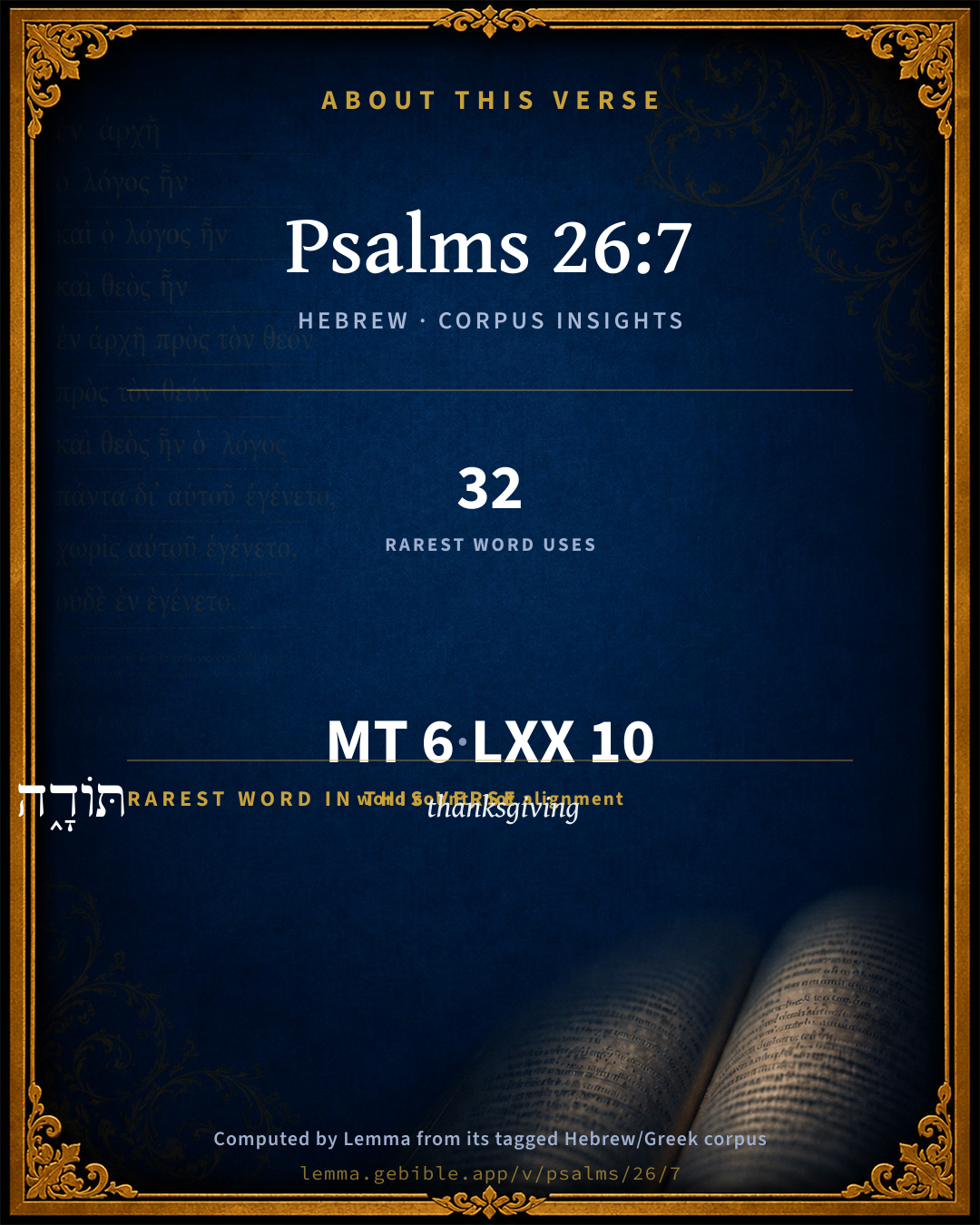
תּוֹדָ֑ה thanksgiving H8426 occurs in 30 verses of the Hebrew Bible. Also found in:

Grammatical profile

  • 3 verbs
  • 3 nouns

Verb forms

  • לַ֭שְׁמִעַ Hiphil · Infinitive Construct
  • וּ֝לְסַפֵּ֗ר Piel · Infinitive Construct
  • נִפְלְאוֹתֶֽיךָ Niphal · Participle Active

Hebrew & Septuagint length

In English translation the verse runs 18 words from the Hebrew and 13 from the Septuagint (LXX English) — closely comparable.

A rough comparison of the two English renderings, which tokenize alike — not a word-level alignment.

Word counts can differ between the Hebrew and the Greek without any difference in meaning — e.g. the Hebrew direct-object marker אֵת has no separate Greek word, and Greek often adds the article ὁ.

In the original languages it is 6 Hebrew tokens and 10 Greek tokens — but the two are counted differently (Hebrew bundles its prefixes and suffixes into one token; the Greek is in lemma form), so that isn’t a like-for-like length.

Cross-references

21

Topical passages linked to Psalms 26:7 in the Treasury of Scripture Knowledge — connected by theme and wording, ordered by reader-vote popularity; previews shown in the World English Bible.

  • Psalms 9:1 I will give thanks to Yahweh with my whole heart. I will tell of all your marvelous works.
  • Psalms 71:17–19 God, you have taught me from my youth. Until now, I have declared your wondrous works.
  • Psalms 145:5 Of the glorious majesty of your honor, Of your wondrous works, I will meditate.
  • 1 Samuel 1:24 When she had weaned him, she took him up with her, with three bulls, and one ephah of meal, and a bottle of wine, and brought him to the house of Yahweh in Shiloh: and the child was young.
  • 1 Samuel 1:27 For this child I prayed; and Yahweh has given me my petition which I asked of him:
  • 2 Chronicles 20:26–29 On the fourth day they assembled themselves in the valley of Beracah; for there they blessed Yahweh: therefore the name of that place was called The valley of Beracah to this day.
  • Psalms 9:14 That I may show forth all your praise. In the gates of the daughter of Zion, I will rejoice in your salvation.
  • Psalms 66:13–15 I will come into your temple with burnt offerings. I will pay my vows to you,
  • Psalms 72:18 Praise be to Yahweh God, the God of Israel, Who alone does marvelous deeds.
  • Psalms 95:2 Let's come before his presence with thanksgiving. Let's extol him with songs!
  • Psalms 100:4–5 Enter into his gates with thanksgiving, Into his courts with praise. Give thanks to him, and bless his name.
  • Psalms 105:2 Sing to him, sing praises to him! Tell of all his marvelous works.
  • Psalms 116:12–14 What will I give to Yahweh for all his benefits toward me?
  • Psalms 116:18–19 I will pay my vows to Yahweh, Yes, in the presence of all his people,
  • Psalms 118:19 Open to me the gates of righteousness. I will enter into them. I will give thanks to Yah.
  • Psalms 118:27 Yahweh is God, and he has given us light. Bind the sacrifice with cords, even to the horns of the altar.
  • Psalms 119:27 Let me understand the teaching of your precepts! Then I will meditate on your wondrous works.
  • Psalms 134:2 Lift up your hands in the sanctuary. Praise Yahweh!
  • Psalms 136:4–5 To him who alone does great wonders; For his loving kindness endures forever:
  • Luke 19:37–40 As he was now getting near, at the descent of the Mount of Olives, the whole multitude of the disciples began to rejoice and praise God with a loud voice for all the mighty works which they had seen,
  • Deuteronomy 26:2–10 that you shall take of the first of all the fruit of the ground, which you shall bring in from your land that Yahweh your God gives you; and you shall put it in a basket, and shall go to the place which Yahweh your God shall choose, to cause his name to dwell there.

Cross-references courtesy of OpenBible.info (CC BY 4.0).

Hebrew and Greek witnesses Masoretic Hebrew ↔ Greek Septuagint

The same verse in the two great witnesses to the Old Testament, shown verse-for-verse.

You’re reading Greek Psalm 25 (Hebrew Psalm 26). The Septuagint counts the superscription, so verse numbers can differ from the Hebrew — chapter-level alignment, not verse-by-verse. Numbering follows Rahlfs.

These are two independent witnesses, not word-aligned to each other, and the Septuagint is shown in lemma (dictionary) form.

Hebrew Psalms 26:7 Masoretic · Westminster Leningrad Codex

לַ֭שְׁמִעַ בְּק֣וֹל תּוֹדָ֑ה וּ֝לְסַפֵּ֗ר כָּל נִפְלְאוֹתֶֽיךָ

That I may make the voice of thanksgiving to be heard, And tell of all your wondrous works.

World English Bible · Public Domain

Greek LXX Greek Psalm 25:7 Septuagint · lemma form

ὁ ἀκούω φωνή αἴνεσις καί διαἡγέομαι πᾶς ὁ θαυμάσιος σύ

to hear the voice of praise, and to declare all your wonderful works.

LXX2012 (modern English Septuagint) · Public Domain

Hebrew: Westminster Leningrad Codex (CC BY 4.0). Greek: Septuagint (public domain); English from LXX2012 (modern English Septuagint) (Public Domain). How the Septuagint differs from the Hebrew →

Commentary

Notes on Psalms 26:7 from classic Christian and Jewish commentators (each source and its license shown beneath its notes). The classic Christian expositions comment on the surrounding passage and are grouped to its opening verse, so a note may address several verses; the Jewish commentaries on the Tanakh (Rashi and others) are per-verse, so they appear only where the commentator wrote on this verse.

Lemma curates 59 commentaries, every one of them public domain or Creative Commons licensed, each selected and text-cleaned for this edition rather than reprinted as found. About our sources →

Trapp's Complete Commentary

John Trapp

Psa 26:7 That I may publish with the voice of thanksgiving, and tell of all thy wondrous works.

Ver. 7. That I may publish] This was the end David propounded to himself in all his solemn services; that he might set up God, and not serve himself upon God.

And tell of all thy wondrous works] All God’s mercies to his are wonders if well weighed in their several circumstances. But we commonly deal by them as Solomon did by the brass of the temple, it was so much that he weighed it not.

John Trapp, A Commentary or Exposition upon All the Books of the Old and New Testament (1647–1656) — public domain. Text from a community e-Sword module.

The Biblical Illustrator

Joseph S. Exell

Psa_26:7

That I may publish with the voice of thanksgiving, and tell of all Thy wondrous works.

--

Declaring boldly Gods mercy and goodness

I have no notion of a timid, disingenuous profession of Christ. Some preachers and professors are like a rat playing at hide and seek behind a wainscot, who puts his head through a hole to see if the coast is clear, and ventures out if nobody is in the way; but slinks back again when danger appears. We cannot be honest to Christ except we are bold for Him. He is either worth all we can lose for Him, or He is worth nothing. (H. G. Salter.)

The Biblical Illustrator, edited by Joseph S. Exell (c. 1880s–1900s) — public domain. Text from a community e-Sword module.

J. A. Alexander on Psalms

Joseph Addison Alexander

7. (Psa 26:7) To make known with a voice of thanksgiving, and to recount all thy wondrous works. The object of the acts described in the preceding verse was to promote's God's glory. To make known, literally to cause to hear or to be heard. The clause admits of several constructions.

Joseph Addison Alexander, The Psalms Translated and Explained (1850) — public domain. Text from a community e-Sword module.

Adam Clarke's Commentary

Verse 7. That I may publish] I have endeavoured to act so as always to keep a conscience void of offence towards thee and towards man. I have made a profession of faith in thee, and salvation from thee, and my practice gives no lie to my profession.

Adam Clarke's Commentary on the Bible (1810–1826) — public domain. Text from a community e-Sword/MySword module.

John Calvin's Commentaries

7. That I may make men to hear, etc In these words, he shows that he referred the sacrifices to their proper use and design, which hypocrites were far from doing. They neither know, nor do they consider, for what purpose God appointed the services of worship, but think it sufficient to thrust themselves into the divine presence with the pomp and form of their dissimulation. David, therefore, wishing to distinguish spiritual worship from that which is fictitious and counterfeit, affirms that he came into the sanctuary to set forth the praise of God’s name. There is, however, a synecdoche in his words, as only one kind of worship is mentioned, although, in offering the sacrifices, the exercise of repentance and faith was required, as well as the giving of thanks. But as the ultimate design of the sacrifices, or at least their principal object was to celebrate the goodness of God in thus acknowledging his blessings, there was no impropriety in comprehending the other parts of worship under this. Thus, in Psalm 50:14, the sacrifice of praise is preferred to all external ceremonies, as if the whole of devotion consisted in it alone. Likewise in Psalm 116:12, it is said, “What shall I render unto the Lord for all his benefits? I will take the cup of salvation, and call upon the name of the Lord.” Moreover, that he may the better commend the acknowledged power of God, and more impressively extol his benefits, David employs the phrase wondrous; as if he had said, that it was in no ordinary way that God had helped him.

John Calvin's Commentaries (1540-1563) — public domain. Text from the Calvin Translation Society English edition (1840s-50s) via the Christian Classics Ethereal Library (ccel.org). Calvin's coverage is partial (roughly two-thirds of the Bible); uncommented books and verses are honest gaps, never fabricated. The 19th-century editor's footnotes and remarks are omitted so the notes are faithfully Calvin's own voice.

Ellicott's Commentary for English Readers

(7) That I may . . .—Literally, to make to hear the voice of praise.

A Bible Commentary for English Readers, edited by Charles John Ellicott (1878–1897) — public domain. Text from a community e-Sword module.

The Cambridge Bible for Schools and Colleges

gen. ed. J. J. S. Perowne

7. That I may publish with the voice of thanksgiving] Better, as R.V., that I may make the voice of thanksgiving to be heard.

thy wondrous works] Or, marvellous works. See note on Psa_9:1.

The Cambridge Bible for Schools and Colleges (gen. ed. J. J. S. Perowne; Cambridge University Press, 1878–1918) — public domain. Text from a community e-Sword module.

John Gill's Exposition

That I may publish with the voice of thanksgiving,.... Or "cause to hear with the voice of confession" (z): the meaning is, that the view of the psalmist, in compassing the altar of God in the manner he proposed, was not to offer upon it any slain beast; but to offer the sacrifices of praise upon that altar, which sanctifies the gift, and from whence they come with acceptance to God; even for all mercies, both temporal and spiritual, and that with a confession and acknowledgment of sin and unworthiness; all this is agreeable to the will of God; it is well pleasing in his sight, what glorifies him, and is but our reasonable service;

and tell of all thy wondrous works; of creation and providence; and especially of grace and redemption; this is the business of saints in God's house below, and will be their employment in heaven to all eternity. Jarchi on the place says, that this song of praise has in it what relates to future times, to Gog, to the days of the Messiah, and to the world to come.

(z) "voce confessionis", Montanus, Cocceius, Gejerus, Michaelis; so Ainsworth.

John Gill's Exposition of the Whole Bible (1746–1763) — public domain (CC PDM 1.0). Text via the HelloAO Bible API.

Albert Barnes' Notes on the Bible

That I may publish with the voice of thanksgiving - literally, “that I may cause to be heard;” that is, that I may make known to others. The idea is, that he would make known to others what he had learned from God; or that He would make known to them the delights of His service, and seek to win them to His worship. This he would do with a thankful remembrance of the favors which he had himself enjoyed, or as an expression of his gratitude for the mercies which had been conferred on him. As expressive of his gratitude to God, he would endeavor to win others also to His service.

And tell of all thy wondrous works - The wonderful things which thou hast done - thy works of creation, providence, and salvation. His own mind was deeply impressed with the greatness of God’s works, and he would desire to make the divine actions known as far as possible in the world. Compare Psa 22:22; Psa 66:16; Psa 145:5-6. This is always one of the evidences of true piety. They who have been impressed properly with a sense of the greatness and goodness of God; they who have experienced His pardoning mercy and forgiving grace, desire always to make these things known to others, and to invite them also to partake of the mercies connected with the divine favor. Compare Joh 1:45,

Albert Barnes' Notes on the Bible (1834–1885) — public domain. Text from a community e-Sword/MySword module.

Matthew Poole's English Annotations

Publish, or, proclaim, to wit,

thy wondrous works, as it here follows.

With the voice of thanksgiving; accompanying my sacrifices with my own solemn thanksgivings and songs of praise.

Matthew Poole's English Annotations on the Holy Bible (1683–1685) — public domain. Text from a community e-Sword/MySword module.

The Treasury of David

Charles H. Spurgeon

Ver. 7. That I may publish with the voice of thanksgiving. David was so far instructed that he does not mention the typical offering, but discerns the spiritual offering which was intended thereby, not the groans of bullocks, but songs of gratitude the spiritual worshipper presents. To sound abroad the worthy praises of the God of all grace should be the everyday business of a pardoned sinner. Let men slander us as they will, let us not defraud the Lord of his praises; let dogs bark, but let us like the moon shine on. And tell of all thy wondrous works. God's people should not be tongue tied. The wonders of divine grace are enough to make the tongue of the dumb sing. God's works of love are wondrous if we consider the unworthiness of their objects, the costliness of their method, and the glory of their result. And as men find great pleasure in discoursing upon things remarkable and astonishing, so the saints rejoice to tell of the great things which the Lord hath done for them.

None.

Ver. 7.

1. The believer's callinga publisher.

2. The author selected, and the quality of his works. "Thy wondrous works."

3. The mode of advertising "voice of thanksgiving", "tell", etc.

Psalms 26:8*

Charles H. Spurgeon's The Treasury of David (1869–1885) — public domain. Psalms only. Text from a community e-Sword/MySword module.

Whedon's Commentary on the Bible

Daniel D. Whedon

7. That I may publish—For this purpose he approaches the altar and joins in the public praise.

Wondrous works— “The latest of these is the bringing him home from the exile he had suffered because of the rebellion of Absalom.”—Delitzsch.

Daniel D. Whedon (gen. ed.), Commentary on the Old and New Testaments (1874–1909) — public domain. Text from a community e-Sword module.

The Pulpit Commentary

That I may publish with the voice of thanksgiving; rather, to sound forth the voice of thanksgiving (Kay); or, to make the voice of thanksgiving to be heard (Revised Version). And tell of all thy wondrous works; or, recount them, enumerate them.

The Pulpit Commentary (1880–1919), ed. H.D.M. Spence-Jones & Joseph S. Exell — public domain. Text from a community e-Sword module.

Rashi

Rabbi Shlomo Yitzchaki (Rashi)

To proclaim Heb. לַשְׁמִעַ, like לְהַשְׁמִיעַ.

all Your wonders This refers to Hallel, which contains mention of the past, mention of Gog and Magog, mention of the Messianic era, and mention of the future.

Rashi on the Tanakh — English translations: “The Judaica Press complete Tanach with Rashi, translated by A. J. Rosenberg” (CC BY 4.0); “Pentateuch with Rashi's commentary by M. Rosenbaum and A.M. Silbermann, 1929-1934” (public domain); “The Metsudah Tanach series, Lakewood, N.J” (CC BY 4.0); and “The Book of Joshua, Metsudah Publications, 1997” (CC BY 4.0). Text via Sefaria.

Lesson kit

Teaching starters — assembled from the data on this page, not authored interpretation. Every prompt links to the verse data it draws on. Edit before teaching.

Psalms, in the Wisdom, opens this verse with 6 words (6 distinct Hebrew lemmas). Its most distinctive word is tôwdâh (“thanksgiving”). A historical commentator’s framing appears above. Read the whole chapter for the surrounding context.

Discussion questions

  1. The word tôwdâh carries the sense “thanksgiving.” How does it shape the verse?
  2. How does Leviticus 7:12, which shares the word «thanksgiving», read alongside this verse?
  3. These translations render this verse differently; the difference is in the English rendering, not the original. What questions does that raise?
  4. «לַ֭שְׁמִעַ» is a Hiphil Infinitive Construct verb. How does that grammatical form shape the action described?
  5. Compare how Trapp's Complete Commentary and The Biblical Illustrator read this verse. Where do they agree or differ?

Things to notice

Reading settings

Reading text

Shown beneath each verse's original-language words.

Old Testament
Old Testament edition

Read the OT as the Masoretic Hebrew (MT) or the Greek Septuagint (LXX).

English shown for the Greek Septuagint (in the Hebrew ↔ Greek comparison).

Comparing translations? Open the Compare panel on any verse page to stack up to four side by side.