

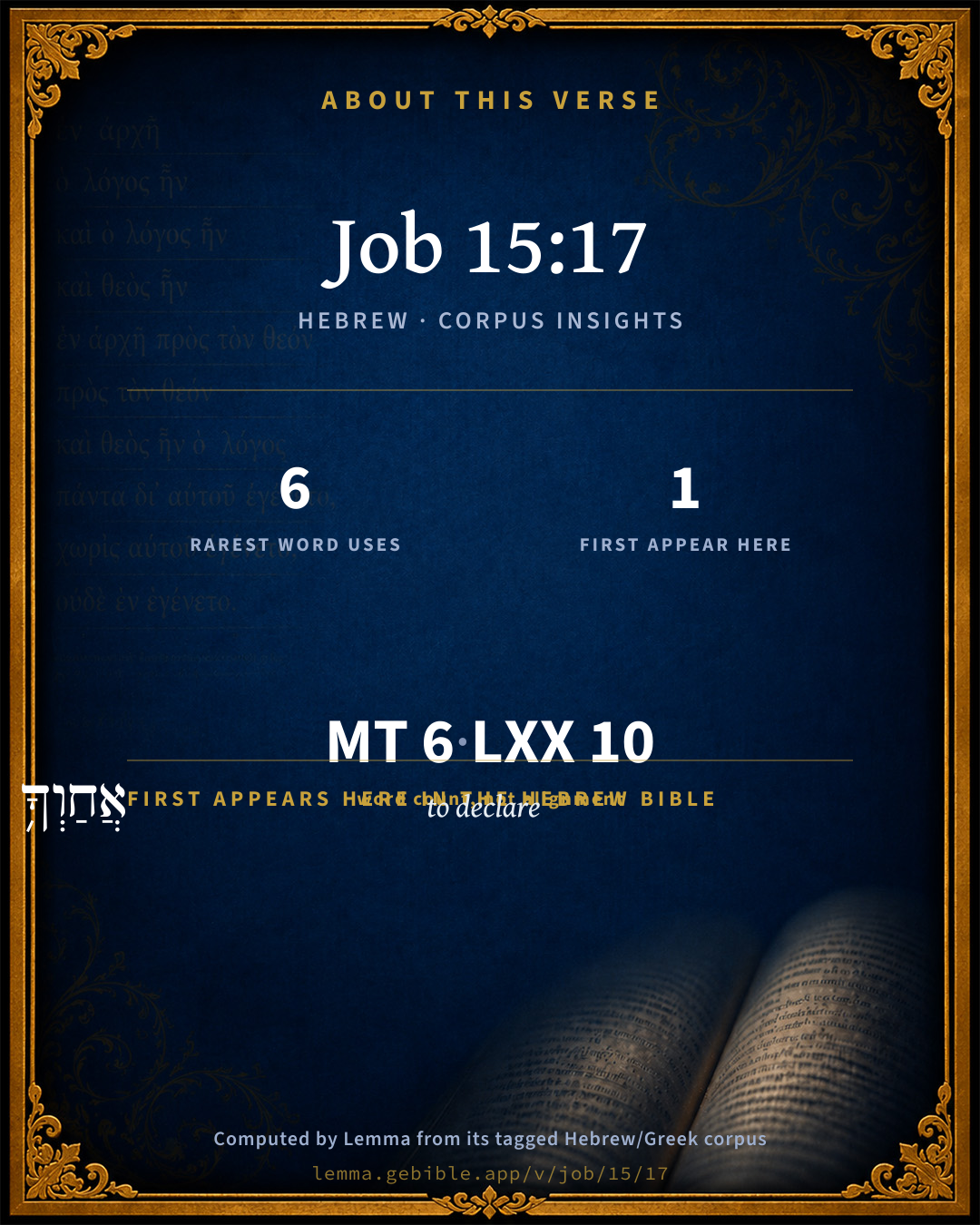
Job 15:17

Hebrew (Westminster Leningrad Codex) Job 15:17 appears in the Hebrew Old Testament. The text above is from the Westminster Leningrad Codex. Each word links to its Strong’s number, a concise gloss, and parsing drawn from the Open Scriptures Hebrew Bible morphology. Click any word for its full Brown-Driver-Briggs (BDB) entry.
Download image
Cite this verse

Job 15:17 (World English Bible). Public Domain. Lemma interlinear Bible study tool, https://lemma.gebible.app/v/job/15/17.

Show BibTeX & RIS
BibTeX
RIS
English Translation
"I will show you, listen to me; That which I have seen I will declare:
World English Bible · Public Domain
Highlights
  • 1 first appearance in the Hebrew Bible
Full analysis ↓
Download a study sheet

One document with this verse’s original text, its word-by-word gloss line, the meaning frame, cross-references with their text, attributed commentary, and full source and license credits — printable, and it pastes into notes with its structure intact.

This verse Autodidact and up

Study sheet (.html) Plain text (.txt)

A passage Seminary Student

Up to 50 verses in one chapter. A passage sheet keeps up to 6 commentary sources and 12 cross-references per verse, in the order this page ranks them, and says so on the sheet whenever that leaves anything out. Ask for a single verse and you get the Autodidact verse sheet above.

Everything on this page stays free to read, with no account — the sheet is a download of what is already on screen, not access to it.

Want to remove ads? Support Godless Engineer
Compare translations 3

The same verse in 3 English versions, stacked beneath the original-language interlinear above. Click any original word for its lexicon entry.

Each is an independent rendering of the whole verse — the interlinear is not word-aligned to these translations.

Highlighted words mark where these versions differ — a whole-verse word diff, not a word-by-word alignment.

  • World English Bible Public Domain
    "I will show you, listen to me; That which I have seen I will declare:
  • King James Version Public Domain
    I will shew thee, hear me; and that which I have seen I will declare;
  • unfoldingWord Literal Text CC BY-SA 4.0
    I will show you; listen to me, and what I have seen, let me also recount,

unfoldingWord Literal Text — © unfoldingWord, licensed CC BY-SA 4.0. Word-aligned USFM3 via Door43 (git.door43.org/unfoldingWord/en_ult).

Versions to compare (up to 4)

3 of 4 selected

Show all 18 translations

Every available English version of this verse, each an independent rendering of the whole verse.

  • World English Bible Public Domain
    "I will show you, listen to me; That which I have seen I will declare:
  • Berean Standard Bible Public Domain
    Listen to me and I will inform you. I will describe what I have seen,
  • Majority Standard Bible Public Domain
    Listen to me and I will inform you. I will describe what I have seen,
  • King James Version Public Domain
    I will shew thee, hear me; and that which I have seen I will declare;
  • American Standard Version (1901) Public Domain
    I will show thee, hear thou me; And that which I have seen I will declare:
  • Revised Version (1885) Public Domain
    I will shew thee, hear thou me; and that which I have seen I will declare:
  • Geneva Bible (1599) Public Domain
    I will tell thee: heare me, and I will declare that which I haue seene:
  • Douay-Rheims (1899) Public Domain
    I will shew thee, hear me: and I mill tell thee what I have seen.
  • Young's Literal Translation Public Domain
    I shew thee -- hearken to me -- And this I have seen and declare:
  • Literal Standard Version CC BY-SA 4.0
    I show you—listen to me—And this I have seen and declare,
  • Unlocked Literal Bible CC BY-SA 4.0
    I will show you; listen to me; I will announce to you the things I have seen,
  • unfoldingWord Literal Text CC BY-SA 4.0
    I will show you; listen to me, and what I have seen, let me also recount,
  • Darby Bible Public Domain
    I will shew thee, listen to me; and what I have seen I will declare;
  • World Messianic Bible Public Domain
    “I will show you, listen to me; that which I have seen I will declare
  • Webster's Bible Public Domain
    I will show thee, hear me; and that which I have seen, I will declare;
  • Free Bible Version CC BY-SA 4.0
    If you are ready to listen to me, I will show you. I will explain my insights.
  • Bible in Basic English Public Domain
    Take note and give ear to my words; and I will say what I have seen:
  • JPS Tanakh (1917) Public Domain
    I will tell thee, hear thou me; and that which I have seen I will declare —

Literal Standard Version (2020), Covenant Press — licensed CC BY-SA 4.0. Text via the HelloAO Bible API (eBible.org). Unlocked Literal Bible (unfoldingWord) — licensed CC BY-SA 4.0. Text via the HelloAO Bible API (eBible.org). unfoldingWord Literal Text — © unfoldingWord, licensed CC BY-SA 4.0. Word-aligned USFM3 via Door43 (git.door43.org/unfoldingWord/en_ult). Free Bible Version, Dr. Jonathan Gallagher — licensed CC BY-SA 4.0. Text via the HelloAO Bible API (eBible.org).

Word by word

More ways to search: Search by grammar → Find every occurrence → Compare this word →

Practice this passage: Drill this verse → Learn its vocabulary →

About this verse

These counts appear in no published source. They are computed here, from the morphology-tagged text and Lemma’s own curated glosses. What Lemma adds →

6
words
5
distinct lemmas
Wisdom
section

Notable vocabulary

The rarest word here is אֲחַוְךָ֥ to declare H2331 — appearing just 6 times in the whole Hebrew Bible.

First appearance in Scripture

This word makes its first canonical appearance in the Hebrew Bible here:

  • אֲחַוְךָ֥ to declare H2331

Shared distinctive vocabulary

אֲחַוְךָ֥ to declare H2331 occurs in 6 verses of the Hebrew Bible. Also found in:

Grammatical profile

  • 4 verbs
  • 1 pronoun
  • 1 preposition

Verb forms

  • אֲחַוְךָ֥ Piel · Imperfect
  • שְֽׁמַֽע Qal · Imperative
  • חָ֝זִ֗יתִי Qal · Perfect
  • וַאֲסַפֵּֽרָה Piel · Cohortative

Hebrew & Septuagint length

In English translation the verse runs 15 words from the Hebrew and 17 from the Septuagint (LXX English) — closely comparable.

A rough comparison of the two English renderings, which tokenize alike — not a word-level alignment.

Word counts can differ between the Hebrew and the Greek without any difference in meaning — e.g. the Hebrew direct-object marker אֵת has no separate Greek word, and Greek often adds the article ὁ.

In the original languages it is 6 Hebrew tokens and 10 Greek tokens — but the two are counted differently (Hebrew bundles its prefixes and suffixes into one token; the Greek is in lemma form), so that isn’t a like-for-like length.

Cross-references

5

Topical passages linked to Job 15:17 in the Treasury of Scripture Knowledge — connected by theme and wording, ordered by reader-vote popularity; previews shown in the World English Bible.

  • Job 5:27 Look this, we have searched it, so it is; Hear it, and know it for your good."
  • Job 13:5–6 Oh that you would be completely silent! Then you would be wise.
  • Job 33:1 "However, Job, Please hear my speech, And listen to all my words.
  • Job 34:2 "Hear my words, you wise men; Give ear to me, you who have knowledge.
  • Job 36:2 "Bear with me a little, and I will show you; For I still have something to say on God's behalf.

Cross-references courtesy of OpenBible.info (CC BY 4.0).

Hebrew and Greek witnesses Masoretic Hebrew ↔ Greek Septuagint

The same verse in the two great witnesses to the Old Testament, shown verse-for-verse.

These are two independent witnesses, not word-aligned to each other, and the Septuagint is shown in lemma (dictionary) form.

Hebrew Job 15:17 Masoretic · Westminster Leningrad Codex

אֲחַוְךָ֥ שְֽׁמַֽע לִ֑י וְזֶֽה חָ֝זִ֗יתִי וַאֲסַפֵּֽרָה

"I will show you, listen to me; That which I have seen I will declare:

World English Bible · Public Domain

Greek LXX Job 15:17 Septuagint · lemma form

ἀναἀγγέλλω δέ σύ ἀκούω ἐγώ ὅς δή ὁράω ἀναἀγγέλλω σύ

But I will tell you, listen to me; I will tell you now what I have seen;

LXX2012 (modern English Septuagint) · Public Domain

Hebrew: Westminster Leningrad Codex (CC BY 4.0). Greek: Septuagint (public domain); English from LXX2012 (modern English Septuagint) (Public Domain). How the Septuagint differs from the Hebrew →

Commentary

Notes on Job 15:17 from classic Christian and Jewish commentators (each source and its license shown beneath its notes). The classic Christian expositions comment on the surrounding passage and are grouped to its opening verse, so a note may address several verses; the Jewish commentaries on the Tanakh (Rashi and others) are per-verse, so they appear only where the commentator wrote on this verse.

Lemma curates 59 commentaries, every one of them public domain or Creative Commons licensed, each selected and text-cleaned for this edition rather than reprinted as found. About our sources →

Matthew Henry's Commentary

Eliphaz, having reproved Job for his answers, here comes to maintain his own thesis, upon which he built his censure of Job. His opinion is that those who are wicked are certainly miserable, whence he would infer that those who are miserable are certainly wicked, and that therefore Job was so. Observe,

I. His solemn preface to this discourse, in which he bespeaks Job's attention, which he had little reason to expect, he having given so little heed to and put so little value upon what Job had said (Job 15:17): "I will show thee that which is worth hearing, and not reason, as thou dost, with unprofitable talk." Thus apt are men, when they condemn the reasonings of others, to commend their own. He promises to teach him, 1. From his own experience and observation: "That which I have myself seen, in divers instances, I will declare." It is of good use to take notice of the providences of God concerning the children of men, from which many a good lesson may be learned. What good observations we have made, and have found benefit by ourselves, we should be ready to communicate for the benefit of others; and we may speak boldly when we declare what we have seen. 2. From the wisdom of the ancients (Job 15:18): Which wise men have told from their fathers. Note, The wisdom and learning of the moderns are very much derived from those of the ancients. Good children will learn a good deal from their good parents; and what we have learned from our ancestors we must transmit to our posterity and not hide from the generations to come. See Psa 78:3-6. If the thread of the knowledge of many ages be cut off by the carelessness of one, and nothing be done to preserve it pure and entire, all that succeed fare the worse. The authorities Eliphaz vouched were authorities indeed, men of rank and figure (Job 15:19), unto whom alone the earth was given, and therefore you may suppose them favourites of Heaven and best capable of making observations concerning the affairs of this earth. The dictates of wisdom come with advantage from those who are in places of dignity and power, as Solomon; yet there is a wisdom which none of the princes of this world knew, Co1 2:7, Co1 2:8.

II. The discourse itself. He here aims to show,

1. That those who are wise and good do ordinarily prosper in this world. This he only hints at (Job 15:19), that those of whose mind he was were such as had the earth given to them, and to them only; they enjoyed it entirely and peaceably, and no stranger passed among them, either to share with them or give disturbance to them. Job had said, The earth is given into the hand of the wicked, Job 9:24. "No," says Eliphaz, "it is given into the hands of the saints, and runs along with the faith committed unto them; and they are not robbed and plundered by strangers and enemies making inroads upon them, as thou art by the Sabeans and Chaldeans." But because many of God's people have remarkably prospered in this world, as Abraham, Isaac, and Jacob, it does not therefore follow that those who are crossed and impoverished, as Job, are not God's people.

2. That wicked people, and particularly oppressors and tyrannizing rulers, are subject to continual terrors, live very uncomfortably, and perish very miserably. On this head he enlarges, showing that even those who impiously dare God's judgments yet cannot but dread them and will feel them at last. He speaks in the singular number - the wicked man, meaning (as some think) Nimrod; or perhaps Chedorlaomer, or some such mighty hunter before the Lord. I fear he meant Job himself, whom he expressly charges both with the tyranny and with the timorousness here described, Job 22:9, Job 22:10. Here he thinks the application easy, and that Job might, in this description, as in a glass, see his own face. Now,

(1.) Let us see how he describes the sinner who lives thus miserably. He does not begin with that, but brings it in as a reason of his doom, Job 15:25-28. It is no ordinary sinner, but one of the first rate, an oppressor (Job 15:20), a blasphemer, and a persecutor, one that neither fears God nor regards man. [1.] He bids defiance to God, and to his authority and power, Job 15:25. Tell him of the divine law, and its obligations; he breaks those bonds asunder, and will not have, no, not him that made him, to restrain him or rule over him. Tell him of the divine wrath, and its terrors; he bids the Almighty do his worst, he will have his will, he will have his way, in spite of him, and will not be controlled by law, or conscience, or the notices of a judgment to come. He stretches out his hand against God, in defiance of him and of the power of his wrath. God is indeed out of his reach, but he stretches out his hand against him, to show that, if it were in his power, he would ungod him. This applies to the audacious impiety of some sinners who are really haters of God (Rom 1:30), and whose carnal mind is not only an enemy to him, but enmity itself, Rom 8:7. But, alas! the sinner's malice is as impotent as it is impudent; what can he do? He strengthens himself (he would be valiant, so some read it) against the Almighty. He thinks with his exorbitant despotic power to change times and laws (Dan 7:25), and, in spite of Providence, to carry the day for rapine and wrong, clear of the check of conscience. Note, It is the prodigious madness of presumptuous sinners that they enter the lists with Omnipotence. Woe unto him that strives with his Maker. That is generally taken for a further description of the sinner's daring presumption (Job 15:26): He runs upon him, upon God himself, in a direct opposition to him, to his precepts and providences, even upon his neck, as a desperate combatant, when he finds himself an unequal match for his adversary, flies in his face, though, at the same time, he falls on his sword's point, or the sharp spike of his buckler. Sinners, in general, run from God; but the presumptuous sinner, who sins with a high hand, runs upon him, fights against him, and bids defiance to him; and it is easy to foretel what will be the issue. [2.] He wraps himself up in security and sensuality (Job 15:27): He covers his face with his fatness. This signifies both the pampering of his flesh with daily delicious fare and the hardening of his heart thereby against the judgments of God. Note, The gratifying of the appetites of the body, feeding and feasting that to the full, often turns to the damage of the soul and its interests. Why is God forgotten and slighted, but because the belly is made a god of and happiness placed in the delights of sense? Those that fill themselves with wine and strong drink abandon all that is serious and flatter themselves with hopes that tomorrow shall be as this day, Isa 56:12. Woe to those that are thus at ease in Zion, Amo 6:1, Amo 6:3, Amo 6:4; Luk 12:19. The fat that covers his face makes him look bold and haughty, and that which covers his flanks makes him lie easy and soft, and feel little; but this will prove poor shelter against the darts of God's wrath. [3.] He enriches himself with the spoils of all about him, Job 15:28. He dwells in cities which he himself has made desolate by expelling the inhabitants out of them, that he might be placed alone in them, Isa 5:8 Proud and cruel men take a strange pleasure in ruins, when they are of their own making, in destroying cities (Psa 9:6) and triumphing in the destruction, since they cannot make them their own but by making them ready to become heaps, and frightening the inhabitants out of them. Note, Those that aim to engross the world to themselves, and grasp at all, lose the comfort of all, and make themselves miserable in the midst of all. How does this tyrant gain his point, and make himself master of cities that have all the marks of antiquity upon them? We are told (Job 15:35) that he does it by malice and falsehood, the two chief ingredients of his wickedness who was a liar and a murderer from the beginning, They conceive mischief, and then they effect it by preparing deceit, pretending to protect those whom they design to subdue, and making leagues of peace the more effectually to carry on the operations of war. From such wicked men God deliver all good men.

(2.) Let us see now what is the miserable condition of this wicked man, both in spiritual and temporal judgments.

[1.] His inward peace is continually disturbed. He seems to those about him to be easy, and they therefore envy him and wish themselves in his condition; but he who knows what is in men tells us that a wicked man has so little comfort and satisfaction in his own breast that he is rather to be pitied than envied. First, His own conscience accuses him, and with the pangs and throes of that he travaileth in pain all his days, Job 15:20. He is continually uneasy at the thought of the cruelties he as been guilty of and the blood in which he has imbrued his hands. His sins stare him in the face at every turn. Diri conscia facti mens habet attonitos - Conscious guilt astonishes and confounds. Secondly, He is vexed at the uncertainty of the continuance of his wealth and power: The number of years is hidden to the oppressor. He knows, whatever he pretends, that they will not last always, and has reason to fear that they will not last long and this he frets at. Thirdly, He is under a certain fearful expectation of judgment and fiery indignation (Heb 10:27), which puts him into, and keeps him in, a continual terror and consternation, so that he dwells with Cain in the land of Nod, or commotion (Gen 4:16), and is made like, Pashur, Magor-missabib - a terror round about, Jer 20:3, Jer 20:4. A dreadful sound is in his ears, Job 15:21. He knows that both heaven and earth are incensed against him, that God is angry with him and that all the world hates him; he has done nothing to make his peace with either, and therefore he thinks that every one who meets him will slay him, Gen 4:14. Or he is like a man absconding for debt, who thinks every man a bailiff. Fear came in, at first, with sin (Gen 3:10) and still attends it. Even in prosperity he is apprehensive that the destroyer will come upon him, either some destroying angel sent of God to avenge his quarrel or some of his injured subjects who will be their own avengers. Those who are the terror of the mighty in the land of the living usually go down slain to the pit (Eze 32:25), the expectation of which makes them a terror to themselves. This is further set forth (Job 15:22): He is, in his own apprehension, waited for of the sword; for he knows that he who killeth with the sword must be killed with the sword, Rev 13:10. A guilty conscience represents to the sinner a flaming sword turning every way (Gen 3:24) and himself inevitably running on it. Again (Job 15:23): He knows that the day of darkness (or the night of darkness rather) is ready at his hand, that it is appointed to him and cannot be put by, that it is hastening on apace and cannot be put off. This day of darkness is something beyond death; it is that day of the Lord which to all wicked people will be darkness and not light and in which they will be doomed to utter, endless, darkness. Note, Some wicked people, though they seem secure, have already received the sentence of death, eternal death, within themselves, and plainly see hell gaping for them. No marvel that it follows (Job 15:24), Trouble and anguish (that inward tribulation and anguish of soul spoken of Rom 2:8, Rom 2:9, which are the effect of God's indignation and wrath fastening upon the conscience) shall make him afraid of worse to come. What is the hell before him if this be the hell within him? And though he would fain shake off his fears, drink them away, and jest them away, it will not do; they shall prevail against him, and overpower him, as a king ready to the battle, with forces too strong to be resisted. He that would keep his peace, let him keep a good conscience. Fourthly, If at any time he be in trouble, he despairs of getting out (Job 15:22): He believeth not that he shall return out of darkness, but he gives himself up for gone and lost in an endless night. Good men expect light at evening time, light out of darkness; but what reason have those to expect that they shall return out of the darkness of trouble who would not return from the darkness of sin, but went on in it? Psa 82:5. It is the misery of damned sinners that they know they shall never return out of that utter darkness, nor pass the gulf there fixed. Fifthly, He perplexes himself with continual care, especially if Providence ever so little frown upon him, Job 15:23. Such a dread he has of poverty, and such a waste does he discern upon his estate, that he is already, in his own imagination, wandering abroad for bread, going a begging for a meal's meat, and saying, Where is it? The rich man, in his abundance, cried out, What shall I do? Luk 12:17. Perhaps he pretends fear of wanting, as an excuse of his covetous practices; and justly may he be brought to this extremity at last. We read of those who were full, but have hired out themselves for bread (Sa1 2:5), which this sinner will not do. He cannot dig; he is too fat (Job 15:27): but to beg he may well be ashamed. See Psa 109:10. David never saw the righteous so far forsaken as to beg their bread; for, verily, they shall be fed by the charitable unasked, Psa 37:3, Psa 37:25. But the wicked want it, and cannot expect it should be readily given them. How should those find mercy who never showed mercy?

[2.] His outward prosperity will soon come to an end, and all his confidence and all his comfort will come to an end with it. How can he prosper when God runs upon him? so some understand that, Job 15:26. Whom God runs upon he will certainly run down; for when he judges he will overcome. See how the judgments of God cross this worldly wicked man in all his cares, desires, and projects, and so complete his misery. First, He is in care to get, but he shall not be rich, Job 15:29. His own covetous mind keeps him from being truly rich. He is not rich that has not enough, and he has not enough that does not think he has. It is contentment only that is great gain. Providence remarkably keeps some from being rich, defeating their enterprises, breaking their measures, and keeping them always behind-hand. Many that get much by fraud and injustice, yet do not grow rich: it goes as it comes; it is got by one sin and spent upon another. Secondly, He is in care to keep what he has got, but in vain: His substance shall not continue; it will dwindle and come to nothing. God blasts it, and what came up in a night perishes in a night. Wealth gotten by vanity will certainly be diminished. Some have themselves lived to see the ruin of those estates which have been raised by oppression; but, where this is not the case, that which is left goes with a curse to those who succeed. De male quaesitis vix gaudet tertius haeres - Ill-gotten property will scarcely be enjoyed by the third generation. He purchases estates to him and his heirs for ever; but to what purpose? He shall not prolong the perfection thereof upon the earth; neither the credit nor the comfort of his riches shall be prolonged; and, when those are gone, where is the perfection of them? How indeed can we expect the perfection of any thing to be prolonged upon the earth, where every thing is transitory, and we soon see the end of all perfection? Thirdly, He is in care to leave what he has got and kept to his children after him. But in this he is crossed; the branches of his family shall perish, in whom he hoped to live and flourish and to have the reputation of making them all great men. They shall not be green, Job 15:32. The flame shall dry them up, Job 15:30. he shall shake them off as blossoms that never knit, or as the unripe grape, Job 15:33. They shall die in the beginning of their days and never come to maturity. Many a man's family is ruined by his iniquity. Fourthly, He is in care to enjoy it a great while himself; but in that also he is crossed. 1. He may perhaps be taken from it (Job 15:30): By the breath of God's mouth shall he go away, and leave his wealth to others; that is, by God's wrath, which, like a stream of brimstone, kindles the fire that devours him (Isa 30:33), or by his word; he speaks, and it is done immediately. This night thy soul shall be required of thee; and so the wicked is driven away in his wickedness, the worldling in his worldliness. 2. It may perhaps be taken from him, and fly away like an eagle towards heaven: It shall be accomplished (or cut off) before his time (Job 15:32); that is, he shall survive his prosperity, and see himself stripped of it. Fifthly, He is in care, when he is in trouble, how to get out of it (not how to get good by it); but in this also he is crossed (Job 15:30): He shall not depart out of darkness. When he begins to fall, like Haman, all men say, "Down with him." It was said of him (Job 15:22), He believeth not that he shall return out of darkness. He frightened himself with the perpetuity of his calamity, and God also shall choose his delusions and bring his fears upon him (Isa 66:4), as he did upon Israel, Num 14:28. God says Amen to his distrust and despair. Sixthly, He is in care to secure his partners, and hopes to secure himself by his partnership with them; but that is in vain too, Job 15:34, Job 15:35. The congregation of them, the whole confederacy, they and all their tabernacles, shall be desolate and consumed with fire. Hypocrisy and bribery are here charged upon them; that is, deceitful dealing both with God and man - God affronted under colour of religion, man wronged under colour of justice. It is impossible that these should end well. Though hand join in hand for the support of these perfidious practices, yet shall not the wicked go unpunished. (3.) The use and application of all this. Will the prosperity of presumptuous sinners end thus miserably? Then (Job 15:31) let not him that is deceived trust in vanity. Let the mischiefs which befal others be our warnings, and let not us rest on that broken reed which always failed those who leaned on it. [1.] Those who trust to their sinful ways of getting wealth trust in vanity, and vanity will be their recompence, for they shall not get what they expected. Their arts will deceive them and perhaps ruin them in this world. [2.] Those who trust to their wealth when they have gotten it, especially to the wealth they have gotten dishonestly, trust in vanity; for it will yield them no satisfaction. The guilt that cleaves to it will ruin the joy of it. They sow the wind, and will reap the whirlwind, and will own at length, with the utmost confusion, that a deceived heart turned them aside, and that they cheated themselves with a lie in their right hand.

Matthew Henry's Commentary on the Whole Bible (1708–1710) — public domain (CC PDM 1.0). Text via the HelloAO Bible API.

The Cambridge Bible for Schools and Colleges

gen. ed. J. J. S. Perowne

17. I will shew thee] Eliphaz assumes a high tone with Job; one is entitled to do so with a man in his unfortunate condition.

17–35. Eliphaz instructs Job regarding the troubled conscience And the Disastrous Fate of the Wicked Man

Having sufficiently rebuked Job’s presumption and irreverence Eliphaz proceeds to take up his principles, which “did away with the fear of God,” Job_15:4. They are such principles as Job gave forth ch. Job_9:22 seq., Job_12:6. The passage has two parts:—

First, Job_15:17-19, a brief preface, in which Eliphaz states that his doctrine is that of the wise of all times among the pure-blooded races of men, who have never been contaminated by mixture with foreign tribes, and whose traditions are uncorrupted.

Second, Job_15:20-35, the doctrine regarding the wicked man itself, in which there are three points: (1) the troubled conscience and presentiments of coming evil that continually haunt the evil man, Job_15:20-24; (2) the cause of this, his defiance of God and sensual life, Job_15:25-28; and (3) finally, a picture of his punishment and disastrous end, Job_15:29-35.

The Cambridge Bible for Schools and Colleges (gen. ed. J. J. S. Perowne; Cambridge University Press, 1878–1918) — public domain. Text from a community e-Sword module.

Trapp's Complete Commentary

John Trapp

Job 15:17 I will shew thee, hear me; and that [which] I have seen I will declare;

Ver. 17. I will show thee, hear me] Here Eliphaz useth a short but a lofty preface, calling hard for attention, and raising in Job an expectation of no mean matters. But

Quid dignum tanto feret hic promissor hiatu - (Horat.)

This is his argument:

This is to be held to be true which experience evinceth, and wise men teach us, just as they have learned it from their religious ancestors.

But, both continued experience and consent of men teach us, that wicked men have terrors within and troubles without.

Therefore this is to be taken for a truth. Therefore also, by consequence, that is false which thou hast spoken concerning the prosperity of wicked men, Job 12:6. Neither canst thou avoid the charge of wickedness who dost suffer the punishments of the wicked. Now what is all this more than Eliphaz had said in a former discourse (so that Job might have cried out, Apage coccysmum?) only there he grounded his argument upon a night vision; here upon the testimony and consent of certain wise men, commended by their power and justice. Some think he meaneth Noah and his pious posterity.

That which I have seen I will declare] Wilt thou not believe an eyewitness? What can be more sure than sight? Joh 1:1. Surely, if we were well read in the story of our own lives, and had laid up our experiences, we might have a divinity of our own. The ll9th Psalm is made up of experiments; and David oft telleth us what he had seen and observed.

John Trapp, A Commentary or Exposition upon All the Books of the Old and New Testament (1647–1656) — public domain. Text from a community e-Sword module.

Joseph Benson's Commentary

Job 15:17-18. I will show thee, hear me — I will prove what I have affirmed, namely, that such strokes as thine are peculiar to hypocrites and wicked men. And that which I have seen I will declare — I will not speak from hearsay, but only from my own observation and experience. Which wise men have told — Who are most able to be witnesses and judges in these matters; from their fathers — Or, ancestors; who diligently observed this, and carefully transmitted their own judgment and experience successively to their posterity. And have not hid it — They judged it to be so certain and important a truth, that they would not conceal it in their own breasts.

Joseph Benson's Commentary on the Old and New Testaments (1811–1818) — public domain. Text from a community e-Sword module.

Keil & Delitzsch

C. F. Keil & F. Delitzsch

17 I will inform thee, hear me!

And what I have myself seen that I will declare,

18 Things which wise men declare

Without concealment from their fathers -

19 To them alone was the land given over,

And no stranger had passed in their midst - :

Eliphaz, as in his first speech, introduces the dogma with which he confronts Job with a solemn preface: in the former case it had its rise in a revelation, here it is supported by his own experience and reliable tradition; for חזיתי is not intended as meaning ecstatic vision (Schlottm.). The poet uses חזה also of sensuous vision, Job 8:17; and of observation and knowledge by means of the senses, not only the more exalted, as Job 19:26., but of any kind (Job 23:9; Job 24:1; Job 27:12, comp. Job 36:25; Job 34:32), in the widest sense. זה is used as neuter, Gen 6:15; Exo 13:8; Exo 30:13; Lev 11:4, and freq.

(Note: So also Psa 56:10, where I now prefer to translate "This I know," זה neuter, like Pro 24:12, and referring forward as above, Job 15:17.)

(comp. the neuter הוּא, Job 13:16, and often), and זה־חזיתי is a relative clause (Ges. 122, 2): quod conspexi, as Job 19:19 quos amo, and Psa 74:2 in quo habitas, comp. Psa 104:8, Psa 104:26; Pro 23:22, where the punctuation throughout proceeds from the correct knowledge of the syntax. The waw of ואספרה is the waw apodosis, which is customary (Ngelsbach, 111, 1, b) after relative clauses (e.g., Num 23:3), or what is the same thing, participles (e.g., Pro 23:24): et narrabo = ea narrabo. In Job 15:18 ולא כחדו is, logically at least, subordinate to יגידו, as in Isa 3:9,

(Note: Heidenheim refers to Hos 8:2 for the position of the words, but there Israel may also be an apposition: we know thee, we Israel.)

as the Targum of the Antwerp Polyglott well translates: "what wise men declare, without concealing (ולא מכדבין), from the tradition of their fathers;" whereas all the other old translations, including Luther's, have missed the right meaning. These fathers to whom this doctrine respecting the fate of evil-doers is referred, lived, as Eliphaz says in Job 15:19, in the land of their birth, and did not mingle themselves with strangers, consequently their manner of viewing things, and their opinions, have in their favour the advantage of independence, of being derived from their own experience, and also of a healthy development undisturbed by any foreign influences, and their teaching may be accounted pure and unalloyed.

Eliphaz thus indirectly says, that the present is not free from such influences, and Ewald is consequently of opinion that the individuality of the Israelitish poet peeps out here, and a state of things is indicated like that which came about after the fall of Samaria in the reign of Manasseh. Hirzel also infers from Eliphaz' words, that at the time when the book was written the poet's fatherland was desecrated by some foreign rule, and considers it an indication for determining the time at which the book was composed. But how groundless and deceptive this is! The way in which Eliphaz commends ancient traditional lore is so genuinely Arabian, that there is but the faintest semblance of a reason for supposing the poet to have thrown his own history and national peculiarity so vividly into the working up of the rôle of another. Purity of race was, from the earliest times, considered by "the sons of the East" as a sign of highest nobility, and hence Eliphaz traces back his teaching to a time when his race could boast of the greatest freedom from intermixture with any other. Schlottmann prefers to interpret Job 15:19 as referring to the "nobler primeval races of man" (without, however, referring to Job 8:8), but הארץ does not signify the earth here, but: country, as in Job 30:8; Job 22:8, and elsewhere, and Job 15:19 seems to refer to nations: זר = barbarus (perhaps Semitic: בּרבּר, ὁ ἔξω). Nevertheless it is unnecessary to suppose that Eliphaz' time was one of foreign domination, as the Assyrian-Chaldean time was for Israel: it is sufficient to imagine it as a time when the tribes of the desert were becoming intermixed, from migration, commerce, and feud.

Now follows the doctrine of the wise men, which springs from a venerable primitive age, an age as yet undisturbed by any strange way of thinking (modern enlightenment and free thinking, as we should say), and is supported by Eliphaz' own experience.

(Note: Communication from Consul Wetzstein: If this verse affirms that the freer a people is from intermixture with other races, the purer is its tradition, it gives expression to a principle derived from experience, which needs no proof. Even European races, especially the Scandinavians, furnish proof of this in their customs, language, and traditions, although in this case certain elements of their indigenous character have vanished with the introduction of Christianity. A more complete parallel is furnished by the wandering tribes of the 'Aneze and Sharrt of the Syrian deserts, people who have indeed had their struggles, and have even been weakened by emigration, but have certainly never lost their political and religious autonomy, and have preserved valuable traditions which may be traced to the earliest antiquity. It is unnecessary to prove this by special instance, when the whole outer and inner life of these peoples can be regarded as the best commentary on the biblical accounts of the patriarchal age. It is, however, not so much the fact that the evil-doer receives his punishment, in favour of which Eliphaz appeals to the teaching handed down from the fathers, as rather the belief in it, consequently in a certain degree the dogma of a moral order in the world. This dogma is an essential element of the ancient Abrahamic religion of the desert tribes - that primitive religion which formed the basis of the Mosaic, and side by side with it was continued among the nomads of the desert; which, shortly before the appearance of Christianity in the country east of Jordan, gave birth to mild doctrines, doctrines which tended to prepare the way for the teaching of the gospel; which at that very time, according to historical testimony, also prevailed in the towns of the Higz, and was first displaced again by the Jemanic idolatry, and limited to the desert, in the second century after Christ, during the repeated migrations of the southern Arabs; which gave the most powerful impulse to the rise of Islam, and furnished its best elements; which, towards the end of the last century, brought about the reform of Islamism in the province of Negd, and produced the Wahabee doctrine; and which, finally, is continued even to the present day by the name of Dn Ibrhm, "Religion of Abraham," as a faithful tradition of the fathers, among the vast Ishmaelitish tribes of the Syrian desert, "to whom alone the land is given over, and into whose midst no stranger has penetrated." Had this cultus spread among settled races with a higher education, it might have been taught also in writings: if, however, portions of writings in reference to it, which have been handed down to us by the Arabic, are to be regarded as unauthentic, it may also in 'Irk have been mixed with the Sabian worship of the stars; but among the nomads it will have always been only oral, taught by the poets in song, and contained in the fine traditions handed down uncorrupted from father to son, and practised in life.

It is a dogma of this religion (of which I shall speak more fully in the introduction to my Anthologie von Poesien der Wanderstmme), that the pious will be rewarded by God in his life and in his descendants, the wicked punished in his life and in his descendants; and it may also, in Job 15:19, be indirectly said that the land of Eliphaz has preserved this faith, in accordance with tradition, purer than Job's land. If Eliphaz was from the Petraean town of Tmn (which we merely suggest as possible here), he might indeed rightly assert that no strange race had become naturalized there; for that hot, sterile land, poorly supplied with water, had nothing inviting to the emigrant or marauder, and its natives remain there only by virtue of the proverb: lôlâ hhibb el-wattan quat.tâl, lakân dâr eṡsû' charâb, "Did not the love of one's country slay (him who is separated from it), the barren country would be uninhabited." Job certainly could not affirm the same of his native country, if this is, with the Syrian tradition, to be regarded as the Nukra (on this point, vid., the Appendix). As the richest province of Syria, it has, from the earliest time to the present, always been an apple of contention, and has not only frequently changed its rulers, but even its inhabitants.)

Keil & Delitzsch — Biblical Commentary on the Old Testament (1861–1891) — public domain (CC PDM 1.0). Text via the HelloAO Bible API. (Old Testament only.)

Tyndale Open Study Notes

Tyndale Open Resources

15:17-19 before any foreigners arrived: Eliphaz’s contempt for foreign ideas is ironic because wisdom literature has a more international flavor than is characteristic of other Old Testament writings.

Tyndale Open Study Notes — © Tyndale Open Resources, licensed CC BY-SA 4.0. Text via the HelloAO Bible API.

Jamieson, Fausset & Brown

Robert Jamieson, A. R. Fausset & David Brown

In direct contradiction of Job's position (Job 12:6, &c.), that the lot of the wicked was the most prosperous here, Eliphaz appeals (1) to his own experience, (2) to the wisdom of the ancients.

Jamieson, Fausset & Brown — Commentary Critical and Explanatory on the Whole Bible (1871) — public domain (CC PDM 1.0). Text via the HelloAO Bible API.

Adam Clarke's Commentary

Verse 17. I will show thee, hear me; and that which I have seen l will declare] Eliphaz is now about to quote a whole collection of wise sayings from the ancients; all good enough in themselves, but sinfully misapplied to the case of Job.

Adam Clarke's Commentary on the Bible (1810–1826) — public domain. Text from a community e-Sword/MySword module.

John Gill's Exposition

I will show thee, hear me,.... Here Eliphaz proceeds to illustrate and make plain, to clear and defend, his former sentiment and proposition, and into which the rest of his friends came; that only wicked, and not righteous men, are afflicted of God, especially in such a manner as Job was; and he proposes to show things worthy of his regard, and not such vain and unprofitable things which Job had uttered; and, in order to stir up and engage his attention, he says what follows:

and that which I have seen I will declare; what he had been an eyewitness of himself; the same he had observed, Job 4:8; and such testimonies are most regarded, and reckoned most authentic and creditable, especially when they come from men of character; see Luk 1:1.

John Gill's Exposition of the Whole Bible (1746–1763) — public domain (CC PDM 1.0). Text via the HelloAO Bible API.

Albert Barnes' Notes on the Bible

I will show thee ... - The remainder of this chapter is a violent declamation, designed to overwhelm Job with the proofs of personal guilt. Eliphaz professes to urge nothing which had not been handed down from his ancestors, and was the result of careful observation. What he says is made up of apothegms and maxims that were regarded as containing the results of ancient wisdom, all meaning that God would punish the wicked, or that the wicked would be treated according to their deserts. The implied inference all along was, that Job, who had had so many proofs of the divine displeasure, must be a wicked man.

Albert Barnes' Notes on the Bible (1834–1885) — public domain. Text from a community e-Sword/MySword module.

Haydock's Catholic Bible Commentary

Seen. He had before given himself out for a prophet. Perhaps he may only mean to deliver what he had been taught, or had learned by experience, ver. 18. His observations are in themselves just; but the application to Job is no less insulting. (Calmet)

George Leo Haydock (1774–1849), Haydock's Catholic Family Bible and Commentary, 1859 edition — public domain. Excludes Psalms (Douay-Rheims chapter numbering differs from Protestant) and Deuterocanonical books (Catholic canon only).

Matthew Poole's English Annotations

I will prove what I have affirmed, that such strokes as thine are peculiar to hypocrites and wicked men. I speak not by hearsay only, but from my own experience.

Matthew Poole's English Annotations on the Holy Bible (1683–1685) — public domain. Text from a community e-Sword/MySword module.

The Pulpit Commentary

I will show thee, hear me; and that which I have seen I will declare. Eliphaz here introduces, with an elaborate preface (vers. 17-19) what is either a citation from a book, as Professor Lee thinks, or a studied description by himself of the proceedings and consequent sufferings of the wicked. This description extends from ver. 20 to the end of the chapter, and is plainly levelled at Job, though it may originally have been intended to apply to some other person or persons.

Vers. 17-35. Eliphaz to Job: 2. More wisdom from the ancients.

I THE EXCELLENCE OF THIS WISDOM.

1. Old; i.e. derived from a remote antiquity. The traditionary lore about to he cited by Eliphaz had been manufactured by primeval sages, from whom it had been carefully transmittal to the "wise men" who had told it to Eliphaz. The "fathers," "unto whom alone the earth was given," and "among whom no stranger passed," were either patriarchal descendants of Noah prior to the time of Peleg, when the earth was divided, (Gen_10:25) or the early progenitors of the Arabian races.

2. Pure; i.e. unmixed with foreign elements. Whether the ancients were pre-Pelegites or post-, the fact to which Eliphaz calls attention remains unaltered. "Purity of race was from the earliest times considered by the sons of the East as the sign of highest nobility" (Delitzsch). That this isolation of the Arabian fathers would tend to preserve the current of primitive tradition pure and unalloyed, and might even favour the healthy development of independent views, "derived from their own experience and undisturbed by foreign influence," can scarcely be questioned, it would seem also as if in the world"s infancy other methods of conserving Divine truth were impracticable. At least Israel was separated from the other nations of the earth in order to serve as a depositary for the gospel promise in order to preserve it till the fulness of the times. Hence she was forbidden to make marriage or other alliances with the nations around for fear of learning their ways. But now the truth of God, under the Christian dispensation, has been revealed with such clearness and fulness of illumination, that it does nor require to be hedged about by safeguards of race, nationality, etc.; though it is still true Christian people that "evil communications corrupt good manners". (1Co_15:33)

3. Certain; i.e. verified by experience. In the preceding colloquy Eliphaz had treated Job to wisdom he had learnt in ecstatic vision; (Job_4:12) here he lays before him the results of observation through the ordinary channels of information. He does not claim for his approaching utterances the high authority of messages from the spirit-world; still, he guarantees their veracity on the double testimony of eye and ear. What the wise men had reported to his sense of hearing he had taken care to verify by the organ of seeing; so that practically he seems to say, "In the mouth of two witnesses is every word established.

II THE PURPORT OF THIS WISDOM. Briefly, it is the dogma that a moral order exists in the world, that good always comes to the good, and in particular that evil never fails to overtake the evil.

1. The wicked mans doom. Painted in lurid colours, as consisting mainly in two things.

(1) The terrors of an evil conscience, which are represented as:

(a) Self-inflicted. "The wicked man writhes or torments himself" (ver. 20). Conscience always is its own avenger. Gagged for a season, it eventually speaks out with greater power because of previous repression. "No man ever offended his own conscience, but first or last it was revenged upon him for it" (South).

(b) Excruciatingly painful, like the pains of parturition. "Conscience is a thousand swords" ("King Richard III," Ac 5. sc. 2). "Methought a legion of foul fiends environed me" (ibid., act 1. sc. 4). "The mind that broods o"er guilty woes is like the scorpion girt by fire" (Byron "Giaour").

(c) Never ceasing; the anguish of the stricken wretch continuing "all his days." Except in rare instances, this part of Eliphaz"s description can scarcely be regarded as literally correct. Yet it teaches that, from one end of life to the other, the wicked man enjoys no security against his guilty fears, which may spring forth upon him at any moment, the exact instant when they shall do so being hidden from his view (ver. 20).

(d) Horribly terrifying; filling him with dismal forebodings of evil. The sound of approaching calamity ever ringing in his ears (ver. 21), every footfall appears to be that of a destroyer: "How is"t with me, when every noise appals me?" ("Macbeth," act 2. sc. 2); and "The wicked flee when no man pursueth". (Pro_28:1) His imagination suggests, even in the midst of prosperity, that the devastator is upon him (ver. 21), that every one who finds him shall slay him, (Gen_4:14) that his destruction will be sudden and complete a fate reserved for unbelievers in the great day of the Lord. (1Th_5:3) His guilty conscience peopling the dark with assassins causes him to live in constant terror of the sword (ver. 22) conscience does make cowards of us all" ("Hamlet," act 3. sc. 1). His feeble spirit agonized by fears of starvation even in the midst of abundance (ver. 23), roams abroad in search of bread, saying, "Where is it?" and he becomes a fugitive and a vagabond on the earth, like another, (Gen_4:12) and like wicked men generally whose evil hearts are restless as the troubled sea. (Isa_57:20) His crowding fears of impending calamity so unman him that when trouble and anguish gather round like royal armies prepared for battle, they paralyze him with dread, and render resistance or escape impossible (ver. 24).

(2) The miseries of an evil fortune form the second ingredient in his unhappy lot. He shall never attain to true, permanent, or abundant wealth. If he make money, he shall make nothing else. And that money shall take wings and flee away. So that, notwithstanding his apparent success, he shall be always a poor man. It is often true of the wicked that they make money only to put it into a bag with holes. (Hag_1:6) Ill-gotten wealth never lasts long. The wicked man shall never be out of misfortune, in himself or in his family. "He shall not escape darkness" (ver. 30). He shall eventually be overwhelmed in ruin; painful, like the burning of a flame; speedy, like a blast of wind; divinely sent, the agent of his destruction being the breath of God"s mouth, which will ultimately consume the enemies of Christ; (2Th_2:8 Rev_19:15) and therefore complete and final, the wicked perishing utterly, as all the ungodly will do hereafter.

2. The wicked man"s crime.

(1) Tyrannical oppression of men (ver. 20). The ungodly persons alluded to by Eliphaz were proud imperious sinners who trampled recklessly on the rights of others. All sin is more or less an infringement of the rights sod liberties of men; and much of the wickedness with which earth is overrun partakes of this character the strong tyrannizing over the weak, the ambitious making stepping-stones of those who are humble the powerful treading down the feeble and unresisting (cf. Cowper, "Task," bk. 2.). The giants of Noah"s (Gen_6:4) and the Arabian robbers of Job"s time (Job_12:6 Job_20:19) were men of this type.

(2) Defiant antagonism to God (vers. 25, 26). Hostility to God is the natural characteristic of the sinful heart; (Rom_8:7) but all tyrannical oppression of men is practically a fighting against God. And the particular aggravation of the wicked man"s offence lies in this, that, though clearly understanding himself to be acting contrary to God"s Law"and thus virtually entering the lists against Jehovah, he persists in his nefarious behaviour, with much braggadocio "stretching out his hand," and "affecting to play the hero against God" (ver. 25); with immeasurable insolence "strengthening himself against the Almighty," a feeble worm presuming to contend with the Lord of hosts; with infinite zest "running upon him," as if eager to close in mortal combat with his celestial Adversary (ver. 26); with fierce determination, "with a stiffened neck," expressive of haughty resolution; with amazing self-sufficiency, dashing up against him with "the thick bosses of his bucklers" (ver. 26), as if expecting to overwhelm the Supreme with ignominious defeat. Examples of such defiers of God may be found in Pharaoh, (Exo_5:2) Sennacherib, (Isa_36:20) the crucifiers of Christ; (Psa_2:1 Act_4:25-27) though all sin is essentially an insolent rejection of God"s rule and defiance of his authority. (Luk_19:14, Luk_19:27)

(3) Licentious indulgence of self (ver. 27). The language describes one given over to gluttony, a person whose "god is his belly". (Php_3:19) Luxurious living an object of ambition to most men; (Luk_12:19) a frequent mark of wicked men; (Psa_17:14 Psa_73:7 Luk_16:19) a special danger for all men. (Deu_8:12) Fat feeding and fair clothing have a tendency to beget and foster pride. "It is a common proverb that provender pricketh men" (Calvin). When Jeshurun waxed fat he kicked. (Deu_32:15) If in politics and civil matters lean men are dangerous ("Julius Caesar," act 1. sc. 2), in religion it is mostly otherwise. Hence the wisdom of Agur"s prayer. (Pro_30:8, Pro_30:9)

(4) Complete insensibility to sin (ver. 28). The wicked man takes up his abode in cities like Jericho, (Jos_6:26) which God"s curse has rendered desolate through some overwhelming visitation, thus evincing not so much his insolent defiance of God, as the stolidity of his wicked soul, his utter want of pious feeling, the complete callousness and deadness of his moral and spiritual nature. All sin gravitates towards "a conscience past feeling". (Eph_4:19)

III THE APPLICATION OF THIS WISDOM.

1. A wicked insinuation. "Let not him that is deceived" (ver. 31), i.e. Job. Eliphaz charges Job with a false confidence in his own integrity. Though not true of Job, it is certain that of many it is not false. Hence the propriety of self-examination as to the grounds on which our assurance rests. If it rest on the Spirit"s witness to our faith in Christ, it is good and will never disappoint our expectations; if it is based on any of those "vanities" alluded to by Eliphaz, it is false, and will eventually overwhelm us in despair.

2. An excellent admonition. "Let him not trust in vanity." Everything outside of God and his favour, on which a human soul grounds its confidence of safety, or in which it thinks to find happiness, is vanity moral excellence, evangelical fervour, general philanthropy, intellectual power, social position, commercial credit, political influence, no less than successful wickedness and unchecked antagonism to God. Yet the human heart is insanely prone to clasp these to its bosom, saying, "Be thou my confidence," instead of trusting in the living God. But to do so is the merest self-deception. For none of these things, nor all of them, can satisfy a human soul. Only God can so occupy the heart as to fill it with happiness and render it secure. God alone is the saint"s portion and trust.

3. A fearful prediction. "Vanity," probably in the sense of calamity, "shall be his recompense" (ver. 31). And this reward, for which the self-deceived man toils, shall be paid:

(1) Fully; "it shall be accomplished" (ver. 32), i.e. his punishment will be fully measured out, his wage paid to the full that wage being death. (cf. Rom_6:23)

(2) Prematurely; "before his time," i.e. before the natural termination of his life, sin having a tendency to shorten, (Psa_4:2-3) as godliness has to prolong life; before any of his schemes have reached completion, like a vine shaking off its unripe grapes and an olive casting off its flowers (ver. 33).

(3) Sadly; involving his family in his ruin, for "the family of the hypocrites shall be desolate" (ver. 34), the wicked man carrying the contagion of ungodliness into his home, and bringing down upon it the curse of God, (Pro_3:33) as certainly as the good man surrounds his children with an atmosphere of salvation, (Luk_19:9 Act_16:31) and draws down upon them by his prayers the benison of love.

(4) Utterly; the judgments of the Almighty consuming the tabernacles of bribery and their wicked inhabitants, who conceive mischief and bring forth vanity, and whose belly prepareth deceit (ver. 35). A description, again, which, though inapplicable to Job, for whom it was wrongfully meant, has sometimes been realized, as in the case of the cities of the plain.

Learn:

1. That the true Divider of countries to nations and of lands to individuals is God. A man can receive nothing except it be given him from above.

2. That if the intercourse of peoples and tribes with one another be productive of good, it is by no means unattended with danger. Sinful practices and opinions are more easily adopted than their opposites.

3. That the way of transgressors is commonly as hard to themselves as to their victims. "Evil pursueth sinners.

4. That the fiercest enemy a soul has to encounter is an awakened conscience. It is hard to contend against a foe through whose face God looks.

5. That the biggest coward upon earth is a bragging tyrant who oppresses the weak. Man"s moral strength rises in proportion to the meekness with which he can endure, not the cruelty with which he can inflict, wrong.

6. That the man who thinks to conquer God in battle is a fool. The way to victory with God is by faith and prayer, humility and submission.

7. That a fat body may become the grave of a lean soul. The man that would have a prosperous and luxuriant soul must keep the body under.

8. That the best-deceived man on earth is he who trusts in earthly vanities. If he who trusts in his own heart is a fool, what must he be who trusts in unsubstantial nothingness?

9. That wicked men"s families are often ruined by their parents. A father should lead his child to heaven by holy deeds, not point him the way to hell by transgression.

10. That the ultimate perdition of ungodly men is sure. "It is a fearful thing to fall into the hands of the living God."

The Pulpit Commentary (1880–1919), ed. H.D.M. Spence-Jones & Joseph S. Exell — public domain. Text from a community e-Sword module.

John Wesley's Explanatory Notes

I - I will prove what I have affirmed, that such strokes as thine are peculiar to hypocrites. Seen - I speak not by hear-say, but from my own experience.

John Wesley, Explanatory Notes Upon the Whole Bible (1754–1765) — public domain. Text via the GEBible commentary corpus.

unfoldingWord translationNotes

Door43 World Missions Community

I will show you

This is an idiom. AT: "I will explain to you" or "I will make it clear to you" (See: Idiom)

I will announce

"I will declare"

their ancestors did not hide

Eliphaz emphasizes that their ancestors purposefully taught them these things. AT: "their ancestors taught openly" (See: Litotes)

translationWords

wise

ancestor

unfoldingWord translationNotes — © Distant Shores Media and the Door43 World Missions Community, licensed CC BY-SA 4.0. Source: git.door43.org/Door43/en_tn.

Lesson kit

Teaching starters — assembled from the data on this page, not authored interpretation. Every prompt links to the verse data it draws on. Edit before teaching.

Job, in the Wisdom, opens this verse with 6 words (5 distinct Hebrew lemmas). Its most distinctive word is châvâh (“to declare”). A historical commentator’s framing appears above. Read the whole chapter for the surrounding context.

Discussion questions

  1. The word châvâh carries the sense “to declare.” How does it shape the verse?
  2. This is the first place “to declare” appears in Scripture (first appears here). What does its debut here establish?
  3. How does Job 32:6, which shares the word «to declare», read alongside this verse?
  4. These translations render this verse differently. What is at stake in choosing one wording over another?
  5. «אֲחַוְךָ֥» is a Piel Imperfect verb. How does that grammatical form shape the action described?
  6. Compare how Matthew Henry's Commentary and The Cambridge Bible for Schools and Colleges read this verse. Where do they agree or differ?

Things to notice

Reading settings

Reading text

Shown beneath each verse's original-language words.

Old Testament
Old Testament edition

Read the OT as the Masoretic Hebrew (MT) or the Greek Septuagint (LXX).

English shown for the Greek Septuagint (in the Hebrew ↔ Greek comparison).

Comparing translations? Open the Compare panel on any verse page to stack up to four side by side.