
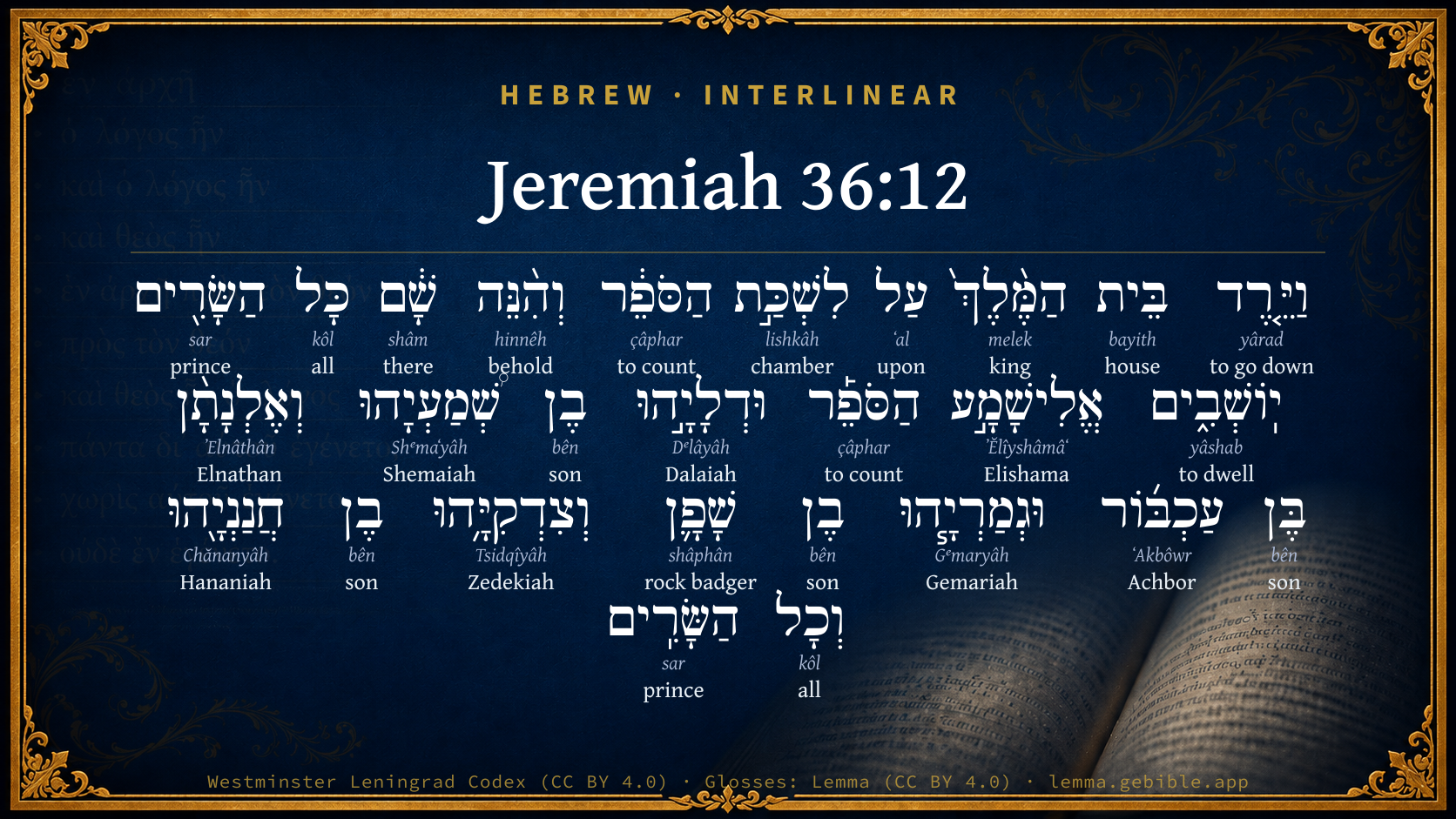
Jeremiah 36:12

Hebrew (Westminster Leningrad Codex) Jeremiah 36:12 appears in the Hebrew Old Testament. The text above is from the Westminster Leningrad Codex. Each word links to its Strong’s number, a concise gloss, and parsing drawn from the Open Scriptures Hebrew Bible morphology. Click any word for its full Brown-Driver-Briggs (BDB) entry.
Download image
Cite this verse

Jeremiah 36:12 (World English Bible). Public Domain. Lemma interlinear Bible study tool, https://lemma.gebible.app/v/jeremiah/36/12.

Show BibTeX & RIS
BibTeX
RIS
English Translation
he went down into the king's house, into the scribe's chamber: and, behold, all the princes were sitting there, [to wit], Elishama the scribe, and Delaiah the son of Shemaiah, and Elnathan the son of Achbor, and Gemariah the son of Shaphan, and Zedekiah the son of Hananiah, and all the princes.
World English Bible · Public Domain
Download a study sheet

One document with this verse’s original text, its word-by-word gloss line, the meaning frame, cross-references with their text, attributed commentary, and full source and license credits — printable, and it pastes into notes with its structure intact.

This verse Autodidact and up

Study sheet (.html) Plain text (.txt)

A passage Seminary Student

Up to 50 verses in one chapter. A passage sheet keeps up to 6 commentary sources and 12 cross-references per verse, in the order this page ranks them, and says so on the sheet whenever that leaves anything out. Ask for a single verse and you get the Autodidact verse sheet above.

Everything on this page stays free to read, with no account — the sheet is a download of what is already on screen, not access to it.

Want to remove ads? Support Godless Engineer
Compare translations 3

The same verse in 3 English versions, stacked beneath the original-language interlinear above. Click any original word for its lexicon entry.

Each is an independent rendering of the whole verse — the interlinear is not word-aligned to these translations.

Highlighted words mark where these versions differ — a whole-verse word diff, not a word-by-word alignment.

  • World English Bible Public Domain
    he went down into the king's house, into the scribe's chamber: and, behold, all the princes were sitting there, [to wit], Elishama the scribe, and Delaiah the son of Shemaiah, and Elnathan the son of Achbor, and Gemariah the son of Shaphan, and Zedekiah the son of Hananiah, and all the princes.
  • King James Version Public Domain
    Then he went down into the king's house, into the scribe's chamber: and, lo, all the princes sat there, even Elishama the scribe, and Delaiah the son of Shemaiah, and Elnathan the son of Achbor, and Gemariah the son of Shaphan, and Zedekiah the son of Hananiah, and all the princes.
  • unfoldingWord Literal Text CC BY-SA 4.0
    He went down to the house of the king, to the secretary’s room. Look, all the officials were sitting there: Elishama the secretary, Delaiah son of Shemaiah, Elnathan son of Akbor, Gemariah son of Shaphan, and Zedekiah son of Hananiah, and all the officials.

unfoldingWord Literal Text — © unfoldingWord, licensed CC BY-SA 4.0. Word-aligned USFM3 via Door43 (git.door43.org/unfoldingWord/en_ult).

Versions to compare (up to 4)

3 of 4 selected

Show all 18 translations

Every available English version of this verse, each an independent rendering of the whole verse.

  • World English Bible Public Domain
    he went down into the king's house, into the scribe's chamber: and, behold, all the princes were sitting there, [to wit], Elishama the scribe, and Delaiah the son of Shemaiah, and Elnathan the son of Achbor, and Gemariah the son of Shaphan, and Zedekiah the son of Hananiah, and all the princes.
  • Berean Standard Bible Public Domain
    he went down to the scribe’s chamber in the king’s palace, where all the officials were sitting: Elishama the scribe, Delaiah son of Shemaiah, Elnathan son of Achbor, Gemariah son of Shaphan, Zedekiah son of Hananiah, and all the other officials.
  • Majority Standard Bible Public Domain
    he went down to the scribe’s chamber in the king’s palace, where all the officials were sitting: Elishama the scribe, Delaiah son of Shemaiah, Elnathan son of Achbor, Gemariah son of Shaphan, Zedekiah son of Hananiah, and all the other officials.
  • King James Version Public Domain
    Then he went down into the king's house, into the scribe's chamber: and, lo, all the princes sat there, even Elishama the scribe, and Delaiah the son of Shemaiah, and Elnathan the son of Achbor, and Gemariah the son of Shaphan, and Zedekiah the son of Hananiah, and all the princes.
  • American Standard Version (1901) Public Domain
    he went down into the king's house, into the scribe's chamber: and, lo, all the princes were sitting there, `to wit', Elishama the scribe, and Delaiah the son of Shemaiah, and Elnathan the son of Achbor, and Gemariah the son of Shaphan, and Zedekiah the son of Hananiah, and all the princes.
  • Revised Version (1885) Public Domain
    he went down into the king’s house, into the scribe’s chamber: and, lo, all the princes sat there, even Elishama the scribe, and Delaiah the son of Shemaiah, and Elnathan the son of Achbor, and Gemariah the son of Shaphan, and Zedekiah the son of Hananiah, and all the princes.
  • Geneva Bible (1599) Public Domain
    Then hee went downe to the Kings house into the Chancellours chamber, and loe, all the princes sate there, euen Elishama the Chancellour, and Delaiah the sonne of Shemaiah, and Elnathan the sonne of Achbor, and Gemariah the sonne of Shaphan, and Zedekiah the sonne of Hananiah, and all the princes.
  • Douay-Rheims (1899) Public Domain
    He went down into the king's house to the secretary's chamber: and behold all the princes sat there, Elisama the scribe, and Dalaias the son of Semeias, and Elnathan the son of Achobor, and Gamarias the son of Saphan, and Sedecias the son of Hananias, and all the princes.
  • Young's Literal Translation Public Domain
    and he goeth down `to' the house of the king, unto the chamber of the scribe, and lo, there are all the heads sitting: Elishama the scribe, and Delaiah son of Shemaiah, and Elnathan son of Acbor, and Gemariah son of Shaphan, and Zedekiah son of Hananiah, and all the heads.
  • Literal Standard Version CC BY-SA 4.0
    and he goes down [to] the house of the king, to the chamber of the scribe, and behold, there all the heads are sitting: Elishama the scribe, and Delaiah son of Shemaiah, and Elnathan son of Acbor, and Gemariah son of Shaphan, and Zedekiah son of Hananiah, and all the heads.
  • Unlocked Literal Bible CC BY-SA 4.0
    He went down to the house of the king, to the secretary's room. Look, all the officials were sitting there: Elishama the secretary, Delaiah son of Shemaiah, Elnathan son of Akbor, Gemariah son of Shaphan, and Zedekiah son of Hananiah, and all the officials.
  • unfoldingWord Literal Text CC BY-SA 4.0
    He went down to the house of the king, to the secretary’s room. Look, all the officials were sitting there: Elishama the secretary, Delaiah son of Shemaiah, Elnathan son of Akbor, Gemariah son of Shaphan, and Zedekiah son of Hananiah, and all the officials.
  • Darby Bible Public Domain
    and he went down to the king's house, into the scribe's chamber, and behold, all the princes were sitting there: Elishama the scribe, and Delaiah the son of Shemaiah, and Elnathan the son of Achbor, and Gemariah the son of Shaphan, and Zedekiah the son of Hananiah, and all the princes.
  • World Messianic Bible Public Domain
    he went down into the king’s house, into the scribe’s room; and behold, all the princes were sitting there, Elishama the scribe, Delaiah the son of Shemaiah, Elnathan the son of Achbor, Gemariah the son of Shaphan, Zedekiah the son of Hananiah, and all the princes.
  • Webster's Bible Public Domain
    Then he went down into the king's house, into the scribe's chamber: and lo, all the princes sat there, even Elishama the scribe, and Delaiah the son of Shemaiah, and Elnathan the son of Achbor, and Gemariah the son of Shaphan, and Zedekiah the son of Hananiah, and all the princes.
  • Free Bible Version CC BY-SA 4.0
    he went down to the royal secretary's room in the king's palace, where all the officials had gathered. Elishama the secretary, Delaiah son of Shemaiah, Elnathan son of Achbor, Gemariah son of Shaphan, Zedekiah son of Hananiah, and all the other officials were there.
  • Bible in Basic English Public Domain
    Went down to the king's house, to the scribe's room: and all the rulers were seated there, Elishama the scribe and Delaiah, the son of Shemaiah, and Elnathan, the son of Achbor, and Gemariah, the son of Shaphan, and Zedekiah, the son of Hananiah, and all the rulers.
  • JPS Tanakh (1917) Public Domain
    he went down into the king's house, into the scribe's chamber; and, lo, all the princes sat there, even Elishama the scribe, and Delaiah the son of Shemaiah, and Elnathan the son of Achbor, and Gemariah the son of Shaphan, and Zedekiah the son of Hananiah, and all the princes.

Literal Standard Version (2020), Covenant Press — licensed CC BY-SA 4.0. Text via the HelloAO Bible API (eBible.org). Unlocked Literal Bible (unfoldingWord) — licensed CC BY-SA 4.0. Text via the HelloAO Bible API (eBible.org). unfoldingWord Literal Text — © unfoldingWord, licensed CC BY-SA 4.0. Word-aligned USFM3 via Door43 (git.door43.org/unfoldingWord/en_ult). Free Bible Version, Dr. Jonathan Gallagher — licensed CC BY-SA 4.0. Text via the HelloAO Bible API (eBible.org).

Word by word

More ways to search: Search by grammar → Find every occurrence → Compare this word →

Practice this passage: Drill this verse → Learn its vocabulary →

וּגְמַרְיָ֧הוּ
Gᵉmaryâh
H1587
“and · Gemariah”
Conjunction + Noun, Proper
Part of Speech
Conjunction + Noun
Type
Proper
Full BDB Definition

Origin: from H1584 and H3050

TWOT: None

Gemariah = "Jehovah has accomplished" - the son of Shaphan the scribe and father of Michaiah; one of the nobles of Judah who had a chamber in the temple from which Baruch read Jeremiah's alarming prophecy to all the people - the son of Hilkiah who bore Jeremiah's letter to the captive Jews
  1. וַיֵּ֤רֶד yârad H3381 “and · to go down” Conjunction + Verb, Qal, Sequential Imperfect, 3rd Person, Masculine, Singular
  2. בֵּית bayith H1004 “house of” Noun, Common, Masculine, Singular, Construct
  3. הַמֶּ֨לֶךְ֙ melek H4428 “the · king” Particle, Definite Article + Noun, Common, Masculine, Singular, Absolute
  4. עַל ʻal H5921 “upon” Preposition
  5. לִשְׁכַּ֣ת lishkâh H3957 “chamber of” Noun, Common, Feminine, Singular, Construct
  6. הַסֹּפֵ֔ר çâphar H5608 “the · scribe” Particle, Definite Article + Noun, Common, Masculine, Singular, Absolute
  7. וְהִ֨נֵּה hinnêh H2009 “and · behold” Conjunction + Particle, Demonstrative
  8. שָׁ֔ם shâm H8033 “there” Adverb
  9. כָּל kôl H3605 “all of” Noun, Common, Masculine, Singular, Construct
  10. הַשָּׂרִ֖ים sar H8269 “the · princes” Particle, Definite Article + Noun, Common, Masculine, Plural, Absolute
  11. יֽוֹשְׁבִ֑ים yâshab H3427 “dwelling” Verb, Qal, Participle Active, Masculine, Plural, Absolute
  12. אֱלִישָׁמָ֣ע ʼĔlîyshâmâʻ H476 “Elishama” Noun, Proper
  13. הַסֹּפֵ֡ר çâphar H5608 “the · scribe” Particle, Definite Article + Noun, Common, Masculine, Singular, Absolute
  14. וּדְלָיָ֣הוּ Dᵉlâyâh H1806 “and · Dalaiah” Conjunction + Noun, Proper
  15. בֶן bên H1121 “son of” Noun, Common, Masculine, Singular, Construct
  16. שְׁ֠מַעְיָהוּ Shᵉmaʻyâh H8098 “Shemaiah” Noun, Proper
  17. וְאֶלְנָתָ֨ן ʼElnâthân H494 “and · Elnathan” Conjunction + Noun, Proper
  18. בֶּן bên H1121 “son of” Noun, Common, Masculine, Singular, Construct
  19. עַכְבּ֜וֹר ʻAkbôwr H5907 “Achbor” Noun, Proper
  20. בֶן bên H1121 “son of” Noun, Common, Masculine, Singular, Construct
  21. שָׁפָ֛ן shâphân H8227 “rock badger” Noun, Proper
  22. וְצִדְקִיָּ֥הוּ Tsidqîyâh H6667 “and · Zedekiah” Conjunction + Noun, Proper
  23. בֶן bên H1121 “son of” Noun, Common, Masculine, Singular, Construct
  24. חֲנַנְיָ֖הוּ Chănanyâh H2608 “Hananiah” Noun, Proper
  25. וְכָל kôl H3605 “and · all of” Conjunction + Noun, Common, Masculine, Singular, Construct
  26. הַשָּׂרִֽים sar H8269 “the · princes” Particle, Definite Article + Noun, Common, Masculine, Plural, Absolute

About this verse

These counts appear in no published source. They are computed here, from the morphology-tagged text and Lemma’s own curated glosses. What Lemma adds →

27
words
21
distinct lemmas
Prophets
section

Notable vocabulary

The rarest word here is וּגְמַרְיָ֧הוּ Gemariah H1587 — appearing just 5 times in the whole Hebrew Bible.

Shared distinctive vocabulary

וּגְמַרְיָ֧הוּ Gemariah H1587 occurs in 5 verses of the Hebrew Bible. Also found in:

Grammatical profile

  • 2 verbs
  • 22 nouns
  • 1 preposition
  • 1 adverb
  • 1 particle

Verb forms

  • וַיֵּ֤רֶד Qal · Sequential Imperfect
  • יֽוֹשְׁבִ֑ים Qal · Participle Active

Repetition

Words recur within this verse — often emphatic in Hebrew:

  • בֶן son H1121 ×4
  • הַסֹּפֵ֔ר to count H5608 ×2
  • כָּל all H3605 ×2
  • הַשָּׂרִ֖ים prince H8269 ×2

Cross-references

10

Topical passages linked to Jeremiah 36:12 in the Treasury of Scripture Knowledge — connected by theme and wording, ordered by reader-vote popularity; previews shown in the World English Bible.

  • Jeremiah 26:22 and Jehoiakim the king sent men into Egypt, [namely], Elnathan the son of Achbor, and certain men with him, into Egypt;
  • 2 Kings 22:12 The king commanded Hilkiah the priest, and Ahikam the son of Shaphan, and Achbor the son of Micaiah, and Shaphan the scribe, and Asaiah the king's servant, saying,
  • Jeremiah 36:25 Moreover Elnathan and Delaiah and Gemariah had made intercession to the king that he would not burn the scroll; but he would not hear them.
  • Jeremiah 41:1 Now it happened in the seventh month, that Ishmael the son of Nethaniah, the son of Elishama, of the seed royal and [one of] the chief officers of the king, and ten men with him, came to Gedaliah the son of Ahikam to Mizpah; and there they ate bread together in Mizpah.
  • 2 Kings 22:3 It happened in the eighteenth year of king Josiah, that the king sent Shaphan, the son of Azaliah the son of Meshullam, the scribe, to the house of Yahweh, saying,
  • 2 Kings 22:14 So Hilkiah the priest, and Ahikam, and Achbor, and Shaphan, and Asaiah, went to Huldah the prophetess, the wife of Shallum the son of Tikvah, the son of Harhas, keeper of the wardrobe (now she lived in Jerusalem in the second quarter); and they talked with her.
  • 2 Kings 24:8 Jehoiachin was eighteen years old when he began to reign; and he reigned in Jerusalem three months: and his mother's name was Nehushta the daughter of Elnathan of Jerusalem.
  • Jeremiah 28:1–17 It happened the same year, in the beginning of the reign of Zedekiah king of Judah, in the fourth year, in the fifth month, that Hananiah the son of Azzur, the prophet, who was of Gibeon, spoke to me in the house of Yahweh, in the presence of the priests and of all the people, saying,
  • Jeremiah 36:10–11 Then read Baruch in the book the words of Jeremiah in the house of Yahweh, in the chamber of Gemariah the son of Shaphan, the scribe, in the upper court, at the entry of the new gate of Yahweh's house, in the ears of all the people.
  • Jeremiah 36:20–21 They went in to the king into the court; but they had laid up the scroll in the chamber of Elishama the scribe; and they told all the words in the ears of the king.

Cross-references courtesy of OpenBible.info (CC BY 4.0).

Hebrew and Greek witnesses Masoretic Hebrew ↔ Greek Septuagint

The same verse in the two great witnesses to the Old Testament, shown verse-for-verse.

These are two independent witnesses, not word-aligned to each other, and the Septuagint is shown in lemma (dictionary) form.

Hebrew Jeremiah 36:12 Masoretic · Westminster Leningrad Codex

וַיֵּ֤רֶד בֵּית הַמֶּ֨לֶךְ֙ עַל לִשְׁכַּ֣ת הַסֹּפֵ֔ר וְהִ֨נֵּה שָׁ֔ם כָּל הַשָּׂרִ֖ים יֽוֹשְׁבִ֑ים אֱלִישָׁמָ֣ע הַסֹּפֵ֡ר וּדְלָיָ֣הוּ בֶן שְׁ֠מַעְיָהוּ וְאֶלְנָתָ֨ן בֶּן עַכְבּ֜וֹר וּגְמַרְיָ֧הוּ בֶן שָׁפָ֛ן וְצִדְקִיָּ֥הוּ בֶן חֲנַנְיָ֖הוּ וְכָל הַשָּׂרִֽים

he went down into the king's house, into the scribe's chamber: and, behold, all the princes were sitting there, [to wit], Elishama the scribe, and Delaiah the son of Shemaiah, and Elnathan the son of Achbor, and Gemariah the son of Shaphan, and Zedekiah the son of Hananiah, and all the princes.

World English Bible · Public Domain

Greek LXX Structure differs

In the Septuagint, Jeremiah is about an eighth shorter than the Hebrew and arranges its material differently — the Oracles Against the Nations (Hebrew chapters 46–51) appear in the middle of the Greek book, after 25:13. Because the chapter and verse boundaries do not line up, a verse-for-verse comparison with the Hebrew is not shown.

A verse-for-verse comparison isn’t shown here because the chapters and verses don’t line up. Switch to the LXX edition with the MT / LXX toggle above to read the Greek directly.

Hebrew: Westminster Leningrad Codex (CC BY 4.0). Greek: Septuagint (public domain); English from a public-domain English Septuagint. How the Septuagint differs from the Hebrew →

Targum (Aramaic paraphrase)

1

The Targum is the ancient Jewish Aramaic paraphrase of the Hebrew Scriptures — an interpretive translation, not the Hebrew text itself. Onkelos (literal) and Pseudo-Jonathan (expansive) render the Torah, and Jonathan the Prophets. Coverage is partial: where no permissively-licensed English translation exists for a verse, only the Aramaic is shown. This is verse-level text, not a word-by-word alignment to the Hebrew.

  1. Targum Jonathan Prophets (Joshua–Malachi)
    וּנְחֵית לְבֵית מַלְכָּא לְלִשְׁכַּת סַפְרָא וְהָא תַמָן כָּל רַבְרְבַיָא יַתְבִין אֱלִישָׁמָע סַפְרָא וּדְלָיָה בַר שְׁמַעְיָה וְאֶלְנָתָן בַּר עַכְבּוֹר וּגְמַרְיָה בַר שָׁפָן וְצִדְקִיָה בַר חֲנַנְיָה וְכָל רַבְרְבַיָא:

    (no public-domain English translation for this verse)

    Targum Jonathan — Aramaic: “Mikraot Gedolot” (public domain). English: “Sefaria Community Translation” (CC0 1.0 (public-domain dedication)); “London "Chaldee Paraphrase," 1871” (public domain). Text via Sefaria.

Commentary

Notes on Jeremiah 36:12 from classic Christian and Jewish commentators (each source and its license shown beneath its notes). The classic Christian expositions comment on the surrounding passage and are grouped to its opening verse, so a note may address several verses; the Jewish commentaries on the Tanakh (Rashi and others) are per-verse, so they appear only where the commentator wrote on this verse.

Lemma curates 59 commentaries, every one of them public domain or Creative Commons licensed, each selected and text-cleaned for this edition rather than reprinted as found. About our sources →

Trapp's Complete Commentary

John Trapp

Jer 36:12 Then he went down into the king’s house, into the scribe’s chamber: and, lo, all the princes sat there, [even] Elishama the scribe, and Delaiah the son of Shemaiah, and Elnathan the son of Achbor, and Gemariah the son of Shaphan, and Zedekiah the son of Hananiah, and all the princes.

Ver. 12. Then he went down into the king’s house.] For there was his father and the rest of the princes, suam aulam vel gulam confectantes, following their court delights, while the people were now humbling themselves before the Lord, and trembling at his Word. Great men are, many of them, of that Earl of Westmoreland’s mind, who profanely said, I need not pray to God, since having tenants enough to pray for me.

John Trapp, A Commentary or Exposition upon All the Books of the Old and New Testament (1647–1656) — public domain. Text from a community e-Sword module.

Jamieson, Fausset & Brown

Robert Jamieson, A. R. Fausset & David Brown

scribe's chamber--an apartment in the palace occupied by the secretary of state.

princes--holding a counsel of state at the time.

Elnathan--who had already been an instrument of evil in Jehoiakim's hand (Jer 26:22-23).

Hananiah--the false prophet (Jer 28:10-17).

Jamieson, Fausset & Brown — Commentary Critical and Explanatory on the Whole Bible (1871) — public domain (CC PDM 1.0). Text via the HelloAO Bible API.

John Calvin's Commentaries

It is not known with what design this Michaiah came to the princes and the king’s counsellors, he may have been an informer, who intended to create ill-will to the Prophet, and to ingratiate himself with the princes, as courtiers usually do. If this was the case, we may learn from this example, that not all who hear are so teachable and ready to obey as to make proficiency in the knowledge of good and holy doctrine: we see that many patiently hear and give some evidence of docility, and yet cherish perverseness in their hearts, and afterwards calumniate what they have heard. Such may have been the character of Michaiah, spoken of here. But his case may have been different, — that being filled with wonder, he conveyed to the king’s counsellors what he deemed new and, as it were, incredible. I leave this without offering an opinion, for we have nothing certain on the subject.

It is said that he came into the king’s palace, where all the princes sat, and into the chamber of the scribe It is probable that this scribe was the king’s chancellor, with whom were all the princes of the court. Some he names, and then says, that they were all there, and that Michaiah read to them the words which he had heard from the mouth of Baruch when he read to the whole people.

Now it was not without the wonderful purpose of God that the king at length came to know what had passed in the Temple, in order that his perverseness against God might be detected, as we shall hereafter see. This messenger, indeed, was the means of bringing danger to Jeremiah as well as to his servant Baruch; but the Lord protected them. However, the impiety and the obstinacy of the king were discovered; for when they were all terrified, he despised God and became enraged against his Prophet. He burnt the book, and wished also to destroy its author. It now follows, —

John Calvin's Commentaries (1540-1563) — public domain. Text from the Calvin Translation Society English edition (1840s-50s) via the Christian Classics Ethereal Library (ccel.org). Calvin's coverage is partial (roughly two-thirds of the Bible); uncommented books and verses are honest gaps, never fabricated. The 19th-century editor's footnotes and remarks are omitted so the notes are faithfully Calvin's own voice.

Ellicott's Commentary for English Readers

(12) And, lo, all the princes sat there.—The following particulars may be noted as to the princes thus named. Elishama may have been identical with the prince of that name in 2Ki_25:25, and, if so, was the grandfather of a man who afterwards plays a conspicuous part in the history of the prophet’s life (Jeremiah 41) He appears to have taken a purely official line, as scribe, standing neutral between the prophet and his opponents. Delaiah (the name signifies “the Lord delivers,” and is found as that of a priest in the time of David, 1Ch_24:18) joins Elnathan and Gemariah in pleading against the king’s destruction of the prophetic roll. The name Shemaiah, which appears here as that of his father, is found in Neh_6:10 as belonging to a son of Delaiah, and this probably indicates relationship. On Elnathan, the son of Achbor, see Note on Jer_26:22. On Gemariah, see Note on Jer_36:10. Of Zedekiah nothing more is known, unless his father Hananiah be the prophet who opposes Jeremiah in Jer_28:1-17.

A Bible Commentary for English Readers, edited by Charles John Ellicott (1878–1897) — public domain. Text from a community e-Sword module.

The Cambridge Bible for Schools and Colleges

gen. ed. J. J. S. Perowne

12. he went down] See on Jer_22:1.

Elnathan the son of Achbor] mentioned ch. Jer_26:22.

The Cambridge Bible for Schools and Colleges (gen. ed. J. J. S. Perowne; Cambridge University Press, 1878–1918) — public domain. Text from a community e-Sword module.

John Gill's Exposition

Then he went down into the king's house,.... The royal palace, which was not upon the mountain on which the temple stood, but lay lower, and therefore Micaiah is said to go down to it; with what design he went thither is not certain, whether out of ill will to Jeremiah and Baruch, or out of good will, being affected with what he had heard, and desirous that some steps might be taken by the government to prevent the calamities coming upon them, according to these prophecies; which latter seems most probable, since no charge or accusation is brought by him; and since his father, with others, to whom he gave the account afterwards, interceded with the king that the roll might not be burnt, Jer 36:25; however, immediately after he had heard the roll read, he went to the king's house:

into the scribe's chamber; the secretary's office; formerly his grandfather Shaphan's, now Elishama's:

and, lo, all the princes sat there; some of them are mentioned by name:

even Elishama the scribe; or secretary; the prime minister, the principal secretary of state, and therefore named first, in whose chamber or office they were:

and Delaiah the son of Shemaiah; who this person was, or his office, is not known; he is nowhere else made mention of; and who his father was is not certain:

and Elnathan the son of Achbor; the same that Jehoiakim sent to Egypt to fetch Uriah from thence, Jer 26:22;

and Gemariah the son of Shaphan: who was Micaiah's father, and in whose chamber Baruch read the roll:

and Zedekiah the son of Hananiah; of this prince also no account is given elsewhere:

and all the princes; the rest of them, who were either members of the great sanhedrim, or courtiers; it appears from hence that this court was very profane and irreligious; for though they had proclaimed a fast, to make a show of religion, or at the importunity of the people; yet they did not attend temple worship and service themselves, but were all together in the secretary's office, very probably about political affairs.

John Gill's Exposition of the Whole Bible (1746–1763) — public domain (CC PDM 1.0). Text via the HelloAO Bible API.

Albert Barnes' Notes on the Bible

The scribe’s chamber - The chancery in which the king’s business was conducted. Probably Elishama was one of the “principal scribes of the host” Jer 52:25, i. e., the secretary of state for war. The business which had brought together “all the princes” would have reference to the Chaldaean war.

Albert Barnes' Notes on the Bible (1834–1885) — public domain. Text from a community e-Sword/MySword module.

Matthew Poole's English Annotations

It is uncertain whether this Michaiah went to make this relation to the princes who sat in the secretary’s chamber, as a piece of news only, or out of a malicious design to accuse the prophet and Baruch for what was done as a seditious practice.

Matthew Poole's English Annotations on the Holy Bible (1683–1685) — public domain. Text from a community e-Sword/MySword module.

Whedon's Commentary on the Bible

Daniel D. Whedon

12. The scribe’s chamber — A public office where the king’s decrees were formulated and recorded; as has properly been suggested, the office of the secretary of state. The presence of all the princes may indicate the critical condition of public affairs.

Daniel D. Whedon (gen. ed.), Commentary on the Old and New Testaments (1874–1909) — public domain. Text from a community e-Sword module.

The Pulpit Commentary

He went down. (see on Jer_26:10) Sat there. In deliberation on the affairs of the state. Elishama the scribe. Gemariah, then, had a colleague. So in Solomon"s cabinet (if the word may be used) there were two soferim, or secretaries, one perhaps for the civil and one for the military business. (1Ki_4:3; comp, Jer_52:25) Elnathan. Mentioned already, Jer_26:22.

The Pulpit Commentary (1880–1919), ed. H.D.M. Spence-Jones & Joseph S. Exell — public domain. Text from a community e-Sword module.

Lesson kit

Teaching starters — assembled from the data on this page, not authored interpretation. Every prompt links to the verse data it draws on. Edit before teaching.

Jeremiah, in the Prophets, opens this verse with 27 words (21 distinct Hebrew lemmas). Its most distinctive word is Gᵉmaryâh (“Gemariah”). A historical commentator’s framing appears above. Read the whole chapter for the surrounding context.

Discussion questions

  1. The word Gᵉmaryâh carries the sense “Gemariah.” How does it shape the verse?
  2. How does Jeremiah 29:3, which shares the word «Gemariah», read alongside this verse?
  3. What does the repetition of “son” (4× in this one verse) do in this verse?
  4. The translations on this page render this verse differently — a whole-verse word diff, not a word-by-word alignment. What might account for the different wordings?
  5. «וַיֵּ֤רֶד» is a Qal Sequential Imperfect verb. How does that grammatical form shape the action described?
  6. Compare how Trapp's Complete Commentary and Jamieson, Fausset & Brown read this verse. Where do they agree or differ?

Things to notice

Reading settings

Reading text

Shown beneath each verse's original-language words.

Old Testament
Old Testament edition

Read the OT as the Masoretic Hebrew (MT) or the Greek Septuagint (LXX).

English shown for the Greek Septuagint (in the Hebrew ↔ Greek comparison).

Comparing translations? Open the Compare panel on any verse page to stack up to four side by side.