
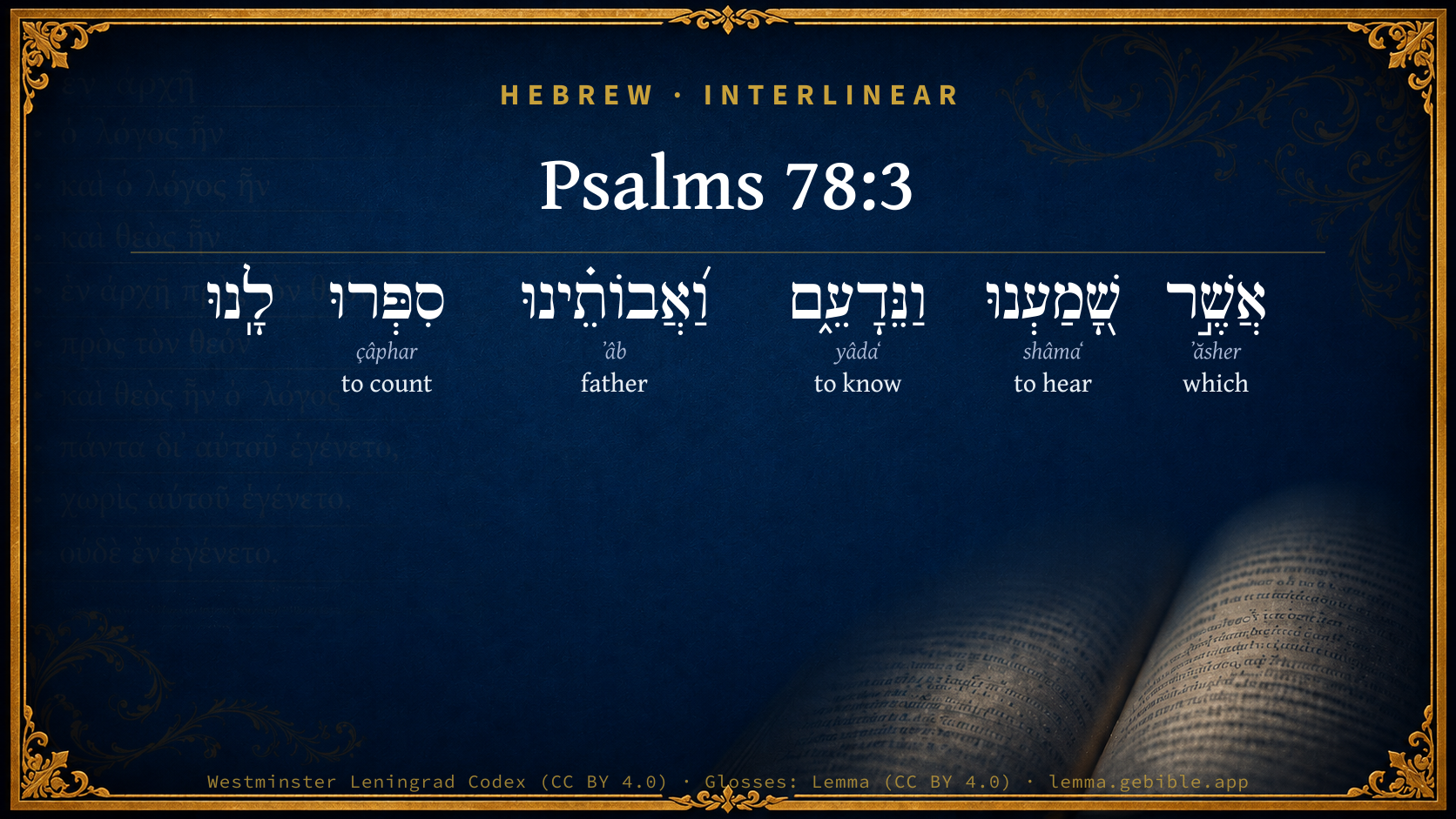
Psalms 78:3

Hebrew (Westminster Leningrad Codex) Psalms 78:3 appears in the Hebrew Old Testament. The text above is from the Westminster Leningrad Codex. Each word links to its Strong’s number, a concise gloss, and parsing drawn from the Open Scriptures Hebrew Bible morphology. Click any word for its full Brown-Driver-Briggs (BDB) entry.
Download image
Cite this verse

Psalms 78:3 (World English Bible). Public Domain. Lemma interlinear Bible study tool, https://lemma.gebible.app/v/psalms/78/3.

Show BibTeX & RIS
BibTeX
RIS
English Translation
Which we have heard and known, And our fathers have told us.
World English Bible · Public Domain
Download a study sheet

One document with this verse’s original text, its word-by-word gloss line, the meaning frame, cross-references with their text, attributed commentary, and full source and license credits — printable, and it pastes into notes with its structure intact.

This verse Autodidact and up

Study sheet (.html) Plain text (.txt)

A passage Seminary Student

Up to 50 verses in one chapter. A passage sheet keeps up to 6 commentary sources and 12 cross-references per verse, in the order this page ranks them, and says so on the sheet whenever that leaves anything out. Ask for a single verse and you get the Autodidact verse sheet above.

Everything on this page stays free to read, with no account — the sheet is a download of what is already on screen, not access to it.

Want to remove ads? Support Godless Engineer
Compare translations 3

The same verse in 3 English versions, stacked beneath the original-language interlinear above. Click any original word for its lexicon entry.

Each is an independent rendering of the whole verse — the interlinear is not word-aligned to these translations.

Highlighted words mark where these versions differ — a whole-verse word diff, not a word-by-word alignment.

  • World English Bible Public Domain
    Which we have heard and known, And our fathers have told us.
  • King James Version Public Domain
    Which we have heard and known, and our fathers have told us.
  • unfoldingWord Literal Text CC BY-SA 4.0
    These are things that we have heard and learned, things that our fathers have told us.

unfoldingWord Literal Text — © unfoldingWord, licensed CC BY-SA 4.0. Word-aligned USFM3 via Door43 (git.door43.org/unfoldingWord/en_ult).

Versions to compare (up to 4)

3 of 4 selected

Show all 18 translations

Every available English version of this verse, each an independent rendering of the whole verse.

  • World English Bible Public Domain
    Which we have heard and known, And our fathers have told us.
  • Berean Standard Bible Public Domain
    that we have heard and known and our fathers have relayed to us.
  • Majority Standard Bible Public Domain
    that we have heard and known and our fathers have relayed to us.
  • King James Version Public Domain
    Which we have heard and known, and our fathers have told us.
  • American Standard Version (1901) Public Domain
    Which we have heard and known, And our fathers have told us.
  • Revised Version (1885) Public Domain
    Which we have heard and known, and our fathers have told us.
  • Geneva Bible (1599) Public Domain
    Which we haue heard and knowen, and our fathers haue tolde vs.
  • Douay-Rheims (1899) Public Domain
    How great things have we heard and known, and our fathers have told us.
  • Young's Literal Translation Public Domain
    That we have heard and do know, And our fathers have recounted to us.
  • Literal Standard Version CC BY-SA 4.0
    That we have heard and know, || And our fathers have recounted to us.
  • Unlocked Literal Bible CC BY-SA 4.0
    These are things that we have heard and learned, things that our ancestors have told us.
  • unfoldingWord Literal Text CC BY-SA 4.0
    These are things that we have heard and learned, things that our fathers have told us.
  • Darby Bible Public Domain
    Which we have heard and known, and our fathers have told us:
  • World Messianic Bible Public Domain
    which we have heard and known, and our fathers have told us.
  • Webster's Bible Public Domain
    Which we have heard and known, and our fathers have told us.
  • Free Bible Version CC BY-SA 4.0
    that we have heard before and reflected on; stories our forefathers passed down to us.
  • Bible in Basic English Public Domain
    Which have come to our hearing and our knowledge, as they were given to us by our fathers.
  • JPS Tanakh (1917) Public Domain
    That which we have heard and known, and our fathers have told us,

Literal Standard Version (2020), Covenant Press — licensed CC BY-SA 4.0. Text via the HelloAO Bible API (eBible.org). Unlocked Literal Bible (unfoldingWord) — licensed CC BY-SA 4.0. Text via the HelloAO Bible API (eBible.org). unfoldingWord Literal Text — © unfoldingWord, licensed CC BY-SA 4.0. Word-aligned USFM3 via Door43 (git.door43.org/unfoldingWord/en_ult). Free Bible Version, Dr. Jonathan Gallagher — licensed CC BY-SA 4.0. Text via the HelloAO Bible API (eBible.org).

Word by word

More ways to search: Search by grammar → Find every occurrence → Compare this word →

Practice this passage: Drill this verse → Learn its vocabulary →

סִפְּרוּ
çâphar
H5608
“to count”
Verb, Piel, Perfect, 3rd Person, Common, Plural
Part of Speech
Verb
Stem
Piel
Form
Perfect
Person
3rd Person
Gender
Common
Number
Plural
Full BDB Definition

Origin: a primitive root

TWOT: 1540 , 1540c

to count, recount, relate (verb) - (Qal) - to count (things) - to number, take account of, reckon - (Niphal) to be counted, be numbered - (Piel) to recount, rehearse, declare - to recount (something), rehearse - to talk - to count exactly or accurately - (Pual) to be recounted, be rehearsed, be related - enumerator, muster-officer, secretary, scribe (noun masculine) - enumerator, muster-officer, secretary - learned man, scribe
  1. אֲשֶׁ֣ר ʼăsher H834 “which” Particle, Relative
  2. שָׁ֭מַעְנוּ shâmaʻ H8085 “to hear” Verb, Qal, Perfect, 1st Person, Common, Plural
  3. וַנֵּדָעֵ֑ם yâdaʻ H3045 “and · to know · them” Conjunction + Verb, Qal, Sequential Imperfect, 1st Person, Common, Plural + Suffix, Personal, 3rd Person, Masculine, Plural
  4. וַ֝אֲבוֹתֵ֗ינוּ ʼâb H1 “and · fathers · our” Conjunction + Noun, Common, Masculine, Plural, Construct + Suffix, Personal, 1st Person, Common, Plural

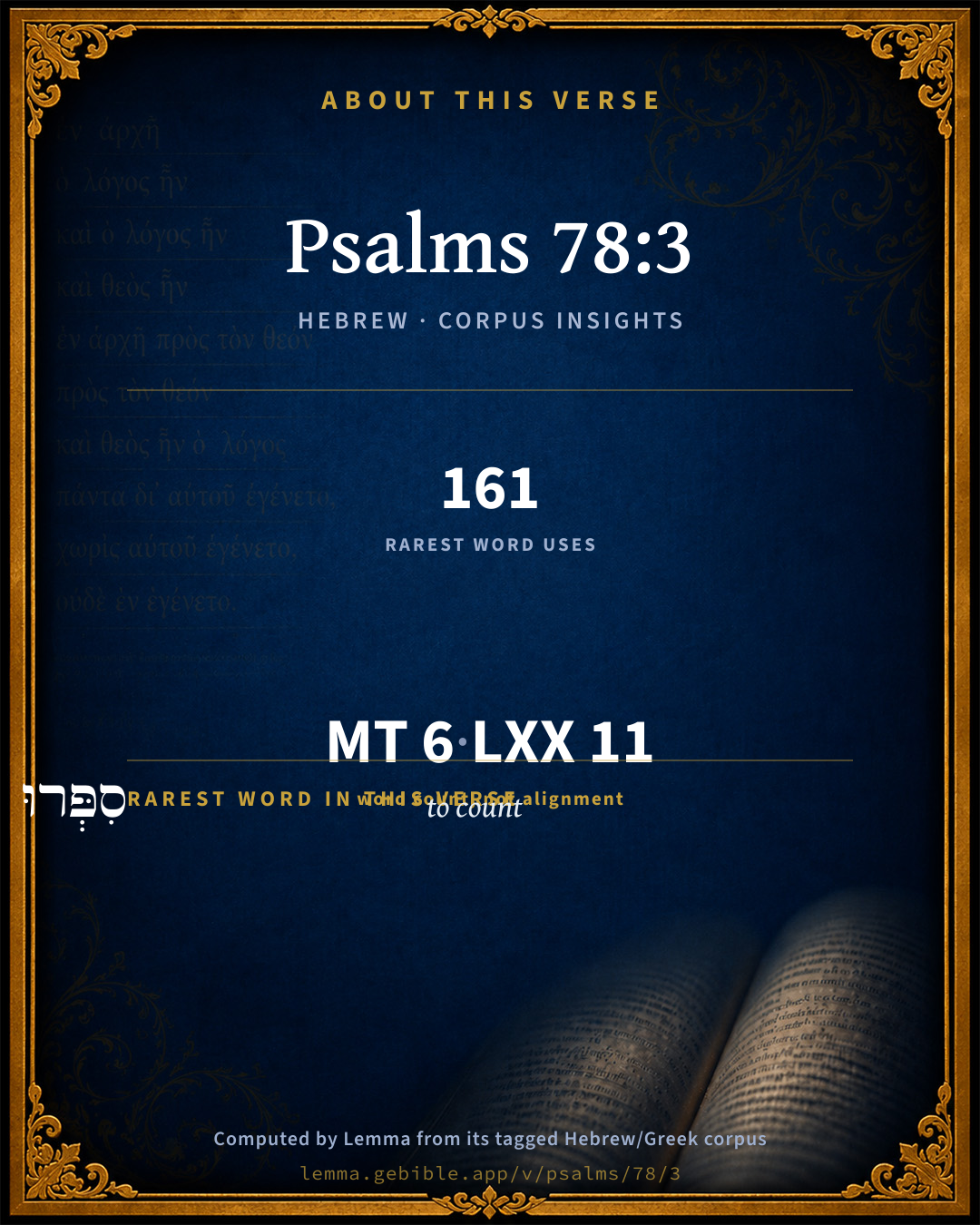
About this verse

These counts appear in no published source. They are computed here, from the morphology-tagged text and Lemma’s own curated glosses. What Lemma adds →

6
words
5
distinct lemmas
Wisdom
section

Grammatical profile

  • 3 verbs
  • 1 noun
  • 1 preposition
  • 1 particle

Verb forms

  • שָׁ֭מַעְנוּ Qal · Perfect
  • וַנֵּדָעֵ֑ם Qal · Sequential Imperfect
  • סִפְּרוּ Piel · Perfect

Hebrew & Septuagint length

In English translation the verse runs 12 words from the Hebrew and 14 from the Septuagint (LXX English) — closely comparable.

A rough comparison of the two English renderings, which tokenize alike — not a word-level alignment.

Word counts can differ between the Hebrew and the Greek without any difference in meaning — e.g. the Hebrew direct-object marker אֵת has no separate Greek word, and Greek often adds the article ὁ.

In the original languages it is 6 Hebrew tokens and 11 Greek tokens — but the two are counted differently (Hebrew bundles its prefixes and suffixes into one token; the Greek is in lemma form), so that isn’t a like-for-like length.

Cross-references

5

Topical passages linked to Psalms 78:3 in the Treasury of Scripture Knowledge — connected by theme and wording, ordered by reader-vote popularity; previews shown in the World English Bible.

  • Psalms 44:1 We have heard with our ears, God; Our fathers have told us, What work you did in their days, In the days of old.
  • Exodus 12:26–27 It will happen, when your children ask you, 'What do you mean by this service?'
  • Exodus 13:8 You shall tell your son in that day, saying, 'It is because of that which Yahweh did for me when I came forth out of Egypt.'
  • Exodus 13:14–15 It shall be, when your son asks you in time to come, saying, 'What is this?' that you shall tell him, 'By strength of hand Yahweh brought us out from Egypt, from the house of bondage;
  • Psalms 48:8 As we have heard, so we have seen, In the city of Yahweh of Hosts, in the city of our God. God will establish it forever. Selah.

Cross-references courtesy of OpenBible.info (CC BY 4.0).

Hebrew and Greek witnesses Masoretic Hebrew ↔ Greek Septuagint

The same verse in the two great witnesses to the Old Testament, shown verse-for-verse.

You’re reading Greek Psalm 77 (Hebrew Psalm 78). The Septuagint counts the superscription, so verse numbers can differ from the Hebrew — chapter-level alignment, not verse-by-verse. Numbering follows Rahlfs.

These are two independent witnesses, not word-aligned to each other, and the Septuagint is shown in lemma (dictionary) form.

Hebrew Psalms 78:3 Masoretic · Westminster Leningrad Codex

אֲשֶׁ֣ר שָׁ֭מַעְנוּ וַנֵּדָעֵ֑ם וַ֝אֲבוֹתֵ֗ינוּ סִפְּרוּ לָֽנוּ

Which we have heard and known, And our fathers have told us.

World English Bible · Public Domain

Greek LXX Greek Psalm 77:3 Septuagint · lemma form

ὅσος ἀκούω καί γιγνώσκω αὐτός καί ὁ πατήρ ἐγώ διαἡγέομαι ἐγώ

All which we have heard and known, and our fathers have declared to us.

LXX2012 (modern English Septuagint) · Public Domain

Hebrew: Westminster Leningrad Codex (CC BY 4.0). Greek: Septuagint (public domain); English from LXX2012 (modern English Septuagint) (Public Domain). How the Septuagint differs from the Hebrew →

Commentary

Notes on Psalms 78:3 from classic Christian and Jewish commentators (each source and its license shown beneath its notes). The classic Christian expositions comment on the surrounding passage and are grouped to its opening verse, so a note may address several verses; the Jewish commentaries on the Tanakh (Rashi and others) are per-verse, so they appear only where the commentator wrote on this verse.

Lemma curates 59 commentaries, every one of them public domain or Creative Commons licensed, each selected and text-cleaned for this edition rather than reprinted as found. About our sources →

The Cambridge Bible for Schools and Colleges

gen. ed. J. J. S. Perowne

3, 4. It is best to place a full stop at the end of Psa_78:2, and connect Psa_78:3-4 thus:

The things which we have heard and known,

And our fathers have told to us,

We will not hide from their sons,

Telling to another generation the praises of Jehovah,

And his strength and his wondrous works that he hath done.

With line 2 cp. Psa_44:1; Jdg_6:13.

‘From our sons’ might have been expected rather than ‘from their sons’: but the pronoun their is significant. It implies that the trust was committed to the speakers by their ancestors not for themselves only but for future generations. Excellently Keble:

“The tale our fathers used to tell

We to their children owe.”

The praises of Jehovah are His praiseworthy acts. Cp. Psa_22:3; Psa_22:30-31. For wondrous works see note on Psa_71:17. Cp. Psa_145:4 ff.

The Cambridge Bible for Schools and Colleges (gen. ed. J. J. S. Perowne; Cambridge University Press, 1878–1918) — public domain. Text from a community e-Sword module.

Trapp's Complete Commentary

John Trapp

Psa 78:3 Which we have heard and known, and our fathers have told us.

Ver. 3. Which we have heard and known] Hearing and seeing are the two learned senses, whereby knowledge, yea, life, entereth into the soul, Pro 2:2; Pro 2:10 Isa 55:3.

And our fathers have told us] Have delivered down to us from hand to hand, whetting upon us the written word, Deu 6:7, and adding thereunto, for explication, many other things fit to be known.

John Trapp, A Commentary or Exposition upon All the Books of the Old and New Testament (1647–1656) — public domain. Text from a community e-Sword module.

J. A. Alexander on Psalms

Joseph Addison Alexander

3. (Psa 78:3) Which we have heard, and have known them, and our fathers recounted to us. Here, as often elsewhere, the knowledge of God's ancient dealings with his people is ascribed to that national tradition, which they were not only suffered but required to cherish and perpetuate (Exo 12:14, Deu 6:20), but which was not at all exclusive of a written and authoritative record.

Joseph Addison Alexander, The Psalms Translated and Explained (1850) — public domain. Text from a community e-Sword module.

Tyndale Open Study Notes

Tyndale Open Resources

78:3-4 This story of what God has done should be told from generation to generation (see Deut 6:20-25; Prov 4:1-4).

Tyndale Open Study Notes — © Tyndale Open Resources, licensed CC BY-SA 4.0. Text via the HelloAO Bible API.

Geneva Bible (1599)

Geneva Bible translators

Which were the people of God.

Geneva Bible (1599) marginal notes — public domain. Text via Bolls.life.

Adam Clarke's Commentary

Verse 3. Which we have heard and known] We have heard the law, and known the facts.

Adam Clarke's Commentary on the Bible (1810–1826) — public domain. Text from a community e-Sword/MySword module.

John Calvin's Commentaries

3. What we have heard and known. There seems to be some discrepancy between what the Psalmist had stated in the commencement, when he said that he would speak of great and hidden matters, and what he now adds, that his subject is a common one, and such as is transmitted from one age to another by the father to the son. If it was incumbent upon the fathers to recount to their children the things here spoken of, these things ought, of course, to have been familiarly known to all the people, yea, even to those who were most illiterate, and had the weakest capacity. Where, then, it may be said, are the enigmas or dark sentences of which he has just now made mention? I answer, that these things can easily be reconciled; for although the psalm contains many things which are generally known, yet he illustrates them with all the splendor and ornaments of diction, that he may the more powerfully affect the hearts of men, and acquire for himself the greater authority. At the same time, it is to be observed, that however high may be the majesty of the Word of God, this does not prevent the benefits or advantages of it from reaching even to the unlearned and to babes. The Holy Spirit does not in vain invite and encourage such to learn from it: — a truth which we ought carefully to mark. If God, accommodating himself to the limited capacity of men, speaks in an humble and lowly style, this manner of teaching is despised as too simple; but if he rise to a higher style, with the view of giving greater authority to his Word, men, to excuse their ignorance, will pretend that it is too obscure. As these two vices are very prevalent in the world, the Holy Spirit so tempers his style as that the sublimity of the truths which he teaches is not hidden even from those of the weakest capacity, provided they are of a submissive and teachable disposition, and bring with them an earnest desire to be instructed. It is the design of the prophet to remove from the mind all doubt respecting his sayings, and for this purpose, he determines to bring forward nothing new, but such subjects as had been long well known, and received without dispute in the Church. He accordingly not only says we have heard, but also we have known. Many things are rashly spread abroad which have no foundation in truth; yea, nothing is more common than for the ears of men to be filled with fables. It is, therefore, not without cause that the prophet, after having spoken of the things which he had heard, at the same time, refers in confirmation of their truth to undoubted testimony. He adds, that the knowledge of these subjects had been communicated to the Jews by their fathers. This does not imply, that what is taught under the domestic roof is always faultless; but it is obvious, that there is afforded a more favorable opportunity of palming upon men forgeries for truth, when things are brought from a distant country. What is to be principally observed is, that all fathers are not here spoken of indiscriminately, but only those who were chosen to be God’s peculiar people, and to whom the care of divine truth was intrusted.

John Calvin's Commentaries (1540-1563) — public domain. Text from the Calvin Translation Society English edition (1840s-50s) via the Christian Classics Ethereal Library (ccel.org). Calvin's coverage is partial (roughly two-thirds of the Bible); uncommented books and verses are honest gaps, never fabricated. The 19th-century editor's footnotes and remarks are omitted so the notes are faithfully Calvin's own voice.

John Gill's Exposition

Which we have heard and known,.... The change of number from "I" to "we" have made some think that the disciples of Christ are here introduced speaking; but there is no need to suppose that, since our Lord uses the same form of speech, Joh 3:11,

and our fathers have told us; this may not only regard the Jewish ancestors, from whom our Lord descended according to the flesh, and so refer to the following account of the wonderful things done for the people of Israel; but also the divine Father of Christ, from whom, as his only begotten Son that lay in his bosom, and as Mediator, and the Angel of the great council, he heard and became acquainted with the secrets and mysteries of grace, and with his Father's mind and will; all which he declared and made known to his apostles, and in so doing used them as his friends, Joh 1:18 and so the apostles of Christ, what they had from him their everlasting Father, and who had used to call them his children, even what they had seen, and heard, and learned, they made known to others, Act 4:20.

John Gill's Exposition of the Whole Bible (1746–1763) — public domain (CC PDM 1.0). Text via the HelloAO Bible API.

Albert Barnes' Notes on the Bible

Which we have heard and known - Which have been communicated to us as certain truth.

And our fathers have told us - That is, we have heard and known them by their telling us; or, this is the means by which we have known them. They have come down to us by tradition from ancient times.

Albert Barnes' Notes on the Bible (1834–1885) — public domain. Text from a community e-Sword/MySword module.

The Treasury of David

Charles H. Spurgeon

Ver. 3. Which we have heard and known, and our fathers have told us. Tradition was of the utmost service to the people of God in the olden time, before the more sure word of prophecy had become complete and generally accessible. The receipt of truth from the lips of others laid the instructed believer under solemn obligation to pass on the truth to the next generation. Truth, endeared to us by its fond associations with godly parents and venerable friends, deserves of us our best exertions to preserve and propagate it. Our fathers told us, we hear them, and we know personally what they taught; it remains for us in our turn to hand it on. Blessed be God we have now the less mutable testimony of written revelation, but this by no means lessens our obligation to instruct our children in divine truth by word of mouth: rather, with such a gracious help, we ought to teach them far more fully the things of God. Dr. Doddridge owed much to the Dutch tiles and his mother's explanations of the Bible narratives. The more of parental teaching the better; ministers and Sabbath school teachers were never meant to be substitutes for mother's tears and father's prayers.

Ver. 3. Which we have heard and known. We have heard the law and known the facts. Adam Clarke.

Ver. 3. Fathers. Those are worthy of the name of fathers in the church, in relation to posterity, who transmit to posterity the truth of God contained in Scripture, such as here is set down in this Psalm: and this is the only infallible sort of tradition, which delivereth to posterity what God delivered to the prophets or their predecessors by Scripture, such as is the doctrine delivered in this Psalm. David Dickson.

Ver. 3. The connection between what we have "heard, "and what we have personally "known" in religion.

Psalms 78:4*

Charles H. Spurgeon's The Treasury of David (1869–1885) — public domain. Psalms only. Text from a community e-Sword/MySword module.

The Pulpit Commentary

Which we have heard and known, and our fathers have told us; or, "recounted to us" (Kay). The facts of their past history had been handed down orally from father to son among the Israelites, not simply learnt from their sacred writings. So the facts of Christianity have reached us, not merely through the New Testament, but also by the teaching of the Church.

HOMILIES BY C. SHORT Vers. 3-8. The Divine object of revelation.

In this paragraph we have stated the object which God had appointed Israel to fulfil to receive his Law and truth, that they might transmit them to posterity, and that they and their posterity might be brought to a living trust in God, and obedience to his will. Suggests

I GOD HAS MADE THE FULLEST REVELATION OF HIMSELF AND HIS WILL TO MANKIND IN JESUS CHRIST.

1. He has gloriously revealed his character in Christ: his love. Christ showed the nature of God to be love by his own character and by his teaching.

2. By him also he made the most perfect revelation of his Law. The old Law was interpreted by Christ, and received its most spiritual meaning and its widest sweep and application. Love is the only fulfilment of the Law love to God and love to man.

II THAT THIS REVELATION IS ADAPTED TO WORK OUT THE SALVATION OF MEN.

1. By awakening trust or faith in God. (Ver. 7) That is the natural effect of the revelation he has made.

2. By producing obedience to his will. (Ver. 7)

3. By awakening a reciprocal love. (Ver. 4) This celebrates "the praise of God, and. his might, and his wonderful works that he has done.

III THAT THIS REVELATION WAS GIVEN THAT IT MIGHT BE PROPAGATED. To all that are living now, and to all coming generations.

1. By the public ministry. By preaching, by books, and by living example.

2. By the instruction of our children. In the family and in schools. The power of character as a teacher. S.

The Pulpit Commentary (1880–1919), ed. H.D.M. Spence-Jones & Joseph S. Exell — public domain. Text from a community e-Sword module.

unfoldingWord translationNotes

Door43 World Missions Community

General Information:

Verse 3 continues the sentence begun in verse 2.

We will not keep them from their descendants

This can be written in positive form. AT: "We will certainly tell our descendants about them"

the praiseworthy deeds of Yahweh

"the things we praise Yahweh for"

translationWords

descend

generation

praise

worthy

works

Yahweh

strength

miracle

unfoldingWord translationNotes — © Distant Shores Media and the Door43 World Missions Community, licensed CC BY-SA 4.0. Source: git.door43.org/Door43/en_tn.

Lesson kit

Teaching starters — assembled from the data on this page, not authored interpretation. Every prompt links to the verse data it draws on. Edit before teaching.

Psalms, in the Wisdom, opens this verse with 6 words (5 distinct Hebrew lemmas). Its most distinctive word is çâphar (“to count”). A historical commentator’s framing appears above. Read the whole chapter for the surrounding context.

Discussion questions

  1. What does “to count” (çâphar) contribute to the verse as a whole?
  2. Psalms 44:1 shares this passage’s theme. How do the two illuminate each other?
  3. These translations render this verse differently. What is at stake in choosing one wording over another?
  4. The verb «שָׁ֭מַעְנוּ» is Qal Perfect. How does its form color the action?
  5. Reading how The Cambridge Bible for Schools and Colleges and Trapp's Complete Commentary read this verse, where do the two commentators agree and where do they part?

Things to notice

Reading settings

Reading text

Shown beneath each verse's original-language words.

Old Testament
Old Testament edition

Read the OT as the Masoretic Hebrew (MT) or the Greek Septuagint (LXX).

English shown for the Greek Septuagint (in the Hebrew ↔ Greek comparison).

Comparing translations? Open the Compare panel on any verse page to stack up to four side by side.