
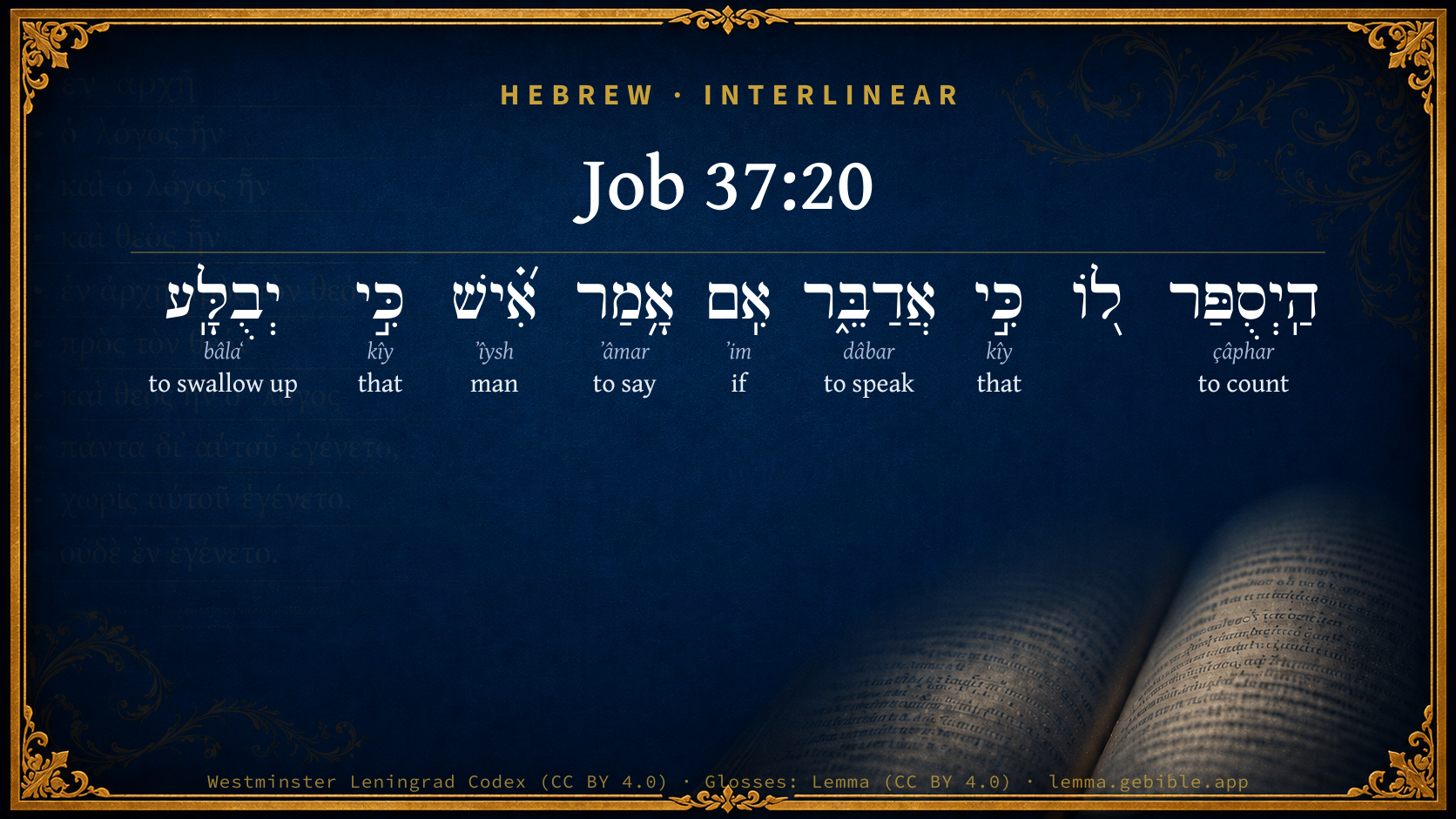
Job 37:20

Hebrew (Westminster Leningrad Codex) Job 37:20 appears in the Hebrew Old Testament. The text above is from the Westminster Leningrad Codex. Each word links to its Strong’s number, a concise gloss, and parsing drawn from the Open Scriptures Hebrew Bible morphology. Click any word for its full Brown-Driver-Briggs (BDB) entry.
Download image
Cite this verse

Job 37:20 (World English Bible). Public Domain. Lemma interlinear Bible study tool, https://lemma.gebible.app/v/job/37/20.

Show BibTeX & RIS
BibTeX
RIS
English Translation
Shall it be told him that I would speak? Or should a man wish that he were swallowed up?
World English Bible · Public Domain
Download a study sheet

One document with this verse’s original text, its word-by-word gloss line, the meaning frame, cross-references with their text, attributed commentary, and full source and license credits — printable, and it pastes into notes with its structure intact.

This verse Autodidact and up

Study sheet (.html) Plain text (.txt)

A passage Seminary Student

Up to 50 verses in one chapter. A passage sheet keeps up to 6 commentary sources and 12 cross-references per verse, in the order this page ranks them, and says so on the sheet whenever that leaves anything out. Ask for a single verse and you get the Autodidact verse sheet above.

Everything on this page stays free to read, with no account — the sheet is a download of what is already on screen, not access to it.

Want to remove ads? Support Godless Engineer
Compare translations 3

The same verse in 3 English versions, stacked beneath the original-language interlinear above. Click any original word for its lexicon entry.

Each is an independent rendering of the whole verse — the interlinear is not word-aligned to these translations.

Highlighted words mark where these versions differ — a whole-verse word diff, not a word-by-word alignment.

  • World English Bible Public Domain
    Shall it be told him that I would speak? Or should a man wish that he were swallowed up?
  • King James Version Public Domain
    Shall it be told him that I speak? if a man speak, surely he shall be swallowed up.
  • unfoldingWord Literal Text CC BY-SA 4.0
    Shall it be recounted to him that I would speak? If a man spoke, that he would be swallowed up?

unfoldingWord Literal Text — © unfoldingWord, licensed CC BY-SA 4.0. Word-aligned USFM3 via Door43 (git.door43.org/unfoldingWord/en_ult).

Versions to compare (up to 4)

3 of 4 selected

Show all 18 translations

Every available English version of this verse, each an independent rendering of the whole verse.

  • World English Bible Public Domain
    Shall it be told him that I would speak? Or should a man wish that he were swallowed up?
  • Berean Standard Bible Public Domain
    Should He be told that I want to speak? Would a man ask to be swallowed up?
  • Majority Standard Bible Public Domain
    Should He be told that I want to speak? Would a man ask to be swallowed up?
  • King James Version Public Domain
    Shall it be told him that I speak? if a man speak, surely he shall be swallowed up.
  • American Standard Version (1901) Public Domain
    Shall it be told him that I would speak? Or should a man wish that he were swallowed up?
  • Revised Version (1885) Public Domain
    Shall it be told him that I would speak? or should a man wish that he were swallowed up?
  • Geneva Bible (1599) Public Domain
    Shall it be told him when I speake? or shall man speake when he shalbe destroyed?
  • Douay-Rheims (1899) Public Domain
    Who shall tell him the things I speak? even if a man shall speak, he shall be swallowed up.
  • Young's Literal Translation Public Domain
    Is it declared to Him that I speak? If a man hath spoken, surely he is swallowed up.
  • Literal Standard Version CC BY-SA 4.0
    Is it declared to Him that I speak? If a man has spoken, surely he is swallowed up.
  • Unlocked Literal Bible CC BY-SA 4.0
    Should he be told that I wish to speak with him? Would a person wish to be swallowed up?
  • unfoldingWord Literal Text CC BY-SA 4.0
    Shall it be recounted to him that I would speak? If a man spoke, that he would be swallowed up?
  • Darby Bible Public Domain
    Shall it be told him if I would speak? if a man [so] say, surely he shall be swallowed up.
  • World Messianic Bible Public Domain
    Will it be told him that I would speak? Or should a man wish that he were swallowed up?
  • Webster's Bible Public Domain
    Shall it be told him that I speak? If a man shall speak, surely he will be swallowed up.
  • Free Bible Version CC BY-SA 4.0
    Should God be told that I want to speak? Anyone who wanted to would be destroyed!
  • Bible in Basic English Public Domain
    How may he have knowledge of my desire for talk with him? or did any man ever say, May destruction come on me?
  • JPS Tanakh (1917) Public Domain
    Shall it be told Him that I would speak? Or should a man wish that he were swallowed up?

Literal Standard Version (2020), Covenant Press — licensed CC BY-SA 4.0. Text via the HelloAO Bible API (eBible.org). Unlocked Literal Bible (unfoldingWord) — licensed CC BY-SA 4.0. Text via the HelloAO Bible API (eBible.org). unfoldingWord Literal Text — © unfoldingWord, licensed CC BY-SA 4.0. Word-aligned USFM3 via Door43 (git.door43.org/unfoldingWord/en_ult). Free Bible Version, Dr. Jonathan Gallagher — licensed CC BY-SA 4.0. Text via the HelloAO Bible API (eBible.org).

Word by word

More ways to search: Search by grammar → Find every occurrence → Compare this word →

Practice this passage: Drill this verse → Learn its vocabulary →

יְבֻלָּֽע
bâlaʻ
H1104
“to swallow up”
Verb, Pual, Imperfect, 3rd Person, Masculine, Singular
Part of Speech
Verb
Stem
Pual
Form
Imperfect
Person
3rd Person
Gender
Masculine
Number
Singular
Full BDB Definition

Origin: a primitive root

TWOT: 251

to swallow down, swallow up, engulf, eat up - (Qal) - to swallow down - to swallow up, engulf - (Niphal) to be swallowed up - (Piel) - to swallow - to swallow up, engulf - squandering (figuratively) - (Pual) to be swallowed up - (Hithpael) to be ended
  1. הַֽיְסֻפַּר çâphar H5608 “to count” Particle, Interrogative + Verb, Pual, Imperfect, 3rd Person, Masculine, Singular
  2. כִּ֣י kîy H3588 “that” Conjunction
  3. אֲדַבֵּ֑ר dâbar H1696 “to speak” Verb, Piel, Imperfect, 1st Person, Common, Singular
  4. אִֽם ʼim H518 “if” Conjunction
  5. אָ֥מַר ʼâmar H559 “to say” Verb, Qal, Perfect, 3rd Person, Masculine, Singular
  6. אִ֝֗ישׁ ʼîysh H376 “man” Noun, Common, Masculine, Singular, Absolute
  7. כִּ֣י kîy H3588 “that” Conjunction

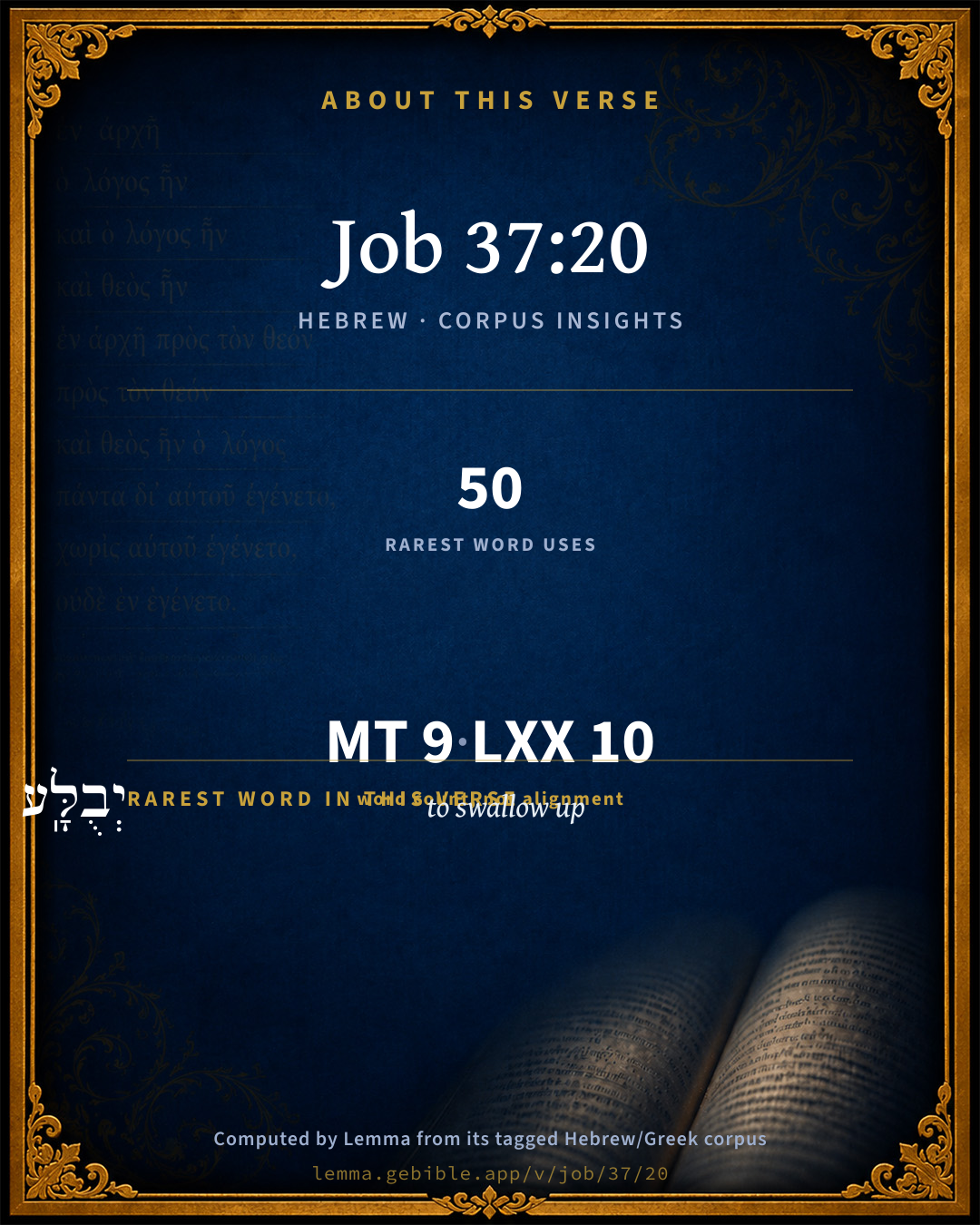
About this verse

These counts appear in no published source. They are computed here, from the morphology-tagged text and Lemma’s own curated glosses. What Lemma adds →

9
words
7
distinct lemmas
Wisdom
section

Shared distinctive vocabulary

יְבֻלָּֽע to swallow up H1104 occurs in 48 verses of the Hebrew Bible. Also found in:

Grammatical profile

  • 4 verbs
  • 1 noun
  • 1 preposition
  • 3 conjunctions

Verb forms

  • הַֽיְסֻפַּר Pual · Imperfect
  • אֲדַבֵּ֑ר Piel · Imperfect
  • אָ֥מַר Qal · Perfect
  • יְבֻלָּֽע Pual · Imperfect

Repetition

A word recurs within this verse — often emphatic in Hebrew:

  • כִּ֣י that H3588 ×2

Hebrew & Septuagint length

In English translation the verse runs 19 words from the Hebrew and 18 from the Septuagint (LXX English) — closely comparable.

A rough comparison of the two English renderings, which tokenize alike — not a word-level alignment.

Word counts can differ between the Hebrew and the Greek without any difference in meaning — e.g. the Hebrew direct-object marker אֵת has no separate Greek word, and Greek often adds the article ὁ.

In the original languages it is 9 Hebrew tokens and 10 Greek tokens — but the two are counted differently (Hebrew bundles its prefixes and suffixes into one token; the Greek is in lemma form), so that isn’t a like-for-like length.

Cross-references

4

Topical passages linked to Job 37:20 in the Treasury of Scripture Knowledge — connected by theme and wording, ordered by reader-vote popularity; previews shown in the World English Bible.

  • Job 6:3 For now it would be heavier than the sand of the seas, Therefore have my words been rash.
  • Job 11:7–8 "Can you fathom the mystery of God? Or can you probe the limits of the Almighty?
  • Psalms 139:4 For there is not a word on my tongue, But, behold, Yahweh, you know it altogether.
  • Matthew 12:36–37 I tell you that every idle word that men speak, they will give account of it in the day of judgment.

Cross-references courtesy of OpenBible.info (CC BY 4.0).

Hebrew and Greek witnesses Masoretic Hebrew ↔ Greek Septuagint

The same verse in the two great witnesses to the Old Testament, shown verse-for-verse.

These are two independent witnesses, not word-aligned to each other, and the Septuagint is shown in lemma (dictionary) form.

Hebrew Job 37:20 Masoretic · Westminster Leningrad Codex

הַֽיְסֻפַּר ל֭וֹ כִּ֣י אֲדַבֵּ֑ר אִֽם אָ֥מַר אִ֝֗ישׁ כִּ֣י יְבֻלָּֽע

Shall it be told him that I would speak? Or should a man wish that he were swallowed up?

World English Bible · Public Domain

Greek LXX Job 37:20 Septuagint · lemma form

μή βίβλος ἤ γραμματεύς ἐγώ παραἵστημι ἵνα ἄνθρωπος ἵστημι κατασιωπάω

Have I a book or a scribe my me, that I may stand and put man to silence?

LXX2012 (modern English Septuagint) · Public Domain

Hebrew: Westminster Leningrad Codex (CC BY 4.0). Greek: Septuagint (public domain); English from LXX2012 (modern English Septuagint) (Public Domain). How the Septuagint differs from the Hebrew →

Commentary

Notes on Job 37:20 from classic Christian and Jewish commentators (each source and its license shown beneath its notes). The classic Christian expositions comment on the surrounding passage and are grouped to its opening verse, so a note may address several verses; the Jewish commentaries on the Tanakh (Rashi and others) are per-verse, so they appear only where the commentator wrote on this verse.

Lemma curates 59 commentaries, every one of them public domain or Creative Commons licensed, each selected and text-cleaned for this edition rather than reprinted as found. About our sources →

Trapp's Complete Commentary

John Trapp

Job 37:20 Shall it be told him that I speak? if a man speak, surely he shall be swallowed up.

Ver. 20. Shall it be told him that I speak?] An in acta referetur ei, si loquar? Shall it be recorded before him? &c. q.d. Then woe be to me, for I am sure to rue it; yea, and (without mercy) to be ruined for it. Did not Enoch, the seventh from Adam, prophesy long since, saying, "Behold, the Lord cometh to execute judgment upon all, and to convince them of all their hard speeches which ungodly sinners have spoken against him," Jdg 1:14-15.

If a man speak, surely he shall be swallowed up] If he speak in thy behalf, or after thine example, presuming to control God’s works, and to quarrel his proceedings, as thou hast done, he is sure to be undone. Some read the words thus, For if he speak man shall be devoured; that is, if God speak, man (who, before he cometh to speak, thinks that he shall be able to reason with him) shall be quite confounded, and his words, as it were, swallowed up by his profound wisdom; and be made unable to speak one word for himself. Wherefore let all flesh be silent before the Lord; for if any presume to chat against his judgments, he shall have his words driven down his throat again by a divine vengeance. Cave ne lingua feriat collum, Take heed thy tongue cut not thy throat, say the Arabian’s wise proverb.

John Trapp, A Commentary or Exposition upon All the Books of the Old and New Testament (1647–1656) — public domain. Text from a community e-Sword module.

Joseph Benson's Commentary

Job 37:20. Shall it be told him that I speak? — Does he need to be informed of any thing? Is any thing that I have said of him worth his hearing? Will any one report it to him? Will any man dare to approach him? But the Hebrew, אדבר, adabber, should rather be rendered, I should, or I will, speak. Shall I send, or who dare carry, a challenge from me to God, or a message that I am ready and desirous to debate with him concerning his proceedings? This, indeed, thou hast done, in effect, but far be such presumption from me. If a man speak — If a man should be so bold and venturous as to enter the lists with God, surely he shall be swallowed up — With the sense of his infinite majesty and spotless purity.

Joseph Benson's Commentary on the Old and New Testaments (1811–1818) — public domain. Text from a community e-Sword module.

Tyndale Open Study Notes

Tyndale Open Resources

37:20 speak when they are confused? Or speak without being swallowed up? Punishment as severe as death might result from contesting God’s judgment (cp. 13:14).

Tyndale Open Study Notes — © Tyndale Open Resources, licensed CC BY-SA 4.0. Text via the HelloAO Bible API.

Geneva Bible (1599)

Geneva Bible translators

Hath God need that any should tell him when man murmureth against him?

If God would destroy a man, should he repine?

Geneva Bible (1599) marginal notes — public domain. Text via Bolls.life.

Jamieson, Fausset & Brown

Robert Jamieson, A. R. Fausset & David Brown

What I a mortal say against God's dealings is not worthy of being told HIM. In opposition to Job's wish to "speak" before God (Job 13:3, Job 13:18-22).

if . . . surely he shall be swallowed up--The parallelism more favors UMBREIT, "Durst a man speak (before Him, complaining) that he is (without cause) being destroyed?"

Jamieson, Fausset & Brown — Commentary Critical and Explanatory on the Whole Bible (1871) — public domain (CC PDM 1.0). Text via the HelloAO Bible API.

Adam Clarke's Commentary

Verse 20. Shall it be told him that I speak?] Shall I dare to whisper even before God? And suppose any one were to accuse me before him for what I have spoken of him, though that has been well intended, how should I be able to stand in his presence? I should be swallowed up in consternation, and consumed with the splendour of his majesty.

But in what state art thou? What hast thou been doing? Thou hast arraigned God for his government of the world; thou hast found fault with the dispensations of his providence; thou hast even charged him with cruelty! What will become of THEE?

Adam Clarke's Commentary on the Bible (1810–1826) — public domain. Text from a community e-Sword/MySword module.

Ellicott's Commentary for English Readers

(20) Be swallowed up.—The sense will vary, according as we understand this of God or of the sun. In the first case, it is a simple expression of awe at God’s majesty: “Shall it be told Him that I would speak? If a man speak, surely he shall be swallowed up;” but unquestionably the sense is clearer if we understand it of the sun: “Shall it be told of him? Shall I, indeed, speak it? or hath any man ever ventured to say, in such a case, that the sun is swallowed up, extinguished?”

A Bible Commentary for English Readers, edited by Charles John Ellicott (1878–1897) — public domain. Text from a community e-Sword module.

The Cambridge Bible for Schools and Colleges

gen. ed. J. J. S. Perowne

20. The verse means,

Shall it be told him that I would speak?

Or shall a man wish that he should be swallowed up?

Elihu recoils from the thought of going into God’s presence to strive with Him; such daring presumption would be voluntarily to court destruction. The words “shall a man wish?” are lit. has a man said or commanded? i. e. has any one ever voluntarily ordered his own annihilation? Nothing other than this does the man do who ventures to contend with the Almighty.

The Cambridge Bible for Schools and Colleges (gen. ed. J. J. S. Perowne; Cambridge University Press, 1878–1918) — public domain. Text from a community e-Sword module.

John Gill's Exposition

Shall it be told him that I speak?.... And what I speak? there is no need of it, since he is omniscient, and knows every word that is spoken by men; or is anything I have said concerning him, his ways, and his works, worthy relating, or worthy of his hearing, being so very imperfect? nor can the things I have spoken of, though common things, be fully explained to any; or should it be told him, the Lord, that he, Elihu, had spoke as Job had done, and arraigned his justice, and complained of his dealings? God forbid; he would not have it said they were spoken by him for all the world: or "shall it be recorded unto him what I speak?" as Mr. Broughton, or that I speak; shall it be recorded in a book, and that sent to God; that I will speak in thy cause, and be an advocate for thee, and endeavour to justify thee in all thou hast said? no, by no means;

if a man speak, surely he shall be swallowed up; if he speaks of the being and perfections of God, he is soon lost; his essence, and many of his attributes, are beyond his comprehension; if he speaks of his works of nature and providence, he is presently out of his depth; there is a bathos, a depth in them he cannot fathom: if he speaks of his love, and grace, and mercy, in the salvation of man, he is swallowed up with admiration; he is obliged to say, what manner of love is this? it has heights he cannot reach, depths he cannot get to the bottom of, lengths and breadths immeasurable: or should he undertake to dispute with God, to litigate a point with him concerning his works, he could not answer him in one thing of a thousand; and particularly Elihu suggests, was he to undertake Job's cause, it would soon be lost and all over with him; so Mr. Broughton renders the words, "would any plead, when he should be undone?" who would engage in a cause he is sure would be lost, and prove his utter undoing?

John Gill's Exposition of the Whole Bible (1746–1763) — public domain (CC PDM 1.0). Text via the HelloAO Bible API.

Albert Barnes' Notes on the Bible

Shall it be told him that I speak? - Still the language of profound awe and reverence, as if he would not have it even intimated to God that he had presumed to say anything in regard to him, or with a view to explain the reason of his doings.

If a man speak - That is, if he attempt to speak with God; to argue a case with him; to contend with him in debate; to oppose him. Elihu had designed to reprove Job for the bold and presumptuous manner in which he bad spoken of God, and for his wish to enter into a debate with him in order to vindicate his cause. He now says, that if anyone should attempt this, God had power at once to destroy him; and that such an attempt would be perilous to his life. But other interpretations have been proposed, which may be seen in Rosenmuller, Umbreit, and Lee.

Surely he shall be swallowed up - Destroyed for his presumption and rashness in thus contending with the Almighty. Elihu says that on this account he would not dare to speak with God. He would fear that he would come forth in his anger, and destroy him. How much man by nature instinctively feels, when he has any just views of the majesty of God, that he needs a Mediator!

Albert Barnes' Notes on the Bible (1834–1885) — public domain. Text from a community e-Sword/MySword module.

Haydock's Catholic Bible Commentary

He shall be swallowed up. All that man can say, when he speaks of God, is so little and inconsiderable in comparison with the subject, that man is lost, an das it were swallowed up in so immense an ocean. (Challoner) --- The man who should are to mention what I could reprehend in God’s works, would soon be overwhelmed with majesty. (Calmet) --- Alphonsus IX, king of Leon, (the year of our Lord 1252) surnamed "the wise and the astronomer," said "he could have given some good advice respecting the motions of the stars, if he had been consulted by God;" meaning to ridicule some vain systems of philosophers, then in vogue. (Dict. 1774.) (Haydock)

George Leo Haydock (1774–1849), Haydock's Catholic Family Bible and Commentary, 1859 edition — public domain. Excludes Psalms (Douay-Rheims chapter numbering differs from Protestant) and Deuterocanonical books (Catholic canon only).

Matthew Poole's English Annotations

That I speak, Heb. that I will speak. Shall I send, or who dare carry, a challenge from me to God, or a message that I am ready and desirous to debate with him concerning his proceedings? This indeed thou hast done in effect, but far be such presumption from me.

If a man speak; if a man should be so bold and venturous to enter the lists with God.

He shall be swallowed up with the sense of God’s infinite majesty and spotless purity.

Matthew Poole's English Annotations on the Holy Bible (1683–1685) — public domain. Text from a community e-Sword/MySword module.

Whedon's Commentary on the Bible

Daniel D. Whedon

20. That I speak — Shall it be told Him that I question and arraign his moral government — even I, involved in such darkness (Job_37:19) that I cannot order aright my speech? He who thus speaks has reason to fear destruction: for such is the overwhelming presence of God that none can “see his face and live,” much less speak to him face to face.

If a man speak… swallowed up — Dillmann and the best critics render these words as a question: “Hath a man ever said that he would (fain) be destroyed?” Will one readily pursue a course involving certain destruction, such as Job would have done had he intruded himself before God? Exo_19:21; Exo_33:20; Jdg_13:22, etc.

Daniel D. Whedon (gen. ed.), Commentary on the Old and New Testaments (1874–1909) — public domain. Text from a community e-Sword module.

The Pulpit Commentary

Shall it be told him that I speak? rather, that I would speak. (comp. Job_31:35) Job had expressed the wish that God would "hear him, and answer him." Elihu, intending to rebuke this presumption, yet shrinking from doing so directly, puts himself in Job"s place, and asks, "Would it be fitting that I should demand to speak with God?" If not, it cannot be fitting that Job should do so. If a man speak, surely he shall be swallowed up. This is probably the true meaning, though another has been suggested by some commentators, who prefer to render, "Or should a man wish that he were destroyed?" (So Ewald, Dillmann, Canon Cook, and our Revisers.) If we adopt this rendering, we must understand Elihu as appending to his first rebuke a second, levelled against Job"s desire to have his life ended.

The Pulpit Commentary (1880–1919), ed. H.D.M. Spence-Jones & Joseph S. Exell — public domain. Text from a community e-Sword module.

John Wesley's Explanatory Notes

Shall - I send a challenge to God, or a message that I am ready to debate with him concerning his proceedings? Speak - If a man should be so bold to enter the lists with God. Swallowed up - With the sense of his infinite majesty.

John Wesley, Explanatory Notes Upon the Whole Bible (1754–1765) — public domain. Text via the GEBible commentary corpus.

Rashi

Rabbi Shlomo Yitzchaki (Rashi)

Need it be told to Him when I speak Is He like mortals, that He must be told what we are saying?

or need a man tell utter with his mouth.

what is kept a secret so that it should be revealed to Him immediately, like (II Sam. 17:16), “lest the king be told secretly (יבלע)” [lest] it be revealed. But our Sages (Meg. 18a) explained: Can all His praise be told Him, that I should speak That we should speak of Him and His might? Has any man said to tell them all, he would surely be destroyed from his place.

Rashi on the Tanakh — English translations: “The Judaica Press complete Tanach with Rashi, translated by A. J. Rosenberg” (CC BY 4.0); “Pentateuch with Rashi's commentary by M. Rosenbaum and A.M. Silbermann, 1929-1934” (public domain); “The Metsudah Tanach series, Lakewood, N.J” (CC BY 4.0); and “The Book of Joshua, Metsudah Publications, 1997” (CC BY 4.0). Text via Sefaria.

Lesson kit

Teaching starters — assembled from the data on this page, not authored interpretation. Every prompt links to the verse data it draws on. Edit before teaching.

Job, in the Wisdom, opens this verse with 9 words (7 distinct Hebrew lemmas). Its most distinctive word is bâlaʻ (“to swallow up”). A historical commentator’s framing appears above. Read the whole chapter for the surrounding context.

Discussion questions

  1. How does “to swallow up” (bâlaʻ) shape what this verse is saying?
  2. How does Genesis 41:7, which shares the word «to swallow up», read alongside this verse?
  3. What does the repetition of “that” (2× in this one verse) do in this verse?
  4. These translations render this verse differently; the difference is in the English rendering, not the original. What questions does that raise?
  5. «הַֽיְסֻפַּר» is a Pual Imperfect verb. How does that grammatical form shape the action described?
  6. Compare how Trapp's Complete Commentary and Joseph Benson's Commentary read this verse. Where do they agree or differ?

Things to notice

Reading settings

Reading text

Shown beneath each verse's original-language words.

Old Testament
Old Testament edition

Read the OT as the Masoretic Hebrew (MT) or the Greek Septuagint (LXX).

English shown for the Greek Septuagint (in the Hebrew ↔ Greek comparison).

Comparing translations? Open the Compare panel on any verse page to stack up to four side by side.