Psalms 59:12

Hebrew (Westminster Leningrad Codex) Psalms 59:12 appears in the Hebrew Old Testament. The text above is from the Westminster Leningrad Codex. Each word links to its Strong’s number, a concise gloss, and parsing drawn from the Open Scriptures Hebrew Bible morphology. Click any word for its full Brown-Driver-Briggs (BDB) entry.
Download image
Cite this verse

Psalms 59:12 (World English Bible). Public Domain. Lemma interlinear Bible study tool, https://lemma.gebible.app/v/psalms/59/12.

Show BibTeX & RIS
BibTeX
RIS
English Translation
For the sin of their mouth, and the words of their lips, Let them be caught in their pride, For the curses and lies which they utter.
World English Bible · Public Domain
Download a study sheet

One document with this verse’s original text, its word-by-word gloss line, the meaning frame, cross-references with their text, attributed commentary, and full source and license credits — printable, and it pastes into notes with its structure intact.

This verse Autodidact and up

Study sheet (.html) Plain text (.txt)

A passage Seminary Student

Up to 50 verses in one chapter. A passage sheet keeps up to 6 commentary sources and 12 cross-references per verse, in the order this page ranks them, and says so on the sheet whenever that leaves anything out. Ask for a single verse and you get the Autodidact verse sheet above.

Everything on this page stays free to read, with no account — the sheet is a download of what is already on screen, not access to it.

Want to remove ads? Support Godless Engineer
Compare translations 3

The same verse in 3 English versions, stacked beneath the original-language interlinear above. Click any original word for its lexicon entry.

Each is an independent rendering of the whole verse — the interlinear is not word-aligned to these translations.

Highlighted words mark where these versions differ — a whole-verse word diff, not a word-by-word alignment.

  • World English Bible Public Domain
    For the sin of their mouth, and the words of their lips, Let them be caught in their pride, For the curses and lies which they utter.
  • King James Version Public Domain
    For the sin of their mouth and the words of their lips let them even be taken in their pride: and for cursing and lying which they speak.
  • unfoldingWord Literal Text CC BY-SA 4.0
    the sin of their mouth, the word of their lips, may they be taken in their pride, and for the curse and for the lying they tell.

unfoldingWord Literal Text — © unfoldingWord, licensed CC BY-SA 4.0. Word-aligned USFM3 via Door43 (git.door43.org/unfoldingWord/en_ult).

Versions to compare (up to 4)

3 of 4 selected

Show all 18 translations

Every available English version of this verse, each an independent rendering of the whole verse.

  • World English Bible Public Domain
    For the sin of their mouth, and the words of their lips, Let them be caught in their pride, For the curses and lies which they utter.
  • Berean Standard Bible Public Domain
    By the sins of their mouths and the words of their lips, let them be trapped in their pride, in the curses and lies they utter.
  • Majority Standard Bible Public Domain
    By the sins of their mouths and the words of their lips, let them be trapped in their pride, in the curses and lies they utter.
  • King James Version Public Domain
    For the sin of their mouth and the words of their lips let them even be taken in their pride: and for cursing and lying which they speak.
  • American Standard Version (1901) Public Domain
    `For' the sin of their mouth, `and' the words of their lips, Let them even be taken in their pride, And for cursing and lying which they speak.
  • Revised Version (1885) Public Domain
    For the sin of their mouth, and the words of their lips, let them even be taken in their pride, and for cursing and lying which they speak.
  • Geneva Bible (1599) Public Domain
    For the sinne of their mouth, and the words of their lips: and let them be taken in their pride, euen for their periurie and lies, that they speake.
  • Douay-Rheims (1899) Public Domain
    God shall let me see over my enemies: slay them not, lest at any time my people forget. Scatter them by thy power; and bring them down, O Lord, my protector:
  • Young's Literal Translation Public Domain
    The sin of their mouth `is' a word of their lips, And they are captured in their pride, And from the curse and lying they recount.
  • Literal Standard Version CC BY-SA 4.0
    The sin of their mouth [is] a word of their lips, || And they are captured in their pride, || And they recount from the curse and lying.
  • Unlocked Literal Bible CC BY-SA 4.0
    For the sins of their mouths and the words of their lips, let them be captured in their pride, and for the curses and lies that they express.
  • unfoldingWord Literal Text CC BY-SA 4.0
    the sin of their mouth, the word of their lips, may they be taken in their pride, and for the curse and for the lying they tell.
  • Darby Bible Public Domain
    [Because of] the sin of their mouth, the word of their lips, let them even be taken in their pride; and because of cursing and lying which they speak.
  • World Messianic Bible Public Domain
    For the sin of their mouth, and the words of their lips, let them be caught in their pride, for the curses and lies which they utter.
  • Webster's Bible Public Domain
    \\59:11\\Slay them not, lest my people forget: scatter them by thy power; and bring them down, O Lord our shield.
  • Free Bible Version CC BY-SA 4.0
    Let them be caught out by the evil things they say, the words they proudly speak—brought down by their curses and the lies they tell!
  • Bible in Basic English Public Domain
    Because of the sin of their mouths and the word of their lips, let them even be taken in their pride; and for their curses and their deceit,
  • JPS Tanakh (1917) Public Domain
    (59-13) For the sin of their mouth, and the words of their lips, let them even be taken in their pride, and for cursing and lying which they speak.

Literal Standard Version (2020), Covenant Press — licensed CC BY-SA 4.0. Text via the HelloAO Bible API (eBible.org). Unlocked Literal Bible (unfoldingWord) — licensed CC BY-SA 4.0. Text via the HelloAO Bible API (eBible.org). unfoldingWord Literal Text — © unfoldingWord, licensed CC BY-SA 4.0. Word-aligned USFM3 via Door43 (git.door43.org/unfoldingWord/en_ult). Free Bible Version, Dr. Jonathan Gallagher — licensed CC BY-SA 4.0. Text via the HelloAO Bible API (eBible.org).

Word by word

More ways to search: Search by grammar → Find every occurrence → Compare this word →

Practice this passage: Drill this verse → Learn its vocabulary →

וּמִכַּ֣חַשׁ
kachash
H3585
“and · from · deception”
Conjunction + Preposition + Noun, Common, Masculine, Singular, Absolute
Part of Speech
Conjunction + Preposition + Noun
Type
Common
Gender
Masculine
Number
Singular
State
Absolute
Full BDB Definition

Origin: from H3584

TWOT: 975a

lying, deception - leanness, failure
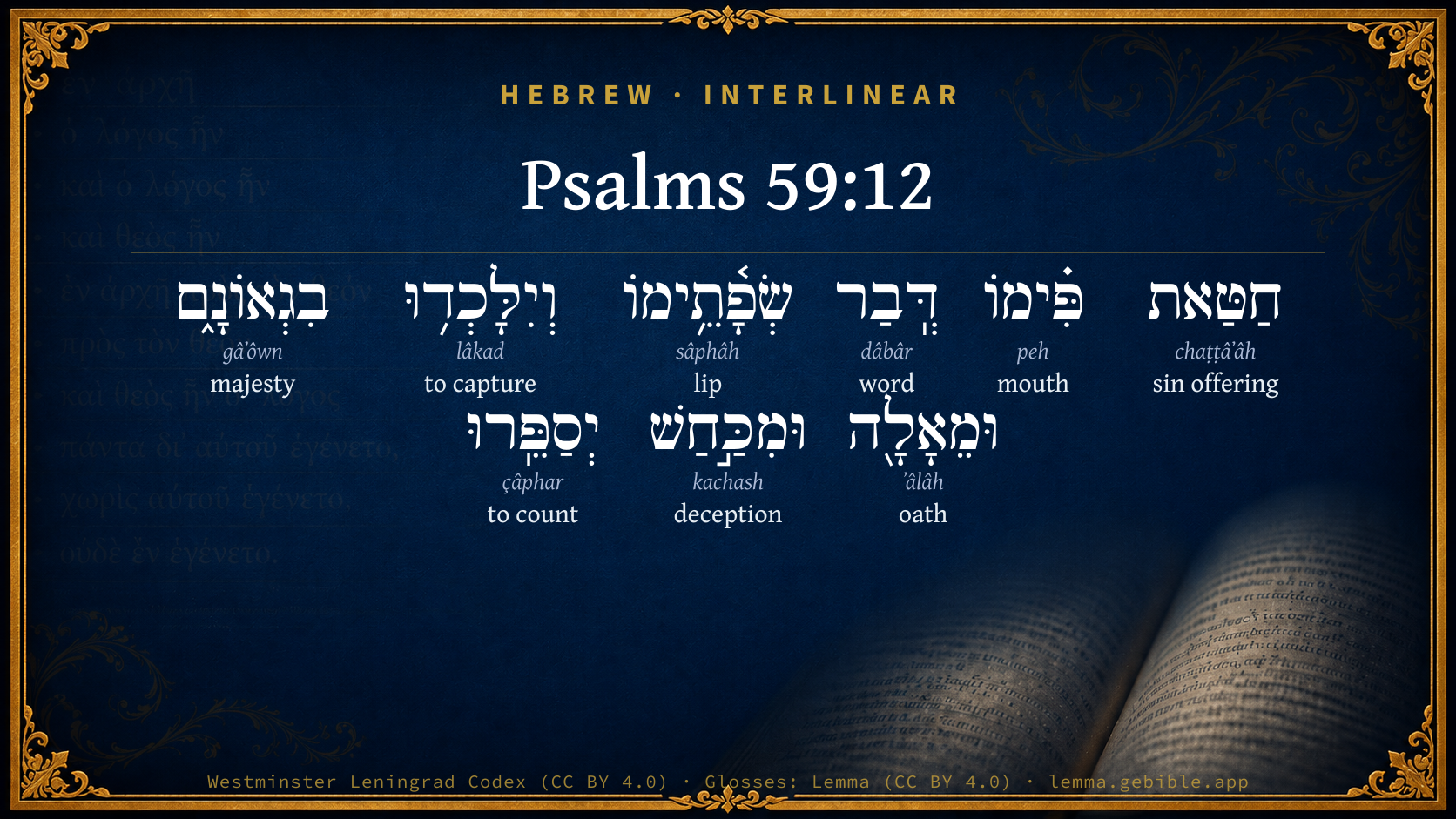
  1. חַטַּאת chaṭṭâʼâh H2403 “sin offering of” Noun, Common, Feminine, Singular, Construct
  2. פִּ֗ימוֹ peh H6310 “mouth · their” Noun, Common, Masculine, Singular, Construct + Suffix, Personal, 3rd Person, Masculine, Plural
  3. דְּֽבַר dâbâr H1697 “word of” Noun, Common, Masculine, Singular, Construct
  4. שְׂפָ֫תֵ֥ימוֹ sâphâh H8193 “lips · their” Noun, Common, Feminine, Dual, Construct + Suffix, Personal, 3rd Person, Masculine, Plural
  5. וְיִלָּכְד֥וּ lâkad H3920 “and · to capture” Conjunction + Verb, Niphal, Imperfect, 3rd Person, Masculine, Plural
  6. בִגְאוֹנָ֑ם gâʼôwn H1347 “in/at · majesty · their” Preposition + Noun, Common, Masculine, Singular, Construct + Suffix, Personal, 3rd Person, Masculine, Plural
  7. וּמֵאָלָ֖ה ʼâlâh H423 “and · from · oath” Conjunction + Preposition + Noun, Common, Feminine, Singular, Absolute
  8. יְסַפֵּֽרוּ çâphar H5608 “to count” Verb, Piel, Imperfect, 3rd Person, Masculine, Plural

About this verse

These counts appear in no published source. They are computed here, from the morphology-tagged text and Lemma’s own curated glosses. What Lemma adds →

9
words
9
distinct lemmas
Wisdom
section

Notable vocabulary

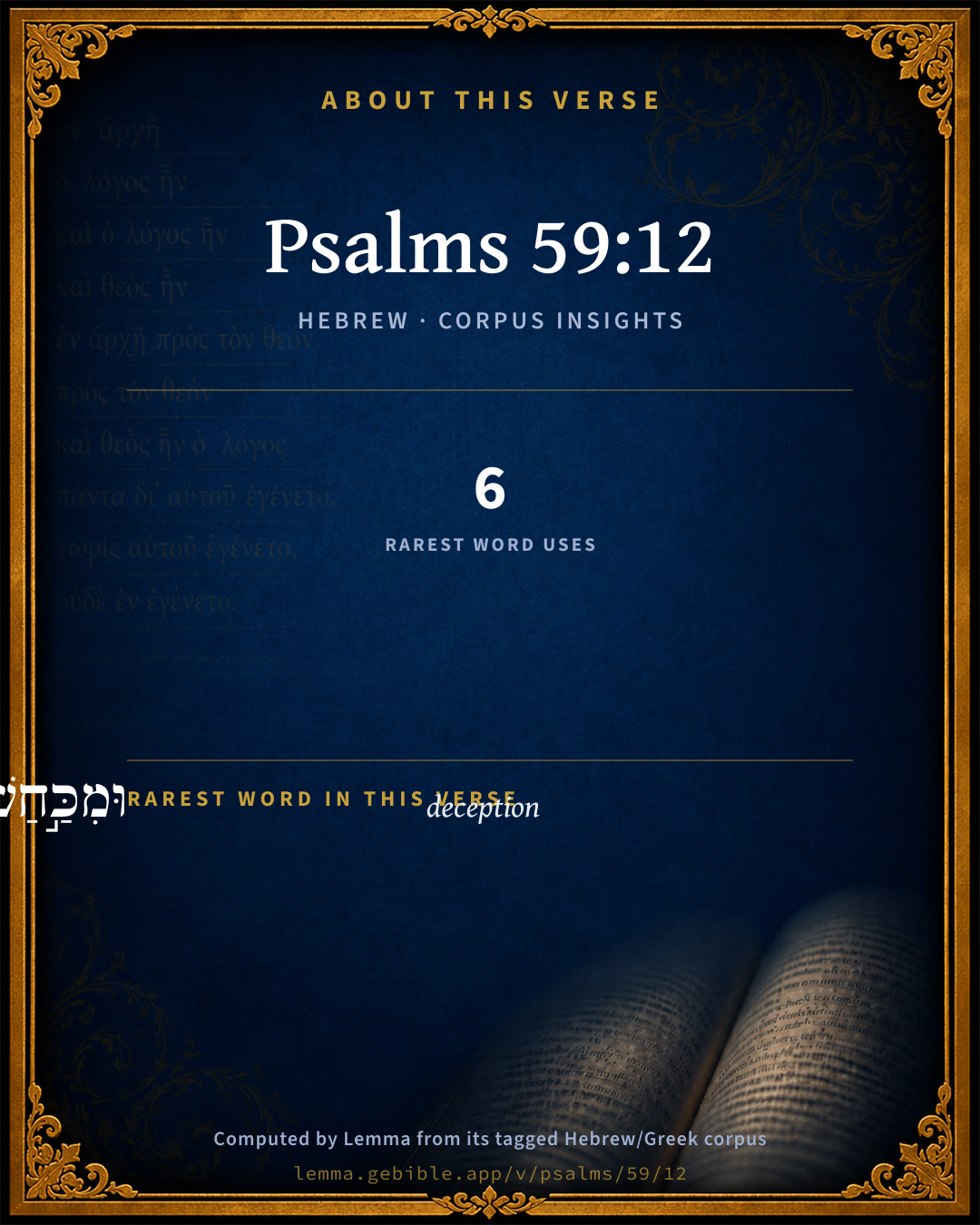
The rarest word here is וּמִכַּ֣חַשׁ deception H3585 — appearing just 6 times in the whole Hebrew Bible.

Shared distinctive vocabulary

וּמִכַּ֣חַשׁ deception H3585 occurs in 6 verses of the Hebrew Bible. Also found in:

Grammatical profile

  • 2 verbs
  • 7 nouns

Verb forms

  • וְיִלָּכְד֥וּ Niphal · Imperfect
  • יְסַפֵּֽרוּ Piel · Imperfect

Hebrew & Septuagint length

In English translation the verse runs 27 words from the Hebrew and 20 from the Septuagint (LXX English) — closely comparable.

A rough comparison of the two English renderings, which tokenize alike — not a word-level alignment.

Word counts can differ between the Hebrew and the Greek without any difference in meaning — e.g. the Hebrew direct-object marker אֵת has no separate Greek word, and Greek often adds the article ὁ.

Cross-references

17

Topical passages linked to Psalms 59:12 in the Treasury of Scripture Knowledge — connected by theme and wording, ordered by reader-vote popularity; previews shown in the World English Bible.

  • Proverbs 12:13 An evil man is trapped by sinfulness of lips, But the righteous shall come out of trouble.
  • Psalms 10:7 His mouth is full of cursing, deceit, and oppression. Under his tongue is mischief and iniquity.
  • Proverbs 18:7 A fool's mouth is his destruction, And his lips are a snare to his soul.
  • Hosea 4:2 There is cursing, lying, murder, stealing, and committing adultery; They break boundaries, and bloodshed causes bloodshed.
  • Matthew 12:36–37 I tell you that every idle word that men speak, they will give account of it in the day of judgment.
  • Psalms 10:2 In arrogance, the wicked hunt down the weak; They are caught in the schemes that they devise.
  • Psalms 120:3–4 What will be given to you, and what will be done more to you, You deceitful tongue?
  • Psalms 64:7–8 But God will shoot at them. They will be suddenly struck down with an arrow.
  • Psalms 79:12 Pay back to our neighbors seven times into their bosom Their reproach with which they have reproached you, Lord.
  • Psalms 109:17–18 Yes, he loved cursing, and it came to him. He didn't delight in blessing, and it was far from him.
  • Psalms 140:9–10 As for the head of those who surround me, Let the mischief of their own lips cover them.
  • Proverbs 6:2 You are trapped by the words of your mouth. You are ensnared with the words of your mouth.
  • Proverbs 11:6 The righteousness of the upright shall deliver them, But the unfaithful will be trapped by evil desires.
  • Zephaniah 3:11 In that day you will not be disappointed for all your doings, in which you have transgressed against me; for then I will take away out of the midst of you your proudly exulting ones, and you will no more be haughty in my holy mountain.
  • Matthew 27:25 All the people answered, "May his blood be on us, and on our children!"
  • Matthew 27:63 saying, "Sir, we remember what that deceiver said while he was still alive: 'After three days I will rise again.'
  • Luke 23:5 But they insisted, saying, "He stirs up the people, teaching throughout all Judea, beginning from Galilee even to this place."

Cross-references courtesy of OpenBible.info (CC BY 4.0).

Hebrew and Greek witnesses Masoretic Hebrew ↔ Greek Septuagint

The same verse in the two great witnesses to the Old Testament, shown verse-for-verse.

You’re reading Greek Psalm 58 (Hebrew Psalm 59). The Septuagint counts the superscription, so verse numbers can differ from the Hebrew — chapter-level alignment, not verse-by-verse. Numbering follows Rahlfs.

These are two independent witnesses, not word-aligned to each other, and the Septuagint is shown in lemma (dictionary) form.

Hebrew Psalms 59:12 Masoretic · Westminster Leningrad Codex

חַטַּאת פִּ֗ימוֹ דְּֽבַר שְׂפָ֫תֵ֥ימוֹ וְיִלָּכְד֥וּ בִגְאוֹנָ֑ם וּמֵאָלָ֖ה וּמִכַּ֣חַשׁ יְסַפֵּֽרוּ

For the sin of their mouth, and the words of their lips, Let them be caught in their pride, For the curses and lies which they utter.

World English Bible · Public Domain

Greek LXX Greek Psalm 58:12 Septuagint · lemma form

μή ἀποκτείνω αὐτός μήποτε ἐπιλανθάνω ὁ λαός ἐγώ διασκορπίζω αὐτός ἐν ὁ δύναμις σύ καί καταἄγω αὐτός ὁ ὑπερασπιστής ἐγώ κύριος

For the sin of their mouth, and the word of their lips, let them be even taken in their pride.

LXX2012 (modern English Septuagint) · Public Domain

Hebrew: Westminster Leningrad Codex (CC BY 4.0). Greek: Septuagint (public domain); English from LXX2012 (modern English Septuagint) (Public Domain). How the Septuagint differs from the Hebrew →

Commentary

Notes on Psalms 59:12 from classic Christian and Jewish commentators (each source and its license shown beneath its notes). The classic Christian expositions comment on the surrounding passage and are grouped to its opening verse, so a note may address several verses; the Jewish commentaries on the Tanakh (Rashi and others) are per-verse, so they appear only where the commentator wrote on this verse.

Lemma curates 59 commentaries, every one of them public domain or Creative Commons licensed, each selected and text-cleaned for this edition rather than reprinted as found. About our sources →

Trapp's Complete Commentary

John Trapp

Psa 59:12 [For] the sin of their mouth [and] the words of their lips let them even be taken in their pride: and for cursing and lying [which] they speak.

Ver. 12. For the sin of their mouth, &c.] The Arabians have this proverb, Take heed lest thy tongue cut thy throat. Many a man’s mouth is a purgatory to the master. Hard words must be reckoned for, Jdg 1:15; the Jews find it so, and will do.

And for cursing, &c.] Cursing men are cursed men.

John Trapp, A Commentary or Exposition upon All the Books of the Old and New Testament (1647–1656) — public domain. Text from a community e-Sword module.

Joseph Benson's Commentary

Psa 59:12. For the sin of their mouth, &c. — For their ungodly, injurious, and pernicious speeches, of which he spoke Psa 59:7. Let them even be taken — Hebrew, וילכדו, vejillachedu, they shall be taken as in a snare, namely, in order to their ruin; in their pride — For their proud and insolent speeches against thee; and for cursing and lying — For their execrations, and lying reports, which they have raised or spread abroad; which they speak — Which they are ready to utter upon all occasions.

Joseph Benson's Commentary on the Old and New Testaments (1811–1818) — public domain. Text from a community e-Sword module.

J. A. Alexander on Psalms

Joseph Addison Alexander

13. (Psa 59:12.) The sin of their mouth—the word of their lips—and they shall be taken in their pride—and from cursing and falsehood they will tell. This is a close translation of this very obscure verse, that is to say, obscure in its particular expressions, though its general sense is obvious enough. The construction given in the English versions, (for) the sin of their mouth (and) the word of their lips they shall be taken, either overlooks the copulative particle before the verb or makes it unmeaning, they shall even be taken. The latest interpreters prefer to render it, the sin of their mouth (is) the word of their lips, i.e. the word of their lips is the sin of their mouth; whatever they speak is spoken sinfully; they cannot speak without committing sin. They shall be taken, caught, surprised, as they have sought to surprise others. See above, Psa 9:15; Psa 35:8. It may also be read as an expression of desire, may they be taken! In their pride, not merely on account of it, although this is included, but in the midst of it, in the act of indulging it. From cursing represents their capture as arising (or proceeding) from their cursing, and may therefore be translated for, as in the English Bible. Cursing, or rather swearing in attestation of a falsehood. See above, on Psa 10:7. The phrase to tell a falsehood is common to both idioms. Most interpreters supply a relative, (which) they tell, or will tell. Otherwise, from must be understood as meaning of, concerning.

Joseph Addison Alexander, The Psalms Translated and Explained (1850) — public domain. Text from a community e-Sword module.

Geneva Bible (1599)

Geneva Bible translators

That in their misery and shame they may be as glasses and examples of God’s vengeance.

Geneva Bible (1599) marginal notes — public domain. Text via Bolls.life.

Jamieson, Fausset & Brown

Robert Jamieson, A. R. Fausset & David Brown

let them even be . . . taken in their pride--while evincing it--that is, to be punished for their lies, &c.

Jamieson, Fausset & Brown — Commentary Critical and Explanatory on the Whole Bible (1871) — public domain (CC PDM 1.0). Text via the HelloAO Bible API.

Adam Clarke's Commentary

Verse 12. For the sin of their mouth] This verse has puzzled all the commentators. If we take חטאת chattath for sin-offering instead of sin, we shall get a better sense. Some of Nehemiah's enemies made a profession of the Jewish religion. Tobiah and his son were allied by marriage to the Jews; for Eliashib the priest had married his grandson to the daughter of Sanballat; and this produced a connexion with Tobiah, the fast friend of Sanballat. Besides this very priest had given Tobiah one of the great chambers in the house of the Lord, where formerly the meat-offerings, the frankincense, the vessels, and the tithe of the corn and wine and oil were kept; Ne 13:4-13:5; Ne 13:7-9. And there were children of Tobiah (probably the same family) who professed to be of the Levites, Nethinim, or children of Solomon's servants; but as they could not show their father's house and their seed, whether they were of Israel; these, and others which were children of the priests, were put out of the priesthood, and out of the sacred service, as polluted; as having sprung from intermarriages with heathens. See Ezr 2:59-62. Tobiah was expelled from the house of the Lord by Nehemiah, and all his household stuff thrown out of doors: Ne 13:7-8. And this was doubtless one ground of the enmity of Tobiah to Nehemiah; and in this verse of the Psalm he may allude particularly to his occupancy of the chamber of offerings, which offerings, instead of being given to the Levites, were consumed by Tobiah and his household. This may be fairly gathered from Ne 13:6; Ne 13:10-11. Here then we have the sin of their mouth; their eating the offerings that belonged to the Levites; so that the temple service was deserted, the Levites being obliged to go and till the ground in order to obtain the means of life. And if we take חטאת chattath for sin-offering, it may refer to promises of sacrifice and offering which Tobiah and his family made, but never performed. They ate instead of offering them; and here was the sin of their mouth, in connexion with the words of their lips, and their cursing and lying which they spake, for which the psalmist calls upon the Lord to consume them, that they may not be, Ps 59:13.

Adam Clarke's Commentary on the Bible (1810–1826) — public domain. Text from a community e-Sword/MySword module.

John Calvin's Commentaries

12 The sin of their mouth, the words of their lips Some interpreters read, for, or, on account of the sin of their mouth, supplying the causal particle, that the words may be the better connected with the preceding verse. And there can be no doubt that the reason is stated here why they deserved to be subjected to constant wanderings and disquietude. The words as they stand, however, although abrupt and elliptical, well express the meaning which David would convey; as if he had said, that no lengthened proof was necessary to convict them of sin, which plainly showed itself in the mischievous tendency of their discourse. Wickedness, he tells us, proceeded from their mouth., They vomited out their pride and cruelty. That this is the sense in which we are to understand the words, is confirmed by what immediately follows — Let them be taken in their pride. He here points to the source of that insolence which led them with such proud and contumelious language, and in such a shameless manner, to oppress the innocent. He then specifies the sin of their lips, adding, that they spoke words of cursing and falsehood By this he means that their mouth was continually filled with horrid imprecations, and that they were wholly addicted to deceit and to calumniating. Those have mistaken the meaning of David who give a passive signification to the word which I have translated to speak, and understand him as saying that the wicked would be accounted examples of divine vengeance, the plain and notorious marks of which were written upon them.

John Calvin's Commentaries (1540-1563) — public domain. Text from the Calvin Translation Society English edition (1840s-50s) via the Christian Classics Ethereal Library (ccel.org). Calvin's coverage is partial (roughly two-thirds of the Bible); uncommented books and verses are honest gaps, never fabricated. The 19th-century editor's footnotes and remarks are omitted so the notes are faithfully Calvin's own voice.

Ellicott's Commentary for English Readers

(12) For the sin . . .—As the text stands, it runs: Sin of their mouth, word of their lips, and they are taken in their pride, and cursing and lying they say; where some would supply a copula, “The sin of their mouth is the word of their lips,” which seems tautological nonsense. But, perhaps, we should take the accusative as adverb of instrument: By the sin of their mouth, by the word of their lips, let them even be taken in their pride.

And for cursing and lying which they speak.—That is, let their own malignant slanders, their blasphemous lies, recoil on their own heads; a frequent thought in the Psalms.

A Bible Commentary for English Readers, edited by Charles John Ellicott (1878–1897) — public domain. Text from a community e-Sword module.

The Cambridge Bible for Schools and Colleges

gen. ed. J. J. S. Perowne

12. The A.V. gives the sense, though the precise construction is doubtful. Perhaps, The word of their lips is the sin of their mouth, i.e. every word they utter is sin: or, O the sin of their mouth! O the word of their lips! let them &c.

let them even be taken] Caught in their own snare, their plots recoiling on themselves. Cp. Psa_9:15; Psa_35:8; Pro_11:6.

in their pride] The atheistic self-sufficiency which says, Who doth hear? Cp. Psa_10:4.

The Cambridge Bible for Schools and Colleges (gen. ed. J. J. S. Perowne; Cambridge University Press, 1878–1918) — public domain. Text from a community e-Sword module.

John Gill's Exposition

For the sin of their mouth, and the words of their lips,.... The words may be read as one proposition, "the words of their lips are the sin of their mouth" (y); they speak nothing but evil; whatever they say is sin; out of the abundance of their evil hearts their mouths speak: or "for the sin of their mouth" and lips; because of the calumnies cast by them on the Messiah, traducing him as a sinful man, a blasphemer, a seditious person, and even as one that had familiarity with the devil;

let them even be taken in their pride; in their city and temple, of which they boasted, and prided themselves in; and so they were: or for their pride in rejecting the Messiah, because of his mean descent and parentage, and because his kingdom was not with outward pomp and observation; and being vain boasters of their carnal privileges, and works of righteousness, they refused to submit to the righteousness of God, and were neither subject to the law of God, nor to the Gospel of Christ;

and for cursing and lying which they speak; for cursing the Messiah, pronouncing him accursed, and treating him as such, by hanging him on a tree; and for lying against him, saying that he was a Samaritan, and had a devil, and cast out devils by Beelzebub; and that he was a deceiver of the people, and a wicked man: for these things they were taken in their besieged city, as is here imprecated.

(y) So Gejerus, Schmidt.

John Gill's Exposition of the Whole Bible (1746–1763) — public domain (CC PDM 1.0). Text via the HelloAO Bible API.

Albert Barnes' Notes on the Bible

For the sin of their mouth ... - That is, in belching out words of reproach and malice, Psa 59:7.

Let them even be taken in their pride - In the very midst of their schemes, or while confidently relying on the success of their plans. Even while their hearts are elated, and they are sure of success, let them be arrested, and let their plans be foiled.

And for cursing and lying which they speak - That is, on account of the false charges which they have brought against me, and of their bitter imprecations on me. The allusion is to the accusations brought against David, and which were believed by Saul, and which were the foundation of the efforts made by Saul to take his life.

Albert Barnes' Notes on the Bible (1834–1885) — public domain. Text from a community e-Sword/MySword module.

Matthew Poole's English Annotations

For the sin of their mouth and the words of their lip; for their ungodly, and injurious, and pernicious speeches, of which he speaks Psa 59:7, and in many other places.

Let them be taken, as in a snare, in order to their ruin. Let thy judgments overtake them. In their pride; for their proud and insolent speeches against thee, Psa 59:7. For cursing and lying; for their execrations and lying reports, which they have raised or spread abroad concerning me. Which they speak; which they are ready to utter upon all occasions.

Matthew Poole's English Annotations on the Holy Bible (1683–1685) — public domain. Text from a community e-Sword/MySword module.

The Treasury of David

Charles H. Spurgeon

Ver. 12. For the sin of their mouth and the words of their lips let them even be taken in their pride. Such dreadful language of atheism and insolence deserves a fit return. As they hope to take their victims, so let them be taken themselves, entangled in their own net, arrested in the midst of their boastful security. Sins of the lips are real sins, and punishable sins. Men must not think because their hatred gets no further than railing and blasphemy that therefore they shall be excused. He who takes the will for the deed, will take the word for the deed and deal with men accordingly. Wretches who are persecutors in talk, burners and stabbers with the tongue, shall have a reckoning for their would be transgressions. Pride though it show not itself in clothes, but only in speech, is a sin; and persecuting pride, though it pile no faggots at Smithfield, but only revile with its lips, shall have to answer for it among the unholy crew of inquisitors.

And for cursing and lying which they speak. Sins, like hounds, often hunt in couples. He who is not ashamed to curse before God, will be sure to lie unto men. Every swearer is a liar. Persecution leads on to perjury. They lie and swear to it. They curse and give a lying reason for their hate. This shall not go unnoticed of the Lord, but shall bring down its recompense. How often has it happened that while haughty speeches have been fresh in the mouths of the wicked they have been overtaken by avenging providence, and made to see their mischief recoil upon themselves!

Ver. 12. For the sin of their mouth and the words of their lips, etc. Albeit the persecutors do not accomplish their purpose against the righteous; yet their pride, their brags, their lies, their slanders, their curses against the godly, are a sufficient ditty for damnation and wrath to come upon them. David Dickson.

Ver. 12. The words of their lips. The phrase, word of the lips, is often used for empty loquacity and boasting; the opposite of a word that is solid and founded on fact, as in 2Ki 18:20. "Thou speakest, but it is only a word of the lips." Pr 14:23. "In all labour there is profit: but the word of the lips tendeth only to penury." Hermann Venema.

None.

Psalms 59:13*

Charles H. Spurgeon's The Treasury of David (1869–1885) — public domain. Psalms only. Text from a community e-Sword/MySword module.

Whedon's Commentary on the Bible

Daniel D. Whedon

12. For the sin of their mouth—Hebrew, the sin of their mouth, the word of their lips; that is, every word of their lips is sin. Hammond: “So many words, so many sins.” And this continuous falsehood, slander, and perjury, should be cause of divine procedure to judgment.

Daniel D. Whedon (gen. ed.), Commentary on the Old and New Testaments (1874–1909) — public domain. Text from a community e-Sword module.

The Pulpit Commentary

For the sin of their mouth and the words of their lips; rather, the sin of their mouth is each word of their lips (Hupfeld, Cheyne); or, O the sin of their mouth! O the word of their lips! (Ewald, Kay, Canon Cook). Let them even be taken in their pride. Saul"s special emissaries (1Sa_19:11) would, of course, be proud of their mission. And for cursing and lying which they speak. (comp. Psa_10:7; and, for an example, see 2Sa_16:5-8)

The Pulpit Commentary (1880–1919), ed. H.D.M. Spence-Jones & Joseph S. Exell — public domain. Text from a community e-Sword module.

John Wesley's Explanatory Notes

Pride - For their proud and insolent speeches against thee. Lying - For their execrations and lying reports, which they have spread concerning me.

John Wesley, Explanatory Notes Upon the Whole Bible (1754–1765) — public domain. Text via the GEBible commentary corpus.

unfoldingWord translationNotes

Door43 World Missions Community

For the sins of their mouths and the words of their lips

The mouths and lips represent the things people say. AT: "Because they sin by what they say" or "Because of the sinful things they say" (See: Metonymy)

let them be captured in their pride

This can be stated in active form. AT: "let people capture them because of their pride" (See: Active or Passive)

that they express

"that they say"

Consume them in wrath, consume them so that they will be no more

Destroying them completely is spoken of either as burning them up or eating them. AT: "Be angry with them and destroy them completely so there will be no more of them" (See: Metaphor)

in Jacob

Jacob here refers to Israel. AT: "in Israel" (See: Metonymy)

to the ends of the earth

"to even the most distance places on earth." This represents all places on earth. AT: "everywhere on earth" (See: Metonymy)

translationWords

sin

word

proud

curse

consume

wrath

know

Jacob

earth

selah

unfoldingWord translationNotes — © Distant Shores Media and the Door43 World Missions Community, licensed CC BY-SA 4.0. Source: git.door43.org/Door43/en_tn.

Rashi

Rabbi Shlomo Yitzchaki (Rashi)

Do not kill them because this is not recognizable [as] revenge.

lest my people forget because all the dead are forgotten. Instead, deprive them of their possessions, so that they are impoverished. That is the revenge that will be long remembered.

Rashi on the Tanakh — English translations: “The Judaica Press complete Tanach with Rashi, translated by A. J. Rosenberg” (CC BY 4.0); “Pentateuch with Rashi's commentary by M. Rosenbaum and A.M. Silbermann, 1929-1934” (public domain); “The Metsudah Tanach series, Lakewood, N.J” (CC BY 4.0); and “The Book of Joshua, Metsudah Publications, 1997” (CC BY 4.0). Text via Sefaria.

Lesson kit

Teaching starters — assembled from the data on this page, not authored interpretation. Every prompt links to the verse data it draws on. Edit before teaching.

Psalms, in the Wisdom, opens this verse with 9 words (9 distinct Hebrew lemmas). Its most distinctive word is kachash (“deception”). A historical commentator’s framing appears above. Read the whole chapter for the surrounding context.

Discussion questions

  1. The word kachash carries the sense “deception.” How does it shape the verse?
  2. How does Job 16:8, which shares the word «deception», read alongside this verse?
  3. The translations on this page render this verse differently — a whole-verse word diff, not a word-by-word alignment. What might account for the different wordings?
  4. «וְיִלָּכְד֥וּ» is a Niphal Imperfect verb. How does that grammatical form shape the action described?
  5. Compare how Trapp's Complete Commentary and Joseph Benson's Commentary read this verse. Where do they agree or differ?

Things to notice

Reading settings

Reading text

Shown beneath each verse's original-language words.

Old Testament
Old Testament edition

Read the OT as the Masoretic Hebrew (MT) or the Greek Septuagint (LXX).

English shown for the Greek Septuagint (in the Hebrew ↔ Greek comparison).

Comparing translations? Open the Compare panel on any verse page to stack up to four side by side.