Psalms 78:4

Hebrew (Westminster Leningrad Codex) Psalms 78:4 appears in the Hebrew Old Testament. The text above is from the Westminster Leningrad Codex. Each word links to its Strong’s number, a concise gloss, and parsing drawn from the Open Scriptures Hebrew Bible morphology. Click any word for its full Brown-Driver-Briggs (BDB) entry.
Download image
Cite this verse

Psalms 78:4 (World English Bible). Public Domain. Lemma interlinear Bible study tool, https://lemma.gebible.app/v/psalms/78/4.

Show BibTeX & RIS
BibTeX
RIS
English Translation
We will not hide them from their children, Telling to the generation to come the praises of Yahweh, His strength, and his wondrous works that he has done.
World English Bible · Public Domain
Highlights
  • 1 first appearance in the Hebrew Bible
Full analysis ↓
Download a study sheet

One document with this verse’s original text, its word-by-word gloss line, the meaning frame, cross-references with their text, attributed commentary, and full source and license credits — printable, and it pastes into notes with its structure intact.

This verse Autodidact and up

Study sheet (.html) Plain text (.txt)

A passage Seminary Student

Up to 50 verses in one chapter. A passage sheet keeps up to 6 commentary sources and 12 cross-references per verse, in the order this page ranks them, and says so on the sheet whenever that leaves anything out. Ask for a single verse and you get the Autodidact verse sheet above.

Everything on this page stays free to read, with no account — the sheet is a download of what is already on screen, not access to it.

Want to remove ads? Support Godless Engineer
Compare translations 3

The same verse in 3 English versions, stacked beneath the original-language interlinear above. Click any original word for its lexicon entry.

Each is an independent rendering of the whole verse — the interlinear is not word-aligned to these translations.

Highlighted words mark where these versions differ — a whole-verse word diff, not a word-by-word alignment.

  • World English Bible Public Domain
    We will not hide them from their children, Telling to the generation to come the praises of Yahweh, His strength, and his wondrous works that he has done.
  • King James Version Public Domain
    We will not hide them from their children, shewing to the generation to come the praises of the LORD, and his strength, and his wonderful works that he hath done.
  • unfoldingWord Literal Text CC BY-SA 4.0
    We will not keep them from their descendants. We will tell the next generation about the praises of Yahweh, his strength, and his wonders that he has done.

unfoldingWord Literal Text — © unfoldingWord, licensed CC BY-SA 4.0. Word-aligned USFM3 via Door43 (git.door43.org/unfoldingWord/en_ult).

Versions to compare (up to 4)

3 of 4 selected

Show all 18 translations

Every available English version of this verse, each an independent rendering of the whole verse.

  • World English Bible Public Domain
    We will not hide them from their children, Telling to the generation to come the praises of Yahweh, His strength, and his wondrous works that he has done.
  • Berean Standard Bible Public Domain
    We will not hide them from their children, but will declare to the next generation the praises of the LORD and His might, and the wonders He has performed.
  • Majority Standard Bible Public Domain
    We will not hide them from their children but will declare to the next generation the praises of the LORD and His might and the wonders He has performed.
  • King James Version Public Domain
    We will not hide them from their children, shewing to the generation to come the praises of the LORD, and his strength, and his wonderful works that he hath done.
  • American Standard Version (1901) Public Domain
    We will not hide them from their children, Telling to the generation to come the praises of Jehovah, And his strength, and his wondrous works that he hath done.
  • Revised Version (1885) Public Domain
    We will not hide them from their children, telling to the generation to come the praises of the LORD, and his strength, and his wondrous works that he hath done.
  • Geneva Bible (1599) Public Domain
    Wee will not hide them from their children but to the generation to come we wil shewe the praises of the Lord his power also, and his wonderful woorkes that he hath done:
  • Douay-Rheims (1899) Public Domain
    They have not been hidden from their children, in another generation. Declaring the praises of the Lord, and his powers, and his wonders which he hath done.
  • Young's Literal Translation Public Domain
    We do not hide from their sons, To a later generation recounting praises of Jehovah, And His strength, and His wonders that He hath done.
  • Literal Standard Version CC BY-SA 4.0
    We do not hide from their sons, || Recounting praises of YHWH to a later generation, || And His strength, and His wonders that He has done.
  • Unlocked Literal Bible CC BY-SA 4.0
    We will not keep them from their descendants. We will tell the next generation about the praiseworthy deeds of Yahweh, his strength, and the wonders that he has done.
  • unfoldingWord Literal Text CC BY-SA 4.0
    We will not keep them from their descendants. We will tell the next generation about the praises of Yahweh, his strength, and his wonders that he has done.
  • Darby Bible Public Domain
    We will not hide [them] from their sons, shewing forth to the generation to come the praises of Jehovah, and his strength, and his marvellous works which he hath done.
  • World Messianic Bible Public Domain
    We will not hide them from their children, telling to the generation to come the praises of the LORD, his strength, and his wondrous deeds that he has done.
  • Webster's Bible Public Domain
    We will not hide them from their children, showing to the generation to come the praises of the LORD, and his strength, and his wonderful works that he hath done.
  • Free Bible Version CC BY-SA 4.0
    We will not keep them from our children; we will tell the next generation about God's marvelous actions—about his power and the amazing things he has done.
  • Bible in Basic English Public Domain
    We will not keep them secret from our children; we will make clear to the coming generation the praises of the Lord and his strength, and the great works of wonder which he has done.
  • JPS Tanakh (1917) Public Domain
    We will not hide from their children, telling to the generation to come the praises of the LORD, and His strength, and His wondrous works that He hath done.

Literal Standard Version (2020), Covenant Press — licensed CC BY-SA 4.0. Text via the HelloAO Bible API (eBible.org). Unlocked Literal Bible (unfoldingWord) — licensed CC BY-SA 4.0. Text via the HelloAO Bible API (eBible.org). unfoldingWord Literal Text — © unfoldingWord, licensed CC BY-SA 4.0. Word-aligned USFM3 via Door43 (git.door43.org/unfoldingWord/en_ult). Free Bible Version, Dr. Jonathan Gallagher — licensed CC BY-SA 4.0. Text via the HelloAO Bible API (eBible.org).

Word by word

More ways to search: Search by grammar → Find every occurrence → Compare this word →

Practice this passage: Drill this verse → Learn its vocabulary →

וֶעֱזוּז֥וֹ
ʻĕzûwz
H5807
“and · might · his”
Conjunction + Noun, Common, Masculine, Singular, Construct + Suffix, Personal, 3rd Person, Masculine, Singular
Part of Speech
Conjunction + Noun
Type
Common
Gender
Masculine
Number
Singular
State
Construct
Full BDB Definition

Origin: from H5810

TWOT: 1596c

strength, fierceness, might
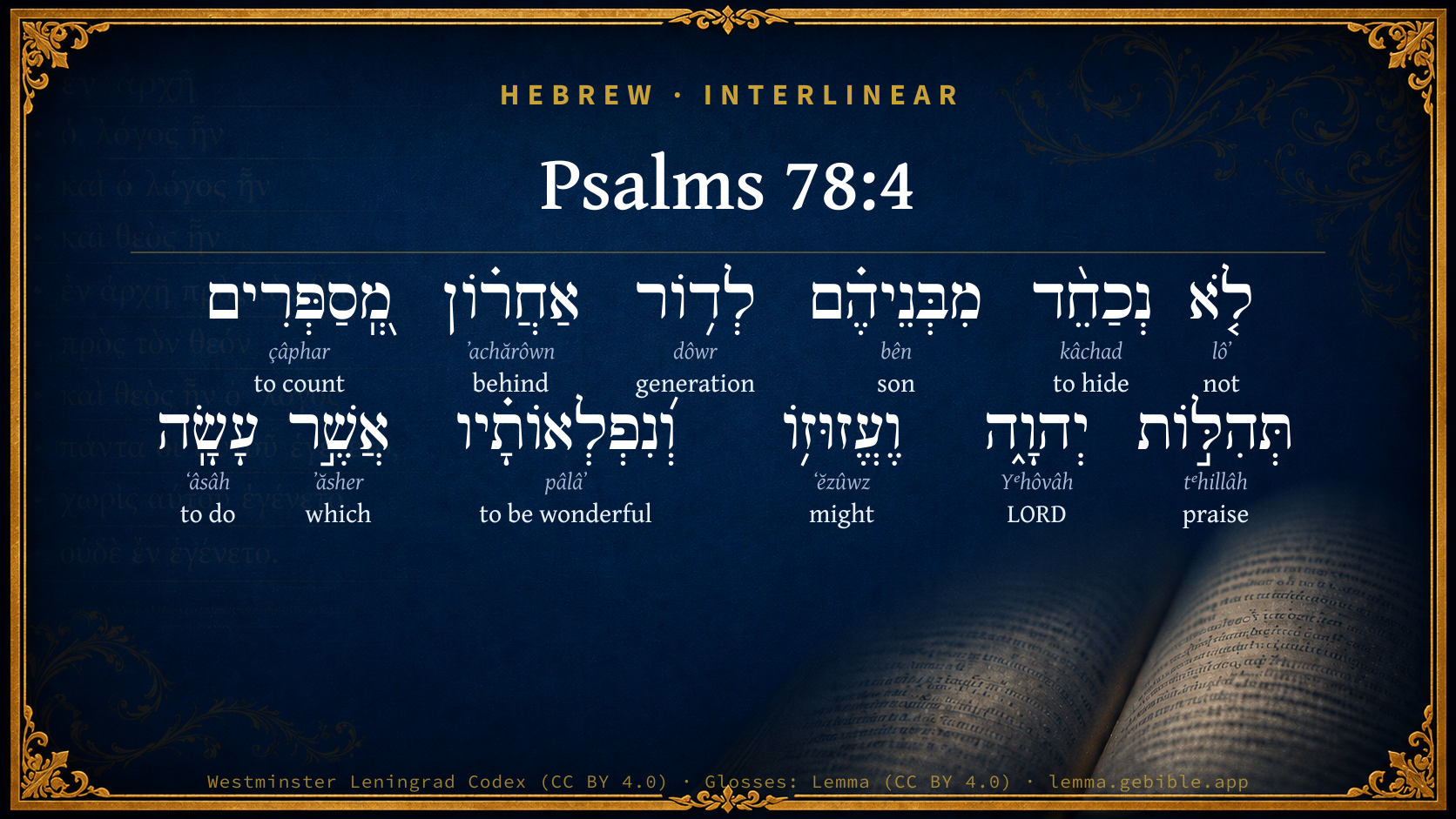
  1. לֹ֤א lôʼ H3808 “not” Particle, Negative
  2. נְכַחֵ֨ד kâchad H3582 “to hide” Verb, Piel, Imperfect, 1st Person, Common, Plural
  3. מִבְּנֵיהֶ֗ם bên H1121 “from · sons · their” Preposition + Noun, Common, Masculine, Plural, Construct + Suffix, Personal, 3rd Person, Masculine, Plural
  4. לְד֥וֹר dôwr H1755 “to/for · generation” Preposition + Noun, Common, Masculine, Singular, Absolute
  5. אַחֲר֗וֹן ʼachărôwn H314 “behind” Adjective, Adjective, Masculine, Singular, Absolute
  6. מְֽ֭סַפְּרִים çâphar H5608 “counting” Verb, Piel, Participle Active, Masculine, Plural, Absolute
  7. תְּהִלּ֣וֹת tᵉhillâh H8416 “praises of” Noun, Common, Feminine, Plural, Construct
  8. יְהוָ֑ה Yᵉhôvâh H3068 “LORD” Noun, Proper
  9. וְ֝נִפְלְאוֹתָ֗יו pâlâʼ H6381 “and · being wonderful · him” Conjunction + Verb, Niphal, Participle Active, Feminine, Plural, Construct + Suffix, Personal, 3rd Person, Masculine, Singular
  10. אֲשֶׁ֣ר ʼăsher H834 “which” Particle, Relative
  11. עָשָֽׂה ʻâsâh H6213 “to do” Verb, Qal, Perfect, 3rd Person, Masculine, Singular

About this verse

These counts appear in no published source. They are computed here, from the morphology-tagged text and Lemma’s own curated glosses. What Lemma adds →

12
words
12
distinct lemmas
Wisdom
section

Notable vocabulary

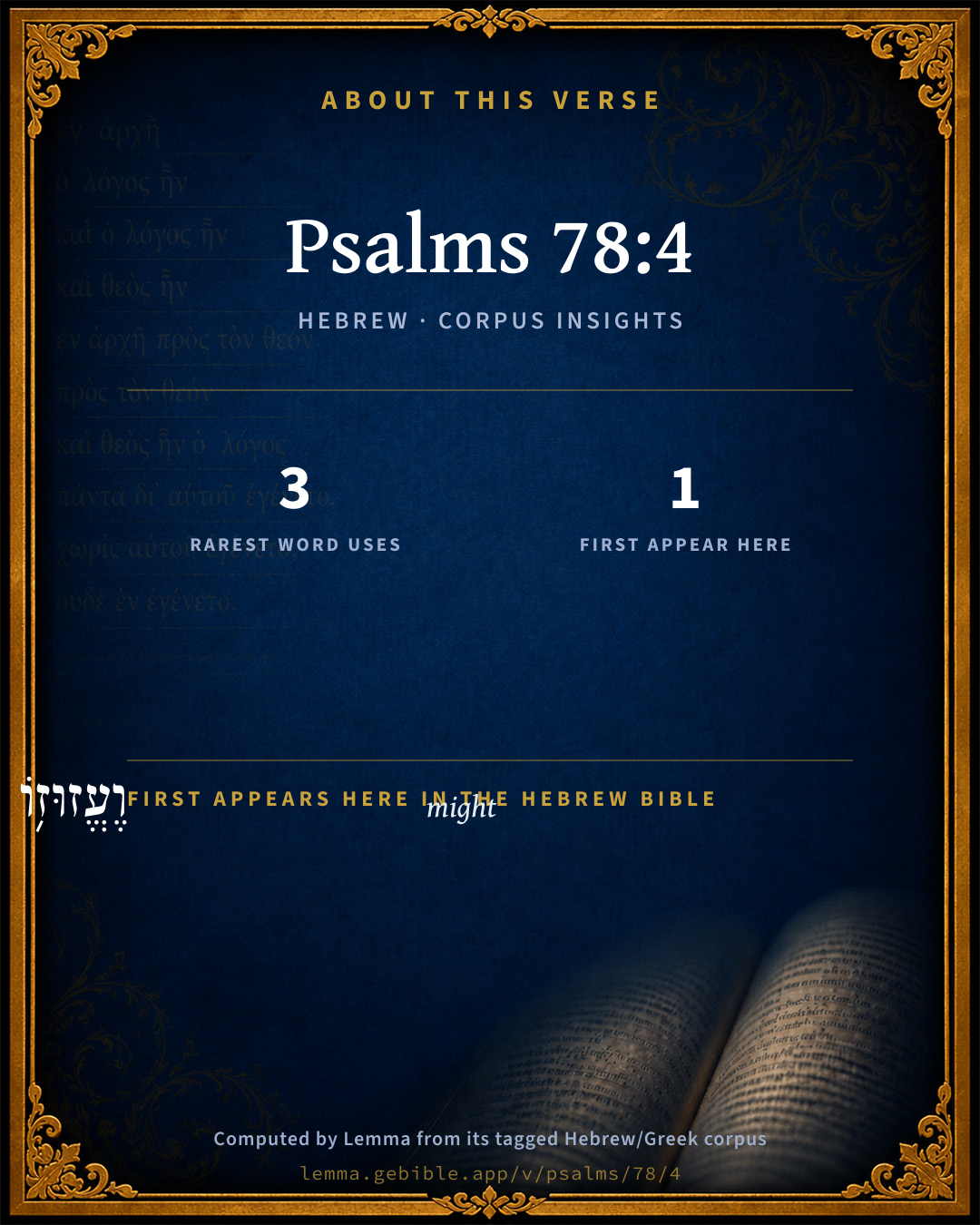
The rarest word here is וֶעֱזוּז֥וֹ might H5807 — appearing just 3 times in the whole Hebrew Bible.

First appearance in Scripture

This word makes its first canonical appearance in the Hebrew Bible here:

  • וֶעֱזוּז֥וֹ might H5807

Shared distinctive vocabulary

וֶעֱזוּז֥וֹ might H5807 occurs in 3 verses of the Hebrew Bible. Also found in:

Grammatical profile

  • 4 verbs
  • 5 nouns
  • 1 adjective
  • 2 particles

Verb forms

  • נְכַחֵ֨ד Piel · Imperfect
  • מְֽ֭סַפְּרִים Piel · Participle Active
  • וְ֝נִפְלְאוֹתָ֗יו Niphal · Participle Active
  • עָשָֽׂה Qal · Perfect

Hebrew & Septuagint length

In English translation the verse runs 28 words from the Hebrew and 29 from the Septuagint (LXX English) — closely comparable.

A rough comparison of the two English renderings, which tokenize alike — not a word-level alignment.

Word counts can differ between the Hebrew and the Greek without any difference in meaning — e.g. the Hebrew direct-object marker אֵת has no separate Greek word, and Greek often adds the article ὁ.

Cross-references

16

Topical passages linked to Psalms 78:4 in the Treasury of Scripture Knowledge — connected by theme and wording, ordered by reader-vote popularity; previews shown in the World English Bible.

  • Deuteronomy 11:19 You shall teach them your children, talking of them, when you sit in your house, and when you walk by the way, and when you lie down, and when you rise up.
  • Deuteronomy 4:9 Only take heed to yourself, and keep your soul diligently, lest you forget the things which your eyes saw, and lest they depart from your heart all the days of your life; but make them known to your children and your children's children;
  • Psalms 145:4–6 One generation will commend your works to another, And will declare your mighty acts.
  • Joel 1:3 Tell your children about it, And have your children tell their children, And their children, another generation.
  • Deuteronomy 6:7 and you shall teach them diligently to your children, and shall talk of them when you sit in your house, and when you walk by the way, and when you lie down, and when you rise up.
  • Psalms 71:17–18 God, you have taught me from my youth. Until now, I have declared your wondrous works.
  • Psalms 10:1–5 Why do you stand far off, Yahweh? Why do you hide yourself in times of trouble?
  • Joshua 4:6–7 that this may be a sign among you, that when your children ask in time to come, saying, What do you mean by these stones?
  • Exodus 13:14 It shall be, when your son asks you in time to come, saying, 'What is this?' that you shall tell him, 'By strength of hand Yahweh brought us out from Egypt, from the house of bondage;
  • Joshua 4:21–24 He spoke to the children of Israel, saying, When your children shall ask their fathers in time to come, saying, What mean these stones?
  • Exodus 12:26 It will happen, when your children ask you, 'What do you mean by this service?'
  • Exodus 13:8 You shall tell your son in that day, saying, 'It is because of that which Yahweh did for me when I came forth out of Egypt.'
  • Psalms 9:14 That I may show forth all your praise. In the gates of the daughter of Zion, I will rejoice in your salvation.
  • Psalms 26:7 That I may make the voice of thanksgiving to be heard, And tell of all your wondrous works.
  • Isaiah 63:7–19 I will make mention of the loving kindnesses of Yahweh, [and] the praises of Yahweh, according to all that Yahweh has bestowed on us, and the great goodness toward the house of Israel, which he has bestowed on them according to his mercies, and according to the multitude of his loving kindnesses.
  • Job 15:18 (Which wise men have told From their fathers, and have not hidden it;

Cross-references courtesy of OpenBible.info (CC BY 4.0).

Hebrew and Greek witnesses Masoretic Hebrew ↔ Greek Septuagint

The same verse in the two great witnesses to the Old Testament, shown verse-for-verse.

You’re reading Greek Psalm 77 (Hebrew Psalm 78). The Septuagint counts the superscription, so verse numbers can differ from the Hebrew — chapter-level alignment, not verse-by-verse. Numbering follows Rahlfs.

These are two independent witnesses, not word-aligned to each other, and the Septuagint is shown in lemma (dictionary) form.

Hebrew Psalms 78:4 Masoretic · Westminster Leningrad Codex

לֹ֤א נְכַחֵ֨ד מִבְּנֵיהֶ֗ם לְד֥וֹר אַחֲר֗וֹן מְֽ֭סַפְּרִים תְּהִלּ֣וֹת יְהוָ֑ה וֶעֱזוּז֥וֹ וְ֝נִפְלְאוֹתָ֗יו אֲשֶׁ֣ר עָשָֽׂה

We will not hide them from their children, Telling to the generation to come the praises of Yahweh, His strength, and his wondrous works that he has done.

World English Bible · Public Domain

Greek LXX Greek Psalm 77:4 Septuagint · lemma form

οὐ κρύπτω ἀπό ὁ τέκνον αὐτός εἰς γενεά ἕτερος ἀποἀγγέλλω ὁ αἴνεσις ὁ κύριος καί ὁ δυναστεία αὐτός καί ὁ θαυμάσιος αὐτός ὅς ποιέω

They were not hid from their children to a second generations; the fathers declaring the praises of the Lord, and his mighty acts, and his wonders which he wrought.

LXX2012 (modern English Septuagint) · Public Domain

Hebrew: Westminster Leningrad Codex (CC BY 4.0). Greek: Septuagint (public domain); English from LXX2012 (modern English Septuagint) (Public Domain). How the Septuagint differs from the Hebrew →

Commentary

Notes on Psalms 78:4 from classic Christian and Jewish commentators (each source and its license shown beneath its notes). The classic Christian expositions comment on the surrounding passage and are grouped to its opening verse, so a note may address several verses; the Jewish commentaries on the Tanakh (Rashi and others) are per-verse, so they appear only where the commentator wrote on this verse.

Lemma curates 59 commentaries, every one of them public domain or Creative Commons licensed, each selected and text-cleaned for this edition rather than reprinted as found. About our sources →

Trapp's Complete Commentary

John Trapp

Psa 78:4 We will not hide [them] from their children, shewing to the generation to come the praises of the LORD, and his strength, and his wonderful works that he hath done.

Ver. 4. We will not hide them from their children] The manifestation of the Spirit is given to every man to profit with, 1Co 12:7, neither is any one born (much less born again) for himself; but must be as useful as may be in his generation,

Paulum sepultae distat inertiae

Celata virtus - (Hor.).

The praises of the Lord] The praise worthy acts of God for his people, and against their enemies; for these two are not sundered, Php 1:28.

John Trapp, A Commentary or Exposition upon All the Books of the Old and New Testament (1647–1656) — public domain. Text from a community e-Sword module.

The Biblical Illustrator

Joseph S. Exell

Psa_78:4

We will not hide them from their children.

Children

I. The interesting objects of our solicitude mentioned. Consider--

1. The love which welcomes them.

2. The evils which surround them.

3. The possibilities which await them.

II. The sacred duties which we owe to them.

1. They are weak; we must protect them (Gen_33:1-20.).

2. They are helpless; we must provide for them.

3. They are ignorant; we must instruct them.

III. The object which we hope shall be realized.

1. The knowledge of truth shall be perpetuated.

2. Our children will put their hope in God.

3. They shall be better than their fathers. (The Study.)

The knowledge of national benefits and deliverances transmitted to the rising generation

I. Point out a few of those things which we have heard and known, or which our fathers have told us, and which we, with the psalmist, may style The praises of the Lord, and His strength, and the wonderful works that He hath done.

II. Recommend and enforce the resolution in my text. The great Gad may justly expect that we acquaint ourselves with His ways and works; that we endeavour to trace Him in the natural, providential, and civil world, and in the world of grace; and that we treasure up in our hearts each signal deliverance He hath wrought. But a genuine disciple of Jesus, and a child of God, will neither wish to live nor to die unto himself. What we have known of the wonderful works of God in favour of our fathers, of ourselves, or of ages to come, we should transmit to the rising generation. I am apprehensive that one cause of the languishing state of public spirit, and of pious zeal, in this age, is the want of knowledge. Had the minds of persons in the present day been early and deeply impressed with the conduct of God to this highly favoured country, the privileges they enjoy would be more dear and important in their esteem, and patriotism would not be that empty boast which we have too much reason to apprehend it now is. With the knowledge of those things we have heard, and known, and which our fathers have told us, transmit, as far as possible, the things themselves. On our part let nothing be left untried, that they who are soon to fill our places in civil and religious life, and that their descendants, even to the worlds last period, may stand forth, under God, the guardians of each important and sacred right, and approve themselves the unshaken friends of their country, of Jesus, and of the Gospel. (N. Hill.)

The transmission of Scriptural truth to posterity

The text presents four grand arguments why we should zealously devote ourselves to this duty.

I. The peculiar character of scriptural truth. Consider it--

1. As a revelation of God.

2. As a law of duty.

3. As a history of Gods conduct.

II. The manner in which we have been put into its possession. As we have received the knowledge of God and the way of happiness from our fathers, who showed us by their lips and their lives the way of happiness, we are bound, by every consideration of gratitude, to give to others what has been so freely given to us.

III. The divine arrangements as to its transmission. Fathers are commanded to make known the commands and the character of Gad to their children. Various powerful reasons might be assigned for this infinitely wise arrangement. The young come into our world with an awfully strong bias to evil, and it is unspeakably important to check the workings of their depravity by presenting the most powerful considerations which tend to the accomplishment of such an end. Nor must it be forgotten here, that, as immortal creatures, the character of man is usually formed in youth for eternity.

IV. The great results which it is intended to accomplish. Every individual who receives the knowledge of God, in the love of it, becomes a moral sun, diffusing light and warmth around him, the glorious effects of which shall be felt through all the changes of time, and in eternity itself. (J. Belcher.)

The true method by which generation helps generation

I. True religious knowledge is a thing imparted to man. It is that which we have heard and known, and our fathers have told us. It is not inbred nor discovered. Without denying that man has a capacity to discover God as the Creator, all history shows that he has never done so; and as to His redeeming capacity, that, in the nature of the case, transcends all human conceptions. As sinners, this is the knowledge of God we require, and it involves the former. And we have it, not by intuition or discovery, but by impartation. It has been transmitted to us through many generations.

1. They have handed it down to us by inspired documents.

2. They have handed it down to us by their own teaching.

II. True religious knowledge is imparted to us, not to monopolize, but to transmit (Psa_78:5-8). The transmittory arrangement implies--

1. That the children of every generation have a capacity for receiving this knowledge. There is no danger of teaching religion boo soon.

2. That the children of every generation will require this knowledge. Coming generations may not require our philosophies, poetries, and governments; they may out-grow our sciences, and despise our civilization, but they will require our religion. Though they may not require our lamps, they will need our sun.

3. The eternal harmony of all Gods operations. The Eternal does not contradict Himself. The first Divine act on earths theatre will harmonize with the last. The whole will form one great anthem filling eternity with music.

III. True religious knowledge is to be thus transmitted in order to elevate posterity.

1. The grand result aimed at is threefold--

(1) Rightness of intellect. Not forget the works of God. A constant recognition of Divine agency.

(2) Rightness of heart. That they might set their hope in God, and set their heart aright; the heart fixed on God as the supreme Good.

(3) Rightness of conduct. Keep His commandments. To bring immortal man to this sublime rightness--this rightness in thought, feeling, and action, is the grand and ultimate end of all this teaching. Glorious end!

2. It is coming slowly but surely. Humanity is rising, and every true thought arid virtuous act helps it on. (Homilist.)

The Biblical Illustrator, edited by Joseph S. Exell (c. 1880s–1900s) — public domain. Text from a community e-Sword module.

The Treasury of David

Charles H. Spurgeon

Ver. 4. We will not hide them from their children. Our negligent silence shall not deprive our own and our father's offspring of the precious truth of God, it would be shameful indeed if we did so.

Shewing to the generation to come the praises of the Lord. We will look forward to future generations, and endeavour to provide for their godly education. It is the duty of the church of God to maintain, in fullest vigour, every agency intended for the religious education of the young; to them we must look for the church of the future, and as we sow towards them so shall we reap. Children are to be taught to magnify the Lord; they ought to be well informed as to his wonderful doings in ages past, and should be made to know

his strength and his wonderful works that he hath done. The best education is education in the best things. The first lesson for a child should be concerning his mother's God. Teach him what you will, if he learn not the fear of the Lord, he will perish for lack of knowledge. Grammar is poor food for the soul if it be not flavoured with grace. Every satchel should have a Bible in it. The world may teach secular knowledge alone, it is all she has a heart to know, but the church must not deal so with her offspring; she should look well to every Timothy, and see to it that from a child he knows the Holy Scriptures. Around the fireside fathers should repeat not only the Bible records, but the deeds of the martyrs and reformers, and moreover the dealings of the Lord with themselves both in providence and grace. We dare not follow the vain and vicious traditions of the apostate church of Rome, neither would we compare the fallible record of the best human memories with the infallible written word, yet would we fain see oral tradition practised by every Christian in his family, and children taught cheerfully by word of mouth by their own mothers and fathers, as well as by the printed pages of what they too often regard as dull, dry task books. What happy hours and pleasant evenings have children had at their parents knees as they have listened to some "sweet story of old." Reader, if you have children, mind you do not fail in this duty.

Ver. 4. We will not hide from their children, etc. Thou must not only praise God thyself, but endeavour to transmit the memorial of his goodness to posterity. Children are their parent's heirs; it were unnatural for a father, before he dies, to bury up his treasure in the earth where his children should not find or enjoy it; now the mercies of God are not the least part of a good man's treasure, nor the least of his children's inheritance, being both helps to their faith, matter for their praise, and spurs to their obedience. "Our fathers have told us what works thou didst in their days, how thou didst drive out the heathen" etc., Ps 44:1-2; from this they ground their confidence, Ps 44:4, "Thou art my King, O God; command deliverances for Jacob, " and excite their thankfulness, Ps 44:8, "In God we boast all the day long, and praise thy name for ever." Indeed, as children are their parents heirs, so they become in justice liable to pay their parents' debts: now the great debt which the saint at death stands charged with, is that which he owes to God for his mercies, and, therefore, it is but reason he should tie his posterity to the payment thereof. Thus mayest thou be praising God in heaven and earth at the same time. William Gurnall.

Ver. 4-6. The cloth that is dyed in the wool will keep colour best. Disciples in youth will prove angels in age. Use and experience strengthen and confirm in any art or science. The longer thy child hath been brought up in Christ's school, the more able he will be to find out Satan's wiles and fallacies, and to avoid them. The longer he hath been at the trade the more skill and delight will he have in worshipping and enjoying the blessed God. The tree when it is old stands strongly against the wind, just as it was set when it was young.

The children of Merindal so answered one another in the matters of religion, before the persecuting Bishop of Cavailon, that a bystander said unto the bishop, I must needs confess I have often been at the disputations of the doctors in the Sorbonne, but I never learned so much as by these children. Seven children at one time suffered martyrdom with Symphrosia, a godly matron, their mother. Such a blessing doth often accompany religious breeding; therefore Julian the apostate, to hinder the growth and increase of Christianity, would not suffer children to be taught either human or divine learning.

Philip was glad that Alexander was born whilst Aristotle lived, that he might be instructed by Aristotle in philosophy. It is no mean mercy that thy children are born in the days of the gospel, and in a valley of vision, a land of light, where they may be instructed in Christianity. Oh, do not fail, therefore, to acquaint thy children with the nature of God, the natures and offices of Christ, their own natural sinfulness and misery, the way and means of their recovery, the end and errand for which they were sent into the world, the necessity of regeneration and a holy life, if ever they would escape eternal death! Alas! how is it possible they should ever arrive at heaven if they know not the way thither?

The inhabitants of Mitylene, sometime the lords of the seas, if any of their neighbours revolted, did inflict this punishment, -- they forbade them to instruct their children, esteeming this a sufficient revenge. --(Aelian.) Reader, if thou art careless of this duty, I would ask thee what wrong thy children have done thee that thou shouldest revenge thyself by denying them that which is their due. I mean pious instruction.

The Jewish rabbis speak of a very strict custom and method for the instruction of their children, according to their age and capacity. At five years old they were filii legis, sons of the law, to read it. At thirteen they were filli praecepti, sons of the precept, to understand the law. At fifteen they were Talmudistae, and went to deeper points of the law, even to Talmudic doubts. As thy children grow up, so do thou go on to instruct them in God's will. They are "born like the wild ass's colt, "Job 11:12 --that is, unruly, foolish, and ignorant. We often call a fool an ass, but here it is a "wild ass's colt, "which is most rude, unruly, and foolish. How, then, shall thy ignorant children come to know God or themselves without instruction?

Thy duty is to acquaint thy children with the works of God. Teach them his doings as well as his sayings. "Take heed to thyself, lest thou forget the things which thine eyes have seen: but teach them thy sons, and thy sons' sons, "De 4:9. God's wonders should be had in everlasting remembrance. "He hath made his wonderful works to be remembered, "Ps 109:4. Now, one special way to do this is by writing them in our children's memories, hereby they are transmitted to posterity. This was the godly practice of the patriarchs, to instruct their children concerning the creation of the world, transgression of man, destruction of the old world, God's providence, the Messiah to be revealed, and the like. The parents' mouths were large books, in which their children did read the noble acts of the Lord. The precept is here urged (Ps 78:2-7) upon a double ground, partly for God's praise, in the perpetuity of his worthy deeds: his words are of great weight, and therefore, as curious pictures or precious jewels, must in memory of him be bequeathed from father to son whilst the world continueth. If they are written on paper or parchment they may perish (and is it not a thousand pities that such excellent records should be lost?); but if they be written by fathers successfully on their children's hearts, no time shall blot or wear them out, Ex 12:26-27. Therefore, as the rabbis observe, the night before the passover the Jews (to keep God's mercies in memory to his honour) were wont to confer with their children on this wise. The child said, Why is it called the passover? The father said, Because the angel passed over us when it slew the Egyptians, and destroyed us not. The child said, Why do we eat unleavened bread? The father answered, Because we were forced to hasten out of Egypt. The child said, Why do we eat bitter herbs? The father answered, To mind us of our afflictions in Egypt.

But the duty is also urged, partly for their own profit, Ps 78:7, That they might set their hope in God, etc. Acquaintance with God's favour will encourage their faith; knowledge of his power will help them to believe his promise. Reader, obedience to this precept may tend much to thy own and thy children's profit. By teaching thy children God's actions, thou wilt fix them the faster, and they will make the greater impression, upon thy own spirit. A frequent mention of things is the best art of memory: what the mouth preacheth often the mind will ponder much. Besides, it may work for thy children's weal; the more they be acquainted with the goodness, wisdom, power, and faithfulness of God which appear in his works, the more they will fear, love, and trust him. George Swinnock.

Ver. 4. A good resolution, and a blessed result. C. D.

Ver. 4.

I. What is to be made known? The praises of the Lord;

his strength and his wonderful works.

II. To whom are they to be made known? To the

generations to come.

III. By whom? Parents--one generation to another.

IV. How made known?

1. By hiding nothing.

2. By declaring everything God has done. G. R.

Psalms 78:5*

Ver. 4-6. See Psalms on "Ps 78:4" for further information.

Ver. 4-6. See Psalms on "Ps 78:4" for further information.

Charles H. Spurgeon's The Treasury of David (1869–1885) — public domain. Psalms only. Text from a community e-Sword/MySword module.

Joseph Benson's Commentary

Psa 78:4-5. Showing the praises of the Lord — His glorious and praiseworthy actions, as the following words explain it. For he established a testimony in Jacob — That is, his law, as it is called in the next clause; which is very often termed a testimony, because it is a witness between God and men, declaring both the duties which God expects from man, and the promises and blessings which man, in the performance of his duty, may expect from God. This is justly put in the first place as the chief of all the following mercies, and the foundation of their temporal and spiritual prosperity. Which he commanded, &c. — Which testimony, or law, God revealed to them, not for their own private use merely or chiefly, but for the benefit of all their posterity, to whom their parents were obliged to teach it, and who were required to hear, read, and study it.

Joseph Benson's Commentary on the Old and New Testaments (1811–1818) — public domain. Text from a community e-Sword module.

J. A. Alexander on Psalms

Joseph Addison Alexander

4. (Psa 78:4) We will not hide (them) from their sons, to an after generation recounting the praises of Jehovah, and his strength, and his wonders which he did. The psalmist here recognises the obligation resting on the individual parent, but above all on the church as such, to continue the transmission of this knowledge to the latest generations.

Joseph Addison Alexander, The Psalms Translated and Explained (1850) — public domain. Text from a community e-Sword module.

Adam Clarke's Commentary

Verse 4. We will not hide them] In those ancient times there was very little reading, because books were exceedingly scarce; tradition was therefore the only, or nearly the only, means of preserving the memory of past events. They were handed down from father to son by parables or pithy sayings, and by chronological poems. This very Psalm is of this kind, and must have been very useful to the Israelites, as giving instructions concerning their ancient history, and recounting the wonderful deeds of the Almighty in their behalf.

Adam Clarke's Commentary on the Bible (1810–1826) — public domain. Text from a community e-Sword/MySword module.

John Calvin's Commentaries

4. We will not conceal them from their children in the generation to come. Some take the verb נכחד, nechached, in the nephil conjugation, and translate it, they are not concealed or hidden. But it ought, according to the rules of grammar, to be resolved thus: — We will not conceal them from our posterity, implying, that what we have been taught by our ancestors we should endeavor to transmit to their children. By this means, all pretense of ignorance is removed; for it was the will of God that these things should be published from age to age without interruption; so that being transmitted from father to child in each family, they might reach even the last family of man. The end for which this was to be done is shown — that they might celebrate the praises of Jehovah, in the wonderful works which he hath done

John Calvin's Commentaries (1540-1563) — public domain. Text from the Calvin Translation Society English edition (1840s-50s) via the Christian Classics Ethereal Library (ccel.org). Calvin's coverage is partial (roughly two-thirds of the Bible); uncommented books and verses are honest gaps, never fabricated. The 19th-century editor's footnotes and remarks are omitted so the notes are faithfully Calvin's own voice.

John Gill's Exposition

We will not hide them from their children,.... The children of the Jewish fathers, but faithfully publish and declare them, as Christ and his apostles did; or the children of God and Christ, their spiritual seed and offspring:

showing to the generation to come; and so in all successive ages, by the ministration of the word, and the Spirit attending it; see Psa 22:30,

the praises of the Lord; what he has done in predestination, redemption, and effectual calling, which is to the praise of the glory of his grace, Eph 1:6, and so all other truths of the Gospel, which are to the praise of Father, Son, and Spirit, and engage men to show it forth:

and his strength displayed; in Christ, the man of his right hand, made strong for himself, and in the redemption wrought out by him, as well as in the conversion of sinners by his mighty grace, and in the preservation of them by his power:

and his wonderful works that he hath done; in providence and grace; the miracles wrought by Christ, which were the wonderful works given him to finish, as proofs of his deity and Messiahship, and are testified in the Gospel for the confirmation of it; and especially the wonders of redeeming love, and calling grace, which are peculiarly to be ascribed unto him as the works his hands have wrought, and the wonderful decrees of God he made in eternity concerning these things.

John Gill's Exposition of the Whole Bible (1746–1763) — public domain (CC PDM 1.0). Text via the HelloAO Bible API.

Albert Barnes' Notes on the Bible

We will not hide them from their children - From their descendants, however remote. We of this generation will be faithful in handing down these truths to future times. We stand between past generations and the generations to come. We are entrusted by those who have gone before us with great and important truths; truths to be preserved and transmitted in their purity to future ages. That trust committed to us we will faithfully discharge. These truths shall not suffer in passing from us to them. They shall not be stayed in their progress; they shall not be corrupted or impaired. This is the duty of each successive generation in the world, receiving, as a trust, from past generations, the result of their thoughts, their experience, their wisdom, their inventions, their arts, their sciences, and the records of their doings, to hand these down unimpaired to future ages, combined with all that they may themselves invent or discover which may be of use or advantage to the generations following.

Shewing to the generation to come the praises of the Lord - The “reasons” why he should be praised, as resulting from his past doings - and the wags in which it should be done. We will keep up, and transmit to future times, the pure institutions of religion.

And his strength - The records of his power.

And his wonderful works that he hath done - In the history of his people, and in his many and varied interpositions in their behalf.

Albert Barnes' Notes on the Bible (1834–1885) — public domain. Text from a community e-Sword/MySword module.

Matthew Poole's English Annotations

The praises, i.e. his glorious and praiseworthy actions, as the following words explain it.

Matthew Poole's English Annotations on the Holy Bible (1683–1685) — public domain. Text from a community e-Sword/MySword module.

The Pulpit Commentary

We will not hide them from their children. They shall still be handed down in the same way. We of this generation will still continue the practice of handing down, by word of mouth, to the next generation, how God has dealt with Israel. Asaph"s psalms were written, it must be remembered, to be recited in the services of the sanctuary. (comp. 2Ch_29:30) Showing to the generation to come the praises of the Lord; i.e. the actions for which he deserves praise. And his strength, and his wonderful works that he hath done (comp. vers. 12-16, and vers. 23-55).

Religious education.

The first eight verses of this psalm have much to say upon this great question. Upon

I ITS AUTHORITY. "He commanded our fathers". (ver. 5; cf. De 6) That which reason, conscience, and experience would alike teach, the authority of God confirms by direct command. And it is at our peril that we neglect this. The sanctions that accompany the command have not to wait for the future life for their fulfilment; they are visible everywhere in the present, as they have been in all the past.

II ITS IMPORTANCE. This entire psalm is the sad record of the results of neglecting this command (see vers. 8, 40).

III ITS METHOD.

1. By entrusting this duty mainly to the parents (see ver. 5) those who might naturally be expected to feel the chief interest in, and responsibility for, their children.

2. Adopting the most interesting mode of instruction the parabolic (ver.2); the historic (ver. 4).

3. Charging the children with the responsibility of transmission (vers. 5, 6).

IV ITS HIGH AND HOLY PURPOSE. (Vers. 7, 8) S.C.

Vers. 4, 5. Our mission to the coming generation.

The interest of the Old Testament in children is seldom worthily recognized. The Divine confidence is felt in Abraham on this singular ground, "For I know him, that he will command his children and his household after him, and they shall keep the way of the Lord, to do justice and judgment". (Gen_18:19) The meaning of the most significant rite of the Mosaic system the Passover was to be carefully explained to the "children." The command is given concerning the holy laws, "Thou shalt teach them diligently unto thy children, and shalt talk of them when thou sittest in thine house, and when thou walkest by the way, and when thou liest down, and when thou risest up". (Deu_6:7) The psalmist speaks thus of his work: "This shall be written for the generation to come; and the people which shall be created shall praise the Lord". (Psa_102:18) And the prophets repeat after Isaiah, and say, "The father to the children shall make known thy truth". (Isa_38:19) Dr. Horace Bushnell, in a very striking way, calls the religious teaching of religious families" the out-populating of the Christian stock." There is always hope for the new generation; but the foundation of that hope is the righteousness and faithfulness of this generation. Then they truly work for the children who work to fit the parents for influencing the children. Our mission to our children is if we follow the psalm

I TO TEACH THEE GOD"S DOINGS AND GOD"S WILL. This mission is entrusted first to parents. Only as civilization involves parental inabilities and disabilities, can the duty be delegated to servants, or to Sunday school teachers. The things we have to teach our children are:

1. God in history.

2. God in covenant.

3. God in law.

4. God in redemption.

Our power to do our work worthily depends on our own spiritual apprehensions. And they must not be left to pick up religious knowledge. God requires that we teach them.

II TO HELP THEM TO BEGIN LIVES OF TRUST AND OBEDIENCE. (See ver. 8) This we can do:

1. By commending such lives in the grace and beauty of our own. It is not enough to "allure to brighter worlds;" we can "lead the way.

2. By teaching them the lessons that we may be able to draw from our own experience.

3. By enforcing the warnings which are suggested by the ancient histories( see ver. 9).

4. By patiently aiding them in the formation of good religious habits.

III TO MAKE THEM FEEL THEIR RESPONSIBILITY TO THE GENERATION FOLLOWING THEM. The object set before us, in teaching our children, is (ver. 7), "to the intent that, when they come up" into their fatherhoods and motherhoods, "they might show their children the same." So our influence should be repeating itself, generation after generation. Our faithfulness to our mission may put a new and nobler impress on the coming generations. R.T. (see Psa_145:4)

The Pulpit Commentary (1880–1919), ed. H.D.M. Spence-Jones & Joseph S. Exell — public domain. Text from a community e-Sword module.

Rashi

Rabbi Shlomo Yitzchaki (Rashi)

We shall not hide from their sons We, too, shall not hide [these words] from our fathers’ sons by not letting them know what they told us.

Rashi on the Tanakh — English translations: “The Judaica Press complete Tanach with Rashi, translated by A. J. Rosenberg” (CC BY 4.0); “Pentateuch with Rashi's commentary by M. Rosenbaum and A.M. Silbermann, 1929-1934” (public domain); “The Metsudah Tanach series, Lakewood, N.J” (CC BY 4.0); and “The Book of Joshua, Metsudah Publications, 1997” (CC BY 4.0). Text via Sefaria.

Lesson kit

Teaching starters — assembled from the data on this page, not authored interpretation. Every prompt links to the verse data it draws on. Edit before teaching.

Psalms, in the Wisdom, opens this verse with 12 words (12 distinct Hebrew lemmas). Its most distinctive word is ʻĕzûwz (“might”). A historical commentator’s framing appears above. Read the whole chapter for the surrounding context.

Discussion questions

  1. The word ʻĕzûwz carries the sense “might.” How does it shape the verse?
  2. This is the first place “might” appears in Scripture (first appears here). What does its debut here establish?
  3. How does Psalms 145:6, which shares the word «might», read alongside this verse?
  4. These translations render this verse differently; the difference is in the English rendering, not the original. What questions does that raise?
  5. «נְכַחֵ֨ד» is a Piel Imperfect verb. How does that grammatical form shape the action described?
  6. Compare how Trapp's Complete Commentary and The Biblical Illustrator read this verse. Where do they agree or differ?

Things to notice

Reading settings

Reading text

Shown beneath each verse's original-language words.

Old Testament
Old Testament edition

Read the OT as the Masoretic Hebrew (MT) or the Greek Septuagint (LXX).

English shown for the Greek Septuagint (in the Hebrew ↔ Greek comparison).

Comparing translations? Open the Compare panel on any verse page to stack up to four side by side.