
Job 14:16

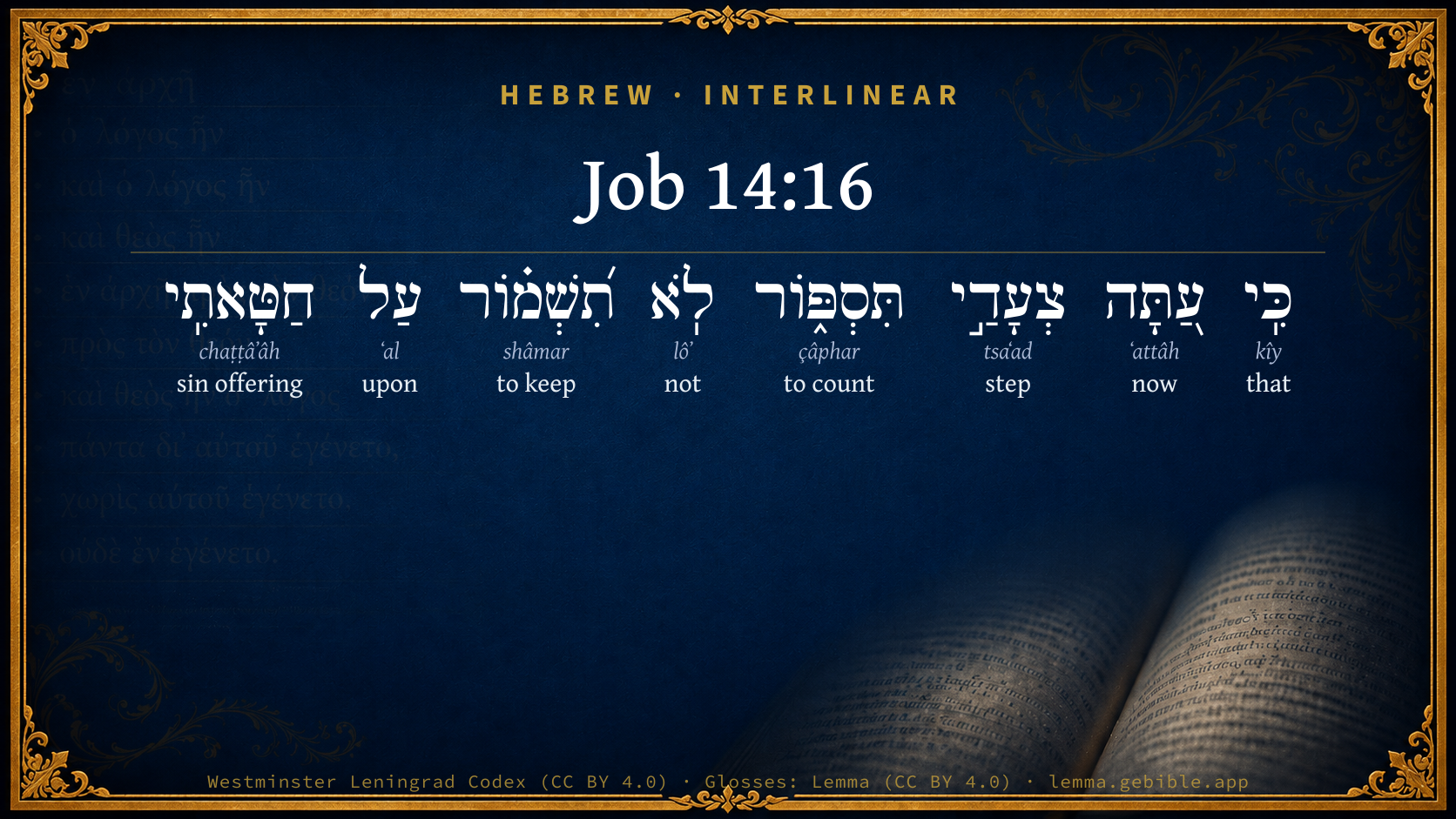
Hebrew (Westminster Leningrad Codex) Job 14:16 appears in the Hebrew Old Testament. The text above is from the Westminster Leningrad Codex. Each word links to its Strong’s number, a concise gloss, and parsing drawn from the Open Scriptures Hebrew Bible morphology. Click any word for its full Brown-Driver-Briggs (BDB) entry.
Download image
Cite this verse

Job 14:16 (World English Bible). Public Domain. Lemma interlinear Bible study tool, https://lemma.gebible.app/v/job/14/16.

Show BibTeX & RIS
BibTeX
RIS
English Translation
But now you number my steps. Don't you watch over my sin?
World English Bible · Public Domain
Download a study sheet

One document with this verse’s original text, its word-by-word gloss line, the meaning frame, cross-references with their text, attributed commentary, and full source and license credits — printable, and it pastes into notes with its structure intact.

This verse Autodidact and up

Study sheet (.html) Plain text (.txt)

A passage Seminary Student

Up to 50 verses in one chapter. A passage sheet keeps up to 6 commentary sources and 12 cross-references per verse, in the order this page ranks them, and says so on the sheet whenever that leaves anything out. Ask for a single verse and you get the Autodidact verse sheet above.

Everything on this page stays free to read, with no account — the sheet is a download of what is already on screen, not access to it.

Want to remove ads? Support Godless Engineer
Compare translations 3

The same verse in 3 English versions, stacked beneath the original-language interlinear above. Click any original word for its lexicon entry.

Each is an independent rendering of the whole verse — the interlinear is not word-aligned to these translations.

Highlighted words mark where these versions differ — a whole-verse word diff, not a word-by-word alignment.

  • World English Bible Public Domain
    But now you number my steps. Don't you watch over my sin?
  • King James Version Public Domain
    For now thou numberest my steps: dost thou not watch over my sin?
  • unfoldingWord Literal Text CC BY-SA 4.0
    For then you would number my steps; you would not watch over my sin.

unfoldingWord Literal Text — © unfoldingWord, licensed CC BY-SA 4.0. Word-aligned USFM3 via Door43 (git.door43.org/unfoldingWord/en_ult).

Versions to compare (up to 4)

3 of 4 selected

Show all 18 translations

Every available English version of this verse, each an independent rendering of the whole verse.

  • World English Bible Public Domain
    But now you number my steps. Don't you watch over my sin?
  • Berean Standard Bible Public Domain
    For then You would count my steps, but would not keep track of my sin.
  • Majority Standard Bible Public Domain
    For then You would count my steps, but would not keep track of my sin.
  • King James Version Public Domain
    For now thou numberest my steps: dost thou not watch over my sin?
  • American Standard Version (1901) Public Domain
    But now thou numberest my steps: Dost thou not watch over my sin?
  • Revised Version (1885) Public Domain
    But now thou numberest my steps: dost thou not watch over my sin?
  • Geneva Bible (1599) Public Domain
    But nowe thou nombrest my steppes, and doest not delay my sinnes.
  • Douay-Rheims (1899) Public Domain
    Thou indeed hast numbered my steps, but spare my sins.
  • Young's Literal Translation Public Domain
    But now, my steps Thou numberest, Thou dost not watch over my sin.
  • Literal Standard Version CC BY-SA 4.0
    But now, You number my steps, || You do not watch over my sin.
  • Unlocked Literal Bible CC BY-SA 4.0
    You would number and care for my footsteps; you would not keep track of my sin.
  • unfoldingWord Literal Text CC BY-SA 4.0
    For then you would number my steps; you would not watch over my sin.
  • Darby Bible Public Domain
    For now thou numberest my steps: dost thou not watch over my sin?
  • World Messianic Bible Public Domain
    But now you count my steps. Don’t you watch over my sin?
  • Webster's Bible Public Domain
    For now thou numberest my steps: dost thou not watch over my sin?
  • Free Bible Version CC BY-SA 4.0
    Then you would look after me and wouldn't be watching me to see if I sinned.
  • Bible in Basic English Public Domain
    For now my steps are numbered by you, and my sin is not overlooked.
  • JPS Tanakh (1917) Public Domain
    But now Thou numberest my steps, Thou dost not even wait for my sin;

Literal Standard Version (2020), Covenant Press — licensed CC BY-SA 4.0. Text via the HelloAO Bible API (eBible.org). Unlocked Literal Bible (unfoldingWord) — licensed CC BY-SA 4.0. Text via the HelloAO Bible API (eBible.org). unfoldingWord Literal Text — © unfoldingWord, licensed CC BY-SA 4.0. Word-aligned USFM3 via Door43 (git.door43.org/unfoldingWord/en_ult). Free Bible Version, Dr. Jonathan Gallagher — licensed CC BY-SA 4.0. Text via the HelloAO Bible API (eBible.org).

Word by word

More ways to search: Search by grammar → Find every occurrence → Compare this word →

Practice this passage: Drill this verse → Learn its vocabulary →

About this verse

These counts appear in no published source. They are computed here, from the morphology-tagged text and Lemma’s own curated glosses. What Lemma adds →

8
words
8
distinct lemmas
Wisdom
section

Notable vocabulary

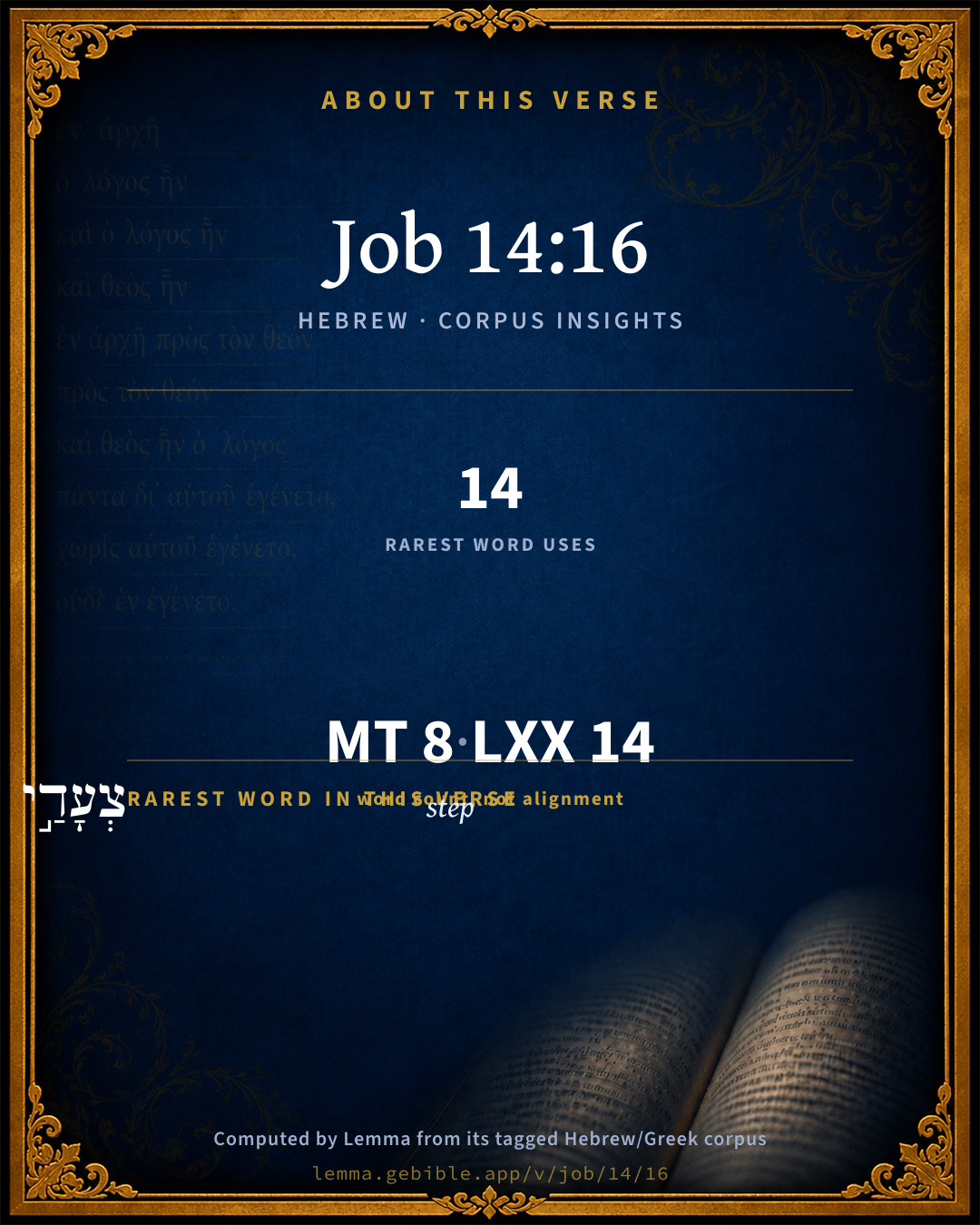
The rarest word here is צְעָדַ֣י step H6806 — appearing just 14 times in the whole Hebrew Bible.

Shared distinctive vocabulary

צְעָדַ֣י step H6806 occurs in 14 verses of the Hebrew Bible. Also found in:

Grammatical profile

  • 2 verbs
  • 2 nouns
  • 1 preposition
  • 1 conjunction
  • 1 adverb
  • 1 particle

Verb forms

  • תִּסְפּ֑וֹר Qal · Imperfect
  • תִ֝שְׁמ֗וֹר Qal · Imperfect

Hebrew & Septuagint length

In English translation the verse runs 12 words from the Hebrew and 15 from the Septuagint (LXX English) — closely comparable.

A rough comparison of the two English renderings, which tokenize alike — not a word-level alignment.

Word counts can differ between the Hebrew and the Greek without any difference in meaning — e.g. the Hebrew direct-object marker אֵת has no separate Greek word, and Greek often adds the article ὁ.

In the original languages it is 8 Hebrew tokens and 14 Greek tokens — but the two are counted differently (Hebrew bundles its prefixes and suffixes into one token; the Greek is in lemma form), so that isn’t a like-for-like length.

Cross-references

10

Topical passages linked to Job 14:16 in the Treasury of Scripture Knowledge — connected by theme and wording, ordered by reader-vote popularity; previews shown in the World English Bible.

  • Job 10:6 That you inquire after my iniquity, And search after my sin?
  • Job 31:4 Doesn't he see my ways, And number all my steps?
  • Job 34:21 "For his eyes are on the ways of a man, He sees all his goings.
  • Psalms 139:1–4 Yahweh, you have searched me, And you know me.
  • Proverbs 5:21 For the ways of man are before the eyes of Yahweh. He examines all his paths.
  • Job 33:11 He puts my feet in the stocks, He marks all my paths.'
  • Jeremiah 32:19 great in counsel, and mighty in work; whose eyes are open on all the ways of the sons of men, to give everyone according to his ways, and according to the fruit of his doings:
  • Job 13:27 You also put my feet in the stocks, And mark all my paths. You set a bound to the soles of my feet:
  • Psalms 56:6 They conspire and lurk, Watching my steps, they are eager to take my life.
  • Job 10:14 If I sin, then you mark me. You will not acquit me from my iniquity.

Cross-references courtesy of OpenBible.info (CC BY 4.0).

Hebrew and Greek witnesses Masoretic Hebrew ↔ Greek Septuagint

The same verse in the two great witnesses to the Old Testament, shown verse-for-verse.

These are two independent witnesses, not word-aligned to each other, and the Septuagint is shown in lemma (dictionary) form.

Hebrew Job 14:16 Masoretic · Westminster Leningrad Codex

כִּֽי עַ֭תָּה צְעָדַ֣י תִּסְפּ֑וֹר לֹֽא תִ֝שְׁמ֗וֹר עַל חַטָּאתִֽי

But now you number my steps. Don't you watch over my sin?

World English Bible · Public Domain

Greek LXX Job 14:16 Septuagint · lemma form

ἀριθμέω δέ ἐγώ ὁ ἐπιτήδευμα καί οὐ μή παραἔρχομαι σύ οὐδείς ὁ ἁμαρτία ἐγώ

But you have numbered my devices: and not one of my sins shall escape you?

LXX2012 (modern English Septuagint) · Public Domain

On this verse, Trapp's Complete Commentary discusses the Septuagint’s reading. Read the note in Commentary ↓

Hebrew: Westminster Leningrad Codex (CC BY 4.0). Greek: Septuagint (public domain); English from LXX2012 (modern English Septuagint) (Public Domain). How the Septuagint differs from the Hebrew →

Commentary

Notes on Job 14:16 from classic Christian and Jewish commentators (each source and its license shown beneath its notes). The classic Christian expositions comment on the surrounding passage and are grouped to its opening verse, so a note may address several verses; the Jewish commentaries on the Tanakh (Rashi and others) are per-verse, so they appear only where the commentator wrote on this verse.

Lemma curates 59 commentaries, every one of them public domain or Creative Commons licensed, each selected and text-cleaned for this edition rather than reprinted as found. About our sources →

Matthew Henry's Commentary

Job here returns to his complaints; and, though he is not without hope of future bliss, he finds it very hard to get over his present grievances.

I. He complains of the particular hardships he apprehended himself under from the strictness of God's justice, Job 14:16, Job 14:17. Therefore he longed to go hence to that world where God's wrath will be past, because now he was under the continual tokens of it, as a child, under the severe discipline of the rod, longs to be of age. "When shall my change come? For now thou seemest to me to number my steps, and watch over my sin, and seal it up in a bag, as bills of indictment are kept safely, to be produced against the prisoner." See Deu 32:34. "Thou takest all advantages against me; old scores are called over, every infirmity is animadverted upon, and no sooner is a false step taken than I am beaten for it." Now, 1. Job does right to the divine justice in owning that he smarted for his sins and transgressions, that he had done enough to deserve all that was laid upon him; for there was sin in all his steps, and he was guilty of transgression enough to bring all this ruin upon him, if it were strictly enquired into: he is far from saying that he perishes being innocent. But, 2. He does wrong to the divine goodness in suggesting that God was extreme to mark what he did amiss, and made the worst of every thing. He spoke to this purport, Job 13:27. It was unadvisedly said, and therefore we will not dwell too much upon it. God does indeed see all our sins; he sees sin in his own people; but he is not severe in reckoning with us, nor is the law ever stretched against us, but we are punished less than our iniquities deserve. God does indeed seal and sew up, against the day of wrath, the transgression of the impenitent, but the sins of his people he blots out as a cloud.

II. He complains of the wasting condition of mankind in general. We live in a dying world. Who knows the power of God's anger, by which we are consumed and troubled, and in which all our days are passed away? See Psa 90:7-9, Psa 90:11. And who can bear up against his rebukes? Psa 39:11.

1. We see the decays of the earth itself. (1.) Of the strongest parts of it, Job 14:18. Nothing will last always, for we see even mountains moulder and come to nought; they wither and fall as a leaf; rocks wax old and pass away by the continual beating of the sea against them. The waters wear the stones with constant dropping, non vi, sed saepe cadendo - not by the violence, but by the constancy with which they fall. On this earth every thing is the worse for the wearing. Tempus edax rerum - Time devours all things. It is not so with the heavenly bodies. (2.) Of the natural products of it. The things which grow out of the earth, and seem to be firmly rooted in it, are sometimes by an excess of rain washed away, Job 14:19. Some think he pleads this for relief: "Lord, my patience will not hold out always; even rocks and mountains will fail at last; therefore cease the controversy."

2. No marvel then if we see the decays of man upon the earth, for he is of the earth, earthy. Job begins to think his case is not singular, and therefore he ought to reconcile himself to the common lot. We perceive by many instances, (1.) How vain it is to expect much from the enjoyments of life: "Thou destroyest the hope of man," that is, "puttest an end to all the projects he had framed and all the prospects of satisfaction he had flattered himself with." Death will be the destruction of all those hopes which are built upon worldly confidences and confined to worldly comforts. Hope in Christ, and hope in heaven, death will consummate and not destroy. (2.) How vain it is to struggle against the assaults of death (Job 14:20): Thou prevailest for ever against him. Note, Man is an unequal match for God. Whom God contends with he will certainly prevail against, prevail for ever against so that they shall never be able to make head again. Note further, The stroke of death is irresistible; it is to no purpose to dispute its summons. God prevails against man and he passes away, and lo he is not. Look upon a dying man, and see, [1.] How his looks are altered: Thou changest his countenance, and this in two ways: - First, By the disease of his body. When a man has been a few days sick what a change is there in his countenance! How much more when he has been a few minutes dead! The countenance which was majestic and awful becomes mean and despicable - that was lovely and amiable becomes ghastly and frightful. Bury my dead out of my sight. Where then is the admired beauty? Death changes the countenance, and then sends us away out of this world, gives us one dismission hence, never to return. Secondly, By the discomposure of his mind. Note, The approach of death will make the strongest and stoutest to change countenance; it will make the most merry smiling countenance to look grave and serious, and the most bold daring countenance to look pale and timorous. [2.] How little he is concerned in the affairs of his family, which once lay so near his heart. When he is in the hands of the harbingers of death, suppose struck with a palsy or apoplexy, or delirious in a fever, or in conflict with death, tell him then the most agreeable news, or the most painful, concerning his children, it is all alike, he knows it not, he perceives it not, Job 14:21. He is going to that world where he will be a perfect stranger to all those things which here filled and affected him. The consideration of this should moderate our cares concerning our children and families. God will know what comes of them when we are gone. To him therefore let us commit them, with him let us leave them, and not burden ourselves with needless fruitless cares concerning them. [3.] How dreadful the agonies of death are (Job 14:22): While his flesh is upon him (so it may be read), that is, the body he is so loth to lay down,: it shall have pain; and while his soul is within him, that is, the spirit he is so loth to resign, it shall mourn. Note, Dying work is hard work; dying pangs are, commonly, sore pangs. It is folly therefore for men to defer their repentance to a death-bed, and to have that to do which is the one thing needful when they are really unfit to do any thing: but it is true wisdom by making our peace with God in Christ and keeping a good conscience, to treasure up comforts which will support and relieve us against the pains and sorrows of a dying hour.

Matthew Henry's Commentary on the Whole Bible (1708–1710) — public domain (CC PDM 1.0). Text via the HelloAO Bible API.

Trapp's Complete Commentary

John Trapp

Job 14:16 For now thou numberest my steps: dost thou not watch over my sin?

Ver. 16. For now thou numberest my steps] Or, But now thou numberest, &c., thou keepest an exact account of every sin of mine, of every step that I have trod awry; yea, though it be but some wry motion of my mind (as the Septuagint here translate), so curious art thou and critical in thine observations of mine outstrays, επιτηδευματα. See Job 10:14. But is this Job that speaketh, or some other? How confident was he erewhile, and comfortable in the hope of a glorious resurrection! but now down again upon all four, as we say; and like an aguish man in a great fit of impatience, which holdeth him to the end of the chapter. But for this, who knoweth not that every new man is two men? that in the saints the flesh is ever lusting against the spirit, and the spirit against the flesh? that in the Shulamite is, as it were, the company of two armies maintaining a continual contest? Son 6:13. "I said, I am cast out of thy sight; yet I will look again toward thy holy temple," Jon 2:4. {See Trapp on "Jon 2:4"}

Dost thou not watch over my sin?] This is the same with the former, but without a figure. The Rabbins have a saying, that there is not any doubt in the law but may be resolved by the context: the Scripture is its own interpreter.

John Trapp, A Commentary or Exposition upon All the Books of the Old and New Testament (1647–1656) — public domain. Text from a community e-Sword module.

The Biblical Illustrator

Joseph S. Exell

Job_14:16

For Thou numberest my steps.

God compassing our paths

Some people think this idea is oppressive. They shrink from it. It contracts their being, and depresses their energy. You have seen a ripe apple that has been kept in the storeroom all the winter until all its juices have evaporated, and its skin becomes dry and wrinkled, and it has shrunk in size to a fourth of what it was. Take that withered, wizened apple, and place it under the bell glass of an air pump, and as you withdraw the air that presses on it from the outside, the air within itself causes it to expand, smooths out its wrinkles, and makes it once more the plump, fresh apple it was when newly plucked. A similar effect, they suppose, would be produced upon their being were the oppressive compassing by God removed. They would move more easily under their own indulgent eye than they could under the strict eye of Gods righteousness. But this is a vain expectation. A heavier burden would press upon them than the compassing of their path by God. The apple swells mechanically only with its own internal gas, and not with the fresh juices of life. It is empty and without substance. And so is the life from which the conscious pressure of God upon it is removed. To be without God in the world is to be without hope. There may be the appearance of living, but the soul is dead. (Hugh Macmillan, D. D.)

The Biblical Illustrator, edited by Joseph S. Exell (c. 1880s–1900s) — public domain. Text from a community e-Sword module.

Joseph Benson's Commentary

Job 14:16-17. For now — Or rather, But now, for this seems to be added by way of opposition, as if he had said, I believe thou wilt pity, help, and deliver me, and even wonderfully change my person, state, and place; but, for the present, it is far otherwise with me. Thus Job returns to his complaints; and, though he is not without hope of future felicity, he finds it hard to get over his present grievances. Thou numberest my steps — Thou makest a strict inquiry into all my actions, that thou mayest find out all my errors. Dost thou not watch over my sin? — The Hebrew should rather be rendered, Do not watch over, or take notice of, my sin, as the Chaldee paraphrast writes. Thus the vulgar Latin, Parce peccatis meis, Spare my sins; that is, forbear to punish me for them. He longed to go hence, to that world where God’s wrath would be past, because now he was under the continual tokens of it; as a child, under the severe discipline of the rod, longs to be of age! As if he had said, O that my change were come! for now thou seemest to number my steps, and watch over my sin, and seal it up in a bag, Job 14:17, as writings, or other choice things are preserved, that they may be all brought forth upon occasion, and not one of them forgotten; or, as bills of endictment are kept safe to be produced against the prisoner. Thou keepest all my sins in thy memory. But herein Job speaks rashly; or, rather, this verse ought to be rendered, in conformity with what was observed concerning a clause of the last, Do not seal up my transgressions in a bag, nor note my iniquities in thy register.

Joseph Benson's Commentary on the Old and New Testaments (1811–1818) — public domain. Text from a community e-Sword module.

Tyndale Open Study Notes

Tyndale Open Resources

14:16 guard my steps: Here, Job refers to God’s providential care (10:12) rather than to his surveillance (13:27; 14:3).

Tyndale Open Study Notes — © Tyndale Open Resources, licensed CC BY-SA 4.0. Text via the HelloAO Bible API.

Jamieson, Fausset & Brown

Robert Jamieson, A. R. Fausset & David Brown

Rather, "Yea, thou wilt number my steps, and wilt not (as now) jealously watch over my sin." Thenceforward, instead of severe watching for every sin of Job, God will guard him against every sin.

number . . . steps--that is, minutely attend to them, that they may not wander [UMBREIT] (Sa1 2:9; Psa 37:23).

Jamieson, Fausset & Brown — Commentary Critical and Explanatory on the Whole Bible (1871) — public domain (CC PDM 1.0). Text via the HelloAO Bible API.

Adam Clarke's Commentary

Verse 16. For now thou numberest my steps] כי עתה ki attah, ALTHOUGH thou, &c. Though thou, by thy conduct towards me, seemest bent on my utter destruction, yet thou delightest in mercy, and I shall be saved.

Adam Clarke's Commentary on the Bible (1810–1826) — public domain. Text from a community e-Sword/MySword module.

Ellicott's Commentary for English Readers

(16) For now thou numberest my steps: dost thou not watch over my sin?—“It is sealed up in a bag, and Thou fastenest up mine iniquity. But persecution so persistent would wear out the strongest, even as the mountain and the rock are gradually worn away. How much more then must I be the subject of decay? for Thou destroyest the hope of man when he dieth, so that he no longer has any interest in the welfare or any concern in the adversity of his children after him; only in his own person he has pain, and his own soul within him mourneth.”

A Bible Commentary for English Readers, edited by Charles John Ellicott (1878–1897) — public domain. Text from a community e-Sword module.

The Cambridge Bible for Schools and Colleges

gen. ed. J. J. S. Perowne

16. Figures expressing the keen scrutiny with which God watches man’s life in order to detect his false steps and observe his every sin, cf. ch. Job_13:27.

16–22. This prayer for a second life is supported by a picture of the severity with which God deals with man in this life and the mournful consequences of it.

The Cambridge Bible for Schools and Colleges (gen. ed. J. J. S. Perowne; Cambridge University Press, 1878–1918) — public domain. Text from a community e-Sword module.

John Gill's Exposition

For now thou numberest my steps,.... Or "but now" (g), at this present time thou seemest to have no desire to me, or affection for me, but the reverse. Job was in a pretty good frame of mind a little before, having in view his last change, and the glorious resurrection; but on a sudden he returns to his former complaints of God, and here of the rigour and strictness of his justice in marking his steps, and correcting him for his sin; so very uncertain are the best of frames: the outward conversation of men, whether good or bad, is often in Scripture expressed by walking, and the actions of men, good or evil, are the steps taken therein; here they signify evil ones, irregular steps, steps out of the way of God's commandments, aberrations, strayings from thence, false steps; these Job supposed God not only had knowledge of, as he has of all the ways, paths, and goings of men, but took very exact notice of his wrong steps; looked very narrowly to his paths, as in Job 13:27; and strictly marked them; yea, told them one by one, that he might miss none, and make up a large account, which he put down in his book, in order to produce against him; in which Job was mistaken: he thought God dealt with him as he does with wicked men, whose evil actions are not only known and observed, but are counted and put down in the book of his remembrance, which will be opened at the last day, and produced against them; but God has blotted out of his book the sins of his people, and will remember them no more; he has a book of remembrance for their good works, words, and thoughts, but none for their evil ones:

dost thou not watch over my sin? of error, infirmity, and weakness; observe it, mark it in a strict and rigorous way, which, when God does, who can stand before him? or "watch for my sin?" Dan 9:14 as Jeremiah's enemies watched for his halting; so Job here represents God very wrongly, as if he watched for an opportunity against him, to take the advantage of it, and severely chastise him: or "thou dost not wait for my sin" (h); that is, the punishment of it as many of the Jewish writers (i) carry the sense; which is, that God did not defer the punishment of sin, or give him any respite or breathing time, but as soon as ever he committed any offence, immediately, at once, he was rough with him, and used him with great severity. Aben Ezra inserts the word "only", as explanative of the meaning of the words, thus, "thou watchest only over my sin", or dost not mark and observe anything but my sins; not my good deeds, only my evil ones; which is a wrong charge, for God takes notice of the good works of his people, and rewards them in a way of grace, though not of debt, as well as of their evil works, and chastises for them in a fatherly way: others render the words to this sense, what is not, or of no moment or consequence, thou keepest for me in mind and memory, as sin (k); that which is not sin, or at least not known to me to be sin, or however something very trifling, scarce to be called a sin, yet I am dealt with for it as if a very heinous one; or I am afflicted for I know not what, or, which is all one, for what is not known to me. Some take the words to be a petition, "do not observe my sin" (l); or mark it strictly, or keep it in mind, or reserve it against another time, but hide thy face from it, and remember it no more, nor never against me.

(g) "at nunc", Piscator. (h) "non differes punitionem meam", Pagninus, (i) Jarchi, Gersom, Bar Tzemach. (k) So Schultens. (l) "Nec serves, id est, observes peccatum meum"; some in Mercerus.

John Gill's Exposition of the Whole Bible (1746–1763) — public domain (CC PDM 1.0). Text via the HelloAO Bible API.

Albert Barnes' Notes on the Bible

For now thou numberest my steps - Thou dost make strict inquiry into all my conduct, that thou mayest mark my errors, and hold me bound to punishment. The sense is, that God treated him now with severity; and he besought him to have pity on him, and bring him to trial, and give him an opportunity to vindicate himself.

Albert Barnes' Notes on the Bible (1834–1885) — public domain. Text from a community e-Sword/MySword module.

Haydock's Catholic Bible Commentary

But. Hebrew, "Mark out, (Calmet) or dost thou not observe my sin?" This fills me with terror, (Haydock) unless thou shew mercy.

George Leo Haydock (1774–1849), Haydock's Catholic Family Bible and Commentary, 1859 edition — public domain. Excludes Psalms (Douay-Rheims chapter numbering differs from Protestant) and Deuterocanonical books (Catholic canon only).

Matthew Poole's English Annotations

For now; so this is a reason of his desire of death, Job 14:13. Or rather, But now; for this seems to be added by way of opposition. I believe thou wilt pity and help me, but for the present it is far otherwise with me.

Thou, numberest my steps; thou makest a strict inquiry into all my actions, that thou mayst find out all mine errors, and punish them. Compare Job 13:27; 31:4; 34:1; Psa 56:6.

Dost thou not watch over my sin, i.e. dost thou not watch for my haltings, or miscarriages, as if thou wast glad of an occasion to punish me? Or, thou dost not delay the punishment of my sin; for the same Hebrew word signifies both sin and its punishments.

Matthew Poole's English Annotations on the Holy Bible (1683–1685) — public domain. Text from a community e-Sword/MySword module.

Whedon's Commentary on the Bible

Daniel D. Whedon

16. For now — Returning to his complaint concerning the evils of life, he gives the reason why he desires the release or respite spoken of in the preceding verse. It is that God “numbers his steps;” that is, holds him as a transgressor, (as in Job_13:27,) and keeps watch for his sins, lest, perchance, any of them should escape punishment. Dost thou not watch, etc. — Some (as Delitzsch) construe this phrase to be an affirmation that God does not keep back wrath, but punishes immediately. To this there is the twofold objection of weakened and unharmonious sense and of the necessity of supplying aph, wrath.

Daniel D. Whedon (gen. ed.), Commentary on the Old and New Testaments (1874–1909) — public domain. Text from a community e-Sword module.

The Pulpit Commentary

For now thou numberest my steps; rather, but now. Job, at this point, proceeds to contrast his actual condition with the ideal one which (in vers. 13-15) his imagination has conjured up. God"s actual attitude towards him he regards as one, not of protecting love, but of jealous hostility. His "steps" are observed, counted every divergence from the right path is noted a false step, if he makes one, is at once punished. Dost thou not watch over my sin?. (comp. Job_10:14) Job"s sins, he thinks, are watched for, spied out, taken note of, and remembered against him.

Vers. 16-22. Job to God: 4. Falling back into the darkness.

I BROODING OVER HIS MISERY.

1. A sudden transition. Job"s anticipation of the future resurrection-life was a momentary inspiration; not a calm, clear, steady light, diffusing a cheerful radiance within his soul, and shining on his onward progress to the grave, but a bright meteoric flash shooting up before his mind"s eye, dazzling it for an instant by celestial splendours, and then plunging across the firmament of his soul into darkness. Like Moses on the summit of Mount Pisgah, looking out over Jordan towards the promised land; like Christ upon the snowy crown of Hermon, gazing far beyond the cross to the glory that was to follow, this great prophetic soul, with his vision clarified through suffering, having been set down by the grave"s mouth, looked across the dark Hadean world, and descried the resurrection-life beyond. But, alas! like the Pisgah-glimpse of Canaan and the transfiguration-glory of Mount Hermon, the beatific vision was not of long duration. It was a momentary parting of the veil before the undiscovered country nothing more. It came, it paused not, it passed, it vanished. The old stream of sorrowful emotion, out of which Job had been lifted for a season, as St. Paul was caught up into the third heaven, resumed its course. He was once more in the full current of his misery. Such transitions are not infrequent in the Christian life from light to darkness, from joy to sadness, from peace to trouble, from delightful anticipations of heaven to sorrowful forebodings of impending disaster.

2. An extraordinary misconception. Losing sight of the light from beyond the tomb, he is once more a wretched creature whose steps are watched, and whose sins are marked by an angry Judge. God appears to be dealing with him as a criminal, lying in wait, as it were, to detect his sins, preserving a careful enumeration of them, storing them up in a bundle as legal documents; or, better, in a purse as money or precious stones, and sealing it to ensure their production on the day of trial nay, for that purpose, sewing them up in a sort of interior scrip (Cox), or tying them up together (Fry, Good), or stitching on to them additional charges (Gesenius, Delitzsch). The experience through which Job here passes was not new to himself, (Job_7:18 Job_13:27) and has sometimes been approximated to by believers under the Law, (Psa_38:1-4 Psa_88:7, Psa_88:16) though, in the case of Christians, it should for ever be impossible, proceeding as it does upon a total misconception of the character of God as revealed in Jesus Christ. Even under the Law such a picture as Job here sketches of the Divine treatment of a believing sinner should scarcely have been possible. As discovered to Moses"the character of Jehovah was "merciful and gracious"; (Exo_34:7) as known to David, "ready to forgive"; (Psa_86:5) as proclaimed by Micah, "delighting in mercy" (Mic_7:18) Much more as published by him who is the Image of the invisible God, (Col_1:15) and who came to declare the Father, (Joh_1:18) it is essentially love. The only being whom God ever treated as a criminal on account of sin was his own Son. (Isa_53:6, 10 Rom_4:25 2Co_5:21) In view of Christ"s propitiatory work he dealt with men in a way of mercy even before the advent; since the sacrifice of Calvary God is in Christ reconciling the world unto himself, not imputing unto men their trespasses. (2Co_5:19) Yet the language of Job is true in the case of sinners who are wilfully impenitent. Their iniquities are all observed by God, remembered by God, and, unless repented of and forgiven, will eventually be produced by God for their condemnation.

3. A strange contradiction. A moment before exulting in the thought that God"s affection for him when dead would be so great as to require the resuscitation of his lifeless body (ver. 15), Job now pictures the same God as a malignant Adversary and an angry Judge. The two conceptions will not hold together. A little calm logic would have enabled Job to see this; but men are seldom logical at the grave"s mouth or in the grasp of an awakened conscience. It were well for Christians, and for men generally, to be distrustful of those representations of the Divine character which are cast up before the mind"s eye by either the soul"s fears or fancies. Pictures of the Deity evolved from the inner consciousness, whether by philosophers or theologians, are seldom congruous with one another, but are as variable as the passing moods of the changeful spirit. In the face of Jesus Christ alone can God be either fully or clearly seen; and there he is "without variableness, or shadow of turning.

II DESPAIRING OF HIS LIFE. Job foresees nothing for him but the early extinction of that hope of life which has hitherto sustained him; and that for two reasons.

1. Decay appeared to be the universal law of nature. The most stable thinks on earth were incapable of resisting this inherent tendency to dissolution. Mountains. rocks, stones, the very soil, yielded to the well-nigh omnipotent forces of nature (vers. 18, 19); how much less could weak and frail man overcome that all-pervading vim disintegration is by which he was assailed, or escape that slow but inevitable destruction which engulfed all mundane things! "The cloud-capp"d towers, the gorgeous palaces," etc. ("Tempest," act 4: So 1)

2. God seemed to have decreed his destruction. The consideration of man"s frailty, which might have been expected to move God to pity, in Job"s estimation had rather stirred him to relentless severity. He had instituted laws against which even the most durable things of earth were unable to stand; "and," as if these same laws were not sufficient of themselves to accomplish his destruction, "thou destroyest the hope of man" (ver. 19). The hope of eluding death is a delusion. (Heb_9:27) But it God destroys man"s hope of life, he mercifully supplants it, in the cause of believers, with a hope of immortality. (1Pe_1:3)

III ANTICIPATING HIS DEMISE. This Job expected would be:

1. Irresistible. "Thou prevailest for ever," either overpowerest (Gesenius, Davidson, Carey) or seizest him (Delitzsch) "for ever" (ver. 20). The struggle of life against death, represented as a contest of man with God, who always proves the Victor, (Ecc_6:10) so that "no man hath power over the spirit to retain the spirit, neither hath he power in the day of death ", (Ecc_8:8) but from all men equally their breath is taken away, and they return to the dust. (Psa_104:29)

2. Speedy. "And he passeth literally, he goeth i.e. into the unseen world. Notwithstanding all man"s attempts to resist the decree of dissolution, not much is required to complete his subjugation. His removal is easily effected. Simply God speaks to him, (Psa_90:3) or breathes upon him, (Isa_40:7) and he moveth on, his valour overcome, his wisdom defeated, his strength paralyzed, his noble form prostrated in stillness and decay.

3. Humiliating. "Thou changest his countenance." Time writes wrinkles on the brow, cute ploughs furrows on the cheek, affliction ages and enfeebles the most stalwart frame; but, O Death! for rudely marring and disfiguring the fair temple of the body, man accords thee the palm. Death, which is exaltation to the spirit, is degradation to the body. To the one the gateway of glory, it is also to the other, though only for a time, the door of dishonour.

4. Final. "Thou sendest him away," as it were into perpetual banishment. If the language implies that man continues to preserve a conscious existence after departing from the earth, it as emphatically bars the way against any return to the present life.

IV REALIZING THE DISEMBODIED STATIC.

1. A complete severance from mundane things. When man vanishes from this mortal scene, not only does the place which knows him now know him no more for ever, (Job_7:10 Job_20:9 Psa_103:16) but he himself has no more knowledge of the place. His connection with the world is completely at an end. (Ecc_9:5) He returns no more to his, (Job_7:10) neither is he more concerned with the fortunes of his family (Ver. 21). How far this correctly represents the Hadean world it is impossible to say. That disembodied spirits should retain the power of apprehending what transpires on earth is neither impossible nor inconceivable; and that they do may seem to derive countenance from Scripture. (Luk_15:7 Luk_16:27 Heb_12:1) Still, it is doubtful if as many and potent arguments cannot be adduced against it; while it is certain that, even if departed souls are cognizant of mundane affairs, they will not be profoundly interested in such things as the temporal prosperity or adversity of their families.

2. An exclusive occupation with the interests of self. "But," or only, "his flesh upon him," or on account of himself, "shall have pain, and his soul within him," or on account of itself, "shall mourn" (ver. 22). The dead man"s body is regarded as a sentient creature suffering extreme physical tortures while undergoing the process of dissolution; the dead man"s soul is depicted as filled with inconsolable sorrow on account of its unhappy lot. Scarcely removed from the conceptions entertained by heathen writers, such a picture as Job here outlines of the realm of departed saints is only true of the impenitent who die unsaved, but is as widely astray as possible from the truth concerning the spirits of just men made perfect, who, if they are occupied exclusively with their own affairs, do not bemoan an undone eternity, but exult in an exceeding, even an eternal, weight of glory, and who, if they do grieve over their absent bodies, lament not the pains they are suffering, but long for their emancipation from the power of death for the adoption, even the redemption of the body". (Rom_8:23)

Learn:

1. To think of God"s mercy as beyond disputation.

2. To contemplate death"s approach as inevitable.

3. To reflect more upon the glory of heaven than upon the gloom of the grave.

4. To keep the soul as much as possible disengaged from the affairs of time.

5. To seek for ourselves and children that honour which cometh from above.

6. To realize that a saint leaves all pain and mourning behind him when he enters the unseen world.

7. To thank God for all the light which has been shed around the grave and upon the future world by the gospel of Christ"s resurrection.

The Pulpit Commentary (1880–1919), ed. H.D.M. Spence-Jones & Joseph S. Exell — public domain. Text from a community e-Sword module.

John Wesley's Explanatory Notes

Numbereth - Thou makest a strict enquiry into all my actions.

John Wesley, Explanatory Notes Upon the Whole Bible (1754–1765) — public domain. Text via the GEBible commentary corpus.

Rashi

Rabbi Shlomo Yitzchaki (Rashi)

But now You are harming me.

my steps You are counting.

You do not wait Heb. תשמר. You do not wait for my sin to requite me, as (Gen. 37:11), “but his father awaited (שמר) the matter,” and in the language of the Mishnah (Sanh. 63b): “A person may not say to his companion, ‘Wait (שמר) for me beside such and such a pagan deity.’” [It is] an expression of waiting.

Rashi on the Tanakh — English translations: “The Judaica Press complete Tanach with Rashi, translated by A. J. Rosenberg” (CC BY 4.0); “Pentateuch with Rashi's commentary by M. Rosenbaum and A.M. Silbermann, 1929-1934” (public domain); “The Metsudah Tanach series, Lakewood, N.J” (CC BY 4.0); and “The Book of Joshua, Metsudah Publications, 1997” (CC BY 4.0). Text via Sefaria.

Lesson kit

Teaching starters — assembled from the data on this page, not authored interpretation. Every prompt links to the verse data it draws on. Edit before teaching.

Job, in the Wisdom, opens this verse with 8 words (8 distinct Hebrew lemmas). Its most distinctive word is tsaʻad (“step”). A historical commentator’s framing appears above. Read the whole chapter for the surrounding context.

Discussion questions

  1. How does “step” (tsaʻad) shape what this verse is saying?
  2. How does 2 Samuel 6:13, which shares the word «step», read alongside this verse?
  3. These translations render this verse differently. What is at stake in choosing one wording over another?
  4. «תִּסְפּ֑וֹר» is a Qal Imperfect verb. How does that grammatical form shape the action described?
  5. Compare how Matthew Henry's Commentary and Trapp's Complete Commentary read this verse. Where do they agree or differ?

Things to notice

Reading settings

Reading text

Shown beneath each verse's original-language words.

Old Testament
Old Testament edition

Read the OT as the Masoretic Hebrew (MT) or the Greek Septuagint (LXX).

English shown for the Greek Septuagint (in the Hebrew ↔ Greek comparison).

Comparing translations? Open the Compare panel on any verse page to stack up to four side by side.