
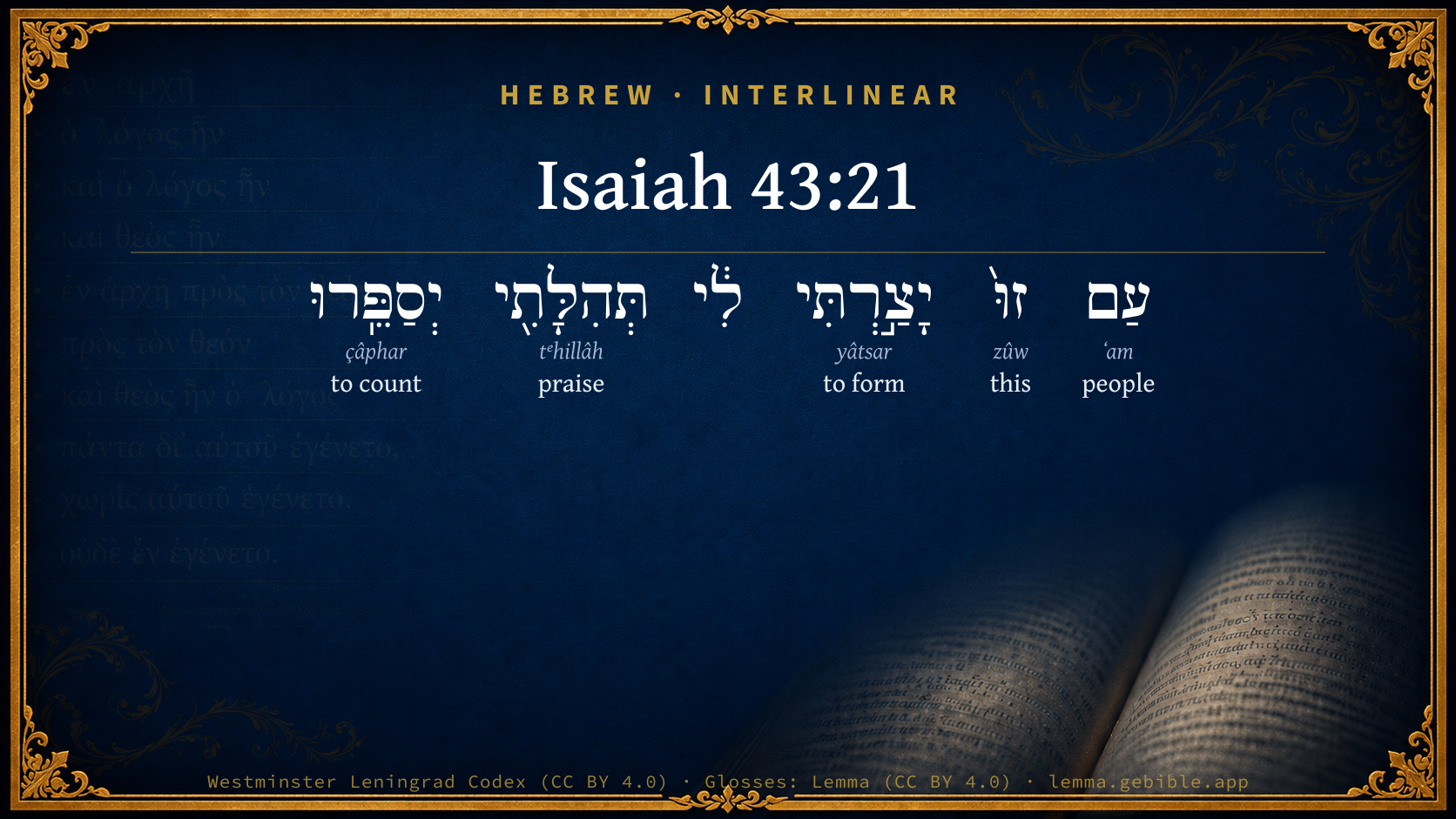
Isaiah 43:21

Hebrew (Westminster Leningrad Codex) Isaiah 43:21 appears in the Hebrew Old Testament. The text above is from the Westminster Leningrad Codex. Each word links to its Strong’s number, a concise gloss, and parsing drawn from the Open Scriptures Hebrew Bible morphology. Click any word for its full Brown-Driver-Briggs (BDB) entry.
Download image
Cite this verse

Isaiah 43:21 (World English Bible). Public Domain. Lemma interlinear Bible study tool, https://lemma.gebible.app/v/isaiah/43/21.

Show BibTeX & RIS
BibTeX
RIS
English Translation
the people which I formed for myself, that they might set forth my praise.
World English Bible · Public Domain
Download a study sheet

One document with this verse’s original text, its word-by-word gloss line, the meaning frame, cross-references with their text, attributed commentary, and full source and license credits — printable, and it pastes into notes with its structure intact.

This verse Autodidact and up

Study sheet (.html) Plain text (.txt)

A passage Seminary Student

Up to 50 verses in one chapter. A passage sheet keeps up to 6 commentary sources and 12 cross-references per verse, in the order this page ranks them, and says so on the sheet whenever that leaves anything out. Ask for a single verse and you get the Autodidact verse sheet above.

Everything on this page stays free to read, with no account — the sheet is a download of what is already on screen, not access to it.

Want to remove ads? Support Godless Engineer
Compare translations 3

The same verse in 3 English versions, stacked beneath the original-language interlinear above. Click any original word for its lexicon entry.

Each is an independent rendering of the whole verse — the interlinear is not word-aligned to these translations.

Highlighted words mark where these versions differ — a whole-verse word diff, not a word-by-word alignment.

  • World English Bible Public Domain
    the people which I formed for myself, that they might set forth my praise.
  • King James Version Public Domain
    This people have I formed for myself; they shall shew forth my praise.
  • unfoldingWord Literal Text CC BY-SA 4.0
    I formed this people for myself; they will recount my praise. q1

unfoldingWord Literal Text — © unfoldingWord, licensed CC BY-SA 4.0. Word-aligned USFM3 via Door43 (git.door43.org/unfoldingWord/en_ult).

Versions to compare (up to 4)

3 of 4 selected

Show all 18 translations

Every available English version of this verse, each an independent rendering of the whole verse.

  • World English Bible Public Domain
    the people which I formed for myself, that they might set forth my praise.
  • Berean Standard Bible Public Domain
    The people I formed for Myself will declare My praise.
  • Majority Standard Bible Public Domain
    The people I formed for Myself will declare My praise.
  • King James Version Public Domain
    This people have I formed for myself; they shall shew forth my praise.
  • American Standard Version (1901) Public Domain
    the people which I formed for myself, that they might set forth my praise.
  • Revised Version (1885) Public Domain
    the people which I formed for myself, that they might set forth my praise.
  • Geneva Bible (1599) Public Domain
    This people haue I formed for my selfe: they shall shewe foorth my praise.
  • Douay-Rheims (1899) Public Domain
    This people have I formed for my- self, they shall shew forth my praise.
  • Young's Literal Translation Public Domain
    This people I have formed for Myself, My praise they recount.
  • Literal Standard Version CC BY-SA 4.0
    I have formed this people for Myself, || They recount My praise.
  • Unlocked Literal Bible CC BY-SA 4.0
    this people whom I formed for myself, that they might recount my praises.
  • unfoldingWord Literal Text CC BY-SA 4.0
    I formed this people for myself; they will recount my praise. q1
  • Darby Bible Public Domain
    This people have I formed for myself: they shall shew forth my praise.
  • World Messianic Bible Public Domain
    the people which I formed for myself, that they might declare my praise.
  • Webster's Bible Public Domain
    This people have I formed for myself; they shall show forth my praise.
  • Free Bible Version CC BY-SA 4.0
    I made this people for myself so that through their praise for me they could make me known.
  • Bible in Basic English Public Domain
    Even the people whom I made to be the witnesses of my praise.
  • JPS Tanakh (1917) Public Domain
    The people which I formed for Myself, that they might tell of My praise.

Literal Standard Version (2020), Covenant Press — licensed CC BY-SA 4.0. Text via the HelloAO Bible API (eBible.org). Unlocked Literal Bible (unfoldingWord) — licensed CC BY-SA 4.0. Text via the HelloAO Bible API (eBible.org). unfoldingWord Literal Text — © unfoldingWord, licensed CC BY-SA 4.0. Word-aligned USFM3 via Door43 (git.door43.org/unfoldingWord/en_ult). Free Bible Version, Dr. Jonathan Gallagher — licensed CC BY-SA 4.0. Text via the HelloAO Bible API (eBible.org).

Word by word

More ways to search: Search by grammar → Find every occurrence → Compare this word →

Practice this passage: Drill this verse → Learn its vocabulary →

About this verse

These counts appear in no published source. They are computed here, from the morphology-tagged text and Lemma’s own curated glosses. What Lemma adds →

6
words
5
distinct lemmas
Prophets
section

Notable vocabulary

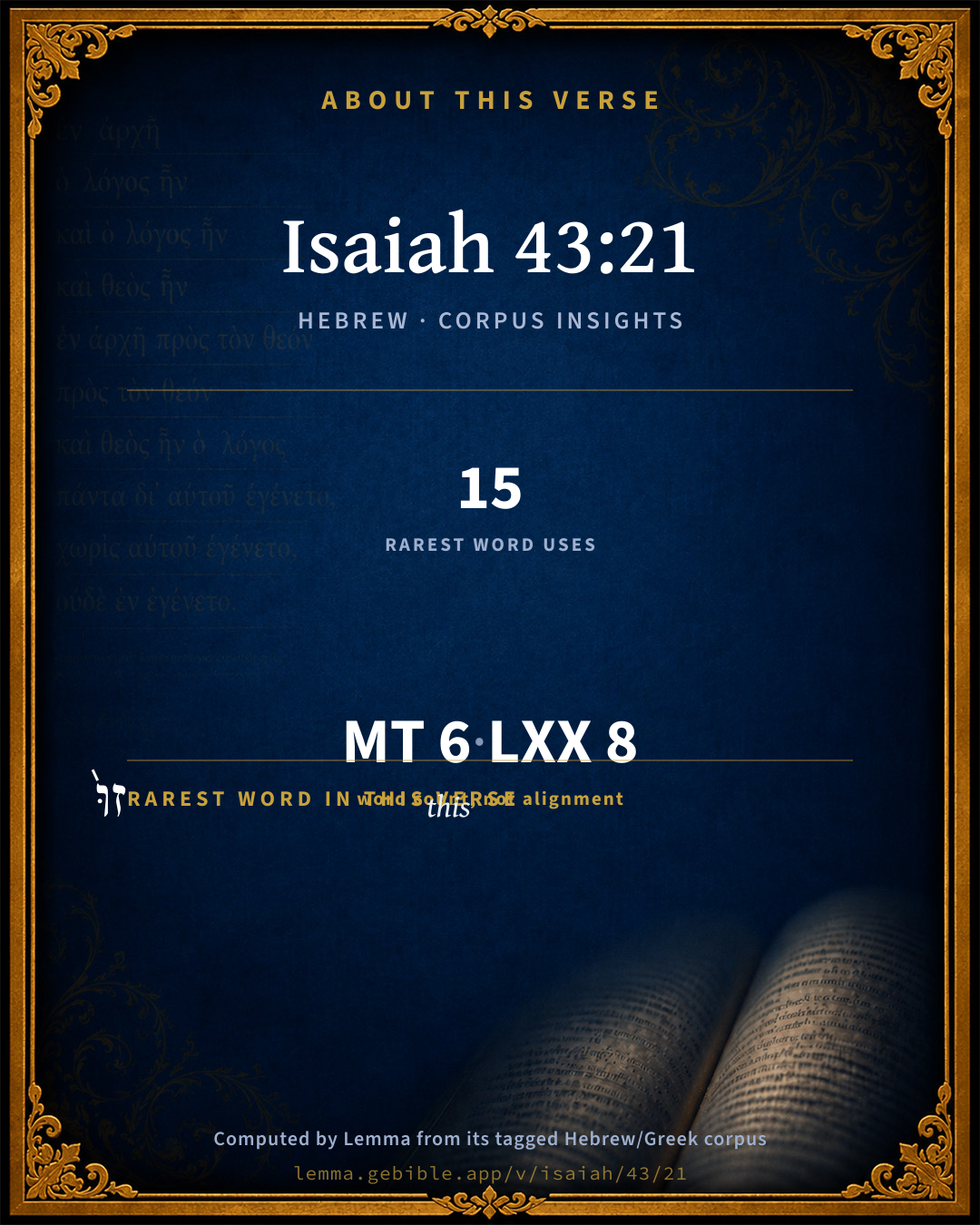
The rarest word here is זוּ֙ this H2098 — appearing just 15 times in the whole Hebrew Bible.

Shared distinctive vocabulary

זוּ֙ this H2098 occurs in 15 verses of the Hebrew Bible. Also found in:

Grammatical profile

  • 2 verbs
  • 2 nouns
  • 1 preposition
  • 1 particle

Verb forms

  • יָצַ֣רְתִּי Qal · Perfect
  • יְסַפֵּֽרוּ Piel · Imperfect

Hebrew & Septuagint length

In English translation the verse runs 14 words from the Hebrew and 11 from the Septuagint (LXX English) — closely comparable.

A rough comparison of the two English renderings, which tokenize alike — not a word-level alignment.

Word counts can differ between the Hebrew and the Greek without any difference in meaning — e.g. the Hebrew direct-object marker אֵת has no separate Greek word, and Greek often adds the article ὁ.

In the original languages it is 6 Hebrew tokens and 8 Greek tokens — but the two are counted differently (Hebrew bundles its prefixes and suffixes into one token; the Greek is in lemma form), so that isn’t a like-for-like length.

Cross-references

15

Topical passages linked to Isaiah 43:21 in the Treasury of Scripture Knowledge — connected by theme and wording, ordered by reader-vote popularity; previews shown in the World English Bible.

  • 1 Peter 2:9 But you are a chosen race, a royal priesthood, a holy nation, a people for God's own possession, that you may show forth the excellencies of him who called you out of darkness into his marvelous light:
  • Hebrews 13:15 Through him, then, let us offer up a sacrifice of praise to God continually, that is, the fruit of lips which make confession to his name.
  • Psalms 102:18 This will be written for the generation to come. A people which will be created will praise Yah.
  • 1 Corinthians 6:19–20 Or don't you know that your body is a temple of the Holy Spirit which is in you, which you have from God? You are not your own,
  • Luke 1:74–75 To grant to us that we, being delivered out of the hand of our enemies, should serve him without fear,
  • 1 Corinthians 10:31 Whether therefore you eat, or drink, or whatever you do, do all to the glory of God.
  • Isaiah 61:3 to appoint to those who mourn in Zion, to give to them a garland for ashes, the oil of joy for mourning, the garment of praise for the spirit of heaviness; that they may be called trees of righteousness, the planting of Yahweh, that he may be glorified.
  • Isaiah 60:21 Your people also shall be all righteous; they shall inherit the land forever, the branch of my planting, the work of my hands, that I may be glorified.
  • Ephesians 1:5–12 having predestined us for adoption as children through Jesus Christ to himself, according to the good pleasure of his desire,
  • Colossians 1:16 For by him were all things created, in the heavens and on the earth, things visible and things invisible, whether thrones or dominions or principalities or powers; all things have been created through him, and for him.
  • Ephesians 3:21 to him be the glory in the assembly and in Christ Jesus to all generations forever and ever. Amen.
  • Psalms 4:3 But know that Yahweh has set apart for himself him who is godly: Yahweh will hear when I call to him.
  • Titus 2:14 who gave himself for us, that he might redeem us from all iniquity, and purify for himself a people for his own possession, zealous for good works.
  • Isaiah 50:7 For the Lord Yahweh will help me; therefore I have not been confounded: therefore have I set my face like a flint, and I know that I shall not be disappointed.
  • Proverbs 16:4 Yahweh has made everything for its own end-- Yes, even the wicked for the day of evil.

Cross-references courtesy of OpenBible.info (CC BY 4.0).

Hebrew and Greek witnesses Masoretic Hebrew ↔ Greek Septuagint

The same verse in the two great witnesses to the Old Testament, shown verse-for-verse.

These are two independent witnesses, not word-aligned to each other, and the Septuagint is shown in lemma (dictionary) form.

Hebrew Isaiah 43:21 Masoretic · Westminster Leningrad Codex

עַם זוּ֙ יָצַ֣רְתִּי לִ֔י תְּהִלָּתִ֖י יְסַפֵּֽרוּ

the people which I formed for myself, that they might set forth my praise.

World English Bible · Public Domain

Greek LXX Isaiah 43:21 Septuagint · lemma form

λαός ἐγώ ὅς περιποιέω ὁ ἀρετή ἐγώ διαἡγέομαι

my people whom I have preserved to tell forth my praises.

LXX2012 (modern English Septuagint) · Public Domain

Hebrew: Westminster Leningrad Codex (CC BY 4.0). Greek: Septuagint (public domain); English from LXX2012 (modern English Septuagint) (Public Domain). How the Septuagint differs from the Hebrew →

Targum (Aramaic paraphrase)

1

The Targum is the ancient Jewish Aramaic paraphrase of the Hebrew Scriptures — an interpretive translation, not the Hebrew text itself. Onkelos (literal) and Pseudo-Jonathan (expansive) render the Torah, and Jonathan the Prophets. Coverage is partial: where no permissively-licensed English translation exists for a verse, only the Aramaic is shown. This is verse-level text, not a word-by-word alignment to the Hebrew.

  1. Targum Jonathan Prophets (Joshua–Malachi)
    עַמָא דֵין אַתְקְנֵית לְפוּלְחָנִי בְתוּשְׁבַּחְתִּי יְהוֹן מִשְׁתָּעָן:

    This people have I prepared for my service, they shall declare my praise.

    Targum Jonathan — Aramaic: “Mikraot Gedolot” (public domain). English: “Sefaria Community Translation” (CC0 1.0 (public-domain dedication)); “London "Chaldee Paraphrase," 1871” (public domain). Text via Sefaria.

Commentary

Notes on Isaiah 43:21 from classic Christian and Jewish commentators (each source and its license shown beneath its notes). The classic Christian expositions comment on the surrounding passage and are grouped to its opening verse, so a note may address several verses; the Jewish commentaries on the Tanakh (Rashi and others) are per-verse, so they appear only where the commentator wrote on this verse.

Lemma curates 59 commentaries, every one of them public domain or Creative Commons licensed, each selected and text-cleaned for this edition rather than reprinted as found. About our sources →

Trapp's Complete Commentary

John Trapp

Isa 43:21 This people have I formed for myself; they shall shew forth my praise.

Ver. 21. This people have I formed for myself.] Even the Gentiles now as well as the Jews.

They shall show forth my praise.] They shall "preach forth (εξαγγειλητε) the virtues, or praises, of him who hath called them out of darkness into his marvellous light." {1Pe 2:9}

John Trapp, A Commentary or Exposition upon All the Books of the Old and New Testament (1647–1656) — public domain. Text from a community e-Sword module.

The Biblical Illustrator

Joseph S. Exell

Isa_43:21

This people have I formed for Myself

The altering of Gods purpose

It is the burden of the Book of Deuteronomy that God chose the seed of Abraham to be a peculiar nation unto Himself above all peoples on the face of the earth.

Those two words people and inheritance are perpetually linked together in the Bible. Jehovahs design is clearly declared in the significant Passage--They shall show forth My praise. By a long process of careful training it was His intention so to form the people that their history should turn mens thoughts to the glory and beauty of His own nature, and elicit perpetual adoration and praise. On three separate occasions they thwarted Jehovah. They came nigh unto cursing instead of praising. They gave men false conceptions of His character. And on three separate occasions they had to learn the temporary suspension and postponement of His purpose.

1. In the wilderness they murmured against Him, and were sent back to wander in the waste for forty years.

2. After nineteen kings had ruled from Davids throne, they were exiled to Babylon for seventy years.

3. Since the rejection of the Beloved Son, they have been driven into all the world to be a by-word and a proverb. For years Gods purpose has been under arrest. It shall, no doubt, be ultimately fulfilled. This change of purpose on the part of God has been the opening of the door for us; and the words which were originally addressed to Israel are now applicable to ourselves. By the lips of the apostles Paul and Peter we are told that Jesus gave Himself for us, to redeem us and to purify us unto Himself, a people for His own possession; so that we are an elect race, a royal priesthood, a holy nation, a people for Gods own possession, that we may show forth the praises of Him who called us out of darkness into His marvellous light. We are what we are, that we may show forth Gods praises; but if we fail to realise His ideal, for us, too, there will be the inevitable postponement of His purpose.

I. THE PURPOSE OF GOD. That they should show forth My praise. We may promote Gods praise by suffering, as much as by active service in every life there are three regions. That of the light, where duty is clearly defined; that of the dark, where wrong is no less clearly marked; and a great borderland of twilight, where there is no certainty, where dividing lines are not distinct, and where each man must be fully persuaded for himself. It is here, however, that the temper of the soul is tested.

II. THE POSSIBLE THWARTING OF HIS PURPOSE. Ye shall know the revoking of My promise (Num_14:34, R.V., marg.). There is nothing more terrible in the history of a soul than to frustrate the Divine ideal in its creation and redemption, and to prevent God deriving from us that for which He saved us.

1. Prayerlessness (verse 22). Nothing is a surer gauge of our spiritual state than our prayers.

2. Neglect of little things (verse 23). The people were probably careful of the larger matters of Jewish ritual, but neglectful of the smaller details. None of us goes wrong at first in the breach of the great obligations of the law.

3. Lack of sweetness. Thou hast bought Me no sweet cane (verse 24). It is possible to do right things from a hard sense of legalism, in which the sweetness and lovableness of true religion are painfully wanting. Many are the instances of this change of purpose. David substituted for Saul; Solomon for Adonijah; the Church for the Hebrew people; Western for Eastern Christianity; the Moravians and Lollards for the established Churches of their time.

III. THE FULFILMENT OF GODS PURPOSE THROUGH OUR PAIN. Gods purpose cannot be ultimately set aside. So with Israel, and with each of us. But the cost, how enormous! (F. B. Meyer B. A.)

The chief end of man

1. God, who made all the lower creatures for some special use, assuredly did not make man, and endow him with those noble powers, without a grand distinctive design or end worthy of Himself and them.

2. This end cannot possibly be anything bounded by his transitory life.

3. The end for which chiefly we were made must needs be that which the Scriptures tell of: This people have I formed for Myself; they shall show forth My praise,--even to know the ever-blessed God; to serve God; to honour, love God; to enjoy God; and to be everlastingly blessed in the knowledge, service, and enjoyment of Him.

(1) This end is a very high and noble one.

(2) A most reasonable and righteous end.

(3) A necessary and indispensable end,--as it is the end which God actually made us for; it is altogether indispensable that we follow and fulfil it, unless we are to live in a terrible conflict with our Maker, and so inevitably perish. For if God made us to serve and honour Him, and we do it not, then, to put it at the very lowest, we are useless and unprofitable on Gods earth; and we are accustomed to cast away from us things useless for the thing they were designed for. But then, most things of this world which are useless do not on that account require to be positively hurtful. But it is otherwise with us. If God made us to serve and honour Him, and we pay no regard to this end, then, necessarily, we dishonour God. If we serve not God, we must serve the devil. If we serve not the true God, we must serve false gods,--creatures of all kinds, to which we give the regard, affection, trust that are due to God, and so unavoidably fall under the sentence of the law of His moral government, The soul that sinneth, it shall die. But this volume has not come to us only to tell the end or use we were made for, but to tell also how we may fulfil it--ay, how we now, after having failed to live for the end, may yet know and serve and love and everlastingly enjoy God. The whole Bible may, as to this vital matter, be summed up in one grand word--Christ. (C. J. Brown, D. D.)

The delight of God in forming a people for Himself

In the good work of forming a people for Himself, God has been engaged from the beginning. The subjects of it have been more numerous in some periods than in others; but in every age He has created a seed to serve Him. And in future times--when He who sits on the throne shall make all things new--this people shall abound in number, and flourish like grass of theearth. And what a thought is this, that in us, if we be indeed new creatures, God delights.

I. The first ground of the Divine satisfaction in this people which I mention arises from THE NATURE OF THE WORK PERFORMED, the character of the effect produced. The effect produced by the forming power of God is--a people on whose immortal spirits His image is impressed, the chief features of which are--knowledge, righteousness, and holiness,--a people enlightened and guided by heavenly truth, sanctified and regulated by Divine love,--a people assimilated to God in understanding and heart, in purpose, in action, in blessedness. If a person be not the partaker of a Divine nature, the most amiable and eminent qualities which he may possess can ultimately contribute only to increase his capacities and his means of doing evil, and to render him pre-eminent in disgrace and in misery.

II. In forming a people for Himself, God gives AN ILLUSTRIOUS DISPLAY OF HIS GLORY. In no work has He communicated so much of Himself, has He given so luminous and extensive a display of His glory, as in that which we are now contemplating, viewed in its manifold relations. Advert to His sovereignty and His power, both which the text obviously suggests.

III. God delights in forming a people for Himself, because He thus GLORIFIES HIS SON. He bears testimony to the dignity of His person, to the worth of His sacrifice, to the efficacy of His mediation.

IV. GOD FORMS A PEOPLE FOR HIMSELF, THAT THEY MAY SHOW FORTH HIS PRAISE; and for this reason also He delights in them. He creates them anew in Christ, not merely that He may display His perfections in the production of so excellent an effect, but that they may contemplate and adore the excellencies which He thus manifests; not merely that they may be a mirror to reflect the splendour of His glory to others, but that they themselves may utter abundantly its praises. They praise Him with their hearts. They praise Him with their lips, by formal acts of devotion; by the celebration of His ordinances; by the public confession of His name; by commending His service to others; by ordering their speech in His fear, and to the use of edifying. And they praise Him with their lives, by avoiding what He forbids, by doing what He requires, by submitting to what He inflicts; and thus do homage to His authority, wisdom, and love.

V. God rejoiceth over this people, because HE DELIGHTS IN THEIR HAPPINESS. (J. Stark.)

Showing forth Gods praise

It has been said that the word translated praise is from the same root as Hallel in Hallelujah, and that it means, first, a clear and shining light; next, a sweet flute-like sound: from which we learn that the people of God are to reflect His glory until it shines from their lives, attracting others to it; and that they are to speak His praise in resonant and harmonious sounds that shall arrest and attract the listening ear. (F. B. Meyer, B. A.)

The Biblical Illustrator, edited by Joseph S. Exell (c. 1880s–1900s) — public domain. Text from a community e-Sword module.

The Preacher's Complete Homiletical Commentary

Joseph S. Exell (gen. ed.)

GOD’S PEOPLE

Isa_43:21. This people I have formed for myself, they shall show forth my praise.

INTRODUCTION. [1396]

[1396] In ancient history we read of a prince, who, from the summit of his palace beholding the metropolis of his extensive empire, exulted thus, “This is Babylon the great—Babylon, which I have built for the house of my kingdom, by the might of my power, and for the honour of my majesty.” He beheld the rising domes, the solemn temples, the numberless palaces of his lords; his heart bounded at the prospect, and his soul inflated with pride. Small cause, however, to be proud, had he recollected that these buildings were inhabited by a nation of slaves, and these temples filled with superstition and idolatry. In the sentence just read you have a far more noble potentate, even the King of kings Himself, reflecting upon the work of His hands, and rejoicing in the review of it. Beholding the triumphs of His grace, the accomplishment of His sacred purposes, and the wonders of His power, He expresses His complete satisfaction. His labour is not found in vain, His exertions are crowned with the designed success, and the production exactly corresponds with the plan laid down. With pleasure He reviews His workmanship, and already anticipates that chorus of praise which will perpetuate the honour of His name through eternal ages.—Lambert.

I. It is the prerogative of God alone to form the soul of man anew, both for His service here, and enjoyment hereafter.

1. The subjects of his workmanship: sinners of Adam’s family. Poor material, degraded by sin; but power belongeth unto God, and nothing is too hard for Him to do. He can humble the most stubborn heart, &c. Great comfort in this truth for ourselves individually.

2. The work itself, creating them in Christ Jesus unto good works; renewing them in knowledge, righteousness, and true holiness after the image of Him who created them. This work will be completed in each of His people. [1399] Cheerfully acquiesce in any discipline through which He may be pleased to put you for this purpose (H. E. I. 113–115, 157, 158, 3696–3703).

[1399] When it is said, “This people have I formed for myself,” it is not to be understood as though the work were already completely accomplished. That will not be the case till all the ransomed of the Lord shall be brought safe to the heavenly Zion. God is here represented as seeing the things which are not as though they were, and as beholding the end from the beginning. With Him to will and to do, to purpose and to perform, are so closely, so infallibly connected, as in effect to be the same.—Lambert.

II. In this act of special sovereign grace He has always respect unto Himself; that is, to the display and manifestation of His own glory as the end. The Scriptures invariably teach us to reflect upon God as having made all things for Himself; a lower motive than this He never acted from. He forms this people for the manifestation of the astonishing and unsearchable riches,—

1. Of His grace. How glorious is the grace manifested in the conquest and captivation of sinners, in the pardon of sin, in the sanctification of the soul, and in the support, supplies, and consolations of the people of God. Instance: (1Ti_1:12-15).

2. Of His power. Manifest in penetrating a heart hard as adamant; in enthroning grace in the very heart where sin has reigned; in preserving it in spite of all opposition (H. E. I. 2365–2376).

3. Of His wisdom. Manifest in fixing upon the means of bringing sinners to Christ, ordering all things relative to their course, overruling all things for their good, and raising them from the depths of human misery to the summit of heaven’s honours.

III. From this, as from all His other works, He will eventually derive a glorious revenue of praise: “They shall show forth my praise.”

1. It is not only the duty, but the desire of that people whom God forms for Himself to praise Him in the present life (1Pe_2:9).

2. It will be their happy disposition and delightful employ eternally to give unto Him the honour due on that account.—George Lambert: Sermons, vol. ii. pp. 274–293.

The text refers to the literal house of Israel. The Church of Christ now enjoy the appellation of “the people of God.” Whether Jews or Gentiles, to them the text will apply.

I. THE PEOPLE REFERRED TO. The people of God. Sometimes called saints, &c.

1. They are a saved people. Not only redeemed, but saved. Christ is the “Saviour of all men, but especially,” &c. St. Paul says, By grace are ye saved, &c. Not shall be, &c., but are (Eph_2:8; Tit_3:5; 1Co_1:18). They have felt the efficacy of divine grace; have been justified, &c. Saved from sin to righteousness; from darkness, &c.

2. They are a peculiar people. So they are described by the apostle (Tit_2:14; 1Pe_2:9). Not like others. They are not of the world, &c. Hence their manners and customs, their spirit and temper, their conduct and pursuits, are all peculiar to themselves. It must be so, it ought to be so. The opposite would be evil, &c.

3. They are a distinct people. There are peculiar people in the world, yet they are of the world. But His people are distinct and separate. A people in the world, but not of the world. Crucified to the world, &c. (H. E. I. 5026–5032).

II. THE FORMATION SPECIFIED.

1. The nature of this formation. Formed into a “people.” God does not intend believers to be isolated beings. He designed they should be collected—united—a people. Hence they are likened to a family, &c. Only in this way they can exercise their graces, &c., exhibit Christianity in its social influences, and extend it in the world. Beautifully likened to the members of the human body (1Co_12:14; 1Co_12:20).

2. The Author of this formation. It is divine—it is of God. The Church is God’s husbandry, God’s building. He gives the same spirit to all, but a diversity of operations, that each may add to the comfort and prosperity of the whole. Hence the term, “the Church of God.” God’s collecting—calling—keeping—saving, &c.

III. THE END CONTEMPLATED IN THIS FORMATION. “For myself,” &c. He made all things for Himself—the Church for Himself. It is called His rest, His dwelling, His delight; and He designs that they “should show forth,” &c. They do this by—

1. Exhibiting the effects of His gracious operations.

2. Labouring to diffuse His glory. For this they live, and act, and pray.

3. Resignation to the divine appointments. Thus Job, the apostles, and first Christians, &c.

CONCLUSION.—Of what people are you personally a part? Let the people of God think of their high vocation, &c.—Preachers’ Magazine, 1839.

The Preacher's Complete Homiletical Commentary (gen. ed. Joseph S. Exell; Funk & Wagnalls, c. 1892) — public domain (pre-1929). A full-Bible homiletical/sermon-outline anthology covering 65 of 66 books (2 John is absent from the source module). Text from a community e-Sword module.

Tyndale Open Study Notes

Tyndale Open Resources

43:21 One purpose of redemption is to honor God through the praises of the redeemed (see 1 Pet 2:9).

Tyndale Open Study Notes — © Tyndale Open Resources, licensed CC BY-SA 4.0. Text via the HelloAO Bible API.

Jamieson, Fausset & Brown

Robert Jamieson, A. R. Fausset & David Brown

This people--namely, The same as "My people, My chosen" (see Isa 43:1, Isa 43:7; Psa 102:18).

my praise--on account of the many and great benefits conferred on them, especially their restoration.

Jamieson, Fausset & Brown — Commentary Critical and Explanatory on the Whole Bible (1871) — public domain (CC PDM 1.0). Text via the HelloAO Bible API.

The Cambridge Bible for Schools and Colleges

gen. ed. J. J. S. Perowne

21. The verse supplies an apposition to “my people” of Isa_43:20. It reads: The people which I have formed for myself, they shall tell forth my praise. As the “streams in the desert” were created for Israel and not for the “beasts of the field,” so it is Israel alone that can fully celebrate the praises of the Lord, Who is its Redeemer (cf. 1Pe_2:9).

The Cambridge Bible for Schools and Colleges (gen. ed. J. J. S. Perowne; Cambridge University Press, 1878–1918) — public domain. Text from a community e-Sword module.

John Gill's Exposition

But thou hast not called upon me, O Jacob,.... The Jews, though they were the posterity of Jacob, a praying person, yet did not tread in his steps, but were more like the Heathens that called not on the name of the Lord; though there is no necessity of restraining this to prayer, it may regard the whole worship of God, which is sometimes included in the invocation of his name; and so the Targum,

"and ye come not to my worship, O ye of the house of Jacob.''

The Jews, in Christ's time, did not call upon his name, nor believe in him, nor receive his Gospel, nor submit to him and his ordinances; they rejected him and his service, therefore the Lord rejected them, and called the Gentiles, as before prophesied of:

but thou hast been weary of me, O Israel: of the word, worship, and ordinances of God; see Mal 1:13.

John Gill's Exposition of the Whole Bible (1746–1763) — public domain (CC PDM 1.0). Text via the HelloAO Bible API.

Albert Barnes' Notes on the Bible

This people have I formed for myself - To preserve the remembrance of my name; to transmit the knowledge of the true God to future times, and to celebrate my praise (see the notes at Isa 43:1).

They shall show forth my praise - They shall celebrate my goodness; or, by their restoration to their own land, they shall show manifestly that they are my people.

Albert Barnes' Notes on the Bible (1834–1885) — public domain. Text from a community e-Sword/MySword module.

Matthew Poole's English Annotations

This people; my people, as he now called them, Isa 43:20; consisting in part of the Jews, but especially of the Gentiles;

have I formed for myself; they shall show forth my praise; I have created as it were out of nothing, I have called them into my church, that I might have glory and praise from them for so stupendous a mercy.

Matthew Poole's English Annotations on the Holy Bible (1683–1685) — public domain. Text from a community e-Sword/MySword module.

The Pulpit Commentary

This people have I formed for myself. (see above, ver. 7, and Pro_16:4) They shall show forth my praise; i.e. their restoration to their own land shall cause them to glorify me both with songs of praise, (for the fulfilment, see Ezr_3:9-11 Neh_12:27; and the post-Captivity psalms) and also by a life in accordance with my laws.

The true end of life.

This is illustrated, for us all, in the true end for which the Hebrew tribes were formed into a nation. They were organized in Egypt, delivered, trained in the wilderness, and settled in the land of Canaan for distinct purposes of God. They were formed into a nation "for himself," to "show forth his praise." St. Peter applies this view of the old Israel of God to the new Israel of God, the first Christian Church. "Ye are a chosen generation, a royal priesthood, a holy nation, a peculiar people; that ye should show forth the praises of him who hath called you out of darkness into his marvellous light". (1Pe_2:9) And the same view may be applied to every regenerate individual; he too is formed anew for God; in his new, regenerate life he is to show forth God"s praise. Taking illustration from the older and the newer Israel, we may impress the truth of the text in its relations to the individual. The following line of thought may be worked out.

I Our life on earth is but a limited and dependent thing. It is but a passing time, an interlude.

II Its beginnings were wholly out of our own control. Whence we came, why we came, we do not know.

III Its endings are equally beyond our reach. Where we are going, and what we are to be, we know not.

IV Even in the passing time, we are in the midst of mysteries which we cannot fathom; and. we fashion aims of our own which never satisfy us, even if we attain them.

V It is evident that there is One who gave us being for his own purposes; who supports us through our interlude to show forth his praise; and who holds the final issues of our lives as the completion of his own all-wise plan.

Then this follows, and may be duly impressed it is folly indeed for any dependent man to live his brief life unto himself. It is wisdom indeed to know him who gave us being for his own purposes. And he has not left himself without witness concerning himself and concerning his will. His revelation convinces us that the true end of life which is to honour our Maker is glorified by the apprehension of how good, how wise, how gracious our Maker is. That which is actually the chief end of life we come lovingly, thankfully, rejoicingly, to set before ourselves as our chief end. R.T.

The Pulpit Commentary (1880–1919), ed. H.D.M. Spence-Jones & Joseph S. Exell — public domain. Text from a community e-Sword module.

J. A. Alexander on Isaiah

Joseph Addison Alexander

“The people (or this people) I have formed for myself; my praise shall they recount (or they are to recount my praise).” Another declaration of the end for which Israel existed as a nation. This brings us back to the main proposition of the chapter, namely, that Jehovah had not only made them what they were, but had made them for the purpose of promoting His own glory, so that any claim of merit upon their part, and any apprehension of entire destruction, must be equally unfounded.

Joseph Addison Alexander, The Prophecies of Isaiah (1846–1847; New York: Scribner, 1870–1878) — public domain. Text from a community e-Sword module.

Rashi

Rabbi Shlomo Yitzchaki (Rashi)

This people I formed for Myself so that they recite My praise.

Rashi on the Tanakh — English translations: “The Judaica Press complete Tanach with Rashi, translated by A. J. Rosenberg” (CC BY 4.0); “Pentateuch with Rashi's commentary by M. Rosenbaum and A.M. Silbermann, 1929-1934” (public domain); “The Metsudah Tanach series, Lakewood, N.J” (CC BY 4.0); and “The Book of Joshua, Metsudah Publications, 1997” (CC BY 4.0). Text via Sefaria.

Ibn Ezra

Rabbi Abraham ibn Ezra

זה ═ זו This. This people, that returns from Babylon, is mine.

Ibn Ezra on the Tanakh — English translations: “Sefaria Community Translation” (CC0 1.0 (public-domain dedication)); “Yalkut, Sifsei Chachomim Chumash, Metsudah Publications, 2009” (CC BY 4.0); and “Commentary of Ibn Ezra on Isaiah - trans. by M. Friedlander, 1873” (public domain). Text via Sefaria.

Lesson kit

Teaching starters — assembled from the data on this page, not authored interpretation. Every prompt links to the verse data it draws on. Edit before teaching.

Isaiah, in the Prophets, opens this verse with 6 words (5 distinct Hebrew lemmas). Its most distinctive word is zûw (“this”). A historical commentator’s framing appears above. Read the whole chapter for the surrounding context.

Discussion questions

  1. How does “this” (zûw) shape what this verse is saying?
  2. How does Exodus 15:13, which shares the word «this», read alongside this verse?
  3. The translations on this page render this verse differently — a whole-verse word diff, not a word-by-word alignment. What might account for the different wordings?
  4. «יָצַ֣רְתִּי» is a Qal Perfect verb. How does that grammatical form shape the action described?
  5. Compare how Trapp's Complete Commentary and The Biblical Illustrator read this verse. Where do they agree or differ?

Things to notice

Reading settings

Reading text

Shown beneath each verse's original-language words.

Old Testament
Old Testament edition

Read the OT as the Masoretic Hebrew (MT) or the Greek Septuagint (LXX).

English shown for the Greek Septuagint (in the Hebrew ↔ Greek comparison).

Comparing translations? Open the Compare panel on any verse page to stack up to four side by side.