
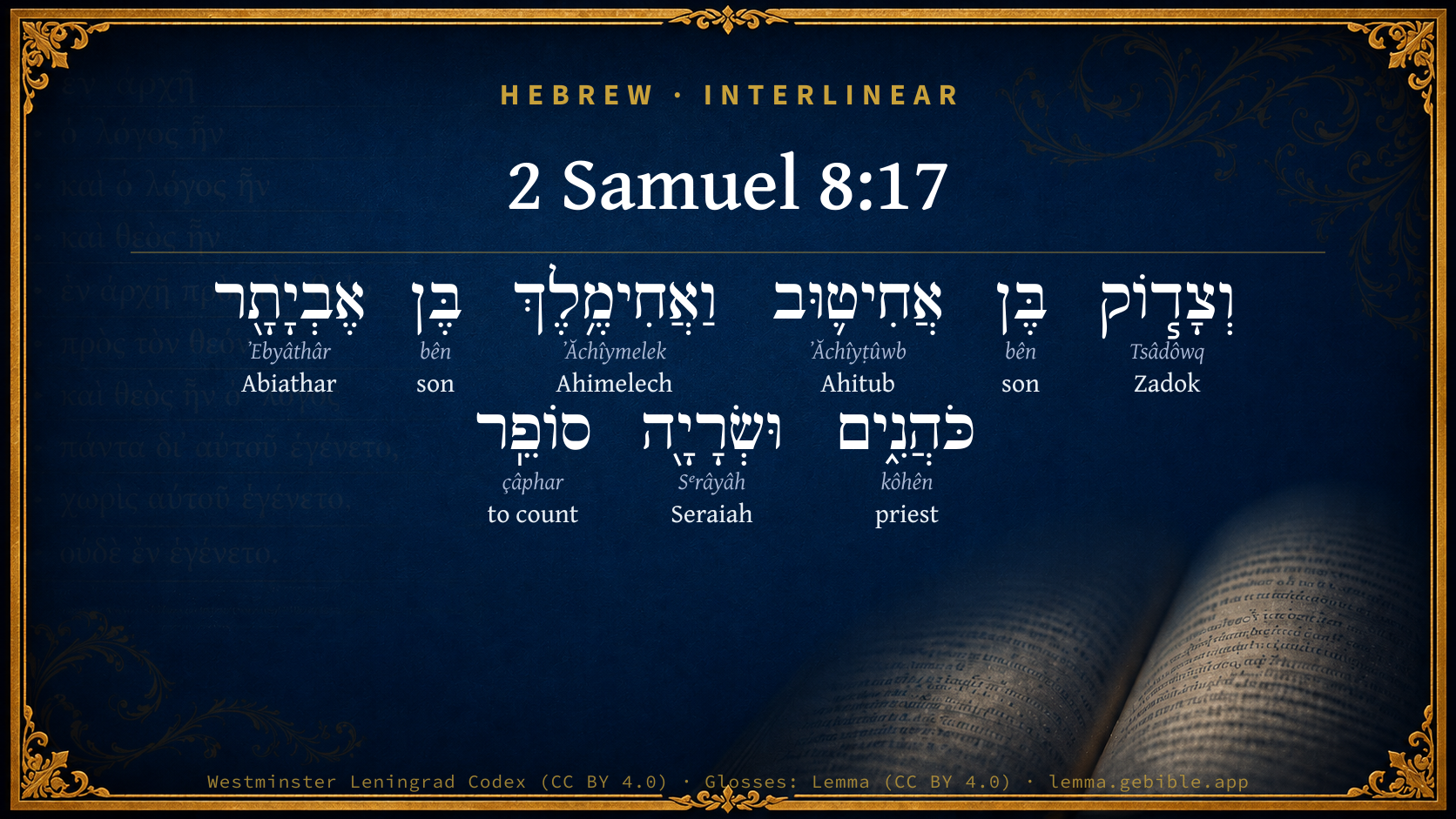
2 Samuel 8:17

Hebrew (Westminster Leningrad Codex) 2 Samuel 8:17 appears in the Hebrew Old Testament. The text above is from the Westminster Leningrad Codex. Each word links to its Strong’s number, a concise gloss, and parsing drawn from the Open Scriptures Hebrew Bible morphology. Click any word for its full Brown-Driver-Briggs (BDB) entry.
Download image
Cite this verse

2 Samuel 8:17 (World English Bible). Public Domain. Lemma interlinear Bible study tool, https://lemma.gebible.app/v/2-samuel/8/17.

Show BibTeX & RIS
BibTeX
RIS
English Translation
and Zadok the son of Ahitub, and Ahimelech the son of Abiathar, were priests; and Seraiah was scribe;
World English Bible · Public Domain
Highlights
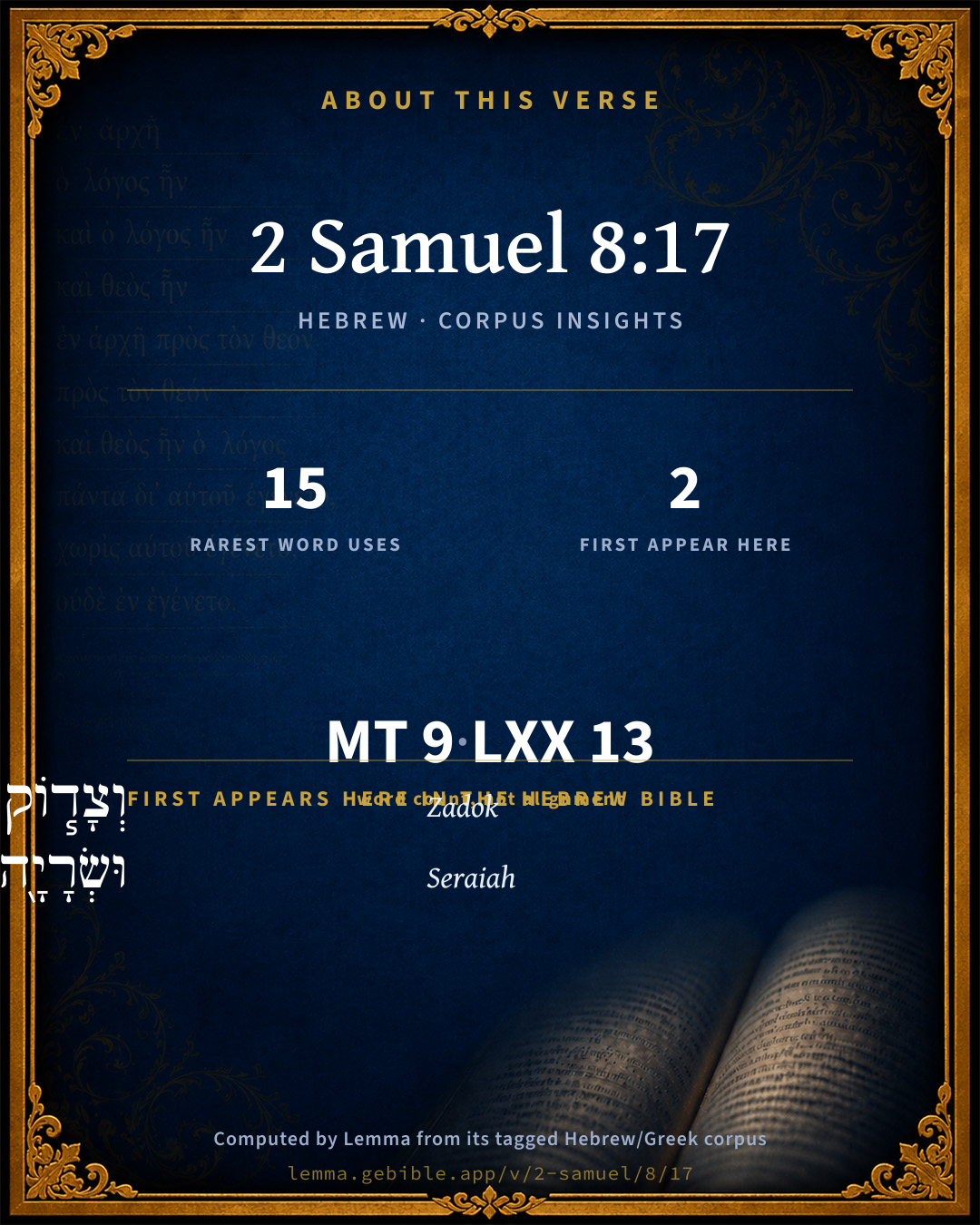
  • 2 first appearances in the Hebrew Bible
Full analysis ↓
Download a study sheet

One document with this verse’s original text, its word-by-word gloss line, the meaning frame, cross-references with their text, attributed commentary, and full source and license credits — printable, and it pastes into notes with its structure intact.

This verse Autodidact and up

Study sheet (.html) Plain text (.txt)

A passage Seminary Student

Up to 50 verses in one chapter. A passage sheet keeps up to 6 commentary sources and 12 cross-references per verse, in the order this page ranks them, and says so on the sheet whenever that leaves anything out. Ask for a single verse and you get the Autodidact verse sheet above.

Everything on this page stays free to read, with no account — the sheet is a download of what is already on screen, not access to it.

Want to remove ads? Support Godless Engineer
Compare translations 3

The same verse in 3 English versions, stacked beneath the original-language interlinear above. Click any original word for its lexicon entry.

Each is an independent rendering of the whole verse — the interlinear is not word-aligned to these translations.

Highlighted words mark where these versions differ — a whole-verse word diff, not a word-by-word alignment.

  • World English Bible Public Domain
    and Zadok the son of Ahitub, and Ahimelech the son of Abiathar, were priests; and Seraiah was scribe;
  • King James Version Public Domain
    And Zadok the son of Ahitub, and Ahimelech the son of Abiathar, were the priests; and Seraiah was the scribe;
  • unfoldingWord Literal Text CC BY-SA 4.0
    And Zadok, the son of Ahitub, and Ahimelech, the son of Abiathar, priests, and Seraiah the scribe.

unfoldingWord Literal Text — © unfoldingWord, licensed CC BY-SA 4.0. Word-aligned USFM3 via Door43 (git.door43.org/unfoldingWord/en_ult).

Versions to compare (up to 4)

3 of 4 selected

Show all 18 translations

Every available English version of this verse, each an independent rendering of the whole verse.

  • World English Bible Public Domain
    and Zadok the son of Ahitub, and Ahimelech the son of Abiathar, were priests; and Seraiah was scribe;
  • Berean Standard Bible Public Domain
    Zadok son of Ahitub and Ahimelech son of Abiathar were priests; Seraiah was the scribe;
  • Majority Standard Bible Public Domain
    Zadok son of Ahitub and Ahimelech son of Abiathar were priests; Seraiah was the scribe;
  • King James Version Public Domain
    And Zadok the son of Ahitub, and Ahimelech the son of Abiathar, were the priests; and Seraiah was the scribe;
  • American Standard Version (1901) Public Domain
    and Zadok the son of Ahitub, and Ahimelech the son of Abiathar, were priests; and Seraiah was scribe;
  • Revised Version (1885) Public Domain
    and Zadok the son of Ahitub, and Ahimelech the son of Abiathar, were priests; and Seraiah was scribe;
  • Geneva Bible (1599) Public Domain
    And Zadok the sonne of Ahitub, and Ahimelech the sonne of Abiathar were the Priestes, and Seraiah the Scribe.
  • Douay-Rheims (1899) Public Domain
    And Sadoc the son of Achitob, and Achimelech the son of Abiathar, were the priests: and Saraias was the scribe:
  • Young's Literal Translation Public Domain
    and Zadok son of Ahitub, and Ahimelech son of Abiathar, `are' priests, and Seraiah `is' scribe,
  • Literal Standard Version CC BY-SA 4.0
    and Zadok son of Ahitub, and Ahimelech son of Abiathar, [are] priests, and Seraiah [is] scribe,
  • Unlocked Literal Bible CC BY-SA 4.0
    Zadok son of Ahitub and Ahimelech son of Abiathar were priests, and Seraiah was scribe.
  • unfoldingWord Literal Text CC BY-SA 4.0
    And Zadok, the son of Ahitub, and Ahimelech, the son of Abiathar, priests, and Seraiah the scribe.
  • Darby Bible Public Domain
    and Zadok the son of Ahitub, and Ahimelech the son of Abiathar, were the priests; and Seraiah was scribe;
  • World Messianic Bible Public Domain
    Zadok the son of Ahitub and Ahimelech the son of Abiathar were priests, Seraiah was scribe,
  • Webster's Bible Public Domain
    And Zadok the son of Ahitub, and Ahimelech the son of Abiathar, were the priests: and Seraiah was the scribe;
  • Free Bible Version CC BY-SA 4.0
    Zadok, son of Ahitub, and Ahimelech, son of Abiathar, were priests, while Seraiah was the secretary.
  • Bible in Basic English Public Domain
    And Zadok and Abiathar, the son of Ahimelech, the son of Ahitub, were priests; and Seraiah was the scribe;
  • JPS Tanakh (1917) Public Domain
    and Zadok the son of Ahitub, and Ahimelech the son of Abiathar, were priests; and Seraiah was scribe;

Literal Standard Version (2020), Covenant Press — licensed CC BY-SA 4.0. Text via the HelloAO Bible API (eBible.org). Unlocked Literal Bible (unfoldingWord) — licensed CC BY-SA 4.0. Text via the HelloAO Bible API (eBible.org). unfoldingWord Literal Text — © unfoldingWord, licensed CC BY-SA 4.0. Word-aligned USFM3 via Door43 (git.door43.org/unfoldingWord/en_ult). Free Bible Version, Dr. Jonathan Gallagher — licensed CC BY-SA 4.0. Text via the HelloAO Bible API (eBible.org).

Word by word

More ways to search: Search by grammar → Find every occurrence → Compare this word →

Practice this passage: Drill this verse → Learn its vocabulary →

About this verse

These counts appear in no published source. They are computed here, from the morphology-tagged text and Lemma’s own curated glosses. What Lemma adds →

9
words
8
distinct lemmas
Historical
section

Notable vocabulary

The rarest word here is אֲחִיט֛וּב Ahitub H285 — appearing just 15 times in the whole Hebrew Bible.

First appearance in Scripture

These words make their first canonical appearance in the Hebrew Bible here:

  • וְצָד֧וֹק Zadok H6659
  • וּשְׂרָיָ֖ה Seraiah H8304

Shared distinctive vocabulary

אֲחִיט֛וּב Ahitub H285 occurs in 15 verses of the Hebrew Bible. Also found in:

Grammatical profile

  • 9 nouns

Repetition

A word recurs within this verse — often emphatic in Hebrew:

Hebrew & Septuagint length

In English translation the verse runs 18 words from the Hebrew and 18 from the Septuagint (LXX English) — the same length.

A rough comparison of the two English renderings, which tokenize alike — not a word-level alignment.

Word counts can differ between the Hebrew and the Greek without any difference in meaning — e.g. the Hebrew direct-object marker אֵת has no separate Greek word, and Greek often adds the article ὁ.

In the original languages it is 9 Hebrew tokens and 13 Greek tokens — but the two are counted differently (Hebrew bundles its prefixes and suffixes into one token; the Greek is in lemma form), so that isn’t a like-for-like length.

Cross-references

5

Topical passages linked to 2 Samuel 8:17 in the Treasury of Scripture Knowledge — connected by theme and wording, ordered by reader-vote popularity; previews shown in the World English Bible.

  • 1 Chronicles 6:8 and Ahitub became the father of Zadok, and Zadok became the father of Ahimaaz,
  • 1 Chronicles 18:16 and Zadok the son of Ahitub, and Abimelech the son of Abiathar, were priests; and Shavsha was scribe;
  • 1 Chronicles 16:39 and Zadok the priest, and his brothers the priests, before the tent of Yahweh in the high place that was at Gibeon,
  • 1 Chronicles 24:3–4 David with Zadok of the sons of Eleazar, and Ahimelech of the sons of Ithamar, divided them according to their ordering in their service.
  • 1 Chronicles 6:53 Zadok his son, Ahimaaz his son.

Cross-references courtesy of OpenBible.info (CC BY 4.0).

Hebrew and Greek witnesses Masoretic Hebrew ↔ Greek Septuagint

The same verse in the two great witnesses to the Old Testament, shown verse-for-verse.

These are two independent witnesses, not word-aligned to each other, and the Septuagint is shown in lemma (dictionary) form.

Hebrew 2 Samuel 8:17 Masoretic · Westminster Leningrad Codex

וְצָד֧וֹק בֶּן אֲחִיט֛וּב וַאֲחִימֶ֥לֶךְ בֶּן אֶבְיָתָ֖ר כֹּהֲנִ֑ים וּשְׂרָיָ֖ה סוֹפֵֽר

and Zadok the son of Ahitub, and Ahimelech the son of Abiathar, were priests; and Seraiah was scribe;

World English Bible · Public Domain

Greek LXX 2 Samuel 8:17 Septuagint · lemma form

καί σαδδουκ υἱός αχιτωβ καί αχιμελεχ υἱός αβιαθαρ ἱερεύς καί ασα ὁ γραμματεύς

And Sadoc the son of Achitob, and Achimelech son of Abiathar, were priests; and Sasa was the scribe,

LXX2012 (modern English Septuagint) · Public Domain

On this verse, Haydock's Catholic Bible Commentary discusses the Septuagint’s reading. Read the note in Commentary ↓

Hebrew: Westminster Leningrad Codex (CC BY 4.0). Greek: Septuagint (public domain); English from LXX2012 (modern English Septuagint) (Public Domain). How the Septuagint differs from the Hebrew →

Targum (Aramaic paraphrase)

1

The Targum is the ancient Jewish Aramaic paraphrase of the Hebrew Scriptures — an interpretive translation, not the Hebrew text itself. Onkelos (literal) and Pseudo-Jonathan (expansive) render the Torah, and Jonathan the Prophets. Coverage is partial: where no permissively-licensed English translation exists for a verse, only the Aramaic is shown. This is verse-level text, not a word-by-word alignment to the Hebrew.

  1. Targum Jonathan Prophets (Joshua–Malachi)
    וְצָדוֹק בַּר אֲחִיטוּב וַאֲחִימֶלֶךְ בַּר אֶבְיָתָר כַּהֲנַיָא וּשְׂרָיָה סַפְרָא:

    (no public-domain English translation for this verse)

    Targum Jonathan — Aramaic: “Mikraot Gedolot” (public domain). English: “Sefaria Community Translation” (CC0 1.0 (public-domain dedication)); “London "Chaldee Paraphrase," 1871” (public domain). Text via Sefaria.

Commentary

Notes on 2 Samuel 8:17 from classic Christian and Jewish commentators (each source and its license shown beneath its notes). The classic Christian expositions comment on the surrounding passage and are grouped to its opening verse, so a note may address several verses; the Jewish commentaries on the Tanakh (Rashi and others) are per-verse, so they appear only where the commentator wrote on this verse.

Lemma curates 59 commentaries, every one of them public domain or Creative Commons licensed, each selected and text-cleaned for this edition rather than reprinted as found. About our sources →

Trapp's Complete Commentary

John Trapp

2Sa 8:17 And Zadok the son of Ahitub, and Ahimelech the son of Abiathar, [were] the priests; and Seraiah [was] the scribe;

Ver. 17. Were the priests.] Ahimelech, alias Abiathar, being the only high priest: till he was thrust out by Solomon for siding with Adonijah; and Zadek set in his room. {1Ki 2:25; 1Ki 2:27}

John Trapp, A Commentary or Exposition upon All the Books of the Old and New Testament (1647–1656) — public domain. Text from a community e-Sword module.

Joseph Benson's Commentary

2Sa 8:17. Zadok and Ahimelech were the priests — That is, as some think, Zadok was the high-priest, and Ahimelech his sagan or vicar; or, according to others, neither of these was the high-priest, but they were both only the vicars of Abiathar, and heads of the sacerdotal families, the second priests, to use the language of Scripture, 2Ki 25:18. The former was of the family of Eleazar, (1Ch 6:8,) the other of Ithamar. The family of Eli was now declining fast; and in the next reign the other family was advanced to the high-priesthood, Abiathar and his posterity being quite thrown out. Seraiah was the scribe — Or secretary of state, as we now speak. But Bishop Patrick observes, that as the word ספרsopher, which we translate scribe, imports something of learning, as the word scribe, so often occurring in the New Testament, also does, he takes Seraiah to have been the king’s prime counsellor in the law. And others think there were two of this character, one an ecclesiastical and the other a civil scribe. Thus “the sacred writer no sooner gives us an account of David’s executing justice and judgment, but he immediately adds a list of the great officers then employed by him. For a principal part of a king’s wisdom, as well as of his felicity, consists in the choice of able ministers to discharge the great offices of the state.” — Delaney.

Joseph Benson's Commentary on the Old and New Testaments (1811–1818) — public domain. Text from a community e-Sword module.

Jamieson, Fausset & Brown

Robert Jamieson, A. R. Fausset & David Brown

Zadok . . . and Ahimelech . . . were the priests--On the massacre of the priests at Nob, [Sa1 22:19], Saul conferred the priesthood on Zadok, of the family of Eleazar (Ch1 6:50), while David acknowledged Ahimelech, of Ithamar's family, who fled to him. The two high priests exercised their office under the respective princes to whom they were attached. But, on David's obtaining the kingdom over all Israel, they both retained their dignity; Ahimelech officiating at Jerusalem, and Zadok at Gibeon (Ch1 16:39).

Jamieson, Fausset & Brown — Commentary Critical and Explanatory on the Whole Bible (1871) — public domain (CC PDM 1.0). Text via the HelloAO Bible API.

Adam Clarke's Commentary

Verse 17. Seraiah - the scribe] Most likely the king's private secretary. See 1Ch 24:3 (note).

Adam Clarke's Commentary on the Bible (1810–1826) — public domain. Text from a community e-Sword/MySword module.

Ellicott's Commentary for English Readers

(17) Ahimelech, the son of Abiathar.—So Ahimelech is also described in 1Ch_18:16; 1Ch_24:6; on the other hand, Abiathar is expressly said to be the son of Ahimelech in the narrative in 1Sa_22:20-23. This difficulty is increased by the further notices of the men bearing these names. Ahimelech was certainly the high priest who gave the shew-bread to David, and was slain in consequence by Saul (1 Samuel 21, 22), and Abiathar, who fled to David, and afterwards became high priest, and was finally put out of the high-priesthood by Solomon (1 Kings 1, 2) was certainly his son; but, on the other hand, in 1Ch_24:3; 1Ch_24:6; 1Ch_24:31 Ahimelech. is said to have been the co-priest with Zadok during the reign of David, and our Lord says that David ate the shew-bread “in the days of Abiathar, the high priest” (Mar_2:26). These apparently conflicting facts have occasioned unnecessary perplexity. The simple solution of the difficulty seems to be that both names were borne alike by father and by son, so that both of them are spoken of sometimes under one name, sometimes under the other.

On the double high-priesthood of Zadok and Abiathar, see Note at the beginning of 2 Samuel 6.

A Bible Commentary for English Readers, edited by Charles John Ellicott (1878–1897) — public domain. Text from a community e-Sword module.

The Cambridge Bible for Schools and Colleges

gen. ed. J. J. S. Perowne

17. Zadok the son of Ahitub] Zadok was of the house of Eleazar (1Ch_6:4-8). He joined David at Hebron after Saul’s death (1Ch_12:28), and remained faithful to him throughout his reign. In Absalom’s rebellion he left Jerusalem along with David, and only returned at his command (2Sa_15:24-29; 2Sa_17:15). Through him David communicated with the elders of Judah concerning his return (ch. 2Sa_19:11). Finally, when Abiathar joined the rebellion of Adonijah, Zadok remained faithful to David, took part in the anointing of Solomon, and was made sole high-priest (1Ki_1:8; 1Ki_1:44; 1Ki_2:35), which office he held during some part of Solomon’s reign (1Ki_4:4).

Ahimelech the son of Abiathar] Since Zadok and Abiathar are elsewhere constantly mentioned together as the high-priests in David’s reign, and it is clear from 1Sa_22:20-23 that Abiathar was the son of Ahimelech, and from 1 Kings 1; 1Ki_2:26 that he held office throughout David’s reign, it seems necessary to emend the text and read Abiathar the son of Ahimelech. The error, if it is one, appears also in 1Ch_18:16; 1Ch_24:3; 1Ch_24:6; 1Ch_24:31, and must have existed in one of the original documents from which these books were compiled. It seems hardly probable, though not impossible, that the high-priesthood of Abiathar is assumed as known, and only the assistant priests mentioned, who stood in the same relation to him as Hophni and Phinehas to Eli (1Sa_1:3): or that Ahimelech officiated for a time as deputy for his father, who was incapacitated by illness or other cause.

priests] Zadok officiated in the Tabernacle at Gibeon (1Ch_16:39), Abiathar probably before the Ark in Jerusalem. On the origin of this double high-priesthood, see preliminary note to ch. vi., p. 88.

Seraiah] Called in 1Ch_18:16 Shavsha, and probably the same as Sheva or Sheya (2Sa_20:25) and Shisha (1Ki_4:3).

scribe] Secretary of state: an official mentioned several times in the course of the history: e.g. 2Ki_12:10; 2Ki_18:18; 2Ki_18:37; 2Ki_22:3, &c.

The Cambridge Bible for Schools and Colleges (gen. ed. J. J. S. Perowne; Cambridge University Press, 1878–1918) — public domain. Text from a community e-Sword module.

John Gill's Exposition

And Zadok the son of Ahitub, and Ahimelech the son of Abiathar, were the priests,.... Not high priests, as Josephus (i) suggests, for there was only one high priest at a time; indeed there was a "sagan", or deputy priest, on occasion; and so Abarbinel says that Zadok was the high priest, and Ahimelech his second or deputy; but the truth of the case was this, Abiathar was high priest only, and continued so until the time of Solomon, when he was thrust out of his office, and Zadok put into it; and Ahimelech his son and Zadok were the principal priests under him, the one of the family of Ithamar, the other of Eleazar; so the Targum on Ch1 18:16 calls them "sagans", or deputies of the high priesthood. Zadok is mentioned first, though Ahimelech was the son of the present high priest, because he was in great favour with David, as afterwards with Solomon, in whose days the high priesthood was translated to him; the family of Eli being now upon the decline, and near being removed from the high priesthood, as was foretold by Samuel it should:

and Seraiah was the scribe; or secretary of state; in Ch1 18:16 he is called Shavsha; he seems to have had two names.

(i) Ut supra, (Antiqu. l. 7. c. 5.) sect. 4.

John Gill's Exposition of the Whole Bible (1746–1763) — public domain (CC PDM 1.0). Text via the HelloAO Bible API.

Haydock's Catholic Bible Commentary

Achimelech is also called the father of Abiathar, as these two had both names indiscriminately, 1 Kings xxi. 2. During the contest between the families of Saul and of David, two high priests were acknowledged, in their respective dominions. Sadoc was also permitted to officiate at Gabaon, during the reign of David; and, as Abiathar took part against Solomon, he was invested with the whole authority, and thus were accomplished the predictions made to Phinees and to Heli, Numbers xxv. 12., and 1 Kings ii. 35. (Calmet) --- Yet Salien considers Abiathar as the sole pontiff, from the time that his father was murdered by Saul. Sadoc, in the mean while, was his arch-priest or delegate, at Gabaon; (Haydock) though Abulensis and Josephus acknowledge both as high priests, (1 Paralipomenon xxiv. 3,) officiating by turns. (Menochius) --- Scribe, or secretary. (Challoner) See Judges v. 14. --- Septuagint, "counsellor." He is called Susa, in Chronicles. (Haydock)

George Leo Haydock (1774–1849), Haydock's Catholic Family Bible and Commentary, 1859 edition — public domain. Excludes Psalms (Douay-Rheims chapter numbering differs from Protestant) and Deuterocanonical books (Catholic canon only).

Matthew Poole's English Annotations

The son of Ahitub; not of that Ahitub, 1Sa 22; for that was of Ithamar’s race, but this of Eleazar.

Ahimelech the son of Abiathar; so Abiathar called his son by the name of his father, 1Sa 22:20. The priests, i. e. the chief priest next under Abiathar, who fled to David, 1Sa 22:20, and now was high priest, as may be gathered from 2Sa 15:35; 1Ki 2:27,35; under him these two were the next chief priests, or the second priests, each one being chief of the house of his father, Zadok of Eleazar, and Ahimelech of Ithamar. See Num 3:32; 1Ch 24:3,4. Or these two are here mentioned, because they constantly attended upon the king, that he might consult with them in the matters of the Lord, as need required.

Matthew Poole's English Annotations on the Holy Bible (1683–1685) — public domain. Text from a community e-Sword/MySword module.

Whedon's Commentary on the Bible

Daniel D. Whedon

17. Zadok… and Ahimelech… priests — The one officiating at Gibeon, the other at the new tabernacle in Jerusalem. See on 2Sa_6:17.

Son of Abiathar — But in 1Sa_22:20, Abiathar is called the son of Ahimelech; who, then, is this Ahimelech the son of Abiathar? Some have supposed that the names in the text have been transposed by the mistake of some copyist. Others, that Abiathar, son of the slain Ahimelech, had also a son named Ahimelech who performed the duties of high priest in connexion with his father. This latter supposition is strengthened by the fact that the associate priest of Zadok is called Ahimelech in 1Ch_24:3; 1Ch_24:6; 1Ch_24:31, but the former supposition seems to us more plausible.

The scribe — Persons of this order were, before the Babylonish exile, private secretaries of the king. Their work was distinct from that of the recorder in this, that the scribe first provided the materials which the recorder afterwards transcribed and preserved among the archives. Heeren, in his “Historical Researches,” thus speaks of the secretaries of the ancient Persian kings: “Whatever the monarch said or did was, of course, worthy of being recorded; and to this intent his person was usually surrounded by scribes or secretaries, whose office it was to register his words and actions. They were in almost constant attendance upon the sovereign, and especially when he appeared in public, on occasion of festivals, of public reviews, and even in the midst of the tumult of battle, and noted down the words which fell from him on such occasions. This institution was not peculiar to the Persians, but prevailed among all the principal nations of Asia. The king’s scribes are mentioned in the earliest records of the Mongol conquerors; and it is well known that Hyder Ali usually appeared in public surrounded by forty such secretaries.” At a later period the work of the scribes among the Jews was to write copies of the Scriptures and interpret the same.

Daniel D. Whedon (gen. ed.), Commentary on the Old and New Testaments (1874–1909) — public domain. Text from a community e-Sword module.

The Pulpit Commentary

Zadok and Ahimelech... were the priests. We have already seen that this was contrary to the letter of the Mosaic Law, and yet that there was no schism, and that by patience matters came back to the right groove. Zadok, of the elder line of Eleazar, (1Ch_6:4-8, 1Ch_6:50-53) was high priest at Gibeon, and Ahimelech, of the junior line of Ithamar, was the high priest at Jerusalem. Instead of Ahimelech the son of Abiathar, the Syriac transposes the names, and reads, "Abiathar the son of Ahimelech" This agrees with the list in 2Sa_20:25, and it is certain that Abiathar outlived David, (1Ki_2:26) and that he was David"s high priest throughout his reign, though Zadok is not only constantly associated with him, but is placed first, as the man of higher rank. (2Sa_15:24-35 2Sa_17:15 2Sa_19:11 2Sa_20:25) It is also remarkable that our Lord makes Abiathar the person who gave David the shewbread, (Mar_2:26) whereas in 1Sa 21. he is repeatedly called Ahimelech. As both the LXX and the Vulgate support the Hebrew against the Syriac, and as the reading "Ahimelech" is confirmed by 1Ch_18:16 and 24:3, 6, 31, we must reject the emendation of the Syriac, and conclude that there was a double tradition respecting these names, some manuscripts making Abiathar the father, and others giving the seniority to Ahimelech. Our Lord made Abiathar the father, but the scribes, in their editing of the Hebrew text, gave that place to Ahimelech, yet did not carry out their restoration so thoroughly as not to leave proof that the names probably ought to be reversed. Seraiah was scribe. His office was similar to that of a secretary of state with us. For Seraiah we have Shavsha in 1Ch_18:16, Shisha in 1Ki_4:3, and Sheva in 2Sa_20:25. This illustrates what has just been said as to the uncertainty about proper names. They are always most difficult to read, as the sense gives no aid, and these various forms of a name that does not occur elsewhere really bear witness to the high antiquity of the manuscripts uses by the scribes in settling the text of the Old Testament; and also to their self-restraint in not making them all forcibly agree.

The Pulpit Commentary (1880–1919), ed. H.D.M. Spence-Jones & Joseph S. Exell — public domain. Text from a community e-Sword module.

John Wesley's Explanatory Notes

Scribe - Or, secretary of state.

John Wesley, Explanatory Notes Upon the Whole Bible (1754–1765) — public domain. Text via the GEBible commentary corpus.

Keil & Delitzsch

C. F. Keil & F. Delitzsch

Zadok the son of Ahitub, of the line of Eleazar (Ch1 6:8; Ch1 6:11-12), and Ahimelech the son of Abiathar, were cohanim, i.e., officiating high priests; the former at the tabernacle at Gibeon (Ch1 16:39), the latter probably at the ark of the covenant upon Mount Zion. Instead of Ahimelech, the Chronicles have Abimelech, evidently through a copyist's error, as the name is written Ahimelech in Ch1 24:3, Ch1 24:6. But the expression "Ahimelech the son of Abiathar" is apparently a very strange one, as Abiathar was a son of Ahimelech according to Sa1 22:20, and in other passages Zadok and Abiathar are mentioned as the two high priests in the time of David (Sa2 15:24, Sa2 15:35; Sa2 17:15; Sa2 19:12; Sa2 20:25). This difference cannot be set aside, as Movers, Thenius, Ewald, and other suppose, by transposing the names, so as to read Abiathar the son of Ahimelech; for such a solution is precluded by the fact that, in Ch1 24:3, Ch1 24:6, Ch1 24:31, Ahimelech is mentioned along with Zadok as head of the priests of the line of Ithamar, and according to Ch1 24:6 he was the son of Abiathar. It would therefore be necessary to change the name Ahimelech into Abiathar in this instance also, both in Ch1 24:3 and Ch1 24:6, and in the latter to transpose the two names. But there is not the slightest probability in the supposition that the names have been changed in so many passaGes. We are therefore disposed to adopt the view held by Bertheau and Oehler, viz., that Abiathar the high priest, the son of Ahimelech, had also a son named Ahimelech, as it is by no means a rare occurrence for grandfather and grandson to have the same names (vid., Ch1 6:4-15), and also that this (the younger) Ahimelech performed the duties of high priest in connection with his father, who was still living at the commencement of Solomon's reign (Kg1 2:27), and is mentioned in this capacity, along with Zadok, both here and in the book of Chronicles, possibly because Abiathar was ill, or for some other reason that we cannot discover. As Abiathar was thirty or thirty-five years old at the time when his father was put to death by Saul, according to what has already been observed at Sa1 14:3, and forty years old at the death of Saul, he was at least forty-eight years old at the time when David removed his residence to Mount Zion, and might have had a son of twenty-five years of age, namely the Ahimelech mentioned here, who could have taken his father's place in the performance of the functions of high priest when he was prevented by illness or other causes. The appearance of a son of Abiathar named Jonathan in Sa2 15:27; Sa2 17:17, Sa2 17:20, is no valid argument against this solution of the apparent discrepancy; for, according to these passages, he was still very young, and may therefore have been a younger brother of Ahimelech. The omission of any allusion to Ahimelech in connection with Abiathar's conspiracy with Adonijah against Solomon (Kg1 1:42-43), and the reference to his son Jonathan alone, might be explained on the supposition that Ahimelech had already died. But as there is no reference to Jonathan at the time when his father was deposed, no stress is to be laid upon the omission of any reference to Ahimelech. Moreover, when Abiathar was deposed after Solomon had ascended the throne, he must have been about eighty years of age. Seraiah was a scribe. Instead of Seraiah, we have Shavsha in the corresponding text of the Chronicles, and Sheva in the parallel passage Sa2 20:25. Whether the last name is merely a mistake for Shavsha, occasioned by the dropping of שׁ, or an abbreviated form of Shisha and Shavsha, cannot be decided. Shavsha is not a copyist's error, for in Kg1 4:3 the same man is unquestionably mentioned again under the name of Shisha, who is called Shavsha in the Chronicles, Sheva (שׁיא) in the text of Sa2 20:25, and here Seraiah. Seraiah also is hardly a copyist's error, but another form for Shavsha or Shisha. The scribe was a secretary of state; not a military officer, whose duty it was to raise and muster the troops, for the technical expression for mustering the people was not ספר, but פּקד (cf. Sa2 24:2, Sa2 24:4,Sa2 24:9; Ch1 21:5-6, etc.).

Keil & Delitzsch — Biblical Commentary on the Old Testament (1861–1891) — public domain (CC PDM 1.0). Text via the HelloAO Bible API. (Old Testament only.)

Lesson kit

Teaching starters — assembled from the data on this page, not authored interpretation. Every prompt links to the verse data it draws on. Edit before teaching.

2 Samuel, in the Historical, opens this verse with 9 words (8 distinct Hebrew lemmas). Its most distinctive word is ʼĂchîyṭûwb (“Ahitub”). A historical commentator’s framing appears above. Read the whole chapter for the surrounding context.

Discussion questions

  1. The word ʼĂchîyṭûwb carries the sense “Ahitub.” How does it shape the verse?
  2. 2 words make their first appearance in Scripture here. What does this debut establish?
  3. How does 1 Samuel 14:3, which shares the word «Ahitub», read alongside this verse?
  4. What does the repetition of “son” (2× in this one verse) do in this verse?
  5. Compare how Trapp's Complete Commentary and Joseph Benson's Commentary read this verse. Where do they agree or differ?

Things to notice

Reading settings

Reading text

Shown beneath each verse's original-language words.

Old Testament
Old Testament edition

Read the OT as the Masoretic Hebrew (MT) or the Greek Septuagint (LXX).

English shown for the Greek Septuagint (in the Hebrew ↔ Greek comparison).

Comparing translations? Open the Compare panel on any verse page to stack up to four side by side.