
Jeremiah 37:15

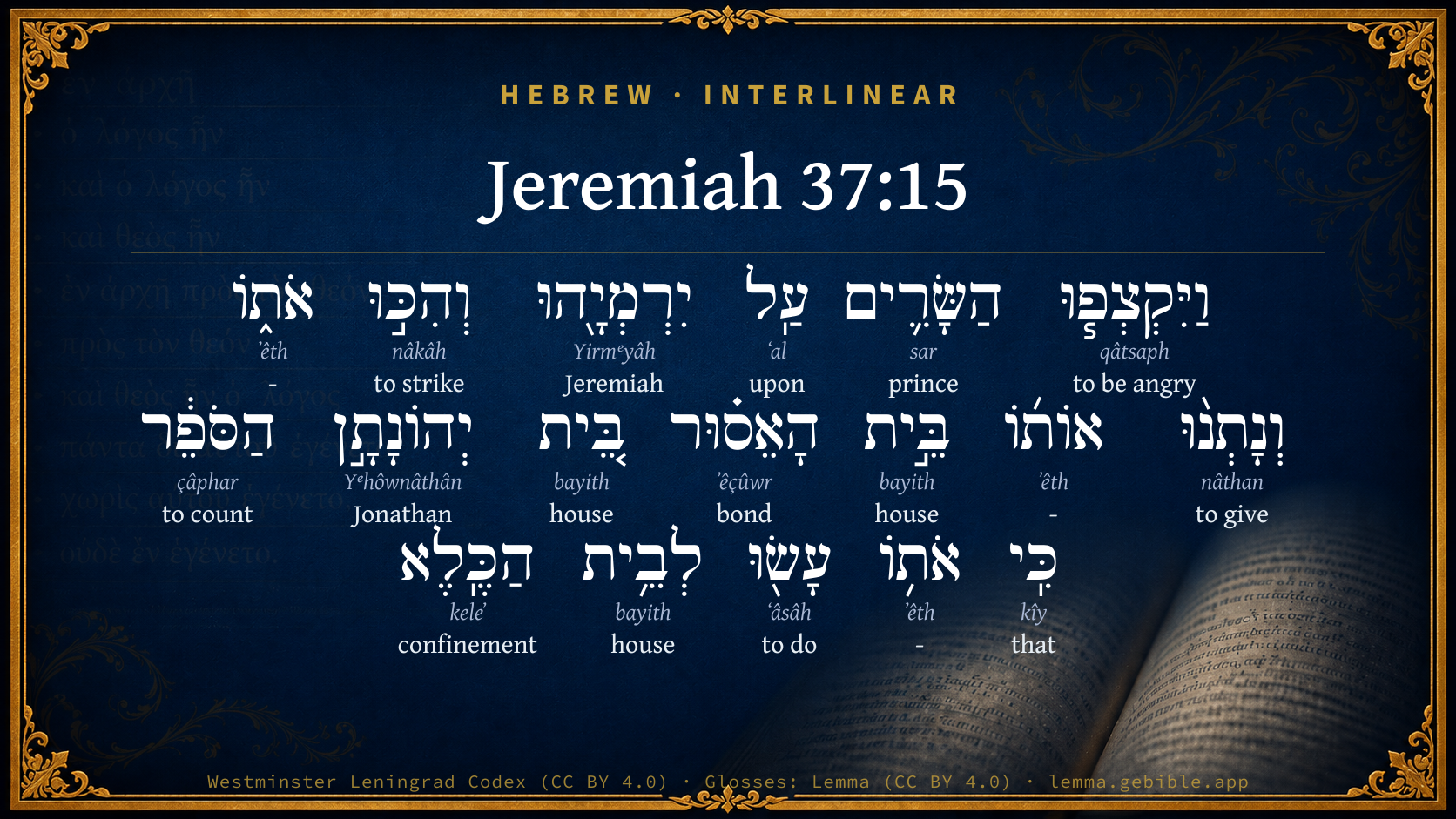
Hebrew (Westminster Leningrad Codex) Jeremiah 37:15 appears in the Hebrew Old Testament. The text above is from the Westminster Leningrad Codex. Each word links to its Strong’s number, a concise gloss, and parsing drawn from the Open Scriptures Hebrew Bible morphology. Click any word for its full Brown-Driver-Briggs (BDB) entry.
Download image
Cite this verse

Jeremiah 37:15 (World English Bible). Public Domain. Lemma interlinear Bible study tool, https://lemma.gebible.app/v/jeremiah/37/15.

Show BibTeX & RIS
BibTeX
RIS
English Translation
The princes were angry with Jeremiah, and struck him, and put him in prison in the house of Jonathan the scribe; for they had made that the prison.
World English Bible · Public Domain
Download a study sheet

One document with this verse’s original text, its word-by-word gloss line, the meaning frame, cross-references with their text, attributed commentary, and full source and license credits — printable, and it pastes into notes with its structure intact.

This verse Autodidact and up

Study sheet (.html) Plain text (.txt)

A passage Seminary Student

Up to 50 verses in one chapter. A passage sheet keeps up to 6 commentary sources and 12 cross-references per verse, in the order this page ranks them, and says so on the sheet whenever that leaves anything out. Ask for a single verse and you get the Autodidact verse sheet above.

Everything on this page stays free to read, with no account — the sheet is a download of what is already on screen, not access to it.

Want to remove ads? Support Godless Engineer
Compare translations 3

The same verse in 3 English versions, stacked beneath the original-language interlinear above. Click any original word for its lexicon entry.

Each is an independent rendering of the whole verse — the interlinear is not word-aligned to these translations.

Highlighted words mark where these versions differ — a whole-verse word diff, not a word-by-word alignment.

  • World English Bible Public Domain
    The princes were angry with Jeremiah, and struck him, and put him in prison in the house of Jonathan the scribe; for they had made that the prison.
  • King James Version Public Domain
    Wherefore the princes were wroth with Jeremiah, and smote him, and put him in prison in the house of Jonathan the scribe: for they had made that the prison.
  • unfoldingWord Literal Text CC BY-SA 4.0
    The officials were angry with Jeremiah. They beat him and put him in prison, which had been the house of Jonathan the scribe, for they had turned it into a prison.

unfoldingWord Literal Text — © unfoldingWord, licensed CC BY-SA 4.0. Word-aligned USFM3 via Door43 (git.door43.org/unfoldingWord/en_ult).

Versions to compare (up to 4)

3 of 4 selected

Show all 18 translations

Every available English version of this verse, each an independent rendering of the whole verse.

  • World English Bible Public Domain
    The princes were angry with Jeremiah, and struck him, and put him in prison in the house of Jonathan the scribe; for they had made that the prison.
  • Berean Standard Bible Public Domain
    The officials were angry with Jeremiah, and they beat him and placed him in jail in the house of Jonathan the scribe, for it had been made into a prison.
  • Majority Standard Bible Public Domain
    The officials were angry with Jeremiah, and they beat him and placed him in jail in the house of Jonathan the scribe, for it had been made into a prison.
  • King James Version Public Domain
    Wherefore the princes were wroth with Jeremiah, and smote him, and put him in prison in the house of Jonathan the scribe: for they had made that the prison.
  • American Standard Version (1901) Public Domain
    And the princes were wroth with Jeremiah, and smote him, and put him in prison in the house of Jonathan the scribe; for they had made that the prison.
  • Revised Version (1885) Public Domain
    And the princes were wroth with Jeremiah, and smote him, and put him in prison in the house of Jonathan the scribe; for they had made that the prison.
  • Geneva Bible (1599) Public Domain
    Wherefore the princes were angry with Ieremiah, and smote him, and layde him in prison in the house of Iehonathan the scribe: for they had made that the prison.
  • Douay-Rheims (1899) Public Domain
    So Jeremias went into the house of the prison, and into the dungeon: and Jeremias remained there many days.
  • Young's Literal Translation Public Domain
    and the heads are wroth against Jeremiah, and have smitten him, and put him in the prison-house -- the house of Jonathan the scribe, for it they had made for a prison-house.
  • Literal Standard Version CC BY-SA 4.0
    and the heads are angry against Jeremiah, and have struck him, and put him in the prison-house—the house of Jonathan the scribe, for they had made it for a prison-house.
  • Unlocked Literal Bible CC BY-SA 4.0
    The officials were angry with Jeremiah. They beat him and put him in prison, which had been the house of Jonathan the scribe, for they had turned it into a prison.
  • unfoldingWord Literal Text CC BY-SA 4.0
    The officials were angry with Jeremiah. They beat him and put him in prison, which had been the house of Jonathan the scribe, for they had turned it into a prison.
  • Darby Bible Public Domain
    And the princes were wroth with Jeremiah, and smote him, and put him in the place of confinement in the house of Jonathan the scribe: for they had made that the prison.
  • World Messianic Bible Public Domain
    The princes were angry with Jeremiah, and struck him, and put him in prison in the house of Jonathan the scribe; for they had made that the prison.
  • Webster's Bible Public Domain
    Wherefore the princes were wroth with Jeremiah, and beat him, and put him in prison in the house of Jonathan the scribe: for they had made that the prison.
  • Free Bible Version CC BY-SA 4.0
    The officers were furious with Jeremiah. They had him beaten and locked up in the house of Jonathan the scribe, which had been turned into a prison.
  • Bible in Basic English Public Domain
    And the rulers were angry with Jeremiah, and gave him blows and put him in prison in the house of Jonathan the scribe: for they had made that the prison.
  • JPS Tanakh (1917) Public Domain
    And the princes were wroth with Jeremiah, and smote him, and put him in prison in the house of Jonathan the scribe; for they had made that the prison.

Literal Standard Version (2020), Covenant Press — licensed CC BY-SA 4.0. Text via the HelloAO Bible API (eBible.org). Unlocked Literal Bible (unfoldingWord) — licensed CC BY-SA 4.0. Text via the HelloAO Bible API (eBible.org). unfoldingWord Literal Text — © unfoldingWord, licensed CC BY-SA 4.0. Word-aligned USFM3 via Door43 (git.door43.org/unfoldingWord/en_ult). Free Bible Version, Dr. Jonathan Gallagher — licensed CC BY-SA 4.0. Text via the HelloAO Bible API (eBible.org).

Word by word

More ways to search: Search by grammar → Find every occurrence → Compare this word →

Practice this passage: Drill this verse → Learn its vocabulary →

הָאֵס֗וּר
ʼêçûwr
H612
“the · bond”
Particle, Definite Article + Noun, Common, Masculine, Singular, Absolute
Part of Speech
Particle + Noun
Type
Common
Gender
Masculine
Number
Singular
State
Absolute
Full BDB Definition

Origin: from H631

TWOT: 141a

band, bond - house of bonds, prison (figurative)
  1. וַיִּקְצְפ֧וּ qâtsaph H7107 “and · to be angry” Conjunction + Verb, Qal, Sequential Imperfect, 3rd Person, Masculine, Plural
  2. הַשָּׂרִ֛ים sar H8269 “the · princes” Particle, Definite Article + Noun, Common, Masculine, Plural, Absolute
  3. עַֽל ʻal H5921 “upon” Preposition
  4. יִרְמְיָ֖הוּ Yirmᵉyâh H3414 “Jeremiah” Noun, Proper
  5. וְהִכּ֣וּ nâkâh H5221 “and · to strike” Conjunction + Verb, Hiphil, Perfect, 3rd Person, Common, Plural
  6. אֹת֑וֹ ʼêth H853 “- · him” Particle, Direct Object + Suffix, Personal, 3rd Person, Masculine, Singular
  7. וְנָתְנ֨וּ nâthan H5414 “and · to give” Conjunction + Verb, Qal, Perfect, 3rd Person, Common, Plural
  8. אוֹת֜וֹ ʼêth H853 “- · him” Particle, Direct Object + Suffix, Personal, 3rd Person, Masculine, Singular
  9. בֵּ֣ית bayith H1004 “house of” Noun, Common, Masculine, Singular, Construct
  10. בֵּ֚ית bayith H1004 “house of” Noun, Common, Masculine, Singular, Construct
  11. יְהוֹנָתָ֣ן Yᵉhôwnâthân H3083 “Jonathan” Noun, Proper
  12. הַסֹּפֵ֔ר çâphar H5608 “the · scribe” Particle, Definite Article + Noun, Common, Masculine, Singular, Absolute
  13. כִּֽי kîy H3588 “that” Conjunction
  14. אֹת֥וֹ ʼêth H853 “- · him” Particle, Direct Object + Suffix, Personal, 3rd Person, Masculine, Singular
  15. עָשׂ֖וּ ʻâsâh H6213 “to do” Verb, Qal, Perfect, 3rd Person, Common, Plural
  16. לְבֵ֥ית bayith H1004 “to/for · house of” Preposition + Noun, Common, Masculine, Singular, Construct
  17. הַכֶּֽלֶא keleʼ H3608 “the · confinement” Particle, Definite Article + Noun, Common, Masculine, Singular, Absolute

About this verse

These counts appear in no published source. They are computed here, from the morphology-tagged text and Lemma’s own curated glosses. What Lemma adds →

18
words
14
distinct lemmas
Prophets
section

Notable vocabulary

The rarest word here is הָאֵס֗וּר bond H612 — appearing just 3 times in the whole Hebrew Bible.

Shared distinctive vocabulary

הָאֵס֗וּר bond H612 occurs in 3 verses of the Hebrew Bible. Also found in:

Grammatical profile

  • 4 verbs
  • 9 nouns
  • 1 preposition
  • 1 conjunction
  • 3 particles

Verb forms

  • וַיִּקְצְפ֧וּ Qal · Sequential Imperfect
  • וְהִכּ֣וּ Hiphil · Perfect
  • וְנָתְנ֨וּ Qal · Perfect
  • עָשׂ֖וּ Qal · Perfect

Repetition

A word recurs within this verse — often emphatic in Hebrew:

  • בֵּ֣ית house H1004 ×3

Cross-references

23

Topical passages linked to Jeremiah 37:15 in the Treasury of Scripture Knowledge — connected by theme and wording, ordered by reader-vote popularity; previews shown in the World English Bible.

  • Jeremiah 38:26 then you shall tell them, I presented my supplication before the king, that he would not cause me to return to Jonathan's house, to die there.
  • Genesis 39:20 Joseph's master took him, and put him into the prison, the place where the king's prisoners were bound, and he was there in custody.
  • 2 Chronicles 16:10 Then Asa was angry with the seer, and put him in the prison-house; for he was in a rage with him because of this thing. Asa oppressed some of the people at the same time.
  • 2 Chronicles 18:26 and say, Thus says the king, Put this fellow in the prison, and feed him with bread of affliction and with water of affliction, until I return in peace.
  • Jeremiah 20:1–3 Now Pashhur, the son of Immer the priest, who was chief officer in the house of Yahweh, heard Jeremiah prophesying these things.
  • Jeremiah 26:16 Then said the princes and all the people to the priests and to the prophets: This man is not worthy of death; for he has spoken to us in the name of Yahweh our God.
  • Matthew 21:35 The farmers took his servants, beat one, killed another, and stoned another.
  • Acts 5:18 and laid hands on the apostles, and put them in public custody.
  • Jeremiah 37:20 Now please hear, my lord the king: please let my supplication be presented before you, that you not cause me to return to the house of Jonathan the scribe, lest I die there.
  • Jeremiah 38:6 Then took they Jeremiah, and cast him into the dungeon of Malchijah the king's son, that was in the court of the guard: and they let down Jeremiah with cords. In the dungeon there was no water, but mire; and Jeremiah sank in the mire.
  • Matthew 23:34 Therefore, behold, I send to you prophets, wise men, and scribes. Some of them you will kill and crucify; and some of them you will scourge in your synagogues, and persecute from city to city;
  • Matthew 26:67–68 Then they spit in his face and beat him with their fists, and some slapped him,
  • Luke 20:10–11 At the proper season, he sent a servant to the farmers to collect his share of the fruit of the vineyard. But the farmers beat him, and sent him away empty.
  • Luke 22:64 Having blindfolded him, they struck him on the face and asked him, "Prophesy! Who is the one who struck you?"
  • John 18:22 When he had said this, one of the officers standing by slapped Jesus with his hand, saying, "Do you answer the high priest like that?"
  • Acts 5:28 saying, "Didn't we strictly charge you not to teach in this name? Behold, you have filled Jerusalem with your teaching, and intend to bring this man's blood on us."
  • Acts 5:40 They agreed with him. Summoning the apostles, they beat them and charged them not to speak in the name of Jesus, and let them go.
  • Acts 12:4–6 When he had arrested him, he put him in prison, and delivered him to four squads of four soldiers each to guard him, intending to bring him out to the people after the Passover.
  • Acts 16:22–24 The multitude rose up together against them, and the magistrates tore their clothes off of them, and commanded them to be beaten with rods.
  • Acts 23:2–3 The high priest, Ananias, commanded those who stood by him to strike him on the mouth.
  • 2 Corinthians 11:23–27 Are they servants of Christ? (I speak as one beside himself) I am more so; in labors more abundantly, in prisons more abundantly, in stripes above measure, in deaths often.
  • Hebrews 11:36–38 Others were tried by mocking and scourging, yes, moreover by bonds and imprisonment.
  • Revelation 2:10 Don't be afraid of the things which you are about to suffer. Behold, the devil is about to throw some of you into prison, that you may be tested; and you will have oppression for ten days. Be faithful to death, and I will give you the crown of life.

Cross-references courtesy of OpenBible.info (CC BY 4.0).

Hebrew and Greek witnesses Masoretic Hebrew ↔ Greek Septuagint

The same verse in the two great witnesses to the Old Testament, shown verse-for-verse.

These are two independent witnesses, not word-aligned to each other, and the Septuagint is shown in lemma (dictionary) form.

Hebrew Jeremiah 37:15 Masoretic · Westminster Leningrad Codex

וַיִּקְצְפ֧וּ הַשָּׂרִ֛ים עַֽל יִרְמְיָ֖הוּ וְהִכּ֣וּ אֹת֑וֹ וְנָתְנ֨וּ אוֹת֜וֹ בֵּ֣ית הָאֵס֗וּר בֵּ֚ית יְהוֹנָתָ֣ן הַסֹּפֵ֔ר כִּֽי אֹת֥וֹ עָשׂ֖וּ לְבֵ֥ית הַכֶּֽלֶא

The princes were angry with Jeremiah, and struck him, and put him in prison in the house of Jonathan the scribe; for they had made that the prison.

World English Bible · Public Domain

Greek LXX Structure differs

In the Septuagint, Jeremiah is about an eighth shorter than the Hebrew and arranges its material differently — the Oracles Against the Nations (Hebrew chapters 46–51) appear in the middle of the Greek book, after 25:13. Because the chapter and verse boundaries do not line up, a verse-for-verse comparison with the Hebrew is not shown.

A verse-for-verse comparison isn’t shown here because the chapters and verses don’t line up. Switch to the LXX edition with the MT / LXX toggle above to read the Greek directly.

Hebrew: Westminster Leningrad Codex (CC BY 4.0). Greek: Septuagint (public domain); English from a public-domain English Septuagint. How the Septuagint differs from the Hebrew →

Targum (Aramaic paraphrase)

1

The Targum is the ancient Jewish Aramaic paraphrase of the Hebrew Scriptures — an interpretive translation, not the Hebrew text itself. Onkelos (literal) and Pseudo-Jonathan (expansive) render the Torah, and Jonathan the Prophets. Coverage is partial: where no permissively-licensed English translation exists for a verse, only the Aramaic is shown. This is verse-level text, not a word-by-word alignment to the Hebrew.

  1. Targum Jonathan Prophets (Joshua–Malachi)
    וּרְגִיזוּ רַבְרְבַיָא עַל יִרְמְיָהוּ וְאַלְקִיאוּ יָתֵיהּ וִיהָבוּ יָתֵיהּ בֵּית אֲסִירֵי בֵּית יְהוֹנָתָן סַפְרָא אֲרֵי יָתֵיהּ עֲבַדוּ לְבֵית אֲסִירֵי:

    (no public-domain English translation for this verse)

    Targum Jonathan — Aramaic: “Mikraot Gedolot” (public domain). English: “Sefaria Community Translation” (CC0 1.0 (public-domain dedication)); “London "Chaldee Paraphrase," 1871” (public domain). Text via Sefaria.

Commentary

Notes on Jeremiah 37:15 from classic Christian and Jewish commentators (each source and its license shown beneath its notes). The classic Christian expositions comment on the surrounding passage and are grouped to its opening verse, so a note may address several verses; the Jewish commentaries on the Tanakh (Rashi and others) are per-verse, so they appear only where the commentator wrote on this verse.

Lemma curates 59 commentaries, every one of them public domain or Creative Commons licensed, each selected and text-cleaned for this edition rather than reprinted as found. About our sources →

Trapp's Complete Commentary

John Trapp

Jer 37:15 Wherefore the princes were wroth with Jeremiah, and smote him, and put him in prison in the house of Jonathan the scribe: for they had made that the prison.

Ver. 15. Wherefore the princes were wroth with Jeremiah.] Upon the captain’s false suggestion, which they should better have sifted into first before they had believed it; for pellucet mendacium, nec per omnia quadrat, a lie is oft so thin, that it may be seen through and soon found out.

And smote him.] Perhaps with their own hands, as bloody Bonner buffeted some of the martyrs, pulling off part of their beards.

And put him in prison.] Causa nondum cognita; before they had heard his defenee. These princes were worse than Jehoiakim’s, {Jer 36:19} or, if they were the same men, they were now grown worse; and here was, as Bernard {a} hath it, sedes prima, et vita ima; ingens authoritas, et nutans stabilitas.

In the house of Jonathan the scribe.] As bad as Lollard’s tower to our martyrs, or the Bishop of London’s coal house, which Mr Philpot thought to be the worst prison about London. {b}

{a} De Consider., lib. ii.

{b} Acts and Mon.

John Trapp, A Commentary or Exposition upon All the Books of the Old and New Testament (1647–1656) — public domain. Text from a community e-Sword module.

Joseph Benson's Commentary

Jer 37:15. Wherefore the princes were wroth — These princes seem to have been much more hostile to the prophet than those that were in the time of Jehoiakim, (see Jer 36:19,) for they proceed here merely upon the captain’s information, and, treating him as guilty, without any proof, cruelly cause him to be beaten, though entirely innocent, and put into a most miserable dungeon. In the house of Jonathan the scribe — “There is nothing extraordinary,” says Blaney, “in making the dwelling- house of a great man a prison, according to either the ancient or modern manners of the East: see Gen 39:20; even in the royal palace itself we find there was a prison, chap. Jer 32:2.” Mr. Harmer (chap. 8. obs. 37) quotes the following passage from a MS. of Sir John Chardin: — “The eastern prisons are not public buildings erected for that purpose; but a part of the house in which their criminal judges dwell. As the governor and provost of a town, or the captain of the watch, imprison such as are accused in their own houses, they set apart a canton of them for that purpose, when they are put into these offices, and choose for the jailer the most proper person they can find of their domestics.” Thus Mr. Harmer thinks that Jonathan’s house became a prison in consequence of his being a royal scribe, or, as we should term him, secretary of state.

Joseph Benson's Commentary on the Old and New Testaments (1811–1818) — public domain. Text from a community e-Sword module.

Geneva Bible (1599)

Geneva Bible translators

Because it was a vile and straight prison.

Geneva Bible (1599) marginal notes — public domain. Text via Bolls.life.

Jamieson, Fausset & Brown

Robert Jamieson, A. R. Fausset & David Brown

scribe--one of the court secretaries; often in the East part of the private house of a public officer serves as a prison.

Jamieson, Fausset & Brown — Commentary Critical and Explanatory on the Whole Bible (1871) — public domain (CC PDM 1.0). Text via the HelloAO Bible API.

Adam Clarke's Commentary

Verse 15. And smote him] Without any proof of the alleged treachery, without any form of justice.

In prison to the house of Jonathan] In Asiatic countries there is an apartment in the houses of the officers of the law, to confine all the accused that are brought before them. Jonathan was a scribe or secretary, and had a prison of this kind in his house.

Adam Clarke's Commentary on the Bible (1810–1826) — public domain. Text from a community e-Sword/MySword module.

John Calvin's Commentaries

Here Jeremiah pursues the same narrative, and shews how unjustly he was treated, for he found no equity at the hands of the princes any more than in the keeper of the ward. He was no doubt prepared to defend himself before them, and sufficient proof was ready at hand, only he would have had to speak to the deaf. But here he shews by one word that the liberty of speaking was precluded, for a furious madness seized them that they would not hear him. And here we may notice how much opposed is wrath to just and peaceable decisions; for if we wish to be right and equitable judges, self-government is especially necessary. When, therefore, our minds are inflamed with anger or wrath, it is impossible that any rectitude or humanity should prevail. So Jeremiah complains that he was oppressed, because the princes boiled with rage, so that they suffered him not to give the explanation which he had prepared.

He then adds, that they smote him They no doubt ordered their servants to smite him; for it would have been more than strange, had the princes themselves risen up to strike the Prophet with their fists, or to smite him with their hands. It is then probable that he was smitten by their orders and at their bidding. This is the reason, if I mistake not, why some have given this rendering, “They caused him to be smitten.” But he is often said to have killed a man, who has ordered him to be killed, while he himself had not touched him with his finger. Even so Jeremiah was smitten by the princes, because they had commanded him to be smitten. And this passage shews also, as in a glass, how miserable would be the condition of God’s servants, were he not to sustain them by the power of his Spirit. For here is a holy Prophet overwhelmed with unjust accusations and also reproaches, and the princes abstained not from stripes, and at last he was cast into a pit. Whenever, then, such, a thing happens to us, let us cast our eyes on Jeremiah, and let it not be grievous to us to follow the steps of the holy Prophet; nor let us think it hard to endure the trials with which God was pleased to exercise him. They put him, he says, in the house, and then the word is changed, the prison, האסור easur, but; the same thing is meant. It now follows what sort of prison it was —

John Calvin's Commentaries (1540-1563) — public domain. Text from the Calvin Translation Society English edition (1840s-50s) via the Christian Classics Ethereal Library (ccel.org). Calvin's coverage is partial (roughly two-thirds of the Bible); uncommented books and verses are honest gaps, never fabricated. The 19th-century editor's footnotes and remarks are omitted so the notes are faithfully Calvin's own voice.

Ellicott's Commentary for English Readers

(15) The princes . . . put him in prison in the house of Jonathan the scribe.—The house was probably chosen as being under the direct control of one who, as scribe, exercised functions like those of a minister of police. It had not only the subterranean dungeon and pit common to all Eastern prisons, but separate “cabins” or cells (the Hebrew word does not occur elsewhere) for the confinement of individual prisoners (Jer_37:16). Of the severity with which the prophet was treated there, we may judge from his entreaty not to be taken back there after his release (Jer_38:26). We have fairly adequate data for measuring the duration of the “many days” of his imprisonment. It began before the second siege of Jerusalem, which lasted for nearly two years (2Ki_25:1-3), and when the city was taken he was still in the court of the prison. The incidents of Jeremiah 32-34 belong to this period.

A Bible Commentary for English Readers, edited by Charles John Ellicott (1878–1897) — public domain. Text from a community e-Sword module.

The Cambridge Bible for Schools and Colleges

gen. ed. J. J. S. Perowne

15. the princes were wroth with Jeremiah] These were not the princes who had looked upon the prophet with favour in the reign of Jehoiakim (Jer_26:16, Jer_36:19). Those were now no doubt exiles, and these their successors, as thoroughly opposed to the Chaldaean rule, and sympathising with their compatriots of Babylon, had no favour to bestow upon Jeremiah. They would remember how he had likened them to evil figs (ch. 24), and had denounced their conduct towards their slaves (ch. 34).

Jonathan] Shaphan, the scribe of seventeen years before (Jer_36:10), was now probably dead or among the exiles.

The Cambridge Bible for Schools and Colleges (gen. ed. J. J. S. Perowne; Cambridge University Press, 1878–1918) — public domain. Text from a community e-Sword module.

John Gill's Exposition

Wherefore the princes were wroth with Jeremiah,.... For attempting to depart the city, and go off to the Chaldeans, as Irijah had suggested to them, and to whom they hearkened; and perhaps would not hear what the prophet had to say for himself; and if they did, it had no weight with them:

and smote him; either with their fists, or with rods, or a scourge; perhaps he underwent the punishment of forty stripes save one, according to the law; and they may be said to smite or beat him, because they ordered it to be done:

and put him in prison, in the house of Jonathan the scribe; or secretary of state; such an one as Elishama was in Jehoiakim's time, who had a house or apartment at court as he had, who was now dead or removed, Jer 36:12;

for they had made that the prison; which had not used to be; but by the courtiers, and with the consent of this scribe, secretary, or chancellor, it was made a prison; not for common malefactors, but for state prisoners; and a bad prison it seems it was. Very probably this scribe was a very cruel wicked man, who used those very ill that were his prisoners; and indeed, if he had not been of such a character, he would scarcely have suffered his house to have been made a prison.

John Gill's Exposition of the Whole Bible (1746–1763) — public domain (CC PDM 1.0). Text via the HelloAO Bible API.

Albert Barnes' Notes on the Bible

The house - Probably the official residence of the secretary of state.

Albert Barnes' Notes on the Bible (1834–1885) — public domain. Text from a community e-Sword/MySword module.

Haydock's Catholic Bible Commentary

Prison. Literally, "lake or pit," (Haydock) such as was used to keep wine. Thus God tries his chosen friends, according to their strength!

George Leo Haydock (1774–1849), Haydock's Catholic Family Bible and Commentary, 1859 edition — public domain. Excludes Psalms (Douay-Rheims chapter numbering differs from Protestant) and Deuterocanonical books (Catholic canon only).

Matthew Poole's English Annotations

These princes seem more fierce against the prophet than those that were in the time of Jehoiakim, for they proceed here upon the captain’s information, cause the prophet to be beaten, and send him to prison, a prison within the compass of the court, bad enough, as appeareth by Jeremiah’s complaint of his condition there to the king, Jer 37:20, and by what followeth in the next verse.

Matthew Poole's English Annotations on the Holy Bible (1683–1685) — public domain. Text from a community e-Sword/MySword module.

Whedon's Commentary on the Bible

Daniel D. Whedon

15. Put him in prison — As appears more clearly from the following verse, this was a subterranean prison having its wards or vaults. Its relation to the house of Jonathan the scribe indicates that he was an executive or police officer.

Daniel D. Whedon (gen. ed.), Commentary on the Old and New Testaments (1874–1909) — public domain. Text from a community e-Sword module.

The Pulpit Commentary

The princes were wroth with Jeremiah. As Graf has pointed out, the princes, who had evinced their respect for Jeremiah on former occasions (Jer 26 Jer 36) had probably shared the captivity of Jehoiachin; Zedekiah"s "princes" would be of a lower origin and type, and ready (like the judges in the French "terror") to accept any charge against an unpopular person without proper examination. The house of Jonathan the scribe. "Scribe," i.e. one of the secretaries of state. The house of Jonathan seems to have been specially adapted for a prison, as the next verse shows. Chardin, the old traveller, remarks, "The Eastern prisons are not public buildings erected for that purpose, but a part of the house in which the criminal judges dwell. As the governor and provost of a town, or the captain of the watch, imprison such as are accused in their own houses, they set apart a canton of them for that purpose when they are put into these offices, and choose for the jailor the most proper person they can find of their domestics" (Chardin).

The Pulpit Commentary (1880–1919), ed. H.D.M. Spence-Jones & Joseph S. Exell — public domain. Text from a community e-Sword module.

Lesson kit

Teaching starters — assembled from the data on this page, not authored interpretation. Every prompt links to the verse data it draws on. Edit before teaching.

Jeremiah, in the Prophets, opens this verse with 18 words (14 distinct Hebrew lemmas). Its most distinctive word is ʼêçûwr (“bond”). A historical commentator’s framing appears above. Read the whole chapter for the surrounding context.

Discussion questions

  1. How does “bond” (ʼêçûwr) shape what this verse is saying?
  2. How does Judges 15:14, which shares the word «bond», read alongside this verse?
  3. What does the repetition of “house” (3× in this one verse) do in this verse?
  4. These translations render this verse differently. What is at stake in choosing one wording over another?
  5. «וַיִּקְצְפ֧וּ» is a Qal Sequential Imperfect verb. How does that grammatical form shape the action described?
  6. Compare how Trapp's Complete Commentary and Joseph Benson's Commentary read this verse. Where do they agree or differ?

Things to notice

Reading settings

Reading text

Shown beneath each verse's original-language words.

Old Testament
Old Testament edition

Read the OT as the Masoretic Hebrew (MT) or the Greek Septuagint (LXX).

English shown for the Greek Septuagint (in the Hebrew ↔ Greek comparison).

Comparing translations? Open the Compare panel on any verse page to stack up to four side by side.