Ezekiel 4:15

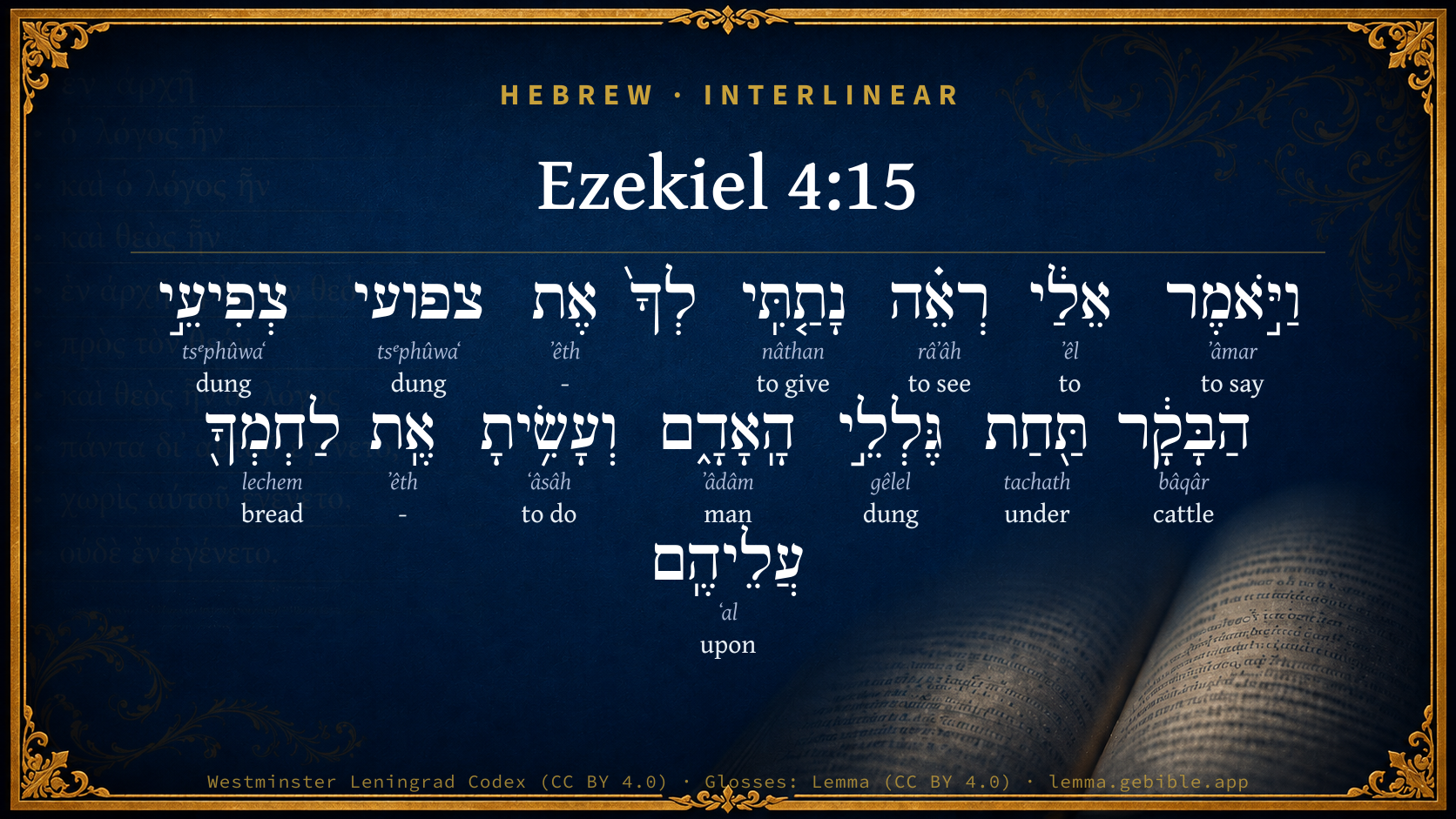
Hebrew (Westminster Leningrad Codex) Ezekiel 4:15 appears in the Hebrew Old Testament. The text above is from the Westminster Leningrad Codex. Each word links to its Strong’s number, a concise gloss, and parsing drawn from the Open Scriptures Hebrew Bible morphology. Click any word for its full Brown-Driver-Briggs (BDB) entry.
Download image
Cite this verse

Ezekiel 4:15 (World English Bible). Public Domain. Lemma interlinear Bible study tool, https://lemma.gebible.app/v/ezekiel/4/15.

Show BibTeX & RIS
BibTeX
RIS
English Translation
Then he said to me, Behold, I have given you cow's dung for man's dung, and you shall prepare your bread thereon.
World English Bible · Public Domain
Highlights
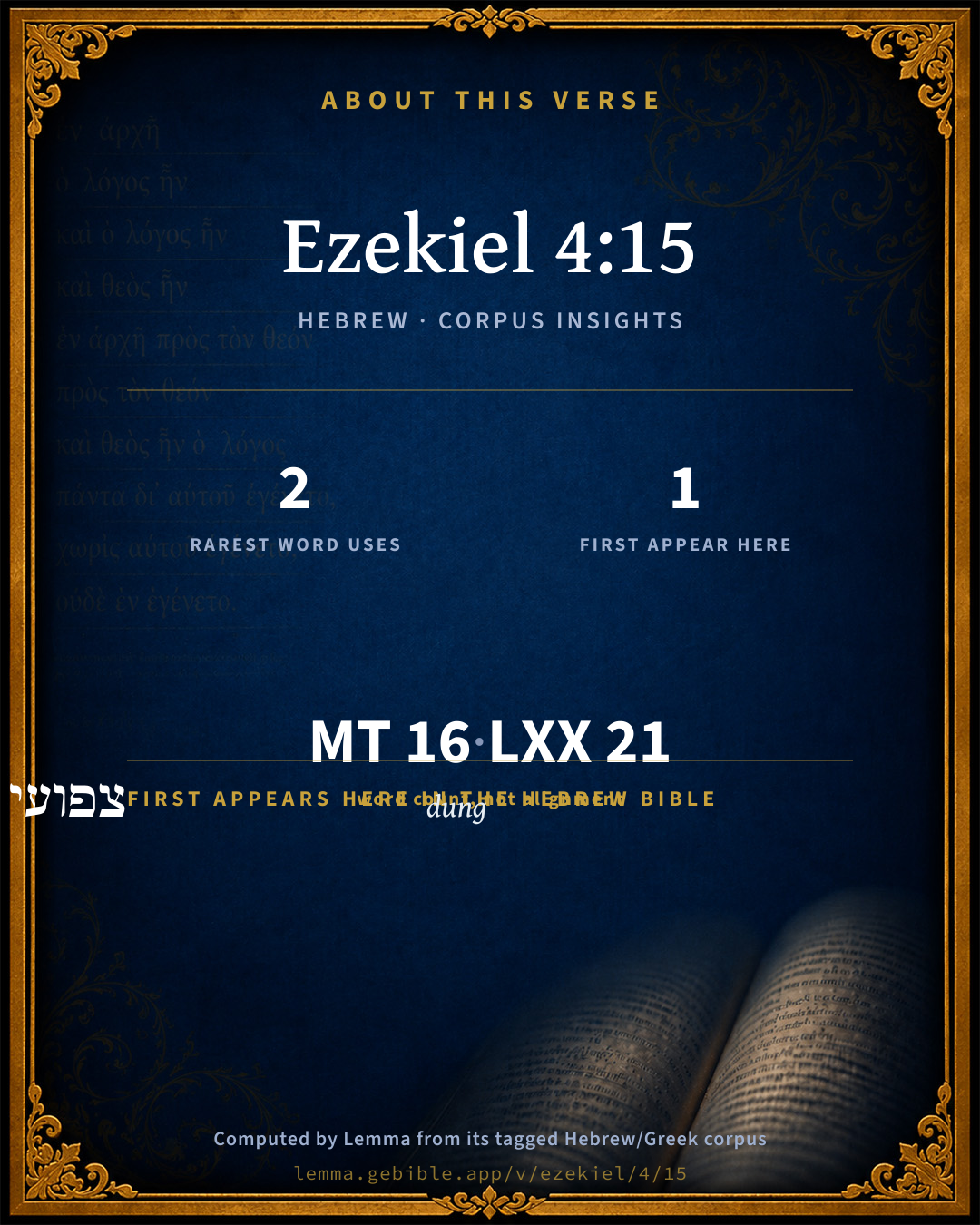
  • 1 first appearance in the Hebrew Bible
Full analysis ↓
Download a study sheet

One document with this verse’s original text, its word-by-word gloss line, the meaning frame, cross-references with their text, attributed commentary, and full source and license credits — printable, and it pastes into notes with its structure intact.

This verse Autodidact and up

Study sheet (.html) Plain text (.txt)

A passage Seminary Student

Up to 50 verses in one chapter. A passage sheet keeps up to 6 commentary sources and 12 cross-references per verse, in the order this page ranks them, and says so on the sheet whenever that leaves anything out. Ask for a single verse and you get the Autodidact verse sheet above.

Everything on this page stays free to read, with no account — the sheet is a download of what is already on screen, not access to it.

Want to remove ads? Support Godless Engineer
Compare translations 3

The same verse in 3 English versions, stacked beneath the original-language interlinear above. Click any original word for its lexicon entry.

Each is an independent rendering of the whole verse — the interlinear is not word-aligned to these translations.

Highlighted words mark where these versions differ — a whole-verse word diff, not a word-by-word alignment.

  • World English Bible Public Domain
    Then he said to me, Behold, I have given you cow's dung for man's dung, and you shall prepare your bread thereon.
  • King James Version Public Domain
    Then he said unto me, Lo, I have given thee cow's dung for man's dung, and thou shalt prepare thy bread therewith.
  • unfoldingWord Literal Text CC BY-SA 4.0
    So he said to me, “Look! I have given you cow manure instead of human dung so you can prepare your bread over that.”

unfoldingWord Literal Text — © unfoldingWord, licensed CC BY-SA 4.0. Word-aligned USFM3 via Door43 (git.door43.org/unfoldingWord/en_ult).

Versions to compare (up to 4)

3 of 4 selected

Show all 18 translations

Every available English version of this verse, each an independent rendering of the whole verse.

  • World English Bible Public Domain
    Then he said to me, Behold, I have given you cow's dung for man's dung, and you shall prepare your bread thereon.
  • Berean Standard Bible Public Domain
    “Look,” He replied, “I will let you use cow dung instead of human excrement, and you may bake your bread over that.”
  • Majority Standard Bible Public Domain
    “Look,” He replied, “I will let you use cow dung instead of human excrement, and you may bake your bread over that.”
  • King James Version Public Domain
    Then he said unto me, Lo, I have given thee cow's dung for man's dung, and thou shalt prepare thy bread therewith.
  • American Standard Version (1901) Public Domain
    Then he said unto me, See, I have given thee cow's dung for man's dung, and thou shalt prepare thy bread thereon.
  • Revised Version (1885) Public Domain
    Then he said unto me, See, I have given thee cow’s dung for man’s dung, and thou shalt prepare thy bread thereon.
  • Geneva Bible (1599) Public Domain
    Then he said vnto me, Loe, I haue giuen thee bullockes dongue for mans dongue, and thou shalt prepare thy bread therewith.
  • Douay-Rheims (1899) Public Domain
    And he said to me: Behold I have given thee neat's dung for man's dung, and thou shalt make thy bread therewith.
  • Young's Literal Translation Public Domain
    And He saith unto me, `See, I have given to thee bullock's dung instead of man's dung, and thou hast made thy bread by it.'
  • Literal Standard Version CC BY-SA 4.0
    And He says to me, “See, I have given to you bullock’s dung instead of man’s dung, and you have made your bread by it.”
  • Unlocked Literal Bible CC BY-SA 4.0
    So he said to me, “Look! I have given you cow manure instead of human dung so you can prepare your bread over that.”
  • unfoldingWord Literal Text CC BY-SA 4.0
    So he said to me, “Look! I have given you cow manure instead of human dung so you can prepare your bread over that.”
  • Darby Bible Public Domain
    And he said unto me, See, I have given thee cow's dung for man's dung, and thou shalt prepare thy bread therewith.
  • World Messianic Bible Public Domain
    Then he said to me, “Behold, I have given you cow’s dung for man’s dung, and you shall prepare your bread on it.”
  • Webster's Bible Public Domain
    Then he said to me, Lo, I have given thee cow's dung for man's dung, and thou shalt prepare thy bread with them.
  • Free Bible Version CC BY-SA 4.0
    “All right,” he said. “I'll let you use cow manure instead of human excrement You can bake your bread over a fire using that.”
  • Bible in Basic English Public Domain
    Then he said to me, See, I have given you cow's waste in place of man's waste, and you will make your bread ready on it.
  • JPS Tanakh (1917) Public Domain
    Then He said unto me: 'See, I have given thee cow's dung for man's dung, and thou shalt prepare thy bread thereon.'

Literal Standard Version (2020), Covenant Press — licensed CC BY-SA 4.0. Text via the HelloAO Bible API (eBible.org). Unlocked Literal Bible (unfoldingWord) — licensed CC BY-SA 4.0. Text via the HelloAO Bible API (eBible.org). unfoldingWord Literal Text — © unfoldingWord, licensed CC BY-SA 4.0. Word-aligned USFM3 via Door43 (git.door43.org/unfoldingWord/en_ult). Free Bible Version, Dr. Jonathan Gallagher — licensed CC BY-SA 4.0. Text via the HelloAO Bible API (eBible.org).

Word by word

More ways to search: Search by grammar → Find every occurrence → Compare this word →

Practice this passage: Drill this verse → Learn its vocabulary →

צפועי
tsᵉphûwaʻ
H6832
“dung of”
Noun, Common, Masculine, Plural, Construct
Part of Speech
Noun
Type
Common
Gender
Masculine
Number
Plural
State
Construct
Full BDB Definition

Origin: from the same as H6848

TWOT: 1955a

dung (of cattle), manure, cattle dung
  1. וַיֹּ֣אמֶר ʼâmar H559 “and · to say” Conjunction + Verb, Qal, Sequential Imperfect, 3rd Person, Masculine, Singular
  2. אֵלַ֔י ʼêl H413 “to · me” Preposition + Suffix, Personal, 1st Person, Common, Singular
  3. רְאֵ֗ה râʼâh H7200 “see” Verb, Qal, Imperative, 2nd Person, Masculine, Singular
  4. נָתַ֤תִּֽי nâthan H5414 “to give” Verb, Qal, Perfect, 1st Person, Common, Singular
  5. אֶת ʼêth H853 “-” Particle, Direct Object
  6. צְפִיעֵ֣י tsᵉphûwaʻ H6832 “dung of” Noun, Common, Masculine, Plural, Construct
  7. הַבָּקָ֔ר bâqâr H1241 “the · cattle” Particle, Definite Article + Noun, Common, Both, Singular, Absolute
  8. תַּ֖חַת tachath H8478 “under” Preposition
  9. גֶּלְלֵ֣י gêlel H1561 “dung of” Noun, Common, Masculine, Plural, Construct
  10. הָֽאָדָ֑ם ʼâdâm H120 “the · man” Particle, Definite Article + Noun, Common, Masculine, Singular, Absolute
  11. וְעָשִׂ֥יתָ ʻâsâh H6213 “and · to do” Conjunction + Verb, Qal, Sequential Perfect, 2nd Person, Masculine, Singular
  12. אֶֽת ʼêth H853 “-” Particle, Direct Object
  13. לַחְמְךָ֖ lechem H3899 “bread · your” Noun, Common, Both, Singular, Construct + Suffix, Personal, 2nd Person, Masculine, Singular
  14. עֲלֵיהֶֽם ʻal H5921 “upon · them” Preposition + Suffix, Personal, 3rd Person, Masculine, Plural

About this verse

These counts appear in no published source. They are computed here, from the morphology-tagged text and Lemma’s own curated glosses. What Lemma adds →

16
words
13
distinct lemmas
Prophets
section

Notable vocabulary

The rarest word here is צפועי dung H6832 — appearing just 2 times in the whole Hebrew Bible.

First appearance in Scripture

This word makes its first canonical appearance in the Hebrew Bible here:

Grammatical profile

  • 4 verbs
  • 6 nouns
  • 4 prepositions
  • 2 particles

Verb forms

  • וַיֹּ֣אמֶר Qal · Sequential Imperfect
  • רְאֵ֗ה Qal · Imperative
  • נָתַ֤תִּֽי Qal · Perfect
  • וְעָשִׂ֥יתָ Qal · Sequential Perfect

Repetition

A word recurs within this verse — often emphatic in Hebrew:

  • צפועי dung H6832 ×2

Hebrew & Septuagint length

In English translation the verse runs 22 words from the Hebrew and 25 from the Septuagint (LXX English) — closely comparable.

A rough comparison of the two English renderings, which tokenize alike — not a word-level alignment.

Word counts can differ between the Hebrew and the Greek without any difference in meaning — e.g. the Hebrew direct-object marker אֵת has no separate Greek word, and Greek often adds the article ὁ.

In the original languages it is 16 Hebrew tokens and 21 Greek tokens — but the two are counted differently (Hebrew bundles its prefixes and suffixes into one token; the Greek is in lemma form), so that isn’t a like-for-like length.

Hebrew and Greek witnesses Masoretic Hebrew ↔ Greek Septuagint

The same verse in the two great witnesses to the Old Testament, shown verse-for-verse.

These are two independent witnesses, not word-aligned to each other, and the Septuagint is shown in lemma (dictionary) form.

Hebrew Ezekiel 4:15 Masoretic · Westminster Leningrad Codex

וַיֹּ֣אמֶר אֵלַ֔י רְאֵ֗ה נָתַ֤תִּֽי לְךָ֙ אֶת צפועי צְפִיעֵ֣י הַבָּקָ֔ר תַּ֖חַת גֶּלְלֵ֣י הָֽאָדָ֑ם וְעָשִׂ֥יתָ אֶֽת לַחְמְךָ֖ עֲלֵיהֶֽם

Then he said to me, Behold, I have given you cow's dung for man's dung, and you shall prepare your bread thereon.

World English Bible · Public Domain

Greek LXX Ezekiel 4:15 Septuagint · lemma form

καί εἶπον πρός ἐγώ ἰδού δίδωμι σύ βόλβιτον βοῦς ἀντί ὁ βόλβιτον ὁ ἀνθρώπινος καί ποιέω ὁ ἄρτος σύ ἐπί αὐτός

And he said to me, Behold, I have given you dung of oxen instead of man's dung, and you shall prepare your loaves upon it.

LXX2012 (modern English Septuagint) · Public Domain

Hebrew: Westminster Leningrad Codex (CC BY 4.0). Greek: Septuagint (public domain); English from LXX2012 (modern English Septuagint) (Public Domain). How the Septuagint differs from the Hebrew →

Targum (Aramaic paraphrase)

1

The Targum is the ancient Jewish Aramaic paraphrase of the Hebrew Scriptures — an interpretive translation, not the Hebrew text itself. Onkelos (literal) and Pseudo-Jonathan (expansive) render the Torah, and Jonathan the Prophets. Coverage is partial: where no permissively-licensed English translation exists for a verse, only the Aramaic is shown. This is verse-level text, not a word-by-word alignment to the Hebrew.

  1. Targum Jonathan Prophets (Joshua–Malachi)
    וַאֲמַר לִי חֲזֵי דִיהָבֵית לָךְ יַת גְלֵי תוֹרַיָא חֲלַף גְלֵי אֱנָשָׁא וְתַעֲבֵיד יַת מֵיכְלָךְ עֲלֵיהוֹן:

    (no public-domain English translation for this verse)

    Targum Jonathan — Aramaic: “Mikraot Gedolot” (public domain). English: “Sefaria Community Translation” (CC0 1.0 (public-domain dedication)); “London "Chaldee Paraphrase," 1871” (public domain). Text via Sefaria.

Commentary

Notes on Ezekiel 4:15 from classic Christian and Jewish commentators (each source and its license shown beneath its notes). The classic Christian expositions comment on the surrounding passage and are grouped to its opening verse, so a note may address several verses; the Jewish commentaries on the Tanakh (Rashi and others) are per-verse, so they appear only where the commentator wrote on this verse.

Lemma curates 59 commentaries, every one of them public domain or Creative Commons licensed, each selected and text-cleaned for this edition rather than reprinted as found. About our sources →

Trapp's Complete Commentary

John Trapp

Eze 4:15 Then he said unto me, Lo, I have given thee cow’s dung for man’s dung, and thou shalt prepare thy bread therewith.

Ver. 15. Lo, I have given thee cow’s dung.] This was some mitigation. Something God will yield to his praying people when most bitterly bent against them.

John Trapp, A Commentary or Exposition upon All the Books of the Old and New Testament (1647–1656) — public domain. Text from a community e-Sword module.

Geneva Bible (1599)

Geneva Bible translators

To be as fire to bake thy bread with.

Geneva Bible (1599) marginal notes — public domain. Text via Bolls.life.

Jamieson, Fausset & Brown

Robert Jamieson, A. R. Fausset & David Brown

cow's dung--a mitigation of the former order (Eze 4:12); no longer "the dung of man"; still the bread so baked is "defiled," to imply that, whatever partial abatement there might be for the prophet's sake, the main decree of God, as to the pollution of Israel by exile among Gentiles, is unalterable.

Jamieson, Fausset & Brown — Commentary Critical and Explanatory on the Whole Bible (1871) — public domain (CC PDM 1.0). Text via the HelloAO Bible API.

Ellicott's Commentary for English Readers

(15) Cow’s dung.—In the scarcity of fuel in the East, cow’s dung and especially camel’s dung, is dried, and becomes the common fuel.

A Bible Commentary for English Readers, edited by Charles John Ellicott (1878–1897) — public domain. Text from a community e-Sword module.

John Gill's Exposition

Then he said to me,.... The Lord hearkened to the prophet's prayer and argument, and makes some abatement and alteration in the charge he gave him:

lo, I have given thee cow's dung for man's dung: that is, allowed him to make use of the one instead of the other, in baking his mingled bread:

thou shalt prepare thy bread therewith; having gathered cow's dung, and dried it, he was to burn it, and bake his bread with it, which is meant by preparing it. In some parts of our nation, where fuel is scarce, cow's dung is made use of; it is gathered and plastered on the walls of houses, and, being dried in clots, is taken and burnt.

John Gill's Exposition of the Whole Bible (1746–1763) — public domain (CC PDM 1.0). Text via the HelloAO Bible API.

Haydock's Catholic Bible Commentary

Neats, or "oxen;" boum. Protestants, "cow’s dung." (Haydock) --- God allows him to bake his bread under such ashes. (Calmet) --- So great is his condescension towards his friends! (Calmet)

George Leo Haydock (1774–1849), Haydock's Catholic Family Bible and Commentary, 1859 edition — public domain. Excludes Psalms (Douay-Rheims chapter numbering differs from Protestant) and Deuterocanonical books (Catholic canon only).

Matthew Poole's English Annotations

So soon as he prayed God answered, and condescends to Ezekiel that he should use what was less abominable than man’s dung; but it was not granted to the Jews, who in the siege at Jerusalem did much worse things, and more detestable, reduced to it by straits, as Eze 5:10; Lam 1:11; 2:11,12,20.

Matthew Poole's English Annotations on the Holy Bible (1683–1685) — public domain. Text from a community e-Sword/MySword module.

The Pulpit Commentary

Lo, I have given thee, etc. The concession mitigates the horror of the first command, though even this was probably regarded as involving some ceremonial uncleanness. It served, at any rate, to represent, in some measure, the pressure of the siege.

The Pulpit Commentary (1880–1919), ed. H.D.M. Spence-Jones & Joseph S. Exell — public domain. Text from a community e-Sword module.

Rashi

Rabbi Shlomo Yitzchaki (Rashi)

dung Heb. צְפִיעֵי [synonymous with] גֶלְלֵי, excrement.

Rashi on the Tanakh — English translations: “The Judaica Press complete Tanach with Rashi, translated by A. J. Rosenberg” (CC BY 4.0); “Pentateuch with Rashi's commentary by M. Rosenbaum and A.M. Silbermann, 1929-1934” (public domain); “The Metsudah Tanach series, Lakewood, N.J” (CC BY 4.0); and “The Book of Joshua, Metsudah Publications, 1997” (CC BY 4.0). Text via Sefaria.

Lesson kit

Teaching starters — assembled from the data on this page, not authored interpretation. Every prompt links to the verse data it draws on. Edit before teaching.

Ezekiel, in the Prophets, opens this verse with 16 words (13 distinct Hebrew lemmas). Its most distinctive word is tsᵉphûwaʻ (“dung”). A historical commentator’s framing appears above. Read the whole chapter for the surrounding context.

Discussion questions

  1. How does “dung” (tsᵉphûwaʻ) shape what this verse is saying?
  2. This is the first place “dung” appears in Scripture (first appears here). What does its debut here establish?
  3. What does the repetition of “dung” (2× in this one verse) do in this verse?
  4. The translations on this page render this verse differently — a whole-verse word diff, not a word-by-word alignment. What might account for the different wordings?
  5. «וַיֹּ֣אמֶר» is a Qal Sequential Imperfect verb. How does that grammatical form shape the action described?
  6. Compare how Trapp's Complete Commentary and Geneva Bible (1599) read this verse. Where do they agree or differ?

Things to notice

Reading settings

Reading text

Shown beneath each verse's original-language words.

Old Testament
Old Testament edition

Read the OT as the Masoretic Hebrew (MT) or the Greek Septuagint (LXX).

English shown for the Greek Septuagint (in the Hebrew ↔ Greek comparison).

Comparing translations? Open the Compare panel on any verse page to stack up to four side by side.