Amos 6:12

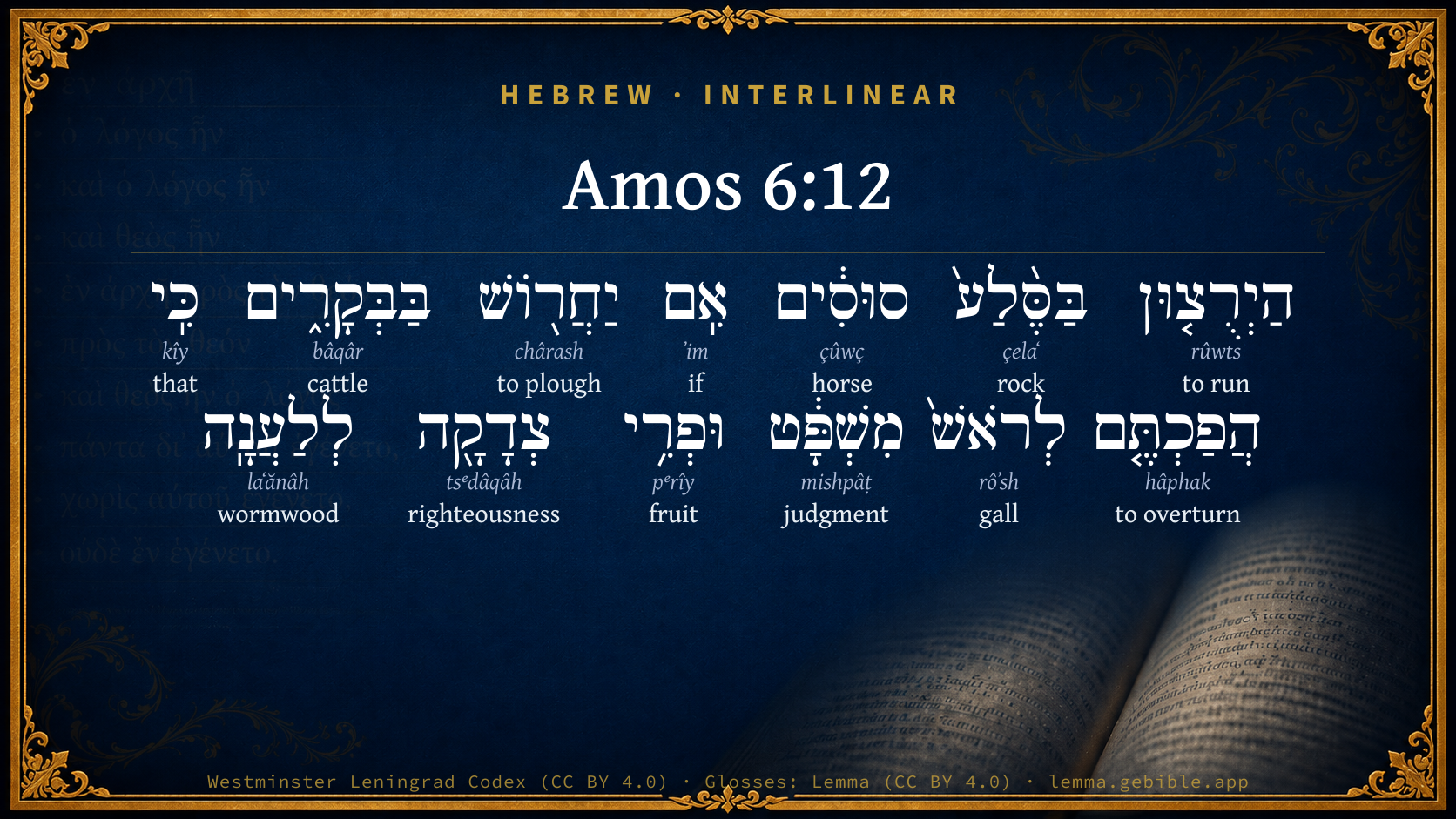
Hebrew (Westminster Leningrad Codex) Amos 6:12 appears in the Hebrew Old Testament. The text above is from the Westminster Leningrad Codex. Each word links to its Strong’s number, a concise gloss, and parsing drawn from the Open Scriptures Hebrew Bible morphology. Click any word for its full Brown-Driver-Briggs (BDB) entry.
Download image
Cite this verse

Amos 6:12 (World English Bible). Public Domain. Lemma interlinear Bible study tool, https://lemma.gebible.app/v/amos/6/12.

Show BibTeX & RIS
BibTeX
RIS
English Translation
Do horses run on the rocky crags? Does one plow there with oxen? But you have turned justice into poison, And the fruit of righteousness into bitterness;
World English Bible · Public Domain
Download a study sheet

One document with this verse’s original text, its word-by-word gloss line, the meaning frame, cross-references with their text, attributed commentary, and full source and license credits — printable, and it pastes into notes with its structure intact.

This verse Autodidact and up

Study sheet (.html) Plain text (.txt)

A passage Seminary Student

Up to 50 verses in one chapter. A passage sheet keeps up to 6 commentary sources and 12 cross-references per verse, in the order this page ranks them, and says so on the sheet whenever that leaves anything out. Ask for a single verse and you get the Autodidact verse sheet above.

Everything on this page stays free to read, with no account — the sheet is a download of what is already on screen, not access to it.

Want to remove ads? Support Godless Engineer
Compare translations 3

The same verse in 3 English versions, stacked beneath the original-language interlinear above. Click any original word for its lexicon entry.

Each is an independent rendering of the whole verse — the interlinear is not word-aligned to these translations.

Highlighted words mark where these versions differ — a whole-verse word diff, not a word-by-word alignment.

  • World English Bible Public Domain
    Do horses run on the rocky crags? Does one plow there with oxen? But you have turned justice into poison, And the fruit of righteousness into bitterness;
  • King James Version Public Domain
    Shall horses run upon the rock? will one plow there with oxen? for ye have turned judgment into gall, and the fruit of righteousness into hemlock:
  • unfoldingWord Literal Text CC BY-SA 4.0
    Do horses run on the rocky cliffs? Does one plow there with oxen? Yet you have turned justice into poison and the fruit of righteousness into bitterness.

unfoldingWord Literal Text — © unfoldingWord, licensed CC BY-SA 4.0. Word-aligned USFM3 via Door43 (git.door43.org/unfoldingWord/en_ult).

Versions to compare (up to 4)

3 of 4 selected

Show all 18 translations

Every available English version of this verse, each an independent rendering of the whole verse.

  • World English Bible Public Domain
    Do horses run on the rocky crags? Does one plow there with oxen? But you have turned justice into poison, And the fruit of righteousness into bitterness;
  • Berean Standard Bible Public Domain
    “Do horses gallop on the cliffs? Does one plow the sea with oxen? But you have turned justice into poison and the fruit of righteousness into wormwood—
  • Majority Standard Bible Public Domain
    “Do horses gallop on the cliffs? Does one plow the sea with oxen? But you have turned justice into poison and the fruit of righteousness into wormwood—
  • King James Version Public Domain
    Shall horses run upon the rock? will one plow there with oxen? for ye have turned judgment into gall, and the fruit of righteousness into hemlock:
  • American Standard Version (1901) Public Domain
    Shall horses run upon the rock? will one plow `there' with oxen? that ye have turned justice into gall, and the fruit of righteousness into wormwood;
  • Revised Version (1885) Public Domain
    Shall horses run upon the rock? will one plow there with oxen? that ye have turned judgment into gall, and the fruit of righteousness into wormwood:
  • Geneva Bible (1599) Public Domain
    Shal horses runne vpon the rocke? or wil one plowe there with oxen? for yee haue turned iudgement into gall, and the fruite of righteousnes into wormewood.
  • Douay-Rheims (1899) Public Domain
    For behold the Lord hath commanded, and he will strike the greater house with breaches, and the lesser house with clefts.
  • Young's Literal Translation Public Domain
    Do horses run on a rock? Doth one plough `it' with oxen? For ye have turned to gall judgment, And the fruit of righteousness to wormwood.
  • Literal Standard Version CC BY-SA 4.0
    Do horses run on a rock? Does one plow [it] with oxen? For you have turned judgment to gall, || And the fruit of righteousness to wormwood.
  • Unlocked Literal Bible CC BY-SA 4.0
    Do horses run on the rocky cliffs? Does one plow there with oxen? Yet you have turned justice into poison and the fruit of righteousness into bitterness.
  • unfoldingWord Literal Text CC BY-SA 4.0
    Do horses run on the rocky cliffs? Does one plow there with oxen? Yet you have turned justice into poison and the fruit of righteousness into bitterness.
  • Darby Bible Public Domain
    Shall horses run upon the rock? will [men] plough [thereon] with oxen? For ye have turned judgment into gall, and the fruit of righteousness into wormwood,
  • World Messianic Bible Public Domain
    Do horses run on the rocky crags? Does one plow there with oxen? But you have turned justice into poison, and the fruit of righteousness into bitterness,
  • Webster's Bible Public Domain
    Shall horses run upon the rock? will one plow there with oxen? for ye have turned judgment into gall, and the fruit of righteousness into hemlock:
  • Free Bible Version CC BY-SA 4.0
    Can horses gallop over rocks? Can oxen plow the sea? But you have turned justice into poison, and the fruit of doing good into bitterness!
  • Bible in Basic English Public Domain
    Is it possible for horses to go running on the rock? may the sea be ploughed with oxen? for the right to be turned by you into poison, and the fruit of righteousness into a bitter plant?
  • JPS Tanakh (1917) Public Domain
    Do horses run upon the rocks? Doth one plow there with oxen? that ye have turned justice into gall, and the fruit of righteousness into wormwood;

Literal Standard Version (2020), Covenant Press — licensed CC BY-SA 4.0. Text via the HelloAO Bible API (eBible.org). Unlocked Literal Bible (unfoldingWord) — licensed CC BY-SA 4.0. Text via the HelloAO Bible API (eBible.org). unfoldingWord Literal Text — © unfoldingWord, licensed CC BY-SA 4.0. Word-aligned USFM3 via Door43 (git.door43.org/unfoldingWord/en_ult). Free Bible Version, Dr. Jonathan Gallagher — licensed CC BY-SA 4.0. Text via the HelloAO Bible API (eBible.org).

Word by word

More ways to search: Search by grammar → Find every occurrence → Compare this word →

Practice this passage: Drill this verse → Learn its vocabulary →

לְלַעֲנָֽה
laʻănâh
H3939
“to/for · wormwood”
Preposition + Noun, Common, Feminine, Singular, Absolute
Part of Speech
Preposition + Noun
Type
Common
Gender
Feminine
Number
Singular
State
Absolute
Full BDB Definition

Origin: from an unused root supposed to mean to curse

TWOT: 1121

wormwood - bitterness (metaphorically)
  1. הַיְרֻצ֤וּן rûwts H7323 “to run” Particle, Interrogative + Verb, Qal, Imperfect, 3rd Person, Masculine, Plural + Suffix, n
  2. בַּסֶּ֨לַע֙ çelaʻ H5553 “in/at the · rock” Preposition, Determined + Noun, Common, Masculine, Singular, Absolute
  3. סוּסִ֔ים çûwç H5483 “horses” Noun, Common, Masculine, Plural, Absolute
  4. אִֽם ʼim H518 “if” Conjunction
  5. יַחֲר֖וֹשׁ chârash H2790 “to plough” Verb, Qal, Imperfect, 3rd Person, Masculine, Singular
  6. בַּבְּקָרִ֑ים bâqâr H1241 “in/at the · cattle” Preposition, Determined + Noun, Common, Both, Plural, Absolute
  7. כִּֽי kîy H3588 “that” Conjunction
  8. הֲפַכְתֶּ֤ם hâphak H2015 “to overturn” Verb, Qal, Perfect, 2nd Person, Masculine, Plural
  9. לְרֹאשׁ֙ rôʼsh H7219 “to/for · gall” Preposition + Noun, Common, Masculine, Singular, Absolute
  10. מִשְׁפָּ֔ט mishpâṭ H4941 “judgment” Noun, Common, Masculine, Singular, Absolute
  11. וּפְרִ֥י pᵉrîy H6529 “and · fruit of” Conjunction + Noun, Common, Masculine, Singular, Construct
  12. צְדָקָ֖ה tsᵉdâqâh H6666 “righteousness” Noun, Common, Feminine, Singular, Absolute

About this verse

These counts appear in no published source. They are computed here, from the morphology-tagged text and Lemma’s own curated glosses. What Lemma adds →

13
words
13
distinct lemmas
Prophets
section

Notable vocabulary

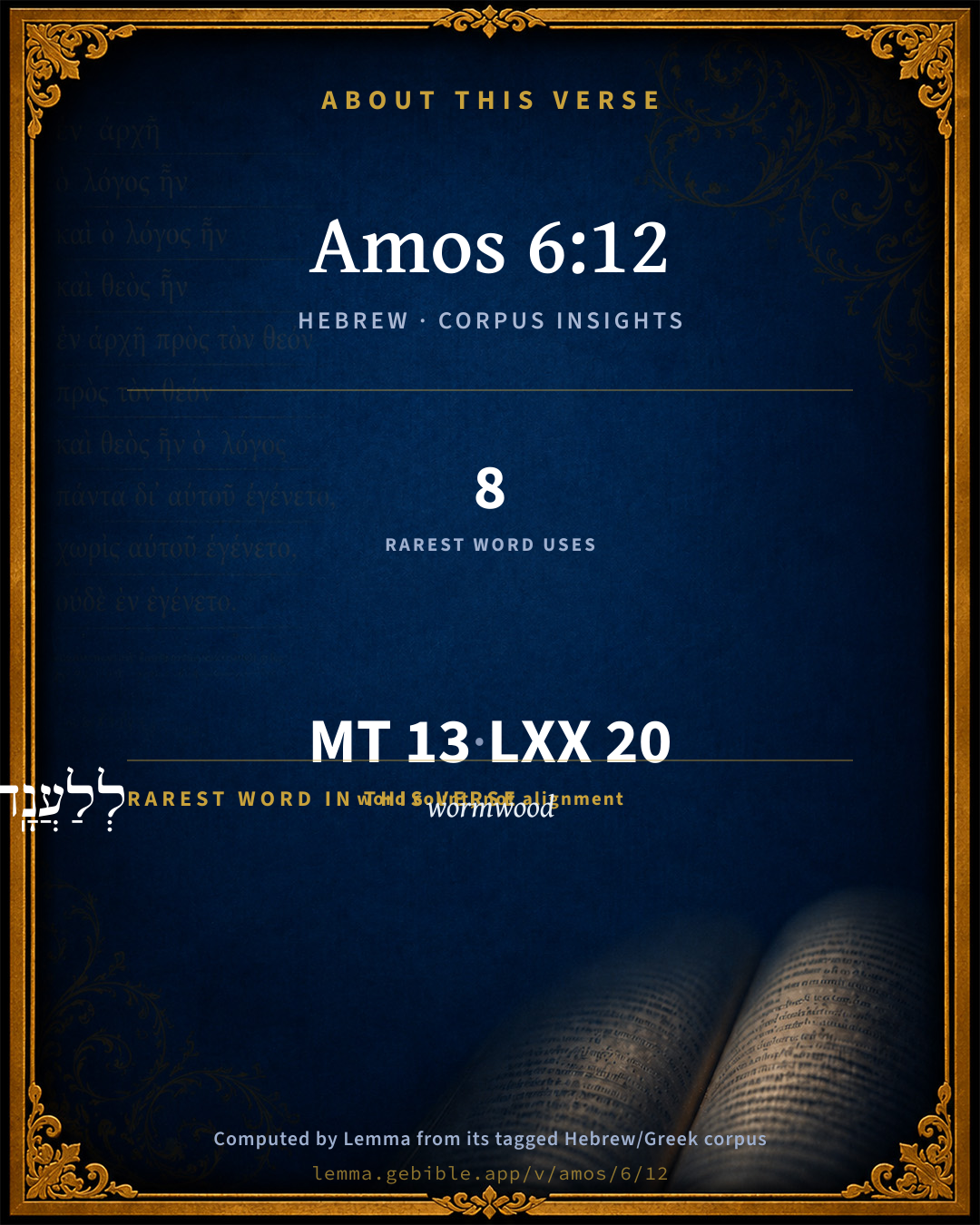
The rarest word here is לְלַעֲנָֽה wormwood H3939 — appearing just 8 times in the whole Hebrew Bible.

Shared distinctive vocabulary

לְלַעֲנָֽה wormwood H3939 occurs in 8 verses of the Hebrew Bible. Also found in:

Grammatical profile

  • 3 verbs
  • 8 nouns
  • 2 conjunctions

Verb forms

  • הַיְרֻצ֤וּן Qal · Imperfect
  • יַחֲר֖וֹשׁ Qal · Imperfect
  • הֲפַכְתֶּ֤ם Qal · Perfect

Hebrew & Septuagint length

In English translation the verse runs 27 words from the Hebrew and 20 from the Septuagint (LXX English) — closely comparable.

A rough comparison of the two English renderings, which tokenize alike — not a word-level alignment.

Word counts can differ between the Hebrew and the Greek without any difference in meaning — e.g. the Hebrew direct-object marker אֵת has no separate Greek word, and Greek often adds the article ὁ.

In the original languages it is 13 Hebrew tokens and 20 Greek tokens — but the two are counted differently (Hebrew bundles its prefixes and suffixes into one token; the Greek is in lemma form), so that isn’t a like-for-like length.

Cross-references

14

Topical passages linked to Amos 6:12 in the Treasury of Scripture Knowledge — connected by theme and wording, ordered by reader-vote popularity; previews shown in the World English Bible.

  • Amos 5:7 You who turn justice to wormwood, And cast down righteousness to the earth:
  • Hosea 10:4 They make promises, swearing falsely in making covenants. Therefore judgment springs up like poisonous weeds in the furrows of the field.
  • Isaiah 59:13–14 transgressing and denying Yahweh, and turning away from following our God, speaking oppression and revolt, conceiving and uttering from the heart words of falsehood.
  • Amos 5:11–12 Forasmuch therefore as you trample on the poor, And take taxes from him of wheat: You have built houses of hewn stone, But you will not dwell in them. You have planted pleasant vineyards, But you shall not drink their wine.
  • 1 Kings 21:7–13 Jezebel his wife said to him, Do you now govern the kingdom of Israel? arise, and eat bread, and let your heart be merry: I will give you the vineyard of Naboth the Jezreelite.
  • Psalms 94:20–21 Shall the throne of wickedness have fellowship with you, Which brings about mischief by statute?
  • Isaiah 48:4 Because I knew that you are obstinate, and your neck is an iron sinew, and your brow brass;
  • Jeremiah 5:3 O Yahweh, don't your eyes look on truth? you have stricken them, but they were not grieved; you have consumed them, but they have refused to receive correction: they have made their faces harder than a rock; they have refused to return.
  • Jeremiah 6:29–30 The bellows blow fiercely; the lead is consumed of the fire: in vain do they go on refining; for the wicked are not plucked away.
  • Hosea 10:13 You have plowed wickedness. You have reaped iniquity. You have eaten the fruit of lies, For you trusted in your way, in the multitude of your mighty men.
  • Micah 7:3 Their hands are on that which is evil to do it diligently. The ruler and judge ask for a bribe; And the powerful man dictates the evil desire of his soul. Thus they conspire together.
  • Habakkuk 1:3–4 Why do you show me iniquity, and look at perversity? For destruction and violence are before me. There is strife, and contention rises up.
  • Zechariah 7:11–12 But they refused to listen, and turned their backs, and stopped their ears, that they might not hear.
  • Acts 7:51–52 "You stiff-necked and uncircumcised in heart and ears, you always resist the Holy Spirit! As your fathers did, so you do.

Cross-references courtesy of OpenBible.info (CC BY 4.0).

Hebrew and Greek witnesses Masoretic Hebrew ↔ Greek Septuagint

The same verse in the two great witnesses to the Old Testament, shown verse-for-verse.

These are two independent witnesses, not word-aligned to each other, and the Septuagint is shown in lemma (dictionary) form.

Hebrew Amos 6:12 Masoretic · Westminster Leningrad Codex

הַיְרֻצ֤וּן בַּסֶּ֨לַע֙ סוּסִ֔ים אִֽם יַחֲר֖וֹשׁ בַּבְּקָרִ֑ים כִּֽי הֲפַכְתֶּ֤ם לְרֹאשׁ֙ מִשְׁפָּ֔ט וּפְרִ֥י צְדָקָ֖ה לְלַעֲנָֽה

Do horses run on the rocky crags? Does one plow there with oxen? But you have turned justice into poison, And the fruit of righteousness into bitterness;

World English Bible · Public Domain

Greek LXX Amos 6:12 Septuagint · lemma form

εἰ διώκω ἐν πέτρα ἵππος εἰ παρασιωπάω ἐν θῆλυς ὅτι σύ ἐκστρέφω εἰς θυμός κρίμα καί καρπός δικαιοσύνη εἰς πικρία

For, behold, the Lord commands, and he will strike the great house with breaches, and the little house with rents.

LXX2012 (modern English Septuagint) · Public Domain

Hebrew: Westminster Leningrad Codex (CC BY 4.0). Greek: Septuagint (public domain); English from LXX2012 (modern English Septuagint) (Public Domain). How the Septuagint differs from the Hebrew →

Targum (Aramaic paraphrase)

1

The Targum is the ancient Jewish Aramaic paraphrase of the Hebrew Scriptures — an interpretive translation, not the Hebrew text itself. Onkelos (literal) and Pseudo-Jonathan (expansive) render the Torah, and Jonathan the Prophets. Coverage is partial: where no permissively-licensed English translation exists for a verse, only the Aramaic is shown. This is verse-level text, not a word-by-word alignment to the Hebrew.

  1. Targum Jonathan Prophets (Joshua–Malachi)
    הֲיִרְהֲטוּן בְּכֵיפָא סוּסְוָן אִם יִתְרְדֵי בְתוֹרַיָא אֲרֵי הֲפַכְתּוּן לְרֵישׁ חִוְיָן בִּישִׁין דִינָא וּפְרִי זְכוּתָא לְגִידִין:

    (no public-domain English translation for this verse)

    Targum Jonathan — Aramaic: “Mikraot Gedolot” (public domain). English: “Sefaria Community Translation” (CC0 1.0 (public-domain dedication)); “London "Chaldee Paraphrase," 1871” (public domain). Text via Sefaria.

Commentary

Notes on Amos 6:12 from classic Christian and Jewish commentators (each source and its license shown beneath its notes). The classic Christian expositions comment on the surrounding passage and are grouped to its opening verse, so a note may address several verses; the Jewish commentaries on the Tanakh (Rashi and others) are per-verse, so they appear only where the commentator wrote on this verse.

Lemma curates 59 commentaries, every one of them public domain or Creative Commons licensed, each selected and text-cleaned for this edition rather than reprinted as found. About our sources →

Trapp's Complete Commentary

John Trapp

Amo 6:12 Shall horses run upon the rock? will [one] plow [there] with oxen? for ye have turned judgment into gall, and the fruit of righteousness into hemlock:

Ver. 12. Shall horses run upon the rock] Is it possible they should do so and not first break their hoofs, and then their necks? will the rider therefore venture there? were it not matchless madness in him?

Will one plough there with oxen] Sure he will conceive it too hard a tug, and too vain a labour. Jerome rendereth it Bubalis, with wild oxen; which, not accustomed to the yoke, are like to make but wild work wherever they are ploughed with. Now as there is no good horse racing upon a rock, nor fit ploughing there; so neither must you ever hope to escape unpunished, or to keep up your commonwealth unshattered, so long as ye deal thus preposterously, perversely, and absurdly, Pro 14:14. That of Virgil is not much unlike:

“ Atque idem iungat vulpes, et mulgeat hircos. ”

For ye have turned judgment into gall, &c.] Or into poison; the Chaldee rendereth it, into the head of hurtful serpents. The word seemeth to signify the poison of serpents, which is in the head. See Hos 10:4. {See Trapp on "Hos 10:4"}

And the fruit of righteousness into hemlock] Or wormwood, as if ye were akin to that star in the Revelation that is styled Wormwood, Rev 8:11, that great Antichrist, who would make the world believe that he hath power, de iniustitia facere iustitiam, ex nihilo aliquid, ex virtute vitium, that is, of injustice to make justice, of nothing to make something, of virtue vice, to dispense with any of the Ten Commandments, to make new articles of the Creed, to dispose of all kingdoms at his pleasure, and what not (Bellarm. lib. 4, de Pontif. Roman.)? Pope John XXIII saith, that he may grant a dispensation against the law of nature and of nations, against St. Paul and St Peter, against the four Gospels. The Council of Constance comes in with a Non obstante against Christ’s own institution, withholding the cup from the sacrament; and the like for priests’ marriages, prayers in a known tongue, singing of Psalms. When the cardinals meet to choose a Pope they make a vow, whosoever is chosen he shall swear to such articles as they make. And Sleidan telleth us, that the Pope is no sooner chosen but he breaks them all, and checks their insolencies, as if they went about to limit his power, to whom all power is given both in heaven and earth, both in spirituals and temporals. And, indeed, he is called the beast, in respect of his civil power, and the false prophet, in respect of his spiritual; and the star Wormwood, because being himself in the gall of bitterness and bond of perdition, he turneth all judgment into gall, and the fruit of righteousess into wormwood: see Amo 5:7.

John Trapp, A Commentary or Exposition upon All the Books of the Old and New Testament (1647–1656) — public domain. Text from a community e-Sword module.

The Biblical Illustrator

Joseph S. Exell

Amo_6:12

Shall horses run upon the rock?

will one plough there with oxen?

Labour in vain

These expressions are proverbs, taken from the familiar sayings of the east country. A proverb is generally a sword with two edges, or, if I may so say, it has many edges, or is all edge, and hence it may be turned this way and that way, and every part of it will have force and point. The connection would tolerate two senses in this place. An ancient commentator says that it has seven meanings. Like those curiously carved Chinese balls in which there is one ball within another, so in many a holy text there is sense within sense, teaching within teaching, and each one worthy of the Spirit of God. It may be that the prophet is expostulating with ungodly men upon their pursuit of happiness where it can never be found. They were endeavouring to grow rich and strong by oppression. And if any of you try to content yourselves with this world, and hope to find a heaven in the midst of your business and your family, without looking upward for it, you labour in vain. To seek after happiness in evil deeds is to plough a rock of granite. To labour after true prosperity by dishonest means is as useless as to till the sandy shore. The words may mean this,--God will not always send His ministers to call men to repentance. There is a time of ploughing, but when it is evident that the heart is wilfully hardened, then wisdom itself suggests to mercy that she should give over her efforts. Taking that sense, we remark--

I. Ministers labour to break up mens hearts. They would make hearts ready to receive the heavenly Seed. Many truths are used, like sharp ploughshares, to break up the heart. We must cut into the heart with the ploughshare of the law. If we really love the souls of men, let us prove it by honest speech. The hard heart must be broken, or it will still refuse the Saviour who was sent to bind up the broken-hearted. There are some things which men may or may not have, and yet may be saved; but those things which go with the ploughing of the heart are indispensable There must be a holy fear and a humble trembling before God, there must be an acknowledgment of guilt and a penitent petition for mercy; there must, in a word, be a thorough ploughing of the soul before we can expect the seed to bring forth fruit.

II. At times ministers labour in vain. In a short time the ploughman feels whether the plough will go or not, and so does the minister. He may use the very same words in one place which he has used in another, but he feels in one place great joy and hopefulness in his preaching, while with another audience he has heavy work and little hope. All labourers of Christ know what it is sometimes to work in heavy soil. There are rocky hearers in all congregations. On some impression is made, but it is not deep and permanent. Certain of these rocky-hearted people have been ploughed for years, and have become harder instead of softer. The sun which softens wax hardens clay, and the same Gospel which has brought others to tenderness and repentance has exercised a contrary effect upon them, and made them more careless about Divine things than they were in their youth. Why are men so extremely rocky? Some are so from a peculiar stolidity of nature. Some are hard because of their infidelity. Worldliness hardens a man in every way. With many hardness is produced by a general levity. There is no depth of earth in their superficial natures; beneath a sprinkling of shifting, worthless sand lies an impenetrable rock of utter stupidity and senselessness.

III. It is unreasonable to expect that Gods servants should always continue to labour in vain. Labour in vain cannot be continued for ever if we consider the ploughman. Then there is the Master to be considered. Is He always to be resisted and provoked? And there are so many other people needing the Gospel who will receive it. There is a boundary to the patience of men, and even to the patience of God.

IV. There must be an alteration then, and that speedily. The oxen shall be taken off from such toil. It can be effected in three ways.

1. The unprofitable hearer can be removed so that he shall no more hear the Gospel from the lips of his best approved minister.

2. Another plan is to take away the ploughman. Or

3. God may say, This piece of rock shall never trouble the ploughman any more. I will take it away. The man dies. O Lord, break up the rock, and let the seed drop among its broken substance, and get Thou a harvest from the dissolved granite at this time. (C. H. Spurgeon.)

Ye have turned judgment into gall.

Mans perverting power

The meaning of this is that they had turned the best things into bad use. See the working of this perverting power in many departments of action.

I. In physical operations. Everywhere you see man perverting nature, perverting the metals, the rivers, the fruits, and the chemical elements of the world to bad and mischievous uses.

II. In civic life. The principle of human government is a Divine ordinance, intended to secure equal justice and protection. But how has man perverted it! He has turned it into an instrument to benefit the few at the expense of the many, an instrument of tyranny and oppression. Mans perversion of the law is proverbial as a hideous enormity. The principle of merchandise, intended to band man together by the exchange of commodities, in mutual obligation and fellowship, man has awfully perverted. He has made it the instrument of cupidity, monopoly, and nameless frauds.

III. In the religious sphere. Do not let man say he has no power. His moral power is something stupendous. He has power to turn the things of God to the use of Satan, heavenly blessings into hellish curses. (Homilist.)

The Biblical Illustrator, edited by Joseph S. Exell (c. 1880s–1900s) — public domain. Text from a community e-Sword module.

Joseph Benson's Commentary

Amo 6:12. Shall horses run upon the rock? — “Is it possible that horses should run upon the steep and craggy cliffs? So impossible is it that ye Israelites should continue to prosper, while ye remain thus sinful.” — Bishop Hall. Or, “as horses and oxen are useless in such places, so are ye evidently useless to God.” — Grotius. Several other interpretations are given of this obscure verse. Mr. Scott’s is, “It was as perilous to endeavour to reform the people as it would be to ride a race on the top of a craggy rock, where both horses and horsemen would be in danger of being killed; and as vain as to plough there with oxen, when no impression could be made or increase expected.” For ye have turned judgment into gall, &c. — Ye have rendered the administration of public justice as bitter as gall, and the fruit of righteousness, or the observance of religious ceremonies, as poisonous as hemlock.

Joseph Benson's Commentary on the Old and New Testaments (1811–1818) — public domain. Text from a community e-Sword module.

The Preacher's Complete Homiletical Commentary

Joseph S. Exell (gen. ed.)

CRITICAL NOTES.]

Amo_6:12.] As horses and oxen are useless on a rock, so ye are incapable of fulfilling justice [Grotius]. The comparison indicates the folly of expecting prosperity while committing acts of injustice. The interrogative form gives strength to the representation.

Amo_6:13. Nought] Their growing empire, or imaginary strength. Horns] A symbol of power; dominion rescued by Jeroboam from the Syrians (2Ki_14:25).

Amo_6:14.] God’s answer to this presumption. A people] Not named, perhaps to awaken attention; probably Assyria. Afflict] Oppress, crush down; the whole extent of territory said to have been recovered by Jeroboam II., the region of triumphs a scene of woe.

HOMILETICS

A HOPELESS PEOPLE.—Amo_6:12-14

These verses are rather abrupt, and generally taken to show how useless and impossible it is to reform the people. Their perversion of right and their indifference to threatening rendered punishment inevitable, and foolish confidence in their own power could not avert it.

I. Punishment was most inevitable. Two illustrations prove this. Their conduct was perilous and preposterous. Horses cannot run with safety, nor can oxen plough, upon rocks: so in their self-chosen way they will wound themselves and be disappointed.

1. Former attempts to reform had failed. God had sent judgment after judgment, prophet after prophet, but in vain. They had not broken up their fallow ground, but were hard and uncultivated as a rock. They hindered the work of God and acted most perversely. “Those who will not be tilled as fields shall be abandoned as rocks,” says Calvin.

2. Special sins were not forsaken. “Ye have turned judgment into gall,” &c. Power was still abused, oppression and injustice practised, and righteousness turned into hemlock. Men who pervert justice, and despise ordinances in hope of advantage, will neither preserve the nation nor escape punishment. They turn the hearts of men and the providence of God against themselves. It is as impossible for them to prosper as to reap a harvest from the rock.

3. The judgments of God were disregarded. They continued to rejoice in their idols and wealth; boasted of their own valour, and thought to defend themselves with their own strength. “Have we not taken to us horns?” i.e. acquired power and dominion. Premeditated injustice, wilful opposition to the word of God, will lead to judicial blindness and destruction. Those who exalt themselves in pride shall be abased.

II. Punishment was most destructive. What they took for their greatest gain would be their greatest loss.

1. Their own strength could not defend them. It was “a thing of nought.” There was no substance, no reality in it. Victory and dominion, courage and prosperity, are nonentities. Empire decays and riches flee away. God only is real and satisfying good.

2. The whole country would be desolated. Under Jeroboam II. they had recovered their lands, “from the entering in of Hamath,” &c. (2Ki_14:25). They were boasting of their success and securing themselves in their dominions. But the scene of their triumph would be the scene of their fall. When men give not God the glory of their possessions, in justice will he take them away.

3. The whole people would be oppressed. “They shall afflict you.” Conquerors would take the riches in which they gloried, treat them with indignity and afflict them with shame. Neither Judah nor Israel would be spared. It is easier to turn the course of nature than to change God’s law from rewarding the righteous and punishing the wicked. When God commands it must be done, and the scourge will be prevalent as the evil.

HOMILETIC HINTS AND OUTLINES

12. Horses upon a rock, &c. The course of the sinner—

1. Most foolish.

2. Most dangerous.

3. Most useless. Horses stumble and wound themselves. No harvest is reaped from such ploughing. The course of sin, turning equity into poison, will grievously disappoint.

13. Taken to us horns. The language of arrogance and self-confidence.

1. Men apt to ascribe possessions to their own efforts. They have done everything and God nothing.

2. To overvalue them in the enjoyment. How many things in which we trust are things of nought.

3. Hence, when we think more of the gifts than the Giver, we are taught our folly. To glory in anything, whatever it may promise, will delude. God will strip men of every false, that he may become their true glory.

14. I will raise up. No foe could ever invade us if the Lord did not raise him up. War therefore is not an accident, but a providential dispensation. Pharaoh, Hadad, Rezon, the Chaldees, are all expressly said to have been raised up by the Lord (Exo_9:16; 1Ki_11:14; 1Ki_11:23; Hab_1:6) [Lange].

ILLUSTRATIONS TO CHAPTER 3

Amo_6:12. The blessings of just administration are emphatically set forth by terms used to describe the opposite. Injustice is gall and poison, bitterness and death. How should it commend to us the kingdom of Christ, that he is to reign in righteousness, to judge in equity [Ryan].

Amo_6:13. Nought. The more I exaggerate these ideal joys, the more do I treasure up subjects of woe. Oh what vanity has God written upon all things under the sun! Adored be the never failing mercy of God! He has made my happiness to depend, not on the uncertain connections of this life, but upon his own most blessed self—a portion that never faileth [Martyn].

Amo_6:14. Captivity. Sell not your liberty to gratify your luxury [Matt Henry].

“There is a paradise that fears

No forfeiture, and of its fruit He sends

Large prelibations oft to saints below.” [Cowper.]

The Preacher's Complete Homiletical Commentary (gen. ed. Joseph S. Exell; Funk & Wagnalls, c. 1892) — public domain (pre-1929). A full-Bible homiletical/sermon-outline anthology covering 65 of 66 books (2 John is absent from the source module). Text from a community e-Sword module.

Keil & Delitzsch

C. F. Keil & F. Delitzsch

This judgment also, they, with their perversion of all right, will be unable to avert by their foolish trust in their own power. Amo 6:12. "Do horses indeed run upon the rock, or do men plough (there) with oxen, that ye turn justice into poison, and the fruit of the righteousness into wormwood? Amo 6:13. They who rejoice over what is worthless, who say: with our strength we make ourselves horns! Amo 6:14. For, behold, I raise over you, O house of Israel, is the saying of Jehovah, the God of hosts, a nation; and they will oppress you from the territory of Hamath to the brook of the desert." To explain the threat in Amo 6:11, Amos now calls attention in Amo 6:12, under two different similes, to the perversity with which the haughty magnates of Israel, who turn right into bitter wrong, imagine that they can offer a successful resistance, or bid defiance with their own strength to the enemy, whom the Lord will raise up as the executor of His judgment. The perversion of right into its opposite can no more bring salvation than horses can run upon rocks, or any one plough upon such a soil with oxen. In the second question בּסּלע (on the rock) is to be repeated from the first, as the majority of commentators suppose. But the two questions are not to be taken in connection with the previous verse in the sense of "Ye will no more be able to avert this destruction than horses can run upon rocks," etc. (Chr. B. Mich.). They belong to what follows, and are meant to expose the moral perversity of the unrighteous conduct of the wicked. For הפכתּם וגו, see Amo 5:7; and for ראשׁ, Hos 10:4. The impartial administration of justice is called the "fruit of righteousness," on account of the figurative use of the terms darnel and wormwood. These great men, however, rejoice thereby in לא דבר, "a nothing," or a thing which has no existence. What the prophet refers to may be seen from the parallel clause, viz., their imaginary strength (chōzeq). They rested this hope upon the might with which Jeroboam had smitten the Syrians, and restored the ancient boundaries of the kingdom. From this might they would take to themselves (lâqach, to take, not now for the first time to create, or ask of God) the horns, to thrust down all their foes. Horns are signs and symbols of power (cf. Deu 33:17; Kg1 22:11); here they stand for the military resources, with which they fancied that they could conquer every foe. These delusions of God-forgetting pride the prophet casts down, by saying that Jehovah the God of hosts will raise up a nation against them, which will crush them down in the whole length and breadth of the kingdom. This nation was Assyria. Kı̄ hinnēh (for behold) is repeated from Amo 6:11; and the threat in Amo 6:14 is thereby described as the resumption and confirmation of the threat expressed in Amo 6:11, although the kı̄ is connected with the perversity condemned in Amo 6:12, Amo 6:13, of trusting in their own power. Lâchats, to oppress, to crush down. On the expression לבוא חמת, as a standing epithet for the northern boundary of the kingdom of Israel, see Num 34:8. As the southern boundary we have נחל הערבה instead of ים הערבה (Kg2 14:25). This is not the willow-brook mentioned in Isa 15:7, the present Wady Sufsaf, or northern arm of the Wady el-Kerek (see Delitzsch on Isaiah, l.c.), nor the Rhinokorura, the present el-Arish, which formed the southern boundary of Canaan, because this is constantly called "the brook of Egypt" (see at Num 34:5; Jos 15:4), but the present el-Ahsy (Ahsa), the southern border river which separated Moab from Edom (see at Kg2 14:25).

Keil & Delitzsch — Biblical Commentary on the Old Testament (1861–1891) — public domain (CC PDM 1.0). Text via the HelloAO Bible API. (Old Testament only.)

Tyndale Open Study Notes

Tyndale Open Resources

6:12 It would be foolish to run horses . . . over boulders, because unshod horses cannot run on rocks without serious damage to their hooves. It is also obvious that oxen cannot plow rocks. A slight adjustment to the word division of the Hebrew text yields plow the sea with oxen, an equally absurd suggestion. • that’s how foolish you are: The point of the comparisons now becomes obvious, as Israel’s own absurdity surfaces in the moral realm. • you turn justice into poison: The people perverted what is just and right, turning it into something toxic and bitter (see also 5:7).

Tyndale Open Study Notes — © Tyndale Open Resources, licensed CC BY-SA 4.0. Text via the HelloAO Bible API.

Geneva Bible (1599)

Geneva Bible translators

He compareth them to barren rocks, whereupon it is in vain to bestow labor: showing that God’s benefits can have no place among them.

Read Amos 5:7.

Geneva Bible (1599) marginal notes — public domain. Text via Bolls.life.

Jamieson, Fausset & Brown

Robert Jamieson, A. R. Fausset & David Brown

In turning "judgment (justice) into gall (poison), and . . . righteousness into hemlock" (or wormwood, bitter and noxious), ye act as perversely as if one were to make "horses run upon the rock" or to "plough with oxen there" [MAURER]. As horses and oxen are useless on a rock, so ye are incapable of fulfilling justice [GROTIUS]. Ye impede the course of God's benefits, because ye are as it were a hard rock on which His favor cannot run. "Those that will not be tilled as fields, shall be abandoned as rocks" [CALVIN].

Jamieson, Fausset & Brown — Commentary Critical and Explanatory on the Whole Bible (1871) — public domain (CC PDM 1.0). Text via the HelloAO Bible API.

Adam Clarke's Commentary

Verse 12. Shall horses run upon the rock] First, they could not do it, because they were unshod; for the shoeing of horses with iron was not then known. Secondly, If they did run on the rock, it would be useless to their owner, and hurtful to themselves. Thirdly, And it would be as useless to plough on the rock with oxen; for there it would be impossible to sow with any advantage. Fourthly, Just as useless and injurious would it be to put gall in the place of judgment, and hemlock in the place of righteousness. You have not only been labouring in vain for yourselves, but you have also been oppressive to others; and for both ye shall suffer.

Adam Clarke's Commentary on the Bible (1810–1826) — public domain. Text from a community e-Sword/MySword module.

John Calvin's Commentaries

This verse interpreters misrepresent; for some think that the Prophet, by these figurative expressions, means, that the people were wholly unprofitable as to any thing good; as some one says, “The slothful ox wishes for the saddle, the horse wishes to plough.” They therefore suppose that this is the meaning of the words, “Ye are no more fitted to lead a good life than a horse is to run on a rock, or an ox to plough on a rock.” Others think that the Prophet complains that the order of things was subverted as though he said, “Ye have alike confounded all equity government, and justice. In short, ye have subverted all right; as when one tries to ride swiftly over a high rock, or attempts to plough there, which is contrary to the nature of things: ye are therefore become monsters.” Others, again, understand that the Prophet here complains that he had lost all his labor; for he had been singing, according to the common proverb, to the deaf. “What do I effect as to this iron generation? It is the same as if one tried to ride on the rock, to mount a rock on a swift horse; or as if one attempted to plough there; both which are impossible. So now, when I address stupid men, there is no fruit to my labor, and no advantage is gained.”

But let us see whether a fitter and a more suitable meaning can be elicited. We have already observed how secure the Israelites were; for they thought that God was, in a manner, bound to them, for he had pledged his faith to be a father to them. This adoption of God puffed up their hearts. The Prophet now reproves this presumptuous security; and, in a fitting manner, “Can a horse,” he says, “run on a rock? and can an ox plough in a stony place? So there is not among you a free course to God’s blessings. Ye ought indeed to have been the vineyard and the field of the Lord; justice and judgment ought to have reigned among, you but ye have turned judgment into gall (ראש, rash, which is variously taken, but as to the sense it matters but little,) ye have then turned judgment into gall, and righteousness into hemlock Since then ye are so perverse, a way for God’s blessings is doubtless closed up. It cannot be that the Lord will act towards you in a manner like himself; for he must necessarily be refractory towards the refractory, as he is gentle towards the gentle”. The Prophet seems to me to mean this and if any one impartially considers the whole verse, he will easily find out the truth of what I have stated, namely, that the Prophet here reproves the supreme haughtiness of the Israelitic people, who thought God bound to them though, at the same time, they, as it were, designedly provoked his wrath. “Ye think”, he says, “that God will be always propitious to you; whence is this confidence? Is it because he has adopted you, because he made a covenant with your fathers? True he has done so; but what sort of covenant was it? What was engaged on your part? Was it not that ye would be perfect before him? But ye have turned judgment into gall, and righteousness into hemlock Since then ye are thus covenant-breakers, what can God now do? Do you wish him to proceed in the same course, and to bestow on you his blessings? Ye do not allow them to be bestowed. For ye are become like craggy rocks. How can God proceed in his course? how can he continue his benefits to you? He can certainly no more do so than a horse, however nimble he may be, can run swiftly on a rock or an ox plough on a rock.” We now understand what the Prophet means in this place. A confirmation of this view now follows, and from this connection the truth of what I have stated will become more evident.

John Calvin's Commentaries (1540-1563) — public domain. Text from the Calvin Translation Society English edition (1840s-50s) via the Christian Classics Ethereal Library (ccel.org). Calvin's coverage is partial (roughly two-thirds of the Bible); uncommented books and verses are honest gaps, never fabricated. The 19th-century editor's footnotes and remarks are omitted so the notes are faithfully Calvin's own voice.

Ellicott's Commentary for English Readers

(12) The questions require a negative answer, and show that the conduct of Israel is as inconsistent and senseless as the supposition involved in the interrogation: that horses should climb steep cliffs, or oxen plough in the rocky gorge. The conception of oppression, luxury, and pride being the forerunners of prosperity and peace is anomalous. The idea is, that that which should have insured the stability of the state, the embodiment of its conscience, had been turned into narcotic poison—the self-satisfaction of personal greed. Rôsh, the Hebrew for “gall,” is a poisonous kind of plant with bitter taste, and resembling, according to Jerome, stalks of grass, and propagating itself with such rapidity that it is difficult to exterminate it. (Comp. Hos_10:4. Speaker’s Commentary suggests “poppy-head.”) In Amo_5:7 the word expressed here by “hemlock” is rendered “worm-wood,” as in Jer_9:15; Jer_23:15; Deu_29:18, &c., a rendering which should have been retained here. Gall and worm-wood are constantly associated in Old Testament prophecy in this metaphorical sense.

A Bible Commentary for English Readers, edited by Charles John Ellicott (1878–1897) — public domain. Text from a community e-Sword module.

The Cambridge Bible for Schools and Colleges

gen. ed. J. J. S. Perowne

12. Do horses run upon crags? doth one plow (there) with oxen? or (dividing one word into two) doth one plow the sea with an ox? that ye have turned judgement into poison, &c.] The two questions are meant to represent what is obviously unnatural and absurd. Do horses run over the jagged crags, or do men plough there with oxen (or with the emendation, Do men plough the sea with oxen), that ye do what is not less preposterous and unreasonable, viz. turn justice into injustice, and so transform what is wholesome into a poison? For the figure ‘turn judgement into poison,’ see Amo_5:7 (“into wormwood”). The emendation proposed (which, though conjectural, is supported by many of the best modern scholars) is recommended by the fact that it avoids the unusual plural beḳârîm and also obviates the necessity of mentally understanding “there” in the second clause of the verse.

gall] poison: Heb. rôsh, occurring also Deu_32:32-33; Hos_10:4; Jer_8:14; Lam_3:5; Psa_69:21; Job_20:16; and coupled, as here, with ‘wormwood’ (cf. ch. Amo_5:7), Deu_29:18; Jer_9:15; Jer_23:15; Lam_3:19. Deu_29:18, Hos_10:4 shew that some poisonous plant is denoted by the word (so that the rendering gall is certainly wrong), though, since it is quite uncertain what plant is meant, it is impossible to render otherwise than by a perfectly general term, such as poison. As rôsh also signifies ‘head,’ some have thought poppies, of which several species are found in Palestine, to be the plant denoted by the word.

the fruit of righteousness] i.e. the effects of righteousness (or justice), which would normally be wholesome and beneficial to society, but which, as it is perverted by the nobles of Israel into injustice, become wormwood (Amo_5:7), i.e. something bitter and deleterious to all.

The Cambridge Bible for Schools and Colleges (gen. ed. J. J. S. Perowne; Cambridge University Press, 1878–1918) — public domain. Text from a community e-Sword module.

John Gill's Exposition

Shall horses run upon the rocks? or will one plough there with oxen?.... Will any man be so weak and foolish, to propose or attempt a race for horses upon rocks, where they and their riders would be in danger of breaking their necks? or would any man act so unwise a part, as to take a yoke of oxen to plough with them upon a rock, where no impression can be made? as vain and fruitless a thing it would be to attempt to bring such persons under a conviction of their sins, and to repentance for them, and reformation from them, who are given up to a judicial hardness of heart, like that of a rock, as are the persons described in the next clause; or as such methods with horses and oxen would be contrary to all the rules of reason and prudence, so as contrary a part do such persons act whose characters are next given, and there is no probability of bringing them to better sense and practice of things;

for ye have turned judgment into gall, and the fruit of righteousness into hemlock; that which would be beneficial to a nation, than which nothing is more so, as the exercise of justice, and judgment, into that which is bitter and pernicious to it, as injustice and oppression; see Amo 5:7.

John Gill's Exposition of the Whole Bible (1746–1763) — public domain (CC PDM 1.0). Text via the HelloAO Bible API.

Albert Barnes' Notes on the Bible

The two images both represent a toil, which people would condemn as absurd, destructive, as well as fruitless. The horse’s hoofs or his limbs would be broken; the plowing-gear would be destroyed. The prophet gains the attention by the question. What then? they ask. The answer is implied by the for, which follows. Ye are they, who are so doing. As absurd is it to seek gain from injustice and oppression, to which God had annexed loss and woe, temporal and eternal. More easy to change the course of nature or the use of things of nature, than the course of God’s Providence or the laws of His just retribution. They had changed the sweet laws of “justice” and equity “into” the “gall” of oppression, and the healthful “fruit of righteousness,” whereof they had received the seed from God, into the life-destroying poison of sin. Better to have “plowed” the rock “with oxen” for food! For now, where they looked for prosperity, they found not barrenness, but death.

Others understand the question as the taunt of unbelievers, trusting in the strength of Samaria, that when horses should run on their rocky eminence, or the oxen plow there, then might an enemy look for gain from investing the hill of Samaria. “Shall things which are against nature be done?” “Yes,” the prophet then would answer, “for ye have done against nature yourselves. Ye, have “changed justice,” the solace of the oppressed, “into wormwood,” the bitterness of oppression. Well may what ye think above the laws of physical nature be done, when ye have violated the laws of moral nature. Well may the less thing be done, your destruction, secure as by nature ye seem, when ye have done the greater, violating the laws of the God of nature.” Amos, however, when he refers to the sayings of the unbelievers, distinguishes them from his own.

Albert Barnes' Notes on the Bible (1834–1885) — public domain. Text from a community e-Sword/MySword module.

Haydock's Catholic Bible Commentary

Clefts. All shall perish, (Calmet) both Israel and Juda. (Chaldean) (Grotius) --- But he speaks only of the former.

George Leo Haydock (1774–1849), Haydock's Catholic Family Bible and Commentary, 1859 edition — public domain. Excludes Psalms (Douay-Rheims chapter numbering differs from Protestant) and Deuterocanonical books (Catholic canon only).

Matthew Poole's English Annotations

Shall horses run upon the rock? would it not be dangerous to horse and rider? If prophets and pious men exhort, threaten, or advise, they endanger themselves, it does no more good than if you would run your horse on the slippery precipices of rocks. Or, all is lost labour on these hardened sinners.

Will one plough there with oxen? your hearts are hard as the rocks; my prophets’ preaching, my lesser judgments warning you, all gentler means used, are but as a husbandman’s ploughing the rocks. These shall therefore be torn up by the roots, your state and kingdom shall be utterly overthrown.

For ye, you judges and governors in the ten tribes, and in Judah too,

have turned judgment, see Amo 5:7,

into gall, or poison; by those laws they took away life, and forfeited estate, which, had the laws been rightly executed, had saved both.

The fruit of righteousness, all that fruit which equity and justice would have produced by due application of the law, hath been wormwood, grief, and complaints, by your wresting and perverting the law.

Into hemlock, a deadly and pernicious weed so the course of your courts have been.

Matthew Poole's English Annotations on the Holy Bible (1683–1685) — public domain. Text from a community e-Sword/MySword module.

Whedon's Commentary on the Bible

Daniel D. Whedon

12. Shall horses run upon the rock? — Or, cliff. The answer is an emphatic No. The attempt would result in the horses’ undoing.

Will one plow there with oxen? — Again the answer is, No. The plow would be broken and the oxen hurt. Every one of Amos’s hearers would see the absurdity of doing these things. So, the prophet means to say, it is equally absurd for you to expect the divine help while you arouse Jehovah’s anger by perverting justice and righteousness, or to trust in your own resources, whose true value you overestimate greatly; your past successes do not warrant the present optimism. The second question is literally, “Will one plow with oxen?” The answer to this is in the affirmative. The context, however, as already suggested, demands a negative answer. To remove the difficulty the English translators added “there,” that is, upon the rock, which meets the demands of the context, and upon this addition the above interpretation is based. Most recent commentators, following the suggestion of Michaelis, divide the last word in Hebrew into two and make a slight change in the vowel points, which results in the reading, “Will one plow the sea with oxen?” This meets the demands of the context, and gives excellent sense.

For — Better, R.V., “that.” Judgment [“justice”]… righteousness — See on Amo_5:7.

Turned… into gall — In defiance of all prophetic exhortations. Gall is the same word as in Hos_10:4, where the translation is “hemlock” (see there).

Fruit — Result or effect. Hemlock [“wormwood”] — See on Amo_5:7. The effects of a faithful administration of justice are always wholesome and desirable; by an unfaithful administration the Israelites have made the effects undesirable and detrimental. For this reason they can expect no help from Jehovah.

Daniel D. Whedon (gen. ed.), Commentary on the Old and New Testaments (1874–1909) — public domain. Text from a community e-Sword module.

The Pulpit Commentary

Vers. 12-14. The prophet shows the folly of these evil doers who think in their own strength to defy judgment and to resist the enemy whom God is sending against them.

Shall horses run upon the rock? Can horses gallop safely over places covered with rocks and stones? Will one plough there with oxen? Do men plough the rock with their oxen? The answer, of course, is "No." Yet your conduct is equally foolish, your labour is equally lost. Some, dividing the words differently, translate, "Does one plough the sea with oxen?" which reminds one of the Latin proverb, "Litus arare bubus." Thus Ovid, "Ep. Heroid," 5:115

Quid facis OEnone? Quid arenae semina mandas? Non protecturis litora bubus aras.

For ye have turned; or, that ye have turned. Judgment into gall. (see note on Amo_5:7) Hemlock. Some plant with an acrid juice. Ye turn the administration of justice, which is "the fruit of righteousness," into the bitterest injustice and wrong. It were "more easy," says Pusey, "to change the course of nature or the use of things of nature, than the course of God"s providence or the laws of his just retribution.

Vers. 12-14.

The doomed people who will not turn.

Sin brings often present gain, but it never pays in the end. When the balance is struck, the wrong doer always finds it on the wrong side of the book. A sinner is one who sets himself against God, and in the nature of things ignorance cannot overreach knowledge, nor weakness overcome omnipotence. Israel had long been under instruction in this matter, and they would see it one day when the knowledge would be too late. Many Scripture maxims are illustrated here.

I "BEHOLD, YE ARE OF NOTHING, AND YOUR WORK OF NOUGHT." (Ver. 13.) "In a thing of nought;" literally, a "non-thing," a phantasm, what has an appearance of being, and yet is not.

1. Human strength is nothing. It is nothing in comparison with God"s. It is nothing apart from God"s. Being derived wholly from God, it has no existence independent of him. It is, therefore, virtually and practically "a thing of nought;" incapable of being used for any purpose either against him or irrespective of him.

2. Out of nothing nothing comes. Human power being a nonentity, belief in it is delusion, trust in it is baseless, and expectation from it must be disappointed. Doubly, therefore, and trebly "cursed is he that maketh flesh his arm.

3. Yet it is in this nonentity that men rejoice. Sin is at bottom a deification of self. We believe in ourselves in our own power and knowledge and excellence. We are satisfied with ourselves, expect great things from ourselves, and rejoice in ourselves. (Psa_10:6 Psa_52:7) Only by a work of grace are we disabused of our carnal confidence and won to a higher trust. It is as complementary of our "trusting in the Lord" that we "lean not to our own understanding.

II "WHO CAN BRING A CLEAN THING OUT OF AN UNCLEAN? NOT ONE." (Ver. 12.) Israel joined oppression to unrighteousness, and out of this endeavoured to bring themselves lasting gain. This is likened to an attempt by the husbandman to cultivate the rock. It implies:

1. Utter futility. The husbandman does not attempt impracticable things. He knows there is no fertility in a bare rock no soil for crop, no bed for seed, no furrow for plough; and so he cultivates the good soil, and leaves the rook alone. And no more than till the rock for a harvest need men seek safety by wrongdoing. They cannot find it so. It is not where they seek it. Good cannot come out of evil by natural generation, for it is not in it.

2. Loss instead of gain. An attempt to plough the rock, like every other offence against the nature of things, must be worse than futile. It means lost time, lost labour, and broken implements. So with the perversion of justice, and the corruption of the fruit of righteousness. It is evil, and can only lead to evil. It increases the sum total of the wickedness that provokes Divine wrath, and itself creates a new source of danger.

III "THEREFORE LET NO MAN GLORY IN MEN." (Ver. 13.) It is the very essence of unreason.

1. It is a crime. It involves departure from God. The soul is capable of sustaining but one great attachment at a time. We cannot love both the Father and the world, or "serve God and mammon," or "make flesh our arm," without our heart departing from the Lord. And it is not only that the two trusts are one too many; they are incompatible and mutually destructive. To deify serf, and defy Jehovah, are acts of the same moral quality. The blindness, and only the blindness, that is capable of the one is capable of the other.

2. It is a blunder. It is putting faith in the faithless. It is attributing power to the impotent. It is pitting the creature against the Creator, the vessel against the potter, the thing formed against him that formed it. Only disappointment can come out of this. A pierced hand is the natural and inevitable penalty of leaning on a broken reed. "Hast thou an arm like God," etc.?

IV "O ASSYRIAN, THE ROD OF MINE ANGER." Israel"s overthrow was decided on, and the instrument of it prepared.

1. War the minister of God. He does not command, nor authorize, nor sanction it. He forbids the lusts of ambition and greed and revenge that lead to it. He inculcates a love of others which, carried out, would make it impossible. The progress of his religion leads to the diminution of war, and its final establishment will coordinate itself with the turning of war into peace to the ends of the earth. Yet, as with other evil things, he permits it to happen, controls its operation, utilizes its results, and makes it a means of good, and the minister of his holy will. War has always been a prominent agency in the judgments that fall on nations. And a terrible agency it is, more ruthlessly destructive than any other. It expresses all the evil qualities of corrupt humanity, deserving the poet"s scathing words

O war, thou son of hell, Whom angry Heavens do make their minister.

And war, apart from its severity as a scourge, is well calculated to be disciplinary. As a revelation of human wickedness, it indirectly lays bare to us the plagues of our own heart. Linked hand in hand as it is, moreover, with deceit and treachery, it exhibits carnal human nature as "a thing of nought," and so is an effective antidote to confidence in the flesh

1. The heathen the rod in his hand. God is not fastidious in the matter of instruments. He uses every man, however vile, for some purpose or other. Israel, moreover, was so enamoured of the heathen of their gods and worship and ways that to know them in the character of enemies and conquerors and masters would be a great advantage. It would be in these capacities that the worst effects of idolatry on the human character would show themselves, and closer acquaintance with them might help to disenchant the idol loving Israel.

2. Victory always on God"s side. God, for the time being, would be on the Assyrian"s side. Without reference to the intrinsic merits of the struggle, as between parties almost equally wicked, he would help the heathen to overcome the apostates. Israel"s victories over the nations were due, not to their own valour or strength, but to God"s assisting arm. (Psa_44:2, Psa_44:3) Left to themselves, they would be utterly beaten now. The difference between defeat and victory is the difference between the God-forsaken and the God-defended.

3. God-sent affliction covers all the ground covered by the provoking sin.

it shall oppress you from the entrance Hamath the extreme northern boundary (Num_34:8) the brook of the desert," the southern boundary, whether "the brook of the willows,", (Isa_15:7) (Pusey) or the present "El Ahsy" (Keil). This territory they had recovered under Jeroboam II, and lost soon to Tiglath-Pileser, defeat and loss retracing to the last inch the steps of conquest. Not only was "the whole scene of their triumphs one scene of affliction and woe" (Pusey), but the very thing, and the whole thing, which they had made an occasion of pride and carnal confidence, vainly deeming that they had conquered it in their own strength, is made an occasion of humiliation and distress. The only way to put us out of conceit with our idol is to destroy it all, and destroy it utterly.

The vanity of the sinner"s principles and hopes.

The perfect naturalness and genuineness of Amos must be apparent to every reader. The sources from which he drew his graphic imagery were his own life and experiences. As a husbandman employed upon the land, he was brought into contact both with the phenomena of nature and with the processes of agriculture; and from these sources his mind was supplied with the bold similitudes which occur in his prophecies. Wishing to depict the irrational and absurd suppositions and expectations of the sinful and rebellious, he compared them to husbandmen who should attempt to drive horses up a steep cliff, or to plough the hard, barren rock by oxen.

I JUSTICE IS THE ETERNAL LAW OF THE MORAL UNIVERSE. Here is the true and Divine bond of human society; here is the principle which should govern earthly rulers, judges, and princes. The higher men"s station, the greater men"s power, the more important is it that justice should guide and inspire their conduct.

II IN A CORRUPT STATE OF SOCIETY OPPRESSION AND VIOLENCE ARE SUBSTITUTED FOR JUSTICE. Amos complained that the kings and nobles of Israel were guilty of the basest and most degrading conduct; they exchanged the sweet and wholesome fruit of righteousness for the bitterness of gall and wormwood and the poison of hemlock, i.e. for bribery, for violence, for oppressiveness. History is full of such instances. The noble institutions of society are perverted into instruments of personal ambition, aggrandizement, and wrong. Cruel kings, luxurious nobles, corrupt judges, are morally disastrous to the state; their example spreads through all classes, and faith, honour, and purity decay and perish.

III IT IS IMPOSSIBLE THAT TRUE PROSPERITY SHOULD PREVAIL WHERE THE FOUNTAIN OF RIGHTEOUSNESS IS POISONED. The great men of Israel had come to confide in their own strength, in their military power, and, like so many in high estate, thought that physical force was sufficient to secure a nation"s greatness. The prophet justly characterizes such a doctrine as "a thing of nought," a nonentity, an absurdity! As well may horses climb the scaur, as well may oxen plough the bare, hard rock, as a nation prosper which has renounced the Law of God, and is attempting to base its success upon physical force, military prestige, ostentations luxury, judicial corruption. We in our own days need not look far for an exemplification of the folly of such confidence. "Be wise now therefore, O ye kings: be instructed, ye judges of the earth. T.

Trying the impossible.

horses run upon the rock? will one plough there with oxen?" The folly of expecting real prosperity by committing acts of injustice or pursuing courses of sin is here forcibly represented by comparing it to the absurdity of attempting to run horses upon a rock or to plough the rock with oxen. The strength of the representation is increased by its interrogative form. Our subject isTrying the impossible. Men are constantly doing this. Let us furnish a few examples.

I WHEN THEY ATTEMPT TO DESTROY AN ENEMY BY PHYSICAL FORCE. An individual has an enemy, a man who hates him with an inveterate antipathy. In order to overcome him, what does he do? He disables or perhaps kills him. Or a nation has an enemy, strong and malignant. How does it seek to overcome it? In the same way, by brute force swords, cannons, bayonets, these are employed. Now, the attempt to destroy an enemy by brute force is as absurd as to make horses run on the peaks of craggy rocks, or to put oxen to plough them. To destroy the enemy"s body is not to destroy either him or his enmity. Philosophy and the Bible teach that the body is not the man; it is his, not himself. All the men that have fallen in duels, campaigns, or private assassinations are living, thinking, acting still, and await their murderers in another state. No bullet or sword can touch the man.

II WHEN THEY ATTEMPT TO MAKE SOCIETY MORALLY GOOD BY MERE SECULAR INSTRUCTION. There are men who imagine that by teaching children the arts of reading, writing, ciphering, and the rudiments of science they will improve the morality of the nation. When you remember that the moral character grows out of the heart and not out of the brain, out of the likings and dislikings, not out of the ideas or intelligence, all this seems as absurd as the attempt to make horses run on rocks. Secular knowledge cannot change the heart, cannot alter a man"s likes or dislikes. It may strengthen them, but not alter them. Dishonesty, uneducated, may commit petty thefts; but educated, it will legally swindle a nation. Knowledge, alas! is all in vain.

III WHEN THEY ATTEMPT TO GET HAPPINESS FROM WITHOUT. All mankind are in search of happiness. "Who will show us any good? this is the universal cry. The great bulk seek happiness from without, from what they can see, and taste, and hear, and handle. They look for happiness in the titillation of the nerves and the gratification of the senses. Now, were man nothing but body, this would do. This does for the brute and the bird. But man is spirit; and matter in no form or combination can satisfy spirit. A man"s life, or happiness, consisteth not in the abundance of material things. True happiness springs from within, not from without; arises from holy loves. hopes, aspirations, and aims. In one word, love is the well of water that springs up unto everlasting life.

IV WHEN THEY ATTEMPT TO SAVE SOULS BY MINISTERING TO THEIR SELFISHNESS. There are men in all Churches who give themselves to saving souls, as they say. Salvation is the burden of all their thought and talk. But how do they endeavour to accomplish their object? By everlasting appeals to the selfish fears and hopes of men. Tragic descriptions are given of hell in order to frighten men, and sensuous descriptions of heaven in order to attract them. But can this save the soul? Impossible. It will only aggravate its damnation. Salvation consists in the extinction of all that is selfish in human nature, and in the generating, fostering, and perfecting disinterested, self-oblivious love. "He that seeketh his life shall lose it: he that loseth his life shall find it." A preacher may increase his congregation by appealing to the selfishness of his hearers, but he does not add one to the family of the good. The man who tries to save souls by constant appeals to the selfishness of human nature acts more absurdly than he who attempts to gallop horses upon the sharp peaks of rugged rocks.

V WHEN THEY ATTEMPT TO CONVERT HEATHENS ABROAD BEFORE CONVERTING THE HEATHENS AT HOME. London abounds with heathens. All the heathens of the heathen world have their representatives in London; besides, the great bulk of the resident population are heathens; they are without God and without hope in the world. The influence of London upon the most distant parts of the world is a thousand times as great as that of all the missionaries from England and America. Under such circumstances, to send a few lonely men to distant peoples, who are ignorant of our language, modes of thought, and habits, with the idea of converting the world, is more absurd than to put horses to run on the rock, and oxen to plough thereon. Are we not bound to go into all the world to spread the gospel? Yes, but is there a greater world than London? and should not our sailors, our merchants, our travellers, and emigrants be the missionaries to foreign lands? Whilst your missionaries carry teaspoonfuls of the gospel here and there, your London pours out floods of depravity on every zone.

CONCLUSION. Alas! how much human effort and sacrifice are lost for the want of practical wisdom and common sense! "Shall horses run upon the rock? will one plough there with oxen?" Yes, more successfully than we poor fools can accomplish some things that we labour to attain. D.T.

Man"s perverting power.

ye have turned judgment into gall, and the fruit of righteousness into hemlock." The meaning of this is that they had turned the best things into bad use. Judgment and righteousness, the laws of right, they had made as nauseous and noxious as "gall" and "hemlock." Our subject is mans perverting power. Our blessed Maker in our constitution has endowed us with a force which no other creature under heaven seems to have, of turning things to wrong uses, and making those things which he intended to bless us the means of misery and rain. You can see man exercising this power in many departments of action.

I IN PHYSICAL OPERATIONS. What does he do with the iron which he discovers in the depths of the earth? Forges it into implements of human destruction. What does he do with the vineyards and the corn fields? He turns them into inebriating liquids, and rolls them like rivers of poison through every district of society. What does he do with his own physical appetites? Instead of attending to them as means of relief, he makes their gratification the chief sources of his pleasure, and thus degrades his mental and moral nature. Everywhere you see man perverting nature perverting the metals, the rivers, the fruits, and the chemical elements of the world.

II IN CIVIC LIFE. The principle of human government is a Divine ordinance, intended to secure equal justice and protection. But how has man perverted it! He has turned it into an instrument to benefit the few at the expense of the many, an instrument of tyranny and oppression. The principle of judicature, intended to secure for all a just administration of law, man notoriously perverts. Men are appointed to occupy the throne of judgment who are not always, or generally, known as incorruptibly just and morally pure. Hence often in the name of justice iniquities are enacted. Man"s perversion of the law is proverbial as a hideous enormity. The principle of merchandise, intended to band man together by the exchange of commodities in mutual obligation and fellowship, man has awfully perverted. He has made it the instrument of cupidity, monopoly, and nameless frauds. Thus, in every part of social life you see this perverting power in action man turning "judgment into gall, and the fruits of righteousness into hemlock.

III IN THE RELIGIOUS SPHERE. In spiritual matters and in scenes that should be the most sacred, its action is perhaps more flagrant and formidable than anywhere else. Without going into the great world of heathenism, or even to remote parts of Christendom, look into our own religious England, and what do you see? You see the gospel ministry, which is essentially self-denying, humble, devout, turned into an arrogant and plethoric priesthood. You see gospel ceremonies, intended to adumbrate spiritual truths, employed as mystic channels of saving grace. You see a system of universal philanthropy made an instrument of miserable sectarianism and intolerable bigotry.

CONCLUSION. Do not let man say he has no power. His moral power is something stupendous. He has power to turn the things of God to the use of Satan, heavenly blessings into hellish curses. This he is doing everywhere. "Ye have turned judgment into gall, and the fruit of righteousness into hemlock. D.T.

The Pulpit Commentary (1880–1919), ed. H.D.M. Spence-Jones & Joseph S. Exell — public domain. Text from a community e-Sword module.

John Wesley's Explanatory Notes

Shall horses - If prophets exhort or advise, it does no more good than if you would run your horses upon the precipices of rocks.

John Wesley, Explanatory Notes Upon the Whole Bible (1754–1765) — public domain. Text via the GEBible commentary corpus.

unfoldingWord translationNotes

Door43 World Missions Community

General Information:

Amos uses two rhetorical questions to draw attention to the rebuke that follows.

Do horses run on the rocky cliffs?

It is impossible for a horse to run on rocky cliffs without getting hurt. Amos uses this rhetorical question to rebuke them for their actions. AT: "Horses do not run on rocky cliffs." (See: Rhetorical Question)

Does one plow there with oxen?

One does not plow on rocky ground. Amos uses this rhetorical question to rebuke them for their actions. AT: "A person does not plow with oxen on rocky ground." (See: Rhetorical Question)

Yet you have turned justice into poison

Distorting what is just is spoken of as if the leaders "turned justice into poison." AT: "Yet you distort what is just" or "But you make laws that hurt innocent people" (See: Metaphor)

the fruit of righteousness into bitterness

This means basically the same thing as the first part of the sentence. Distorting what is right is spoken of as if righteousness were a sweet fruit that the people made bitter tasting. AT: "you distort what is right" or "you punish those who do what is right" (See: Parallelism and Metaphor)

Lo Debar ... Karnaim

These are names of towns. (See: How to Translate Names)

Have we not taken Karnaim by our own strength?

The people use a question to emphasize that they believe they captured a city because of their own power. AT: "We captured Karnaim by our own power!" (See: Rhetorical Question)

translationWords

run

cow

just

fruit

righteous

joy

unfoldingWord translationNotes — © Distant Shores Media and the Door43 World Missions Community, licensed CC BY-SA 4.0. Source: git.door43.org/Door43/en_tn.

Rashi

Rabbi Shlomo Yitzchaki (Rashi)

Will horses run on the rock—I.e, will they maintain their running when they change the order of the world?

or will one plow—[I.e.] will a man [plow] with oxen on the rock, that you think to pervert the good way and survive and prosper?

Rashi on the Tanakh — English translations: “The Judaica Press complete Tanach with Rashi, translated by A. J. Rosenberg” (CC BY 4.0); “Pentateuch with Rashi's commentary by M. Rosenbaum and A.M. Silbermann, 1929-1934” (public domain); “The Metsudah Tanach series, Lakewood, N.J” (CC BY 4.0); and “The Book of Joshua, Metsudah Publications, 1997” (CC BY 4.0). Text via Sefaria.

Lesson kit

Teaching starters — assembled from the data on this page, not authored interpretation. Every prompt links to the verse data it draws on. Edit before teaching.

Amos, in the Prophets, opens this verse with 13 words (13 distinct Hebrew lemmas). Its most distinctive word is laʻănâh (“wormwood”). A historical commentator’s framing appears above. Read the whole chapter for the surrounding context.

Discussion questions

  1. How does “wormwood” (laʻănâh) shape what this verse is saying?
  2. How does Deuteronomy 29:18, which shares the word «wormwood», read alongside this verse?
  3. These translations render this verse differently; the difference is in the English rendering, not the original. What questions does that raise?
  4. «הַיְרֻצ֤וּן» is a Qal Imperfect verb. How does that grammatical form shape the action described?
  5. Compare how Trapp's Complete Commentary and The Biblical Illustrator read this verse. Where do they agree or differ?

Things to notice

Reading settings

Reading text

Shown beneath each verse's original-language words.

Old Testament
Old Testament edition

Read the OT as the Masoretic Hebrew (MT) or the Greek Septuagint (LXX).

English shown for the Greek Septuagint (in the Hebrew ↔ Greek comparison).

Comparing translations? Open the Compare panel on any verse page to stack up to four side by side.