Psalms 66:15

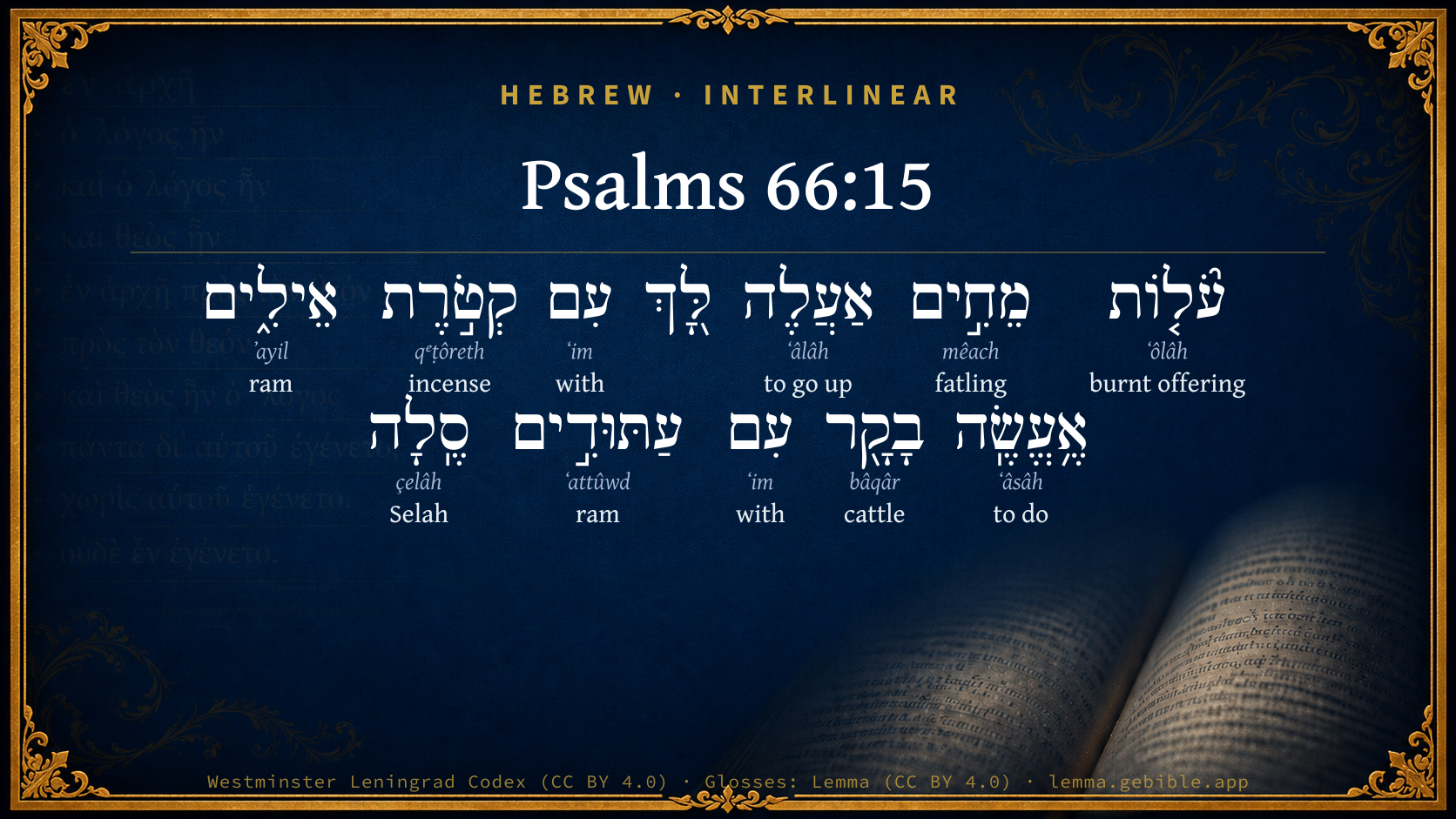
Hebrew (Westminster Leningrad Codex) Psalms 66:15 appears in the Hebrew Old Testament. The text above is from the Westminster Leningrad Codex. Each word links to its Strong’s number, a concise gloss, and parsing drawn from the Open Scriptures Hebrew Bible morphology. Click any word for its full Brown-Driver-Briggs (BDB) entry.
Download image
Cite this verse

Psalms 66:15 (World English Bible). Public Domain. Lemma interlinear Bible study tool, https://lemma.gebible.app/v/psalms/66/15.

Show BibTeX & RIS
BibTeX
RIS
English Translation
I will offer to you burnt offerings of fat animals, With the offering of rams, I will offer bulls with goats. Selah.
World English Bible · Public Domain
Highlights
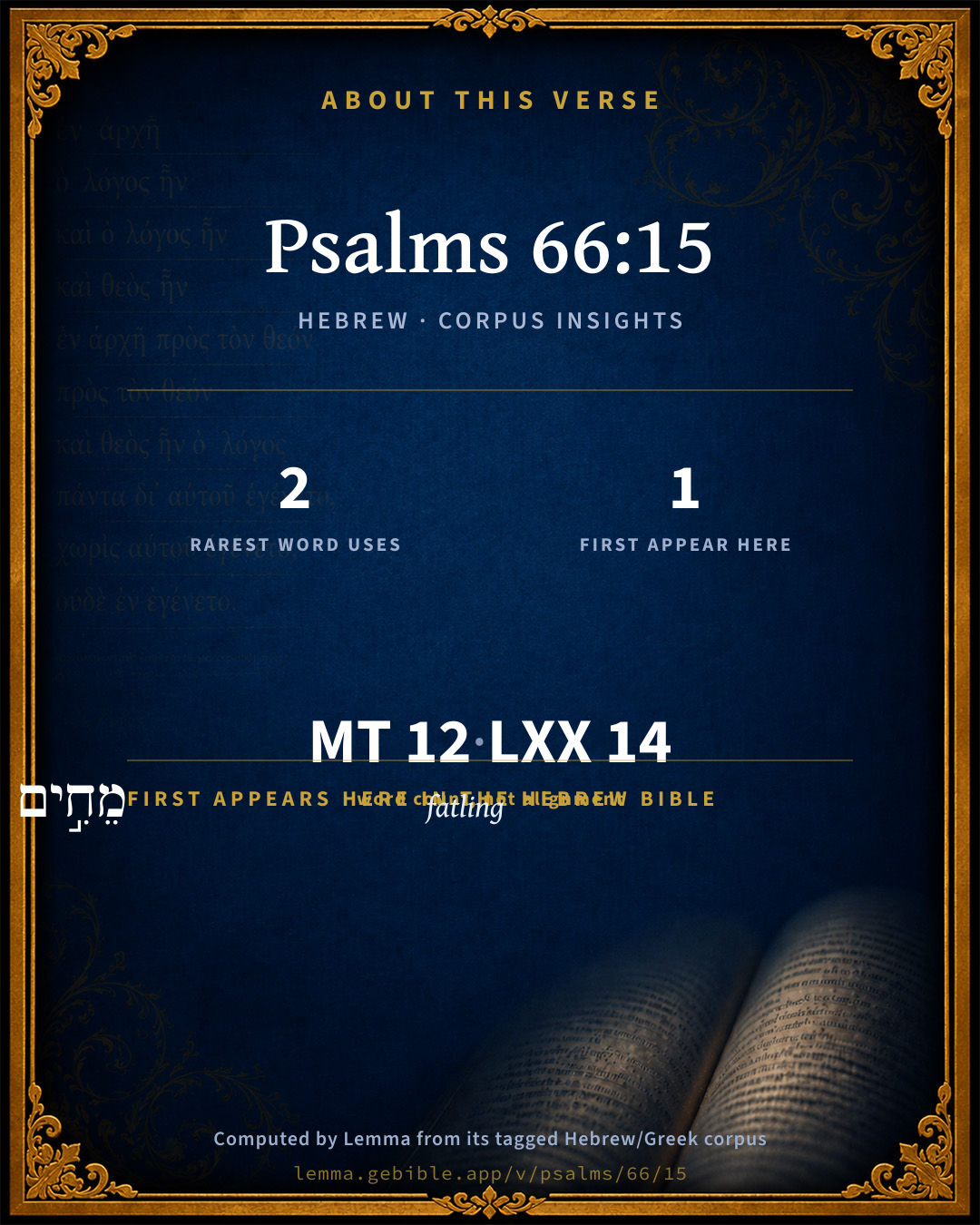
  • 1 first appearance in the Hebrew Bible
Full analysis ↓
Download a study sheet

One document with this verse’s original text, its word-by-word gloss line, the meaning frame, cross-references with their text, attributed commentary, and full source and license credits — printable, and it pastes into notes with its structure intact.

This verse Autodidact and up

Study sheet (.html) Plain text (.txt)

A passage Seminary Student

Up to 50 verses in one chapter. A passage sheet keeps up to 6 commentary sources and 12 cross-references per verse, in the order this page ranks them, and says so on the sheet whenever that leaves anything out. Ask for a single verse and you get the Autodidact verse sheet above.

Everything on this page stays free to read, with no account — the sheet is a download of what is already on screen, not access to it.

Want to remove ads? Support Godless Engineer
Compare translations 3

The same verse in 3 English versions, stacked beneath the original-language interlinear above. Click any original word for its lexicon entry.

Each is an independent rendering of the whole verse — the interlinear is not word-aligned to these translations.

Highlighted words mark where these versions differ — a whole-verse word diff, not a word-by-word alignment.

  • World English Bible Public Domain
    I will offer to you burnt offerings of fat animals, With the offering of rams, I will offer bulls with goats. Selah.
  • King James Version Public Domain
    I will offer unto thee burnt sacrifices of fatlings, with the incense of rams; I will offer bullocks with goats. Selah.
  • unfoldingWord Literal Text CC BY-SA 4.0
    I will offer up burnt offerings of fatlings to you with the smoke of rams; I will offer cattle with male goats. Selah

unfoldingWord Literal Text — © unfoldingWord, licensed CC BY-SA 4.0. Word-aligned USFM3 via Door43 (git.door43.org/unfoldingWord/en_ult).

Versions to compare (up to 4)

3 of 4 selected

Show all 18 translations

Every available English version of this verse, each an independent rendering of the whole verse.

  • World English Bible Public Domain
    I will offer to you burnt offerings of fat animals, With the offering of rams, I will offer bulls with goats. Selah.
  • Berean Standard Bible Public Domain
    I will offer You fatlings as burnt offerings, with the fragrant smoke of rams; I will offer bulls and goats. Selah
  • Majority Standard Bible Public Domain
    I will offer You fatlings as burnt offerings, with the fragrant smoke of rams; I will offer bulls and goats. Selah
  • King James Version Public Domain
    I will offer unto thee burnt sacrifices of fatlings, with the incense of rams; I will offer bullocks with goats. Selah.
  • American Standard Version (1901) Public Domain
    I will offer unto thee burnt-offerings of fatlings, With the incense of rams; I will offer bullocks with goats. Selah
  • Revised Version (1885) Public Domain
    I will offer unto thee burnt offerings of fatlings, with the incense of rams; I will offer bullocks with goats. Selah
  • Geneva Bible (1599) Public Domain
    I will offer vnto thee the burnt offerings of fat rammes with incense: I will prepare bullocks and goates. Selah.
  • Douay-Rheims (1899) Public Domain
    I will offer up to thee holocausts full of marrow, with burnt offerings of rams: I will offer to thee bullocks with goats.
  • Young's Literal Translation Public Domain
    `Burnt-offerings of fatlings I offer to Thee, With perfume of rams, I prepare a bullock with he-goats.' Selah.
  • Literal Standard Version CC BY-SA 4.0
    “I offer to You burnt-offerings of fatlings, || With incense of rams, I prepare a bullock with male goats.” Selah.
  • Unlocked Literal Bible CC BY-SA 4.0
    I will offer to you burnt offerings of fat animals with the sweet aroma of rams; I will offer bulls and goats. Selah
  • unfoldingWord Literal Text CC BY-SA 4.0
    I will offer up burnt offerings of fatlings to you with the smoke of rams; I will offer cattle with male goats. Selah
  • Darby Bible Public Domain
    I will offer up unto thee burnt-offerings of fatted beasts, with the incense of rams; I will offer bullocks with goats. Selah.
  • World Messianic Bible Public Domain
    I will offer to you burnt offerings of fat animals, with the offering of rams, I will offer bulls with goats. Selah.
  • Webster's Bible Public Domain
    I will offer to thee burnt-sacrifices of fatlings, with the incense of rams; I will offer bullocks with goats. Selah.
  • Free Bible Version CC BY-SA 4.0
    I will sacrifice burnt offerings to you of fattened livestock—the smoke of the sacrifice of rams, offerings of bulls and goats. Selah.
  • Bible in Basic English Public Domain
    I will give you burned offerings of fat beasts, and the smoke of sheep; I will make offerings of oxen and goats. (Selah.)
  • JPS Tanakh (1917) Public Domain
    I will offer unto Thee burnt-offerings of fatlings, with the sweet smoke of rams; I will offer bullocks with goats. Selah

Literal Standard Version (2020), Covenant Press — licensed CC BY-SA 4.0. Text via the HelloAO Bible API (eBible.org). Unlocked Literal Bible (unfoldingWord) — licensed CC BY-SA 4.0. Text via the HelloAO Bible API (eBible.org). unfoldingWord Literal Text — © unfoldingWord, licensed CC BY-SA 4.0. Word-aligned USFM3 via Door43 (git.door43.org/unfoldingWord/en_ult). Free Bible Version, Dr. Jonathan Gallagher — licensed CC BY-SA 4.0. Text via the HelloAO Bible API (eBible.org).

Word by word

More ways to search: Search by grammar → Find every occurrence → Compare this word →

Practice this passage: Drill this verse → Learn its vocabulary →

About this verse

These counts appear in no published source. They are computed here, from the morphology-tagged text and Lemma’s own curated glosses. What Lemma adds →

12
words
10
distinct lemmas
Wisdom
section

Notable vocabulary

The rarest word here is מֵחִ֣ים fatling H4220 — appearing just 2 times in the whole Hebrew Bible.

First appearance in Scripture

This word makes its first canonical appearance in the Hebrew Bible here:

  • מֵחִ֣ים fatling H4220

Shared distinctive vocabulary

מֵחִ֣ים fatling H4220 occurs in 2 verses of the Hebrew Bible. Also found in:

Grammatical profile

  • 2 verbs
  • 6 nouns
  • 3 prepositions
  • 1 particle

Verb forms

  • אַעֲלֶה Hiphil · Imperfect
  • אֶ֥עֱשֶֽׂה Qal · Imperfect

Repetition

A word recurs within this verse — often emphatic in Hebrew:

Hebrew & Septuagint length

In English translation the verse runs 22 words from the Hebrew and 24 from the Septuagint (LXX English) — closely comparable.

A rough comparison of the two English renderings, which tokenize alike — not a word-level alignment.

Word counts can differ between the Hebrew and the Greek without any difference in meaning — e.g. the Hebrew direct-object marker אֵת has no separate Greek word, and Greek often adds the article ὁ.

In the original languages it is 12 Hebrew tokens and 14 Greek tokens — but the two are counted differently (Hebrew bundles its prefixes and suffixes into one token; the Greek is in lemma form), so that isn’t a like-for-like length.

Cross-references

6

Topical passages linked to Psalms 66:15 in the Treasury of Scripture Knowledge — connected by theme and wording, ordered by reader-vote popularity; previews shown in the World English Bible.

  • Psalms 51:19 Then you will delight in the sacrifices of righteousness, In burnt offerings and in whole burnt offerings. Then they will offer bulls on your altar.
  • Numbers 6:14 and he shall offer his offering to Yahweh, one male lamb a year old without blemish for a burnt offering, and one ewe lamb a year old without blemish for a sin offering, and one ram without blemish for peace offerings,
  • 2 Samuel 6:13 It was so, that, when those who bore the ark of Yahweh had gone six paces, he sacrificed an ox and a fattened calf.
  • 2 Samuel 6:17–19 They brought in the ark of Yahweh, and set it in its place, in the midst of the tent that David had pitched for it; and David offered burnt offerings and peace-offerings before Yahweh.
  • 1 Chronicles 16:1–3 They brought in the ark of God, and set it in the midst of the tent that David had pitched for it: and they offered burnt offerings and peace-offerings before God.
  • Jeremiah 41:5 that there came men from Shechem, from Shiloh, and from Samaria, even eighty men, having their beards shaved and their clothes torn, and having cut themselves, with meal-offerings and frankincense in their hand, to bring them to the house of Yahweh.

Cross-references courtesy of OpenBible.info (CC BY 4.0).

Hebrew and Greek witnesses Masoretic Hebrew ↔ Greek Septuagint

The same verse in the two great witnesses to the Old Testament, shown verse-for-verse.

You’re reading Greek Psalm 65 (Hebrew Psalm 66). The Septuagint counts the superscription, so verse numbers can differ from the Hebrew — chapter-level alignment, not verse-by-verse. Numbering follows Rahlfs.

These are two independent witnesses, not word-aligned to each other, and the Septuagint is shown in lemma (dictionary) form.

Hebrew Psalms 66:15 Masoretic · Westminster Leningrad Codex

עֹ֘ל֤וֹת מֵחִ֣ים אַעֲלֶה לָּ֭ךְ עִם קְטֹ֣רֶת אֵילִ֑ים אֶ֥עֱשֶֽׂה בָקָ֖ר עִם עַתּוּדִ֣ים סֶֽלָה

I will offer to you burnt offerings of fat animals, With the offering of rams, I will offer bulls with goats. Selah.

World English Bible · Public Domain

Greek LXX Greek Psalm 65:15 Septuagint · lemma form

ὁλοκαύτωμα μυαλόω ἀναφέρω σύ μετά θυμίαμα καί κριός ποιέω σύ βοῦς μετά χίμαρος διάψαλμα

I will offer to you whole burnt sacrifices full of marrow, with incense and rams; I will sacrifice to you oxen with goats. Pause.

LXX2012 (modern English Septuagint) · Public Domain

On this verse, The Cambridge Bible for Schools and Colleges discusses the Septuagint’s reading. Read the note in Commentary ↓

Hebrew: Westminster Leningrad Codex (CC BY 4.0). Greek: Septuagint (public domain); English from LXX2012 (modern English Septuagint) (Public Domain). How the Septuagint differs from the Hebrew →

Commentary

Notes on Psalms 66:15 from classic Christian and Jewish commentators (each source and its license shown beneath its notes). The classic Christian expositions comment on the surrounding passage and are grouped to its opening verse, so a note may address several verses; the Jewish commentaries on the Tanakh (Rashi and others) are per-verse, so they appear only where the commentator wrote on this verse.

Lemma curates 59 commentaries, every one of them public domain or Creative Commons licensed, each selected and text-cleaned for this edition rather than reprinted as found. About our sources →

Trapp's Complete Commentary

John Trapp

Psa 66:15 I will offer unto thee burnt sacrifices of fatlings, with the incense of rams; I will offer bullocks with goats. Selah.

Ver. 15. I will offer unto thee burnt sacrifices of fatlings] Heb. marrow, the very best of the best; and better I could beteem the Lord if I had it.

With the incense of rams] Which, being offered in faith, and as figures of that great sacrifice to come, shall be accepted of God for a sweet smelling savour.

I will offer bullocks with goats] Faciam boves; this Eccius allegeth, but absurdly, to prove the Popish unbloody sacrifice of the mass; as if Christ, when he said, This do ye in remembrance of me, had meant, Thus sacrifice ye.

John Trapp, A Commentary or Exposition upon All the Books of the Old and New Testament (1647–1656) — public domain. Text from a community e-Sword module.

J. A. Alexander on Psalms

Joseph Addison Alexander

15. (Psa 66:15) Burnt-offerings of fatlings will I offer to thee, with incense of rams; I will make (an oblation of) cattle with he-goats. Selah. The word translated fatlings is especially applied to lambs, Isa 5:17. The verb is the first clause in the one from which the noun rendered burnt-offering is derived, and strictly means I will cause to ascend, i. e. upon the altar, or in vapour from it. Incense may here be taken in its etymological sense of something burnt sacrificially, although in usage limited to aromatic fumigations, which is also the case with the Hebrew word in every place but this, where it seems to mean the sacrificial fat that was burned upon the altar. The verb to make is absolutely used, as a technical term of the Mosaic Law, to denote the act of sacrifice. See Exo 29:36, Lev 9:7, and compare Jdg 6:19, 1Ki 18:23; 1Ki 18:26. The different species of victims are enumerated here, to convey the idea of a regular and perfect sacrifice, implying more than ordinary thankfulness.

Joseph Addison Alexander, The Psalms Translated and Explained (1850) — public domain. Text from a community e-Sword module.

Tyndale Open Study Notes

Tyndale Open Resources

66:15 Vows often included sacrifices of thanksgiving, including burnt offerings (see 20:3; 40:6; 50:8; 51:19).

Tyndale Open Study Notes — © Tyndale Open Resources, licensed CC BY-SA 4.0. Text via the HelloAO Bible API.

Jamieson, Fausset & Brown

Robert Jamieson, A. R. Fausset & David Brown

I will offer--literally, "make to ascend," alluding to the smoke of burnt offering, which explains the use of "incense."

incense--elsewhere always denoting the fumes of aromatics.

Jamieson, Fausset & Brown — Commentary Critical and Explanatory on the Whole Bible (1871) — public domain (CC PDM 1.0). Text via the HelloAO Bible API.

Adam Clarke's Commentary

Verse 15. I will offer, c.] Thou shalt have the best of the herd and of the fold the lame and the blind shall never be given to thee for sacrifice.

The incense of rams] The fine effluvia arising from the burning of the pure fat.

Adam Clarke's Commentary on the Bible (1810–1826) — public domain. Text from a community e-Sword/MySword module.

John Calvin's Commentaries

15 I will offer unto thee burnt-sacrifices of fatlings. We must suppose the speaker to be either David or one of the more considerable men of the nation, for none in humbler circumstances could have offered rich sacrifices of this kind. It is probable that David was the author of the psalm, and here he signifies his intention to show a kingly liberality in his offerings. The reason why God ordered victims to be offered as an expression of thanksgiving was, as is well known, to teach the people that their praises were polluted by sin, and needed to be sanctified from without. However we might propose to ourselves to praise the name of God, we could only profane it with our impure lips, had not Christ once offered himself up a sacrifice, to sanctify both us and our services. (Hebrews 10:7) It is through him, as we learn from the apostle, that our praises are accepted. The Psalmist, by way of commendation of his burnt-offering, speaks of its incense or sweet savor; for although in themselves vile and loathsome, yet the rams and other victims, so far as they were figures of Christ, sent up a sweet savor unto God. Now that the shadows of the Law have been abolished, attentionis called to the true spiritual service. What this consists in, is more clearly brought under our notice in the verse which follows, where the Psalmist tells us, that he would spread abroad the fame of the benefits which he had received from God. Such was the end designed, even in the outward ceremonies under the Law, apart from which they could only be considered as an empty show. It was this — the fact, that they set forth the praises of the divine goodness — which formed the very season of the sacrifices, preserving them from insipidity. In calling, as he does, upon all the fearers of the Lord, the Psalmist teaches us, that if we duly feel the goodness of God, we will be inflamed with a desire to publish it abroad, that others may have their faith and hope confirmed, by what they hear of it, as well as join with us in a united song of praise. He addresses himself to none but such as feared the Lord, for they only could appreciate what he had to say, and it would have been lost labor to communicate it to the hypocritical and ungodly.

John Calvin's Commentaries (1540-1563) — public domain. Text from the Calvin Translation Society English edition (1840s-50s) via the Christian Classics Ethereal Library (ccel.org). Calvin's coverage is partial (roughly two-thirds of the Bible); uncommented books and verses are honest gaps, never fabricated. The 19th-century editor's footnotes and remarks are omitted so the notes are faithfully Calvin's own voice.

Ellicott's Commentary for English Readers

(15) I will offer.—Such a holocaust could hardly have been vowed by a single person. It is the community that speaks. Besides, the ram was not a sacrifice for any individual, but particularly enjoined for the high priest (Lev_9:2), the head of a tribe (Numbers 7), or a Nazarite (Num_6:14). Incense is here the ascending smoke of the sacrifice.

A Bible Commentary for English Readers, edited by Charles John Ellicott (1878–1897) — public domain. Text from a community e-Sword module.

The Cambridge Bible for Schools and Colleges

gen. ed. J. J. S. Perowne

15. Burnt offerings of fatlings will I offer unto thee,

Together with incense of rams.

‘Incense of rams’ denotes the sweet savour of the sacrifice ascending as it was consumed by fire. Cp. perhaps, though the meaning is not certain, Isa_1:13. The cognate verb is used of burning the victim or the fat of the victim on the altar. Thus Exo_29:18, “and thou shalt burn (lit., if an obsolete verb might be revived, incense) the whole ram upon the altar; it is a burnt offering unto the Lord: it is a sweet savour.” According to the Levitical ritual the ram was to be offered as a burnt offering or peace offering only by the whole people or its princes, by the high-priest or an ordinary priest, or by a Nazirite; never by an ordinary individual (by whom however it was to be used as a trespass offering). He-goats are only mentioned in connexion with the offerings of the princes (Num_7:17 ff). Hence it may be inferred that the Psalm refers to sacrifices offered by the nation or its leaders, not by an ordinary private individual. Cp. however Isa_1:11, where almost exactly the same animals are mentioned as here; and Psa_50:9; Psa_50:13.

I will offer] Lit., dress for sacrifice. Cp. 1Ki_18:23 ff; Exo_29:36 ff; &c.: and Gr. ἔρδειν, ῥέζειν, in LXX ποιεῖν: Lat. facere.

The Cambridge Bible for Schools and Colleges (gen. ed. J. J. S. Perowne; Cambridge University Press, 1878–1918) — public domain. Text from a community e-Sword module.

John Gill's Exposition

I will offer unto thee burnt sacrifices of fatlings,.... Of the fattest of the flock; that is, of the best; such as Abel offered, Gen 4:4;

with the incense of rams; or "rams with incense" (f); the Targum is,

"with sweet incense, the sacrifice of rams;''

Kimchi interprets it of incense of the fat of rams.

I will offer bullocks with goats; he proposed to offer all kind of offerings, to show gratitude and thankfulness for the favours received; by all which are meant the calves, or fruit of the lips, the sacrifices of praise, thanksgiving to God, in the name of the whole church and people of God; see Rev 19:1.

Selah; on this word; see Gill on Psa 3:2.

(f) "arietes cum incenso", Gejerus; so Campeusis in ibid.

John Gill's Exposition of the Whole Bible (1746–1763) — public domain (CC PDM 1.0). Text via the HelloAO Bible API.

Albert Barnes' Notes on the Bible

I will offer unto thee burnt sacrifices of fatlings - Margin, marrow. On the word rendered “burnt-offerings” see the notes at Isa 1:11. The word rendered “fatlings” is rendered in Isa 5:17, lambs. It may be applied to any animal considered as fat - a qualification required in sacrifices to be made on the altar, Isa 1:11.

With the incense of rams - The word here rendered incense is commonly applied to aromatics which were burned in the tabernacle or temple, producing a grateful odor (see the notes at Isa 1:13); but it seems here to be used with reference to the smoke ascending from burning rams offered in sacrifice - ascending as the smoke of incense did. The smoke thus ascending would be as grateful and acceptable as incense.

I will offer bullocks with goats - Bullocks and goats. That is, I will present sacrifices in all the forms required in worship; in all the forms that will express gratitude to God, or that will be an acknowledgment of dependence and guilt; in all that would properly express homage to the Deity. Bullocks and goats were both required in the ancient worship.

Albert Barnes' Notes on the Bible (1834–1885) — public domain. Text from a community e-Sword/MySword module.

Matthew Poole's English Annotations

With the incense of rams; with the fat of rams, which in these peace-offerings was burnt upon the altar, and so vanished into smoke like incense, and which is no less pleasing to God than incense.

Matthew Poole's English Annotations on the Holy Bible (1683–1685) — public domain. Text from a community e-Sword/MySword module.

The Treasury of David

Charles H. Spurgeon

Ver. 15. I will offer unto thee burnt sacrifices of fatlings. The good man will give his best things to God. No starveling goat upon the hills will he present at the altar, but the well fed bullocks of the luxuriant pastures shall ascend in smoke from the sacred fire. He who is miserly with God is a wretch indeed. Few devise liberal things, but those few find a rich reward in so doing.

With the incense of rams. The smoke of burning rams should also rise from the altar; he would offer the strength and prime of his flocks as well as his herds. Of all we have we should give the Lord his portion, and that should be the choicest we can select. It was no waste to burn the fat upon Jehovah's altar, nor to pour the precious ointment upon Jesus' head; neither are large gifts and bountiful offerings to the church of God any diminution to a man's estate: such money is put to good interest and placed where it cannot be stolen by thieves nor corroded by rust.

I will offer bullocks with goats. A perfect sacrifice, completing the circle of offerings, should show forth the intense love of his heart. We should magnify the Lord with the great and the little. None of his ordinances should be disregarded; we must not omit either the bullocks or the goats. In these three verses we have gratitude in action, not content with words, but proving its own sincerity by deeds of obedient sacrifice.

Selah. It is most fit that we should suspend the song while the smoke of the victims ascends the heavens; let the burnt offerings stand for praises while we meditate upon the infinitely greater sacrifice of Calvary.

Ver. 15. I will offer, etc. Thou shalt have the best of the herd and of the fold. Adam Clarke.

Ver. 15. Fatlings. For as I will not come empty into thy house, so I will not bring thee a niggardly present; but offer sacrifices of all sorts, and the best and choicest in every kind. Symon Patrick.

Ver. 15. Bullocks with goats. That is, I will liberally provide for every part of the service at the tabernacle. Thomas Scott.

Charles H. Spurgeon's The Treasury of David (1869–1885) — public domain. Psalms only. Text from a community e-Sword/MySword module.

Whedon's Commentary on the Bible

Daniel D. Whedon

15. He enumerates the victims to be offered in fulfilment of his vow.

Fatlings—Fat sheep, or “marrowy lambs.” These were for his “burnt offerings.” Psa_66:13. Another kind of sacrifices follows, שׁלמים, (shelamim, or peace-offerings,) consisting of rams, bullocks, and goats; but as these were offered as shelamim for Aaron and the tribes, (Lev_9:4; Numbers 7,) we should consider the psalmist here as speaking in behalf of the whole people, while the costliness and number of the sacrifices indicate his zeal and devotion.

Daniel D. Whedon (gen. ed.), Commentary on the Old and New Testaments (1874–1909) — public domain. Text from a community e-Sword module.

The Pulpit Commentary

I will offer unto thee burnt sacrifices of fatlings; i.e. of fatted beasts. (comp. 1Sa_15:9 2Sa_6:13 Eze_39:18) With the incense of rams; i.e. the smoke, or savoury odour of rams. I will offer bullocks with goats; literally, I will prepare i.e, dress for sacrifice. (see 1Ki_18:23, 1Ki_18:26)

The Pulpit Commentary (1880–1919), ed. H.D.M. Spence-Jones & Joseph S. Exell — public domain. Text from a community e-Sword module.

John Wesley's Explanatory Notes

I will go - One speaks in the name of all the rest. Incense - With the fat of rams, which is no less pleasing to God than incense.

John Wesley, Explanatory Notes Upon the Whole Bible (1754–1765) — public domain. Text via the GEBible commentary corpus.

Rashi

Rabbi Shlomo Yitzchaki (Rashi)

fat Heb. מיחים, fat, an expression of מוֹחַ, marrow.

Rashi on the Tanakh — English translations: “The Judaica Press complete Tanach with Rashi, translated by A. J. Rosenberg” (CC BY 4.0); “Pentateuch with Rashi's commentary by M. Rosenbaum and A.M. Silbermann, 1929-1934” (public domain); “The Metsudah Tanach series, Lakewood, N.J” (CC BY 4.0); and “The Book of Joshua, Metsudah Publications, 1997” (CC BY 4.0). Text via Sefaria.

Lesson kit

Teaching starters — assembled from the data on this page, not authored interpretation. Every prompt links to the verse data it draws on. Edit before teaching.

Psalms, in the Wisdom, opens this verse with 12 words (10 distinct Hebrew lemmas). Its most distinctive word is mêach (“fatling”). A historical commentator’s framing appears above. Read the whole chapter for the surrounding context.

Discussion questions

  1. The word mêach carries the sense “fatling.” How does it shape the verse?
  2. The word “fatling” first appears here in Scripture. What is being introduced at this debut?
  3. Isaiah 5:17 shares the word «fatling» with this verse. How do the two illuminate each other?
  4. “with” occurs 2× in this one verse. What is the effect of the repetition?
  5. The translations on this page render this verse differently — a whole-verse word diff, not a word-by-word alignment. What might account for the different wordings?
  6. The verb «אַעֲלֶה» is Hiphil Imperfect. How does its form color the action?
  7. Reading how Trapp's Complete Commentary and J. A. Alexander on Psalms read this verse, where do the two commentators agree and where do they part?

Things to notice

Reading settings

Reading text

Shown beneath each verse's original-language words.

Old Testament
Old Testament edition

Read the OT as the Masoretic Hebrew (MT) or the Greek Septuagint (LXX).

English shown for the Greek Septuagint (in the Hebrew ↔ Greek comparison).

Comparing translations? Open the Compare panel on any verse page to stack up to four side by side.