
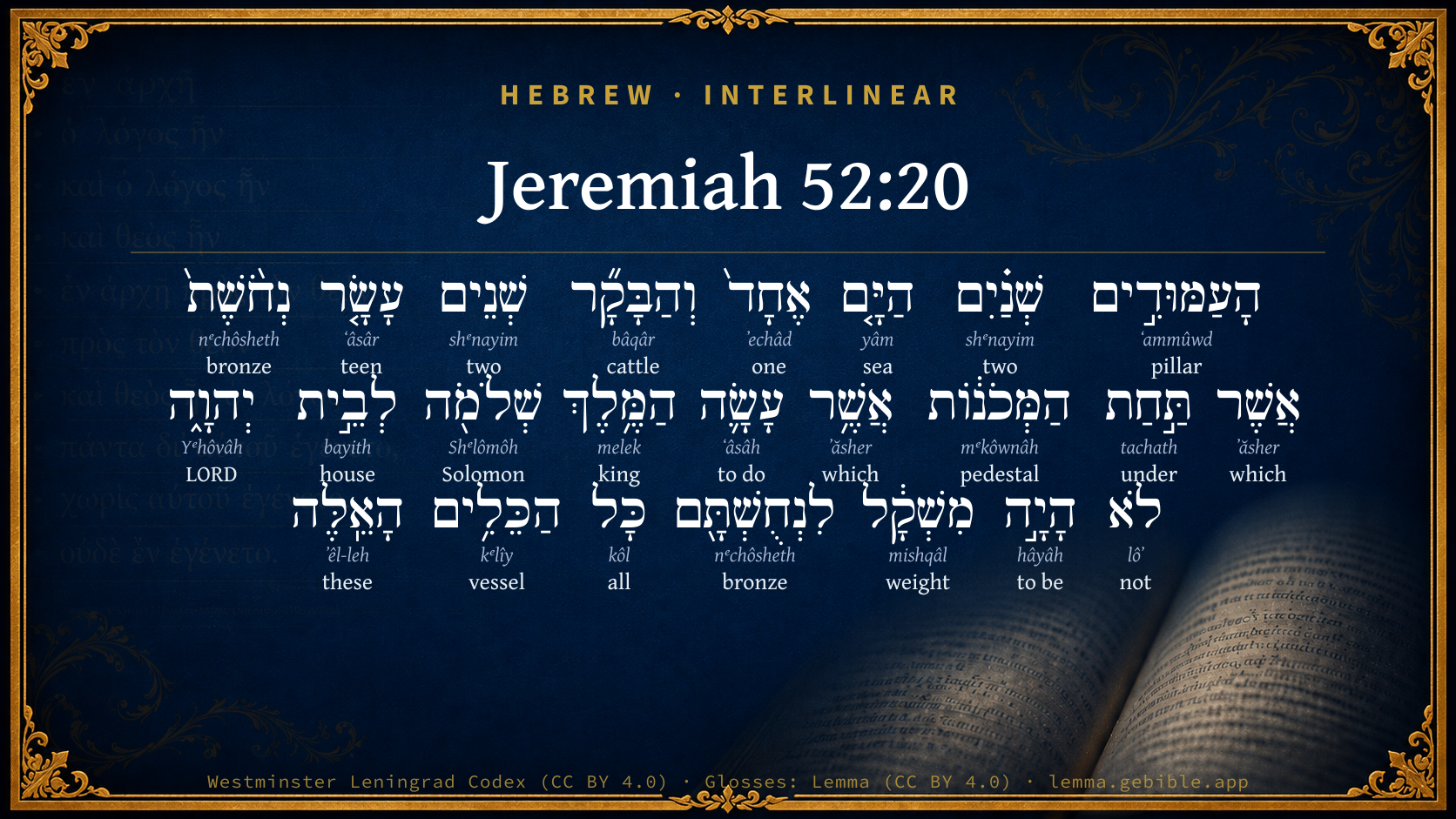
Jeremiah 52:20

Hebrew (Westminster Leningrad Codex) Jeremiah 52:20 appears in the Hebrew Old Testament. The text above is from the Westminster Leningrad Codex. Each word links to its Strong’s number, a concise gloss, and parsing drawn from the Open Scriptures Hebrew Bible morphology. Click any word for its full Brown-Driver-Briggs (BDB) entry.
Download image
Cite this verse

Jeremiah 52:20 (World English Bible). Public Domain. Lemma interlinear Bible study tool, https://lemma.gebible.app/v/jeremiah/52/20.

Show BibTeX & RIS
BibTeX
RIS
English Translation
The two pillars, the one sea, and the twelve brazen bulls that were under the bases, which king Solomon had made for the house of Yahweh. The brass of all these vessels was without weight.
World English Bible · Public Domain
Download a study sheet

One document with this verse’s original text, its word-by-word gloss line, the meaning frame, cross-references with their text, attributed commentary, and full source and license credits — printable, and it pastes into notes with its structure intact.

This verse Autodidact and up

Study sheet (.html) Plain text (.txt)

A passage Seminary Student

Up to 50 verses in one chapter. A passage sheet keeps up to 6 commentary sources and 12 cross-references per verse, in the order this page ranks them, and says so on the sheet whenever that leaves anything out. Ask for a single verse and you get the Autodidact verse sheet above.

Everything on this page stays free to read, with no account — the sheet is a download of what is already on screen, not access to it.

Want to remove ads? Support Godless Engineer
Compare translations 3

The same verse in 3 English versions, stacked beneath the original-language interlinear above. Click any original word for its lexicon entry.

Each is an independent rendering of the whole verse — the interlinear is not word-aligned to these translations.

Highlighted words mark where these versions differ — a whole-verse word diff, not a word-by-word alignment.

  • World English Bible Public Domain
    The two pillars, the one sea, and the twelve brazen bulls that were under the bases, which king Solomon had made for the house of Yahweh. The brass of all these vessels was without weight.
  • King James Version Public Domain
    The two pillars, one sea, and twelve brasen bulls that were under the bases, which king Solomon had made in the house of the LORD: the brass of all these vessels was without weight.
  • unfoldingWord Literal Text CC BY-SA 4.0
    The two pillars, the large bronze basin known as “The Sea,” and the twelve bronze bulls that were under the stands, things that Solomon had made for the house of Yahweh, contained more bronze than could be weighed.

unfoldingWord Literal Text — © unfoldingWord, licensed CC BY-SA 4.0. Word-aligned USFM3 via Door43 (git.door43.org/unfoldingWord/en_ult).

Versions to compare (up to 4)

3 of 4 selected

Show all 18 translations

Every available English version of this verse, each an independent rendering of the whole verse.

  • World English Bible Public Domain
    The two pillars, the one sea, and the twelve brazen bulls that were under the bases, which king Solomon had made for the house of Yahweh. The brass of all these vessels was without weight.
  • Berean Standard Bible Public Domain
    As for the two pillars, the Sea, the twelve bronze bulls under it, and the movable stands that King Solomon had made for the house of the LORD, the weight of the bronze from all these articles was beyond measure.
  • Majority Standard Bible Public Domain
    As for the two pillars, the Sea, the twelve bronze bulls under it, and the movable stands that King Solomon had made for the house of the LORD, the weight of the bronze from all these articles was beyond measure.
  • King James Version Public Domain
    The two pillars, one sea, and twelve brasen bulls that were under the bases, which king Solomon had made in the house of the LORD: the brass of all these vessels was without weight.
  • American Standard Version (1901) Public Domain
    The two pillars, the one sea, and the twelve brazen bulls that were under the bases, which king Solomon had made for the house of Jehovah-the brass of all these vessels was without weight.
  • Revised Version (1885) Public Domain
    The two pillars, the one sea, and the twelve brasen bulls that were under the bases, which king Solomon had made for the house of the LORD: the brass of all these vessels was without weight.
  • Geneva Bible (1599) Public Domain
    With the two pillars, one Sea, and twelue brasen bulles, that were vnder the bases, which King Salomon had made in ye house of ye Lord: the brasse of all these vessels was without weight.
  • Douay-Rheims (1899) Public Domain
    And the two pillars, and one sea, and twelve oxen of brass that were under the bases, which king Solomon had made in the house of the Lord: there was no weight of the brass of all these vessels.
  • Young's Literal Translation Public Domain
    The two pillars, the one sea, and the twelve brazen oxen that `are' beneath the bases, that king Solomon made for the house of Jehovah, there was no weighing of the brass of all these vessels.
  • Literal Standard Version CC BY-SA 4.0
    The two pillars, the one sea, and the twelve bronze oxen that [are] beneath the bases, that King Solomon made for the house of YHWH, there was no weighing of the bronze of all these vessels.
  • Unlocked Literal Bible CC BY-SA 4.0
    The two pillars, the large bronze basin known as “The Sea,” and the twelve bronze bulls that were under the stands, things that Solomon had made for the house of Yahweh, contained more bronze than could be weighed.
  • unfoldingWord Literal Text CC BY-SA 4.0
    The two pillars, the large bronze basin known as “The Sea,” and the twelve bronze bulls that were under the stands, things that Solomon had made for the house of Yahweh, contained more bronze than could be weighed.
  • Darby Bible Public Domain
    The two pillars, the one sea, and the twelve brazen oxen that formed the bases, which king Solomon had made for the house of Jehovah: for the brass of all these vessels there was no weight.
  • World Messianic Bible Public Domain
    They took the two pillars, the one sea, and the twelve bronze bulls that were under the bases, which King Solomon had made for the LORD’s house. The bronze of all these vessels was without weight.
  • Webster's Bible Public Domain
    The two pillars, one sea, and twelve brazen bulls that were under the bases, which king Solomon had made in the house of the LORD: the brass of all these vessels was without weight.
  • Free Bible Version CC BY-SA 4.0
    The amount of bronze that came from the two columns, the Sea, the twelve bronze bulls under it, and the movable carts, which Solomon had made for the Lord's Temple, all of this weighed more than could be measured.
  • Bible in Basic English Public Domain
    The two pillars, the great water-vessel, and the twelve brass oxen which were under it, and the ten wheeled bases, which King Solomon had made for the house of the Lord: the brass of all these vessels was without weight.
  • JPS Tanakh (1917) Public Domain
    The two pillars, the one sea, and the twelve brazen bulls that were under the bases, which king Solomon had made for the house of the LORD — the brass of all these vessels was without weight.

Literal Standard Version (2020), Covenant Press — licensed CC BY-SA 4.0. Text via the HelloAO Bible API (eBible.org). Unlocked Literal Bible (unfoldingWord) — licensed CC BY-SA 4.0. Text via the HelloAO Bible API (eBible.org). unfoldingWord Literal Text — © unfoldingWord, licensed CC BY-SA 4.0. Word-aligned USFM3 via Door43 (git.door43.org/unfoldingWord/en_ult). Free Bible Version, Dr. Jonathan Gallagher — licensed CC BY-SA 4.0. Text via the HelloAO Bible API (eBible.org).

Word by word

More ways to search: Search by grammar → Find every occurrence → Compare this word →

Practice this passage: Drill this verse → Learn its vocabulary →

הַמְּכֹנ֔וֹת
mᵉkôwnâh
H4350
“the · pedestals”
Particle, Definite Article + Noun, Common, Feminine, Plural, Absolute
Part of Speech
Particle + Noun
Type
Common
Gender
Feminine
Number
Plural
State
Absolute
Full BDB Definition

Origin: from H4349

TWOT: 964d

fixed resting place, base, pedestal
  1. הָעַמּוּדִ֣ים ʻammûwd H5982 “the · pillars” Particle, Definite Article + Noun, Common, Masculine, Plural, Absolute
  2. שְׁנַ֗יִם shᵉnayim H8147 “two” Adjective, Cardinal number, Masculine, Dual, Absolute
  3. הַיָּ֤ם yâm H3220 “the · sea” Particle, Definite Article + Noun, Common, Masculine, Singular, Absolute
  4. אֶחָד֙ ʼechâd H259 “one” Adjective, Cardinal number, Masculine, Singular, Absolute
  5. וְהַבָּקָ֞ר bâqâr H1241 “and · the · cattle” Conjunction + Particle, Definite Article + Noun, Common, Both, Singular, Absolute
  6. שְׁנֵים shᵉnayim H8147 “two” Adjective, Cardinal number, Masculine, Dual, Absolute
  7. עָשָׂ֤ר ʻâsâr H6240 “teen” Adjective, Cardinal number, Masculine, Singular, Absolute
  8. נְחֹ֨שֶׁת֙ nᵉchôsheth H5178 “bronze” Noun, Common, Feminine, Singular, Absolute
  9. אֲשֶׁר ʼăsher H834 “which” Particle, Relative
  10. תַּ֣חַת tachath H8478 “under” Preposition
  11. אֲשֶׁ֥ר ʼăsher H834 “which” Particle, Relative
  12. עָשָׂ֛ה ʻâsâh H6213 “to do” Verb, Qal, Perfect, 3rd Person, Masculine, Singular
  13. הַמֶּ֥לֶךְ melek H4428 “the · king” Particle, Definite Article + Noun, Common, Masculine, Singular, Absolute
  14. שְׁלֹמֹ֖ה Shᵉlômôh H8010 “Solomon” Noun, Proper
  15. לְבֵ֣ית bayith H1004 “to/for · house of” Preposition + Noun, Common, Masculine, Singular, Construct
  16. יְהוָ֑ה Yᵉhôvâh H3068 “LORD” Noun, Proper
  17. לֹא lôʼ H3808 “not” Particle, Negative
  18. הָיָ֣ה hâyâh H1961 “to be” Verb, Qal, Perfect, 3rd Person, Masculine, Singular
  19. מִשְׁקָ֔ל mishqâl H4948 “weight” Noun, Common, Masculine, Singular, Absolute
  20. לִנְחֻשְׁתָּ֖ם nᵉchôsheth H5178 “to/for · bronze · their” Preposition + Noun, Common, Feminine, Singular, Construct + Suffix, Personal, 3rd Person, Masculine, Plural
  21. כָּל kôl H3605 “all of” Noun, Common, Masculine, Singular, Construct
  22. הַכֵּלִ֥ים kᵉlîy H3627 “the · vessels” Particle, Definite Article + Noun, Common, Masculine, Plural, Absolute
  23. הָאֵֽלֶּה ʼêl-leh H428 “the · these” Particle, Definite Article + Pronoun, Demonstrative, Common, Plural

About this verse

These counts appear in no published source. They are computed here, from the morphology-tagged text and Lemma’s own curated glosses. What Lemma adds →

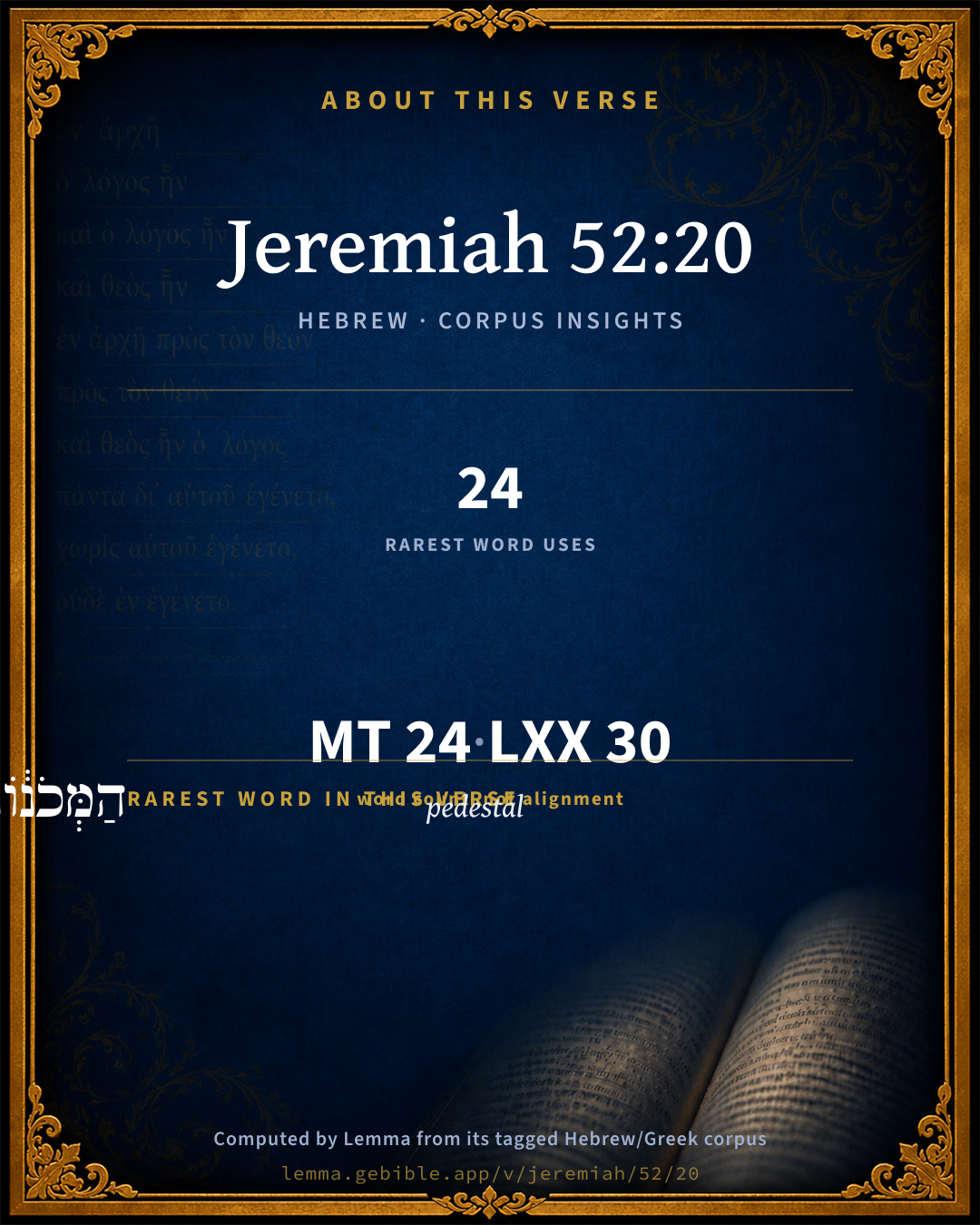
24
words
21
distinct lemmas
Prophets
section

Notable vocabulary

The rarest word here is הַמְּכֹנ֔וֹת pedestal H4350 — appearing just 24 times in the whole Hebrew Bible.

Shared distinctive vocabulary

הַמְּכֹנ֔וֹת pedestal H4350 occurs in 18 verses of the Hebrew Bible. Also found in:

Grammatical profile

  • 2 verbs
  • 13 nouns
  • 4 adjectives
  • 1 pronoun
  • 1 preposition
  • 3 particles

Verb forms

  • עָשָׂ֛ה Qal · Perfect
  • הָיָ֣ה Qal · Perfect

Repetition

Words recur within this verse — often emphatic in Hebrew:

  • שְׁנַ֗יִם two H8147 ×2
  • נְחֹ֨שֶׁת֙ bronze H5178 ×2
  • אֲשֶׁר which H834 ×2

Hebrew & Septuagint length

In the original languages it is 24 Hebrew tokens and 30 Greek tokens — but the two are counted differently (Hebrew bundles its prefixes and suffixes into one token; the Greek is in lemma form), so that isn’t a like-for-like length.

Cross-references

4

Topical passages linked to Jeremiah 52:20 in the Treasury of Scripture Knowledge — connected by theme and wording, ordered by reader-vote popularity; previews shown in the World English Bible.

  • 1 Kings 7:47 Solomon left all the vessels [unweighed], because they were exceeding many: the weight of the brass could not be found out.
  • 2 Kings 25:16 The two pillars, the one sea, and the bases, which Solomon had made for the house of Yahweh, the brass of all these vessels was without weight.
  • 1 Chronicles 22:14 Now, behold, in my affliction I have prepared for the house of Yahweh one hundred thousand talents of gold, and one thousand thousand talents of silver, and of brass and iron without weight; for it is in abundance: timber also and stone have I prepared; and you may add to them.
  • 2 Chronicles 4:18 Thus Solomon made all these vessels in great abundance: for the weight of the brass could not be found out.

Cross-references courtesy of OpenBible.info (CC BY 4.0).

Hebrew and Greek witnesses Masoretic Hebrew ↔ Greek Septuagint

The same verse in the two great witnesses to the Old Testament, shown verse-for-verse.

These are two independent witnesses, not word-aligned to each other, and the Septuagint is shown in lemma (dictionary) form.

Hebrew Jeremiah 52:20 Masoretic · Westminster Leningrad Codex

הָעַמּוּדִ֣ים שְׁנַ֗יִם הַיָּ֤ם אֶחָד֙ וְהַבָּקָ֞ר שְׁנֵים עָשָׂ֤ר נְחֹ֨שֶׁת֙ אֲשֶׁר תַּ֣חַת הַמְּכֹנ֔וֹת אֲשֶׁ֥ר עָשָׂ֛ה הַמֶּ֥לֶךְ שְׁלֹמֹ֖ה לְבֵ֣ית יְהוָ֑ה לֹא הָיָ֣ה מִשְׁקָ֔ל לִנְחֻשְׁתָּ֖ם כָּל הַכֵּלִ֥ים הָאֵֽלֶּה

The two pillars, the one sea, and the twelve brazen bulls that were under the bases, which king Solomon had made for the house of Yahweh. The brass of all these vessels was without weight.

World English Bible · Public Domain

Greek LXX Structure differs

In the Septuagint, Jeremiah is about an eighth shorter than the Hebrew and arranges its material differently — the Oracles Against the Nations (Hebrew chapters 46–51) appear in the middle of the Greek book, after 25:13. Because the chapter and verse boundaries do not line up, a verse-for-verse comparison with the Hebrew is not shown.

A verse-for-verse comparison isn’t shown here because the chapters and verses don’t line up. Switch to the LXX edition with the MT / LXX toggle above to read the Greek directly.

On this verse, Jamieson, Fausset & Brown discusses the Septuagint’s reading. Read the note in Commentary ↓

Hebrew: Westminster Leningrad Codex (CC BY 4.0). Greek: Septuagint (public domain); English from a public-domain English Septuagint. How the Septuagint differs from the Hebrew →

Targum (Aramaic paraphrase)

1

The Targum is the ancient Jewish Aramaic paraphrase of the Hebrew Scriptures — an interpretive translation, not the Hebrew text itself. Onkelos (literal) and Pseudo-Jonathan (expansive) render the Torah, and Jonathan the Prophets. Coverage is partial: where no permissively-licensed English translation exists for a verse, only the Aramaic is shown. This is verse-level text, not a word-by-word alignment to the Hebrew.

  1. Targum Jonathan Prophets (Joshua–Malachi)
    עֲמוּדַיָא תְּרֵין יַמָא חָד וְתוֹרֵי תְּרֵי עֲסַר דִנְחָשָׁא דִתְחוֹת בְּסִיסַיָא דַעֲבַד מַלְכָּא שְׁלֹמֹה בְּבֵית מַקְדָשָׁא דַייָ לָא הֲוָה מִתְקַל לִנְחָשְׁהוֹן דְכָל מָנַיָא הָאִלֵין:

    (no public-domain English translation for this verse)

    Targum Jonathan — Aramaic: “Mikraot Gedolot” (public domain). English: “Sefaria Community Translation” (CC0 1.0 (public-domain dedication)); “London "Chaldee Paraphrase," 1871” (public domain). Text via Sefaria.

Commentary

Notes on Jeremiah 52:20 from classic Christian and Jewish commentators (each source and its license shown beneath its notes). The classic Christian expositions comment on the surrounding passage and are grouped to its opening verse, so a note may address several verses; the Jewish commentaries on the Tanakh (Rashi and others) are per-verse, so they appear only where the commentator wrote on this verse.

Lemma curates 59 commentaries, every one of them public domain or Creative Commons licensed, each selected and text-cleaned for this edition rather than reprinted as found. About our sources →

Geneva Bible (1599)

Geneva Bible translators

It was so much in quantity.

Geneva Bible (1599) marginal notes — public domain. Text via Bolls.life.

Jamieson, Fausset & Brown

Robert Jamieson, A. R. Fausset & David Brown

bulls . . . under the bases--But the bulls were not "under the bases," but under the sea (Kg1 7:25, Kg1 7:27, Kg1 7:38); the ten bases were not under the sea, but under the ten lavers. In English Version, "bases," therefore, must mean the lower parts of the sea under which the bulls were. Rather, translate, "the bulls were in the place of (that is, 'by way of'; so the Hebrew, Sa1 14:9), bases," or supports to the sea [BUXTORF]. So the Septuagint. Kg2 25:16 omits the "bulls," and has "and the bases"; so GROTIUS here reads "the bulls (which were) under (the sea) and the bases."

Jamieson, Fausset & Brown — Commentary Critical and Explanatory on the Whole Bible (1871) — public domain (CC PDM 1.0). Text via the HelloAO Bible API.

Adam Clarke's Commentary

Verse 20. See Clarke on Jer 52:18.

Adam Clarke's Commentary on the Bible (1810–1826) — public domain. Text from a community e-Sword/MySword module.

The Cambridge Bible for Schools and Colleges

gen. ed. J. J. S. Perowne

20. twelve brasen bulls that were under, etc.] There appears to be some confusion in the MT. In the Temple as built by Solomon the bases were under the lavers, while the twelve bulls supported the sea. (1Ki_7:25; 1Ki_7:44.)

The Cambridge Bible for Schools and Colleges (gen. ed. J. J. S. Perowne; Cambridge University Press, 1878–1918) — public domain. Text from a community e-Sword module.

John Gill's Exposition

And concerning the pillars, the height of one pillar was eighteen cubits,.... As in Kg1 7:15; said to be thirty five, Ch2 3:15; of the reconciliation of which; see Gill on Ch2 3:15,

and a fillet of twelve cubits did compass it; a thread or line of that measure encompassed each of the pillars, Kg1 7:15;

and the thickness thereof was four fingers; either of the pillar, or the fillet about it; that is, the brass of it was four fingers thick:

it was hollow; that is, the pillar was hollow.

John Gill's Exposition of the Whole Bible (1746–1763) — public domain (CC PDM 1.0). Text via the HelloAO Bible API.

Albert Barnes' Notes on the Bible

twelve brasen bulls that were under - Omitted in 2 Kings and in Jer 27:19. Probably rightly, for what is said here of their being under the bases is a mistake. The bases were under the ten lavers. The Septuagint makes sense by translating it: “the twelve brasen bulls under the sea.”

Albert Barnes' Notes on the Bible (1834–1885) — public domain. Text from a community e-Sword/MySword module.

Haydock's Catholic Bible Commentary

Under the sea the bases, (Haydock) or bowls, which, &c.

George Leo Haydock (1774–1849), Haydock's Catholic Family Bible and Commentary, 1859 edition — public domain. Excludes Psalms (Douay-Rheims chapter numbering differs from Protestant) and Deuterocanonical books (Catholic canon only).

Matthew Poole's English Annotations

Solomon made two pillars, 1Ki 7:15, which, Jer 52:21, he called Jachin and Boaz; Jer 52:23, a molten sea, ten cubits broad; this, Jer 52:25, stood upon twelve oxen, and had ten bases, Jer 52:27; the making of all these took up a vast quantity of brass, as any one will easily judge, who, 1Ki 7:27, readeth the dimensions of these things.

Matthew Poole's English Annotations on the Holy Bible (1683–1685) — public domain. Text from a community e-Sword/MySword module.

unfoldingWord translationNotes

Door43 World Missions Community

eighteen cubits ... twelve cubits

A cubit was about 46 centimeters long. AT: "18 cubits ... 12 cubits" or "about 8.3 meters ... about 5.5 meters" (See: Biblical Distance)

hollow

The pillars had empty space inside them.

translationWords

cow

Solomon

house of God

unfoldingWord translationNotes — © Distant Shores Media and the Door43 World Missions Community, licensed CC BY-SA 4.0. Source: git.door43.org/Door43/en_tn.

Lesson kit

Teaching starters — assembled from the data on this page, not authored interpretation. Every prompt links to the verse data it draws on. Edit before teaching.

Jeremiah, in the Prophets, opens this verse with 24 words (21 distinct Hebrew lemmas). Its most distinctive word is mᵉkôwnâh (“pedestal”). A historical commentator’s framing appears above. Read the whole chapter for the surrounding context.

Discussion questions

  1. How does “pedestal” (mᵉkôwnâh) shape what this verse is saying?
  2. 1 Kings 7:27 shares the word «pedestal» with this verse. How do the two illuminate each other?
  3. “two” occurs 2× in this one verse. What is the effect of the repetition?
  4. The translations on this page render this verse differently — a whole-verse word diff, not a word-by-word alignment. What might account for the different wordings?
  5. The verb «עָשָׂ֛ה» is Qal Perfect. How does its form color the action?
  6. Reading how Geneva Bible (1599) and Jamieson, Fausset & Brown read this verse, where do the two commentators agree and where do they part?

Things to notice

Reading settings

Reading text

Shown beneath each verse's original-language words.

Old Testament
Old Testament edition

Read the OT as the Masoretic Hebrew (MT) or the Greek Septuagint (LXX).

English shown for the Greek Septuagint (in the Hebrew ↔ Greek comparison).

Comparing translations? Open the Compare panel on any verse page to stack up to four side by side.