
Numbers 15:24

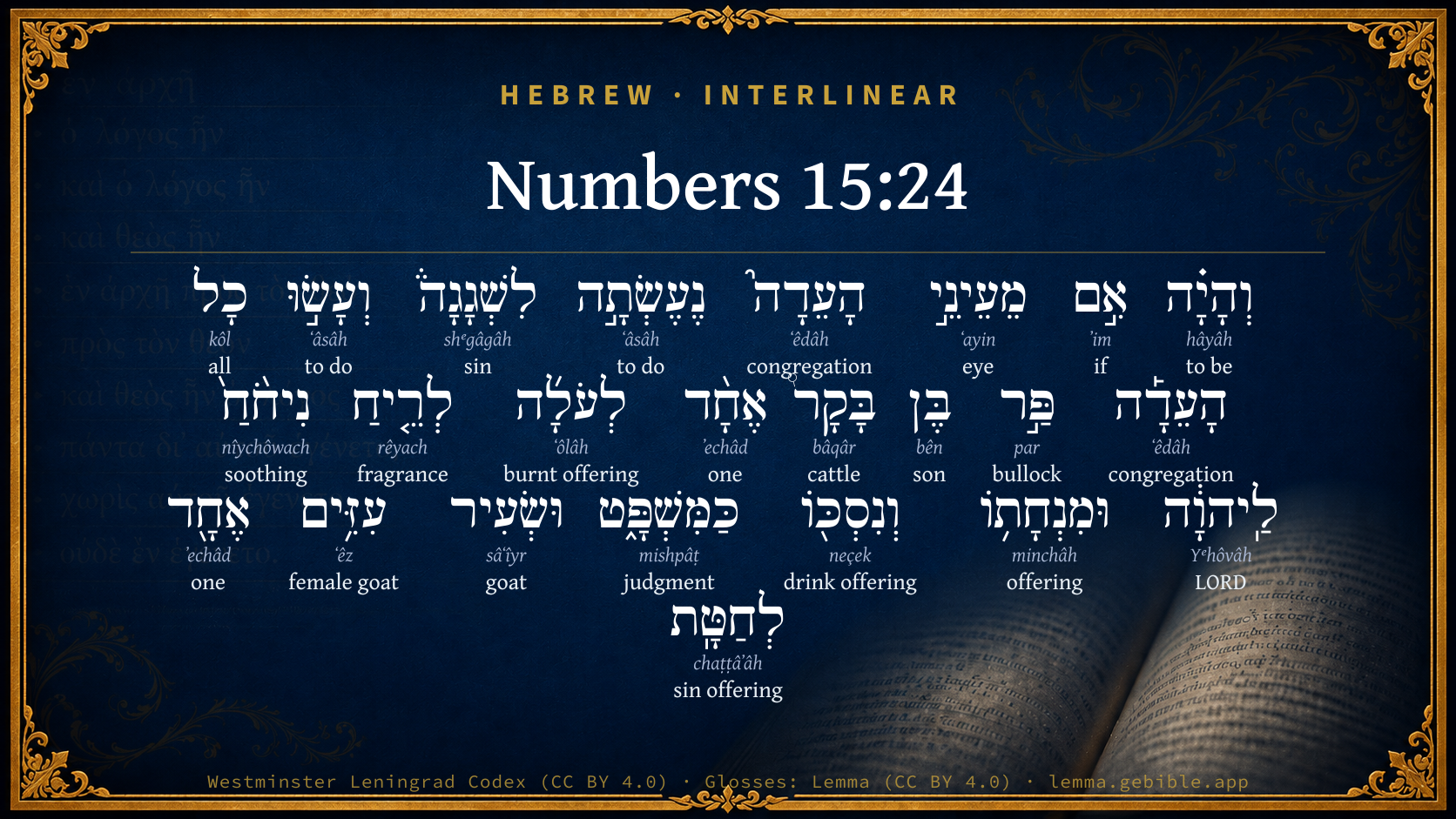
Hebrew (Westminster Leningrad Codex) Numbers 15:24 appears in the Hebrew Old Testament. The text above is from the Westminster Leningrad Codex. Each word links to its Strong’s number, a concise gloss, and parsing drawn from the Open Scriptures Hebrew Bible morphology. Click any word for its full Brown-Driver-Briggs (BDB) entry.
Download image
Cite this verse

Numbers 15:24 (World English Bible). Public Domain. Lemma interlinear Bible study tool, https://lemma.gebible.app/v/numbers/15/24.

Show BibTeX & RIS
BibTeX
RIS
English Translation
then it shall be, if it be done unwittingly, without the knowledge of the congregation, that all the congregation shall offer one young bull for a burnt offering, for a sweet savor to Yahweh, with the meal-offering of it, and the drink-offering of it, according to the ordinance, and one male goat for a sin-offering.
World English Bible · Public Domain
Download a study sheet

One document with this verse’s original text, its word-by-word gloss line, the meaning frame, cross-references with their text, attributed commentary, and full source and license credits — printable, and it pastes into notes with its structure intact.

This verse Autodidact and up

Study sheet (.html) Plain text (.txt)

A passage Seminary Student

Up to 50 verses in one chapter. A passage sheet keeps up to 6 commentary sources and 12 cross-references per verse, in the order this page ranks them, and says so on the sheet whenever that leaves anything out. Ask for a single verse and you get the Autodidact verse sheet above.

Everything on this page stays free to read, with no account — the sheet is a download of what is already on screen, not access to it.

Want to remove ads? Support Godless Engineer
Compare translations 3

The same verse in 3 English versions, stacked beneath the original-language interlinear above. Click any original word for its lexicon entry.

Each is an independent rendering of the whole verse — the interlinear is not word-aligned to these translations.

Highlighted words mark where these versions differ — a whole-verse word diff, not a word-by-word alignment.

  • World English Bible Public Domain
    then it shall be, if it be done unwittingly, without the knowledge of the congregation, that all the congregation shall offer one young bull for a burnt offering, for a sweet savor to Yahweh, with the meal-offering of it, and the drink-offering of it, according to the ordinance, and one male goat for a sin-offering.
  • King James Version Public Domain
    Then it shall be, if ought be committed by ignorance without the knowledge of the congregation, that all the congregation shall offer one young bullock for a burnt offering, for a sweet savor unto the LORD, with his meat offering, and his drink offering, according to the manner, and one kid of the goats for a sin offering.
  • unfoldingWord Literal Text CC BY-SA 4.0
    then it shall be, if from the eyes of the congregation it was done by mistake, that all the congregation shall make a bull (one son of cattle) for a burnt offering, for a scent of pleasing for Yahweh, and its grain offering and its drink offering, according to the ordinance, and one buck of the goats for a sin offering.

unfoldingWord Literal Text — © unfoldingWord, licensed CC BY-SA 4.0. Word-aligned USFM3 via Door43 (git.door43.org/unfoldingWord/en_ult).

Versions to compare (up to 4)

3 of 4 selected

Show all 18 translations

Every available English version of this verse, each an independent rendering of the whole verse.

  • World English Bible Public Domain
    then it shall be, if it be done unwittingly, without the knowledge of the congregation, that all the congregation shall offer one young bull for a burnt offering, for a sweet savor to Yahweh, with the meal-offering of it, and the drink-offering of it, according to the ordinance, and one male goat for a sin-offering.
  • Berean Standard Bible Public Domain
    and if it was done unintentionally without the knowledge of the congregation, then the whole congregation is to prepare one young bull as a burnt offering, a pleasing aroma to the LORD, with its grain offering and drink offering according to the regulation, and one male goat as a sin offering.
  • Majority Standard Bible Public Domain
    and if it was done unintentionally without the knowledge of the congregation, then the whole congregation is to prepare one young bull as a burnt offering, a pleasing aroma to the LORD, with its grain offering and drink offering according to the regulation, and one male goat as a sin offering.
  • King James Version Public Domain
    Then it shall be, if ought be committed by ignorance without the knowledge of the congregation, that all the congregation shall offer one young bullock for a burnt offering, for a sweet savor unto the LORD, with his meat offering, and his drink offering, according to the manner, and one kid of the goats for a sin offering.
  • American Standard Version (1901) Public Domain
    then it shall be, if it be done unwittingly, without the knowledge of the congregation, that all the congregation shall offer one young bullock for a burnt-offering, for a sweet savor unto Jehovah, with the meal-offering thereof, and the drink-offering thereof, according to the ordinance, and one he-goat for a sin-offering.
  • Revised Version (1885) Public Domain
    then it shall be, if it be done unwittingly, without the knowledge of the congregation, that all the congregation shall offer one young bullock for a burnt offering, for a sweet savour unto the LORD, with the meal offering thereof, and the drink offering thereof, according to the ordinance, and one he-goat for a sin offering.
  • Geneva Bible (1599) Public Domain
    And if so be that ought be committed ignorantly of the Congregation, then all ye Congregatio shall giue a bullocke for a burnt offring, for a sweete sauour vnto the Lord, with the meat offring and drinke offring thereto, according to the maner, and an hee goate for a sinne offring.
  • Douay-Rheims (1899) Public Domain
    And the multitude have forgotten to do it: they shall offer a calf out of the herd, a holocaust for a most sweet savour to the Lord, and the sacrifice and libations thereof, as the ceremonies require, and a buck goat for sin:
  • Young's Literal Translation Public Domain
    then it hath been, if from the eyes of the company it hath been done in ignorance, that all the company have prepared one bullock, a son of the herd, for a burnt-offering, for sweet fragrance to Jehovah, and its present, and its libation, according to the ordinance, and one kid of the goats for a sin-offering.
  • Literal Standard Version CC BY-SA 4.0
    then it has been, if from the eyes of the congregation it has been done through ignorance, that all the congregation has prepared one bullock, a son of the herd, for a burnt-offering, for refreshing fragrance to YHWH, and its present, and its drink-offering, according to the ordinance, and one kid of the goats for a sin-offering.
  • Unlocked Literal Bible CC BY-SA 4.0
    In the case of unintentional sin without the community's knowledge, then all the community must offer one young bull as a burnt offering to produce a sweet aroma for Yahweh. Along with this must be made a grain offering and drink offering, as commanded by the decree, and one male goat as a sin offering.
  • unfoldingWord Literal Text CC BY-SA 4.0
    then it shall be, if from the eyes of the congregation it was done by mistake, that all the congregation shall make a bull (one son of cattle) for a burnt offering, for a scent of pleasing for Yahweh, and its grain offering and its drink offering, according to the ordinance, and one buck of the goats for a sin offering.
  • Darby Bible Public Domain
    then it shall be, if ought be committed by inadvertence [hid] from the eyes of the assembly, that the whole assembly shall offer one young bullock for a burnt-offering, for a sweet odour to Jehovah, and its oblation and its drink-offering according to the ordinance, and one buck of the goats for a sin-offering.
  • World Messianic Bible Public Domain
    then it shall be, if it was done unwittingly, without the knowledge of the congregation, that all the congregation shall offer one young bull for a burnt offering, for a pleasant aroma to the LORD, with its meal offering and its drink offering, according to the ordinance, and one male goat for a sin offering.
  • Webster's Bible Public Domain
    Then it shall be, if aught shall be committed by ignorance without the knowledge of the congregation, that all the congregation shall offer one young bullock for a burnt-offering, for a sweet savor to the LORD, with his meat-offering, and his drink-offering, according to the manner, and one kid of the goats for a sin-offering.
  • Free Bible Version CC BY-SA 4.0
    and if it was done unintentionally without everyone knowing about it, then the whole congregation is to present a young bull as a burnt offering to be accepted by the Lord, along with its grain offering and drink offering presented according to the rules, as well as a male goat as a sin offering.
  • Bible in Basic English Public Domain
    Then, if the wrong is done in error, without the knowledge of the meeting of the people, let all the meeting give a young ox as a burned offering, a sweet smell to the Lord, with its meal offering and its drink offering, as is ordered in the law, together with a he-goat for a sin-offering.
  • JPS Tanakh (1917) Public Domain
    then it shall be, if it be done in error by the congregation, it being hid from their eyes, that all the congregation shall offer one young bullock for a burnt-offering, for a sweet savour unto the LORD — with the meal-offering thereof, and the drink-offering thereof, according to the ordinance — and one he-goat for a sin-offering.

Literal Standard Version (2020), Covenant Press — licensed CC BY-SA 4.0. Text via the HelloAO Bible API (eBible.org). Unlocked Literal Bible (unfoldingWord) — licensed CC BY-SA 4.0. Text via the HelloAO Bible API (eBible.org). unfoldingWord Literal Text — © unfoldingWord, licensed CC BY-SA 4.0. Word-aligned USFM3 via Door43 (git.door43.org/unfoldingWord/en_ult). Free Bible Version, Dr. Jonathan Gallagher — licensed CC BY-SA 4.0. Text via the HelloAO Bible API (eBible.org).

Word by word

More ways to search: Search by grammar → Find every occurrence → Compare this word →

Practice this passage: Drill this verse → Learn its vocabulary →

לִשְׁגָגָה֒
shᵉgâgâh
H7684
“to/for · sin”
Preposition + Noun, Common, Feminine, Singular, Absolute
Part of Speech
Preposition + Noun
Type
Common
Gender
Feminine
Number
Singular
State
Absolute
Full BDB Definition

Origin: from H7683

TWOT: 2324a

sin, sin of error or inadvertence, inadvertent sin - error
  1. וְהָיָ֗ה hâyâh H1961 “and · to be” Conjunction + Verb, Qal, Sequential Perfect, 3rd Person, Masculine, Singular
  2. אִ֣ם ʼim H518 “if” Conjunction
  3. מֵעֵינֵ֣י ʻayin H5869 “from · eyes of” Preposition + Noun, Common, Both, Dual, Construct
  4. הָעֵדָה֮ ʻêdâh H5712 “the · congregation” Particle, Definite Article + Noun, Common, Feminine, Singular, Absolute
  5. נֶעֶשְׂתָ֣ה ʻâsâh H6213 “to do” Verb, Niphal, Perfect, 3rd Person, Feminine, Singular
  6. וְעָשׂ֣וּ ʻâsâh H6213 “and · to do” Conjunction + Verb, Qal, Sequential Perfect, 3rd Person, Common, Plural
  7. כָל kôl H3605 “all of” Noun, Common, Masculine, Singular, Construct
  8. הָעֵדָ֡ה ʻêdâh H5712 “the · congregation” Particle, Definite Article + Noun, Common, Feminine, Singular, Absolute
  9. פַּ֣ר par H6499 “bullock” Noun, Common, Masculine, Singular, Absolute
  10. בֶּן bên H1121 “son of” Noun, Common, Masculine, Singular, Construct
  11. בָּקָר֩ bâqâr H1241 “cattle” Noun, Common, Both, Singular, Absolute
  12. אֶחָ֨ד ʼechâd H259 “one” Adjective, Cardinal number, Masculine, Singular, Absolute
  13. לְעֹלָ֜ה ʻôlâh H5930 “to/for · burnt offering” Preposition + Noun, Common, Feminine, Singular, Absolute
  14. לְרֵ֤יחַ rêyach H7381 “to/for · fragrance of” Preposition + Noun, Common, Masculine, Singular, Construct
  15. נִיחֹ֨חַ֙ nîychôwach H5207 “soothing” Noun, Common, Masculine, Singular, Absolute
  16. לַֽיהוָ֔ה Yᵉhôvâh H3068 “to/for · LORD” Preposition + Noun, Proper
  17. וּמִנְחָת֥וֹ minchâh H4503 “and · offering · his” Conjunction + Noun, Common, Feminine, Singular, Construct + Suffix, Personal, 3rd Person, Masculine, Singular
  18. וְנִסְכּ֖וֹ neçek H5262 “and · drink offering · his” Conjunction + Noun, Common, Masculine, Singular, Construct + Suffix, Personal, 3rd Person, Masculine, Singular
  19. כַּמִּשְׁפָּ֑ט mishpâṭ H4941 “like/as the · judgment” Preposition, Determined + Noun, Common, Masculine, Singular, Absolute
  20. וּשְׂעִיר sâʻîyr H8163 “and · goat of” Conjunction + Noun, Common, Masculine, Singular, Construct
  21. עִזִּ֥ים ʻêz H5795 “female goats” Noun, Common, Feminine, Plural, Absolute
  22. אֶחָ֖ד ʼechâd H259 “one” Adjective, Cardinal number, Masculine, Singular, Absolute
  23. לְחַטָּֽת chaṭṭâʼâh H2403 “to/for · sin offering” Preposition + Noun, Common, Feminine, Singular, Absolute

About this verse

These counts appear in no published source. They are computed here, from the morphology-tagged text and Lemma’s own curated glosses. What Lemma adds →

24
words
21
distinct lemmas
Pentateuch
section

Notable vocabulary

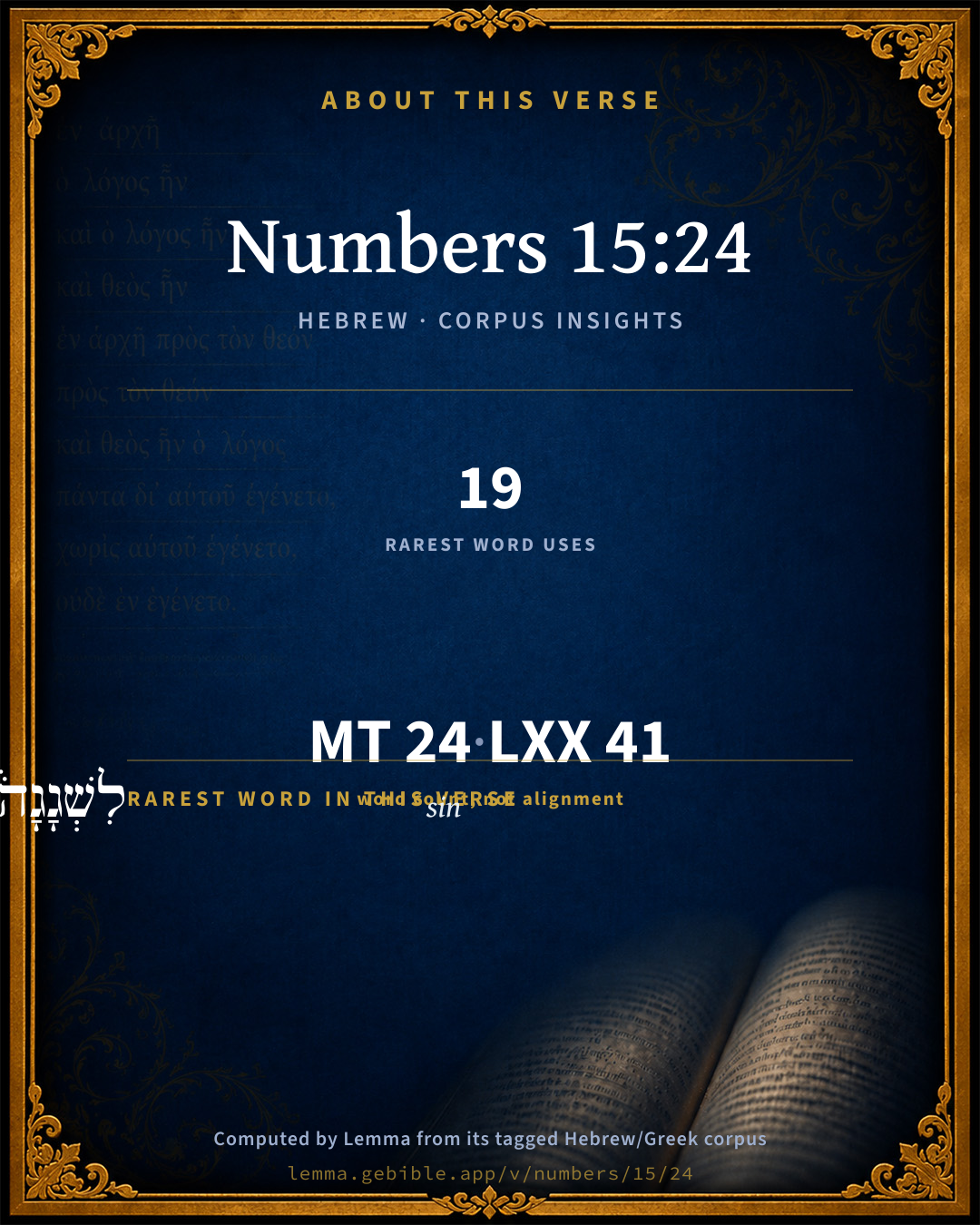
The rarest word here is לִשְׁגָגָה֒ sin H7684 — appearing just 19 times in the whole Hebrew Bible.

Shared distinctive vocabulary

לִשְׁגָגָה֒ sin H7684 occurs in 18 verses of the Hebrew Bible. Also found in:

Grammatical profile

  • 3 verbs
  • 18 nouns
  • 2 adjectives
  • 1 conjunction

Verb forms

  • וְהָיָ֗ה Qal · Sequential Perfect
  • נֶעֶשְׂתָ֣ה Niphal · Perfect
  • וְעָשׂ֣וּ Qal · Sequential Perfect

Repetition

Words recur within this verse — often emphatic in Hebrew:

  • הָעֵדָה֮ congregation H5712 ×2
  • נֶעֶשְׂתָ֣ה to do H6213 ×2
  • אֶחָ֨ד one H259 ×2

Hebrew & Septuagint length

In English translation the verse runs 55 words from the Hebrew and 59 from the Septuagint (LXX English) — closely comparable.

A rough comparison of the two English renderings, which tokenize alike — not a word-level alignment.

Word counts can differ between the Hebrew and the Greek without any difference in meaning — e.g. the Hebrew direct-object marker אֵת has no separate Greek word, and Greek often adds the article ὁ.

In the original languages it is 24 Hebrew tokens and 41 Greek tokens — but the two are counted differently (Hebrew bundles its prefixes and suffixes into one token; the Greek is in lemma form), so that isn’t a like-for-like length.

Cross-references

8

Topical passages linked to Numbers 15:24 in the Treasury of Scripture Knowledge — connected by theme and wording, ordered by reader-vote popularity; previews shown in the World English Bible.

  • Leviticus 4:23 if his sin, in which he has sinned, is made known to him, he shall bring as his offering a goat, a male without blemish.
  • Leviticus 4:13–21 "'If the whole congregation of Israel sins, and the thing is hidden from the eyes of the assembly, and they have done any of the things which Yahweh has commanded not to be done, and are guilty;
  • Leviticus 5:15 "If anyone commits a trespass, and sins unwittingly, in the holy things of Yahweh; then he shall bring his trespass offering to Yahweh, a ram without blemish from the flock, according to your estimation in silver by shekels, after the shekel of the sanctuary, for a trespass offering.
  • Numbers 15:8–10 When you prepare a bull for a burnt offering, or for a sacrifice, to accomplish a vow, or for peace-offerings to Yahweh;
  • Numbers 28:15 One male goat for a sin-offering to Yahweh; it shall be offered besides the continual burnt offering, and the drink-offering of it.
  • 2 Chronicles 29:21–24 They brought seven bulls, and seven rams, and seven lambs, and seven male goats, for a sin-offering for the kingdom and for the sanctuary and for Judah. He commanded the priests the sons of Aaron to offer them on the altar of Yahweh.
  • Ezra 6:17 They offered at the dedication of this house of God one hundred bulls, two hundred rams, four hundred lambs; and for a sin-offering for all Israel, twelve male goats, according to the number of the tribes of Israel.
  • Ezra 8:35 The children of the captivity, who had come out of exile, offered burnt offerings to the God of Israel, twelve bulls for all Israel, ninety-six rams, seventy-seven lambs, and twelve male goats for a sin-offering: all this was a burnt offering to Yahweh.

Cross-references courtesy of OpenBible.info (CC BY 4.0).

Hebrew and Greek witnesses Masoretic Hebrew ↔ Greek Septuagint

The same verse in the two great witnesses to the Old Testament, shown verse-for-verse.

These are two independent witnesses, not word-aligned to each other, and the Septuagint is shown in lemma (dictionary) form.

Hebrew Numbers 15:24 Masoretic · Westminster Leningrad Codex

וְהָיָ֗ה אִ֣ם מֵעֵינֵ֣י הָעֵדָה֮ נֶעֶשְׂתָ֣ה לִשְׁגָגָה֒ וְעָשׂ֣וּ כָל הָעֵדָ֡ה פַּ֣ר בֶּן בָּקָר֩ אֶחָ֨ד לְעֹלָ֜ה לְרֵ֤יחַ נִיחֹ֨חַ֙ לַֽיהוָ֔ה וּמִנְחָת֥וֹ וְנִסְכּ֖וֹ כַּמִּשְׁפָּ֑ט וּשְׂעִיר עִזִּ֥ים אֶחָ֖ד לְחַטָּֽת

then it shall be, if it be done unwittingly, without the knowledge of the congregation, that all the congregation shall offer one young bull for a burnt offering, for a sweet savor to Yahweh, with the meal-offering of it, and the drink-offering of it, according to the ordinance, and one male goat for a sin-offering.

World English Bible · Public Domain

Greek LXX Numbers 15:24 Septuagint · lemma form

καί εἰμί ἐάν ἐκ ὀφθαλμός ὁ συναγωγή γίγνομαι ἀκουσίως καί ποιέω πᾶς ὁ συναγωγή μόσχος εἷς ἐκ βοῦς ἄμωμος εἰς ὁλοκαύτωμα εἰς ὀσμή εὐωδία κύριος καί θυσία οὗτος καί σπονδή αὐτός κατά ὁ σύνταξις καί χίμαρος ἐκ αἴξ εἷς περί ἁμαρτία

then it shall come to pass, if a trespass be committed unwillingly, unknown to the congregation, then shall all the congregation offer a calf of the herd without blemish for a whole burnt offering of sweet savor to the Lord, and its meat-offering and its drink-offering according to the ordinance, and one kid of the goats for a sin-offering.

LXX2012 (modern English Septuagint) · Public Domain

Hebrew: Westminster Leningrad Codex (CC BY 4.0). Greek: Septuagint (public domain); English from LXX2012 (modern English Septuagint) (Public Domain). How the Septuagint differs from the Hebrew →

Targum (Aramaic paraphrase)

2

The Targum is the ancient Jewish Aramaic paraphrase of the Hebrew Scriptures — an interpretive translation, not the Hebrew text itself. Onkelos (literal) and Pseudo-Jonathan (expansive) render the Torah, and Jonathan the Prophets. Coverage is partial: where no permissively-licensed English translation exists for a verse, only the Aramaic is shown. This is verse-level text, not a word-by-word alignment to the Hebrew.

  1. Targum Onkelos Torah (Genesis–Deuteronomy)
    וִיהֵי אִם מֵעֵינֵי כְנִשְׁתָּא אִתְעֲבִדַת לְשָׁלוּ וְיַעְבְּדוּן כָּל כְּנִשְׁתָּא תּוֹר בַּר תּוֹרֵי חַד לַעֲלָתָא לְאִתְקַבָּלָא בְרַעֲוָא קֳדָם יְיָ וּמִנְחָתֵהּ וְנִסְכֵּהּ כִּדְחָזֵי וּצְפִיר בַּר עִזֵי חַד לְחַטָּאתָא

    (no public-domain English translation for this verse)

    Targum Onkelos — Aramaic: “Onkelos Genesis” (public domain); “Onkelos Exodus” (public domain); “Onkelos Leviticus” (public domain); “Onkelos Numbers” (public domain); “Onkelos Deuteronomy” (public domain). English: “Sefaria Community Translation” (CC0 1.0 (public-domain dedication)); “J.W. Etheridge. The Targums of Onkelos and Jonathan Ben Uzziel on the Pentateuch. London: Longmans, Green, 1862” (public domain). Text via Sefaria.

  2. Targum Pseudo-Jonathan Torah (Genesis–Deuteronomy)
    וִיהֵי אִין מִן מֶחְמֵי כְנִשְׁתָּא אִיתְעֲבִידַת סוּרְחָנוּתָא בְּשָׁלוּ וְיַעַבְדוּן כָּל כְּנִשְׁתָּא תּוֹר בַּר תּוֹרֵי חַד לְעָלָתָא לְאִתְקַבָּלָא בְּרַעֲוָא קֳדָם יְיָ וּמִנְחָתֵיהּ וְנִיסוּכֵיהּ כַּד חָמֵי וּצְפִיר בַּר עִזִין דְלָא עֵירוּבִין חַד לְחַטָאתָא

    if without the knowledge of the congregation sin hath been committed through ignorance, let all the congregation make one young bullock a burnt offering to be received with acceptance before the Lord, with his mincha and libation. as are proper; and one kid of the goats without mixture for a sin offering;

    Targum Pseudo-Jonathan — Aramaic: “Targum Jonathan on Genesis” (public domain); “Targum Jonathan on Exodus” (public domain); “Targum Jonathan on Leviticus” (public domain); “Targum Jonathan on Numbers” (public domain); “Targum Jonathan on Deuteronomy” (public domain). English: “The Targum of Jonathan ben Uzziel, trans. J. W. Etheridge, London, 1862” (public domain). Text via Sefaria.

Commentary

Notes on Numbers 15:24 from classic Christian and Jewish commentators (each source and its license shown beneath its notes). The classic Christian expositions comment on the surrounding passage and are grouped to its opening verse, so a note may address several verses; the Jewish commentaries on the Tanakh (Rashi and others) are per-verse, so they appear only where the commentator wrote on this verse.

Lemma curates 59 commentaries, every one of them public domain or Creative Commons licensed, each selected and text-cleaned for this edition rather than reprinted as found. About our sources →

Trapp's Complete Commentary

John Trapp

Num 15:24 Then it shall be, if [ought] be committed by ignorance without the knowledge of the congregation, that all the congregation shall offer one young bullock for a burnt offering, for a sweet savour unto the LORD, with his meat offering, and his drink offering, according to the manner, and one kid of the goats for a sin offering.

Ver. 24. By ignorance.] Or, Infirmity; incogitancy; inadvertency. For such there is a pardon, of course, ready sealed by God in Christ: else we might die in our sins, while the pardon is providing.

John Trapp, A Commentary or Exposition upon All the Books of the Old and New Testament (1647–1656) — public domain. Text from a community e-Sword module.

Geneva Bible (1599)

Geneva Bible translators

Some read, from the eyes of the Congregation, that is, which is hid from the Congregation.

Geneva Bible (1599) marginal notes — public domain. Text via Bolls.life.

Jamieson, Fausset & Brown

Robert Jamieson, A. R. Fausset & David Brown

if aught be committed by ignorance--The Mosaic ritual was complicated, and the ceremonies to be gone through in the various instances of purification which are specified, would expose a worshipper, through ignorance, to the risk of omitting or neglecting some of them. This law includes the stranger in the number of those for whom the sacrifice was offered for the sin of general ignorance.

Jamieson, Fausset & Brown — Commentary Critical and Explanatory on the Whole Bible (1871) — public domain (CC PDM 1.0). Text via the HelloAO Bible API.

Adam Clarke's Commentary

Verse 24. If aught be committed by ignorance] See Clarke on Le 4:2, and "Le 5:17". The case here probably refers to the whole congregation; the cases above, to the sin of an individual.

Adam Clarke's Commentary on the Bible (1810–1826) — public domain. Text from a community e-Sword/MySword module.

Ellicott's Commentary for English Readers

(24) By ignorance.—The word shegagah is used to denote transgressions committed unwittingly in contrast to sins committed presumptuously (Num_15:30). (See Lev_4:2 and Note.) Provision had already been made in Leviticus 4 for sins of commission committed unwittingly by the whole congregation, but no provision appears to have been made for the guilt contracted in the case of sins of omission. It is possible, also, that in this place transgressions committed by an individual, but affecting the whole of the congregation, may be included. In Lev_4:14 a young bullock is appointed as a sin offering; in the present case a young bullock is appointed for a burnt offering and a kid of the goats for a sin offering. It must be remembered, moreover, that the commandments delivered in this chapter have express reference to the land of Canaan, whereas many of the commandments previously delivered had already become obligatory.

A Bible Commentary for English Readers, edited by Charles John Ellicott (1878–1897) — public domain. Text from a community e-Sword module.

The Cambridge Bible for Schools and Colleges

gen. ed. J. J. S. Perowne

24. The offering is a young bullock for a burnt-offering, together with the proper meal-offering and libation, and a he-goat for a sin offering.

The Cambridge Bible for Schools and Colleges (gen. ed. J. J. S. Perowne; Cambridge University Press, 1878–1918) — public domain. Text from a community e-Sword module.

John Gill's Exposition

And the priest shall make an atonement for all the congregation of the children of Israel;.... By offering a sin offering for them, a type of Christ, the propitiation not only for the sins of the people among the Jews, but throughout the whole world, Jo1 2:2,

and it shall be forgiven them; as the sins of the Lord's people are forgiven them through the blood of Christ, and on account of his stoning sacrifice and satisfaction made for them:

for it is ignorance; a sin of ignorance, for which reason Christ pleads for pardon on the foot of his sacrifice, and his people receive it, Luk 23:34; for that this sin was forgiven on the score of a sacrifice appears by what follows:

and they shall bring their offering, a sacrifice made by fire unto the Lord; the bullock for the burnt offering:

and their sin offering before the Lord, for their ignorance; a kid of the goats.

John Gill's Exposition of the Whole Bible (1746–1763) — public domain (CC PDM 1.0). Text via the HelloAO Bible API.

Matthew Poole's English Annotations

In Le 4 the bullock is for a sin-offering, here it is for a burnt-offering, either because they are different laws, as hath been said; or because here is added a new penalty, to breed the greater caution and diligence in the Israelites, who had given many instances, and now a fresh and eminent instance, of their heedlessness in observing the commands of God; and so, besides that bullock for a sin-offering, which he leaves to be gathered out of Lev 4:11, he now requires another bullock for a burnt-offering.

Matthew Poole's English Annotations on the Holy Bible (1683–1685) — public domain. Text from a community e-Sword/MySword module.

Whedon's Commentary on the Bible

Daniel D. Whedon

24. Without the knowledge — Hebrew, away from the eyes of the congregation. How the whole nation could be ignorantly delinquent it is difficult to discover. Outram supposes that it was done “by retaining to a certain extent the national rites, and following the worship of the true God, and yet at the same time acting unconsciously in opposition to the law through having been led astray by some common errors.” Others explain it as the neglect of religious duties through the example of godless rulers who adopted pagan customs apparently reconcilable with Mosaism but really repugnant to its spirit.

For a burnt offering — This is mentioned first, since it is the principal sacrifice. But in the order of time the sin offering was first offered, since sin must be expiated before the sinner can consecrate himself wholly, and be entirely sanctified. In this comment Keil concurs, forgetful of his declaration elsewhere that there is no prescribed order when two or more sacrifices were offered together. See Introd. to Leviticus (5.)

Sin offering — In Mosaism the killing of the animal is by the offerer and not by the priest, unless he be the offerer. Comp. Lev_1:5; Lev_4:3-4. If the slaughter were really an act of atonement it would probably take place on the altar itself, and not by its side. “The priestly function begins not with the shedding but with the use of the blood.” — Oehler. “The blood (of Christ) itself, not the shedding of the blood, is the ransom, the price of eternal redemption.” — Bengel. See Leviticus iv, notes.

Daniel D. Whedon (gen. ed.), Commentary on the Old and New Testaments (1874–1909) — public domain. Text from a community e-Sword module.

The Pulpit Commentary

If ought be committed. Rather, "if it be committed," i.e., the non-observance of "all these commandments." It cannot, however, be necessary to suppose that a falling away from the whole body of the Mosaic legislation is here intended; such an apostasy could not happen by oversight, and if it did, the remedy provided would seem much too slight for the occasion. The analogy of the provision which follows (verse 27), and of the parallel provisions in Lev_4:2, Lev_4:13, points clearly to the neglect of any one of the Divine commandments. One young bullock for a burnt offering. In the case of a sin of commission done ignorantly, the bullock was treated as a sin offering, (Lev_4:14, Lev_4:20) for in that case the expiation of guilt incurred is the prominent point in the atonement; in this case it is the necessity of a fresh self-dedication to the Lord. According to the manner, fpvMiK, according to the ordinance given above. One kid of the goats for a sin offering. This was no doubt offered first, because expiation must precede self-oblation, but the bullock is mentioned first as forming the principal part of the sacrifice. The kid was probably treated according to the regulations of Lev_4:14, sq.

The Pulpit Commentary (1880–1919), ed. H.D.M. Spence-Jones & Joseph S. Exell — public domain. Text from a community e-Sword module.

Rashi

Rabbi Shlomo Yitzchaki (Rashi)

ואם מעיני העדה נעשתה בשגגה — This means: If it is by the eyes (the leaders) of the community that this sin has been committed in error, i.e., that they have mistakenly taught of a certain one of the rites associated with the worship of God that it is permissible to worship an idol in that manner, [then it shall be that all the congregation shall offer, etc.] (cf. Horayot 5b).

לחטת — This lacks the א usually found in it, to indicate that it is not like other חטאות, sin-offerings; for in the case of all sin offerings mentioned in the Torah that are to be brought together with a burnt offering, the sin-offering precedes the burnt offering (i.e. is offered first), since it is said, (Leviticus 5:10) “And the second animal shall he make as a burnt offering,” whilst in this case the burnt offering precedes the sin-offering (Horayot 13a).

Rashi on the Tanakh — English translations: “The Judaica Press complete Tanach with Rashi, translated by A. J. Rosenberg” (CC BY 4.0); “Pentateuch with Rashi's commentary by M. Rosenbaum and A.M. Silbermann, 1929-1934” (public domain); “The Metsudah Tanach series, Lakewood, N.J” (CC BY 4.0); and “The Book of Joshua, Metsudah Publications, 1997” (CC BY 4.0). Text via Sefaria.

Lesson kit

Teaching starters — assembled from the data on this page, not authored interpretation. Every prompt links to the verse data it draws on. Edit before teaching.

Numbers, in the Pentateuch, opens this verse with 24 words (21 distinct Hebrew lemmas). Its most distinctive word is shᵉgâgâh (“sin”). A historical commentator’s framing appears above. Read the whole chapter for the surrounding context.

Discussion questions

  1. The word shᵉgâgâh carries the sense “sin.” How does it shape the verse?
  2. Leviticus 4:2 shares the word «sin» with this verse. How do the two illuminate each other?
  3. “congregation” occurs 2× in this one verse. What is the effect of the repetition?
  4. These translations render this verse differently. What is at stake in choosing one wording over another?
  5. The verb «וְהָיָ֗ה» is Qal Sequential Perfect. How does its form color the action?
  6. Reading how Trapp's Complete Commentary and Geneva Bible (1599) read this verse, where do the two commentators agree and where do they part?

Things to notice

Reading settings

Reading text

Shown beneath each verse's original-language words.

Old Testament
Old Testament edition

Read the OT as the Masoretic Hebrew (MT) or the Greek Septuagint (LXX).

English shown for the Greek Septuagint (in the Hebrew ↔ Greek comparison).

Comparing translations? Open the Compare panel on any verse page to stack up to four side by side.