Numbers 29:17

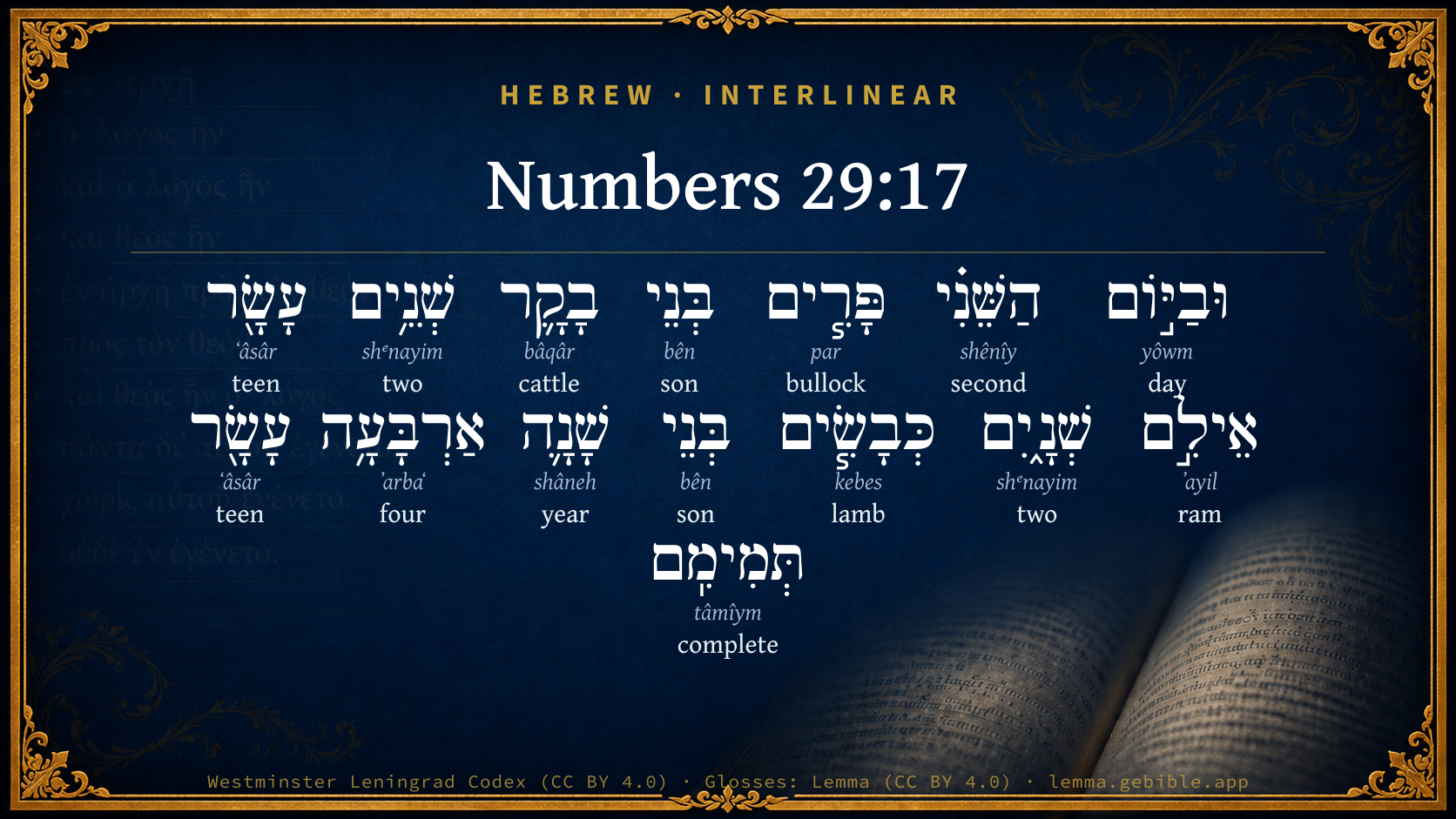
Hebrew (Westminster Leningrad Codex) Numbers 29:17 appears in the Hebrew Old Testament. The text above is from the Westminster Leningrad Codex. Each word links to its Strong’s number, a concise gloss, and parsing drawn from the Open Scriptures Hebrew Bible morphology. Click any word for its full Brown-Driver-Briggs (BDB) entry.
Download image
Cite this verse

Numbers 29:17 (World English Bible). Public Domain. Lemma interlinear Bible study tool, https://lemma.gebible.app/v/numbers/29/17.

Show BibTeX & RIS
BibTeX
RIS
English Translation
On the second day [you shall offer] twelve young bulls, two rams, fourteen he-lambs a year old without blemish;
World English Bible · Public Domain
Download a study sheet

One document with this verse’s original text, its word-by-word gloss line, the meaning frame, cross-references with their text, attributed commentary, and full source and license credits — printable, and it pastes into notes with its structure intact.

This verse Autodidact and up

Study sheet (.html) Plain text (.txt)

A passage Seminary Student

Up to 50 verses in one chapter. A passage sheet keeps up to 6 commentary sources and 12 cross-references per verse, in the order this page ranks them, and says so on the sheet whenever that leaves anything out. Ask for a single verse and you get the Autodidact verse sheet above.

Everything on this page stays free to read, with no account — the sheet is a download of what is already on screen, not access to it.

Want to remove ads? Support Godless Engineer
Compare translations 3

The same verse in 3 English versions, stacked beneath the original-language interlinear above. Click any original word for its lexicon entry.

Each is an independent rendering of the whole verse — the interlinear is not word-aligned to these translations.

Highlighted words mark where these versions differ — a whole-verse word diff, not a word-by-word alignment.

  • World English Bible Public Domain
    On the second day [you shall offer] twelve young bulls, two rams, fourteen he-lambs a year old without blemish;
  • King James Version Public Domain
    And on the second day ye shall offer twelve young bullocks, two rams, fourteen lambs of the first year without spot:
  • unfoldingWord Literal Text CC BY-SA 4.0
    And on the second day: 12 bulls, sons of cattle, two rams, 14 male lambs, sons of a year, unblemished,

unfoldingWord Literal Text — © unfoldingWord, licensed CC BY-SA 4.0. Word-aligned USFM3 via Door43 (git.door43.org/unfoldingWord/en_ult).

Versions to compare (up to 4)

3 of 4 selected

Show all 18 translations

Every available English version of this verse, each an independent rendering of the whole verse.

  • World English Bible Public Domain
    On the second day [you shall offer] twelve young bulls, two rams, fourteen he-lambs a year old without blemish;
  • Berean Standard Bible Public Domain
    On the second day you are to present twelve young bulls, two rams, and fourteen male lambs a year old, all unblemished,
  • Majority Standard Bible Public Domain
    On the second day you are to present twelve young bulls, two rams, and fourteen male lambs a year old, all unblemished,
  • King James Version Public Domain
    And on the second day ye shall offer twelve young bullocks, two rams, fourteen lambs of the first year without spot:
  • American Standard Version (1901) Public Domain
    And on the second day `ye shall offer' twelve young bullocks, two rams, fourteen he-lambs a year old without blemish;
  • Revised Version (1885) Public Domain
    And on the second day ye shall offer twelve young bullocks, two rams, fourteen he-lambs of the first year without blemish:
  • Geneva Bible (1599) Public Domain
    And the second day ye shall offer twelue yong bullockes, two rams, fourteene lambes of a yeere olde without blemish,
  • Douay-Rheims (1899) Public Domain
    On the second day you shall offer twelve calves of the herd, two rams and fourteen lambs of a year old, without blemish:
  • Young's Literal Translation Public Domain
    `And on the second day twelve bullocks, sons of the herd, two rams, fourteen lambs, sons of a year, perfect ones;
  • Literal Standard Version CC BY-SA 4.0
    And on the second day: twelve bullocks, sons of the herd, two rams, fourteen lambs, sons of a year, perfect ones;
  • Unlocked Literal Bible CC BY-SA 4.0
    On the second day of the assembly, you must offer twelve young bulls, two rams, and fourteen male lambs a year old, each without blemish.
  • unfoldingWord Literal Text CC BY-SA 4.0
    And on the second day: 12 bulls, sons of cattle, two rams, 14 male lambs, sons of a year, unblemished,
  • Darby Bible Public Domain
    And on the second day, [ye shall present] twelve young bullocks, two rams, fourteen yearling lambs without blemish;
  • World Messianic Bible Public Domain
    “‘On the second day you shall offer twelve young bulls, two rams, and fourteen male lambs a year old without defect;
  • Webster's Bible Public Domain
    And on the second day ye shall offer twelve young bullocks, two rams, fourteen lambs of the first year without spot:
  • Free Bible Version CC BY-SA 4.0
    On the second day present twelve young bulls, two rams, and fourteen male lambs a year old, all of them without defects.
  • Bible in Basic English Public Domain
    On the second day of the feast give an offering of twelve oxen, two male sheep, fourteen he-lambs of the first year, without any mark on them;
  • JPS Tanakh (1917) Public Domain
    And on the second day ye shall present twelve young bullocks, two rams, fourteen he-lambs of the first year without blemish;

Literal Standard Version (2020), Covenant Press — licensed CC BY-SA 4.0. Text via the HelloAO Bible API (eBible.org). Unlocked Literal Bible (unfoldingWord) — licensed CC BY-SA 4.0. Text via the HelloAO Bible API (eBible.org). unfoldingWord Literal Text — © unfoldingWord, licensed CC BY-SA 4.0. Word-aligned USFM3 via Door43 (git.door43.org/unfoldingWord/en_ult). Free Bible Version, Dr. Jonathan Gallagher — licensed CC BY-SA 4.0. Text via the HelloAO Bible API (eBible.org).

Word by word

More ways to search: Search by grammar → Find every occurrence → Compare this word →

Practice this passage: Drill this verse → Learn its vocabulary →

תְּמִימִֽם
tâmîym
H8549
“complete”
Adjective, Adjective, Masculine, Plural, Absolute
Part of Speech
Adjective
Type
Adjective
Gender
Masculine
Number
Plural
State
Absolute
Full BDB Definition

Origin: from H8552

TWOT: 2522d

complete, whole, entire, sound - complete, whole, entire - whole, sound, healthful - complete, entire (of time) - sound, wholesome, unimpaired, innocent, having integrity - what is complete or entirely in accord with truth and fact (neuter adjective/substantive)
  1. וּבַיּ֣וֹם yôwm H3117 “and · in/at the · day” Conjunction + Preposition, Determined + Noun, Common, Masculine, Singular, Absolute
  2. הַשֵּׁנִ֗י shênîy H8145 “the · second” Particle, Definite Article + Adjective, Ordinal number, Masculine, Singular, Absolute
  3. פָּרִ֧ים par H6499 “bullocks” Noun, Common, Masculine, Plural, Absolute
  4. בְּנֵי bên H1121 “sons of” Noun, Common, Masculine, Plural, Construct
  5. בָקָ֛ר bâqâr H1241 “cattle” Noun, Common, Both, Singular, Absolute
  6. שְׁנֵ֥ים shᵉnayim H8147 “two” Adjective, Cardinal number, Masculine, Dual, Absolute
  7. עָשָׂ֖ר ʻâsâr H6240 “teen” Adjective, Cardinal number, Masculine, Singular, Absolute
  8. אֵילִ֣ם ʼayil H352 “rams” Noun, Common, Masculine, Plural, Absolute
  9. שְׁנָ֑יִם shᵉnayim H8147 “two” Adjective, Cardinal number, Masculine, Dual, Absolute
  10. כְּבָשִׂ֧ים kebes H3532 “lambs” Noun, Common, Masculine, Plural, Absolute
  11. בְּנֵי bên H1121 “sons of” Noun, Common, Masculine, Plural, Construct
  12. שָׁנָ֛ה shâneh H8141 “year” Noun, Common, Feminine, Singular, Absolute
  13. אַרְבָּעָ֥ה ʼarbaʻ H702 “four” Adjective, Cardinal number, Masculine, Singular, Absolute
  14. עָשָׂ֖ר ʻâsâr H6240 “teen” Adjective, Cardinal number, Masculine, Singular, Absolute

About this verse

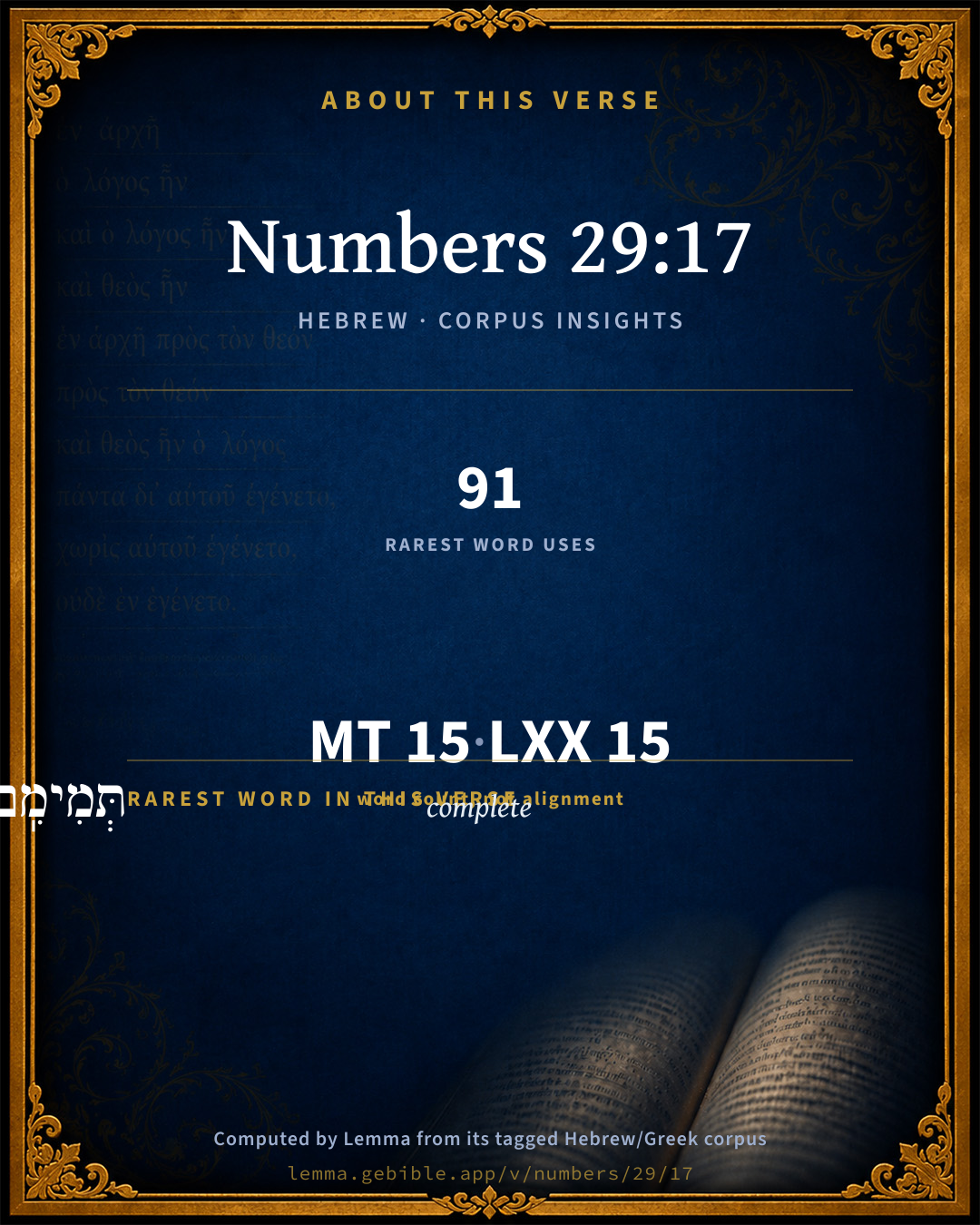
These counts appear in no published source. They are computed here, from the morphology-tagged text and Lemma’s own curated glosses. What Lemma adds →

15
words
12
distinct lemmas
Pentateuch
section

Grammatical profile

  • 8 nouns
  • 7 adjectives

Repetition

Words recur within this verse — often emphatic in Hebrew:

  • בְּנֵי son H1121 ×2
  • שְׁנֵ֥ים two H8147 ×2
  • עָשָׂ֖ר teen H6240 ×2

Hebrew & Septuagint length

In English translation the verse runs 19 words from the Hebrew and 17 from the Septuagint (LXX English) — closely comparable.

A rough comparison of the two English renderings, which tokenize alike — not a word-level alignment.

Word counts can differ between the Hebrew and the Greek without any difference in meaning — e.g. the Hebrew direct-object marker אֵת has no separate Greek word, and Greek often adds the article ὁ.

In the original languages it is 15 Hebrew tokens and 15 Greek tokens — but the two are counted differently (Hebrew bundles its prefixes and suffixes into one token; the Greek is in lemma form), so that isn’t a like-for-like length.

Cross-references

13

Topical passages linked to Numbers 29:17 in the Treasury of Scripture Knowledge — connected by theme and wording, ordered by reader-vote popularity; previews shown in the World English Bible.

  • Leviticus 23:36 Seven days you shall offer an offering made by fire to Yahweh. On the eighth day shall be a holy convocation to you; and you shall offer an offering made by fire to Yahweh. It is a solemn assembly; you shall do no regular work.
  • Numbers 29:13 and you shall offer a burnt offering, an offering made by fire, of a sweet savor to Yahweh; thirteen young bulls, two rams, fourteen he-lambs a year old; they shall be without blemish;
  • Numbers 29:20–40 On the third day eleven bulls, two rams, fourteen he-lambs a year old without blemish;
  • Psalms 40:6 Sacrifice and offering you didn't desire. You have opened my ears: Burnt offering and sin offering you have not required.
  • Psalms 50:8–9 I don't rebuke you for your sacrifices. Your burnt offerings are continually before me.
  • Psalms 51:16–17 For you don't delight in sacrifice, or else I would give it. You have no pleasure in burnt offering.
  • Psalms 69:31 It will please Yahweh better than an ox, Or a bull that has horns and hoofs.
  • Isaiah 1:11 "What are the multitude of your sacrifices to me?," says Yahweh. "I have had enough of the burnt offerings of rams, And the fat of fed animals. I don't delight in the blood of bulls, Or of lambs, Or of male goats.
  • Jeremiah 7:22–23 For I didn't speak to your fathers, nor command them in the day that I brought them out of the land of Egypt, concerning burnt offerings or sacrifices:
  • Hosea 6:6 For I desire mercy, and not sacrifice; And the knowledge of God more than burnt offerings.
  • Romans 12:1 Therefore I urge you, brothers, by the mercies of God, to present your bodies a living sacrifice, holy, acceptable to God, which is your spiritual service.
  • Hebrews 8:13 In that he says, "A new covenant," he has made the first old. But that which is becoming old and grows aged is near to vanishing away.
  • Hebrews 9:3–14 After the second veil was the tabernacle which is called the Holy of Holies,

Cross-references courtesy of OpenBible.info (CC BY 4.0).

Hebrew and Greek witnesses Masoretic Hebrew ↔ Greek Septuagint

The same verse in the two great witnesses to the Old Testament, shown verse-for-verse.

These are two independent witnesses, not word-aligned to each other, and the Septuagint is shown in lemma (dictionary) form.

Hebrew Numbers 29:17 Masoretic · Westminster Leningrad Codex

וּבַיּ֣וֹם הַשֵּׁנִ֗י פָּרִ֧ים בְּנֵי בָקָ֛ר שְׁנֵ֥ים עָשָׂ֖ר אֵילִ֣ם שְׁנָ֑יִם כְּבָשִׂ֧ים בְּנֵי שָׁנָ֛ה אַרְבָּעָ֥ה עָשָׂ֖ר תְּמִימִֽם

On the second day [you shall offer] twelve young bulls, two rams, fourteen he-lambs a year old without blemish;

World English Bible · Public Domain

Greek LXX Numbers 29:17 Septuagint · lemma form

καί ὁ ἡμέρα ὁ δεύτερος μόσχος δώδεκα κριός δύο ἀμνός ἐνιαύσιος τέσσαρες καί δέκα ἄμωμος

And on the second day twelve calves, two rams, fourteen lambs of a year old without blemish.

LXX2012 (modern English Septuagint) · Public Domain

Hebrew: Westminster Leningrad Codex (CC BY 4.0). Greek: Septuagint (public domain); English from LXX2012 (modern English Septuagint) (Public Domain). How the Septuagint differs from the Hebrew →

Targum (Aramaic paraphrase)

2

The Targum is the ancient Jewish Aramaic paraphrase of the Hebrew Scriptures — an interpretive translation, not the Hebrew text itself. Onkelos (literal) and Pseudo-Jonathan (expansive) render the Torah, and Jonathan the Prophets. Coverage is partial: where no permissively-licensed English translation exists for a verse, only the Aramaic is shown. This is verse-level text, not a word-by-word alignment to the Hebrew.

  1. Targum Onkelos Torah (Genesis–Deuteronomy)
    וּבְיוֹמָא תִנְיָנָא תּוֹרִין בְּנֵי תוֹרֵי תְּרֵי עֲשַׂר דִכְרִין תְּרֵין אִימְרִין בְּנֵי שְׁנָא אַרְבְּעָא עֲשַׂר שַׁלְמִין

    (no public-domain English translation for this verse)

    Targum Onkelos — Aramaic: “Onkelos Genesis” (public domain); “Onkelos Exodus” (public domain); “Onkelos Leviticus” (public domain); “Onkelos Numbers” (public domain); “Onkelos Deuteronomy” (public domain). English: “Sefaria Community Translation” (CC0 1.0 (public-domain dedication)); “J.W. Etheridge. The Targums of Onkelos and Jonathan Ben Uzziel on the Pentateuch. London: Longmans, Green, 1862” (public domain). Text via Sefaria.

  2. Targum Pseudo-Jonathan Torah (Genesis–Deuteronomy)
    וּבְיוֹמָא תִּנְיָינָא דְחַגָא דִמְטָלַיָיא תִּקְרְבוּן תּוֹרִין בְּנֵי תּוֹרֵי תְּרֵיסַר לִתְרֵיסַר מַטַרְתָּא דִכְרִין תְּרֵין לִתְרֵי מַטַרְתָּא אִמְרִין בְּנֵי שְׁנָא אַרְבֵּיסַר שַׁלְמִין לְתִשְׁעַת מַטַרְתָּא חַמְשָׁא מִנְהוֹן מְקַרְבִין תְּרֵי תְּרֵי וְאַרְבַּע מִנְהוֹן חָד חָד

    On the second day of the Feast of Tabernacles you shall offer twelve young bullocks, by twelve orders; two rams, by two orders; fourteen lambs of the year unblemished by nine orders, five of them shall offer two by two, and four of them one by one.

    Targum Pseudo-Jonathan — Aramaic: “Targum Jonathan on Genesis” (public domain); “Targum Jonathan on Exodus” (public domain); “Targum Jonathan on Leviticus” (public domain); “Targum Jonathan on Numbers” (public domain); “Targum Jonathan on Deuteronomy” (public domain). English: “The Targum of Jonathan ben Uzziel, trans. J. W. Etheridge, London, 1862” (public domain). Text via Sefaria.

Commentary

Notes on Numbers 29:17 from classic Christian and Jewish commentators (each source and its license shown beneath its notes). The classic Christian expositions comment on the surrounding passage and are grouped to its opening verse, so a note may address several verses; the Jewish commentaries on the Tanakh (Rashi and others) are per-verse, so they appear only where the commentator wrote on this verse.

Lemma curates 59 commentaries, every one of them public domain or Creative Commons licensed, each selected and text-cleaned for this edition rather than reprinted as found. About our sources →

Trapp's Complete Commentary

John Trapp

Num 29:17 And on the second day [ye shall offer] twelve young bullocks, two rams, fourteen lambs of the first year without spot:

Ver. 17. And on the second day ye shall offer twelve, &c.] In every of these seven days sacrifices, one bullock is abated: hereby the Holy Ghost might teach them their duty, to grow in grace and increase in sanctification, that their sins decreasing, the number of their sacrifices, whereby atonement was made for their sins, should also decrease daily. Or it might signify a diminishing and wearing away of the legal offerings, &c., as one well observeth; Hac caeremonia significabat Deus gratiam suam de die in diem crescere, ita nempe ut minuatur vetus homo, et novus augeatur, &c., saith Alsted, - till the very ruins of Satan’s castles be, as most of our old castles are, almost brought to ruin.

John Trapp, A Commentary or Exposition upon All the Books of the Old and New Testament (1647–1656) — public domain. Text from a community e-Sword module.

Geneva Bible (1599)

Geneva Bible translators

The second day of the feast of Tabernacles.

Geneva Bible (1599) marginal notes — public domain. Text via Bolls.life.

unfoldingWord translationNotes

Door43 World Missions Community

On the second day of the assembly

"On day 2 of the festival." Here the word "assembly" refers to the Festival of Weeks. (See: Ordinal Numbers)

twelve young bulls, two rams, and fourteen male lambs

"12 young bulls, 2 rams, and 14 male lambs" (See: Numbers)

as were commanded

This can be stated in active form. AT: "as Yahweh commanded" (See: Active or Passive)

its grain offering, and their drink offerings

The grain offering was to be offered with the burnt offering. Drink offerings were to be offered with both the sin offering and the burnt offering. AT: "along with the grain offering and the drink offerings that accompany them" (See: Possession)

translationWords

day

assembly

cow

ewe

lamb

year

blemish

command

goat

unfoldingWord translationNotes — © Distant Shores Media and the Door43 World Missions Community, licensed CC BY-SA 4.0. Source: git.door43.org/Door43/en_tn.

Lesson kit

Teaching starters — assembled from the data on this page, not authored interpretation. Every prompt links to the verse data it draws on. Edit before teaching.

Numbers, in the Pentateuch, opens this verse with 15 words (12 distinct Hebrew lemmas). Its most distinctive word is tâmîym (“complete”). Read the whole chapter for the surrounding context.

Discussion questions

  1. What does “complete” (tâmîym) contribute to the verse as a whole?
  2. How does Leviticus 23:36, which shares this passage’s theme, read alongside this verse?
  3. What does the repetition of “son” (2× in this one verse) do in this verse?
  4. These translations render this verse differently. What is at stake in choosing one wording over another?
  5. Compare how Trapp's Complete Commentary and Geneva Bible (1599) read this verse. Where do they agree or differ?

Things to notice

Reading settings

Reading text

Shown beneath each verse's original-language words.

Old Testament
Old Testament edition

Read the OT as the Masoretic Hebrew (MT) or the Greek Septuagint (LXX).

English shown for the Greek Septuagint (in the Hebrew ↔ Greek comparison).

Comparing translations? Open the Compare panel on any verse page to stack up to four side by side.