Ezekiel 43:25

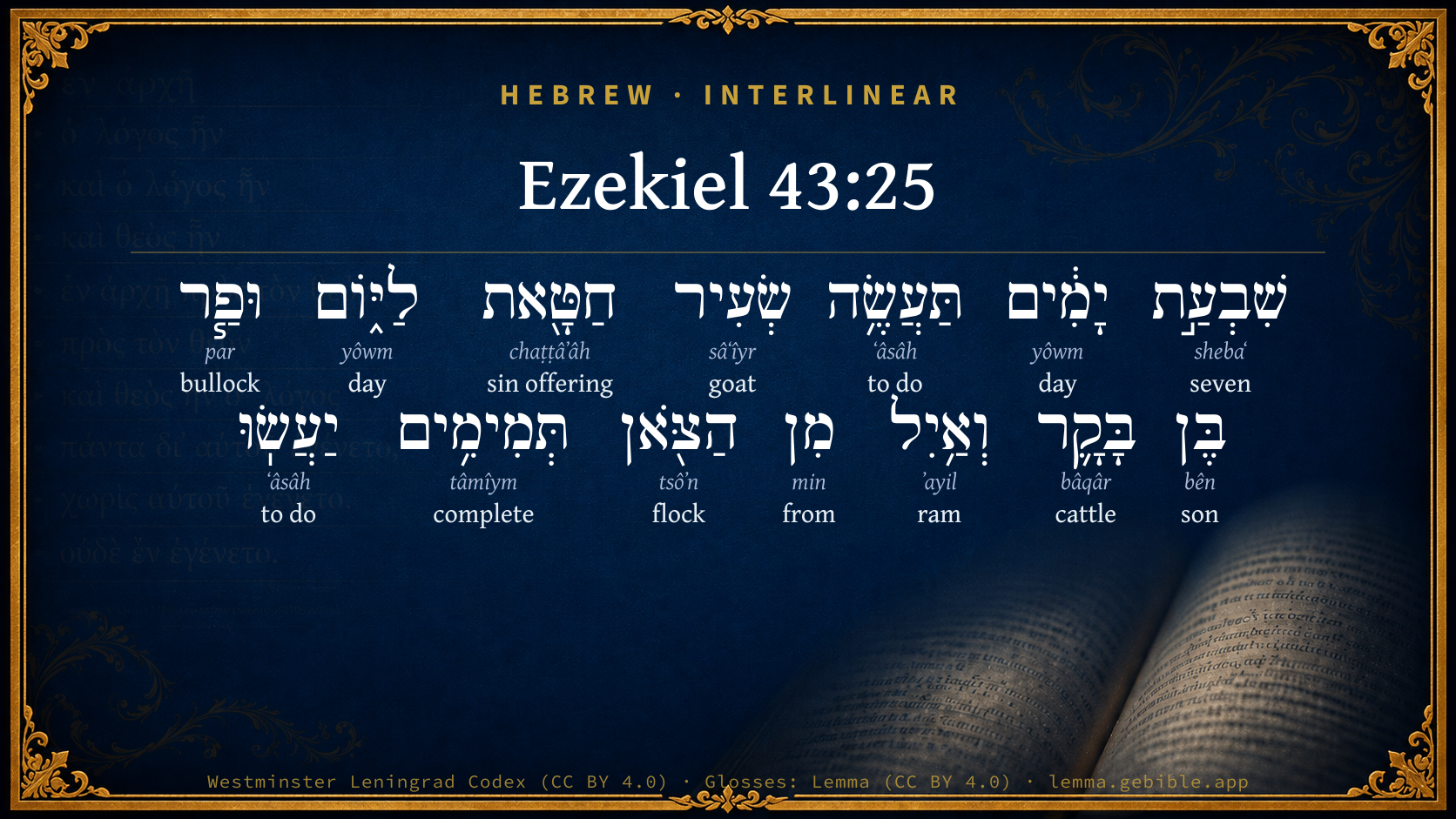
Hebrew (Westminster Leningrad Codex) Ezekiel 43:25 appears in the Hebrew Old Testament. The text above is from the Westminster Leningrad Codex. Each word links to its Strong’s number, a concise gloss, and parsing drawn from the Open Scriptures Hebrew Bible morphology. Click any word for its full Brown-Driver-Briggs (BDB) entry.
Download image
Cite this verse

Ezekiel 43:25 (World English Bible). Public Domain. Lemma interlinear Bible study tool, https://lemma.gebible.app/v/ezekiel/43/25.

Show BibTeX & RIS
BibTeX
RIS
English Translation
Seven days shall you prepare every day a goat for a sin-offering: they shall also prepare a young bull, and a ram out of the flock, without blemish.
World English Bible · Public Domain
Download a study sheet

One document with this verse’s original text, its word-by-word gloss line, the meaning frame, cross-references with their text, attributed commentary, and full source and license credits — printable, and it pastes into notes with its structure intact.

This verse Autodidact and up

Study sheet (.html) Plain text (.txt)

A passage Seminary Student

Up to 50 verses in one chapter. A passage sheet keeps up to 6 commentary sources and 12 cross-references per verse, in the order this page ranks them, and says so on the sheet whenever that leaves anything out. Ask for a single verse and you get the Autodidact verse sheet above.

Everything on this page stays free to read, with no account — the sheet is a download of what is already on screen, not access to it.

Want to remove ads? Support Godless Engineer
Compare translations 3

The same verse in 3 English versions, stacked beneath the original-language interlinear above. Click any original word for its lexicon entry.

Each is an independent rendering of the whole verse — the interlinear is not word-aligned to these translations.

Highlighted words mark where these versions differ — a whole-verse word diff, not a word-by-word alignment.

  • World English Bible Public Domain
    Seven days shall you prepare every day a goat for a sin-offering: they shall also prepare a young bull, and a ram out of the flock, without blemish.
  • King James Version Public Domain
    Seven days shalt thou prepare every day a goat for a sin offering: they shall also prepare a young bullock, and a ram out of the flock, without blemish.
  • unfoldingWord Literal Text CC BY-SA 4.0
    You must prepare a male goat as a sin offering daily for seven days, and the priests must also prepare an unblemished bull of the cattle and unblemished ram from the flock.

unfoldingWord Literal Text — © unfoldingWord, licensed CC BY-SA 4.0. Word-aligned USFM3 via Door43 (git.door43.org/unfoldingWord/en_ult).

Versions to compare (up to 4)

3 of 4 selected

Show all 18 translations

Every available English version of this verse, each an independent rendering of the whole verse.

  • World English Bible Public Domain
    Seven days shall you prepare every day a goat for a sin-offering: they shall also prepare a young bull, and a ram out of the flock, without blemish.
  • Berean Standard Bible Public Domain
    For seven days you are to provide a male goat daily for a sin offering; you are also to provide a young bull and a ram from the flock, both unblemished.
  • Majority Standard Bible Public Domain
    For seven days you are to provide a male goat daily for a sin offering; you are also to provide a young bull and a ram from the flock, both unblemished.
  • King James Version Public Domain
    Seven days shalt thou prepare every day a goat for a sin offering: they shall also prepare a young bullock, and a ram out of the flock, without blemish.
  • American Standard Version (1901) Public Domain
    Seven days shalt thou prepare every day a goat for a sin-offering: they shall also prepare a young bullock, and a ram out of the flock, without blemish.
  • Revised Version (1885) Public Domain
    Seven days shalt thou prepare every day a goat for a sin offering: they shall also prepare a young bullock, and a ram out of the flock, without blemish.
  • Geneva Bible (1599) Public Domain
    Seuen dayes shalt thou prepare euery day an hee goate for a sinne offring: they shall also prepare a yong bullocke and a ramme out of the flocke, without blemish.
  • Douay-Rheims (1899) Public Domain
    And thou shalt offer them in the sight of the Lord: and the priests shall put salt upon them, and shall offer them a holocaust to the Lord.
  • Young's Literal Translation Public Domain
    Seven days thou dost prepare a goat for a sin-offering daily, and a bullock, a son of the herd, and a ram out of the flock, perfect ones, do they prepare.
  • Literal Standard Version CC BY-SA 4.0
    [For] seven days you prepare a goat daily for a sin-offering; and they also prepare a bullock, a son of the herd, and a ram out of the flock—perfect ones.
  • Unlocked Literal Bible CC BY-SA 4.0
    You must prepare a male goat as a sin offering daily for seven days, and the priests must also prepare an unblemished bull of the cattle and unblemished ram from the flock.
  • unfoldingWord Literal Text CC BY-SA 4.0
    You must prepare a male goat as a sin offering daily for seven days, and the priests must also prepare an unblemished bull of the cattle and unblemished ram from the flock.
  • Darby Bible Public Domain
    Seven days shalt thou offer daily a goat for a sin-offering; they shall also offer a young bullock, and a ram out of the flock without blemish.
  • World Messianic Bible Public Domain
    “Seven days you shall prepare every day a goat for a sin offering. They shall also prepare a young bull and a ram out of the flock, without defect.
  • Webster's Bible Public Domain
    Seven days shalt thou prepare every day a goat for a sin-offering: they shall also prepare a young bullock, and a ram out of the flock, without blemish.
  • Free Bible Version CC BY-SA 4.0
    For seven days you are to supply a male goat daily for a sin offering. You are also to supply a young bull and a ram, they are both to have no defects.
  • Bible in Basic English Public Domain
    Every day for seven days you are to give a goat for a sin-offering: and let them give in addition a young ox and a male sheep from the flock without any mark on them.
  • JPS Tanakh (1917) Public Domain
    Seven days shalt thou prepare every day a goat for a sin-offering; they shall also prepare a young bullock, and a ram out of the flock, without blemish.

Literal Standard Version (2020), Covenant Press — licensed CC BY-SA 4.0. Text via the HelloAO Bible API (eBible.org). Unlocked Literal Bible (unfoldingWord) — licensed CC BY-SA 4.0. Text via the HelloAO Bible API (eBible.org). unfoldingWord Literal Text — © unfoldingWord, licensed CC BY-SA 4.0. Word-aligned USFM3 via Door43 (git.door43.org/unfoldingWord/en_ult). Free Bible Version, Dr. Jonathan Gallagher — licensed CC BY-SA 4.0. Text via the HelloAO Bible API (eBible.org).

Word by word

More ways to search: Search by grammar → Find every occurrence → Compare this word →

Practice this passage: Drill this verse → Learn its vocabulary →

שְׂעִיר
sâʻîyr
H8163
“goat of”
Noun, Common, Masculine, Singular, Construct
Part of Speech
Noun
Type
Common
Gender
Masculine
Number
Singular
State
Construct
Full BDB Definition

Origin: from H8175

TWOT: 2274c , 2274e

hairy (adjective) - he-goat, buck (noun masculine) - as sacrificial animal - satyr, may refer to a demon possessed goat like the swine of Gadara ( Mat 8:30-32 )
  1. שִׁבְעַ֣ת shebaʻ H7651 “seven” Adjective, Cardinal number, Masculine, Singular, Construct
  2. יָמִ֔ים yôwm H3117 “days” Noun, Common, Masculine, Plural, Absolute
  3. תַּעֲשֶׂ֥ה ʻâsâh H6213 “to do” Verb, Qal, Imperfect, 2nd Person, Masculine, Singular
  4. חַטָּ֖את chaṭṭâʼâh H2403 “sin offering” Noun, Common, Feminine, Singular, Absolute
  5. לַיּ֑וֹם yôwm H3117 “to/for the · day” Preposition, Determined + Noun, Common, Masculine, Singular, Absolute
  6. וּפַ֧ר par H6499 “and · bullock” Conjunction + Noun, Common, Masculine, Singular, Absolute
  7. בֶּן bên H1121 “son of” Noun, Common, Masculine, Singular, Construct
  8. בָּקָ֛ר bâqâr H1241 “cattle” Noun, Common, Both, Singular, Absolute
  9. וְאַ֥יִל ʼayil H352 “and · ram” Conjunction + Noun, Common, Masculine, Singular, Absolute
  10. מִן min H4480 “from” Preposition
  11. הַצֹּ֖אן tsôʼn H6629 “the · flock” Particle, Definite Article + Noun, Common, Both, Singular, Absolute
  12. תְּמִימִ֥ים tâmîym H8549 “complete” Adjective, Adjective, Masculine, Plural, Absolute
  13. יַעֲשֽׂוּ ʻâsâh H6213 “to do” Verb, Qal, Imperfect, 3rd Person, Masculine, Plural

About this verse

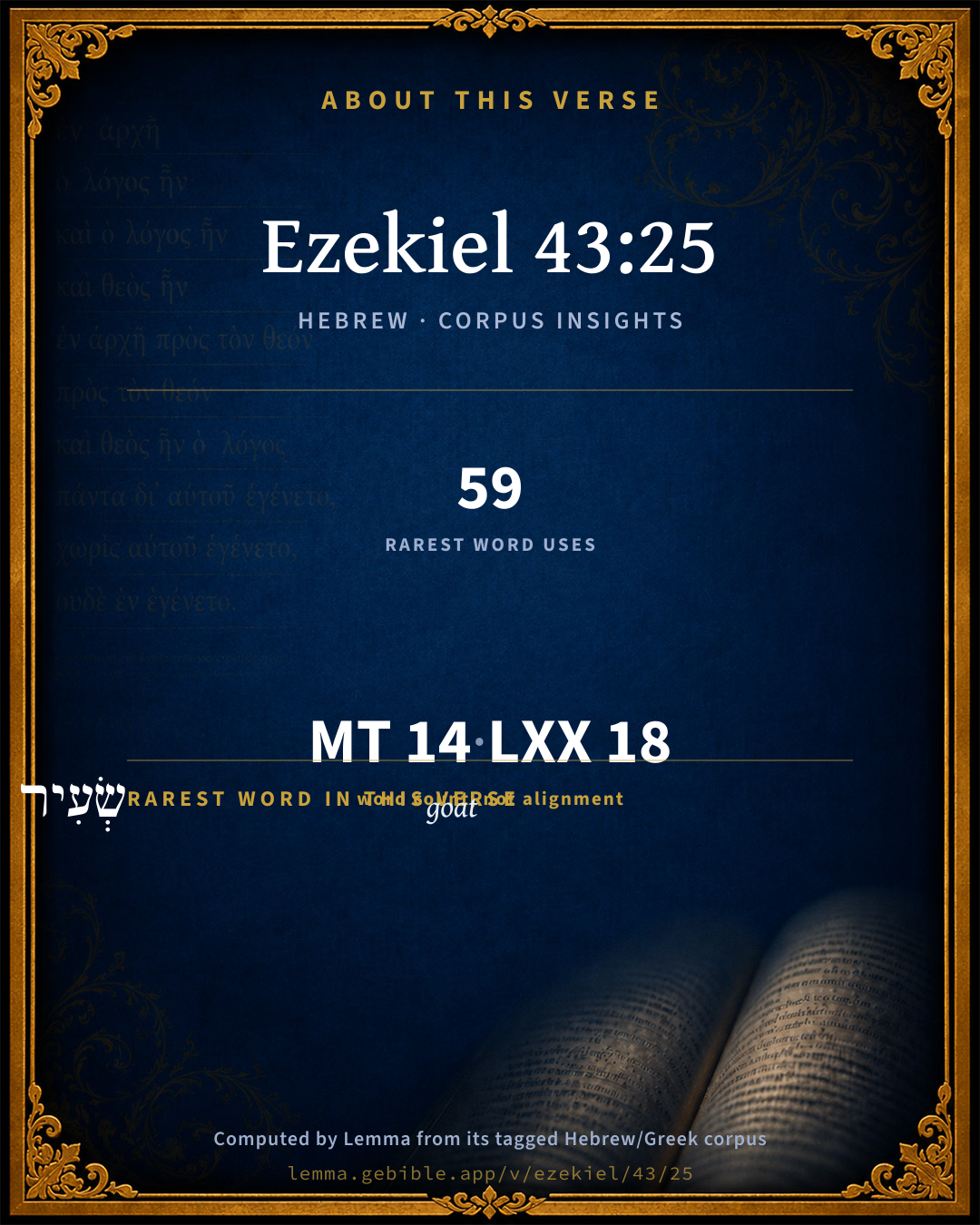
These counts appear in no published source. They are computed here, from the morphology-tagged text and Lemma’s own curated glosses. What Lemma adds →

14
words
12
distinct lemmas
Prophets
section

Shared distinctive vocabulary

שְׂעִיר goat H8163 occurs in 57 verses of the Hebrew Bible. Also found in:

Grammatical profile

  • 2 verbs
  • 9 nouns
  • 2 adjectives
  • 1 preposition

Verb forms

  • תַּעֲשֶׂ֥ה Qal · Imperfect
  • יַעֲשֽׂוּ Qal · Imperfect

Repetition

Words recur within this verse — often emphatic in Hebrew:

  • יָמִ֔ים day H3117 ×2
  • תַּעֲשֶׂ֥ה to do H6213 ×2

Hebrew & Septuagint length

In English translation the verse runs 28 words from the Hebrew and 32 from the Septuagint (LXX English) — closely comparable.

A rough comparison of the two English renderings, which tokenize alike — not a word-level alignment.

Word counts can differ between the Hebrew and the Greek without any difference in meaning — e.g. the Hebrew direct-object marker אֵת has no separate Greek word, and Greek often adds the article ὁ.

In the original languages it is 14 Hebrew tokens and 18 Greek tokens — but the two are counted differently (Hebrew bundles its prefixes and suffixes into one token; the Greek is in lemma form), so that isn’t a like-for-like length.

Cross-references

3

Topical passages linked to Ezekiel 43:25 in the Treasury of Scripture Knowledge — connected by theme and wording, ordered by reader-vote popularity; previews shown in the World English Bible.

  • Leviticus 8:33 You shall not go out from the door of the Tent of Meeting seven days, until the days of your consecration are fulfilled: for he shall consecrate you seven days.
  • Exodus 29:35–37 "Thus shall you do to Aaron, and to his sons, according to all that I have commanded you. Seven days shall you consecrate them.
  • Leviticus 8:35 At the door of the Tent of Meeting you shall stay day and night seven days, and keep the charge of Yahweh, that you don't die: for so I am commanded."

Cross-references courtesy of OpenBible.info (CC BY 4.0).

Hebrew and Greek witnesses Masoretic Hebrew ↔ Greek Septuagint

The same verse in the two great witnesses to the Old Testament, shown verse-for-verse.

These are two independent witnesses, not word-aligned to each other, and the Septuagint is shown in lemma (dictionary) form.

Hebrew Ezekiel 43:25 Masoretic · Westminster Leningrad Codex

שִׁבְעַ֣ת יָמִ֔ים תַּעֲשֶׂ֥ה שְׂעִיר חַטָּ֖את לַיּ֑וֹם וּפַ֧ר בֶּן בָּקָ֛ר וְאַ֥יִל מִן הַצֹּ֖אן תְּמִימִ֥ים יַעֲשֽׂוּ

Seven days shall you prepare every day a goat for a sin-offering: they shall also prepare a young bull, and a ram out of the flock, without blemish.

World English Bible · Public Domain

Greek LXX Ezekiel 43:25 Septuagint · lemma form

ἑπτά ἡμέρα ποιέω ἔριφος ὑπέρ ἁμαρτία κατά ἡμέρα καί μόσχος ἐκ βοῦς καί κριός ἐκ πρόβατον ἄμωμος ποιέω

Seven days shall you offer a kid daily for a sin-offering, and a calf of the herd, and a ram out of the flock: they shall sacrifice them unblemished for seven days:

LXX2012 (modern English Septuagint) · Public Domain

Hebrew: Westminster Leningrad Codex (CC BY 4.0). Greek: Septuagint (public domain); English from LXX2012 (modern English Septuagint) (Public Domain). How the Septuagint differs from the Hebrew →

Targum (Aramaic paraphrase)

1

The Targum is the ancient Jewish Aramaic paraphrase of the Hebrew Scriptures — an interpretive translation, not the Hebrew text itself. Onkelos (literal) and Pseudo-Jonathan (expansive) render the Torah, and Jonathan the Prophets. Coverage is partial: where no permissively-licensed English translation exists for a verse, only the Aramaic is shown. This is verse-level text, not a word-by-word alignment to the Hebrew.

  1. Targum Jonathan Prophets (Joshua–Malachi)
    שַׁבְעָא יוֹמִין תַּעֲבֵּיד צְפִירָא דְחַטָאתָא לְיוֹמָא וְתוֹר בַּר תּוֹרֵי וּדִכַר מִן עָנָא שְׁלֵימִין יַעַבְדוּן:

    (no public-domain English translation for this verse)

    Targum Jonathan — Aramaic: “Mikraot Gedolot” (public domain). English: “Sefaria Community Translation” (CC0 1.0 (public-domain dedication)); “London "Chaldee Paraphrase," 1871” (public domain). Text via Sefaria.

Commentary

Notes on Ezekiel 43:25 from classic Christian and Jewish commentators (each source and its license shown beneath its notes). The classic Christian expositions comment on the surrounding passage and are grouped to its opening verse, so a note may address several verses; the Jewish commentaries on the Tanakh (Rashi and others) are per-verse, so they appear only where the commentator wrote on this verse.

Lemma curates 59 commentaries, every one of them public domain or Creative Commons licensed, each selected and text-cleaned for this edition rather than reprinted as found. About our sources →

Trapp's Complete Commentary

John Trapp

Eze 43:25 Seven days shalt thou prepare every day a goat [for] a sin offering: they shall also prepare a young bullock, and a ram out of the flock, without blemish.

Ver. 25. Every day a goat.] Mortification must be a Christian’s daily practice.

John Trapp, A Commentary or Exposition upon All the Books of the Old and New Testament (1647–1656) — public domain. Text from a community e-Sword module.

Tyndale Open Study Notes

Tyndale Open Resources

43:25 The procedure for the second day was repeated for seven more days to complete the eight-day purification cycle. A similar procedure was followed when Solomon’s Temple was consecrated (2 Chr 7:8-9).

Tyndale Open Study Notes — © Tyndale Open Resources, licensed CC BY-SA 4.0. Text via the HelloAO Bible API.

Adam Clarke's Commentary

Verse 25. Seven days shalt thou prepare] These are, in general, ordinances of the LAW; and may be seen by consulting the parallel passages. All these directions are given that they might follow them, when they should be put in possession of their own land. For in several cases the prophet enters into particulars, as if he had supposed that the book of the law had perished.

Adam Clarke's Commentary on the Bible (1810–1826) — public domain. Text from a community e-Sword/MySword module.

The Cambridge Bible for Schools and Colleges

gen. ed. J. J. S. Perowne

25. The statement is somewhat general; strictly the he-goat was offered only on six days (Eze_43:19), but the burnt-offering was the same all the seven.

The Cambridge Bible for Schools and Colleges (gen. ed. J. J. S. Perowne; Cambridge University Press, 1878–1918) — public domain. Text from a community e-Sword module.

John Gill's Exposition

Seven days shalt thou prepare every day a goat for a sin offering,.... By this it appears that the altar was seven days a consecrating and cleansing; and that on each day a goat was prepared and offered, typical of Christ, as before observed. Here Kimchi owns that this was not according to the order of Moses, or was done by those that came out of the captivity of Babylon; and is obliged to confess that there will be a change or an innovation in the order of sacrifices in time to come, or under the Messiah.

They shall also prepare a young bullock, and a ram out of the flock without blemish; which, either one or all of them, should be offered up on each of the seven days; See Gill on Eze 43:23.

John Gill's Exposition of the Whole Bible (1746–1763) — public domain (CC PDM 1.0). Text via the HelloAO Bible API.

Matthew Poole's English Annotations

By this it appears that there were seven days appointed for consecrating altar and priests, and that either these three sacrifices were every day of the seven offered up, and their blood sprinkled on the altar, or at least the young bullock every day, and one goat or one ram with it: the word here is copulative, but possibly the sense disjunctive, for so this particle is often used.

Matthew Poole's English Annotations on the Holy Bible (1683–1685) — public domain. Text from a community e-Sword/MySword module.

The Pulpit Commentary

Seven days. Hitzig reckons these as additional to the first (ver. 19) and second (ver. 22) days; Kliefoth begins them with the second; Keil, Schroder, Currey, and the majority of expositors take them as inclusive of the first and second. Hitzig"s proposal may be set aside, since it cannot be maintained without erasing "thou shalt make atonement for it" in ver. 20, and the first half of the present verse. In favor of Kliefoth"s view may be urged that the first day appears to stand out from the others, "and to be distinguished by the peculiar character of its offering a young bullock for a sin offering, without any accompanying burnt offering; that the offerings on the second and subsequent days are alike, a he-goat and a ram; that on each of the seven days a goat is mentioned for a sin offering, whereas on the first day it was a young bullock that was slain; and that in Zec_3:9 occurs an allusion to what seems a special day such as this first day of Ezekiel. In support of Keil"s interpretation it is contended that the seven days were to be employed in purging or making atonement for, and purifying the altar, which was in part at least (even admitting a distinction in meaning between aFj and rh the business of the first day; that the general statement in ver. 20 as to a goat for a sin offering on the seven days admits of easy qualification by the previous statement in ver. 19; and that seven days was the normal duration of religious solemnities under the Law. (see Lev_8:33; 1Ki_8:65; 2Ch_7:8, 2Ch_7:9)

The Pulpit Commentary (1880–1919), ed. H.D.M. Spence-Jones & Joseph S. Exell — public domain. Text from a community e-Sword module.

unfoldingWord translationNotes

Door43 World Missions Community

You must prepare

This is spoken to Ezekiel and so the word "You" is singular. See how you translated this in Ezekiel 43:19. (See: Pronouns and Forms of You)

it will come about that

This phrase is used here to mark an important part of the instructions. If your language has a way for doing this, you could consider using it here.

your burnt offerings ... your peace offerings ... accept you

The words "your" and "you" are second person plural and refer to the people of Israel in general. (See: Pronouns and Forms of You)

will accept you

"will gladly receive you"

translationWords

atonement

pure

consecrate

priest

burnt offering

peace offering

Lord Yahweh

unfoldingWord translationNotes — © Distant Shores Media and the Door43 World Missions Community, licensed CC BY-SA 4.0. Source: git.door43.org/Door43/en_tn.

Rashi

Rabbi Shlomo Yitzchaki (Rashi)

without blemish shall they make (the burnt offering).

Rashi on the Tanakh — English translations: “The Judaica Press complete Tanach with Rashi, translated by A. J. Rosenberg” (CC BY 4.0); “Pentateuch with Rashi's commentary by M. Rosenbaum and A.M. Silbermann, 1929-1934” (public domain); “The Metsudah Tanach series, Lakewood, N.J” (CC BY 4.0); and “The Book of Joshua, Metsudah Publications, 1997” (CC BY 4.0). Text via Sefaria.

Lesson kit

Teaching starters — assembled from the data on this page, not authored interpretation. Every prompt links to the verse data it draws on. Edit before teaching.

Ezekiel, in the Prophets, opens this verse with 14 words (12 distinct Hebrew lemmas). Its most distinctive word is sâʻîyr (“goat”). A historical commentator’s framing appears above. Read the whole chapter for the surrounding context.

Discussion questions

  1. The word sâʻîyr carries the sense “goat.” How does it shape the verse?
  2. How does Genesis 27:11, which shares the word «goat», read alongside this verse?
  3. What does the repetition of “day” (2× in this one verse) do in this verse?
  4. The translations on this page render this verse differently — a whole-verse word diff, not a word-by-word alignment. What might account for the different wordings?
  5. «תַּעֲשֶׂ֥ה» is a Qal Imperfect verb. How does that grammatical form shape the action described?
  6. Compare how Trapp's Complete Commentary and Tyndale Open Study Notes read this verse. Where do they agree or differ?

Things to notice

Reading settings

Reading text

Shown beneath each verse's original-language words.

Old Testament
Old Testament edition

Read the OT as the Masoretic Hebrew (MT) or the Greek Septuagint (LXX).

English shown for the Greek Septuagint (in the Hebrew ↔ Greek comparison).

Comparing translations? Open the Compare panel on any verse page to stack up to four side by side.