Joel 1:18

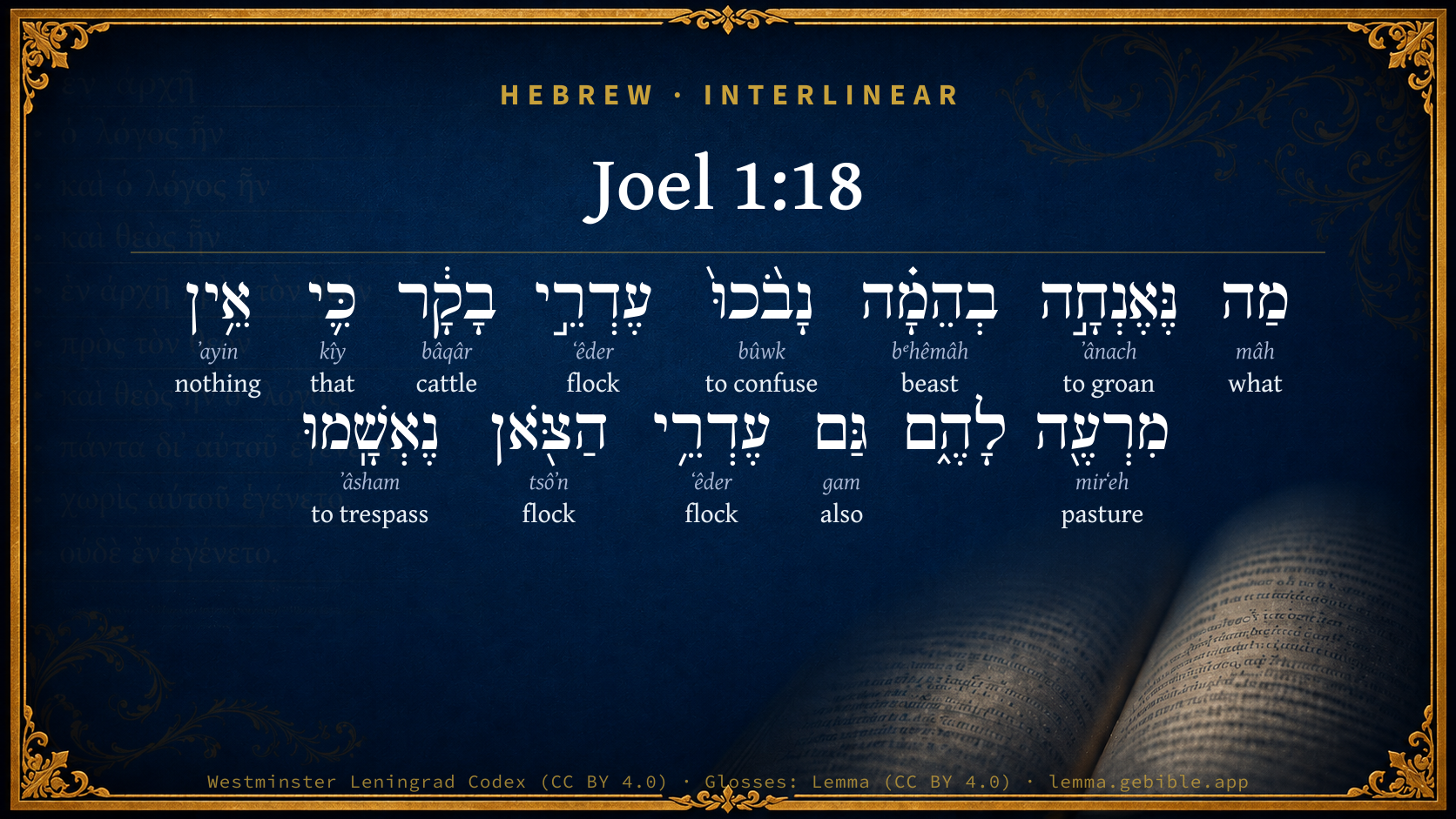
Hebrew (Westminster Leningrad Codex) Joel 1:18 appears in the Hebrew Old Testament. The text above is from the Westminster Leningrad Codex. Each word links to its Strong’s number, a concise gloss, and parsing drawn from the Open Scriptures Hebrew Bible morphology. Click any word for its full Brown-Driver-Briggs (BDB) entry.
Download image
Cite this verse

Joel 1:18 (World English Bible). Public Domain. Lemma interlinear Bible study tool, https://lemma.gebible.app/v/joel/1/18.

Show BibTeX & RIS
BibTeX
RIS
English Translation
How the animals groan! The herds of cattle are perplexed, because they have no pasture. Yes, the flocks of sheep are made desolate.
World English Bible · Public Domain
Download a study sheet

One document with this verse’s original text, its word-by-word gloss line, the meaning frame, cross-references with their text, attributed commentary, and full source and license credits — printable, and it pastes into notes with its structure intact.

This verse Autodidact and up

Study sheet (.html) Plain text (.txt)

A passage Seminary Student

Up to 50 verses in one chapter. A passage sheet keeps up to 6 commentary sources and 12 cross-references per verse, in the order this page ranks them, and says so on the sheet whenever that leaves anything out. Ask for a single verse and you get the Autodidact verse sheet above.

Everything on this page stays free to read, with no account — the sheet is a download of what is already on screen, not access to it.

Want to remove ads? Support Godless Engineer
Compare translations 3

The same verse in 3 English versions, stacked beneath the original-language interlinear above. Click any original word for its lexicon entry.

Each is an independent rendering of the whole verse — the interlinear is not word-aligned to these translations.

Highlighted words mark where these versions differ — a whole-verse word diff, not a word-by-word alignment.

  • World English Bible Public Domain
    How the animals groan! The herds of cattle are perplexed, because they have no pasture. Yes, the flocks of sheep are made desolate.
  • King James Version Public Domain
    How do the beasts groan! the herds of cattle are perplexed, because they have no pasture; yea, the flocks of sheep are made desolate.
  • unfoldingWord Literal Text CC BY-SA 4.0
    How the beast groans! The herds of cattle are perplexed, for no pasture to them. Also the flocks of sheep are punished.

unfoldingWord Literal Text — © unfoldingWord, licensed CC BY-SA 4.0. Word-aligned USFM3 via Door43 (git.door43.org/unfoldingWord/en_ult).

Versions to compare (up to 4)

3 of 4 selected

Show all 18 translations

Every available English version of this verse, each an independent rendering of the whole verse.

  • World English Bible Public Domain
    How the animals groan! The herds of cattle are perplexed, because they have no pasture. Yes, the flocks of sheep are made desolate.
  • Berean Standard Bible Public Domain
    How the cattle groan! The herds wander in confusion because they have no pasture. Even the flocks of sheep are suffering.
  • Majority Standard Bible Public Domain
    How the cattle groan! The herds wander in confusion because they have no pasture. Even the flocks of sheep are suffering.
  • King James Version Public Domain
    How do the beasts groan! the herds of cattle are perplexed, because they have no pasture; yea, the flocks of sheep are made desolate.
  • American Standard Version (1901) Public Domain
    How do the beasts groan! the herds of cattle are perplexed, because they have no pasture; yea, the flocks of sheep are made desolate.
  • Revised Version (1885) Public Domain
    How do the beasts groan! the herds of cattle are perplexed, because they have no pasture; yea, the flocks of sheep are made desolate.
  • Geneva Bible (1599) Public Domain
    How did the beasts mourne! the herdes of cattel pine away, because they haue no pasture, and the flockes of sheepe are destroyed.
  • Douay-Rheims (1899) Public Domain
    Why did the beast groan, why did the herds of cattle low? because there is no pasture for them: yea, and the flocks of sheep are perished.
  • Young's Literal Translation Public Domain
    How have cattle sighed! Perplexed have been droves of oxen, For there is no pasture for them, Also droves of sheep have been desolated.
  • Literal Standard Version CC BY-SA 4.0
    How livestock have sighed! Perplexed have been droves of oxen, || For there is no pasture for them, || Also droves of sheep have been desolated.
  • Unlocked Literal Bible CC BY-SA 4.0
    How the animals groan! The herds of cattle are suffering because they have no pasture. Also, the flocks of sheep suffer.
  • unfoldingWord Literal Text CC BY-SA 4.0
    How the beast groans! The herds of cattle are perplexed, for no pasture to them. Also the flocks of sheep are punished.
  • Darby Bible Public Domain
    How do the beasts groan! The herds of cattle are bewildered, for they have no pasture; the flocks of sheep also are in suffering.
  • World Messianic Bible Public Domain
    How the animals groan! The herds of livestock are perplexed, because they have no pasture. Yes, the flocks of sheep are made desolate.
  • Webster's Bible Public Domain
    How do the beasts groan! the herds of cattle are perplexed, because they have no pasture; yes, the flocks of sheep are made desolate.
  • Free Bible Version CC BY-SA 4.0
    The farm animals moan with hunger. The herds of cattle wander everywhere because they can't find grass to eat; the flocks of sheep are suffering.
  • Bible in Basic English Public Domain
    What sounds of pain come from the beasts! the herds of cattle are at a loss because there is no grass for them; even the flocks of sheep are no longer to be seen.
  • JPS Tanakh (1917) Public Domain
    How do the beasts groan! the herds of cattle are perplexed, because they have no pasture; yea, the flocks of sheep are made desolate.

Literal Standard Version (2020), Covenant Press — licensed CC BY-SA 4.0. Text via the HelloAO Bible API (eBible.org). Unlocked Literal Bible (unfoldingWord) — licensed CC BY-SA 4.0. Text via the HelloAO Bible API (eBible.org). unfoldingWord Literal Text — © unfoldingWord, licensed CC BY-SA 4.0. Word-aligned USFM3 via Door43 (git.door43.org/unfoldingWord/en_ult). Free Bible Version, Dr. Jonathan Gallagher — licensed CC BY-SA 4.0. Text via the HelloAO Bible API (eBible.org).

Word by word

More ways to search: Search by grammar → Find every occurrence → Compare this word →

Practice this passage: Drill this verse → Learn its vocabulary →

נָבֹ֨כוּ֙
bûwk
H943
“to confuse”
Verb, Niphal, Perfect, 3rd Person, Common, Plural
Part of Speech
Verb
Stem
Niphal
Form
Perfect
Person
3rd Person
Gender
Common
Number
Plural
Full BDB Definition

Origin: a primitive root

TWOT: 214

to perplex, confuse, be confused - (Niphal) to be confused, be in confusion
  1. מַה mâh H4100 “what” Particle, Interrogative
  2. נֶּאֶנְחָ֣ה ʼânach H584 “to groan” Verb, Niphal, Perfect, 3rd Person, Feminine, Singular
  3. בְהֵמָ֗ה bᵉhêmâh H929 “beast” Noun, Common, Feminine, Singular, Absolute
  4. עֶדְרֵ֣י ʻêder H5739 “flocks of” Noun, Common, Masculine, Plural, Construct
  5. בָקָ֔ר bâqâr H1241 “cattle” Noun, Common, Both, Singular, Absolute
  6. כִּ֛י kîy H3588 “that” Conjunction
  7. אֵ֥ין ʼayin H369 “nothing” Particle, Negative
  8. מִרְעֶ֖ה mirʻeh H4829 “pasture” Noun, Common, Masculine, Singular, Absolute
  9. גַּם gam H1571 “also” Particle, Accusative
  10. עֶדְרֵ֥י ʻêder H5739 “flocks of” Noun, Common, Masculine, Plural, Construct
  11. הַצֹּ֖אן tsôʼn H6629 “the · flock” Particle, Definite Article + Noun, Common, Both, Singular, Absolute
  12. נֶאְשָֽׁמוּ ʼâsham H816 “to trespass” Verb, Niphal, Perfect, 3rd Person, Common, Plural

About this verse

These counts appear in no published source. They are computed here, from the morphology-tagged text and Lemma’s own curated glosses. What Lemma adds →

14
words
12
distinct lemmas
Prophets
section

Notable vocabulary

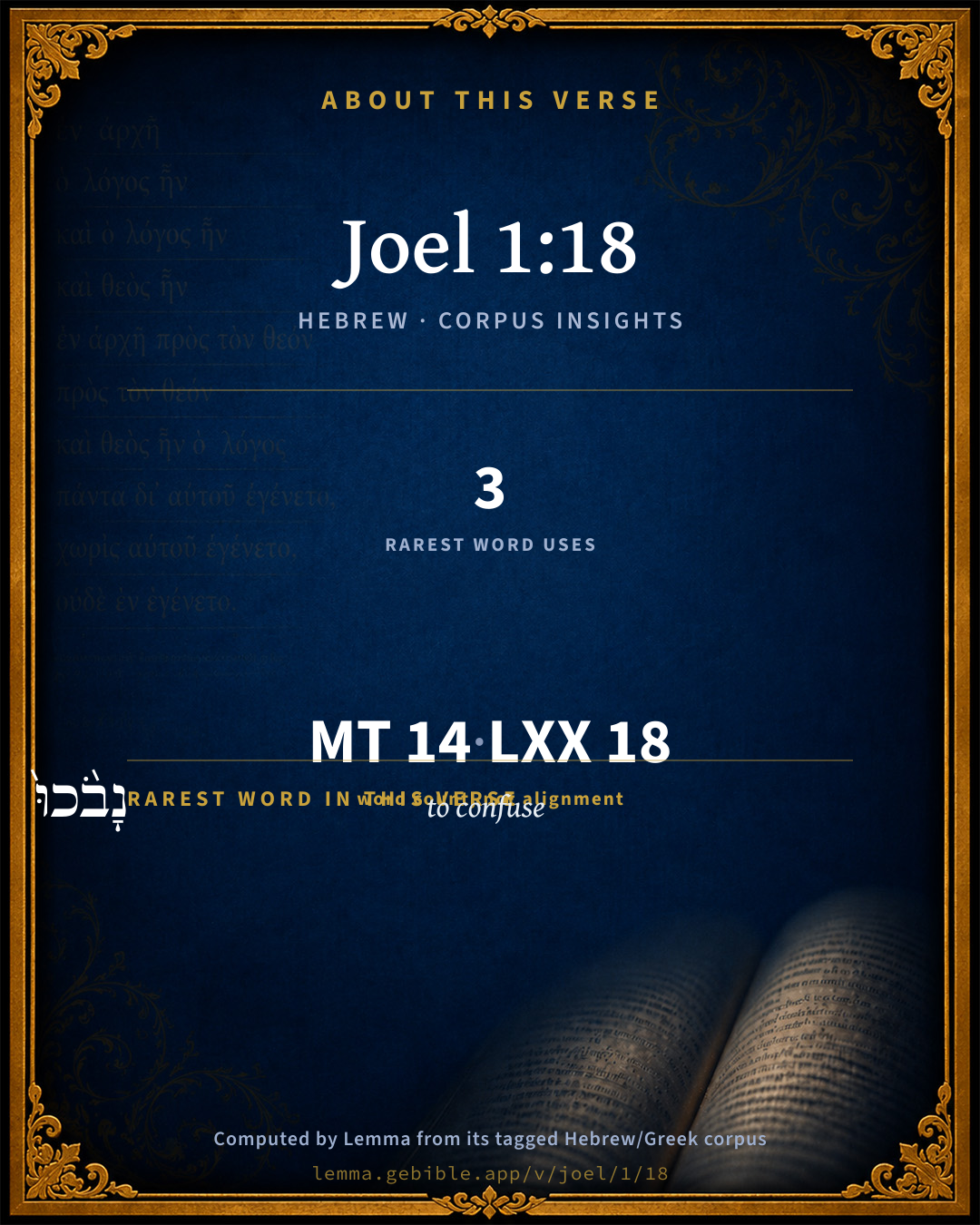
The rarest word here is נָבֹ֨כוּ֙ to confuse H943 — appearing just 3 times in the whole Hebrew Bible.

Shared distinctive vocabulary

נָבֹ֨כוּ֙ to confuse H943 occurs in 3 verses of the Hebrew Bible. Also found in:

Grammatical profile

  • 3 verbs
  • 6 nouns
  • 1 preposition
  • 1 conjunction
  • 3 particles

Verb forms

  • נֶּאֶנְחָ֣ה Niphal · Perfect
  • נָבֹ֨כוּ֙ Niphal · Perfect
  • נֶאְשָֽׁמוּ Niphal · Perfect

Repetition

A word recurs within this verse — often emphatic in Hebrew:

  • עֶדְרֵ֣י flock H5739 ×2

Hebrew & Septuagint length

In English translation the verse runs 23 words from the Hebrew and 27 from the Septuagint (LXX English) — closely comparable.

A rough comparison of the two English renderings, which tokenize alike — not a word-level alignment.

Word counts can differ between the Hebrew and the Greek without any difference in meaning — e.g. the Hebrew direct-object marker אֵת has no separate Greek word, and Greek often adds the article ὁ.

In the original languages it is 14 Hebrew tokens and 18 Greek tokens — but the two are counted differently (Hebrew bundles its prefixes and suffixes into one token; the Greek is in lemma form), so that isn’t a like-for-like length.

Cross-references

6

Topical passages linked to Joel 1:18 in the Treasury of Scripture Knowledge — connected by theme and wording, ordered by reader-vote popularity; previews shown in the World English Bible.

  • Jeremiah 12:4 How long shall the land mourn, and the herbs of the whole country wither? for the wickedness of those who dwell therein, the animals are consumed, and the birds; because they said, He shall not see our latter end.
  • Hosea 4:3 Therefore the land will mourn, And everyone who dwells therein will waste away. All living things in her, Even the animals of the field and the birds of the sky; Yes, the fish of the sea also die.
  • Jeremiah 14:5–6 Yes, the hind also in the field calves, and forsakes [her young], because there is no grass.
  • 1 Kings 18:5 Ahab said to Obadiah, Go through the land, to all the springs of water, and to all the brooks: peradventure we may find grass and save the horses and mules alive, that we not lose all the animals.
  • Joel 1:20 Yes, the animals of the field pant to you, For the water brooks have dried up, And the fire has devoured the pastures of the wilderness.
  • Romans 8:22 For we know that the whole creation groans and travails in pain together until now.

Cross-references courtesy of OpenBible.info (CC BY 4.0).

Hebrew and Greek witnesses Masoretic Hebrew ↔ Greek Septuagint

The same verse in the two great witnesses to the Old Testament, shown verse-for-verse.

These are two independent witnesses, not word-aligned to each other, and the Septuagint is shown in lemma (dictionary) form.

Hebrew Joel 1:18 Masoretic · Westminster Leningrad Codex

מַה נֶּאֶנְחָ֣ה בְהֵמָ֗ה נָבֹ֨כוּ֙ עֶדְרֵ֣י בָקָ֔ר כִּ֛י אֵ֥ין מִרְעֶ֖ה לָהֶ֑ם גַּם עֶדְרֵ֥י הַצֹּ֖אן נֶאְשָֽׁמוּ

How the animals groan! The herds of cattle are perplexed, because they have no pasture. Yes, the flocks of sheep are made desolate.

World English Bible · Public Domain

Greek LXX Joel 1:18 Septuagint · lemma form

τίς ἀποτίθημι ἑαυτοῦ κλαίω βουκόλιον βοῦς ὅτι οὐ ὑποἄρχω νομή αὐτός καί ὁ ποίμνιον ὁ πρόβατον ἀπο ἀναἵζω

What shall we store up for ourselves? the herds of cattle have mourned, because they had no pasture; and the flocks of sheep have been utterly destroyed.

LXX2012 (modern English Septuagint) · Public Domain

On this verse, Whedon's Commentary on the Bible discusses the Septuagint’s reading. Read the note in Commentary ↓

Hebrew: Westminster Leningrad Codex (CC BY 4.0). Greek: Septuagint (public domain); English from LXX2012 (modern English Septuagint) (Public Domain). How the Septuagint differs from the Hebrew →

Targum (Aramaic paraphrase)

1

The Targum is the ancient Jewish Aramaic paraphrase of the Hebrew Scriptures — an interpretive translation, not the Hebrew text itself. Onkelos (literal) and Pseudo-Jonathan (expansive) render the Torah, and Jonathan the Prophets. Coverage is partial: where no permissively-licensed English translation exists for a verse, only the Aramaic is shown. This is verse-level text, not a word-by-word alignment to the Hebrew.

  1. Targum Jonathan Prophets (Joshua–Malachi)
    לַחֲדָא מִתְאַנְחָא בְעִירָא מִתְעַרְבְּלָן בְּקָרַן דְתוֹרִין אֲרֵי לֵית רָעַיָא לְהוֹן אַף עֶדְרֵי עֲנָא צְדִיאָה:

    (no public-domain English translation for this verse)

    Targum Jonathan — Aramaic: “Mikraot Gedolot” (public domain). English: “Sefaria Community Translation” (CC0 1.0 (public-domain dedication)); “London "Chaldee Paraphrase," 1871” (public domain). Text via Sefaria.

Commentary

Notes on Joel 1:18 from classic Christian and Jewish commentators (each source and its license shown beneath its notes). The classic Christian expositions comment on the surrounding passage and are grouped to its opening verse, so a note may address several verses; the Jewish commentaries on the Tanakh (Rashi and others) are per-verse, so they appear only where the commentator wrote on this verse.

Lemma curates 59 commentaries, every one of them public domain or Creative Commons licensed, each selected and text-cleaned for this edition rather than reprinted as found. About our sources →

Trapp's Complete Commentary

John Trapp

Joe 1:18 How do the beasts groan! the herds of cattle are perplexed, because they have no pasture; yea, the flocks of sheep are made desolate.

Ver. 18. How do the beasts groan] The wild beasts groan in their kind.

The herds of cattle] Home and tame beasts, as oxen,

&c., are perplexed] as not knowing what to do; it is the same word with that, Est 3:15. God had "hid his face" (withdrawn his hand), "and they were troubled; he taketh away their breath" (for lack of pasture), "they die and return to their dust," as David telleth us in his psalm, Psa 104:29. Epiphanius’s physiologer reporteth of the bird called Charadius, that being brought where a sick man lieth, if he look upon the sick with a fixed and unremoved eye there is hopes of recovery, but if he look another way the disease is deadly. Sure it is, that if God look in mercy upon man and beast they are cared and catered for, Psa 36:7; Psa 104:27; Psa 145:15-16, &c. and the contrary. Yea, the flocks of sheep, &c., which yet can bite upon the bare, live with a little, and get pasture where the larger creatures cannot come.

John Trapp, A Commentary or Exposition upon All the Books of the Old and New Testament (1647–1656) — public domain. Text from a community e-Sword module.

The Biblical Illustrator

Joseph S. Exell

Joe_1:16; Joe_1:18

Is not the meat cut off before our eyes.

Sin a great deprivation

I. That sin deprives man of his cherished hope. Is not the meat cut off before our eyes?

1. This deprivation was unexpected. The ripe crops were seen by the people of Judah, who were rejoicing in the prospect of a safe harvest, when to their astonishment all was destroyed. And sin deprives sinners of their expected pleasures just when they are within sure reach, and turns in an unexpected moment the fairest prospects into barren wastes, it is the way of God to disappoint the evil-doer of his cherished anticipations.

2. This deprivation was calamitous. The people of Judah were dependent upon the ripe crops for the supply of their temporal wants, and would not be able to provide anything as a substitute for them. And sin does not merely deprive man of those things which are for his luxury, but even those things which are essential to his bare comfort.

3. This deprivation was righteous. The people of Judah might imagine that it was very unjust thus to deprive them of the harvest for which they had laboured, and that too at the very moment they were expecting to gather it in for use. They would be unable to understand the equity and meaning of such a visitation. But it is a righteous thing that sin should be punished, and in the manner most likely to restrain it, and this is often done by the destruction of a cherished hope.

II. That sin deprives the sanctuary of its appropriate joy. Is not the meat cut off before our eyes, yea, joy and gladness from the house of our Lord?

1. That joy should ever be associated with the service of the sanctuary. Joy and gladness always belonged to the ancient temple; thither the Jews went to give thanks, and to acknowledge themselves the blessed of the Lord. But now they could not rejoice in the presence of God, because of the calamities which were upon them.

2. That sin deprives the sanctuary of the joy which should ever be associated with it. The sins of the people of Judah rendered it impossible for them to participate in their usual harvest festivals, and divested the Divine presence of its accustomed joy. And sin will extinguish the bright lights of the sanctuary; it will hush its sweet music, and stay the spring of joy which God has destined should flow from the temple into human souls.

III. That sin deprives the seed of its necessary vitality. The seed is rotten under the clods, the garners are laid desolate, the barns are broken down; for the corn is withered. Thus we see that sin perverts the natural order of Gods universe, it renders the seed which is full of life destitute of all vitality. The seed is precious; mans sin makes it useless. God can plague mans mercies in the germ or in the barn, it is impossible to escape His retribution.

IV. That sin deprives the brute of its refreshing pasture. How do the beasts groan! the herds of cattle are perplexed, because they have no pasture, yea, the flocks of sheep are made desolate. All the life and interests of the universe arc one, and one part of it cannot suffer without involving the rest; hence the sin of man affects the whole. Lessons--

1. That men who imagine that they gain anything by sin are deceived.

2. That sin divests the most sacred places of their destined gladness.

3. That sin brings famine where God intended there should be plenty. (J. S. Exell, M. A.)

The seed is rotten under their clods.

National calamities

The Supreme Ruler of the world is righteous and beneficent. What, then, is the cause of national calamities? It is sin.

I. Some of the prevailing sins which have brought us into our present situation. The vices which, on account of their enormity and uncommon spread, may be considered as, in a certain degree, peculiar to the present age.

1. Ingratitude. No nation ever experienced more of the kindness of heaven. Our climate is desirable; our minerals are varied and abundant; our situation favours our independence; our form of government is just and efficient. Internal peace is a blessing we have long enjoyed, Has our gratitude increased in proportion as our blessings have been multiplied? Consider, too, our religious privileges. What returns have we made to God for these mercies?

2. Pride. This has been called the universal passion. It is by no means peculiar to our country and times. Yet it may be called one of the peculiar sins of our age. Would to God that pride were confined to the State! Alas! its ravages have extended to the Church.

3. Infidelity has of late been greatly increasing. There is public avowed scepticism, by which revelation in general is censured and rejected.

4. Luxury and licentiousness of manners prevail to a most alarming degree. Was there ever a period, not excepting the age of the second Charles, when profanity, intemperance, seduction, and other vices were so common? Lewdness and intemperance are not confined to the more wealthy. Our prosperity, it may be said, is the cause of all these disorders. But shall we dare to palliate our vices by that which aggravates them in an inconceivable degree?

5. The prevailing influence of a worldly spirit.

6. The spirit of irreligion. As seen in the practice of profane swearing, in the omission of family duties, and in the neglect of Divinely instituted ordinances.

II. The means of deliverance. Consider those important duties without which there is neither safety nor hope.

1. We must return to God in the exercise of faith.

2. The review of our sins ought to fill us with grief.

3. Our faith and contrition must be accompanied with a universal reformation of our hearts and conduct. Exercise faith in God. Present to Him the sacrifices of a broken spirit. Be concerned to mortify the whole body of sin. These are duties beyond the strength of fallen humanity. The Spirit alone can enable us to perform them. To Unwearied diligence let us add fervent supplication to the God of our Lord Jesus Christ, that He would have mercy upon us, and cause His Spirit to descend as a spirit of faith, of contrition, and of holiness. (Alex. Black.)

Potting seeds

This is the first new stroke of pathos which the poet adds to his previous description; but mark how he multiplies stroke on stroke. As though it were not enough to lose all mirth in the passing day, the heart of the people is torn with apprehension for the future. The very grain in the earth has rotted under the clods, so that there is no prospect of a crop in the coming year to compensate for the loss of this years harvest. Smitten by the burning rays of the sun, denied the vivifying touch of dew or rain, the germ has withered in the seed. The husbandmen, hopeless of any reward for their toils, fold their hands in indolent despair; they suffer their garners to moulder away, their barns to fall. Why should they repair barn and storehouse when the corn is withered, even the seed-corn? (Samel Cox, D. D.)

Gods voice in things terrible

How does God utter His voice? In things terrible by terror, so that the feeling He inspires finds utterance in voice of man. In nature, by objects which He creates. In history, by results which He brings about. In calls to repentance, by the concurrence of calamity with our sense of sin, whether an instinct trained or rather a sentiment inbreathed by Divine communion. When such sentiments run through a people, kindled by prophets or organised by priests, the national temples echo with them; public religion embodies them; signs of joy are suspended, and prayers go up to the unsearchable Dweller of eternity in words which are the words of men, seeking to move the mind of God, yet breathing a life which Gods breath implanted. (Rowland Williams, D. D.)

Joe_1:18

How do the beasts groan! The herds of cattle are perplexed.

The cattle plague

We have been called to make this a time of solemn humiliation and prayer, in the presence of a grievous plague upon cattle. Let us seek that our prayers this day may be the prevailing prayers of faith There is a rough way of regarding the afflictive dispensations of Gods providence, which is founded on a principle more Jewish than Christian, and regards them as judgments in the vulgar sense. We may say, generally, that all suffering is the consequence of sin, but no man has any right to say that a particular judgment follows a particular national or individual sin.

1. We are asked to acknowledge that this grievous plague has been sent by God in His all-disposing and sovereign providence. And we are surely all agreed here. Providential is an adjective that admits of no comparison. Nothing that happens in this world is more or less appointed by God than all the rest. He ordains all events. Mercy and judgment are alike providential: we take them both from God. Mercy with thankful joy: judgment with thankful resignation. We are not driven from our simple faith in God by anything that can be said of second causes intervening between Him and us, or even of the intervention of human folly or crime. Mans mistakes and misdoings have doubtless contributed to the spread and fatality of the cattle plague. Want of observance of obvious natural laws: want of knowledge of such; want of simple precautions, etc. We are called to acknowledge Gods hand in this sore calamity; to humble ourselves before Him under it, and to turn from our sins by a true repentance. There is a discipline of Gods appointment always around us which ought to lead us to repentance. Gods goodness should do that; it ought not to need a cattle plague. Gods goodness would be quite enough if we took our discipline rightly. Alas! Gods abounding goodness often is found to harden. And we know that seasons of great sorrow and bereavement are often times of spiritual awakening. As times of trouble have been times of individual repentance and amendment, so doubtless have they been of national. How shall we repent? We cannot just make up our mind to be sorry, any more than to be joyful. All feeling must be founded in fact. The only way to be sorry for our sins is to think of them, to set them before us, so shall we find good reason to be humble and penitent. To be truly penitent for anything you have thought or done, you must see it to be wrong yourself. Then let us take with us words, and turn unto the Lord. (A. K. H. Boyd, D. D.)

The Biblical Illustrator, edited by Joseph S. Exell (c. 1880s–1900s) — public domain. Text from a community e-Sword module.

Joseph Benson's Commentary

Joe 1:18. How do the beasts groan! — “How grievous will be the distress of the beasts of the field! How sadly will they complain through the vehemency of thirst! How will the herds of cattle be troubled and perplexed! For their verdant pastures shall be all scorched up, and they will have none wherein to feed. The flocks also shall be desolate, and ready to perish.” Scarce any thing can be more strongly or more movingly descriptive of the effects of a dearth and drought than this is.

Joseph Benson's Commentary on the Old and New Testaments (1811–1818) — public domain. Text from a community e-Sword module.

Whedon's Commentary on the Bible

Daniel D. Whedon

18. Even the irrational animal world cries out in agony.

How do the beasts groan! — Or, sob. Everyone knows that the cattle do not sob, but in a style like that of Joel such highly poetic personification is perfectly permissible. The fact that the verb is used nowhere else of animals is hardly sufficient reason for doubting its genuineness; it serves its purpose well; we can almost see the agony of the cattle and hear their sobs. The reading of the Septuagint, “What shall we lay up in them?” — that is, the garners of Joe_1:17 (accepted as original by some scholars) — is a weak close of Joe_1:17, and rests upon a misunderstanding of the Hebrew.

The herds of cattle are perplexed — They look in vain for food, perplexed they huddle together, or go back and forth not knowing how to still their hunger, since the drought has withered the pastures. For “are perplexed” LXX. reads “weep,” which would make a good parallel to “sob.”

Yea, the flocks of sheep — Intended for a climax; the sheep do not require as rich pasture as the cattle, yet even their limited wants cannot be supplied.

Are made desolate — Literally, suffer punishment, or, are held guilty. In poetic style it may be permissible to speak of the animal world as suffering for sins committed by men, but the expression is peculiar. The translators have felt the difficulty, for they translate the Greek rather than the Hebrew, and most commentators follow LXX.

Overcome by the awful sight, the prophet in 19, 20 sends up to God an agonizing cry for deliverance. He seems to be prompted chiefly by the sufferings of the irrational, therefore guiltless, brute creation; the people deserve the blow.

To thee — No one else can help, but Jehovah “preserveth man and beast” (Psa_36:6).

Will I cry — Better, do I cry.

Fire… flame — Might be two figures for the excessive heat of the sun: like fire the rays consume the meadows and even scorch the trees; or simply a poetic description of the ravages of the locusts (Joe_2:3). Modern travelers do compare the ravages of the locusts to the destruction wrought by fire: “Whatever of herb or leaf they gnaw is, as it were, scorched by fire.” “I myself have observed that the places where they had browsed were as scorched as if the fire had passed there.” “They covered a square mile so completely that it appeared, at a little distance, to have been burned and strewed over with brown ashes.” (See also Pusey, on Joe_2:3.) It is not impossible, however, that the prophet has in mind an actual fire or conflagration, for these are not uncommon in Palestine during very dry summers. “Throughout the summer the prairie and forest fires are not uncommon; the grass and thistle of the desert will blaze for miles. (G.A. Smith, Historical Geography of the Holy Land, 66).

Wilderness — The English word suggests ideas that are entirely foreign to the Hebrew. The notion of a sandy waste must be banished. The Hebrew word designates a tract of land to which herds are driven, an uncultivated region, but one where pasturage, however scanty, may be found; usually without a settled population, although in certain districts there may be cities and towns occupied by nomads (Jos_15:61-62; Isa_42:11). In Joe_1:18 the agony of the domestic animals is described, in Joe_1:20 that of the wild animals.

The beasts of the field — They join the prophet in his petition, for they also are about to perish.

Cry — Better, with R.V., “pant”; literally, ascend, with longing and desire, that God may turn away the affliction so that they may satisfy their hunger and their thirst. Even the wild beasts, though they can roam over a large territory, can find nothing to satisfy them. As a result of the continued drought the rivers (better, as R.V., “water brooks”) have run dry. The word really means channel, and refers to the water bed rather than to the water. During the rainy season in Palestine “every highland gorge, every lowland valley bed, is filled with a roaring torrent,” but during the dry season most of these river beds run dry; only a few of the streams are perennial. In the calamity described by Joel there are no exceptions, all are dried up. The address is rhetorically rounded off by the repetition of a clause from Joe_1:19.

Daniel D. Whedon (gen. ed.), Commentary on the Old and New Testaments (1874–1909) — public domain. Text from a community e-Sword module.

Tyndale Open Study Notes

Tyndale Open Resources

1:18 The inhabitants of Judah were hard pressed by the famine; even sheep and goats, animals that can live on very meager forage, bleat in misery for lack of food.

Tyndale Open Study Notes — © Tyndale Open Resources, licensed CC BY-SA 4.0. Text via the HelloAO Bible API.

Jamieson, Fausset & Brown

Robert Jamieson, A. R. Fausset & David Brown

cattle . . . perplexed--implying the restless gestures of the dumb beasts in their inability to find food. There is a tacit contrast between the sense of the brute creation and the insensibility of the people.

yea, the . . . sheep--Even the sheep, which are content with less rich pasturage, cannot find food.

are made desolate--literally, "suffer punishment." The innocent brute shares the "punishment" of guilty man (Exo 12:29; Jon 3:7; Jon 4:11).

Jamieson, Fausset & Brown — Commentary Critical and Explanatory on the Whole Bible (1871) — public domain (CC PDM 1.0). Text via the HelloAO Bible API.

Adam Clarke's Commentary

Verse 18. How do the beasts groan!] I really think that the neighing of horses, or braying of asses, is wonderfully expressed by the sound of the original: מה נאנחה בהמה mah NEENCHAH behemah, how do the horses neigh! how do the asses bray! בהמה behemah is a collective name for all domestic cattle, and those used in husbandry.

Cattle are perplexed] They are looking everywhere, and wandering about to find some grass, and know not which way to run.

Adam Clarke's Commentary on the Bible (1810–1826) — public domain. Text from a community e-Sword/MySword module.

John Calvin's Commentaries

The Prophet amplifies his reproof, that even oxen as well as other animals felt the judgment of God. There is then here an implied comparison between the feeling of brute animals and the insensibility of the people, as though he said, “There is certainly more intelligence and reason in oxen and other brute animals than in you; for the herds groan, the flocks groan, but ye remain stupid and confounded. What does this mean?” We then see that the Prophet here compares the stupidity of the people with the feeling of animals, to make them more ashamed.

How, he says, has the beast groaned? The question serves to show vehemence; for if he had said in the form of a narrative, that the animals groaned, that the cattle were confounded, and that the flocks perished, the Jews would have been less affected; but when he exclaims and, moved with astonishment, speaks interrogatively, How does the beast groan? He, no doubt, wished to produce an effect on the Jews, that they might perceive the judgment of God, which they had before passed by with their eyes closed, though it was quite manifest. It follows —

John Calvin's Commentaries (1540-1563) — public domain. Text from the Calvin Translation Society English edition (1840s-50s) via the Christian Classics Ethereal Library (ccel.org). Calvin's coverage is partial (roughly two-thirds of the Bible); uncommented books and verses are honest gaps, never fabricated. The 19th-century editor's footnotes and remarks are omitted so the notes are faithfully Calvin's own voice.

Ellicott's Commentary for English Readers

(18) How do the beasts groan.—All creation is represented as sharing in the dread perplexity; the beasts are involved in it, as also in Nineveh the animals were united in the proclamation of the general fast by the king’s decree, when he had heard of the preaching of Jonah.

A Bible Commentary for English Readers, edited by Charles John Ellicott (1878–1897) — public domain. Text from a community e-Sword module.

The Cambridge Bible for Schools and Colleges

gen. ed. J. J. S. Perowne

18. The distress of the cattle through lack of pasture (cf. Jer_14:5-6).

are perplexed] wandering hither and thither in quest of food[33].

[33] LXX. for מה נאנחה בהמה express מַה־נַּנִּחָה בָהֵמָּה, “what shall we lay up (Deu_14:28) in them?” connecting the words with Joe_1:17. But such a clause would be a very weak addition to כי הוביש דגן.

yea (or even) the flocks of sheep, &c.] even the sheep, which do not require such moist or rich pasture as kine, suffer with them.

are made desolate] are held guilty, or (R.V. marg.) suffer punishment. âsham, to be guilty, is sometimes used in the sense of to be held guilty, to bear the consequences of guilt, i.e. to suffer punishment (comp. Hos_13:16; Isa_24:6); and here the term is applied improperly, by a poetical figure, to cattle. The rendering are made desolate is due to the fact that the Jews understood אשׁם in the sense of שׁמם. Merx and Wellh., however, perhaps rightly, read נָשַׁמּוּ, ‘are made desolate’ (Lam_4:5), or ‘stand aghast’ (Jer_4:9).

The Cambridge Bible for Schools and Colleges (gen. ed. J. J. S. Perowne; Cambridge University Press, 1878–1918) — public domain. Text from a community e-Sword module.

John Gill's Exposition

How do the beasts groan?.... For want of fodder, all green grass and herbs being eaten up by the locusts; or devoured, or trampled upon, and destroyed, by the Chaldeans; and also for want of water to quench their thirst:

the herds of cattle are perplexed, because they have no pasture; the larger cattle, as oxen; these were in the utmost perplexity, not knowing where to go for food or drink:

yea, the flocks of sheep are made desolate; which have shepherds to lead and direct them to pastures, and can feed on commons, where the grass is short, which other cattle cannot; yet even these were in great distress, and wasted away, and were consumed for want of nourishment.

John Gill's Exposition of the Whole Bible (1746–1763) — public domain (CC PDM 1.0). Text via the HelloAO Bible API.

Albert Barnes' Notes on the Bible

How do the beasts groan! - There is something very pitiable in the cry of the brute creation, even because they are innocent, yet bear man’s guilt. Their groaning seems to the prophet to be beyond expression. How vehemently do they “groan! The herds of cattle are perplexed,” as though, like man, they were endued with reason, to debate where to find their food. Yea, not these only, but the flocks of sheep, which might find pasture where the herds could not, these too shall bear the punishment of guilt. They suffered by the guilt of man; and yet so stupid was man, that he was not so sensible of his own win for which they suffered, as they of its effect. The beasts cried to God, but even their cries did not awaken His own people. The prophet cries for them;

Albert Barnes' Notes on the Bible (1834–1885) — public domain. Text from a community e-Sword/MySword module.

Matthew Poole's English Annotations

How do the beasts groan? so great was the penury and want of sustenance, that the beasts in the field, pinched with hunger, groaned, made dismal noise for fodder and water; the word beasts is general, and contains all sorts.

The herds of cattle; the greater cattle, which go wandering about, and range over all places, yet can find no pasturage.

The flocks of sheep; which, led by shepherds, might likely be supposed better secured; yet their shepherds find no pasture, and the sheep pine away and starve. These things are mentioned, either as convincing men of their stupidity, who were less sensible of present miseries than brute beasts were, or to provoke them to lay to heart the pressing calamities, or as arguments that lie would pity and relieve innocent brutes, though he punished sinful brutes.

Matthew Poole's English Annotations on the Holy Bible (1683–1685) — public domain. Text from a community e-Sword/MySword module.

unfoldingWord translationNotes

Door43 World Missions Community

General Information:

God continues to tell the priests how they should pray for Israel.

groan

make a deep sound because of pain

brooks

small streams

translationWords

suffer

flocks

ewe

Yahweh

desert

unfoldingWord translationNotes — © Distant Shores Media and the Door43 World Missions Community, licensed CC BY-SA 4.0. Source: git.door43.org/Door43/en_tn.

Rashi

Rabbi Shlomo Yitzchaki (Rashi)

herds of cattle are perplexed—They are confounded. They are closed in and astray in the forests and in the wilderness.

are laid waste Heb. נֶאְשָׁמוּ. have become spoiled through their guilt.

Rashi on the Tanakh — English translations: “The Judaica Press complete Tanach with Rashi, translated by A. J. Rosenberg” (CC BY 4.0); “Pentateuch with Rashi's commentary by M. Rosenbaum and A.M. Silbermann, 1929-1934” (public domain); “The Metsudah Tanach series, Lakewood, N.J” (CC BY 4.0); and “The Book of Joshua, Metsudah Publications, 1997” (CC BY 4.0). Text via Sefaria.

Lesson kit

Teaching starters — assembled from the data on this page, not authored interpretation. Every prompt links to the verse data it draws on. Edit before teaching.

Joel, in the Prophets, opens this verse with 14 words (12 distinct Hebrew lemmas). Its most distinctive word is bûwk (“to confuse”). A historical commentator’s framing appears above. Read the whole chapter for the surrounding context.

Discussion questions

  1. What does “to confuse” (bûwk) contribute to the verse as a whole?
  2. Exodus 14:3 shares the word «to confuse» with this verse. How do the two illuminate each other?
  3. “flock” occurs 2× in this one verse. What is the effect of the repetition?
  4. These translations render this verse differently. What is at stake in choosing one wording over another?
  5. The verb «נֶּאֶנְחָ֣ה» is Niphal Perfect. How does its form color the action?
  6. Reading how Trapp's Complete Commentary and The Biblical Illustrator read this verse, where do the two commentators agree and where do they part?

Things to notice

Reading settings

Reading text

Shown beneath each verse's original-language words.

Old Testament
Old Testament edition

Read the OT as the Masoretic Hebrew (MT) or the Greek Septuagint (LXX).

English shown for the Greek Septuagint (in the Hebrew ↔ Greek comparison).

Comparing translations? Open the Compare panel on any verse page to stack up to four side by side.