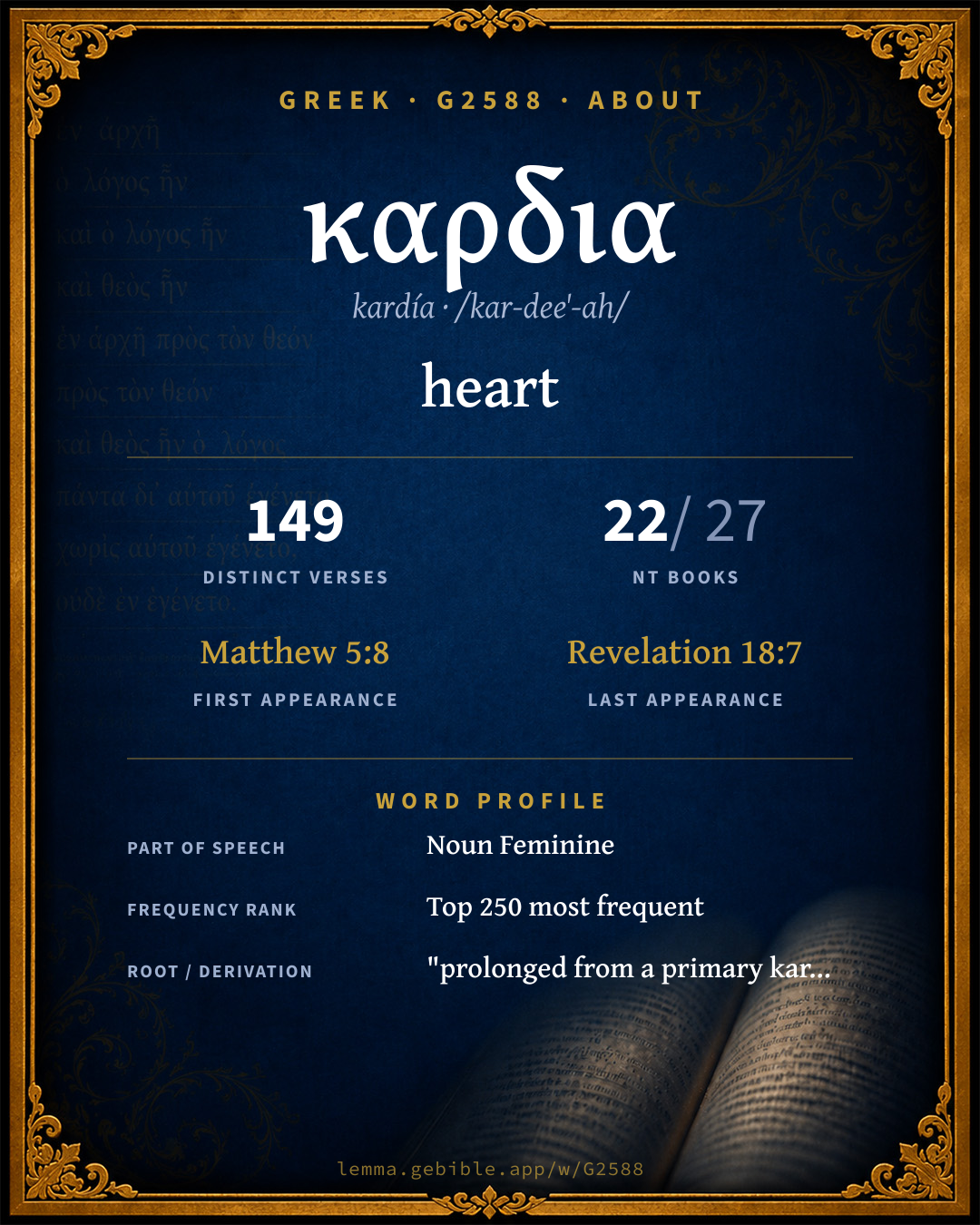
καρδία
heart
‘heart’ is one of 5 main senses fuller range ↓
Full lexicon entry — Thayer's Greek Lexicon
From Thayer's Greek Lexicon
Where this word appears
See every Dative-case word in the Greek New Testament →
Grammar key — what these labels mean
Part of speech
- Noun
- A naming word — a person, place, thing, or idea.
Case
- Dative
- The case of the indirect object, means, or location — “to / for / with / in.”
- Genitive
- The case of source, possession, or “of” — answers “whose / from what.”
- Accusative
- The case of the direct object and of extent.
- Nominative
- The case of the subject (and the predicate nominative).
Gender
- Feminine
- Grammatically feminine.
Number
- Singular
- One.
- Plural
- More than one.
Grammatical forms
- Noun, Dative, Singular, Feminine 35 times (22%)
- Noun, Genitive, Singular, Feminine 32 times (21%)
- Noun, Accusative, Plural, Feminine 25 times (16%)
- Noun, Dative, Plural, Feminine 21 times (13%)
- Noun, Nominative, Singular, Feminine 19 times (12%)
- Noun, Accusative, Singular, Feminine 18 times (12%)
- Noun, Genitive, Plural, Feminine 4 times (3%)
- Noun, Nominative, Plural, Feminine 2 times (1%)
Parsed forms decoded from the imported morphology (Robinson–Tischendorf, public domain), counted across 156 parsed occurrences — not distinct verses.
Every verse where G2588 appears — 149 distinct verses across 22 books. Click any verse to open its interlinear word-by-word view. Verse text shown in the World English Bible for context — . Each verse’s Greek form is shown with its reference; the English is not keyword-highlighted, since the data carries no word-level English alignment. Use “Compare translations” on any verse to read it across multiple English versions. This concordance covers the Greek New Testament; Septuagint (Greek Old Testament) occurrences of this word are not indexed here.
Matthew 15 verses
- Matthew 5:8 καρδίᾳ n dat sg fem Blessed are the pure in heart, For they shall see God.
- Matthew 5:28 καρδίᾳ n dat sg fem but I tell you that everyone who gazes at a woman to lust after her has committed adultery with her already in his heart.
- Matthew 6:21 καρδία n nom sg fem for where your treasure is, there your heart will be also.
- Matthew 9:4 καρδίαις n dat pl fem Jesus, knowing their thoughts, said, "Why do you think evil in your hearts?
- Matthew 11:29 καρδίᾳ n dat sg fem Take my yoke upon you, and learn from me, for I am gentle and lowly in heart; and you will find rest for your souls.
- Matthew 12:34 καρδίας n gen sg fem You offspring of vipers, how can you, being evil, speak good things? For out of the abundance of the heart, the mouth speaks.
- Matthew 12:40 καρδίᾳ n dat sg fem For as Jonah was three days and three nights in the belly of the whale, so will the Son of Man be three days and three nights in the heart of the earth.
- Matthew 13:15 καρδία καρδίᾳ n nom sg fem n dat sg fem For this people's heart has grown callous, Their ears are dull of hearing, They have closed their eyes; Or else perhaps they might perceive with their eyes, Hear with their ears, Understand with their heart, And should turn again; And I would heal them.'
- Matthew 13:19 καρδίᾳ n dat sg fem When anyone hears the word of the Kingdom, and doesn't understand it, the evil one comes, and snatches away that which has been sown in his heart. This is what was sown by the roadside.
- Matthew 15:8 καρδία n nom sg fem 'These people draw near to me with their mouth, And honor me with their lips; But their heart is far from me.
- Matthew 15:18 καρδίας n gen sg fem But the things which proceed out of the mouth come out of the heart, and they defile the man.
- Matthew 15:19 καρδίας n gen sg fem For out of the heart come forth evil thoughts, murders, adulteries, sexual sins, thefts, false testimony, and blasphemies.
- Matthew 18:35 καρδιῶν n gen pl fem So my heavenly Father will also do to you, if you don't each forgive your brother from your hearts for his misdeeds."
- Matthew 22:37 καρδίᾳ n dat sg fem Jesus said to him, "'You shall love the Lord your God with all your heart, and with all your soul, and with all your mind.'
- Matthew 24:48 καρδίᾳ n dat sg fem But if that evil servant should say in his heart, 'My lord is delaying his coming,'
Mark 11 verses
- Mark 2:6 καρδίαις n dat pl fem But there were some of the scribes sitting there, and reasoning in their hearts,
- Mark 2:8 καρδίαις n dat pl fem Immediately Jesus, perceiving in his spirit that they so reasoned within themselves, said to them, "Why do you reason these things in your hearts?
- Mark 3:5 καρδίας n gen sg fem When he had looked around at them with anger, being grieved at the hardening of their hearts, he said to the man, "Stretch out your hand." He stretched it out, and his hand was restored as healthy as the other.
- Mark 6:52 καρδία n nom sg fem for they hadn't understood about the loaves, but their hearts were hardened.
- Mark 7:6 καρδία n nom sg fem He answered them, "Well did Isaiah prophesy of you hypocrites, as it is written, 'This people honors me with their lips, But their heart is far from me.
- Mark 7:19 καρδίαν n acc sg fem because it doesn't go into his heart, but into his stomach, then into the latrine, thus making all foods clean?"
- Mark 7:21 καρδίας n gen sg fem For from within, out of the hearts of men, proceed evil thoughts, adulteries, sexual sins, murders, thefts,
- Mark 8:17 καρδίαν n acc sg fem Jesus, perceiving it, said to them, "Why do you reason that it's because you have no bread? Don't you perceive yet, neither understand? Is your heart still hardened?
- Mark 11:23 καρδίᾳ n dat sg fem For most assuredly I tell you, whoever may tell this mountain, 'Be taken up and cast into the sea,' and doesn't doubt in his heart, but believes that what he says is happening; he shall have whatever he says.
- Mark 12:30 καρδίας n gen sg fem you shall love the Lord your God with all your heart, and with all your soul, and with all your mind, and with all your strength.' This is the first commandment.
- Mark 12:33 καρδίας n gen sg fem and to love him with all the heart, and with all the understanding, with all the soul, and with all the strength, and to love his neighbor as himself, is more important than all whole burnt offerings and sacrifices."
Luke 21 verses
- Luke 1:17 καρδίας n acc pl fem He will go before him in the spirit and power of Elijah, 'to turn the hearts of the fathers to the children,' and the disobedient to the wisdom of the just; to make ready a people prepared for the Lord."
- Luke 1:51 καρδίας n gen sg fem He has shown strength with his arm. He has scattered the proud in the imagination of their heart.
- Luke 1:66 καρδίᾳ n dat sg fem All who heard them laid them up in their heart, saying, "What then will this child be?" The hand of the Lord was with him.
- Luke 2:19 καρδίᾳ n dat sg fem But Mary kept all these sayings, pondering them in her heart.
- Luke 2:35 καρδιῶν n gen pl fem Yes, a sword will pierce through your own soul, that the thoughts of many hearts may be revealed."
- Luke 2:51 καρδίᾳ n dat sg fem And he went down with them, and came to Nazareth. He was subject to them, and his mother kept all these sayings in her heart.
- Luke 3:15 καρδίαις n dat pl fem As the people were in expectation, and all men reasoned in their hearts concerning John, whether perhaps he was the Christ,
- Luke 5:22 καρδίαις n dat pl fem But Jesus, perceiving their thoughts, answered them, "Why are you reasoning so in your hearts?
- Luke 6:45 καρδίας καρδίας n gen sg fem n gen sg fem The good man out of the good treasure of his heart brings out that which is good, and the evil man out of the evil treasure of his heart brings out that which is evil, for out of the abundance of the heart, his mouth speaks.
- Luke 8:12 καρδίας n gen sg fem Those along the road are those who hear, then the devil comes, and takes away the word from their heart, that they may not believe and be saved.
- Luke 8:15 καρδίᾳ n dat sg fem That in the good ground, these are such as in an honest and good heart, having heard the word, hold it tightly, and bring forth fruit with patience.
- Luke 9:47 καρδίας n gen sg fem Jesus, perceiving the reasoning of their hearts, took a little child, and set him by his side,
- Luke 10:27 καρδίας n gen sg fem He answered, "You shall love the Lord your God with all your heart, with all your soul, with all your strength, and with all your mind; and your neighbor as yourself."
- Luke 12:34 καρδία n nom sg fem For where your treasure is, there will your heart be also.
- Luke 12:45 καρδίᾳ n dat sg fem But if that servant says in his heart, 'My lord delays his coming,' and begins to beat the menservants and the maidservants, and to eat and drink, and to be drunken,
- Luke 16:15 καρδίας n acc pl fem He said to them, "You are those who justify yourselves in the sight of men, but God knows your hearts. For that which is exalted among men is an abomination in the sight of God.
- Luke 21:14 καρδίαις n dat pl fem Settle it therefore in your hearts not to meditate beforehand how to answer,
- Luke 21:34 καρδίαι n nom pl fem "So be careful, or your hearts will be loaded down with carousing, drunkenness, and cares of this life, and that day will come on you suddenly.
- Luke 24:25 καρδίᾳ n dat sg fem He said to them, "Foolish men, and slow of heart to believe in all that the prophets have spoken!
- Luke 24:32 καρδία n nom sg fem They said one to another, "Weren't our hearts burning within us, while he spoke to us along the way, and while he opened the Scriptures to us?"
- Luke 24:38 καρδίᾳ n dat sg fem He said to them, "Why are you troubled? Why do doubts arise in your hearts?
John 6 verses
- John 12:40 καρδίαν καρδίᾳ n acc sg fem n dat sg fem "He has blinded their eyes and he hardened their heart, Lest they should see with their eyes, And perceive with their heart, And would turn, And I would heal them."
- John 13:2 καρδίαν n acc sg fem After supper, the devil having already put into the heart of Judas Iscariot, Simon's son, to betray him,
- John 14:1 καρδία n nom sg fem "Don't let your heart be troubled. Believe in God. Believe also in me.
- John 14:27 καρδία n nom sg fem Peace I leave with you. My peace I give to you; not as the world gives, give I to you. Don't let your heart be troubled, neither let it be fearful.
- John 16:6 καρδίαν n acc sg fem But because I have told you these things, sorrow has filled your heart.
- John 16:22 καρδία n nom sg fem Therefore you now have sorrow, but I will see you again, and your heart will rejoice, and no one will take your joy away from you.
Acts 19 verses
- Acts 2:26 καρδία n nom sg fem Therefore my heart was glad, and my tongue rejoiced. Moreover my flesh also will dwell in hope;
- Acts 2:37 καρδίαν n acc sg fem Now when they heard this, they were cut to the heart, and said to Peter and the rest of the apostles, "Brothers, what shall we do?"
- Acts 2:46 καρδίας n gen sg fem Day by day, continuing steadfastly with one accord in the temple, and breaking bread at home, they took their food with gladness and singleness of heart,
- Acts 4:32 καρδία n nom sg fem The multitude of those who believed were of one heart and soul. Not one of them claimed that anything of the things which he possessed was his own, but they had all things in common.
- Acts 5:3 καρδίαν n acc sg fem But Peter said, "Ananias, why has Satan filled your heart to lie to the Holy Spirit, and to keep back part of the price of the land?
- Acts 5:4 καρδίᾳ n dat sg fem While you kept it, didn't it remain your own? After it was sold, wasn't it in your power? How is it that you have conceived this thing in your heart? You haven't lied to men, but to God."
- Acts 7:23 καρδίαν n acc sg fem But when he was forty years old, it came into his heart to visit his brothers, the children of Israel.
- Acts 7:39 καρδίαις n dat pl fem to whom our fathers wouldn't be obedient, but rejected him, and turned back in their hearts to Egypt,
- Acts 7:51 καρδίαις n dat pl fem "You stiff-necked and uncircumcised in heart and ears, you always resist the Holy Spirit! As your fathers did, so you do.
- Acts 7:54 καρδίαις n dat pl fem Now when they heard these things, they were cut to the heart, and they gnashed at him with their teeth.
- Acts 8:21 καρδία n nom sg fem You have neither part nor lot in this matter, for your heart isn't right before God.
- Acts 8:22 καρδίας n gen sg fem Repent therefore of this, your wickedness, and ask God if perhaps the thought of your heart may be forgiven you.
- Acts 11:23 καρδίας n gen sg fem who, when he had come, and had seen the grace of God, was glad. He exhorted them all, that with purpose of heart they should remain near to the Lord.
- Acts 13:22 καρδίαν n acc sg fem When he had removed him, he raised up David to be their king, to whom he also testified, 'I have found David the son of Jesse, a man after my heart, who will do all my will.'
- Acts 14:17 καρδίας n acc pl fem Yet he didn't leave himself without witness, in that he did good and gave you rains from the sky and fruitful seasons, filling our hearts with food and gladness."
- Acts 15:9 καρδίας n acc pl fem He made no distinction between us and them, cleansing their hearts by faith.
- Acts 16:14 καρδίαν n acc sg fem A certain woman named Lydia, a seller of purple, of the city of Thyatira, one who worshiped God, heard us; whose heart the Lord opened to listen to the things which were spoken by Paul.
- Acts 21:13 καρδίαν n acc sg fem Then Paul answered, "What are you doing, weeping and breaking my heart? For I am ready not only to be bound, but also to die at Jerusalem for the name of the Lord Jesus."
- Acts 28:27 καρδία καρδίᾳ n nom sg fem n dat sg fem For this people's heart has grown callous. Their ears are dull of hearing. Their eyes they have closed. Lest they should see with their eyes, Hear with their ears, Understand with their heart, And would turn again, And I would heal them.'
Romans 15 verses
- Romans 1:21 καρδία n nom sg fem Because, knowing God, they didn't glorify him as God, neither gave thanks, but became vain in their reasoning, and their senseless heart was darkened.
- Romans 1:24 καρδιῶν n gen pl fem Therefore God also gave them up in the lusts of their hearts to uncleanness, that their bodies should be dishonored among themselves,
- Romans 2:5 καρδίαν n acc sg fem But according to your hardness and unrepentant heart you are treasuring up for yourself wrath in the day of wrath, revelation, and of the righteous judgment of God;
- Romans 2:15 καρδίαις n dat pl fem in that they show the work of the law written in their hearts, their conscience testifying with them, and their thoughts among themselves accusing or else excusing them)
- Romans 2:29 καρδίας n gen sg fem but he is a Jew who is one inwardly, and circumcision is that of the heart, in the spirit not in the letter; whose praise is not from men, but from God.
- Romans 5:5 καρδίαις n dat pl fem and hope doesn't disappoint us, because God's love has been poured out into our hearts through the Holy Spirit who was given to us.
- Romans 6:17 καρδίας n gen sg fem But thanks be to God, that, whereas you were bondservants of sin, you became obedient from the heart to that form of teaching whereunto you were delivered.
- Romans 8:27 καρδίας n acc pl fem He who searches the hearts knows what is on the Spirit's mind, because he makes intercession for the saints according to God.
- Romans 9:2 καρδίᾳ n dat sg fem that I have great sorrow and unceasing pain in my heart.
- Romans 10:1 καρδίας n gen sg fem Brothers, my heart's desire and my prayer to God is for Israel, that they may be saved.
- Romans 10:6 καρδίᾳ n dat sg fem But the righteousness which is of faith says this, "Don't say in your heart, 'Who will ascend into heaven?' (that is, to bring Christ down);
- Romans 10:8 καρδίᾳ n dat sg fem But what does it say? "The word is near you, in your mouth, and in your heart;" that is, the word of faith, which we preach:
- Romans 10:9 καρδίᾳ n dat sg fem that if you will confess with your mouth the Lord Jesus, and believe in your heart that God raised him from the dead, you will be saved.
- Romans 10:10 καρδίᾳ n dat sg fem For with the heart, one believes unto righteousness; and with the mouth confession is made unto salvation.
- Romans 16:18 καρδίας n acc pl fem For those who are such don't serve our Lord, Jesus Christ, but their own belly; and by their smooth and flattering speech, they deceive the hearts of the innocent.
1 Corinthians 4 verses
- 1 Corinthians 2:9 καρδίαν n acc sg fem But as it is written, "Things which an eye didn't see, and an ear didn't hear, Which didn't enter into the heart of man, These God has prepared for those who love him."
- 1 Corinthians 4:5 καρδιῶν n gen pl fem Therefore judge nothing before the time, until the Lord comes, who will both bring to light the hidden things of darkness, and reveal the counsels of the hearts. Then each man will get his praise from God.
- 1 Corinthians 7:37 καρδίᾳ καρδίᾳ n dat sg fem n dat sg fem But he who stands steadfast in his heart, having no necessity, but has power over his own heart, to keep his own virgin, does well.
- 1 Corinthians 14:25 καρδίας n gen sg fem And thus the secrets of his heart are revealed. So he will fall down on his face and worship God, declaring that God is among you indeed.
2 Corinthians 11 verses
- 2 Corinthians 1:22 καρδίαις n dat pl fem who also sealed us, and gave us the down payment of the Spirit in our hearts.
- 2 Corinthians 2:4 καρδίας n gen sg fem For out of much affliction and anguish of heart I wrote to you with many tears, not that you should be made sorry, but that you might know the love that I have so abundantly for you.
- 2 Corinthians 3:2 καρδίαις n dat pl fem You are our letter, written in our hearts, known and read by all men;
- 2 Corinthians 3:3 καρδίαις n dat pl fem being revealed that you are a letter of Christ, ministered by us, written not with ink, but with the Spirit of the living God; not in tablets of stone, but in tablets that are hearts of flesh.
- 2 Corinthians 3:15 καρδίαν n acc sg fem But to this day, when Moses is read, a veil lies on their heart.
- 2 Corinthians 4:6 καρδίαις n dat pl fem seeing it is God who said, "Light will shine out of darkness," who has shone in our hearts, to give the light of the knowledge of the glory of God in the face of Jesus Christ.
- 2 Corinthians 5:12 καρδίᾳ n dat sg fem For we are not commending ourselves to you again, but speak as giving you occasion of boasting on our behalf, that you may have something to answer those who boast in appearance, and not in heart.
- 2 Corinthians 6:11 καρδία n nom sg fem Our mouth is open to you, Corinthians. Our heart is enlarged.
- 2 Corinthians 7:3 καρδίαις n dat pl fem I say this not to condemn you, for I have said before, that you are in our hearts to die together and live together.
- 2 Corinthians 8:16 καρδίᾳ n dat sg fem But thanks be to God, who puts the same earnest care for you into the heart of Titus.
- 2 Corinthians 9:7 καρδίᾳ n dat sg fem Let each man give according as he has determined in his heart; not grudgingly, or under compulsion; for God loves a cheerful giver.
Galatians 1 verse
Ephesians 6 verses
- Ephesians 1:18 καρδίας n gen sg fem having the eyes of your hearts enlightened, that you may know what is the hope of his calling, and what are the riches of the glory of his inheritance in the saints,
- Ephesians 3:17 καρδίαις n dat pl fem that Christ may dwell in your hearts through faith; to the end that you, being rooted and grounded in love,
- Ephesians 4:18 καρδίας n gen sg fem being darkened in their understanding, alienated from the life of God, because of the ignorance that is in them, because of the hardening of their hearts;
- Ephesians 5:19 καρδίᾳ n dat sg fem speaking to one another in psalms, hymns, and spiritual songs; singing, and singing praises in your heart to the Lord;
- Ephesians 6:5 καρδίας n gen sg fem Servants, be obedient to those who according to the flesh are your masters, with fear and trembling, in singleness of your heart, as to Christ;
- Ephesians 6:22 καρδίας n acc pl fem whom I have sent to you for this very purpose, that you may know our state, and that he may comfort your hearts.
Philippians 2 verses
- Philippians 1:7 καρδίᾳ n dat sg fem It is even right for me to think this way on behalf of all of you, because I have you in my heart, because, both in my bonds and in the defense and confirmation of the Gospel, you all are partakers with me of grace.
- Philippians 4:7 καρδίας n acc pl fem And the peace of God, which surpasses all understanding, will guard your hearts and your thoughts in Christ Jesus.
Colossians 5 verses
- Colossians 2:2 καρδίαι n nom pl fem that their hearts may be comforted, they being knit together in love, and gaining all riches of the full assurance of understanding, that they may know the mystery of God, both of the Father and of Christ,
- Colossians 3:15 καρδίαις n dat pl fem And let the peace of God rule in your hearts, to which also you were called in one body; and be thankful.
- Colossians 3:16 καρδίαις n dat pl fem Let the word of Christ dwell in you richly; in all wisdom teaching and admonishing one another with psalms, hymns, and spiritual songs, singing with grace in your heart to the Lord.
- Colossians 3:22 καρδίας n gen sg fem Servants, obey in all things those who are your masters according to the flesh, not just when they are looking, as men-pleasers, but in singleness of heart, fearing God.
- Colossians 4:8 καρδίας n acc pl fem I am sending him to you for this very purpose, that he may know your circumstances and comfort your hearts,
1 Thessalonians 3 verses
- 1 Thessalonians 2:4 καρδίας n acc pl fem But even as we have been approved by God to be entrusted with the Gospel, so we speak; not as pleasing men, but God, who tests our hearts.
- 1 Thessalonians 2:17 καρδίᾳ n dat sg fem But we, brothers, being bereaved of you for a short season, in presence, not in heart, tried even harder to see your face with great desire,
- 1 Thessalonians 3:13 καρδίας n acc pl fem to the end he may establish your hearts blameless in holiness before our God and Father, at the coming of our Lord Jesus with all his saints.
2 Thessalonians 2 verses
1 Timothy 1 verse
2 Timothy 1 verse
Hebrews 10 verses
- Hebrews 3:8 καρδίας n acc pl fem Don't harden your hearts, as in the provocation, Like as in the day of the trial in the wilderness,
- Hebrews 3:10 καρδίᾳ n dat sg fem Therefore I was displeased with that generation, And said, 'They always err in their heart, But they didn't know my ways;'
- Hebrews 3:12 καρδία n nom sg fem Beware, brothers, lest perhaps there be in any one of you an evil heart of unbelief, in falling away from the living God;
- Hebrews 3:15 καρδίας n acc pl fem while it is said, "Today if you will hear his voice, Don't harden your hearts, as in the rebellion."
- Hebrews 4:7 καρδίας n acc pl fem he again defines a certain day, today, saying through David so long a time afterward (just as has been said), "Today if you will hear his voice, Don't harden your hearts."
- Hebrews 4:12 καρδίας n gen sg fem For the word of God is living, and active, and sharper than any two-edged sword, and piercing even to the dividing of soul and spirit, of both joints and marrow, and is able to discern the thoughts and intentions of the heart.
- Hebrews 8:10 καρδίαν n acc sg fem "For this is the covenant that I will make with the house of Israel. After those days," says the Lord; "I will put my laws into their mind, I will also write them on their heart. I will be to them a God, And they will be to me a people.
- Hebrews 10:16 καρδίας n acc pl fem "This is the covenant that I will make with them: 'After those days,' says the Lord, 'I will put my laws on their heart, I will also write them on their mind;'" then he says,
- Hebrews 10:22 καρδίας καρδίας n gen sg fem n acc pl fem let's draw near with a true heart in fullness of faith, having our hearts sprinkled from an evil conscience, and having our body washed with pure water,
- Hebrews 13:9 καρδίαν n acc sg fem Don't be carried away by various and strange teachings, for it is good that the heart be established by grace, not by food, through which those who were so occupied were not benefited.
James 5 verses
- James 1:26 καρδίαν n acc sg fem If anyone among you thinks himself to be religious while he doesn't bridle his tongue, but deceives his heart, this man's religion is worthless.
- James 3:14 καρδίᾳ n dat sg fem But if you have bitter jealousy and selfish ambition in your heart, don't boast and don't lie against the truth.
- James 4:8 καρδίας n acc pl fem Draw near to God, and he will draw near to you. Cleanse your hands, you sinners; and purify your hearts, you double-minded.
- James 5:5 καρδίας n acc pl fem You have lived delicately on the earth, and taken your pleasure. You have nourished your hearts as in a day of slaughter.
- James 5:8 καρδίας n acc pl fem You also be patient. Establish your hearts, for the coming of the Lord is at hand.
1 Peter 3 verses
- 1 Peter 1:22 καρδίας n gen sg fem Seeing you have purified your souls in your obedience to the truth through the Spirit in sincere brotherly affection, love one another from the heart fervently:
- 1 Peter 3:4 καρδίας n gen sg fem but in the hidden person of the heart, in the incorruptible adornment of a gentle and quiet spirit, which is in the sight of God very precious.
- 1 Peter 3:15 καρδίαις n dat pl fem But sanctify the Lord God in your hearts; and always be ready to give an answer to everyone who asks you a reason concerning the hope that is in you, with humility and fear:
2 Peter 2 verses
- 2 Peter 1:19 καρδίαις n dat pl fem We have the more sure word of prophecy; whereunto you do well that you take heed, as to a lamp shining in a dark place, until the day dawns, and the day star arises in your hearts:
- 2 Peter 2:14 καρδίαν n acc sg fem having eyes full of adultery, and who can't cease from sin; enticing unsettled souls; having a heart trained in greed; children of cursing;
1 John 3 verses
- 1 John 3:19 καρδίας n acc pl fem And by this we know that we are of the truth, and persuade our hearts before him,
- 1 John 3:20 καρδία καρδίας n nom sg fem n gen sg fem because if our heart condemns us, God is greater than our heart, and knows all things.
- 1 John 3:21 καρδία n nom sg fem Beloved, if our hearts don't condemn us, we have boldness toward God;
Revelation 3 verses
- Revelation 2:23 καρδίας n acc pl fem I will kill her children with Death, and all the assemblies will know that I am he who searches the minds and hearts. I will give to each one of you according to your deeds.
- Revelation 17:17 καρδίας n acc pl fem For God has put in their hearts to do what he has in mind, and to be of one mind, and to give their kingdom to the beast, until the words of God should be accomplished.
- Revelation 18:7 καρδίᾳ n dat sg fem However much she glorified herself, and grew wanton, so much give her of torment and mourning. For she says in her heart, 'I sit a queen, and am no widow, and will in no way see mourning.'
About this entry
At a glance — auto-summarized from this page’s data, not written by a person. Every figure links to its source below. This summary describes the numbers; it doesn’t interpret them.
At its core, καρδια (kardía) means “heart.” Catalogued under 5 senses, its meaning is not single-sense. It turns up in 149 verses across 22 books, a common footprint. Scripture first uses it in Matthew 5:8. It shares a root with καρδιογνωστης. Each statement above links to its evidence; the full detail follows below.
Gloss history
Strong's 1890 vs modern scholarship
About this word
Strong's G2588 catalogs a Greek word from the Greek New Testament.
These counts are not copied from any lexicon or concordance. They are computed here, from the morphology-tagged Greek New Testament. What Lemma adds →
- 149
- distinct verses
- The word appears in 149 distinct verses.
- 22 / 27
- NT books
- The word appears in 22 of 27 New Testament books.
- #102
- by frequency
- Top 250 most frequent Greek words (rank 102 of 5,347 Greek words by occurrence).
View all 149 occurrences in the concordance →
By section of the New Testament
By traditional corpus
Conventional, traditional groupings — biblical authorship is debated, so this is a traditional corpus grouping, not an authorship claim. Some books belong to more than one corpus (Luke is in both the Gospels and the Lukan corpus, and so on), so these shares overlap and need not total 100%. Each figure is a share of the word’s 149 distinct verses.
- Gospels 53 verses · 36%
- Pauline corpus 51 verses · 34%
- Lukan (Luke–Acts) 40 verses · 27%
- General (Catholic) Epistles 13 verses · 9%
- Johannine 12 verses · 8%
- Hebrews 10 verses · 7%
- Revelation 3 verses · 2%
How translations render this word
Counts come from each version’s own published word-to-Strong’s tagging or interlinear alignment — an approximate guide to how each version renders this word, not a word-level alignment the data otherwise carries. Because each total is that version’s own tagged count, the per-version totals vary from one another and need not match the appearance or distinct-verse counts above. These counts may also differ from a printed concordance because Lemma counts each distinctly tagged rendering and does not collapse phrase taggings into a single head-word total. This is a fixed set of word-tagged versions (KJV, ASV, BSB, ULT) and does not change with the reading translation you choose elsewhere. Each version’s license is shown beside its name below (and on Sources).
- King James Version: Heart 99×, Hearts 57×
- American Standard Version: Heart 95×, Hearts 45×, Of 4×
- Berean Standard Bible: Hearts 80×, Heart 71×
- unfoldingWord Literal Text: Heart 98×, Hearts 59×, Of 8×
King James Version Public Domain
Renders G2588 across 159 tagged occurrences — most commonly:
Plus 3 renderings that appear only once — usually multi-word phrases or single function words the recovered tagging swept in, not distinct renderings. Not rendered by a distinct English word in 1 further occurrence.
American Standard Version Public Domain
Renders G2588 across 160 tagged occurrences — most commonly:
Plus 9 renderings that appear only once — usually multi-word phrases or single function words the recovered tagging swept in, not distinct renderings.
Berean Standard Bible Public Domain
Renders G2588 across 153 tagged occurrences — most commonly:
Plus 2 renderings that appear only once — usually multi-word phrases or single function words the recovered tagging swept in, not distinct renderings. Not rendered by a distinct English word in 3 further occurrences.
unfoldingWord Literal Text CC BY-SA 4.0
Renders G2588 across 176 tagged occurrences — most commonly:
Plus 2 renderings that appear only once — usually multi-word phrases or single function words the recovered tagging swept in, not distinct renderings.
Senses in Thayer's
The 5 senses Thayer's distinguishes for this word, in lexicon order (not ranked by frequency or importance). The full entry — with sub-senses — is in the Lexicon Entry tab.
- that organ in the animal body which is the centre of the circulation of the blood…
- denotes the centre of all physical and spiritual life
- the vigour and sense of physical life
- the centre and seat of spiritual life
- of the middle or central or inmost part of anything, even though inanimate
Word origin
Origin: "prolonged from a primary kar (Latin, cor, "heart")"
Prolonged from a primary κάρ kar (Latin cor heart); the heart that is (figuratively) the thoughts or feelings ( mind ); also (by analogy) the middle : - (+ broken-) heart (-ed).
— Strong’s Exhaustive Concordance (1890), public domain.
Forms in the corpus
The 7 distinct written forms G2588 takes in the Greek New Testament, most frequent first — each parse links to that case’s occurrences in the concordance.
| Form | Parsing | Example | Uses |
|---|---|---|---|
| καρδίας kardías | Noun, Genitive, Singular, Feminine | Matthew 12:34 | 57 |
| καρδίᾳ kardía | Noun, Dative, Singular, Feminine | Matthew 5:8 | 35 |
| καρδίαις kardíais | Noun, Dative, Plural, Feminine | Matthew 9:4 | 21 |
| καρδία kardía | Noun, Nominative, Singular, Feminine | Matthew 6:21 | 19 |
| καρδίαν kardían | Noun, Accusative, Singular, Feminine | Mark 7:19 | 18 |
| καρδιῶν kardiō̂n | Noun, Genitive, Plural, Feminine | Matthew 18:35 | 4 |
| καρδίαι kardíai | Noun, Nominative, Plural, Feminine | Luke 21:34 | 2 |
Same root — word family
Other Thayer's entries built from the same root as G2588, grouped by Strong’s listed origin. These share a root / origin per the lexicon — not necessarily a shared meaning. Each links to that word’s own entry.
Derived from this word
Compare all same-root words → They share a root, not necessarily a meaning.
Septuagint usage
The same Greek word καρδια appears 746 times in the Greek Old Testament (Septuagint), across 680 verses in 36 books.
- 746
- LXX occurrences
- Tagged occurrences of this Greek word in the Septuagint.
- 680
- verses
- Distinct Septuagint verses containing this word.
- 36 / 39
- OT books
- The word appears in 36 of the 39 Old Testament books.
Sample Septuagint occurrences
- Genesis 6:5 καρδία
- Exodus 4:21 καρδία
- Leviticus 26:36 καρδία
- Numbers 32:9 καρδία
- Deuteronomy 1:28 καρδία
- Joshua 2:11 καρδία
- Judges 1:15 καρδία
- Ruth 2:13 καρδία
- 1 Samuel 1:8 καρδία
- 2 Samuel 6:16 καρδία
- 1 Kings 2:4 καρδία
- 2 Kings 5:26 καρδία
Septuagint occurrences (same lexeme)
Every verse where the same Strong’s number (G2588) appears in the Greek Septuagint — showing the first 50 of 680. Verse text shown in the World English Bible for context; the Greek form is the matched word — the English is not keyword-highlighted.
- Genesis 6:5 καρδία Yahweh saw that the wickedness of man was great in the earth, and that every imagination of the thoughts of his heart was only evil continually.
- Genesis 20:5 καρδία Didn't he tell me, 'She is my sister?' She, even she herself said, 'He is my brother.' In the integrity of my heart and the innocence of my hands have I done this."
- Genesis 20:6 καρδία God said to him in the dream, "Yes, I know that in the integrity of your heart you have done this, and I also withheld you from sinning against me. Therefore I didn't allow you to touch her.
- Genesis 42:28 καρδία He said to his brothers, "My money is restored! Behold, it is even in my sack." Their hearts failed them, and they turned trembling one to another, saying, "What is this that God has done to us?"
- Genesis 50:21 καρδία Now therefore don't be afraid. I will nourish you and your little ones." He comforted them, and spoke kindly to them.
- Exodus 4:21 καρδία Yahweh said to Moses, "When you go back into Egypt, see that you do before Pharaoh all the wonders which I have put in your hand, but I will harden his heart and he will not let the people go.
- Exodus 7:3 καρδία I will harden Pharaoh's heart, and multiply my signs and my wonders in the land of Egypt.
- Exodus 7:13 καρδία Pharaoh's heart was hardened, and he didn't listen to them; as Yahweh had spoken.
- Exodus 7:14 καρδία Yahweh said to Moses, "Pharaoh's heart is stubborn. He refuses to let the people go.
- Exodus 7:22 καρδία The magicians of Egypt did in like manner with their enchantments; and Pharaoh's heart was hardened, and he didn't listen to them; as Yahweh had spoken.
- Exodus 8:11 καρδία The frogs shall depart from you, and from your houses, and from your servants, and from your people. They shall remain in the river only."
- Exodus 8:15 καρδία But when Pharaoh saw that there was a respite, he hardened his heart, and didn't listen to them, as Yahweh had spoken.
- Exodus 8:28 καρδία Pharaoh said, "I will let you go, that you may sacrifice to Yahweh your God in the wilderness, only you shall not go very far away. Pray for me."
- Exodus 9:7 καρδία Pharaoh sent, and, behold, there was not so much as one of the cattle of the Israelites dead. But the heart of Pharaoh was stubborn, and he didn't let the people go.
- Exodus 9:12 καρδία Yahweh hardened the heart of Pharaoh, and he didn't listen to them, as Yahweh had spoken to Moses.
- Exodus 9:14 καρδία For this time I will send all my plagues against your heart, against your officials, and against your people; that you may know that there is none like me in all the earth.
- Exodus 9:34 καρδία When Pharaoh saw that the rain and the hail and the thunders were ceased, he sinned yet more, and hardened his heart, he and his servants.
- Exodus 9:35 καρδία The heart of Pharaoh was hardened, and he didn't let the children of Israel go, just as Yahweh had spoken through Moses.
- Exodus 10:1 καρδία Yahweh said to Moses, "Go in to Pharaoh, for I have hardened his heart, and the heart of his servants, that I may show these my signs in the midst of them,
- Exodus 10:20 καρδία But Yahweh hardened Pharaoh's heart, and he didn't let the children of Israel go.
- Exodus 10:27 καρδία But Yahweh hardened Pharaoh's heart, and he wouldn't let them go.
- Exodus 11:10 καρδία Moses and Aaron did all these wonders before Pharaoh, and Yahweh hardened Pharaoh's heart, and he didn't let the children of Israel go out of his land.
- Exodus 14:4 καρδία I will harden Pharaoh's heart, and he will follow after them; and I will get honor over Pharaoh, and over all his host; and the Egyptians shall know that I am Yahweh." They did so.
- Exodus 14:5 καρδία It was told the king of Egypt that the people had fled; and the heart of Pharaoh and of his servants was changed towards the people, and they said, "What is this we have done, that we have let Israel go from serving us?"
- Exodus 14:8 καρδία Yahweh hardened the heart of Pharaoh king of Egypt, and he pursued after the children of Israel; for the children of Israel went out with a high hand.
- Exodus 14:17 καρδία I, behold, I will harden the hearts of the Egyptians, and they shall go in after them: and I will get myself honor over Pharaoh, and over all his host, over his chariots, and over his horsemen.
- Exodus 25:2 καρδία "Speak to the children of Israel, that they take an offering for me. From everyone whose heart makes him willing you shall take my offering.
- Exodus 31:6 καρδία I, behold, I have appointed with him Oholiab, the son of Ahisamach, of the tribe of Dan; and in the heart of all who are wise-hearted I have put wisdom, that they may make all that I have commanded you:
- Exodus 35:5 καρδία 'Take from among you an offering to Yahweh. Whoever is of a willing heart, let him bring it, Yahweh's offering: gold, silver, brass,
- Exodus 35:10 καρδία "Let every wise-hearted man among you come, and make all that Yahweh has commanded:
- Exodus 35:21 καρδία They came, everyone whose heart stirred him up, and everyone whom his spirit made willing, and brought Yahweh's offering, for the work of the tent of meeting, and for all of its service, and for the holy garments.
- Exodus 36:2 καρδία Moses called Bezalel and Oholiab, and every wise-hearted man, in whose heart Yahweh had put wisdom, even everyone whose heart stirred him up to come to the work to do it:
- Leviticus 26:36 καρδία "'As for those of you who are left, I will send a faintness into their hearts in the lands of their enemies: and the sound of a driven leaf will put them to flight; and they shall flee, as one flees from the sword; and they will fall when no one pursues.
- Leviticus 26:41 καρδία I also walked contrary to them, and brought them into the land of their enemies: if then their uncircumcised heart is humbled, and they then accept the punishment of their iniquity;
- Numbers 32:9 καρδία For when they went up to the valley of Eshcol, and saw the land, they discouraged the heart of the children of Israel, that they should not go into the land which Yahweh had given them.
- Deuteronomy 1:28 καρδία Where are we going up? our brothers have made our heart to melt, saying, The people are greater and taller than we; the cities are great and fortified up to the sky; and moreover we have seen the sons of the Anakim there.
- Deuteronomy 2:30 καρδία But Sihon king of Heshbon would not let us pass by him; for Yahweh your God hardened his spirit, and made his heart obstinate, that he might deliver him into your hand, as at this day.
- Deuteronomy 4:9 καρδία Only take heed to yourself, and keep your soul diligently, lest you forget the things which your eyes saw, and lest they depart from your heart all the days of your life; but make them known to your children and your children's children;
- Deuteronomy 4:29 καρδία But from there you shall seek Yahweh your God, and you shall find him, when you search after him with all your heart and with all your soul.
- Deuteronomy 5:29 καρδία Oh that there were such a heart in them, that they would fear me, and keep all my commandments always, that it might be well with them, and with their children forever!
- Deuteronomy 6:5 καρδία and you shall love Yahweh your God with all your heart, and with all your soul, and with all your might.
- Deuteronomy 6:6 καρδία These words, which I command you this day, shall be on your heart;
- Deuteronomy 8:2 καρδία You shall remember all the way which Yahweh your God has led you these forty years in the wilderness, that he might humble you, to prove you, to know what was in your heart, whether you would keep his commandments, or not.
- Deuteronomy 8:5 καρδία You shall consider in your heart that as a man chastens his son, so Yahweh your God chastens you.
- Deuteronomy 8:14 καρδία then your heart be lifted up, and you forget Yahweh your God, who brought you forth out of the land of Egypt, out of the house of bondage;
- Deuteronomy 8:17 καρδία and [lest] you say in your heart, My power and the might of my hand has gotten me this wealth.
- Deuteronomy 9:4 καρδία Don't speak in your heart, after that Yahweh your God has thrust them out from before you, saying, For my righteousness Yahweh has brought me in to possess this land; whereas for the wickedness of these nations Yahweh does drive them out from before you.
- Deuteronomy 9:5 καρδία Not for your righteousness, or for the uprightness of your heart, do you go in to possess their land; but for the wickedness of these nations Yahweh your God does drive them out from before you, and that he may establish the word which Yahweh swore to your fathers, to Abraham, to Isaac, and to Jacob.
- Deuteronomy 10:12 καρδία Now, Israel, what does Yahweh your God require of you, but to fear Yahweh your God, to walk in all his ways, and to love him, and to serve Yahweh your God with all your heart and with all your soul,
- Deuteronomy 11:13 καρδία It shall happen, if you shall listen diligently to my commandments which I command you this day, to love Yahweh your God, and to serve him with all your heart and with all your soul,
These are occurrences of the same Greek lexeme (G2588) in the Septuagint — not a translation of any one Hebrew word. The store carries no word-level Hebrew↔Greek alignment, so no Hebrew original is asserted here. Counts come from the recovered LXX Strong's tagging — high-frequency vocabulary is well covered, while rare or late forms may be untagged — so they reflect tagged occurrences and may slightly undercount.