
Hebrews 3:8

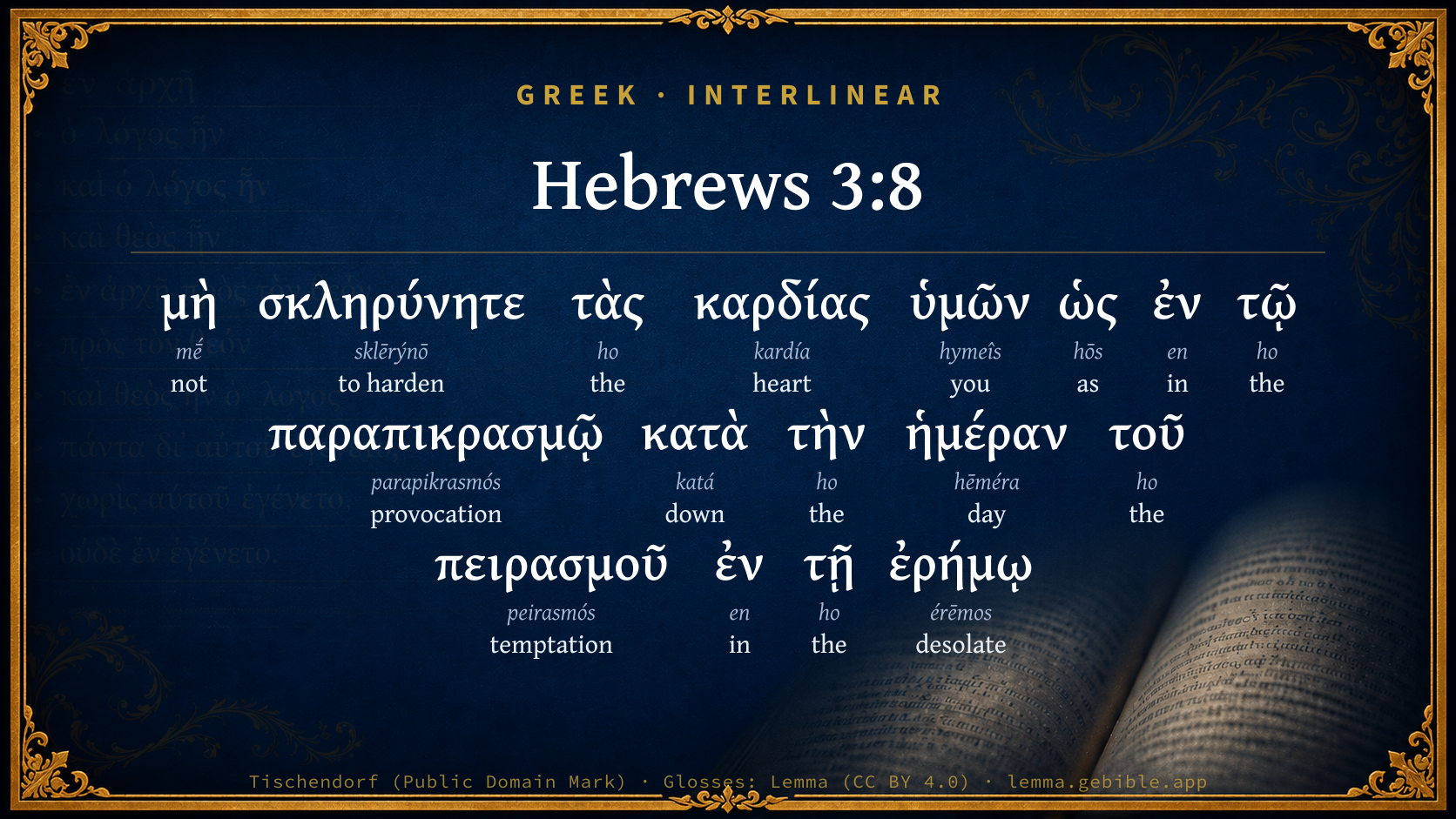
Greek (Tischendorf 8th ed.) Hebrews 3:8 appears in the Greek New Testament. The text above is from the Tischendorf 8th edition. Each word links to its Strong’s number and a concise gloss. Click any word for its full Thayer’s Greek Lexicon entry.
Download image
Cite this verse

Hebrews 3:8 (World English Bible). Public Domain. Lemma interlinear Bible study tool, https://lemma.gebible.app/v/hebrews/3/8.

Show BibTeX & RIS
BibTeX
RIS
English Translation
Don't harden your hearts, as in the provocation, Like as in the day of the trial in the wilderness,
World English Bible · Public Domain
Highlights
  • 1 first appearance in the Greek New Testament
Full analysis ↓
Download a study sheet

One document with this verse’s original text, its word-by-word gloss line, the meaning frame, cross-references with their text, attributed commentary, and full source and license credits — printable, and it pastes into notes with its structure intact.

This verse Autodidact and up

Study sheet (.html) Plain text (.txt)

A passage Seminary Student

Up to 50 verses in one chapter. A passage sheet keeps up to 6 commentary sources and 12 cross-references per verse, in the order this page ranks them, and says so on the sheet whenever that leaves anything out. Ask for a single verse and you get the Autodidact verse sheet above.

Everything on this page stays free to read, with no account — the sheet is a download of what is already on screen, not access to it.

Want to remove ads? Support Godless Engineer
Compare translations 3

The same verse in 3 English versions, stacked beneath the original-language interlinear above. Click any original word for its lexicon entry.

Each is an independent rendering of the whole verse — the interlinear is not word-aligned to these translations.

Highlighted words mark where these versions differ — a whole-verse word diff, not a word-by-word alignment.

  • World English Bible Public Domain
    Don't harden your hearts, as in the provocation, Like as in the day of the trial in the wilderness,
  • King James Version Public Domain
    Harden not your hearts, as in the provocation, in the day of temptation in the wilderness:
  • unfoldingWord Literal Text CC BY-SA 4.0
    do not harden your hearts as in the provocation, during the day of testing in the wilderness

unfoldingWord Literal Text — © unfoldingWord, licensed CC BY-SA 4.0. Word-aligned USFM3 via Door43 (git.door43.org/unfoldingWord/en_ult).

Versions to compare (up to 4)

3 of 4 selected

Show all 19 translations

Every available English version of this verse, each an independent rendering of the whole verse.

  • World English Bible Public Domain
    Don't harden your hearts, as in the provocation, Like as in the day of the trial in the wilderness,
  • Berean Standard Bible Public Domain
    do not harden your hearts, as you did in the rebellion, in the day of testing in the wilderness,
  • Majority Standard Bible Public Domain
    do not harden your hearts, as you did in the rebellion, in the day of testing in the wilderness,
  • King James Version Public Domain
    Harden not your hearts, as in the provocation, in the day of temptation in the wilderness:
  • American Standard Version (1901) Public Domain
    Harden not your hearts, as in the provocation, Like as in the day of the trial in the wilderness,
  • Revised Version (1885) Public Domain
    Harden not your hearts, as in the provocation, Like as in the day of the temptation in the wilderness,
  • Geneva Bible (1599) Public Domain
    Harden not your hearts, as in the prouocation, according to the day of the tentation in the wildernes,
  • Douay-Rheims (1899) Public Domain
    Harden not your hearts, as in the provocation; in the day of temptation in the desert,
  • Young's Literal Translation Public Domain
    ye may not harden your hearts, as in the provocation, in the day of the temptation in the wilderness,
  • Literal Standard Version CC BY-SA 4.0
    you may not harden your hearts, as in the provocation, in the day of the temptation in the wilderness,
  • Unlocked Literal Bible CC BY-SA 4.0
    do not harden your hearts as in the rebellion, in the time of testing in the wilderness.
  • unfoldingWord Literal Text CC BY-SA 4.0
    do not harden your hearts as in the provocation, during the day of testing in the wilderness
  • Darby Bible Public Domain
    harden not your hearts, as in the provocation, in the day of temptation in the wilderness;
  • World Messianic Bible Public Domain
    don’t harden your hearts as in the rebellion, in the day of the trial in the wilderness,
  • Webster's Bible Public Domain
    Harden not your hearts, as in the provocation, in the day of temptation in the wilderness:
  • Free Bible Version CC BY-SA 4.0
    don't have a hard-hearted attitude like the time you rebelled against him, when you tested him in the wilderness.
  • Bible in Basic English Public Domain
    Be not hard of heart, as when you made me angry, on the day of testing in the waste land,
  • Text-Critical English NT CC BY 4.0
    do not harden your hearts as in the rebellion, on the day of testing in the wilderness,
  • Tyndale New Testament (1534) Public Domain
    harden not youre hertes after the rebellyon in the daye of temptacion in the wildernes

Literal Standard Version (2020), Covenant Press — licensed CC BY-SA 4.0. Text via the HelloAO Bible API (eBible.org). Unlocked Literal Bible (unfoldingWord) — licensed CC BY-SA 4.0. Text via the HelloAO Bible API (eBible.org). unfoldingWord Literal Text — © unfoldingWord, licensed CC BY-SA 4.0. Word-aligned USFM3 via Door43 (git.door43.org/unfoldingWord/en_ult). Free Bible Version, Dr. Jonathan Gallagher — licensed CC BY-SA 4.0. Text via the HelloAO Bible API (eBible.org).

Word by word

More ways to search: Search by grammar → Find every occurrence → Compare this word →

Practice this passage: Drill this verse → Learn its vocabulary →

παραπικρασμῷ
parapikrasmós
G3894
“provocation”
Noun, Dative, Singular, Masculine
Part of Speech
Noun
Case
Dative
Number
Singular
Gender
Masculine
Full Thayer's Definition

Origin: from G3893

TDNT: 08:05,8

1. provocation
  1. μὴ mḗ G3361 “not” Particle, Negative
  2. σκληρύνητε sklērýnō G4645 “to harden” Verb, Present, Active, Subjunctive, 2nd person, Plural
  3. τὰς ho G3588 “the” Article, Accusative, Plural, Feminine
  4. καρδίας kardía G2588 “heart” Noun, Accusative, Plural, Feminine
  5. ὑμῶν hymeîs G5210 “you” Personal pronoun, 2nd person, Genitive, Plural
  6. ὡς hōs G5613 “as” Adverb
  7. ἐν en G1722 “in” Preposition
  8. τῷ ho G3588 “the” Article, Dative, Singular, Masculine
  9. κατὰ katá G2596 “down” Preposition
  10. τὴν ho G3588 “the” Article, Accusative, Singular, Feminine
  11. ἡμέραν hēméra G2250 “day” Noun, Accusative, Singular, Feminine
  12. τοῦ ho G3588 “the” Article, Genitive, Singular, Masculine
  13. πειρασμοῦ peirasmós G3986 “temptation” Noun, Genitive, Singular, Masculine
  14. ἐν en G1722 “in” Preposition
  15. τῇ ho G3588 “the” Article, Dative, Singular, Feminine
  16. ἐρήμῳ érēmos G2048 “desolate” Adjective, Dative, Singular, Feminine

About this verse

These counts appear in no published source. They are computed here, from the morphology-tagged text and Lemma’s own curated glosses. What Lemma adds →

17
words
12
distinct lemmas
General Epistles
section

Notable vocabulary

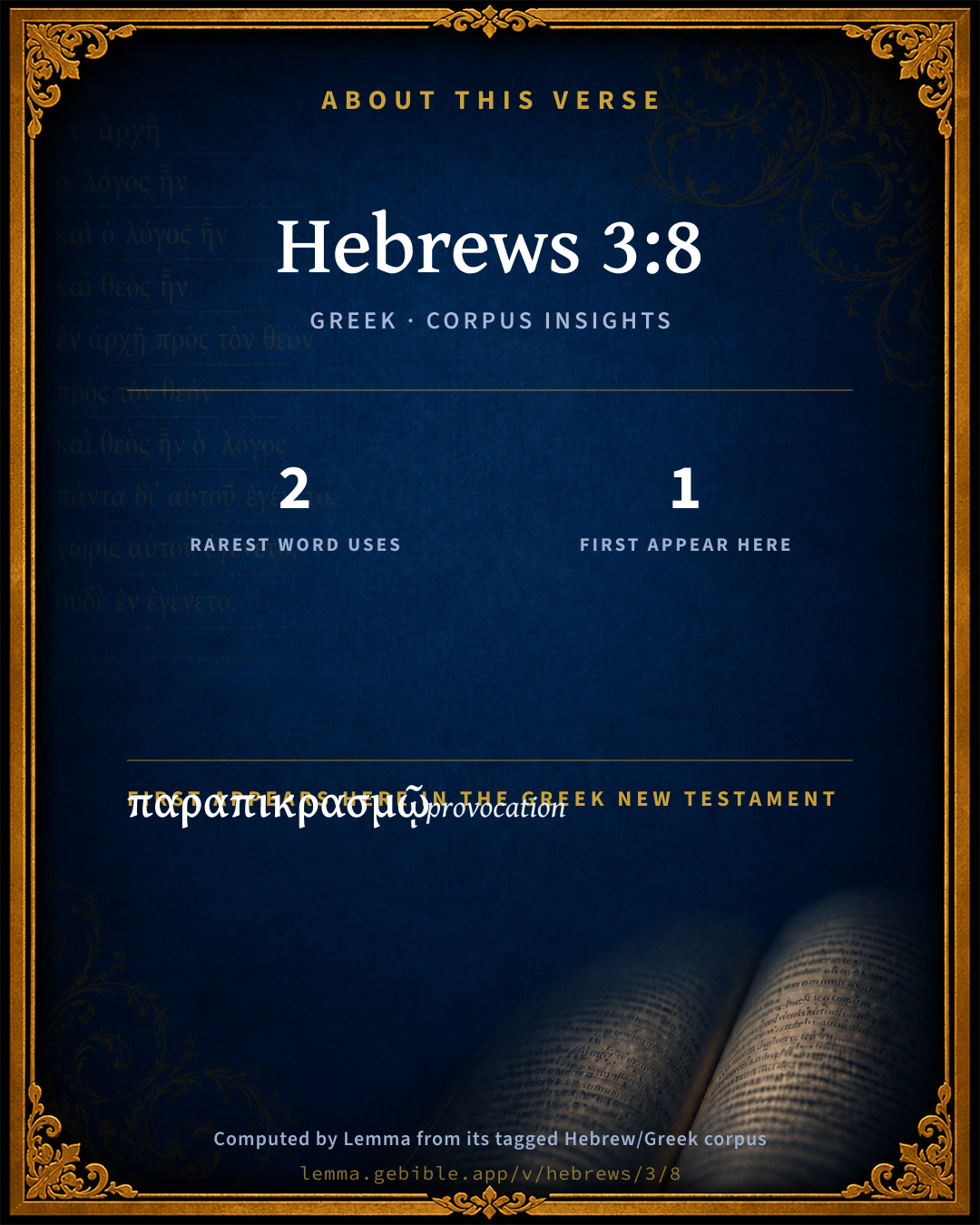
The rarest word here is παραπικρασμῷ provocation G3894 — appearing just 2 times in the whole Greek New Testament.

First appearance in Scripture

This word makes its first canonical appearance in the Greek New Testament here:

  • παραπικρασμῷ provocation G3894

Shared distinctive vocabulary

παραπικρασμῷ provocation G3894 occurs in 2 verses of the Greek New Testament. Also found in:
Repetition

Words recur within this verse:

Cross-references

26

Topical passages linked to Hebrews 3:8 in the Treasury of Scripture Knowledge — connected by theme and wording, ordered by reader-vote popularity; previews shown in the World English Bible.

  • Proverbs 28:14 Blessed is the man who always fears; But one who hardens his heart falls into trouble.
  • Exodus 17:7 He called the name of the place Massah, and Meribah, because the children of Israel quarreled, and because they tested Yahweh, saying, "Is Yahweh among us, or not?"
  • Zechariah 7:11–12 But they refused to listen, and turned their backs, and stopped their ears, that they might not hear.
  • Matthew 13:15 For this people's heart has grown callous, Their ears are dull of hearing, They have closed their eyes; Or else perhaps they might perceive with their eyes, Hear with their ears, Understand with their heart, And should turn again; And I would heal them.'
  • Psalms 78:18 They tempted God in their heart By asking food according to their desire.
  • Psalms 78:56 Yet they tempted and rebelled against the Most High God, And didn't keep his testimonies;
  • Jeremiah 7:26 yet they didn't listen to me, nor inclined their ear, but made their neck stiff: they did worse than their fathers.
  • Ezekiel 3:7–9 But the house of Israel will not listen to you; for they will not listen to me: for all the house of Israel are of hard forehead and of a stiff heart.
  • Daniel 5:20 But when his heart was lifted up, and his spirit was hardened so that he dealt proudly, he was deposed from his kingly throne, and they took his glory from him:
  • Exodus 8:15 But when Pharaoh saw that there was a respite, he hardened his heart, and didn't listen to them, as Yahweh had spoken.
  • Job 9:4 God who is wise in heart, and mighty in strength: Who has hardened himself against him, and prospered?
  • Proverbs 29:1 He who is often rebuked and stiffens his neck Will be destroyed suddenly, with no remedy.
  • Hebrews 3:12–13 Beware, brothers, lest perhaps there be in any one of you an evil heart of unbelief, in falling away from the living God;
  • Deuteronomy 6:16 You shall not tempt Yahweh your God, as you tempted him in Massah.
  • Deuteronomy 9:22–24 At Taberah, and at Massah, and at Kibroth-hattaavah, you provoked Yahweh to wrath.
  • 2 Chronicles 36:13 He also rebelled against king Nebuchadnezzar, who had made him swear by God: but he stiffened his neck, and hardened his heart against turning to Yahweh, the God of Israel.
  • Psalms 106:14 But gave in to craving in the desert, And tested God in the wasteland.
  • Numbers 14:11 Yahweh said to Moses, How long will this people despise me? and how long will they not believe in me, for all the signs which I have worked among them?
  • 1 Samuel 6:6 Why then do you harden your hearts, as the Egyptians and Pharaoh hardened their hearts? When he had worked wonderfully among them, didn't they let the people go, and they departed?
  • Nehemiah 9:16 But they and our fathers dealt proudly and hardened their neck, and didn't listen to your commandments,
  • Acts 19:9 But when some were hardened and disobedient, speaking evil of the Way before the multitude, he departed from them, and separated the disciples, reasoning daily in the school of Tyrannus.
  • Romans 2:5–6 But according to your hardness and unrepentant heart you are treasuring up for yourself wrath in the day of wrath, revelation, and of the righteous judgment of God;
  • 1 Corinthians 10:9 Neither let us test the Lord, as some of them tested, and perished by the serpents.
  • Numbers 14:22–23 because all those men who have seen my glory, and my signs, which I worked in Egypt and in the wilderness, yet have tempted me these ten times, and have not listened to my voice;
  • 2 Kings 17:14 Notwithstanding, they would not hear, but hardened their neck, like the neck of their fathers, who didn't believe in Yahweh their God.
  • 2 Chronicles 30:8 Now don't you be stiff-necked, as your fathers were; but yield yourselves to Yahweh, and enter into his sanctuary, which he has sanctified forever, and serve Yahweh your God, that his fierce anger may turn away from you.

Cross-references courtesy of OpenBible.info (CC BY 4.0).

Commentary

Notes on Hebrews 3:8 from classic Christian and Jewish commentators (each source and its license shown beneath its notes). The classic Christian expositions comment on the surrounding passage and are grouped to its opening verse, so a note may address several verses; the Jewish commentaries on the Tanakh (Rashi and others) are per-verse, so they appear only where the commentator wrote on this verse.

Lemma curates 59 commentaries, every one of them public domain or Creative Commons licensed, each selected and text-cleaned for this edition rather than reprinted as found. About our sources →

Tyndale Open Study Notes

Tyndale Open Resources

3:8 Israel . . . rebelled and tested God in places such as Massah and Meribah, where there was a shortage of water (Exod 17:1-7; Num 20:2-13), and especially at Kadesh, where the disobedient Israelites refused to enter the Promised Land (Heb 3:10; see Num 14:1-25; Deut 1:19-46; Ps 106).

Tyndale Open Study Notes — © Tyndale Open Resources, licensed CC BY-SA 4.0. Text via the HelloAO Bible API.

Bengel's Gnomon

Johann Albrecht Bengel

Heb 3:8. Παραπικρασμῷ—πειρασμοῦ, in the provocation—in the temptation) By Chiasmus, in Heb 3:9, as compared with Heb 3:8, temptation is first treated, then provocation; ὕστερον πρότερον ἑβραιδὸν, as Franc. Junius says, when he observed the same figure occurring several times in this epistle. Both refer to the History, Exo 17:7, as the first offence; comp. below Heb 3:16, they that came (went) out. The first offence ought to be guarded against; for more very easily spring up from it, and the first is wont to be most severely reproved.—κατὰ, according to) that is, as in the day. So the Hebrew text.—ἐν τῇ ἐρήμῳ, in the wilderness) the theatre of very great events.

Bengel's Gnomon of the New Testament — English translation (T&T Clark, Edinburgh, 1860) — public domain. Text from a community e-Sword module.

Meyer's Critical & Exegetical Commentary

Heinrich August Wilhelm Meyer

Heb_3:8. Harden not your hearts, as in the provocation (contumacy), on the day of temptation in the wilderness. In the original, παραπικρασμός and πειρασμός are proper names (as at Meribah, as on the day of Massah in the wilderness [כִּמְרִיבָה כְּיו̇ם מַסָּה בַּמִּדְבָּר]), which, however, are understood by the author in the appellative sense (comp. Heb_3:16), in that he takes κατὰ τὴν ἡμέραν τοῦ πειρασμοῦ as an epexegetical note of time to ἐν τῷ παραπικρασμῷ. On the history, comp. Exo_17:1-7; Num_20:1-13.

τοῦ πειρασμοῦ] in the active sense: the tempting of God by contumacious behaviour, comp. Heb_3:9.

Meyer — Critical and Exegetical Commentary on the New Testament — English translation by Peter Christie, edited by Frederick Crombie (T&T Clark, 1880) — public domain. Text from a community e-Sword module.

Expositor's Greek Testament

ed. W. Robertson Nicoll

Heb 3:8 . μὴ σκληρύνητε , the prohibitory subjunctive, v . Burton, p. 162. “The figure is from the stiffening by cold or disease, of what ought to be supple and pliable” (Vaughan). [The verb occurs first in Hippocrates, cf. Anz . 342.] It is ascribed to τὸν τράχηλον (Deu 10:16 ), τὸν νῶτον (2Ki 17:14 ), τὴν καρδίαν (Exo 4:21 ), τὸ πνεῦμα (Deu 2:30 ). Sometimes the hardening is referred to the man, sometimes it is God who inflicts the hardening as a punishment. Here the possible hardening is spoken of as if the human subject could prevent it. τὰς καρδίας , the whole inner man. ὡς ἐν τῷ … ἐρήμῳ . This stands in the psalm as the translation of the Hebrew which might be rendered: [“Harden not your hearts] as at Meribah , as on the day of Massah in the wilderness,” Meribah being represented by παραπικρασμός and Massah by πειρασμός . The tempting of God by Israel in the wilderness is recorded in Exo 17:1-7 , where the place is called “Massah and Meribah”. This occurred in the first year of the wanderings. παραπικρασμός is found only in this psalm (although παραπικραίνειν is frequent) its place being taken by λοιδόρησις in Exo 17:7 and by ἀντιλογία in Num 20:12 . It means “embitterment,” “exacerbation,” “exasperation”, κατὰ τὴν ἡμέραν is rendered by the Vulgate “secundum diem,” rightly. It means “after the manner of the day”. Westcott, however, prefers the temporal sense.

The Expositor's Greek Testament, edited by W. Robertson Nicoll (1897–1910) — public domain. Text from a community e-Sword module.

Geneva Bible (1599)

Geneva Bible translators

In the day that they vexed the Lord, or strove with him.

Geneva Bible (1599) marginal notes — public domain. Text via Bolls.life.

Jamieson, Fausset & Brown

Robert Jamieson, A. R. Fausset & David Brown

Harden not your hearts--This phrase here only is used of man's own act; usually of God's act (Rom 9:18). When man is spoken of as the agent in hardening, the phrase usually is, "harden his neck," or "back" (Neh 9:17).

provocation . . . temptation--"Massah-meribah," translated in Margin "tentation . . . chiding," or "strife" (Exo 17:1-7). Both names seem to refer to that one event, the murmuring of the people against the Lord at Rephidim for want of water. The first offense especially ought to be guarded against, and is the most severely reproved, as it is apt to produce many more. Num 20:1-13 and Deu 33:8 mention a second similar occasion in the wilderness of Sin, near Kadesh, also called Meribah.

in the day--Greek, "according to the day of."

Jamieson, Fausset & Brown — Commentary Critical and Explanatory on the Whole Bible (1871) — public domain (CC PDM 1.0). Text via the HelloAO Bible API.

Adam Clarke's Commentary

Verse 8. Harden not your hearts] Which ye will infallibly do, if ye will not hear his voice.

Provocation] παραπικρασμος. From παρα, signifying intensity, and πικραινω, to make bitter; the exasperation, or bitter provocation. "The Israelites provoked God first in the wilderness of Sin, (Pelusium,) when they murmured for want of bread, and had the manna given them, Ex 16:4. From the wilderness of Sin they journeyed to Rephidim, where they provoked God a second time for want of water, and insolently saying, Is the Lord God among us or not? Ex 17:2-9, on which account the place was called Massah and Meribah. See "1Co 10:4", note 1. From Rephidim they went into the wilderness of Sinai, where they received the law, in the beginning of the third year from their coming out of Egypt. Here they provoked God again, by making the golden calf, Ex 32:10. After the law was given they were commanded to go directly to Canaan, and take possession of the promised land, De 1:6; De 1:7: God spake unto us in Horeb, saying, Ye have dwelt long enough in this mount: turn you, and take your journey, and go to the mount of the Amorites, and unto all the places nigh thereunto, in the plain, in the hills, and in the vales, and in the south, and by the seaside, to the land if the Canaanites, and unto Lebanon, and unto the great river, the river Euphrates. The Israelites, having received this order, departed from Horeb, and went forward three days' journey, Nu 10:33, till they came to Taberah, Nu 11:3, where they provoked God the fourth time, by murmuring for want of flesh to eat; and for that sin were smitten with a very great plague, Nu 11:33; this place was called Kibroth-hattaavah, because there they buried the people who lusted. From Kibroth-hattaavah they went to Hazeroth, Nu 11:35, and from thence into the wilderness of Paran, Nu 12:16, to a place called Kadesh, Nu 13:26. Their journey from Horeb to Kadesh is thus described by Moses, De 1:19-21: And when we departed from Horeb, we went through all that great and terrible wilderness, which you saw by the way of the mountain of the Amorites, as the Lord our God commanded us; and, we came to Kadesh-barnea. And I said unto you, Ye are come unto the mountain of the Amorites, which the Lord our God doth give unto us. Behold, the Lord thy God hath set the land before thee; go up and possess it. But the people proposed to Moses to send spies, to bring them an account of the land, and of its inhabitants, De 1:22. These after forty days returned to Kadesh; and, except Caleb and Joshua, they all agreed in bringing an evil report of the land, Nu 13:25-32; whereby the people were so discouraged that they refused to go up, and proposed to make a captain, and return into Egypt, Nu 14:4. Wherefore, having thus shown an absolute disbelief of God's promises, and an utter distrust of his power, he sware that not one of that generation should enter Canaan, except Caleb and Joshua, but should all die in the wilderness, Nu 14:20; De 1:34; De 1:35; and ordered them to turn, and get into the wilderness, by the way of the Red Sea. In that wilderness the Israelites, as Moses informs us, sojourned thirty-eight years, De 2:14: And the space in which we came from Kadesh-barnea, until we were come over the brook Zereb, was thirty and eight years; until all the generation of the men of war were wasted out from among the host, as the Lord sware unto them. Wherefore, although the Israelites provoked God to wrath in the wilderness, from the day they came out of the land of Egypt until their arrival in Canaan, as Moses told them, De 9:7, their greatest provocation, the provocation in which they showed the greatest degree of evil disposition, undoubtedly was their refusing to go into Canaan from Kadesh. It was therefore very properly termed the bitter provocation and the day of temptation, by way of eminence; and justly brought on them the oath of God, excluding them from his rest in Canaan. To distinguish this from the provocation at Rephidim, it is called Meribah-Kadesh," De 32:51. See Dr. Macknight.

Adam Clarke's Commentary on the Bible (1810–1826) — public domain. Text from a community e-Sword/MySword module.

John Calvin's Commentaries

8. Then follows, Harden not your hearts By which words is intimated that our rebellion against God flows from no other fountain than willful wickedness, by which we obstruct the entrance of his grace, We have indeed by nature a heart of stone, and there is in all an innate hardness from the womb, which God alone can mollify and amend. That we, however, reject the voice of God, it happens through a spontaneous obstinacy, not through an external impulse, a fact of which every one is a witness to himself. Rightly, then, does the Spirit accuse all the unbelieving that they resist God, and that they are the teachers and authors of their own perverseness, so that they can throw the blame on none else. It is hence, however, absurdly concluded that we have, on the other hand, a free power to form the heart for God’s service; nay rather, it must ever be the case with men, that they harden their heart until another be given them from heaven; for as we are bent towards wickedness, we shall never cease to resist God until we shall be tamed and subdued by his hand.

As in the provocation, etc. It was for two reasons necessary for them to be reminded of the disobedience of their fathers; for as they were foolishly inflated on account of the glory of their race, they often imitated the vices of their fathers as though they were virtues, and defended themselves by their examples; and further, when they heard that their fathers were so disobedient to God, they were thus more fully taught that this admonition was not superfluous. As both these reasons existed even in the Apostle’s time, he readily accommodated to his own purpose what had been formerly said by David, in order that those whom he addressed might not imitate their fathers too much.

And hence may be learnt a general truth, that we are not to defer too much to the authority of the fathers lest it should draw us away from God; for if any fathers have ever been worthy of honor, no doubt the Jews possessed that preeminence; and yet David distinctly commanded their children to beware of being like them.

And I have no doubt but that he referred to the history recorded in Exodus 17: for David uses here the two names which Moses relates were given to a certain place, מרבה Meribah, which means strife or provocation, and מסה Massah, which means temptation. They tempted God by denying that he was in the midst of them, because they were distressed for want of water; and they also provoked him by contending with Moses. Though indeed they gave many examples of unbelief, yet David selected this in an especial manner, because it was more memorable then any other, and also, because in order of time it followed for the most part the rest, as it evidently appears from the fourth book of Moses, where from chap. 10 to 20 a series of many temptations is described; but this narrative is given in the twentieth chapter. This circumstance increased not a little the atrocity of their wickedness; for they had often experienced the power of God, and yet they perversely contended with him, and renounced all confidence in him: how great was their ingratitude! He then mentioned one particular instance instead of many.

John Calvin's Commentaries (1540-1563) — public domain. Text from the Calvin Translation Society English edition (1840s-50s) via the Christian Classics Ethereal Library (ccel.org). Calvin's coverage is partial (roughly two-thirds of the Bible); uncommented books and verses are honest gaps, never fabricated. The 19th-century editor's footnotes and remarks are omitted so the notes are faithfully Calvin's own voice.

Ellicott's Commentary for English Readers

(8) In the day of temptation.—Better, like the day of the temptation. As in the LXX., so here, two words which in the Hebrew are proper names (“as at Meribah, and as in the day of Massah”) are translated according to their intrinsic meaning. (For the former see Exo_17:7; Num_20:13; and for the latter Exo_17:7.) We may believe that these places are here chosen for reference partly on account of their significant names; but it is noteworthy that the rebellions recorded in the names belonged to the beginning and to the close of the years of wandering.

A Bible Commentary for English Readers, edited by Charles John Ellicott (1878–1897) — public domain. Text from a community e-Sword module.

The Cambridge Bible for Schools and Colleges

gen. ed. J. J. S. Perowne

8. harden not your hearts] Comp. Act_19:9. Usually God is said to harden man’s heart (Exo_7:3, &c.; Isa_63:17; Rom_9:18) an anthropomorphic way of expressing the inevitable results of neglect and of evil habit. But that this is man’s own doing and choice is always recognised (Deu_10:16; 2Ki_17:14, &c.).

as in the provocation] Lit., “in the embitterment.” The LXX. here seem to have read Marah (which means “bitter” and which they render by πικρία in Exo_15:23) for Meribah which, in Exo_17:1-7, they render by Loidoresis “reproach.” This is not however certain, for though the substantive does not occur again, the verb “I embitter” is frequently used of provoking God to anger. For the story of Meribah, see Num_20:7-13.

in the day of temptation] Rather, “of the temptation,” i.e. at Massah; Exo_17:7; Deu_6:16, though the allusion might also be to Numbers 14.

The Cambridge Bible for Schools and Colleges (gen. ed. J. J. S. Perowne; Cambridge University Press, 1878–1918) — public domain. Text from a community e-Sword module.

John Gill's Exposition

Harden not you hearts,.... There is a natural hardness of the heart; the heart of man is like a stone, destitute of spiritual life, motion, and activity; it is senseless, stupid, impenitent, stubborn, and inflexible, on which no impressions can be made, but by powerful grace: and there is an acquired, habitual, and voluntary hardness of heart, to which men arrive by various steps; as entertaining pleasing thoughts of sin; an actual commission of it, with frequency, till it becomes customary, and so habitual; an extenuation or justification of it, and so they become hardened against all reproofs and sermons, and to all afflictions and judgments; are insensible and past feeling, and openly declare for sin, and glory in it: and there is a hardness which God's people are liable to, and should guard against; and which is brought on by a neglect of private and public worship, and by keeping bad company, and through the ill examples of others, and by giving way to lesser sins; for all sin is of an hardening nature:

as in the provocation, in the day of temptation in the wilderness; the Jews provoked God in the wilderness by their unbelief, murmurings, ingratitude, and idolatry; and they tempted him there by distrusting his power and goodness; hence one of the places in which they murmured against him was called Massah and Meribah, Exo 17:7 and it is an aggravation of their sin, that it was in the wilderness, after they had been just brought out of bondage into liberty, and had lately had such an instance of the power and goodness of God, in bringing them through the Red sea; and where they could have no human supplies, and therefore should have been entirely dependent on God, and trust in him.

John Gill's Exposition of the Whole Bible (1746–1763) — public domain (CC PDM 1.0). Text via the HelloAO Bible API.

Trapp's Complete Commentary

John Trapp

8 Harden not your hearts, as in the provocation, in the day of temptation in the wilderness:

Ver. 8. Harden not your hearts] Some hearts are so hard that neither ministry, nor misery, nor miracle, nor mercy can possibly mollify them. Such a heart is in some respects worse than hell. And if God broke David’s bones for his adultery, and the angels’ backs for their pride, the Lord, if ever he save any, will break his heart too. As when he marks out a man for eternal misery, he denies him his grace; and then the sinner hardens his own heart by his own inward depravity. Like as when an owner denies to prop up or repair a ruinous reeling house, the house falls by its own ponderousness.

John Trapp, A Commentary or Exposition upon All the Books of the Old and New Testament (1647–1656) — public domain. Text from a community e-Sword module.

Albert Barnes' Notes on the Bible

Harden not your hearts - Do not render the heart insensible to the divine voice and admonition. A hard heart is that where the conscience is seared and insensible; where truth makes no impression; where no religious effect is produced by afflictions; where preaching is listened to without interest; and where the mind is unaffected by the appeals of friends. The idea here is, that a refusal to listen to the voice of God is connected with a hardening of the heart. It is in two ways:

The very refusal to do this tends to harden it. And,

(2)In order to resist the appeals of God, people must resort to the means of “voluntarily” hardening the heart. This they do by setting themselves against the truth; by the excuses which they offer for not becoming Christians: by plunging into sin in order to avoid serious impressions; and by direct resistance of the Holy Spirit. No inconsiderable part of the efforts of sinners consists in endeavoring to produce insensibility in their minds to the truth and the appeals of God.

As in the provocation - Literally, “in the embittering” - ἐν τῶ παραπικρασμῶ en tō parapikrasmō. Then it means what embitters or provokes the mind - as disobedience. Here it refers to what they did to “embitter” the mind of God against them; that is to the course of conduct which was adopted to provoke him to wrath.

In the day of temptation - In the time of temptation - the word “day” being used here, as it is often, to denote an indefinite period, or “time” in general. The word “temptation” here refers to the various provocations by which they “tried” the patience of God. They rebelled against him; they did what put the divine patience and forbearance to a trial. It does not mean that they tempted God to do evil, but that his long-suffering was “tried” by their sins.

In the wilderness - The desert through which they passed. The word “wilderness” in the Scriptures commonly means a “desert;” see the notes at Mat 3:1. “One provocation was in demanding bread at Sin; a second for want of water at Massah or Meribah; a third time at Sinai with the golden calf; a fourth time at Taberah for want of flesh; a fifth time at Kadesh when they refused to go up into Canaan, and the oath came that they should die in the wilderness. A like refusal may prevent us from entering into rest.” - Dr. John P. Wilson, Manuscript Notes.

Albert Barnes' Notes on the Bible (1834–1885) — public domain. Text from a community e-Sword/MySword module.

Haydock's Catholic Bible Commentary

This alludes to the 17th chapter of Exodus, where the history of provocations and contradictions of the Israelites is related at large.

George Leo Haydock (1774–1849), Haydock's Catholic Family Bible and Commentary, 1859 edition — public domain. Excludes Psalms (Douay-Rheims chapter numbering differs from Protestant) and Deuterocanonical books (Catholic canon only).

Matthew Poole's English Annotations

Harden not your hearts: to help in the former duty the Spirit subjoins this negative counsel. That is styled hard, which will not yield to any impression: make not your heart a stone, so as not to understand, believe, or obey God’s voice to it, Deu 15:17; 1Sa 6:6; for God requires them to be fleshy tables, to write his will on, 2Co 3:3. The hardening of this part is the hardening of the whole person, and when hardened by themselves, is provoking God’s judicial hardening of them to their destruction.

As in the provocation; en tw parapikrasmw, in the bitter contention, comprehending in it both work, season, and place; called Meribah, Num 20:13,14; names of places and persons by words of the same signification, though not of the same sound.

In the day of temptation in the wilderness; in the day of Massah, when Israel in the wilderness did murmur, and strive against, and vexed God, (after he had divided the sea for them), for their want of water, Exo 17:2,7; Deu 6:16; 33:8; that bitter contest of unbelief after the sight of so many miracles, when they cried out: Is the Lord among us? Psa 95:8. It may also refer to the whole forty years’ time of their murmuring and tempting him in the wilderness.

Matthew Poole's English Annotations on the Holy Bible (1683–1685) — public domain. Text from a community e-Sword/MySword module.

Whedon's Commentary on the Bible

Daniel D. Whedon

8. Provocation… temptation—In Exo_17:7, at the smiting of the rock to bring water for the murmuring people, it is said that Moses “called the name of the place Massah, [temptation,] and Meribah, [bitterness,] because of the chiding of the children of Israel, and because they tempted the Lord, saying, Is the Lord among us or not.” The word provocation, here, is the Septuagint translation of Meribah, and temptation of Massah.

Wilderness—Of Zin.

Daniel D. Whedon (gen. ed.), Commentary on the Old and New Testaments (1874–1909) — public domain. Text from a community e-Sword module.

John Wesley's Explanatory Notes

As in the provocation - When Israel provoked me by their strife and murmurings. In the day of temptation - When at the same time they tempted me, by distrusting my power and goodness. Exod. xvii, 7.

John Wesley, Explanatory Notes Upon the Whole Bible (1754–1765) — public domain. Text via the GEBible commentary corpus.

The People's New Testament

B. W. Johnson

8. Harden not your hearts. To harden the heart is to reach such a state that God's voice makes no impression. As in the provocation. The Hebrew of the Psalm says Like Meribah. The meaning is “Harden not your hearts as our fathers did at Meribah.” See the account in Exod. 17:1–7. See also Num. 27:14, where Kadesh Meribah is named. Both may be referred to. Day of temptation. Day of trial.

B. W. Johnson's The People's New Testament with Notes (1889–1891) — public domain. Electronic text from the Christian Classics Ethereal Library (CCEL) ThML edition.

Cambridge Greek Testament for Schools and Colleges

8. μὴ σκληρύνητε. Comp. Act 19:9. Usually God is said to harden man’s heart (Exo 7:3, &c.; Isa 63:17; Rom 9:18), an anthropomorphic way of expressing the inevitable results of neglect and of evil habit. But that this is man’s own doing and choice is always recognised (Deu 10:16; 2Ki 17:14, &c.).

ὡς ἐν τῷ παραπικρασμῷ. Lit., “in the embitterment.” Heb. כִּמְרִיבָה. The LXX. here seem to have read Marah (which means “bitter” and which they render by Πικρία in Exo 15:23) for Meribah which, in Exo 17:1-7, they render by Λοιδόρησις “reproach.” This is not however certain, for though the substantive does not occur again, the verb παραπικράζω is frequently used of provoking God to anger. For the story of Meribah, see Num 20:7-13.

τοῦ πειρασμοῦ, “of the temptation,” i.e. at Massah; Exo 17:7; Deu 6:16, though the allusion might also be to Numbers 14.

Cambridge Greek Testament for Schools and Colleges (Cambridge University Press, 1896; 21 vols, various authors incl. Carr, Maclear, Plummer, Farrar, Lumby, Moule, M. R. James, Simcox) — public domain. Text from a community e-Sword module.

Vincent's Word Studies in the New Testament

Marvin R. Vincent

Harden not [μη σκληρυνητε] . In N. T. mostly in this epistle. Comp. Act 19:9; Rom 9:18, see note. The group of kindred words consists of sklhrov hard (see on Matthew 25; 24; Jude 1:14); sklyrothv hardness (Rom 2:5); sklhrunein to harden (Act 19:9; Rom 9:18); and the compounds sklhrokardia hardness of heart (Mt 19:8; Mr 10:5), and sklhrotrachlov stiff - necked (Acts 7; 5). All occur in LXX, with the addition of sklhrwv hardly, painfully (not in N. T.). In the provocation [εν τω παραπικρασμω] . Only here and ver. 15. In LXX only Psa 94:8. The verb parapikraineinto provoke, only in ver. 16. Often in LXX The simple verb pikrainein to make bitter, Col 3:19; Rev 8:11; Rev 10:9, 10. From pikrov bitter, pungent : hence to stir up to bitterness, to irritate. Comp. LXX Eze 2:4. In the day (kata thn hJmeran). Kata in a temporal sense, as Act 12:1; Act 19:23; Act 27:27. Comp. kat' ajrcav in the beginning, ch. 1 10. Of temptation [του πειρασμου] . Rend. "of the temptation," referring to a definite event, the murmuring against Moses at Rephidim on account of the lack of water, Exo 17:1 - 7. In that passage the LXX gives for the two proper names Massah and Meribah, peirasmov temptation, which is correct, and loidorhsiv railing or reviling, which is loose, since Meribah signifies strife. 181 In Psalm 94, LXX renders Meribah parapikrasmov provocation, which is inexact, and Massah peirasmov temptation, which is correct.

Marvin R. Vincent, Word Studies in the New Testament (1887–1900) — public domain. Text from a community e-Sword/MySword module.

Lesson kit

Teaching starters — assembled from the data on this page, not authored interpretation. Every prompt links to the verse data it draws on. Edit before teaching.

Hebrews, in the General Epistles, opens this verse with 17 words (12 distinct Greek lemmas). Its most distinctive word is parapikrasmós (“provocation”). A historical commentator’s framing appears above. Read the whole chapter for the surrounding context.

Discussion questions

  1. How does “provocation” (parapikrasmós) shape what this verse is saying?
  2. This is the first place “provocation” appears in Scripture (first appears here). What does its debut here establish?
  3. How does Hebrews 3:15, which shares the word «provocation», read alongside this verse?
  4. What does the repetition of “the” (5× in this one verse) do in this verse?
  5. These translations render this verse differently; the difference is in the English rendering, not the original. What questions does that raise?
  6. Compare how Tyndale Open Study Notes and Bengel's Gnomon read this verse. Where do they agree or differ?

Things to notice

  • 1 word makes its first canonical appearance in Scripture here.
  • These translations choose different wording for 7 words in this verse.
  • “the” occurs 5× in this single verse.
  • 12 distinct Greek lemmas span 17 words in this verse.

Reading settings

Reading text

Shown beneath each verse's original-language words.

Old Testament
Old Testament edition

Read the OT as the Masoretic Hebrew (MT) or the Greek Septuagint (LXX).

English shown for the Greek Septuagint (in the Hebrew ↔ Greek comparison).

Comparing translations? Open the Compare panel on any verse page to stack up to four side by side.