

Mark 7:21
Greek (Tischendorf 8th ed.) Mark 7:21 appears in the Greek New Testament. The text above is from the Tischendorf 8th edition. Each word links to its Strong’s number and a concise gloss. Click any word for its full Thayer’s Greek Lexicon entry.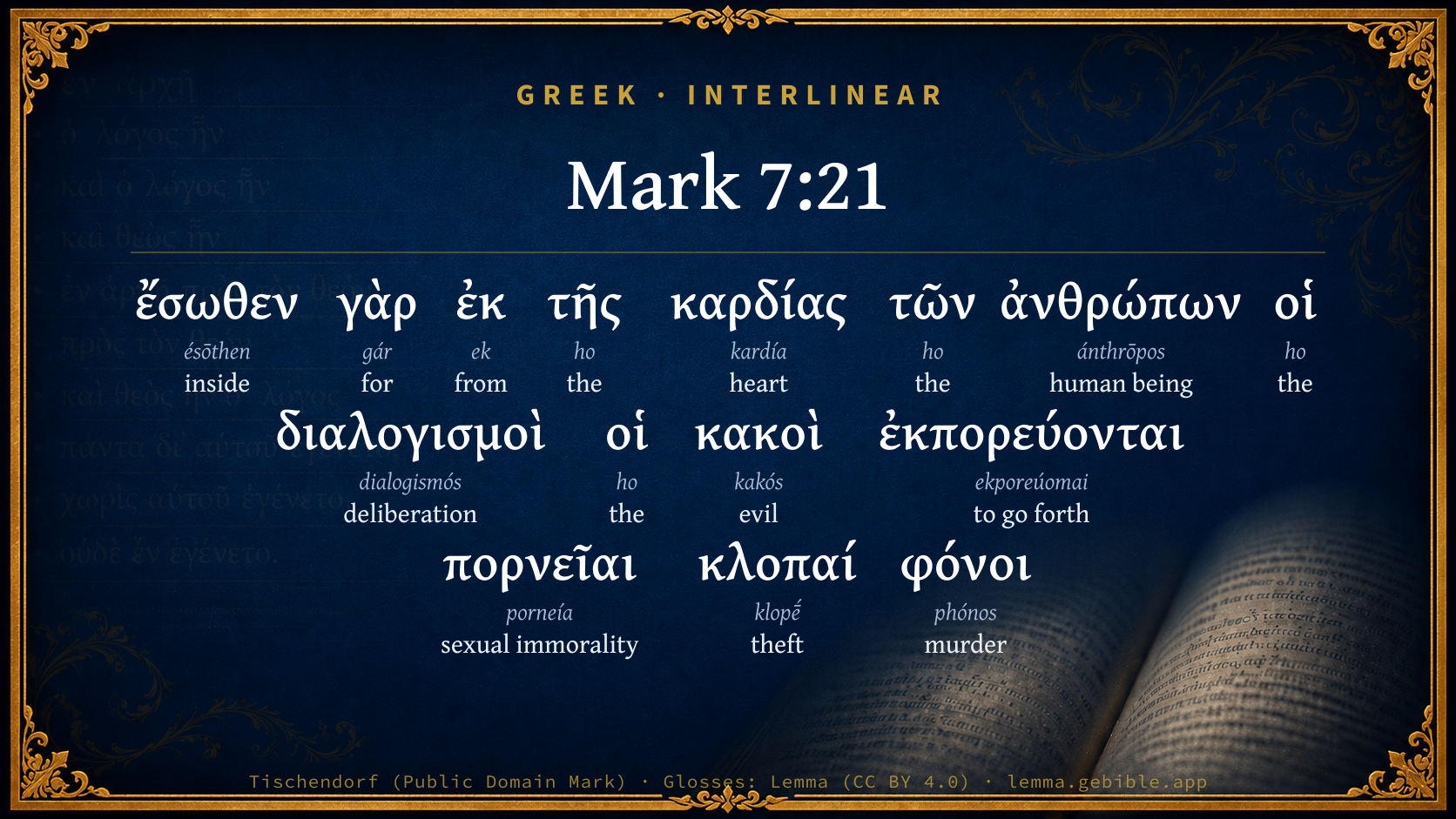
For from within, out of the hearts of men, proceed evil thoughts, adulteries, sexual sins, murders, thefts,
Download a study sheet
One document with this verse’s original text, its word-by-word gloss line, the meaning frame, cross-references with their text, attributed commentary, and full source and license credits — printable, and it pastes into notes with its structure intact.
This verse Autodidact and up
A passage Seminary Student
Up to 50 verses in one chapter. A passage sheet keeps up to 6 commentary sources and 12 cross-references per verse, in the order this page ranks them, and says so on the sheet whenever that leaves anything out. Ask for a single verse and you get the Autodidact verse sheet above.
Everything on this page stays free to read, with no account — the sheet is a download of what is already on screen, not access to it.
Compare translations 3
The same verse in 3 English versions, stacked beneath the original-language interlinear above. Click any original word for its lexicon entry.
Each is an independent rendering of the whole verse — the interlinear is not word-aligned to these translations.
Highlighted words mark where these versions differ — a whole-verse word diff, not a word-by-word alignment.
-
World English Bible Public Domain
For from within, out of the hearts of men, proceed evil thoughts, adulteries, sexual sins, murders, thefts,
-
King James Version Public Domain
For from within, out of the heart of men, proceed evil thoughts, adulteries, fornications, murders,
-
unfoldingWord Literal Text CC BY-SA 4.0
For from within, from the heart of men, come out evil thoughts, sexual immorality, thefts, murders,
unfoldingWord Literal Text — © unfoldingWord, licensed CC BY-SA 4.0. Word-aligned USFM3 via Door43 (git.door43.org/unfoldingWord/en_ult).
Show all 19 translations
Every available English version of this verse, each an independent rendering of the whole verse.
-
World English Bible Public Domain
For from within, out of the hearts of men, proceed evil thoughts, adulteries, sexual sins, murders, thefts,
-
Berean Standard Bible Public Domain
For from within the hearts of men come evil thoughts, sexual immorality, theft, murder, adultery,
-
Majority Standard Bible Public Domain
For from within the hearts of men come evil thoughts, adultery, sexual immorality, murder, theft,
-
King James Version Public Domain
For from within, out of the heart of men, proceed evil thoughts, adulteries, fornications, murders,
-
American Standard Version (1901) Public Domain
For from within, out of the heart of men, evil thoughts proceed, fornications, thefts, murders, adulteries,
-
Revised Version (1885) Public Domain
For from within, out of the heart of men, evil thoughts proceed, fornications, thefts, murders, adulteries,
-
Geneva Bible (1599) Public Domain
For from within, euen out of the heart of men, proceede euill thoughtes, adulteries, fornications, murthers,
-
Douay-Rheims (1899) Public Domain
For from within out of the heart of men proceed evil thoughts, adulteries, fornications, murders,
-
Young's Literal Translation Public Domain
for from within, out of the heart of men, the evil reasonings do come forth, adulteries, whoredoms, murders,
-
Literal Standard Version CC BY-SA 4.0
for from within, out of the heart of men, the evil reasonings come forth, adulteries, whoredoms, murders,
-
Unlocked Literal Bible CC BY-SA 4.0
For from within a person, out of the heart, proceed evil thoughts, sexual immorality, theft, murder,
-
unfoldingWord Literal Text CC BY-SA 4.0
For from within, from the heart of men, come out evil thoughts, sexual immorality, thefts, murders,
-
Darby Bible Public Domain
For from within, out of the heart of men, go forth evil thoughts, adulteries, fornications, murders,
-
World Messianic Bible Public Domain
For from within, out of the hearts of men, proceed evil thoughts, adulteries, sexual sins, murders, thefts,
-
Webster's Bible Public Domain
For from within, out of the heart of men, proceed evil thoughts, adulteries, fornications, murders,
-
Free Bible Version CC BY-SA 4.0
It's from the inside, from people's minds, that evil thoughts come: sexual immorality, theft, murder, adultery,
-
Bible in Basic English Public Domain
Because from inside, from the heart of men, come evil thoughts and unclean pleasures,
-
Text-Critical English NT CC BY 4.0
For from within, from the hearts of men, come evil thoughts, adultery, fornication, murder,
-
Tyndale New Testament (1534) Public Domain
For from with in even oute of the herte of men proceade evill thoughtes: advantry fornicacion murder
Literal Standard Version (2020), Covenant Press — licensed CC BY-SA 4.0. Text via the HelloAO Bible API (eBible.org). Unlocked Literal Bible (unfoldingWord) — licensed CC BY-SA 4.0. Text via the HelloAO Bible API (eBible.org). unfoldingWord Literal Text — © unfoldingWord, licensed CC BY-SA 4.0. Word-aligned USFM3 via Door43 (git.door43.org/unfoldingWord/en_ult). Free Bible Version, Dr. Jonathan Gallagher — licensed CC BY-SA 4.0. Text via the HelloAO Bible API (eBible.org).
Word by word
More ways to search: Search by grammar → Find every occurrence → Compare this word →
Practice this passage: Drill this verse → Learn its vocabulary →
- Appears 2× in the Greek New Testament
- First appears at Matthew 15:19
- Part of Speech
- Noun
- Case
- Nominative
- Number
- Plural
- Gender
- Feminine
Full Thayer's Definition
- ἔσωθεν ésōthen G2081 “inside” Adverb
- γὰρ gár G1063 “for” Conjunction
- ἐκ ek G1537 “from” Preposition
- τῆς ho G3588 “the” Article, Genitive, Singular, Feminine
- καρδίας kardía G2588 “heart” Noun, Genitive, Singular, Feminine
- τῶν ho G3588 “the” Article, Genitive, Plural, Masculine
- ἀνθρώπων ánthrōpos G444 “human being” Noun, Genitive, Plural, Masculine
- οἱ ho G3588 “the” Article, Nominative, Plural, Masculine
- διαλογισμοὶ dialogismós G1261 “deliberation” Noun, Nominative, Plural, Masculine
- οἱ ho G3588 “the” Article, Nominative, Plural, Masculine
- κακοὶ kakós G2556 “evil” Adjective, Nominative, Plural, Masculine
- ἐκπορεύονται ekporeúomai G1607 “to go forth” Verb, Present, Middle or Passive deponent, Indicative, 3rd person, Plural
- πορνεῖαι porneía G4202 “sexual immorality” Noun, Nominative, Plural, Feminine
- κλοπαί klopḗ G2829 “theft” Noun, Nominative, Plural, Feminine
- φόνοι phónos G5408 “murder” Noun, Nominative, Plural, Masculine
About this verse
These counts appear in no published source. They are computed here, from the morphology-tagged text and Lemma’s own curated glosses. What Lemma adds →
- 15
- words
- 12
- distinct lemmas
- Gospels
- section
Cross-references
31Topical passages linked to Mark 7:21 in the Treasury of Scripture Knowledge — connected by theme and wording, ordered by reader-vote popularity; previews shown in the World English Bible.
- Jeremiah 17:9 The heart is deceitful above all things, and it is exceedingly corrupt: who can know it?
- Romans 8:7–8 because the mind of the flesh is hostile towards God; for it is not subject to God's law, neither indeed can it be.
- James 4:1–3 Where do wars and fightings among you come from? Don't they come from your pleasures that war in your members?
- Matthew 15:19 For out of the heart come forth evil thoughts, murders, adulteries, sexual sins, thefts, false testimony, and blasphemies.
- Galatians 5:19–21 Now the works of the flesh are obvious, which are: adultery, sexual immorality, uncleanness, lustfulness,
- Ezekiel 38:10 Thus says the Lord Yahweh: It shall happen in that day, that things shall come into your mind, and you shall devise an evil device:
- Acts 8:22 Repent therefore of this, your wickedness, and ask God if perhaps the thought of your heart may be forgiven you.
- Jeremiah 4:14 Jerusalem, wash your heart from wickedness, that you may be saved. How long shall your evil thoughts lodge within you?
- Matthew 9:4 Jesus, knowing their thoughts, said, "Why do you think evil in your hearts?
- James 2:4 haven't you shown partiality among yourselves, and become judges with evil thoughts?
- Proverbs 4:23 Keep your heart with all diligence, For out of it is the wellspring of life.
- Matthew 23:25–28 "Woe to you, scribes and Pharisees, hypocrites! For you clean the outside of the cup and of the platter, but within they are full of extortion and unrighteousness.
- Luke 16:15 He said to them, "You are those who justify yourselves in the sight of men, but God knows your hearts. For that which is exalted among men is an abomination in the sight of God.
- James 1:14–15 But each one is tempted, when he is drawn away by his own lust, and enticed.
- Psalms 14:3 They have all gone aside. They have together become corrupt. There is none who does good, no, not one.
- Psalms 53:3 Every one of them has gone back. They have become filthy together. There is no one who does good, no, not one.
- Psalms 58:2–3 No, in your heart you plot injustice. You measure out the violence of your hands in the earth.
- Isaiah 59:7 Their feet run to evil, and they make haste to shed innocent blood: their thoughts are thoughts of iniquity; desolation and destruction are in their paths.
- Genesis 6:5 Yahweh saw that the wickedness of man was great in the earth, and that every imagination of the thoughts of his heart was only evil continually.
- Genesis 8:21 Yahweh smelled the sweet savor. Yahweh said in his heart, "I will not again curse the ground any more for man's sake, because the imagination of man's heart is evil from his youth; neither will I ever again strike everything living, as I have done.
- Job 14:4 Who can bring a clean thing out of an unclean? Not one.
- Job 15:14–16 What is man, that he should be clean? He who is born of a woman, that he should be righteous?
- Job 25:4 How then can man be just with God? Or how can he who is born of a woman be clean?
- Psalms 14:1 The fool has said in his heart, "There is no God." They are corrupt. They have done abominable works. There is none who does good.
- Proverbs 15:25 Yahweh will uproot the house of the proud, But he will keep the widow's borders intact.
- Acts 5:4 While you kept it, didn't it remain your own? After it was sold, wasn't it in your power? How is it that you have conceived this thing in your heart? You haven't lied to men, but to God."
- Romans 7:8 But sin, finding occasion through the commandment, produced in me all kinds of coveting. For apart from the law, sin is dead.
- 1 Peter 4:2–3 that you no longer should live the rest of your time in the flesh for the lusts of men, but for the will of God.
- Psalms 53:1 The fool has said in his heart, "There is no God." They are corrupt, and have done abominable iniquity. There is no one who does good.
- Romans 7:5 For when we were in the flesh, the sinful passions which were through the law, worked in our members to bring forth fruit to death.
- Titus 3:3 For we were also once foolish, disobedient, deceived, serving various lusts and pleasures, living in malice and envy, hateful, and hating one another.
Cross-references courtesy of OpenBible.info (CC BY 4.0).
Lesson kit
Teaching starters — assembled from the data on this page, not authored interpretation. Every prompt links to the verse data it draws on. Edit before teaching.
Mark, in the Gospels, opens this verse with 15 words (12 distinct Greek lemmas). Its most distinctive word is klopḗ (“theft”). A historical commentator’s framing appears above. Read the whole chapter for the surrounding context.
Discussion questions
- The word klopḗ carries the sense “theft.” How does it shape the verse?
- How does Matthew 15:19, which shares the word «theft», read alongside this verse?
- What does the repetition of “the” (4× in this one verse) do in this verse?
- These translations render this verse differently; the difference is in the English rendering, not the original. What questions does that raise?
- Compare how Expositor's Greek Testament and The Cambridge Bible for Schools and Colleges read this verse. Where do they agree or differ?
Things to notice
- These translations choose different wording for 10 words in this verse.
- “the” occurs 4× in this single verse.
- 12 distinct Greek lemmas span 15 words in this verse.
Commentary
Notes on Mark 7:21 from classic Christian and Jewish commentators (each source and its license shown beneath its notes). The classic Christian expositions comment on the surrounding passage and are grouped to its opening verse, so a note may address several verses; the Jewish commentaries on the Tanakh (Rashi and others) are per-verse, so they appear only where the commentator wrote on this verse.
Lemma curates 59 commentaries, every one of them public domain or Creative Commons licensed, each selected and text-cleaned for this edition rather than reprinted as found. About our sources →
Expositor's Greek Testament
ed. W. Robertson Nicoll
The Expositor's Greek Testament, edited by W. Robertson Nicoll (1897–1910) — public domain. Text from a community e-Sword module.
The Cambridge Bible for Schools and Colleges
gen. ed. J. J. S. Perowne
The Cambridge Bible for Schools and Colleges (gen. ed. J. J. S. Perowne; Cambridge University Press, 1878–1918) — public domain. Text from a community e-Sword module.
John Gill's Exposition
John Gill's Exposition of the Whole Bible (1746–1763) — public domain (CC PDM 1.0). Text via the HelloAO Bible API.
Trapp's Complete Commentary
John Trapp
John Trapp, A Commentary or Exposition upon All the Books of the Old and New Testament (1647–1656) — public domain. Text from a community e-Sword module.
Cambridge Greek Testament for Schools and Colleges
Cambridge Greek Testament for Schools and Colleges (Cambridge University Press, 1896; 21 vols, various authors incl. Carr, Maclear, Plummer, Farrar, Lumby, Moule, M. R. James, Simcox) — public domain. Text from a community e-Sword module.
International Critical Commentary
International Critical Commentary — older volumes (1896–1929), various authors — public domain. Text from a community e-Sword module.
Vincent's Word Studies in the New Testament
Marvin R. Vincent
Marvin R. Vincent, Word Studies in the New Testament (1887–1900) — public domain. Text from a community e-Sword/MySword module.