
Revelation 18:7

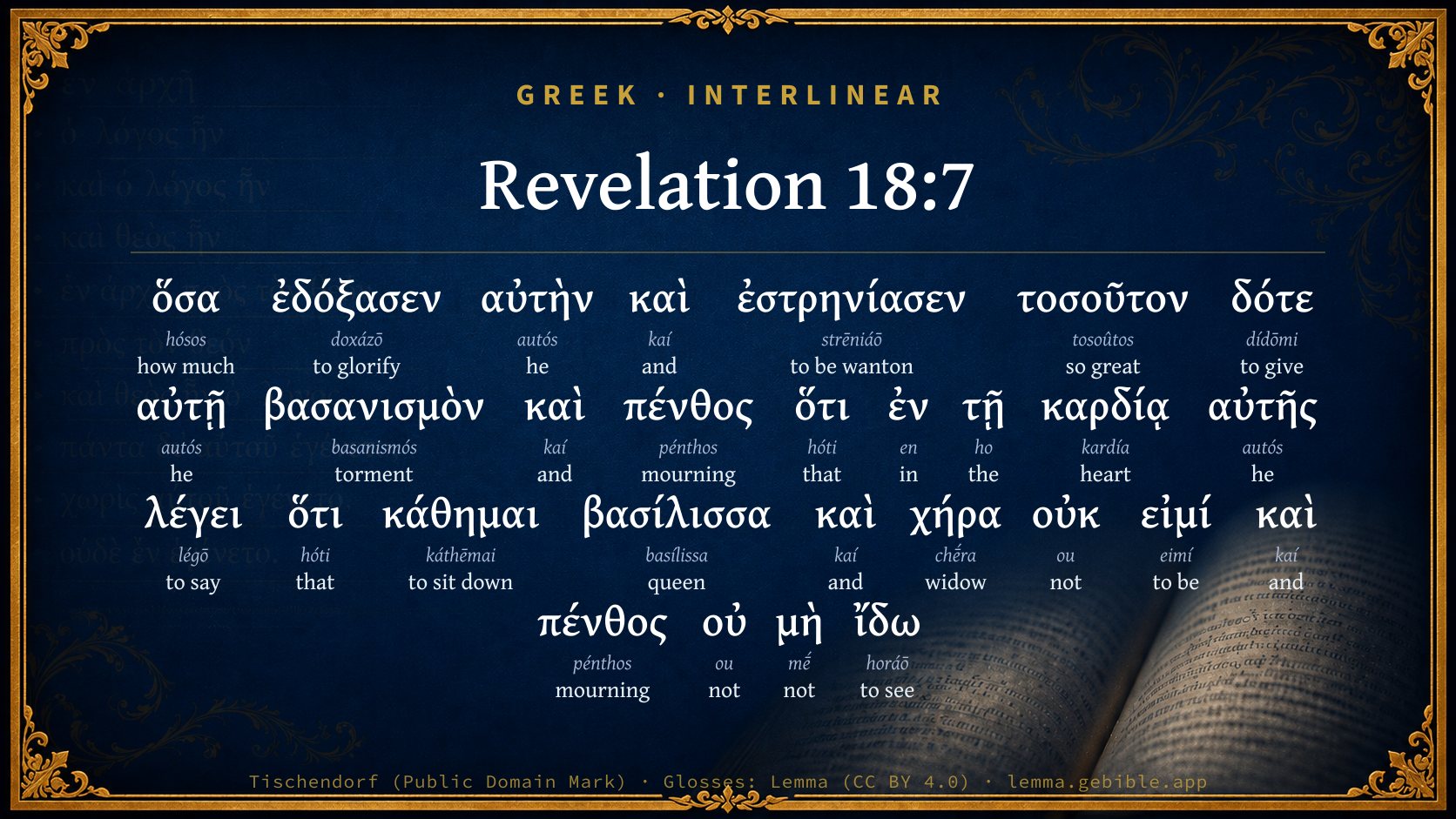
Greek (Tischendorf 8th ed.) Revelation 18:7 appears in the Greek New Testament. The text above is from the Tischendorf 8th edition. Each word links to its Strong’s number and a concise gloss. Click any word for its full Thayer’s Greek Lexicon entry.
Download image
Cite this verse

Revelation 18:7 (World English Bible). Public Domain. Lemma interlinear Bible study tool, https://lemma.gebible.app/v/revelation/18/7.

Show BibTeX & RIS
BibTeX
RIS
English Translation
However much she glorified herself, and grew wanton, so much give her of torment and mourning. For she says in her heart, 'I sit a queen, and am no widow, and will in no way see mourning.'
World English Bible · Public Domain
Highlights
  • 1 first appearance in the Greek New Testament
Full analysis ↓
Download a study sheet

One document with this verse’s original text, its word-by-word gloss line, the meaning frame, cross-references with their text, attributed commentary, and full source and license credits — printable, and it pastes into notes with its structure intact.

This verse Autodidact and up

Study sheet (.html) Plain text (.txt)

A passage Seminary Student

Up to 50 verses in one chapter. A passage sheet keeps up to 6 commentary sources and 12 cross-references per verse, in the order this page ranks them, and says so on the sheet whenever that leaves anything out. Ask for a single verse and you get the Autodidact verse sheet above.

Everything on this page stays free to read, with no account — the sheet is a download of what is already on screen, not access to it.

Want to remove ads? Support Godless Engineer
Compare translations 3

The same verse in 3 English versions, stacked beneath the original-language interlinear above. Click any original word for its lexicon entry.

Each is an independent rendering of the whole verse — the interlinear is not word-aligned to these translations.

Highlighted words mark where these versions differ — a whole-verse word diff, not a word-by-word alignment.

  • World English Bible Public Domain
    However much she glorified herself, and grew wanton, so much give her of torment and mourning. For she says in her heart, 'I sit a queen, and am no widow, and will in no way see mourning.'
  • King James Version Public Domain
    How much she hath glorified herself, and lived deliciously, so much torment and sorrow give her: for she saith in her heart, I sit a queen, and am no widow, and shall see no sorrow.
  • unfoldingWord Literal Text CC BY-SA 4.0
    As much as she glorified herself and lived in luxury, give her just as much torture and grief. For she says in her heart, ‘I sit a queen and I am not a widow and I will certainly not see mourning.’

unfoldingWord Literal Text — © unfoldingWord, licensed CC BY-SA 4.0. Word-aligned USFM3 via Door43 (git.door43.org/unfoldingWord/en_ult).

Versions to compare (up to 4)

3 of 4 selected

Show all 19 translations

Every available English version of this verse, each an independent rendering of the whole verse.

  • World English Bible Public Domain
    However much she glorified herself, and grew wanton, so much give her of torment and mourning. For she says in her heart, 'I sit a queen, and am no widow, and will in no way see mourning.'
  • Berean Standard Bible Public Domain
    As much as she has glorified herself and lived in luxury, give her the same measure of torment and grief. In her heart she says, ‘I sit as queen; I am not a widow and will never see grief.’
  • Majority Standard Bible Public Domain
    As much as she has glorified herself and lived in luxury, give her the same measure of torment and grief. In her heart she says, ‘I sit as queen; I am not a widow and will never see grief.’
  • King James Version Public Domain
    How much she hath glorified herself, and lived deliciously, so much torment and sorrow give her: for she saith in her heart, I sit a queen, and am no widow, and shall see no sorrow.
  • American Standard Version (1901) Public Domain
    How much soever she glorified herself, and waxed wanton, so much give her of torment and mourning: for she saith in her heart, I sit a queen, and am no widow, and shall in no wise see mourning.
  • Revised Version (1885) Public Domain
    How much soever she glorified herself, and waxed wanton, so much give her of torment and mourning: for she saith in her heart, I sit a queen, and am no widow, and shall in no wise see mourning.
  • Geneva Bible (1599) Public Domain
    In as much as she glorified her selfe, and liued in pleasure, so much giue ye to her torment and sorow: for she saith in her heart, I sit being a queene, and am no widowe, and shall see no mourning.
  • Douay-Rheims (1899) Public Domain
    As much as she hath glorified herself, and lived in delicacies, so much torment and sorrow give ye to her; because she saith in her heart: I sit a queen, and am no widow; and sorrow I shall not see.
  • Young's Literal Translation Public Domain
    `As much as she did glorify herself and did revel, so much torment and sorrow give to her, because in her heart she saith, I sit a queen, and a widow I am not, and sorrow I shall not see;
  • Literal Standard Version CC BY-SA 4.0
    As much as she glorified herself and indulged, so much torment and sorrow give to her, because in her heart she says, I sit [as] queen, and I am not a widow, and I will not see sorrow;
  • Unlocked Literal Bible CC BY-SA 4.0
    As she glorified herself and lived in luxury, give her just as much torture and grief. For she says in her heart, 'I am seated as a queen; I am not a widow, and I will never see mourning.'
  • unfoldingWord Literal Text CC BY-SA 4.0
    As much as she glorified herself and lived in luxury, give her just as much torture and grief. For she says in her heart, ‘I sit a queen and I am not a widow and I will certainly not see mourning.’
  • Darby Bible Public Domain
    So much as she has glorified herself and lived luxuriously, so much torment and grief give to her. Because she says in her heart, I sit a queen, and I am not a widow; and I shall in no wise see grief:
  • World Messianic Bible Public Domain
    However much she glorified herself and grew wanton, so much give her of torment and mourning. For she says in her heart, ‘I sit a queen, and am no widow, and will in no way see mourning.’
  • Webster's Bible Public Domain
    How much she hath glorified herself, and lived deliciously, so much torment and sorrow give her: for she saith in her heart, I sit a queen, and am no widow, and shall see no sorrow.
  • Free Bible Version CC BY-SA 4.0
    As much as she boasted about herself and indulged her lusts, give her back just as much anguish and sorrow. She told herself, ‘I reign as queen. I am no widow; I will never be in mourning.’
  • Bible in Basic English Public Domain
    As she gave glory to herself, and became more evil in her ways, in the same measure give her pain and weeping: for she says in her heart, I am seated here a queen, and am no widow, and will in no way see sorrow.
  • Text-Critical English NT CC BY 4.0
    As much as she has glorified herself and lived in luxury, give her the same amount of torment and mourning, for in her heart she says, ‘I sit enthroned as a queen; I am not a widow and will never see mourning.’
  • Tyndale New Testament (1534) Public Domain
    And as moche as she gloryfied her silfe and lyved wantanly so moche poure ye in for her of punysshment and sorowe for she sayde in her herte: I sytt beinge a quene and am no wyddowe and shall se no sorowe.

Literal Standard Version (2020), Covenant Press — licensed CC BY-SA 4.0. Text via the HelloAO Bible API (eBible.org). Unlocked Literal Bible (unfoldingWord) — licensed CC BY-SA 4.0. Text via the HelloAO Bible API (eBible.org). unfoldingWord Literal Text — © unfoldingWord, licensed CC BY-SA 4.0. Word-aligned USFM3 via Door43 (git.door43.org/unfoldingWord/en_ult). Free Bible Version, Dr. Jonathan Gallagher — licensed CC BY-SA 4.0. Text via the HelloAO Bible API (eBible.org).

Word by word

More ways to search: Search by grammar → Find every occurrence → Compare this word →

Practice this passage: Drill this verse → Learn its vocabulary →

ἐστρηνίασεν
strēniáō
G4763
“to be wanton”
Verb, Aorist, Active, Indicative, 3rd person, Singular
Part of Speech
Verb
Tense
Aorist
Voice
Active
Mood
Indicative
Person
3rd person
Number
Singular
Full Thayer's Definition

Origin: from a presumed derivative of G4764

TDNT: None

1. to be wanton, to live luxuriously
  1. ὅσα hósos G3745 “how much” Correlative pronoun, Accusative, Plural, Neuter
  2. ἐδόξασεν doxázō G1392 “to glorify” Verb, Aorist, Active, Indicative, 3rd person, Singular
  3. αὐτὴν autós G846 “he” Personal pronoun, Accusative, Singular, Feminine
  4. καὶ kaí G2532 “and” Conjunction
  5. τοσοῦτον tosoûtos G5118 “so great” Demonstrative pronoun, Accusative, Singular, Masculine
  6. δότε dídōmi G1325 “to give” Verb, Aorist, Active, Imperative, 2nd person, Plural
  7. αὐτῇ autós G846 “he” Personal pronoun, Dative, Singular, Feminine
  8. βασανισμὸν basanismós G929 “torment” Noun, Accusative, Singular, Masculine
  9. καὶ kaí G2532 “and” Conjunction
  10. πένθος pénthos G3997 “mourning” Noun, Accusative, Singular, Neuter
  11. ὅτι hóti G3754 “that” Conjunction
  12. ἐν en G1722 “in” Preposition
  13. τῇ ho G3588 “the” Article, Dative, Singular, Feminine
  14. καρδίᾳ kardía G2588 “heart” Noun, Dative, Singular, Feminine
  15. αὐτῆς autós G846 “he” Personal pronoun, Genitive, Singular, Feminine
  16. λέγει légō G3004 “to say” Verb, Present, Active, Indicative, 3rd person, Singular
  17. ὅτι hóti G3754 “that” Conjunction
  18. κάθημαι káthēmai G2521 “to sit down” Verb, Present, Middle or Passive deponent, Indicative, 1st person, Singular
  19. βασίλισσα basílissa G938 “queen” Noun, Nominative, Singular, Feminine
  20. καὶ kaí G2532 “and” Conjunction
  21. χήρα chḗra G5503 “widow” Noun, Nominative, Singular, Feminine
  22. οὐκ ou G3756 “not” Particle, Negative
  23. εἰμί eimí G1510 “to be” Verb, Present, Active, Indicative, 1st person, Singular
  24. καὶ kaí G2532 “and” Conjunction
  25. πένθος pénthos G3997 “mourning” Noun, Accusative, Singular, Neuter
  26. οὐ ou G3756 “not” Particle, Negative
  27. μὴ mḗ G3361 “not” Particle, Negative
  28. ἴδω horáō G3708 “to see” Verb, Aorist, Active, Subjunctive, 1st person, Singular

About this verse

These counts appear in no published source. They are computed here, from the morphology-tagged text and Lemma’s own curated glosses. What Lemma adds →

29
words
21
distinct lemmas
Revelation
section

Notable vocabulary

The rarest word here is ἐστρηνίασεν to be wanton G4763 — appearing just 2 times in the whole Greek New Testament.

First appearance in Scripture

This word makes its first canonical appearance in the Greek New Testament here:

  • ἐστρηνίασεν to be wanton G4763

Shared distinctive vocabulary

ἐστρηνίασεν to be wanton G4763 occurs in 2 verses of the Greek New Testament. Also found in:
Repetition

Words recur within this verse:

  • πένθος mourning G3997 ×2
  • καὶ and G2532 ×4
  • αὐτὴν he G846 ×3
  • ὅτι that G3754 ×2
  • οὐκ not G3756 ×2

Cross-references

8

Topical passages linked to Revelation 18:7 in the Treasury of Scripture Knowledge — connected by theme and wording, ordered by reader-vote popularity; previews shown in the World English Bible.

  • Isaiah 47:7–9 You said, I shall be mistress forever; so that you did not lay these things to your heart, neither did remember the latter end of it.
  • Zephaniah 2:15 This is the joyous city that lived carelessly, that said in her heart, "I am, and there is none besides me." How she has become a desolation, a place for animals to lie down in! Everyone who passes by her will hiss, and shake their fists.
  • Lamentations 1:1 How does the city sit solitary, that was full of people! She has become as a widow, who was great among the nations! She who was a princess among the provinces is become tributary!
  • Ezekiel 28:2–10 Son of man, tell the prince of Tyre, Thus says the Lord Yahweh: Because your heart is lifted up, and you have said, I am a god, I sit in the seat of God, in the midst of the seas; yet you are man, and not God, though you did set your heart as the heart of God;-
  • 2 Thessalonians 2:4–8 he who opposes and exalts himself against all that is called God or that is worshiped; so that he sits as God in the temple of God, setting himself up as God.
  • Jeremiah 13:18 Say you to the king and to the queen-mother, Humble yourselves, sit down; for your headdresses are come down, even the crown of your glory.
  • Isaiah 22:12–14 In that day did the Lord, Yahweh of Hosts, call to weeping, and to mourning, and to baldness, and to girding with sackcloth:
  • Isaiah 47:1–2 Come down, and sit in the dust, virgin daughter of Babylon; sit on the ground without a throne, daughter of the Chaldeans: for you shall no more be called tender and delicate.

Cross-references courtesy of OpenBible.info (CC BY 4.0).

Commentary

Notes on Revelation 18:7 from classic Christian and Jewish commentators (each source and its license shown beneath its notes). The classic Christian expositions comment on the surrounding passage and are grouped to its opening verse, so a note may address several verses; the Jewish commentaries on the Tanakh (Rashi and others) are per-verse, so they appear only where the commentator wrote on this verse.

Lemma curates 59 commentaries, every one of them public domain or Creative Commons licensed, each selected and text-cleaned for this edition rather than reprinted as found. About our sources →

Joseph Benson's Commentary

Rev 18:7-8. How much she hath glorified herself — By pride, and pomp, and arrogant boasting; and lived deliciously — In all kinds of elegance, luxury, and wantonness; so much torment and sorrow give her — Proportioning the punishment to the sin; for, or because, she saith in her heart — As did ancient Babylon, Isa 47:8-9; I sit — Her usual style. Hence those expressions, the chair, the see of Rome. She sat so many years as a queen, over many kings, “mistress of all churches; the supreme, the infallible, the only spouse of Christ; a church out of which there is no salvation:” and am no widow — But the spouse of Christ; and shall see no sorrow — From the death of my children, or any other calamity, for God himself will defend “the church.” Therefore — As both the natural and judicial consequence of this proud security; shall her plagues come in one day — All at once, in full extremity; death — The death of her children, with an incapacity of bearing more; mourning — Πενθος, sorrow, or lamentation, instead of carnal pleasure and delights; and famine — In the room of luxurious plenty; the very things from which she imagined herself to be most safe; and she shall be utterly burned with fire — Even ancient Rome, which gloried in the name of the eternal city; for strong is the Lord God who judgeth her — Expressions these which, as Bishop Newton observes, “can imply no less than a total destruction by fire; but Rome hath never yet been totally destroyed by fire. The most that Alaric and Totilas did was burning some parts of the city: but if only some parts of the city were burned, it was not an event important enough to be ascribed to the Lord God particularly, and to be considered as a strong exertion of his judgment.”

Joseph Benson's Commentary on the Old and New Testaments (1811–1818) — public domain. Text from a community e-Sword module.

Tyndale Open Study Notes

Tyndale Open Resources

18:7 I am queen: Cp. Ezek 28:1-2.

Tyndale Open Study Notes — © Tyndale Open Resources, licensed CC BY-SA 4.0. Text via the HelloAO Bible API.

Bengel's Gnomon

Johann Albrecht Bengel

Rev 18:7. Κάθημαι—οὐκ εἰμὶ—οὐ μὴ ἴδω) κάθημαι, from ἧμαι· ἧμαι, a present, has the force of a perfect, from ἓω, as στήκω from στάω, and ἥκω from the same ἓω. Therefore Babylon displays the most unconcerned security as respects the past, the present, and the future time. She calls herself Queen: and Bossuet is in error, when he thinks that a corrupt church only, and not also a royal city, is sought by us in Rome. Both are had in view. See ch. Rev 17:5; Rev 17:18.

Bengel's Gnomon of the New Testament — English translation (T&T Clark, Edinburgh, 1860) — public domain. Text from a community e-Sword module.

Expositor's Greek Testament

ed. W. Robertson Nicoll

Rev 18:7 . It is probably at this point that the passage drifts over from the conception of a voice heard (Rev 18:4 ) to that of direct utterance on the part of the prophet; unless we are to suppose that the voice speaks till the close of Rev 18:20 (a similar instance in ch. 11). Imperial Rome is imperious and insolent; haughty self-confidence is the sin of the second Babylon as of the first (see Isa 47:5 ; Isa 47:7-8 , imitated in this passage). Cf. (bef. 80 A.D.) Sibyll. ver. 173, where the impious and doomed city is upbraided for vaunting “I am by myself, and none shall overthrow me”. A similar charge of arrogance was brought by Ezekiel against the prince of Tyre (Eze 28:2 f., cf. Eze 28:26 , 27 throughout with the present passage), and by the Jewish author of Apoc. Bar. xii. 3 against Rome. To the Semitic as to the Hellenic conscience, the fall of a haughty spirit always afforded moral relief. Nothing so shocked the ancient conscience as overweening presumption in a state or an individual, which was certain ultimately to draw down upon itself the crashing anger of heaven.

The Expositor's Greek Testament, edited by W. Robertson Nicoll (1897–1910) — public domain. Text from a community e-Sword module.

Geneva Bible (1599)

Geneva Bible translators

With herself.

I shall taste of none.

I am full of people and mighty.

Geneva Bible (1599) marginal notes — public domain. Text via Bolls.life.

Jamieson, Fausset & Brown

Robert Jamieson, A. R. Fausset & David Brown

How much--that is in proportion as.

lived deliciously--luxuriously: see on Rev 18:3, where the Greek is akin.

sorrow--Greek, "mourning," as for a dead husband.

I sit--so Vulgate. But A, B, and C prefix "that."

I . . . am no widow--for the world power is my husband and my supporter.

shall see no sorrow--Greek, "mourning." "I am seated (this long time) . . . I am no widow . . . I shall see no sorrow," marks her complete unconcerned security as to the past, present, and future [BENGEL]. I shall never have to mourn as one bereft of her husband. As Babylon was queen of the East, so Rome has been queen of the West, and is called on Imperial coins "the eternal city." So Papal Rome is called by AMMIAN MARCELLIN [15.7]. "Babylon is a former Rome, and Rome a latter Babylon. Rome is a daughter of Babylon, and by her, as by her mother, God has been pleased to subdue the world under one sway" [AUGUSTINE]. As the Jew's restoration did not take place till Babylon's fall, so R. KIMCHI on Obadiah, writes, "When Rome (Edom) shall be devastated, there shall be redemption to Israel." Romish idolatries have been the great stumbling-blocks to the Jews' acceptance of Christianity.

Jamieson, Fausset & Brown — Commentary Critical and Explanatory on the Whole Bible (1871) — public domain (CC PDM 1.0). Text via the HelloAO Bible API.

Adam Clarke's Commentary

Verse 7. How much she hath glorified herself] By every act of transgression and sinful pampering of the body she has been preparing for herself a suitable and proportionate punishment.

Adam Clarke's Commentary on the Bible (1810–1826) — public domain. Text from a community e-Sword/MySword module.

Ellicott's Commentary for English Readers

(7) The thought of retribution is carried on in this verse. It should not read, “How much . . .,” but, In as many things as she glorified herself and luxuriated, so much give to her torment and grief; because in her heart she saith (comp. Psa_49:11; Luk_14:30), I sit a queen, and am not a widow, and shall never see sorrow. The words are echoes of prophecies against old Babylon (Isa_47:7-9) and Tyre (Eze_28:2).

A Bible Commentary for English Readers, edited by Charles John Ellicott (1878–1897) — public domain. Text from a community e-Sword module.

The Cambridge Bible for Schools and Colleges

gen. ed. J. J. S. Perowne

7. for she saith in her heart &c.] Isa_47:7-8 : in Rev_18:8 we have a reminiscence of the next verse of Isaiah, but less verbally close.

The Cambridge Bible for Schools and Colleges (gen. ed. J. J. S. Perowne; Cambridge University Press, 1878–1918) — public domain. Text from a community e-Sword module.

John Gill's Exposition

How much she hath glorified herself,.... And acted the proud and haughty part in exalting herself above all emperors, kings, and princes, above all kingdoms and states, and also above all churches, assuming arrogant titles, and even blasphemous names; see Rev 13:1

and lived deliciously: in a very luxuriant manner, as the popes, cardinals, archbishops, bishops, priests, monks, and friars have done; some being clothed in purple and scarlet, and in gold and silver, and all living upon the fat of the land, and in rioting and drunkenness, in chambering and wantonness:

so much torment and sorrow give her: by pulling down her pride, which goes before a fall, than which nothing could more torment and afflict her; by stripping her of her fine clothes and rich apparel; and by taking away her fat benefices from her, which will cut her to the heart; and by burning her with fire, which will be very excruciating:

for she saith in her heart, I sit a queen; a lady of kingdoms, as in Isa 47:5 to which the reference is; having a temporal power and authority over the kings of the earth, and a spiritual jurisdiction over all churches, apostate ones, being the mother of harlots; and her "sitting" as such, as it well agrees with the whore on many waters, and the woman on the scarlet coloured beast and seven mountains, who are all the same, and is very suitable to antichrist, who pretends to sit in Peter's chair, and does sit in the temple of God, as if he was God; so it is expressive of her empire and government over nations and churches, and of the continuance of it, as she imagines, see Isa 46:7 and so the Ethiopic version renders it, "I shall reign always": to which she adds,

and am no widow; nor never shall be, as she flatters herself, see Isa 47:8. Were she the true spouse of Christ, as she boasts herself, she indeed would be no widow, for Christ is an everlasting and never dying husband; but she is the whore of the kings of the earth, and though she fancies she shall be no widow, that is, bereft of people and power, see Lam 1:1 because she now sits on many waters, people, multitudes, and nations and tongues; yet ere long, like old Babylon, she will have no men in her, but will be inhabited by devils, foul spirits, and hateful birds:

and shall see no sorrow; through loss of children, power, and authority; see Isa 47:8 but in this also she will be mistaken; her children will be killed with death, as is threatened to Jezebel, Rev 2:23 and her plagues shall come upon her at once: now these words may be considered either as spoken by her when in the height of her power and glory, as she was about three or four hundred years ago; or just before her destruction, which seems to be the case, and looks as if she would regain her power, and be in her former state before her utter ruin; See Gill on Rev 11:2.

John Gill's Exposition of the Whole Bible (1746–1763) — public domain (CC PDM 1.0). Text via the HelloAO Bible API.

Trapp's Complete Commentary

John Trapp

7 How much she hath glorified herself, and lived deliciously, so much torment and sorrow give her: for she saith in her heart, I sit a queen, and am no widow, and shall see no sorrow.

Ver. 7. She hath glorified herself] As mother of Churches, queen of nations. Steuchus (one of her parasites) saith, That kings have but the use and administration of their kingdoms; the right and property belongs to her. Pope Boniface wrote thus to Philip the Fair, king of France: Volumus te scire te in temporali et spirituali nobis subiacere, &c. Contra sentientes pro insanis habemus: We would ye should know, that ye are to be subject unto us both in temporals and spirituals; and that none that are in their right minds can be otherwise minded. The king thus answered him again, Sciat tua maxima fatuitas, &c., I would your singular foolishness should know that I acknowledge no such subjection, &c. (Alsted. Chron.) It was tartly and trimly replied by one Leonard to Rustandus the pope’s envoy, claiming all the churches here in England to be the pope’s, Omnes Ecclesias Papae esse, tuitione non fruitione, defensione non dissipatione; That if the pope had such right to all the churches, it was to defend them, not to devour them. (Jac. Rev. de Vit. Pontif., p. 178.)

So much torment, &c.] Thus the sinner’s cup of honey endeth in the dregs of gall; as Herodotus writeth of the river Hypanis, that the first day’s journey from the fountain and head of it the water is sweet and wholesome; but after that, exceeding bitter. Pleasure and pain are tied together with chains of adamant. Oh, how short is the wicked man’s Hilary term! {a}

{a} humorous. to keep Hilary term: to maintain hilarity, be cheerful or merry. Obs. ŒD

John Trapp, A Commentary or Exposition upon All the Books of the Old and New Testament (1647–1656) — public domain. Text from a community e-Sword module.

Albert Barnes' Notes on the Bible

How much she hath glorified herself - Been proud, boastful, arrogant. This was true of ancient Babylon, that she was proud and haughty; and it has been no less true of mystical Babylon - papal Rome.

And lived deliciously - By as much as she has lived in luxury and dissoluteness, so let her suffer now. The word used here and rendered “lived deliciously” - ἐστρηνίασεν estrēniasen - is derived from the noun - στρῆνος strēnos - which is used in Rev 18:3, and rendered “delicacies.” See the notes on that verse. It means properly, “to live strenuously, rudely,” as in English, “to live hard”; and then to revel, to live in luxury, riot, dissoluteness. No one can doubt the propriety of this as descriptive of ancient Babylon, and as little can its propriety be doubted as applied to papal Rome.

So much torment and sorrow give her - Let her punishment correspond with her sins. This is expressing substantially the same idea which occurs in the previous verse.

For she saith in her heart - This is the estimate which she forms of herself.

I sit a queen - Indicative of pride, and of an asserted claim to rule.

And am no widow - Am not in the condition of a widow - a state of depression, sorrow, and mourning. All this indicates security and self-confidence, a description in every way applicable to papal Rome.

And shall see no sorrow - This is indicative of a state where there was nothing feared, notwithstanding all the indications which existed of approaching calamity. In this state we may expect to find papal Rome, even when its last judgments are about to come upon it; in this state it has usually been; in this state it is now, notwithstanding all the indications that are abroad in the world that its power is waning, and that the period of its fall approaches.

Albert Barnes' Notes on the Bible (1834–1885) — public domain. Text from a community e-Sword/MySword module.

Matthew Poole's English Annotations

How much she hath glorified herself, and lived deliciously, so much torment and sorrow give her: this speaketh thus much; That whenever God’s time cometh for the ruin of the papacy, the condition of all that party shall appear as miserable as it appears now splendid and happy.

For she saith in her heart, I sit a queen, and am no widow, and shall see no sorrow; and one great reason of this so great affliction, will be the pride, presumption, and security of that faction, much after the rate of old Babylon, Isa 47:8. Old Babylon thought itself impregnable; and new mystical Babylon thinks herself infallible and impregnable too; the only church, (if we will believe her), against whom the gates of hell shall not prevail.

Matthew Poole's English Annotations on the Holy Bible (1683–1685) — public domain. Text from a community e-Sword/MySword module.

Whedon's Commentary on the Bible

Daniel D. Whedon

7. I sit a queen—Quoted from Isa_47:7-8.

Daniel D. Whedon (gen. ed.), Commentary on the Old and New Testaments (1874–1909) — public domain. Text from a community e-Sword module.

The Pulpit Commentary

How much she hath glorified herself, and lived deliciously, so much torment and sorrow give her. (For "lived deliciously," see on "delicacies," ver. 3.) The words are a re-echo and expansion of those in ver. 6. (cf. Luk_16:25) For she saith in her heart, I sit a queen, and am no widow, and shall see no sorrow; because she saith, etc.; and contact with the succeeding verse. The prophetical writers still supply the imagery. (cf. Isa_47:8, "I shall not sit as a widow;" see also Lam_1:1)

The rule of retribution

"How much... so much," etc. The subject here suggested is man"s future retribution ruled by his present condition. "How much she hath glorified herself, and lived deliciously, so much... sorrow give her." This, stripped of all historical and metaphorical allusions, means the present circumstances of the sinner shall rule his future suffering. I offer three remarks on this subject.

I THIS RULE COMMENDS ITSELF TO OUR SENSE OF JUSTICE. That those of the wicked who in this world live in affluence, and have more than heart can wish, possess abundant opportunities for intellectual and moral improvement and means of doing good, should in future retribution fare alike with those who have none of these blessings or advantages, would be an outrage on our sense of right. Justice requires a balancing of human affairs a kind of compensation for existing discrepancies, and this mankind will have in the great retributive future.

II THIS RULE ANSWERS TO BIBLICAL TEACHING. Throughout the whole Scripture record it is taught that sinners, after they have passed through their probationary period, will be dealt with according to the mercies they have abused, the opportunities they have neglected, and the advantages they have wasted. "He that knoweth his master"s will, and doeth it not," etc.; "Son, remember thou in thy lifetime didst receive," etc.

III THIS RULE AGREES WITH UNIVERSAL EXPERIENCE, Conscious contrast between a propitious past and a distressing present is, and must ever be, an element in mental suffering. There are two paupers equal, I will suppose, in age, capacity, sensibility, and character. The hovels they live in and the means of their sustenance are also equal; but the one is intensely wretched, and the other is comparatively happy. Why this? The wretched man has come down into that hovel from the home of opulence and luxury, and the other has never had a better home. Thus the contrast gives a misery to the one which the other cannot experience. So it must be in the future; the sinner who goes into retribution from mansions, colleges, and churches will, by the law of contrast, find a more terrible hell than the poor creature who has fallen into it from ignorance and pauperism. Far more terrible, methinks, will be the hell of the aristocracy than the hell of the struggling and starving millions. "How much she hath glorified herself, and lived deliciously, so much torment and sorrow give her." Worldly advantages are not always transitory, but often permanently injurious. "Though the sinner"s excellency mount up to the heavens, and his head reach unto the clouds, yet he shall perish forever. D.T.

The Pulpit Commentary (1880–1919), ed. H.D.M. Spence-Jones & Joseph S. Exell — public domain. Text from a community e-Sword module.

John Wesley's Explanatory Notes

As much as she hath glorified herself - By pride, and pomp, and arrogant boasting. And lived deliciously - In all kinds of elegance, luxury, and wantonness. So much torment give her - Proportioning the punishment to the sin. Because she saith in her heart - As did ancient Babylon, Isai xlvii, 8, 9. I sit - Her usual style. Hence those expressions, "The chair, the seat of Rome: he sat so many years." As a queen - Over many kings, "mistress of all churches; the supreme; the infallible; the only spouse of Christ; out of which there is no salvation." And am no widow - But the spouse of Christ. And shall see no sorrow - From the death of my children, or any other calamity; for God himself will defend "the church."

John Wesley, Explanatory Notes Upon the Whole Bible (1754–1765) — public domain. Text via the GEBible commentary corpus.

The People's New Testament

B. W. Johnson

7. I sit as a queen. This verse describes her former pride. Compare Isaiah 47:8–9.

B. W. Johnson's The People's New Testament with Notes (1889–1891) — public domain. Electronic text from the Christian Classics Ethereal Library (CCEL) ThML edition.

unfoldingWord translationNotes

Door43 World Missions Community

Connecting Statement:

The same voice from heaven continues speaking about Babylon as if it were a woman.

she glorified herself

"the people of Babylon glorified themselves"

For she says in her heart

Here "heart" is a metonym for a person's mind or thoughts. AT: "For she says to herself" (See: Metonymy)

I am seated as a queen

She claims to be a ruler, having her own authority. (See: Simile)

I am not a widow

She implies that she will not be dependent on other people. (See: Metaphor)

I will never see mourning

Experiencing mourning is spoken of as seeing mourning. AT: "I will never mourn" (See: Metaphor)

her plagues will come

Existing in the future is spoken of a coming. (See: Metaphor)

She will be consumed by fire

Being burned up by fires is spoken of as being eaten up by fire. This can be stated in active form. AT: "Fire will completely burn her up" (See: Metaphor and Active or Passive)

translationWords

glory

heart

queen

mourn

plague

famine

lord

might

judge, judges

unfoldingWord translationNotes — © Distant Shores Media and the Door43 World Missions Community, licensed CC BY-SA 4.0. Source: git.door43.org/Door43/en_tn.

Cambridge Greek Testament for Schools and Colleges

7. δότε. Cyp[650] Primas[651] have datur.

[650] St Cyprian as quoted by Haussleiter.

[651] Primasius, edited by Haussleiter.

7. ὅτι … ἴδω. Isa 47:7-8: in Rev 18:8 we have a reminiscence of the next verse of Isaiah, but less verbally close.

Cambridge Greek Testament for Schools and Colleges (Cambridge University Press, 1896; 21 vols, various authors incl. Carr, Maclear, Plummer, Farrar, Lumby, Moule, M. R. James, Simcox) — public domain. Text from a community e-Sword module.

Vincent's Word Studies in the New Testament

Marvin R. Vincent

Lived deliciously [εστρηνιασεν] . See on ver. 3.

Torment [βασανισμον] . Only in Revelation. On the kindred word, basanov torment, see on Mt 4:23, 24.

I sit a queen and am no widow. See Isa 47:8; Zep 2:15.

Marvin R. Vincent, Word Studies in the New Testament (1887–1900) — public domain. Text from a community e-Sword/MySword module.

Lesson kit

Teaching starters — assembled from the data on this page, not authored interpretation. Every prompt links to the verse data it draws on. Edit before teaching.

Revelation, in the Revelation, opens this verse with 29 words (21 distinct Greek lemmas). Its most distinctive word is strēniáō (“to be wanton”). A historical commentator’s framing appears above. Read the whole chapter for the surrounding context.

Discussion questions

  1. What does “to be wanton” (strēniáō) contribute to the verse as a whole?
  2. This is the first place “to be wanton” appears in Scripture (first appears here). What does its debut here establish?
  3. How does Revelation 18:9, which shares the word «to be wanton», read alongside this verse?
  4. What does the repetition of “mourning” (2× in this one verse) do in this verse?
  5. These translations render this verse differently; the difference is in the English rendering, not the original. What questions does that raise?
  6. Compare how Joseph Benson's Commentary and Tyndale Open Study Notes read this verse. Where do they agree or differ?

Things to notice

  • 1 word makes its first canonical appearance in Scripture here.
  • These translations choose different wording for 18 words in this verse.
  • “mourning” occurs 2× in this single verse.
  • 21 distinct Greek lemmas span 29 words in this verse.

Reading settings

Reading text

Shown beneath each verse's original-language words.

Old Testament
Old Testament edition

Read the OT as the Masoretic Hebrew (MT) or the Greek Septuagint (LXX).

English shown for the Greek Septuagint (in the Hebrew ↔ Greek comparison).

Comparing translations? Open the Compare panel on any verse page to stack up to four side by side.