Exodus 8:15

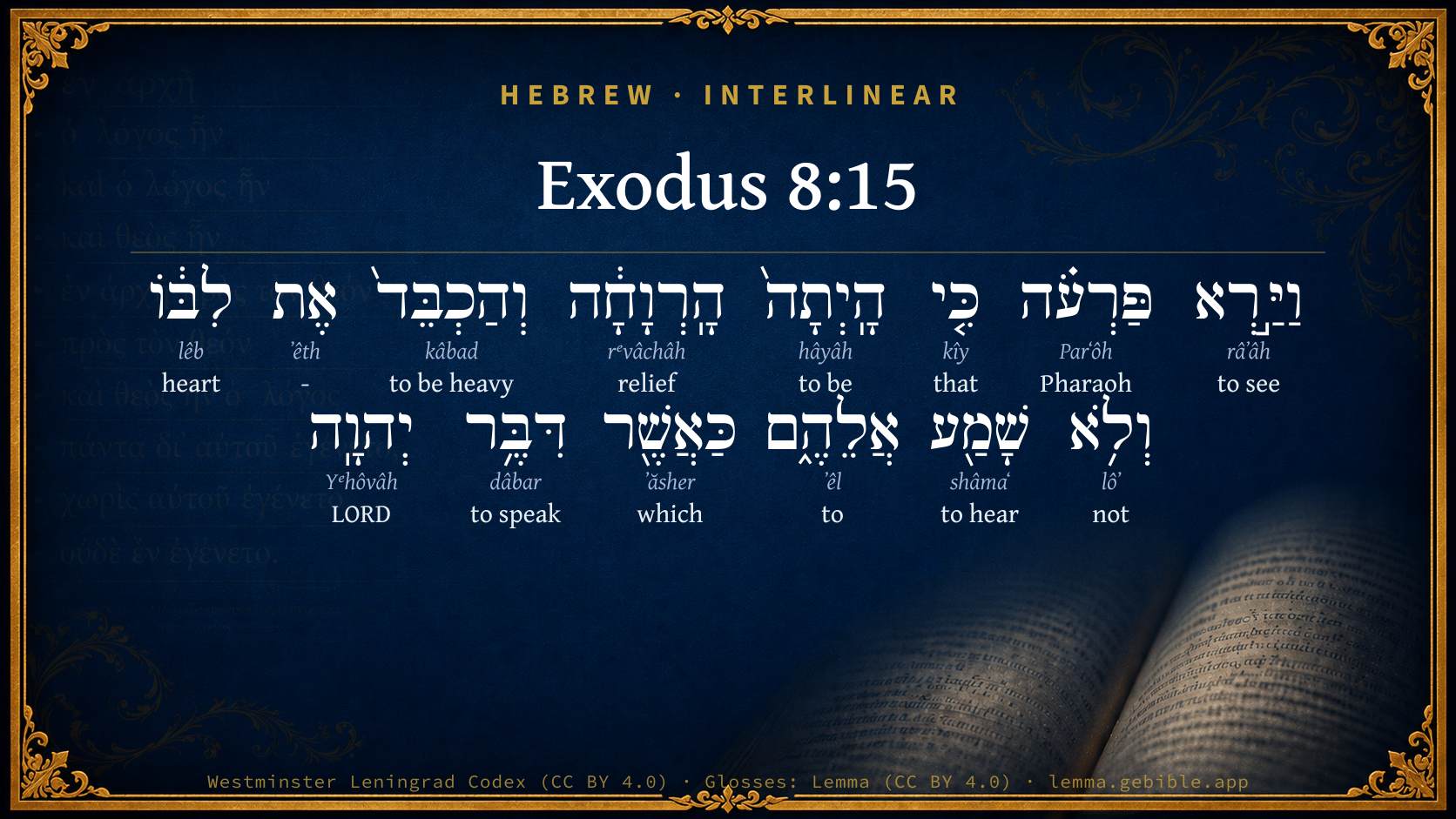
Hebrew (Westminster Leningrad Codex) Exodus 8:15 appears in the Hebrew Old Testament. The text above is from the Westminster Leningrad Codex. Each word links to its Strong’s number, a concise gloss, and parsing drawn from the Open Scriptures Hebrew Bible morphology. Click any word for its full Brown-Driver-Briggs (BDB) entry.
Download image
Cite this verse

Exodus 8:15 (World English Bible). Public Domain. Lemma interlinear Bible study tool, https://lemma.gebible.app/v/exodus/8/15.

Show BibTeX & RIS
BibTeX
RIS
English Translation
But when Pharaoh saw that there was a respite, he hardened his heart, and didn't listen to them, as Yahweh had spoken.
World English Bible · Public Domain
Highlights
  • 1 first appearance in the Hebrew Bible
Full analysis ↓
Download a study sheet

One document with this verse’s original text, its word-by-word gloss line, the meaning frame, cross-references with their text, attributed commentary, and full source and license credits — printable, and it pastes into notes with its structure intact.

This verse Autodidact and up

Study sheet (.html) Plain text (.txt)

A passage Seminary Student

Up to 50 verses in one chapter. A passage sheet keeps up to 6 commentary sources and 12 cross-references per verse, in the order this page ranks them, and says so on the sheet whenever that leaves anything out. Ask for a single verse and you get the Autodidact verse sheet above.

Everything on this page stays free to read, with no account — the sheet is a download of what is already on screen, not access to it.

Want to remove ads? Support Godless Engineer
Compare translations 3

The same verse in 3 English versions, stacked beneath the original-language interlinear above. Click any original word for its lexicon entry.

Each is an independent rendering of the whole verse — the interlinear is not word-aligned to these translations.

Highlighted words mark where these versions differ — a whole-verse word diff, not a word-by-word alignment.

  • World English Bible Public Domain
    But when Pharaoh saw that there was a respite, he hardened his heart, and didn't listen to them, as Yahweh had spoken.
  • King James Version Public Domain
    But when Pharaoh saw that there was respite, he hardened his heart, and hearkened not unto them; as the LORD had said.
  • unfoldingWord Literal Text CC BY-SA 4.0
    And Pharaoh saw that there was a respite, and he caused his heart to be heavy, and he did not listen to them, just as Yahweh had said.

unfoldingWord Literal Text — © unfoldingWord, licensed CC BY-SA 4.0. Word-aligned USFM3 via Door43 (git.door43.org/unfoldingWord/en_ult).

Versions to compare (up to 4)

3 of 4 selected

Show all 18 translations

Every available English version of this verse, each an independent rendering of the whole verse.

  • World English Bible Public Domain
    But when Pharaoh saw that there was a respite, he hardened his heart, and didn't listen to them, as Yahweh had spoken.
  • Berean Standard Bible Public Domain
    When Pharaoh saw that there was relief, however, he hardened his heart and would not listen to Moses and Aaron, just as the LORD had said.
  • Majority Standard Bible Public Domain
    When Pharaoh saw that there was relief, however, he hardened his heart and would not listen to Moses and Aaron, just as the LORD had said.
  • King James Version Public Domain
    But when Pharaoh saw that there was respite, he hardened his heart, and hearkened not unto them; as the LORD had said.
  • American Standard Version (1901) Public Domain
    But when Pharaoh saw that there was respite, he hardened his heart, and hearkened not unto them, as Jehovah had spoken.
  • Revised Version (1885) Public Domain
    But when Pharaoh saw that there was respite, he hardened his heart, and hearkened not unto them; as the LORD had spoken.
  • Geneva Bible (1599) Public Domain
    But when Pharaoh sawe that hee had rest giuen him, he hardened his heart, and hearkened not vnto them, as the Lord had said.
  • Douay-Rheims (1899) Public Domain
    And Pharao seeing that rest was given, hardened his own heart, and did not hear them, as the Lord had commanded.
  • Young's Literal Translation Public Domain
    And Pharaoh seeth that there hath been a respite, and he hath hardened his heart, and hath not hearkened unto them, as Jehovah hath spoken.
  • Literal Standard Version CC BY-SA 4.0
    And Pharaoh sees that there has been a respite, and he has hardened his heart, and has not listened to them, as YHWH has spoken.
  • Unlocked Literal Bible CC BY-SA 4.0
    But when Pharaoh saw that there was relief, he hardened his heart and did not listen to Moses and Aaron, just as Yahweh had said that he would do.
  • unfoldingWord Literal Text CC BY-SA 4.0
    And Pharaoh saw that there was a respite, and he caused his heart to be heavy, and he did not listen to them, just as Yahweh had said.
  • Darby Bible Public Domain
    And Pharaoh saw that there was respite; and he hardened his heart, and hearkened not to them, as Jehovah had said.
  • World Messianic Bible Public Domain
    But when Pharaoh saw that there was a respite, he hardened his heart, and didn’t listen to them, as the LORD had spoken.
  • Webster's Bible Public Domain
    But when Pharaoh saw that there was respit, he hardened his heart, and hearkened not to them, as the LORD had said.
  • Free Bible Version CC BY-SA 4.0
    But when Pharaoh realized the plague had passed, he chose to become hard and stubborn again, and wouldn't listen to Moses and Aaron, just as the Lord had predicted.
  • Bible in Basic English Public Domain
    But when Pharaoh saw that there was peace for a time, he made his heart hard and did not give ear to them, as the Lord had said.
  • JPS Tanakh (1917) Public Domain
    (8-11) But when Pharaoh saw that there was respite, he hardened his heart, and hearkened not unto them; as the LORD had spoken.

Literal Standard Version (2020), Covenant Press — licensed CC BY-SA 4.0. Text via the HelloAO Bible API (eBible.org). Unlocked Literal Bible (unfoldingWord) — licensed CC BY-SA 4.0. Text via the HelloAO Bible API (eBible.org). unfoldingWord Literal Text — © unfoldingWord, licensed CC BY-SA 4.0. Word-aligned USFM3 via Door43 (git.door43.org/unfoldingWord/en_ult). Free Bible Version, Dr. Jonathan Gallagher — licensed CC BY-SA 4.0. Text via the HelloAO Bible API (eBible.org).

Word by word

More ways to search: Search by grammar → Find every occurrence → Compare this word →

Practice this passage: Drill this verse → Learn its vocabulary →

הָֽרְוָחָ֔ה
rᵉvâchâh
H7309
“the · relief”
Particle, Definite Article + Noun, Common, Feminine, Singular, Absolute
Part of Speech
Particle + Noun
Type
Common
Gender
Feminine
Number
Singular
State
Absolute
Full BDB Definition

Origin: from H7305

TWOT: 2132b

respite, relief
  1. וַיַּ֣רְא râʼâh H7200 “and · to see” Conjunction + Verb, Qal, Sequential Imperfect, 3rd Person, Masculine, Singular
  2. פַּרְעֹ֗ה Parʻôh H6547 “Pharaoh” Noun, Proper
  3. כִּ֤י kîy H3588 “that” Conjunction
  4. הָֽיְתָה֙ hâyâh H1961 “to be” Verb, Qal, Perfect, 3rd Person, Feminine, Singular
  5. וְהַכְבֵּד֙ kâbad H3513 “and · to be heavy” Conjunction + Verb, Hiphil, Infinitive Absolute
  6. אֶת ʼêth H853 “-” Particle, Direct Object
  7. לִבּ֔וֹ lêb H3820 “heart · his” Noun, Common, Masculine, Singular, Construct + Suffix, Personal, 3rd Person, Masculine, Singular
  8. וְלֹ֥א lôʼ H3808 “and · not” Conjunction + Particle, Negative
  9. שָׁמַ֖ע shâmaʻ H8085 “to hear” Verb, Qal, Perfect, 3rd Person, Masculine, Singular
  10. אֲלֵהֶ֑ם ʼêl H413 “to · them” Preposition + Suffix, Personal, 3rd Person, Masculine, Plural
  11. כַּאֲשֶׁ֖ר ʼăsher H834 “like/as · which” Preposition + Particle, Relative
  12. דִּבֶּ֥ר dâbar H1696 “to speak” Verb, Piel, Perfect, 3rd Person, Masculine, Singular
  13. יְהוָֽה Yᵉhôvâh H3068 “LORD” Noun, Proper

About this verse

These counts appear in no published source. They are computed here, from the morphology-tagged text and Lemma’s own curated glosses. What Lemma adds →

14
words
14
distinct lemmas
Pentateuch
section

Notable vocabulary

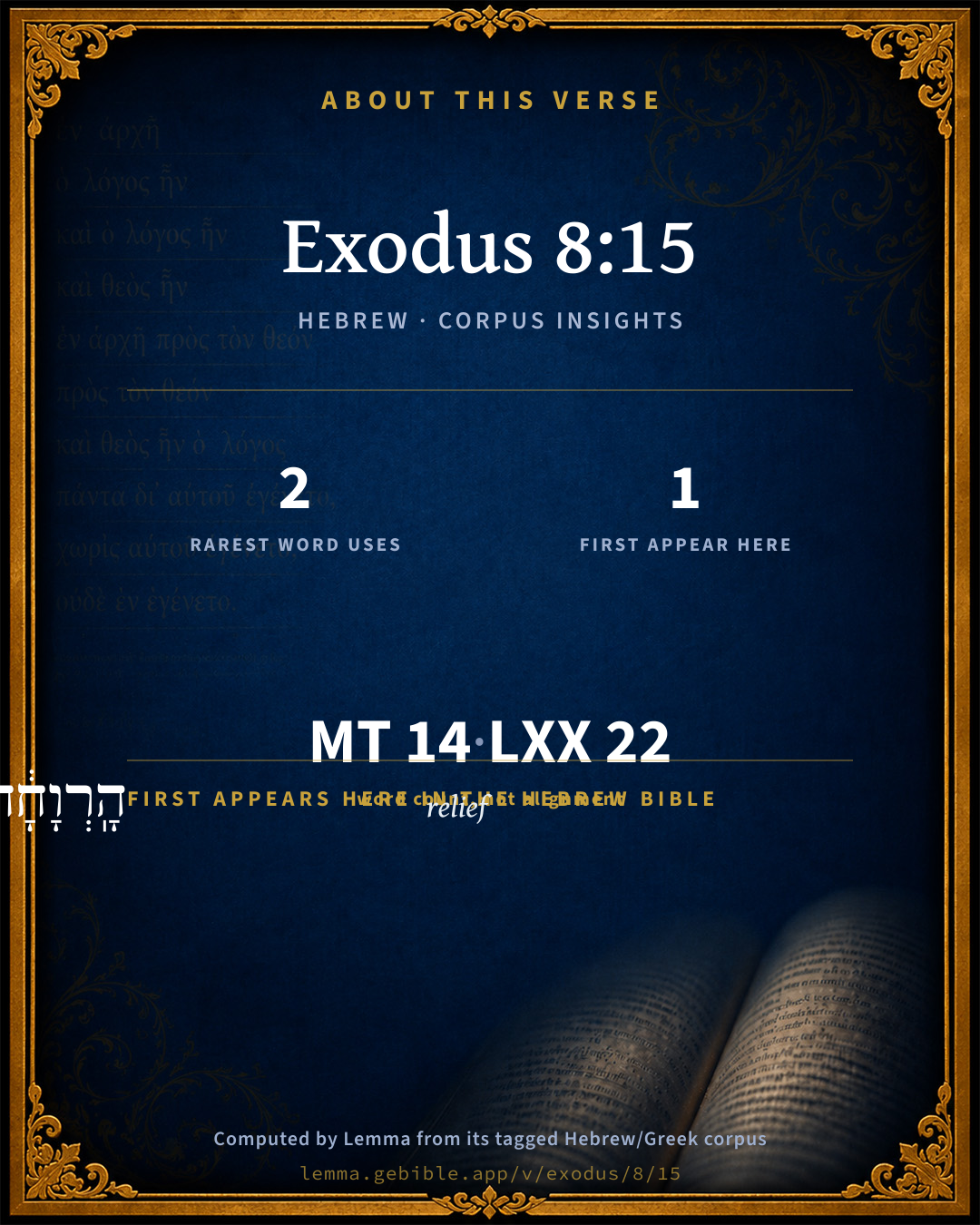
The rarest word here is הָֽרְוָחָ֔ה relief H7309 — appearing just 2 times in the whole Hebrew Bible.

First appearance in Scripture

This word makes its first canonical appearance in the Hebrew Bible here:

  • הָֽרְוָחָ֔ה relief H7309

Shared distinctive vocabulary

הָֽרְוָחָ֔ה relief H7309 occurs in 2 verses of the Hebrew Bible. Also found in:

Grammatical profile

  • 5 verbs
  • 4 nouns
  • 1 preposition
  • 1 conjunction
  • 3 particles

Verb forms

  • וַיַּ֣רְא Qal · Sequential Imperfect
  • הָֽיְתָה֙ Qal · Perfect
  • וְהַכְבֵּד֙ Hiphil · Infinitive Absolute
  • שָׁמַ֖ע Qal · Perfect
  • דִּבֶּ֥ר Piel · Perfect

Hebrew & Septuagint length

In English translation the verse runs 22 words from the Hebrew and 23 from the Septuagint (LXX English) — closely comparable.

A rough comparison of the two English renderings, which tokenize alike — not a word-level alignment.

Word counts can differ between the Hebrew and the Greek without any difference in meaning — e.g. the Hebrew direct-object marker אֵת has no separate Greek word, and Greek often adds the article ὁ.

In the original languages it is 14 Hebrew tokens and 22 Greek tokens — but the two are counted differently (Hebrew bundles its prefixes and suffixes into one token; the Greek is in lemma form), so that isn’t a like-for-like length.

Cross-references

13

Topical passages linked to Exodus 8:15 in the Treasury of Scripture Knowledge — connected by theme and wording, ordered by reader-vote popularity; previews shown in the World English Bible.

  • Ecclesiastes 8:11 Because sentence against an evil work is not executed speedily, therefore the heart of the sons of men is fully set in them to do evil.
  • Isaiah 26:10 Let favor be shown to the wicked, yet will he not learn righteousness; in the land of uprightness will he deal wrongfully, and will not see the majesty of Yahweh.
  • Exodus 7:4 But Pharaoh will not listen to you, and I will lay my hand on Egypt, and bring forth my hosts, my people the children of Israel, out of the land of Egypt by great judgments.
  • Hebrews 3:8 Don't harden your hearts, as in the provocation, Like as in the day of the trial in the wilderness,
  • Hebrews 3:15 while it is said, "Today if you will hear his voice, Don't harden your hearts, as in the rebellion."
  • Exodus 4:21 Yahweh said to Moses, "When you go back into Egypt, see that you do before Pharaoh all the wonders which I have put in your hand, but I will harden his heart and he will not let the people go.
  • Exodus 7:13–14 Pharaoh's heart was hardened, and he didn't listen to them; as Yahweh had spoken.
  • Exodus 14:5 It was told the king of Egypt that the people had fled; and the heart of Pharaoh and of his servants was changed towards the people, and they said, "What is this we have done, that we have let Israel go from serving us?"
  • Jeremiah 34:7–11 when the king of Babylon's army was fighting against Jerusalem, and against all the cities of Judah that were left, against Lachish and against Azekah; for these [alone] remained of the cities of Judah [as] fortified cities.
  • Zechariah 7:11–12 But they refused to listen, and turned their backs, and stopped their ears, that they might not hear.
  • Proverbs 29:1 He who is often rebuked and stiffens his neck Will be destroyed suddenly, with no remedy.
  • Hosea 6:4 "Ephraim, what shall I do to you? Judah, what shall I do to you? For your love is like a morning cloud, And like the dew that disappears early.
  • Revelation 16:9 People were scorched with great heat, and people blasphemed the name of God who has the power over these plagues. They didn't repent and give him glory.

Cross-references courtesy of OpenBible.info (CC BY 4.0).

Hebrew and Greek witnesses Masoretic Hebrew ↔ Greek Septuagint

The same verse in the two great witnesses to the Old Testament, shown verse-for-verse.

These are two independent witnesses, not word-aligned to each other, and the Septuagint is shown in lemma (dictionary) form.

Hebrew Exodus 8:15 Masoretic · Westminster Leningrad Codex

וַיַּ֣רְא פַּרְעֹ֗ה כִּ֤י הָֽיְתָה֙ הָֽרְוָחָ֔ה וְהַכְבֵּד֙ אֶת לִבּ֔וֹ וְלֹ֥א שָׁמַ֖ע אֲלֵהֶ֑ם כַּאֲשֶׁ֖ר דִּבֶּ֥ר יְהוָֽה

But when Pharaoh saw that there was a respite, he hardened his heart, and didn't listen to them, as Yahweh had spoken.

World English Bible · Public Domain

Greek LXX Exodus 8:15 Septuagint · lemma form

εἶπον οὖν ὁ ἐπαοιδός ὁ φαραώ δάκτυλος θεός εἰμί οὗτος καί σκληρύνω ὁ καρδία φαραώ καί οὐ εἰςἀκούω αὐτός καθάπερ λαλέω κύριος

And when Pharao saw that there was relief, his heart was hardened, and he did not listen to them, as the Lord spoke.

LXX2012 (modern English Septuagint) · Public Domain

Hebrew: Westminster Leningrad Codex (CC BY 4.0). Greek: Septuagint (public domain); English from LXX2012 (modern English Septuagint) (Public Domain). How the Septuagint differs from the Hebrew →

Targum (Aramaic paraphrase)

2

The Targum is the ancient Jewish Aramaic paraphrase of the Hebrew Scriptures — an interpretive translation, not the Hebrew text itself. Onkelos (literal) and Pseudo-Jonathan (expansive) render the Torah, and Jonathan the Prophets. Coverage is partial: where no permissively-licensed English translation exists for a verse, only the Aramaic is shown. This is verse-level text, not a word-by-word alignment to the Hebrew.

  1. Targum Onkelos Torah (Genesis–Deuteronomy)
    וַאֲמָרוּ חָרָשַּׁיָא לְפַרְעֹה הָא מָחָא מִן קֳדָם יְיָ הִיא וְאִתַּקַף לִבָּא דְפַרְעֹה וְלָא קַבִּיל מִנְהוֹן כְּמָא דִמַלִיל יְיָ:

    (no public-domain English translation for this verse)

    Targum Onkelos — Aramaic: “Onkelos Genesis” (public domain); “Onkelos Exodus” (public domain); “Onkelos Leviticus” (public domain); “Onkelos Numbers” (public domain); “Onkelos Deuteronomy” (public domain). English: “Sefaria Community Translation” (CC0 1.0 (public-domain dedication)); “J.W. Etheridge. The Targums of Onkelos and Jonathan Ben Uzziel on the Pentateuch. London: Longmans, Green, 1862” (public domain). Text via Sefaria.

  2. Targum Pseudo-Jonathan Torah (Genesis–Deuteronomy)
    וַאֲמָרוּ אִיסְטַגְנִינֵי פַּרְעה לָא מִן כּחַ גְבוּרַת משֶׁה וְאַהֲרן הִיא אֱלָהֵן מְחָא מִשְׁתַּלְחָא מִן קֳדָם יְיָ הִיא וְאִתְקַף יִצְרָא דְלִבָּא דְפַרְעה וְלָא קַבֵּיל מִנְהוֹן הֵיכְמָא דְמַלֵיל יְיָ

    And the astrologers said to Pharoh, This is not by the power or strength of Mosheh and Aharon; but this is a plague sent from before the Lord. Yet the design of Pharoh's heart was strengthened, and he would not hearken to them, as the Lord had said.

    Targum Pseudo-Jonathan — Aramaic: “Targum Jonathan on Genesis” (public domain); “Targum Jonathan on Exodus” (public domain); “Targum Jonathan on Leviticus” (public domain); “Targum Jonathan on Numbers” (public domain); “Targum Jonathan on Deuteronomy” (public domain). English: “The Targum of Jonathan ben Uzziel, trans. J. W. Etheridge, London, 1862” (public domain). Text via Sefaria.

Commentary

Notes on Exodus 8:15 from classic Christian and Jewish commentators (each source and its license shown beneath its notes). The classic Christian expositions comment on the surrounding passage and are grouped to its opening verse, so a note may address several verses; the Jewish commentaries on the Tanakh (Rashi and others) are per-verse, so they appear only where the commentator wrote on this verse.

Lemma curates 59 commentaries, every one of them public domain or Creative Commons licensed, each selected and text-cleaned for this edition rather than reprinted as found. About our sources →

Trapp's Complete Commentary

John Trapp

Exo 8:15 But when Pharaoh saw that there was respite, he hardened his heart, and hearkened not unto them; as the LORD had said.

Ver. 15. But when Pharaoh saw that there was respite.] Heb., A breathing, or respiration. So fulfilling that of the prophet Isaiah, Isa 26:10. In like sort William Rufus, being dangerously sick at Gloucester, in the sixth year of his reign, vowed, upon his recovery, to see all vacancies in the Church furnished: which he did, but with so much ado, as showed, that having escaped the danger, he would gladly have deceived the saint; {a} like the man in Erasmus’s Naufragium, who in a storm promised the Virgin a picture of wax as big as St Christotpher: but when he came to shore would not give a tallow candle! Thus, in the sweating sickness ministers were sent for, and large promises made of amendment: but no sooner were they recovered, but they returned to their old courses, as Mr Bradford complaineth: whence Pliny, in one of his epistles to one who desired rules from him how to order his life aright, I will, saith he, give you one rule, that shall be instead of a thousand, Ut tales esse perseveremus sani, quales nos futuros esse profitemur infirmi: That we go on to be such when well, as we promised to be when sick. Men roar when upon the rack: but once got off, they think they may do as they wish.

{a} Daniel’s Hist, fol. 58. Sciaputo il morbo, fraudato il santo.

John Trapp, A Commentary or Exposition upon All the Books of the Old and New Testament (1647–1656) — public domain. Text from a community e-Sword module.

The Biblical Illustrator

Joseph S. Exell

Exo_8:15

When Pharaoh saw that there was respite, he hardened his heart.

The hardening nature and awful consequences of sin

I. I observe, that when God issues out His terrible threatenings against sinners, He is wont to suspend or stay the full execution of His sentence, and give them many an interval for repentance. A criminal shut up in the condemned cell, is said to be respited when, by a royal grant, his punishment is put off from the day appointed. This practice in the administration of human laws, may serve the purpose of illustrating the dispensations of Providence, or the dealings of God with men. The stubborn rebel is often admonished ere he meets the stern arrest of justice; and the guilty soul is often respited before the sentence is carried into execution. It seems to me, that this procedure of the great Judge in the mysterious ways of Providence is a bright display of mercy, blended even with the tokens of His displeasure. Each interval between successive warnings and judgments is a space given for repentance. But the final term of forbearance is not far distant; and with some of you it may be now the very last reprieve.

II. I observe, that it proves a state of most dreadful depravity, when men take occasion, from the very compassions and mercies of god, to harden themselves in sin. The goodness of God is designed to lead you to repentance; but if you either do not know, or will not consider this, then the most lovely and attractive of all the Divine perfections is shamefully abused and contemned by you. But can you hope to escape? Is it possible to evade the eye of Omniscience, or resist the hand of Omnipotence? Where can you find an asylum for your souls, when the only Refuge which God has prepared, is scorned and set at nought?

III. I observe, that God perfectly knows all the deeds of wicked men before they are done, and all their designs before they are conceived.

IV. Do you now ask, what are the signs by which it may be known, that any man is given up to hardness of heart?

1. It is a dark sign that the heart is desperately hardened, when men sin on knowingly and deliberately. A crime is deeply aggravated, which is committed with the full consent of the will, in defiance of the clearest dictates of the understanding and the conscience.

2. It is a dark sign that the heart is desperately hardened, when men hate and shun those who faithfully warn and reprove them, and affectionately labour to reclaim them.

3. It is a dark sign that the heart is desperately hardened, when the very intervals and opportunities which mercy gives for repentance, are perverted to the purpose of adding sin to sin. Are there not some of you, who have been brought under the scourge of Gods afflicting hand? Remember, it is written, He that being often reproved hardeneth his neck, shall be suddenly destroyed, and that without remedy. (John Thornton.)

Constrained repentance

The constrained and pretended penitence of Pharaoh, with the compassion and prayer of Moses, teach us valuable lessons. The penitence of Pharaoh shows us that we ought not to put off our repentance until the hour of sickness, trial, and death; for the seeming conversions which take place at such times may be hypocritical and short-lived, like that of Pharaoh. Is this sincere? The sick man thinks that it is; but if he recover will he not be the same as before? Will he not forget, as Pharaoh did, his promises, humiliation, confessions of sin, and seeming conversion? From the example of Moses we may also obtain important instruction. He had, truly, very many reasons for not putting much faith in the word of the king. Pharaoh had already shown much pride, obstinacy, and deceit; nevertheless, Moses did not repulse him; he knew that God can convert a soul even at the last hour. Pharaoh made promises, and charity hopeth all things. It is God alone who can judge the heart. We ought, therefore, always to be ready to console, and help with our prayers, even persons who have been most hostile, opposed, and contemptuous to us. There was a worthy pastor of the Canton de Vaud in Switzerland, who, during a time of persecution, had to suffer much because he preached the gospel faithfully. He was even obliged to leave his parish, and to go and settle in another. Some time afterwards, one of the men who had behaved most wickedly to him was converted to the Lord. He immediately determined to go to his former pastor to tell him this good news. How surprised he will be, thought he as he walked along. He arrived at the village; he rung the bell at the ministers house; the pastor himself opened the door. I am come to tell you that I am converted; I, who have done you so much harm. I am not astonished at it, answered the pastor, for I have prayed for you all these seven years. (Prof. Gaussen.)

Sin interrupted, not forsaken

Though the course of sin may be repelled for a season by the dispensation of the law, yet the spring and fountain of it is not dried up thereby. Though it withdraws and hides itself for season, it is but to shift out of a storm, and then to return again. As a traveller in his way meeting with a violent storm of thunder and rain, immediately turns out of his way to some house or tree for his shelter, but yet this causes him not to give over his journey, as soon as the storm is over he returns to his way and progress again; so it is with men in bondage unto sin. They are in a course of pursuing their lusts; the law meets with them in a storm of thunder and lightning from heaven, terrifies and hinders them in their way. This turns them for a season out of their course; they will run to prayer or amendment of life, for some shelter from the storm of wrath which is feared coming upon their consciences. But is their course stopped? are their principles altered? Not at all; so soon as the storm is over, so that they begin to wear out that sense and the terror that was upon them, they return to their former course in the service of sin again. This was the state with Pharaoh once and again. In such seasons sin is not conquered, but diverted. When it seems to fall under the power of the law, indeed it is only turned into new channel; it is not dried up. If you go and set a dam against the streams of a river, so that you suffer no water to pass in the old course and channel, but it breaks out another way, and turns all its streams in a new course, you will not say you have dried up that river, though some that come and look into the old channel may think, perhaps, that the waters are utterly gone. So is it in this case. The streams of sin, it may be, run in open sensuality and profaneness, in drunkenness and viciousness; the preaching of the law sets a dam against these causes; conscience is terrified, and the man dares not walk in the ways wherein he has been formerly engaged. His companions in sin, not finding him in his old ways, begin to laugh at him, as one that is converted and growing precise; professors themselves begin to be persuaded that the work of God is upon his heart, because they see his old streams dried up; but if there has been only a work of the law upon him, there in a dam put to his course, but the spring of sin is not dried up, only the streams of it are turned another way. It may be the man is fallen upon other more secret or more spiritual sins; or if he be beat from them also, the whole strength of lust and sin will take up its residence in self-righteousness, and pour out thereby as filthy streams as in any other way whatever. So that, notwithstanding the whole work of the law upon the souls of men, indwelling sin will keep alive in them still. (J. Owen, D. D.)

Hypocritical profession

As a horse that is good at hand, but nought at length, so is the hypocrite; free and fiery for a spurt, but he jades and tires in a journey. The faith, repentance, reformation, obedience, joy, sorrow, zeal, and other graces and affections of hypocrites, have their first motion and issue from false and erroneous grounds, as shame, fear, hope, and such respects. And it thence comes to pass that, where these respects cease to give them motion, the graces themselves can no more stand than a house can stand when the foundation is taken from under it. The boy that goes to his book no longer than the master holds the rod over him; the masters back once turned, away goes the book, and he to play: so is it with the hypocrite. Take away the rod from Pharaoh; and he will be old Pharaoh still. Now, then, here is a wide difference between the hypocrite and the godly man: the one does all by fits and starts, by sudden motions and flashes; whereas the other goes on fairly and soberly in a settled, constant, regular course of humiliation and obedience. (Bp. Sanderson.)

False repentance

Many persons who appear to repent, are like sailors who throw their goods overboard in a storm, and wish for them again as soon as it becomes calm.

Mercy mistaken for weakness

How easy it is to mistake mercy for weakness! This was Pharaohs mistake. The moment the Lord lifted His heavy hand from the Egyptian king, Pharaoh began to forget his oath, and vow, and promise, and to harden his heart,--saying, in effect, He can do no more; the God of the Israelites has exhausted Himself; now that He has removed His hand He has confessed His weakness rather than demonstrated His pity. We are committing the same mistake every day: whilst the plague is in the house we are ready to do anything to get rid of it! we will say prayers morning, noon and night, and send for the holy man who has been anointed as Gods minister, and will read nothing but solid and most impressive books, listen to no frivolous conversation, and touch nothing that could dissipate or enfeeble the mind. How long will the plague be removed before the elasticity will return to the man and the old self reassert its sovereignty? Not a day need pass. We begin to feel that the worst is past: we say it is darkest before it is dawn, hope springs eternal in the human breast; and so easily do we fall back into the old swing between self-indulgence and nominal homage to God. We think we have felt all the Lord can do, and we say, His sword is no longer; it cannot reach us now that we have removed away this little distance from its range; now and here we may do what we please, and judgment cannot fall upon us. Thus we play old Pharaohs part day by day. He is a mirror in which we may see ourselves. There is nothing mysterious in this part of the solemn reading. However we may endeavour to escape from the line when it becomes supernatural or romantic, we are brought swiftly and surely back to it when we see these repetitions of obduracy and these renewed challenges of Divine anger and judgment. (J. Parker, D. D.)

Transient repentance

Manton says, Many a time a brabble falleth out between a man and his lusts; but he delayeth, and all cometh to nothing. In a heat we bid a naughty servant begone; but he lingereth and before the next morning all is cool and quiet, and he is again in favour. Ungodly men have their quarrels with their favourite sins on various accounts, but these are like childrens pets with one another, soon over because they come of passion, and not from principle. An unholy person will fall out with sin because it has injured his health or his credit, or has brought him into difficulty with his neighbours; but when these temporary results are ended he falls in love again with the same iniquity. Thus we have seen the drunkard loathing his cups when his eyes were red and his head was aching; but ere the sun went down the quarrel was ended, and he and Bacchus were rolling in the gutter together. (Flowers from a Puritans Garden.)

False repentance

Pharaohs professions of repentance and promises of amendment were like those of the child under the rod of chastisement, they were designed to mitigate the infliction, and when the punishment was over they went for nothing. Now, this is always the case when fear alone predominates over the soul. Ah! how much of our penitence is like this of Pharaoh; how many are saints on a sick-bed, but as wicked as ever when they recover! During an epidemic of cholera in the village where I first laboured as a minister, the churches were filled to overflowing by suppliants who had never before entered them; but when it had passed, they relapsed into worse carelessness than ever: and there may be some here to-night who, when they were dangerously ill, or when they were laying a dear little ones body in the grave, vowed to God that they would yield themselves to Him; while now they are as far from His service as ever. Let me beseech such hardened ones to beware. (W. M. Taylor, D. D.)

Tests of sincerity in repentance

Lorenzo de Medici lies dying in the city of Florence: in the terrors of death he has sent for the one man who never had yielded to his threats or caresses--the brave Savonarola. Lorenzo confesses that he has heavy on his soul three crimes: the cruel sack of Volterra, the theft of the public dower of young girls, by which many were driven to a wicked life, and the blood shed after the conspiracy of Pazzi. He is greatly agitated, and Savon-arola, to keep him quiet, keeps repeating, God is merciful, God is good. But, he added, there is need of three things. And what are they, father? First, you must have a great and living faith in the mercy of God. This I have--the greatest. Second, you must restore that which you have wrongfully taken, or require your children to restore it for you. Lorenzo looked surprised and troubled; but he forces himself to compliance, and nods his head in sign of assent. Then Savonarola rises to his feet, and stands over the dying prince. Last, you must give back their liberties to the people of Florence. Lorenzo, summoning up all his remaining strength, disdainfully turns his back, and, without uttering another word, Savonarola departs without giving him absolution.

The Biblical Illustrator, edited by Joseph S. Exell (c. 1880s–1900s) — public domain. Text from a community e-Sword module.

Joseph Benson's Commentary

Exo 8:15. Pharaoh hardened his heart — Observe, he did it himself, not God, any otherwise than by not hindering.

Joseph Benson's Commentary on the Old and New Testaments (1811–1818) — public domain. Text from a community e-Sword module.

Geneva Bible (1599)

Geneva Bible translators

Or, made his heart heavy.

Geneva Bible (1599) marginal notes — public domain. Text via Bolls.life.

Ellicott's Commentary for English Readers

(15) When Pharaoh saw that there was respite.—Hebrew, a breathing space.

He hardened his heart.—Hitherto Pharaoh’s nature had not been impressed; his heart had remained dull, callous, hard. Now an impression had been made (Exo_8:8), and he must have yielded, if he had not called in his own will to efface it. Herein was his great guilt. (See the comment on Exo_4:21.)

A Bible Commentary for English Readers, edited by Charles John Ellicott (1878–1897) — public domain. Text from a community e-Sword module.

The Cambridge Bible for Schools and Colleges

gen. ed. J. J. S. Perowne

15. that the respite had come] the respite (or relief, Est_4:14; lit. open space, width), promised in v. 10 f.

he made his heart stubborn] The word used by J; cf. Exo_7:14.

and hearkened not, &c.] The closing phrase, from P: notice exactly the same words in Exo_7:13; and cf. p. 55.

Plagues of frogs in different places are mentioned by the classical writers; they are also not unknown in modern times (DB. iii. 890). In Egypt ‘each year the inundation brings with it myriads of frogs, which swarm along the banks of the river and canals, and fill the night air with continual croakings’ (Sayce, EHH. 168); similarly Seetzen and other travellers cited by Di. ‘Accordingly here also the Hebrew tradition simply describes a miraculously intensified form of a natural phaenomenon characteristic of the country. For the frogs come at the signal given by Aaron’s wonder-working rod, they climb up even into the houses, and they disappear, not, as happens now, by returning to the water, or being devoured by the ibis or other water-birds, but by dying immediately, in immense numbers, upon the land’ (Di.).

The Cambridge Bible for Schools and Colleges (gen. ed. J. J. S. Perowne; Cambridge University Press, 1878–1918) — public domain. Text from a community e-Sword module.

John Gill's Exposition

And the Lord said unto Moses,.... On the twenty seventh day of the month, according to Bishop Usher, the same day the flogs were removed; no warning is given him of the next plague, at least there is no account of any:

say unto Aaron, stretch out thy rod, and smite the dust of the land; in some one part of the land, that place nearest to him where there was a quantity of dust; for it cannot be imagined that he should smite all the dust of the land in every part of it, but smiting one part served for the whole:

that it may become lice throughout all the land of Egypt: not gnats, as some, nor flies, as others, but lice, though perhaps not of the common and ordinary sort, but new and extraordinary, and it may be of different sorts, suitable to different creatures.

John Gill's Exposition of the Whole Bible (1746–1763) — public domain (CC PDM 1.0). Text via the HelloAO Bible API.

Haydock's Catholic Bible Commentary

Pharao hardened his own heart. By this we see that Pharao was himself the efficient cause of his heart being hardened, and not God. See the same repeated in ver. 32, Pharao hardened his heart at this time also; likewise chap. ix. 7, 35, and chap. xiii. 15. (Challoner) --- This is the constant doctrine of the holy fathers, St. Augustine, ser. 88, de Temp. q. 18, 28, 36; St. Basil, orat., "that god is not the author of evil;" St. Chrysostom, hom. 67, in John; &c. Hence Origen, periar. 3, says, "The Scripture sheweth manifestly that Pharao was hardened by his own will; for God said to him, thou wouldst not: if thou wilt not dismiss Israel." Even the priests of the Philistines were so well convinced of this, that they said, (1 Kings vi. 6,) Why do you harden your hearts? God therefore hardened them only by not absolutely hindering their wickedness, and by punishing them with less severity, as they did not deserve to be corrected like dear children, Hebrews xii. --- Perdition is from thyself, Osee xii. 9. Thus God cast Pharao into the sea, by permitting, not by forcing, him to enter, Exodus xv. 4. How shocking must then the blasphemous doctrine of Zuinglius, (Ser. de Provid. 5,) Calvin, (Instit. viii. 17,) &c., appear, who attribute every wicked deed to God, though they pretend at the same time that he is not unjust, even when he commands and impels a man to commit murder or adultery! Idem facinus puta adulterium....quantum Dei est auctoris, motoris, impulsoris opus est, crimen non est; quantum hominis est, crimen ac scelus est. (Zuinglius, sup.) The light of reason may suffice to confute such absurdity. (Worthington)

George Leo Haydock (1774–1849), Haydock's Catholic Family Bible and Commentary, 1859 edition — public domain. Excludes Psalms (Douay-Rheims chapter numbering differs from Protestant) and Deuterocanonical books (Catholic canon only).

The Pulpit Commentary

When Pharaoh saw that there was respite. Literally, "a taking of breath," i.e., " a breathing-space." He hardened his heart. He became hard and merciless once more, believing that the danger was past, and not expecting any fresh visitation. As Isaiah says favour be shewed to the wicked, yet will he not learn righteousness". (Isa_26:10) Bad men "despise the riches of God"s goodness and forbearance, and long-suffering, not knowing that the goodness of God leadeth them to repentance." In this way, they "treasure up to themselves wrath against the day of wrath and revelation of the righteous judgment of God", (Rom_2:4, Rom_2:5) either in this world or in the world to come. As the Lord had said. See Exo_3:19 Exo_4:21 Exo_7:4.

Double-minded men, unstable in all their ways.

An Egyptian king was not likely, unless exceptionally gifted by nature, to be firm, fixed, and stable in his conduct. Flattered and indulged from infancy, no sooner did he obtain the crown, than he found himself recognised as a divinity by the great mass of his subjects, and regarded as one who "could do no wrong." Occasionally, he may have been so fortunate as to fall under the influence of a wise counsellor, but in general he would have been surrounded by advisers only anxious to please by echoing to him his own wishes and ideas. This Pharaoh whether he was Menephthah, or any one else was evidently a weak, impulsive, double-minded monarch. He wavered between good and bad impulses, now inclining one way, now another. He was sure therefore to be unstable in his ways. Similar, though (it may be) less pronounced, instability attaches to all those whose souls are not anchored upon the firm and unchangeable basis of fixed principles. It is fatal to the consistency of a career that a man should be double-minded. No man can serve God and Mammon. There is no fellowship between light and darkness, or between Christ and Belial. A man should make his choice, and not "halt between two opinions." If Jehovah be God, follow Him; but if Baal, then follow him. Shifting, unstable, uncertain, variable souls earn universal contempt, and are powerless to effect anything but their own ruin.

The Pulpit Commentary (1880–1919), ed. H.D.M. Spence-Jones & Joseph S. Exell — public domain. Text from a community e-Sword module.

John Wesley's Explanatory Notes

But when Pharaoh saw that there was respite, he hardened his heart - Observe he did it himself, not God, any otherwise than by not hindering.

John Wesley, Explanatory Notes Upon the Whole Bible (1754–1765) — public domain. Text via the GEBible commentary corpus.

Rashi

Rabbi Shlomo Yitzchaki (Rashi)

אצבע אלהים הוא THIS IS THE FINGER OF GOD — This plague is not caused by sorcery: it is of the Omnipresent God!

כאשר דבר ה׳ AS THE LORD HAD SPOKEN — when He said, (Exodus 7:4) “Pharaoh will not hearken unto you”.

Rashi on the Tanakh — English translations: “The Judaica Press complete Tanach with Rashi, translated by A. J. Rosenberg” (CC BY 4.0); “Pentateuch with Rashi's commentary by M. Rosenbaum and A.M. Silbermann, 1929-1934” (public domain); “The Metsudah Tanach series, Lakewood, N.J” (CC BY 4.0); and “The Book of Joshua, Metsudah Publications, 1997” (CC BY 4.0). Text via Sefaria.

Ramban (Nachmanides)

Rabbi Moshe ben Nachman (Ramban / Nachmanides)

AND THE MAGICIANS SAID UNTO PHARAOH: THIS IS THE FINGER OF G-D. Rabbi Abraham ibn Ezra commented that because the magicians had done as Aaron did with the serpent and also with the plagues of blood and the frogs and now they could not do so, they therefore said to Pharaoh: “This plague of gnats has not come through Aaron for the sake of Israel. Rather it is a plague of G-d due to the particular [evil] stars under which the land of Egypt found itself at the time.” Pharaoh did not deny the existence of the Creator 5:3. but only the Divine Name which Moses mentioned to him. This is similar in sense to the verse, It was not His hand that smote us; it was a chance that happened to us. Therefore Pharaoh’s heart was hardened. And Ibn Ezra brought proof for his explanation from the fact that Scripture does not state that the magicians said, “This is the finger of the Eternal,” which would have been a reference to the G-d of Israel, just as Pharaoh said to Moses and Aaron, Entreat the Eternal. Another proof [which Ibn Ezra brought for his explanation] is that in the case of the smiting of the river, Moses had forewarned Pharaoh, Verses 27-29). but he mentioned nothing to him about the plague of gnats. [Therefore the magicians felt justified in saying that it was not a plague for the sake of Israel but merely due to the evil stars.]Ibn Ezra’s interpretation does not appear to me to be correct. “A chance” is not called “the finger of G-d.” Only a plague which comes directly from Him as a form of punishment is called the hand of the Eternal and the finger of G-d, just as it is written in the verse which [Ibn Ezra] mentioned: It was not His hand that smote us. And it is furthermore written: And Israel saw the great hand; And the hand of the Eternal shall be against you;, 5:11. the hand of G-d was very heavy there., 5:11. Moreover, in the next plague of swarms, as well as in the following ones, Pharaoh no longer called upon the magicians to stand before Moses to do the same things, even though there had been a forewarning of their coming! But the subject, in accordance with the simple explanation of Scripture, is as follows: When the magicians saw that they could not bring forth the gnats, they admitted Aaron’s deed to be through an act of G-d, and this is why Pharaoh no longer called upon them from that time on. They [the magicians] said, This is ‘the finger’ of G-d, and not “the hand” of G-d [as is the customary way of the Scriptures to refer to plagues, as e.g., It was not His ‘hand’ that smote us] in order to minimize the plague, that is to say, it is but a small plague from Him [which we can easily endure]. They did not, however, say to Pharaoh, “This is the finger of ‘the Eternal,’” [but instead they said, “This is the finger of ‘G-d’”]. Pharaoh and his servants would not mention the Proper Divine Name except when speaking to Moses because he mentioned that Name to them. [In addressing Pharaoh, however, the magicians would not use that Name since that would be an open recognition on their part of His existence and power. Therefore they said to Pharaoh, “ This is the finger of ' G-d, ’” although their intent was to say, “This is the finger of ‘the Eternal.’ “] That the magicians could not bring forth the gnats was [not because they really could not do it, but it] was by reason of the fact that G-d so caused it to happen to them. He confounded their counsel in accordance with His Will, for everything is His and it is within His power to do all.It appears to me further that in the first two plagues — in the one of blood, where the water naturally changed into blood, and in the one of the frogs, which consisted of bringing them up from the river — since they did not involve the creation of some new phenomenon out of nothing or some act of new formation,. See Vol. I, p. 23, that only the term bara (or bri’ah) signifies “bringing forth something from nothing.” the magicians could do [as Aaron did]. Scripture does not say, “and the frogs came into existence,” but only, and the frogs came up; they assembled and came up. In the plague of gnats, however, there was an act of creation, for it is not in the nature of dust to turn into gnats. Therefore He said, that it may become gnats. The verse, And the magicians did so with their secret arts to bring forth gnats, is similar in intent to: Let the earth bring forth the living creature, etc., and it was so. But only the Creator, praised and magnified be He, can perform such a [new] act of creation. The verse, And the magicians did so…but they could not, means they incanted the demons to do their command, but they were powerless.Confirming me in my opinion concerning the frogs, [i.e., that there was no new act of creation there], is the following text [of the Talmud]: ‘Rabbi Akiba said that there was only one frog (and the frog came up), in the singular. which swarmed and filled the whole land of Egypt. Rabbi Eliezer ben Azaryah said to him: ‘Akiba, what have you to do with Agadah (homily)? Turn from these matters and go instead to [delve in the difficulties of] Negaim and Oholoth. It was only one frog croaking to all other frogs, and so they gathered.’” Rabbi Eleazar ben Azaryah could not accept the opinion [of Rabbi Akiba] that the magicians should have been able to bestow a new nature upon the frog, i.e., that one frog should give birth to so many, which is contrary to its nature, but rather they gathered them in order to bring them up. In the opinion then of Rabbi Akiba, the verse And the river shall swarm with frogs, means that the river should swarm with them more than its due. But according to Rabbi Eleazar ben Azaryah, the sense of that verse is like, ‘shirtzu’ in the earth, which connotes movement, as I have explained in Seder Bereshith, 1:20 (Vol. I, pp. 47-48). and here its meaning is that the frogs gather and move about in the river and from there go up upon Egypt.Now with regard to the gnats, our Rabbis have said that the demon [through whose power this was to be done by the magicians] is powerless in the case of a creature that is smaller than a lentil., must hence mean as explained in the text. Such is Ramban’s intent as explained by Rabbeinu Bachya. See my Hebrew commentary, p. 313. The expression, but they could not, must therefore mean that they could not assemble gnats from their [breeding] places and bring them.In Midrash Rabbah, the Rabbis have further said: “Perceiving that they cannot bring forth the gnats, the magicians at once recognized that [Aaron’s deed] was an act of G-d and not an act of the demons. From that moment on, therefore, they were no longer anxious to liken themselves to Moses by bringing forth the plagues.”Now with regard to Rabbi Abraham ibn Ezra’s statement that Moses did not inform them of the coming of the plague of gnats, it appears to me that Aaron struck [the dust of the earth] with the rod in the sight of Pharaoh, just as he did in the case of the soot of the furnace. (Verse 13), it was done in the sight of the king. However, there was no forewarning here, since the Holy One, blessed be He, warned Pharaoh only of those plagues which entailed the death of people. In the case of the frogs, [there was also death involved], as it is written: And [He sent among them] frogs, which destroyed them, which is an allusion to death or to the kind of destruction mentioned by our Rabbis, i.e., that the frogs made them impotent. Similarly, [He warned him of] the locusts, [which destroyed the crops], because it would cause the Egyptians to die of hunger, for they ate up the residue of that which escaped, which remaineth unto you from the hail. All this reflects His mercies towards man, just as it is said, Nevertheless, if thou warn the wicked of his way to turn from it, and he turn not from his way; he shall die in his iniquity, but thou hast delivered thy soul. Therefore, He did not warn Pharaoh of the plagues of gnats, boils, and darkness, [as these did not entail the loss of human lives]. He warned him only of the pestilence of cattle because it involved death which should have taken effect also on man, as He told him afterward, For now I might have stretched out My hand and I might have smitten thee and thy people with pestilence. But in very deed for this cause have I raised thee up, etc., Verses 15-16. Therefore He informed him of what was to happen.

Ramban (Nachmanides) on the Tanakh — English translation: “Commentary on the Torah by Ramban (Nachmanides). Translated and annotated by Charles B. Chavel. New York, Shilo Pub. House, 1971-1976” (CC BY 4.0). Text via Sefaria.

Lesson kit

Teaching starters — assembled from the data on this page, not authored interpretation. Every prompt links to the verse data it draws on. Edit before teaching.

Exodus, in the Pentateuch, opens this verse with 14 words (14 distinct Hebrew lemmas). Its most distinctive word is rᵉvâchâh (“relief”). A historical commentator’s framing appears above. Read the whole chapter for the surrounding context.

Discussion questions

  1. What does “relief” (rᵉvâchâh) contribute to the verse as a whole?
  2. The word “relief” first appears here in Scripture. What is being introduced at this debut?
  3. Lamentations 3:56 shares the word «relief» with this verse. How do the two illuminate each other?
  4. These translations render this verse differently; the difference is in the English rendering, not the original. What questions does that raise?
  5. The verb «וַיַּ֣רְא» is Qal Sequential Imperfect. How does its form color the action?
  6. Reading how Trapp's Complete Commentary and The Biblical Illustrator read this verse, where do the two commentators agree and where do they part?

Things to notice

Reading settings

Reading text

Shown beneath each verse's original-language words.

Old Testament
Old Testament edition

Read the OT as the Masoretic Hebrew (MT) or the Greek Septuagint (LXX).

English shown for the Greek Septuagint (in the Hebrew ↔ Greek comparison).

Comparing translations? Open the Compare panel on any verse page to stack up to four side by side.