
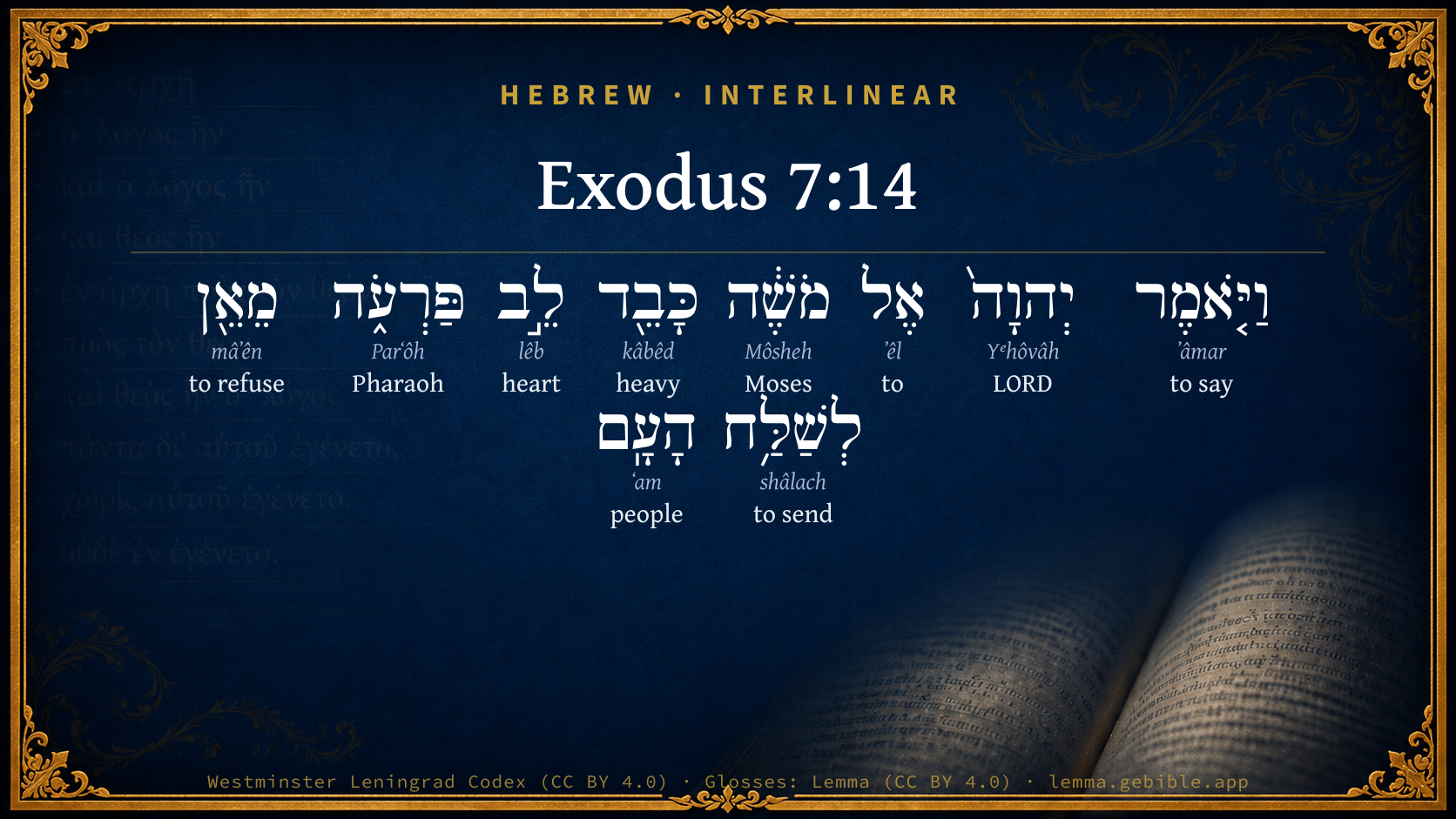
Exodus 7:14

Hebrew (Westminster Leningrad Codex) Exodus 7:14 appears in the Hebrew Old Testament. The text above is from the Westminster Leningrad Codex. Each word links to its Strong’s number, a concise gloss, and parsing drawn from the Open Scriptures Hebrew Bible morphology. Click any word for its full Brown-Driver-Briggs (BDB) entry.
Download image
Cite this verse

Exodus 7:14 (World English Bible). Public Domain. Lemma interlinear Bible study tool, https://lemma.gebible.app/v/exodus/7/14.

Show BibTeX & RIS
BibTeX
RIS
English Translation
Yahweh said to Moses, "Pharaoh's heart is stubborn. He refuses to let the people go.
World English Bible · Public Domain
Download a study sheet

One document with this verse’s original text, its word-by-word gloss line, the meaning frame, cross-references with their text, attributed commentary, and full source and license credits — printable, and it pastes into notes with its structure intact.

This verse Autodidact and up

Study sheet (.html) Plain text (.txt)

A passage Seminary Student

Up to 50 verses in one chapter. A passage sheet keeps up to 6 commentary sources and 12 cross-references per verse, in the order this page ranks them, and says so on the sheet whenever that leaves anything out. Ask for a single verse and you get the Autodidact verse sheet above.

Everything on this page stays free to read, with no account — the sheet is a download of what is already on screen, not access to it.

Want to remove ads? Support Godless Engineer
Compare translations 3

The same verse in 3 English versions, stacked beneath the original-language interlinear above. Click any original word for its lexicon entry.

Each is an independent rendering of the whole verse — the interlinear is not word-aligned to these translations.

Highlighted words mark where these versions differ — a whole-verse word diff, not a word-by-word alignment.

  • World English Bible Public Domain
    Yahweh said to Moses, "Pharaoh's heart is stubborn. He refuses to let the people go.
  • King James Version Public Domain
    And the LORD said unto Moses, Pharaoh's heart is hardened, he refuseth to let the people go.
  • unfoldingWord Literal Text CC BY-SA 4.0
    And Yahweh said to Moses, “The heart of Pharaoh is heavy; he has refused to let the people go.

unfoldingWord Literal Text — © unfoldingWord, licensed CC BY-SA 4.0. Word-aligned USFM3 via Door43 (git.door43.org/unfoldingWord/en_ult).

Versions to compare (up to 4)

3 of 4 selected

Show all 18 translations

Every available English version of this verse, each an independent rendering of the whole verse.

  • World English Bible Public Domain
    Yahweh said to Moses, "Pharaoh's heart is stubborn. He refuses to let the people go.
  • Berean Standard Bible Public Domain
    Then the LORD said to Moses, “Pharaoh’s heart is unyielding; he refuses to let the people go.
  • Majority Standard Bible Public Domain
    Then the LORD said to Moses, “Pharaoh’s heart is unyielding; he refuses to let the people go.
  • King James Version Public Domain
    And the LORD said unto Moses, Pharaoh's heart is hardened, he refuseth to let the people go.
  • American Standard Version (1901) Public Domain
    And Jehovah said unto Moses, Pharaoh's heart is stubborn, he refuseth to let the people go.
  • Revised Version (1885) Public Domain
    And the LORD said unto Moses, Pharaoh’s heart is stubborn, he refuseth to let the people go.
  • Geneva Bible (1599) Public Domain
    The Lord then saide vnto Moses, Pharaohs heart is obstinate, hee refuseth to let the people goe.
  • Douay-Rheims (1899) Public Domain
    And the Lord said to Moses: Pharao's heart is hardened, he will not let the people go.
  • Young's Literal Translation Public Domain
    And Jehovah saith unto Moses, `The heart of Pharaoh hath been hard, he hath refused to send the people away;
  • Literal Standard Version CC BY-SA 4.0
    And YHWH says to Moses, “The heart of Pharaoh has been hard, he has refused to send the people away;
  • Unlocked Literal Bible CC BY-SA 4.0
    Yahweh said to Moses, “Pharaoh's heart is hard, and he refuses to let the people go.
  • unfoldingWord Literal Text CC BY-SA 4.0
    And Yahweh said to Moses, “The heart of Pharaoh is heavy; he has refused to let the people go.
  • Darby Bible Public Domain
    And Jehovah said to Moses, Pharaoh's heart is hardened: he refuseth to let the people go.
  • World Messianic Bible Public Domain
    The LORD said to Moses, “Pharaoh’s heart is stubborn. He refuses to let the people go.
  • Webster's Bible Public Domain
    And the LORD said to Moses, Pharaoh's heart is hardened; he refuseth to let the people go.
  • Free Bible Version CC BY-SA 4.0
    The Lord said to Moses, “Pharaoh has a stubborn attitude—he's refusing to let the people go.
  • Bible in Basic English Public Domain
    And the Lord said to Moses and Aaron, Pharaoh's heart is unchanged; he will not let the people go.
  • JPS Tanakh (1917) Public Domain
    And the LORD said unto Moses: 'Pharaoh's heart is stubborn, he refuseth to let the people go.

Literal Standard Version (2020), Covenant Press — licensed CC BY-SA 4.0. Text via the HelloAO Bible API (eBible.org). Unlocked Literal Bible (unfoldingWord) — licensed CC BY-SA 4.0. Text via the HelloAO Bible API (eBible.org). unfoldingWord Literal Text — © unfoldingWord, licensed CC BY-SA 4.0. Word-aligned USFM3 via Door43 (git.door43.org/unfoldingWord/en_ult). Free Bible Version, Dr. Jonathan Gallagher — licensed CC BY-SA 4.0. Text via the HelloAO Bible API (eBible.org).

Word by word

More ways to search: Search by grammar → Find every occurrence → Compare this word →

Practice this passage: Drill this verse → Learn its vocabulary →

About this verse

These counts appear in no published source. They are computed here, from the morphology-tagged text and Lemma’s own curated glosses. What Lemma adds →

10
words
10
distinct lemmas
Pentateuch
section

Shared distinctive vocabulary

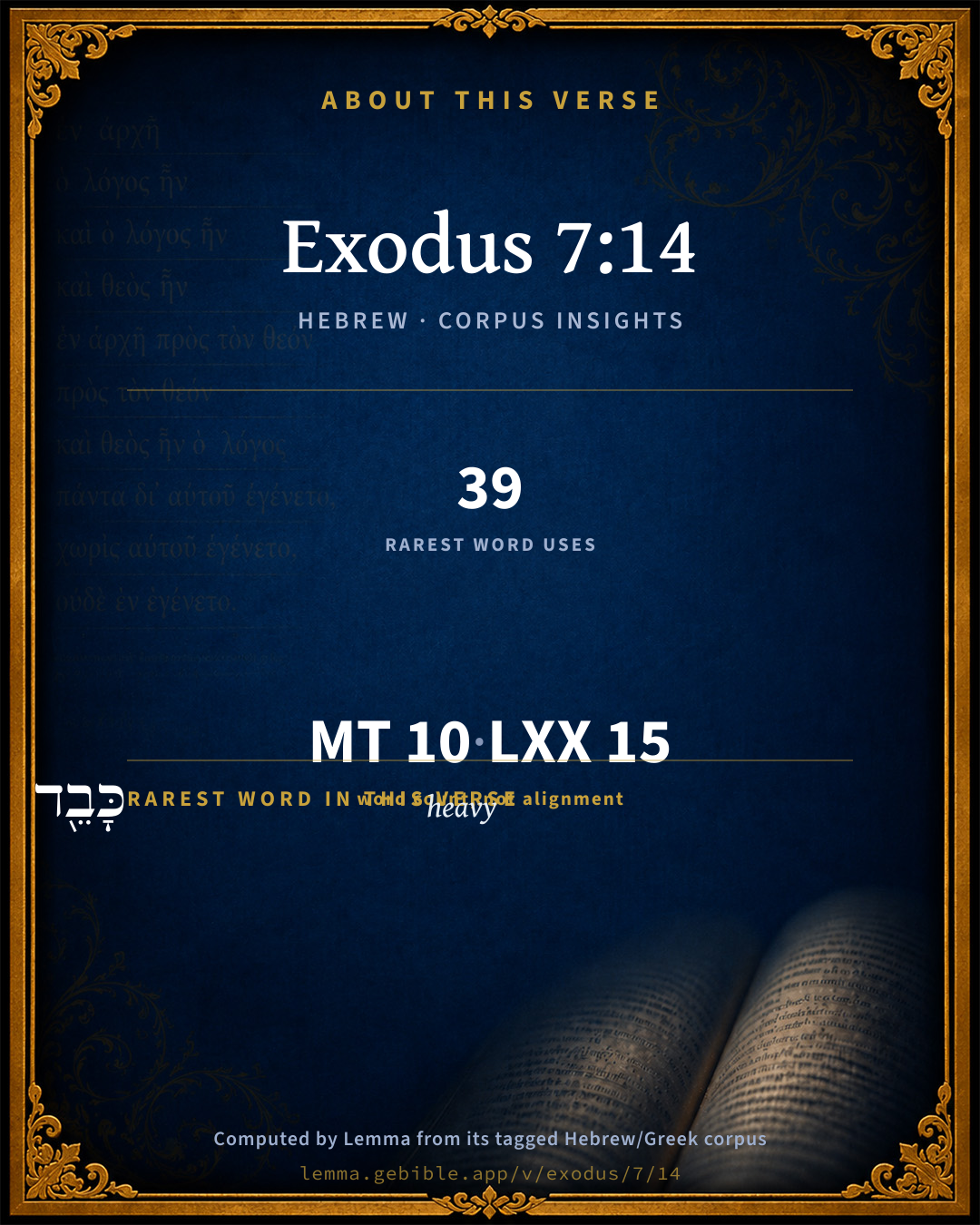
כָּבֵ֖ד heavy H3515 occurs in 38 verses of the Hebrew Bible. Also found in:

Grammatical profile

  • 3 verbs
  • 5 nouns
  • 1 adjective
  • 1 preposition

Verb forms

  • וַיֹּ֤אמֶר Qal · Sequential Imperfect
  • מֵאֵ֖ן Piel · Perfect
  • לְשַׁלַּ֥ח Piel · Infinitive Construct

Hebrew & Septuagint length

In English translation the verse runs 15 words from the Hebrew and 22 from the Septuagint (LXX English) — the Septuagint runs noticeably longer here. See the side-by-side →

A rough comparison of the two English renderings, which tokenize alike — not a word-level alignment.

Word counts can differ between the Hebrew and the Greek without any difference in meaning — e.g. the Hebrew direct-object marker אֵת has no separate Greek word, and Greek often adds the article ὁ.

In the original languages it is 10 Hebrew tokens and 15 Greek tokens — but the two are counted differently (Hebrew bundles its prefixes and suffixes into one token; the Greek is in lemma form), so that isn’t a like-for-like length.

Cross-references

13

Topical passages linked to Exodus 7:14 in the Treasury of Scripture Knowledge — connected by theme and wording, ordered by reader-vote popularity; previews shown in the World English Bible.

  • Exodus 8:15 But when Pharaoh saw that there was a respite, he hardened his heart, and didn't listen to them, as Yahweh had spoken.
  • Exodus 10:1 Yahweh said to Moses, "Go in to Pharaoh, for I have hardened his heart, and the heart of his servants, that I may show these my signs in the midst of them,
  • Exodus 10:20 But Yahweh hardened Pharaoh's heart, and he didn't let the children of Israel go.
  • Exodus 10:27 But Yahweh hardened Pharaoh's heart, and he wouldn't let them go.
  • Exodus 4:23 and I have said to you, "Let my son go, that he may serve me;" and you have refused to let him go. Behold, I will kill your son, your firstborn.'"
  • Exodus 8:2 If you refuse to let them go, behold, I will plague all your borders with frogs:
  • Exodus 9:2 For if you refuse to let them go, and hold them still,
  • Exodus 10:4 Or else, if you refuse to let my people go, behold, tomorrow I will bring locusts into your country,
  • Isaiah 1:20 But if you refuse and rebel, you shall be devoured with the sword; For the mouth of Yahweh has spoken it."
  • Jeremiah 8:5 Why then is this people of Jerusalem slidden back by a perpetual backsliding? they hold fast deceit, they refuse to return.
  • Jeremiah 9:6 Your habitation is in the midst of deceit; through deceit they refuse to know me, says Yahweh.
  • Zechariah 7:12 Yes, they made their hearts as hard as flint, lest they might hear the law, and the words which Yahweh of Hosts had sent by his Spirit by the former prophets. Therefore great wrath came from Yahweh of Hosts.
  • Hebrews 12:25 See that you don't refuse him who speaks. For if they didn't escape when they refused him who warned on the Earth, how much more will we not escape who turn away from him who warns from heaven,

Cross-references courtesy of OpenBible.info (CC BY 4.0).

Hebrew and Greek witnesses Masoretic Hebrew ↔ Greek Septuagint

The same verse in the two great witnesses to the Old Testament, shown verse-for-verse.

Here the Septuagint runs noticeably longer than the Hebrew — LXX2012 (modern English Septuagint) 22 words vs World English Bible 15. A rough length comparison of the two English translations, not a word-level alignment — read both below.

These are two independent witnesses, not word-aligned to each other, and the Septuagint is shown in lemma (dictionary) form.

Hebrew Exodus 7:14 Masoretic · Westminster Leningrad Codex

וַיֹּ֤אמֶר יְהוָה֙ אֶל מֹשֶׁ֔ה כָּבֵ֖ד לֵ֣ב פַּרְעֹ֑ה מֵאֵ֖ן לְשַׁלַּ֥ח הָעָֽם

Yahweh said to Moses, "Pharaoh's heart is stubborn. He refuses to let the people go.

World English Bible · Public Domain

Greek LXX Exodus 7:14 Septuagint · lemma form

εἶπον δέ κύριος πρός μωυσῆς βαρέω ὁ καρδία φαραώ ὁ μή ἐκ ἀποστέλλω ὁ λαός

and the Lord said to Moses, The heart of Pharao is made hard, so that he should not let the people go.

LXX2012 (modern English Septuagint) · Public Domain

On this verse, The Cambridge Bible for Schools and Colleges discusses the Septuagint’s reading. Read the note in Commentary ↓

Hebrew: Westminster Leningrad Codex (CC BY 4.0). Greek: Septuagint (public domain); English from LXX2012 (modern English Septuagint) (Public Domain). How the Septuagint differs from the Hebrew →

Targum (Aramaic paraphrase)

2

The Targum is the ancient Jewish Aramaic paraphrase of the Hebrew Scriptures — an interpretive translation, not the Hebrew text itself. Onkelos (literal) and Pseudo-Jonathan (expansive) render the Torah, and Jonathan the Prophets. Coverage is partial: where no permissively-licensed English translation exists for a verse, only the Aramaic is shown. This is verse-level text, not a word-by-word alignment to the Hebrew.

  1. Targum Onkelos Torah (Genesis–Deuteronomy)
    וַאֲמַר יְיָ לְמשׁה אִתְיַקַר (לפרש״‎י יַקִיר) לִבָּא דְפַרְעֹה סָרִיב לְשַׁלָחָא עַמָא:

    (no public-domain English translation for this verse)

    Targum Onkelos — Aramaic: “Onkelos Genesis” (public domain); “Onkelos Exodus” (public domain); “Onkelos Leviticus” (public domain); “Onkelos Numbers” (public domain); “Onkelos Deuteronomy” (public domain). English: “Sefaria Community Translation” (CC0 1.0 (public-domain dedication)); “J.W. Etheridge. The Targums of Onkelos and Jonathan Ben Uzziel on the Pentateuch. London: Longmans, Green, 1862” (public domain). Text via Sefaria.

  2. Targum Pseudo-Jonathan Torah (Genesis–Deuteronomy)
    וַאֲמַר יְיָ לְמשֶׁה אִיתְקַף יִצְרָא דְלִבָּא דְפַרְעה מְסָרֵב לְמִפְטוֹר יַת עַמָא

    And the Lord said to Mosheh, The disposition of Pharoh's heart is obdurated in refusing to release the people.

    Targum Pseudo-Jonathan — Aramaic: “Targum Jonathan on Genesis” (public domain); “Targum Jonathan on Exodus” (public domain); “Targum Jonathan on Leviticus” (public domain); “Targum Jonathan on Numbers” (public domain); “Targum Jonathan on Deuteronomy” (public domain). English: “The Targum of Jonathan ben Uzziel, trans. J. W. Etheridge, London, 1862” (public domain). Text via Sefaria.

Commentary

Notes on Exodus 7:14 from classic Christian and Jewish commentators (each source and its license shown beneath its notes). The classic Christian expositions comment on the surrounding passage and are grouped to its opening verse, so a note may address several verses; the Jewish commentaries on the Tanakh (Rashi and others) are per-verse, so they appear only where the commentator wrote on this verse.

Lemma curates 59 commentaries, every one of them public domain or Creative Commons licensed, each selected and text-cleaned for this edition rather than reprinted as found. About our sources →

Matthew Henry's Commentary

Here is the first of the ten plagues, the turning of the water into blood, which was, 1. A dreadful plague, and very grievous. The very sight of such vast rolling streams of blood, pure blood no doubt, florid and high-colored, could not but strike a horror upon people: much more afflictive were the consequences of it. Nothing more common than water: so wisely has Providence ordered it, and so kindly, that that which is so needful and serviceable to the comfort of human life should be cheap, and almost every where to be had; but now the Egyptians must either drink blood, or die for thirst. Fish was much of their food (Num 11:5), but the changing of the waters was the death of the fish; it was a pestilence in that element (Exo 7:21): The fish died. In the general deluge they escaped, because perhaps they had not then contributed so much to the luxury of man as they have since; but in this particular judgment they perished (Psa 105:29): He slew their fish; and when another destruction of Egypt, long afterwards, is threatened, the disappointment of those that make sluices and ponds for fish is particularly noticed, Isa 19:10. Egypt was a pleasant land, but the noisome stench of dead fish and blood, which by degrees would grow putrid, now rendered it very unpleasant. 2. It was a righteous plague, and justly inflicted upon the Egyptians. For, (1.) Nilus, the river of Egypt, was their idol; they and their land derived so much benefit from it that they served and worshipped it more than the Creator. The true fountain of the Nile being unknown to them, they paid all their devotions to its streams: here therefore God punished them, and turned that into blood which they had turned into a god. Note, That creature which we idolize God justly removes from us, or embitters to us. He makes that a scourge to us which we make a competitor with him. (2.) They had stained the river with the blood of the Hebrews' children, and now God made that river all bloody. Thus he gave them blood to drink, for they were worthy, Rev 16:6. Note, Never any thirsted after blood, but, sooner or later, they had enough of it. 3. It was a significant plague. Egypt had a great dependence upon their river (Zac 14:18), so that in smiting the river they were warned of the destruction of all the productions of their country, till it came at last to their firstborn; and this red river proved a direful omen of the ruin of Pharaoh and all his forces in the Red Sea. This plague of Egypt is alluded to in the prediction of the ruin of the enemies of the New Testament church, Rev 16:3, Rev 16:4. But there the sea, as well as the rivers and fountains of water, is turned into blood; for spiritual judgments reach further, and strike deeper, than temporal judgments do. And, lastly, let me observe in general concerning this plague that one of the first miracles Moses wrought was turning water into blood, but one of the first miracles our Lord Jesus wrought was turning water into wine; for the law was given by Moses, and it was a dispensation of death and terror; but grace and truth, which, like wine, make glad the heart, came by Jesus Christ. Observe,

I. Moses is directed to give Pharaoh warning of this plague. "Pharaoh's heart is hardened (Exo 7:14), therefore go and try what this will do to soften it," Exo 7:15. Moses perhaps may not be admitted into Pharaoh's presence-chamber, or the room of state where he used to give audience to ambassadors; and therefore he is directed to meet him by the river's brink, whither God foresaw he would come in the morning, either for the pleasure of a morning's walk or to pay his morning devotions to the river: for thus all people will walk, every one in the name of his god; they will not fail to worship their god every morning. There Moses must be ready to give him a new summons to surrender, and, in case of a refusal, to tell him of the judgment that was coming upon that very river on the banks of which they were now standing. Notice is thus given him of it beforehand, that they might have no colour to say it was a chance, or to attribute it to any other cause, but that it might appear to be done by the power of the God of the Hebrews, and as a punishment upon him for his obstinacy. Moses is expressly ordered to take the rod with him, that Pharaoh might be alarmed at the sight of that rod which had so lately triumphed over the rods of the magicians. Now learn hence, 1. That the judgments of God are all known to himself beforehand. He knows what he will do in wrath as well as in mercy. Every consumption is a consumption determined, Isa 10:23. 2. That men cannot escape the alarms of God's wrath, because they cannot go out of the hearing of their own consciences: he that made their hearts can make his sword to approach them. 3. That God warns before he wounds; for he is long-suffering, not willing that any should perish, but that all should come to repentance.

II. Aaron (who carried the mace) is directed to summon the plague by smiting the river with his rod, Exo 7:19, Exo 7:20. It was done in the sight of Pharaoh and his attendants; for God's true miracles were not performed, as Satan's lying wonders were, by those that peeped and muttered: truth seeks no corners. An amazing change was immediately wrought; all the waters, not only in the rivers but in all their ponds, were turned into blood. 1. See here the almighty power of God. Every creature is that to us which he makes it to be, water or blood. 2. See the mutability of all things under the sun, and what changes we may meet with in them. That which is water today may be blood tomorrow; what is always vain may soon become vexatious. A river, at the best, is transient; but divine justice can quickly make it malignant. 3. See what mischievous work sin makes. if the things that have been our comforts prove our crosses, we must thank ourselves: it is sin that turns our waters into blood.

III. Pharaoh endeavours to confront the miracle, because he resolves not to humble himself under the plague. He sends for the magicians, and, by God's permission, they ape the miracle with their enchantments (Exo 7:22), and this serves Pharaoh for an excuse not to set his heart to this also (Exo 7:23), and a pitiful excuse it was. Could they have turned the river of blood into water again, this would have been something to the purpose; then they would have proved their power, and Pharaoh would have been obliged to them as his benefactors. But for them, when there was such scarcity of water, to turn more of it into blood, only to show their art, plainly intimates that the design of the devil is only to delude his devotees and amuse them, not to do them any real kindness, but to keep them from doing a real kindness to themselves by repenting and returning to their God.

IV. The Egyptians, in the mean time, are seeking for relief against the plague, digging round about the river for water to drink, Exo 7:24. Probably they found some, with much ado, God remembering mercy in the midst of wrath; for he is full of compassion, and would not let the subjects smart too much for the obstinacy of their prince.

V. The plague continued seven days (Exo 7:25), and, in all that time, Pharaoh's proud heart would not let him so much as desire Moses to intercede for the removal of it. Thus the hypocrites in heart heap up wrath; they cry not when he binds them (Job 36:13); and then no wonder that his anger is not turned away, but his hand is stretched out still.

Matthew Henry's Commentary on the Whole Bible (1708–1710) — public domain (CC PDM 1.0). Text via the HelloAO Bible API.

The Cambridge Bible for Schools and Colleges

gen. ed. J. J. S. Perowne

14. is stubborn] lit. is heavy, i.e. difficult to move, the word used by J to express the idea of hardening of the heart. See on Exo_7:13.

refuseth] cf. Exo_4:23, Exo_8:2, Exo_9:2, Exo_10:3-4.

14–25. The first plague: the water turned into blood. From J, E, and P. In J and E only the water of the Nile is turned to blood (vv. 17, 20), in P all the water in Egypt (vv. 19, 21b). In P, also, as in other cases (p. 55), the wonder is wrought at a signal given by Aaron with his rod (v. 19); and though the distinction is obscured as the text now stands, it is probable, that when J and E were in their original form, it was described in J as wrought, like the other plagues, by Jehovah, without human intervention, and in E at a signal given by Moses (see on vv. 15, 17, 20b; and cf. p. 56).

Chapters Exo_7:14 to Exo_11:5

The first nine Plagues

The narrative of the Plagues, like that of the preceding chapters, is composite. The details of the analysis depend partly upon literary criteria, partly upon differences in the representation, which are not isolated, but recurrent, and which moreover accompany the literary differences and support the conclusions based upon them,—the differences referred to often also agreeing remarkably with corresponding differences in the parts of the preceding narrative, especially in Exo_3:1 to Exo_7:13, which have already, upon independent grounds, been assigned to P, J, and E, respectively. No one source, however, it should be premised, in the parts of it that have been preserved, gives all the plagues.

The parts belonging to P are most readily distinguished, viz. (after Exo_7:8-13) Exo_7:19-20 a, 21b–22, Exo_8:5-7; Exo_8:15 b–19, Exo_9:8-12, Exo_11:9-10 : the rest of the narrative belongs in the main to J, the hand of E being hardly traceable beyond Exo_7:15; Exo_7:17 b, 20b, Exo_9:22-23 a, 31–32 (perhaps), 35a, Exo_10:12-13 a, 14a, 15b, 20, 21–23, 27, Exo_11:1-3.

Putting aside for the present purely literary differences, we have thus a threefold representation of the plagues, corresponding to the three literary sources, P, J, and E, of which the narrative is composed. The differences relate to not less than five or six distinct points,—the terms of the command addressed to Moses, the part taken by Aaron, the demand made of the Pharaoh, the use made of the rod, the description of the plague, and the formulae used to express the Pharaoh’s obstinacy. Thus in P Aaron co-operates with Moses, and the command is Say unto Aaron (Exo_7:19, Exo_8:5; Exo_8:16; so before in Exo_7:9 : even in Exo_9:8, where Moses alone is to act, both are expressly addressed); there is no interview with the Pharaoh, so that no demand is ever made for Israel’s release; the descriptions are brief; except in Exo_9:10, Aaron is the wonder-worker, bringing about the result by stretching out his rod at Moses’ direction (Exo_7:19, Exo_8:5 f., 16 f.; cf. Exo_7:9); the wonders wrought (‘signs and portents,’ Exo_7:3 : P does not speak of them as ‘plagues’) are intended less to break down the Pharaoh’s resistance than to accredit Moses as Jehovah’s representative; they thus take substantially the form of a contest with the native magicians, who are mentioned only in this narrative (Exo_7:11 f., 22, Exo_8:7; Exo_8:18 f., Exo_9:11), and who at first do the same things by their arts, but in the end are completely defeated; the hardening of Pharaoh’s heart is expressed by ḥâzaḳ ḥizzçḳ (was strong, made strong), Exo_7:22, Exo_8:19, Exo_9:12, Exo_11:10 (Son_7:13), and the closing formula is, and he hearkened not unto them, as Jehovah had spoken, Exo_7:22, Exo_8:15 b, 19, Exo_9:12 (Son_7:13). In J, on the contrary, Moses one (without Aaron) is told to go in before the Pharaoh, and he addresses the Pharaoh himself (in agreement with Exo_4:10-16, where Aaron is appointed to be Moses’ spokesman not with Pharaoh, as in P, but with the people), Exo_7:14-16, Exo_8:1; Exo_8:9-10; Exo_8:20; Exo_8:26; Exo_8:29, Exo_9:1; Exo_9:13; Exo_9:29, Exo_10:1; Exo_10:9; Exo_10:25, Exo_11:4-10[116]; a formal demand is regularly made, Let my people go, that they may serve me, Exo_7:16, Exo_8:1; Exo_8:20, Exo_9:1; Exo_9:13, Exo_10:3 (comp. before, Exo_4:23); the interview with the Pharaoh is prolonged, and described in some detail; Jehovah Himself brings the plague, after it has been announced by Moses,—usually on the morrow, Exo_8:23, Exo_9:5 f., 18, Exo_10:4,—without any mention of Aaron or his rod; sometimes the king sends for Moses and Aaron to crave their intercession, Exo_8:8; Exo_8:25, Exo_9:27, Exo_10:16; the plague is removed, as it is brought, without any human intervention; the hardening of Pharaoh’s heart is expressed by kâbçd, hikbîd (was heavy, made heavy), Exo_7:14, Exo_8:15; Exo_8:32, Exo_9:7; Exo_9:34, Exo_10:1; and there is no closing formula: J also, unlike both P and E, represents the Israelites as living apart from the Egyptians, in the land of Goshen, Exo_8:22, Exo_9:26 (so before, Gen_45:10; Gen_46:28 f., &c.). The narrative generally is written (just as it is in Genesis, for instance) in a more picturesque and varied style than that of P; there are frequent descriptive touches, and the dialogue is abundant.

[116] Aaron, if he appears at all, is only Moses’ silent companion, Exo_8:8; Exo_8:12 (see vv. 9, 10), 25 (see vv. 26, 29), Exo_9:27 (see v. 29), Exo_10:8 (see v. 9). In Exo_10:3 it is doubtful if the plural, ‘and they said,’ is original: notice in v. 6b ‘and he turned.’

Some other, chiefly literary, characteristics of J may also be here noticed: refuseth (מאן), esp. followed by to let the people go, Exo_7:14, Exo_8:2, Exo_9:2, Exo_10:3-4 (so before Exo_4:23); the God of the Heb_7:16; Heb_9:1; Heb_9:13; Heb_10:3 (so Exo_3:18; Exo_5:3); Thus saith Jehovah, said regularly to Pharaoh, Exo_7:17, Exo_8:1; Exo_8:20, Exo_9:1; Exo_9:13, Exo_10:3, Exo_11:4 (so Exo_4:22); behold … with the participle (in the Heb.) in the announcement of the plague Exo_7:17, Exo_8:2; Exo_8:21, Exo_9:3; Exo_9:18, Exo_10:4 (so Exo_4:23); border, Exo_8:2, Exo_10:4; Exo_10:14; Exo_10:19; thou, thy people, and thy servants, Exo_8:3, Exodus 4, 9, 11, 21, 29, Exo_9:14 (see the note), cf. Exo_10:6; to intreat, Exo_8:8-9; Exo_8:28-29, Exo_9:28, Exo_10:17; such as hath not been, &c. Exo_9:18 b, 24b, Exo_11:6 b, cf. Exo_10:6 b, 14b; to sever, Exo_8:22, Exo_9:4, Exo_11:7; the didactic aim or object of the plague (or circumstance attending it) stated, Exo_7:17 a, Exo_8:10 b, 22b, Exo_9:14 b, 16b, 29c, Exo_10:2 b, Exo_11:7 b.

The narrative of E has been only very partially preserved; so it is not possible to characterize it as fully as those of P or J. Its most distinctive feature is that Moses is the wonder-worker, bringing about the plague by his rod (in agreement with Exo_4:17; Exo_4:20 b, where it is said to have been specially given to him by God), Exo_7:15 b, 17b, 20b, Exo_9:23 a, Exo_10:13 a (cf. afterwards, Exo_14:16, Exo_17:5; Exo_17:9); only in the case of the darkness (Exo_10:21 f.) does he use his hand for the purpose. This feature differentiates E from both P (with whom the wonder-working rod is in Aaron’s hand), and J (who mentions no rod, and represents the plague as brought about directly, after Moses’ previous announcement of it, by Jehovah Himself). E uses the same word be or make strong, for ‘harden,’ that P does, but he follows the clause describing the hardening of the Pharaoh’s heart by the words, and he did not let the children of Israel (or them) go, Exo_9:35 (contrast J’s phrase, v. 34b), Exo_10:20; Exo_10:27 (cf. Exo_4:21 E). He also pictures the Israelites, not, as J does, as living apart in Goshen, but as having every one an Egyptian ‘neighbour’ (Exo_3:2, Exo_11:2, Exo_12:35 f.), and consequently as settled promiscuously among the Egyptians.

The scheme, or framework, of the plagues, as described by P, J, and E, is thus suggestively exhibited by Bäntsch:—

In P we have—

And Jehovah said unto Moses, Say unto Aaron, Stretch out thy rod …, and there shall be.… And they did so: and Aaron stretched out his rod, and there was.… And the magicians did so (or could not do so) with their secret arts.… And Pharaoh’s heart was hardened; and he hearkened not unto them, as Jehovah had spoken.

J’s formula is quite different—

And Jehovah said unto Moses, Go in unto Pharaoh, and say unto him, Thus saith Jehovah, the God of the Hebrews, Let my people go that they may serve me. And if thou refuse to let them go, behold I will.… And Jehovah did so; and there came (or and he sent, &c.).… And Pharaoh called for Moses, and said unto him, Entreat for me, that.… And Jehovah did so …, and removed.… But Pharaoh made his heart heavy, and he did not let the people go.

The formula of E is again different—

And Jehovah said unto Moses, Stretch forth thy hand (with thy rod) toward …, that there may be.… And Moses stretched forth his hand (or his rod) toward …, and there was.… But Jehovah made Pharaoh’s heart hard, and he did not let the children of Israel go.

It has long since been remarked by commentators that the plagues stand in close connexion with the actual conditions of Egypt; and were in fact just miraculously intensified forms of the diseases or other natural occurrences to which Egypt is more or less liable (see particulars in the notes on the different plagues). They were of unexampled severity; they came, and in some cases went, at the announcement, or signal, given by one of the Hebrew leaders; one followed another with unprecedented swiftness; in other respects also they are represented as having an evidently miraculous character.

What judgement, however, are we to form with regard to their historical character? The narratives, there are strong reasons for believing, were written long after the time of Moses, and do not do more than acquaint us with the traditions current among the Hebrews at the time when they were written: we consequently have no guarantee that they preserve exact recollections of the actual facts. That there is no basis of fact for the traditions which the narratives incorporate is in the highest degree improbable: we may feel very sure of this, and yet not feel sure that they describe the events exactly as they happened. ‘As the original nucleus of fact,’ writes Dillm. (p. 66 f., ed. 2, p. 77), ‘we may suppose that at the time of Israel’s deliverance Egypt was visited by various adverse natural occurrences, which the Israelites ascribed to the operation of their God, and by which their leaders, Moses and Aaron, sought to prove to the Egyptian court the superiority of their God above the king and gods of Egypt; it must however be admitted that in the Israelitish story (Sage) these occurrences had for long been invested with a purely miraculous character. And if all had once been lifted up into the sphere of God’s unlimited power, the compiler could feel no scruple in combining the different plagues mentioned in his sources into a series of ten, in such a manner as to depict, in a picture drawn with unfading colours, not only the abundance of resources which God has at His disposal for helping His own people, and humiliating those who resist His will, but also the slow and patient yet sure steps with which He proceeds against His foes, and the growth of evil in men till it becomes at last obstinate and confirmed.’ The real value of the narratives, according to Dillmann, is thus not historical, but moral and religious. And from these points of view their typical and didactic significance cannot be overrated. The traditional story of the contest between Moses and the Pharaoh is applied so as to depict, to use Dillmann’s expression, ‘in unfading colours,’ the impotence of man’s strongest determination when it essays to contend with God, and the fruitlessness of all human efforts to frustrate His purposes.

Dr Sanday,—whose historical bias, if he has one, always leads him to conservative conclusions,—has expressed himself recently on the subject, in an essay on the Symbolism of the Bible, in words which are well worth quoting:—‘The early chapters of Genesis are not the only portion of the Pentateuchal history to which I think that we may rightly apply the epithet “symbolical.” Indeed I suspect that the greater part of the Pentateuch would be rightly so described in greater or less degree. The narrative of the Pentateuch culminates in two great events, the Exodus from Egypt and the giving of the Law from Mount Sinai. What are we to say of these? Are they historical in the sense in which the Second Book of Samuel is historical? I think we may say that they are not. If we accept—as I at least feel constrained to accept at least in broad outline—the critical theory now so widely held as to the composition of the Pentateuch, then there is a long interval, an interval of some four centuries or more, between the events and the main portions of the record as we now have it. In such a case we should expect to happen just what we find has happened. There is an element of folk-lore, of oral tradition insufficiently checked by writing. The imagination has been at work.

‘If we compare, for instance, the narrative of the Ten Plagues with the narrative of the Revolt of Absalom, we shall feel the difference. The one is nature itself, with all the flexibility and easy sequence that we associate with nature. The other is constructed upon a scheme which is so symmetrical that we cannot help seeing that it is really artificial. I do not mean artificial in the sense that the writer, with no materials before him, sat down consciously and deliberately to invent them in the form they now have; but I mean that, as the story passed from mouth to mouth, it gradually and almost imperceptibly assumed its present shape’ (The Life of Christ in recent Research, 1907, p. 18f.).

The ‘Plagues’ are denoted by the following terms:—

(1) maggçphâh, properly a severe blow, Exo_9:14 J (see the note).

(2) néga‘, a heavy touch or stroke, Exo_11:1 E (see the note).

(3) négeph (cognate with No. 1), a severe blow, Exo_12:13 P (by implication, of the tenth plague only).

Nos 2 and 3 of these are rendered in LXX. πληγή, and Nos. 1, 2, 3 in the Vulg. plaga: hence the Engl. plague.

They are also spoken of as:—

(4) ’ôthôth, signs, LXX. σημεῖα (proofs of God’s power), Exo_8:23 J, Exo_10:1-2 J or the compiler of JE, Exo_7:3 P; probably also in Exo_4:17; Exo_4:28 E. Cf. Num_14:11; Num_14:22 (JE); also σημεῖα in the NT.

In Exo_4:8-9; Exo_4:30 (all J) the same word is used, not of the ‘plagues,’ but of ‘signs’ to be wrought,—or, in v. 30, actually wrought,—before the Pharaoh, to accredit Moses, as Jehovah’s representative. In Exo_4:17; Exo_4:28, the reference might be similarly, not to the ‘plagues,’ but to the antecedent credentials, to be given by Moses.

(5) môphĕthim, portents, LXX. τέρατα (unusual phaenomena, arresting attention, and calling for explanation: see on Exo_4:21; and cf. Act_2:43, &c.), Exo_7:3, Exo_11:9-10 (all P); also, probably, Exo_4:21 E.

In Exo_7:9 P the same word is used, not of one of the ‘plagues,’ but of the preliminary portent of Aaron’s rod becoming a serpent, wrought before Pharaoh.

(6) niphlâ’ôth, wonders or marvels (extraordinary phaenomena), Exo_3:20 J.

N.B. In EVV., No. 5 is in Ex. confused with No. 6; elsewhere in the OT. it is confused with both No. 4 and No. 6 (cf. on Exo_4:21).

The Cambridge Bible for Schools and Colleges (gen. ed. J. J. S. Perowne; Cambridge University Press, 1878–1918) — public domain. Text from a community e-Sword module.

Trapp's Complete Commentary

John Trapp

Exo 7:14 And the LORD said unto Moses, Pharaoh’s heart [is] hardened, he refuseth to let the people go.

Ver. 14. Pharaoh’s heart is hardened.] Heb., Heavy; clogged with corruption, and held down by the devil: as, on the contrary, Jehoshaphat’s "heart was light, and lifted up in the ways of the Lord." {2Ch 17:6} So were Dr Taylor’s and George Roper’s, the martyrs: the former fetched a frisk, the latter a great leap, when they came to the stake. {a}

{a} Ibid., fol. 1386, 1629.

John Trapp, A Commentary or Exposition upon All the Books of the Old and New Testament (1647–1656) — public domain. Text from a community e-Sword module.

The Biblical Illustrator

Joseph S. Exell

Exo_7:14-25

They shall be turned to blood.

The river which was turned into blood

I. The river. Has received various names. The river of Egypt (Gen_15:18); Sihor (Job_13:3); Shihor (1Ch_13:5). Diodorus Siculus says: The Nile was first called Egypt. Best and longest known by the term Nile, which is derived from the Arabic words Nil, which means blue, and Nileh, which means indigo. Designated, therefore, the dark blue river, on account of its waters assuming at times that appearance.

1. Its sources. These are three branches. The White River, which is the western branch, and takes its rise in the Mountains of the Moon; the Blue River, which is the central branch, and rises in the highlands of the Galla country, south of Abyssinia; the Black River, which is the eastern branch, and rises in the Mountains of Laska. These three required to make the Nile what it is. Owes its abundance and majesty to each of them. Learn the necessity and the advantage of combined efforts in doing good.

2. Its course. Referring here not to the flow of the three rivers just named and their various tributaries; but coming down to the confluence of the last of these, the Nile runs in a directly northern course to a distance of 1,150 miles. During all this way it receives no permanent streams, although in the rainy season it is often swollen by torrents from the mountains which lie between it and the Red Sea Fifteen miles below Cairo it divides into two arms. One of these runs into the Mediterranean Sea below Rosetta, the other flows into it near Damietta. The whole extent of the river from its farthest source is 3,300 miles. Has been pursuing this course for the last 6,000 years. As deep and broad as ever. Why? For the same reason that the rays of the sun are as numerous and powerful as at first. He who has supplied the sun with light has supplied the Nile with water. How thankful we should be to Him.

3. Its uses. It has helped to form the clouds. The sun has visited it every day; has received from it some of the human family in various forms. Above all it has been, and continues to be, the life of Egypt.

II. The river changed. As at the marriage-feast of Cana in Galilee, the waters in the water-pots blushed into wine, because the Lord willed the transformation; so the waters of the Nile blushed into blood for the same reason. The locomotive in the hands of the driver, the ship and the pilot, the horse and the rider; all the elements of nature much more under God. He can do with every one of them just as He pleases. This, great comfort to all that love Him. They are safe, for nothing can harm them, contrary to His mind respecting them. This should deeply impress those who do not love Him. May be conquered at any moment by the lightning, the wind, or the water.

III. The river changed for three reasons.

1. It was changed on account of idolatry. The Egyptians reverenced the Nile; boasted that it made them independent of the rain; believed that all their gods, particularly Vulcan, were born on its banks. In honour of it observed rites, ceremonies, and celebrated festivals.

2. It was changed that the priests of Egypt might be deeply impressed. Nothing which the priests more abhorred than blood. If the slightest stain of blood had been on their persons, even on their sandals or garments, they would have thought themselves deeply polluted. How terrified they must have been when they saw that there was blood throughout all the land of Egypt. God meant this, that they might begin to think of Him, and turn from their dumb idols to Him. Events, as well as words, are teachers. May we listen at all times to truth.

3. It was changed to show that God is all-powerful. (A. McAuslane, D. D.)

The river turned into blood; or, mans chief pleasure and pride made the medium of Divine retribution

I. That Divine retributions are sent when other and merciful measures have failed to accomplish the purpose of God in man.

II. Divine retributions often consist in making the source of mans truest pleasure the cause of his greatest misery.

1. Sometimes the religious notions of men are made the medium of retributive pain.

2. Sometimes the commercial enterprises of men are made the medium of retributive pain. He who might have been prosperous, had he obeyed the behest of God, is ruined by his folly.

3. Sometimes all the spheres of a mans life are made the medium of retributive pain. If a man gets wrong with God, it affects the entirety of his life. Moral questions penetrate into every realm and department of being, and affect the whole of them, either gladly or wofully, all being dependant upon the attitude of the soul toward the Eternal. Hence it is wise for men to obey the command of God if they would be prosperous.

4. Thus we see how easily and completely God can make human life a retribution to the evil doer. He can turn our glory into shame.

III. That the Divine retributions are extensive in their effect, and are operative before the impotent presence of the socially great. And Moses and Aaron did, etc.

1. This Divine retribution extended throughout all the land of Egypt.

2. This Divine retribution, in the act of infliction, was witnessed by Pharaoh, and he was unable to prevent it.

IV. That the Divine retributions are not always effectual to the subjugation of the wicked heart. And the magicians of Egypt did so with their enchantments, etc. And Pharaoh turned, etc.

1. The hardihood of a.disobedient soul.

2. The resistance of a tyrannic will.

3. The effort of men to mitigate the retribution of God. All the Egyptians digged, etc. Vain effort.

V. That the Divine retribution sometimes evokes presumptive conduct on the part of the wicked. Lessons:

1. That Divine retributions are often merited by men.

2. That God can soon turn our joy into pain.

3. That obedience is the wisdom of man. (J. S. Exell, M. A.)

Opportunity in Christian service

I. That there are favourable times at which to approach men with the messages of God. Get thee unto Pharaoh in the morning.

II. That there are favourable places in which to approach men with the messages of God. And thou shalt stand, etc.

III. That the servants of God are often Divinely instructed as to the best opportunity of christian service. Get thee unto Pharaoh in the morning. By a deep conviction, by a holy impression, and by keen moral vision, God unfolds to good men the most favourable opportunity in which to declare His message to the wicked. (J. S. Exell, M. A.)

The river changed into blood

I. That God can change the scene of life into death.

II. That God can change useful things into useless. All life dependent on His will.

III. That God can change beautiful things into loathsome. (J. S. Exell, M. A.)

Superstitions respecting the Nile

One of its names was Hapi, or Apis, which is the same as the sacred bull. There is extant a hymn to the Nile, written about the time of the Exodus, beginning thus--Hail, O Nile, thou comest forth over this ]and, thou comest in peace, giving life to Egypt, O hidden God! Plutarch, following the jargon of the priests, calls the Nile the Father and Saviour of Egypt (Symp. 8, 8); and affirms, There is nothing so much honoured among the Egyptians as the river Nile. Even the fish and reptiles which it nourished, and the very reeds and flowers which grew in it, were held sacred. About midsummer every year a great festival was celebrated throughout the country in honour of the Nile. Men and women assembled from all parts of the country in the towns of their respective Nomes; grand festivities were proclaimed, and the religious solemnities which then took place were accompanied with feasting, dancing, and a general rejoicing. A wooden image of the river god was carried by the priests through the villages in solemn procession, appropriate hymns were sung, and the blessings of the anticipated inundation were invoked. By the miraculous change of the waters into blood, a practical rebuke was given to these superstitions. This sacred and beautiful river, the benefactor and preserver of their country, this birthplace of their chief gods, this abode of their lesser deities, this source of all their prosperity, this centre of all their devotion, is turned to blood: the waters stink; the canals and pools, the vessels of wood and vessels of stone, which were replenished from the river, all are alike polluted. (T. S. Millington.)

.

The Biblical Illustrator, edited by Joseph S. Exell (c. 1880s–1900s) — public domain. Text from a community e-Sword module.

Joseph Benson's Commentary

Exo 7:14. Pharaoh’s heart is hardened — כבד לב, is made heavy.

Neither my word nor works make any impression upon him. He is obdurate and obstinate, and what was designed for his conviction and humiliation only aggravates his guilt, and prepares him for a more signal destruction.

Joseph Benson's Commentary on the Old and New Testaments (1811–1818) — public domain. Text from a community e-Sword module.

Whedon's Commentary on the Bible

Daniel D. Whedon

FIRST PLAGUE — BLOOD, Exo_7:14-25.

15. Lo, he goeth out unto the water; and thou shalt stand by the river’s brink — Some think that this was the time of the commencement of the annual rise of the river, because that the Nile then assumes a reddish hue produced by the mud of the upper country; but this annual redness of the river is an indication of palatability and wholesomeness. Yet, as all these plagues are found, as far as we understand them, to correspond remarkably with peculiarities of the country, being, as Hengstenberg has shown, specially fitted to the Egyptian geography, climate, soil, vegetable and animal life, it is possible that the very peculiarity of the miracle lay in the fact that the reddish hue, which is usually a sign of wholesomeness in the Nile, then deepened to a bloody tinge, which was the token of loathsomeness and death. The water which is usually drank with such avidity became nauseous and poisonous. If this be so, then the time of the infliction is fixed at about the middle of June. Yet this must be taken as supposition only, the first sure note of time occurring in the account of the hail, (Exo_9:31-32,) which destroyed the barley in the ear and the flax in blossom, which in Egypt must have been in February. The tenth plague occurred about the middle of April. Now the Nile begins to regularly rise in Lower Egypt, which is the scene of this history, about the summer solstice, or toward the end of June; about the end of August it begins to pour through the canals and fall over the valley in sheets of water, and the inundation then properly commences; toward the end of September it reaches its height, and then sinks to its lowest point at about the Vernal Equinox, or the last of March. If now the first of the plagues took place in the middle of June, it will be seen that the ten ran through the whole Nile period, thus cursing every several part of the Egyptian year. This is the view of Hengstenberg in his Egypt and the Books of Moses.

Probably Pharaoh went forth in the morning to worship, since the Nile was regarded as the embodiment of the god Osiris, of whom the bull Apis was considered the living emblem. On the monuments we find it called the “god Nile,” the “Father of the gods,” the “life-giving Father of all things.” At Nilopolis (Nile-city) there was a temple and an order of priests for the worship of the river. Thus was Pharaoh’s god smitten to death before his eyes as he offered him his morning prayer.

Daniel D. Whedon (gen. ed.), Commentary on the Old and New Testaments (1874–1909) — public domain. Text from a community e-Sword module.

The Preacher's Complete Homiletical Commentary

Joseph S. Exell (gen. ed.)

MAIN HOMILETICS OF THE PARAGRAPH.—Exo_7:14-25

THE RIVER TURNED INTO BLOOD; OR, MAN’S CHIEF PLEASURE AND PRIDE MADE THE MEDIUM OF DIVINE RETRIBUTION

I. That Divine Retributions are sent when other and merciful measures have failed to accomplish the purpose of God in man. Moses and Aaron had now more than once communicated the Divine will to the impious monarch of Egypt, and had met with stern and determined rejection, he would not heed their message. The gradation in the appeal of these servants of God is worthy of observation:—

1. Moses and Aaron appealed to Pharaoh as men of noble heart and purpose. They came bravely and without ostentation to the king and asked him in the name of Jehovah to give freedom to the Israelitish slaves. They urged the plea of right and manhood. They simply mentioned the name of Jehovah. They wrought the miracle. There are some messages which need no miraculous evidence to confirm them, they are so in harmony with the dictates of an enlightened conscience, and the sympathies of a true soul. When we ask for the liberty of the slaves, we make a request which should win a ready response from the instinctive pity of the human heart. Such was the first appeal made to the King of Egypt. It was an appeal to the natural sentiments of his manhood. It gave him an opportunity to be generous, and to announce the freedom of the slave without any coercive measures being brought to bear upon him. And so it is, generally, the messages of God appeal first to the natural instincts of the human heart, to our pity, we are inspired to duty by the sheer force of natural manhood, awakened by the common ministries around us.

2. Moses and Aaron appealed to Pharaoh with the credentials of heaven to sustain the message. These two men now advance a stage in the method of their address to the Egyptian king, they do not merely try to reach him through the sympathy of his own heart, or by the mere announcement of the Divine will, this has failed, they now render their demand apparent to his reason and judgment, so that escape from it may be intellectually impossible. They wrought a miracle in support of their mission. This ought to have convinced the mind of Pharaoh that they were uttering the Word of God. And so it is now, the human soul has given to it unmistakable proof of all the heavenly messages which come to it, and of all the duties which require its attention. God often strengthens the credential in proportion to the unwillingness of men to accept it. Such is His merciful condescension. Man has no excuse for rejecting the service of heaven.

3. Moses and Aaron now appeal to Pharaoh with the retributive anger of God. They had presented the Divine claim in reference to Israel, to his pity, to his judgment, and now with terrible retribution. And hence when the credentials of heaven are wilfully and continuously rejected, they are not altogether withdrawn, but they become retributive. Thus the retributions of heaven are not wilful, they are for the combined purpose of convincing and punishing the unbelief of men. They are not sent until every other method of appeal has been exhausted.

II. Divine Retributions often consist in making the source of man’s truest pleasure into the cause of his greatest misery. “And the Lord spake unto Moses, say unto Aaron, Take thy rod, and stretch out thine hand upon the waters of Egypt, upon their streams, upon their rivers, and upon their ponds, and upon all their pools of water, that they may become blood; and that there may be blood throughout all the land of Egypt, both in vessels of wood, and in vessels of stone.” Thus the principal subject of the first great judgment was the river Nile. “The River,” as it was emphatically called, or “the River of Egypt,” for the name Nile is not to be found in Holy Scriptures, was the chief source of wealth and prosperity to the Egyptians, by whom it was regarded with superstitious reverence as the birthplace of the gods. Let us endeavour to form some idea of the appearance it presented in the days of the Pharaohs. The source of the Nile was, even at that early period, the subject of much speculation and adventure, and it is only within the last few years that it has been ascertained. It takes its rise from a great lake or basin in central Africa, and traverses a rich and beautiful country on its way northward to the sea. It is the largest river in the world. In some parts of its course it flows gently and peacefully, fertilizing the land upon its banks; at others it rushes with great swiftness between lofty and precipitous rocks; broken here and there by mighty cataracts, or by a series of rapids extending over many miles. In lower Egypt, the Nile flowed through a rich plain, bordered by the desert and extending to the sea. On either side, as far as the eye could reach, luxurious crops of corn or barley grew, and ripened in the sun. Groves of sycamore and palm trees cast their grateful shade over the banks and paths; high rocks or hillocks rising from the plain were crowned with ancient cities, villages or temples, of which a few crumbling ruins alone remain, or whose memorial is altogether perished. Broad dykes, with roads running along them, served to connect those towns or hamlets at all seasons, even when the fields were overflowed. The less frequented parts of the river were lined with reeds and flags, and the far-famed papyrus, while the richly scented and variegated flowers of the sacred lotus floated upon the surface. The waters abounded in fish, some of which were regarded with superstitious awe, while others were in estimation only as articles of food (Num_11:5). There are but few fish in the river now, and the lotus and papyrus are scarce (Gen_19:6). In the time of the Pharaohs, the River of Egypt presented a gay and animated scene. Boats, formed for the most part of reeds, “arks of bulrushes,” were continually passing over its waters, some of them carrying anglers, or groups of sportsmen armed with the bow and arrow, in pursuit of wild fowl; others laden with merchandise. About the middle of August, the river, after a gradual rise of many weeks, poured forth through the channels prepared for it, and covered the lowlands with broad sheets of water, depositing upon them the rich alluvial soil brought down in its course from upper Egypt. As soon as the river has spread itself over the lands, and returned to its bed, each man scatters the seed over his ground, and waits for the harvest. It is not surprising that a river which was the source of such incalculable benefits to the Egyptians, should become an object of their religious veneration. By the miraculous change of the waters into blood, a practical rebuke was given to these superstitions. This sacred and beautiful river, this benefactor of their country, this birthplace of their chief gods, the abode of the lesser deities, this source of all their prosperity, this centre of all their devotion is turned into blood. The Nile, according to Pliny, was the only source from whence the Egyptians obtained water for drinking. This water was considered particularly sweet and refreshing; so much so, that the people were in the habit of provoking thirst in order that they might partake more freely of its soft and pleasant draught. Now it was become abominable to them, and they loathed to drink it. Apart from the suffering occasioned by this plague, there was something awful in the very nature of the miracle: it was not merely a “wonder,” but a “sign.” Prodigies of this kind were always looked upon as very fearful, and the Egyptians were addicted, more than any other people, to observing omens. It would remind them of their cruelty in casting their infants into the river (Exodus 1.) (See Plagues of Egypt by Millington). Here we see the method of the Divine retribution which is to make the things to which men obey, and from whence they derive their enterprise and pleasure the channel and medium of pain.

1. Sometimes the religious notions of men are made the medium of retributive pain. It was so in the case of this miracle, when the river regarded with such superstitious reverence was turned into blood. What a shock this would give to the devout sentiments of the Egyptians. Their gods were desecrated, and were unable to vindicate their supremacy. The people were shown that there was a Supreme Being of whom they were ignorant, but with whom they were in conflict. They felt themselves in circumstances in which their fancied religion was of no avail to them. Truly, then, their religious ideas were made the medium of severe pain, yea of terrible retribution to them. And so when men rebel against God, He can make their religious notions the channel through which to pour grief into their hearts. And this occasions pain of the most unbearable character, as it touches man in the most sensitive part of his soul.

2. Sometimes the commercial enterprises of men are made the medium of retributive pain. The river Nile was the chief strength of Egypt’s commerce, and when its waters were turned into blood, the enterprise of the nation would be largely suspended. It never pays men in a commercial point of view to reject the commands of God, for they are enriched by unwilling slaves, they are impoverished by the river unfit for use, and the river will be of greater service than all the slaves they can possess. But men dare the Divine Being, and so invite His retributions, and how often do these retributions flash their messages of grief along the wires of a man’s business or trade. And he who might have been prosperous if he would have obeyed the behest of God, is ruined by his folly. If men will not obey God, He will turn their rivers of enterprise into blood.

3. Sometimes all the spheres of a man’s life are made the medium of retributive pain. It was so in the case of the Egyptians, when their river was turned into blood; not merely was this river affected, but their religion was outraged, their commerce was suspended, and a hundred little inconveniences were the result. And so it is with human life to-day. If man gets wrong with God, it affects the entirety of his life. Moral questions penetrate into every realm and department of being, and affect the whole of them, either gladly or woefully, all being dependant upon the attitude of the soul toward the Eternal. Hence it is wise for men to obey the command of God if they would be prosperous.

4. Thus we see how easily and completely God can make human life a retribution to the evil doer. God has access to every avenue of life, and can soon start a messenger of pain along any of them. His word or touch can turn all our rivers of enjoyment, happiness, prosperity, and peace into blood. He can make our chief delights unwelcome. He can turn our glory into shame. One wicked ruler may bring a plague upon a vast nation. Righteousness is the exaltation of national life. Let men not sin against God, for retribution will be certain. He can make the pleasure of men to be bitter to the taste, undesirable to the eye, and offensive to the smell. Thus the retributions of God are effective.

III. That the Divine retributions are extensive in their effect, and are operative before the impotent presence of the socially Great. “And Moses and Aaron did so, as the Lord commanded; and he lifted up the rod, and smote the waters that were in the river, in the sight of Pharaoh, and in the sight of his servants; and all the waters that were in the river were turned to blood.”

1. Thus the Divine retribution extended throughout all the land of Egypt. Perhaps some may imagine this somewhat unfair, and a token of injustice on the part of God, and that it was making the nation suffer for the disobedience of the king, in which they had taken no active and immediate part. But the whole nation of Egypt were a consenting party to the slavery of the Israelites, and were to a certain extent reaping the temporal advantage of it. And besides if they were not guilty on this score, they were guilty of idolatry, and so were justly punished by the change which had come over their idol. Proud men in a nation often attract the retribution of heaven towards a wicked people, they are the connecting links between heaven’s wrath and man’s sin. They get our national rivers turned into blood.

2. This Divine retribution, in the act of infliction, was witnessed by Pharaoh, and he was unable to prevent it. The proud Monarch beheld these two men before him, and saw his beautiful river as it changed into blood. What a spectacle it would appear to him. He was impotent. He could not prevent it by any means. He could not alter it by any strategy. And so wicked men stand in the very presence of the ills which occasion their retributive pain, and are unable to remove or mitigate them. At such a time the king is one with the pauper in his woe. Men are never more weak than in the presence of the Divine retribution.

IV. That the Divine retributions are not always effectual to the subjugation of the wicked heart. “And the magicians of Egypt did so with their enchantments; and Pharaoh’s heart was hardened, neither did he hearken unto them: as the Lord had said. And Pharaoh turned and went into his house, neither did he set his heart to this also.”

1. Thus we see the hardihood of a disobedient soul. The entire land of Egypt was stricken with one common woe, which it was in the power of Pharaoh by repentance, to have removed. He prefers that it should remain rather than that he should yield to the command of God. He was indeed a man of hardy soul.

2. Thus we see the resistance of a tyrannic will. The will of Pharaoh’s was as iron. It was not influenced by a trifle. It could resist the utmost moral energy. It was not to be coerced. Even a national woe could not make it yield its pride. It could repel the most awful suffering. Truly man is capable of moral freedom.

3. Thus we see the effort of men to mitigate the retribution of God. “And all the Egyptians digged round about the river for water to drink.” Vain is the effort of men to attain relief from the retribution of God, they may dig their holes, but they cannot long fill them with pure water.

V. That Divine retributions sometimes evoke presumptive conduct on the part of the wicked. The Egyptians endeavoured to imitate the miracle wrought by the servants of God; this was the greatest presumption on their part; it would have been more to their credit if they had removed the blood from the river. Sometimes men grow desperate. They are hardened beyond recovery. They work the moral destruction of others. LESSONS:

1. That Divine retributions are often merited by men.

2. That God can soon turn our joy into pain.

3. That obedience is the wisdom of man.

SUGGESTIVE COMMENTS ON THE VERSES

Exo_7:14. God quickly observes what effect His word and work have upon the hearts of men.

God shows the unbelief of men to His servants.

Unbelief renders the hearts of men unwilling to duty, and hastens judgment.

Man has the ability to reject the commands of God:—

1. Mysterious.

2. Responsible.

3. Influential to destiny.

Moral obstinacy:—

1. Known to God.

2. Unsubdued by reason.

3. Averse to the purpose of God.

4. Prejudicial to the true welfare of man.

OPPORTUNITY IN CHRISTIAN SERVICE

Exo_7:15. “Get thee unto Pharaoh in the morning; lo, he goeth out unto the water,” &c.

I. That there are favourable times at which to approach men with the messages of God. “Get thee unto Pharaoh in the morning.” There are times when Christian service can be more readily accomplished, and when it is more likely to be successful, when opportunity is favourable, and gives it an advantage. Many ministers would be much more effective in their holy work if they would only be more timely in their appeals to men, and if they would judiciously seek the best time in which to announce the message of God. To everything there is a time. The true worker for the moral good of men will endeavour to render circumstances favourable to his toils. He will be an early riser. He will be always on the outlook for those to whom His mission is addressed.

II. That there are favourable places in which to approach men with the messages of God. “And thou shalt stand by the river’s brink.” As there is a favourable time for Christian service, so there are places where it may best be accomplished. A wise minister will carefully select the place in which he declares to individuals the message of God. Moses met Pharaoh near the river, alone, and in case the proud monarch should refuse obedience to the will of heaven, he would be able at once to turn the river into blood. His position was favourable to the retribution to be inflicted. It is well to speak to men alone about their sins.

III. That the servants of God are often divinely instructed as to the best opportunity of Christian service “Get thee unto Pharaoh in the morning.” By a deep conviction, by a holy impression, and by keen moral vision, God unfolds to good men the most favourable opportunity in which to declare His message to the wicked. The Divine voice within us, prompting to duty, should always be carefully heeded, and the opportunity willingly embraced.

Exo_7:16-18. Hard hearts shut all ears against the message of God.

Sinners offended with God’s word and judgment turn from Him unto their own ways.

Unbelief will not allow a man to heed either miracles, persuasion, or vindication.

THE RIVER CHANGED INTO BLOOD

Exo_7:19-25.

I. That God can change the scene of life into death. The great river of Egypt was considered as the giver of life to the people, its waters were life-preserving and fertilizing. Yet it was turned into blood by the stretching out of a rod. The fish died. God can soon and easily change all our life-inspiring energies and joys into the current of death.

II. That God can change useful things into useless. The river was in manifold ways useful to Egypt. It was refreshing to the taste, and would be used for domestic purposes. It was also the centre of the nation’s commerce. By the rod of God the most useful things we possess, as nations and individuals, are deprived of their utility. Hence all life is dependant upon the Divine will.

III. That God can change beautiful things into loathsome. The river of Egypt, so beautiful to the eye, was turned into blood. And so the most beautiful things of country, of home, of person, may by the outstretching of the Divine rod be rendered unlovely and hateful.

When necessity comes upon sinners they would rather dig for relief than ask God for it.

The devil may delude into difficulty, but cannot help men out of it.

Moses and Aaron may smite with the rod, but God effects it.

ILLUSTRATIONS

BY THE

REV. WM. ADAMSON

Precursors! Exo_7:14. Away amid the lovely tropical forests at the foot of the Andes lives a cinnamon brown bird, with head and neck of dark olive. No feathered songster gives forth more sweet and harmonious strains, yet those delicious notes forebode a coming storm. When the traveller, who has amid the excitement of the scene forgotton all about time, is suddenly aroused to reflection by the bird-music of the Organista, he at once looks up to catch a glimpse of the sky between the trees. He sees there signs of the coming storm—hurries on! Soon it bursts—the wind roars—the mighty trees rock to and fro, as if they were but reeds—the thunder rattles in deafening peals, and the lightning flashes vividly in every direction. Hark! what a tremendous crash! There goes a tall tree—one of the giants of the forest—riven from crown to roots. These merciful miracles wrought by Moses and Aaron were so many liquid-voices monishing Pharaoh to hasten on to repentence, before the retributive tempest burst overhead. Their warblings ought to have induced the heedless monarch to look up to the sky of Justice, and mark the dark clouds gathering.

“And what if all of animated nature

Be but organic harps diversely framed,

That tremble into thought.

—Coleridge.

Omniscience! Exo_7:14. When Pharaoh turned away into his palace, Moses could guess from the frown upon his brow that the monarch’s heart was set against the request; but he could not see it. God alone could gaze upon the darkest, innermost recesses of that despot’s stubborn will. Had Pharaoh forgotten what even his idol-faith taught him, that the gods know what is in the heart? God’s eye, as a flame of fire, lights up a clear and searching day in his soul, and around his steps; and shows in sunbeams the iniquities he devises, utters, perpetrates. He unfolds the whole state of the despot’s mind to Moses, and enjoins on him the further execution of judgments. Moses obeys!

“The mystic mazes of Thy will,

The shadows of celestial light,

Are past the power of human skill—

But what the Eternal acts is right.”

Retributive Justice! Exo_7:15. As that storm roars the loudest which has been the longest gathering, so God’s reckoning day with rebellious sinners, by being long coming, will be the more terrible when it comes Upon the beach, the pilot often pauses—with glance turned upward to that vast expanse, which is slowly darkening into gloom intense—because well he knows the ominous sign of the terrible tornado soon to burst So Moses often paused—fully conscious that the steadily gathering storm of retributive justice would soon melt down the verge of heaven. But Pharaoh saw not the approaching tempest of successive judgments.

“On earth ’twas yet all calm around,

A pulseless silence—dread—profound,

More awful than the tempest’s sound.”

—Moore.

Obduracy! Exo_7:16; Exo_7:23. Sinners offended with God’s Word and its requirements betake themselves to their follies. The Indians of South America told the missionaries who went among them proclaiming the truths of the Christian Religion: “You say that the God of the Christians knows everything, that nothing is hidden from Him, that He is of almighty power, and can see all that is done; but we do not desire a God so mighty and sharpsighted; we choose to be our own masters, to live with freedom in our woods, without having a perpetual observer of our actions over our heads.” Men may disown the Divine Being, but they cannot destroy His attributes. He still rules over them, and still marks out all their ways. This was what Jehovah was teaching the proud and obdurate oppressor in his Egyptian palace, but in vain.

“Yon massive mountain-peak

The lightning rends at will;

The rock can melt or break—

I am unbroken still.”

—Bonar.

Nile-God! Exo_7:17. This river was one of the principal Egyptian deities, and was worshipped under the name of “Hapi Mou.” There was a temple to this deity; who is generally represented as a fat man, of blue colour, with water-plants growing on his head. A festival was held at the commencement of the rise of the Nile in the middle of June. It was probably on this occasion, when a solemn sacrifice was to be offered by the Egyptian priests that Moses stood by the brink; and as he smote the sacred waters with his mighty rod, so did Jehovah smite

“The prince of darkness, couch’d

In symbol of the great leviathan,

The dragon of the river-floods of Nile.”

—Bickersteth

Judgments Exo_7:18. The Egyptians subsisted, says Cook, to a great extent on the fish of the Nile, though saltwater fish was regarded as impure. A mortality among fish was a plague much dreaded. In a hymn to the Nile, written by the scribe Enmer, it is said that the wrath of Hapi, the Nile-god, is a calamity for the fishes. By Moses’ avenging rod, this food supply is cut off. And how often does Jehovah turn the very necessaries of life into putridity and death—that the sense of our want may humble us under the sense of our forgetfulness of Him from whom all goodness flows. When, therefore, we are the subjects of His correcting providence, we must acknowledge the necessity and wisdom.

“If in this bosom aught but Thee,

Encroaching, sought a boundless sway,

Omniscience could the danger see,

And mercy took the cause away.”

—Chatterton.

Divine Transformings! Exo_7:19-21. A man idolizes his wife. He is proud of her beauty; and when at the ball she is the admiration of both sexes, his heart overflows with self-gratulation. As she stood in the centre of the floor, her beautiful face flushed with a rosy colour, her glossy hair twined with delicate pearls, her tall figure enhanced in its gracefulness by the rich folds of drapery which fell softly round her, more than one admiring voice complimented him upon the beauty of his wife, and pronounced her the loveliest woman, fairest of the fair in all that lovely throng. She was his idol. A few days after, she lies upon her bed, with blotted and disfigured features, loathsome and repulsive as the Syrian leper, for small-pox has swept all trace of beauty from her face—as Moses’ rod brushed all beauty from the clear, glassy countenance of Nile. The Divine rod had rendered unlovely and loathsome his “goddess”—the only and supreme object of his adoration. And just as the river was all the more repulsive from its previous loveliness, so

“Lilies that fester smell far worse than weeds.”

Shakespeare.

Vain Effort! Exo_7:24. As you stood, remarks Guthrie, some stormy day upon a sea cliff, and marked the giant billow rise from the deep to rush on with foaming crest, and throw itself thundering on the trembling shore, did you ever fancy that you could stay its course, and hurl it back to the depths of ocean? Did you ever stand beneath the leaden, louring cloud, and mark the lightning’s leap, as it shot and flashed, dazzling athwart the gloom; and think that you could grasp the bolt, and change its path? Still more foolish and vain his thought, who fancies that he can arrest or turn aside the purpose of God Pharaoh’s folly was the essence of madness. He thought to counteract the retributive agency of God—heedless of the truth taught by his own Egyptian creed that

“No wrath of men or rage of seas

Can shake Jehovah’s purposes.”

—Herrick.

The Preacher's Complete Homiletical Commentary (gen. ed. Joseph S. Exell; Funk & Wagnalls, c. 1892) — public domain (pre-1929). A full-Bible homiletical/sermon-outline anthology covering 65 of 66 books (2 John is absent from the source module). Text from a community e-Sword module.

Keil & Delitzsch

C. F. Keil & F. Delitzsch

When Pharaoh hardened his heart against the first sign, notwithstanding the fact that it displayed the supremacy of the messengers of Jehovah over the might of the Egyptian conjurers and their gods, and refused to let the people of Israel go; Moses and Aaron were empowered by God to force the release of Israel from the obdurate king by a series of penal miracles. These מפתים were not purely supernatural wonders, or altogether unknown to the Egyptians, but were land-plagues with which Egypt was occasionally visited, and were raised into miraculous deeds of the Almighty God, by the fact that they burst upon the land one after another at an unusual time of the year, in unwonted force, and in close succession. These plagues were selected by God as miraculous signs, because He intended to prove thereby to the king and his servants, that He, Jehovah, was the Lord in the land, and ruled over the powers of nature with unrestricted freedom and omnipotence. For this reason God not only caused them to burst suddenly upon the land according to His word, and then as suddenly to disappear according to His omnipotent will, but caused them to be produced by Moses and Aaron and disappear again at their word and prayer, that Pharaoh might learn that these men were appointed by Him as His messengers, and were endowed by Him with divine power for the accomplishment of His will.

Exo 7:14-21

The Water of the Nile Turned into Blood. - In the morning, when Pharaoh went to the Nile, Moses took his staff at the command of God; went up to him on the bank of the river, with the demand of Jehovah that he would let His people Israel go; and because hitherto (עד־כּה) he had not obeyed, announced this first plague, which Aaron immediately brought to pass. Both time and place are of significance here. Pharaoh went out in the morning to the Nile (Exo 7:15; Exo 8:20), not merely to take a refreshing walk, or to bathe in the river, or to see how high the water had risen, but without doubt to present his daily worship to the Nile, which was honoured by the Egyptians as their supreme deity (vid., Exo 2:5). At this very moment the will of God with regard to Israel was declared to him; and for his refusal to comply with the will of the Lord as thus revealed to him, the smiting of the Nile with the staff made known to him the fact, that the God of the Hebrews was the true God, and possessed the power to turn the fertilizing water of this object of their highest worship into blood. The changing of the water into blood is to be interpreted in the same sense as in Joe 3:4, where the moon is said to be turned into blood; that is to say, not as a chemical change into real blood, but as a change in the colour, which caused it to assume the appearance of blood (Kg2 3:22). According to the statements of many travellers, the Nile water changes its colour when the water is lowest, assumes first of all a greenish hue and is almost undrinkable, and then, while it is rising, becomes as red as ochre, when it is more wholesome again. The causes of this change have not been sufficiently investigated. The reddening of the water is attributed by many to the red earth, which the river brings down from Sennaar (cf. Hengstenberg, Egypt and the Books of Moses, pp. 104ff. transl.; Laborde, comment. p. 28); but Ehrenberg came to the conclusion, after microscopical examinations, that it was caused by cryptogamic plants and infusoria. This natural phenomenon was here intensified into a miracle, not only by the fact that the change took place immediately in all the branches of the river at Moses' word and through the smiting of the Nile, but even more by a chemical change in the water, which caused the fishes to die, the stream to stink, and, what seems to indicate putrefaction, the water to become undrinkable; whereas, according to the accounts of travellers, which certainly do not quite agree with one another, and are not entirely trustworthy, the Nile water becomes more drinkable as soon as the natural reddening beings. The change in the water extended to "the streams," or different arms of the Nile; "the rivers," or Nile canals; "the ponds," or large standing lakes formed by the Nile; and all "the pools of water," lit., every collection of their waters, i.e., all the other standing lakes and ponds, left by the overflowings of the Nile, with the water of which those who lived at a distance from the river had to content themselves. "So that there was blood in all the land of Egypt, both in the wood and in the stone;" i.e., in the vessels of wood and stone, in which the water taken from the Nile and its branches was kept for daily use. The reference is not merely to the earthen vessels used for filtering and cleansing the water, but to every vessel into which water had been put. The "stone" vessels were the stone reservoirs built up at the corners of the streets and in other places, where fresh water was kept for the poor (cf. Oedmann's verm. Samml. p. 133). The meaning of this supplementary clause is not that even the water which was in these vessels previous to the smiting of the river was turned into blood, in which Kurtz perceives "the most miraculous part of the whole miracle;" for in that case the "wood and stone" would have been mentioned immediately after the "gatherings of the waters;" but simply that there was no more water to put into these vessels that was not changed into blood. The death of the fishes was a sign, that the smiting had taken away from the river its life-sustaining power, and that its red hue was intended to depict before the eyes of the Egyptians all the terrors of death; but we are not to suppose that there was any reference to the innocent blood which the Egyptians had poured into the river through the drowning of the Hebrew boys, or to their own guilty blood which was afterwards to be shed.

Exo 7:22-25

This miracle was also imitated by the magicians. The question, where they got any water that was still unchanged, is not answered in the biblical text. Kurtz is of opinion that they took spring water for the purpose; but he has overlooked the fact, that if spring water was still to be had, there would be no necessity for the Egyptians to dig wells for the purpose of finding drinkable water. The supposition that the magicians did not try their arts till the miracle wrought by Aaron had passed away, is hardly reconcilable with the text, which places the return of Pharaoh to his house after the work of the magicians. For it can neither be assumed, that the miracle wrought by the messengers of Jehovah lasted only a few hours, so that Pharaoh was able to wait by the Nile till it was over, since in that case the Egyptians would not have thought it necessary to dig wells; nor can it be regarded as probable, that after the miracle was over, and the plague had ceased, the magicians began to imitate it for the purpose of showing the king that they could do the same, and that it was after this that the king went to his house without paying any need to the miracle. We must therefore follow the analogy of Exo 9:25 as compared with Exo 10:5, and not press the expression, "every collection of water" (Exo 7:19), so as to infer that there was no Nile water at all, not even what had been taken away before the smiting of the river, that was not changed, but rather conclude that the magicians tried their arts upon water that was already drawn, for the purpose of neutralizing the effect of the plague as soon as it had been produced. The fact that the clause, "Pharaoh's heart was hardened," is linked with the previous clause, "the magicians did so, etc.," by a vav consecutive, unquestionably implies that the imitation of the miracle by the magicians contributed to the hardening of Pharaoh's heart. The expression, "to this also," in Exo 7:23, points back to the first miraculous sign in Exo 7:10. This plague was keenly felt by the Egyptians; for the Nile contains the only good drinking water, and its excellence is unanimously attested by both ancient and modern writers (Hengstenberg ut sup. pp. 108, 109, transl.). As they could not drink of the water of the river from their loathing at its stench (Exo 7:18), they were obliged to dig round about the river for water to drink (Exo 7:24). From this it is evident that the plague lasted a considerable time; according to Exo 7:25, apparently seven days. At least this is the most natural interpretation of the words, "and seven days were fulfilled after that Jehovah had smitten the river." It is true, there is still the possibility that this verse may be connected with the following one, "when seven days were fulfilled...Jehovah said to Moses." But this is not probable; for the time which intervened between the plagues is not stated anywhere else, nor is the expression, "Jehovah said," with which the plagues are introduced, connected in any other instance with what precedes. The narrative leaves it quite undecided how rapidly the plagues succeeded one another. On the supposition that the changing of the Nile water took place at the time when the river began to rise, and when the reddening generally occurs, many expositors fix upon the month of June or July for the commencement of the plague; in which case all the plagues down to the death of the first-born, which occurred in the night of the 14th Abib, i.e., about the middle of April, would be confined to the space of about nine months. But this conjecture is a very uncertain one, and all that is tolerably sure is, that the seventh plague (the hail) occurred in February (vid., Exo 9:31-32), and there were (not three weeks, but) eight weeks therefore, or about two months, between the seventh and tenth plagues; so that between each of the last three there would be an interval of fourteen or twenty days. And if we suppose that there was a similar interval in the case of all the others, the first plague would take place in September or October-that is to say, after the yearly overflow of the Nile, which lasts from June to September.

Keil & Delitzsch — Biblical Commentary on the Old Testament (1861–1891) — public domain (CC PDM 1.0). Text via the HelloAO Bible API. (Old Testament only.)

The Annotated Bible

Arno C. Gaebelein

4. The Nine Plagues and the Tenth Judgment Announced

CHAPTER 7:14-25 The First Plague

1. The plague announced (Exo 7:14-19)

2. The judgment executed (Exo 7:20-25)

Nine judgment plagues follow, and after they had passed, the tenth, the great judgment, fell upon Egypt. There are striking and different characteristics of these plagues. Aaron uses his rod in the beginning of the plagues, while Moses stretches out his rod and hand in the last three, not counting the slaying of the firstborn. Some of them were announced beforehand, others were not announced and came without warning. We give them now in their order:

1. Water turned into blood;

2. Frogs;

3. Lice;

4. Flies;

5. Murrain;

6. Boils;

7. Hail;

8. Locusts;

9. Darkness (see Psa 105:26-36).

The process of the hardening of Pharaoh’s heart progresses with these judgments till God hardened him completely. After the first plague his heart was hardened (or firm) and deliberately he set himself to do this. Note this process in Exo 8:15; Exo 8:19; Exo 8:31; and Exo 9:7. When this present age closes with the great tribulation and the vials of God’s wrath are poured out upon an unbelieving world, the hearts of the earthdwellers and Christ rejectors will be hardened and thus ripe for the day of wrath. The book of Revelation acquaints us with this solemn fact.

“The plagues of Egypt are founded on the natural features which Egypt presents, so that they are unprecedented and extraordinary, not so much in themselves, as on account of their power and extent, and their rapid succession when Moses simply gives the command. As they are, consequently, both natural and supernatural, they afford both to faith and to unbelief the freedom to choose (in Pharaoh, unbelief prevailed); they are, besides, adapted to convince the Egyptians that Jehovah is not merely the national God of the Israelites, but a God above all gods, who holds in his hand all the powers of nature likewise, which Egypt was accustomed to deify” (J.H. Kurtz).

The water of the river Nile was turned into blood. The Nile was worshipped by the Egyptians and now this great river was polluted. Strange that even orthodox commentators can state that the change in the water was a change in color produced by red earth or by a certain water plant. But we know a real change took place, for the water stank and the fish died. Thus the Nile , known as Osiris, became an object of abomination and death. The messengers of Satan imitated this miracle also. This plague lasted seven days.

Arno C. Gaebelein, The Annotated Bible (1913–1922) — public domain. Text from a community e-Sword module.

Tyndale Open Study Notes

Tyndale Open Resources

7:14-25 The first plague was the plague on the Nile, when the whole river turned to blood (7:20). The Egyptians correctly understood that without the Nile there would be no life in Egypt. They worshiped the Nile as the Mother of Egypt, but God showed that life is his to give or withhold.

7:14 See “Hardened Hearts” Theme Note.

Tyndale Open Study Notes — © Tyndale Open Resources, licensed CC BY-SA 4.0. Text via the HelloAO Bible API.

Geneva Bible (1599)

Geneva Bible translators

Or, heavy and dull.

Geneva Bible (1599) marginal notes — public domain. Text via Bolls.life.

Jamieson, Fausset & Brown

Robert Jamieson, A. R. Fausset & David Brown

Pharaoh's heart is hardened--Whatever might have been his first impressions, they were soon dispelled; and when he found his magicians making similar attempts, he concluded that Aaron's affair was a magical deception, the secret of which was not known to his wise men.

Jamieson, Fausset & Brown — Commentary Critical and Explanatory on the Whole Bible (1871) — public domain (CC PDM 1.0). Text via the HelloAO Bible API.

Adam Clarke's Commentary

Verse 14. Pharaoh's heart is hardened] כבד cabed, is become heavy or stupid; he receives no conviction, notwithstanding the clearness of the light which shines upon him. We well know the power of prejudice: where persons are determined to think and act after a predetermined plan, arguments, demonstrations, and even miracles themselves, are lost on them, as in the case of Pharaoh here, and that of the obstinate Jews in the days of our Lord and his apostles.

Adam Clarke's Commentary on the Bible (1810–1826) — public domain. Text from a community e-Sword/MySword module.

Ellicott's Commentary for English Readers

THE FIRST PLAGUE.

(14-21) The water turned to blood.—Moses had already been empowered to turn water into blood on a small scale (Exo_4:9), and had exhibited his power before his own people (Exo_4:30). But the present miracle is different. (1) It is to be done on the largest possible scale; (2) in the sight of all the Egyptians; and (3) not as a sign, but as a “judgment.” All the Nile water—whether in the main river, or its branches, or the canals derived from it, or the pools formed by its inundation or by percolation through its banks, or in artificial reservoirs, including the tanks of wood or stone attached to houses (Exo_7:19)—is to be “turned to blood:” i.e., not merely turned of a red colour, either by admixture of earthy matter or of Infusoriae, but made to have all the qualities and appearance of blood, so as to become offensive, horrible, loathsome (Exo_7:18). The judgment strikes the Egyptians two several blows. (1) It involves an insult to their religion, and brings it into discredit, since the Nile-god, Hapi, was a main object of worship, closely connected with Osiris, and even with Amnion, celebrated in hymns with the most extravagant titles of honour (Records of the Past, vol. iv. pp. 108-110), and a frequent object of public adoration in festivals. (2) It is a great physical affliction. They are accustomed to use the Nile water for drinking, for ablutions, for the washing of their clothes, and for culinary purposes; they have great difficulty in procuring any other; they delight in the Nile water, regard it as the best in the world, are in the habit of drinking deep draughts of it continually. This is all put a stop to. They suffer from thirst, from enforced uncleanliness, from the horror of blood all about them, even in their cisterns. Again, their fish are killed. Fish was one of their principal foods, perhaps the main food of the common people; and the river was the chief source whence the fish supply was obtained, for even the Lake Moeris was an off-shoot from the river (Herod. ii. 149). Their fish supply is stopped. The punishment is retaliatory: for as they had made the Nile the means of destroying Hebrew infants (Exo_1:22), so that Hebrew parents had loathed to drink of it, as though stained with the blood of their children, so is it now made by means of blood undrinkable for themselves. The plague lasts seven days (Exo_7:25), a longer time than any other; and if not so destructive as the later ones, was perhaps of all the most nauseous and disgusting.

A Bible Commentary for English Readers, edited by Charles John Ellicott (1878–1897) — public domain. Text from a community e-Sword module.

John Gill's Exposition

And the Lord said unto Moses, Pharaoh's heart is hardened,.... Or "heavy" (c), dull and stupid, stiff and inflexible, cannot lift up his heart, or find in his heart to obey the will of God:

he refuseth to let the people go; which was an instance and proof of the hardness and heaviness of his heart, on which the above miracle had made no impression, to regard what God by his ambassadors had required of him.

(c) "grave", Montanus, Drusius. So Ainsworth.

John Gill's Exposition of the Whole Bible (1746–1763) — public domain (CC PDM 1.0). Text via the HelloAO Bible API.

Matthew Poole's English Annotations

He is obstinate, and resolved in his way, so as neither my word nor my works can make any impression upon him.

Matthew Poole's English Annotations on the Holy Bible (1683–1685) — public domain. Text from a community e-Sword/MySword module.

The Pulpit Commentary

Vers. 14-21. THE FIRST PLAGUE. The first miracle had been exhibited, and had failed. It had been a mere "sign," and in no respect a "judgment." Now the "judgments " were to begin. God manifests himself again to Moses, and gives him exact directions what he is to do. He is to meet Pharaoh on the banks of the Nile, and to warn him that a plague is coming upon all Egypt on account of his obstinacy; that the waters of the Nile will be turned to blood, so that the ash will die, and the river stink, and the Egyptians loathe to drink of the water of the river (vers. 15-18). Pharaoh not yielding, making no sign, the threat is to be immediately followed by the act. In the sight of Pharaoh and his court, or at any rate of his train of attendants (ver. 20), Aaron is to stretch his rod over the Nile, and the water is at once to become blood, the fish to die, and the river in a short time to become offensive, or, in the simple and direct language of the Bible, to stink. The commands given by God are executed, and the result is as declared beforehand by Moses (vers. 20, 21).

Pharaoh"s heart is hardened. Rather, "is hard, is dull." The adjective used is entirely unconnected with the verb of the preceding verse.

HOMILIES BY J. ORR Vers. 14-25. The Nile turned into blood.

The first of the series of plagues which fell on Egypt was of a truly terrific character. At the stretching out of the red of Aaron, the broad, swift-flowing current of. the rising Nile suddenly assumed the hue and qualities of blood. The stroke fell also on the reservoirs, canals, and ponds. Whatever connection may be traced between this plague and natural phenomena (see Hengstenberg) it is plain that it stood on an entirely different footing from changes produced under purely natural conditions.

1. The water was rendered wholly unfit for use.

2. It became deadly in its properties (ver. 18).

3. The stroke was instantaneous.

4. It was pre-announced.

5. It descended on the river at the summons of Moses and Aaron.

6. It lasted exactly seven days (ver. 25).

An event of this kind was palpably of supernatural origin. Contrast Moses with Christ, the one beginning the series of wonders by turning the river into blood; the other, in his first miracle, turning the water into wine. (Joh_2:1-12) The contrast of judgment and mercy, of law and Gospel. Consider

I THE DEMAND RENEWED WITH THE ACCOMPANIMENT OF THREAT (vers. 16-19).

1. The demand was that which Pharaoh had hitherto resisted. It was a demand righteous and reasonable in itself my people go," etc. It had come to him, moreover, as the command of Jehovah, and proof had been given him that such was its character. Still he had resisted it. This, however, did not dispose of the demand, which now confronts him again.

2. The demand which Pharaoh would not freely grant, he is now to be compelled to grant. If he will not bow to reason, to persuasion, to evidence, he must bow to power. An unprecedented calamity would overtake his land: "In this shalt thou know that I am the Lord; behold, I will smite with the rod," etc. (ver. 17). Note

(1) Reasonable means are exhausted with the sinner before compulsion is resorted to. God is unwilling to proceed to extremities.

(2) Nevertheless, if gentler methods fail, means will be used which will compel submission. "As I live, saith the Lord, every knee shall bow to me, and every tongue shall confess to God". (Rom_14:11; Php_2:10, 11)

(3) Excuses are not admitted for wilful unbelief. Pharaoh would probably have pleaded as a ground for his refusal, that he did not believe that the command in question proceeded from Jehovah. No such plea will be admitted in the court of heaven. Every allowance will be made for involuntary ignorance, but none for wilful unbelief. What the sinner is asked to do is righteous and reasonable in itself; is made known to him as God"s will; and is evidenced to be such by many infallible proofs. Refusal to acknowledge the sufficiency of this evidence does not exculpate from the guilt of disobedience. The question is not Does he, or will he, admit its sufficiency, but is it sufficient? Not, Does it convince him? but, Ought it to convince him? Our errors, follies, and mistakes will not hinder the Almighty from executing his purposes. If we stand in the way of them, and will not bend, we must be crushed.

II THE PLAGUE AS A SIGN TO EGYPT. The smiting of the Nile was

1. A proof of the power of Jehovah (ver. 17). It showed him to be an actually existing Being, demonstrated his supremacy in nature, and made manifest his determination to punish resistance to his will.

2. A blow at Egyptian idolatry. It turned the river Nile, which itself was worshipped as a divinity, into an object of loathsomeness and source of death to its worshippers. They were the chief gods of Egypt, too, who were supposed to be embodied in the river. How clear the proof of the vanity of the idols, and of the unchallengeable superiority of Jehovah! Yet we do net learn that one idol the less was worshipped in Egypt as the result of it.

3. A warning of worse evil to come. The Nile was in a sense symbolical of Egypt, of whose prosperity it was the source. The turning of this river into blood was in fact a prophecy or threat of utter ruin to the state. The succeeding plagues are merely the unfolding of the threat contained in this one.

4. The removal of the plague at the end of seven days betokened the unwillingness of God to proceed to extremities. It is very noticeable.that the plague was removed unasked, and while Pharaoh was still hardening his heart. So long-suffering is God that he will try all means with sinners before finally giving them up. The lessons for ourselves from this plague are these

(1) The certainty of God"s threatenings being executed.

(2) The terrible punishments in reserve for disobedience.

(3) The ease with which God can smite a nation, and bring it to the point of ruin. The smiting of the Erie meant the immediate paralysis of all industry, commerce, and agriculture throughout the land of Egypt, while, had the plague lasted a few days longer, the result would have been the death of the whole population. We call this "miracle," but miracle is only the coming forth into visibility of the hand which is at all times working in the phenomena of nature, and in the affairs of history. By famine, by pestilence, by blight of crops, by clap of war, turning the river of a nation"s life into very literal blood (so France in 1870), by the simplest natural agencies, if so it pleased him-could Jehovah speedily reduce our national pride, and smite at the fountain-heads the sources of our national prosperity. A very sensible proof was given of this of the readiness with which the trade of a whole country could be paralysed, and great cities reduced in no long period to absolute starvation, by a slight change in natural conditions in the great snowstorm of January 1881. (See the Spectator of 29th January, 1881.) Had the storm lasted but a week or two longer, the effects would have been as serious to cities like London, and to the country as a whole, as this smiting. of the Nile in Egypt.

(4) God"s judgments are anticipative. Judgments in this life forewarn of judgments beyond.

III THE PUERILE IMITATION OF THE MAGICIANS (ver. 22).

1. The magicians could not remove the plague; they could only with thefew drops of water at their command produce a feeble imitation of it. How futile is this as a disproof of God"s agency! So it is a pitiable way of disposing of God"s judgments to show that something like them can be produced by undivine means. The savant, e.g. , may produce in his laboratory an imitation of rain or thunder, and may think that he has thereby disproved God"s agency in any infliction he may send upon a land through these instrumentalities; but this is small comfort to the country that is being smitten by them.

2. The attempts of the magicians to refute the pretensions of Moses onlyresulted in making the supernatural character of the plague more manifest. In the same way, the efforts of sceptics to disprove, e.g. , the Divine origin of the religion of the Bible, or of the book itself, only end in making its Divinity more apparent. "The more conclusively you demonstrate to the human reason that that which exists ought not to exist, so much the more do you enhance the miracle of its existence. That must be the most astounding of all facts that still exists notwithstanding the gravest objections to its existence.

IV THE HARDENING OF PHARAOH (vers. 22, 23). The hardening of Pharaoh here enters on a new phase. It was

1. Hardening against conviction. Pharaoh must have felt in this case that he was in presence of a true work of God. The puny efforts of his magicians could not possibly impose upon him. But he would not yield. He would not obey conviction.

2. Hardening under punishment. Pharaoh was in the position of one who, being often reproved, hardeneth his neck. (Pro_29:1) He had risked, even after this last warning, the chances of the threatening turning out to be untrue. Now, to his utter discomfiture, the stroke descends, and his empire is on the point of ruin. Yet he hardened himself in resistance.

3. Hardening which was deliberate. "Pharaoh turned and went into his house, neither did he set his heart to this also" (ver. 23). He had reached a point at which he could only stiffen himself in his determination to resist God, by refusing to think, by deliberately turning away from the light and resolving not to face the question of his duty. The monarch knows his duty, and knows that he knows it, yet. he will not obey.

4. Hardening obstinately persevered in. He held out through all the seven days of the duration of the plague. Hardening of this kind speedily robs the soul of its few remaining sparks of susceptibility to truth. J.O.

HOMILIES BY D. YOUNG Vers. 14-25. The first plague: the water turned to blood.

I THE PLACE WHERE MOSES WAS TO MEET PHARAOH. Moses was not always to be put to it to find his entrance into the palace. God can arrange things so that Pharaoh shall come to meet him. The instructions given to Moses at once call to our minds how Pharaoh"s daughter, eighty years before, had come down to the river to find and protect a helpless babe, and how that same babe having passed through many chequered years, and many strange experiences at the hands both of God and men has to meet with another Pharaoh. We are not told why Pharaoh went down to the water; it may have been to worship, for the Egyptians held the Nile in pious regard. But as the narrative says nothing on this point, we had better not assume it. It is sufficient to observe that Pharaoh was led down to the stream, to see it, the great benefactor of his land, turned into a curse (that is, if it was down to the Nile that he went. M. de Lesseps maintains that the city of the Pharaohs was not on the Nile, but on a tributary of it. See Hunter"s "Life of Lord Mayo," vol. 1. p. 132).

II THE DISTINCT WARNING GIVEN TO PHARAOH OF WHAT IS ABOUT TO HAPPEN. This warning is not peculiar to the first plague. Warning is mentioned as having been given along with most of the others, and possibly it was given where it is not mentioned. But it is of course a thing to be specially noted that God did not begin this succession of disasters without due and solemn warning. Not that there was any formal appeal to Pharaoh. It rather seems to be taken for granted that an appeal will be of no use. But even though Pharaoh disregarded, it was a good thing to say beforehand what was about to happen. Moses himself, and Aaron, and all devout Israelites who had eyes to perceive, could thus see God"s plan opening out more and more. All information is good that makes us feel how God is working upon an ascertained and settled plan.

III THE PLAGUE ITSELF, Water is changed to blood. Two of the great elements that belong to life are thus put in sharp contrast. Water is an element scarcely less distributed than the air itself. It is one of those common blessings which are so common that we take them with no manner of doubt that we are perfectly sure of them, come what may. The importance of water is seen by nothing more than by the frequent references to it in Scripture as illustrative of spiritual blessings. There is water to drink; water to cleanse; water to fertilise vegetation. This element God takes, and all at once, over a wide stretch of territory, turns it to blood. Thus we see how he can make mere natural things a blessing or a curse according to his will. Water is a blessing, and blood a blessing, according to circumstances of time and place. There is suffering when blood is where water ought to be; and equally there is suffering if water is where blood ought to be. Here there was great suffering because blood was where water was meant to be. When the people came for water to drink, to cook, to wash, to water plants, they found only blood; and yet that very blood was the same in its composition with the liquid which flowed incessantly through their own bodies. Their health depended on its richness, its purity, and the regularity of its flow. On the other hand, consider the poor man who came to Christ to be cured of the dropsy. (Luk_14:2) He had to complain, not that blood was where water ought to be, but that water was where blood ought to be. And here we claim that this miracle is not sufficiently explained by saying that the water was turned into something like blood. We must take it that there was a conversion of the water literally into blood. We are here just at the beginning of a critical and sublime exhibition of signs and wonders. Why, then, needlessly make admissions which will diminish the force of these? Granting the supernatural at all, let us be ready to grant it to the full where the statements of the text require it. The Being who changed a rod to a serpent could change, if need were, the waters of the whole globe into blood. We should be careful not to admit, without sufficient reason, anything to diminish the horrors of this plague. What a poor picture it presents to the imagination to think of streams stained with red earth or microscopic infusoria! How much more impressive in every way how much more consistent with high conceptions of the anger of Jehovah, and of the punitive aspect of his power to think of blood, real blood everywhere, "vast rolling streams, florid and high-coloured," and becoming after a while, a stagnating, clotting, putrescent mass. Very fitly does Matthew Henry remark on this plague: of the first miracles Moses wrought was turning water into blood, but one of the first miracles our Lord Jesus wrought was turning water into wine; for the law was given by Moses, and it was a dispensation of death and terror; but grace and truth, which, like wine, make glad the heart, came by Jesus Christ.

IV THE APPARENTLY SUCCESSFUL RIVALRY OF THE MAGICIANS. They also were able, or seemed to be able, to turn water into blood. There are, indeed, some difficulties in understanding the nature of their action here whether it was mere trickery and deception, or whether God did allow water, as it passed through their hands, to be changed to blood. An understanding of these points is, however, of secondary importance. The thing of moment is to mark how unimpressed the magicians themselves seem to have been with the terrible spectacle presented to them. It was not for Pharaoh only to take heed to this river of blood; the intimation was for them also. But they clung, as privileged men almost always do cling, to their position and influence. Not only was Pharaoh"s kingdom in danger, but their standing as the professed agents of supernatural powers. They went on, vainly contending against this new manifestation of power, though surely in their hearts they must have felt it was destined to prevail And their conduct was made worse by the fact that they were pursuing it in the midst of general suffering.

V THE INTERVAL TO THE NEXT PLAGUE. What was this interval for? Surely to give Pharaoh time time to consider the miracle in all its bearings, and get over the rashness and pride which prompted his first thoughts of continued resistance. We know not if, during these seven days, the river slowly returned to its natural state. Perhaps there was no sharp dividing line between the plagues; one may have come on as another faded away. Seven days, then, were given to Pharaoh to change his mind; but it is very hard for a man, even in seven days, to say he has been utterly wrong. And then there is the success of these magicians to keep him astray. Yet what was there in them to give satisfaction? It seemed they could do the same thing which Moses was doing, viz. change water into blood. If only they could have changed blood into water again, then they might have been of some use and comfort to Pharaoh. Y.

HOMILIES BY J. URQUHART

Ver. 14-25. The water turned into blood.

I THE PUNISHMENT. There were two elements in it.

1. The deprivation: water, one of the most essential of all God"s gifts, was suddenly made useless.

2. The horror. Had all the water of Egypt suddenly disappeared, thepunishment had been infinitely less. Instead of water, there was blood and corruption.

3. It was a judgment on Egypt"s idolatry. The things we set in God"s steadwill be made an abomination and a horror to us.

4. It was the revelation of Egypt"s guilt; beneath these waters the babes ofIsrael had sunk in their hopeless struggle with death. The abused gifts of God will be removed, but the horror of their abuse will abide.

I THE ATTEMPT TO DISCREDIT GOD"S AGENCY IN THE CALAMITY. The magicians could increase the plague, and therefore it was not from the hand of God! The same argument is used still to prevent misfortune being considered as a chastisement and warning from God. Men can see in it chance only, or man"s hand, not the Lord"s.

III PHARAOH"S DOGGED REFUSAL TO OBEY. He "turned and went into his house" (ver. 23). This would prolong his punishment, but could not conquer God. Instead of bowing to God"s word, we may shut ourselves in with our sin, but we only bind judgment upon us, and tempt God to inflict a heavier blow. U.

The Pulpit Commentary (1880–1919), ed. H.D.M. Spence-Jones & Joseph S. Exell — public domain. Text from a community e-Sword module.

Kretzmann's Popular Commentary

Paul E. Kretzmann

The Plague of Blood

v. 14. And the Lord said unto Moses, Pharaoh’s heart is hardened, he refuseth to let the people go.

v. 15. Get thee unto Pharaoh in the morning; lo, he goeth out unto the water, to the river Nile; and thou shalt stand by the river’s brink against he come, he should stand ready to meet him as Pharaoh approached; and the rod which was turned to a serpent thou shalt take in thine hand.

v. 16. And thou shalt say unto him, The Lord God of the Hebrews hath sent me unto thee, saying, Let My people go that they may serve Me in the wilderness, Exo 3:12-18; and, behold, hitherto thou wouldest not hear.

v. 17. Thus saith the Lord, In this thou shalt know that I am the Lord: behold, I will smite with the rod that is in mine hand upon the waters which are in the river, and they shall be turned to blood, not merely be given a blood-red color through the presence of microscopic animals or particles of red clay, but actually be changed into blood, that the river throughout the length of Egypt would flow with the liquid which commonly pulses through the arteries and veins of men and beasts.

v. 18. And the fish that is in the river shall die, and the river shall stink; and the Egyptians shall loathe to drink of the water of the river. With their life element taken from them, the fishes could no longer live, and their decaying carcasses would infect the river and cause an insufferable stench.

v. 19. And the Lord spake unto Moses, Say unto Aaron, Take thy rod, the same staff which had served before, and stretch out thine hand upon the waters of Egypt, upon their streams, upon their rivers, and upon their ponds, and upon all their pools of water, that they may become blood. Thus not only the Nile with its various arms was involved, but also the canals of the Nile, all lakes or ponds that had been formed by the overflow of the Nile, And that there may be blood throughout all the land of Egypt, both in vessels of wood and in vessels of stone, in all pails, jugs, and tubs, in which water was kept for use in the homes.

v. 20. And Moses and Aaron did so, as the Lord commanded; and he lifted up the rod, and smote the waters that were in the river, in the sight of Pharaoh, who was thus to witness the cause and to note the effect, and in the sight of his servants; and all the waters that were in the river were turned to blood.

v. 21. And the fish that was in the river died; and the river stank, and the Egyptians could not drink of the water of the river; and there was blood throughout all the land of Egypt. The Nile was the one source of fertility and life in Egypt, and therefore the Lord indicated by this miracle that it was an easy matter for Him to change all the blessings of the country into curses. The very Nile to which the Egyptians gave divine honor was subject to the command of the God of the Hebrews, and this fact was to be impressed upon them forcibly.

v. 22. And the magicians of Egypt did so with their enchantments, probably over the water of the wells dug by the Egyptians,

v. 24. and Pharaoh’s heart was hardened, neither did he hearken unto them, as the Lord had said.

v. 23. And Pharaoh turned and went into his house, neither did he set his heart to this also. His heart was in no manner moved to grant the request of Moses and Aaron.

v. 24. And all the Egyptians digged round about the river for water to drink; they quickly dug wells in the hope that the underground springs were still pure or that the seepage water had not turned into blood; for they could not drink of the water of the river.

v. 25. And seven days were fulfilled, after that the Lord had smitten the river, for it was He whose curse rested upon the land, and the miracle had been performed in His power. The plague lasted seven days and may to this day be regarded as an example of warning to all unbelievers.

Paul E. Kretzmann, Popular Commentary of the Bible (1921–1924) — public domain. Text from a community e-Sword module.

unfoldingWord translationNotes

Door43 World Missions Community

Pharaoh's heart is hard

Here "heart" refers to Pharaoh. His stubborn attitude is spoken of as if his heart was hard. See how you translated this in Exodus 7:13. AT: "Pharaoh is stubborn" (See: Synecdoche and Metaphor)

when he goes out to the water

The full meaning of this statement can be made explicit. AT: "when he goes down to the Nile River to bathe" (See: Assumed Knowledge and Implicit Information)

translationWords

Yahweh

Moses

Pharaoh

water

unfoldingWord translationNotes — © Distant Shores Media and the Door43 World Missions Community, licensed CC BY-SA 4.0. Source: git.door43.org/Door43/en_tn.

Rashi

Rabbi Shlomo Yitzchaki (Rashi)

כבד — This word should be translated in the Targum by יקיר (his heart is hard — an adjective) and not by אתיקר (his heart has become Hard — a verb, as is given in some editions of Onkelos) because it is an adjective, just as (Exodus 18:18) “the thing is too heavy (כָּבֵד) for thee”.

Rashi on the Tanakh — English translations: “The Judaica Press complete Tanach with Rashi, translated by A. J. Rosenberg” (CC BY 4.0); “Pentateuch with Rashi's commentary by M. Rosenbaum and A.M. Silbermann, 1929-1934” (public domain); “The Metsudah Tanach series, Lakewood, N.J” (CC BY 4.0); and “The Book of Joshua, Metsudah Publications, 1997” (CC BY 4.0). Text via Sefaria.

Lesson kit

Teaching starters — assembled from the data on this page, not authored interpretation. Every prompt links to the verse data it draws on. Edit before teaching.

Exodus, in the Pentateuch, opens this verse with 10 words (10 distinct Hebrew lemmas). Its most distinctive word is kâbêd (“heavy”). The Greek Septuagint runs longer here. A historical commentator’s framing appears above. Read the whole chapter for the surrounding context.

Discussion questions

  1. The word kâbêd carries the sense “heavy.” How does it shape the verse?
  2. Genesis 12:10 shares the word «heavy» with this verse. How do the two illuminate each other?
  3. Compared with the Hebrew, the Septuagint runs longer here. What questions does that raise?
  4. The translations on this page render this verse differently — a whole-verse word diff, not a word-by-word alignment. What might account for the different wordings?
  5. The verb «וַיֹּ֤אמֶר» is Qal Sequential Imperfect. How does its form color the action?
  6. Reading how Matthew Henry's Commentary and The Cambridge Bible for Schools and Colleges read this verse, where do the two commentators agree and where do they part?

Things to notice

Reading settings

Reading text

Shown beneath each verse's original-language words.

Old Testament
Old Testament edition

Read the OT as the Masoretic Hebrew (MT) or the Greek Septuagint (LXX).

English shown for the Greek Septuagint (in the Hebrew ↔ Greek comparison).

Comparing translations? Open the Compare panel on any verse page to stack up to four side by side.