Philippians 4:7

Greek (Tischendorf 8th ed.) Philippians 4:7 appears in the Greek New Testament. The text above is from the Tischendorf 8th edition. Each word links to its Strong’s number and a concise gloss. Click any word for its full Thayer’s Greek Lexicon entry.
Download image
Cite this verse

Philippians 4:7 (World English Bible). Public Domain. Lemma interlinear Bible study tool, https://lemma.gebible.app/v/philippians/4/7.

Show BibTeX & RIS
BibTeX
RIS
English Translation
And the peace of God, which surpasses all understanding, will guard your hearts and your thoughts in Christ Jesus.
World English Bible · Public Domain
Download a study sheet

One document with this verse’s original text, its word-by-word gloss line, the meaning frame, cross-references with their text, attributed commentary, and full source and license credits — printable, and it pastes into notes with its structure intact.

This verse Autodidact and up

Study sheet (.html) Plain text (.txt)

A passage Seminary Student

Up to 50 verses in one chapter. A passage sheet keeps up to 6 commentary sources and 12 cross-references per verse, in the order this page ranks them, and says so on the sheet whenever that leaves anything out. Ask for a single verse and you get the Autodidact verse sheet above.

Everything on this page stays free to read, with no account — the sheet is a download of what is already on screen, not access to it.

Want to remove ads? Support Godless Engineer
Compare translations 3

The same verse in 3 English versions, stacked beneath the original-language interlinear above. Click any original word for its lexicon entry.

Each is an independent rendering of the whole verse — the interlinear is not word-aligned to these translations.

Highlighted words mark where these versions differ — a whole-verse word diff, not a word-by-word alignment.

  • World English Bible Public Domain
    And the peace of God, which surpasses all understanding, will guard your hearts and your thoughts in Christ Jesus.
  • King James Version Public Domain
    And the peace of God, which passeth all understanding, shall keep your hearts and minds through Christ Jesus.
  • unfoldingWord Literal Text CC BY-SA 4.0
    and the peace of God, which surpasses all understanding, will guard your hearts and your minds in Christ Jesus.

unfoldingWord Literal Text — © unfoldingWord, licensed CC BY-SA 4.0. Word-aligned USFM3 via Door43 (git.door43.org/unfoldingWord/en_ult).

Versions to compare (up to 4)

3 of 4 selected

Show all 19 translations

Every available English version of this verse, each an independent rendering of the whole verse.

  • World English Bible Public Domain
    And the peace of God, which surpasses all understanding, will guard your hearts and your thoughts in Christ Jesus.
  • Berean Standard Bible Public Domain
    And the peace of God, which surpasses all understanding, will guard your hearts and your minds in Christ Jesus.
  • Majority Standard Bible Public Domain
    And the peace of God, which surpasses all understanding, will guard your hearts and your minds in Christ Jesus.
  • King James Version Public Domain
    And the peace of God, which passeth all understanding, shall keep your hearts and minds through Christ Jesus.
  • American Standard Version (1901) Public Domain
    And the peace of God, which passeth all understanding, shall guard your hearts and your thoughts in Christ Jesus.
  • Revised Version (1885) Public Domain
    And the peace of God, which passeth all understanding, shall guard your hearts and your thoughts in Christ Jesus.
  • Geneva Bible (1599) Public Domain
    And the peace of God which passeth all vnderstanding, shall preserue your heartes and mindes in Christ Iesus.
  • Douay-Rheims (1899) Public Domain
    And the peace of God, which surpasseth all understanding, keep your hearts and minds in Christ Jesus.
  • Young's Literal Translation Public Domain
    and the peace of God, that is surpassing all understanding, shall guard your hearts and your thoughts in Christ Jesus.
  • Literal Standard Version CC BY-SA 4.0
    and the peace of God, that is surpassing all understanding, will guard your hearts and your thoughts in Christ Jesus.
  • Unlocked Literal Bible CC BY-SA 4.0
    and the peace of God, which surpasses all understanding, will guard your hearts and your thoughts in Christ Jesus.
  • unfoldingWord Literal Text CC BY-SA 4.0
    and the peace of God, which surpasses all understanding, will guard your hearts and your minds in Christ Jesus.
  • Darby Bible Public Domain
    and the peace of God, which surpasses every understanding, shall guard your hearts and your thoughts by Christ Jesus.
  • World Messianic Bible Public Domain
    And the peace of God, which surpasses all understanding, will guard your hearts and your thoughts in Messiah Yeshua.
  • Webster's Bible Public Domain
    And the peace of God, which passeth all understanding, will keep your hearts and minds through Christ Jesus.
  • Free Bible Version CC BY-SA 4.0
    Then the peace that comes from God, which is better than we can ever imagine, will protect your thoughts and attitudes in Christ Jesus.
  • Bible in Basic English Public Domain
    And the peace of God, which is deeper than all knowledge, will keep your hearts and minds in Christ Jesus.
  • Text-Critical English NT CC BY 4.0
    And the peace of God that surpasses all understanding will guard your hearts and minds in Christ Jesus.
  • Tyndale New Testament (1534) Public Domain
    And the peace of god which passeth all vnderstondinge kepe youre hertes and myndes in christ Iesu.

Literal Standard Version (2020), Covenant Press — licensed CC BY-SA 4.0. Text via the HelloAO Bible API (eBible.org). Unlocked Literal Bible (unfoldingWord) — licensed CC BY-SA 4.0. Text via the HelloAO Bible API (eBible.org). unfoldingWord Literal Text — © unfoldingWord, licensed CC BY-SA 4.0. Word-aligned USFM3 via Door43 (git.door43.org/unfoldingWord/en_ult). Free Bible Version, Dr. Jonathan Gallagher — licensed CC BY-SA 4.0. Text via the HelloAO Bible API (eBible.org).

Word by word

More ways to search: Search by grammar → Find every occurrence → Compare this word →

Practice this passage: Drill this verse → Learn its vocabulary →

φρουρήσει
phrouréō
G5432
“to guard”
Verb, Future, Active, Indicative, 3rd person, Singular
Part of Speech
Verb
Tense
Future
Voice
Active
Mood
Indicative
Person
3rd person
Number
Singular
Full Thayer's Definition

Origin: from a compound of G4253 and G3708

TDNT: None

1. to guard, protect by a military guard, either to prevent hostile invasion, or to keep the inhabitants of a besieged city from flight 2. metaph. a. under the control of the Mosaic law, that he might not escape from its power b. to protect by guarding, to keep c. by watching and guarding to preserve one for the attainment of something
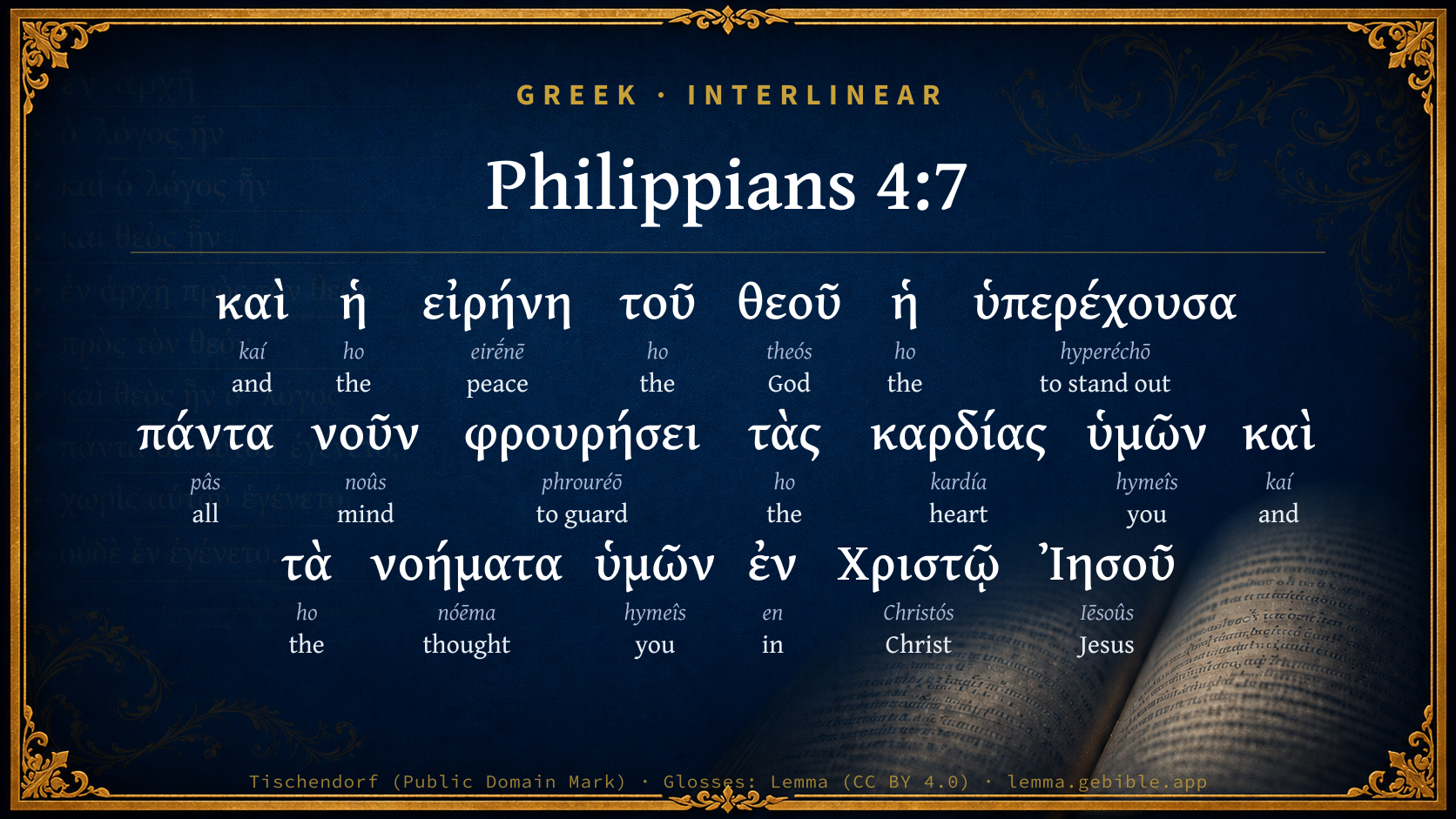
  1. καὶ kaí G2532 “and” Conjunction
  2. ἡ ho G3588 “the” Article, Nominative, Singular, Feminine
  3. εἰρήνη eirḗnē G1515 “peace” Noun, Nominative, Singular, Feminine
  4. τοῦ ho G3588 “the” Article, Genitive, Singular, Masculine
  5. θεοῦ theós G2316 “God” Noun, Genitive, Singular, Masculine
  6. ἡ ho G3588 “the” Article, Nominative, Singular, Feminine
  7. ὑπερέχουσα hyperéchō G5242 “to stand out” Verb, Present, Active, Participle, Nominative, Singular, Feminine
  8. πάντα pâs G3956 “all” Adjective, Accusative, Singular, Masculine
  9. νοῦν noûs G3563 “mind” Noun, Accusative, Singular, Masculine
  10. τὰς ho G3588 “the” Article, Accusative, Plural, Feminine
  11. καρδίας kardía G2588 “heart” Noun, Accusative, Plural, Feminine
  12. ὑμῶν hymeîs G5210 “you” Personal pronoun, 2nd person, Genitive, Plural
  13. καὶ kaí G2532 “and” Conjunction
  14. τὰ ho G3588 “the” Article, Accusative, Plural, Neuter
  15. νοήματα nóēma G3540 “thought” Noun, Accusative, Plural, Neuter
  16. ὑμῶν hymeîs G5210 “you” Personal pronoun, 2nd person, Genitive, Plural
  17. ἐν en G1722 “in” Preposition
  18. Χριστῷ Christós G5547 “Christ” Noun, Dative, Singular, Masculine
  19. Ἰησοῦ Iēsoûs G2424 “Jesus” Noun, Dative, Singular, Masculine

About this verse

These counts appear in no published source. They are computed here, from the morphology-tagged text and Lemma’s own curated glosses. What Lemma adds →

20
words
14
distinct lemmas
Pauline Epistles
section

Notable vocabulary

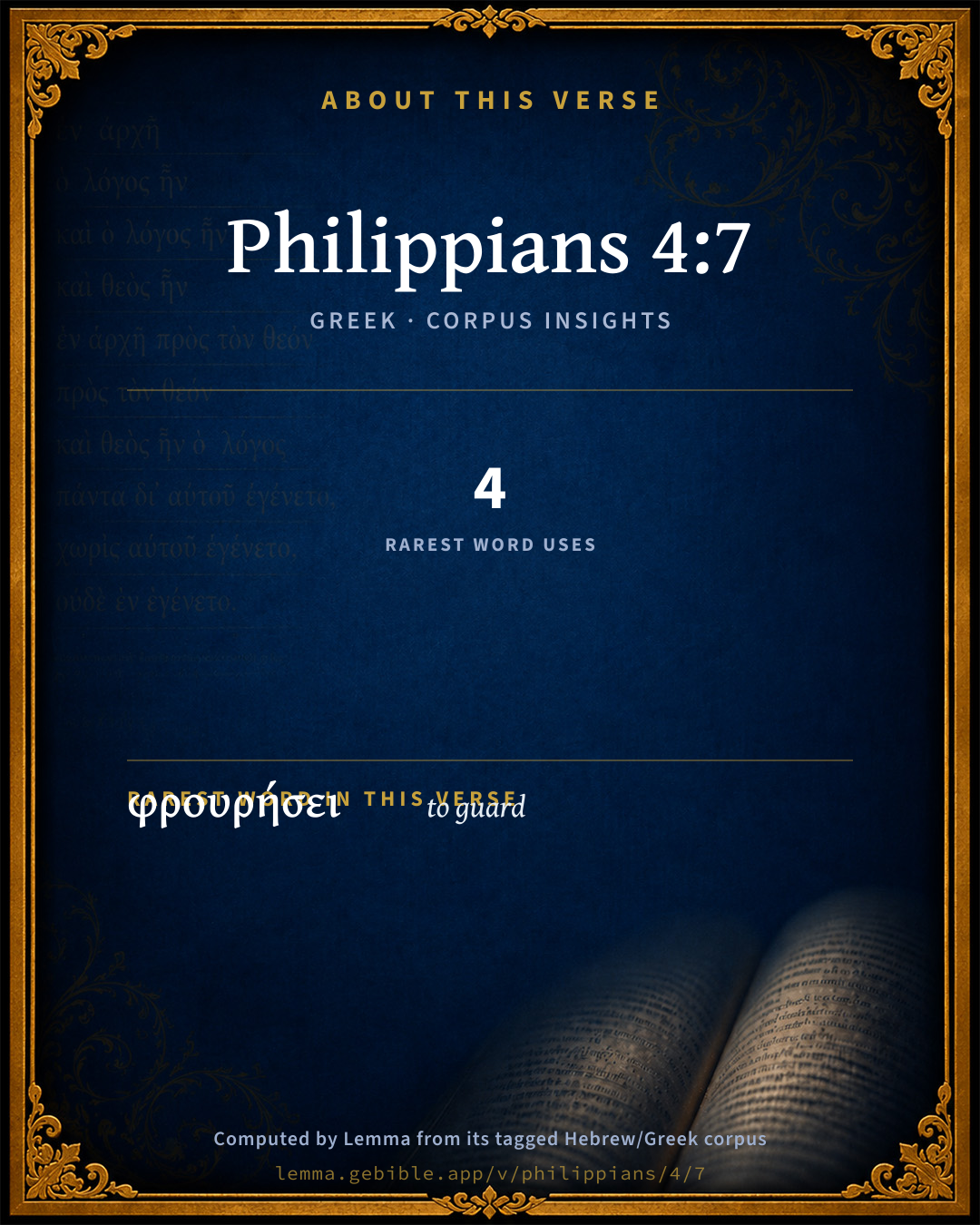
The rarest word here is φρουρήσει to guard G5432 — appearing just 4 times in the whole Greek New Testament.

Shared distinctive vocabulary

φρουρήσει to guard G5432 occurs in 4 verses of the Greek New Testament. Also found in:

Repetition

Words recur within this verse:

Cross-references

38

Topical passages linked to Philippians 4:7 in the Treasury of Scripture Knowledge — connected by theme and wording, ordered by reader-vote popularity; previews shown in the World English Bible.

  • John 14:27 Peace I leave with you. My peace I give to you; not as the world gives, give I to you. Don't let your heart be troubled, neither let it be fearful.
  • Isaiah 26:3 You will keep [him] in perfect peace, [whose] mind [is] stayed [on you]; because he trusts in you.
  • 2 Thessalonians 3:16 Now may the Lord of peace himself give you peace at all times in all ways. The Lord be with you all.
  • Colossians 3:15 And let the peace of God rule in your hearts, to which also you were called in one body; and be thankful.
  • Psalms 29:11 Yahweh will give strength to his people. Yahweh will bless his people with peace.
  • John 16:33 I have told you these things, that in me you may have peace. In the world you have oppression; but cheer up! I have overcome the world."
  • Romans 15:13 Now may the God of hope fill you with all joy and peace in believing, that you may abound in hope, in the power of the Holy Spirit.
  • Galatians 5:22 But the fruit of the Spirit is love, joy, peace, patience, kindness, goodness, faithfulness,
  • Romans 8:6 For the mind of the flesh is death, but the mind of the Spirit is life and peace;
  • Job 22:21 "Acquaint yourself with him, now, and be at peace. Thereby good shall come to you.
  • Romans 5:1 Being therefore justified by faith, we have peace with God through our Lord Jesus Christ;
  • Ephesians 3:19 and to know Christ's love which surpasses knowledge, that you may be filled with all the fullness of God.
  • Isaiah 48:18 Oh that you had listened to my commandments! then had your peace been as a river, and your righteousness as the waves of the sea:
  • Isaiah 48:22 There is no peace, says Yahweh, to the wicked.
  • Romans 14:17 for the Kingdom of God is not eating and drinking, but righteousness, peace, and joy in the Holy Spirit.
  • Luke 1:79 To shine on those who sit in darkness and the shadow of death; To guide our feet into the way of peace."
  • Revelation 1:4 John, to the seven assemblies that are in Asia: Grace to you and peace, from God, who is and who was and who is to come; and from the seven Spirits who are before his throne;
  • Numbers 6:26 Yahweh lift up his face toward you, And give you peace.'
  • 2 Corinthians 13:11 Finally, brothers, rejoice. Be perfected, be comforted, be of the same mind, live in peace, and the God of love and peace will be with you.
  • Proverbs 6:22 When you walk, it will lead you. When you sleep, it will watch over you. When you awake, it will talk with you.
  • Luke 2:14 "Glory to God in the highest, On earth peace, good will toward men."
  • Isaiah 55:11–12 so shall my word be that goes forth out of my mouth: it shall not return to me void, but it shall accomplish that which I please, and it shall prosper in the thing whereto I sent it.
  • Philippians 4:9 The things which you learned, received, heard, and saw in me: do these things, and the God of peace will be with you.
  • Psalms 85:8 I will hear what God, Yahweh, will speak, For he will speak peace to his people, his saints; But let them not turn again to folly.
  • Isaiah 26:12 Yahweh, you will ordain peace for us; for you have also worked all our works for us.
  • Proverbs 4:6 Don't forsake her, and she will preserve you. Love her, and she will keep you.
  • Romans 1:7 to all who are in Rome, beloved of God, called to be saints: Grace to you and peace from God our Father and the Lord Jesus Christ.
  • Isaiah 57:19–21 I create the fruit of the lips: Peace, peace, to him who is far off and to him who is near, says Yahweh; and I will heal him.
  • Jeremiah 33:6 Behold, I will bring it health and cure, and I will cure them; and I will reveal to them abundance of peace and truth.
  • Nehemiah 8:10 Then he said to them, Go your way, eat the fat, and drink the sweet, and send portions to him for whom nothing is prepared; for this day is holy to our Lord: neither be you grieved; for the joy of Yahweh is your strength.
  • Proverbs 2:11 Discretion will watch over you. Understanding will keep you,
  • Isaiah 45:7 I form the light, and create darkness; I make peace, and create evil. I am Yahweh, who does all these things.
  • Hebrews 13:20 Now may the God of peace, who brought again from the dead the great shepherd of the sheep with the blood of an eternal covenant, our Lord Jesus,
  • Job 34:29 When he gives quietness, who then can condemn? When he hides his face, who then can see him? Alike whether to a nation, or to a man:
  • Philippians 1:2 Grace to you, and peace from God, our Father, and the Lord Jesus Christ.
  • Revelation 2:17 He who has an ear, let him hear what the Spirit says to the assemblies. To him who overcomes, to him I will give of the hidden manna, and I will give him a white stone, and on the stone a new name written, which no one knows but he who receives it.
  • Jude 1:1 Jude, a servant of Jesus Christ, and brother of James, to those who are called, sanctified by God the Father, and kept for Jesus Christ:
  • 1 Peter 1:4–5 to an incorruptible and undefiled inheritance that doesn't fade away, reserved in heaven for you,

Cross-references courtesy of OpenBible.info (CC BY 4.0).

Commentary

Notes on Philippians 4:7 from classic Christian and Jewish commentators (each source and its license shown beneath its notes). The classic Christian expositions comment on the surrounding passage and are grouped to its opening verse, so a note may address several verses; the Jewish commentaries on the Tanakh (Rashi and others) are per-verse, so they appear only where the commentator wrote on this verse.

Lemma curates 59 commentaries, every one of them public domain or Creative Commons licensed, each selected and text-cleaned for this edition rather than reprinted as found. About our sources →

The Biblical Illustrator

Joseph S. Exell

Php_4:7

The peace of God which passeth all understanding.

Gods peace

I. The priceless legacy--Christ left peace with His followers as His last and best gift. Peace I leave with you, etc. The apostle in speaking of it gives us two descriptive particulars. He calls it--

1. The peace of God. No one else can give peace. No one else could ensure peace. No one else could possess peace.

2. Which passeth all understanding. The worldling cannot understand it. The Christian cannot understand it. Angels cannot understand it. It is so far removed from all that is material and sensible.

II. The mighty effects--Shall keep your hearts and minds. Here is a power more mighty than the universe. Silence is sometimes more powerful than speech; love is more mighty than rage. So peace is more powerful than storm.

1. It keeps the heart from fear. There can be no fear of man, no fear of the world, no fear of death, no fear of hell in the heart where dwells the peace of God.

2. It keeps the heart from ambition. Ambition is the chief cause of trouble. He who has the peace of God has every ambition satisfied. He desires nothing else.

3. It keeps the heart from strife. There can be no contention where there is peace.

4. It keeps the mind from doubt. Probably by mind the apostle means the intellect as distinguished from the affections. The man who has no doubts is fixed on a rock. Even the poorest, the meanest, the most illiterate can enjoy the trust.

III. The blessed means--Through Christ Jesus. Christ is the medium through which the possibility of peace came at first. Christ is the channel through which it flows at present. He is the propitiation for sins; therefore He brings peace to the conscience. He is the power of God; therefore He brings peace to those who are weak and in fear. He is the path to heaven; therefore He brings confidence to these who are pilgrims. He is the Prince of Peace; therefore He is the delight of all His subjects. (J. J. S. Bird, M. A.)

The peace of God

I. An unspeakable privilege.

1. It is peace with God. Reconciliation there must be, and the soul must be aware of it. A man conscious of being guilty can never know it till he becomes equally conscious of being forgiven. Your sin was the ground of the quarrel, but it is east into the depths of the sea. There is nothing now that can cause the anger of God towards us. We are accepted in the Beloved, and thus have a profound sense of peace.

2. A consequent peace in the little kingdom within. By nature everything in our inner nature is at war with itself. The passions, instead of being curbed by the reason, often holds the reins; and reason, instead of being guided by Divine knowledge, chooses to obey a depraved imagination, and demands to become a separate power and to judge God Himself. There is no cure for this but restoring grace. The King must occupy the throne, and then the state of Mansoul will be settled.

3. A peace in reference to outward circumstances. The man who is reconciled to God by Christ has nothing outside him that he needs fear. Is he poor? He rejoices that Christ makes poor men rich. Does he prosper? He rejoices that there is grace which prevents his prosperity intoxicating him. Is he in trouble? He thanks God for the promise that as His day so his strength shall be. In death the hope of the resurrection gives peace to his pillow; and as for judgment, he knows whom he has believed and knows who will protect him in that day. Whatever may be suggested to distress him, deep down in his soul he cannot be disturbed, because he sees God at the helm of the vessel holding the rudder with a hand that defies the storm.

4. God gives peace in reference to all His commands. The unregenerate soul rebels, but when the change takes place we drop into the same line with God; His will becomes our delight and His statutes our songs.

5. We feel peace with regard to Gods providential dealings, because we believe that they are helping us to arrive at conformity with Him.

6. It is a peace which passeth all understanding. Not only beyond common, or the sinners, but all--deeper, broader, more heavenly than even the joyful saint can tell.

(1) There are kinds of peace which we can understand.

(a) The peace of apathy, to which the Stoics schooled themselves. Their secret is easily discovered. Christianity is not this; it cultivates tenderness, not insensibility, and gives us a peace consistent with the utmost delicacy of feeling.

(b) The peace of levity, which is perfectly understood.

(2) The Christian is often surprised at his own peacefulness. There is a possibility of having the surface of the mind lashed into storm, while yet, deep down, all is still. There are earthquakes, yet the earth pursues the even tenour of its way. It surpasses understanding, but not experience.

II. How this peace is to be obtained. Christians are always at peace with God, but are not always sensible of it. If you wish to realize it hear Paul.

(1) Rejoice in the Lord alway; make God your joy, and place all your joy in Him. You cannot rejoice in yourself, nor in your varying circumstances, but God never changes.

2. Let your moderation be known unto all men. Deal cautiously with earthly things. If any man praises dont exult; if you are censured dont despond. Take matters quietly.

3. Be careful for nothing. Leave your care with God.

4. Pray about everything. That which we pray over will have the sting taken out of it if it be evil, and the sweetness of it will be sanctified if it be good.

5. Be thankful for anything. Thankfulness is the mother and nurse of restfulness. Neglected praises sour into unquiet forebodings.

III. The operation of this blessed privilege on our hearts and minds.

1. Our hearts want keeping--

(1) From sinking, for they are very apt to faint even under small trials.

(2) From wandering, for how soon are they beguiled? A quiet spirit will neither sink nor wander. Like the life buoy, it will rise above the billows and keep its place.

2. Our minds want keeping. In all ages the minds of Christians have been apt to be disturbed on vital truths. But these truths are known to consciousness, and having brought peace to the mind, keep it in perfect peace.

IV. The sphere of its action--In Christ Jesus. There is no peace out of Him. He is our peace. (C. H. Spurgeon.)

The peace of God

This is not a wish or prayer, like the benediction of 2Th_3:16; nor a precept like Col_3:15; but is one of the exceeding great and precious promises. The world is weary for peace; the army after a long campaign, the country bearing the burden of a protracted war, longs for peace; but not more earnestly than men tossed on the waves of this troublesome world. This blessing is for the spirit satiated with the vain pleasures of the world; for the spirit tried with sorrow; for the Pharisee tormented with the incumbrances of his over righteousness; for the publican standing on the threshold.

I. Its source.

1. It originates with Him. Man by sin has placed himself in antagonism to God. The carnal mind is enmity against God. The transgression and enmity were ours, yet God devised means whereby the banished might be restored, and sends to rebels the ambassadors of peace. It was not from man the sinner that the overtures were made.

2. It has reference to Him. It is not only peace from, but with, God. The ambassadors are sent to proclaim that God has devised the means, has made peace. It is no imaginary reconciliation; it is a peace wrought by real means, purchased at a real price--the blood of the Son of God (Col_2:14). And when the sentence of condemnation is blotted out there is no condemnation to those who believe (Rom_5:1; Rom_8:1). This act is the foundation of all peace in the heart. It is a peace which the world can neither give nor take away.

II. Its character. It passeth understanding because--

1. Man unaided cannot attain to it. There are many voices which cry to man of pleasure and rest. But they are delusive. Peace, they cry, when there is no peace. Wherever sin is there is unrest. There is no peace to the wicked. They are like the troubled sea which cannot rest, continually straining after some haven of repose, but only to be cast back by the waves of passion. And not only cannot the sinner, unaided, attain this peace; he cannot, unaided, even receive it when provided for him. The things which belong to his peace are hidden from him. But this does not make void his responsibility. God hath revealed it by His Spirit, whom He gives to those who ask for Him.

2. There are depths in it which the richest Christian experience cannot fathom. There are mysteries in grace as well as in nature and providence. The source of this peace is God, and its guarantee the love of Christ which passeth knowledge. All the gifts of God are inexhaustible.

III. Its effect--Shall guard. Our hearts and minds are in need of continual guardianship, and where shall we meet with one more reliable?

1. It can keep our hearts. We understand by the heart the source of the affections and passions; but not unfrequently the inspired writers use the word to signify the affections and understanding acting together. The fool hath said in his heart, There is no God. The affections are apt to stray from their centre. There is a fatal affinity between the evil within and the evil without. Keep thy heart with all diligence, etc. It needs a strong power to watch over it, but the peace of God is equal to this. There is a strength in it to stay your stray reflections; for it gives you in your heart something on which your love may centre. The lustre of the ballroom and the gaudy trappings of the stage looks tawdry in the daylight; and the loves of the earth look tinsel indeed in the light of a Saviours love and the brightness of the peace of God.

2. The mind. That is prone to be carried off by merely speculative problems. The peace of God keeps the mind not by enslaving its faculties or starving their energy, but by rightly balancing them. By giving us a clear conception of the relative values of things temporal and eternal, by revealing the due order which presides over all Gods works, we are taught to estimate aright the true value of speculative and practical problems.

3. Both the heart and mind are kept. In some natures the thinking faculty is the most active: such are in danger of neglecting the keeping of the heart--the spirit of devotion. Others are exposed to the reverse temptation. To neglect either is injurious. Let us give to each its sustenance; storing our minds with Divine truth and yet increasing in love and grace.

IV. The channel through which it comes. There is no blessing which comes not through Him--in nature, Providence, salvation. He is our peace. (Bp. W. Boyd Carpenter.)

The peace of God

By this the apostle does not mean the blessedness which belongs to the Divine Nature, nor the rest that is laid up for us in heaven: but the deep inward repose of the spiritual life, Divine in its origin, religious in its nature, holy in its impulses, heavenly in its results,

I. Being justified by faith we have peace with God (Rom_5:1). Man is contemplated as a sinner, conscious of guilt, exposed to punishment, and who cannot be justified by law, which has nothing to do but to condemn him. Let this idea be distinctly realized, and it is seen at once that it has power to terribly agitate the soul. The apostle meets the case by a proclamation of mercy, not indeed the tender and benevolent Divine affection to which the guilty and miserable may appeal, but something embodied in a supernatural fact to be apprehended and confided in: God hath set forth Christ to be a propitiation through faith in His blood--that as man could not be justified by law through obedience, he might be through grace by faith. This we have received who have trusted in Christ. There is now no condemnation, etc.; the terrors of conscience are stilled; we have joy and peace through believing. There is no peace, saith my God, to the wicked, but there is peace when he forsakes his evil way and turns to the Lord. The prophet was agitated by the revelation of the glory of the Divine nature and the corruption of his own (Isa_6:1-13.), but he was tranquilized when a live coal from the altar of sacrifice was laid upon his mouth. No angelic voice or vision is to be expected now, but there may be such a certainty of the truth of the gospel, such a perception of its appropriateness, and such a realization of peace, that the penitent and believing man may be able neither to doubt the fact of his forgiveness, nor to resist the feeling of deep calm blessedness, which the persuasion of it brings.

II. To be spiritually minded is life and peace (Rom_8:6), a passage taken from Pauls discourse on the work of the Spirit in man as the former was taken from that on the work of Christ for man. By being spiritually minded the apostle means that the man who has obtained forgiveness through Christ, in virtue of the agency of the Spirit of God has his moral tastes so rectified, his moral affections so cleansed and elevated, that he loves all spiritual things and exercises. Man was made for God. His powers and affections were so constituted that they were to find their supreme enjoyment in Him. Sin has disturbed this original law and given to the flesh an unnatural ascendancy, and so is productive of misery and misrule. The consequence is that to the idea of antagonism between the sinner and God, there is the idea of antagonism to himself. Spiritual renovation restores the natural order of things, reason is enlightened, affections purified, passion restrained, the animal is brought into subjection to the man, and the man bound by love and loyalty to God.

III. Great peace have they who love thy law. The work of righteousness is peace. These and other passages lead us to the correspondence of the Christians outward conduct with the instincts and principles of his inward life. That condition of heart described as minding the things of the Spirit is to find appropriate embodiment in the maintenance of a uniform and elevated morality. It is only by a course of practical obedience that peace of conscience can be preserved. Inconsistency cannot but disturb inward peace. Guilt is a thing full of fears. The secret of Pauls peace was--herein do I exercise myself to have a conscience void of offence.

IV. Thou wilt keep him in perfect peace whose mind is stayed upon thee (Isa_26:3). Filial trust in God is everything that belongs to the circumstances of life. There is a thought for the morrow which is proper and becoming, but there is also a care that hath torment, a fear that is sinful. A Christian man who realizes that all his times are in Gods hands, that He fixes the bounds of his habitation, and perfects that which concerns him, that his Heavenly Father knoweth what he has need of; that all things work together for good; he who thoroughly believes all this, and casts his care, and stays his soul on God, cannot but be saved from the perturbations and anxieties which torment the worldly mind. He is kept from murmuring at what God does, from petulance at what He does not. He can confide and wait, and believe and be thankful, suffer and be satisfied. (T. Binney, LL. D.)

The Divine peace

I. The peace of God. It is so called--

1. Because it is that for which God made man at first--the realization of His original idea of the happiness of humanity. It springs from intercourse with God, filial trust, devotional communion, loving obedience, apprehension of spiritual truth, just and regulated affections, perfect repose in Gods Fatherhood, and conscious complacency in everything that pleases Him. These things are such as would have entered into the happiness of man had he never sinned; many of them, of course, enter into that of the angels.

2. Because it is the result of His merciful interposition for man as well as the realization of His original plan. Something has been done to produce it beyond the original constitution of things, and the result of this interposition in human experience must be of a nature different from and additional to, the blessedness that would have belonged to humanity had it only realized that for which it was made. It is Gods peace because it is by Gods grace that it is possible, by the gift of His Son that it is procured, by the application of His truth that it is produced. It consists of forgiveness of sin, peace of conscience, deliverance from wrath, which man, had he continued upright, would not have needed.

3. Because it is that which is immediately produced by Gods Spirit, and is thus a direct Divine donation. When Christ was about to leave His sorrowing disciples He promised that He would send them another comforter, and then He adds, as if interpreting His meaning, Peace I leave with you, etc. And so the fruit of the Spirit is … peace. May the God of hope fill you with joy and peace in believing, through the power of the Holy Ghost.

4. Because it is sustained and nourished by those acts which bring the soul in contact with God--meditation on His truth, trust in His promises, prayer and praise, song and sacrament.

II. It passeth all understanding. There is nothing unphilosophical in this. Mystery surrounds us. We are incessantly met with ultimate facts whose being and agency we are bound to admit, but which none of us can understand. In the natural laws of the mind, in things connected with our own consciousness, there are matters about which we can only say that they are. Surely, then, it is not wonderful that this should be so in religious life. His peace--

1. Passes the understanding of the man of the world. The very terms and phrases by which it is expressed are foolishness unto them, or repugnant, or unintelligible. In listening to the sober statements of a Christian man, if restrained by courtesy, they are silent, but incredulous and perhaps pitiful: if not restrained they reject the whole thing with contempt as cant or jargon. Nor is this wonderful. Many things connected with art, taste, science, and philosophy, can be understood only through the medium of experience. And so to him who is destitute of religious experience, the very language of religion must be incomprehensible.

2. It passes the understanding of the Christian himself.

(1) Light sometimes gushes into the intellect, filling it with clear apprehensions of truth, and an impression of its power in a manner perfectly inexplicible. The man, all on a sudden, is filled with joy and peace from seeing matters of faith after he had been toiling in doubt and darkness, and was just on the point of abandoning forever.

(2) In the same way the burden of guilt has been lifted, the troubled conscience calmed. The blessedness of the man whose transgression is forgiven has come like an angel of God.

(3) It has been thus, too, with taste and affection; by a sudden transition, the reckless and impure have become like unto a little child.

(4) So, too, in things of great and terrible afflictions. Christians have been kept in such calm peace as has been a perfect amazement to themselves.

(5) And so, too, in the ordinary course of the Christian life.

3. It passes the understanding of angels. The inward joys of hope and faith are associated with redemption and into these things angels desire to look.

III. It keeps the heart and mind. The word is used only in three other places, 2Co_11:32, where the words with a garrison are included in the word that stands for kept; Gal_3:23, where we have the idea of a sort of strong room, or protected custody; 1Pe_1:5, where it is preserved as in a fortress. The general import of the statement is that the experience of religious life is the most powerful preservative of the happiness and virtue of man. Trouble and sin by the peace of God are cast out of the soul and kept out. Heart and mind, however discriminated, include every, faculty of the inner man.

1. Suppose an attack be made on a mans belief, and dark clouds of doubt overspread the mind, I do not say that he need not go to his books and arguments, but I do say that the portable evidence of Christianity in his own experience of its power will often do more to reveal the hollowness of sceptical suggestions than all the learning of the schools. Nay, the peace of God as a felt possession will prevent the rising and entrance of the doubt itself, or will instantly repel it.

2. If the memory of his old sins comes to disturb the tranquillity of his conscience he will, of course, be humbled at the thought of this; but the counter recollection of the peace and joy he had in believing will prove a protection from what would break his peace. And here again the possession of peace will prevent the rising or entrance of that into the soul which would throw it back again on hopelessness and despair. I know whom I have believed. I will trust and not be afraid.

3. In like manner the peace of God will guard the heart against murmuring and anxiety, fear and distrust in relation to the affairs of life. Thou hast been my help, therefore in the shadow of Thy wings will I rejoice.

4. It is a preservative, strong and sure, against all sin. The religiously happy are the morally strong. Duty is pleasant because the mind is in joyous harmony with Gods requirements.

(1) It keeps the heart by keeping its volatile affections, not permitting them to go forth to twine themselves round anything forbidden.

(2) Sin is resisted from the knowledge that it will damage the peace of the soul.

(3) When this peace dilates the soul it is not easy for the devil to put in a temptation. A rich man cannot be tempted to steal; a sober man is not tempted by the sight of a tavern. So with the spiritually happy man; what might overcome others is nothing to him. He is raised above them, and the peace of God shields him from their influence.

IV. Through Christ Jesus. He is the object of faith and the sole medium of spiritual influence. In virtue of His work on earth we obtain peace at first; and if, as justified, any man sin, it is by His work in heaven that peace is restored. (T. Binney, LL. D.)

The peace of God keeping the heart

We all need something to keep our hearts. The changes of the world affect not only our homes and outward comforts, but our inmost souls. And more, our hearts are naturally restless. The result is that even in a calm our minds are shifting. It is plain we need something to steady us. Where shall we find it? Plainly not in this world; as well seek it in the hurricane. Not in ourselves, there there is only misery. The text shows us the blessing that we need.

I. Its nature. Not self-denial, exertion, or watchfulness, but peace; enjoyment and repose in enjoyment. A calm which not only quiets the soul amid the tumult of the storm, but keeps it quiet. But there is no peace to the wicked. They are like a troubled sea when it cannot rest. This peace is the result of a change in mans state and character; the effect of a reconciliation between him and heaven. When this transpires man can look on God as his Friend, expect victory in temptation, a refuge in perils, strength in weakness, comfort in affliction, safety in death, heaven, and, in heaven, God.

II. Its author--God.

1. The work of saving mercy on which it rests is only His. He provides mercy and induces its acceptance.

2. He communicates that peace which flows from a sense of pardon. This is not the result of reasoning or self-examination, it is the gift of that God who fills us with all joy and peace in believing.

III. One of its properties. A peace thus Divine in its origin must partake in some degree of the lofty nature of its Author, and in that degree must be incomprehensible.

1. It passes the understanding of those who are strangers to it. They who have not experienced it can know nothing of its character. Not that it is visionary or enthusiastic--nothing can be so rational and real; there is no other that will bear any serious reflection at all. And this peculiarity is not confined to this or any other spiritual blessing. The man of intellect may talk of the delight he experiences in the acquisition of knowledge, but his words convey no distinct idea to his ignorant neighbour. Tell a deaf man of the harmonies of music, or a blind man of the beauty of the world!

2. Those who enjoy it most cannot fully comprehend it. They are sensible of it, and find their hearts quieted and purified by it; but how did it come into the heart? Why is it at times so unspeakably sweet and strong? All they can say is, it passeth understanding, and perhaps an inhabitant of heaven cannot say more. We may all, however, comprehend its effects.

IV. One of these effects.

1. It keeps the heart.

(1) In temptation by satisfying it. It triumphs over the pleasures of sense by communicating higher pleasures.

(2) In affliction. It is a pledge of the special love of God to the soul, and as such it begets confidence in Him. Let a worldly man lose his earthly comforts and he has lost all; but let a man of God lose what he may his chief treasure is safe.

2. It keeps the mind.

(1) It settles the judgment, and informs and elevates the understanding by showing it, in the light of spiritual blessedness, the measure and poverty of all temporal good.

(2) It keeps the mind from folly, new and strange notions, sceptical doubt and error. The man who has it has the witness in himself. Tell him that the Bible is not true, his religion a fable! You might as well tell him in the broad light of day that there is no sun.

V. Its source and instrumentality. The apostle had been inculcating freedom from anxiety and care; but lest the Philippians should seek in this the fountain of their peace he here adds in Christ Jesus. This peace has God for its author and giver, but it flows, to us through His Son.

1. It is one of the blessed fruits of His obedience, sufferings, and intercession.

2. It dwells also in Him as the head of the Church, the royal treasury of all precious gifts.

3. It is dispersed by Him through the agency of the Spirit. (C. Bradley, M. A.)

How to keep the heart

Inasmuch as the heart is the most important part of a man--for out of it are the issues of life--it is natural that it should be the object of Satans perpetual attacks.

I. That which keeps the heart and mind.

1. The peace of God, the peace existing between the child of God and his Judge through his Saviour, from whence flows peace of conscience.

2. This peace passeth all understanding.

(1) See how it keeps those who are in the depth of poverty while many rich are distracted.

(2) The bereaved, when those who have Dot suffered are gnawed with fear.

(3) The confessors, Luther, Huss, Bradford--while popes and kings tremble.

II. How is this peace to be obtained. This promise has precepts (see verse 4).

1. Rejoice ever more. The man who never rejoices is always murmuring. Cultivate a cheerful disposition.

2. Be moderate. Merchant, you cannot push that speculation too far, and have peace of mind. Young man, you cannot be trying so fast to rise in the world, and have the fear of God. You must be moderate in anger, in expectations, etc.

3. Be careful for nothing, etc. If you tell your troubles to God you put them into the grave. If you roll them anywhere else they will roll back again like the stone of Sisyphus. Cast your troubles where you have cast your sins, into the depths of the sea.

III. How this peace keeps the heart.

1. It keeps the heart full of that love which casteth out all fear.

2. It keeps the heart pure, without the least relish for sin, which is the souls disturbance.

3. It keeps it undivided, and thus saves it from distraction.

4. It keeps it rich, and thus renders it secure from anxiety. (C. H. Spurgeon.)

Characteristics of peace

It is--

1. Real; not the delusive calm of a hollow truce, nor the deceitful tranquillity of stolid indifference and thoughtless apathy. An ice-bound river is at peace; a motionless corpse. In true peace there is life and activity as well as rest.

2. Great (Psa_119:165; Isa_54:13) in its foundation, author, effect.

3. Abundant (Jer_33:6), flowing in many channels, and filling the heart (Rom_15:13).

4. Abiding; secure and certain, a peace that lives independently of circumstances, which the world can neither give nor take away, the unruffled undercurrent, beneath the grounds well of the Christians sorrows; a peace not often disturbed, and never finally overthrown.

5. Incomprehensive, both to the men of this world and saints of God as well. (G. S. Bowes, B. A.)

The secret of peace

He who climbs above the cares of the world and turns his face to his God, has found the sunny side of life. The worlds side of the hill is chill and freezing to a spiritual mind, but the Lords presence gives a warmth of joy which turns winter into summer. (C. H. Spurgeon.)

The peace of elevation

Dust, by its own nature, can rise only so far above the road; and birds which fly higher never have it upon their wings. So the heart that knows how to fly high enough escapes those little cares and vexations which brood upon the earth, but cannot rise above it into that purer air. (H. W. Beecher)

True and false peace

There are other kinds of peace besides the peace of God. There is the peace, for example, of an uninformed conscience; of one who thinks that an amiable disposition, and a freedom from open or definite sin, is enough to win heaven. There is the peace of a sleeping conscience; a conscience still lying dormant in the torpor of natural indifference. There is the peace of a drugged conscience; of one who is surrendering himself to a bosom lust, and refusing to look on to its probable misery in this life, to its certain punishment in the next. There is the peace too of a hardened conscience; of one who has become so used to sin that it has lost its power to alarm; of one who can even lie down to die, impenitent and unremorseful, on the strength of a few vague hopes, if even these, in Gods mercy and in Christs atonement. All sinful men are not yet consciously unhappy, though of peace, in its true meaning, they can know nothing. There is no peace, saith my God, no true, permanent peace of God, to the wicked. God calls us to peace. That is what He offers to us. Repose instead of restlessness; tranquillity instead of confusion; an anchor of the soul, sure and stedfast, because entering into that within the veil. God grant that the religion here known may be all of that character; a religion of quietness, a religion of soberness, a religion of reality, a religion of peace. (Dean Vaughan.)

The peace passing all understanding

You have seen the sea when it was perfectly smooth, with hardly a ripple on the water, and you have watches it when lashed into a fury by the tempest, the waves run mountains high. But all this rage of the elements is only on the surface; below the waves and foam and howling winds there are depths which no storms ever reach, where the many-branched coral and other strange forms of growth and life spread over vast submarine plains and valleys, throughout the whole extent of which reigns the silence and stillness of an unbroken calm. Such is the contrast between the outward trials of life and the deep inward peace which reigns in the heart which is stayed in God. We cannot escape the trials of life, but if there be within us true trust in God, then there will be depths in our inmost being where no storms can reach, depths beyond the play of the waves of this troublesome world, where the fury of the tempest cannot come, where all will be calm and still. (J. B. Mozley, D. D.)

The peace of God a protection

The peace, the harmony of soul, the repose and concord of the whole man, which is Gods gift, the effect of Gods own presence by His Holy Spirit, shall keep you as in a fortified place from all danger, from all the crafts and assaults of evil. What is it which exposes us to our worst perils? Is it not a roving heart? A heart seeking rest and finding none? It is not the unsatisfied insatiable thirst which is in us all by nature, for a happiness which yet earth cannot give. That is what makes a man a pleasure hunter, an idolater of the world, the slave of his evil passions and sinful lusts. That is the bait which the devil presents to the fallen Adam: and if it succeeded even with the unfallen and upright, who shall wonder if it succeeds with him? Let a man have found peace in God, let him have tasted of that water after drinking of which none thirsts again for any other, and he has a safeguard against evil. Why should he go after that which cannot profit or satisfy when he has within him a spring of living water. That is the sense in which Paul writes that the peace of God shall guard our hearts and our thoughts, i.e., the seat of thought, and the workings of thought. There will be no roving desires there to go abroad from the camp and fall into the enemys ambush. And there will be no traitor there to open the gate of the citadel to some disguised foe. The heart that has found peace in God, is kept as in a sure fortress by that peace itself. It is built as a city that is at unity in itself (Pro_18:10; Psa_122:3, Psa_13:5). It is all at one. It is not divided between this and that; it is not, like the heart of nature, a fighting ground of conflicting parties; it is in safe keeping under an almighty hand. (Dean Vaughan.)

Peace protecting

The child frightened in his play runs to seek his mother. She takes him upon her lap and presses his head to her bosom; and with tenderest words of love, she locks down upon him, and smoothes his hair, and kisses his cheek and wipes away his tears, and then in a low and gentle voice, she sings some sweet descant, some lullaby of love; and the fear fades out from his face, and a smile of satisfaction plays over it, and at length his eyes close, and he sleeps in the deep depths and delights of peace. God Almighty is the mother, and the soul is the frightened child; and He folds it in His arms, dispels its fear, and lulls it to repose, saying, Sleep, my darling, sleep! It is I who watch and protect thee. No weapon that is formed against thee shall prosper. The mothers arms encircle but one; but God clasps every yearning soul to His bosom and gives it the peace which passeth understanding, beyond the reach of care or storm. (H. W. Beecher.)

Peace protective

The peace of God will keep us from sinning under our troubles and from sinking under them. (Matthew Henry.)

The Biblical Illustrator, edited by Joseph S. Exell (c. 1880s–1900s) — public domain. Text from a community e-Sword module.

MacLaren's Expositions of Holy Scripture

Alexander MacLaren

Philippians

THE WARRIOR PEACE

Php 4:7.

The great Mosque of Constantinople was once a Christian church, dedicated to the Holy Wisdom. Over its western portal may still be read, graven on a brazen plate, the words, ‘Come unto Me, all ye that labour and are heavy-laden, and I will give you rest.’ For four hundred years noisy crowds have fought, and sorrowed, and fretted, beneath the dim inscription in an unknown tongue; and no eye has looked at it, nor any heart responded. It is but too sad a symbol of the reception which Christ’s offers meet amongst men, and--blessed be His name!--its prominence there, though unread and unbelieved, is a symbol of the patient forbearance with which rejected blessings are once and again pressed upon us, and He stretches out His hand though no man regards, and calls though none do hear. My text is Christ’s offer of peace. The world offers excitement, Christ promises repose.

I. Mark, then, first, this peace of God.

What is it? What are its elements? Whence does it come? It is of God, as being its Source, or Origin, or Author, or Giver, but it belongs to Him in a yet deeper sense, for Himself is Peace. And in some humble but yet real fashion our restless and anxious hearts may partake in the divine tranquillity, and with a calm repose, kindred with that rest from which it is derived, may enter into His rest.

If that be too high a flight, at all events the peace that may be ours was Christ’s, in the perfect and unbroken tranquillity of His perfect Manhood. What, then, are its elements? The peace of God must, first of all, be peace with God. Conscious friendship with Him is indispensable to all true tranquillity. Where that is absent there may be the ignoring of the disturbed relationship; but there will be no peace of heart. The indispensable requisite is ‘a conscience like a sea at rest.’ Unless we have made sure work of our relationship with God, and know that He and we are friends, there is no real repose possible for us. In the whirl of excitement we may forget, and for a time turn away from, the realities of our relation to Him, and so get such gladness as is possible to a life not rooted in conscious friendship with Him. But such lives will be like some of those sunny islands in the Eastern Pacific, extinct volcanoes, where nature smiles and all things are prodigal and life is easy and luxuriant; but some day the clouds gather, and the earth shakes, and fire pours forth, and the sea boils, and every living thing dies, and darkness and desolation come. You are living, brother, upon a volcano’s side, unless the roots of your being are fixed in a God who is your friend.

Again, the peace of God is peace within ourselves. The unrest of human life comes largely from our being torn asunder by contending impulses. Conscience pulls this way, passion that. Desire says, ‘Do this’; reason, judgment, prudence say, ‘It is at your peril if you do!’ One desire fights against another, and so the man is rent asunder. There must be the harmonising of all the Being if there is to be real rest of spirit. No longer must it be like the chaos ere the creative word was spoken, where, in gloom, contending elements strove.

Again, men have not peace, because in most of them everything is topmost that ought to be undermost, and everything undermost that ought to be uppermost. ‘Beggars are on horseback’ {and we know where they ride}, ‘and princes walking.’ The more regal part of the man’s nature is suppressed, and trodden under foot; and the servile parts, which ought to be under firm restraint, and guided by a wise hand, are too often supreme, and wild work comes of that. When you put the captain and the officers, and everybody on board that knows anything about navigation, into irons, and fasten down the hatches on them, and let the crew and the cabin boys take the helm and direct the ship, it is not likely that the voyage will end anywhere but on the rocks. Multitudes are living lives of unrestfulness, simply because they have set the lowest parts of their nature upon the throne, and subordinated the highest to these.

Our unrest comes from yet another source. We have not peace, because we have not found and grasped the true objects for any of our faculties. God is the only possession that brings quiet. The heart hungers until it feeds upon Him. The mind is satisfied with no truth until behind truth it finds a Person who is true. The will is enslaved and wretched until in God it recognises legitimate and absolute authority, which it is blessing to obey. Love puts out its yearnings, like the filaments that gossamer spiders send out into the air, seeking in vain for something to fasten upon, until it touches God, and clings there. There is no rest for a man until he rests in God. The reason why this world is so full of excitement is because it is so empty of peace, and the reason why it is so empty of peace is because it is so void of God. The peace of God brings peace with Him, and peace within. It unites our hearts to fear His name, and draws all the else turbulent and confusedly flowing impulses of the great deep of the spirit after itself, in a tidal wave, as the moon draws the waters of the gathered ocean. The peace of God is peace with Him, and peace within.

I need not, I suppose, do more than say one word about that descriptive clause in my text, It ‘passeth understanding.’ The understanding is not the faculty by which men lay hold of the peace of God any more than you can see a picture with your ears or hear music with your eyes. To everything its own organ; you cannot weigh truth in a tradesman’s scales or measure thought with a yard-stick. Love is not the instrument for apprehending Euclid, nor the brain the instrument for grasping these divine and spiritual gifts. The peace of God transcends the understanding, as well as belongs to another order of things than that about which the understanding is concerned. You must experience it to know it; you must have it in order that you may feel its sweetness. It eludes the grasp of the wisest, though it yields itself to the patient and loving heart.

II. So notice, in the next place, what the peace of God does.

It ‘shall keep your hearts and minds.’ The Apostle here blends together, in a very remarkable manner, the conceptions of peace and of war, for he employs a purely military word to express the office of this Divine peace. That word, ‘shall keep,’ is the same as is translated in another of his letters kept with a garrison --and, though, perhaps, it might be going too far to insist that the military idea is prominent in his mind, it will certainly not be unsafe to recognise its presence.

So, then, this Divine peace takes upon itself warlike functions, and garrisons the heart and mind. What does he mean by ‘the heart and mind’? Not, as the English reader might suppose, two different faculties, the emotional and the intellectual--which is what we usually roughly mean by our distinction between heart and mind--but, as is always the case in the Bible, the ‘heart’ means the whole inner man, whether considered as thinking, willing, purposing, or doing any other inward act; and the word rendered ‘mind’ does not mean another part of human nature, but the whole products of the operations of the heart. The Revised Version renders it by ‘thoughts,’ and that is correct if it be given a wide enough application, so as to include emotions, affections, purposes, as well as ‘thoughts’ in the narrower sense. The whole inner man, in all the extent of its manifold operations, that indwelling peace of God will garrison and guard.

So note, however profound and real that Divine peace is, it is to be enjoyed in the midst of warfare. Quiet is not quiescence. God’s peace is not torpor. The man that has it has still to wage continual conflict, and day by day to brace himself anew for the fight. The highest energy of action is the result of the deepest calm of heart; just as the motion of this solid, and, as we feel it to be, immovable world, is far more rapid through the abysses of space, and on its own axis, than any of the motions of the things on its surface. So the quiet heart, ‘which moveth altogether if it move at all,’ rests whilst it moves, and moves the more swiftly because of its unbroken repose. That peace of God, which is peace militant, is unbroken amidst all conflicts. The wise old Greeks chose for the protectress of Athens the goddess of Wisdom, and whilst they consecrated to her the olive branch, which is the symbol of peace, they set her image on the Parthenon, helmed and spear-bearing, to defend the peace, which she brought to earth. So this heavenly Virgin, whom the Apostle personifies here, is the ‘winged sentry, all skilful in the wars,’ who enters into our hearts and fights for us to keep us in unbroken peace.

It is possible day by day to go out to toil and care and anxiety and change and suffering and conflict, and yet to bear within our hearts the unalterable rest of God. Deep in the bosom of the ocean, beneath the region where winds howl and billows break, there is calm, but the calm is not stagnation. Each drop from these fathomless abysses may be raised to the surface by the power of the sunbeams, expanded there by their heat, and sent on some beneficent message across the world. So, deep in our hearts, beneath the storm, beneath the raving winds and the curling waves, there may be a central repose, as unlike stagnation as it is unlike tumult; and the peace of God may, as a warrior, keep our hearts and minds in Christ Jesus.

What is the plain English of that metaphor? Just this, that a man who has that peace as his conscious possession is lifted above the temptations that otherwise would drag him away. The full cup, filled with precious wine, has no room in it for the poison that otherwise might be poured in. As Jesus Christ has taught us, there is such a thing as cleansing a heart in some measure, and yet because it is ‘empty,’ though it is ‘swept and garnished,’ the demons come back again. The best way to be made strong to resist temptation, is to be lifted above feeling it to be a temptation, by reason of the sweetness of the peace possessed. Oh! if our hearts were filled, as they might be filled, with that divine repose, do you think that the vulgar, coarse-tasting baits which make our mouths water now would have any power over us? Will a man who bears in his hands jewels of priceless value, and knows them to be such, find much temptation when some imitation stone, made of coloured glass and a tinfoil backing, is presented to him? Will the world draw us away if we are rooted and grounded in the peace of God? Geologists tell us that climates are changed and creatures are killed by the slow variation of level in the earth. If you and I can only heave our lives up high enough, the foul things that live down below will find the air too pure and keen for them, and will die and disappear; and all the vermin that stung and nestled down in the flats will be gone when we get up to the heights. The peace of God will keep our hearts and thoughts.

III. Now, lastly, notice how we get the peace of God.

My text is an exuberant promise, but it is knit on to something before, by that ‘and’ at the beginning of the verse. It is a promise, as all God’s promises are, on conditions. And here are the conditions. ‘Be careful for nothing; but in everything by prayer and supplication, with thanksgiving, let your requests be made known unto God.’ That defines the conditions in part; and the last words of the text itself complete the definition. ‘In Christ Jesus’ describes, not so much where we are to be kept, as a condition under which we shall be kept. How, then, can I get this peace into my turbulent, changeful life?

I answer, first, trust is peace. It is always so; even when it is misplaced we are at rest. The condition of repose for the human heart is that we shall be ‘in Christ,’ who has said, ‘In the world ye shall have tribulation, but in Me ye shall have peace.’ And how may I be ‘in Him’? Simply by trusting myself to Him. That brings peace with God.

The sinless Son of God has died on the Cross, a sacrifice for the sins of the whole world, for yours and for mine. Let us trust to that, and we shall have peace with God, through our Lord Jesus Christ. And ‘in Him’ we have, by trust, inward peace, for He, through our faith, controls our whole natures, and Faith leads the lion in a silken leash, like Spenser’s Una. Trust in Christ brings peace amid outward sorrows and conflicts. When the pilot comes on board the captain does not leave the bridge, but stands by the pilot’s side. His responsibility is past, but his duties are not over. And when Christ comes into my heart, my effort, my judgment, are not made unnecessary, or put on one side. Let Him take the command, and stand beside Him, and carry out His orders, and you will find rest to your souls.

Again, submission is peace. What makes our troubles is not outward circumstances, howsoever afflictive they may be, but the resistance of our spirits to the circumstances. And where a man’s will bends and says, ‘Not mine but Thine be done,’ there is calm. Submission is like the lotion that is applied to mosquito bites--it takes away the irritation, though the puncture be left. Submission is peace, both as resignation and as obedience.

Communion is peace. You will get no quiet until you live with God. Until He is at your side you will always be moved.

So, dear friend, fix this in your minds: a life without Christ is a life without peace. Without Him you may have excitement, pleasure, gratified passions, success, accomplished hopes, but peace never! You never have had it, have you? If you live without Him, you may forget that you have not Him, and you can plunge into the world, and so lose the consciousness of the aching void, but it is there all the same. You never will have peace until you go to Him. There is only one way to get it. The Christless heart is like the troubled sea that cannot rest. There is no peace for it. But in Him you can get it for the asking. ‘The chastisement of our peace was laid upon Him.’ For our sakes He died on the Cross, so making peace. Trust Him as your only hope, Saviour and friend, and the God of peace will ‘fill you with all joy and peace in believing.’ Then bow your wills to Him in acceptance of His providence, and in obedience to His commands, and so, ‘your peace shall be as a river, and your righteousness as the waves of the sea.’ Then keep your hearts in union and communion with Him, and so His presence will keep you in perfect peace whilst conflicts last, and, with Him at your side, you will pass through the valley of the shadow of death undisturbed, and come to the true Salem, the city of peace, where they beat their swords into ploughshares, and learn and fear war no more.

Alexander MacLaren, Expositions of Holy Scripture (1904–1910) — public domain. Text from a community e-Sword module.

Tyndale Open Study Notes

Tyndale Open Resources

4:7 The life of trusting God (4:6) brings God’s peace (see also Isa 26:3; John 14:27; Col 3:15).

Tyndale Open Study Notes — © Tyndale Open Resources, licensed CC BY-SA 4.0. Text via the HelloAO Bible API.

Bengel's Gnomon

Johann Albrecht Bengel

Php 4:7. Ἡ εἰρήνη, the peace) Peace, free from all anxiety [the companion of joy; comp. Php 4:9.—V. g.]—ἡ ὑπερέχουσα πάντα νοῦν) that exceedeth all understanding, and therefore every request; Eph 3:20.—φρουρήσει) will keep; it will defend you against all inroads (assaults) and anxieties, and will correct whatever is wanting to the suitableness (dexteritati, to the spiritual skilfulness, happiness of expression) of your desires, Rom 8:26-27.—καρδίας—νοήματα, hearts—thoughts) The heart is the seat of the thoughts.

Bengel's Gnomon of the New Testament — English translation (T&T Clark, Edinburgh, 1860) — public domain. Text from a community e-Sword module.

Meyer's Critical & Exegetical Commentary

Heinrich August Wilhelm Meyer

Php_4:7. The blessed result, which the compliance with Php_4:6 will have for the inner man. How independent is this blessing of the concrete granting or non-granting of what is prayed for!

ἡ εἰρήνη τ. Θεοῦ] the peace of soul produced by God (through the Holy Spirit; comp. χαρὰ ἐν πνεύματι ἁγίῳ, Rom_14:17), the repose and satisfaction of the mind in Gods counsel and love, whereby all inward discord, doubt, and variance are excluded, such as it is expressed e.g. in Rom_8:18; Rom_8:28. So in substance most expositors, including Rheinwald, Flatt, Baumgarten-Crusius, Hoelemann, Rilliet, de Wette, Wiesinger, Ewald, Weiss, Hofmann, and Winer. This viewand not (in opposition to Theodoret and Pelagius) that explanation of peace in the sense of harmony with the brethren (Rom_15:33; Rom_16:20; 2Co_13:11; 1Th_5:23; 2Th_3:16), which corresponds to the ordinary use of the correlative ὁ Θεὸς τῆς εἰρήνης in Php_4:9is here required on the part of the context, both by the contrast of μεριμνᾶτε in Php_4:6, and by the predicate ἡ ὑπερέχουσα πάντα νοῦν. The latter, if applicable to the peace of harmony, would express too much and too general an idea; it is, on the other hand, admirably adapted to the holy peace of the soul which God produces, as contrasted with the μέριμνα, to which the feeble νοῦς by itself is liable; as, indeed, in the classical authors also (Plat. Rep. p. 329 C, p. 372 D), and elsewhere (Wis_3:3), εἰρήνη denotes the tranquillitas and securitas, the mental γαλήνη (Plat. Legg. vii. p. 791 A) and ἡσυχίαa rest, which here is invested by τοῦ Θεοῦ with the consecration of divine life. Comp. εἰρήνη τοῦ Χριστοῦ, Col_3:15; Joh_14:27; and, on the other hand, the false εἰρήνη κ. ἀσφάλεια, 1Th_5:3. It is therefore not to be understood, according to Rom_5:1, as pax, qua reconciliati estis Deo (Erasmus, Paraphr.; so Chrysostom, ἡ καταλλαγὴ, ἡ ἀγάπη τ. Θεοῦ; and Theophylact, Oecumenius, Beza, Estius, Wetstein, and others, including Storr, Matthies, and van Hengel), which would be too general and foreign to the context. The peace of reconciliation is the presupposition of the divinely produced moral feeling which is here meant; the former is εἰρήνη πρὸς τὸν Θεόν, the latter εἰρήνη τοῦ Θεοῦ.

ἡ ὑπερέχουσα πάντα νοῦν] which surpasses every reason, namely, in regard to its salutary power and efficacy; that is, which is able more than any reason to elevate above all solicitude, to comfort and to strengthen. Because the reason in its moral thinking, willing, and feeling is of itself too weak to confront the power of the σάρξ (Rom_7:23; Rom_7:25; Gal_5:17), no reason is in a position to give this clear holy elevation and strength against the world and its afflictions. This can be effected by nothing but the agency of the divine peace, which is given by means of the Spirit in the believing heart, when by its prayer and supplication with thanksgiving it has elevated itself to God and has confided to Him all its concerns, 1Pe_5:7. Then, in virtue of this blessed peace, the heart experiences what it could not have experienced by means of its own thinking, feeling, and willing. According to de Wette, the doubting and heart-disquieting νοῦς is meant, which is surpassed by the peace of God, because the latter is based upon faith and feeling. In opposition to this, however, stands the πάντα, according to which not merely all doubting reason, but every reason is meant. No one, not even the believer and regenerate, has through his reason and its action what he has through the peace of God. Others have explained it in the sense of the incomprehensibleness of the peace of God, the greatness of which the understanding cannot even grasp (Wiesinger). So Chrysostom, Oecumenius, Theophylact, Erasmus, Luther, Calvin, Grotius, also Hoelemann and Weiss. Comp. Eph_3:20. But the context, both in the foregoing μηδὲν μεριμνᾶτε and in the φρουρήσει κ.τ.λ. which follows, points only to the blessed influence, in respect of which the peace of God surpasses every kind of reason whatever, and consequently is more efficacious than it. It is a ὑπερέχειν τῇ δυνάμει; Paul had no occasion to bring into prominence the incomprehensibleness of the εἰρήνη Θεοῦ.

On ὑπερέχειν with the accusative (usually with the genitive, Php_2:3), see Valckenaer, ad Eur. Hippol. 1365; Kühner, II. 1, p. 337.

φρουρήσει κ.τ.λ.] not custodiat (Vulgate, Chrysostom, Theodoret, Theophylact: ἀσφαλίσαιτο, Luther, Calovius, Cornelius a Lapide, and others, including Storr, Heinrichs, Flatt), but custodiet (Castalio, Beza, Calvin), whereby protection against all injurious influences (comp. 1Pe_1:5) is promised. Comp. Plat. Rep. p. 560 B: οἱ … ἄριστοι φρουροί τε καὶ φύλακες ἐν ἀνδρῶν θεοφιλῶν εἰσὶ διανοίαις. Eur. Suppl. 902: ἐφρούρει (πολλοὺς) μηδὲν ἐξαμαρτάνειν. Animat eos hac fiducia, Erasmus, Annot. This protecting vigilance is more precisely defined by ἐν Χ. Ἰ., which expresses its specific character, so far as this peace of God is in Christ as the element of its nature and life, and therefore its influence, protecting and keeping mens hearts, is not otherwise realized and carried out than in this its holy sphere of life, which is Christ. The φρουρά which the peace of God exercises implies in Christ, as it were, the φρουραρχία (Xen. Mem. iv. 4. 17). Comp. Col_3:15, where the εἰρήνη τοῦ Χριστοῦ βραβεύει in mens hearts. Others consider ἐν Χ. Ἰ. as that which takes place on the part of the readers, wherein the peace of God would keep them, namely in unity with Christ, in His divinely-blessed, holy life, de Wette; or ὥστε μένειν καὶ μὴ ἐκπεσεῖν αὐτοῦ, Oecumenius, comp. Chrysostom, Theophylact, Luther, Zanchius, and others, including Heinrichs, Storr, Flatt, Rheinwald, van Hengel, Matthies, Rilliet, Wiesinger, Weiss. But the words do not affirm wherein watchful activity is to keep or preserve the readers (Paul does not write τηρήσει; comp. Joh_17:11), but wherein it will take place; therefore the inaccurate rendering per Christum (Erasmus, Grotius, Estius, and others) is so far more correct. The artificial suggestion of Hoelemann (Christo fere cinguli instar τὰς καρδίας ὑμῶν κ.τ.λ. circumcludente, etc.) is all the less warranted, the more familiar the idea ἐν Χριστῷ was to the apostle as representing the element in which the life and action, as Christian, move.

The pernicious influences themselves, the withholding and warding off of which are meant by φρουρήσει κ.τ.λ., are not to be arbitrarily limited, e.g. to opponents (Heinrichs), or to Satan (Beza, Grotius, and others), or sin (Theophylact), or pravas cogitationes (Calvin), or omnes insultus et curas (Bengel), and the like; but to be left quite general, comprehending all such special aspects. Erasmus well says (Paraphr.): adversus omnia, quae hic possunt incidere formidanda.

τὰς καρδ. ὑμ. κ. τὰ νοήμ. ὑμῶν] emphatically kept apart. It is enough to add Bengels note: cor sedes cogitationum. Comp. Roos, Fundam. psychol. ex sacr. script. III. § 6: causa cogitationum interna eaque libera. The heart is the organ of self-consciousness, and therefore the moral seat of the activity of thought and will. As to the νοήματα (2Co_3:14) as the internal products of the theoretical and practical reason, and therefore including purposes and plans (Plat. Polit. p. 260 D; 2Co_2:11), comp. Beck, bibl. Seelenl. p. 59, and Delitzsch, Psychol, p. 179. The distinction is an arbitrary one, which applies τ. καρδ. to the emotions and will, and τ. νοήμ. to the intelligence (Beza, Calvin).

Meyer — Critical and Exegetical Commentary on the New Testament — English translation by Peter Christie, edited by Frederick Crombie (T&T Clark, 1880) — public domain. Text from a community e-Sword module.

Expositor's Greek Testament

ed. W. Robertson Nicoll

Phi 4:7 . Hpt [30] . would put no stop at the close of Phi 4:6 . Whether there be a stop or not, this verse is manifestly a kind of apodosis to the preceding. “If you make your requests, etc., … then the peace … shall guard,” etc. ἡ εἰρ . τ . Θ . Paul’s favourite thought of that health and harmonious relation which prevail in the inner life as the result of reconciliation with God through Jesus Christ. Cf. Mat 11:28 . It would be an undue restriction of his thought to imagine that he only refers to agreement between members of the Church, although, no doubt, that idea is here included. “This peace is like some magic mirror, by the dimness growing on which we may discern the breath of an unclean spirit that would work us ill” (Rendel Harris, Memoranda Sacra , p. 130; the quotation skilfully catches the spiritual conception before Paul’s mind). To share anxiety with God is to destroy its corroding power and to be calmed by His peace. Peace is used as a name of God in the Talmud (see Taylor, Jewish Fathers , pp. 25 26). ἡ ὑπερέχ . πάντα νοῦν . “Which surpasses every thought, all our conception.” (So also Chr [31] . , Erasm., Weizs., Moule, Von Soden, etc.). This meaning seems inevitable from the parallel in Eph 3:20 , τῷ δὲ δυναμένῳ ὑπὲρ πάντα ποιῆσαι ὑπερεκπερισσοῦ ὧν αἰτούμεθα ἢ νοοῦμεν , and Cf. Phi 4:19 , τὴν ὑπερβάλλουσαν τῆς γνώσεως ἀγάπην τοῦ Χ . Space forbids the enumeration of the many interpretations given. Wordsworth ( Prelude , Bk. 14) defines this peace as “repose in moral judgments”. νοῦν … καρδίας … νοήματα . νοῦς , very much what we call “reason,” in Paul’s view, belongs to the life of the σάρξ . It is the highest power in that life, and affords, as it were, the material on which the Divine πνεῦμα can work. It remains in those who possess the πνεῦμα as that part of the inner man which is exposed to earthly influences and relations. (See an admirable note in Ws [32] . ) καρδία is “a more undefined concept, side by side with νοῦς ” (so Lüdemann, Anthropol. , p. 16 ff.). It has to do not merely with feelings but with will. νοήματα are products of the νοῦς , thoughts or purposes. Paul would probably regard them as being contained in the καρδία . The word is found five times in 2 Cor. and nowhere else in N.T. φρουρήσει . A close parallel is 1Pe 1:5 , τοὺς ἐν δυνάμει Θεοῦ φρουρουμένους διὰ πίστεως εἰς σωτηρίαν . Hicks ( Class. Review , i., pp. 7 8) presses the figure of a garrison keeping ward over a town, and observes that one of the most important elements in the history of the Hellenistic period was the garrisoning of the cities both in Greece and Asia Minor by the successors of Alexander the Great. Cf. Gal 3:23 . The peace of God is the garrison of the soul in all the experiences of its life, defending it from the external assaults of temptation or anxiety, and disciplining all lawless desires and imaginations within, that war against its higher purposes. ἐν Χ . Ἰ . Christ Jesus is the sure refuge and the atmosphere of security.

[30] Haupt.

[31] Chrysostom.

[32] . Weiss.

The Expositor's Greek Testament, edited by W. Robertson Nicoll (1897–1910) — public domain. Text from a community e-Sword module.

Geneva Bible (1599)

Geneva Bible translators

That great quietness of mind, which God only giveth in Christ.

He divideth the mind into the heart, that is, into that part which is the seat of the will and affections, and into the higher part, whereby we understand and reason of matters.

Geneva Bible (1599) marginal notes — public domain. Text via Bolls.life.

Jamieson, Fausset & Brown

Robert Jamieson, A. R. Fausset & David Brown

And--The inseparable consequence of thus laying everything before God in "prayer with thanksgiving."

peace--the dispeller of "anxious care" (Phi 4:6).

of God--coming from God, and resting in God (Joh 14:27; Joh 16:33; Col 3:15).

passeth--surpasseth, or exceedeth, all man's notional powers of understanding its full blessedness (Co1 2:9-10; Eph 3:20; compare Pro 3:17).

shall keep--rather, "shall guard"; shall keep as a well-garrisoned stronghold (Isa 26:1, Isa 26:3). The same Greek verb is used in Pe1 1:5. There shall be peace secure within, whatever outward troubles may besiege.

hearts and minds--rather, "hearts (the seat of the thoughts) and thoughts" or purposes.

through--rather as Greek, "in Christ Jesus." It is in Christ that we are "kept" or "guarded" secure.

Jamieson, Fausset & Brown — Commentary Critical and Explanatory on the Whole Bible (1871) — public domain (CC PDM 1.0). Text via the HelloAO Bible API.

Adam Clarke's Commentary

Verse 7. And the peace of God] That harmonizing of all passions and appetites which is produced by the Holy Spirit, and arises from a sense of pardon and the favour of God;

Shall keep your hearts] φρουρησει. Shall keep them as in a strong place or castle. Your hearts-the seat of all your affections and passions, and minds-your understanding, judgment, and conscience through Christ Jesus; by whom ye were brought into this state of favour, through whom ye are preserved in it, and in whom ye possess it; for Christ keeps that heart in peace in which he dwells and rules. This peace passeth all understanding; it is of a very different nature from all that can arise from human occurrences; it is a peace which Christ has purchased, and which God dispenses; it is felt by all the truly godly, but can be explained by none; it is communion with the Father, and his Son Jesus Christ, by the power and influence of the Holy Ghost.

Adam Clarke's Commentary on the Bible (1810–1826) — public domain. Text from a community e-Sword/MySword module.

John Calvin's Commentaries

7. And the peace of God Some, by turning the future tense into the optative mood, convert this statement into a prayer, but it is without proper foundation. For it is a promise in which he points out the advantage of a firm confidence in God, and invocation of him. “If you do that,” says he, “the peace of God will keep your minds and hearts.” Scripture is accustomed to divide the soul of man, as to its frailties, into two parts — the mind and the heart. The mind means the understanding, while the heart denotes all the disposition or inclinations. These two terms, therefore, include the entire soul, in this sense, — “The peace of God will guard you, so as to prevent you from turning back from God in wicked thoughts or desires.”

It is on good ground that he calls it the peace of God, inasmuch as it does not depend on the present aspect of things, and does not bend itself to the various shiftings of the world, but is founded on the firm and immutable word of God. It is on good grounds, also, that he speaks of it as surpassing all understanding or perception, for nothing is more foreign to the human mind, than in the depth of despair to exercise, nevertheless, a feeling of hope, in the depth of poverty to see opulence, and in the depth of weakness to keep from giving way, and, in fine, to promise ourselves that nothing will be wanting to us when we are left destitute of all things; and all this in the grace of God alone, which is not itself known otherwise than through the word, and the inward earnest of the Spirit.

John Calvin's Commentaries (1540-1563) — public domain. Text from the Calvin Translation Society English edition (1840s-50s) via the Christian Classics Ethereal Library (ccel.org). Calvin's coverage is partial (roughly two-thirds of the Bible); uncommented books and verses are honest gaps, never fabricated. The 19th-century editor's footnotes and remarks are omitted so the notes are faithfully Calvin's own voice.

Ellicott's Commentary for English Readers

(7) The peace of God—i.e. (like the “righteousness of God,” “the life of God”), the peace which God gives to every soul which rests on Him in prayer. It is peace—the sense of unity in the largest sense—the “peace on earth” proclaimed at our Lord’s birth, left as His last legacy to His disciples, and pronounced at His first coming back to them from the grave (Luk_2:14; Joh_14:27). Hence it includes peace with God, peace with men, peace with self. It keeps—that is, watches over with the watchfulness that “neither slumbers nor sleeps”—both “the hearts and minds” (or, more properly, the souls and the thoughts formed in them), guarding our whole spiritual action, both in its source and its developments. It is “through Christ Jesus,” for “He is our peace (Eph_2:14), as “making all one,” and “reconciling all to God.” The comprehensiveness and beauty of the passage has naturally made it (with the characteristic change from the “shall” of promise to the “may” of benediction) the closing blessing of our most solemn church service of “Holy Communion” with God and man.

A Bible Commentary for English Readers, edited by Charles John Ellicott (1878–1897) — public domain. Text from a community e-Sword module.

The Cambridge Bible for Schools and Colleges

gen. ed. J. J. S. Perowne

7. And] An important link. The coming promise of the Peace of God is not isolated, but in deep connexion.

the peace of God] The chastened but glad tranquillity, caused by knowledge of the God of peace, and given by His Spirit to our spirit. Cp. Col_3:15 (where read, “the peace of Christ”); Joh_14:27. The long and full previous context all leads up to this; the view of our acceptance in and for Christ alone (Php_3:3-9); the deepening knowledge of the living Lord and His power (10); the expectation, in the path of spiritual obedience, of a blessed future (11–21); watchful care over communion with Christ, and over a temper befitting the Gospel, and over the practice of prayer (Php_4:1-6).

Here is the true “Quietism” of the Scriptures.

all understanding] “All mind,” “all thinking power.” Our truest reason recognizes that this peace exists, because God exists; our articulate reasoning cannot overtake its experiences; they are always above, below, beyond. Cp. Eph_3:19.

shall keep] Observe the definite promise; not merely an aspiration, or even an invocation. Cp. Isa_26:3. The Latin versions, mistakenly, read custodiat.

R.V., shall guard. This is better, except as it breaks in on the immemorial music of the Benediction. All the older English versions have “keep”, except the Genevan, which has “defend.” “Guard” (or “defend”) represents correctly the Greek verb, which is connected with nouns meaning “garrison,” “fort,” and the like, and also prevents the mistake of explaining the sentence—“shall keep you in Christ, prevent you from going out of Christ.” What it means is that, “in Christ Jesus,” who is the one true spiritual Region of blessing, the peace of God shall protect the soul against its foes. hearts] The word in Scripture includes the whole “inner man”; understanding, affections, will.

minds] Lit. and better, thoughts, acts of mind. The holy serenity of the believer’s spirit, in Christ Jesus, shall be the immediate means of shielding even the details of mental action from the tempter’s power. Cp. Eph_6:16, where the “faith” which accepts and embraces the promise occupies nearly the place given here to the peace which is the substance of the promise.

through Christ Jesus] Lit. and better, in.—See last note but two.

The Cambridge Bible for Schools and Colleges (gen. ed. J. J. S. Perowne; Cambridge University Press, 1878–1918) — public domain. Text from a community e-Sword module.

John Gill's Exposition

And the peace of God which passeth all understanding,.... Not that peace which God calls his people to among themselves in their effectual calling; and which he requires of them to cultivate and maintain; and which he encourages in them by the promise of his gracious presence among them; and which indeed he is the author of, and therefore is so called, Col 3:15; and which may be said to surpass or exceed all speculative knowledge, and understanding; for the one puffs up and profits nothing, but the other edifies; and much less that peace which God has in himself, who is all peace and love, and which passes all understanding, human and angelic; but either that peace which is made with God by the blood of Christ, and is published in the Gospel of peace, which passes and surprises all understanding of men and angels, that it should be; that the thoughts of God should be concerning it from everlasting; that a council of peace should be called and held between the eternal Three, and a covenant of peace entered into; that Christ should be appointed the peace maker, and the chastisement of it laid on him; that he should make it by the blood of his cross, and for men, while enemies to God and to himself: or else that peace of conscience, which arises from a view of peace made by Christ; of justification by his righteousness, and atonement by his sacrifice; and which may be called "the peace of Christ", as the Alexandrian copy reads; both because it is founded upon, and springs from him, and is what he is the donor of: and this is what passes the understanding of every natural man; he knows nothing of this peace, what this tranquillity of mind means; he intermeddles not with this joy; it is unaccountable to him how it should be, that such then should have peace, who have so much trouble, are so much reproached, afflicted, and persecuted, and yet have peace in Christ, while they have tribulation in the world; which

shall keep your hearts and minds through Jesus Christ, or "in Christ Jesus": some read these words prayer wise, or as a wish, "let it", or "may it keep", so the Vulgate Latin; but they are rather a promise, encouraging the saints to the discharge of the above duties; as rejoicing always in the Lord, showing their moderation to all men, avoiding anxious care, and betaking themselves at all times, on all occasions, to prayer to God; in which way they may expect peace, and such as will be of that see vice to them, as here expressed; that is, be a means of their final perseverance; for the peace of God, in either sense, is a preservation of the saints: peace made with God secures them in Christ from all condemnation by the law, sin, Satan, the world, or their own hearts; and peace in their own souls, on so good a foundation as it is, keeps them through Christ as in a garrison, from being overset with the troubles of the world, or the temptations of Satan; and is a means of preserving them from being carried away with the errors and heresies of the wicked, having a witness to truth within themselves; and from every evil way and work, from profaneness and immorality; the grace of God teaching them, and the love of Christ constraining them, which is shed abroad in their hearts, to live and act otherwise.

John Gill's Exposition of the Whole Bible (1746–1763) — public domain (CC PDM 1.0). Text via the HelloAO Bible API.

Trapp's Complete Commentary

John Trapp

7 And the peace of God, which passeth all understanding, shall keep your hearts and minds through Christ Jesus.

Ver. 7. And the peace of God] Prayer hath virtutem pacativam. "Acquaint thyself with God and be at peace," Job 22:21. Pray, "that your joy may be full," Joh 16:24. David prays down his distempers, Psa 6:1-10 Psa 116:1-19, and then cries out, "Return to thy rest, O my soul;" he rocks himself asleep in this sort; and sets all to rights often times, even then when his heart was more out of tune than his harp. Would you then have that peace of God, that most precious jewel that ever the heart of man was acquainted with? do as you are here advised: 1. Pray for what you want, and give thanks for that you have: (a sacrifice of praise is called a "pay offering," or a "peace offering," because peace ensues upon it.) 2. Be always doing something that is good, as Php 4:8-9, for as every flower hath its sweetness, so every good union hath its comfort. This is so true, that very heathens (upon the discharge of a good conscience) have found comfort and peace answerably. How boldly did Abimelech bear himself upon his integrity; and what a blessed composedness had holy Noah, who was righteous in his generation, and therefore sat mediis tranquillus in undis.

Shall keep your hearts] φρουρησει, keep as with a guard, or as in a garrison. Solomon’s bed was not so well guarded with his threescore valiant men, all holding swords, Son 3:7-8, as each good Christian is by the power of God without him and the peace of God within him. This peace, like David’s harp, drives away the evil spirit of cares and fears; it soon husheth all. God can soon raise up in his an army of powerful thoughts and meditations, so as their very inward tranquillity arising from the testimony of a good conscience (called here, their minds), and the sweet sabbath of spirit, the composedness of their affections (called here, their hearts), can make and keep them secure and sound, yea, bring aid when they are close besieged by sin and Satan.

John Trapp, A Commentary or Exposition upon All the Books of the Old and New Testament (1647–1656) — public domain. Text from a community e-Sword module.

Albert Barnes' Notes on the Bible

And the peace of God - The peace which God gives. The peace here particularly referred to is that which is felt when we have no anxious care about the supply of our needs, and when we go confidently and commit everything into the hands of God. “Thou wilt keep him in perfect peace whose mind is stayed on thee;” Isa 26:3; see the notes at Joh 14:27.

Which passeth all understanding - That is, which surpasses all that people had conceived or imagined. The expression is one that denotes that the peace imparted is of the highest possible kind. The apostle Paul frequently used terms which had somewhat of a hyperbolical cast (see the notes on Eph 3:19; compare Joh 21:25, and the language here is that which one would use who designed to speak of that which was of the highest order. The Christian, committing his way to God, and feeling that he will order all things aright, has a peace which is nowhere else known. Nothing else will furnish it but religion. No confidence that a man can have in his own powers; no reliance which he can repose on his own plans or on the promises or fidelity of his fellow-men, and no calculations which he can make on the course of events, can impart such peace to the soul as simple confidence in God.

Shall keep your hearts and minds - That is, shall keep them from anxiety and agitation. The idea is, that by thus making our requests known to God, and going to him in view of all our trials and wants, the mind would be preserved from distressing anxiety. The way to find peace, and to have the heart kept from trouble, is thus to go and spread out all before the Lord; compare Isa 26:3-4, Isa 26:20; Isa 37:1-7. The word rendered here “shall keep,” is a military term, and means that the mind would be guarded as a camp or castle is. It would be preserved from the intrusion of anxious fears and alarms.

Through Christ Jesus - By his agency, or intervention. It is only in him that the mind can be preserved in peace. It is not by mere confidence in God, or by mere prayer, but it is by confidence in God as he is revealed through the Redeemer, and by faith in him. Paul never lost sight of the truth that all the security and happiness of a believer were to be traced to the Saviour.

Albert Barnes' Notes on the Bible (1834–1885) — public domain. Text from a community e-Sword/MySword module.

Matthew Poole's English Annotations

He adds, as an encouragement to prayer, the peace of God, who was in Christ reconciling the world unto himself, so that upon believing and obeying the gospel, they who really do so are reconciled to him, 2Co 5:19,20, and at peace with him, Rom 5:1, through Christ, who leaves and gives peace to his, Joh 14:27. It is then the peace of God, in that he is the object, the donor, the author of it, by his Spirit, to those who persevere in the communion of Christ, as in Phi 4:9, have the God of peace with them, and a sense thereof in their own spirits.

Which passeth all understanding: how it transcends a finite understanding, may be answered:

1. In that he who hath perceived it, before he had done so, could not sufficiently conceive in his own mind what at length it might be, 1Co 2:9; hence:

2. After it is perceived, it cannot be that any one should esteem and express the power and virtue of it, according to the worth and excellency of the matter. Not that the peace should affect the heart, the will without the intervention of the understanding; since it is said to keep the heart and mind; and, Rev 2:17, the white stone given to believers (whereby this peace is signified) is of that kind, which no man knoweth save he that receiveth it; and it is no new thing in Scripture, to say that doth exceed all understanding, which human understanding doth not so distinctly conceive as to be able to express it, as Eph 3:19. So man’s mind doth receive that which is taken into admiration, that it perceives something always to remain, which it hath notice of, yet cannot so perceive as to express the whole of it.

Shall keep your hearts and minds through Christ Jesus; wherefore they who are really interested in this peace shall be kept as in a garrison, 1Pe 1:5. So their whole souls shall be in safety against the assaults of Satan, their affections and reasoning shall be so kept in order, that, through Christ, they shall not finally fall.

Matthew Poole's English Annotations on the Holy Bible (1683–1685) — public domain. Text from a community e-Sword/MySword module.

Whedon's Commentary on the Bible

Daniel D. Whedon

7. The peace of God—This result follows. This peace, though allied to that which follows the pardon of a sinner, differs from it. It is the quiet rest which God gives him who continually surrenders every thing into his hand.

Daniel D. Whedon (gen. ed.), Commentary on the Old and New Testaments (1874–1909) — public domain. Text from a community e-Sword module.

The Pulpit Commentary

And the peace of God, which passeth all understanding. The peace which God gives, which flows from the sense of his most gracious presence, and consists in childlike confidence and trustful love. This peace passeth all understanding; its calm blessedness transcends the reach of human thought; it can be known only by the inner experience of the believer. The similar passage, Ephesians in 20, "Unto him that is able to do exceeding abundantly above all that we ask or think," seems decisive for the ordinary interpretation. Bishop Light-foot, Meyer, and others take another view of the passage: "Surpassing every device or counsel of man, i.e. which is far better, which produces a higher satisfaction, than all punctilious self-assertion, all anxious forethought." Shall keep your hearts and minds through Christ Jesus; rather, as R.V, shall guard your hearts and your thoughts in Christ Jesus. Peace shall guard verbal paradox, for to guard is a warrior"s duty" (Bishop Lightfoot). The peace of God abiding in the heart is a sure and trusty garrison, guarding it so that the evil spirit, once cast out, cannot return. The thoughts issue from the heart; for the heart, as commonly in the Hebrew Scriptures, is regarded as the seat of the intellect, not of feeling only. In Christ Jesus; in the sphere of his influence, his presence. True believers, abiding in Christ, realize his promise, "Peace I leave with you, my peace I give unto you.

Vers. 7, 8. Divine peace.

"And the peace of God, which passeth all understanding, shall keep your hearts and minds through Christ Jesus. Finally, brethren, whatsoever things are true, whatsoever things are honest, whatsoever things are just, whatsoever things are pure, whatsoever things are lovely, whatsoever things are of good report; if there be any virtue, and if there be any praise, think on these things." These words direct attention to the highest good in the universe peace; highest because it implies the existence and development of every conceivable moral virtue. These words suggest three remarks concerning Divine peace.

I ITS NATURE IS OF DIFFICULT INTERPRETATION. "The peace of God, which passeth all understanding." "That is, which surpasses all that men had conceived or imagined. The expression is one that denotes that the peace imparted is of the highest possible kind. The Apostle Paul frequently used terms which had somewhat of a hyperbolical cast, and the language here is that which one would use who designed to speak of that which was of the highest order." Elsewhere Paul says, concerning the love of Christ, "it surpasseth knowledge;" that is, the knowledge of the understanding. You cannot put it into propositions.

1. Who can interpret peace as it exists in the mind of God? We may have negative conceptions of it, exclude from it that which cannot possibly belong to it and which is opposite to its nature. It is not stagnation. Not the peace of the lake that has no ripple. He is essentially active. It is not insensibility. Not the quiescence of the rock which feels not the greatest violence of storms. He is feeling, the infinite Sensorium of the universe. But what is it? It transcends all intellectual understanding. We cannot measure the measureless, we cannot fathom the fathomless.

2. Who can interpret Divine peace as it exists in the mind of the Christly? The peace of God comes from God; it is the gift of Christ. "My peace I give unto you: not as the world giveth, give I unto you." In truth the highest states of mind, such as love, joy, peace, cannot be explained. These are matters of consciousness, not logic. You can no more put the divinest and deepest emotions of the heart into a proposition than you could put the ocean into a nutshell. They are things that "cannot be uttered.

II ITS EXISTENCE IN MAN IS A TRANSCENDENT GOOD. "Shall keep guard your hearts and minds your thoughts through in Christ Jesus." It keeps the heart and mind, it garrisons the soul from every distressing element. what are the disturbing elements of the soul? The three chief may be mentioned.

1. There is fear. Foreboding fears are agitating elements. Under the influence of fear all the powers of the soul often tremble and shake like the leaves of a forest in a storm. But "perfect love casteth out fear," and peace is the fruit of love.

2. There is remorse. Sense of guilt fills the soul with those feelings of self-loathing and self-denunciation which lash Auto fury. But in the case of Christly men this sense of guilt is gone. Being made right, or justified, "we have peace with God through our Lord Jesus Christ.

3. There are conflicting tendencies. In every soul there are instinctive tendencies towards. God and the true. In every unregenerate soul there are tendencies towards the devil and the false. These are ever in battle on the arena of un-Christly minds. Hence the wicked are like the troubled sea. He who is Christly is delivered from this conflict. The corrupt tendencies are exorcised, and all the corrupt passions and forces of the soul are brought into one grand channel, and will flow on translucently and harmoniously with ever-increasing volume to the great ocean God.

III IT CAN ONLY BE REACHED BY THE PRACTICE OF GOODNESS. "Finally, brethren, whatsoever things are true, whatsoever things are honest honorable, whatsoever things are just, whatsoever things are pure, whatsoever things are lovely, whatsoever things are of good report." Whatever minute definition we may give of these terms, they all stand for the elements of moral goodness; and to these elements we are bidden to give a practical regard. "If there be any virtue, and if there be any praise, think on these things." The practice of the morality of Christ is the ladder by which alone we can climb through all that is dark and tumultuous in the atmosphere of the soul into the pure heavens of peace. It is the "doer" of the Word that is blessed, not the hearer. There are some, alas! who recommend other means to this glorious end, but they are utterly worthless. Some recommend ritualistic observances and sacerdotal services. Some recommend faith in an event that transpired on Calvary eighteen centuries ago. They say you have only to believe on this and peace will come at once. A philosophic absurdity and a monstrous delusion! Some recommend a mechanical religiousness. They say, Go to church regularly, join in the liturgy, listen to sermons, partake of the communion, and all will be right." Ah me! The peace which such things give is like that peace in nature which cradles the thunder-storm. I tell you peace is only reached by the practice of that morality proclaimed in that grand sermon on the mount and embodied in the life of its matchless Preacher, and this requires faith in him.

Though my means may be small and name quite obscure, Live only by labor and dwell "mid the poor, I"m resolved upon this, and I"ll follow it through, To love and to practice the "things that are true." The things that are showy are things in request, The empty and thoughtless regard them as best. I"ve pondered the matter, and I will pursue, Despite of all customs, the "things that are true." I"m resolv"d upon this, and I"ll follow it through, To love and to practice the "things that are true.

The things most imposing are things for the proud; The pomp and the glitter enamour the crowd; Pretences and shams I"m resolved to eschew, And walk in the light of the "things that are true." Though things most in vogue are the things to ensure Most gold for the pocket, most fame for the hour; The vain and the greedy, for them they may do, To me all is worthless but "things that are true." I"m resolved, etc.

The "things that are true" are the things that will last, All seemings will vanish as dreams that are past; Like clouds that are swept from the face of the sky, All falsehoods of life they shall melt by-and-by. The things of a party Heav"n knows how I hate! The blight of the Church and the curse of the state; The minions of cliqueship, what mischief they do! Avaunt to all canting! All hail to the true! I"m resolved, etc.

The peace that is better than intellectual satisfaction.

I GOD ANSWERS THE PRAYER OF ANXIETY WITH A GIFT OF PEACE, The promise of peace follows close upon the exhortation to convert our anxieties into prayers. The result of such conduct is not the immediate removal of the source of care: the old trouble may still be with us, and the dreaded danger may not yet be averted; but we have an inward peace and acquiescence in the assurance that all must be well in our Father"s hands. Thus the prayer is answered, though not exactly as we expected.

1. This peace is given by God. It is not the product of our own reasonings, nor of altered circumstances, but of Divine grace.

2. It is directly dependent on communion with God; for it is not so much a blessing bestowed in response to prayer as the natural consequence of approaching God in prayer. As we turn from the fretting cares of life to talk with God, we enter a new serene atmosphere above the tumults of earth, and the peace of it steals into our souls.

3. It is a peace like that of God himself. Given by God, growing out of communion with God, it has the character of God. It is a solid, deep, pure, true, lasting peace, quite different from any peace the world can give. (Joh_14:27)

II THIS PEACE IS BETTER THAN ANY INTELLECTUAL SATISFACTION. We are impatient for an explanation of the mysteries of providence. We would know why God has dealt with us so differently from what we had expected. We would have the veil of the future uplifted that our anxious hearts might be set at rest. But it is not possible. We are left to grope among many dark secrets while we learn to walk by faith. Nevertheless, if we have not the understanding, the peace is better. If we cannot know all, we can live trustfully with an inward quiet. Better a calm in midnight darkness than a storm in the glare of noon. For our training it is well not to know many things that God has mercifully hidden from our imperfect comprehension. If we can trust God in the darkness and be at peace in our own souls, we have the highest blessing.

III THIS DIVINE PEACE PREVENTS OUR MINDS FROM WANDERING FROM CHRIST. It is represented as a sentinel on the watch, guarding our hearts and thoughts, and keeping them in Christ. The cares of this world tempt us from Christ with vexing doubts and distracting claims. In peace of heart our thoughts return to him. No understanding of providence and its mysteries would thus settle the Soul on the true foundation of its rest. That would not guard our hearts and thoughts because it is not the ideas of our minds but the spirit of our lives, the tone and temper and character of them, that dissuades our affections and thoughts from wandering from Christ. This, therefore, is the great commendation of the Divine peace which is given in response to the prayer of anxiety, It does not remove the trouble that causes the anxiety, but it prevents that trouble from driving us from Christ, and so secures to us the supreme blessedness of abiding in him. W.F.A.

The Pulpit Commentary (1880–1919), ed. H.D.M. Spence-Jones & Joseph S. Exell — public domain. Text from a community e-Sword module.

John Wesley's Explanatory Notes

And the peace of God - That calm, heavenly repose, that tranquility of spirit, which God only can give. Which surpasseth all understanding - Which none can comprehend, save he that receiveth it. Shall keep - Shall guard, as a garrison does a city. Your hearts - Your affections. Your minds - Your understandings, and all the various workings of them; through the Spirit and power of Christ Jesus, in the knowledge and love of God. Without a guard set on these likewise, the purity and vigour of our affections cannot long be preserved.

John Wesley, Explanatory Notes Upon the Whole Bible (1754–1765) — public domain. Text via the GEBible commentary corpus.

Scofield Reference Notes

C. I. Scofield

peace

(See Scofield "Mat 10:34").

The Scofield Reference Bible (1917 edition), notes by C. I. Scofield — public domain. Text from a community e-Sword module.

The People's New Testament

B. W. Johnson

7. And the peace of God. The peace that comes by putting all in the hands of the one who is able and willing to deliver. Whenever we fully trust the Lord there comes a peace that is past the understanding of those who have never experienced it. Shall keep your hearts. That peace will be a guard which will keep the heart and thoughts holy and pure.

B. W. Johnson's The People's New Testament with Notes (1889–1891) — public domain. Electronic text from the Christian Classics Ethereal Library (CCEL) ThML edition.

Cambridge Greek Testament for Schools and Colleges

7. καὶ. An important link here. Prayerfulness and the Divine peace are in profound connexion.

ἡ εἰρήνη τοῦ θεοῦ. The inward serenity, caused by the known presence of ὁ θεὸς τῆς εἰρήνης (Php 4:9), as His Spirit calms our spirit. Cp. Col 3:15, [ἐνδύσασθε … τὴν ἀγάπην …], καὶ ἡ εἰρήνη τοῦ χριστοῦ βραβενέτω ἐν ταῖς καρδίαις ὑμῶν: and see Joh 14:27, εἰρήνην τὴν ἐμὴν δίδωμι ὑμῖν.

πάντα νοῦν. “All mind,” all mere thinking power. “It passes the mind of man,” to analyse or describe. Lightfoot renders “ ‘surpassing every device or counsel’ of man, i.e. [producing] a higher satisfaction than all anxious forethought.” But this seems scarcely to harmonize with the lofty tone of the words. Lightfoot himself quotes as in favour of the ordinary rendering Eph 3:20, τῷ δυναμένῳ ὑπὲρ πάντα ποιῆσαι … ὧν … νοοῦμεν.—Vulg., not happily, omnem sensum.

φρουρήσει. “Shall guard,” R.V. Geneva, “shall defend.” Vulg., custodiat, missing the point of the future tense, with its strong positive promise, far different from an aspiration. For the verb cp. 2Co 11:32, ἐφρούρει τὴν Δαμασκηνῶν πόλιν: 1Pe 1:5, τοὺς ἐν δυνάμει θεοῦ φρουρουμένους διὰ πίστεως εἰς σωτηρίαν.

καρδίας … νοήματα. “Heart” in Scripture includes the whole inner world, with its contents of understanding (a frequent special reference), affections, and will.—Νοήματα are the actions of the νοῦς. Cp. 2Co 2:11, οὐ γὰρ αὐτοῦ τὰ νοήματα ἀγνοοῦμεν (the word is confined to this Ep. and 2 Cor. in the whole range of Biblical Greek).—Even the details of our mental action, as we plan, reason, judge, and the like, shall be shielded from evil by the peace of God.

ἐν Χριστῷ Ἰησοῦ. “In,” not (A.V.) “through.” The Lord is the Place of peace.

Cambridge Greek Testament for Schools and Colleges (Cambridge University Press, 1896; 21 vols, various authors incl. Carr, Maclear, Plummer, Farrar, Lumby, Moule, M. R. James, Simcox) — public domain. Text from a community e-Sword module.

Alford’s Greek Testament

Henry Alford

7.] Consequence of this laying every thing before God in prayer with thanksgiving—peace unspeakable.

καί, and then.

ἡ εἰρ. τοῦ θεοῦ, that peace which rests in God and is wrought by Him in the soul, the counterpoise of all troubles and anxieties—see Joh 16:33—… ἵνα ἐν ἐμοὶ εἰρήνην ἔχητε· ἐν τῷ κόσμῳ θλίψιν ἔχετε. Meyer denies that εἰρήνη ever has this meaning: but he is certainly wrong. The above verse, and Joh 16:27, Col 3:15, cannot be fully interpreted on his meaning, mere mutual concord. It is of course true, that mutual concord, and τὸ ἐπιεικές, are necessary elements of this peace: but it goes far beyond them. See the alternatives thoroughly discussed, as usual, in Ellic.’s note.

ἡ ὑπερέχουσα πάντα νοῦν] not as Chrys., ὅταν λέγῃ πρὸς τοὺς ἐχθροὺς εἰρηνεύειν … πῶς οὐχ ὑπὲρ νοῦν ἐστιν ἀνθρώπινον τοῦτο; nor as Estius, “quia omnem expectationem humanam excedit, quod Deus pro inimicis sibi reconciliandis filium suum dederit in mortem:” nor as Calvin, “quia nihil humano ingenio magis adversum, quam in summa desperatione nihilominus sperare:” but as Erasm., all., “res felicior quam ut humana mens queat percipere.” νοῦς is the intelligent faculty, the perceptive and appreciative power: reff. On the sentiment itself, cf. Eph 3:19.

φρουρήσει must not with Chrys., Thdrt., Thl., Luth., all. and Vulg., be made optative in sense: it is not a wish, but a declaration—following upon the performance of the injunction above.

τὰς καρδίας ὑμῶν κ. τὰ νοήματα ὑμῶν] The heart is the fountain of the thoughts, i.e. designs, plans (not minds, as E. V.): so that this expression is equivalent to ‘your hearts themselves, and their fruits.’

ἐν χριστῷ Ἰησοῦ is not the predicate after φρουρήσει—shall keep &c. in Christ, i.e. keep them from falling from Christ (ὥστε μένειν κ. μὴ ἐκπεσεῖν αὐτοῦ τῆς πίστεως, Chrys.): but, as usual, denotes the sphere or element of the φρουρά thus bestowed—that it shall be a Christian security:—the verb φρουρήσει being absolute.

8,

Henry Alford, The Greek Testament (1849–1861) — public domain. Text from a community e-Sword module.

International Critical Commentary

7. καὶ: Consecutive; ‘and so.’

ἡ εἰρήνη τοῦ θεοῦ: ‘the peace of God.’ Only here in N.T. Comp. ὁ θεὸς τῆς εἰρήνης (vs. 9). Not the objective peace with God, wrought by justification (Rom 5:1 [Chr., Theoph., Aug.]); nor the favor of God (Grot.); nor peace with one another (Thdrt., Lips.), since mutual peace cannot dissipate anxiety; but the inward peace of the soul which comes from God, and is grounded in God’s presence and promise. It is the fruit of believing prayer; “the companion of joy” (Beng.). Of course such peace implies and involves the peace of reconciliation with God. In the hearts of those who are reconciled to God through faith in Christ, the peace of Christ rules (Col 3:15). As members of the heavenly commonwealth (3:20), they are in a kingdom which is “righteousness and peace and joy” (Rom 14:17). “The God of hope,” to whom their expectation is directed, fills them “with all joy and peace in believing” (Rom 15:13). They are not disquieted because they know that “all things are working together for good to them that love God” (Rom 8:28).

ἡ ὑπερέχουσα πάντα νοῦν: ‘which surpasseth every thought (of man).’ For ὑπερέχειν, ‘to rise above,’ ‘overtop,’ ‘surpass,’ see 2:3, 3:8. The verb is not common in N.T. Only four times in Paul, and once in 1Pe 2:13. Paul has been enjoining the duty of prayer under all circumstances as a safeguard against anxiety. Hence this assurance that the peace of God surpasses every human thought or device as a means of insuring tranquillity of heart. The processes and combinations of human reasoning result only in continued doubt and anxiety. Mere reason cannot find a way out of perplexity. The mysterious dealings of God present problems which it cannot solve, and which only multiply its doubts and questionings. Within the sphere of God’s peace all these are dismissed, and the spirit rests in the Lord, even where it cannot understand. A different and widely-accepted explanation is that of the Greek expositors: that the peace of God is so great and wonderful that it transcends the power of the human mind to understand it. So Ellic., Ril., Alf., Ead. Aug. and Theoph. add that even the angels cannot comprehend it. But this thought has no special relevancy here, while the other explanation is in entire harmony with the context. Comp. also 1Co 2:9-16.

Νοῦς is the reflective intelligence; in Paul, mostly as related to ethical and spiritual matters. It is the organ of the natural moral consciousness and knowledge of God (Rom 1:20, Rom 1:28, Rom 1:7:23). It is related to πνεῦμα as the faculty to the efficient power. Until renewed by the divine πνεῦμα, it cannot exercise right moral judgment (Rom 12:2); and although it may theoretically approve what is good, it cannot conform the practice of the life to its theory (Rom 7:25). It is this which is incapable of dealing with the painful and menacing facts of life in such a way as to afford rest.

φρουρήσει: ‘shall guard.’ A promise, not a prayer, ‘may the peace of God guard,’ as the Greek Fathers (Chr., however, says it may mean either), some of the older expositors, and Vulg. ‘custodiat.’ The word, which is a military term, in the N.T. is almost confined to Paul. (See 1Pe 1:5.) The metaphor is beautiful —the peace of God as a sentinel mounting guard over a believer’s heart. It suggests Tennyson’s familiar lines:

“Love is and was my King and Lord,

And will be, though as yet I keep

Within his court on earth, and sleep

Encompassed by his faithful guard,

And hear at times a sentinel

Who moves about from place to place,

And whispers to the worlds of space,

In the deep night, that all is well.”

All limitations of the promise, such as guarding from the power of Satan, from spiritual enemies, from evil thoughts, etc. are arbitrary. The promise is general, covering all conceivable occasions for fear or anxiety. “He teaches us the certain result of our prayers. He does not, indeed, promise that God will deliver us in this life entirely from calamities and straits, since he may have the best reasons for leaving us in this struggle of faith and patience with a view to his and our greater glory at the appearing of Christ; but he does promise us that which is greater and more desirable than all the good things of this life—the peace of God” (Schlichting).

τὰς καρδίας ὑμῶν καὶ τὰ νοήματα ὑμῶν: ‘your hearts and your thoughts.’ Καρδία in the sense of the physical organ is not used in N.T. It is the centre of willing, feeling, and thinking. Never, like ψυχή, to denote the individual subject of personal life, so as to be exchanged with the personal pronoun; nor as πνεῦμα, of the divine principle of life in man. Like our ‘heart,’ it denotes the seat of feeling, as contrasted with intelligence (Rom 9:2, Rom 9:10:1; 2Co 2:4, 2Co 2:6:11; Php 1:7). But not this only. It is also the seat of mental action—intelligence (Rom 1:21; Eph 1:18), and of moral choice (1Co 7:37; 2Co 9:7). It gives impulse and character to action (Rom 6:17; Eph 6:5). It is the seat of the divine Spirit (Rom 5:5; 2Co 1:22; Gal 4:6), and the sphere of his operation in directing, comforting, establishing, etc. (Col 3:15; 1Th 3:13; 2Th 2:17, 2Th 3:5). It is the seat of faith (Rom 10:9), and of divine love (Rom 5:5), and is the organ of spiritual praise (Col 3:16).

νοήματα, only in Paul. Things which issue from the καρδία; thoughts, acts of the will. Hence, of Satan’s ‘devices’ (2Co 2:11). (See 2Co 3:14, 2Co 4:4, 2Co 10:5, 2Co 11:3.) The two nouns are emphatically separated by the article and the personal pronoun attached to each.

Calv.’s distinction between καρδ. and νο. as ‘affections’ and ‘intelligence’ is unpauline. Neither are they to be taken as synonymous, nor as a popular and summary description of the spiritual life (De W.).

ἐν Χριστῷ Ἰησοῦ: As so often, the sphere in which divine protection will be exercised. This divine peace is assigned as guardian only to those who are in Christ (3:9).

Some, as De W., Ril., Kl., Weiss, explain: ‘Shall keep your hearts in union with Christ.’ So Theoph., ἃστε μὴ ἐκπεσεῖν αὐτοῦ ἀλλὰ μᾶλλον μένειν ἐν αὐτῷ.

International Critical Commentary — older volumes (1896–1929), various authors — public domain. Text from a community e-Sword module.

Vincent's Word Studies in the New Testament

Marvin R. Vincent

Peace of God. As the antidote to anxiety, ver. 6.

Which passeth all understanding [η υπερεχουσα παντα νουν] . Either, which passes all power of comprehension, compare Eph 3:20; or, better, which surpasses every (human) reason, in its power to relieve anxiety. Compare Mt 6:31, 32. For understanding, see on Rom 7:23.

Shall keep [φρουρησει] . Lit., guard, as Rev., or mount guard over. God 's peace, like a sentinel, patrols before the heart. Compare Tennyson :

"Love is and was my King and Lord, And will be, though as yet I keep Within his court on earth, and sleep Encompassed by his faithful guard, And hear at times a sentinel Who moves about from place to place, And whispers to the worlds of space, In the deep night, that all is well." " In Memoriam. "

Gurnall. a little differently : "The peace of God is said to garrison the believer 's heart and mind. He is surrounded with such blessed privileges that he is as safe as one in an impregnable castle" (" Christian in Complete Armor, " p. 419).

Hearts - minds [καρδιας - νοηματα] . For hearts, see on Rom 1:21. For minds, Rev., thoughts, on 2Co 3:14. The guardianship is over the source and the issues of thought and will. "Your hearts and their fruits" (Alford).

Marvin R. Vincent, Word Studies in the New Testament (1887–1900) — public domain. Text from a community e-Sword/MySword module.

Lesson kit

Teaching starters — assembled from the data on this page, not authored interpretation. Every prompt links to the verse data it draws on. Edit before teaching.

Philippians, in the Pauline Epistles, opens this verse with 20 words (14 distinct Greek lemmas). Its most distinctive word is phrouréō (“to guard”). A historical commentator’s framing appears above. Read the whole chapter for the surrounding context.

Discussion questions

  1. What does “to guard” (phrouréō) contribute to the verse as a whole?
  2. 2 Corinthians 11:32 shares the word «to guard» with this verse. How do the two illuminate each other?
  3. “the” occurs 5× in this one verse. What is the effect of the repetition?
  4. These translations render this verse differently; the difference is in the English rendering, not the original. What questions does that raise?
  5. Reading how The Biblical Illustrator and MacLaren's Expositions of Holy Scripture read this verse, where do the two commentators agree and where do they part?

Things to notice

Reading settings

Reading text

Shown beneath each verse's original-language words.

Old Testament
Old Testament edition

Read the OT as the Masoretic Hebrew (MT) or the Greek Septuagint (LXX).

English shown for the Greek Septuagint (in the Hebrew ↔ Greek comparison).

Comparing translations? Open the Compare panel on any verse page to stack up to four side by side.