Exodus 35:5

Hebrew (Westminster Leningrad Codex) Exodus 35:5 appears in the Hebrew Old Testament. The text above is from the Westminster Leningrad Codex. Each word links to its Strong’s number, a concise gloss, and parsing drawn from the Open Scriptures Hebrew Bible morphology. Click any word for its full Brown-Driver-Briggs (BDB) entry.
Download image
Cite this verse

Exodus 35:5 (World English Bible). Public Domain. Lemma interlinear Bible study tool, https://lemma.gebible.app/v/exodus/35/5.

Show BibTeX & RIS
BibTeX
RIS
English Translation
'Take from among you an offering to Yahweh. Whoever is of a willing heart, let him bring it, Yahweh's offering: gold, silver, brass,
World English Bible · Public Domain
Highlights
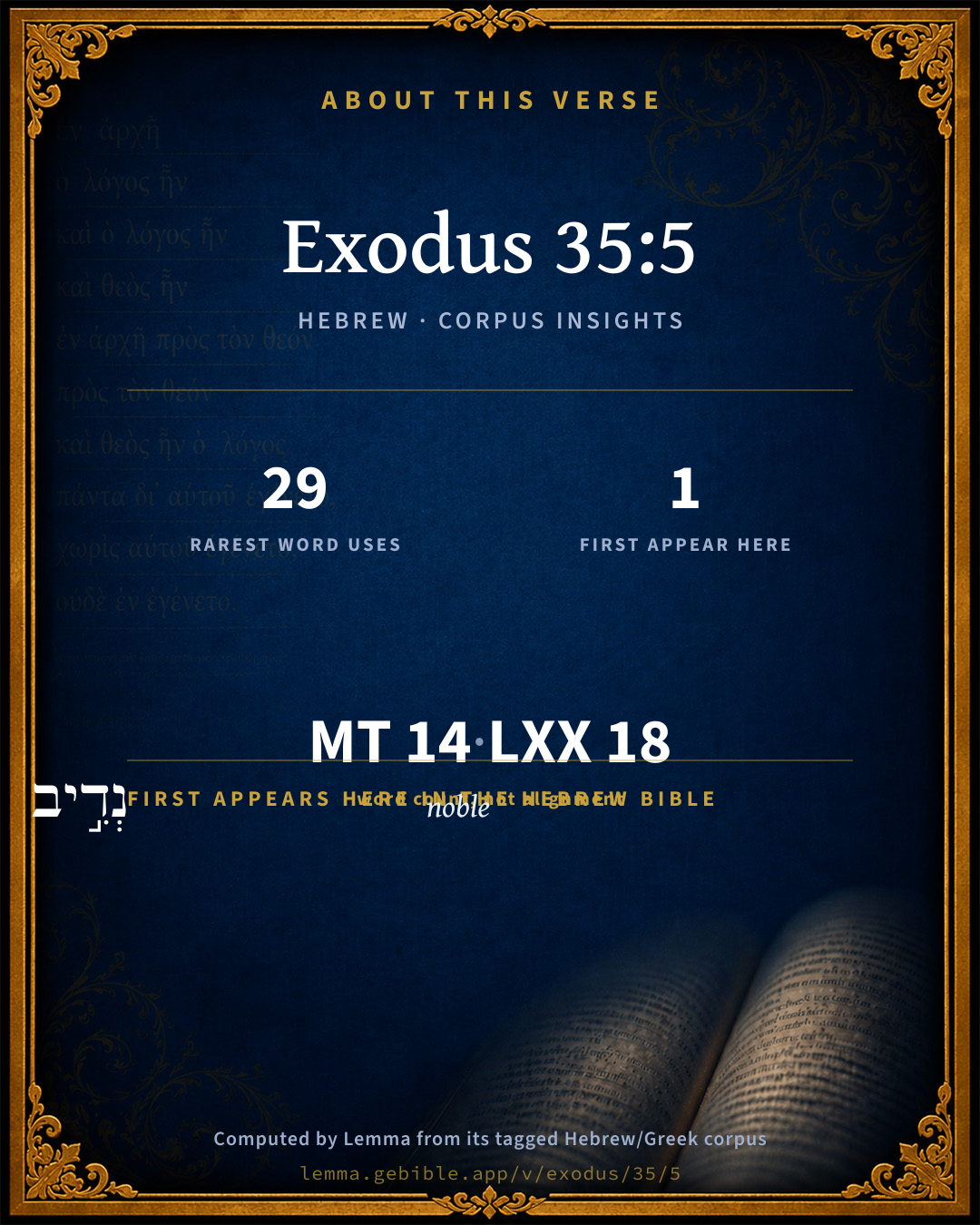
  • 1 first appearance in the Hebrew Bible
Full analysis ↓
Download a study sheet

One document with this verse’s original text, its word-by-word gloss line, the meaning frame, cross-references with their text, attributed commentary, and full source and license credits — printable, and it pastes into notes with its structure intact.

This verse Autodidact and up

Study sheet (.html) Plain text (.txt)

A passage Seminary Student

Up to 50 verses in one chapter. A passage sheet keeps up to 6 commentary sources and 12 cross-references per verse, in the order this page ranks them, and says so on the sheet whenever that leaves anything out. Ask for a single verse and you get the Autodidact verse sheet above.

Everything on this page stays free to read, with no account — the sheet is a download of what is already on screen, not access to it.

Want to remove ads? Support Godless Engineer
Compare translations 3

The same verse in 3 English versions, stacked beneath the original-language interlinear above. Click any original word for its lexicon entry.

Each is an independent rendering of the whole verse — the interlinear is not word-aligned to these translations.

Highlighted words mark where these versions differ — a whole-verse word diff, not a word-by-word alignment.

  • World English Bible Public Domain
    'Take from among you an offering to Yahweh. Whoever is of a willing heart, let him bring it, Yahweh's offering: gold, silver, brass,
  • King James Version Public Domain
    Take ye from among you an offering unto the LORD: whosoever is of a willing heart, let him bring it, an offering of the LORD; gold, and silver, and brass,
  • unfoldingWord Literal Text CC BY-SA 4.0
    ‘Take from with you a contribution for Yahweh, every willing of his heart. Let him bring the contribution of Yahweh: gold and silver and bronze

unfoldingWord Literal Text — © unfoldingWord, licensed CC BY-SA 4.0. Word-aligned USFM3 via Door43 (git.door43.org/unfoldingWord/en_ult).

Versions to compare (up to 4)

3 of 4 selected

Show all 18 translations

Every available English version of this verse, each an independent rendering of the whole verse.

  • World English Bible Public Domain
    'Take from among you an offering to Yahweh. Whoever is of a willing heart, let him bring it, Yahweh's offering: gold, silver, brass,
  • Berean Standard Bible Public Domain
    Take from among you an offering to the LORD. Let everyone whose heart is willing bring an offering to the LORD: gold, silver, and bronze;
  • Majority Standard Bible Public Domain
    Take from among you an offering to the LORD. Let everyone whose heart is willing bring an offering to the LORD: gold, silver, and bronze;
  • King James Version Public Domain
    Take ye from among you an offering unto the LORD: whosoever is of a willing heart, let him bring it, an offering of the LORD; gold, and silver, and brass,
  • American Standard Version (1901) Public Domain
    Take ye from among you an offering unto Jehovah; whosoever is of a willing heart, let him bring it, Jehovah's offering: gold, and silver, and brass,
  • Revised Version (1885) Public Domain
    Take ye from among you an offering unto the LORD: whosoever is of a willing heart, let him bring it, the LORD’S offering; gold, and silver, and brass;
  • Geneva Bible (1599) Public Domain
    Take from among you an offering vnto the Lord: whosoeuer is of a willing heart, let him bring this offring to the Lord, namely golde, and siluer, and brasse:
  • Douay-Rheims (1899) Public Domain
    Set aside with you firstfuits to the Lord. Let every one that is willing and hath a ready heart, offer them to the Lord: gold, and silver, and brass,
  • Young's Literal Translation Public Domain
    Take ye from among you a heave-offering to Jehovah; every one whose heart `is' willing doth bring it, -- the heave-offering of Jehovah, -- gold, and silver, and brass,
  • Literal Standard Version CC BY-SA 4.0
    Take a raised-offering for YHWH from among you; everyone whose heart [is] willing brings it [as] the raised-offering of YHWH: gold, and silver, and bronze,
  • Unlocked Literal Bible CC BY-SA 4.0
    Take an offering for Yahweh, all of you who have a willing heart. Bring an offering to Yahweh—gold, silver, bronze,
  • unfoldingWord Literal Text CC BY-SA 4.0
    ‘Take from with you a contribution for Yahweh, every willing of his heart. Let him bring the contribution of Yahweh: gold and silver and bronze
  • Darby Bible Public Domain
    Take from among you a heave-offering to Jehovah: every one whose heart [is] willing, let him bring it, Jehovah's heave-offering -- gold, and silver, and copper,
  • World Messianic Bible Public Domain
    ‘Take from among you an offering to the LORD. Whoever is of a willing heart, let him bring it as the LORD’s offering: gold, silver, bronze,
  • Webster's Bible Public Domain
    Take ye from among you an offering to the LORD: whoever is of a willing heart, let him bring it, an offering of the LORD; gold, and silver, and brass,
  • Free Bible Version CC BY-SA 4.0
    Collect an offering to the Lord from what you have. Everyone who wants to should bring an offering to the Lord: gold, silver, and bronze;
  • Bible in Basic English Public Domain
    Take from among you an offering to the Lord; everyone who has the impulse in his heart, let him give his offering to the Lord; gold and silver and brass;
  • JPS Tanakh (1917) Public Domain
    Take ye from among you an offering unto the LORD, whosoever is of a willing heart, let him bring it, the LORD'S offering: gold, and silver, and brass;

Literal Standard Version (2020), Covenant Press — licensed CC BY-SA 4.0. Text via the HelloAO Bible API (eBible.org). Unlocked Literal Bible (unfoldingWord) — licensed CC BY-SA 4.0. Text via the HelloAO Bible API (eBible.org). unfoldingWord Literal Text — © unfoldingWord, licensed CC BY-SA 4.0. Word-aligned USFM3 via Door43 (git.door43.org/unfoldingWord/en_ult). Free Bible Version, Dr. Jonathan Gallagher — licensed CC BY-SA 4.0. Text via the HelloAO Bible API (eBible.org).

Word by word

More ways to search: Search by grammar → Find every occurrence → Compare this word →

Practice this passage: Drill this verse → Learn its vocabulary →

נְדִ֣יב
nâdîyb
H5081
“noble of”
Adjective, Adjective, Masculine, Singular, Construct
Part of Speech
Adjective
Type
Adjective
Gender
Masculine
Number
Singular
State
Construct
Full BDB Definition

Origin: from H5068

TWOT: 1299b

inclined, willing, noble, generous (adjective) - incited, inclined, willing - noble, princely (in rank) - noble (in mind and character) - noble one (noun masculine)
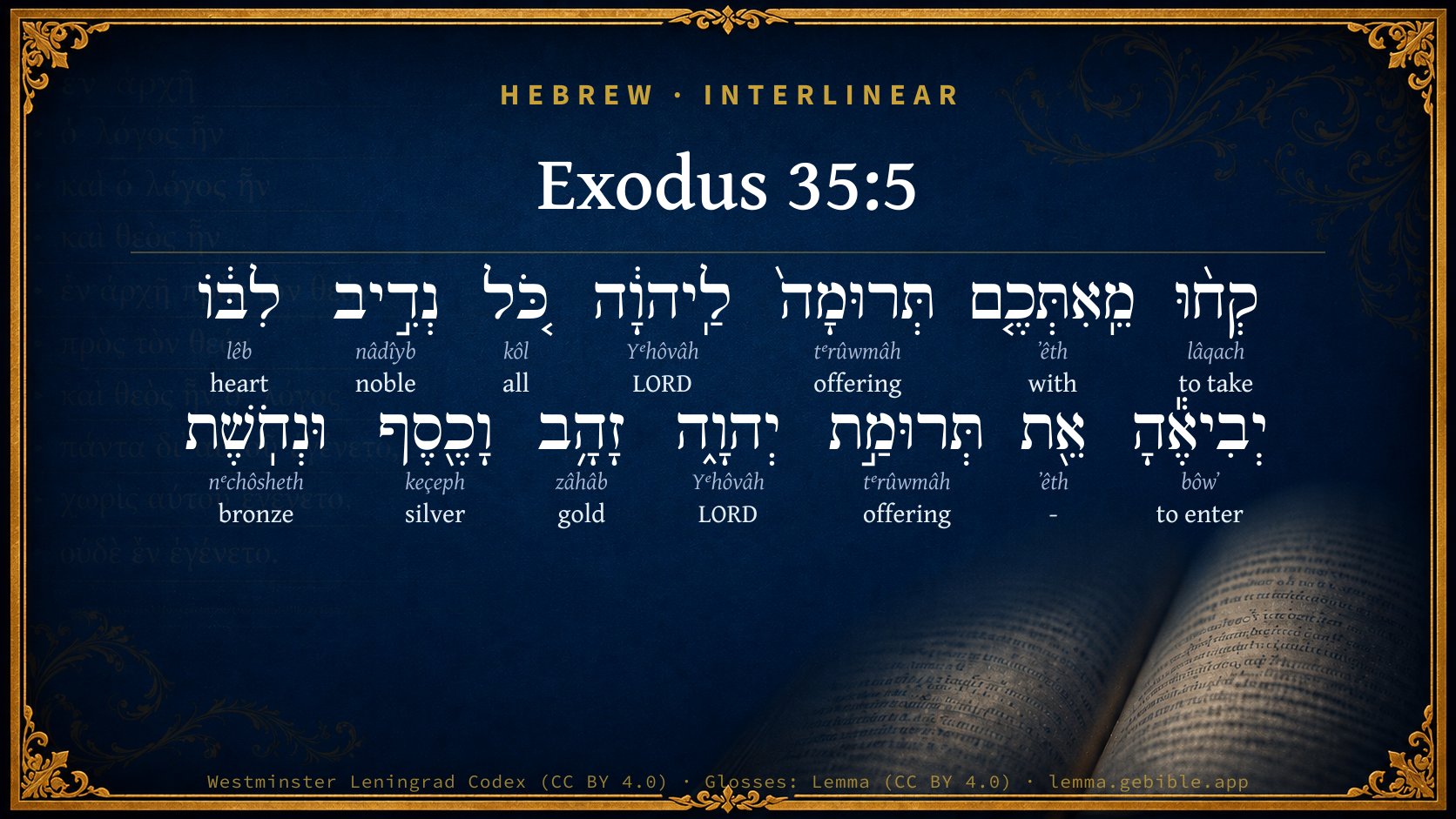
  1. קְח֨וּ lâqach H3947 “take” Verb, Qal, Imperative, 2nd Person, Masculine, Plural
  2. מֵֽאִתְּכֶ֤ם ʼêth H854 “from · with · you” Preposition + Preposition + Suffix, Personal, 2nd Person, Masculine, Plural
  3. תְּרוּמָה֙ tᵉrûwmâh H8641 “offering” Noun, Common, Feminine, Singular, Absolute
  4. לַֽיהוָ֔ה Yᵉhôvâh H3068 “to/for · LORD” Preposition + Noun, Proper
  5. כֹּ֚ל kôl H3605 “all of” Noun, Common, Masculine, Singular, Construct
  6. לִבּ֔וֹ lêb H3820 “heart · his” Noun, Common, Masculine, Singular, Construct + Suffix, Personal, 3rd Person, Masculine, Singular
  7. יְבִיאֶ֕הָ bôwʼ H935 “to enter · her” Verb, Hiphil, Imperfect, 3rd Person, Masculine, Singular + Suffix, Personal, 3rd Person, Feminine, Singular
  8. אֵ֖ת ʼêth H853 “-” Particle, Direct Object
  9. תְּרוּמַ֣ת tᵉrûwmâh H8641 “offering of” Noun, Common, Feminine, Singular, Construct
  10. יְהוָ֑ה Yᵉhôvâh H3068 “LORD” Noun, Proper
  11. זָהָ֥ב zâhâb H2091 “gold” Noun, Common, Masculine, Singular, Absolute
  12. וָכֶ֖סֶף keçeph H3701 “and · silver” Conjunction + Noun, Common, Masculine, Singular, Absolute
  13. וּנְחֹֽשֶׁת nᵉchôsheth H5178 “and · bronze” Conjunction + Noun, Common, Feminine, Singular, Absolute

About this verse

These counts appear in no published source. They are computed here, from the morphology-tagged text and Lemma’s own curated glosses. What Lemma adds →

14
words
12
distinct lemmas
Pentateuch
section

First appearance in Scripture

This word makes its first canonical appearance in the Hebrew Bible here:

  • נְדִ֣יב noble H5081

Shared distinctive vocabulary

נְדִ֣יב noble H5081 occurs in 26 verses of the Hebrew Bible. Also found in:

Grammatical profile

  • 2 verbs
  • 9 nouns
  • 1 adjective
  • 1 preposition
  • 1 particle

Verb forms

  • קְח֨וּ Qal · Imperative
  • יְבִיאֶ֕הָ Hiphil · Imperfect

Repetition

Words recur within this verse — often emphatic in Hebrew:

  • תְּרוּמָה֙ offering H8641 ×2
  • לַֽיהוָ֔ה LORD H3068 ×2

Hebrew & Septuagint length

In English translation the verse runs 23 words from the Hebrew and 26 from the Septuagint (LXX English) — closely comparable.

A rough comparison of the two English renderings, which tokenize alike — not a word-level alignment.

Word counts can differ between the Hebrew and the Greek without any difference in meaning — e.g. the Hebrew direct-object marker אֵת has no separate Greek word, and Greek often adds the article ὁ.

In the original languages it is 14 Hebrew tokens and 18 Greek tokens — but the two are counted differently (Hebrew bundles its prefixes and suffixes into one token; the Greek is in lemma form), so that isn’t a like-for-like length.

Cross-references

6

Topical passages linked to Exodus 35:5 in the Treasury of Scripture Knowledge — connected by theme and wording, ordered by reader-vote popularity; previews shown in the World English Bible.

  • 2 Corinthians 9:7 Let each man give according as he has determined in his heart; not grudgingly, or under compulsion; for God loves a cheerful giver.
  • Psalms 110:3 Your people offer themselves willingly in the day of your power, in holy array. Out of the womb of the morning, you have the dew of your youth.
  • Exodus 25:2–7 "Speak to the children of Israel, that they take an offering for me. From everyone whose heart makes him willing you shall take my offering.
  • Judges 5:9 My heart is toward the governors of Israel, Who offered themselves willingly among the people: Bless you Yahweh.
  • 2 Corinthians 8:11–12 But now complete the doing also, that as there was the readiness to be willing, so there may be the completion also out of your ability.
  • Mark 12:41–44 Jesus sat down opposite the treasury, and saw how the multitude cast money into the treasury. Many who were rich cast in much.

Cross-references courtesy of OpenBible.info (CC BY 4.0).

Hebrew and Greek witnesses Masoretic Hebrew ↔ Greek Septuagint

The same verse in the two great witnesses to the Old Testament, shown verse-for-verse.

These are two independent witnesses, not word-aligned to each other, and the Septuagint is shown in lemma (dictionary) form.

Hebrew Exodus 35:5 Masoretic · Westminster Leningrad Codex

קְח֨וּ מֵֽאִתְּכֶ֤ם תְּרוּמָה֙ לַֽיהוָ֔ה כֹּ֚ל נְדִ֣יב לִבּ֔וֹ יְבִיאֶ֕הָ אֵ֖ת תְּרוּמַ֣ת יְהוָ֑ה זָהָ֥ב וָכֶ֖סֶף וּנְחֹֽשֶׁת

'Take from among you an offering to Yahweh. Whoever is of a willing heart, let him bring it, Yahweh's offering: gold, silver, brass,

World English Bible · Public Domain

Greek LXX Exodus 35:5 Septuagint · lemma form

λαμβάνω παρά σύ αὐτός ἀφαίρεμα κύριος πᾶς ὁ καταδέχομαι ὁ καρδία φέρω ὁ ἀπαρχή κύριος χρυσίον ἀργύριον χαλκός

Take of yourselves an offering for the Lord: every one that engages in his heart shall bring the first fruits to the Lord; gold, silver, brass,

LXX2012 (modern English Septuagint) · Public Domain

Hebrew: Westminster Leningrad Codex (CC BY 4.0). Greek: Septuagint (public domain); English from LXX2012 (modern English Septuagint) (Public Domain). How the Septuagint differs from the Hebrew →

Targum (Aramaic paraphrase)

2

The Targum is the ancient Jewish Aramaic paraphrase of the Hebrew Scriptures — an interpretive translation, not the Hebrew text itself. Onkelos (literal) and Pseudo-Jonathan (expansive) render the Torah, and Jonathan the Prophets. Coverage is partial: where no permissively-licensed English translation exists for a verse, only the Aramaic is shown. This is verse-level text, not a word-by-word alignment to the Hebrew.

  1. Targum Onkelos Torah (Genesis–Deuteronomy)
    סָבוּ מִנְכוֹן אַפְרָשׁוּתָא קֳדָם יְיָ כֹּל דְיִתְרְעֵי לִבֵּהּ יַיְתֵי יָת אַפְרָשׁוּתָא קֳדָם יְיָ דַהֲבָא וְכַסְפָא וּנְחָשָׁא:

    (no public-domain English translation for this verse)

    Targum Onkelos — Aramaic: “Onkelos Genesis” (public domain); “Onkelos Exodus” (public domain); “Onkelos Leviticus” (public domain); “Onkelos Numbers” (public domain); “Onkelos Deuteronomy” (public domain). English: “Sefaria Community Translation” (CC0 1.0 (public-domain dedication)); “J.W. Etheridge. The Targums of Onkelos and Jonathan Ben Uzziel on the Pentateuch. London: Longmans, Green, 1862” (public domain). Text via Sefaria.

  2. Targum Pseudo-Jonathan Torah (Genesis–Deuteronomy)
    סָבוּ מִנְכוֹן אַפְרָשׁוּתָא קֳדָם יְיָ כָּל מַאן דְּאִתְרְעֵי לִבֵּיהּ יַיְתֵי יַת אַפְרָשׁוּתָא דַיְיָ דַהֲבָא וְכַסְפָּא וּנְחָשָׁא

    Take of you a separation before the Lord: whosoever is moved in his heart, let him present the separation for the Lord; gold, or silver, or brass,

    Targum Pseudo-Jonathan — Aramaic: “Targum Jonathan on Genesis” (public domain); “Targum Jonathan on Exodus” (public domain); “Targum Jonathan on Leviticus” (public domain); “Targum Jonathan on Numbers” (public domain); “Targum Jonathan on Deuteronomy” (public domain). English: “The Targum of Jonathan ben Uzziel, trans. J. W. Etheridge, London, 1862” (public domain). Text via Sefaria.

Commentary

Notes on Exodus 35:5 from classic Christian and Jewish commentators (each source and its license shown beneath its notes). The classic Christian expositions comment on the surrounding passage and are grouped to its opening verse, so a note may address several verses; the Jewish commentaries on the Tanakh (Rashi and others) are per-verse, so they appear only where the commentator wrote on this verse.

Lemma curates 59 commentaries, every one of them public domain or Creative Commons licensed, each selected and text-cleaned for this edition rather than reprinted as found. About our sources →

Trapp's Complete Commentary

John Trapp

Exo 35:5 Take ye from among you an offering unto the LORD: whosoever [is] of a willing heart, let him bring it, an offering of the LORD; gold, and silver, and brass,

Ver. 5. {See Trapp on "Exo 35:4"}

John Trapp, A Commentary or Exposition upon All the Books of the Old and New Testament (1647–1656) — public domain. Text from a community e-Sword module.

Adam Clarke's Commentary

Verse 5. An offering - A terumah or heave-offering; see Le 7:1, etc. , Ex 35:6

See, on these metals and colours, Ex 25:3-4. &c.

Adam Clarke's Commentary on the Bible (1810–1826) — public domain. Text from a community e-Sword/MySword module.

The Cambridge Bible for Schools and Colleges

gen. ed. J. J. S. Perowne

5. from among] from; ‘among’ is wrong. The prep. is the one rendered ‘of’ (i.e. from) in Exo_25:2.

an offering (twice)] a contribution, Heb. terûmâh; see on Exo_25:2.

of a willing heart] cf. on Exo_25:2.

brass] bronze or copper, as Exo_25:3.

The Cambridge Bible for Schools and Colleges (gen. ed. J. J. S. Perowne; Cambridge University Press, 1878–1918) — public domain. Text from a community e-Sword module.

John Gill's Exposition

Take ye from amongst you an offering unto the Lord,.... That is, they were to take a part of their substance, of what they were possessed of, every man according to his ability, out of what he had in his hand that was suitable, and present it as a freewill offering to the Lord, for the use of the tabernacle to be built, and the service of it:

whosoever is of a willing heart; that is, of a generous and liberal disposition:

let him bring it, an offering of the Lord; or an offering to him, otherwise not; if brought niggardly and grudgingly it would not be acceptable, for God loves a willing and cheerful giver:

gold, silver, and brass: here and in the four following verses, the several things are particularly mentioned, which would be wanted in building the tabernacle, and in the service of it, and therefore would be acceptable; and they being exactly the same, and delivered in the same words and in the same order as in Exo 25:3 the reader is referred to the notes there. See Gill on Exo 25:3. See Gill on Exo 25:4. See Gill on Exo 25:5. See Gill on Exo 25:6. See Gill on Exo 25:7.

John Gill's Exposition of the Whole Bible (1746–1763) — public domain (CC PDM 1.0). Text via the HelloAO Bible API.

Matthew Poole's English Annotations

Whosoever is of a willing heart, for God values not forced or grudged services, 2Co 9:7.

Matthew Poole's English Annotations on the Holy Bible (1683–1685) — public domain. Text from a community e-Sword/MySword module.

Whedon's Commentary on the Bible

Daniel D. Whedon

THE OFFERINGS FOR THE SANCTUARY, Exo_35:4-29.

5-9. An offering — See notes on Exo_25:2-7.

Daniel D. Whedon (gen. ed.), Commentary on the Old and New Testaments (1874–1909) — public domain. Text from a community e-Sword module.

The Pulpit Commentary

Vers. 5-10 correspond to vers. 2-7 of ch. 25., the correspondence in the list of offerings being exact.

HOMILETICS.

On the symbolism of the Tabernacle and its parts, see the Homiletics on Exo_25:10-39 Ex 26; Exo_27:1-8; and Exo_30:1-10. On the symbolism of the anointing oil and the holy incense, see the Homiletics on Exo_30:23-28.

Vers. 5-19. The duty and privilege of making offerings to God.

That God allows us to offer to him of his own, and accepts such offerings as free gifts, is one of his many gracious condescensions. It is the part of all ministers to give opportunity for such offerings to encourage them, suggest them, elicit them. Moses now summoned "all the congregation of the children of Israel," that he might give to all, without partiality or favouritism, the opportunity for a good action, which would obtain its due reward. Doubtless he pointed out that the object was one for the glory of God and the edification of his people no less an object than the substitution for that poor "tent of meeting," which he had extemporised on the morrow of his first descent from Sinai, (Exo_33:7) of a glorious structure, Of the richest materials, designed by God himself, worthy of him, and suited to intensify and spiritualise the devotions of all worshippers. It was fit that the structure should, if possible, be raised by means of the free gifts of the faithful. For this Moses now, like a faithful minister of Christ, made appeal to all. In doing so, he pointed out the two modes in which such offerings may be made.

I OFFERINGS MAY BE MADE BY THE ASSIGNMENT TO A SACRED USE OF A PORTION OF OUR SUBSTANCE. All who had gold, silver, brass, blue, purple, scarlet, fine linen, goat"s hair, etc., were invited to contribute out of their abundance to the erection of the new sanctuary. It was especially urged that, if they did so, it should be with "a willing heart" (ver. 1) grudgingly, or of necessity; for God loveth a cheerful giver". (2Co_9:7) Such a mode of offering is open to those only who have property of some kind or other, and is especially suited to the rich and well-to-do classes; and it was no doubt the wealthy who at this time chiefly contributed in this way. But, as God is "no respecter of persons," and regards the poor and needy fully as much as those who are of high estate, some further mode of making him an offering is necessary. Note, in this connection, that

II OFFERINGS MAY BE MADE BY THE DEVOTION TO A SACRED USE OF SOME PORTION OF OUR TIME AND LABOUR. "Every wise-hearted among you shall come, and make all that the Lord hath commanded" (ver. 10). All who had sufficient skill were invited to join in the actual work of preparing and making the various fabrics. Carpenters, weavers, dyers, smiths, embroiderers, metallurgists, might contribute their time and work, and so make an offering to God as acceptable as that of the gold or jewels of the wealthy. Even poor women, whose only skill was to spin thread with their hands (ver. 25), might "bring that which they had spun," and were accepted as offering worthily. In this way there were few families that might not have their part in the work, for spinning was a wide-spread accomplishment. And so, in our own day, whenever any good work is taken in hand, it will always be found that every one who wills can have some part in it can hep, by headwork or by handiwork, to effect the end desired. And the value of such participation is quite equal to that rendered by rich contributors, at any rate, in the sight of God. For observe, the women who spun goat"s hair are placed side by side with the "rulers" who "brought onyx stones," and costly spices, and jewels to be set in the high-priest"s breastplate (vers. 26-28).

The Pulpit Commentary (1880–1919), ed. H.D.M. Spence-Jones & Joseph S. Exell — public domain. Text from a community e-Sword module.

Rashi

Rabbi Shlomo Yitzchaki (Rashi)

נדיב לבו [WHOSOEVER] IS OF A WILLING HEART — Because his heart prompts one to generosity, he is called נדיב לב, one who is prompted to generosity by the heart. I have already explained the various materials which formed the contribution towards the Tabernacle and the work done for it in the passages where the commands about them were given.

Rashi on the Tanakh — English translations: “The Judaica Press complete Tanach with Rashi, translated by A. J. Rosenberg” (CC BY 4.0); “Pentateuch with Rashi's commentary by M. Rosenbaum and A.M. Silbermann, 1929-1934” (public domain); “The Metsudah Tanach series, Lakewood, N.J” (CC BY 4.0); and “The Book of Joshua, Metsudah Publications, 1997” (CC BY 4.0). Text via Sefaria.

Ramban (Nachmanides)

Rabbi Moshe ben Nachman (Ramban / Nachmanides)

Y’VI’EHA’ (LET HIM BRING IT), THE ETERNAL’S OFFERING. This is like “yavi (let him bring) the Eternal’s offering.” But Scripture mentions a pronoun and then returns to explain it. Similarly: And she opened and saw him, the child; when he went in, the man; — when the man went in. the nation and the kingdom which will not serve him, Nebuchadnezzar; which I do give to them, the children of Israel. There are many similar instances.By way of the Truth, [the mystic lore of the Cabala], the phrase here is like “let him bring it ‘with’ the Eternal’s offering,” meaning that he is to bring the higher offering as alluded to in the secret of and they take for Me an offering. I have already explained it., Verse 3. Our Rabbis have a Midrash on the verse, and she opened and saw him, the child, that she saw with him the Divine Glory.Now it was necessary for Moses to tell the whole congregation all the work which G-d had commanded him, in order to let them know that they had to bring large donations, for the work is great. That is why he told them, The Tabernacle, its tent, and its covering etc., mentioning all in a general way. The reason for the definite article in ‘eth hamishkan’ (the Tabernacle), ‘eth ha’aron’ (the ark), ‘eth hashulchan’ (the table), and all those mentioned with the definite article, is as if to say: “the Tabernacle and the vessels which we will explain to the wise men doing the work in their details and measurements,” but speaking now to the whole congregation, he told them only their names in general.

Ramban (Nachmanides) on the Tanakh — English translation: “Commentary on the Torah by Ramban (Nachmanides). Translated and annotated by Charles B. Chavel. New York, Shilo Pub. House, 1971-1976” (CC BY 4.0). Text via Sefaria.

Sforno

Rabbi Ovadia Sforno

Take from among yourselves. Appoint officials to accept your offerings.

Every man whose heart impels him. The officials were not allowed to take anything by force.

Shall bring a terumah-offering to Ad-noy. Alternatively, the word es (es terumas Ad-noy) means, “along with,” in this context, so that the sense of the verse is, “Every man shall bring what his heart impels him to, along with his compulsory terumah-offering.

Sforno on the Tanakh — English translation: “Yalkut, Sifsei Chachomim Chumash, Metsudah Publications, 2009” (CC BY 4.0). Text via Sefaria.

Lesson kit

Teaching starters — assembled from the data on this page, not authored interpretation. Every prompt links to the verse data it draws on. Edit before teaching.

Exodus, in the Pentateuch, opens this verse with 14 words (12 distinct Hebrew lemmas). Its most distinctive word is nâdîyb (“noble”). A historical commentator’s framing appears above. Read the whole chapter for the surrounding context.

Discussion questions

  1. How does “noble” (nâdîyb) shape what this verse is saying?
  2. This is the first place “noble” appears in Scripture (first appears here). What does its debut here establish?
  3. How does Exodus 35:22, which shares the word «noble», read alongside this verse?
  4. What does the repetition of “offering” (2× in this one verse) do in this verse?
  5. These translations render this verse differently; the difference is in the English rendering, not the original. What questions does that raise?
  6. «קְח֨וּ» is a Qal Imperative verb. How does that grammatical form shape the action described?
  7. Compare how Trapp's Complete Commentary and Adam Clarke's Commentary read this verse. Where do they agree or differ?

Things to notice

Reading settings

Reading text

Shown beneath each verse's original-language words.

Old Testament
Old Testament edition

Read the OT as the Masoretic Hebrew (MT) or the Greek Septuagint (LXX).

English shown for the Greek Septuagint (in the Hebrew ↔ Greek comparison).

Comparing translations? Open the Compare panel on any verse page to stack up to four side by side.