

Acts 2:46
Greek (Tischendorf 8th ed.) Acts 2:46 appears in the Greek New Testament. The text above is from the Tischendorf 8th edition. Each word links to its Strong’s number and a concise gloss. Click any word for its full Thayer’s Greek Lexicon entry.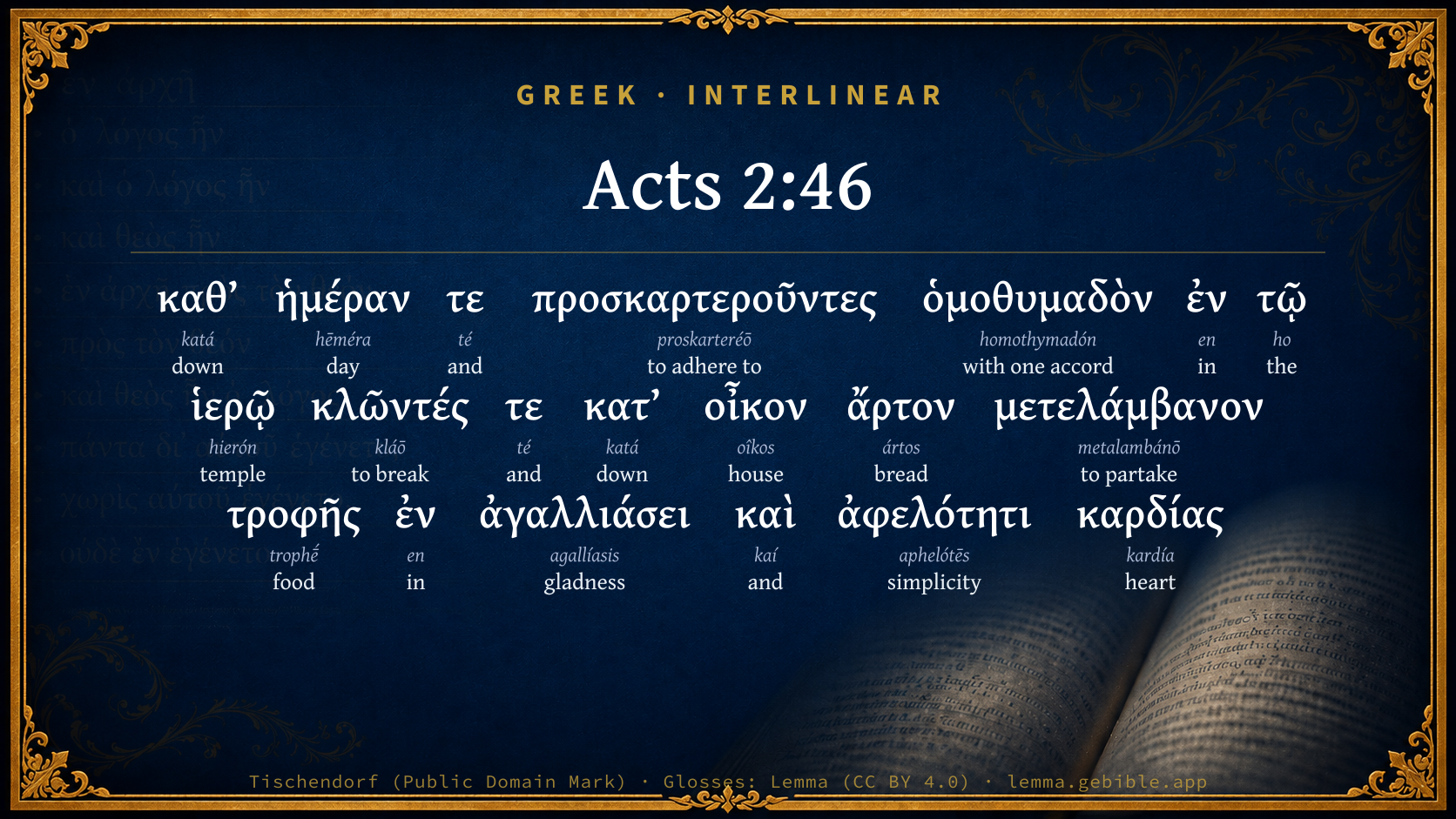
Day by day, continuing steadfastly with one accord in the temple, and breaking bread at home, they took their food with gladness and singleness of heart,
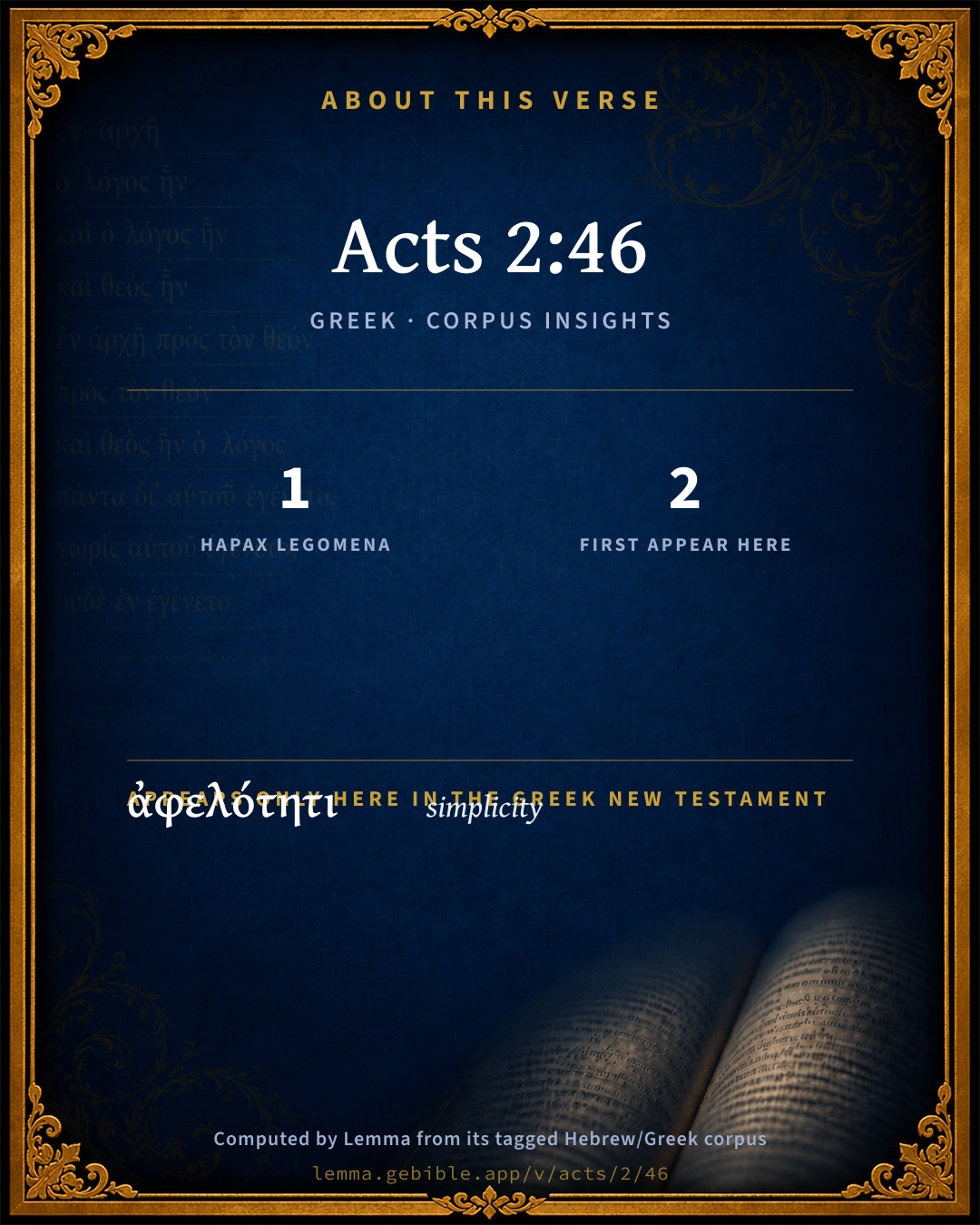
- 1 hapax legomenon — only here in the Greek New Testament
- 2 first appearances in the Greek New Testament
Download a study sheet
One document with this verse’s original text, its word-by-word gloss line, the meaning frame, cross-references with their text, attributed commentary, and full source and license credits — printable, and it pastes into notes with its structure intact.
This verse Autodidact and up
A passage Seminary Student
Up to 50 verses in one chapter. A passage sheet keeps up to 6 commentary sources and 12 cross-references per verse, in the order this page ranks them, and says so on the sheet whenever that leaves anything out. Ask for a single verse and you get the Autodidact verse sheet above.
Everything on this page stays free to read, with no account — the sheet is a download of what is already on screen, not access to it.
Compare translations 3
The same verse in 3 English versions, stacked beneath the original-language interlinear above. Click any original word for its lexicon entry.
Each is an independent rendering of the whole verse — the interlinear is not word-aligned to these translations.
Highlighted words mark where these versions differ — a whole-verse word diff, not a word-by-word alignment.
-
World English Bible Public Domain
Day by day, continuing steadfastly with one accord in the temple, and breaking bread at home, they took their food with gladness and singleness of heart,
-
King James Version Public Domain
And they, continuing daily with one accord in the temple, and breaking bread from house to house, did eat their meat with gladness and singleness of heart,
-
unfoldingWord Literal Text CC BY-SA 4.0
and, continuing unanimously every day in the temple and breaking bread in each house, they were sharing food with exultation and sincerity of heart,
unfoldingWord Literal Text — © unfoldingWord, licensed CC BY-SA 4.0. Word-aligned USFM3 via Door43 (git.door43.org/unfoldingWord/en_ult).
Show all 19 translations
Every available English version of this verse, each an independent rendering of the whole verse.
-
World English Bible Public Domain
Day by day, continuing steadfastly with one accord in the temple, and breaking bread at home, they took their food with gladness and singleness of heart,
-
Berean Standard Bible Public Domain
With one accord they continued to meet daily in the temple courts and to break bread from house to house, sharing their meals with gladness and sincerity of heart,
-
Majority Standard Bible Public Domain
With one accord they continued to meet daily in the temple courts and to break bread from house to house, sharing their meals with gladness and sincerity of heart,
-
King James Version Public Domain
And they, continuing daily with one accord in the temple, and breaking bread from house to house, did eat their meat with gladness and singleness of heart,
-
American Standard Version (1901) Public Domain
And day by day, continuing stedfastly with one accord in the temple, and breaking bread at home, they took their food with gladness and singleness of heart,
-
Revised Version (1885) Public Domain
And day by day, continuing stedfastly with one accord in the temple, and breaking bread at home, they did take their food with gladness and singleness of heart,
-
Geneva Bible (1599) Public Domain
And they continued dayly with one accord in the Temple, and breaking bread at home, did eate their meate together with gladnesse and singlenesse of heart,
-
Douay-Rheims (1899) Public Domain
And continuing daily with one accord in the temple, and breaking bread from house to house, they took their meat with gladness and simplicity of heart;
-
Young's Literal Translation Public Domain
Daily also continuing with one accord in the temple, breaking also at every house bread, they were partaking of food in gladness and simplicity of heart,
-
Literal Standard Version CC BY-SA 4.0
Also continuing daily with one accord in the temple, also breaking bread at every house, they were partaking of food in gladness and simplicity of heart,
-
Unlocked Literal Bible CC BY-SA 4.0
So day after day they continued with one purpose in the temple, and they broke bread in homes, and they shared food with glad and humble hearts,
-
unfoldingWord Literal Text CC BY-SA 4.0
and, continuing unanimously every day in the temple and breaking bread in each house, they were sharing food with exultation and sincerity of heart,
-
Darby Bible Public Domain
And every day, being constantly in the temple with one accord, and breaking bread in [the] house, they received their food with gladness and simplicity of heart,
-
World Messianic Bible Public Domain
Day by day, continuing steadfastly with one accord in the temple, and breaking bread at home, they took their food with gladness and singleness of heart,
-
Webster's Bible Public Domain
And they, continuing daily with one accord in the temple, and breaking bread from house to house, ate their food with gladness and singleness of heart,
-
Free Bible Version CC BY-SA 4.0
Day after day they continued to meet together in the Temple, and ate together in their homes. They enjoyed their meals humbly and happily. They praised God, and everyone thought favorably of them.
-
Bible in Basic English Public Domain
And day by day, going in agreement together regularly to the Temple and, taking broken bread together in their houses, they took their food with joy and with true hearts,
-
Text-Critical English NT CC BY 4.0
Day by day as they continued meeting together with one accord in the temple courts and breaking bread from house to house, they shared food together with gladness and simplicity of heart,
-
Tyndale New Testament (1534) Public Domain
And they continued dayly with one acorde in the temple and brake breed in every housse and dyd eate their meate to gedder with gladnes and singlenes of hert
Literal Standard Version (2020), Covenant Press — licensed CC BY-SA 4.0. Text via the HelloAO Bible API (eBible.org). Unlocked Literal Bible (unfoldingWord) — licensed CC BY-SA 4.0. Text via the HelloAO Bible API (eBible.org). unfoldingWord Literal Text — © unfoldingWord, licensed CC BY-SA 4.0. Word-aligned USFM3 via Door43 (git.door43.org/unfoldingWord/en_ult). Free Bible Version, Dr. Jonathan Gallagher — licensed CC BY-SA 4.0. Text via the HelloAO Bible API (eBible.org).
Word by word
More ways to search: Search by grammar → Find every occurrence → Compare this word →
Practice this passage: Drill this verse → Learn its vocabulary →
- Appears 1× in the Greek New Testament
- First appears here
- Part of Speech
- Noun
- Case
- Dative
- Number
- Singular
- Gender
- Feminine
Full Thayer's Definition
- καθ’ katá G2596 “down” Preposition
- ἡμέραν hēméra G2250 “day” Noun, Accusative, Singular, Feminine
- τε té G5037 “and” Particle
- προσκαρτεροῦντες proskarteréō G4342 “to adhere to” Verb, Present, Active, Participle, Nominative, Plural, Masculine
- ὁμοθυμαδὸν homothymadón G3661 “with one accord” Adverb
- ἐν en G1722 “in” Preposition
- τῷ ho G3588 “the” Article, Dative, Singular, Neuter
- ἱερῷ hierón G2411 “temple” Noun, Dative, Singular, Neuter
- κλῶντές kláō G2806 “to break” Verb, Present, Active, Participle, Nominative, Plural, Masculine
- τε té G5037 “and” Particle
- κατ’ katá G2596 “down” Preposition
- οἶκον oîkos G3624 “house” Noun, Accusative, Singular, Masculine
- ἄρτον ártos G740 “bread” Noun, Accusative, Singular, Masculine
- μετελάμβανον metalambánō G3335 “to partake” Verb, Imperfect, Active, Indicative, 3rd person, Plural
- τροφῆς trophḗ G5160 “food” Noun, Genitive, Singular, Feminine
- ἐν en G1722 “in” Preposition
- ἀγαλλιάσει agallíasis G20 “gladness” Noun, Dative, Singular, Feminine
- καὶ kaí G2532 “and” Conjunction
- ἀφελότητι aphelótēs G858 “simplicity” Noun, Dative, Singular, Feminine
- καρδίας kardía G2588 “heart” Noun, Genitive, Singular, Feminine
About this verse
These counts appear in no published source. They are computed here, from the morphology-tagged text and Lemma’s own curated glosses. What Lemma adds →
- 20
- words
- 17
- distinct lemmas
- Acts
- section
Notable vocabulary
1 hapax legomenon — a word that appears only here in the entire Greek New Testament:
- ἀφελότητι simplicity G858
First appearance in Scripture
These words make their first canonical appearance in the Greek New Testament here:
Shared distinctive vocabulary
ἀγαλλιάσει gladness G20 occurs in 5 verses of the Greek New Testament. Also found in:
Cross-references
24Topical passages linked to Acts 2:46 in the Treasury of Scripture Knowledge — connected by theme and wording, ordered by reader-vote popularity; previews shown in the World English Bible.
- Acts 5:42 Every day, in the temple and at home, they never stopped teaching and preaching Jesus, the Christ.
- Acts 2:42 They continued steadfastly in the apostles' teaching and fellowship, in the breaking of bread, and prayer.
- Psalms 86:11 Teach me your way, Yahweh. I will walk in your truth. Make my heart undivided to fear your name.
- Acts 20:7 On the first day of the week, when the disciples were gathered together to break bread, Paul talked with them, intending to depart on the next day, and continued his speech until midnight.
- 2 Corinthians 1:12 For our boasting is this: the testimony of our conscience, that in holiness and sincerity of God, not in fleshly wisdom but in the grace of God we behaved ourselves in the world, and more abundantly toward you.
- Acts 16:34 He brought them up into his house, and set food before them, and rejoiced greatly, with all his household, having believed in God.
- Colossians 3:22 Servants, obey in all things those who are your masters according to the flesh, not just when they are looking, as men-pleasers, but in singleness of heart, fearing God.
- Acts 1:13–14 When they had come in, they went up into the upper room, where they were staying; that is Peter, John, James, Andrew, Philip, Thomas, Bartholomew, Matthew, James the son of Alphaeus, Simon the Zealot, and Judas the son of James.
- Romans 12:8 or he who exhorts, to his exhorting: he who gives, let him do it with liberality; he who rules, with diligence; he who shows mercy, with cheerfulness.
- Nehemiah 8:10 Then he said to them, Go your way, eat the fat, and drink the sweet, and send portions to him for whom nothing is prepared; for this day is holy to our Lord: neither be you grieved; for the joy of Yahweh is your strength.
- Ecclesiastes 9:7 Go your way--eat your bread with joy, and drink your wine with a merry heart; for God has already accepted your works.
- Luke 24:53 and were continually in the temple, praising and blessing God. Amen.
- 1 Corinthians 11:20–22 When therefore you assemble yourselves together, it is not possible to eat the Lord's supper.
- Deuteronomy 12:7 and there you shall eat before Yahweh your God, and you shall rejoice in all that you put your hand to, you and your households, in which Yahweh your God has blessed you.
- Deuteronomy 12:12 You shall rejoice before Yahweh your God, you, and your sons, and your daughters, and your men-servants, and your maid-servants, and the Levite who is within your gates, because he has no portion nor inheritance with you.
- Deuteronomy 16:11 and you shall rejoice before Yahweh your God, you, and your son, and your daughter, and your man-servant, and your maid-servant, and the Levite who is within your gates, and the foreigner, and the fatherless, and the widow, who are in the midst of you, in the place which Yahweh your God shall choose, to cause his name to dwell there.
- Luke 24:30 It happened, that when he had sat down at the table with them, he took the bread and gave thanks. Breaking it, he gave to them.
- 1 Corinthians 10:30–31 If I partake with thankfulness, why am I denounced for that for which I give thanks?
- 2 Corinthians 11:3 But I am afraid that somehow, as the serpent deceived Eve in his craftiness, so your minds might be corrupted from the simplicity that is in Christ.
- Matthew 6:22 "The lamp of the body is the eye. If therefore your eye is sound, your whole body will be full of light.
- Luke 11:41 But give for gifts to the needy those things which are within, and behold, all things will be clean to you.
- Acts 3:1 Peter and John were going up into the temple at the hour of prayer, the ninth hour.
- Acts 5:21 When they heard this, they entered into the temple about daybreak, and taught. But the high priest came, and those who were with him, and called the council together, and all the senate of the children of Israel, and sent to the prison to have them brought.
- Ephesians 6:5 Servants, be obedient to those who according to the flesh are your masters, with fear and trembling, in singleness of your heart, as to Christ;
Cross-references courtesy of OpenBible.info (CC BY 4.0).
Lesson kit
Teaching starters — assembled from the data on this page, not authored interpretation. Every prompt links to the verse data it draws on. Edit before teaching.
Acts, in the Acts, opens this verse with 20 words (17 distinct Greek lemmas). Its most distinctive word is aphelótēs (“simplicity”). A historical commentator’s framing appears above. Read the whole chapter for the surrounding context.
Discussion questions
- How does “simplicity” (aphelótēs) shape what this verse is saying?
- 1 word here appears nowhere else in the Greek New Testament. Why might the author reach for such rare wording?
- 2 words make their first appearance in Scripture here. What does this debut establish?
- How does Luke 1:14, which shares the word «gladness», read alongside this verse?
- What does the repetition of “down” (2× in this one verse) do in this verse?
- These translations render this verse differently; the difference is in the English rendering, not the original. What questions does that raise?
- Compare how Joseph Benson's Commentary and Bengel's Gnomon read this verse. Where do they agree or differ?
Things to notice
- 1 word in this verse appears nowhere else in the Greek New Testament.
- 2 words make their first canonical appearance in Scripture here.
- These translations choose different wording for 20 words in this verse.
- “down” occurs 2× in this single verse.
- 17 distinct Greek lemmas span 20 words in this verse.
Commentary
Notes on Acts 2:46 from classic Christian and Jewish commentators (each source and its license shown beneath its notes). The classic Christian expositions comment on the surrounding passage and are grouped to its opening verse, so a note may address several verses; the Jewish commentaries on the Tanakh (Rashi and others) are per-verse, so they appear only where the commentator wrote on this verse.
Lemma curates 59 commentaries, every one of them public domain or Creative Commons licensed, each selected and text-cleaned for this edition rather than reprinted as found. About our sources →
Joseph Benson's Commentary
Joseph Benson's Commentary on the Old and New Testaments (1811–1818) — public domain. Text from a community e-Sword module.
Bengel's Gnomon
Johann Albrecht Bengel
Bengel's Gnomon of the New Testament — English translation (T&T Clark, Edinburgh, 1860) — public domain. Text from a community e-Sword module.
Meyer's Critical & Exegetical Commentary
Heinrich August Wilhelm Meyer
Meyer — Critical and Exegetical Commentary on the New Testament — English translation by Peter Christie, edited by Frederick Crombie (T&T Clark, 1880) — public domain. Text from a community e-Sword module.
Expositor's Greek Testament
ed. W. Robertson Nicoll
The Expositor's Greek Testament, edited by W. Robertson Nicoll (1897–1910) — public domain. Text from a community e-Sword module.
Geneva Bible (1599)
Geneva Bible translators
Geneva Bible (1599) marginal notes — public domain. Text via Bolls.life.
Jamieson, Fausset & Brown
Robert Jamieson, A. R. Fausset & David Brown
Jamieson, Fausset & Brown — Commentary Critical and Explanatory on the Whole Bible (1871) — public domain (CC PDM 1.0). Text via the HelloAO Bible API.
Adam Clarke's Commentary
Adam Clarke's Commentary on the Bible (1810–1826) — public domain. Text from a community e-Sword/MySword module.
John Calvin's Commentaries
John Calvin's Commentaries (1540-1563) — public domain. Text from the Calvin Translation Society English edition (1840s-50s) via the Christian Classics Ethereal Library (ccel.org). Calvin's coverage is partial (roughly two-thirds of the Bible); uncommented books and verses are honest gaps, never fabricated. The 19th-century editor's footnotes and remarks are omitted so the notes are faithfully Calvin's own voice.
Ellicott's Commentary for English Readers
A Bible Commentary for English Readers, edited by Charles John Ellicott (1878–1897) — public domain. Text from a community e-Sword module.
The Cambridge Bible for Schools and Colleges
gen. ed. J. J. S. Perowne
The Cambridge Bible for Schools and Colleges (gen. ed. J. J. S. Perowne; Cambridge University Press, 1878–1918) — public domain. Text from a community e-Sword module.
John Gill's Exposition
John Gill's Exposition of the Whole Bible (1746–1763) — public domain (CC PDM 1.0). Text via the HelloAO Bible API.
Trapp's Complete Commentary
John Trapp
John Trapp, A Commentary or Exposition upon All the Books of the Old and New Testament (1647–1656) — public domain. Text from a community e-Sword module.
Albert Barnes' Notes on the Bible
Albert Barnes' Notes on the Bible (1834–1885) — public domain. Text from a community e-Sword/MySword module.
Haydock's Catholic Bible Commentary
George Leo Haydock (1774–1849), Haydock's Catholic Family Bible and Commentary, 1859 edition — public domain. Excludes Psalms (Douay-Rheims chapter numbering differs from Protestant) and Deuterocanonical books (Catholic canon only).
Matthew Poole's English Annotations
Matthew Poole's English Annotations on the Holy Bible (1683–1685) — public domain. Text from a community e-Sword/MySword module.
Whedon's Commentary on the Bible
Daniel D. Whedon
Daniel D. Whedon (gen. ed.), Commentary on the Old and New Testaments (1874–1909) — public domain. Text from a community e-Sword module.
The Pulpit Commentary
The Pulpit Commentary (1880–1919), ed. H.D.M. Spence-Jones & Joseph S. Exell — public domain. Text from a community e-Sword module.
John Wesley's Explanatory Notes
John Wesley, Explanatory Notes Upon the Whole Bible (1754–1765) — public domain. Text via the GEBible commentary corpus.
Burkitt's Expository Notes on the New Testament
William Burkitt
William Burkitt's Expository Notes on the New Testament (1700–1703) — public domain. Text from a community e-Sword module.
Godbey's Commentary on the New Testament
William B. Godbey
William B. Godbey, Commentary on the New Testament (1896–1900) — public domain. Text from a community e-Sword module.
McGarvey & Pendleton's Commentaries
J. W. McGarvey
J. W. McGarvey (with Philip Y. Pendleton), Commentaries on the New Testament (The Fourfold Gospel, 1914; Acts; and the epistles) — public domain. Text from a community e-Sword/MySword module.
The People's New Testament
B. W. Johnson
B. W. Johnson's The People's New Testament with Notes (1889–1891) — public domain. Electronic text from the Christian Classics Ethereal Library (CCEL) ThML edition.
unfoldingWord translationNotes
Door43 World Missions Community
unfoldingWord translationNotes — © Distant Shores Media and the Door43 World Missions Community, licensed CC BY-SA 4.0. Source: git.door43.org/Door43/en_tn.
Cambridge Greek Testament for Schools and Colleges
Cambridge Greek Testament for Schools and Colleges (Cambridge University Press, 1896; 21 vols, various authors incl. Carr, Maclear, Plummer, Farrar, Lumby, Moule, M. R. James, Simcox) — public domain. Text from a community e-Sword module.
Alford’s Greek Testament
Henry Alford
Henry Alford, The Greek Testament (1849–1861) — public domain. Text from a community e-Sword module.
Vincent's Word Studies in the New Testament
Marvin R. Vincent
Marvin R. Vincent, Word Studies in the New Testament (1887–1900) — public domain. Text from a community e-Sword/MySword module.