Galatians 4:6

Greek (Tischendorf 8th ed.) Galatians 4:6 appears in the Greek New Testament. The text above is from the Tischendorf 8th edition. Each word links to its Strong’s number and a concise gloss. Click any word for its full Thayer’s Greek Lexicon entry.
Download image
Cite this verse

Galatians 4:6 (World English Bible). Public Domain. Lemma interlinear Bible study tool, https://lemma.gebible.app/v/galatians/4/6.

Show BibTeX & RIS
BibTeX
RIS
English Translation
And because you are children, God sent out the Spirit of his Son into your hearts, crying, "Abba, Father!"
World English Bible · Public Domain
Download a study sheet

One document with this verse’s original text, its word-by-word gloss line, the meaning frame, cross-references with their text, attributed commentary, and full source and license credits — printable, and it pastes into notes with its structure intact.

This verse Autodidact and up

Study sheet (.html) Plain text (.txt)

A passage Seminary Student

Up to 50 verses in one chapter. A passage sheet keeps up to 6 commentary sources and 12 cross-references per verse, in the order this page ranks them, and says so on the sheet whenever that leaves anything out. Ask for a single verse and you get the Autodidact verse sheet above.

Everything on this page stays free to read, with no account — the sheet is a download of what is already on screen, not access to it.

Want to remove ads? Support Godless Engineer
Compare translations 3

The same verse in 3 English versions, stacked beneath the original-language interlinear above. Click any original word for its lexicon entry.

Each is an independent rendering of the whole verse — the interlinear is not word-aligned to these translations.

Highlighted words mark where these versions differ — a whole-verse word diff, not a word-by-word alignment.

  • World English Bible Public Domain
    And because you are children, God sent out the Spirit of his Son into your hearts, crying, "Abba, Father!"
  • King James Version Public Domain
    And because ye are sons, God hath sent forth the Spirit of his Son into your hearts, crying, Abba, Father.
  • unfoldingWord Literal Text CC BY-SA 4.0
    And because you are sons, God sent the Spirit of his Son into our hearts, crying out, “Abba, Father.”

unfoldingWord Literal Text — © unfoldingWord, licensed CC BY-SA 4.0. Word-aligned USFM3 via Door43 (git.door43.org/unfoldingWord/en_ult).

Versions to compare (up to 4)

3 of 4 selected

Show all 19 translations

Every available English version of this verse, each an independent rendering of the whole verse.

  • World English Bible Public Domain
    And because you are children, God sent out the Spirit of his Son into your hearts, crying, "Abba, Father!"
  • Berean Standard Bible Public Domain
    And because you are sons, God sent the Spirit of His Son into our hearts, crying out, “Abba, Father!”
  • Majority Standard Bible Public Domain
    And because you are sons, God sent the Spirit of His Son into your hearts, crying out, “Abba, Father!”
  • King James Version Public Domain
    And because ye are sons, God hath sent forth the Spirit of his Son into your hearts, crying, Abba, Father.
  • American Standard Version (1901) Public Domain
    And because ye are sons, God sent forth the Spirit of his Son into our hearts, crying, Abba, Father.
  • Revised Version (1885) Public Domain
    And because ye are sons, God sent forth the Spirit of his Son into our hearts, crying, Abba, Father.
  • Geneva Bible (1599) Public Domain
    And because ye are sonnes, God hath sent foorth the Spirit of his Sonne into your heartes, which crieth, Abba, Father.
  • Douay-Rheims (1899) Public Domain
    And because you are sons, God hath sent the Spirit of his Son into your hearts, crying: Abba, Father.
  • Young's Literal Translation Public Domain
    and because ye are sons, God did send forth the spirit of His Son into your hearts, crying, `Abba, Father!'
  • Literal Standard Version CC BY-SA 4.0
    and because you are sons, God sent forth the Spirit of His Son into your hearts, crying, “Abba! Father!”
  • Unlocked Literal Bible CC BY-SA 4.0
    And because you are sons, God has sent the Spirit of his Son into our hearts, who calls out, “Abba, Father.”
  • unfoldingWord Literal Text CC BY-SA 4.0
    And because you are sons, God sent the Spirit of his Son into our hearts, crying out, “Abba, Father.”
  • Darby Bible Public Domain
    But because ye are sons, God has sent out the Spirit of his Son into our hearts, crying, Abba, Father.
  • World Messianic Bible Public Domain
    And because you are children, God sent out the Spirit of his Son into your hearts, crying, “Abba, Father!”
  • Webster's Bible Public Domain
    And because ye are sons, God hath sent forth the Spirit of his Son into your hearts, crying, Abba, Father.
  • Free Bible Version CC BY-SA 4.0
    To show you are his children, God sent the Spirit of his Son to convince us, causing us to call out, “Abba,” meaning “Father.”
  • Bible in Basic English Public Domain
    And because you are sons, God has sent out the Spirit of his Son into our hearts, saying, Abba, Father.
  • Text-Critical English NT CC BY 4.0
    And because you are sons, God has sent the Spirit of his Son into your hearts, crying out, “Abba! Father!”
  • Tyndale New Testament (1534) Public Domain
    Because ye are sonnes God hath sent the sprete of his sonne in to oure hertes which cryeth Abba father.

Literal Standard Version (2020), Covenant Press — licensed CC BY-SA 4.0. Text via the HelloAO Bible API (eBible.org). Unlocked Literal Bible (unfoldingWord) — licensed CC BY-SA 4.0. Text via the HelloAO Bible API (eBible.org). unfoldingWord Literal Text — © unfoldingWord, licensed CC BY-SA 4.0. Word-aligned USFM3 via Door43 (git.door43.org/unfoldingWord/en_ult). Free Bible Version, Dr. Jonathan Gallagher — licensed CC BY-SA 4.0. Text via the HelloAO Bible API (eBible.org).

Word by word

More ways to search: Search by grammar → Find every occurrence → Compare this word →

Practice this passage: Drill this verse → Learn its vocabulary →

Ἀββᾶ
Abbâ
G5
“father”
Noun, Proper, indeclinable
Part of Speech
Noun · Proper, indeclinable
Full Thayer's Definition

Origin: of Aramaic origin H2

TDNT: 01:05,1

Abba = "father" 1. father, customary title used of God in prayer. Whenever it occurs in the New Testament it has the Greek interpretation joined to it, that is apparently to be explained by the fact that the Chaldee "ABBA" through frequent use in prayer, gradually acquired the nature of a most sacred proper name, to which the Greek speaking Jews added the name from their own tongue.
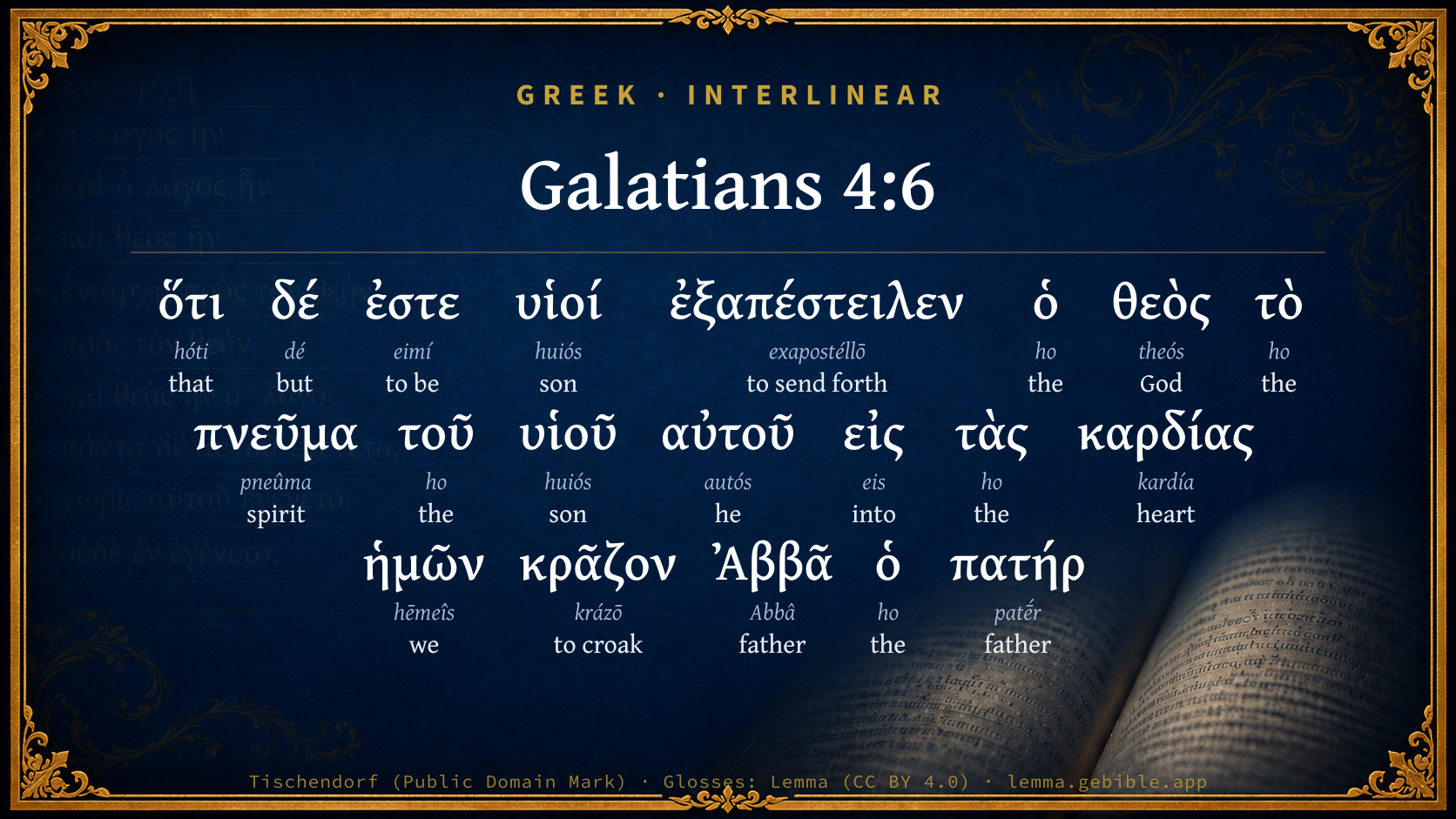
  1. ὅτι hóti G3754 “that” Conjunction
  2. δέ dé G1161 “but” Conjunction
  3. ἐστε eimí G1510 “to be” Verb, Present, Active, Indicative, 2nd person, Plural
  4. υἱοί huiós G5207 “son” Noun, Nominative, Plural, Masculine
  5. ἐξαπέστειλεν exapostéllō G1821 “to send forth” Verb, Aorist, Active, Indicative, 3rd person, Singular
  6. ὁ ho G3588 “the” Article, Nominative, Singular, Masculine
  7. θεὸς theós G2316 “God” Noun, Nominative, Singular, Masculine
  8. τὸ ho G3588 “the” Article, Accusative, Singular, Neuter
  9. πνεῦμα pneûma G4151 “spirit” Noun, Accusative, Singular, Neuter
  10. τοῦ ho G3588 “the” Article, Genitive, Singular, Masculine
  11. υἱοῦ huiós G5207 “son” Noun, Genitive, Singular, Masculine
  12. αὐτοῦ autós G846 “he” Personal pronoun, Genitive, Singular, Masculine
  13. εἰς eis G1519 “into” Preposition
  14. τὰς ho G3588 “the” Article, Accusative, Plural, Feminine
  15. καρδίας kardía G2588 “heart” Noun, Accusative, Plural, Feminine
  16. ἡμῶν hēmeîs G2249 “we” Personal pronoun, 1st person, Genitive, Plural
  17. κρᾶζον krázō G2896 “to croak” Verb, Present, Active, Participle, Accusative, Singular, Neuter
  18. ὁ ho G3588 “the” Article, Nominative, Singular, Masculine
  19. πατήρ patḗr G3962 “father” Noun, Nominative, Singular, Masculine

About this verse

These counts appear in no published source. They are computed here, from the morphology-tagged text and Lemma’s own curated glosses. What Lemma adds →

20
words
15
distinct lemmas
Pauline Epistles
section

Notable vocabulary

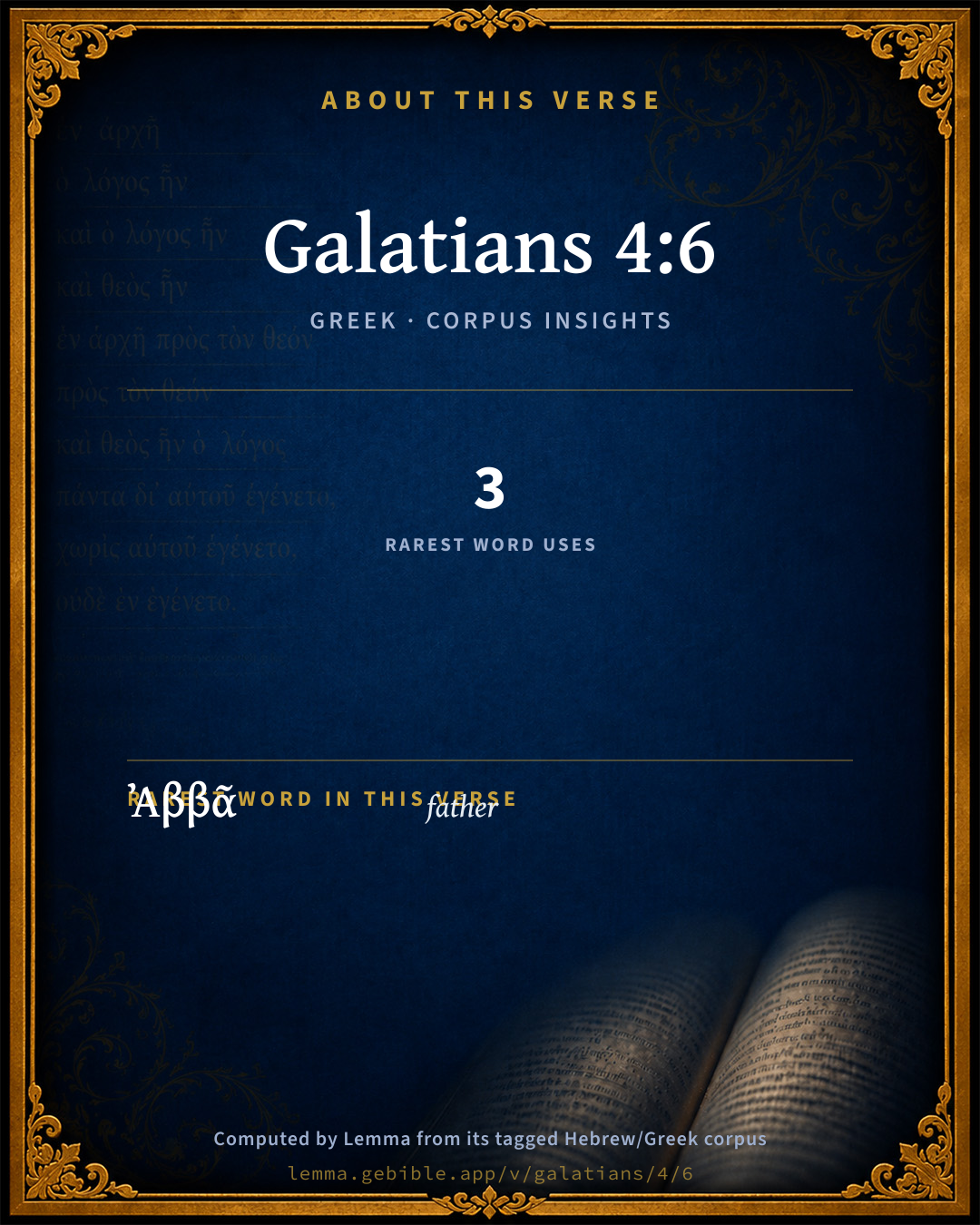
The rarest word here is Ἀββᾶ father G5 — appearing just 3 times in the whole Greek New Testament.

Shared distinctive vocabulary

Ἀββᾶ father G5 occurs in 3 verses of the Greek New Testament. Also found in:

Repetition

Words recur within this verse:

Cross-references

26

Topical passages linked to Galatians 4:6 in the Treasury of Scripture Knowledge — connected by theme and wording, ordered by reader-vote popularity; previews shown in the World English Bible.

  • Romans 8:15–17 For you didn't receive the spirit of bondage again to fear, but you received the Spirit of adoption, by whom we cry, "Abba! Father!"
  • Romans 5:5 and hope doesn't disappoint us, because God's love has been poured out into our hearts through the Holy Spirit who was given to us.
  • Romans 8:9 But you are not in the flesh but in the Spirit, if it is so that the Spirit of God dwells in you. But if any man doesn't have the Spirit of Christ, he is not his.
  • 2 Corinthians 3:17 Now the Lord is the Spirit and where the Spirit of the Lord is, there is liberty.
  • Ephesians 2:18 For through him we both have our access in one Spirit to the Father.
  • Philippians 1:19 For I know that this will turn out to my salvation, through your supplication and the supply of the Spirit of Jesus Christ,
  • Ephesians 4:30 Don't grieve the Holy Spirit of God, in whom you were sealed for the day of redemption.
  • Jude 1:20 But you, beloved, keep building up yourselves on your most holy faith, praying in the Holy Spirit.
  • John 15:26 "When the Counselor has come, whom I will send to you from the Father, the Spirit of truth, who proceeds from the Father, he will testify about me.
  • Luke 11:13 If you then, being evil, know how to give good gifts to your children, how much more will your heavenly Father give the Holy Spirit to those who ask him?"
  • John 16:7 Nevertheless I tell you the truth: It is to your advantage that I go away, for if I don't go away, the Counselor won't come to you. But if I go, I will send him to you.
  • John 14:16 I will pray to the Father, and he will give you another Counselor, that he may be with you forever,--
  • 2 Corinthians 1:22 who also sealed us, and gave us the down payment of the Spirit in our hearts.
  • Luke 11:2 He said to them, "When you pray, say, 'Our Father in heaven, May your name be kept holy. May your Kingdom come. May your will be done on Earth, as it is in heaven.
  • John 3:34 For he whom God has sent speaks the words of God; for God gives the Spirit without measure.
  • Ephesians 1:13 in whom you also, having heard the word of the truth, the Gospel of your salvation,--in whom, having also believed, you were sealed with the Holy Spirit of promise,
  • Jeremiah 3:4 Will you not from this time cry to me, My Father, you are the guide of my youth?
  • Matthew 6:6–9 But you, when you pray, enter into your inner chamber, and having shut your door, pray to your Father who is in secret, and your Father who sees in secret will reward you openly.
  • John 7:39 But he said this about the Spirit, which those believing in him were to receive. For the Holy Spirit was not yet given, because Jesus wasn't yet glorified.
  • Romans 8:26–27 In the same way, the Spirit also helps our weaknesses, for we don't know how to pray as we ought. But the Spirit himself makes intercession for us with groanings which can't be uttered.
  • Hebrews 4:14–16 Having then a great high priest, who has passed through the heavens, Jesus, the Son of God, let us hold tightly to our confession.
  • 1 Peter 1:11 searching for who or what kind of time the Spirit of Christ, which was in them, pointed to, when he predicted the sufferings of Christ, and the glories that would follow them.
  • Revelation 19:10 I fell down before his feet to worship him. He said to me, "Look! Don't do it! I am a fellow bondservant with you and with your brothers who hold the testimony of Jesus. Worship God, for the testimony of Jesus is the Spirit of Prophecy."
  • Isaiah 44:3–5 For I will pour water on him who is thirsty, and streams on the dry ground; I will pour my Spirit on your seed, and my blessing on your offspring:
  • Jeremiah 3:19 But I said, How I will put you among the children, and give you a pleasant land, a goodly heritage of the hosts of the nations! and I said, You shall call me My Father, and shall not turn away from following me.
  • Ephesians 6:18 with all prayer and requests, praying at all times in the Spirit, and being watchful to this end in all perseverance and requests for all the saints:

Cross-references courtesy of OpenBible.info (CC BY 4.0).

Where the printed editions differ

1 variant

Places in this verse where the major printed Greek editions disagree on the wording in a way that affects the translation — a comparison of editions, not a manuscript-by-manuscript collation. The editions are the modern critical texts (Nestlé-Aland 28/27, SBL, Westcott-Hort, Tregelles, Tyndale House) and the traditional texts behind the KJV (the Textus Receptus and the Byzantine/Majority text). It is not a claim about which reading is original.

  1. Different wording
    ἡμῶν

    “of us”

    In NA28NA27TynSBLWHTreg Not in TRByz

    ὑμῶν (humōn) 'of you' occurs in traditional manuscripts (TR+Byz) instead of ἡμῶν (hēmōn) 'of us' in older manuscripts (NA28+NA27+Tyn+SBL+WH+Treg)

Textual data: Translators Amalgamated Greek New Testament (STEPBible TAGNT) · CC BY 4.0.

Commentary

Notes on Galatians 4:6 from classic Christian and Jewish commentators (each source and its license shown beneath its notes). The classic Christian expositions comment on the surrounding passage and are grouped to its opening verse, so a note may address several verses; the Jewish commentaries on the Tanakh (Rashi and others) are per-verse, so they appear only where the commentator wrote on this verse.

Lemma curates 59 commentaries, every one of them public domain or Creative Commons licensed, each selected and text-cleaned for this edition rather than reprinted as found. About our sources →

The Biblical Illustrator

Joseph S. Exell

Gal_4:6

And because ye are sons, God hath sent forth the Spirit of His Son into your hearts.

The spirit and the cry of adoption

I. The dignity of believers. Adoption gives us the rights of children; regeneration gives us the nature of children: we are partakers of both of these, for we are sons.

1. This sonship is a gift of grace received by faith.

(1) Faith brings us justification.

(2) Faith sets us free from the bondage of the law.

(3) Faith is the mark of sonship in all who have it.

2. Adoption comes to us by redemption.

3. We now enjoy the privilege of sonship. Not only sons, but full-grown sons.

II. The consequent indwelling of the Holy Ghost in believers.

1. Here is a Divine act of the Father.

2. He comes as the Spirit of Jesus.

3. He takes up His residence in the believers heart. Coming into the central fortress and universal citadel of our nature, He takes possession of the whole.

4. This wonderful blessing is fraught with marvellous results. Sonship sealed by the indwelling Spirit brings us peace and joy; it leads to nearness to God and fellowship with Him; it excites trust, love, and vehement desire; and creates in us reverence, obedience, and actual likeness to God.

III. The filial cry.

1. It is the Spirit of God that cries.

2. It is literally the cry of the Son.

3. This cry in our hearts is exceedingly near and familiar. A cry is a sound which we are not anxious that every passer-by should hear; yet what child minds his father hearing him cry?

4. How earnest a thing is a cry.

5. The most of this crying is kept within the heart, and does not come out at the lips. At all times and in all places we can lift up our hearts and cry to God. (C. H. Spurgeon.)

The gain of adoption

By adoption God gives us

(1) a new nature (2Pe_1:3);

(2) a new name (Rev_3:12);

(3) a new inheritance (Rom_8:17);

(4) new relations (Rom_8:15-16);

(5) a new hope (1Pe_1:3). (John Bate.)

What is implied in adoption

1. Derivation of nature from God (Joh_1:13; Jam_1:18; 1Jn_5:18).

2. Being born again in the image of God, bearing His likeness (Rom_8:29; 2Co_3:18; Col_3:10; 2Pe_1:4).

3. Bearing His name (1Jn_3:1; Rev_2:17; Rev_3:12).

4. Being the objects of His peculiar love (Joh_17:23; Rom_5:5-8; Tit_3:4; 1Jn_4:7-11).

5. The indwelling of the Spirit of His Son; who gives an obedient spirit (1Pe_1:14; 2Jn_1:6), a spirit free from sense of guilt, legal bondage, fear of death (Rom_8:15; Rom_8:21; 2Co_3:17; Gal_5:1; Heb_2:15; 1Jn_5:14), a spirit elevated with a holy boldness and royal dignity (Heb_10:19; Heb_10:22; 1Pe_2:9; 1Pe_4:14).

6. Present protection, consolations, and abundant provisions (Psa_125:2; Isa_66:13; Luk_12:27-32; Joh_14:18; 1Co_3:21-23; 2Co_1:4).

7. Present fatherly chastisements for our good, including both temporal and spiritual afflictions (Psa_51:11-12; Heb_12:5-11).

8. The certain inheritance of the riches of our Fathers glory, as heirs of God, and joint heirs with Christ (Rom_8:17; Jam_2:5; 1Pe_1:4; 1Pe_3:7), including the exaltation of our bodies to fellowship with Him (Rom_8:28; Php_3:21). (A. A. Hodge.)

Divine adoption contrasted with human

1. Men generally adopt when they have no children of their own. But God had a Son, His dear Son, His well-beloved Son. He also had angels.

2. Men generally adopt such as they think deserving; God adopts criminals, traitors, enemies.

3. Men adopt living children; God, those who are by nature spiritually dead.

4. Man generally adopts one only: God, many. (G. S. Bowes.)

Privileges of adoption

By adoption--

1. God the Father is made our Father.

2. The incarnate God.Man is made our elder Brother, and we are made

(1) like Him;

(2) intimately associated with Him in community of life, standing, relations, privileges;

(3) joint-heirs with Him of His glory.

3. The Holy Ghost is our indweller, teacher, guide, advocate, comforter, sanctifier.

4. All believers, being subjects of the same adoption, are brethren (Eph_3:6; 1Jn_3:14; 1Jn_5:1). (A. A. Hodge.)

Heathen and Christian conceptions of God

A Jew entered a Persian temple, and saw there the sacred fire. He said to the priest, How! do you worship fire? Not the fire; it is to us an emblem of the sun and of his animating light, said the priest. Then asked the Jew, Do you adore the sun as a deity? Do you know that he also is a creature of the Almighty? The priest explained that the sun was to them only an emblem of the invisible light which preserves all things. The Israelite continued, Does your nation distinguish the image from the original? They call the sun their god, and kneel before the earthly flame. You dazzle the eye of the body, but darken that of the mind; in presenting to them the terrestrial light you take from them the celestial. The Persian asked, How do you name the Supreme Being? We call Him Jehovah Adonai; that is, the Lord who was, and is, and shall be. Your word is great and glorious; but it is terrible, said the Persian. A Christian approaching, said, We call Him Abba, Father. Then the Gentile and the Jew regarded each other with surprise, and said, Your word is the nearest and the highest; but who gives you courage to call the Eternal thus? The Father Himself, replied the Christian; and with that he proceeded to expound to them the plan of redemption. Then they believed, and lifted up their eyes to heaven, saying, Father, dear Father; and, joining hands, called each other brethren. (Krummacher.)

I. The spirit sent.

1. There are Three Persons in the Godhead who are often mentioned together as here (Mat_3:16-17; Mat_28:19; 2Co_13:14; 1Jn_5:7).

2. The Spirit is the third Person because He proceeds from the Father and the Son (Joh_14:26; Joh_15:26; Joh_16:15, and here).

II. Who sent him?

1. God sent His Son (Gal_4:4).

2. By the mediation of His Son. He sent the Spirit too (Joh_16:6-7; Luk_24:49; Act_1:4; Act_2:1).

III. why?, Because ye are sons.

1. All believers are Gods sons (Joh_1:12).

2. There fore, because they believe, and so are His Sons, God gives them His Spirit.

IV. Whither? Into your hearts.

1. Because the heart is the fountain of life (Pro_4:23).

2. The seat of true grace.

V. What to do?

1. To be a pledge of Christs presence (Joh_14:16-18; Mat_28:20).

2. To teach us all things needful (Joh_14:26).

3. To guide us into all truth.

4. To comfort us (Joh_15:26; Joh_16:7).

5. To seal our redemption (Eph_1:13-14; Eph_4:30).

6. To uphold us under all afflictions (Psa_51:12).

7. To witness our adoption (Rom_8:15-16).

VI. Uses.

1. Examine yourselves whether you have this Spirit.

(1) He is a convincing Spirit (Joh_16:9-11)

(a) of sin in ourselves,

(b) of righteousness in Christ,

(c) of Christs power and judgment to come.

(2) A renewing Spirit (Tit_3:5; Joh_3:3-5).

(3) A quickening Spirit (Rom_8:2; Joh_6:63)

(4) A leading Spirit (Rom_8:1; Rom_8:14).

(5) A praying Spirit (Rom_8:15; Rom_8:26).

2. Use all the means to get the Spirit in your hearts.

VII. Motives. Consider--

1. Till then you are not Christs (Rom_8:9).

2. Can do no good thing (Joh_15:5; Rom_8:26).

3. Are exposed to all sin.

4. In continual danger of hell.

5. Can have no true comfort.

VIII. Means.

1. Pray to God for it (Luk_11:13).

2. Frequent all public ordinances (Act_2:1). (Bishop Beveridge.)

The work of the Spirit

I. The worker. The Holy Spirit is called the Spirit of the Son because--

1. Of His eternal procession from the Son.

2. He was given to the Son as Head of the Church for the unction, consecration, and sanctification of His human nature.

3. He is communicated through the Son to all believers.

(1) Authoritatively, by virtue of the covenant of redemption (Act_2:33; Act_5:32).

(2) Formally, in that all the graces of the Spirit are derived by us from Him (Col_1:19; Col_2:19; Col_3:1-4; Eph_4:16).

II. The work. He enables Gods adopted children to behave themselves suitably to their state and condition.

1. Not as strangers, foreigners, or even servants, but

2. as children and heirs by becoming in them the Spirit of power, love, and sobriety (2Ti_1:7).

III. The effects of the working.

1. Freedom of access to the Father is secured.

2. He becomes to us the Spirit of grace and of supplications,

(1) by exerting graces and gracious affections in our souls in the duty of prayer: especially those of faith, love, and delight;

(2) by enabling us to exercise those graces and express those affections in vocal prayer. (J. Owen, D. D.)

Abba Father

I. The first, a Hebrew word, and the second, a Greek, signifies the union of Jews and Gentiles in our Church. In Christ the corner-stone both are joined by becoming sons: circumcision from one place, wherefore Abba--uncircumcision from another, wherefore Father is named, the concord of walls being the glory of the corner-stone.

II. The word Abba is retained because it is full of affection; but Father is added not only to expound the same, but the better to express the eager moving, the earnest and vehement desires and singular affections of believers in their crying unto God. (Brooks.)

You are to look unto your experience, and try and find out whether there there be not working with your soul, working through it, working beneath it, distinct from it, but not distinguishable from it by anything but its consequences and fruitfulness--a deeper voice than yours--a still, small voice. No whirlwind, nor fire, nor earthquake, but the voice of God speaking in secret, taking the voice and tones of your own heart and your own consciousness, and saying to you: Thou art My child, inasmuch as, operated by My grace, and Mine inspiration alone, there rises tremlingly, but truly, in thine own soul the cry Abba, Father. (A. Maclaren, D. D.)

It involves that the Father and the child shall have kindred life--the Father bestowing, and the child possessing, a life which is derived; and because derived, kindred; and because kindred, unfolding itself in likeness to the Father that gave it. And it requires that between the Fathers heart and the childs heart there shall pass in blessed interchange and quick correspondence, answering love, flashing backwards and forwards, like the lightning that touches the earth, and rises from it again. (A. Maclaren, D. D.)

The character and privileges of the children of God

I. The distinguishing characteristics of the children of God. Believing Christians enter into a higher condition. The servant becomes a son. Everything which would obstruct the view of a God of love is done away in Christ.

1. A spirit of filial confidence, as opposed to servile fear.

2. A spirit of holy love, as opposed to the bondage of sin.

3. A spirit of ready obedience, as opposed to the gloomy spirit of servitude. As love is the most powerful and self-devoted passion of our nature, it explains the character as well as the principle of Christian obedience. It is self-denying; for we no longer live to ourselves, but to Him who died for us and rose again (2Co_5:15). It is soul-absorbing; for it is not so much we that now live, as Christ that liveth in us (Gal_2:20). It is devoted, for our will is swallowed up in His, and the cry of the heart is, Lord, what wouldst Thou have me to do? Hence the bold assertion of St. Paul, For what the law could not do, in that it was weak through the flesh, God sending His own Son in the likeness of sinful flesh, and for sin condemned sin in the flesh; that the righteousness of the law might be fulfilled in us, who walk not after the flesh, but after the Spirit (Rom_8:3-4).

II. We now proceed to consider some of the distinguishing privileges of the children of God. It will be at once acknowledged that the characteristics which we have mentioned are also exalted privileges. To have a satisfactory sense of sin being pardoned; to walk in the light of Gods countenance, with a secret assurance of His love and favour; to be freed from the degrading bondage of Sin, and the servile fear of a holy law; to possess the moral power of holy obedience, and to have this heavenly principle pervading the soul; these are distinguishing gifts of Divine mercy. Whilst the spirit of a son has its characteristic endowments, the condition of a child has its peculiar prerogatives. The one is the family genius, the other the family privileges.

1. The child of God has a part in the Fathers love and care.

2. The child of God has a filial resemblance to his heavenly Father. In the households of earth there is what is termed a family likeness. Some distinguishing trait of feature often marks the countenances of all the offspring. However varied may be the form and hue of their faces, there is some identity of expression which makes them like their parent, and like to one another. So it is with the family of God, Being born from above, they possess the characteristics of a heavenly nature. They differ in the proportion and intensity of their spiritual graces, but they are all marked with the lineaments of virtue. One is more eminent for faith, another for zeal, another for wisdom; some excel in patience, or meekness, or fervid hope, or gentle love; but all have the fundamentals of these holy principles. They all bear the marks of a noble lineage. You might see in each of their hearts the peculiar traits of royalty. You might readily perceive that each inherits his Fathers holiness. He is the child of a King, a prince of God (1Pe_2:9; Rev_1:6).

3. Children of God have the privileges of family communion and fellowship. It is not now granted to man to hold conversational intercourse with angelic or sainted members of the heavenly family. He must be satisfied with knowing that they have some communion with his spirit. This is often alleged in the Scriptures, And who can tell what benefits we receive from holy thoughts, counsels, and promptings, whispered to the soul by hovering spirits of an ethereal nature? But we are privileged with the communion of saints. We may associate with the wise and good, the saints that are in the earth, and the excellent (Psa_16:3). Above all, the Christian has access to the throne of grace, and holds communion with the Father, through the Son, by the Holy Spirit.

4. Children of God have a share in the family provisions. There is a common stock of mercies, of which all the children have a right to partake. A certain property in blessings belongs to the household of faith. Exceeding great and precious promises have been provided by their heavenly Father. There is a fulness in Christ out of which His Church are permitted to receive. Every one is exhorted to take largely of these Divine gifts. Unlike property of an earthly nature, these riches never diminish by using. There could, therefore, be no reason for withholding them from any seeking soul. All are at liberty to ask and receive, that their joy may be full.

5. Children have a title to the future inheritance. If a son, then an heir of God through Christ; or, as the apostle writes in another place, If children then heirs, etc. Heirs of God--it is a strange expression! What does it mean? (R. M. Macbraire, M. A.)

Adoption

I. In what does adoption consist? It is the translation of a person out of one family into another. The act of grace by which God takes the children of the wicked one out of the world, and makes them the sons and daughters of His spiritual family.

1. Points of similarity between natural and spiritual adoption.

(1) In adoption we cease to have our former name, and are designated after the name of God, who adopted us; then sinners, now saints; then enemies, now reconciled; then aliens and rebels, now brought nigh and the friends of God.

(2) In adoption we change our abode. Once in the world, in the kingdom of darkness, in a far country; now in the Church, in the kingdom of Gods dear Son, in the household of faith, and family of heaven.

(3) We change our costume. Conform to the family dress.

2. Points of difference between natural and spiritual adoption.

(1) Natural adoption was to supply a family defect. Because there was no son. God had hosts of sons--the angels, etc.

(2) Natural adoption was only of sons. God makes no distinction as to sex, race, etc.

(3) In natural adoption there was only a change of condition; the child never became really the son of the adopter. But God makes His children partakers of His own nature, and imprints on them His own image.

(4) In natural adoption only one was adopted; but God adopts multitudes.

(5) In natural adoption only temporal advantages were derived; but in spiritual, the blessings are eternal.

II. The signs of adoption.

1. Internal (see Gal_4:6; Rom_8:14-16). The Spirit will produce within us

(1) peace of mind,

(2) comfort of heart,

(3) spiritual joy.

2. External.

(1) Language. Conversation such as becometh the gospel of Christ.

(2) Profession. We shall appear as the sons of the family of God; have the family badge, be enrolled in the family book, be found in the family circle, and sit at the family table.

(3) Obedience. Gods family has its laws, its specific rules for the government of itself, and for the direction of its conduct towards those who are without,

III. Its privileges.

1. Deliverance from all the miseries of our pristine state. Poverty, rags, misery, ruin.

2. Investiture into all the benefits of Christs family on earth.

3. A title to the celestial inheritance which Christ has bought and prepared for all who lave Him.

Application:

1. Learn the essential importance of this blessing. What would pardon and regeneration be without it? Let us seek the good of Gods family. We are in it to labour as well as enjoy.

2. Invite strangers to become the sons and heirs of God. (J. Burns, D. D.)

Sons by adoption

Great indeed is the rank and privilege of a son of God. The son of Adam, that is taken to be the Son of God, is taken out of the company of the rebels against God, into the company of those that adore and bless His name with thanksgiving, and perform His service with diligence, in His glorious presence. But he always remembers whence he has been taken; that if as a son of Adam he was taken from the comparatively vile dust of the earth, as a son of God he has been taken into a spiritual nature out of the comparatively much viler fleshly nature. He remembers that he is not a real son, but an adopted. Now a real son is always a son to his father, happen what will. And having been born and bred in his house, he knows all that is required of him, and does naturally all the duties of a member of the family. But very different is the condition of an adopted son; he has been born and bred in another family, and therefore under different rules; and hence, however respectable his family may be, he cannot accommodate himself so freely and fully as he could wish, nor sufficiently know the mind of a father, whom he has not known from childhood. Much more then if he be taken out of a family whose habits are quite contrary, and disreputably contrary, to the habits of that into which he has been adopted, he must be in continual fear and perplexity. All is quite strange to him, and let him be ever so willing to accommodate himself to his new situation, still he is in continual doubt as to what he should do, and what he should not do, and is continually, notwithstanding all his watchfulness, letting out the secrets of the corrupt habits of his old family. But on the very account of this natural infirmity, God hath put him under an instructor, to give him the proper knowledge, to form his habits, to influence his will, and by such a thorough change, to qualify him for the duties of the new station to which he has been admitted. And this instructor is the Holy Spirit, called also, from this His very office amongst us, the spirit of adoption, as in Rom_8:14-15. (R. W. Evans, M. A.)

Comfort of assurance

Death, like the proud Philistine, comes marching out in his hideous shape, daring the whole host of Israel to match him with an equal combatant. The atheist dares not die for fear non esse,--that he shall not be at all; the profane dares not die, for fear male esse--to be damned; the doubtful conscience dares not die, because he knows not whether he shall be, or be damned, or not be at all. Only the resolved Christian dares die, because he is assured of his election; he knows he shall be happy; and so lifts up pleasant eyes to heaven, the infallible place of his eternal rest. He dares encounter with his last enemy, trample on him with the foot of disdain, and triumphantly sing over him, O death! where is thy sting? O gravel where is thy victory? He conquers in being conquered; and all because God hath said to his soul, I am thy salvation. (T. Adams.)

Assurance of adoption

In 1768 Mr. Wesley visited Glasgow, where the greatest part of the members had found peace with God. Three years before Thomas Taylor had been sent there, and had for his first congregation two bakers boys and two old women. He kept off preaching, and his hearers increased also to two hundred, but for want of means he never kept so many fast days in his life. He hired a room, formed a society, and paid a precentor fourpence for each service to lead off the psalms, but the money falling short, he had to dismiss both the psalms and the precentor; but he left a society of seventy members. One of these was old Janet, of whom John Pawson records this anecdote. Meeting the minister of the kirk she had long attended, she was thus accosted: Oh, Janet, where have ye been, woman? I have no seen ye at the kirk for long. She replied, I go among the Methodists. Why, what gude get ye there, woman? Glory to God! said Janet; I do get gude; for God, for Christs sake, has forgiven me a my sins. Ah, Janet, be not highminded, but fear; the deil is a cunning adversary. I dinna care a button for the deil, said Janet; Ive gotten him under my feet. I ken the deil can do muckle deal, but there is ant thing he canna do. What is that, Janet? He canna shed abroad the love of God in my heart; an I am sure Ive got it there! Weel, weel, said the minister, If ye have got that there, hold it fast, Janet, and never let it go. Benefit of assurance:--Latimer writes to Ridley, When I live in a settled and steadfast assurance about the state of my soul, methinks I am as bold as a lion; I can laugh at all trouble; no affliction daunts me; but, when I am eclipsed in my comforts, I am of so fearful a spirit, that I could run into a very mouse-hole.

Sonship of the believer

I. The true position of the Christian. Sons. Many fail to see it. They admit believers, Christians, disciples, soldiers, servants. True. Each has a truth. Just as Jesus, Christ, Master, Lord; but Emanuel reveals a new connection. So with the believer. Son. Christ took our nature, and we receive His in degree (2Pe_1:4). This is often urged in Scripture. Rom_7:1-25. plainly describes law of nature and law of grace. Why urge this?

1. Because of privileges, of which we shall speak soon.

2. Because it is a necessity of life. Many fail in efforts. They try to be good, and fail. Because they begin wrongly. Must be so. Ostrich cannot soar as eagle. Nature is fitted to habits. So in grace. God requires great things. A new life begins. How? Not by laws or precepts--it is a new gift. Adoption transfers from Satans family to Gods, and then a new nature is given.

II. The power by whom this adoption is wrought. By Gods Spirit. In every aspect--redemption, sanctification, preservation, fruitfulness--the believer is a Divine work. Often forgotten. We are surrounded by human instruments, and the agent is not seen. Insufficient. Only the statue, not the man. Form without life. Both solemn and assuring.

III. The necessary results of this indwelling. Whereby, etc. Immediate connection between life and action. The means may lie dormant, but the grace never. What results?

1. God is known. In daily life such knowledge must be imparted. Very true of spiritual things. This knowledge surpasses that imparted by Scripture or human teachers. Examples: 1Sa_3:7; 2Co_4:6; Gal_3:16-17. Samuel and Paul both taught by man, and yet they were spiritually ignorant. So, however much we may study, prize, increasingly value the Bible, each must go beyond it.

2. Confidence is enjoyed. Point of argument lies in son and slave. The difference, the unwavering confidence of son. So boldness in prayer, conflict, work, is believers privilege. The Father never deserts His child.

3. Consistent life. A great name should never be disgraced. What so noble as this? where else is such honour entrusted? Be imitators of God. (H. T. Cavell.)

The Biblical Illustrator, edited by Joseph S. Exell (c. 1880s–1900s) — public domain. Text from a community e-Sword module.

Tyndale Open Study Notes

Tyndale Open Resources

4:6 The Holy Spirit provides an inner testimony to assure us that we are God’s children (see Rom 8:16; Eph 1:13-14). • Those who have the Spirit of his Son are able to address God as Father, just as Christ did (Mark 14:36; cp. Matt 6:9).

Tyndale Open Study Notes — © Tyndale Open Resources, licensed CC BY-SA 4.0. Text via the HelloAO Bible API.

Bengel's Gnomon

Johann Albrecht Bengel

Gal 4:6. Ὅτι, because) The indwelling of the Holy Spirit is the consequence of the condition of sons [their status as sons], the latter does not follow the former.—ἐστε) you are; even you of the Gentiles.—υἱοὶ sons) who are of age, living with the Father on terms of free-born liberty.—Ἀββᾶ ὁ Πατήρ, Abba Father) The Hebrew noun is here delightfully used; comp, Mar 14:36; and the union of the Hebrew and Greek idiom is consonant with the one mixed cry [in prayer] of the Hebrews and Greeks [made one in Christ]. The Hebrew says, Abba, the Greek says, Father, both, Abba, Father; comp. Rev 1:8.[35] So peace, peace, is redoubled, in like manner, for the Jews and Greeks, Isa 57:19. Individuals also no less [than the whole Church] redouble their call upon the name of the Father. This is a pledge of sonship in the New Testament; comp. Mat 6:9, note.

[35] “I am Alpha and Omega (Greek), the Beginning and Ending” (expressed in Hebrew, à and ú). The Greek and Hebrew are often so conjoined. Or rather it is vers. 7 to which Beng. refers, ναί (Greek), ἀμήν (Hebrew).—ED.

Bengel's Gnomon of the New Testament — English translation (T&T Clark, Edinburgh, 1860) — public domain. Text from a community e-Sword module.

Meyer's Critical & Exegetical Commentary

Heinrich August Wilhelm Meyer

Gal_4:6. A confirmation of the reality of this reception of sonship from the experience of the readers; for the ἐστέ, which, after the foregoing more general statement, now comes in with its individual application (comp. Gal_3:26), does not refer to the Galatians as Gentile Christians only (Hofmann), any more than in Gal_3:26-29.

ὅτι] is taken by most expositors, following the Vulgate, as quoniam (Luther, Castalio, Beza, Calvin, Grotius, Bengel, Semler, Morus, Rosenmüller, Paulus, Olshausen, Baumgarten-Crusius, de Wette, Baur, Hilgenfeld, Ewald, and others). And this interpretation (on ὅτι, because, at the beginning of the sentence, comp. 1Co_12:15; Joh_20:29; Joh_15:19) is the most simple, natural, and correct; the emphasis is laid on υἱοί, which is therefore placed at the end: but because ye are sons, God has sent forth the Spirit of His Son, etc. He would not have done this, if ye had not (through the υἱοθεσία) been υἱοί; thus the reception of the Spirit is the experimental and practical divine testimony to the sonship. If not sons of God, ye would not be the recipients of the Spirit of His Son. The Spirit is the seal of the sonship, into which they had entered through faiththe divine σημεῖον attesting and confirming it; comp. Rom_8:16. See also Weiss, bibl. Theol. p. 340. Others (Theophylact, Ambrose, Pelagius, Koppe, Flatt, Rückert, Schott) take ὅτι as that, and treat it as an abbreviated mode of saying: But that ye are sons, is certain by this, that God has sent forth, etc. (comp. Gal_3:11). This is unnecessarily harsh, and without any similar instance in the N.T.; modes of expression like those in Winer, p. 575 f. [E. T. 774], and Dissen, ad Dem. de Cor. p. 205, are different. Wieseler takes it as equivalent to εἰς ἐκεῖνο, ὅτι (see on Mar_16:14; Joh_2:18; Joh_9:17; Joh_11:51; Joh_16:19; 1Co_1:26; 2Co_1:18; 2Co_11:10): as concerns the reality (ἐστέ is to have the emphasis) of your state as sons. But this would unnecessarily introduce into the vivid and direct character of these short sentences an element of dialectic reflection, which also appears in Matthias view. Hofmann handles this passage with extreme violence, asserting that ὅτι δέ is an elliptical protasis,the completion of which is to be derived from the apodosis of the preceding period, from ἐξαπέστ. in Gal_4:4 onward,that ἐστὲ υἱοί is apodosis, and that the following ἐξαπέστ. κ.τ.λ. is the further result connected with it. In Hofmanns view, Paul reminds his (Gentile) readers that they are for this reason sons, because God has done that act ἐξαπέστειλεν κ.τ.λ. (Gal_4:4), and because He has done it in the way and with the design stated in Gal_4:4 f. This interpretation is at variance with linguistic usage, because the supposed elliptical use of ὅτι δέ does not anywhere occur, and the analogies in the use of εἰ δέ, etc., which Hofmann adducessome of them, however, only self-invented (as those from the epistles of the apostle, 2Co_2:2; 2Co_7:12)are heterogeneous. And how abruptly ἐξαπέστ. ὁ Θεὸς κ.τ.λ. would stand! But, as regards the thought also, the interpretation is unsuitable; for they are sons, etc., not because God has sent Christ, but because they have become believers in Him that was sent (Gal_3:26; Joh_1:12); it is not that fact itself, but their faith in it, which is the cause of their sonship and of their reception of the Spirit; comp. Gal_3:14. To refer the sending of the Spirit to the event of Pentecost (as Hofmann does), by which God caused His Spirit to initiate a presence of a new kind in the world, is entirely foreign to the connection; comp., on the contrary, Gal_3:2, Gal_5:14.

ἐξαπέστειλεν ὁ Θεὸς κ.τ.λ.] for it is τὸ πνεῦμα τὸ ἐκ Θεοῦ, 1Co_2:12. Observe the symmetry with ἐξαπέστ. κ.τ.λ. in Gal_4:4. The phrase conveys, in point of form, the solemn expression of the objective (Gal_4:4) and subjective (Gal_4:5) certainty of salvation, but, in a dogmatic point of view, the like personal relation of the Spirit, whom God has sent forth from Himself as He sent forth Christ.

τὸ πνεῦμα τοῦ υἱοῦ αὐτοῦ] So Paul designates the Holy Spirit, because he represents the reception of the Spirit as the proof of sonship; for the Spirit of the Son cannot be given to any, who are of a different nature and are not also υἱοὶ Θεοῦ. Comp. Rom_8:9. But the Holy Spirit is the Spirit of Christ, inasmuch as He is the divine principle of Christs self-communication, by whose dwelling and ruling in the heart Christ Himself (comp. on 2Co_3:17) dwells and rules livingly, really, and efficaciously (Gal_2:20) in the children of God. See on Rom_8:9; Rom_8:14. Comp. the Johannean discourses as to the self-revelation and the coming of Christ in the Paraclete.

ἡμῶν] The change of persons arose involuntarily from the apostles own lively, experimental consciousness of this blessedness. Comp. Rom_7:4.

κράζον] The strong word expresses the matter as it was: with crying the deep fervour excited by the Spirit broke forth into appeal to the Father. Comp. Rom_8:15; also Psa_22:3; Psa_28:1; Psa_30:8; Bar_3:1; Bar_4:20. The Spirit Himself is here represented as crying (it is different in Rom. l.c.), because the Spirit is so completely the active author of the Abba-invocation, that the man who invokes appears only as the organ of the Spirit. Comp. the analogy of the opposite casethe crying of the unclean spirits (Mar_1:26; Mar_9:26).

Ἀββᾶ ὁ πατήρ] The usual view taken by modern expositors,[182] following Erasmus and Beza, in this passage, as in Rom_8:15 and in Mar_14:36, is, that ὁ πατήρ is appended as an explanation of the Aramaic Abba for Greek readers (so Koppe, Flatt, Winer, Rückert, Usteri, Schott); along with which stress is laid on the childlike sound of the expression, so foreign to the Greek readers (Hofmann). But see, against this view, on Rom_8:15. No; Ἀββᾶ, the address of Christ the Son of God to His Father, which had been heard times without number by the apostles and the first believers, had become so established and sacred in Christian prayer that it had assumed the nature of a proper name, so that the deep and lively emotion of the consciousness of sonship could now superadd the appellative ὁ πατήρ; and the use of the two in conjunction had gradually become so habitual (Bengel appropriately remarks, haec tessera filiorum in Novo Testamento), that in Mar_14:36, by an hysteron proteron, they are placed even in the mouth of Christ. In opposition to this view, which is adopted by Hilgenfeld and Matthias, it has been objected by Fritzsche, ad Rom. II. p. 140, that ὁ πατήρ expresses exactly the same as the Aramaic אַבָּא, and that, if אבא had assumed the nature of a proper name, this name would very often have occurred in the N.T. and afterwards instead of Θεός; and people would not have said constantly Ἀββᾶ ὁ πατήρ, but also Ἀββᾶ ὁ Θεός. But these objections would only avail to confute our view, if it were maintained that Ἀββᾶ had become in general a proper name of God (as was יהוה in the O.T. and the other names of God), so that it would have been used at every kind of mention of God. The word is, however, to be regarded merely as a name used in prayer: only he who prayed addressed God by this name; and just because he was aware that this name was an original appellative and expressed the paternal character of God, he added the purely appellative corresponding term Ὁ ΠΑΤΉΡ, and in doing so satisfied the fervour of his feeling of sonship. This remark applies also to Wieselers objection, that Ἀββᾶ could only have continued to be used as an appellative. It might become a name just as well as, for instance, Adonai, but with the consciousness still remaining of its appellative origin and import. Moreover, that the address in prayer Ἀββᾶ ὁ πατήρ took its rise among the Greek Jewish-Christians, and first became habitual among them, is clear of itself on account of the Hebrew Abba. It is to be remarked also, that, according to the Rabbins, analogous emotional combinations of a Hebrew and a Greek address, which mean quite the same thing, were in use. See Erub. f. 53. Galatians 2 : מרי כירי (mi domine, mi ΚΎΡΙΕ). Comp. Schemoth rabb. f. 140. Galatians 2 : קירי מרי אבי. See Schoettgen, Hor. p. 252. Fritzsches view is, that the ἈΒΒᾶ of prayer, which had through Christs use of it become sacred and habitual, was so frequently explained on the part of the teachers of the Gentile Christians, as of Paul, by the addition of ὁ πατήρ, that it had become a habit with these teachers to say, ἈΒΒᾶ Ὁ ΠΑΤΉΡ. But this would be a mechanical explanation which, at least in the case of Paul, is à priori not probable, and can least of all be assumed in a case where the fervid emotion of prayer[183] is exhibited. Paul would have very improperly allowed himself to be ruled by the custom. Wieseler contents himself with the strengthening of the idea by two synonymous expressions, but this still fails to explain why πάτερ, πάτερ (comp. Soph. O. C. 1101), or πάτερ ὁ πατὴρ ἡμῶν (comp. κύριε ὁ κύριος ἡμῶν, Psa_8:2), is not said, just as κύριε, κύριε, and the like.

On the nominative with the article, as in apposition to the vocative, see Krüger, § 45. 2. 7.

[182] See the usual view of the ancient expositors, following Augustine, in Luther: Abba pater cur geminarit, cum grammatica ratio non appareat, placet vulgata ratio mysterii, quod idem Spiritus fidei sit Judaeorum et gentium, duorum populorum unius Dei. Comp. Calvin and Bengel.

[183] And let it be noticed, that in all the three passages where Ἀββᾶ ὁ πατήρ occurs (Rom_8:15; Gal_4:6; Mar_14:36), the most fervid tone of prayer prevails.

Meyer — Critical and Exegetical Commentary on the New Testament — English translation by Peter Christie, edited by Frederick Crombie (T&T Clark, 1880) — public domain. Text from a community e-Sword module.

Expositor's Greek Testament

ed. W. Robertson Nicoll

Gal 4:6 . Sonship involves relations of mutual confidence and love between the Father who bestows His choicest gifts, and the Son who responds with His whole heart.

The Expositor's Greek Testament, edited by W. Robertson Nicoll (1897–1910) — public domain. Text from a community e-Sword module.

International Critical Commentary

6. Ὅτι δέ ἐστε υἱοί, ἐξαπέστειλεν ὁ θεὸς τὸ πνεῦμα τοῦ υἱοῦ αὐτοῦ εἰς τὰς καρδίας ἡμῶν, “And because ye are sons, God sent forth the Spirit of his Son into your hearts.” The clause ὅτι … υἱοί is naturally interpreted as causal, giving the reason in the divine mind for the act ἐξαπέστειλεν … ἡμῶν, there being no verb of saying or the like for it to depend upon as an object clause. Nor is there any sufficient reason for departing from this obvious interpretation. It follows, however, that the sonship here spoken of being antecedent to and the ground of the bestowal of the Spirit is not the full, achieved fact, nor the consciousness of a filial relation, but the first and objective stage which the preceding context has emphasised, viz.: release from bondage to law, figuratively described as a pedagogue or guardians and stewards. It is involved in this relation of sonship and the possession of the Spirit that from the consciousness of the latter one may infer the former, and it is doubtless to induce the Galatians to draw this inference from their consciousness of possessing the Spirit (cf. 3:3-5) that this sentence was written. But the direct affirmation of the sentence is that the sonship is the cause of the experience of the Spirit.

To take ὅτι as meaning “that,” making ὅτι … υἱοί the proposition to be established, and then to supply after it “is proved by the fact” (Philippi, following ancient interpreters), or to take ὅτι in the sense of quod, “as respects the fact that” (Wies.), introduces unwarranted complication into a sentence which is on its face complete and simple. That in Rom 8:14, Rom 8:15 sonship is apparently proved by possession of the Spirit does not forbid our interpreting this passage as making the sonship the ground of the bestowal of the Spirit; for not only is the language of Rom 8:14, Rom 8:15 open to interpretation as an argument from effect to cause, in which case there also adoption precedes possession of the Spirit, but if the reverse is true there, antecedence of sonship to the bestowal of the Spirit, clearly indicated in this passage, is explicable by the fact that υἱοθεσία (see on v. 5) is used by the apostle of different stages of the process by which men come to the full possession of the relationship of sons to God, and that the context implies that it is the first and objective stage of which he is here speaking.

Precisely the phrase τὸ πνεῦμα τοῦ υἱοῦ αὐτοῦ does not occur elsewhere in N. T., but in Php 1:19 Paul uses τὸ πνεῦμα Ἰησοῦ Χριστοῦ and in Rom 8:9c πνεῦμα Χριστοῦ (cf. also 2Co 3:17, Act 16:7, 1Pe 1:11, Heb 9:14 Rev 19:10). Particularly instructive is Rom 8:9, Rom 8:10, where (a) πνεῦμα θεοῦ ἐν ὑμῖν, (b) πνεῦμα Χριστοῦ ἔχειν, and (c) Χριστὸς ἐν ὑμῖν all express the same fact of experience. It is manifestly also the same experience for which Paul employs in Gal 2:20 the phrase ζῂ͂ ἐνἐμοὶ Χριστός and in 5:25 ζῶμεν πνεύματι. Historically speaking, the sending of the Son and the sending of the Spirit are distinguished in early Christian thought, most markedly so in the fourth gospel (Joh 3:17, Joh 3:7:39, Joh 3:16:7; but note also that the coming of the Spirit is practically identified with the return of the Son), but also in Paul (cf. the ἐξαπέστειλεν of v. 4 with the same verb in this v.). The two terminologies, that of the Christ and that of the Spirit, have also a different origin, both, indeed, having their roots largely in O. T., but being there and in later Jewish thought quite distinct. But in the experience of the early Christians the Christ who by his resurrection had become a spirit active in their lives, and the Spirit of God similarly active, could not be distinguished. Cf. Burton, Spirit, Soul, and Flesh, p. 189. Precisely to what extent this experiential identification of the heavenly Christ and the Spirit of God has caused a numerical identification of them as personalities is difficult to say. Apparently the apostle Paul, while clearly distinguishing Christ from God the Father (see 1Co 8:6, Php 2:6-8, etc.) and less sharply distinguishing the Spirit from God (Rom 5:5, Rom 5:8:7, Rom 5:8, Rom 5:9, Rom 5:14, Rom 5:15), is not careful to distinguish the Spirit and Christ, yet never explicitly identifies them. Cf. Wood, The Spirit of God in Biblical Literature, pp. 229-231. The choice of τὸ πνεῦμα τοῦ ὑ̓οῦ αὐτοῦ for this passage in preference to any of its equivalents is due, on the one side to the necessity of distinguishing the fact referred to from the historic coming of the Christ (4:4), which excludes τὸν υἱὸν αὐτοῦ and Χριστόν, and on the other to the desire to connect this experience closely with the gift of Christ, which excludes τὸ πνεῦμα or τὸ πνεῦμα τοῦ θεοῦ.

On εἰς τὰς χαρδίας ἡμῶν, added to emphasise the transition from the objective sonship to the subjective experience, see Rom 5:5, Rom 5:1 Cor. 2:22, Eph 3:17. It is in the heart, as the seat of intellectual and spiritual life in general (1Co 2:9, Rom 9:2, Rom 10:1, etc.) and in particular of the moral and spiritual life (2Co 4:6, Rom 1:12, Rom 1:24), that the Spirit of God operates. The use of the expression here shows that ἐξαπέστειλεν refers (not as the same word in v. 4 does) to a single historic fact (the day of Pentecost, e. g.), but to the successive bestowals of the Spirit on individuals (cf. 3:3), the aor. being, therefore, a collective historical aor. (BMT 39). On the translation of an aor. in such a case, see BMT 46, 52. On ἡμῶν, undoubtedly to be preferred to ὑμῶν, a Western and Syrian reading, see on v. 3.

κράζον Ἀββά ὁ πατήρ. “crying, Abba, Father.” The recognition of God as Father is the distinguishing mark of the filial spirit. The participle κράζον agreeing with πνεῦμα ascribes the cry to the Spirit of God’s Son; yet it is undoubtedly the apostle’s thought that it is the expression of the believer’s attitude also. For the Spirit that dwells in us dominates our lives. See chap. 2:20, 5:25, and cf. Rom 8:15: ἐλάβετε πνεῦμα υἱοθεσίας, ἐν ᾧ κράζομεν Ἀββά ὁ πατήρ. The use of κράζον, usually employed of a loud or earnest cry (Mat 9:27, Act 14:14, Rom 9:27) or of a public announcement (Joh 7:28, Joh 7:37), in the Lxx often of prayer addressed to God (Psa 3:5, Psa 107:13), emphasises the earnestness and intensity of the utterance of the Spirit within us. Though the word κράζον itself conveys no suggestion of joy, it can hardly be doubted that the intensity which the word reflects is in this case to be conceived of as the intensity of joy. Though to be free from law is to obtain adoption, sonship in its full realisation is more than mere freedom from law. The significance of such freedom lies, indeed, precisely in the fact that it makes it possible that a truly filial relation and attitude of man to God shall displace the legal relation that law creates, that instead of our looking upon God as lawgiver in the spirit of bondage and fear (Rom 8:15) he becomes to us Father with whom we live in fellowship as his sons. See detached note on Πατήρ as applied to God, p. 391.

Ὁ πατήρ, Greek equivalent of the Aramaic Ἀββά, אִבָּא, is a nominative form with vocative force. Cf. Rom 8:15, Mar 14:36, Mat 11:26, Joh 20:28; Bl. D. 147.3. The repetition of the idea in Aramaic and Greek form gives added solemnity to the expression, and doubtless reflects a more or less common usage of the early church (see Mar 14:36, Rom 8:15). On the origin of this usage, see Th. s. v. Ἀββά, Ltft. ad loc., Sief. ad loc. It is quite likely that the use of the Aramaic word was derived from Jesus, being taken up into the vocabulary of Greek-speaking Christians through the medium of those who, knowing both Aramaic and Greek, in reporting in Greek the words of Jesus used this word with a sort of affectionate fondness for the very term that Jesus himself had used to express an idea of capital importance in his teaching. This is more probable than that it was taken over into the Christian vocabulary from that of the Jewish synagogue in which the idea of God as Father had so much less prominent place than in the thought and teaching of Jesus. See Bous. Rel. d. Jud 1:2 pp. 432-3, 434; Dal. WJ. p. 192. The attachment of the Greek translation ὁ πατήρ to the Aramaic word would naturally take place on the passage of the term into Greek-speaking circles.

International Critical Commentary — older volumes (1896–1929), various authors — public domain. Text from a community e-Sword module.

Geneva Bible (1599)

Geneva Bible translators

He showeth that we are in such sort free and set at liberty, that in the mean season we must be governed by the Spirit of Christ, which reigning in our hearts, may teach us the true service of the Father. But this is not to serve, but rather to enjoy true liberality, as it cometh sons and heirs.

The holy Ghost, who is both of the Father and of the Son: but there is a peculiar reason why he is called the Spirit of the Son, to wit, because the holy Ghost sealeth up our adoption in Christ, and maketh us a full assurance of it.

By that that followeth he gathereth that that went before: for if we have his spirit, we are his sons, and if we are his sons, then are we free.

Geneva Bible (1599) marginal notes — public domain. Text via Bolls.life.

Jamieson, Fausset & Brown

Robert Jamieson, A. R. Fausset & David Brown

because ye are sons--The gift of the Spirit of prayer is the consequence of our adoption. The Gentile Galatians might think, as the Jews were under the law before their adoption, that so they, too, must first be under the law. Paul, by anticipation, meets this objection by saying, YE ARE sons, therefore ye need not be as children (Gal 4:1) under the tutorship of the law, as being already in the free state of "sons" of God by faith in Christ (Gal 3:26), no longer in your nonage (as "children," Gal 4:1). The Spirit of God's only Begotten Son in your hearts, sent from, and leading you to cry to, the Father, attests your sonship by adoption: for the Spirit is the "earnest of your inheritance" (Rom 8:15-16; Eph 1:13). "It is because ye are sons that God sent forth" (the Greek requires this translation, not "hath sent forth") into OUR (so the oldest manuscripts read for "your," in English Version) hearts the Spirit of His son, crying, "Abba, Father" (Joh 1:12). As in Gal 4:5 he changed from "them," the third person, to "we," the first person, so here he changes from "ye," the second person, to "our," the first person: this he does to identify their case as Gentiles, with his own and that of his believing fellow countrymen, as Jews. In another point of view, though not the immediate one intended by the context, this verse expresses, "Because ye are sons (already in God's electing purpose of love), God sent forth the Spirit of His Son into your hearts," &c.: God thus, by sending His Spirit in due time, actually conferring that sonship which He already regarded as a present reality ("are") because of His purpose, even before it was actually fulfilled. So Heb 2:13, where "the children" are spoken of as existing in His purpose, before their actual existence.

the Spirit of his Son--By faith ye are one with the Son, so that what is His is yours; His Sonship ensures your sonship; His Spirit ensures for you a share in the same. "If any man have not the Spirit of Christ, he is none of His" (Rom 8:9). Moreover, as the Spirit of God proceeds from God the Father, so the Spirit of the Son proceeds from the Son: so that the Holy Ghost, as the Creed says, "proceedeth from the Father and the Son." The Father was not begotten: the Son is begotten of the Father; the Holy Ghost proceeding from the Father and the Son.

crying--Here the SPIRIT is regarded as the agent in praying, and the believer as His organ. In Rom 8:15, "The Spirit of adoption" is said to be that whereby WE cry, "Abba, Father"; but in Rom 8:26, "The SPIRIT ITSELF maketh intercession for us with groanings which cannot be uttered." The believers' prayer is His prayer: hence arises its acceptability with God.

Abba, Father--The Hebrew says, "Abba" (a Hebrew term), the Greek, "Father" ("Pater," a Greek term in the original), both united together in one Sonship and one cry of faith, "Abba, Father." So "Even so ('Nai,' Greek) Amen (Hebrew)," both meaning the same (Rev 1:7). Christ's own former cry is the believers' cry, "Abba, Father" (Mar 14:36).

Jamieson, Fausset & Brown — Commentary Critical and Explanatory on the Whole Bible (1871) — public domain (CC PDM 1.0). Text via the HelloAO Bible API.

Adam Clarke's Commentary

Verse 6. And because ye are sons] By faith in Christ Jesus, being redeemed both from the bondage and curse of the law; GOD-the Father, called generally the first person of the glorious TRINITY, hath sent forth the SPIRIT-the Holy Ghost, the second person of that Trinity, of his SON-Jesus Christ, the third person of the Trinity-crying, Abba, Father! from the fullest and most satisfactory evidence that God, the Father, Son, and Spirit, had become their portion. For the explanation of the phrase, and why the Greek and Syriac terms are joined together here, See Clarke on Mr 14:36; and "Ro 8:15".

Adam Clarke's Commentary on the Bible (1810–1826) — public domain. Text from a community e-Sword/MySword module.

John Calvin's Commentaries

6. And because ye are sons. The adoption which he had mentioned, is proved to belong to the Galatians by the following argument. This adoption must have preceded the testimony of adoption given by the Holy Spirit; but the effect is the sign of the cause. In venturing, he says, to call God your Father, you have the advice and direction of the Spirit of Christ; therefore it is certain that you are the sons of God. This agrees with what is elsewhere taught by him, that the Spirit is the earnest and pledge of our adoption, and gives to us a well-founded belief that God regards us with a father’s love.

“Who hath also sealed us, and given the earnest of the Spirit in our hearts.” (2 Corinthians 1:22.)

“Now he that hath wrought us for the self-same thing is God, who also hath given unto us the earnest of the Spirit.” (2 Corinthians 5:5.)

But it will be objected, do not wicked men, too, carry their rashness so far as to proclaim that God is their Father? Do they not frequently, with greater confidence than others, utter their false boasts? I reply, Paul’s language does not relate to idle boasting, or to the proud opinion of himself which any man may entertain, but to the testimony of a pious conscience which accompanies the new birth. This argument can have no weight but in the case of believers, for ungodly men have no experience of this certainty; as our Lord himself declares.

“The Spirit of truth,” says he, “whom the world cannot receive, because it seeth him not, neither knoweth him.” (John 14:17.)

This is implied in Paul’s words, God hath sent forth the Spirit of his Son into your hearts. It is not what the persons themselves, in the foolish judgment of the flesh, may venture to believe, but what God declares in their hearts by his Spirit. The Spirit of his Son is a title more strictly adapted to the present occasion than any other that could have been employed. We are the sons of God, because we have received the same Spirit as his only Son.

Let it be observed, that Paul ascribes this universally to all Christians; for where this pledge of the Divine love towards us is wanting, there is assuredly no faith. Hence it is evident what sort of Christianity belongs to Popery, since any man who says, that he has the Spirit of God, is charged by them with impious presumption. Neither the Spirit of God, nor certainty, belongs to their notion of faith. This single tenet held by them is a remarkable proof that, in all the schools of the Papists, the devil, the father of unbelief, reigns. I acknowledge, indeed, that the scholastic divines, when they enjoin upon the consciences of men the agitation of perpetual doubt, are in perfect agreement with what the natural feelings of mankind would dictate. It is the more necessary to fix in our minds this doctrine of Paul, that no man is a Christian who has not learned, by the teaching of the Holy Spirit, to call God his Father.

Crying. This participle, I think, is used in order to express greater boldness. Hesitation does not allow us to speak freely, but keeps the mouth nearly shut, while the half-broken words can hardly escape from a stammering tongue. “Crying,” on the other hand, expresses firmness and unwavering confidence.

“For we have not received again the spirit of bondage to fear, but of freedom to full confidence.” (Romans 8:15.)

Abba, Father. The meaning of these words, I have no doubt, is, that calling upon God is common to all languages. It is a fact which bears directly on the present subject, that the name Father is given to God both by the Hebrews and by the Greeks; as had been predicted by Isaiah,

“Every tongue shall make confession to my name.” (Isaiah 45:23.)

The whole of this subject is handled by the apostle at greater length in his Epistle to the Romans. I judge it unnecessary to repeat here observations which I have already made in the exposition of that Epistle, and which the reader may consult. Since, therefore, Gentiles are reckoned among the sons of God, it is evident that adoption comes not by the merit of the law, but by the grace of faith.

John Calvin's Commentaries (1540-1563) — public domain. Text from the Calvin Translation Society English edition (1840s-50s) via the Christian Classics Ethereal Library (ccel.org). Calvin's coverage is partial (roughly two-thirds of the Bible); uncommented books and verses are honest gaps, never fabricated. The 19th-century editor's footnotes and remarks are omitted so the notes are faithfully Calvin's own voice.

Ellicott's Commentary for English Readers

(6) It is because you are sons that you are able to address your Heavenly Father in such genuine accents of filial emotion. It is not ye that speak, but the Spirit of Christ which has been given to you in virtue of your adoption. He prompts your prayers.

This verse should be read in connection with Rom_8:15-16, to which it forms a close parallel.

Because.—It is, perhaps, on the whole, best to retain this translation. The conjunction may, however, possibly mean “in proof that.”

Abba, Father.—A reduplication of loving entreaty. (See Note on Rom_8:15.) For similar instances of a Greek word being repeated in Aramaic, or an Aramaic word in Greek, we may compare Rev_9:11 : “The angel of the bottomless pit, whose name in the Hebrew tongue is Abaddon, but in the Greek tongue hath his name Apollyon;” Rev_12:9 : “That old serpent, called the Devil, and Satan.” The Aramaic “Abba” appears in our word “abbot.”

A Bible Commentary for English Readers, edited by Charles John Ellicott (1878–1897) — public domain. Text from a community e-Sword module.

The Cambridge Bible for Schools and Colleges

gen. ed. J. J. S. Perowne

6. In proof of this, as in ch. Gal_3:2, St Paul appeals to their own experience. Man by nature does not regard God, much less does he pray to Him, as a father. If the Galatians have “the earnest of the Spirit” (2Co_1:22; 2Co_5:5) in their hearts, it is a pledge of their inheritance (Eph_1:14), a proof that they are sons of God. Comp. Rom_8:15-16 (where the identity of the words employed is very striking in the original) “For ye did not receive a spirit of bondage again unto fear, but ye received a spirit of adoption, whereby we cry, Abba, Father. The Spirit Himself beareth witness with our spirit that we are children of God.”

sent forth] the same verb which is used in Gal_4:4. The Father sends forth from Himself the Son and the Spirit.

the Spirit of his Son] ‘A title more strictly adapted to this occasion than any other that could have been employed. We are sons of God, because we have received the same Spirit as His only Son’. Calvin. He is the Spirit of Christ because given to Christ (Joh_3:34), sent by Christ (Joh_15:26) witnessing to Christ (Ib.).

crying] A word denoting intense earnestness of supplication. Here it is the Holy Ghost who makes intercession in the believer’s heart (comp. Rom_8:26); in Romans (loc. cit.) the believer himself cries, Abba, Father. There is no contradiction in this, any more than in our Lord’s promise, Mat_10:20.

Abba, Father] The first word is Aramaic, and means ‘Father.’ In two other passages the same combination is found. From its use in one of these (Rom_8:15) which is parallel to the verse before us, nothing can be inferred as to its origin. But from the other (Mar_14:36), we learn that our Blessed Lord in His agony in Gethsemane used this form of invocation. Why He used it, we cannot say. Certainly the second word was not added by Him (or by the Evangelist) as explanatory of the first. In the repetition of the word, which expressed at once His faith and His filial submission, we have an utterance which baffles our finite exegesis. The anguish of that spotless soul, in the near prospect of the Cross and bowing beneath the load of a world’s sin, found vent in words, the most fitting, yet (as language ever must be) inadequate fully to convey the deepest feelings of the heart. But we observe, 1st, that it was in deep suffering that these words were spoken. Suffering is a mark of Sonship. Comp. Heb_5:7-8 ‘Who in the days of His flesh, having offered up prayers and supplications with strong crying and tears unto Him that was able to save Him from death … though He was a Son, yet learned He obedience by the things which He suffered,’ with Heb_12:7 ‘If ye endure chastening, God dealeth with you as with sons: for what son is there whom his father chasteneth not?’ And, 2ndly, the use of a Jewish and a Gentile word in that mysterious and awful cry reminds and assures us that in Him and by His Passion we both, Jews and Gentiles, have access as children unto the Father.

The Cambridge Bible for Schools and Colleges (gen. ed. J. J. S. Perowne; Cambridge University Press, 1878–1918) — public domain. Text from a community e-Sword module.

John Gill's Exposition

And because ye are sons,.... That is of God, so some copies read; and the Ethiopic version, "inasmuch as ye are his sons"; not in so high a sense as Christ is the Son of God; nor in so low a sense as all men are his offspring; nor in such sense as magistrates are the children of the most High; nor merely on account of a profession of religion, as the "sons of God" was a phrase very early used of the worshippers of the true God; but by virtue of adoption, and which is not owing to the merits of men, who are by nature children of wrath, but to the free rich sovereign grace of God. It is a privilege and blessing of grace in which all the three persons are concerned. The Father has predestinated to it, and in the covenant has provided and laid it up; he set up his Son as the pattern to which these sons should be conformed, and proposed the glory of his own grace, as the end; by virtue of which act of grace they were considered as the children of God, as early as the gift of them to Christ; and so by him when he partook of their flesh and blood, and died to gather them together who were scattered abroad; see Heb 2:13. The Son of God has also an hand in this affair; for through his espousing their persons, they become the sons and daughters of the Lord God Almighty; and through his assumption of their nature they become his brethren, and so to be in the relation of sons to God; through his redemption they receive the adoption of children, and at his hands the privilege, the power itself, to become such. The Spirit of God not only regenerates them, which is an evidence of their sonship, but as a spirit of adoption manifests it to them, works faith in them to receive it, and frequently witnesses to the truth of it; all which show how any come and are known to be the sons of God. This is a privilege that exceeds all others; it is more to be a son than to be a saint; angels are saints, but not sons, they are servants; it is more to be a child of God, than to be redeemed, pardoned, and justified; it is great grace to redeem from slavery, to pardon criminals, and justify the ungodly; but it is another and an higher act of grace to make them sons; and which makes them infinitely more honourable, than to be the sons and daughters of the greatest potentate upon earth; yea, gives them an honour which Adam had not in innocence, nor the angels in heaven, who though sons by creation, yet not by adoption. The consequence, and so the evidence of it, follows,

God hath sent forth the Spirit of his Son into your hearts, crying Abba, Father. The Syriac and Arabic versions read, "our Father"; all the three divine persons here appear, as having a concern in this business, as before observed; here are God and his Son, and the Spirit of his Son, said to be sent; by whom is designed not any work of his upon the heart, nor any of his gifts and graces; but he himself in person, even the same Spirit of God that moved upon the face of the waters at the creation of the world, and moved holy men of God to write the Scriptures; who formed and filled the human nature of Christ, and descended on him as a dove; and by whom Christ and his apostles wrought their miracles; and who is called the Spirit of his Son; as he is frequently by the Jews (g), , "the Spirit of the King Messiah"; and sometimes (h) , "the Spirit of his word", the essential word of God; because he proceeds from him as from the Father, and because he dwells in him, in an eminent manner, as Mediator, and is sent by virtue of his mediation and intercession; and he is the rather mentioned under this character, because adoption proceeds upon the natural sonship of Christ, and is what is the peculiar office of the Spirit to testify. When he is said to be "sent", it does not suppose any local motion or change of place in him, who is a spirit infinite, immense, and omnipresent; nor any inferiority to the Father that sends him, or to the Son whose Spirit he is; for he is one God with the Father and Son, and with the Father is the sender of Christ, Isa 48:16, but it regards his peculiar office in this affair of adoption, by agreement of all the three persons; the Father predestinated to it, the Son redeems, that it might be received, and the Spirit is sent to discover, apply, and bear witness to it; which is a wondrous instance of the grace of God. The place where he is sent is "into" the "heart": where he is as a principle of spiritual life, and which he furnishes and supplies with all grace; where he dwells as in his temple, and is the evidence of God's dwelling there, and also of interest in Christ; is there as a pledge and an earnest of future glory; and the whole is a surprising instance of condescending grace. The work he does there is various, and consists of divers parts; as convincing of sin, and righteousness, working faith, and acting the part of a comforter; but what is here referred to, is the discharge of his office as a spirit of adoption, "crying Abba, Father". The word Abba is an Hebrew, or rather a Syriac or Chaldee word, signifying "father"; and which is added for explanation sake; and its repetition may denote the vehemency of filial affection, the strength of faith and confidence as to interest in the relation; and being expressed both in Hebrew and Greek, may show that God is the Father both of Jews and Gentiles, and that there is but one Father of all; and if it might not be thought too curious an observation, it may be remarked that the word "Abba", read backwards or forwards, is the same pronunciation, and may teach us that God is the Father of his people in adversity as well as in prosperity. The act of "crying", though it is here ascribed to the Spirit, yet is not properly his, but the believers; and is attributed to him because he excites, encourages, and assists them as a spirit of adoption to call God their Father; and may be understood both of the secret internal crying of the soul, or exercise of faith on God as its Father, and of an open outward invocation of him as such, with much confidence, freedom, and boldness.

(g) Bereshit Rabba, fol. 2. 4. & 6. 3. Vajikra Rabba, fol. 156. 4. See Gill on Rom 8:9. (h) Targum in 2 Chron. ii. 6.

John Gill's Exposition of the Whole Bible (1746–1763) — public domain (CC PDM 1.0). Text via the HelloAO Bible API.

Trapp's Complete Commentary

John Trapp

6 And because ye are sons, God hath sent forth the Spirit of his Son into your hearts, crying, Abba, Father.

Ver. 6. Crying, Abba, Father] God hath no stillborn children. Paul was no sooner converted, but behold he prayed, Act 9:11. The spirit of grace is a spirit of supplication, Zec 12:10. And when God sends this spirit of prayer into our hearts, it is a sure sign that he means to answer our desires; like as when we bid our children say, I pray you, father, give me this, we do it not, but when we mean to give them that which we teach them to ask. The gemination, "Abba, Father," noteth fiducial, filial, vehement affection; and it is made the first word we can speak when we are made sons, to cry "Abba, Father."

John Trapp, A Commentary or Exposition upon All the Books of the Old and New Testament (1647–1656) — public domain. Text from a community e-Sword module.

Albert Barnes' Notes on the Bible

And because ye are sons - As a consequence of your being adopted into the family of God, and being regarded as his sons. It follows as a part of his purpose of adoption that his children shall have the spirit of the Lord Jesus.

The Spirit of his Son - The spirit of the Lord Jesus; the spirit which animated him, or which he evinced. The idea is, that as the Lord Jesus was enabled to approach God with the language of endearment and love, so they would be. He, being the true and exalted Son of God, had the spirit appropriate to such a relation; they being adopted, and made like him, have the same spirit. The “spirit” here referred to does not mean, as I suppose: the Holy Spirit as such; nor the miraculous endowments of the Holy Spirit, but the spirit which made them like the Lord Jesus; the spirit by which they were enabled to approach God as his children, and use the reverent, and tender, and affectionate language of a child addressing a father. It is that language used by Christians when they have evidence of adoption; the expression of the warm, and elevated, and glowing emotions which they have when they can approach God as their God, and address him as their Father.

Crying - That is, the spirit thus cries, Πνεῦμα Pneuma - κράζον krazon). Compare the notes, Rom 8:26-27. In Rom 8:15 it is, “wherewith we cry.”

Abba, Father - See the note at Rom 8:15. It is said in the Babylonian Gemara, a Jewish work, that it was not permitted slaves to use the title of Abba in addressing the master of the family to which they belonged. If so, then the language which Christians are here represented as using is the language of freemen, and denotes that they are not under the servitude of sin.

Albert Barnes' Notes on the Bible (1834–1885) — public domain. Text from a community e-Sword/MySword module.

Haydock's Catholic Bible Commentary

Crying, Abba. That is, Father; Christ taught us in prayer to call God our Father, he having made us his adoptive sons by his grace, and heirs of heaven. (Witham)

George Leo Haydock (1774–1849), Haydock's Catholic Family Bible and Commentary, 1859 edition — public domain. Excludes Psalms (Douay-Rheims chapter numbering differs from Protestant) and Deuterocanonical books (Catholic canon only).

Matthew Poole's English Annotations

Lest the Jews should claim the adoption as peculiar to them, the apostle tells them that these Gentiles were also sons; and in confirmation of that, he saith, that God had sent

the Spirit of his Son into their hearts: not that the Holy Spirit is not the Spirit of the Father, as well as of Christ; but he calleth him the Spirit of Christ, because he had made adoption the end and fruit of redemption; and redemption is every where made the work of the Son. The apostle saith, Rom 9:4, that the adoption belongeth to the Israelites: the Jews were the first people whom God dignified with the name of his sons, his first-born, Exo 4:22; and so many of them as believed also received the Spirit, Eze 36:27; but the full effusion of the Spirit was reserved to gospel times, and until the time that Christ ascended, Joh 7:39; 16:7. After which the Spirit was poured out in the days of Pentecost, Act 2:1-47, whose effects were evident, not only in power to work miracles, and speak with divers tongues, (which were not common to all believers), but also in a variety of spiritual gifts and habits, amongst which this was one, teaching them to cry,

Abba, Father.

Crying, ( it is expounded, Rom 8:15, whereby we cry, that is, through whose influence and working in us we cry), Abba, Father, that is, Father, Father: which not only signifieth the Spirit’s influence upon believers’ words in prayer, first conceived in the heart, then uttered by the lips; but chiefly those habits of grace, by which we pray acceptably; faith and holy boldness, by which we call God Father; zeal and fervency, by which we are importunate with God, and say, Father, Father. Which were now not the privileges of Jews only, but of these Galatians also, who were by nature Gentiles, and strangers to God; and a certain evidence of their concern in the redemption of Christ, and that they also might expect salvation from him.

Matthew Poole's English Annotations on the Holy Bible (1683–1685) — public domain. Text from a community e-Sword/MySword module.

Whedon's Commentary on the Bible

Daniel D. Whedon

6. Ye are sons—As the minor does not cease to be a son upon attaining his majority.

The Spirit of his Son—Not merely in the rationalistic interpretation—”the temper of a true Christian”—but the divine Spirit indwelling. So Bishop Pearson: “Here the Son is distinguished from the Father, as sent by him; and the Spirit of the Son is distinguished from the Father, as sent by the Father after he had sent the Son. And this our Saviour hath taught us several times. Joh_14:26; Joh_15:26. Hence we conclude that the Holy Ghost, although he be truly and properly God, is neither God the Father nor God the Son.” So also Mr. Locke: “He could not be called the Spirit of the Son any otherwise than as proceeding from the Son; so that it is evident he proceeds from the Father and the Son.”

Into your hearts—See note on Rom_8:26.

Crying—It is the very Spirit itself which in our hearts utters the cry. Not only is there a groaning, (Rom_8:26,) as for a deliverance, but there is a cry, as ascending from our hearts to the Father on high.

Abba, Father—Both the popular Hebrew and the Greek form of the name are given in undoubted symbol; we think that both Jew and Gentile are united in this blessed co-sonship with the Son. In the heart of either alike the indwelling Spirit sendeth up the filial cry. Yet this mode of double wording arose from the fact that Hebrews largely spoke two languages, and Greeks would, in approximate Christianity, often become Hebraized. Schoettgen is quoted by Lightfoot as giving a specimen of the title my lord, addressed in both Hebrew and Greek by a Jewish woman to a judge. Compare Mar_14:36, and Rom_8:15.

The word abba, signifying father in Hebrew, is the original of the ecclesiastical terms abbot, abbe, and abbey, in modern European languages.

Daniel D. Whedon (gen. ed.), Commentary on the Old and New Testaments (1874–1909) — public domain. Text from a community e-Sword module.

The Pulpit Commentary

And because ye are sons (oti de ejste uiJoi). The apostle is adducing proof that God"s people had actually received the adoption of sons; it was because it was so, that God had sent into their hearts the Holy Spirit, imparting that vivid consciousness of sonship which they enjoyed. The fact of the adoption must have been there, to qualify them to be recipients of this divinely inspired consciousness. The affirmation in Rom_8:16, "The Spirit himself beareth witness with our spirit that we are children of God," closely resembles our present passage; but it is not identical. We are not made sons (the apostle intimates) by the Spirit giving us the consciousness of sonship; but, having been previously made sons, the Spirit raises in our spirits sentiments answering to the filial relation already established. The position of the clause introduced by "because" is like that in 1Co_12:15, 1Co_12:16. The persons recited by the "ye" are still God"s people; not the Galatian believers in particular, except as a portion of the whole Church of God. The apostle puts the thought in this form to bring the truth more strikingly home to their minds. This he does more closely still in the next verse by "thou." But that he has in view God"s people as a whole is clear, not only from the whole strain of the context, but also from the phrase, "into our hearts," in the next clause.

God hath sent forth (ejxapesteilen oJ Qeov); God sent forth. The tense indicates that the apostle does not refer to a sending forth of God"s Spirit to each individual believer, parallel to that "sealing" which believers are stated to be subjects of in Eph_1:13. This historic aorist, as it does in ver. 4, points to one particular emission that by which the Comforter was sent forth to take up his dwelling in the Church as his temple through all time (Joh_14:16, Joh_14:17; Act_1:4, Act_1:5) The Spirit of his Son. The Spirit which "anointed" Jesus to be the Christ; which throughout animated the God-Man Jesus; which prompted him in full filial consciousness, himself in a certain critical hour with loud outcry (meta kraughv ijscurav, (Heb_5:7) to call out, "Abba, Father!" The phrase, "his Son," is aetiological; by it the apostle intimates that it was only congruous that the Spirit which had animated the whole life of the incarnate Son should be shed forth upon those who by faith become one with him, and should manifest his presence with them, as well as their union with Christ, by outcome of sentiment similar to that which Christ had expressed. Since the sonship of Christ is here spoken of as if it were not merely antecedent, but also in some way preparatory to the sending forth of the Spirit, it best suits the connection to construe it, not, as in ver. 4, as that belonging to him in his preincarnate state of being, but as that which appertained to him after being "made to be of a woman," and in which his disciples might be considered as standing on a certain footing of parity with him. This harmonizes with the relation which in the Gospels and Acts the sending of the Spirit is represented as holding to his resurrection and ascension. The interpretation above given in one point presupposes the apostle"s knowledge of the story of the agony in the garden, when, according to St. Mark, (Mar_14:36) Jesus himself used the words, "Abba. Father." This presupposition is warranted, not only by the probabilities of the case, but also by what we read in Gal_5:7 of the Epistle to the Hebrews, Pauline, certainly, if not actually St. Paul"s. We have to add that the Gospels not only make repeated mention of our Lord as addressing the Supreme Being by the compellative of "Father," but also represent him as constantly speaking of God as bearing that relation both to himself and to his disciples. This mode of designating the Almighty was characteristic in the highest degree of Jesus, and up to that time, so far as appears in the Scriptures, unknown. The manner in which the apostle here speaks of the "sending forth" of the Spirit in close proximity to the mention of the "sending forth" of the Son, strongly favours the belief that he regarded the Spirit, as being also a personal agent in Psa_104:30 we have in the Septuagint "Thou wilt send forth (ejxaposteleiv) thy Spirit, and they will be created." in Psa_43:3 and 57:3 God is implored to "send forth ejxaposteilon, Septuagint his light and his truth," "his mercy and his truth;" these being poetically personified as angelic messengers. Into your hearts (eijv taav uJmwn). But this reading of the Textus Receptus is, by recent editors, replaced by the reading, eijv taav hJmwn, into our hearts, the other reading being regarded as a correction designed to conform this clause with the words, "ye are sons," in the preceding one. In both cases the apostle has in his view the Church of God viewed generally. His putting "our" here instead of "your" was probably an outcome of his feeling of proud gladness in the thought of his own happy experience. A precisely similar change in the pronoun, attributable probably to the same cause, is observable in the remarkably analogous passage inzon); Rom_8:15, "Ye received not the spirit of bondage again unto fear; but ye received the Spirit of adoption, whereby we cry, Abba, Father." Crying (kra) crying out aloud. The word expressing loud utterance betokens in this case undoubting assurance. No faint whisper this of an inner consciousness, shy, reticent, because afraid to assure itself of so. glorious, so blissful a relation; no hesitating half-hope; it is a strong, unwavering conviction, bold, though humbly bold, to thus address the all-holy Supreme himself. The "cry" is here attributed to the Spirit himself; in Rom_8:15 to believers, these being the Spirit"s organs of utterance; presently after in the Romans, vers. 26, 27, the Spirit himself is said to "intercede with groanings which cannot be uttered according to the will of God." Analogously, in the Gospels, evil spirits in demoniacs at times are said to "cry out", (Mar_1:26 9:26) while in other passages the cry is attributed to the possessed person. Abba, Father (jAbba oJ Pathr). In addition to Rom_8:15, just cited, the same remarkable words are found once only besides, in Mar_14:36, as uttered by our Lord in the garden. St. Luke (Luk_22:42) gives only "Father" (Pater); St. Matthew, (Mat_26:39, Mat_26:42) "my Father" (Pater mou: in ver. 39, however, nou is omitted by Tischendorf, though he retains it in ver. 42). St. Matthew, by adding mou to Pater here, which he does not add in Mat_11:25, Mat_11:26, seems to indicate that the form of address which our Lord then employed bespoke more than usual of fervency or of intimacy of communion. According to Furst ("Concordance"), Abba," aBa, occurs frequently in the Targums sensu proprio et honorifico;" in the Jerusalem Targum taking the form "Ibba," aB; ai. In consequence, we may assume, of,the "honorific" complexion of this form of the word, it was in Chaldee the form usually employed in compellation, or for the vocative. The hypothesis that either the Divine Sneaker, or the Evangelist Mark, or the Apostle Paul, added oJ Pathr as an explanatory adjunct to the Aramaic "Abba," for the benefit of such as might need the explanation, is resisted

(1) by the threefold recurrence of the conjoined phrases in just the same form;

(2) by the absence of any such intimation of a translation as we find given in other passages where an Aramaic word is explained, as in Mar_5:41 7:11, 34; Joh_1:38, Joh_1:41, 42 20:16; Act_9:36;

(3) by the addition of oJ Pathr being made by St. Paul in the Romans, when writing with a glowing ardour of strong feeling wholly repugnant to the didactic calmness of a translational gloss: he does not pause to add such a gloss to "Maranatha" in 1Co_16:22, where it would seem to be much more called for. The apparently nominatival form of oJ Pathr lends no countenance to this view, as is shown by the comparison Mat_11:26, nai oJ Pathr geire: Luk_8:54, 41 hJ paiv, e and in the Septuagint, rie Psa_8:1, Psa_8:9, Ku oJ Kuriov hJmwn: Psa_7:1, Kurie oJ Qeov mou. Another hypothesis that the twofold compellative was meant to intimate that God was now Father alike to Jewish believers and to Gentile, is wrecked upon its occurrence in St. Mark. The present writer ventures to surmise that the conjoined phrase originated thus: The Lord Jesus, being wont very commonly to substitute for the name "God" the designation of "Father," may be supposed to have used for this designation the word "Abba" as the honorific form of the Chaldaic noun for "father," in much the same way as the Jews regularly substituted the noun Adonai, an honorific form of Adonim, "lord," or "master," for the unutterable tetragrammaton, hwhy. Instead of Adonai, Christ (it may be supposed) customarily employed the word "Abha," as an almost proper name of the Supreme Being. When our Lord had occasion to apply the word "Father" as a common noun to God, whether in addressing him or in speaking of him, we may infer firm the Peshito-Syriac Version of Mar_14:36 that he added another form of the same original noun Abj," or Obj," instead of or in addition to "Abba." The Pater ofter Luk_22:42 may have been used to represent Abba;" St. Matthew"s Pa) mou to represent Abj" or Obj. " The use of Abba, oJ Pathr" by believers, probably quite an exceptional use, was adopted, both as a conscious reminiscence of Christ"s utterance in the garden they, by conjoining themselves thus with their Lord, pleading, as it were, his Name as their warrant for claiming this filial relation with the Most High and also as an intensely emphatic description of God"s fatherhood, by conjoining together the almost proper name denoting his general fatherhood by which (supposably) Christ was used to designate God, and the common noun by which Christ"s disciples had by him been taught to address him in prayer, and which embodied their sense of his especial fatherhood to those who serve him. The apostle is not to be understood as intimating that the Holy Spirit does actually produce in every heart in which he dwells the definite consciousness of sonship. It is enough for his purpose that the nisus, the endeavour and tendency of his spiritual operation, is in all cases in that direction, though through slackness on their own part so many Christians fail of conquering for themselves the full possession of their inheritance. But, however, we need not (he implies)go back to Mosaic ceremonialism to seek there for our assured sonship. We have it already here here, in Christ, and in the indwelling presence of his Spirit.

The evidence of sonship.

because ye are sons, God hath sent forth the Spirit of his Son into your hearts, crying, Abba, Father." The presence of the Spirit was the witness of their sonship. (Rom_8:15)

I THE MISSION OF THE SPIRIT. "God sent forth the Spirit of his Son." Here are the three Persons of the blessed Trinity. "God manifests himself in the Son, but communicates his life by the Holy Ghost" (Oosterzee).

1. He is called the Spirit of his Son," just as he is called the Spirit of the Father. " The title applies to the Son, not in his Messiahship, but in his Godhead. He is often described as the Spirit of Christ; and, if that were all, it might imply that he is simply related to Christ in his office as Mediator, either given to Christ or given by Christ. But he is called the Spirit of God"s Son, which is not a title derived by Christ from his office, but from necessary and eternal relation. It cannot be supposed that he is the Spirit of the Father in one sense and to one effect, and the Spirit of the Son, who is also God, in another sense and to another effect. It is this eternal and necessary relation which is the ground of his coming forth in the free interpositions and covenant operations of his grace.

2. The mission of the Spirit. Just as in the fulness of time the Son was sent forth, so in the fulness of time the Spirit was sent forth to apply and witness the redemption purchased by Christ. It is the Spirit who unites us to Christ in our effectual calling, and makes us "sons of God by faith in Christ Jesus.

3. The sphere of his operations. "In your hearts." It is thus an inward, sanctifying, saving work; for it has its seat in the heart, in which the habits of grace are implanted, and out of which are all the issues of life. "I will put my Spirit within them.

II THE OFFICE WHICH THE SPIRIT PERFORMS IN THE BELIEVER"S HEART. "Crying, Abba, Father.

1. The crying is the earnest importunate prayer of the the believer, of which he is the organ and the Spirit the agent. The intensity of feeling in prayer is due to the Holy Spirit, who enables us to realize our need and the fulness of supply in Christ Jesus.

2. The cry finds voice in the tender accents of Abba, Father. " The two words one Aramaic, and the other Greek are a fitting type of the union of Jew and Gentile in Christ. The dearest conception in Christianity is the fatherhood of God. The believer is enabled by the Spirit of the Son to realize the tenderness as well as the dignity of the new relation in which he stands by adoption.

III THE CONCLUSION OF THE WHOLE MATTER. "Wherefore thou art no more a slave, but a son; and if a son, then an heir of God through Christ." Thus the apostle corroborates the closing verse of the third chapter: "And if ye be Christ"s, then are ye Abraham"s seed, and heirs according to the promise." The slave is not an heir; the son enters on his father"s inheritance, which comes to him, not by merit, but by promise.

Abba, Father.

I TRUST IN THE FATHERHOOD OF GOD IS A PECULIARLY CHRISTIAN GRACE.

1. Christ revealed the fatherhood of God. Mohammedans think of "Allah" as an omnipotent autocrat, and Jews regard "the Eternal" as a righteous Lord, but Christians know God as "our Father in heaven." It is not that the idea of the fatherhood of God was not conceived before the time of Christ, for Hebrew psalmists found comfort in it, (Psa_103:13) and even Homer sang of "the father of gods and men." But

(1) Christ gave prominence and supremacy to an idea which before was only co-ordinate with, or even less regarded than, other Divine attributes; and

(2) he revealed for the first time the richness and tenderness of this the inmost character of God.

1. The fatherhood of God is to Christians a relationship of love and gentleness. God is not regarded, like the Roman father, as one who might be a terror to his children. The "Abba, Father" in the old home language the language of the nursery suggests the feelings of little children to their father, and may we not say their mother? (see Isa_49:15) The type of the citizen of the kingdom of heaven is a little child; a little child"s affection for his parents is the pattern of the purest Christian devotion. Nevertheless, this childlike confidence does not conflict with the rightful authority of God. The father is not weak because he is gentle. The trust of love is an obedient trust.

2. From trust in God"s fatherly love the Christian life grows into a habit of aspiration. The yearning of the soul for God is met only to be deepened and intensified, so that the Christian learns to press on ever nearer and nearer to God, the burden of his heart"s desire finding utterance in the cry, "Abba, Father.

II THIS GRACE GROWS OUT OF AN INSPIRATION OF THE SPIRIT OF GOD"S SON. Christ reveals the fact of the fatherhood of God; but the mere knowledge of that fact which we may derive from studying the words and life of Christ will not enable us to realize the spirit of trustful sonship. It is little to know that God is a Father if we do not experience the love and close relationship of his fatherhood. So great a change is required before we can do this that nothing short of a Divine inspiration can make it possible. Indeed, it is Christ"s Spirit in us that utters the cry, "Abba, Father." Thus the yearning of the soul for God is itself the result of God"s visit to the soul. All aspiration springs from inspiration. Because Christ lived in trust and communion with God, his Spirit entering us enables us to do the same. He is the true Son, and therefore his Spirit gives to us the grace of sonship.

III THE DIVINE INSPIRATION DEPENDS ON OUR RELATION OF SONSHIP WITH GOD. Though God is naturally the Father of all, it is not every one who can cry, "Abba, Father." The mingled trust and aspiration of such a cry are only possible to those who are sons indeed, reconciled to God and restored to the family home. The Spirit that inspires the cry is not given to all. We must be receptive if we are to receive it. The Spirit of God"s firstborn Son is given to the true sons of God. The sonship, St. Paul teaches, is the consequence of our own faith, and the inspiration follows. Therefore the consciousness of trustful aspiration towards God as our Father is a proof of sonship. The Spirit thus bears witness with our spirit that we are sons of God. W.F.A.

The Pulpit Commentary (1880–1919), ed. H.D.M. Spence-Jones & Joseph S. Exell — public domain. Text from a community e-Sword module.

John Wesley's Explanatory Notes

And because ye - Gentiles who believe, are also thus made his adult sons, God hath sent forth the Spirit of his Son into your hearts likewise, crying, Abba, Father - Enabling you to call upon God both with the confidence, and the tempers, of dutiful children. The Hebrew and Greek word are joined together, to express the joint cry of the Jews and gentiles.

John Wesley, Explanatory Notes Upon the Whole Bible (1754–1765) — public domain. Text via the GEBible commentary corpus.

Luther on Galatians

Martin Luther

VERSE 6. And because ye are sons, God hath sent forth the Spirit of his Son into your hearts.

In the early Church the Holy Spirit was sent forth in visible form. He descended upon Christ in the form of a dove (Mat 3:16), and in the likeness of fire upon the apostles and other believers. (Act 2:3.) This visible outpouring of the Holy Spirit was necessary to the establishment of the early Church, as were also the miracles that accompanied the gift of the Holy Ghost. Paul explained the purpose of these miraculous gifts of the Spirit in 1Co 14:22, "Tongues are for a sign, not to them that believe, but to them that believe not." Once the Church had been established and properly advertised by these miracles, the visible appearance of the Holy Ghost ceased.

Next, the Holy Ghost is sent forth into the hearts of the believers, as here stated, "God sent the Spirit of his Son into your hearts." This sending is accomplished by the preaching of the Gospel through which the Holy Spirit inspires us with fervor and light, with new judgment, new desires, and new motives. This happy innovation is not a derivative of reason or personal development, but solely the gift and operation of the Holy Ghost.

This renewal by the Holy Spirit may not be conspicuous to the world, but it is patent to us by our better judgment, our improved speech, and our unashamed confession of Christ. Formerly we did not confess Christ to be our only merit, as we do now in the light of the Gospel. Why, then, should we feel bad if the world looks upon us as ravagers of religion and insurgents against constituted authority? We confess Christ and our conscience approves of it.

Then, too, we live in the fear of God. If we sin, we sin not on purpose, but unwittingly, and we are sorry for it. Sin sticks in our flesh, and the flesh gets us into sin even after we have been imbued by the Holy Ghost. Outwardly there is no great difference between a Christian and any honest man. The activities of a Christian are not sensational. He performs his duty according to his vocation. He takes good care of his family, and is kind and helpful to others. Such homely, everyday performances are not much admired. But the setting-up exercises of the monks draw great applause. Holy works, you know. Only the acts of a Christian are truly good and acceptable to God, because they are done in faith, with a cheerful heart, out of gratitude to Christ.

We ought to have no misgivings about whether the Holy Ghost dwells in us. We are "the temple of the Holy Ghost." (1Co 3:16.) When we have a love for the Word of God, and gladly hear, talk, write, and think of Christ, we are to know that this inclination toward Christ is the gift and work of the Holy Ghost. Where you come across contempt for the Word of God, there is the devil. We meet with such contempt for the Word of God mostly among the common people. They act as though the Word of God does not concern them. Wherever you find a love for the Word, thank God for the Holy Spirit who infuses this love into the hearts of men. We never come by this love naturally, neither can it be enforced by laws. It is the gift of the Holy Spirit.

The Roman theologians teach that no man can know for a certainty whether he stands in the favor of God or not. This teaching forms one of the chief articles of their faith. With this teaching they tormented men’s consciences, excommunicated Christ from the Church, and limited the operations of the Holy Ghost.

St. Augustine observed that "every man is certain of his faith, if he has faith." This the Romanists deny. "God forbid," they exclaim piously, "that I should ever be so arrogant as to think that I stand in grace, that I am holy, or that I have the Holy Ghost." We ought to feel sure that we stand in the grace of God, not in view of our own worthiness, but through the good services of Christ. As certain as we are that Christ pleases God, so sure ought we to be that we also please God, because Christ is in us. And although we daily offend God by our sins, yet as often as we sin, God’s mercy bends over us. Therefore sin cannot get us to doubt the grace of God. Our certainty is of Christ, that mighty Hero who overcame the Law, sin, death, and all evils. So long as He sits at the right hand of God to intercede for us, we have nothing to fear from the anger of God.

This inner assurance of the grace of God is accompanied by outward indications such as gladly to hear, preach, praise, and to confess Christ, to do one’s duty in the station in which God has placed us, to aid the needy, and to comfort the sorrowing. These are the affidavits of the Holy Spirit testifying to our favorable standing with God.

If we could be fully persuaded that we are in the good grace of God, that our sins are forgiven, that we have the Spirit of Christ, that we are the beloved children of God, we would be ever so happy and grateful to God. But because we often feel fear and doubt we cannot come to that happy certainty.

Train your conscience to believe that God approves of you. Fight it out with doubt. Gain assurance through the Word of God. Say: "I am all right with God. I have the Holy Ghost. Christ, in whom I do believe, makes me worthy. I gladly hear, read, sing, and write of Him. I would like nothing better than that Christ’s Gospel be known throughout the world and that many, many be brought to faith in Him."

VERSE 6. Crying, Abba, Father.

Paul might have written, "God sent forth the Spirit of his Son into your hearts, calling Abba, Father." Instead, he wrote, "Crying, Abba, Father." In the eighth chapter of the Epistle to the Romans the Apostle describes this crying of the Spirit as "groanings which cannot be uttered." He writes in the 26th verse: "Likewise the Spirit also helpeth our infirmities: for we know not what we should pray for as we ought: but the Spirit itself maketh intercession for us with groanings which cannot be uttered."

The fact that the Spirit of Christ in our hearts cries unto God and makes intercession for us with groanings should reassure us greatly. However, there are many factors that prevent such full reassurance on our part. We are born in sin. To doubt the good will of God is an inborn suspicion of God with all of us. Besides, the devil, our adversary, goeth about seeking to devour us by roaring: "God is angry at you and is going to destroy you forever." In all these difficulties we have only one support, the Gospel of Christ. To hold on to it, that is the trick. Christ cannot be perceived with the senses. We cannot see Him. The heart does not feel His helpful presence. Especially in times of trials a Christian feels the power of sin, the infirmity of his flesh, the goading darts of the devil, the agues of death, the scowl and judgment of God. All these things cry out against us. The Law scolds us, sin screams at us, death thunders at us, the devil roars at us. In the midst of the clamor the Spirit of Christ cries in our hearts: "Abba, Father." And this little cry of the Spirit transcends the hullabaloo of the Law, sin, death, and the devil, and finds a hearing with God.

The Spirit cries in us because of our weakness. Because of our infirmity the Holy Ghost is sent forth into our hearts to pray for us according to the will of God and to assure us of the grace of God.

Let the Law, sin, and the devil cry out against us until their outcry fills heaven and earth. The Spirit of God outcries them all. Our feeble groans, "Abba, Father," will be heard of God sooner than the combined racket of hell, sin, and the Law.

We do not think of our groanings as a crying. It is so faint we do not know we are groaning. "But he," says Paul, "that searcheth the hearts knoweth what is the mind of the Spirit." (Rom 8:27.) To this Searcher of hearts our feeble groaning, as it seems to us, is a loud shout for help in comparison with which the howls of hell, the din of the devil, the yells of the Law, the shouts of sin are like so many whispers.

In the fourteenth chapter of Exodus the Lord addresses Moses at the Red Sea: "Wherefore criest thou unto me?" Moses had not cried unto the Lord. He trembled so he could hardly talk. His faith was at low ebb. He saw the people of Israel wedged between the Sea and the approaching armies of Pharaoh. How were they to escape? Moses did not know what to say. How then could God say that Moses was crying to Him? God heard the groaning heart of Moses and the groans to Him sounded like loud shouts for help. God is quick to catch the sigh of the heart.

Some have claimed that the saints are without infirmities. But Paul says: "The Spirit helpeth our infirmities, and maketh intercession for us with groanings which cannot be uttered." We need the help of the Holy Spirit because we are weak and infirm. And the Holy Spirit never disappoints us. Confronted by the armies of Pharaoh, retreat cut off by the waters of the Red Sea, Moses was in a bad spot. He felt himself to blame. The devil accused him: "These people will all perish, for they cannot escape. And you are to blame because you led the people out of Egypt. You started all this." And then the people started in on Moses. "Because there were no graves in Egypt, hast thou taken us away to die in the wilderness? For it had been better for us to serve the Egyptians, than that we should die in the wilderness." (Exo 14:11-12.) But the Holy Ghost was in Moses and made intercession for him with unutterable groanings, sighings unto the Lord: "O Lord, at Thy commandment have I led forth this people. So help me now."

The Spirit intercedes for us not in many words or long prayers, but with groanings, with little sounds like "Abba." Small as this word is, it says ever so much. It says: "My Father, I am in great trouble and you seem so far away. But I know I am your child, because you are my Father for Christ’s sake. I am loved by you because of the Beloved." This one little word "Abba" surpasses the eloquence of a Demosthenes and a Cicero.

I have spent much time on this verse in order to combat the cruel teaching of the Roman church, that a person ought to be kept in a state of uncertainty concerning his status with God. The monasteries recruit the youth on the plea that their "holy" orders will assuredly recruit them for heaven. But once inside the monastery the recruits are told to doubt the promises of God.

In support of their error the papists quote the saying of Solomon: "The righteous, and the wise, and their works, are in the hand of God: no man knoweth either love or hatred by all that is before them." (Ecc 9:1.) They take this hatred to mean the wrath of God to come. Others take it to mean God’s present anger. None of them seem to understand this passage from Solomon. On every page the Scriptures urge us to believe that God is merciful, loving, and patient; that He is faithful and true, and that He keeps His promises. All the promises of God were fulfilled in the gift of His only- begotten Son, that "whosoever believeth in him should not perish, but have everlasting life." The Gospel is reassurance for sinners. Yet this one saying from Solomon, misinterpreted at that, is made to count for more than all the many promises of all the Scriptures.

If our opponents are so uncertain about their status with God, and even go so far as to say that the conscience ought to be kept in a state of doubt, why is it that they persecute us as vile heretics? When it comes to persecuting us they do not seem to be in doubt and uncertainty one minute.

Let us not fail to thank God for delivering us from the doctrine of doubt. The Gospel commands us to look away from our own good works to the promises of God in Christ, the Mediator. The pope commands us to look away from the promises of God in Christ to our own merit. No wonder they are the eternal prey of doubt and despair. We depend upon God for salvation. No wonder that our doctrine is certified, because it does not rest in our own strength, our own conscience, our own feelings, our own person, our own works. It is built on a better foundation. It is built on the promises and truth of God.

Besides, the passage from Solomon does not treat of the hatred and love of God towards men. It merely rebukes the ingratitude of men. The more deserving a person is, the less he is appreciated. Often those who should be his best friends, are his worst enemies. Those who least deserve the praise of the world, get most. David was a holy man and a good king. Nevertheless he was chased from his own country. The prophets, Christ, the apostles, were slain. Solomon in this passage does not speak of the love and hatred of God, but of love and hatred among men. As though Solomon wanted to say: "There are many good and wise men whom God uses for the advancement of mankind. Seldom, if ever, are their efforts crowned with gratitude. They are usually repaid with hatred and ingratitude."

We are being treated that way. We thought we would find favor with men for bringing them the Gospel of peace, life, and eternal salvation. Instead of favor, we found fury. At first, yes, many were delighted with our doctrine and received it gladly. We counted them as our friends and brethren, and were happy to think that they would help us in sowing the seed of the Gospel. But they revealed themselves as false brethren and deadly enemies of the Gospel. If you experience the ingratitude of men, don’t let it get you down. Say with Christ: "They hated me without cause." And, "For my love they are my adversaries; but I give myself unto prayer." (Psa 109:4.)

Let us never doubt the mercy of God in Christ Jesus, but make up our minds that God is pleased with us, that He looks after us, and that we have the Holy Spirit who prays for us.

Martin Luther — Commentary on the Epistle to the Galatians (1535), English translation by Theodore Graebner (Zondervan, 1939) — public domain (U.S. copyright not renewed). Text from a community e-Sword module.

Burkitt's Expository Notes on the New Testament

William Burkitt

As if the apostle had said, "That you are now, under the gospel, become and made the sons of God, appeareth by this, that God hath sent the Spirit of his natural Son into your hearts to authorize and enable you to call upon him, not only as your God, but as your Father: The gospel assuring you, that you are no longer in that servile condition you were in whilst under the law; but God will deal with you now upon gospel terms, and justify you by faith, without the deeds of the law: Now God hath sent forth the Spirit of his Son into your hearts."

Observe here, 1. The title given to the Holy Spirit; it is called the Spirit of God’s Son; that is, the Spirit of Christ, because it is the same Spirit which abode upon him that resteth upon us, and because the Spirit is purchased and procured for us by the blood of the Son. Those rivers of living water, by which the effusion of the Spirit is expressed, do flow out of Christ’s pierced side; Christ purchased the spirit for us, before he sent him from heaven to us.

Observe, 2. The act respecting his person, God hath sent forth. This imports not any change of place, as if he were more distant from the Father when he was thus sent, than he was before; but it notes his commission for some special work in and upon the creature.

Observe, 3. The objects which have the benefits of this act; God hath sent the Spirit of his Son into your hearts; that is, into the hearts of believers; signifying that the work here intended is an inward work, and a saving work, I will put my Spirit in them; Eze 36:27 not into the brain, to dwell there by common unsanctified gifts, but into the heart, where all the habits of grace are planted, and from whence all the issues of life proceed.

Observe, 4. The office which the Holy Spirit performs in the believer’s heart: First, it cries; secondly, it cries, Abba, Father: The Spirit cries, by enabling us through his gracious influences and assistances to cry or pray unto God; and it cries, Father, Father: The repetition made, and the word redoubled, denotes the strength and vehemency of the desire, and speaks a passionate and extraordinary concernment of soul, for obtaining the mercy desired, and the blessings prayed for.

Learn hence, 1. That there are three sacred persons in the blessed Godhead, the Father, Son, and Holy Spirit: all are held forth to us in this single verse, yea, in this single clause of the verse, God hath sent forth the Spirit of his Son.

Learn, 2. That the Spirit is not a quality or operation, but a person that has a real being and subsistence; else the phrase of being sent could not be properly applied to him.

Learn, 3. That the Holy Spirit proceeds both from the Father and Son; for he is the Spirit of the Son, and is sent by the Father: There is an order among the divine persons, though no priority of being.

Learn, 4. That the spirit of adoption is a spirit of supplication; and this spirit of supplication is the great privilege and advantage of believers under the gospel, for it teaches us what to pray for, and the manner how we are to pray; it joineth with our prayers his own effectual intercession; it gives us a right and privilege to come unto God as unto a Father, and gives us also confidence and assurance, as sons, to be accepted with him.

Learn, 5. That the great privilege of adoption is both discovered and improved by the help of the Spirit of Christ: Our privilege of sonship under the gospel excels by far theirs under the law:

1. In point of manifestation and clearness.

2. As to fulness and amplitude of enjoyment.

William Burkitt's Expository Notes on the New Testament (1700–1703) — public domain. Text from a community e-Sword module.

McGarvey & Pendleton's Commentaries

J. W. McGarvey

And because ye are sons, God sent forth the Spirit of his Son into our hearts, crying, Abba, Father .

J. W. McGarvey (with Philip Y. Pendleton), Commentaries on the New Testament (The Fourfold Gospel, 1914; Acts; and the epistles) — public domain. Text from a community e-Sword/MySword module.

The People's New Testament

B. W. Johnson

6. Because ye are sons. The spirit is bestowed not to make us sons, but because we have become sons by the faith. See John 1:12. Crying, Abba, Father. See notes on Rom. 8:15. Abba is simply the Syriac for father. It is found also in Mark 14:36. This spirit of adoption helps the son to realize that he is a son, and to look up to God and to address him, if a Semitic, as Abba; if a Greek as Pater; is an Anglo-Saxon, as Father.

B. W. Johnson's The People's New Testament with Notes (1889–1891) — public domain. Electronic text from the Christian Classics Ethereal Library (CCEL) ThML edition.

unfoldingWord translationNotes

Door43 World Missions Community

you are sons ... you are no longer a slave, but a son

Paul uses the word for male child here because the subject is inheritance. In his culture and that of his readers, inheritance passed most commonly, but not always, to male children. He was neither specifying nor excluding female children here.

God has sent the Spirit of his Son into our hearts, who calls out, "Abba, Father."

By calling out "Abba, Father" the Spirit assures us that we are God's children and he loves us.

sent the Spirit of his Son into our hearts

The heart is metonym for the part of a person that thinks and feels. AT: "sent his Son's Spirit to show us how to think and act" (See: Metonymy)

his Son

This is an important title for Jesus, the Son of God. (See: Translating Son and Father)

who calls

The Spirit is the one who calls.

Abba, Father

This is the way a young child would address his father in Paul's home language, but not in the language of the Galatian readers. To keep the sense of a foreign language, translate this as a word that sounds as much like "Abba" as your language allows.

you are no longer a slave ... you are also an heir

Paul is addressing his readers as though they are one person, so "you" here is singular. (See: Forms of You)

heir

The people to whom God has made promises are spoken of as if they were to inherit property and wealth from a family member. (See: Metaphor)

translationWords

son

God

Holy Spirit

Son of God

servant

heir

unfoldingWord translationNotes — © Distant Shores Media and the Door43 World Missions Community, licensed CC BY-SA 4.0. Source: git.door43.org/Door43/en_tn.

Cambridge Greek Testament for Schools and Colleges

6. With this and Gal 4:7 cf. Rom 8:15-17. Sonship implies privileges, in this case spiritual, yes, the possession of the Spirit of God’s Son with His utterance within us of dependence on the Father. In Gal 3:26-27 sonship is connected with putting on Christ, here with receiving His Spirit.

ὅτι δέ ἐστε υἱοί. ὅτι is demonstrative “But as a proof that,” rather than strictly causal, ἐστε, for St Paul will bring the truth home to the Galatians.

ἐξαπέστειλεν. Gal 4:4 note. The parallel is exact; as His Son into the world, so the Spirit of His Son into our hearts. For the thought compare Col 1:12 note on τῷ πατρί.

ὁ θεὸς τὸ πνεῦμα τοῦ υἱοῦ αὐτοῦ. Compare Isa 48:16, rightly translated by Bengel (on Gal 4:4): Dominus Jehovah misit me suumque Spiritum, and so probably the LXX. κύριος Κύριος ἀπἐστειλέν με καὶ τὸ πνεῦμα αὐτοῦ. On τὸ πνεῦμα see Appendix, Note F.

εἰς τὰς καρδίας ἡμῶν. St Paul reverts quickly to the first person, cf. Gal 2:18 note. Bp Chase writes “confirmation is the Pentecost of the individual soul” (Confirmation in the Apostolic Age, p. 88).

κρᾶζον, i.e. τὸ πνεῦμα. In Rom 8:15 St Paul has modified his words to πνεῦμα υἱοθεσίας ἐν ᾦ κράζομεν Ἀββά ὁ πατήρ. The close conjunction of the Holy Spirit with our own personality forms a contrast to Mar 5:9 and parallels.

Ἀββά ὁ πατήρ. For the Aramaic Abba cf. Bar-abbas. The bilingual phrase occurs also in Rom 8:15 in a context similar to our passage, and in Mar 14:36[120], our Lord’s utterance in the Garden. Thus in all three passages it is expressive of the deepest feeling. But why both terms? In the Gospel the second may perhaps be by way of explanation for Gentile readers, but this hardly suits the thought of the Epistles. Rather Abba had lost somewhat of its original force, and the fervour of the human speaker was not satisfied without adding the equivalent in his ordinary Greek tongue. If so St Paul’s mother tongue would seem to have been not Aramaic but Greek.

[120] Is affixed to a word it means that all the passages are mentioned where that word occurs in the New Testament.

For a similar case see Rev 1:7 (ναί, ἀμήν) where the change is in the reverse order, from Greek to Hebrew, as was natural if St John was the author. Akin to this explanation is another that the readiness of the bilingual Palestinian Church to use both Aramaic and Greek in prayer had spread to other countries.

Perhaps all the passages are to be connected with the Lord’s Prayer, of course in the form answering to that of St Luke’s narrative, in which alone the first word in Aramaic would be Abba, the Aramaic being here retained from peculiar sacredness of association (Moulton, Proleg., p. 10; cf. Chase, Lord’s Prayer, p. 23). It is possible that St Paul by using both terms also wished to suggest the impartiality of the Spirit’s work in believers, whether they be Jews or Gentiles. Dr Swete thinks that if the double phrase is a reminiscence of the words used by our Lord it suggests that “the adopted children of God reveal their sonship in the same spirit of filial submission which marked the Only Son” (The Holy Spirit in the N.T. p. 205).

The only other Aramaic words employed as such by St Paul are Μαρὰν ἀθά in 1Co 16:22.

Illustrations of similar bilingual or even trilingual expressions are given in Schoettgen on Mar 14:36: e.g. T. B. Erubin, 53b, a Galilean woman is ridiculed as saying mâri kiri (χείριος) “my lord, my servant,” though intending mâri qiri (κύριος) “my lord, my lord,” and Shemoth R., § 46, 3, in a Mashal a physician’s son addresses a mountebank (presumably a quack) as qiri, mâri, âbi, “my lord, my lord, my father,” much to his own father’s displeasure.

Cambridge Greek Testament for Schools and Colleges (Cambridge University Press, 1896; 21 vols, various authors incl. Carr, Maclear, Plummer, Farrar, Lumby, Moule, M. R. James, Simcox) — public domain. Text from a community e-Sword module.

Alford’s Greek Testament

Henry Alford

6.] Meyer interprets this verse with Chrys.: καὶ πόθεν δῆλον ὅτι γεγόναμεν υἱοί, φησίν; εἶπε τρόπον ἕνα, ὅτι τὸν χριστὸν ἐνεδυσάμεθα τὸν ὄντα υἱόν· λέγει κ. δεύτερον, ὅτι τὸ πνεῦμα τῆς υἱοθεσίας ἐλάβομεν· οὐ γὰρ ἂν ἐδυνήθημεν καλέσαι πατέρα, εἰ μὴ πρότερον υἱοὶ κατέστημεν. And so Thdrt., Thl., Ambr., Pel., Koppe, Flatt, Rückert, Schött., and Ellicott. [Jowett combines both interpretations: but this can hardly be.] If so, we must assume a very unusual ellipsis after ὅτι δέ ἐστε υἱοί,—one hardly justified by such precedents as Rom 11:18,—εἰ δὲ κατακαυχᾶσαι, οὐ σὺ τ. ῥίζαν βαστάζεις, κ.τ.λ., Rom 11:15, and supply, ‘God hath given you this proof, that.…’ Meyer urges in defence of his view the emphatic position of ἐστε, on which see below. I prefer the ordinary rendering because it suits best (1) the simplicity of construction,—the causal ὅτι thus beginning a sentence followed by an apodosis, as in ref.,—whereas we have no example of the demonstrative ὅτι followed by the ellipsis here supposed: cf. ch. 3:11, where δῆλον follows:—(2) the context;—it is not in corroboration of the fact that we are sons, but as a consequence of that fact, that the Apostle states what follows: to shew the completeness of the state of sonship. In Rom 8:16, the order of these is inverted, and the witness of the Spirit proves our sonship: but that does not affect the present passage, which must stand on its own ground. (3) The aorist ἐξαπέστειλεν is against Meyer’s view—it would be in that case ἐξαπέσταλκεν. It is now used of the time of the gift of the Spirit. Render then: Because moreover ye are sons (the stress on ἐστε is hardly to be urged: υἱοί ἐστε would certainly give a very strong emphasis on the noun: all we can say of ἐστε υἱοί, where so insignificant a word as a verb substantive is concerned, is that there is now no such strong stress on υἱοί, but that the whole fact, of the state of sonship having been brought in, and actually existing, is alleged) God sent forth (not, ‘hath sent forth’—see above) the Spirit of His Son (you being now fellows with that Son in the communion of the Spirit, won for you as a consequence of His atonement: called, Rom 8:15, πνεῦμα υἱοθεσίας, and ib. 9, πνεῦμα χριστοῦ, where participation in Him is said to be the necessary condition of belonging to Christ at all) into our hearts (as he changed from the third person to the first in the foregoing verse, so now from the second: both times from the fervour of his heart, wavering between logical accuracy and generous largeness of sympathy), crying (in Rom 8:15, it is ἐν ᾧ κράζομεν. Here the Spirit being the main subject, is regarded as the agent, and the believer merely as His organ) Abba Father. ὁ πατήρ is not a mere Greek explanation of Ἀββᾶ, but an address by His name of relation, of Him to whom the term Ἀββᾶ was used more as a token of affection than as conveying its real meaning of ‘my father:’ see notes on Mar 14:36, Rom 8:15. Aug. gives a fanciful reason for the repetition: “Eleganter autem intelligitur non frustra duarum linguarum verba posuisse idem significantia propter universum populum, qui de Judæis et de Gentilibus in unitatem fidei vocatus est: ut Hebræum verbum ad Judæos, Græcum ad gentes, utriusque tamen verbi eadem significatio ad ejusdem fidei spiritusque unitatem pertineat.” And so Luther, Calvin, and Bengel.

Henry Alford, The Greek Testament (1849–1861) — public domain. Text from a community e-Sword module.

Vincent's Word Studies in the New Testament

Marvin R. Vincent

Because ye are sons [οτι] . For oti in this sense at the beginning of a clause see Rom 9:7; 1Co 12:15; Joh 14:19; Joh 20:29. The emphasis is on sons. The spirit would not be given is ye were not sons. Others take oti as demonstrative, as a proof that ye are sons; but examples of such usage are wanting. It is not a proof of the fact of sonship that the apostle is giving, but a consequence of it. Comp. Rom 8:16, where the witness of the Spirit attests the sonship.

The Spirit of his Son. The Holy Spirit which animated Jesus in his human life, and which, in the risen Christ, is the life - principle of believers. See 1Co 14:45, and comp. Rom 8:9 - 11. The Holy Spirit is called the Spirit of Christ, Rom 8:9, 10, where Paul uses Spirit of God, Spirit of Christ and Christ as convertible terms. The phrase Spirit of Jesus Christ only Phi 1:19. In Joh 3:34 Christ is represented as dispensing the Spirit. He is fully endowed with the Spirit (Mr 1:10; Joh 1:32) : he sends the Spirit from the Father to the disciples, and he is the burden of the Spirit's testimony (Joh 14:26; Joh 16:7, 9, 10, 15). The Paraclete is given in answer to Christ 's prayer (Joh 14:16). Christ identifies his own coming and presence with those of the Spirit (Joh 14:17, 18). Paul identifies him personally with the Spirit (2Co 3:17).

Our hearts. Note the interchange of persons : we might receive, ye are sons, our hearts. Comp. Rom 7:4.

Crying [κραζον] . A strong word, expressing deep emotion. The verb originally represents the sound of a croak or harsh scream; thence, generally, an inarticulate cry; an exclamation of fear or pain. The cry of an animal. So Aristoph. Knights, 1017, of the barking of a dog : 285, 287, of two men in a quarrel, trying to bawl each other down : Frogs, 258, of the croaking of frogs. This original sense appears in N. T. usage, as Mt 14:26; Mt 14:23; Mt 27:50; Mr 5:5, etc., and is recognized even where the word is used in connection with articulate speech, by adding to it the participles legwn, legontev saying, or didaskwn teaching. See Mt 8:29; Mt 14:22; Mr 3:11; Joh 7:28, etc. In Mr 10:47 the inarticulate cry and the articulate utterance are distinguished. At the same time, the word is often used of articulate speech without such additions, as Mr 10:48; Mr 11:9; Mr 14:13, 14; Luk 18:39; Act 7:60; Act 19:34; Rom 8:15. It falls into more dignified association in LXX, where it is often used of prayer or appeal to God, as Jud 3:9, 15; Jud 4:3; Jud 6:7; Psa 21:2, 5; Psa 27:1, Psa 54:16; and in N. T., where it is applied to solemn, prophetic utterance, as Rom 9:27; Joh 1:15, and is used of Jesus himself, as Joh 7:28, 37; Joh 12:44, and of the Holy Spirit, as here. The Spirit gives the inspiration of which the believer is the organ. In Rom 8:15 the statement is inverted. The believer cries under the power of the Spirit.

Abba, Father. Comp. Mr 14:36; Rom 8:15. O pathr the Father, is not added in order to explain the Aramaic Abba for Greek readers. Rather the whole phrase Abba oJ pathr had passed into the early Christian prayers, the Aramaic title by which Christ addressed his Father (Mr 14:36) being very early united with the Greek synonym. Such combinations of Hebrew and Greek addresses having the same meaning were employed in rabbinical writings. Comp. also Rev 9:11; Rev 12:9.

Marvin R. Vincent, Word Studies in the New Testament (1887–1900) — public domain. Text from a community e-Sword/MySword module.

Lesson kit

Teaching starters — assembled from the data on this page, not authored interpretation. Every prompt links to the verse data it draws on. Edit before teaching.

Galatians, in the Pauline Epistles, opens this verse with 20 words (15 distinct Greek lemmas). Its most distinctive word is Abbâ (“father”). A historical commentator’s framing appears above. Read the whole chapter for the surrounding context.

Discussion questions

  1. What does “father” (Abbâ) contribute to the verse as a whole?
  2. Mark 14:36 shares the word «father» with this verse. How do the two illuminate each other?
  3. “son” occurs 2× in this one verse. What is the effect of the repetition?
  4. These translations render this verse differently; the difference is in the English rendering, not the original. What questions does that raise?
  5. Reading how The Biblical Illustrator and Tyndale Open Study Notes read this verse, where do the two commentators agree and where do they part?

Things to notice

Reading settings

Reading text

Shown beneath each verse's original-language words.

Old Testament
Old Testament edition

Read the OT as the Masoretic Hebrew (MT) or the Greek Septuagint (LXX).

English shown for the Greek Septuagint (in the Hebrew ↔ Greek comparison).

Comparing translations? Open the Compare panel on any verse page to stack up to four side by side.