Mark 6:52

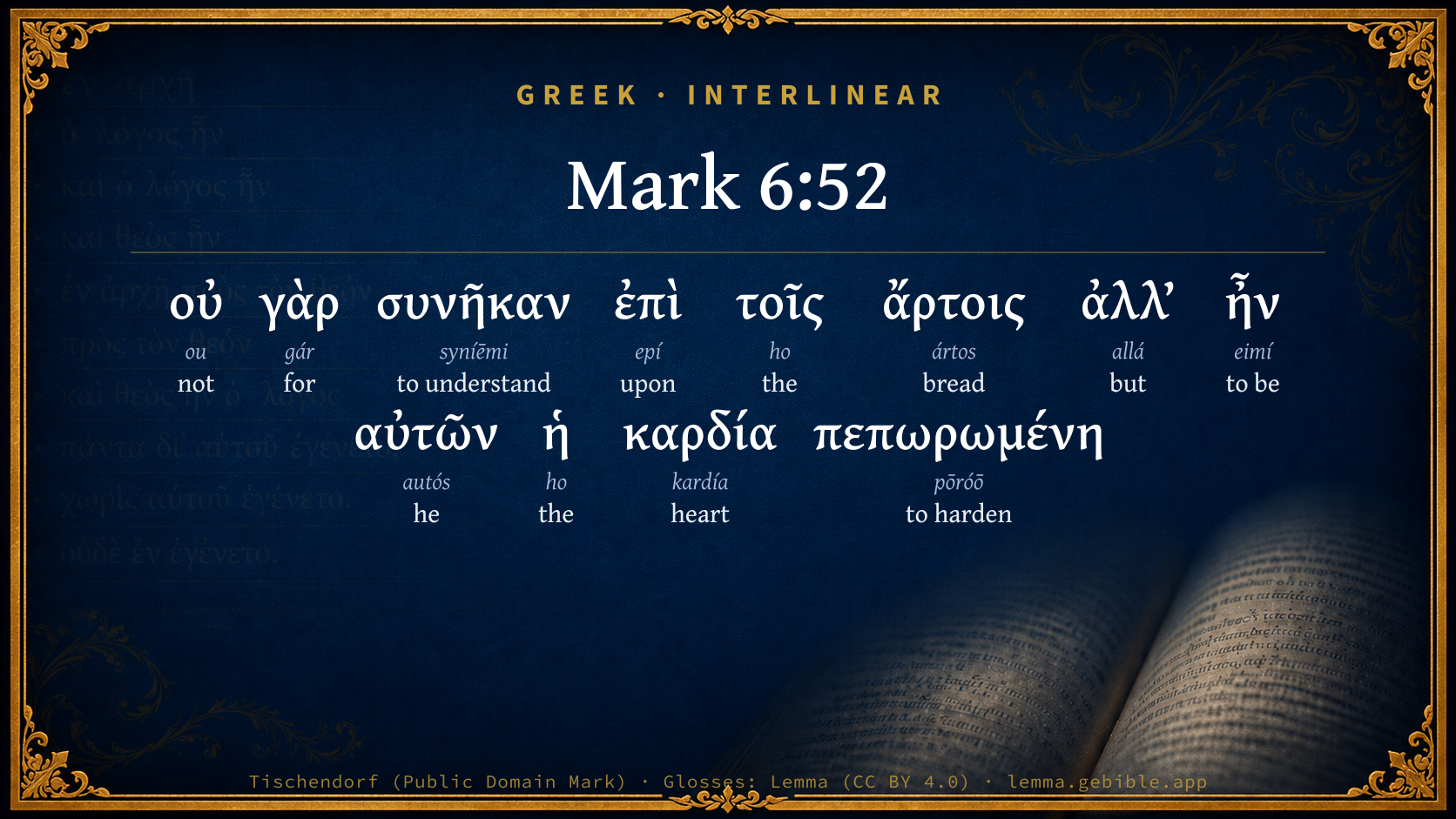
Greek (Tischendorf 8th ed.) Mark 6:52 appears in the Greek New Testament. The text above is from the Tischendorf 8th edition. Each word links to its Strong’s number and a concise gloss. Click any word for its full Thayer’s Greek Lexicon entry.
Download image
Cite this verse

Mark 6:52 (World English Bible). Public Domain. Lemma interlinear Bible study tool, https://lemma.gebible.app/v/mark/6/52.

Show BibTeX & RIS
BibTeX
RIS
English Translation
for they hadn't understood about the loaves, but their hearts were hardened.
World English Bible · Public Domain
Highlights
  • 1 first appearance in the Greek New Testament
Full analysis ↓
Download a study sheet

One document with this verse’s original text, its word-by-word gloss line, the meaning frame, cross-references with their text, attributed commentary, and full source and license credits — printable, and it pastes into notes with its structure intact.

This verse Autodidact and up

Study sheet (.html) Plain text (.txt)

A passage Seminary Student

Up to 50 verses in one chapter. A passage sheet keeps up to 6 commentary sources and 12 cross-references per verse, in the order this page ranks them, and says so on the sheet whenever that leaves anything out. Ask for a single verse and you get the Autodidact verse sheet above.

Everything on this page stays free to read, with no account — the sheet is a download of what is already on screen, not access to it.

Want to remove ads? Support Godless Engineer
Compare translations 3

The same verse in 3 English versions, stacked beneath the original-language interlinear above. Click any original word for its lexicon entry.

Each is an independent rendering of the whole verse — the interlinear is not word-aligned to these translations.

Highlighted words mark where these versions differ — a whole-verse word diff, not a word-by-word alignment.

  • World English Bible Public Domain
    for they hadn't understood about the loaves, but their hearts were hardened.
  • King James Version Public Domain
    For they considered not the miracle of the loaves: for their heart was hardened.
  • unfoldingWord Literal Text CC BY-SA 4.0
    For they did not understand about the loaves, but their heart was having been hardened.

unfoldingWord Literal Text — © unfoldingWord, licensed CC BY-SA 4.0. Word-aligned USFM3 via Door43 (git.door43.org/unfoldingWord/en_ult).

Versions to compare (up to 4)

3 of 4 selected

Show all 19 translations

Every available English version of this verse, each an independent rendering of the whole verse.

  • World English Bible Public Domain
    for they hadn't understood about the loaves, but their hearts were hardened.
  • Berean Standard Bible Public Domain
    for they had not understood about the loaves, but their hearts had been hardened.
  • Majority Standard Bible Public Domain
    For they had not understood about the loaves because their hearts had been hardened.
  • King James Version Public Domain
    For they considered not the miracle of the loaves: for their heart was hardened.
  • American Standard Version (1901) Public Domain
    for they understood not concerning the loaves, but their heart was hardened.
  • Revised Version (1885) Public Domain
    for they understood not concerning the loaves, but their heart was hardened.
  • Geneva Bible (1599) Public Domain
    For they had not considered the matter of the loaues, because their hearts were hardened.
  • Douay-Rheims (1899) Public Domain
    For they understood not concerning the loaves; for their heart was blinded.
  • Young's Literal Translation Public Domain
    for they understood not concerning the loaves, for their heart hath been hard.
  • Literal Standard Version CC BY-SA 4.0
    for they did not understand concerning the loaves, for their heart has been hard.
  • Unlocked Literal Bible CC BY-SA 4.0
    For they had not understood what the loaves meant. Instead, their hearts were hardened.
  • unfoldingWord Literal Text CC BY-SA 4.0
    For they did not understand about the loaves, but their heart was having been hardened.
  • Darby Bible Public Domain
    for they understood not through the loaves: for their heart was hardened.
  • World Messianic Bible Public Domain
    for they hadn’t understood about the loaves, but their hearts were hardened.
  • Webster's Bible Public Domain
    For they considered not the miracle of the loaves; for their heart was hardened.
  • Free Bible Version CC BY-SA 4.0
    for they hadn't understood the meaning of the feeding miracle due to their stubborn, hard-hearted attitude.
  • Bible in Basic English Public Domain
    For it was not clear to them about the bread; but their hearts were hard.
  • Text-Critical English NT CC BY 4.0
    for they did not understand the significance of what had happened with the loaves, because their hearts were hardened.
  • Tyndale New Testament (1534) Public Domain
    For they remembred not of the loves because their hertes were blynded.

Literal Standard Version (2020), Covenant Press — licensed CC BY-SA 4.0. Text via the HelloAO Bible API (eBible.org). Unlocked Literal Bible (unfoldingWord) — licensed CC BY-SA 4.0. Text via the HelloAO Bible API (eBible.org). unfoldingWord Literal Text — © unfoldingWord, licensed CC BY-SA 4.0. Word-aligned USFM3 via Door43 (git.door43.org/unfoldingWord/en_ult). Free Bible Version, Dr. Jonathan Gallagher — licensed CC BY-SA 4.0. Text via the HelloAO Bible API (eBible.org).

Word by word

More ways to search: Search by grammar → Find every occurrence → Compare this word →

Practice this passage: Drill this verse → Learn its vocabulary →

πεπωρωμένη
pōróō
G4456
“to harden”
Verb, Perfect, Passive, Participle, Nominative, Singular, Feminine
Part of Speech
Verb
Tense
Perfect
Voice
Passive
Mood
Participle
Case
Nominative
Number
Singular
Gender
Feminine
Full Thayer's Definition

Origin: apparently from poros (a kind of stone)

TDNT: 22:05,8

1. to cover with a thick skin, to harden by covering with a callus 2. metaph. a. to make the heart dull b. to grow hard, callous, become dull, lose the power of understanding
  1. οὐ ou G3756 “not” Particle, Negative
  2. γὰρ gár G1063 “for” Conjunction
  3. συνῆκαν syníēmi G4920 “to understand” Verb, Aorist, Active, Indicative, 3rd person, Plural
  4. ἐπὶ epí G1909 “upon” Preposition
  5. τοῖς ho G3588 “the” Article, Dative, Plural, Masculine
  6. ἄρτοις ártos G740 “bread” Noun, Dative, Plural, Masculine
  7. ἀλλ’ allá G235 “but” Conjunction
  8. ἦν eimí G1510 “to be” Verb, Imperfect, Active, Indicative, 3rd person, Singular
  9. αὐτῶν autós G846 “he” Personal pronoun, Genitive, Plural, Masculine
  10. ἡ ho G3588 “the” Article, Nominative, Singular, Feminine
  11. καρδία kardía G2588 “heart” Noun, Nominative, Singular, Feminine

About this verse

These counts appear in no published source. They are computed here, from the morphology-tagged text and Lemma’s own curated glosses. What Lemma adds →

12
words
11
distinct lemmas
Gospels
section

Notable vocabulary

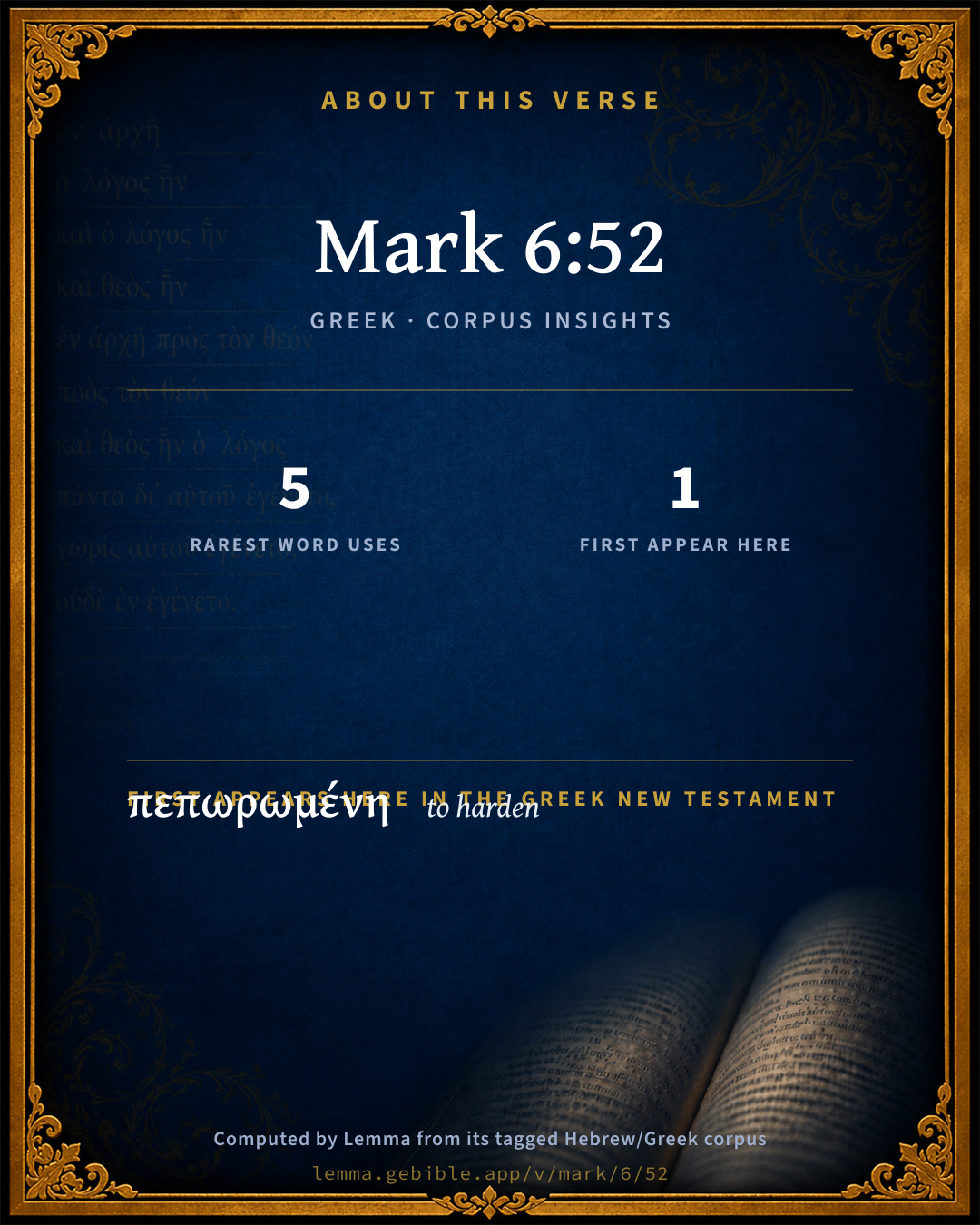
The rarest word here is πεπωρωμένη to harden G4456 — appearing just 5 times in the whole Greek New Testament.

First appearance in Scripture

This word makes its first canonical appearance in the Greek New Testament here:

  • πεπωρωμένη to harden G4456

Shared distinctive vocabulary

πεπωρωμένη to harden G4456 occurs in 5 verses of the Greek New Testament. Also found in:

Repetition

A word recurs within this verse:

  • τοῖς the G3588 ×2

Cross-references

8

Topical passages linked to Mark 6:52 in the Treasury of Scripture Knowledge — connected by theme and wording, ordered by reader-vote popularity; previews shown in the World English Bible.

  • Mark 8:17–21 Jesus, perceiving it, said to them, "Why do you reason that it's because you have no bread? Don't you perceive yet, neither understand? Is your heart still hardened?
  • Luke 24:25 He said to them, "Foolish men, and slow of heart to believe in all that the prophets have spoken!
  • Isaiah 63:17 O Yahweh, why do you make us to err from your ways, and harden our heart from your fear? Return for your servants' sake, the tribes of your inheritance.
  • Mark 16:14 Afterward he was revealed to the eleven themselves as they sat at the table, and he rebuked them for their unbelief and hardness of heart, because they didn't believe those who had seen him after he had risen.
  • Matthew 16:9–11 Don't you yet perceive, neither remember the five loaves for the five thousand, and how many baskets you took up?
  • Mark 3:5 When he had looked around at them with anger, being grieved at the hardening of their hearts, he said to the man, "Stretch out your hand." He stretched it out, and his hand was restored as healthy as the other.
  • Mark 7:18 He said to them, "Are you thus without understanding also? Don't you perceive that whatever goes into the man from outside can't defile him,
  • Romans 11:7 What then? That which Israel seeks for, that he didn't obtain, but the chosen ones obtained it, and the rest were hardened.

Cross-references courtesy of OpenBible.info (CC BY 4.0).

Where the printed editions differ

1 variant

Places in this verse where the major printed Greek editions disagree on the wording in a way that affects the translation — a comparison of editions, not a manuscript-by-manuscript collation. The editions are the modern critical texts (Nestlé-Aland 28/27, SBL, Westcott-Hort, Tregelles, Tyndale House) and the traditional texts behind the KJV (the Textus Receptus and the Byzantine/Majority text). It is not a claim about which reading is original.

  1. Different wording
    ἀλλ᾽

    “but”

    In NA28NA27TynSBLWHTreg Not in TRByz

    γὰρ (gar) 'for' occurs in traditional manuscripts (TR+Byz) instead of ἀλλ᾽ (all᾽) 'but' in older manuscripts (NA28+NA27+Tyn+SBL+WH+Treg)

Textual data: Translators Amalgamated Greek New Testament (STEPBible TAGNT) · CC BY 4.0.

Commentary

Notes on Mark 6:52 from classic Christian and Jewish commentators (each source and its license shown beneath its notes). The classic Christian expositions comment on the surrounding passage and are grouped to its opening verse, so a note may address several verses; the Jewish commentaries on the Tanakh (Rashi and others) are per-verse, so they appear only where the commentator wrote on this verse.

Lemma curates 59 commentaries, every one of them public domain or Creative Commons licensed, each selected and text-cleaned for this edition rather than reprinted as found. About our sources →

The Biblical Illustrator

Joseph S. Exell

Mar_6:52

For they considered not the miracle of the loaves.

The miracle of the loaves

The disciples were sore amazed in themselves beyond measure, and wondered. Had the miracle of the loaves been duly considered, the inference from it must have been that He who had wrought it must be Lord over the whole system of nature, and could, therefore, whenever He pleased, bend the elements to His rule.

I. There was another occasion on which Christ miraculously fed a great multitude. We read of His sustaining four thousand men, besides women and children, with seven loaves and a few little fishes. There were only two occasions on which this was done. He showed Himself ready to heal all manner of sickness; but He showed no readiness to provide food miraculously. The reason is not far to seek. It was altogether one of the consequences of sin that men were afflicted with various maladies and pains, and that disease and death held sway in this creation. But it was not one of those consequences, that men had to labour for subsistence. Labour was Gods earliest ordinance, so that Adam, in innocence, was placed in paradise to keep it. Had He dealt with mens want as He dealt with disease, removing it instantly by the exercise of miraculous power, He would have pronounced it a grievance that labour had been made the heritage of man; whereas, by the course which He actually took, He gave all the weight of His testimony to the advantageousness of the existing appointment. Universal plenty, yielded without toil, would generate universal dissoluteness.

II. When He multiplied the scanty provision, and made it satisfy the wants of a famishing multitude, He designed, we may believe, to fix attention on Himself, as appointed to provide, or rather to be the spiritual sustenance of the whole human race. And how striking, in the first place, the correspondence between Christ, the multiplier of a few loaves and fishes, and Christ the expounder of the commandments of the moral law. It might almost have been excusable, had a man who lived under the legal dispensation, and had nothing before him but the letter of the precepts, imagined the possibility of a perfect obedience to the commandments of the two tables. It was a wonderful amplification. The statute books of a nation are numerous and ponderous volumes; various cases as they arise demand fresh laws, and legislatures are either busy in making new legislations, or modifying old. But the statutes of God, though intended for countless ages, contain only ten short commandments-the whole not so long as the preamble to a single act of human legislation, and these ten commandments, breathed on by Him who spake as never man spake, amplify themselves into innumerable precepts, so that every possible case was provided for, every possible sin, every possible duty enjoined; and who can fail to observe how aptly Christ represented His office as expounder of the law, when He fed a multitude with the slender provision which His disciples had brought into the wilderness? But have not the virtues of the single death, the merits of the one work of expiation, proved ample enough for the innumerable company which have gathered round Christ and applied to Him for deliverance? And are not-if we may use the expression-are not the basketfuls which still remain, sufficient to preclude the necessity for any fresh miracle, though those who should crave spiritual food for ages to come should immeasurably exceed those who have already been satisfied in the wilderness?

III. To the precise effect which a want of consideration produced in the case of the apostles and which it is just as likely to produce in our own. It is evident that the miracle of the loaves is referred to by the sacred historian, as so signal a display of Christs power that none who witnessed it ought to have been surprised at any other. The thing charged against the apostles is that they were amazed and confounded at Christ stilling the winds and the waves, though they had just before seen Him produce food for thousands; and the thing implied is-for otherwise there would be no ground for blame-that the miracle of the loaves should have prepared them for any further demonstration of lordship over nature and her laws. Thus the miracle of the loaves should have sufficed to destroy all remains of unbelief, and should have furnished the apostles with motives to confidence under the most trying circumstances, and a simple dependence on the guardianship of the Saviour, whatever the trials to which they were exposed. And why is it that we ourselves adopt not His reasoning? Why is it that we do not similarly argue from the loaves to the storm-from the mighty works of the atonement to the manifold requirements of a state of warfare and pilgrimage? Ah, if we did, could there be that anxiety, that mistrust, those fears, those tremblings, which we too often manifest when pains and troubles come thickly upon us? No, no; it is because we look not on the cross, because we forget the agony and bloody sweat and passion of the Redeemer, that we shrink from the storm and are terrified by the waxes. We consider not the miracle of the loaves, and then, when the sky is dark, and the winds fierce, we are tempted to give ourselves up for lost. (H. Melvill.)

Forgotten mercies

Hard hearts and painful unbeliefs spring up in the waste places where we bury our forgotten mercies. (C. H. Spurgeon.)

Consider the past

Neither earth nor heaven, time nor eternity, yields choicer gems of thought than the achievements of our Lord. (C. H. Spurgeon.)

Hast action an index to future help

Since Jesus Christ is the same yesterday, today, and forever, what He did at one time ought to be well top, sidereal, because it is the index of what He is prepared to do again should need arise. His accomplished wonders have not spent His strength, He has the dew of His youth still upon Him. Our Samsons locks are not shorn, our Solomon has not lost His wisdom, our Immanuel has not ceased to be, God with us. (C. H. Spurgeon.)

The inconsideration of the disciples

They considered not the miracle of the loaves.-At first sight this may seem almost as marvellous as the miracle itself.

I. It is by no means difficult to discover a very satisfactory reason why the disciples should be much less affected by the feeding of the five thousand, than by the walking upon the water and the sudden stilling of the tempest.

1. The former was a miracle wrought in the open day, when there was nothing to disturb the imagination, or to awaken fear. It was, moreover, not a sudden effect, but a gradual operation; not a shock upon the senses, but a gentle and continuous appeal to them; and would thus be far too calm and quiet in its general character to produce anything like that turbulence of emotion which the latter miracles would excite, aided as they were by the presence of danger, the confusion of the storm, the horror of darkness, and all that sublimity of circumstance with which they were accompanied. This, however, though it may afford an explanation of their excessive amazement, is far from explaining their total inadvertency to that great miracle at which they had so recently been present; and which, had it occurred to their memory, as it manifestly ought, would speedily have recalled them from their transport.

2. The evangelist accounts for this, by saying that their heart was hardened. They had become so accustomed to the sight of their Masters mighty works that they had ceased to regard them with any peculiar interest, or to attach to them any peculiar importance. Everyone is aware of the influence of familiarity with the great and astonishing, in abating the impressions they originally produce. How little, for instance, are any of us affected by the sublime spectacle of the universe around us! Even the conclusion which, beyond all others, one would have thought it impossible to escape-the conviction of His omnipotence-they seem far from having practically realized. Some exception from the full weight of this censure may perhaps be made in favour of Peter, who, on various occasions, discovered a certain boldness and force of apprehension, which we look in vain for in his fellow disciples.

3. Our Lord knew all this, and felt the necessity of reviving their early feeling of wonder, in order to rouse them from that mental inactivity, that slumberous inconsideration, into which they had fallen. Hence He sent them away, etc. Astonishment opens the eyes of their understanding to at least some temporary recognition of His greatness, for now, says St. Matthew, they came and worshipped Him, saying, Of a truth, Thou art the Son of God! But they speedily relapsed into their old habit of inconsideration. To this, accordingly, He frequently addressed Himself, and sometimes in a tone of the strongest expostulation and reproof (Mar_8:15-21).

II. The practical import of the subject in application to ourselves.

1. We ought to derive a strong corroboration of our faith in the gospel. How unfit were the disciples for the great work for which, nevertheless, they were set apart. What can we say to the story of their success, etc, but This is the hand of God.

2. Their heedlessness of mind ought to come directly home to our own bosoms, and awaken us to the necessity of earnest and serious reflection. Familiarity has produced the same effects upon many of us. So with respect to the volume of Scripture generally.

3. There are methods in the order of Divine grace by which we are at times roused from that insensibility and heedlessness to which we are prone, and the remedy which the Lord adopted in the case of the disciples is strikingly symbolical of the manner in which He still condescends at times to deal with us. Affliction and fear, under the gracious direction of the Divine Spirit, are at times the most efficient of all interpreters of Scripture.

4. The gospel, when it does not soften the heart, hardens it, etc. (J. H. Smith.)

The Biblical Illustrator, edited by Joseph S. Exell (c. 1880s–1900s) — public domain. Text from a community e-Sword module.

Tyndale Open Study Notes

Tyndale Open Resources

6:52 The account ends with a comment about the disciples’ dullness. It was not from lack of opportunity to believe in Jesus—they had witnessed the miracle of the loaves and many other miracles—but because their hearts were too hard, usually a quality of Jesus’ opponents (e.g., 3:5; see also 8:17, 21; 9:32). Later their hearts would be softened, and they would understand (Luke 24:44-49; John 12:16; 13:7).

Tyndale Open Study Notes — © Tyndale Open Resources, licensed CC BY-SA 4.0. Text via the HelloAO Bible API.

Bengel's Gnomon

Johann Albrecht Bengel

Mar 6:52. Γὰρ, for) They ought to have inferred from the miracle of the loaves as to [His power also over] the sea. The more exercised that faith is, the more it becomes accustomed to the spectacle of [to seeing and discerning] the marvellous works of God. [Comp. Mat 14:33.]—ἦν γὰρ, for was) Not only is that particular time denoted, but the habitual state of their heart during their then pupillage [early training].

Bengel's Gnomon of the New Testament — English translation (T&T Clark, Edinburgh, 1860) — public domain. Text from a community e-Sword module.

Expositor's Greek Testament

ed. W. Robertson Nicoll

Mar 6:52 reflects on the astonishment of the Twelve as blameworthy in view of the recent feeding of the multitude. One might rather have expected a reference to the stilling of the storm in crossing to Decapolis. But that seems to have appeared a small matter compared with walking on the sea. The evangelist seems anxious to show how much the Twelve needed the instruction to which in the sequel Jesus gives Himself more and more.

The Expositor's Greek Testament, edited by W. Robertson Nicoll (1897–1910) — public domain. Text from a community e-Sword module.

Geneva Bible (1599)

Geneva Bible translators

Either they perceived not, or had not well considered that miracle of the five loaves, insomuch that that virtue of Christ was no less strange to them, than if they had not been present at that miracle which was done but a little before.

Geneva Bible (1599) marginal notes — public domain. Text via Bolls.life.

Adam Clarke's Commentary

Verse 52. Their heart was hardened.] See this explained Mt 14:33.

Adam Clarke's Commentary on the Bible (1810–1826) — public domain. Text from a community e-Sword/MySword module.

Ellicott's Commentary for English Readers

(52) For they considered not.—This is peculiar to St. Mark, and may fairly be received as representing St. Peter’s recollection of what had been the mental state of the disciples at the time. They had not drawn from the miracle of the Loaves the conclusion which they might have drawn, that all natural forces were subject to their Master’s sovereignty. The personal connection of the Evangelist with the Apostle may, perhaps, also account for his omission of the narrative which St. Matthew gives of his rashness and failing faith.

A Bible Commentary for English Readers, edited by Charles John Ellicott (1878–1897) — public domain. Text from a community e-Sword module.

The Cambridge Bible for Schools and Colleges

gen. ed. J. J. S. Perowne

52. hardened] See note above, Mar_3:5.

The Cambridge Bible for Schools and Colleges (gen. ed. J. J. S. Perowne; Cambridge University Press, 1878–1918) — public domain. Text from a community e-Sword module.

John Gill's Exposition

And when they had passed over,.... The lake of Gennesaret, or sea of "Galilee",

they came into the land of Gennesaret; See Gill on Mat 14:34; to Capernaum, as appears from Joh 6:17 for Capernaum was in the land of Gennesaret; to which agrees what Josephus says, that the land of Gennesaret was watered with a very excellent spring, which the inhabitants of that place called Capernaum (h):

and drew to the shore: this is omitted in the Syriac and Persic versions: and the Arabic reads, "and they cast anchors".

(h) De Bello Jud. l. 3. c. 35.

John Gill's Exposition of the Whole Bible (1746–1763) — public domain (CC PDM 1.0). Text via the HelloAO Bible API.

Haydock's Catholic Bible Commentary

They understood not concerning the loaves;[3] i.e. they did not reflect how great a miracle that was which Christ had lately wrought, otherwise they would not have been so much surprised at his walking upon the sea. (Witham)

===============================

[BIBLIOGRAPHY]

Non intellexerunt de panibus, Greek: ou gar sunekan epi tois artois.

====================

George Leo Haydock (1774–1849), Haydock's Catholic Family Bible and Commentary, 1859 edition — public domain. Excludes Psalms (Douay-Rheims chapter numbering differs from Protestant) and Deuterocanonical books (Catholic canon only).

Whedon's Commentary on the Bible

Daniel D. Whedon

52. Their heart was hardened — A clear passage in which obtuseness or unimpressibility of intellect is called hardness of heart; or at least the dullness of perception is attributed to the moral insensibility.

Daniel D. Whedon (gen. ed.), Commentary on the Old and New Testaments (1874–1909) — public domain. Text from a community e-Sword module.

John Wesley's Explanatory Notes

Their heart was hardened - And yet they were not reprobates. It means only, they were slow and dull of apprehension.

John Wesley, Explanatory Notes Upon the Whole Bible (1754–1765) — public domain. Text via the GEBible commentary corpus.

Cambridge Greek Testament for Schools and Colleges

52. ἀλλʼ ἦν ([1313][1314][1315][1316]) rather than ἦν γάρ ([1317][1318][1313] Codex Sinaiticus. 4th cent. Discovered by Tischendorf in 1859 at the Monastery of St Katharine on Mount Sinai. Now at St Petersburg. The whole Gospel, ending at Mar 16:8. Photographic facsimile, 1911.

[1314] Codex Vaticanus. 4th cent., but perhaps a little later than א. In the Vatican Library almost since its foundation by Pope Nicolas V., and one of its greatest treasures. The whole Gospel, ending at Mar 16:8. Photographic facsimile, 1889.

[1315] Codex Regius. 8th cent. An important witness. At Paris. Contains Mar 1:1 to Mar 10:15; Mar 10:30 to Mar 15:1; Mar 15:20 to Mar 16:20, but the shorter ending is inserted between Mar 16:8 and Mar 16:9, showing that the scribe preferred it to the longer one.

[1316] Codex Sangallensis. 9th or 10th cent. Contains the Gospels nearly complete, with an interlinear Latin translation. The text of Mark is specially good, agreeing often with CL. At St Gall.

[1317] Codex Alexandrinus. 5th cent. Brought by Cyril Lucar, Patriarch of Constantinople, from Alexandria, and afterwards presented by him to King Charles I. in 1628. In the British Museum. The whole Gospel. Photographic facsimile, 1879.

[1318] odex Bezae. 6th cent. Has a Latin translation (d) side by side with the Greek text, and the two do not quite always agree. Presented by Beza to the University Library of Cambridge in 1581. Remarkable for its frequent divergences from other texts. Contains Mark, except Mar 16:15-20, which has been added by a later hand. Photographic facsimile, 1899.

52. οὐ γὰρ συνῆκαν ἐπὶ τοῖς ἄρτοις. “For the miracle of the loaves afforded them no basis for comprehending.” See crit. note. Neither A.V. nor R.V. seems to be right here. As often, Mt. and Lk. omit what is discreditable to the Twelve, and Mt. substitutes what does honour both to them and to Christ. It was natural that His walking on the waves and the sudden cessation of the gale should amaze them more than the feeding of the multitudes (Mar 8:17 f.); as fishermen they could appreciate the former, but they were still very defective in insight. See on Mar 3:5. This miracle is part of their education.

Cambridge Greek Testament for Schools and Colleges (Cambridge University Press, 1896; 21 vols, various authors incl. Carr, Maclear, Plummer, Farrar, Lumby, Moule, M. R. James, Simcox) — public domain. Text from a community e-Sword module.

Alford’s Greek Testament

Henry Alford

52.] Peculiar to Mark.

οὐ γὰρ συν.] They did not, from the miracle which they had seen, infer the power of the Lord over nature.

ἐπί, hardly as Kuinoel, al., post, but rather denoting, as usual, close superposition of the preceding on the following: there was no intelligent comprehension founded on the miracle of the loaves.

Henry Alford, The Greek Testament (1849–1861) — public domain. Text from a community e-Sword module.

International Critical Commentary

52. ἐπὶ τοῖς ἄρτοις—this does not denote, as in RV., the object of the verb, concerning the loaves, but the ground of understanding, on the ground of the (miracle of the) loaves. The miracle of the loaves and fishes should have led to an understanding of the present miracles, but it did not have this effect.2 ἀλλʼ ἦν αὐτῶν ἡ καρδία πεπωρωμένη—but their heart was hardened. This hardness of heart is something quite different from our use of the same words, denoting blunted feelings and moral sensibilities. The Biblical καρδία denotes the general inner man, and here especially the mind, which is represented as so calloused as to be incapable of receiving mental impressions.

ἀλλʼ ἦν, instead of ἦν γὰρ, Tisch. Treg. WH. RV. א BLM2 S Δ 33, Memph. Harcl. marg.

JESUS CROSSES THE LAKE AGAIN TO GENNESARET, AND MEETS AN IMPORTUNATE AND ENTHUSIASTIC MULTITUDE WHEREVER HE GOES

International Critical Commentary — older volumes (1896–1929), various authors — public domain. Text from a community e-Sword module.

Vincent's Word Studies in the New Testament

Marvin R. Vincent

Peculiar to Mark.

The miracle of the loaves [επι τοις αρτοις] . Rev., concerning the loaves. Lit., upon; in the matter of. They did not reason from the multiplying of the loaves to the stilling of the sea.

Marvin R. Vincent, Word Studies in the New Testament (1887–1900) — public domain. Text from a community e-Sword/MySword module.

Lesson kit

Teaching starters — assembled from the data on this page, not authored interpretation. Every prompt links to the verse data it draws on. Edit before teaching.

Mark, in the Gospels, opens this verse with 12 words (11 distinct Greek lemmas). Its most distinctive word is pōróō (“to harden”). A historical commentator’s framing appears above. Read the whole chapter for the surrounding context.

Discussion questions

  1. How does “to harden” (pōróō) shape what this verse is saying?
  2. The word “to harden” first appears here in Scripture. What is being introduced at this debut?
  3. Mark 8:17 shares the word «to harden» with this verse. How do the two illuminate each other?
  4. “the” occurs 2× in this one verse. What is the effect of the repetition?
  5. These translations render this verse differently. What is at stake in choosing one wording over another?
  6. Reading how The Biblical Illustrator and Tyndale Open Study Notes read this verse, where do the two commentators agree and where do they part?

Things to notice

  • 1 word makes its first canonical appearance in Scripture here.
  • These translations choose different wording for 11 words in this verse.
  • “the” occurs 2× in this single verse.
  • 11 distinct Greek lemmas span 12 words in this verse.

Reading settings

Reading text

Shown beneath each verse's original-language words.

Old Testament
Old Testament edition

Read the OT as the Masoretic Hebrew (MT) or the Greek Septuagint (LXX).

English shown for the Greek Septuagint (in the Hebrew ↔ Greek comparison).

Comparing translations? Open the Compare panel on any verse page to stack up to four side by side.