James 3:14

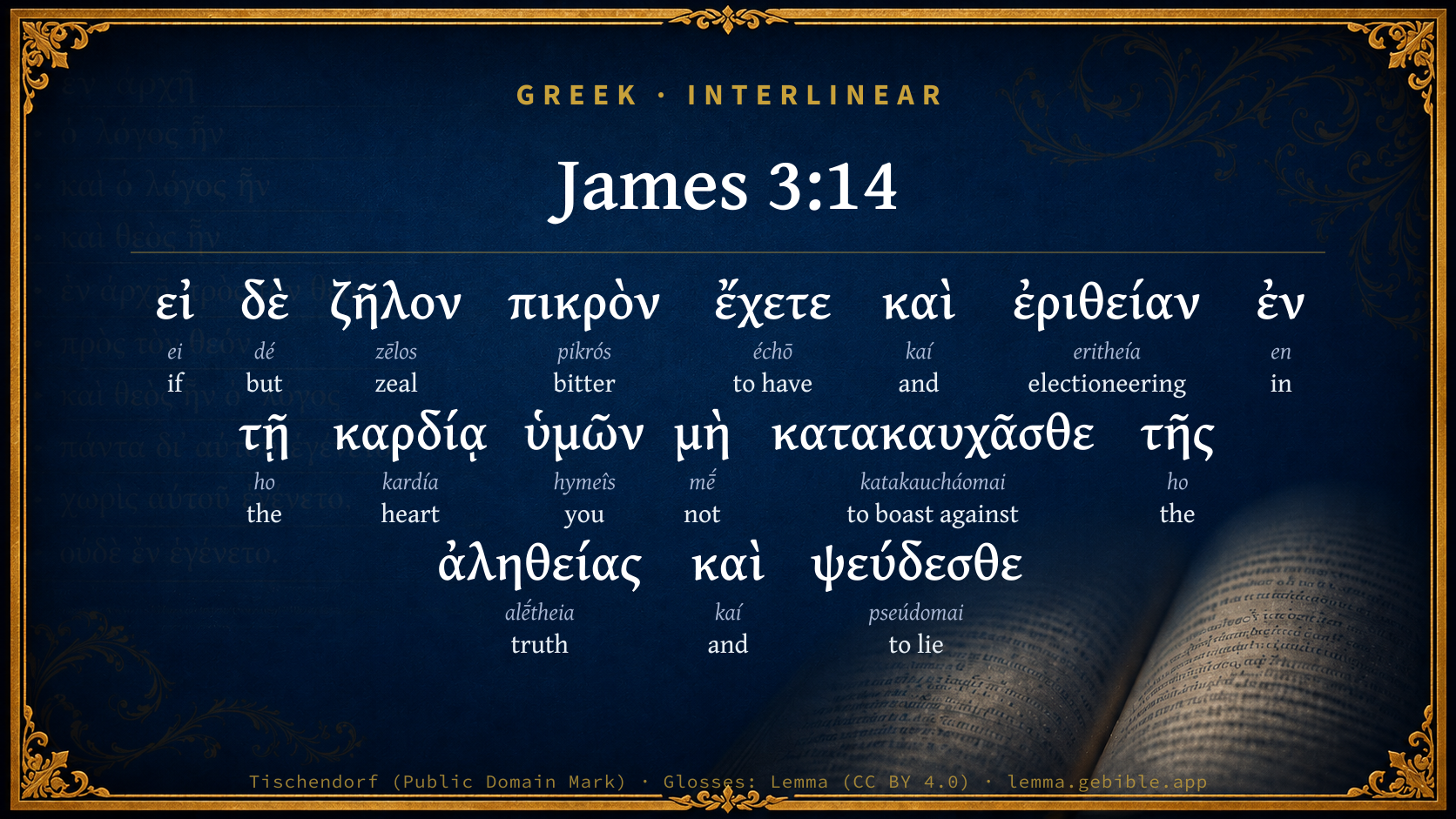
Greek (Tischendorf 8th ed.) James 3:14 appears in the Greek New Testament. The text above is from the Tischendorf 8th edition. Each word links to its Strong’s number and a concise gloss. Click any word for its full Thayer’s Greek Lexicon entry.
Download image
Cite this verse

James 3:14 (World English Bible). Public Domain. Lemma interlinear Bible study tool, https://lemma.gebible.app/v/james/3/14.

Show BibTeX & RIS
BibTeX
RIS
English Translation
But if you have bitter jealousy and selfish ambition in your heart, don't boast and don't lie against the truth.
World English Bible · Public Domain
Download a study sheet

One document with this verse’s original text, its word-by-word gloss line, the meaning frame, cross-references with their text, attributed commentary, and full source and license credits — printable, and it pastes into notes with its structure intact.

This verse Autodidact and up

Study sheet (.html) Plain text (.txt)

A passage Seminary Student

Up to 50 verses in one chapter. A passage sheet keeps up to 6 commentary sources and 12 cross-references per verse, in the order this page ranks them, and says so on the sheet whenever that leaves anything out. Ask for a single verse and you get the Autodidact verse sheet above.

Everything on this page stays free to read, with no account — the sheet is a download of what is already on screen, not access to it.

Want to remove ads? Support Godless Engineer
Compare translations 3

The same verse in 3 English versions, stacked beneath the original-language interlinear above. Click any original word for its lexicon entry.

Each is an independent rendering of the whole verse — the interlinear is not word-aligned to these translations.

Highlighted words mark where these versions differ — a whole-verse word diff, not a word-by-word alignment.

  • World English Bible Public Domain
    But if you have bitter jealousy and selfish ambition in your heart, don't boast and don't lie against the truth.
  • King James Version Public Domain
    But if ye have bitter envying and strife in your hearts, glory not, and lie not against the truth.
  • unfoldingWord Literal Text CC BY-SA 4.0
    But if you have bitter jealousy and ambition in your heart, do not boast and lie against the truth.

unfoldingWord Literal Text — © unfoldingWord, licensed CC BY-SA 4.0. Word-aligned USFM3 via Door43 (git.door43.org/unfoldingWord/en_ult).

Versions to compare (up to 4)

3 of 4 selected

Show all 19 translations

Every available English version of this verse, each an independent rendering of the whole verse.

  • World English Bible Public Domain
    But if you have bitter jealousy and selfish ambition in your heart, don't boast and don't lie against the truth.
  • Berean Standard Bible Public Domain
    But if you harbor bitter jealousy and selfish ambition in your hearts, do not boast in it or deny the truth.
  • Majority Standard Bible Public Domain
    But if you harbor bitter jealousy and selfish ambition in your hearts, do not boast in it or deny the truth.
  • King James Version Public Domain
    But if ye have bitter envying and strife in your hearts, glory not, and lie not against the truth.
  • American Standard Version (1901) Public Domain
    But if ye have bitter jealousy and faction in your heart, glory not and lie not against the truth.
  • Revised Version (1885) Public Domain
    But if ye have bitter jealousy and faction in your heart, glory not and lie not against the truth.
  • Geneva Bible (1599) Public Domain
    But if ye haue bitter enuying and strife in your hearts, reioyce not, neither be liars against the trueth.
  • Douay-Rheims (1899) Public Domain
    But if you have bitter zeal, and there be contentions in your hearts; glory not, and be not liars against the truth.
  • Young's Literal Translation Public Domain
    and if bitter zeal ye have, and rivalry in your heart, glory not, nor lie against the truth;
  • Literal Standard Version CC BY-SA 4.0
    yet, if you have bitter zeal, and rivalry in your heart, do not glory, nor lie against the truth;
  • Unlocked Literal Bible CC BY-SA 4.0
    But if you have bitter jealousy and ambition in your heart, do not boast and lie against the truth.
  • unfoldingWord Literal Text CC BY-SA 4.0
    But if you have bitter jealousy and ambition in your heart, do not boast and lie against the truth.
  • Darby Bible Public Domain
    but if ye have bitter emulation and strife in your hearts, do not boast and lie against the truth.
  • World Messianic Bible Public Domain
    But if you have bitter jealousy and selfish ambition in your heart, don’t boast and don’t lie against the truth.
  • Webster's Bible Public Domain
    But if ye have bitter envying and strife in your hearts, glory not, and lie not against the truth.
  • Free Bible Version CC BY-SA 4.0
    But if you have bitter jealousy and selfish ambition in your heart, don't boast about it and don't lie against the truth.
  • Bible in Basic English Public Domain
    But if you have bitter envy in your heart and the desire to get the better of others, have no pride in this, talking falsely against what is true.
  • Text-Critical English NT CC BY 4.0
    But if you have bitter jealousy and selfish ambition in your hearts, do not boast or deny the truth.
  • Tyndale New Testament (1534) Public Domain
    But Yf ye have bitter envyinge and stryfe in youre hertes reioyce not: nether be lyars agaynst the trueth.

Literal Standard Version (2020), Covenant Press — licensed CC BY-SA 4.0. Text via the HelloAO Bible API (eBible.org). Unlocked Literal Bible (unfoldingWord) — licensed CC BY-SA 4.0. Text via the HelloAO Bible API (eBible.org). unfoldingWord Literal Text — © unfoldingWord, licensed CC BY-SA 4.0. Word-aligned USFM3 via Door43 (git.door43.org/unfoldingWord/en_ult). Free Bible Version, Dr. Jonathan Gallagher — licensed CC BY-SA 4.0. Text via the HelloAO Bible API (eBible.org).

Word by word

More ways to search: Search by grammar → Find every occurrence → Compare this word →

Practice this passage: Drill this verse → Learn its vocabulary →

πικρὸν
pikrós
G4089
“bitter”
Adjective, Accusative, Singular, Masculine
Part of Speech
Adjective
Case
Accusative
Number
Singular
Gender
Masculine
Full Thayer's Definition

Origin: perhaps from G4078 (through the idea of piercing)

TDNT: 08:02,8

1. bitter 2. metaph. harsh, virulent
  1. εἰ ei G1487 “if” Conditional
  2. δὲ dé G1161 “but” Conjunction
  3. ζῆλον zēlos G2205 “zeal” Noun, Accusative, Singular, Masculine
  4. ἔχετε échō G2192 “to have” Verb, Present, Active, Indicative, 2nd person, Plural
  5. καὶ kaí G2532 “and” Conjunction
  6. ἐριθείαν eritheía G2052 “electioneering” Noun, Accusative, Singular, Feminine
  7. ἐν en G1722 “in” Preposition
  8. τῇ ho G3588 “the” Article, Dative, Singular, Feminine
  9. καρδίᾳ kardía G2588 “heart” Noun, Dative, Singular, Feminine
  10. ὑμῶν hymeîs G5210 “you” Personal pronoun, 2nd person, Genitive, Plural
  11. μὴ mḗ G3361 “not” Particle, Negative
  12. κατακαυχᾶσθε katakaucháomai G2620 “to boast against” Verb, Present, Middle or Passive deponent, Imperative, 2nd person, Plural
  13. τῆς ho G3588 “the” Article, Genitive, Singular, Feminine
  14. ἀληθείας alḗtheia G225 “truth” Noun, Genitive, Singular, Feminine
  15. καὶ kaí G2532 “and” Conjunction
  16. ψεύδεσθε pseúdomai G5574 “to lie” Verb, Present, Middle or Passive deponent, Imperative, 2nd person, Plural

About this verse

These counts appear in no published source. They are computed here, from the morphology-tagged text and Lemma’s own curated glosses. What Lemma adds →

17
words
15
distinct lemmas
General Epistles
section

Notable vocabulary

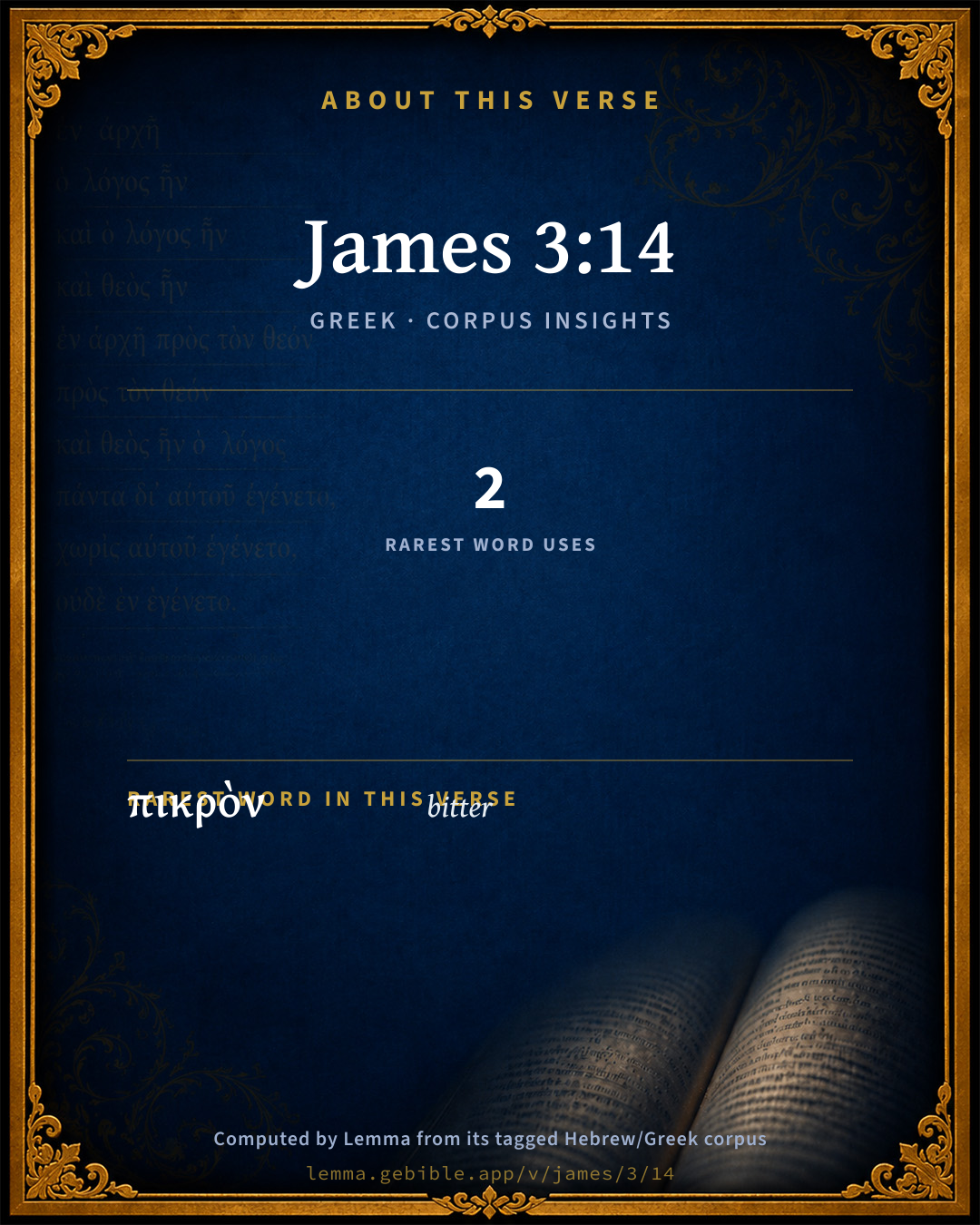
The rarest word here is πικρὸν bitter G4089 — appearing just 2 times in the whole Greek New Testament.

Shared distinctive vocabulary

πικρὸν bitter G4089 occurs in 2 verses of the Greek New Testament. Also found in:

Repetition

Words recur within this verse:

Cross-references

38

Topical passages linked to James 3:14 in the Treasury of Scripture Knowledge — connected by theme and wording, ordered by reader-vote popularity; previews shown in the World English Bible.

  • James 3:16 For where jealousy and selfish ambition are, there is confusion and every evil deed.
  • 1 Corinthians 13:4 Love is patient and is kind; love doesn't envy. Love doesn't brag, is not proud,
  • Philippians 2:3 doing nothing through rivalry or through conceit, but in humility, each counting others better than himself;
  • 1 Corinthians 3:3 for you are still fleshly. For insofar as there is jealousy, strife, and factions among you, aren't you fleshly, and don't you walk in the ways of men?
  • Romans 13:13 Let us walk properly, as in the day; not in reveling and drunkenness, not in sexual promiscuity and lustful acts, and not in strife and jealousy.
  • 2 Corinthians 12:20 For I am afraid that by any means, when I come, I might find you not the way I want to, and that I might be found by you as you don't desire; that by any means there would be strife, jealousy, outbursts of anger, factions, slander, whisperings, proud thoughts, riots;
  • 1 Peter 2:1–2 Putting away therefore all wickedness, all deceit, hypocrisies, envies, and all evil speaking,
  • Philippians 1:15 Some indeed preach Christ even out of envy and strife, and some also out of good will.
  • 1 Timothy 6:4 he is conceited, knowing nothing, but obsessed with arguments, disputes, and word battles, from which come envy, strife, reviling, evil suspicions,
  • Titus 3:3 For we were also once foolish, disobedient, deceived, serving various lusts and pleasures, living in malice and envy, hateful, and hating one another.
  • James 5:19 Brothers, if any among you wanders from the truth, and someone turns him back,
  • 2 Kings 10:31 But Jehu took no heed to walk in the law of Yahweh, the God of Israel, with all his heart: he didn't depart from the sins of Jeroboam, with which he made Israel to sin.
  • Proverbs 14:30 The life of the body is a heart at peace, But envy rots the bones.
  • Proverbs 27:4 Wrath is cruel, And anger is overwhelming; But who is able to stand before jealousy?
  • Acts 5:17 But the high priest rose up, and all those who were with him (which is the sect of the Sadducees), and they were filled with jealousy,
  • Romans 2:8 but to those who are self-seeking, and don't obey the truth, but obey unrighteousness, will be wrath and indignation,
  • Romans 2:23–29 You who glory in the law, through your disobedience of the law do you dishonor God?
  • 1 Corinthians 5:2 You are puffed up, and didn't rather mourn, that he who had done this deed might be removed from among you.
  • Genesis 30:1–2 When Rachel saw that she bore Jacob no children, Rachel envied her sister. She said to Jacob, "Give me children, or else I will die."
  • Genesis 37:11 His brothers envied him; but his father kept this saying in mind.
  • 2 Kings 10:16 He said, Come with me, and see my zeal for Yahweh. So they made him ride in his chariot.
  • Job 5:2 For resentment kills the foolish man, And jealousy kills the simple.
  • Isaiah 11:13 The envy also of Ephraim shall depart, and those who vex Judah shall be cut off: Ephraim shall not envy Judah, and Judah shall not vex Ephraim.
  • Habakkuk 1:3 Why do you show me iniquity, and look at perversity? For destruction and violence are before me. There is strife, and contention rises up.
  • Matthew 27:18 For he knew that because of envy they had delivered him up.
  • John 16:2 They will put you out of the synagogues. Yes, the time comes that whoever kills you will think that he offers service to God.
  • Acts 13:45 But when the Jews saw the multitudes, they were filled with jealousy, and contradicted the things which were spoken by Paul, and blasphemed.
  • Acts 26:9 "I myself most assuredly thought that I ought to do many things contrary to the name of Jesus of Nazareth.
  • Romans 1:29 being filled with all unrighteousness, sexual immorality, wickedness, covetousness, maliciousness; full of envy, murder, strife, deceit, evil habits, secret slanderers,
  • Romans 2:17 Indeed you bear the name of a Jew, and rest on the law, and glory in God,
  • 1 Corinthians 4:7–8 For who makes you different? And what do you have that you didn't receive? But if you did receive it, why do you boast as if you had not received it?
  • 1 Corinthians 5:6 Your boasting is not good. Don't you know that a little yeast leavens the whole lump?
  • Galatians 5:15 But if you bite and devour one another, be careful that you don't consume one another.
  • Galatians 5:21 envyings, murders, drunkenness, orgies, and things like these; of which I forewarn you, even as I also forewarned you, that those who practice such things will not inherit the Kingdom of God.
  • Galatians 5:26 Let's not become conceited, provoking one another, and envying one another.
  • Galatians 6:13 For even they who receive circumcision don't keep the law themselves, but they desire to have you circumcised, that they may boast in your flesh.
  • James 4:1–5 Where do wars and fightings among you come from? Don't they come from your pleasures that war in your members?
  • Acts 7:9 "The patriarchs, moved with jealousy against Joseph, sold him into Egypt. God was with him,

Cross-references courtesy of OpenBible.info (CC BY 4.0).

Commentary

Notes on James 3:14 from classic Christian and Jewish commentators (each source and its license shown beneath its notes). The classic Christian expositions comment on the surrounding passage and are grouped to its opening verse, so a note may address several verses; the Jewish commentaries on the Tanakh (Rashi and others) are per-verse, so they appear only where the commentator wrote on this verse.

Lemma curates 59 commentaries, every one of them public domain or Creative Commons licensed, each selected and text-cleaned for this edition rather than reprinted as found. About our sources →

The Biblical Illustrator

Joseph S. Exell

Jam_3:14

Bitter envying and strife in your hearts

Envying and strife

1.

Envy is the mother of strife. They are often coupled (Rom_1:29, 1Co_3:3; 2Co_12:20; Gal_5:20). Envy is the source of all heresies. Arius envied Peter of Alexandria, and thence those bitter strifes and persecutions. It must needs be so. Envy is an eager desire of our own fame, and a maligning of that which others have. Well, then, let nothing be done through strife and vainglory Php_2:3). Scorn to act out of that impulse. Should we harbour that corruption which betrayed Christ, enkindled the world, and poisoned the Church?

2. There is nothing in the life but what was first in the heart (Mat_15:19). The heart is the fountain, keep it pure; be as careful to avoid guilt as shame. If you would have the life holy before men, let the heart be pure before God; especially cleanse the heart from strife and envy. Strife in the heart is worst; the words are not so abominable in Gods eye as the will and purpose. Strife is in the heart when it is cherished there, and anger is soured into malice, and malice bewrayeth itself by debates or desires of revenge; clamour is naught, but malice is worse.

3. Envious or contentious persons have little reason to glory in their engagements. Envy argueth either a nullity or a poverty of grace; a nullity where it reigneth, a weakness where it is resisted but not overcome Gal_5:24).

4. Envy and strife goeth often under the mask of zeal. These were apt to glory in their carnal strifes; it is easy to take on a pretence of religion, and to baptize envious contests with a glorious name.

5. Hypocrisy and carnal pretences are the worst kind of lies. The practical lie is worst of all; by other lies we deny the truth, by this we abuse it; and it is worse sometimes to abuse an enemy than to destroy him. (T. Manton.)

The nature, causes, and consequences of envy

I. WHAT ENVY IS, AND WHEREIN THE NATURE OF IT CONSISTS. Moralists generally give us this description of it: that it is a depraved affection or passion of the mind, disposing a man to hate or malign another for some good or excellency belonging to him, which the envious person judges him unworthy of, and which for the most part he wants himself. Or yet more briefly: envy is a certain grief of mind conceived upon the sight of anothers felicity, whether real or supposed. So that we see that it consists partly of hatred, and partly of grief. In respect of which two passions, and the proper actings of both, we are to observe, that as it shows itself in hatred, it strikes at the person envied; but as it affects a man in the nature of grief, it recoils and does execution upon the envier; both of them are hostile affections, and vexatious to the breast which harbours them.

II. WHAT ARE THE GROUNDS AND CAUSES OF ENVY.

1. On the part of the person envying.

(1) Great malice and baseness of nature.

(2) An unreasonable grasping ambition. It is remarked of Alexander as a very great fault, and, in truth, of that nature, that one would wonder how it could fall upon so great a spirit, namely, that he would sometimes carp at the valorous achievements of his own captains. He thought that whatsoever praise was bestowed upon another was taken from him.

(3) Another cause of envy is an inward sense of a mans own weakness and inability to attain what he desires and would aspire to.

(4) Idleness often makes men envy the high offices, honours, and accomplishments of others.

2. On the part of the person envied.

(1) Great abilities and endowments of nature.

(2) The favour of princes and great persons.

(3) Wealth, riches, and prosperity.

(4) A fair credit, esteem, and reputation in the world.

III. THE EFFECTS AND CONSEQUENCES OF ENVY.

1. First of all, this ill quality brings confusion and calamity upon the envious person himself who cherishes and entertains it, and, like the viper, gnaws out the bowels which first conceived it. It is indeed the only act of justice that it does, that the guilt it brings upon a man it revenges upon him too, and so torments and punishes him much more than it can afflict or annoy the person who is envied by him. We know what the poet says of envy; and it is with the strictest truth, without the least hyperbole, that Phalariss brazen hull, and all the arts of torment invented by the greatest masters of them, the Sicilian tyrants, were not comparable to those that the tyranny of envy racks the mind of man with. For it ferments and boils in the soul, putting all the powers of it into the most restless and disorderly agitation.

2. In the next place, consider the effects of envy, in respect of the object of it, or the person envied; and these may be reduced to the following three.

(1) A busy, curious inquiry, or prying into all the concerns of the person envied and maligned; and this, no doubt, only as a step or preparative to those further mischiefs which envy assuredly drives at.

(2) Calumny, or detraction. Has a man done bravely, and got himself a reputation too great to be borne down by any base and direct aspersions? Why, then, envy will seemingly subscribe to the general vogue in many or most things; but then it will be sure to come over him again with a sly oblique stroke in some derogating but or other, and so slide in some scurvy exception, which shall effectually stain all his other virtues; and like the dead fly in the apothecarys ointment, which (Solomon tells us) never fails to give the whole an offensive savour.

(3) The last and grand effect of envy, in respect of the person envied, is his utter ruin and destruction; for nothing less was intended from the very first, whatsoever comes to be effected in the issue.

Lessons:

1. The extreme vanity of even the most excellent and best esteemed enjoyments of this world. Shadows do not more naturally attend shining bodies than envy pursues worth and merit, always close at the very heels of them, and like a sharp blighting east wind, still blasting and killing the noblest and most promising productions of virtue in their earliest bud; and, as Jacob did Esau, supplants them in their very birth.

2. This may convince us of the safety of the lowest, and the happiness of a middle condition. Only power and greatness are prize for envy; whose evil eye always looks upwards, and whose hand scorns to strike where it can place its foot. Life and a bare competence are a quarry too low for so stately a vice-as envy to fly at. And therefore men of a middle condition are indeed doubly happy.

(1) That, with the poor, they are not the objects of pity; nor

(2), with the rich and great, the mark of envy.

3. We learn from hence the necessity of a mans depending upon something without him, higher and stronger than himself, even for the preservation of his ordinary concerns in this life. Nothing can be a greater argument to make a man fly, and cast himself into the arms of Providence, than a due consideration of the nature and the workings of envy. (R. South, D. D.)

Envy the worst of sins

Envy, says an old writer, is, in some respects, the worst of all sins; for when the devil tempts to them, he draws men by the bait of some delight; but the envious he catches without a bait, for envy is made up of bitterness and vexation. Another mans good is the envious mans grief. Nothing but misery pleases him, nor is anything but misery spared by him. Every smile of another fetches a sigh from him. To him bitter things are sweet, and sweet bitter. And whereas the enjoyment of good is unpleasant without a companion, the envious would rather want any good than that another should share with him. It is recorded that a prince once promised an envious and a covetous man whatever they pleased to ask of him. The promise, however, was suspended upon this condition, that he who asked last should have twice as much as he who asked first. Both, therefore, were unwilling to make the first request; but the prince, perceiving this reluctance, commanded the envious man to be the first petitioner. His request was this--that one of his own eyes should be put out, that so both the eyes of the covetous man should be put out also. Truly envy, like jealousy, is cruel as the grave! It is its own punishment--a scourge not so much to him upon whom it is set, as to him in whom it is.

Boasting in evil principles

Bitter envying and strife in the heart are things in the very indulgence of which some men actually glory. They call them exhibitions of a manly nature, and indications of an honourable pride. Alas! alas! These are mean and ignoble, as well as vile and criminal, affections of the soul. They degrade, as well as defile, the man in whom they dwell. But there are others who, without boasting of these evil principles, suppose that, in spite of them, they are pious and religious men-the children of God and the heirs of heaven. These, too, are grievously deceived. Love pervades the religion of Jesus Christ, and must needs be a paramount and prevailing principle in the regenerated soul. In applying to this state of character and experience the name of wisdom, the apostle uses one of its current names, and suggests what opinion is frequently formed of it in this misguided world, but assuredly does not sympathise with that opinion. And how dark is the description which he gives of that very thing to which he attaches the name of This grows in all soils and climates and is no less luxuriant in the country than in the court; it is not confined to any rank of men or extent of fortune, but rages in the breasts of all degrees. Alexander was not prouder than Diogenes; and it may be, if we would endeavour to surprise it in its most gaudy dress and attire, and in the exercise of its full empire and tyranny, we should find it in schoolmasters and scholars, or in some country lady, or the knight, her husband; all which ranks of people more despise their neighbours than all the degrees of honour in which courts abound; and it rages as much in a sordid affected dress as in all the silks and embroideries which the excess of the age and the folly of youth delight to be adorned with. Since, then, it keeps all sorts of company, and wriggles itself into the liking of the most contrary natures and dispositions, and yet carries so much poison and venom with it, that it alienates the affections from heaven, and raises rebellion against God Himself, it is worth our utmost care to watch it in all its disguises and approaches, that we may discover it in its first entrance, and dislodge it before it procures a shelter or retiring-place to lodge and conceal itself. (Lord Clarendon.)

Envy is a pure soul-sin

Having least connection with the material or animal nature, and for which there is the least palliation in appetite or in any extrinsic temptation. Its seat and origin is super-carnal, except as the term carnal is taken, as it sometimes is by the apostle, for all that is evil in humanity. A man may be most intellectual, most free from every vulgar appetite of the flesh; he may be a philosopher, he may dwell speculatively in the region of the abstract and the ideal, and yet his soul be full of this corroding malice. Envy is also the most purely evil. Almost every other passion, even acknowledged to be sinful, has in it somewhat of good or appearance of good. But envy or hatred of a man for the good that is in him, or in any way pertains to him, is evil unalloyed. It is the breath of the old serpent. It is pure devil, as it is also purely spiritual. It is a soul-poison, yet acting fearfully upon the body itself, bringing more death into it than seemingly stronger and more tumultuous passions that have their nearer seat in the fleshy nature. Solomon describes it as rottenness in the bones Pro_14:30). All bad passions are painful, but envy has a double barb to sting itself.

Lie not against the truth

Lying against the truth

They professed the faith of the truth. But the indulgence and manifestation of such tempers of mind was a lie against the truth which they professed. It was not merely a lie against, their profession of it. Then all would have been right. Those who witnessed their tempers and behaviour would have been led only to conclude that their profession was unsound, and had no corresponding reality; that they were either self-deceivers or hypocrites. And this would have been the right conclusion. But they lied against the truth. While they professed to believe it, and acted inconsistently with it, they bore to the world a false testimony--a practical testimony much more apt to be credited than a verbal one--with regard to its real nature and its legitimate influence. Everything of the kind is a practical lie. It is bearing false witness against the truth of God, and, consequently against the God of truth. It is leading the world to erroneous estimates; and while dishonouring to God, is ruinous to souls. And let us see that we gereralise the principle. It is true of all inconsistences, as well as of those here specified. The charge of lying against the truth bears upon every one who assumes the name of Christian, while walking, in any part of his conduct, according to the course of this world. As the Jews of old belied their God and their religion, when, on entering among the heathen, they acted so wickedly as to lead the heathen to say, with a scornful taunt--These are the people of Jehovah, and are come forth out of His land! so is it, alas, among the heathen still, in regard to the multitudes who go amongst them, from our own or other countries called Christian, bearing the Christian name, while in the general course of their conduct they are utterly unchristian. There is hardly a more serious obstacle in the way of their success with which missionaries have to contend than this. O let us beware of throwing any such stumbling-block in the way of an ungodly world--any such obstacle in the way of the progress of the Redeemers cause. Upon all our words and all our actions let there ever be the impress of the truth--that, like Demetrius, we may have good report of all men, and of the truth itself:--and that thus our characters may attest the Divine origin of the gospelby presenting to men a manifestation of its Divine influence. (R. Wardlaw, D. D.)

The Biblical Illustrator, edited by Joseph S. Exell (c. 1880s–1900s) — public domain. Text from a community e-Sword module.

Tyndale Open Study Notes

Tyndale Open Resources

3:14 The truth is that wisdom cannot be associated with jealousy and selfish ambition. Only in humility can we receive God’s true word (1:18, 21).

Tyndale Open Study Notes — © Tyndale Open Resources, licensed CC BY-SA 4.0. Text via the HelloAO Bible API.

Bengel's Gnomon

Johann Albrecht Bengel

Jas 3:14. Ζῆλον πικρὸν, bitter emulation) Emulation is not condemned, when exercised with kindness; nor anger, accompanied with kindness, and proceeding from faithfulness and love.—μὴ, do not) They boast and lie against the truth, who, when they have bitter emulation, still give out that they themselves have wisdom.—μὴ κατακαυχᾶσθε) The Alex. and others read μὴ καυχᾶσθε.[45] See App. Crit., Ed ii.

[45] Κατακαυχᾶσθε is the reading of BC. Καυχᾶσθε, of A.—E.

Bengel's Gnomon of the New Testament — English translation (T&T Clark, Edinburgh, 1860) — public domain. Text from a community e-Sword module.

Meyer's Critical & Exegetical Commentary

Heinrich August Wilhelm Meyer

Jam_3:14. As meekness belongs to wisdom, so he who has in his heart ζῆλος πικρός and ἐριθεία boasts of wisdom without any right. As this was the case with his readers, James now directly addresses them: εἰ δὲ … ἔχετε] To ζῆλος, zeal,which is here, as frequently, used in a bad sense,is added the adjective πικρός for the sake of strengthening it, perhaps with reference to Jam_3:11-12 (Grotius, Pott, Gebser).

ἐριθεία] has in the N. T. the meaning controversial spirit, or, more definitely, partisanship; comp. Rom_2:8; 2Co_12:20 (see Meyer on both passages); Gal_5:20; Php_1:17; Php_2:3; in 2Co_12:20 and Gal_5:20 ζῆλοι and θυμοί are united together as plurals.

ἐν τῇ καρδίᾳ ὑμῶν] in contrast with the word of his readers, boasting of their wisdom.

In the apodosis: μὴ κατακαυχᾶσθε καὶ ψεύδεσθε κατὰ τῆς ἀληθείας] neither the first nor the second verb is to be converted into a participle; certainly κατα in the first verb refers to κατὰ τῆς ἀληθ., and so far already contains the idea of lying, but James designed prominently to bring forward this, and therefore he adds καὶ ψεύδεσθε to κατακαυχᾶσθε. On κατακαυχᾶσθε, comp. chap. Jam_2:13 (see Winer, p. 417 [E. T. 590, note 1]). In κατακαυχᾶσθε the reference is to others, in ψεύδεσθε to ones own conscience (Lange). In order to avoid the tautology in ψεύδεσθε and κατὰ τ. ἀληθείας, Wiesinger understands by ἀληθεία truth in an objective Christian sensethe Christian truth, by the possession of which they fancied themselves σοφοί.[183] But, on the contrary, it is to be considered that that which, logically considered, appears as mere tautology, receives another import, when not only the understanding but also the disposition is recognised as a factor of the construction; so it is here; compare, moreover, Isocrates, de pace, p. 165: διαψεύδεσθαι τῆς ἀληθείας.

[183] According to Lange, the theocratic truth is to be understood which the Jewish zealots professed to protect.

Meyer — Critical and Exegetical Commentary on the New Testament — English translation by Peter Christie, edited by Frederick Crombie (T&T Clark, 1880) — public domain. Text from a community e-Sword module.

Expositor's Greek Testament

ed. W. Robertson Nicoll

Jas 3:14 . εἰ δὲ ζῆλον πικρὸν ἔχετε καὶ ἐριθείαν ἐν τῇ καρδίᾳ ὑμῶν : This makes it quite clear that what has been referred to all along is controversial strife; the bitter use of the tongue which the writer has been reprobating is the personal abuse which had been heaped upon one another by the partisans of rival schools of thought. ζῆλον is mostly used in a bad sense in the N.T., though the opposite is sometimes the case ( e.g. , 2Co 11:2 ; Gal 1:14 ); the intensity of feeling which had been aroused among those to whom the Epistle was addressed is seen by the words ζῆλον πικρόν , with the latter word in an emphatic position; they form a striking contrast to πραΰτητι σοφίας . The word ἐριθείαν , derived from ἔριθος “a hireling,” means “party-spirit”. μὴ κατακαυχᾶσθε : the malicious triumphing at the least point of vantage gained by one party was just the thing calculated to embitter the other side; this was a real “lying against the truth,” because such petty triumphs are often gained at the expense of truth.

The Expositor's Greek Testament, edited by W. Robertson Nicoll (1897–1910) — public domain. Text from a community e-Sword module.

Jamieson, Fausset & Brown

Robert Jamieson, A. R. Fausset & David Brown

if ye have--as is the case (this is implied in the Greek indicative).

bitter-- Eph 4:31, "bitterness."

envying--rather, "emulation," or literally, "zeal": kindly, generous emulation, or zeal, is not condemned, but that which is "bitter" [BENGEL].

strife--rather, "rivalry."

in your hearts--from which flow your words and deeds, as from a fountain.

glory not, and lie not against the truth--To boast of your wisdom is virtually a lying against the truth (the gospel), while your lives belie your glorying. Jam 3:15; Jam 1:18, "The word of truth." Rom 2:17, Rom 2:23, speaks similarly of the same contentious Jewish Christians.

Jamieson, Fausset & Brown — Commentary Critical and Explanatory on the Whole Bible (1871) — public domain (CC PDM 1.0). Text via the HelloAO Bible API.

Adam Clarke's Commentary

Verse 14. If ye have bitter envying and strife] If ye be under the influence of an unkind, fierce, and contemptuous spirit, even while attempting or pretending to defend true religion, do not boast either of your exertions or success in silencing an adversary; ye have no religion, and no true wisdom, and to profess either is to lie against the truth. Let all writers on what is called polemic (fighting, warring) divinity lay this to heart. The pious Mr. Herbert gives excellent advice on this subject: -

"Be calm in arguing, for fierceness makes

Error a fault, and truth discourtesy;

Why should I feel another man's mistakes

More than his sickness or his poverty?

In love I should; but anger is not love,

Nor wisdom neither; therefore g-e-n-t-l-y m-o-v-e."

Adam Clarke's Commentary on the Bible (1810–1826) — public domain. Text from a community e-Sword/MySword module.

John Calvin's Commentaries

l4 But if ye have bitter envying. He points out the fruits which proceed from that extreme austerity which is contrary to meekness; for immoderate rigor necessarily begets mischievous emulations, which presently break forth into contentions. It is, indeed, an improper mode of speaking, to place contentions in the heart; but this affects not the meaning; for the object was to shew that the evil disposition of the heart is the fountain of these evils.

He has called envying, or emulation, bitter; for it prevails not, except when minds are so infected with the poison of malignity, that they turn all things into bitterness.

That we may then really glory that we are the children of God, he bids us to act calmly and meekly towards our brethren; otherwise he declares that we are lying in assuming the Christian name. But it is not without reason that he has added the associate of envying, even strife, or contention, for contests and quarrels ever arise from malignity and envy.

John Calvin's Commentaries (1540-1563) — public domain. Text from the Calvin Translation Society English edition (1840s-50s) via the Christian Classics Ethereal Library (ccel.org). Calvin's coverage is partial (roughly two-thirds of the Bible); uncommented books and verses are honest gaps, never fabricated. The 19th-century editor's footnotes and remarks are omitted so the notes are faithfully Calvin's own voice.

Ellicott's Commentary for English Readers

(14) But if ye have bitter envying and strife in your hearts.—Rather, it should be, bitter zeal and party-spirit. “Above all no zeal” was the worldly caution of an astute French prelate. But that against which the Apostle inveighed had caused Jerusalem to run with blood, and afterwards helped in her last hour to add horror upon shame. The Zealots were really assassins, pledged to any iniquity; such were the forty men “who bound themselves under a curse, saying they would neither eat nor drink till they had killed Paul” (Act_23:12; see Note there). Some of these desperadoes unluckily escaped the swords of the Romans, and fled to the fastnesses of Mount Lebanon. They were probably the nucleus of a still more infamous society, known in the middle ages as that of the Old Man of the Mountain; in fact, our word “assassin” comes from “Hassan,” their first sheik. Happily for humanity they were at length exterminated by the Turks.

Glory not.—Boast not yourselves as partakers of this accursed zeal; behold already what ruin it is bringing on us as a nation and a Church. And it were well to take care even in these milder days of religious factions, that the strife of creeds be wholly different in kind from the old zealot feuds, and not merely in degree. Able only to rend and overthrow, party-spirit will, if it be gloried and exulted in, lay down the walls of Zion “even to the ground.” But “if any man defile the temple of God, him shall God destroy” (1Co_3:17), and the words must be translated much more sternly, “If any man destroy . . .”

Lie not against the truth.—This is not tautology, nor a Hebraism, but of far deeper import. “What is truth?” said jesting Pilate (Joh_18:38), and, as Bacon remarks in his Essay on Truth, he would not stay for an answer. Probably he put a question familiar to himself, learned in a certain school of knowledge whose wise conclusion was that mankind could not tell; and the inquirer turned away, unwitting that before him stood the incarnate Truth itself. The world of unbelief repeats the careless utterance of the Roman Governor, and holds with him in its new Agnosticism; and to its self-assurance and pride of life He, Who can only be learned in the doing of His will (Joh_7:17), is alike unknowable and unknown. But the words of the Apostle have a mournful significance for the ignorant of God; and a terrible one for the Christian who knows and sins against the Light. Falsehood is not the hurt of some abstract virtue, or bare rule of right and wrong, but a direct blow at the living Truth (Joh_14:6), Who suffered and still “endures such contradiction of sinners against Himself” (Heb_12:3). As the fault of Judas was double—personal treachery against his Friend and Master, and a wider attack on Christ, the Truth manifest in the flesh—so in a like two-fold manner we smite at once God and our brother when we speak or act a lie. All faintest shades of falsehood tend to the dark one of a fresh betrayal of the Son of Man if they be conceived against others, while if they be wrought only to shield ourselves, we are. as Montaigne observed, “brave before God, and cowards before men,” who are as the dust of His feet.

A Bible Commentary for English Readers, edited by Charles John Ellicott (1878–1897) — public domain. Text from a community e-Sword module.

The Cambridge Bible for Schools and Colleges

gen. ed. J. J. S. Perowne

14. But if ye have bitter envying and strife in your hearts] Better, envy and rivalry. The latter substantive, formed from a word which means a “day-labourer”, expresses primarily the temper of competition that characterised the class, and then more generally, faction and party-spirit of any kind. It is significant that the word for “envy” is used by St Luke as specially characterising the temper of the Jews towards the Gentile converts (Act_13:45), and this, together with what we have seen of the true bearing of ch. Jas_2:14-26, leads to the conclusion that St James’s warning is specially addressed to those of the Circumcision who displayed that feeling. He is shewing himself not the antagonist, but the supporter of St Paul’s work, condemning the factious spirit which was then, as afterwards at Corinth (2Co_12:20), in Galatia (Gal_5:20), and at Rome (Php_1:15), his chief hindrance. The word “bitter” is perhaps added to “envy” because the Greek word “zeal” was neutral, and admitted of a good meaning.

glory not] The word expresses a relative, not an absolute glorying, a glorying over some one, on the ground of superior privileges. This was, it is obvious, likely to be the besetting sin of the party of the Circumcision in relation to the Gentiles, and was therefore checked by St James, just as afterwards, when the prospect of the rejection of Israel was becoming a certainty, it became, in its turn, the sin of the Gentile converts, and was then checked by St Paul (Rom_11:18).

lie not against the truth] It is clear that if the word “truth” were only subjective in its meaning, as meaning “truthfulness,” the precept would be open to the charge of tautology. We must therefore assume that it is used with an objective force, as the truth of God revealed in Christ. We ask what special truth thus revealed those to whom St James wrote were most in danger of denying, and the answer lies on the surface. They were claiming God as the God of the Jews only (Rom_3:29), denying the brotherhood of mankind in Christ, “lying against” the very truth of which they fancied that they were the exclusive possessors.

The Cambridge Bible for Schools and Colleges (gen. ed. J. J. S. Perowne; Cambridge University Press, 1878–1918) — public domain. Text from a community e-Sword module.

John Gill's Exposition

But if ye have bitter envying and strife in your hearts,.... Though these may not be expressed by words, or actions: envy at the happiness of others, whether at the external blessings of Providence, as riches and honours, or at the internal endowments of their minds, as their wisdom and knowledge, their parts and abilities, is a root of bitterness in the heart, which bears wormwood and gall, and produces bitter effects in the persons in whom it is; it embitters their minds against their neighbours and friends; it is rottenness in their bones, and slays and destroys those who are so silly as to be governed by it; and also in the persons the objects of it; for who can stand before it? and strife in the mind, or an intention to strive end quarrel with others, who are the objects of envy, is very sinful, and of pernicious consequence: and if these be fomented and cherished in the minds and breasts of men, though they may not outwardly show themselves, yet

glory not; let not such boast of their being Gnostics, wise men, and endued with knowledge; they are far from deserving such a character; and such boasting is contrary to truth, yea, is lying against it, as follows:

and lie not against the truth; for, for a man to assert himself to be a wise and knowing man, and yet cherishes bitterness in his heart, and quarrelling and contention in his mind, arising from envy, at the equal or superior knowledge of others, he lies both against the truth of God's word and his own conscience, which condemn such things as ignorance, folly, and madness.

John Gill's Exposition of the Whole Bible (1746–1763) — public domain (CC PDM 1.0). Text via the HelloAO Bible API.

Trapp's Complete Commentary

John Trapp

14 But if ye have bitter envying and strife in your hearts, glory not, and lie not against the truth.

Ver. 14. Bitter envying] Properly so called; for it flows from the gall; it shows that the man is in the gall of bitterness, and of kin to the star called Wormwood, Rev 8:11. It is also an evil wherein is steeped the venom of all other vices. It is the observation of a late reverend divine, that, Gen 38:29, Pharez was the son of Tamar, division, of a palm tree, which hath its name ab amaritudine, from bitterness, saith Pagnine. Division comes from bitterness, and envy drinks up the most part of its own venom. It infecteth also others with her venomous breath; as that maid mentioned by Avicen, who fed upon poison.

Glory not] viz. Of your wisdom.

Lie not against the truth] As if ye were true Christians, when in truth you are not so; Jesuits you may be (those great boutefeans of the world), but Christians ye are none; ye have not so learned Christ.

John Trapp, A Commentary or Exposition upon All the Books of the Old and New Testament (1647–1656) — public domain. Text from a community e-Sword module.

Albert Barnes' Notes on the Bible

But if ye have bitter envying and strife in your hearts - If that is your characteristic. There is reference here to a fierce and unholy zeal against each other; a spirit of ambition and contention.

Glory not - Do not boast, in such a case, of your qualifications to be public teachers. Nothing would render you more unfit for such an office than such a spirit.

And lie not against the truth - You would lie against what is true by setting up a claim to the requisite qualifications for such an office, if this is your spirit. Men should seek no office or station which they could not properly seek if the whole truth about them were known.

Albert Barnes' Notes on the Bible (1834–1885) — public domain. Text from a community e-Sword/MySword module.

Haydock's Catholic Bible Commentary

But if you have bitter zeal. He hints at that bitter, false zeal, which many teachers among the Jews, even after their conversion, were apt to retain against the converted Gentiles, pretending with lies, and against the truth of the Scriptures, that they are not to be made partakers of the blessings brought to all nations by the Messias. --- Glory not, boast not in this pretended wisdom, which descendeth not from above, from God, but which is earthly, sensual, diabolical, from an evil spirit, which foments these jealousies and divisions; and where there are such emulations and divisions, there is nothing but inconstancy, and all kind of evils. (Witham)

George Leo Haydock (1774–1849), Haydock's Catholic Family Bible and Commentary, 1859 edition — public domain. Excludes Psalms (Douay-Rheims chapter numbering differs from Protestant) and Deuterocanonical books (Catholic canon only).

Matthew Poole's English Annotations

Bitter envying; Greek, zeal, which he calls bitter, partly to distinguish it from that zeal which is good, whereas this he speaks of is evil, and though it pretends to be zeal, yet is really no other than envy; and partly because it commonly proceeds from an imbittered spirit. and tends to the imbittering it more.

Strife; the usual effect of bitter zeal, or envy.

In your hearts; the fountain whence it proceeds; or strife in the heart implies a heart propense and inclined to strife.

Glory not; glory not of your zeal, or rather of your wisdom, as if you were so well able to reprehend others, but rather be humbled; what you make the matter of your glorying, being really just cause of shame.

And lie not against the truth; viz. by professing yourselves wise, or zealous, when ye are really neither.

Matthew Poole's English Annotations on the Holy Bible (1683–1685) — public domain. Text from a community e-Sword/MySword module.

Whedon's Commentary on the Bible

Daniel D. Whedon

14. The contrasted traits.

Glory not—Make no proud profession, nor fancy that these are exalting qualities.

Lie not against the truth—By depreciating its excellence in order to exalt your worldly vices. The worldly, emulous spirit fancies itself to be infinitely superior to the meekness and wisdom of the Gospel, having a lordlier wisdom of its own, and this wisdom James characterizes in the next verse.

Daniel D. Whedon (gen. ed.), Commentary on the Old and New Testaments (1874–1909) — public domain. Text from a community e-Sword module.

The Pulpit Commentary

Bitter envying, Zhlov in itself may be either good or bad, and therefore pikron is added to characterize it. Bishop Lightfoot on Gal_5:20 points out that as it is the tendency of Christian teaching to exalt the gentler qualities and to depress their opposites, zhlov falls in the scale of Christian ethics (see Clem. Romans, while tapeinothv, for instance, rises." It may, perhaps, be an incidental mark of early date that St. James finds it necessary to characterize zhlov as pikron. Where St. Paul joins it with ejriqeiai and eriv there is no qualifying adjective (Rom_13:13; 1Co_3:3; 2Co_12:20; Gal_5:20) (On the distinction between zhlov and fqonov, both of which are used by St. James, see Archbishop Trench on "Synonyms," Strife (ejriqeian); better, party spirit, or faction (Rom_2:8; 2Co_12:20; Gal_5:20; Php_1:17 2:3) The A.V "strife" comes from a wrong derivation, as if ejriqeia were connected with eriv, whereas it really comes from eriqov, a hired laborer, and so signifies

(1) working for hire;

(2) the canvassing of hired partisans; and

(3) factiousness in general. (see Lightfoot on Gal_5:20)

Glory not; i.e. glory not of your wisdom, a boast to which your whole conduct thus gives the lie.

The Pulpit Commentary (1880–1919), ed. H.D.M. Spence-Jones & Joseph S. Exell — public domain. Text from a community e-Sword module.

John Wesley's Explanatory Notes

If ye have bitter zeal - True Christian zeal is only the flame of love. Even in your hearts - Though it went no further. Do not lie against the truth - As if such zeal could consist with heavenly wisdom.

John Wesley, Explanatory Notes Upon the Whole Bible (1754–1765) — public domain. Text via the GEBible commentary corpus.

Burkitt's Expository Notes on the New Testament

William Burkitt

Observe here, 1. How the apostle points at the root of all tongue evils; we pretend zeal and justice, zeal for God, and doing right to ourselves; but the true cause is envy, called bitter envying, as being bitter in its root, bitter in its fruit, bitter to others, bitter to ourselves; this is a painful evil, an unprofitable evil, a foolish, sinful evil; it makes another’s good our grief.

But why so?

The good of another is no hurt to us; we have not the less because another has more; Leah’s fruitfulness was no cause of Rachel’s barrenness; why then should it be the occasion of Rachel’s envy? Thy portion is not impaired because thy brother’s is increased.

Observe, 2. How envy and strife are here joined together; if you have envying and strife in your hearts; when envy is found in the heart, strife will soon be found in the tongue, for envy is the mother of strife; natural corruption doth most of all betray itself by envy; it has an early spring, and a late autumn: we have it as soon as we come into the world, and it is a hard matter to leave it before we go out of it again: children suck it in with their milk, and the old man buries it in his coffin.

Observe, 3. What are the bitter effects and fruits of envy and strife, namely, confusion, and every evil work; an envious spirit is an unquiet and wicked spirit; the devil worketh by no instruments more than by envious, discontented, and malicious persons; pride and envy were the two first sins that crept into the world; the first man was ruined by pride, the second destroyed by envy, the whole world could not hold two brothers when the one was envied by the other: Cain’s envy tasted blood, and verily the sinner’s envy thirsts after it; well therefore may the apostle say, Where envying and strife is, there is confusion, and every evil work; this wisdom descendeth not from above, but is earthly, sensual, devilish.

William Burkitt's Expository Notes on the New Testament (1700–1703) — public domain. Text from a community e-Sword module.

The People's New Testament

B. W. Johnson

14. Glory not. If there is bitterness in the heart, let there be no boasting of your goodness. That would be to lie against the truth.

B. W. Johnson's The People's New Testament with Notes (1889–1891) — public domain. Electronic text from the Christian Classics Ethereal Library (CCEL) ThML edition.

Cambridge Greek Testament for Schools and Colleges

14. ζῆλον πικρόν, in strong contrast to πραϋ̓τητι σοφίας.

ἐριθείαν (ἐριθίαν W. H.), party spirit, intrigue, contention. The derivation is from ἔριθος, a day labourer; ἐν δʼ ἐτίθει τέμενος βαθυλήιον· ἔνθα δʼ ἔριθοι | ἤμων ὀξείας δρεπάνας ἐν χερσὶν ἔχοντες, Il. XVIII. 550; πότνιʼ Ἀθηναία, ποῖαί σφʼ ἐπόνασαν ἔριθοι, Theocr. Id. XV. 80. ἐριθεία rare in classics, see Arist. Pol. VIII. (v.) 2. 6 where it is used in the derived sense of party spirit or faction. Aristotle also uses the verb ἐριθεύεσθαι, Pol. VIII (v.) 3. 9, comp. Polyb. x. 22. 9; ἐριθεύεσθαι τοὺς νέους, to inveigle the young men into party measures. Not in LXX., in N.T. see Rom 2:8, τοῖς δὲ ἐξ ἐριθίας, Gal 5:20, Php 1:17 οἱ δὲ ἐξ ἐριθίας, Jas 2:3 μηδὲν κατʼ ἐριθίαν.

Curtius, Etym. § 343, refers ἔριθος to the root αρ- the fundamental meaning of which is movement in direction of something with a view to attainment, as in ἀρέσθαι, ἄρνυμαι, μίσθαρνος. The last word explains ἔριθος, earning wages, and also ἐριθία in the sense of struggle for party ends &c. It may be added that there is no etymological connexion between ἐριθεία and ἔρις.

εἰ δὲ ζῆλον πικρὸν ἔχετε. If you have (as you have in fact) bitter zeal (πικρόν emphatic by position, and added because zeal is not in itself evil), do not go on glorying and lying against the truth, i.e. the truth which heavenly wisdom shews—the truth of Christ, the Christian faith. Bitter emulation and contentiousness are absolutely inconsistent with the truth as Christ taught it. St James therefore calls upon the brotherhood to give up that life of emulation and quarrelling and show by a true and noble life what the heavenly σοφία is. The warning is addressed to zealots, whether converted or unconverted Jews (St James had influence with both). The spirit of misdirected zeal, already a danger in the Church, developed into the Judaistic opposition to St Paul. The tendency was to boast of the privileges of Israel: comp. Rom 4:1-2; 2Co 11:18 ff.

Cambridge Greek Testament for Schools and Colleges (Cambridge University Press, 1896; 21 vols, various authors incl. Carr, Maclear, Plummer, Farrar, Lumby, Moule, M. R. James, Simcox) — public domain. Text from a community e-Sword module.

Alford’s Greek Testament

Henry Alford

14-16.] Consequences of the opposite course.

14.] But if ye have (as is the fact: this is implied by the indic.: cf. Col 3:1, εἰ οὖν συνηγέρθητε τῷ χριστῷ κ.τ.λ.) bitter emulation (πικρόν seems to refer back to the example in vv. 11, 12. “Non damnatur,” says Bengel, “zelus dulcis et ira dulcis, ex fide et amore”) and rivalry (see on ἔριθος and ἐριθεία in note, Rom 2:8. Beware of confounding ἐριθεία with ἔρις, as is very generally done) in your heart (out of which come thoughts and words and acts, see Mat 15:18, Mat 15:19), do not (in giving yourselves out for wise, which (cf. ver. 15) you cannot really be) boast against (ref.) and lie against the truth (q. d. κατακαυχᾶσθε κ. καταψεύδεσθε, but the latter compound is resolved to bring out more forcibly the ψεῦδος in their conduct. Some, as De W. and Wiesinger, suppose κατακαυχ. κατά to belong together, and καὶ ψεύδεσθε to be an insertion of the Apostle further to define the κατακαυχᾶσθε. Others again have taken pains to excuse the imagined tautology in ψεύδεσθε κατὰ τῆς ἀληθείας, which however is no tautology at all. ἡ ἀλήθεια, from its following κατακαυχᾶσθε, is necessarily not subjective, ‘truth’ merely, as a quality absent from the conduct of those thus acting, but objective, ‘the truth,’ of which their whole lives would be thus a negation and an opposition;—which would be in their persons vaunted against and lied against).

Henry Alford, The Greek Testament (1849–1861) — public domain. Text from a community e-Sword module.

International Critical Commentary

14. And if your heart enkindle with fierce, obstinate, and divisive zeal for your own views, do not let such passion come to expression.

δέ, “and,” in continuation of v. 13, not in contrast.

WH.’s period before εἰ δέ is too strong a punctuation; a colon is sufficient.

ζῆλον πικρόν, “harsh zeal.” Because of ἐριθίαν this meaning for ζῆλον is better than the meaning “jealousy” (in the ordinary sense of personal jealousy), and corresponds well to the general thought. The idea is of a fierce desire to promote one’s own opinion to the exclusion of those of others.

This sense of “fanatical zeal” (as distinguished from “emulation” and “jealousy”) is not wholly foreign to Greek usage, but has been made specially common by the influence of the LXX, where ζῆλος stands in all cases for קִנְאָה, “jealous devotion to a cause,” “fanatical ardour,” as ζηλοῦν does in nearly all cases for the verb קָנָא.

It is the virtue of the religious “zealot,” cf. 1Ki 19:10, 1Ki 19:14, Ecclus. 48:2 (Elijah), 1 Macc. 2:54, 58, 4 Macc. 18:12 (Phinehas), Php 3:6 (Paul), Gal 1:14, Act 21:20. But it also becomes the vice of the fanatic; and hence its special danger for the religious teacher.

In secular use ζῆλος generally means “heat,” as expressed in “emulation,” “rivalry”—whether good or bad; see below, note on 4:2. The Biblical sense brings it near to the Hellenic σπουδή, which, starting from another side (“haste,” “exertion”), acquired a wide range of meanings including “zeal” and “rivalry.”

See Trench, Synonyms, § xxvi, Lightfoot on Clem. Rom_3. Note the connection of ζῆλος and ἀκαταστασία in v. 16, and cf. Clem. Rom 3:2.

ἐριθίαν, “selfish ambition.” The word denotes the inclination to use unworthy and divisive means for promoting one’s own views or interests, cf. Rom 2:8, 2Co 12:20, Gal 5:20 (and Lightfoot’s note), and references in Mayor, together with Hort’s valuable note, ad loc. pp. 81-83; “ἐριθία really means the vice of a leader of a party created for his own pride: it is partly ambition, partly rivalry” (Hort).

ἐν τῇ καρδίᾳ ὑμῶν has a certain emphasis, in contrast with κατακαυχᾶσθε. The meaning is: “If you have these qualities in your heart, do not let them come to expression.”

μὴ κατακαυχᾶσθε (sc. τῶν ἄλλων) καὶ ψεύδεσθε κατὰ τῆς ἀληθείας. “Do not boast and be arrogant, and thus prove false to the Truth.” That would be the natural fruit of the spirit of ζῆλος and ἐριθία in the heart; and it must be suppressed. κατακαυχᾶσθε (cf. note on 2:13) seems here to relate to the browbeating on the part of the Wise Man who haughtily forces his own views on others.

Others connect μὴ κατακαυχᾶσθε directly with κατὰ τῆς ἀληθείας, see Winer, § 54. 5, note (Thayer’s transl. p. 470, note 3). The sense then would be: “Do not boast over, and lie against, the truth.” But the idea of “boasting over (or against) the truth” is out of place in the context, and is itself unnatural. κατακαυχᾶσθαι κατά τινος is a construction which nowhere occurs.

καὶ ψεύδεσθε κατὰ τῆς ἀληθείας. “And thus play false against the truth,” i. e. by your conduct (κατακαυχᾶσθαι) prove false to, and belie, the truth which you as a Wise Man profess to have and utter.

Cf. 4 Macc. 5:34 οὐ ψεύσομαί σε, παιδευτὰ νόμε, 13:18; see L. and S. s. v. for examples of ψεύδομαι with accusative, meaning “prove false to” an oath, a treaty, a marriage, an alliance, a threat, a promise.

See also Zahn, GnK, i, p. 792, note, and J. Weiss, Der erste Korintherbrief, p. 354, note, for examples of καταψεύδεσθαι, “speak falsely to the injury of someone.”

τῆς ἀληθείας. Cf. 1:18 λόγῳ ἀληθείας, 5:19 πλανηθῇ ἀπὸ τῆς ἀληθείας. This means the Christian truth which the Wise Man knows—truth of both practical morals and religion. See the fuller discussion in the note on 5:19. The conduct here censured is contrary to and forbidden by this truth; hence, if the Wise Man is guilty of that conduct, he is false to the truth of which he is the representative.

If the phrase ψεύδεσθε κατὰ τῆς ἀληθείας stood alone, a simpler interpretation would perhaps be “do not lie, violating the truth” (cf. Ecclus. 4:25 μὴ ἀντίλεγε τῇ ἀληθείᾳ, Test. XII Patr. Gad 5:1 λαλῶν κατὰ τῆς ἀληθείας), but that would be alien to the context here, and it is in itself not wholly acceptable since it makes κατὰ τῆς ἀληθείας a mere redundancy.

μὴ κατακαυχᾶσθε καὶ ψεύδεσθε κατὰ τῆς ἀληθείας] א syrpesh read μὴ κατακαυχᾶσθε [אc + κατὰ] τῆς ἀληθείας καὶ ψεύδεσθε. Doubtless an emendation due to the apparent incompleteness of κατακαυχᾶσθε alone.

International Critical Commentary — older volumes (1896–1929), various authors — public domain. Text from a community e-Sword module.

Vincent's Word Studies in the New Testament

Marvin R. Vincent

Envying [ζηλον] . The word is used in the New Testament both in a bad and a good sense. For the latter, see Joh 2:17; Rom 10:2; 2Co 9:2. From it is our word zeal, which may be either good or bad, wise or foolish. The bad sense is predominant in the New Testament. See Act 5:17; Rom 13:13; Gal 5:20, and here, where the bad sense is defined and emphasized by the epithet bitter. It is often joined with eriv, strife, as here with ejriqeia, intriguing or faction. The rendering envying, as A. V., more properly belongs to fqonov, which is never used in a good sense. Emulation is the better general rendering, which does not necessarily include envy, but may be full of the spirit of self - devotion. Rev. renders jealousy.

Strife [εριθειαν] . A wrong rendering, founded on the mistaken derivation from eriv, strife. It is derived from eriqov, a hired servant, and means, primarily, labor for hire. Compare Tobit 2 11 : My wife did take women 's work to do [ηριθευετο] . Thus it comes to be applied to those who serve in official positions for their own selfish interest, and who, to that end, promote party spirit and faction. So Rom 2:8 : them that are contentious [εξ εριθειας] , lit., of faction. Rev., factious. Also, 2Co 12:20. Rev., here, rightly, faction.

Marvin R. Vincent, Word Studies in the New Testament (1887–1900) — public domain. Text from a community e-Sword/MySword module.

Lesson kit

Teaching starters — assembled from the data on this page, not authored interpretation. Every prompt links to the verse data it draws on. Edit before teaching.

James, in the General Epistles, opens this verse with 17 words (15 distinct Greek lemmas). Its most distinctive word is pikrós (“bitter”). A historical commentator’s framing appears above. Read the whole chapter for the surrounding context.

Discussion questions

  1. The word pikrós carries the sense “bitter.” How does it shape the verse?
  2. James 3:11 shares the word «bitter» with this verse. How do the two illuminate each other?
  3. “and” occurs 2× in this one verse. What is the effect of the repetition?
  4. These translations render this verse differently. What is at stake in choosing one wording over another?
  5. Reading how The Biblical Illustrator and Tyndale Open Study Notes read this verse, where do the two commentators agree and where do they part?

Things to notice

Reading settings

Reading text

Shown beneath each verse's original-language words.

Old Testament
Old Testament edition

Read the OT as the Masoretic Hebrew (MT) or the Greek Septuagint (LXX).

English shown for the Greek Septuagint (in the Hebrew ↔ Greek comparison).

Comparing translations? Open the Compare panel on any verse page to stack up to four side by side.