
2 Corinthians 1:22

Greek (Tischendorf 8th ed.) 2 Corinthians 1:22 appears in the Greek New Testament. The text above is from the Tischendorf 8th edition. Each word links to its Strong’s number and a concise gloss. Click any word for its full Thayer’s Greek Lexicon entry.
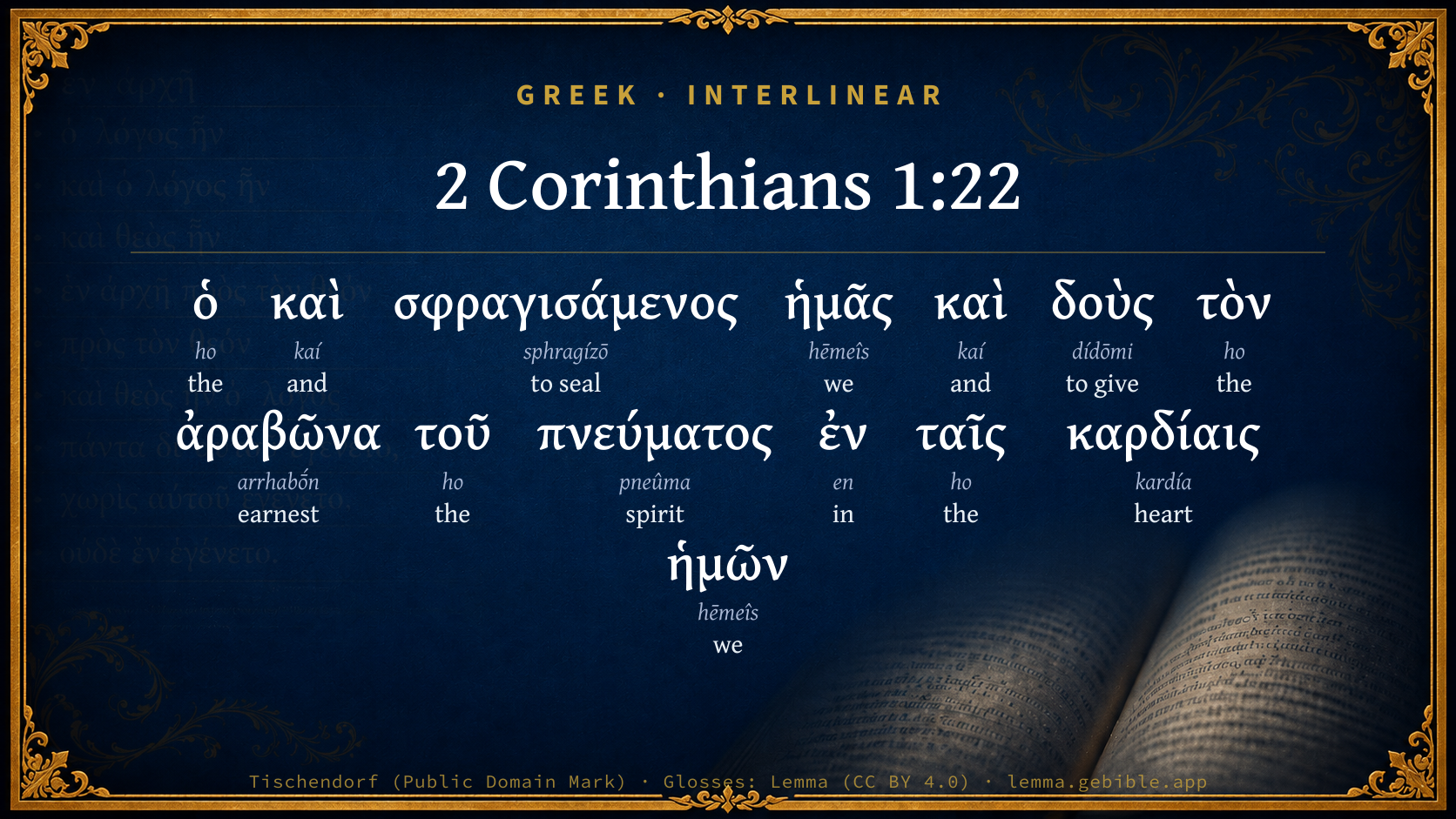
Download image
Cite this verse

2 Corinthians 1:22 (World English Bible). Public Domain. Lemma interlinear Bible study tool, https://lemma.gebible.app/v/2-corinthians/1/22.

Show BibTeX & RIS
BibTeX
RIS
English Translation
who also sealed us, and gave us the down payment of the Spirit in our hearts.
World English Bible · Public Domain
Highlights
  • 1 first appearance in the Greek New Testament
Full analysis ↓
Download a study sheet

One document with this verse’s original text, its word-by-word gloss line, the meaning frame, cross-references with their text, attributed commentary, and full source and license credits — printable, and it pastes into notes with its structure intact.

This verse Autodidact and up

Study sheet (.html) Plain text (.txt)

A passage Seminary Student

Up to 50 verses in one chapter. A passage sheet keeps up to 6 commentary sources and 12 cross-references per verse, in the order this page ranks them, and says so on the sheet whenever that leaves anything out. Ask for a single verse and you get the Autodidact verse sheet above.

Everything on this page stays free to read, with no account — the sheet is a download of what is already on screen, not access to it.

Want to remove ads? Support Godless Engineer
Compare translations 3

The same verse in 3 English versions, stacked beneath the original-language interlinear above. Click any original word for its lexicon entry.

Each is an independent rendering of the whole verse — the interlinear is not word-aligned to these translations.

Highlighted words mark where these versions differ — a whole-verse word diff, not a word-by-word alignment.

  • World English Bible Public Domain
    who also sealed us, and gave us the down payment of the Spirit in our hearts.
  • King James Version Public Domain
    Who hath also sealed us, and given the earnest of the Spirit in our hearts.
  • unfoldingWord Literal Text CC BY-SA 4.0
    the one also having sealed us and having given the down payment of the Spirit in our hearts.

unfoldingWord Literal Text — © unfoldingWord, licensed CC BY-SA 4.0. Word-aligned USFM3 via Door43 (git.door43.org/unfoldingWord/en_ult).

Versions to compare (up to 4)

3 of 4 selected

Show all 19 translations

Every available English version of this verse, each an independent rendering of the whole verse.

  • World English Bible Public Domain
    who also sealed us, and gave us the down payment of the Spirit in our hearts.
  • Berean Standard Bible Public Domain
    placed His seal on us, and put His Spirit in our hearts as a pledge of what is to come.
  • Majority Standard Bible Public Domain
    placed His seal on us, and put His Spirit in our hearts as a pledge of what is to come.
  • King James Version Public Domain
    Who hath also sealed us, and given the earnest of the Spirit in our hearts.
  • American Standard Version (1901) Public Domain
    who also sealed us, and gave `us' the earnest of the Spirit in our hearts.
  • Revised Version (1885) Public Domain
    who also sealed us, and gave us the earnest of the Spirit in our hearts.
  • Geneva Bible (1599) Public Domain
    Who hath also sealed vs, and hath giuen the earnest of the Spirit in our hearts.
  • Douay-Rheims (1899) Public Domain
    Who also hath sealed us, and given the pledge of the Spirit in our hearts.
  • Young's Literal Translation Public Domain
    who also sealed us, and gave the earnest of the Spirit in our hearts.
  • Literal Standard Version CC BY-SA 4.0
    who also sealed us, and gave the deposit of the Spirit in our hearts.
  • Unlocked Literal Bible CC BY-SA 4.0
    he set his seal on us and he gave us the Spirit in our hearts as a guarantee of what is to come.
  • unfoldingWord Literal Text CC BY-SA 4.0
    the one also having sealed us and having given the down payment of the Spirit in our hearts.
  • Darby Bible Public Domain
    who also has sealed us, and given the earnest of the Spirit in our hearts.
  • World Messianic Bible Public Domain
    who also sealed us and gave us the down payment of the Spirit in our hearts.
  • Webster's Bible Public Domain
    Who hath also sealed us, and given the earnest of the spirit in our hearts.
  • Free Bible Version CC BY-SA 4.0
    placed his stamp of approval on us, and given us the guarantee of the Spirit to convince us.
  • Bible in Basic English Public Domain
    And it is he who has put his stamp on us, even the Spirit, as the sign in our hearts of the coming glory.
  • Text-Critical English NT CC BY 4.0
    He has also sealed us and put his Spirit in our hearts as a guarantee.
  • Tyndale New Testament (1534) Public Domain
    and hath geven the ernest of the sprete into oure hertes.

Literal Standard Version (2020), Covenant Press — licensed CC BY-SA 4.0. Text via the HelloAO Bible API (eBible.org). Unlocked Literal Bible (unfoldingWord) — licensed CC BY-SA 4.0. Text via the HelloAO Bible API (eBible.org). unfoldingWord Literal Text — © unfoldingWord, licensed CC BY-SA 4.0. Word-aligned USFM3 via Door43 (git.door43.org/unfoldingWord/en_ult). Free Bible Version, Dr. Jonathan Gallagher — licensed CC BY-SA 4.0. Text via the HelloAO Bible API (eBible.org).

Word by word

More ways to search: Search by grammar → Find every occurrence → Compare this word →

Practice this passage: Drill this verse → Learn its vocabulary →

ἀραβῶνα
arrhabṓn
G728
“earnest”
Noun, Accusative, Singular, Masculine
Part of Speech
Noun
Case
Accusative
Number
Singular
Gender
Masculine
Full Thayer's Definition

Origin: of hebrew origin H6162

TDNT: 08:55,8

1. an earnest a. money which in purchases is given as a pledge or downpayment that the full amount will subsequently be paid
  1. ὁ ho G3588 “the” Article, Nominative, Singular, Masculine
  2. καὶ kaí G2532 “and” Conjunction
  3. σφραγισάμενος sphragízō G4972 “to seal” Verb, Aorist, Middle, Participle, Nominative, Singular, Masculine
  4. ἡμᾶς hēmeîs G2249 “we” Personal pronoun, 1st person, Accusative, Plural
  5. καὶ kaí G2532 “and” Conjunction
  6. δοὺς dídōmi G1325 “to give” Verb, Aorist, Active, Participle, Nominative, Singular, Masculine
  7. τὸν ho G3588 “the” Article, Accusative, Singular, Masculine
  8. τοῦ ho G3588 “the” Article, Genitive, Singular, Neuter
  9. πνεύματος pneûma G4151 “spirit” Noun, Genitive, Singular, Neuter
  10. ἐν en G1722 “in” Preposition
  11. ταῖς ho G3588 “the” Article, Dative, Plural, Feminine
  12. καρδίαις kardía G2588 “heart” Noun, Dative, Plural, Feminine
  13. ἡμῶν hēmeîs G2249 “we” Personal pronoun, 1st person, Genitive, Plural

About this verse

These counts appear in no published source. They are computed here, from the morphology-tagged text and Lemma’s own curated glosses. What Lemma adds →

14
words
9
distinct lemmas
Pauline Epistles
section

Notable vocabulary

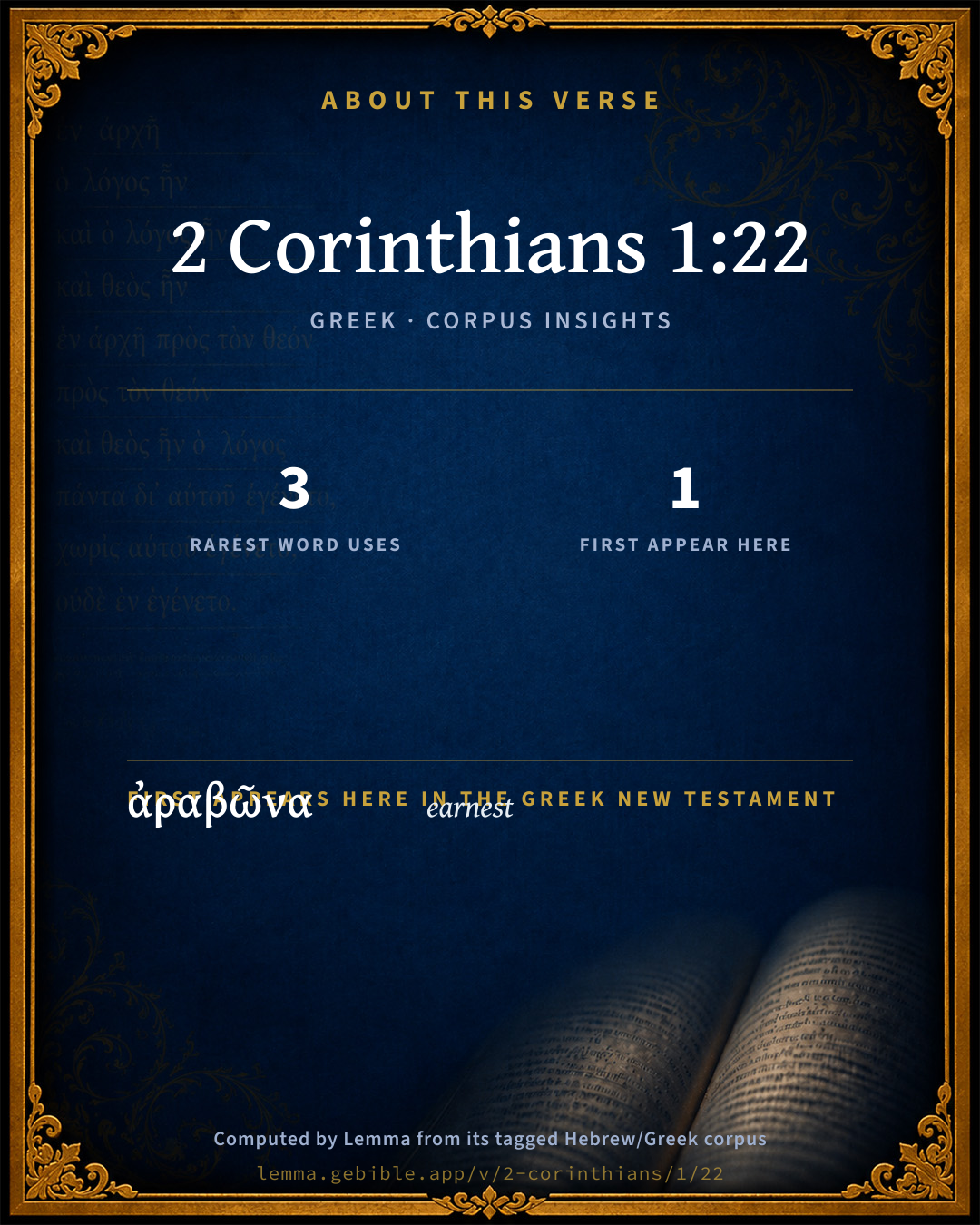
The rarest word here is ἀραβῶνα earnest G728 — appearing just 3 times in the whole Greek New Testament.

First appearance in Scripture

This word makes its first canonical appearance in the Greek New Testament here:

  • ἀραβῶνα earnest G728

Shared distinctive vocabulary

ἀραβῶνα earnest G728 occurs in 3 verses of the Greek New Testament. Also found in:
Repetition

Words recur within this verse:

Cross-references

12

Topical passages linked to 2 Corinthians 1:22 in the Treasury of Scripture Knowledge — connected by theme and wording, ordered by reader-vote popularity; previews shown in the World English Bible.

  • Ephesians 4:30 Don't grieve the Holy Spirit of God, in whom you were sealed for the day of redemption.
  • 2 Corinthians 5:5 Now he who made us for this very thing is God, who also gave to us the down payment of the Spirit.
  • Ephesians 1:13–14 in whom you also, having heard the word of the truth, the Gospel of your salvation,--in whom, having also believed, you were sealed with the Holy Spirit of promise,
  • John 6:27 Don't work for the food which perishes, but for the food which remains to eternal life, which the Son of Man will give to you. For God the Father has sealed him."
  • Revelation 9:4 They were told that they should not hurt the grass of the earth, neither any green thing, neither any tree, but only those people who don't have God's seal on their foreheads.
  • Romans 8:14–16 For as many as are led by the Spirit of God, these are children of God.
  • Romans 8:9 But you are not in the flesh but in the Spirit, if it is so that the Spirit of God dwells in you. But if any man doesn't have the Spirit of Christ, he is not his.
  • Romans 8:23 Not only so, but ourselves also, who have the first fruits of the Spirit, even we ourselves groan within ourselves, waiting for adoption, the redemption of our body.
  • 2 Timothy 2:19 However God's firm foundation stands, having this seal, "The Lord knows those who are his," and, "Let every one who names the name of the Lord depart from unrighteousness."
  • Revelation 7:3 saying, "Don't harm the earth, neither the sea, nor the trees, until we have sealed the bondservants of our God on their foreheads!"
  • Romans 4:11 He received the sign of circumcision, a seal of the righteousness of the faith which he had while he was in uncircumcision, that he might be the father of all those who believe, though they be in uncircumcision, that righteousness might also be accounted to them.
  • Revelation 2:17 He who has an ear, let him hear what the Spirit says to the assemblies. To him who overcomes, to him I will give of the hidden manna, and I will give him a white stone, and on the stone a new name written, which no one knows but he who receives it.

Cross-references courtesy of OpenBible.info (CC BY 4.0).

Commentary

Notes on 2 Corinthians 1:22 from classic Christian and Jewish commentators (each source and its license shown beneath its notes). The classic Christian expositions comment on the surrounding passage and are grouped to its opening verse, so a note may address several verses; the Jewish commentaries on the Tanakh (Rashi and others) are per-verse, so they appear only where the commentator wrote on this verse.

Lemma curates 59 commentaries, every one of them public domain or Creative Commons licensed, each selected and text-cleaned for this edition rather than reprinted as found. About our sources →

The Biblical Illustrator

Joseph S. Exell

2Co_1:22

Who hath also sealed us, and given the earnest of the Spirit in our hearts.

Sealing of the Spirit

What are we to understand by the sealing of the Spirit? It is that act of the Holy Spirit by which the work of grace is deepened in the heart of the believer, so that he has an increasing conviction of his acceptance in Jesus and his adoption into the family of God.

1. It is sometimes a sudden work of the Spirit. A soul may be so deeply sealed in conversion, may receive such a vivid impression of Divine grace, as it never afterwards loses.

2. But in most cases the sealing of the Spirit is a more gradual work. It is a work of time. There are, then, degrees, or progressive stages, of the Spirits sealing.

(1) The first impression is made in regeneration. This is often faint, and in numerous cases scarcely perceptible. The first impression is as much the work of the Spirit as any deeper one in after years. Let not the weak believer undervalue what God has done for him.

(2) But a yet deeper impression of the seal is made when the believer is led more fully into the realisation of his sonship, when he attains to the blessed sense of the adoption of children. Oh, what an impression is then left upon his heart, when all his legal fears are calmed, when all his slavish meanings are hushed (

(3) In the process of sanctified affliction the soul often receives a fresh and a deep impress of the seal of the Spirit. The furnace works wonders for a believer. The hour of affliction is the hour of softening. Job bore this testimony: He maketh my heart soft. Let it not, then, be forgotten that an afflicting time is often a sealing time. We would remark, in this connection of the subject, that the sealing of the Spirit does not always imply a rejoicing frame. It is not necessarily accompanied by great spiritual joy.

I. It is the duty and privilege of every believer diligently and prayerfully to seek the sealing of the spirit. He rests short of his great privilege if he slights or undervalues this blessing. Be not satisfied with the faint impression which you receive in conversion. In other words, rest not contented with a past experience.

II. Again, I remark, this blessing is only found is the way or gods appointment. He has ordained that prayer should be the great channel through which His covenant blessings should flow into the soul. (O. Winslow, D. D.)

The sealing of the Spirit

Christ is the first sealed (Joh_6:27). God hath distinguished Him, and set a stamp upon Him to be the Messiah by the graces of the Spirit. Christ being sealed Himself, He sealed all that He did for our redemption with His blood, and hath added for the strengthening of our faith outward seals--the sacraments--to secure His love more firmly to us. But in this place another manner of sealing is to be understood.

I. What is the manner of our sealing by the spirit? Sealing, we know, hath divers uses.

1. It imprints a likeness of him that seals. When the kings image is stamped upon the wax, everything in the wax answers to that in the seal. So the Spirit sets the stamp of Christ upon every true convert. There is no grace in Christ but there is the like in every Christian in some measure.

2. It distinguishes. Sealing is a stamp upon one thing among many. It distinguisheth Christians from others.

3. It serves for appropriation. Men seal those things that are their own. So God appropriates His own to show that He hath chosen them for Himself to delight in.

4. It serves to make things authentic, to give authority and excellency. The seal of the prince is the authority of the prince. This gives validity to things, answerable to the dignity and esteem of him that seals.

II. What is the stamp that the spirit seals us withal?

III. How shall we know that there is such a spiritual sealing in us? (R. Sibbes, D. D.)

The seal and earnest of the Spirit

I. God hath sealed us by His spirit. Seals are employed--

1. To authenticate a document or confirm it as genuine (1Ki_21:8; Est_3:12). So by the Spirit the believer has the assurance that he is a genuine disciple of Christ (Rom_8:16). The Christian knows that the Holy Ghost has been exerting His agency within him when he perceives that the fruit of the Spirit has begun to make its appearance in him.

2. As a mark to distinguish property. We have something like it in the trade marks of the manufacturer, and in the broad arrow, which indicates that the thing so stamped is the property of the Government. In ancient times the servants, cattle, and goods of a rich man were distinguished by his seal. In like manner believers are recognised as the property of God by the seal of the Spirit. And, as sometimes a seal has an obverse and reverse side, so is it in the case of believers. On the hidden side, visible only to Jehovah, is--The Lord knoweth them that are His; on the other side, where all men may read it, there is--Let him that nameth the name of Christ depart from iniquity. When the coinage of a country has worn thin and light, so that no one can See the image or superscription, it is called in, reminted, and sent forth anew, with a distinct impression from the original die. And so, when our Christian characters are rubbed down by the abrasion of the world to such an extent that the image of the Lord in us has been well-nigh effaced, there is need to submit to the reminting of the Holy Spirit, that we may come forth anew and bear unmistakable witness to Christs property in us.

3. As a means of security. Thus the stone laid at the mouth of the den into which Daniel was thrust was sealed with the kings signet, etc.; and when Jesus was laid in the grave the Jews made the sepulchre sure, sealing the stone and setting a watch. In like manner believers are kept secure in the world by the seal of the Spirit. The reference here is not to Gods almighty protection, nor to the ordering of His all-wise providence, but to the characteristics and habits which are acquired by the believer through the grace of the Holy Ghost. The Christians graces are his armour also. Our security is perfect, and yet it is not without our own exertions, for it is effected by the constant manifestation by us of the qualities which are formed and fostered in us by the Holy Ghost.

II. God hath given us the earnest of the spirit. The term is borrowed from a custom in connection with the transfer of property, when the buyer received a small instalment at once as a sample of it, and as a pledge of full delivery. So, when the Spirit in our hearts is styled an earnest, we have implied--

1. That the fruit of the Spirit which we here enjoy is the same in kind with the blessedness of heaven.

2. That the fruit of the Spirit is a pledge that the full inheritance of heaven shall yet be ours. He who hath begun a good work in us will perform it until the day of Jesus Christ. This is not quite the same as the security suggested by the seal. That was the pledge that we should be kept for heaven; this is an assurance that heaven shall be ours. Conclusion: I come to-day as the spies came to Kadesh-barnea, with the Eshcol cluster of grapes as a sample of the products of the goodly land which they had been to see. Beware how ye receive our report. Remember what happened to the tribes when they refused to go up and possess the land, and take heed lest ye fall after the same example of unbelief. (W. M. Taylor, D. D.)

The sealing Spirit

I. St. Paul reminds us of our peculiar obligation to the Spirit by pointing to one of the primary characteristics of his work. Sealed by His indwelling witness, and that not for a favoured moment only, but unto the day of redemption. This custom, on which the Bible metaphor rests, of sealing letter, decree, edict, or title of possession, came from the East, and is of obvious significance. It gives validity, assurance, legal effect to contract, declaration, or title-deed, and affirms proprietorship over the things upon which it is carried out. With the spread of education the personal signature comes to take the place of the old-fashioned seal. Some years ago a bundle of unsigned Bank of England notes was stolen. A note without that signature at the bottom, familiar to most of us, would be valueless. Religious life, endeavour, relationship, anticipation, borrow force and validity from the sealing of the Spirit. The intermediate position in the religious history of Gods saved people into which Paul puts this act of sealing clearly indicates its nature and purport. Whilst a solitary believer slumbers in the sepulchre, Christ looks upon His inheritance as but incompletely redeemed. It is till Christs power has wrought through its last redemptive cycle and undone the remotest disaster of sin that the Spirit seals us. Sealed unto the day of redemption.

II. This sealing by the Spirit implies that the reconciliation in which we are so deeply interested is more or less secret and unseen. After long and anxious debate, the terms of peace between two belligerent powers are fixed. But, pending the formal ratification of the treaty, and possibly for some time after, the contending parties occupy the same positions on the field. You can scarcely predicate the cessation of hostilities from what meets the eye. But to the commanders on either side the message has passed along the wires, and the genuineness of the message is vouched for by the cypher in which it is sent. When the children begin to play about the homesteads, the peasants to till the hillsides, the nightingales to sing in the myrtle bush, the golden crops to sway in the warm winds, and the church bells to chime again through the valleys, there will be no need to prove the reality of the peace by the seal or official announcement of the fact. It will be then proved by every sight and sound and movement within the horizon. For the present our personal reconciliation to God is an unseen fact, and is only attested by the indwelling Spirit which seals us. The heritage has not been fully and finally released and redeemed. The law yet seems to rumble with ominous curses. Nature often seems hostile in the last degree. We are left under conditions that sometimes suggest that awful and hopeless war is still going on, and yet the peace has been secretly sealed and its conditions ratified. One day the last thunder will have rolled itself into silence, the last bolt have hurtled through the air, the last hostile footstep be gone, and the stormless peace of eternity hide us in its sacred wings. The seal will then be needless.

III. This sealing declares the relationship of dignity and privilege we sustain before God. In Oriental life the seal is necessary to accredit a man to the office his master may have bestowed upon him. The messenger of the throne is recognised by the imperial seal he bears. When he has fulfilled his term of office, let him go back to the palace, stand amidst its fabulous splendours, and move to and fro beneath the eye of his imperial master, and there, at the centre of government once more, he will no longer need the seal, as a personal credential at least. His dignity is recognised and promptly acknowledged on all sides. The seal is indispensable when he has to cross the mountains or sail up unknown rivers, and go into districts where he must deal with semi-aliens. And it is whilst we pass as strangers and pilgrims through the earth that we need the seal which attests our true standing before God. Our majesty is obscured, our bodies are inglorious and subject to decay, and our garments torn and stained with travel. The world knows us not, as it knew not Gods greatest Son.

IV. This sealing marks out the believer as the subject of a specific providential care. In this sense was it that circumcision stood to the Jews both for a sign arid a seal. The rite proclaimed Gods special proprietorship over the nation, and singled out its separate members for such defence, tender oversight, strenuous protection as a father exercises over the little ones of his family.

V. The seal is a token of proprietorship. You watch a ship as it is being loaded for a voyage, and amongst other cargo notice a number of boxes bearing a significant seal. These are not stowed away in the hold, like consignments of common goods, but are taken to some place where they will be constantly watched by the responsible officers of the ship. The chests are chests of sealed treasure. Should the ship spring a leak and be endangered, after the safety of of the passengers has been provided for, these sealed chests will be the first things to be put into the lifeboats. The seal marks them out for special care and defence, and whatever human vigilance, foresight, and valour can do will be done to deliver them to the consignees. And so with that sealing of the Spirit affixed to sincere believers in Jesus Christ. They are subject to the same risks, vicissitudes, and temptations as other men; but all that Gods power can do to help and deliver them shall be done. This special sealing marks out body and soul alike for Gods special possession and guardianship.

VI. This sealing goes on to mark out those who receive it as the types of a pure and incorruptible life. God seals us for our humbler vocation no less infallibly than He sealed the only-begotten Son. He is incapable of the folly of sending into a disloyal, suspicious, and sense-ridden world an unsealed servant and message-bearer. And by the holy fruit which appears in our lives, the world, if it be not altogether thoughtless and unteachable, will be compelled sooner or later to see that we are of God. The Holy Spirit is ever working a continuous transformation and ennoblement within us which is the distinctive mark of the children of the kingdom. When we shall have come to bear in our transfigured flesh the power and potency of all Divine qualities, this sealing will be needless. Till that day of perfect redemption dawns we cannot afford to despise this high signature. Sealed unto the day of redemption--sealed for our Own assurance, and also for a witness to the world. (T. G. Selby.)

The seal and earnest

The three metaphors in this and verse 21--anointing, sealing, and giving the earnest--

1. All refer to the same subject--the Divine Spirit.

2. All refer to one and the same act. They are three aspects of one thing, just as a sunbeam might be regarded either as the source of warmth, or of light, or of chemical action.

3. All declare a universal prerogative of Christians. Every man that loves Christ has the Spirit in the measure of his faith. Note:--

I. The seal of the spirit. A seal is impressed upon a recipient material, made soft by warmth, in order to leave there a copy of itself.

1. The effect of the Divine indwelling is to mould the recipient into the image of the Divine inhabitant. There is in the human spirit a capacity of receiving the image of God. His Spirit, entering into a heart, will there make that heart wise with its own wisdom, strong with its own strength, gentle with its own gentleness, holy with some purity of its own.

2. There are, however, characteristics which are not so much copies as correspondences--i.e., just as what is convex in the seal is concave in the impression, and vice versa, so, when that Spirit comes into our spirits, its promises will excite faith, its gifts will breed desire; yearning love will correspond to the love that longs to dispense, emptiness to abundance, prayers to promises; the cry, Abba! Father! to the word, Thou art My Son,

3. Then, mark, the material is made capable of receiving the stamp, because it is warmed and softened--i.e., my faith must prepare my heart for the sanctifying indwelling of that Divine Spirit. God does not do with man as the coiner does with his blanks--put them cold into a press, and by violence from without stamp an image upon them; but He does as men do with a seal--warms the wax first, and then, with a gentle, firm touch, leaves the likeness there.

4. This aggregate of Christian character is the true sign that we belong to God, as the seal is the mark of ownership. I believe that Christian people ought to have a consciousness that they are Gods children, for their own peace and rest and joy. But you cannot use that in demonstration to other people. The two things must go together. Be very sure that your happy consciousness that you are Christs is verified to yourself and to others by a plain outward life of righteousness like the Lords. Have you got that seal stamped upon your lives like the hall-mark that says, This is genuine silver, and no plated Brummagem stuff? And is it woven into the whole length of your being like the scarlet thread that is spun into every Admiralty cable as a sign that it is Crown property?

5. This sealing, which is thus the token of Gods ownership, is also the pledge of security. A seal is stamped in order that there may be no tampering with what it seals--that it may be kept safe from thieves and violence. And our true guarantee that we shall come at last to heaven is present likeness to the indwelling Spirit. The seal is the pledge of security just because it is the mark of ownership. When, by Gods Spirit dwelling in us, we are led to love the things that be fair, and to long after more, that is like Gods hoisting His flag upon a newly-annexed territory. And is He going to be so careless in the preservation of His property as that He will allow it to slip away from Him? But no man has a right to rest on the assurance of Gods saving him into the heavenly kingdom unless He is saving him at this moment from the devil and his own evil heart.

II. The earnest of the spirit.

1. It is the guarantee of the inheritance.

(1) The experiences of the Christian life here are plainly immortal. The resurrection of Christ is the external proof; the facts of the Christian life are the inward proofs of a future life. Howsoever much we may say we believe in a future life and in a heaven, we really grasp it in the proportion in which here we are living in direct contact with God. What have faith, love, fellowship with God, to do with death? They cannot be cut through with the stroke that destroys physical life, any more than you can divide a sunbeam with a sword.

(2) All the results of the Divine Spirits sealing of the soul manifestly tend towards completeness. The engine is clearly working only half-speed. Those powers in the Christian man can plainly do a great deal more than they ever have done here, and are meant to do a great deal more. The road evidently leads upwards, and round that sharp corner, where the black rocks come so near each other and our eyesight cannot travel, we may be sure it goes steadily up still to the top of the pass, until it reaches the shining tablelands whereof our God Himself is Sun and Moon, and brings us all to the city set on a hill.

2. It is part of the whole. The truest and loftiest conception that we can form of heaven is the perfecting of the religious experience of earth. The shilling or two given to the servant of old when he was hired is of the same currency as the balance that he is to get when the years work is done. You have but to take from the faith, love, obedience, communion of the highest of moments of the Christian life all their imperfections, multiply them to their superlative possibility, and stretch them out to absolute eternity, and you get heaven. So here is a gift offered for us all, a gift which our feebleness sorely needs, the offer of a reinforcement as real and as sure to bring victory as when, at Waterloo, the Prussian bugles blew, and the English commander knew that victory was sure. (A. Maclaren, D. D.)

The Spirit as an earnest

I. We are the heirs of a spiritual inheritance. It is quite consistent with the present economy of mercy that we should enjoy some of this whilst on earth, and before we are put in full possession. Many things in the Divine purpose, and in the history of the world, preceded Christs personal mediation, prepared the way for it, and passed over, through His work, in blessings upon our souls. We were originally members of a disinherited race. The inheritance under consideration was the rightful possession of our Lord as the Only-begotten of the Father. As to our interest in it, it lay under a forfeiture, and we were treated as aliens. It is also) a merciful part of the plan that it should, at least for a time, be vested in Christ as trustee for us. In Eden, the inheritance of life was vested in the first man, who lost it to himself and all his posterity. God is our inheritance, and heaven is the place where most perfectly we shall enter upon its full and undisputed enjoyment. This is our estate; not ours for years merely, but for eternity, It will then be subject neither to corruption nor violence. Heaven, with its freedom from sin, sickness, pain, the curse, and death, is ours in reversion.

II. The spirit is given to us as an earnest of this splendid inheritance.

1. It is supposed that the word and its use came to the Greeks from the Syrian and Phoenician merchants, just as the words tariff and cargo came to England from Spanish merchants. The technical sense of the word signifies the deposit paid by the purchaser on entering into an agreement for the purchase of anything. The identity of the deposit with the full payment is a very essential consideration in the force and use of the word. In many of the rural districts of Scotland, and possibly in other places, a shilling, or small sum of money, is put into the hand of a servant when hired for a certain work as handsel-money, and as a pledge that when the whole work is done the whole wages shall be paid. Two things, therefore, seem to be included in the meaning of the word used: first, that it should be the same in kind as the fulness of which it is a part; and, secondly, representing our present state as Christians, it affirms the certainty of our privileges in this world and the next. As God Himself is said to be our inheritance--as we are said to have the inheritance in Christ--so the Holy Ghost is Himself the earnest of it in our hearts. It is not a work which He delegates to another; nor would it suffice to say that any one blessing, such as pardon, life, or peace, is the earnest of heaven it is the Spirit Himself only. He is the earnest of heaven.

2. The earnest is thus part of- our future inheritance, and identical in kind with it. An infant has a title to an inheritance which has descended from his deceased father; and though not legally, or in fact, in possession, except as under tutors and governors, certain advances are made from it to conduct his education, and in this way foretastes of it are given to him. As he passes through the family mansion, forests, and fields, and meets with the servants of the estate, he has in this walk, and in the loving respect of faithful dependents, an earnest of what he is speedily coming to; and we can imagine how his breast, as heir, would heave with excitement on the eve of possessing the inheritance. This experience of the earthly heir may help us, as an illustration, to understand our present enjoyment of the firstfruits of the Spirit, which, upon the testimony of the apostle, we now have. To take the blessing, eternal life, it is obvious, from both our Lords teaching and that of His apostles, that in all the essential elements of eternal life we are equal to the spirits of just men made perfect (Heb_12:23). We form part of the same family. Life in heaven is just our spiritual life here, excepting the amplification and elevation which death, as a freedom from the body and from the fretting power of sin, will confer upon us. Again, how vivid is the writers conception of the likeness, and indeed identity, of the earnest to the whole in his view of the nearness of the believers on earth to heaven. But ye are come unto Mount Sion (Heb_12:22-23). Portions of this inheritance are ministered to us in advance. True, it is but twilight yet with us. But as the sun is seen from the lofty Swiss mountains to throw forward on the distant peaks his rays, as skirmishers before an army, to announce his coming, so our present foretastes of heaven--the earnest of our inheritance, calm, intelligent faith in the Lord, love to Him and to His people, and our luminous hope cast as an anchor within the veil--testify that the day in which there shall be no night is at hand. All these experiences are pledges of our immediate admission into heaven when we die.

3. The earnest of the Spirit, which is thus a real part of the inheritance of heaven, is only a part of it. There is no principle or fixed rule by which we could define the proportion which it bears as a part to the whole. A handful of wheat offered by the farmer in the market as a sample to the purchaser of the entire crop, though identically the same, bears a very small proportion to the whole. We may safely infer that the earnest is less than the whole. The Spirit who Himself is the earnest, with all the grace and love which He is pleased to bestow upon our souls, is but a part. All the blessings of which God kindly thought and devised for us in eternity, which cost the Redeemer His life to secure and bestow as the efficient cause of oar salvation, and which the Holy Ghost came down from heaven to reveal, are undoubtedly involved in this earnest. How stupendous a thought that something greater--and how much greater!--awaits us when we shall see God! It may be said that even here we have God, and what more can we have inheaven? But there He will be our God without any of the deductions made for our present imperfections and actual transgressions (1Co_13:12; 1Jn_3:2). (A. Douglas McMillan.)

The Biblical Illustrator, edited by Joseph S. Exell (c. 1880s–1900s) — public domain. Text from a community e-Sword module.

MacLaren's Expositions of Holy Scripture

Alexander MacLaren

2 Corinthians

SEAL AND EARNEST

2Co 1:22.

There are three strong metaphors in this and the preceding verse-’anointing,’ ‘sealing,’ and ‘giving the earnest’-all of which find their reality in the same divine act. These three metaphors all refer to the same subject, and what that subject is is sufficiently explained in the last of them. The ‘earnest’ consists of ‘the Spirit in our hearts,’ and the same explanation might have been appended to both the preceding clauses, for the ‘anointing’ is the anointing of the Spirit, and the ‘seal’ is the seal of the Spirit. Further, these three metaphors all refer to one and the same act. They are not three things, but three aspects of one thing, just as a sunbeam might be regarded either as the source of warmth, or of light, or of chemical action. So the one gift of the one Spirit, ‘anoints,’ ‘seals,’ and is the ‘earnest.’ Further, these three metaphors all declare a universal prerogative of Christians. Every man that loves Jesus Christ has the Spirit in the measure of his faith,’ and if any man have not the Spirit of Christ he is none of His.’

I. Note the first metaphor in the text-the ‘seal’ of the Spirit.

A seal is impressed upon a recipient material made soft by warmth, in order to leave there a copy of itself. Now it is not fanciful, nor riding a metaphor to death, when I dwell upon these features of the emblem in order to suggest their analogies in Christian life. The Spirit of God comes into our spirits, and by gentle contact impresses upon the material, which was intractable until it was melted by the genial warmth of faith and love, the likeness of Himself, but yet so as that prominences correspond to the hollows, and what is in relief in the one is sunk in the other. Expand that general statement for a moment or two.

The effect of all the divine indwelling, which is the characteristic gift of Christ to every Christian soul, is to mould the recipient into the image of the divine inhabitant. There is in the human spirit-such are its dignity amidst its ruins, and its nobility shining through its degradation-a capacity of receiving that image of God which consists not only in voluntary and intelligent action and the consciousness of personal being, but in the love of the things that are fair, and in righteousness, and true holiness. His Spirit, entering into a heart, will make that heart wise with its own wisdom, strong with some infusion of its own strength, gracious with some drops of its own grace, gentle with some softening from its own gentleness, holy with some purity reflected from its own transcendent whiteness. The Spirit, which is life, moulds the heart into which it enters to a kindred, and, therefore, similar life.

There are, however, characteristics in this ‘seal’ of the Spirit which are not so much copies as correspondences. That is to say, just as what is convex in the seal is concave in the impression, and vice versb, so, when that Divine Spirit comes into our spirits, its promises will excite faith, its gifts will breed desire; to every bestowment there will answer an opening receptivity. Recipient love will correspond to the love that longs to dispense, the sense of need to the divine fulness and sufficiency, emptiness to abundance, prayers to promises; the cry ‘Abba! Father’ ! the yearning consciousness of sonship, to the word ‘Thou art My Son’; and the upward eye of aspiration and petition, and necessity, and waiting, to the downward glance of love bestowing itself. The open heart answers to the extended hand, and the seal which God’s Spirit impresses upon the heart that is submitted to it, has the two-fold character of resemblance in moral nature and righteousness, and of correspondence as regards the mysteries of the converse between the recipient man and the giving God.

Then, mark that the material is made capable of receiving the stamp, because it is warmed and softened. That is to say, faith must prepare the heart for the sanctifying indwelling of that Divine Spirit. The hard wax may be struck with the seal, but it leaves no trace. God does not do with man as the coiner does with his blanks, put them cold into a press, and by violence from without stamp an image upon them, but He does as men do with a seal, warms the wax first, and then, with a gentle, firm touch, leaves the likeness there. So, brother! learn this lesson: if you wish to be good, lie under the contact of the Spirit of righteousness, and see that your heart is warm.

Still further, note that this aggregate of Christian character, in likeness and correspondence, is the true sign that we belong to God. The seal is the mark of ownership, is it not? Where the broad arrow has been impressed, everybody knows that that is royal property. And so this seal of God’s Divine Spirit, in its effects upon my character, is the one token to myself and to other people that I belong to God, and that He belongs to me. Or, to put it into plain English, the best reason for any man’s being regarded as a Christian is his possession of the likeness and correspondence to God which that Divine Spirit gives. Likeness and correspondence, I say, for the one class of results is the more open for the observation of the world, and the other class is of the more value for ourselves. I believe that Christian people ought to have, and are meant by that Divine Spirit dwelling in them to have, a consciousness that they are Christians and God’s children, for their own peace and rest and joy. But you cannot use that in demonstration to other people; you may be as sure of it as you will, in your inmost hearts, but it is no sign to anybody else. And, on the other hand, there may be much of outward virtue and beauty of character which may lead other people to say about a man: ‘That is a good Christian man, at any rate,’ and yet there may be in the heart an all but absolute absence of any joyful assurance that we are Christ’s, and that He belongs to us. So the two facts must go together. Correspondence, the spirit of sonship which meets His taking us as sons, the faith which clasps the promise, the reception which welcomes bestowment, must be stamped upon the inward life. For the outward life there must be the manifest impress of righteousness upon my actions, if there is to be any real seal and token that I belong to Him. God writes His own name upon the men that are His. All their goodness, their gentleness, patience, hatred of evil, energy and strenuousness in service, submission in suffering, with whatsoever other radiance of human virtue may belong to them, are really ‘His mark!’

There is no other worth talking about, and to you Christian men I come and say, Be very sure that your professions of inward communion and happy consciousness that you are Christ’s are verified to yourself and to others by a plain outward life of righteousness like the Lord’s. Have you got that seal stamped upon your lives, like the hall-mark that says, ‘This is genuine silver, and no plated Brummagem stuff’ ? Have you got that seal of a visible righteousness and every-day purity to confirm your assertion that you belong to Christ? Is it woven into the whole length of your being, like the scarlet thread that is spun into every Admiralty cable as a sign that it is Crown property? God’s seal, visible to me and to nobody else, is my consciousness that I am His; but that consciousness is vindicated and delivered from the possibility of illusion or hypocrisy, only when it is checked and fortified by the outward evidence of the holy life which the Spirit of God has wrought.

Further, this sealing, which is thus the token of God’s ownership, is also the pledge of security. A seal is stamped in order that there may be no tampering with what it seals; that it may be kept safe from all assaults, thieves, and violence. And in the metaphor of our text there is included this thought, too, which is also of an intensely practical nature. For it just comes to this-our true guarantee that we shall come at last into the sweet security and safety of the perfect state is present likeness to the indwelling Spirit and present reception of divine grace. The seal is the pledge of security, just because it is the mark of ownership. When, by God’s Spirit dwelling in us, we are led to love the things that are fair, and to long after more possession of whatever things are of good report, that is like God’s hoisting His flag upon a newly-annexed territory. And is He going to be so careless in the preservation of His property as that He will allow that which is thus acquired to slip away from Him? Does He account us as of so small value as to hold us with so slack a hand? But no man has a right to rest on the assurance of God’s saving him into the heavenly kingdom, unless He is saving him at this moment from the devil and his own evil heart. And, therefore, I say the Christian character, in its outward manifestations and in its sweet inward secrets of communion, is the guarantee that we shall not fall. Rest upon Him, and He will hold you up. We are ‘kept by the power of God unto salvation,’ and that power keeps us and that final salvation becomes ours, ‘through faith.’

II. Now, secondly, turn to the other emblem, that ‘earnest’ which consists in like manner ‘of the Spirit.’

The ‘earnest,’ of course, is a small portion of purchase-money, or wages, or contract-money, which is given at the making of a bargain, as an assurance that the whole amount will be paid in due time. And, says the Apostle, this seal is also an earnest. It not only makes certain God’s ownership and guarantees the security of those on whom it is impressed, but it also points onwards to the future, and at once guarantees that, and to a large extent reveals the nature of it. So, then, we have here two thoughts on which I touch.

The Christian character and experience are the earnest of the inheritance, in the sense of being its guarantee, inasmuch as the experiences of the Christian life here are plainly immortal. The Resurrection of Jesus Christ from the dead is the objective and external proof of a future life. The facts of the Christian life, its aspirations, its communion, its clasp of God as its very own, are the subjective and inward proofs of a future life. As a matter of fact, if you will take the Old Testament, you will see that the highest summits in it, to which the hope of immortality soared, spring directly from the experience of deep and blessed communion with the living God. When the Psalmist said ‘Thou wilt not leave my soul in Sheol; neither wilt Thou suffer Thy Holy One to see corruption,’ he was speaking a conviction that had been floated into his mind on the crest of a great wave of religious enjoyment and communion. And, in like manner, when the other Psalmist said, ‘Thou art the strength of my heart, and my portion for ever,’ he was speaking of the glimpse that he had got of the land that was very far off, from the height which he had climbed on the Mount of fellowship with God. And for us, I suppose that the same experience holds good. Howsoever much we may say that we believe in a future life and in a heaven, we really grasp them as facts that will be true about ourselves, in the proportion in which we are living here in direct contact and communion with God. The conviction of immortality is the distinct and direct result of the present enjoyment of communion with Him, and it is a reasonable result. No man who has known what it is to turn himself to God with a glow of humble love, and to feel that he is not turning his face to vacuity, but to a Face that looks on him with love, can believe that anything can ever come to destroy that communion. What have faith, love, aspiration, resignation, fellowship with God, to do with death? They cannot be cut through with the stroke that destroys physical life, any more than you can divide a sunbeam with a sword. It unites again, and the impotent edge passes through and has effected nothing. Death can shear asunder many bonds, but that invisible bond that unites the soul to God is of adamant, against which his scythe is in vain. Death is the grim porter that opens the door of a dark hole and herds us into it as sheep are driven into a slaughter-house. But to those who have learned what it is to lay a trusting hand in God’s hand, the grim porter is turned into the gentle damsel, who keeps the door, and opens it for light and warmth and safety to the hunted prisoner that has escaped from the dungeon of life. Death cannot touch communion, and the consciousness of communion with God is the earnest of the inheritance.

It is so for another reason also. All the results of the Divine Spirit’s sealing of the soul are manifestly incomplete, and as manifestly tend towards completeness. The engine is clearly working now at half-speed. It is obviously capable of much higher pressure than it is going at now. Those powers in the Christian man can plainly do a great deal more than they ever have done here, and are meant to do a great deal more. Is this imperfect Christianity of ours, our little faith so soon shattered, our little love so quickly disproved, our faltering resolutions, our lame performances, our earthward cleavings-are these things all that Jesus Christ’s bitter agony was for, and all that a Divine Spirit is able to make of us? Manifestly, here is but a segment of the circle, in heaven is the perfect round; and the imperfections, so far as life is concerned, in the work of so obviously divine an Agent, cry aloud for a region where tendency shall become result, and all that it was possible for Him to make us we shall become. The road evidently leads upwards, and round that sharp corner where the black rocks come so near each other and our eyesight cannot travel, we may be sure it goes steadily up still to the top of the pass, until it reaches ‘the shining table-lands whereof our God Himself is Sun and Moon,’ and brings us all to the city set on a hill.

And, further, that divine seal is the earnest, inasmuch as itself is part of the whole. The truest and the loftiest conception that we can form of heaven is as being the perfecting of the religious experience of earth. The shilling or two, given to the servant in old-fashioned days, when he was hired, is of the same currency as the balance that he is to get when the year’s work is done. The small payment to-day comes out of the same purse, and is coined out of the same specie, and is part of the same currency of the same kingdom, as what we get when we go yonder and count the endless riches to which we have fallen heirs at last. You have but to take the faith, the love, the obedience, the communion of the highest moments of the Christian life on earth, and free them from all their limitations, subtract from them all their imperfections, multiply them to their superlative possibility, and endow them with a continual power of growth, and stretch them out to absolute eternity, and you get heaven. The earnest is of a piece with the inheritance.

So, dear brethren, here is a gift offered for us all, a gift which our feebleness sorely needs, a gift for every timid nature, for every weak will, for every man, woman, and child beset with snares and fighting with heavy tasks, the offer of a reinforcement as real and as sure to bring victory as when, on that day when the fate of Europe was determined, after long hours of conflict, the Prussian bugles blew, and the English commander knew that {with the fresh troops that came on the field} victory was made certain. So you and I may have in our hearts the Spirit of God, the spirit of strength, the spirit of love and of a sound mind, the spirit of adoption, the spirit of wisdom and of revelation in the knowledge of Him, to enlighten our darkness, to bind our hearts to Him, to quicken and energise our souls, to make the weakest among us strong, and the strong as an angel of God. And the condition on which we may get it is this simple one which the Apostle lays down; ‘After that ye believed, ye were sealed with that Holy Spirit of promise, which is the earnest of our inheritance.’ The Christ, who is the Lord and Giver of the Spirit, has shown us how its blessed influences may be ours when, on the great day of the feast, He stood and cried with a voice that echoes across the centuries, and is meant for each of us, ‘If any man thirsts, let him come unto Me and drink. He that believeth in Me, out of his belly shall flow rivers of living water. This spake He of the Spirit which they that believe or Him should receive.’

Alexander MacLaren, Expositions of Holy Scripture (1904–1910) — public domain. Text from a community e-Sword module.

Bengel's Gnomon

Johann Albrecht Bengel

2Co 1:22. Ἀῤῥαβῶνα, earnest) ch. 2Co 5:5. ἀῤῥαβὼν, Gen 38:17-18, is used for a pledge, which is given up at the payment of a debt; but elsewhere for earnest money, which is given beforehand, that an assurance may be afforded as to the subsequent full performance of the bargain. Hesychius, ἀῤῥαβὼν, πεόδομα. For the earnest, says Isid. Hispal., is to be completed [by paying the balance in full] not to be taken away: whence he who has an earnest does not restore it as a pledge, but requires the completion of the payment. Such an earnest is the Spirit Himself, Eph 1:14: whence also we are said to have the first fruits of the Spirit, Rom 8:23. See Rittershusii, lib. 7, sacr. lect. c. 19.

Bengel's Gnomon of the New Testament — English translation (T&T Clark, Edinburgh, 1860) — public domain. Text from a community e-Sword module.

Expositor's Greek Testament

ed. W. Robertson Nicoll

2Co 1:22 . ὁ καὶ σφρ . ἡμᾶς κ . τ . λ .: who also sealed us ( sc. , all Christians), and gave us the earnest of the Spirit in our hearts . The aorists, σφραγισάμενος … δούς , point to acts completed at a definite moment in the past; and this can only mean the moment of baptism . This, too, is the best explanation of the parallel passages, Eph 1:13 ; Eph 4:30 . The gift of the Holy Spirit is repeatedly mentioned as consequent on baptism (Act 2:38 ; Act 19:6 ); and the σφραγίς , or “seal” of baptism, is a common image in early Christian literature ( e.g. , [2 Clem.,] § 8, τηρήσατε … τὴν σφραγῖδα ἄσπιλον ). The “seal” of the Church is given by St. Paul (2Ti 2:19 ) as “The Lord knoweth them that are His” (Num 16:5 ), and “Let every one that nameth the Name of the Lord depart from unrighteousness” (Isa 52:11 ; cf. Num 16:26 , Isa 26:13 ). The ἀρραβών (see an exhaustive note in Pearson, On the Creed , 7), i.e. , עֵרָבוֹן , is a first instalment, given in pledge of full payment in due course; see reff. and cf. Rom 8:16 , τὸ πνεῦμα συνμαρτυρεῖ τῷ πνεύματι ἡμῶν ὅτι ἐσμὲν τέκνα Θεοῦ : here is the ἀπαρχή τοῦ πνεύματος (Rom 8:23 ). For the constr. διδόναι ἐν cf. Eze 36:26 , Joh 3:35 , Act 4:12 , chap. 2Co 8:1 ; 2Co 8:16 .

The Expositor's Greek Testament, edited by W. Robertson Nicoll (1897–1910) — public domain. Text from a community e-Sword module.

Geneva Bible (1599)

Geneva Bible translators

An earnest, is, whatsoever is given to confirm a promise.

Geneva Bible (1599) marginal notes — public domain. Text via Bolls.life.

Jamieson, Fausset & Brown

Robert Jamieson, A. R. Fausset & David Brown

sealed--A seal is a token assuring the possession of property to one; "sealed" here answers to "stablisheth us" (Co2 1:21; Co1 9:2).

the earnest of the Spirit--that is, the Spirit as the earnest (that is, money given by a purchaser as a pledge for the full payment of the sum promised). The Holy Spirit is given to the believer now as a first instalment to assure him his full inheritance as a son of God shall be his hereafter (Eph 1:13-14). "Sealed with that Holy Spirit of promise which is the earnest of our inheritance until the redemption of the purchased possession" (Rom 8:23). The Spirit is the pledge of the fulfilment of "all the promises" (Co2 1:20).

Jamieson, Fausset & Brown — Commentary Critical and Explanatory on the Whole Bible (1871) — public domain (CC PDM 1.0). Text via the HelloAO Bible API.

Adam Clarke's Commentary

Verse 22. Who hath also sealed us] Not only deeply impressed His truth and image upon our hearts; but, by the miraculous gifts of the Holy Spirit, attested the truth of our extraordinary unction or calling to the ministry.

And given the earnest of the Spirit] Τον αρραβωνα του Πνευματος. From this unction and sealing we have a clear testimony in our souls, the Divine Spirit dwelling constantly in us, of our acceptance with God, and that our ways please him. The αρραβων of the apostle is the same as the ערבן erabon of Moses, Ge 38:17; Ge 38:18; Ge 38:20, which we there translate pledge. The word properly signifies an earnest of something promised; a part of the price agreed for between a buyer and seller, by giving and receiving of which the bargain was ratified; or a deposit, which was to be restored when the thing promised was given. From the use of the term in Genesis, which the apostle puts here in Greek letters, we may at once see his meaning above, and in Eph 1:14; the Holy Spirit being an earnest in the heart, and an earnest of the promised inheritance means a security given in hand for the fulfilment of all God's promises relative to grace and eternal life. We may learn from this, that eternal life will be given in the great day to all who can produce the arrhabon, or pledge. He who is found then with the earnest of God's Spirit in his heart, shall not only be saved from death, but have that eternal life of which it is the pledge, the earnest, and the evidence. Without this arrhabon there can be no glory. See the whole case of Judah and Tamar, Ge 38:13, &c., and the notes there.

Adam Clarke's Commentary on the Bible (1810–1826) — public domain. Text from a community e-Sword/MySword module.

Ellicott's Commentary for English Readers

(22) Who hath also sealed us.—Better, who also sealed us. The thought thus expressed is that the gift of the Spirit, following on baptism or the laying on of hands, is as the seal of the covenant which God makes with His people, attesting its validity. (Comp. Eph_1:13; Eph_4:30; and, for the Jewish use of seals, Jer_32:10.)

And given the earnest of the Spirit.—Better, for the same reason as before, gave. The Greek word for “earnest” (arrhabôn), which occurs here for the first time, and is used only by St. Paul in the New Testament (2Co_5:5; Eph_1:14), has a somewhat interesting history. Originally a Hebrew word, from a verb meaning “to mix,” “to change,” “to pledge,” and so used, as a cognate noun, with the last of the three senses, it appears simply transliterated in the LXX. of Gen_38:17-18. It would seem to have been in common use among the Canaanite or Phoenician traders, and was carried by them to Greece, to Carthage, to Alexandria, and to Rome. It was used by the Greek orator Isæus, and by Plautus and Terence among the earlier Latin writers. The full form came to be considered somehow as pedantic or vulgar, and was superseded in Roman law by the shortened “arrha,” the payment of a small sum given on the completion of a bargain as a pledge that the payer would fulfil the contract; and it has passed into Italian as “arra;” into modern French, as “les arrhes;” into popular Scotch even, as “arles.” As applied by St. Paul, it had the force of a condensed parable, such as the people of commercial cities like Corinth and Ephesus would readily understand. They were not to think that their past spiritual experience had any character of finality. It was rather but the pledge of yet greater gifts to come: even of that knowledge of God which is eternal life (Joh_17:3). The same thought is expressed, under a more Hebrew image, in the “firstfruits of the Spirit” in Rom_8:23. Grammatically, the “earnest of the Spirit” may be taken as an example of the genitive of apposition, “the earnest which is the Spirit.”

A Bible Commentary for English Readers, edited by Charles John Ellicott (1878–1897) — public domain. Text from a community e-Sword module.

The Cambridge Bible for Schools and Colleges

gen. ed. J. J. S. Perowne

22. Who hath also sealed us] Here again the Greek has the aorist. We must refer it here to the attestation God gave to his calling and anointing by the manifest signs of His presence with His ministers. See ch 2Co_3:1-3, 2Co_12:12. Also Rom_15:15-19; 1Co_9:2. A seal (see note on 1Co_9:2; cf. Rom_15:28) is used to attest and confirm a legal document, which, according to our present legal custom, derived from the practice of past ages, when but few were able to write their names, must be ‘sealed’ as well as ‘signed,’ before it is ‘delivered’ to another person to act upon. For the expression ‘sealed with the Spirit,’ see Eph_1:13; Eph_4:30, and also, for a similar expression, Joh_6:27.

and given the earnest of the Spirit] The Apostle here, as in ch. 2Co_5:5 and Eph_1:14, uses the Hebrew word arrhabon, which, derived from a verb signifying to plait or interweave, and thence to pledge or be security for (as in Gen_43:9), came to have the meaning of earnest. An earnest is to be distinguished, however, from a pledge (see Robertson in loc.), in that the latter is “something different in kind, given as assurance for something else,” as in the case of the Sacraments, while the former is a part of the thing to be given, as when “a purchase is made, and part of the money paid down at once.” Schleusner translates into German by handgeld or angeld. The Hebrew word however, has also the meaning of pledge, as in Gen_38:17-18. The word is found in the Greek and in a modified form in the Latin language, and exists to this day in the French “arrhes,” and was no doubt derived by Greeks and Latins “from the language of Phoenician traders, as tariff, cargo, are derived in English and other modern languages from Spanish traders.”—Stanley. See his whole note, and cf. Rom_8:23. Our own word earnest comes from a root signifying to run, to follow after eagerly. The use of the word in the text is due to the custom, common in all countries, of giving some pledge of being in earnest. The words ‘in earnest,’ in our sense of meaning what we say, occur early in our literature. See Chaucer, Legende of Good Women, Queen Dido, line 1301. There is a valuable note on this word in the Speaker’s Commentary on Pro_6:1.

The Cambridge Bible for Schools and Colleges (gen. ed. J. J. S. Perowne; Cambridge University Press, 1878–1918) — public domain. Text from a community e-Sword module.

John Gill's Exposition

Who hath also sealed us,.... "Two" things more are here attributed to God; "first", the sealing of his people. The use of seals is various, as to denote property in things, to distinguish one thing from another, to show esteem and affection for persons or things, and for security and protection, and to hide and conceal; all which might be applied to sealing, as expressive of the grace of God to his people, in claiming a property in them, distinguishing them from the rest of the world, setting his affections on them, securing and protecting their persons, and hiding them under the shadow of his wings: but sometimes a seal is used to certify, make sure, or assure the truth of a thing; see Joh 3:33 in which sense the word "sealing" is used here, and intends that assurance which God gives his people of their interest in his love, and the covenant of grace; of their election of God, and redemption by Christ; of their interest in Christ, and union with him; of their justification by him, and adoption through him; of the truth of grace in their hearts, their perseverance in it, and sure and certain enjoyment of eternal glory. The persons thus sealed are not carnal and unconverted persons, only believers in Christ, and these, after they commence such; the seal by which they are sealed, is not any of the ordinances, as circumcision under the Old Testament, or baptism, or the Lord's supper under the New; for these are no seals, nor are they ever so called; but the Spirit of God himself, as the Holy Spirit of promise; for the same who, in the next clause, is called the earnest, is the seal; see Eph 1:13. "Secondly", the giving of the earnest of the Spirit:

and given the earnest of the Spirit in our hearts: by "the Spirit" is meant, not the gifts and graces of the Spirit merely, but the Spirit of God and Christ himself; who was concerned in the creation of the world, in inditing the Scriptures, in forming and filling the human nature of Christ, and in his resurrection from the dead; he himself is given as an "earnest": the word here used, and in Co2 5:5 is the Hebrew word and comes from which signifies "to become a surety, to give a pledge"; and is used for a pledge in covenants and bargains, both in Scripture, see Gen 38:17, and in Jewish writings (d); which is given as an earnest, and in part of what it is a pledge of, and is never returned: the Spirit of God is an earnest or pledge of the heavenly inheritance, which is not only prepared for us, and promised to us, and Christ is in the possession of in our nature, in our room and stead, and as our representative; but the Spirit of God also is sent down "into our hearts" as a pledge of it; where he dwells as in his temple, supplies us with all grace, witnesses to us our sonship, and assures us of the heavenly glory: and as such he is "given"; and an unmerited free grace gift he is; for him to be given in this manner, and for such a purpose, is a wonderful display of the love of the Father, and of the Son, and is a surprising instance of his grace and condescension of the Spirit, and for which we should be abundantly thankful.

(d) Midrash Megillath Esther, fol. 94. 2. Maimon. Hilch. Mechira, c. 7. sect. 1. & c. 11. sect. 4.

John Gill's Exposition of the Whole Bible (1746–1763) — public domain (CC PDM 1.0). Text via the HelloAO Bible API.

Trapp's Complete Commentary

John Trapp

22 Who hath also sealed us, and given the earnest of the Spirit in our hearts.

Ver. 22. Sealed us] As the merchant sets his seal upon his goods.

The earnest of the Spirit] Whereof God should undergo the loss, if he should not give the inheritance, as Chrysostom noteth. The Greeks bought usually repraesentata pecunia, for ready money; and this was to buy Graeca fide; Greek trust, howbeit sometimes they gave earnest: and this αρραβων, or earnest, was (usually) the hundredth part of the whole bargain. {See Trapp on "Eph 1:14"}

John Trapp, A Commentary or Exposition upon All the Books of the Old and New Testament (1647–1656) — public domain. Text from a community e-Sword module.

Albert Barnes' Notes on the Bible

Who hath also sealed us - The word used here (from σφραγίζω sphragizō) means to seal up; to close and make fast with a seal, or signet; as, e. g., books, letters, etc. that they may not be read. It is also used in the sense of setting a mark on anything, or a seal, to denote that it is genuine, authentic, confirmed, or approved, as when a deed, compact, or agreement is sealed. it is thus made sure; and is confirmed or established. Hence, it is applied to persons, as denoting that they are approved, as in Rev 7:3; “Hurt not the earth, neither the sea, nor the trees, until we have sealed the servants of our God in their foreheads;” compare Eze 9:4; see the note, Joh 6:27, were it is said of the Saviour, “for him hath God the Father sealed;” compare Joh 3:33. In a similar manner Christians are said to be sealed; to be sealed by the Holy Spirit Eph 1:13; Eph 4:30; that is, the Holy Spirit is given to them to confirm them as belonging to God. He grants them His Spirit. He renews and sanctifies them. He produces in their hearts those feelings, hopes, and desires which are an evidence that they are approved by God; that they are regarded as his adopted children; that their hope is genuine, and that their redemption and salvation are sure - in the same way as a seal makes a will or an agreement sure. God grants to them His Holy Spirit as the certain pledge that they are His, and shall be approved and saved in the last day. In this there is nothing miraculous, or in the nature of direct revelation. It consists of the ordinary operations of the Spirit on the heart, producing repentance, faith, hope, joy, conformity to God, the love of prayer and praise, and the Christian virtues generally; and these things are the evidences that the Holy Spirit has renewed the heart, and that the Christian is sealed for the day of redemption.

And given the earnest of the Spirit - The word used here (ἀῤῥαβών arrabōn from the Hebrew צרבון ‛arabown means properly a pledge given to ratify a contract; a part of the price, or purchase money; a first payment; that which confirms the bargain, and which is regarded as a pledge that all the price will be paid. The word occurs in the Septuagint and Hebrew, in Gen 38:17-18; Gen 38:20. In the New Testament it occurs only in this place, and in 2Co 5:5, and Eph 1:14, in each place in the same connection as applied to the Holy Spirit, and his influences on the heart. It refers to those influences as a pledge of the future glories which await Christians in heaven. In regard to the “earnest,” or the part of a price which was paid in a contract, it may be remarked:

That it was of the same nature as the full price, being regarded as a part of it; It was regarded as a pledge or assurance that the full price would be paid. So the “earnest of the Spirit,” denotes that God gives to his people the influences of his Spirit: his operation on the heart as a part or pledge that all the blessings of the covenant of redemption shall be given to them.

And it implies:

(1) That the comforts of the Christian here are of the same nature as they will be in heaven. Heaven will consist of like comforts; of love, and peace, and joy, and purity begun here, and simply expanded there to complete and eternal perfection. The joys of heaven differ only in degree, not in kind, from those of the Christian on earth. That which is begun here is perfected there; and the feelings and views which the Christian has here, if expanded and carried out, would constitute heaven.

(2) These comforts, these influences of the Spirit, are a pledge of heaven. They are the security which God gives us that we shall be saved. If we are brought under the renewing influences of the Spirit here; if we are made meek, and humble, and prayerful by his agency; if we are made to partake of the joys which result from pardoned sin; if we are filled with the hope of heaven, it is all produced by the Holy Spirit, and is a pledge, or earnest of our future inheritance; as the first sheaves of a harvest are a pledge of a harvest; or the first payment under a contract a pledge that all will be payed. God thus gives to his people the assurance that they shall be saved; and by this “pledge” makes their title to eternal life sure.

Albert Barnes' Notes on the Bible (1834–1885) — public domain. Text from a community e-Sword/MySword module.

Haydock's Catholic Bible Commentary

===============================

[BIBLIOGRAPHY]

Pignus spiritus, Greek: ton arrabona. That by receiving the earnest, says St. John Chrysostom, p. 662, you may be assured to receive the whole.

====================

George Leo Haydock (1774–1849), Haydock's Catholic Family Bible and Commentary, 1859 edition — public domain. Excludes Psalms (Douay-Rheims chapter numbering differs from Protestant) and Deuterocanonical books (Catholic canon only).

Matthew Poole's English Annotations

The use of a seal is for confirmation of the thing to which it is affixed; the effect of it is the making the impression of itself upon the wax: so as sealing us, both in this and other texts, signifies both the confirmation of the love of God to our souls, and also the renewing and sanctification of our natures, imprinting the image of God upon our souls, making us (as the apostle Peter saith, 2Pe 1:4) partakers of the Divine nature; but the first seemeth probably to be most intended here.

And given the earnest of the Spirit in our hearts: we have the same expression, 2Co 5:5; Eph 1:14. We read of the first-fruits of the Spirit, Rom 8:23. The giving unto believers the Holy Spirit, and those saving spiritual habits which are his effects in the soul, are both the first-fruits and an earnest; for as the first-fruits assured the harvest, and the earnest is a sure pledge of the bargain, when those who give it are honest and faithful; so the sanctifying habits, wrought in the soul by the Spirit of holiness, are a certain pledge of that glory which shall be the portion of believers.

Matthew Poole's English Annotations on the Holy Bible (1683–1685) — public domain. Text from a community e-Sword/MySword module.

Whedon's Commentary on the Bible

Daniel D. Whedon

22. Earnest—The word αρραβων means that small part of the price paid down “to bind the bargain,” as a pawn or pledge left as security that the full price will be paid. See Gen_38:17-18. The Spirit of God given in our hearts is a small advance gift, and a pledge of the eternal gift of the heavenly life. Stanley says: “The word was probably derived by the Greeks and Romans from the language of the Phenician traders, as ‘tariff,’ ‘cargo,’ etc., are derived in English and other modern languages, from Spanish traders.”

Daniel D. Whedon (gen. ed.), Commentary on the Old and New Testaments (1874–1909) — public domain. Text from a community e-Sword module.

The Pulpit Commentary

Who hath also sealed us. We cannot be deconsecrated, disanointed. Still less can the confirming seal be broken. He continues to dwell on the conception of the unchangeableness of God and of the gospel into which he had been incidentally led by the charge of "lightness." The earnest of the Spirit. The promises which we have received are not mere promises, they are already so far fulfilled to us and in us as to guarantee hereafter their plenary fruition. Just as in money bargains "earnest money," "money on account," is given, in pledge that the whole will be ultimately discharged, so we have "the earnest of the Spirit", (2Co_5:5) "the firstfruits of the Spirit", (Rom_8:23) which are to us "the earnest" or pledge money that we shall hereafter enter upon the purchased possession. (Eph_1:13, Eph_1:14) We now see the meaning of the "and." It involves a climax the promise is much; the unction more; the seal a still further security (Eph_4:30; 2Ti_2:19) but beyond all this we have already a part payment in the indwelling of the Present of God (Rom_5:5 Rom_8:9; Gal_4:6) The word arrabon, rendered "earnest," has an interesting history. It is very ancient, for it is found (wObr) in Gen_38:17, Gen_38:18, and comes from a root meaning "to pledge." It seems to be a Phoenician word, which had been introduced into various languages by the universality of Phoenician commerce. In classical Latin it is shortened into arrha, and it still exists in Italian as aura, in French as arrhes. The equivalent Hebrew figure is "firstfruits". (Rom_8:23)

The Pulpit Commentary (1880–1919), ed. H.D.M. Spence-Jones & Joseph S. Exell — public domain. Text from a community e-Sword module.

John Wesley's Explanatory Notes

Who also hath sealed us - Stamping his image on our hearts, thus marking and sealing us as his own property. And given us the earnest of his Spirit - There is a difference between an earnest and a pledge. A pledge is to be restored when the debt is paid; but an earnest is not taken away, but completed. Such an earnest is the Spirit. The first fruits of it we have Rom. viii, 23; and we wait for all the fulness.

John Wesley, Explanatory Notes Upon the Whole Bible (1754–1765) — public domain. Text via the GEBible commentary corpus.

McGarvey & Pendleton's Commentaries

J. W. McGarvey

who also sealed us, and gave us the earnest of the Spirit in our hearts . ["Every one when he is perfected shall be as his teacher," said Jesus ( Luk_6:40 ). Paul has this truth in mind, and his meaning is as follows: "As God the teacher is a promise-keeper whose yea is absolute, unchangeable and immutable, so also am I, his pupil, a promise-keeper, a yea-man. I showed my approval of promise-keeping, and likewise taught you the value of such a characteristic, in that I, together with my colleagues, preached Christ as he is--a promise-keeper. For God, no matter how varied his promises, is indeed a promise-keeper, so that he has begotten in us that assurance of faith which causes us to say an expectant amen to all his promises, and to glorify him by living as in anticipation of their fulfillment. Such a God could never indorse a promise-breaker, but God has indorsed me. He has established me, with you, in Christ, and by anointing me he has set me apart to the apostolic office, and has sealed me as his own, and has given me the earnest of the Spirit. If I am thus his apostle and still recognized as his, then am I like him, and raised above suspicion of being a pledge-breaker." The seal was then a sign or symbol indicating ownership ( Act_9:15 ; Eph_1:13 ; Eph_4:30 ; Rev_7:3 ; Rev_9:4 ). False apostles might attempt to prove their claims by insufficient evidence, such as letters of recommendation, but Paul was truly certified as such by the unction of the Spirit ( Act_9:17 ; 1Jo_2:20 ). Earnest money was a partial payment given to bind a contract, or given to a servant to encourage and stimulate his faithfulness. As a servant might exhibit such earnest-money in proof of his employment, so Paul pointed to the power of the Spirit in his life as an evidence that he was in the divine service.]

J. W. McGarvey (with Philip Y. Pendleton), Commentaries on the New Testament (The Fourfold Gospel, 1914; Acts; and the epistles) — public domain. Text from a community e-Sword/MySword module.

The People's New Testament

B. W. Johnson

22. Sealed us. The seal was anciently the mark of ownership. In Eph. 1:13 and 4:30, it is said that the saints are sealed by the Holy Spirit. They are thus marked as Christ's. So here the sealing is by the earnest of the Spirit.

B. W. Johnson's The People's New Testament with Notes (1889–1891) — public domain. Electronic text from the Christian Classics Ethereal Library (CCEL) ThML edition.

Cambridge Greek Testament for Schools and Colleges

22. ὁ καὶ σφραγισάμενος ἡμᾶς. The ὁ is omitted in א1Acts 1 KP and some versions. The sealing is not a mere change of metaphor; it continues and extends what has just been stated. Seals have had an enormous use in the East, and without a seal no document was valid. This may be part of the meaning here; ‘God stamped us as a guarantee of genuineness, especially by the signs of His power which we manifested’ (2Co 12:12; Rom 15:18-19; Eph 1:13; Eph 4:30: comp. 1Co 9:2). The middle voice introduces another idea; ‘He stamped us as His own property, sealed us for Himself. And the proximity of βεβαιῶν and ἀρραβῶνα suggests the further thought of the confirmation of a bargain: He confirms us along with you unto Christ, in as much as He put His seal upon us. Comp. Joh 6:27 and esp. Rev 7:3. See Deissmann, Bible Studies, pp. 108, 109.

τὸν ἀρραβῶνα τοῦ πνεύματος. The expression occurs again 2Co 1:5, and the remarkable word ἀρραβών, Lat. arrhabo and arrha, Scotch ‘arles,’ is found Eph 1:14, ἀρραβὼν τῆς κληρονομίας ἡμῶν, where see Ellicott’s and Lightfoot’s notes. It is said to be of Phoenician origin. It is more than a pledge (pignus); it is a part of what is to be handed over, which is delivered at once, as a guarantee that the main portion will follow. It is an instalment paid in advance, e.g. a coin from a large sum, a turf from an estate, a tile from a house. See on 2Co 2:6. The genitive is one of apposition, the Spirit being the earnest of the eternal life, which is hereafter to be given in full. Comp. Rom 8:23. God confirms His ministers, and with them those to whom they minister, unto Christ; and as a security that they will become Christ’s fully and for ever, He gave the Spirit. Or, the reference may be to the bestowal of the Spirit at the beginning of the Christian life; Act 2:38; Act 19:6; Tit 3:5.

Cambridge Greek Testament for Schools and Colleges (Cambridge University Press, 1896; 21 vols, various authors incl. Carr, Maclear, Plummer, Farrar, Lumby, Moule, M. R. James, Simcox) — public domain. Text from a community e-Sword module.

Alford’s Greek Testament

Henry Alford

22.] construction as in ch. 5:5, which in form is remarkably similar;

22.] σφραγ. again cannot refer to the Apostles alone, nor is ref. John any ground for such a reference,—but as in the other N. T. reff., to all,—sealed by the Holy Spirit to the day of redemption.

καὶ δοὺς.…] ‘And assured us of the fact of that sealing:’ see Rom 8:16.

τ. ἀῤῥ. τ. πν.] the pledge or token of the Spirit: genitive of apposition: the Spirit is the token. ἀῤῥ., πρόδομα, Hesych.:—ἡ ἐπὶ ταῖς ὠναῖς παρὰ τῶν ὠνουμένων διδομένη προκαταβολὴ ὑπὲρ ἀσφαλείας, Etymol. in Wetst., where see examples. “It is remarkable that the same word עֵרָבוֹן, is used in the same sense in Gen 38:17, Gen 38:18, from עָרַב, to ‘mix’ or ‘exchange,’ and thence to ‘pledge,’ as Jer 30:21; Neh 5:3. It was therefore probably derived by the Greeks from the language of Phœnician traders, as ‘tariff,’ ‘cargo,’ are derived, in English and other modern languages, from Spanish traders.” Stanley.

23,

Henry Alford, The Greek Testament (1849–1861) — public domain. Text from a community e-Sword module.

International Critical Commentary

22. ὁ καὶ σφραγισάμενος ἡμᾶς. The ὁ is omitted in important authorities, but is probably genuine. Deissmann (Bible Studies, pp. 108 f.) has thrown much light on both σφραγισάμενος and ἀρραβῶνα. Sealing is mentioned in O.T. in the literal sense as a security against secret opening (Dan 6:17) and as a substitute for signature (1Ki 21:8); and in a figurative sense (Deu 32:34; Job 14:17, 33:16, 37:7; Isa 8:16). But the papyri show that sealing had a very extended and important use in the East, especially for legal purposes, to give validity to documents, to guarantee the genuineness of articles, and that sacks and chests convey the specified amount, etc. The meaning here may be that, in confirmation of a covenant, God sealed us as His own (mid.) and attested our value (see J. A. Robinson on Eph 1:13, Eph 1:14, and Swete on Rev 7:2). ‘He not only anointed us, but also (καί) sealed us and gave us’; this is a further security. The first καί does not anticipate the second, ‘both sealed us and gave’; it introduces a fresh argument. We need not suppose that St Paul is referring to supernatural spiritual gifts as signs of an Apostle. An allusion to rites for initiation into certain mysteries is perhaps possible; but it is more probable that an allusion to Christian baptism is meant, a rite for which at a later period the metaphor of ‘sealing’ was often used. The aorists point to some definite occasion. See on Rom 4:11, Rom 15:28.

τὸν ἀρραβῶνα τοῦ πνεύματος. Lightfoot has a full note on the strange word ἀρραβών, Notes on the Epistles of St Paul, pp. 323 f.; see also Ellicott on Eph 1:14. It may be Phoenician. Cf. the Scotch ‘arles’ and the German Angeld or Handgeld. It is more than a pledge (pignus, ἐνέχυρον); it is μικρόν τι μέρος τοῦ πάντος (Thdrt.), an instalment, i.e. delivery of a small portion, whether of money or goods, as an earnest that the remainder would be delivered later. Comp. the use of ἀπαρχή in Rom 8:23. In v. 5 the expression occurs again. Papyri show that the ἀρραβών was sometimes a considerable portion of the total, and that, if the buyer failed to deliver the remainder, he lost his ἀρραβών; on the other hand, if the seller failed to fulfil his side of the bargain, he had to pay twice the amount of the ἀρραβών plus interest on it. The genitive is one of apposition; the Spirit is the earnest, the earnest of eternal life; quantum ergo praemium est, cujus tanta est arrha ! id est gratia Spiritus (Pseudo-Primasius). The Spirit is the anointing, the sealing, and the first instalment of eternal life; and the three metaphors are perhaps meant to form a climax. The incidental, and probably unintentional, suggestion of Trinitarian doctrine is note-worthy. God confirms both teachers and taught to Christ; as a security He gave His Spirit. See on 13:14, on 1Co 12:4-6, and comp. Eph 4:4-6; also Clem. Rom. Cor. 46:3, 58:2. In the last two passages, as here, we have the order, God, Christ, Spirit; in the other passages the order varies, and sometimes Christ or the Spirit is mentioned first. In the Apostolic age there was evidently a pervading thought that in some sense the Divine Essence is threefold.

ἐν ταῖς καρδίαις ἡμῶν. ‘Our hearts are the sphere in which the gift of the Spirit is displayed’; cf. ἐν ταῖς ἐκκλησίαις, ἐν τῷ εὐαγγελίῳ (8:1, 16), and especially ἐκκέχυται ἐν ταῖς καρδίαις ἡμῶν (Rom 5:5).

ὁ καὶ σφραγ. (א3 B C3 D E L O) rather than καὶ ὁ σφραγ (F G, Latt.), or καὶ σφραγ (א* A C* K P).

Jerome notes that the Latin version has pignus here and 5:5, instead of arrabo (or arrha). Pignus = ἐνέχυρον (Deu 24:10-13), a word not found in N.T. Nevertheless, in the Vulgate, Jerome has left pignus in both passages. This is one of many pieces of evidence that Jerome’s revision of the Epistles was very perfunctory. Augustine also points out the inaccuracy of pignus as a translation; Melius dicitur arrha quam pignus ; haec enim duo similia videntur inter se, sed tamen habent aliquam differentiam non negligendam (Serm. 378). In LXX ἀρραβών occurs Gen 38:18-20, and there it means pignus, a pledge, and not an instalment.

McFadyen takes this paragraph (15-22) as evidence of “the heights upon which Paul was habitually living.” He repels a charge of insincerity by showing how impossible it must be for a minister of Christ, the eternal affirmation of all God’s promises, to be insincere. “For a moment he loses sight of himself and his pain in the contemplation of Christ as the Everlasting Yea … the finished realization of the divine purpose.”

Here the chapter ought to have ended; or still better at v. 14. The next two verses (23, 24) are closely connected with 2:1-4. See on 1Co 11:1.

International Critical Commentary — older volumes (1896–1929), various authors — public domain. Text from a community e-Sword module.

Vincent's Word Studies in the New Testament

Marvin R. Vincent

Sealed [σφραγισαμενος] . See on Joh 3:33; Rev 22:10. Earnest [αρραβωνα] . Only here, ch. 5 5, and Eph 1:14. It means caution - money, deposited by a purchaser in pledge of full payment.

Of the Spirit. Not the foretaste or pledge of the Spirit, but the Spirit Himself in pledge of the fulfillment of the promises. By a common Greek usage the words are in apposition : the earnest which is the Spirit.

Marvin R. Vincent, Word Studies in the New Testament (1887–1900) — public domain. Text from a community e-Sword/MySword module.

Lesson kit

Teaching starters — assembled from the data on this page, not authored interpretation. Every prompt links to the verse data it draws on. Edit before teaching.

2 Corinthians, in the Pauline Epistles, opens this verse with 14 words (9 distinct Greek lemmas). Its most distinctive word is arrhabṓn (“earnest”). A historical commentator’s framing appears above. Read the whole chapter for the surrounding context.

Discussion questions

  1. What does “earnest” (arrhabṓn) contribute to the verse as a whole?
  2. This is the first place “earnest” appears in Scripture (first appears here). What does its debut here establish?
  3. How does 2 Corinthians 5:5, which shares the word «earnest», read alongside this verse?
  4. What does the repetition of “the” (4× in this one verse) do in this verse?
  5. These translations render this verse differently. What is at stake in choosing one wording over another?
  6. Compare how The Biblical Illustrator and MacLaren's Expositions of Holy Scripture read this verse. Where do they agree or differ?

Things to notice

  • 1 word makes its first canonical appearance in Scripture here.
  • These translations choose different wording for 8 words in this verse.
  • “the” occurs 4× in this single verse.
  • 9 distinct Greek lemmas span 14 words in this verse.

Reading settings

Reading text

Shown beneath each verse's original-language words.

Old Testament
Old Testament edition

Read the OT as the Masoretic Hebrew (MT) or the Greek Septuagint (LXX).

English shown for the Greek Septuagint (in the Hebrew ↔ Greek comparison).

Comparing translations? Open the Compare panel on any verse page to stack up to four side by side.