
Acts 14:17

Greek (Tischendorf 8th ed.) Acts 14:17 appears in the Greek New Testament. The text above is from the Tischendorf 8th edition. Each word links to its Strong’s number and a concise gloss. Click any word for its full Thayer’s Greek Lexicon entry.
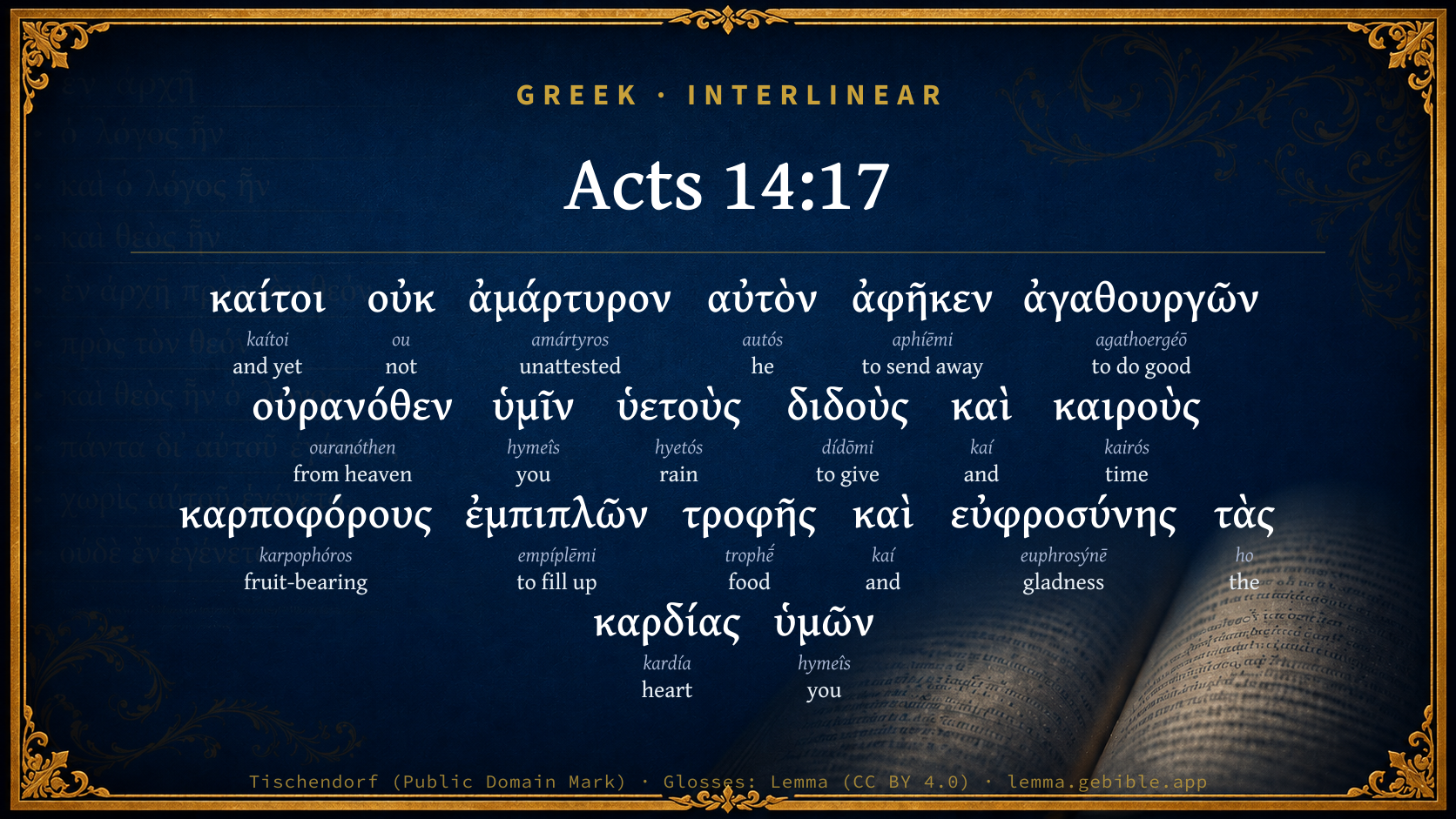
Download image
Cite this verse

Acts 14:17 (World English Bible). Public Domain. Lemma interlinear Bible study tool, https://lemma.gebible.app/v/acts/14/17.

Show BibTeX & RIS
BibTeX
RIS
English Translation
Yet he didn't leave himself without witness, in that he did good and gave you rains from the sky and fruitful seasons, filling our hearts with food and gladness."
World English Bible · Public Domain
Highlights
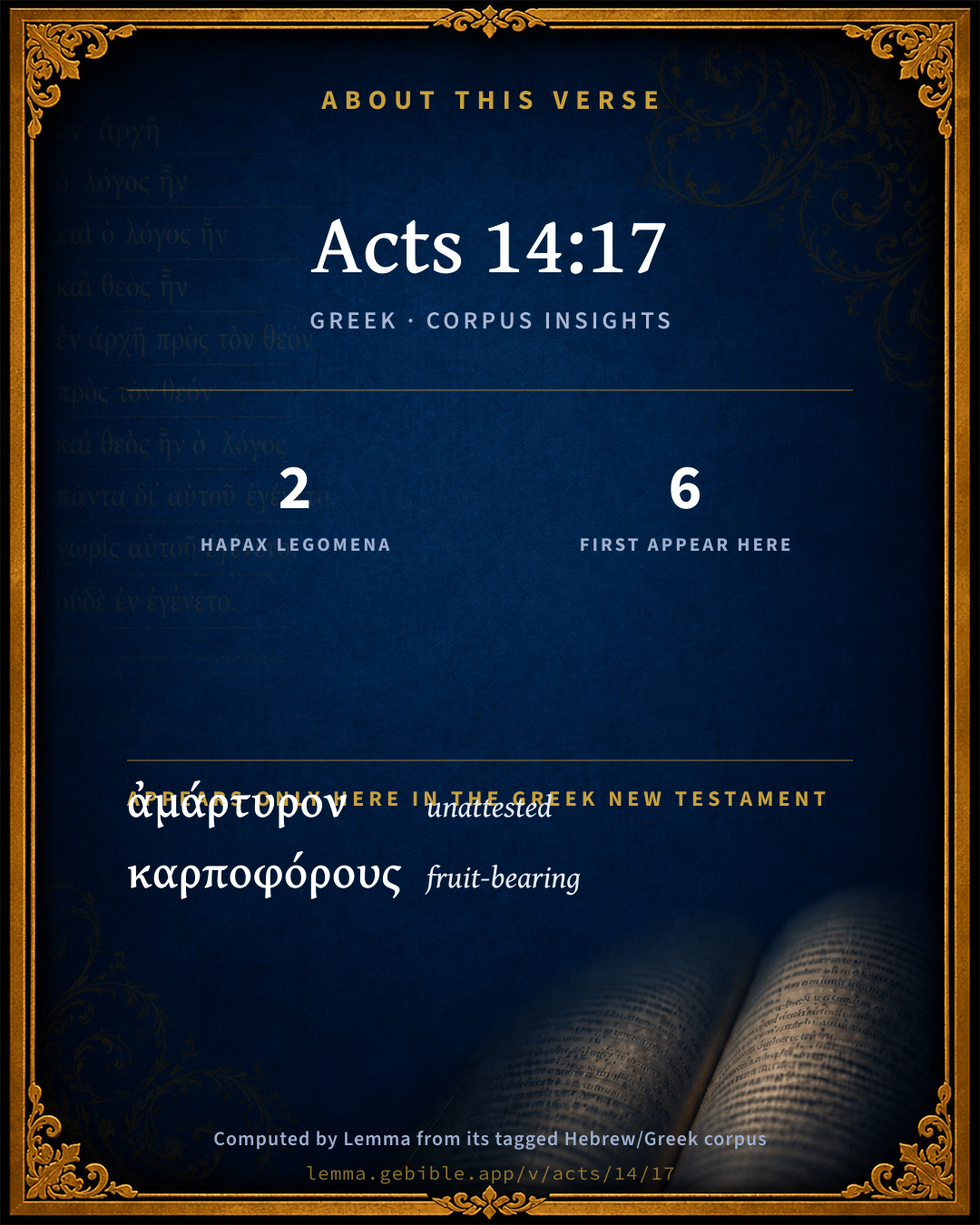
  • 2 hapax legomena — only here in the Greek New Testament
  • 6 first appearances in the Greek New Testament
Full analysis ↓
Download a study sheet

One document with this verse’s original text, its word-by-word gloss line, the meaning frame, cross-references with their text, attributed commentary, and full source and license credits — printable, and it pastes into notes with its structure intact.

This verse Autodidact and up

Study sheet (.html) Plain text (.txt)

A passage Seminary Student

Up to 50 verses in one chapter. A passage sheet keeps up to 6 commentary sources and 12 cross-references per verse, in the order this page ranks them, and says so on the sheet whenever that leaves anything out. Ask for a single verse and you get the Autodidact verse sheet above.

Everything on this page stays free to read, with no account — the sheet is a download of what is already on screen, not access to it.

Want to remove ads? Support Godless Engineer
Compare translations 3

The same verse in 3 English versions, stacked beneath the original-language interlinear above. Click any original word for its lexicon entry.

Each is an independent rendering of the whole verse — the interlinear is not word-aligned to these translations.

Highlighted words mark where these versions differ — a whole-verse word diff, not a word-by-word alignment.

  • World English Bible Public Domain
    Yet he didn't leave himself without witness, in that he did good and gave you rains from the sky and fruitful seasons, filling our hearts with food and gladness."
  • King James Version Public Domain
    Nevertheless he left not himself without witness, in that he did good, and gave us rain from heaven, and fruitful seasons, filling our hearts with food and gladness.
  • unfoldingWord Literal Text CC BY-SA 4.0
    and yet he did not leave himself without witness: doing good, giving you rains from the sky and fruitful seasons, filling your hearts with food and gladness.”

unfoldingWord Literal Text — © unfoldingWord, licensed CC BY-SA 4.0. Word-aligned USFM3 via Door43 (git.door43.org/unfoldingWord/en_ult).

Versions to compare (up to 4)

3 of 4 selected

Show all 19 translations

Every available English version of this verse, each an independent rendering of the whole verse.

  • World English Bible Public Domain
    Yet he didn't leave himself without witness, in that he did good and gave you rains from the sky and fruitful seasons, filling our hearts with food and gladness."
  • Berean Standard Bible Public Domain
    Yet He has not left Himself without testimony to His goodness: He gives you rain from heaven and fruitful seasons, filling your hearts with food and gladness.”
  • Majority Standard Bible Public Domain
    Yet He has not left Himself without testimony to His goodness: He gives you rain from heaven and fruitful seasons, filling our hearts with food and gladness.”
  • King James Version Public Domain
    Nevertheless he left not himself without witness, in that he did good, and gave us rain from heaven, and fruitful seasons, filling our hearts with food and gladness.
  • American Standard Version (1901) Public Domain
    And yet He left not himself without witness, in that he did good and gave you from heaven rains and fruitful seasons, filling your hearts with food and gladness.
  • Revised Version (1885) Public Domain
    And yet he left not himself without witness, in that he did good, and gave you from heaven rains and fruitful seasons, filling your hearts with food and gladness.
  • Geneva Bible (1599) Public Domain
    Neuerthelesse, hee left not him selfe without witnes, in that hee did good and gaue vs raine from heauen, and fruitful seasons, filling our hearts with foode, and gladnesse.
  • Douay-Rheims (1899) Public Domain
    And speaking these things, they scarce restrained the people from sacrificing to them.
  • Young's Literal Translation Public Domain
    though, indeed, without witness He did not leave himself, doing good -- from heaven giving rains to us, and fruitful seasons, filling our hearts with food and gladness;'
  • Literal Standard Version CC BY-SA 4.0
    though, indeed, He did not leave Himself without witness, doing good—giving rains to us from Heaven, and fruitful seasons, filling our hearts with food and gladness”;
  • Unlocked Literal Bible CC BY-SA 4.0
    But still, he did not leave himself without witness, in that he did good and gave you the rains from heaven and fruitful seasons, filling your hearts with food and gladness.”
  • unfoldingWord Literal Text CC BY-SA 4.0
    and yet he did not leave himself without witness: doing good, giving you rains from the sky and fruitful seasons, filling your hearts with food and gladness.”
  • Darby Bible Public Domain
    though indeed he did not leave himself without witness, doing good, and giving to you from heaven rain and fruitful seasons, filling your hearts with food and gladness.
  • World Messianic Bible Public Domain
    Yet he didn’t leave himself without witness, in that he did good and gave you rains from the sky and fruitful seasons, filling our hearts with food and gladness.”
  • Webster's Bible Public Domain
    Nevertheless he left not himself without witness, in that he did good, and gave us rain from heaven, and fruitful seasons, filling our hearts with food and gladness.
  • Free Bible Version CC BY-SA 4.0
    Even so he still provided evidence of himself by doing good, sending you rain from heaven and crops in their seasons, providing all the food you need, and filling you with happiness.”
  • Bible in Basic English Public Domain
    But he was not without witness, because he did good, and gave you rain from heaven and times of fruit, making your hearts full of food and joy.
  • Text-Critical English NT CC BY 4.0
    although he did not leave himself without a witness in that he did good by giving you rain from heaven and fruitful seasons, filling our hearts with food and gladness.”
  • Tyndale New Testament (1534) Public Domain
    Neverthelesse he lefte not him selfe with outen witnes in that he shewed his benefites in gevinge vs rayne from heaven and frutefull ceasons fyllinge oure hertes with fode and gladnes.

Literal Standard Version (2020), Covenant Press — licensed CC BY-SA 4.0. Text via the HelloAO Bible API (eBible.org). Unlocked Literal Bible (unfoldingWord) — licensed CC BY-SA 4.0. Text via the HelloAO Bible API (eBible.org). unfoldingWord Literal Text — © unfoldingWord, licensed CC BY-SA 4.0. Word-aligned USFM3 via Door43 (git.door43.org/unfoldingWord/en_ult). Free Bible Version, Dr. Jonathan Gallagher — licensed CC BY-SA 4.0. Text via the HelloAO Bible API (eBible.org).

Word by word

More ways to search: Search by grammar → Find every occurrence → Compare this word →

Practice this passage: Drill this verse → Learn its vocabulary →

ἀμάρτυρον
amártyros
G267
“unattested”
Adjective, Accusative, Singular, Masculine
Part of Speech
Adjective
Case
Accusative
Number
Singular
Gender
Masculine
Full Thayer's Definition

Origin: from G1 (as a negative particle) and a form of G3144

TDNT: None

1. without witness or testimony, unattested
  1. καίτοι kaítoi G2543 “and yet” Conjunction
  2. οὐκ ou G3756 “not” Particle, Negative
  3. αὐτὸν autós G846 “he” Personal pronoun, Accusative, Singular, Masculine
  4. ἀφῆκεν aphíēmi G863 “to send away” Verb, Aorist, Active, Indicative, 3rd person, Singular
  5. ἀγαθουργῶν agathoergéō G14 “to do good” Verb, Present, Active, Participle, Nominative, Singular, Masculine
  6. οὐρανόθεν ouranóthen G3771 “from heaven” Adverb
  7. ὑμῖν hymeîs G5210 “you” Personal pronoun, 2nd person, Dative, Plural
  8. ὑετοὺς hyetós G5205 “rain” Noun, Accusative, Plural, Masculine
  9. διδοὺς dídōmi G1325 “to give” Verb, Present, Active, Participle, Nominative, Singular, Masculine
  10. καὶ kaí G2532 “and” Conjunction
  11. καιροὺς kairós G2540 “time” Noun, Accusative, Plural, Masculine
  12. καρποφόρους karpophóros G2593 “fruit-bearing” Adjective, Accusative, Plural, Masculine
  13. ἐμπιπλῶν empíplēmi G1705 “to fill up” Verb, Present, Active, Participle, Nominative, Singular, Masculine
  14. τροφῆς trophḗ G5160 “food” Noun, Genitive, Singular, Feminine
  15. καὶ kaí G2532 “and” Conjunction
  16. εὐφροσύνης euphrosýnē G2167 “gladness” Noun, Genitive, Singular, Feminine
  17. τὰς ho G3588 “the” Article, Accusative, Plural, Feminine
  18. καρδίας kardía G2588 “heart” Noun, Accusative, Plural, Feminine
  19. ὑμῶν hymeîs G5210 “you” Personal pronoun, 2nd person, Genitive, Plural

About this verse

These counts appear in no published source. They are computed here, from the morphology-tagged text and Lemma’s own curated glosses. What Lemma adds →

20
words
18
distinct lemmas
Acts
section

Notable vocabulary

2 hapax legomena — words that appear only here in the entire Greek New Testament:

  • ἀμάρτυρον unattested G267
  • καρποφόρους fruit-bearing G2593

First appearance in Scripture

These words make their first canonical appearance in the Greek New Testament here:

  • καίτοι and yet G2543
  • ἀμάρτυρον unattested G267
  • ἀγαθουργῶν to do good G14
  • οὐρανόθεν from heaven G3771
  • ὑετοὺς rain G5205
  • καρποφόρους fruit-bearing G2593

Shared distinctive vocabulary

καίτοι and yet G2543 occurs in 2 verses of the Greek New Testament. Also found in:
Repetition

Words recur within this verse:

Cross-references

30

Topical passages linked to Acts 14:17 in the Treasury of Scripture Knowledge — connected by theme and wording, ordered by reader-vote popularity; previews shown in the World English Bible.

  • Romans 1:19–20 because that which is known of God is revealed in them, for God revealed it to them.
  • Joel 2:23 "Be glad then, you children of Zion, And rejoice in Yahweh, your God; For he gives you the former rain in just measure, And he causes the rain to come down for you, The former rain and the latter rain, As before.
  • Job 5:10 Who gives rain on the earth, And sends waters on the fields;
  • Deuteronomy 11:14 that I will give the rain of your land in its season, the former rain and the latter rain, that you may gather in your grain, and your new wine, and your oil.
  • Isaiah 5:6 I will lay it a wasteland. It won't be pruned nor hoed, But it will grow briers and thorns. I will also command the clouds that they rain no rain on it."
  • Leviticus 26:4 then I will give you your rains in their season, and the land shall yield its increase, and the trees of the field shall yield their fruit.
  • Deuteronomy 8:12–14 lest, when you have eaten and are full, and have built goodly houses, and lived therein;
  • Deuteronomy 28:12 Yahweh will open to you his good treasure in the sky, to give the rain of your land in its season, and to bless all the work of your hand: and you shall lend to many nations, and you shall not borrow.
  • Psalms 19:1–4 The heavens declare the glory of God. The expanse shows his handiwork.
  • Psalms 145:9 Yahweh is good to all. His tender mercies are over all his works.
  • Psalms 145:15–16 The eyes of all wait for you. You give them their food in due season.
  • Psalms 147:7–8 Sing to Yahweh with thanksgiving. Sing praises on the harp to our God,
  • Jeremiah 5:24 Neither say they in their heart, Let us now fear Yahweh our God, who gives rain, both the former and the latter, in its season; who preserves to us the appointed weeks of the harvest.
  • Ezekiel 34:26 I will make them and the places round about my hill a blessing; and I will cause the shower to come down in its season; there shall be showers of blessing.
  • 1 Timothy 6:17 Charge those who are rich in this present world that they not be haughty, nor have their hope set on the uncertainty of riches, but on the living God, who richly provides us with everything to enjoy;
  • James 5:17–18 Elijah was a man with a nature like ours, and he prayed earnestly that it might not rain, and it didn't rain on the earth for three years and six months.
  • 1 Kings 18:1 It happened after many days, that the word of Yahweh came to Elijah, in the third year, saying, Go, show yourself to Ahab; and I will send rain on the earth.
  • Nehemiah 9:25 They took fortified cities, and a fat land, and possessed houses full of all good things, cisterns hewn out, vineyards, and olive groves, and fruit trees in abundance: so they ate, and were filled, and became fat, and delighted themselves in your great goodness.
  • Job 37:6 For he says to the snow, 'Fall on the earth;' Likewise to the shower of rain, And to the showers of his mighty rain.
  • Psalms 36:5–7 Your loving kindness, Yahweh, is in the heavens. Your faithfulness reaches to the skies.
  • Psalms 52:1 Why do you boast of mischief, mighty man? God's loving kindness endures continually.
  • Psalms 65:9–13 You visit the earth, and water it. You greatly enrich it. The river of God is full of water. You provide them grain, for so you have ordained it.
  • Psalms 68:9–10 You, God, sent a plentiful rain. You confirmed your inheritance, when it was weary.
  • Psalms 104:24–28 Yahweh, how many are your works! In wisdom have you made them all. The earth is full of your riches.
  • Jeremiah 14:22 Are there any among the vanities of the nations that can cause rain? or can the sky give showers? Aren't you he, Yahweh our God? therefore we will wait for you; for you have made all these things.
  • Luke 6:35 But love your enemies, and do good, and lend, expecting nothing back; and your reward will be great, and you will be children of the Most High; for he is kind toward the unthankful and evil.
  • Acts 17:27–28 that they should seek the Lord, if perhaps they might reach out for him and find him, though he is not far from each one of us.
  • Job 38:26–28 To cause it to rain on a land where no man is; On the wilderness, in which there is no man;
  • Isaiah 22:13 and behold, joy and gladness, killing oxen and killing sheep, eating flesh and drinking wine: let us eat and drink, for tomorrow we shall die.
  • Matthew 5:45 that you may be children of your Father who is in heaven. For he makes his sun to rise on the evil and the good, and sends rain on the just and the unjust.

Cross-references courtesy of OpenBible.info (CC BY 4.0).

Where the printed editions differ

2 variants

Places in this verse where the major printed Greek editions disagree on the wording in a way that affects the translation — a comparison of editions, not a manuscript-by-manuscript collation. The editions are the modern critical texts (Nestlé-Aland 28/27, SBL, Westcott-Hort, Tregelles, Tyndale House) and the traditional texts behind the KJV (the Textus Receptus and the Byzantine/Majority text). It is not a claim about which reading is original.

  1. Different wording
    ὑμῖν

    “to you”

    In NA28NA27TynSBLWHTregByz Not in TR

    ἡμῖν (hēmin) 'to us' occurs in traditional manuscripts (TR) instead of ὑμῖν (humin) 'to you' in older manuscripts (NA28+NA27+Tyn+SBL+WH+Treg+Byz)

  2. Different wording
    ὑμῶν.

    “of you.”

    In NA28NA27TynSBLWHTreg Not in TRByz

    ἡμῶν (hēmōn) 'of us' occurs in traditional manuscripts (TR+Byz) instead of ὑμῶν. (humōn) 'of you.' in older manuscripts (NA28+NA27+Tyn+SBL+WH+Treg)

Textual data: Translators Amalgamated Greek New Testament (STEPBible TAGNT) · CC BY 4.0.

Commentary

Notes on Acts 14:17 from classic Christian and Jewish commentators (each source and its license shown beneath its notes). The classic Christian expositions comment on the surrounding passage and are grouped to its opening verse, so a note may address several verses; the Jewish commentaries on the Tanakh (Rashi and others) are per-verse, so they appear only where the commentator wrote on this verse.

Lemma curates 59 commentaries, every one of them public domain or Creative Commons licensed, each selected and text-cleaned for this edition rather than reprinted as found. About our sources →

Bengel's Gnomon

Johann Albrecht Bengel

Act 14:17. Οὐκ ἀμάρτυρον, not without witness) For the nations had testimony from GOD, concerning GOD. And now He decidedly commandeth (all men everywhere to repent): ch. Act 17:30.—ἀγαθοποιῶν, in that He did good) The testimony of GOD is put forth even in the punishments which He inflicts; but more properly in His acts of goodness, namely from heaven: Hos 2:21.—οὐράνοθεν, from heaven) Without doubt Paul here pointed to the heaven by a gesture (a motion of his head) or with his hand. Heaven is the seat of GOD. Comp. the expression, are come down, applied to the gods, Act 14:11.—ὑετοὺς) By the rain the heaven, earth, and sea are joined with one another. Therefore it is beautifully mentioned in this place, and perhaps there was rain at the time.—διδοὺς, giving) in the larger world [macrocosmo, opposed to the microcosmus].—καιροὺς, seasons) Days of sunshine, winds, and seasons of the year.—ἐμπιπλῶν, filling) in the little world in which we move [microcosmo].—τροφῆς, with food) in the body, daily.—εὐφροσύνης, gladness) in the mind: at festive seasons.

Bengel's Gnomon of the New Testament — English translation (T&T Clark, Edinburgh, 1860) — public domain. Text from a community e-Sword module.

Expositor's Greek Testament

ed. W. Robertson Nicoll

Act 14:17 . καίτοιγε , see critical notes. If we read καίτοι the word is only found in the N.T. here and in Heb 4:3 ; used here as an adversative conjunction; see Simcox, Language of the N. T. , p. 168, and further Blass, Gramm. , pp. 242, 264; Viteau, Le Grec du N. T. , p. 118 (1893); see Mal 2:6Mal 2:6 . ἀμάρτυρον : not in LXX or Apocrypha; only here in N.T., but in classical Greek, and also in Josephus, see instances in Wetstein. This witness is not as at Athens, Act 17:27 , Rom 2:15 , to man’s consciousness and conscience, but rather to God’s presence in nature, cf. for the expression LXX, Ps. 88:37, ὁ μάρτυς ἐν οὐρανῷ πιστός , and Pseudo-Heracleitus, letter iv., where the moon is spoken of as God’s οὐράνιος μαρτυρία ; see below on Act 14:17 . οὐκ ἀφῆκεν : non reliquit sed sivit (Blass). ἀγαθοποιῶν , see critical notes. Neither ἀγαθουργέω nor ἀγαθοεργέω , 1Ti 6:18 , occur in classical Greek or LXX. T.R. uses the more familiar word; found three times in Luke’s Gospel and elsewhere in N.T., and also a few times in LXX (in different senses), but not in classical Greek; see Plummer on Luk 6:33 , and Hatch, Essays in B. G. , p. 7.

The Expositor's Greek Testament, edited by W. Robertson Nicoll (1897–1910) — public domain. Text from a community e-Sword module.

Jamieson, Fausset & Brown

Robert Jamieson, A. R. Fausset & David Brown

Nevertheless he left not himself without witness--Though the heinousness of idolatry is represented as so much less in the heathen, by how much they were outside the pale of revealed religion, he takes care to add that the heathen have divine "witness" enough to leave them "without excuse."

he did good--scattering His beneficence everywhere and in a thousand forms.

rain from heaven, and fruitful seasons--on which human subsistence and all human enjoyment depend. In Lycaonia, where, as ancient writers attest, rain is peculiarly scarce, this allusion would have all the greater effect.

filling our hearts with food and gladness--a natural colloquialism, the heart being gladdened by the food supplied to the body.

Jamieson, Fausset & Brown — Commentary Critical and Explanatory on the Whole Bible (1871) — public domain (CC PDM 1.0). Text via the HelloAO Bible API.

Adam Clarke's Commentary

Verse 17. He left not himself without witness] Though he gave the Gentiles no revelation of his will, yet he continued to govern them by his gracious providence; doing them good in general; giving then rain to fertilize their grounds, and fruitful seasons as the result; so that grass grew for the cattle and corn for the service of man.

Filling our hearts with food] Giving as much food as could reasonably be wished, so that gladness, or general happiness, was the result. Such was the gracious provision made for man, at all times, that the economy and bounty of the Divine Being were equally evidenced by it. He never gives less than is necessary, nor more than is sufficient. His economy forbids men to waste, by going them in general no profusion. His bounty forbids them to want, by giving as much as is sufficient for all the natural wants of his creatures. By not giving too much, he prevents luxury and riot: by giving enough, he prevents discontent and misery. Thus he does mankind good, by causing his rain to descend upon the just and the unjust, and his sun to shine upon the evil, and the good. Thus he is said not to have left himself without witness: for his providential dealings are the witnesses of his being, his wisdom, and his bounty; and thus the invisible things of God, even his eternal power and Godhead, were clearly seen, being understood by the things which are made, Ro 1:20. Therefore those who continued to worship stocks and stones were without excuse. These were great and striking truths; and into what detail the apostles now went, we cannot say; but it is likely that they spoke much more than is here related, as the next verse states that, with all these sayings, they found it difficult to prevent the people from offering them sacrifice.

Adam Clarke's Commentary on the Bible (1810–1826) — public domain. Text from a community e-Sword/MySword module.

John Calvin's Commentaries

17. Notwithstanding, he did not suffer himself to be without witness. Paul and Barnabas take from the Gentiles in this place the cloak [pretext] of ignorance. For how greatly soever men please themselves in their own inventions, being at length convicted of error, they fly unto this fortress, [asylums] that they ought to bear no blame; but that God was rather cruel, who did not vouchsafe so much as. with one hiss to call those back whom he saw perish, [perishing.] Paul and Barnabas cut off this frivolous objection, when they show that God lay hid in such sort, that he [still] bare witness of himself and his divinity. Notwithstanding, we must see how these two things can hang together; for if God bare witness of himself, he did not suffer (so much as in him lay) the world to err. I answer, that this kind of testimony, whereof mention is made, was such as that it made men without excuse, and yet was it not sufficient to salvation. For that of the apostle is true, that by faith it is understood that the worlds were ordained by the word of God, (Hebrews 11:3.) But faith is not conceived by the bare beholding of the heaven and earth, but by the hearing of the word. Whereupon it followeth, that men are brought by the direction of the word alone unto that knowledge of Almighty God which bringeth salvation. And yet this letteth not but that they may be made without excuse, even without the word, who, though they be naturally deprived of light, are blind notwithstanding, through their own malice, as Paul teacheth in the first chapter to the Romans.

Giving rain and fruitful seasons. God hath, indeed, revealed himself to all mankind by his word since [from] the beginning. But Paul and Barnabas show that there was no age on which God did not bestow benefits, which might testify that the world is governed by his government (and commandment;) and because the light of doctrine had been buried long thee, therefore they say only, that God was showed by natural arguments, [evidences.] And it is to be thought that they did, in such sort, set forth the magnificence and greatness of the works of God as became them; but it was sufficient for Luke to touch the (sums and) chief points of matters. Neither do I so understand it, that they intreated subtlety, and after the manner of the philosophers, of the secrets of nature, for they spake unto an unlearned multitude; therefore it behooved them to set that before them plainly which the most ignorant did know. Notwithstanding they take this principle, that in the order of nature there is a certain and evident manifestation of God, in that the earth is watered with rain; in that the heat of the sun doth comfort it; in that there cometh such abundance of fruit out of the same yearly, it is thereby gathered for a surety, that there is some God who governeth all things. For even the heaven and earth are not moved or governed by their own motion, and much less by fortune. Therefore it remaineth, that this wonderful workmanship of nature doth manifestly show the providence of God; and those who said that the world was eternal spake not as they thought, but they went about by malicious and barbarous unthankfulness [ingratitude] to suppress the glory of God, wherein they betrayed their impudence.

Filling with meat and gladness. The ungodliness of men is more convict in that, if they knew not God, because he cloth not only set before their eyes testimonies of his glory in his works, but doth also appoint all things for their use. For why doth the sun and stars shine in the heavens, save only that they may serve men? Why doth the rain fall from heaven? Why doth the earth bring forth her increase, save only that they may minister food to men? Therefore, God hath not set man upon earth that he may be an idle beholder of his work, as being set upon a theater, but to exercise himself in praising the liberality of God, whilst that he enjoyeth the riches of heaven and earth. And now, is it not more than filthy forwardness [depravity] not to be moved with so great goodness of God in the manifold abundance of things? To fill the hearts with meat, doth signify nothing else but to give food which may satisfy the desires of men. By this word gladness, Paul and Barnabas do mean that God doth give more to men, according to his infinite goodness, than their necessity doth require; as if it had been said, that men have meat given them not only to refresh their strength, but also to make their hearts merry.

If any man do object that it falleth out so oftentimes that men do rather mourn, being hungry, then rejoice, being full; I answer, that that cometh to pass contrary to the order of nature; namely, when the Lord shutteth his hand because of the sins of men. For the liberality of God should flow unto us abundantly of his [its] own accord, as it is here described by Paul and Barnabas, unless it were kept back by the lets of our vices. And yet there was never so great barrenness wherein the blessing of God in feeding men did quite wither away. It was, indeed, well said of the prophet, Open thy mouth, and I will fill it, (Psalm 81:10,) that we may know that we be hungry through our own fault, whilst that we do not admit the goodness of God. But how unworthy soever we be and straight, yet the fatherly love of God breaketh through even unto the unworthy. Especially the generality of mankind doth testify that the benefits of God do never cease, wherein he appeareth to be our Father.

John Calvin's Commentaries (1540-1563) — public domain. Text from the Calvin Translation Society English edition (1840s-50s) via the Christian Classics Ethereal Library (ccel.org). Calvin's coverage is partial (roughly two-thirds of the Bible); uncommented books and verses are honest gaps, never fabricated. The 19th-century editor's footnotes and remarks are omitted so the notes are faithfully Calvin's own voice.

Ellicott's Commentary for English Readers

(17) He left not himself without witness.—Here again we have the outline of what is afterwards expanded (Rom_1:19-20). In speaking to peasants like those at Lystra, St. Paul naturally dwells most on the witness given through the divine goodness as manifested in nature. In addressing philosophers at Athens and at Rome, he points to the yet fuller witness of consciousness and conscience (Act_17:28; Rom_2:14-15).

In that he did good.—Better, as expressing the continuous manifestation of the divine will, “working good, giving rain, filling our hearts.” The MSS. vary, some giving “us” and “our,” and some “you” and “your.” The former is more characteristic of the sympathy which led St. Paul to identify himself with Gentile as well as Jew. The “joy of harvest” (Isa_9:3) was the common inheritance of each. The latter words in the Greek, from “giving us rain from heaven,” are so distinctly rhythmical that they suggest the thought that St. Paul quotes from some hymn of praise which he had heard in a harvest or vintage festival, and which, as with the altar to the Unknown God at Athens, he claims as due to Him whom men ignorantly worshipped. (See Note on Act_17:23.)

A Bible Commentary for English Readers, edited by Charles John Ellicott (1878–1897) — public domain. Text from a community e-Sword module.

The Cambridge Bible for Schools and Colleges

gen. ed. J. J. S. Perowne

17. he left not himself without witness] This is the same argument which the Apostle employs (Act_17:27) to the more philosophic multitude whom he addressed on Mars’ hill. God’s natural teaching is meant to speak alike to all men. Cp. also the similar reasoning in Rom_1:19-20.

and gave us rain] The oldest MSS. read “gave you,” and this is the more natural language, for the Apostle could not include himself among those to whom God’s appeal was made through the gifts of nature only.

A few rather unusual words and forms which occur in this verse have suggested to some that we have here a fragment of a Greek poem on the bounties of nature, which the Apostle quotes, as he sometimes does quote the Greek poets, to illustrate his speech from the language familiar to his hearers. Attempts have therefore been made to arrange the words into some dithyrambic metre. But it is hardly probable that St Paul would quote Greek poetry to the people in Lycaonia, to whom Greek was not sufficiently familiar for them to appreciate its literature to the extent which this supposition presumes, and certainly the other quotations which he makes from Greek authors (Act_17:28; 1Co_15:33; Tit_1:12) are used to much more cultured audiences.

The Cambridge Bible for Schools and Colleges (gen. ed. J. J. S. Perowne; Cambridge University Press, 1878–1918) — public domain. Text from a community e-Sword module.

John Gill's Exposition

Nevertheless, he left not himself without witness,.... Of his kindness and goodness to them, during this long interval and period of time; for they had not the written law, yet they were not destitute of the law of nature; and had, besides, many instances of providential goodness, by which they might have known God: and should have been thankful to him, and glorified him as God, and not have worshipped the idols of their own hands; the goodness of God should have led them to repentance, and not have been abused to so many wicked purposes as it had been:

in that he did good; in a providential way, to persons very undeserving of it, of which some particular instances follow:

and gave us rain from heaven, which none of the gods of the Gentiles could, do, Jer 14:22. So , "the key of rains", is by the Jews (a) said to be one of the keys which God has in his own hands, and which he does not commit to any other: and a wonderful blessing is this to mankind, and which God gives to the just and to the unjust, and did give to the ignorant and idolatrous Gentiles. Beza's most ancient copy, and four other ancient copies of his, and some others, read "you", instead of "us"; which reading seems most agreeable:

and fruitful seasons; spring, summer, harvest, and autumn, at which several times, different fruits of the earth appear:

filling our hearts with food and gladness; giving a sufficiency of food, and even an abundance of it, and that for pleasure and delight, as well as for support and refreshment: the Syriac version reads, "their hearts"; some copies read, "your hearts".

(a) Targum Jerus. in Gen. xxx. 22. & Jon. in Deut. xxviii. 12.

John Gill's Exposition of the Whole Bible (1746–1763) — public domain (CC PDM 1.0). Text via the HelloAO Bible API.

Trapp's Complete Commentary

John Trapp

17 Nevertheless he left not himself without witness, in that he did good, and gave us rain from heaven, and fruitful seasons, filling our hearts with food and gladness.

Ver. 17. He left not himself] Here they might object, that God in suffering men so to wander, showed not himself so kind and bountiful. The apostle answers, that God had sufficiently sealed up his general love and goodness, in doing good, giving rain from heaven, &c. Stars are the storehouses of God’s good treasure, which he openeth to our profit, Deu 28:12. By their influence they make a scatter of riches upon the earth, which good men gather, bad men scramble for. Every of the heavenly bodies is a purse of gold, out of which God throws down riches and plenty upon the earth.

And fruitful seasons] If St Paul had thought well of the Sibyl’s oracles (saith learned Beza) it was wonder he had not here mentioned them. Casaubon and Obsopaeus reckon them for no better than officious lies.

John Trapp, A Commentary or Exposition upon All the Books of the Old and New Testament (1647–1656) — public domain. Text from a community e-Sword module.

Albert Barnes' Notes on the Bible

Nevertheless - Though he gave them no revelation.

He left not himself without witness - He gave demonstration of his existence and of his moral character.

In that he did good - By doing good. The manner in which he did it, Paul immediately specifies. Idols did not do good; they conferred no favors, and were, therefore, unworthy of confidence.

And gave us rain from heaven - Rain from above - from the clouds, Mar 8:11; Luk 9:54; Luk 17:29; Luk 21:11; Joh 6:31-32. Rain is one of the evidences of the goodness of God. Man could not cause it; and without it, regulated at proper intervals of time and in proper quantities, the earth would soon be one wide scene of desolation. There is scarcely anything which more certainly indicates unceasing care and wisdom than the needful and refreshing showers of rain. The sun and stars move by fixed laws, whose operation we can see and anticipate. The falling of rain is regulated by laws which We cannot trace, and it seems, therefore, to be poured, as it were, directly from God’s hollow hand, Psa 147:8, “Who covereth the heaven with clouds; who prepareth rain for the earth.”

And fruitful seasons - Seasons when the earth produces abundance. It is remarkable, and a striking proof of the divine goodness, that so few seasons are unfruitful. The earth yields her increase; the labors of the farmer are crowned with success; and the goodness of God demands the expressions of praise. God does not forget his ancient covenant Gen 8:22, though man forgets it, and disregards his great Benefactor.

Filling our hearts with food - The word “hearts” is used here as a Hebraism, to denote “persons” themselves; filling us with food, etc. Compare Mat 12:40.

Gladness - Joy; comfort the comfort arising from the supply of our constantly returning needs. This is proof of everwatchful goodness. It is a demonstration at once that there is a God, and that he is good. It would be easy for God to withdraw these blessings, and leave us to want. A single word, or a single deviation from the fullness of benevolence, would blast all these comforts, and leave us to lamentation, woe, and death, Psa 104:27-29; Psa 145:15-16.

Albert Barnes' Notes on the Bible (1834–1885) — public domain. Text from a community e-Sword/MySword module.

Matthew Poole's English Annotations

These words are to prevent that cavil, Why does God yet complain? and inform them, that though God had not given them, nor their ancestors, his laws written in tables of stone, as he had given to the Jews; yet they had the law written in their hearts, which they had not obeyed, though God’s manifold mercies, his works of creation and providence, had testified unto them, that he only was to be feared and worshipped. How many witnesses hath God against sinful man, when every creature and providence speaks his power, wisdom, goodness, &c., and call upon us to love and obey him? Every creature tells us that God made it, &c.

Matthew Poole's English Annotations on the Holy Bible (1683–1685) — public domain. Text from a community e-Sword/MySword module.

The Pulpit Commentary

And yet for nevertheless, A.V.; you from heaven rains for us rain from hearer, A.V. and T.R.; your for our, A.V. and T.R. Observe how the apostle adapts his preaching to his hearers. How different this address to the heathen Lycaonians from those to Jews and proselytes! Here he leads them from nature to God; there from prophecy to Jesus.

The witness of harvest-times.

For the point as presented to a very different audience, see Rom_1:19, Rom_1:20; Act_17:28. It has been remarked that the Greek words here used by the apostle are "so distinctly rhythmical that they suggest the thought that St. Paul quotes from some hymn of praise which he had heard in a harvest or vintage festival, and which, as with the altar to the Unknown God at Athens, he claims as due to him whom men ignorantly worshipped." A sentence from Neander may give the key-note to the sermon. He says, The whole creation, as a revelation of God, especially of his almightiness and goodness, is designed to arouse the spirit of man to a perception of the inward revelation of God." Introduce the subject by a picture of the scene connected with it. An occasion was made for declaring the relations of nature with religion. Fix thought on the one nature-scene of harvest, and apply St. Paul"s teaching; first showing how fully in harmony with his views this representation was, and what support Holy Scripture gives to it.

I GOD MAY SPEAK TO HIS CREATURES BY THE VOICE OF NATURE, AND HE DOES THUS SPEAK TO THEM ALL.

1. God must use some agency in revealing his mind to his creatures.

2. The agency he uses must be in relation to our bodily senses.

3. It need not be fashioned into precise words, because man"s heart can be reached through the eye, the ear, the taste, as well as by verbal statements. Illustrate the impressions of beautiful landscape, music of the waters, thunderstorms, etc. Any of the things that man can feel God can use to convey his mind and message to him. The voices of God in nature are translated for us by our poets, who are if they fit into their true mission ministers of God"s will to men, or rather, ministers revealing Godhimself to men. See how the psalmist recognizes the universal witness of this nature-voice: "Their sound is gone out through all the earth, their words to the end of the world;" and apply especially to the harvest-time of earth, which knits the millions of earth together in the joyful recognition of God"s loving care and providing mercies.

II WHAT OF THIS NATURE-WITNESS TO GOD MAY ALL MEN RECEIVE?

1. The truth of the Divine unity; for it is plain to all that nature is a design some one person"s design. Its perfect harmonies suggest this. Andincreasing knowledge corrects the notion of two agents, which men have been tempted to accept, when impressed with the seemingly injurious forces working in nature. Science, in making more plain the perfect harmony of all nature-forces, is giving her testimony to the unity of God. And then comes on us this consideration: if there be but one God, our supreme concern is to be in right relations with him.

1. The truth that he is infinite in power; for nature shows us that he is infinite in resources.

2. The truth that he is infinitely good; for nature shows him to us fitting all things together to secure the general well-being. Nature suggests the attractiveness and beautifulness of God.

III WHAT MORE THAN THIS CAN NATURE WITNESS OF GOD TO THE CHRISTIAN? The Christian man comes back upon nature with the illuminations of that higher and fuller revelation which has for a time absorbed him from the vision of God, manifest in Christ Jesus, which was so glorious as for a while to occupy his thought and feeling wholly. But coming back with these new thoughts of God, he finds Nature has new voices and new messages, and her provisions tell him:

1. Of God"s care.

2. Of God"s long-suffering and mercy; for he knows now that man has no deserts upon which he might claim, and positive ill deserts which might reasonably lead to the removal of his common every-day mercies.

3. Of God"s great love to man"s soul, which seems shown by its overflow in God"s gracious provision in nature for all the wants of his body.

4. Of God"s faithfulness to all his promises, which are assured in his yearly fulfillment of that earliest promise that "seed-time and harvest shall not cease." Press, in conclusion, how St. Paul urges that the proper influence of nature is a constant and mighty persuasion to turn from all our vanities to the loving and hearty service of the one living God, and to accept of the full salvation which he has provided in the person of his Son Jesus Christ. R.T.

The Pulpit Commentary (1880–1919), ed. H.D.M. Spence-Jones & Joseph S. Exell — public domain. Text from a community e-Sword module.

John Wesley's Explanatory Notes

He left not himself without witness - For the heathens had always from God himself a testimony both of his existence and of his providence; in that he did good - Even by punishments he testifies of himself; but more peculiarly by benefits; giving rain - By which air, earth, and sea, are, as it were, all joined together; from heaven - The seat of God; to which St. Paul probably pointed while he spoke, filling the body with food, the soul with gladness.

John Wesley, Explanatory Notes Upon the Whole Bible (1754–1765) — public domain. Text via the GEBible commentary corpus.

McGarvey & Pendleton's Commentaries

J. W. McGarvey

See notes one verse 14

J. W. McGarvey (with Philip Y. Pendleton), Commentaries on the New Testament (The Fourfold Gospel, 1914; Acts; and the epistles) — public domain. Text from a community e-Sword/MySword module.

unfoldingWord translationNotes

Door43 World Missions Community

Connecting Statement:

Paul and Barnabas continue speaking to the crowd outside the city of Lystra. (See: Acts 14:8)

he did not leave himself without witness

This could also be stated in positive form. AT: "God has certainly left a witness" or "God has indeed testified" (See: Litotes)

in that

"as shown by the fact that"

filling your hearts with food and gladness

Here "you hearts" refers to the people. AT: "giving you enough to eat and things about which to be happy" (See: Metonymy)

Paul and Barnabas barely kept the multitudes from sacrificing to them

Paul and Barnabas stopped the multitude from sacrificing to them, but it was difficult to do so.

barely kept

"had difficulty preventing"

translationWords

testimony

heart

Paul

Barnabas

sacrifice

unfoldingWord translationNotes — © Distant Shores Media and the Door43 World Missions Community, licensed CC BY-SA 4.0. Source: git.door43.org/Door43/en_tn.

Cambridge Greek Testament for Schools and Colleges

17. ἀγαθουγῶν for ἀγαθοποιῶν with אABC.

17. οὐκ ἀμάρτυρον αὐτὸν ἀφῆκεν, He left not Himself without witness. This is the same argument which the Apostle employs (Act 17:27) to the more philosophic multitude whom he addressed on Mars’ Hill. God’s natural teaching is meant to speak alike to all men. Cf. also the similar reasoning in Rom 1:19-20.

ὑμῖν ὑετοὺς διδούς, giving you rain. The reading ἡμῖν of the Text. recept. seems unnatural. For the Apostle could not include himself amongst those to whom God’s appeal had been made through the gifts of nature only.

A few rather unusual words and forms which occur in this verse have suggested to some that we have here a fragment of a Greek poem on the bounties of nature, which the Apostle quotes, as he sometimes does quote the Greek poets, to illustrate his speech from the language familiar to his hearers. Attempts have therefore been made to arrange the words into some dithyrambic metre. But it is hardly probable that St Paul would quote Greek poetry to the people in Lycaonia, to whom Greek was not sufficiently familiar for them to appreciate its literature to the extent which this supposition presumes, and certainly the other quotations which he makes from Greek authors (Act 17:28; 1Co 15:33; Tit 1:12) are used to much more cultured audiences.

τὰς καρδίας ὑμῶν, your hearts, to correspond with the first part of the verse. With the Greeks καρδία was the seat of the appetites, so that there could be no harshness in such an expression as ‘to fill the heart with food.’

Cambridge Greek Testament for Schools and Colleges (Cambridge University Press, 1896; 21 vols, various authors incl. Carr, Maclear, Plummer, Farrar, Lumby, Moule, M. R. James, Simcox) — public domain. Text from a community e-Sword module.

Alford’s Greek Testament

Henry Alford

17.] Compare Rom 1:19, Rom 1:20. The words οὐρανόθεν ὑετοὺς διδούς had a remarkable applicability in a country where we have seen from Strabo (on ver. 6) that there was great scarcity of water. He relates that in one city of Lycaonia, where water was reached by digging the wells very deep, it was sold for money. The idea of Mr. Humphry, that the conclusion of this speech is a citation from some lyric poet, seems improbable on other accounts, and is rendered more so by the above-noticed propriety.

Henry Alford, The Greek Testament (1849–1861) — public domain. Text from a community e-Sword module.

Vincent's Word Studies in the New Testament

Marvin R. Vincent

Rains. Jupiter was Lord of the air. He dispensed the thunder and lightning, the rain and the hail, the rivers and tempests. "All signs and portents whatever, that appear in the air, belong primarily to him, as does the genial sign of the rainbow" (Gladstone, " Homer and the Homeric Age "). The mention of rain is appropriate, as there was a scarcity of water in Lycaonia.

Food. Mercury, as the God of merchandise, was also the dispenser of food.

"No one can read the speech without once more perceiving its subtle and inimitable coincidence with his (Paul 's) thoughts and expressions. The rhythmic conclusion is not unaccordant with the style of his most elevated moods; and besides the appropriate appeal to God 's natural gifts in a town not in itself unhappily situated, but surrounded by a waterless and treeless plain, we may naturally suppose that the 'filling our hearts with food and gladness ' was suggested by the garlands and festive pomp which accompanied the bulls on which the people would afterward have made their common banquet" (Farrar, " Life and Work of Paul "). For the coincidences between this discourse and other utterances of Paul, compare ver. 15, and 1Th 1:9; ver. 16, and Rom 3:25; Act 17:30; ver. 17, and Rom 1:19, 20.

Marvin R. Vincent, Word Studies in the New Testament (1887–1900) — public domain. Text from a community e-Sword/MySword module.

Lesson kit

Teaching starters — assembled from the data on this page, not authored interpretation. Every prompt links to the verse data it draws on. Edit before teaching.

Acts, in the Acts, opens this verse with 20 words (18 distinct Greek lemmas). Its most distinctive word is amártyros (“unattested”). A historical commentator’s framing appears above. Read the whole chapter for the surrounding context.

Discussion questions

  1. The word amártyros carries the sense “unattested.” How does it shape the verse?
  2. This verse holds 2 words here found nowhere else in the Greek New Testament. What might the rare words draw attention to?
  3. 6 words here appear for the first time in Scripture. What is being introduced at this debut?
  4. Hebrews 4:3 shares the word «and yet» with this verse. How do the two illuminate each other?
  5. “you” occurs 2× in this one verse. What is the effect of the repetition?
  6. These translations render this verse differently. What is at stake in choosing one wording over another?
  7. Reading how Bengel's Gnomon and Expositor's Greek Testament read this verse, where do the two commentators agree and where do they part?

Things to notice

  • 2 words in this verse appear nowhere else in the Greek New Testament.
  • 6 words make their first canonical appearance in Scripture here.
  • These translations choose different wording for 13 words in this verse.
  • “you” occurs 2× in this single verse.
  • 18 distinct Greek lemmas span 20 words in this verse.

Reading settings

Reading text

Shown beneath each verse's original-language words.

Old Testament
Old Testament edition

Read the OT as the Masoretic Hebrew (MT) or the Greek Septuagint (LXX).

English shown for the Greek Septuagint (in the Hebrew ↔ Greek comparison).

Comparing translations? Open the Compare panel on any verse page to stack up to four side by side.