

Acts 8:22
Greek (Tischendorf 8th ed.) Acts 8:22 appears in the Greek New Testament. The text above is from the Tischendorf 8th edition. Each word links to its Strong’s number and a concise gloss. Click any word for its full Thayer’s Greek Lexicon entry.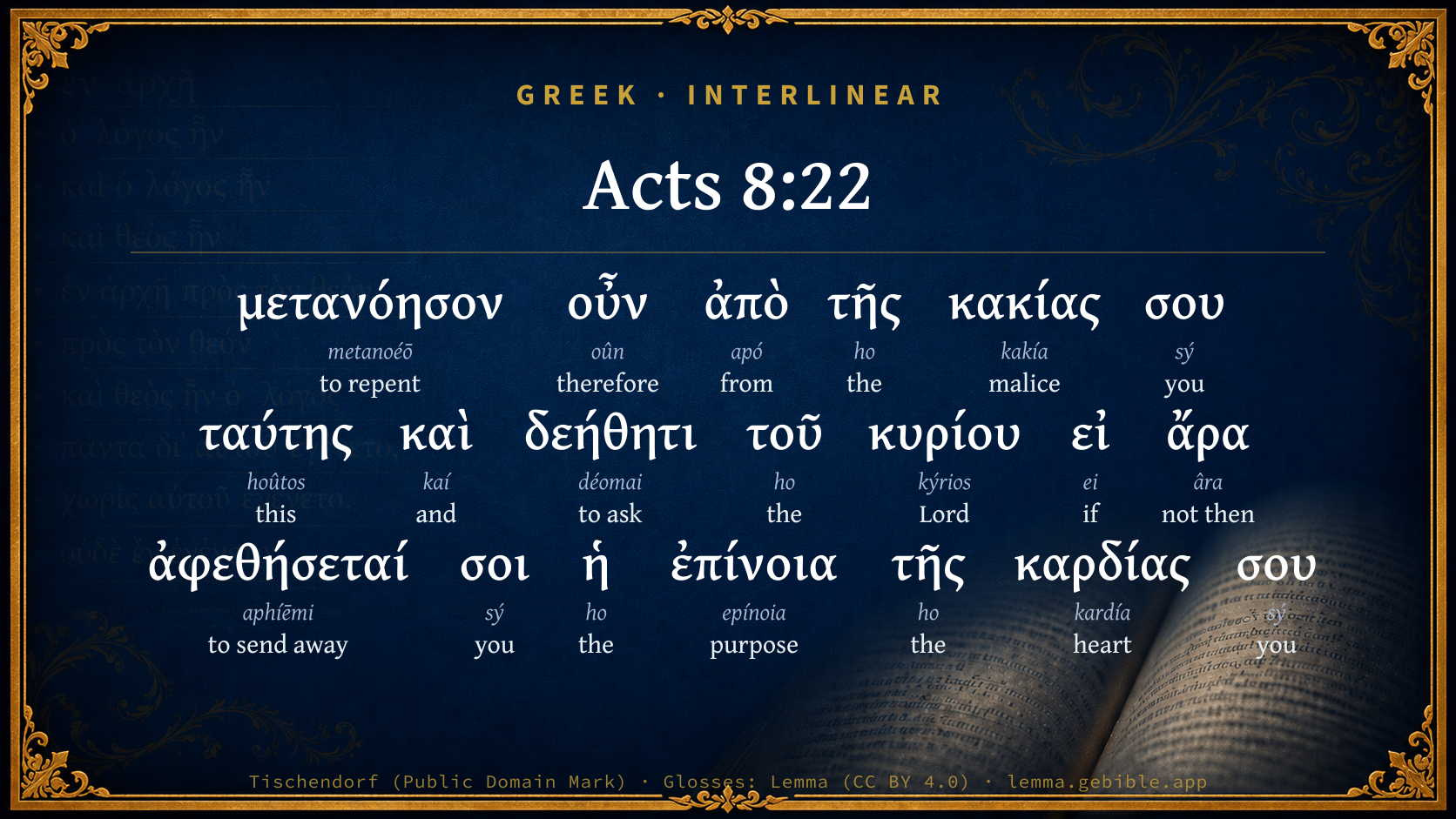
Repent therefore of this, your wickedness, and ask God if perhaps the thought of your heart may be forgiven you.
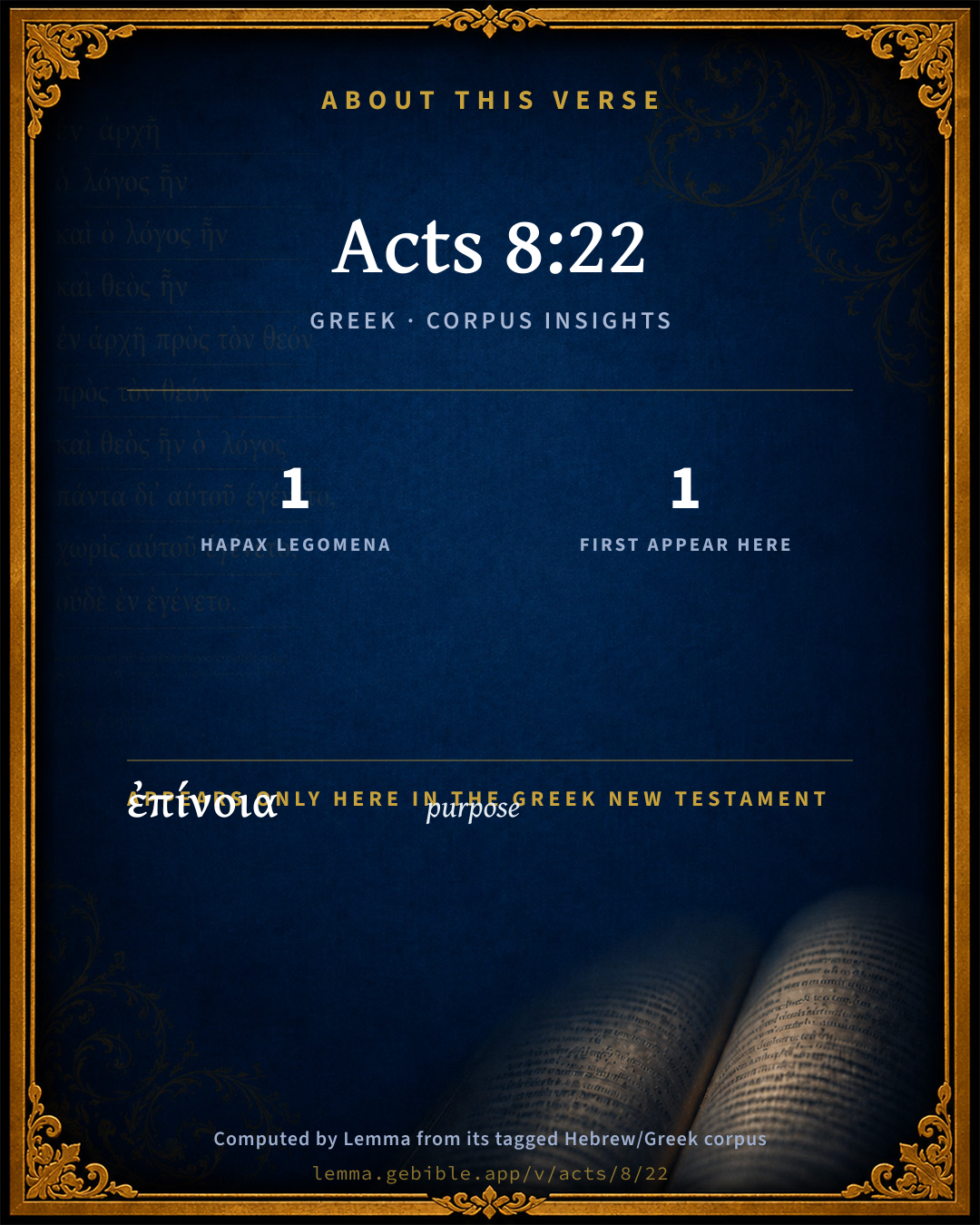
- 1 hapax legomenon — only here in the Greek New Testament
- 1 first appearance in the Greek New Testament
Download a study sheet
One document with this verse’s original text, its word-by-word gloss line, the meaning frame, cross-references with their text, attributed commentary, and full source and license credits — printable, and it pastes into notes with its structure intact.
This verse Autodidact and up
A passage Seminary Student
Up to 50 verses in one chapter. A passage sheet keeps up to 6 commentary sources and 12 cross-references per verse, in the order this page ranks them, and says so on the sheet whenever that leaves anything out. Ask for a single verse and you get the Autodidact verse sheet above.
Everything on this page stays free to read, with no account — the sheet is a download of what is already on screen, not access to it.
Compare translations 3
The same verse in 3 English versions, stacked beneath the original-language interlinear above. Click any original word for its lexicon entry.
Each is an independent rendering of the whole verse — the interlinear is not word-aligned to these translations.
Highlighted words mark where these versions differ — a whole-verse word diff, not a word-by-word alignment.
-
World English Bible Public Domain
Repent therefore of this, your wickedness, and ask God if perhaps the thought of your heart may be forgiven you.
-
King James Version Public Domain
Repent therefore of this thy wickedness, and pray God, if perhaps the thought of thine heart may be forgiven thee.
-
unfoldingWord Literal Text CC BY-SA 4.0
Therefore repent of this wickedness of yours, and pray to the Lord, if therefore the intention of your heart will be forgiven to you.
unfoldingWord Literal Text — © unfoldingWord, licensed CC BY-SA 4.0. Word-aligned USFM3 via Door43 (git.door43.org/unfoldingWord/en_ult).
Show all 19 translations
Every available English version of this verse, each an independent rendering of the whole verse.
-
World English Bible Public Domain
Repent therefore of this, your wickedness, and ask God if perhaps the thought of your heart may be forgiven you.
-
Berean Standard Bible Public Domain
Repent, therefore, of your wickedness, and pray to the Lord. Perhaps He will forgive you for the intent of your heart.
-
Majority Standard Bible Public Domain
Repent, therefore, of your wickedness, and pray to God. Perhaps He will forgive you for the intent of your heart.
-
King James Version Public Domain
Repent therefore of this thy wickedness, and pray God, if perhaps the thought of thine heart may be forgiven thee.
-
American Standard Version (1901) Public Domain
Repent therefore of this thy wickedness, and pray the Lord, if perhaps the thought of thy heart shall be forgiven thee.
-
Revised Version (1885) Public Domain
Repent therefore of this thy wickedness, and pray the Lord, if perhaps the thought of thy heart shall be forgiven thee.
-
Geneva Bible (1599) Public Domain
Repent therefore of this thy wickednes, and pray God, that if it be possible, the thought of thine heart may be forgiuen thee.
-
Douay-Rheims (1899) Public Domain
Do penance therefore for this thy wickedness; and pray to God, that perhaps this thought of thy heart may be forgiven thee.
-
Young's Literal Translation Public Domain
reform, therefore, from this thy wickedness, and beseech God, if then the purpose of thy heart may be forgiven thee,
-
Literal Standard Version CC BY-SA 4.0
convert, therefore, from this your wickedness, and implore God, if then the purpose of your heart may be forgiven you,
-
Unlocked Literal Bible CC BY-SA 4.0
Therefore repent of this wickedness of yours, and pray to the Lord, so that he might perhaps forgive you for the intention of your heart.
-
unfoldingWord Literal Text CC BY-SA 4.0
Therefore repent of this wickedness of yours, and pray to the Lord, if therefore the intention of your heart will be forgiven to you.
-
Darby Bible Public Domain
Repent therefore of this thy wickedness, and supplicate the Lord, if indeed the thought of thy heart may be forgiven thee;
-
World Messianic Bible Public Domain
Repent therefore of this, your wickedness, and ask God if perhaps the thought of your heart may be forgiven you.
-
Webster's Bible Public Domain
Repent therefore of this thy wickedness, and pray God, if perhaps the thought of thy heart may be forgiven thee.
-
Free Bible Version CC BY-SA 4.0
Repent of your evil ways! Pray to the Lord and ask forgiveness for thinking like this.
-
Bible in Basic English Public Domain
Let your heart be changed, and make prayer to God that you may have forgiveness for your evil thoughts.
-
Text-Critical English NT CC BY 4.0
Therefore repent of this wickedness of yoʋrs, and plead with God in the hope that the intention of yoʋr heart might be forgiven yoʋ.
-
Tyndale New Testament (1534) Public Domain
Repent therfore of this thy wickednes and praye God that the thought of thyne hert maye be forgeven the.
Literal Standard Version (2020), Covenant Press — licensed CC BY-SA 4.0. Text via the HelloAO Bible API (eBible.org). Unlocked Literal Bible (unfoldingWord) — licensed CC BY-SA 4.0. Text via the HelloAO Bible API (eBible.org). unfoldingWord Literal Text — © unfoldingWord, licensed CC BY-SA 4.0. Word-aligned USFM3 via Door43 (git.door43.org/unfoldingWord/en_ult). Free Bible Version, Dr. Jonathan Gallagher — licensed CC BY-SA 4.0. Text via the HelloAO Bible API (eBible.org).
Word by word
More ways to search: Search by grammar → Find every occurrence → Compare this word →
Practice this passage: Drill this verse → Learn its vocabulary →
- Appears 1× in the Greek New Testament
- First appears here
- Part of Speech
- Noun
- Case
- Nominative
- Number
- Singular
- Gender
- Feminine
Full Thayer's Definition
- μετανόησον metanoéō G3340 “to repent” Verb, Aorist, Active, Imperative, 2nd person, Singular
- οὖν oûn G3767 “therefore” Conjunction
- ἀπὸ apó G575 “from” Preposition
- τῆς ho G3588 “the” Article, Genitive, Singular, Feminine
- κακίας kakía G2549 “malice” Noun, Genitive, Singular, Feminine
- σου sý G4771 “you” Personal pronoun, 2nd person, Genitive, Singular
- ταύτης hoûtos G3778 “this” Demonstrative pronoun, Genitive, Singular, Feminine
- καὶ kaí G2532 “and” Conjunction
- δεήθητι déomai G1189 “to ask” Verb, Aorist, Passive deponent, Imperative, 2nd person, Singular
- τοῦ ho G3588 “the” Article, Genitive, Singular, Masculine
- κυρίου kýrios G2962 “Lord” Noun, Genitive, Singular, Masculine
- εἰ ei G1487 “if” Conditional
- ἄρα âra G687 “not then” Particle, Interrogative
- ἀφεθήσεταί aphíēmi G863 “to send away” Verb, Future, Passive, Indicative, 3rd person, Singular
- σοι sý G4771 “you” Personal pronoun, 2nd person, Dative, Singular
- ἡ ho G3588 “the” Article, Nominative, Singular, Feminine
- ἐπίνοια epínoia G1963 “purpose” Noun, Nominative, Singular, Feminine
- τῆς ho G3588 “the” Article, Genitive, Singular, Feminine
- καρδίας kardía G2588 “heart” Noun, Genitive, Singular, Feminine
- σου sý G4771 “you” Personal pronoun, 2nd person, Genitive, Singular
About this verse
These counts appear in no published source. They are computed here, from the morphology-tagged text and Lemma’s own curated glosses. What Lemma adds →
- 20
- words
- 15
- distinct lemmas
- Acts
- section
Notable vocabulary
1 hapax legomenon — a word that appears only here in the entire Greek New Testament:
- ἐπίνοια purpose G1963
First appearance in Scripture
This word makes its first canonical appearance in the Greek New Testament here:
- ἐπίνοια purpose G1963
Shared distinctive vocabulary
κακίας malice G2549 occurs in 11 verses of the Greek New Testament. Also found in:
Cross-references
22Topical passages linked to Acts 8:22 in the Treasury of Scripture Knowledge — connected by theme and wording, ordered by reader-vote popularity; previews shown in the World English Bible.
- 2 Timothy 2:25–26 in gentleness correcting those who oppose him: perhaps God may give them repentance leading to a full knowledge of the truth,
- Daniel 4:27 Therefore, O king, let my counsel be acceptable to you, and break off your sins by righteousness, and your iniquities by showing mercy to the poor; if there may be a lengthening of your tranquillity.
- Hebrews 4:12 For the word of God is living, and active, and sharper than any two-edged sword, and piercing even to the dividing of soul and spirit, of both joints and marrow, and is able to discern the thoughts and intentions of the heart.
- Matthew 7:7–8 "Ask, and it will be given you. Seek, and you will find. Knock, and it will be opened for you.
- Luke 11:9–13 "I tell you, keep asking, and it will be given you. Keep seeking, and you will find. Keep knocking, and it will be opened to you.
- Acts 9:11 The Lord said to him, "Arise, and go to the street which is called Straight, and inquire in the house of Judas for one named Saul, a man of Tarsus. For behold, he is praying,
- Acts 17:30 The times of ignorance therefore God overlooked. But now he commands that all people everywhere should repent,
- Romans 2:4 Or do you despise the riches of his goodness, forbearance, and patience, not knowing that the goodness of God leads you to repentance?
- Deuteronomy 4:29–30 But from there you shall seek Yahweh your God, and you shall find him, when you search after him with all your heart and with all your soul.
- Isaiah 55:6–7 Seek you Yahweh while he may be found; call you on him while he is near:
- Jonah 3:9 Who knows whether God will not turn and repent, and turn away from his fierce anger, so that we might not perish?"
- Acts 2:38 Peter said to them, "Repent, and be baptized, everyone of you, in the name of Jesus Christ for the forgiveness of sins, and you will receive the gift of the Holy Spirit.
- Acts 3:19 "Repent therefore, and turn again, that your sins may be blotted out, so that there may come times of refreshing from the presence of the Lord,
- Acts 8:20 But Peter said to him, "May your silver perish with you, because you thought you could obtain the gift of God with money!
- Revelation 2:21 I gave her time to repent, but she refuses to repent of her sexual immorality.
- 1 Kings 8:47–48 yet if they shall repent themselves in the land where they are carried captive, and turn again, and make supplication to you in the land of those who carried them captive, saying, We have sinned, and have done perversely, we have dealt wickedly;
- 2 Chronicles 33:12–13 When he was in distress, he begged Yahweh his God, and humbled himself greatly before the God of his fathers.
- Joel 2:13–14 Tear your heart, and not your garments, And turn to Yahweh, your God; For he is gracious and merciful, Slow to anger, and abundant in loving kindness, And relents from sending calamity.
- Amos 5:6 Seek Yahweh, and you will live; Lest he break out like fire in the house of Joseph, And it devour, and there be no one to quench it in Bethel.
- Amos 5:15 Hate evil, love good, And establish justice in the courts. It may be that Yahweh, the God of hosts, will be gracious to the remnant of Joseph."
- Jonah 1:6 So the shipmaster came to him, and said to him, "What do you mean, sleeper? Arise, call on your gods! Maybe the gods will notice us, so that we won't perish."
- Revelation 3:17–18 Because you say, 'I am rich, and have gotten riches, and have need of nothing;' and don't know that you are the wretched one, miserable, poor, blind, and naked;
Cross-references courtesy of OpenBible.info (CC BY 4.0).
Where the printed editions differ
1 variantPlaces in this verse where the major printed Greek editions disagree on the wording in a way that affects the translation — a comparison of editions, not a manuscript-by-manuscript collation. The editions are the modern critical texts (Nestlé-Aland 28/27, SBL, Westcott-Hort, Tregelles, Tyndale House) and the traditional texts behind the KJV (the Textus Receptus and the Byzantine/Majority text). It is not a claim about which reading is original.
-
Different wording
κυρίου,
“Lord,”
In NA28NA27TynSBLWHTreg Not in TRByzθεοῦ (theou) 'God' occurs in traditional manuscripts (TR+Byz) instead of κυρίου, (kuriou) 'Lord,' in older manuscripts (NA28+NA27+Tyn+SBL+WH+Treg)
Textual data: Translators Amalgamated Greek New Testament (STEPBible TAGNT) · CC BY 4.0.
Lesson kit
Teaching starters — assembled from the data on this page, not authored interpretation. Every prompt links to the verse data it draws on. Edit before teaching.
Acts, in the Acts, opens this verse with 20 words (15 distinct Greek lemmas). Its most distinctive word is epínoia (“purpose”). A historical commentator’s framing appears above. Read the whole chapter for the surrounding context.
Discussion questions
- What does “purpose” (epínoia) contribute to the verse as a whole?
- 1 word here appears nowhere else in the Greek New Testament. Why might the author reach for such rare wording?
- This is the first place “purpose” appears in Scripture (first appears here). What does its debut here establish?
- How does Matthew 6:34, which shares the word «malice», read alongside this verse?
- What does the repetition of “the” (4× in this one verse) do in this verse?
- These translations render this verse differently; the difference is in the English rendering, not the original. What questions does that raise?
- Compare how Joseph Benson's Commentary and Bengel's Gnomon read this verse. Where do they agree or differ?
Things to notice
- 1 word in this verse appears nowhere else in the Greek New Testament.
- 1 word makes its first canonical appearance in Scripture here.
- These translations choose different wording for 11 words in this verse.
- “the” occurs 4× in this single verse.
- 15 distinct Greek lemmas span 20 words in this verse.
Commentary
Notes on Acts 8:22 from classic Christian and Jewish commentators (each source and its license shown beneath its notes). The classic Christian expositions comment on the surrounding passage and are grouped to its opening verse, so a note may address several verses; the Jewish commentaries on the Tanakh (Rashi and others) are per-verse, so they appear only where the commentator wrote on this verse.
Lemma curates 59 commentaries, every one of them public domain or Creative Commons licensed, each selected and text-cleaned for this edition rather than reprinted as found. About our sources →
Joseph Benson's Commentary
Joseph Benson's Commentary on the Old and New Testaments (1811–1818) — public domain. Text from a community e-Sword module.
Bengel's Gnomon
Johann Albrecht Bengel
Bengel's Gnomon of the New Testament — English translation (T&T Clark, Edinburgh, 1860) — public domain. Text from a community e-Sword module.
Meyer's Critical & Exegetical Commentary
Heinrich August Wilhelm Meyer
Meyer — Critical and Exegetical Commentary on the New Testament — English translation by Peter Christie, edited by Frederick Crombie (T&T Clark, 1880) — public domain. Text from a community e-Sword module.
Expositor's Greek Testament
ed. W. Robertson Nicoll
The Expositor's Greek Testament, edited by W. Robertson Nicoll (1897–1910) — public domain. Text from a community e-Sword module.
Geneva Bible (1599)
Geneva Bible translators
Geneva Bible (1599) marginal notes — public domain. Text via Bolls.life.
Jamieson, Fausset & Brown
Robert Jamieson, A. R. Fausset & David Brown
Jamieson, Fausset & Brown — Commentary Critical and Explanatory on the Whole Bible (1871) — public domain (CC PDM 1.0). Text via the HelloAO Bible API.
Adam Clarke's Commentary
Adam Clarke's Commentary on the Bible (1810–1826) — public domain. Text from a community e-Sword/MySword module.
John Calvin's Commentaries
John Calvin's Commentaries (1540-1563) — public domain. Text from the Calvin Translation Society English edition (1840s-50s) via the Christian Classics Ethereal Library (ccel.org). Calvin's coverage is partial (roughly two-thirds of the Bible); uncommented books and verses are honest gaps, never fabricated. The 19th-century editor's footnotes and remarks are omitted so the notes are faithfully Calvin's own voice.
Ellicott's Commentary for English Readers
A Bible Commentary for English Readers, edited by Charles John Ellicott (1878–1897) — public domain. Text from a community e-Sword module.
The Cambridge Bible for Schools and Colleges
gen. ed. J. J. S. Perowne
The Cambridge Bible for Schools and Colleges (gen. ed. J. J. S. Perowne; Cambridge University Press, 1878–1918) — public domain. Text from a community e-Sword module.
John Gill's Exposition
John Gill's Exposition of the Whole Bible (1746–1763) — public domain (CC PDM 1.0). Text via the HelloAO Bible API.
Trapp's Complete Commentary
John Trapp
John Trapp, A Commentary or Exposition upon All the Books of the Old and New Testament (1647–1656) — public domain. Text from a community e-Sword module.
Albert Barnes' Notes on the Bible
Albert Barnes' Notes on the Bible (1834–1885) — public domain. Text from a community e-Sword/MySword module.
Haydock's Catholic Bible Commentary
George Leo Haydock (1774–1849), Haydock's Catholic Family Bible and Commentary, 1859 edition — public domain. Excludes Psalms (Douay-Rheims chapter numbering differs from Protestant) and Deuterocanonical books (Catholic canon only).
Matthew Poole's English Annotations
Matthew Poole's English Annotations on the Holy Bible (1683–1685) — public domain. Text from a community e-Sword/MySword module.
The Pulpit Commentary
The Pulpit Commentary (1880–1919), ed. H.D.M. Spence-Jones & Joseph S. Exell — public domain. Text from a community e-Sword module.
John Wesley's Explanatory Notes
John Wesley, Explanatory Notes Upon the Whole Bible (1754–1765) — public domain. Text via the GEBible commentary corpus.
Burkitt's Expository Notes on the New Testament
William Burkitt
William Burkitt's Expository Notes on the New Testament (1700–1703) — public domain. Text from a community e-Sword module.
Godbey's Commentary on the New Testament
William B. Godbey
William B. Godbey, Commentary on the New Testament (1896–1900) — public domain. Text from a community e-Sword module.
McGarvey & Pendleton's Commentaries
J. W. McGarvey
J. W. McGarvey (with Philip Y. Pendleton), Commentaries on the New Testament (The Fourfold Gospel, 1914; Acts; and the epistles) — public domain. Text from a community e-Sword/MySword module.
Cambridge Greek Testament for Schools and Colleges
Cambridge Greek Testament for Schools and Colleges (Cambridge University Press, 1896; 21 vols, various authors incl. Carr, Maclear, Plummer, Farrar, Lumby, Moule, M. R. James, Simcox) — public domain. Text from a community e-Sword module.
Alford’s Greek Testament
Henry Alford
Henry Alford, The Greek Testament (1849–1861) — public domain. Text from a community e-Sword module.
Vincent's Word Studies in the New Testament
Marvin R. Vincent
Marvin R. Vincent, Word Studies in the New Testament (1887–1900) — public domain. Text from a community e-Sword/MySword module.