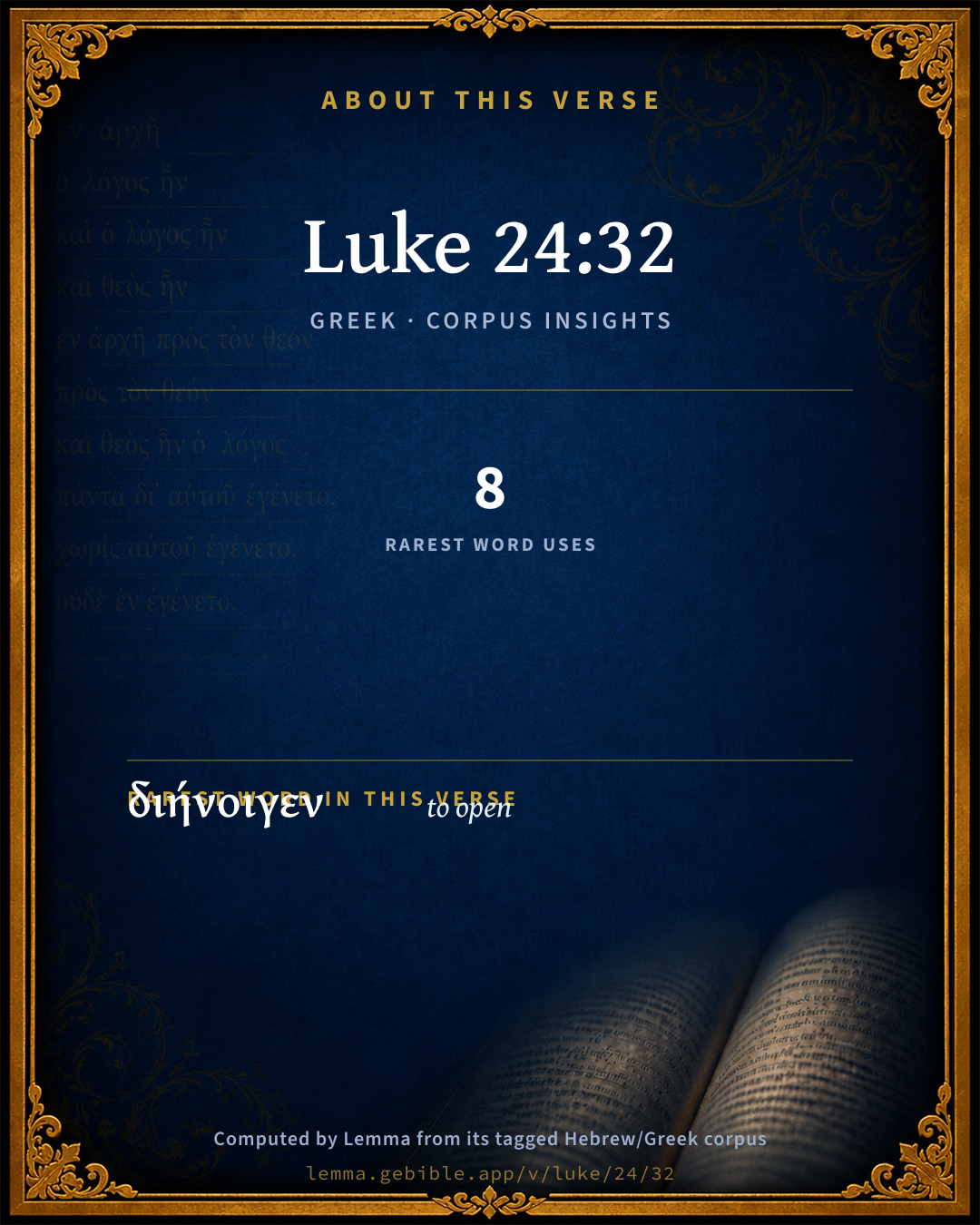
Luke 24:32

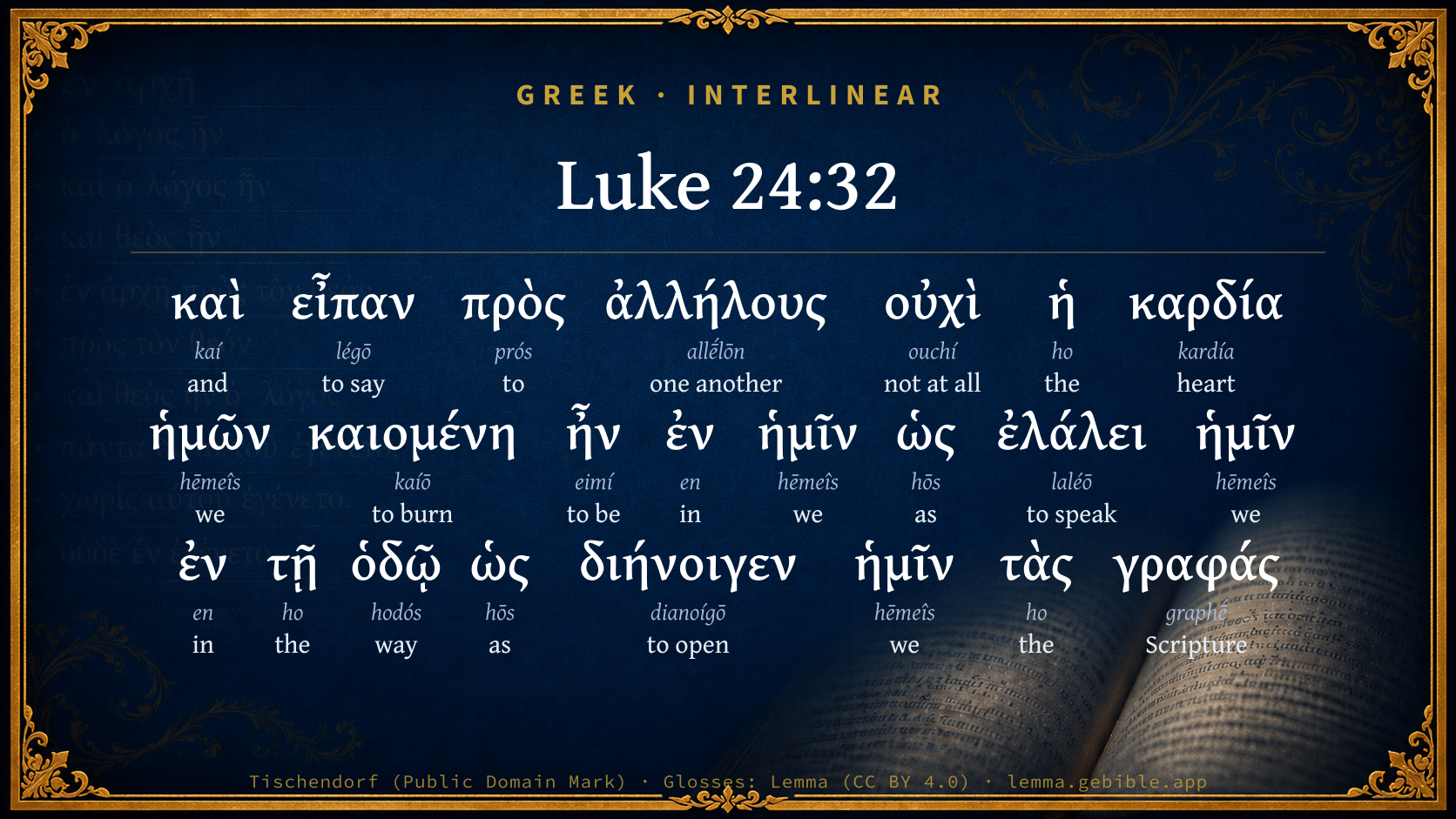
Greek (Tischendorf 8th ed.) Luke 24:32 appears in the Greek New Testament. The text above is from the Tischendorf 8th edition. Each word links to its Strong’s number and a concise gloss. Click any word for its full Thayer’s Greek Lexicon entry.
Download image
Cite this verse

Luke 24:32 (World English Bible). Public Domain. Lemma interlinear Bible study tool, https://lemma.gebible.app/v/luke/24/32.

Show BibTeX & RIS
BibTeX
RIS
English Translation
They said one to another, "Weren't our hearts burning within us, while he spoke to us along the way, and while he opened the Scriptures to us?"
World English Bible · Public Domain
Download a study sheet

One document with this verse’s original text, its word-by-word gloss line, the meaning frame, cross-references with their text, attributed commentary, and full source and license credits — printable, and it pastes into notes with its structure intact.

This verse Autodidact and up

Study sheet (.html) Plain text (.txt)

A passage Seminary Student

Up to 50 verses in one chapter. A passage sheet keeps up to 6 commentary sources and 12 cross-references per verse, in the order this page ranks them, and says so on the sheet whenever that leaves anything out. Ask for a single verse and you get the Autodidact verse sheet above.

Everything on this page stays free to read, with no account — the sheet is a download of what is already on screen, not access to it.

Want to remove ads? Support Godless Engineer
Compare translations 3

The same verse in 3 English versions, stacked beneath the original-language interlinear above. Click any original word for its lexicon entry.

Each is an independent rendering of the whole verse — the interlinear is not word-aligned to these translations.

Highlighted words mark where these versions differ — a whole-verse word diff, not a word-by-word alignment.

  • World English Bible Public Domain
    They said one to another, "Weren't our hearts burning within us, while he spoke to us along the way, and while he opened the Scriptures to us?"
  • King James Version Public Domain
    And they said one to another, Did not our heart burn within us, while he talked with us by the way, and while he opened to us the scriptures?
  • unfoldingWord Literal Text CC BY-SA 4.0
    And they said to one another, “Was not our heart burning as he spoke to us on the way, as he opened to us the Scriptures?”

unfoldingWord Literal Text — © unfoldingWord, licensed CC BY-SA 4.0. Word-aligned USFM3 via Door43 (git.door43.org/unfoldingWord/en_ult).

Versions to compare (up to 4)

3 of 4 selected

Show all 19 translations

Every available English version of this verse, each an independent rendering of the whole verse.

  • World English Bible Public Domain
    They said one to another, "Weren't our hearts burning within us, while he spoke to us along the way, and while he opened the Scriptures to us?"
  • Berean Standard Bible Public Domain
    They asked each other, “Were not our hearts burning within us as He spoke with us on the road and opened the Scriptures to us?”
  • Majority Standard Bible Public Domain
    They asked each other, “Were not our hearts burning within us as He spoke with us on the road and opened the Scriptures to us?”
  • King James Version Public Domain
    And they said one to another, Did not our heart burn within us, while he talked with us by the way, and while he opened to us the scriptures?
  • American Standard Version (1901) Public Domain
    And they said one to another, Was not our heart burning within us, while he spake to us in the way, while he opened to us the scriptures?
  • Revised Version (1885) Public Domain
    And they said one to another, Was not our heart burning within us, while he spake to us in the way, while he opened to us the scriptures?
  • Geneva Bible (1599) Public Domain
    And they saide betweene themselues, Did not our heartes burne within vs, while he talked with vs by the way, and when he opened to vs the Scriptures?
  • Douay-Rheims (1899) Public Domain
    And they said one to the other: Was not our heart burning within us, whilst he spoke in this way, and opened to us the scriptures?
  • Young's Literal Translation Public Domain
    And they said one to another, `Was not our heart burning within us, as he was speaking to us in the way, and as he was opening up to us the Writings?'
  • Literal Standard Version CC BY-SA 4.0
    And they said to one another, “Was our heart not burning within us as He was speaking to us in the way, and as He was opening the Writings up to us?”
  • Unlocked Literal Bible CC BY-SA 4.0
    They said one to another, “Was not our heart burning within us, while he spoke to us on the way, while he opened to us the scriptures?”
  • unfoldingWord Literal Text CC BY-SA 4.0
    And they said to one another, “Was not our heart burning as he spoke to us on the way, as he opened to us the Scriptures?”
  • Darby Bible Public Domain
    And they said to one another, Was not our heart burning in us as he spoke to us on the way, [and] as he opened the scriptures to us?
  • World Messianic Bible Public Domain
    They said to one another, “Weren’t our hearts burning within us while he spoke to us along the way, and while he opened the Scriptures to us?”
  • Webster's Bible Public Domain
    And they said one to another, Did not our heart burn within us while he talked with us by the way, and while he opened to us the scriptures?
  • Free Bible Version CC BY-SA 4.0
    The two disciples said to each other, “Weren't our thoughts on fire when he spoke to us, as he explained the Scriptures to us?”
  • Bible in Basic English Public Domain
    And they said to one another, Were not our hearts burning in us while he was talking to us on the way, making clear to us the holy Writings?
  • Text-Critical English NT CC BY 4.0
    They said to each other, “Were not our hearts burning within us as he spoke to us on the road and explained the Scriptures to us?”
  • Tyndale New Testament (1534) Public Domain
    And they sayde betwene them selves: dyd not oure hertes burne with in vs whyll he talked with vs by the waye and as he opened to vs the scriptures?

Literal Standard Version (2020), Covenant Press — licensed CC BY-SA 4.0. Text via the HelloAO Bible API (eBible.org). Unlocked Literal Bible (unfoldingWord) — licensed CC BY-SA 4.0. Text via the HelloAO Bible API (eBible.org). unfoldingWord Literal Text — © unfoldingWord, licensed CC BY-SA 4.0. Word-aligned USFM3 via Door43 (git.door43.org/unfoldingWord/en_ult). Free Bible Version, Dr. Jonathan Gallagher — licensed CC BY-SA 4.0. Text via the HelloAO Bible API (eBible.org).

Word by word

More ways to search: Search by grammar → Find every occurrence → Compare this word →

Practice this passage: Drill this verse → Learn its vocabulary →

διήνοιγεν
dianoígō
G1272
“to open”
Verb, Imperfect, Active, Indicative, 3rd person, Singular
Part of Speech
Verb
Tense
Imperfect
Voice
Active
Mood
Indicative
Person
3rd person
Number
Singular
Full Thayer's Definition

Origin: from G1223 and G455

TDNT: None

1. to open by dividing or drawing asunder, to open thoroughly (what had been closed) a. a male opening the womb (the closed matrix), i.e. the first-born b. of the eyes and the ears c. to open the mind of one, i.e. to cause to understand a thing 1. to open one's soul, i.e. to rouse in one the faculty of understanding or the desire of learning
  1. καὶ kaí G2532 “and” Conjunction
  2. εἶπαν légō G3004 “to say” Verb, Aorist, Active, Indicative, 3rd person, Plural
  3. πρὸς prós G4314 “to” Preposition
  4. ἀλλήλους allḗlōn G240 “one another” Reciprocal pronoun, Accusative, Plural, Masculine
  5. οὐχὶ ouchí G3780 “not at all” Particle, Interrogative
  6. ἡ ho G3588 “the” Article, Nominative, Singular, Feminine
  7. καρδία kardía G2588 “heart” Noun, Nominative, Singular, Feminine
  8. ἡμῶν hēmeîs G2249 “we” Personal pronoun, 1st person, Genitive, Plural
  9. καιομένη kaíō G2545 “to burn” Verb, Present, Passive, Participle, Nominative, Singular, Feminine
  10. ἦν eimí G1510 “to be” Verb, Imperfect, Active, Indicative, 3rd person, Singular
  11. ἐν en G1722 “in” Preposition
  12. ἡμῖν hēmeîs G2249 “we” Personal pronoun, 1st person, Dative, Plural
  13. ὡς hōs G5613 “as” Adverb
  14. ἐλάλει laléō G2980 “to speak” Verb, Imperfect, Active, Indicative, 3rd person, Singular
  15. ἡμῖν hēmeîs G2249 “we” Personal pronoun, 1st person, Dative, Plural
  16. ἐν en G1722 “in” Preposition
  17. τῇ ho G3588 “the” Article, Dative, Singular, Feminine
  18. ὁδῷ hodós G3598 “way” Noun, Dative, Singular, Feminine
  19. ὡς hōs G5613 “as” Adverb
  20. ἡμῖν hēmeîs G2249 “we” Personal pronoun, 1st person, Dative, Plural
  21. τὰς ho G3588 “the” Article, Accusative, Plural, Feminine
  22. γραφάς graphḗ G1124 “Scripture” Noun, Accusative, Plural, Feminine

About this verse

These counts appear in no published source. They are computed here, from the morphology-tagged text and Lemma’s own curated glosses. What Lemma adds →

23
words
16
distinct lemmas
Gospels
section

Notable vocabulary

The rarest word here is διήνοιγεν to open G1272 — appearing just 8 times in the whole Greek New Testament.

Shared distinctive vocabulary

διήνοιγεν to open G1272 occurs in 8 verses of the Greek New Testament. Also found in:

Repetition

Words recur within this verse:

Cross-references

13

Topical passages linked to Luke 24:32 in the Treasury of Scripture Knowledge — connected by theme and wording, ordered by reader-vote popularity; previews shown in the World English Bible.

  • Luke 24:45 Then he opened their minds, that they might understand the Scriptures.
  • Jeremiah 23:29 Isn't my word like fire? says Yahweh; and like a hammer that breaks the rock in pieces?
  • Hebrews 4:12 For the word of God is living, and active, and sharper than any two-edged sword, and piercing even to the dividing of soul and spirit, of both joints and marrow, and is able to discern the thoughts and intentions of the heart.
  • Psalms 39:3 My heart was hot within me. While I meditated, the fire burned: I spoke with my tongue:
  • Jeremiah 15:16 Your words were found, and I ate them; and your words were to me a joy and the rejoicing of my heart: for I am called by your name, Yahweh, God of hosts.
  • Jeremiah 20:9 If I say, I will not make mention of him, nor speak any more in his name, then there is in my heart as it were a burning fire shut up in my bones, and I am weary with forbearing, and I can't [contain].
  • Proverbs 27:17 Iron sharpens iron; So a man sharpens his friend's countenance.
  • John 6:63 It is the spirit who gives life. The flesh profits nothing. The words that I speak to you are spirit, and are life.
  • Psalms 104:34 Let your meditation be sweet to him. I will rejoice in Yahweh.
  • Acts 17:2–3 Paul, as was his custom, went in to them, and for three Sabbath days reasoned with them from the Scriptures,
  • Acts 28:23 When they had appointed him a day, many people came to him at his lodging. He explained to them, testifying about the Kingdom of God, and persuading them concerning Jesus, both from the law of Moses and from the prophets, from morning until evening.
  • Isaiah 50:4 The Lord Yahweh has given me the tongue of those who are taught, that I may know how to sustain with words him who is weary: he wakens morning by morning, he wakens my ear to hear as those who are taught.
  • Proverbs 27:9 Perfume and incense bring joy to the heart; So does earnest counsel from a man's friend.

Cross-references courtesy of OpenBible.info (CC BY 4.0).

Commentary

Notes on Luke 24:32 from classic Christian and Jewish commentators (each source and its license shown beneath its notes). The classic Christian expositions comment on the surrounding passage and are grouped to its opening verse, so a note may address several verses; the Jewish commentaries on the Tanakh (Rashi and others) are per-verse, so they appear only where the commentator wrote on this verse.

Lemma curates 59 commentaries, every one of them public domain or Creative Commons licensed, each selected and text-cleaned for this edition rather than reprinted as found. About our sources →

Joseph Benson's Commentary

Luk 24:32-35. And they said one to another, Did not our heart burn within us? — This reflection of the disciples, on this affair, is natural and beautiful. It is as if they had said, How strange it is that we should not have discovered him sooner, when we found his discourses have that effect upon us, which was peculiar to his teaching. For did not our very hearts glow within us, with love to God and our Divine Instructer, as well as to the truths which he made known to us by opening the Scriptures? They found the preaching powerful, even when they knew not the preacher; it not only made things of the greatest importance very plain and clear to them, but, together with a divine light, brought a divine warmth into their souls, and kindled therein a holy fire of pious and devout affections: and this they now notice for the confirming of their belief, that it was indeed Jesus himself who had been talking with them all the while. And they rose up the same hour — Not being able to conceal such good news, or to defer the publication of that which they believed would give their brethren such joy, as they felt in their own breasts; they therefore, late as it was, rose up from their unfinished meal, that very hour, and made all possible haste to Jerusalem, that they might declare to the other disciples the wonderful story, and give them full assurance of their Lord’s resurrection. They were, however, in some measure prevented: for, immediately upon their arrival, the apostles, with the women, accosted them with this declaration, The Lord is risen indeed, and hath appeared to Simon — Before he was seen of the other apostles, (1Co 15:5,) he had, in his wonderful condescension and grace, taken an opportunity on the former part of the day, (though where or in what manner is not recorded,) to show himself to Peter, that he might early relieve his distresses and fears, on account of his having so shamefully denied his Master. The generality of the apostles had given little credit to the reports of the women, supposing that they were occasioned more by imagination than reality. But when a person of Simon’s capacity and gravity declared that he had seen the Lord, they began to think he was risen indeed. And their belief was not a little confirmed by the arrival of these two disciples, who declared that the Lord had appeared to them also, and gave a circumstantial relation of all that had happened.

Joseph Benson's Commentary on the Old and New Testaments (1811–1818) — public domain. Text from a community e-Sword module.

MacLaren's Expositions of Holy Scripture

Alexander MacLaren

Luke

THE RISEN LORD’S SELF-REVELATION TO WAVERING DISCIPLES

Luk 24:13 - Luk 24:32.

These two disciples had left their companions after Peter’s return from the sepulchre and before Mary Magdalene hurried in with her tidings that she had seen Jesus. Their coming away at such a crisis, like Thomas’s absence that day, shows that the scattering of the sheep was beginning to follow the smiting of the shepherd. The magnet withdrawn, the attracted particles fall apart. What arrested that process? Why did not the spokes fall asunder when the centre was removed? John’s disciples crumbled away after his death. When Theudas fell, all his followers ‘were dispersed’ and came to nought. The Church was knit more closely together after the death that, according to all analogy, should have scattered it. Only the fact of the Resurrection explains the anomaly. No reasonable men would have held together unless they had known that their Messianic hopes had not been buried in Christ’s grave. We see the beginnings of the Resurrection of these hopes in this sweet story.

I. We have first the two sad travellers and the third who joins them.

Probably the former had left the group of disciples on purpose to relieve the tension of anxiety and sorrow by walking, and to get a quiet time to bring their thoughts into some order. They were like men who had lived through an earthquake; they were stunned, and physical exertion, the morning quiet of the country, and the absence of other people, would help to calm their nerves, and enable them to realise their position. Their tone of mind will come out more distinctly presently. Here it is enough to note that the ‘things which had come to pass’ filled their minds and conversation. That being so, they were not left to grope in the dark. ‘Jesus Himself drew near, and went with them.’ Honest occupation of mind with the truth concerning Him, and a real desire to know it, are not left unhelped. We draw Him to our sides when we wish and try to grasp the real facts concerning Him, whether they coincide with our prepossessions or not.

It is profoundly interesting and instructive to note the characteristics of the favoured ones who first saw the risen Lord. They were Mary, whose heart was an altar of flaming and fragrant love; Peter, the penitent denier; and these two, absorbed in meditation on the facts of the death and burial. What attracts Jesus? Love, penitence, study of His truth. He comes to these with the appropriate gifts for them, as truly-yea, more closely-as of old. Perhaps the very doubting that troubled them brought Him to their help. He saw that they especially needed Him, for their faith was sorely wounded. Necessity is as potent a spell to bring Jesus as desert. He comes to reward fixed and fervent love, and He comes, too, to revive it when tremulous and cold.

‘Their eyes were holden,’ says Luke; and similarly ‘their eyes were opened’ {Luk 24:31}. He makes the reason for His not being recognised a subjective one, and his narrative affords no support to the theory of a change in our Lord’s resurrection body. How often does Jesus still come to us, and we discern Him not! Our paths would be less lonely, and our thoughts less sad, if we realised more fully and constantly our individual share in the promise,’ I am with you always.’

II. We have next the conversation {Luk 24:17 - Luk 24:28}.

The unknown new-comer strikes into the dialogue with a question which, on some lips, would have been intrusive curiosity, and would have provoked rude retorts. But there was something in His voice and manner which unlocked hearts. Does He not still come close to burdened souls, and with a smile of love on His face and a promise of help in His tones, ask us to tell Him all that is in our hearts? ‘Communications’ told to Him cease to sadden. Those that we cannot tell to Him we should not speak to ourselves.

Cleopas naively wonders that there should be found a single man in Jerusalem ignorant of the things which had come to pass. He forgot that the stranger might know these, and not know that they were talking about them. Like the rest of us, he fancied that what was great to him was as great to everybody. What could be the subject of their talk but the one theme? The stranger assumes ignorance, in order to win to a full outpouring. Jesus wishes us to put all fears and doubts and shattered hopes into plain words to Him. Speech to Christ cleanses our bosoms of much perilous stuff. Before He speaks in answer we are lightened.

Very true to nature is the eager answer of the two. The silence once broken, out flows a torrent of speech, in which love and grief, disciples’ pride in their Master, and shattered hopes, incredulous bewilderment and questioning wonder, are blended.

That long speech {Luk 24:19 - Luk 24:24} gives a lively conception of the two disciples’ state of mind. Probably it fairly represented the thought of all. We note in it the limited conception of Jesus as but a prophet, the witness to His miracles and teaching {the former being set first, as having more impressed their minds}, the assertion of His universal appreciation by the ‘people,’ the charging of the guilt of Christ’s death on ‘our rulers,’ the sad contrast between the officials’ condemnation of Him and their own fond Messianic hopes, and the despairing acknowledgment that these were shattered.

The reference to ‘the third day’ seems to imply that the two had been discussing the meaning of our Lord’s frequent prophecy about it. The connection in which they introduce it looks as if they were beginning to understand the prophecy, and to cherish a germ of hope in His Resurrection, or, at all events, were tossed about with uncertainty as to whether they dared to cherish it. They are chary of allowing that the women’s story was true; naively they attach more importance to its confirmation by men. ‘But Him they saw not,’ and, so long as He did not appear, they could not believe even angels saying ‘that He was alive.’

The whole speech shows how complete was the collapse of the disciples’ Messianic hopes, how slowly their minds opened to admit the possibility of Resurrection, and how exacting they were in the matter of evidence for it, even to the point of hesitating to accept angelic announcements. Such a state of mind is not the soil in which hallucinations spring up. Nothing but the actual appearance of the risen Lord could have changed these sad, cautious unbelievers to lifelong confessors. What else could have set light to these rolling smoke-clouds of doubt, and made them flame heaven-high and world-wide?

‘The ingenuous disclosure of their bewilderment appealed to their Companion’s heart, as it ever does. Jesus is not repelled by doubts and perplexities, if they are freely spoken to Him. To put our confused thoughts into plain words tends to clear them, and to bring Him as our Teacher. His reproach has no anger in it, and inflicts no pain, but puts us on the right track for arriving at the truth. If these two had listened to the ‘prophets,’ they would have understood their Master, and known that a divine ‘must’ wrought itself out in His Death and Resurrection. How often, like them, do we torture ourselves with problems of belief and conduct of which the solution lies close beside us, if we would use it?

Jesus claimed ‘all the prophets’ as His witnesses. He teaches us to find the highest purpose of the Old Testament in its preparation for Himself, and to look for foreshadowings of His Death and Resurrection there. What gigantic delusion of self-importance that was, if it was not the self-attestation of the Incarnate Word, to whom all the written word pointed! He will still, to docile souls, be the Interpreter of Scripture. They who see Him in it all are nearer its true appreciation than those who see in the Old Testament everything but Him.

III. We have finally the disclosure and disappearance of the Lord.

The little group must have travelled slowly, with many a pause on the road, while Jesus opened the Scriptures; for they left the city in the morning, and evening was near before they had finished their ‘threescore furlongs’ {between seven and eight miles}. His presence makes the day’s march seem short.

‘He made as though He would have gone further,’ not therein assuming the appearance of a design which He did not really entertain, but beginning a movement which He would have carried out if the disciples’ urgency had not detained Him. Jesus forces His company on no man. He ‘would have gone further’ if they had not said ‘Abide with us.’ He will leave us if we do not keep Him. But He delights to be held by beseeching hands, and our wishes ‘constrain’ Him. Happy are they who, having felt the sweetness of walking with Him on the weary road, seek Him to bless their leisure and to add a more blissful depth of repose to their rest!

The humble table where Christ is invited to sit, becomes a sacred place of revelation. He hallows common life, and turns the meals over which He presides into holy things. His disciples’ tables should be such that they dare ask their Lord to sit at them. But how often He would be driven away by luxury, gross appetite, trivial or malicious talk! We shall all be the better for asking ourselves whether we should like to invite Jesus to our tables. He is there, spectator and judge, whether invited or not.

Where Jesus is welcomed as guest He becomes host. Perhaps something in gesture or tone, as He blessed and brake the bread, recalled the loved Master to the disciples’ minds, and, with a flash, the glad ‘It is He!’ illuminated their souls. That was enough. His bodily presence was no longer necessary when the conviction of His risen life was firmly fixed in them. Therefore He disappeared. The old unbroken companionship was not to be resumed. Occasional appearances, separated by intervals of absence, prepared the disciples gradually for doing without His visible presence.

If we are sure that He has risen and lives for ever, we have a better presence than that. He is gone from our sight that He may be seen by our faith. That ‘now we see Him not’ is advance on the position of His first disciples, not retrogression. Let us strive to possess the blessing of ‘those who have not seen, and yet have believed.’

Alexander MacLaren, Expositions of Holy Scripture (1904–1910) — public domain. Text from a community e-Sword module.

Bengel's Gnomon

Johann Albrecht Bengel

Luk 24:32. Καιομένη, burning) much and for long. [A most blessed sensation!—V. g.]—ἦν, was) They observed the fact more afterwards than during the actual continuance of the burning sensation.—ἐλάλει ἡμῖν) He spake to us. This means more than with us [which is however the Engl. rendering].—[διήνοιγεν, He opened) The Scripture is opened out, when “the understanding” is opened, Luk 24:45.—V. g.]

Bengel's Gnomon of the New Testament — English translation (T&T Clark, Edinburgh, 1860) — public domain. Text from a community e-Sword module.

Meyer's Critical & Exegetical Commentary

Heinrich August Wilhelm Meyer

Luk_24:32-33. Οὐχὶ ἡ καρδία ἡμῶν καιομένη ἦν ἐν ἡμῖν;] Was not our heart on fire within us? The extraordinarily lively emotions are, as in all languages, represented under the image of burning, of heat, of being inflamed, and the like, Wetstein and Kypke in loc.; Musgrave, ad Soph. Aj. 473. Hence the meaning: Was not our heart in an extraordinarily fervent commotion? Comp. Psa_39:4; Jer_20:9. Quite naturally the two disciples abstain from explaining more fully the excitement of feeling that they had experienced, because such an excitement, comprehending several affections, rises into consciousness, as divided into its special elements, the less in proportion as its experiences are deep, urgent, and marvellous. The connection of the question with what precedes is: Vere Christus est, nam non alia potuit esse causa, cur in via eo loquente tantopere animus noster inflammaretur, Maldonatus.

ὡς διήνοιγεν κ.τ.λ.] without καί (see the critical remarks) adds the special to the general asyndetically, in which form that which is urgent and impressive of the recollection expresses itself.

Luk_24:33. αὐτῇ τῇ ὥρᾳ] Certainly after such an experience the meal of which they had intended to partake was immediately given up. They had now no more irresistible necessity than that of communicating with their fellow-disciples in Jerusalem, and jam non timent iter nocturnum, quod antea dissuaserant ignoto comiti, Luk_24:29, Bengel.

Meyer — Critical and Exegetical Commentary on the New Testament — English translation by Peter Christie, edited by Frederick Crombie (T&T Clark, 1880) — public domain. Text from a community e-Sword module.

Expositor's Greek Testament

ed. W. Robertson Nicoll

Luk 24:32-35 . After Jesus’ departure .

Luk 24:32 . ἡ καρδία καιομένη , the heart burning, a beautiful expression for the emotional effect of new truth dawning on the mind; common to sacred writers ( vide Psa 39:4 , Jer 20:9 ) with profane. Their heart began to burn while the stranger expounded Scripture, and kept burning, and burning up into ever clearer flame, as He went on “valde et diu,” Bengel. It is the heart that has been dried by tribulation that burns so. This burning of the heart experienced by the two disciples was typical of the experience of the whole early Church when it got the key to the sufferings of Jesus (Holtzmann, H. C.). Their doubt and its removal was common to them with many, and that is why the story is told so carefully by Lk. ὡς ἐλάλει , ὡς διήνοιγεν (without καὶ ), as He spoke, as He opened, etc.; first the general then the more specific form of the fact.

The Expositor's Greek Testament, edited by W. Robertson Nicoll (1897–1910) — public domain. Text from a community e-Sword module.

Jamieson, Fausset & Brown

Robert Jamieson, A. R. Fausset & David Brown

They now tell each to the other how their hearts burned--were fired--within them at His talk and His expositions of Scripture. "Ah! this accounts for it: We could not understand the glow of self-evidencing light, love, glory that ravished our hearts; but now we do." They cannot rest--how could they?--they must go straight back and tell the news. They find the eleven, but ere they have time to tell their tale, their ears are saluted with the thrilling news, "The Lord is risen indeed, and hath appeared to Simon." Most touching and precious intelligence this. The only one of the Eleven to whom He appeared alone was he, it seems, who had so shamefully denied Him. What passed at that interview we shall never know here. Probably it was too sacred for disclosure. (See on Mar 16:7). The two from Emmaus now relate what had happened to them, and while thus comparing notes of their Lord's appearances, lo! Christ Himself stands in the midst of them. What encouragement to doubting, dark, true-hearted disciples!

Jamieson, Fausset & Brown — Commentary Critical and Explanatory on the Whole Bible (1871) — public domain (CC PDM 1.0). Text via the HelloAO Bible API.

Adam Clarke's Commentary

Verse 32. Did not our heart burn within us] His word was in our heart as a burning fire, Jer 20:9. Our hearts waxed hot within us, and while we were musing the fire burned, Ps 39:3. In some such way as this the words of the disciples may be understood: but there is a very remarkable reading here in the Codex Bezae; instead of καιομενη, burned, it has κεκαλυμμενη, veiled; and one of the Itala has, fuit excaecatum, was blinded. Was not our heart veiled (blinded) when he conversed with us on the way, and while he unfolded the Scriptures to us, seeing we did not know him?

Adam Clarke's Commentary on the Bible (1810–1826) — public domain. Text from a community e-Sword/MySword module.

Ellicott's Commentary for English Readers

(32) Did not our heart burn within us . . .?—More accurately, Was not our heart burning . . .? the tense both of this and of the other verbs implying a continuous and not a momentary state or act.

A Bible Commentary for English Readers, edited by Charles John Ellicott (1878–1897) — public domain. Text from a community e-Sword module.

The Cambridge Bible for Schools and Colleges

gen. ed. J. J. S. Perowne

32. Did not our heart burn] Rather, Was not our heart burning?

while he talked with us] Rather, to us. “Never man spake like this man,” Joh_7:46.

The Cambridge Bible for Schools and Colleges (gen. ed. J. J. S. Perowne; Cambridge University Press, 1878–1918) — public domain. Text from a community e-Sword module.

John Gill's Exposition

Saying,.... The following words; and which are not the words of the two disciples, but of the apostles, whom they found gathered together; and who, just as these two entered the room, said to one another, or rather to these two disciples, to whom at once, and as soon as ever they saw them, not being able to hold it in, they communicated the good news they had just heard, and which; perhaps, Peter had been just telling them:

the Lord is risen indeed; it is certainly matter of fact: for though the women were not credited, but their accounts were as idle tales, and, at most, only occasioned some thoughts and reflections, which they could not settle; yet now they were satisfied of the reality of his resurrection, and speak of it with the greatest assurance and joy:

and hath appeared unto Simon; he appeared to him first, before he did to any of the rest, though he had denied him in so shameful a manner: which is an instance of great grace and goodness: and he appeared to him, on purpose, no doubt, to comfort him under his distress; as well as being the oldest, disciple, and a man of figure and credit among them, his report would be believed. None of the writers of the New Testament take notice of this appearance besides, only the Apostle Paul, Co1 15:5. It is certain that it was the same day Christ rose from the dead; and was after the women had seen him, and after Peter had, been at the sepulchre; and before the return of the two disciples from Emmaus, and before he showed himself to the rest of the apostles.

John Gill's Exposition of the Whole Bible (1746–1763) — public domain (CC PDM 1.0). Text via the HelloAO Bible API.

Trapp's Complete Commentary

John Trapp

32 And they said one to another, Did not our heart burn within us, while he talked with us by the way, and while he opened to us the scriptures?

Ver. 32. Did not our hearts burn] By that spirit of burning {Isa 4:4} that kindleth the fire of God {Son 8:6} on the hearth of his people’s hearts, while the mystery of Christ is laid open unto them. Ego vero illius oratione sic incendebar, saith Senarclaeus, concerning Darius the martyr, ut cum eum disserentem audirem, Spiritus Sancti verba me audire existimarem. Methought when I heard him, I heard the Holy Ghost himself speaking to me.

While he opened] Preaching then is the key of the Scripture.

John Trapp, A Commentary or Exposition upon All the Books of the Old and New Testament (1647–1656) — public domain. Text from a community e-Sword module.

Albert Barnes' Notes on the Bible

Our heart burn within us - This is an expression denoting the deep interest and pleasure which they had felt in his discourse before they knew who he was. They now recalled his instruction; they remembered how his words reached the “heart” as he spoke to them; how convincingly he had showed them that the Messiah ought to suffer, and how, while he talked to them of the Christ that they so much loved, their hearts glowed with intense love. This feeling was not confined to them alone. All the followers of Jesus know how precious and tender are the communications of the Saviour, and how the heart glows with love as they think or hear of his life, and sufferings, and death.

He opened to us - He explained to us the Scriptures. See Luk 24:27.

This narrative shows us,

1. How blind people may be to the plainest doctrines of the Scriptures until they are explained to them. These disciples had often read or heard the Scriptures, but never, until then, did they fully understand that the Messiah must suffer.

2. It is proper there should be those whose office it is to explain the Scriptures. Jesus did it while on earth; he does it now by his Spirit; and he has appointed his ministers, whose business it is to explain them.

3. If people attempt to explain the Bible, they should themselves understand it. They should give their time and talents to a suitable preparation to understand the sacred volume. Preaching should consist in “real,” and not “fancied” explanations of the Scriptures; the real doctrines which “God” has taught in his word, and not the doctrines that “men” have taught in their systems.

4. Here was convincing evidence that Jesus was the Messiah. This was but one of many instances where Jesus convinced his disciples, contrary to their previous belief. In this case the evidence was abundant. He first satisfied them from the Old Testament that the very things which had happened were foretold; he then dissipated every doubt by showing “himself” to them and convincing them that he was truly the Christ. There was no chance here for deception and juggling. Who would have met them and talked with them in this way but the real Saviour? Who would have thought of writing this narrative to help an imposture? What impostor would have recorded the dulness of the disciples as to the plain declarations of the Old Testament, and “then” have thought of this device to prop up the narrative? Everything about this narrative - its simplicity - its tenderness - its particularity - its perfect nature - its freedom from all appearance of trick - shows that it was taken from real life; and if so, then the Christian religion is true, for here is evidence that Jesus rose from the dead.

Albert Barnes' Notes on the Bible (1834–1885) — public domain. Text from a community e-Sword/MySword module.

Matthew Poole's English Annotations

There was a mighty difference, no doubt, between Christ’s preaching and his ministers’: he preached as one who had authority, not as the scribes, not as ordinary ministers, but with more majesty and power; but as to the saving efficacy of his words, that depended upon his will; where he pleased to put forth such efficacious grace, there his words became effectual; where he did not, they were not so: Christ preached in the hearing of hundreds, who yet continued unbelievers, and perished in their unbelief. There is a great deal of difference also between one minister’s preaching and another’s; some kind of preaching of itself makes men’s hearts to freeze, others make them to burn; but where preaching makes our heart to burn within us, Christ throws in the coal, which the best preacher doth but blow up: only the Spirit of God is pleased to work (as Erasmus saith) secundum quod nactus est organon, according to the instrument it worketh by, and to concur with rational and spiritual means in order to rational and spiritual ends. But wherever any soul is baptized with fire at hearing a sermon, it is also baptized with the Holy Ghost. Christ will not always cure blind eyes with clay and spittle, though he did it once. These were disciples before the fire was kindled in their hearts; Christ’s preaching did but blow it up. We ought so to speak in our preaching, so to open and apply the Scriptures, as our discourses may have a rational tendency to make the hearts of our hearers to burn within them, not so as to make them dead, and sleepy, and cold, or lukewarm; and then to know that it must be Christ’s work to inflame them, when we have said all that we can say.

Matthew Poole's English Annotations on the Holy Bible (1683–1685) — public domain. Text from a community e-Sword/MySword module.

The Pulpit Commentary

And they said one to another, Did not our heart burn within us, while he talked with us by the way? better rendered, was not our heart burning within us, while, etc.?

The Pulpit Commentary (1880–1919), ed. H.D.M. Spence-Jones & Joseph S. Exell — public domain. Text from a community e-Sword module.

John Wesley's Explanatory Notes

Did not our heart burn within us - Did not we feel an unusual warmth of love! Was not our heart burning, &c.

John Wesley, Explanatory Notes Upon the Whole Bible (1754–1765) — public domain. Text via the GEBible commentary corpus.

Kretzmann's Popular Commentary

Paul E. Kretzmann

Mutual expressions of joy:

v. 32. And they said one to another, Did not our heart burn within us while He talked with us by the way, and while He opened to us the Scriptures?

v. 33. And they rose up the same hour, and returned to Jerusalem, and found the Eleven gathered together, and them that were with them,

v. 34. saying, The Lord is risen indeed, and hath appeared to Simon.

v. 35. And they told what things were done in the way, and how He was known of them in breaking of bread.

The vanishing of Christ did not fill the hearts of these two men with new sorrow and fear. They had the blessed remembrance of the words of Jesus which He had spoken to them on the way. Full of eager happiness they exchanged confidences on their experience. It is an expressive word: their hearts had been burning within them. "Their heart began to burn while the Stranger expounded Scripture, and kept burning, and burning up into ever clearer flame, as He went on. " In His discourse on the way the Lord had thoroughly opened to them the Scriptures. They now realized that the prophecies of old had been to them a sealed and hidden book. But now it had been opened to them, now they comprehended some of its wonderful treasures and beauties. This is always the effect of the words of Christ. When we are sad and weak, when we are longing for consolation and thereupon hear the Word of the Lord with all eagerness, then our heart will be warmed with the comfort of the salvation and the forgiveness of sins, and our faith, which was at the point of extinction, is once more enlivened to the brightness of a rich flame. For the risen Christ is in and with His Word. It is the living Christ who impresses the Word of the Gospel into our hearts and seals the comfort of the atonement through the blood of Christ in our hearts. The joy of these men did not permit them to rest at Emmaus. Though it must have been after six o’clock then, they arose from their meal at once; they hurried back to Jerusalem; they felt constrained to bring the good news to the others. And for the moment they found everybody happy. The apostles and disciples were all gathered together into one place, and they were met with the information that the Lord had risen indeed and had appeared to Simon. Sometime in the course of the day Jesus had met Peter, probably to reassure the deeply penitent apostle of His forgiveness. But the two disciples from Emmaus were not sorry that someone had forestalled them in bringing the happy news. For this would prove a welcome confirmation of their own experience, and the others would be only too glad to hear their story and thus to receive further assurance. It was unfortunate that the old doubts soon returned into the hearts of most of the disciples, as Mark is obliged to state. Christians must not depend too strongly upon moments of exaltation in their spiritual life. We cannot always be on the mountain peaks in our Christian experience, but must now and then descend into the valleys. But His Word is with us even in the valley of the shadow of death.

Paul E. Kretzmann, Popular Commentary of the Bible (1921–1924) — public domain. Text from a community e-Sword module.

Cambridge Greek Testament for Schools and Colleges

32. οὐχὶ ἡ καρδία ἡμῶν καιομένη ἦν; The expanded imperfect. Comp. Luk 21:24 ἔσται πατουμένη, Luk 23:51 ἦν συγκατατεθειμένος, Act 8:28 ἦν ὑποστρέφων, Mar 13:25 ἔσονται ἐκπίπτοντες, &c. The metaphor is common, “The heart may burn without a sigh.” Byron.

ὡς ἐλάλει ἡμῖν. “Never man spake like this man,” Joh 7:46.

Cambridge Greek Testament for Schools and Colleges (Cambridge University Press, 1896; 21 vols, various authors incl. Carr, Maclear, Plummer, Farrar, Lumby, Moule, M. R. James, Simcox) — public domain. Text from a community e-Sword module.

Alford’s Greek Testament

Henry Alford

32.] ‘Was there not something heart-kindling in His discourse by the way, which would have led us to suppose that it was none but the Lord Himself?’ not that they did suppose it,—but the words are a sort of self-reproach for not having done so. Compare Mat 7:29.

ἐλάλει ἡμῖν, as Bengel remarks, is more than συνελάλει ἡμ.:—He spoke to us, not merely, ‘with us,’ as E. V.

Henry Alford, The Greek Testament (1849–1861) — public domain. Text from a community e-Sword module.

International Critical Commentary

32. καιομένη ἦν. The periphrastic tense emphasizes the continuance of the emotion. Common and natural as the metaphor is, it seems to have been misunderstood; and hence the reading κεκαλυμμένη (D). perhaps from 2Co 3:14-16; while exaæcatum (c). and optusum (1) seem to imply πεπηρωμένη as another correction. Other variations are exterminatum (e) and gravatum (Syr-Cur. Syr-Sin. Sah. Arm.). They regard the glow in their hearts as further proof that it was indeed Jesus who was with them as they walked.

ὡς ἐλάλει…ὡς διήνοιγεν “While He was speaking… while He was opening.” Note the asyndeton and the use of the same verb for be opening of their eyes and the opening of the Scriptures.

International Critical Commentary — older volumes (1896–1929), various authors — public domain. Text from a community e-Sword module.

Vincent's Word Studies in the New Testament

Marvin R. Vincent

Did not our heart burn - while he talked - opened. [ουχι η καρδια ημων καιομενη ην - ως ελαλει - διηνοιγεν] . The A. V., as usual, pays no attention to the graphic imperfects here. They are speaking of something which was in progress : "was not our heart burning (finite verb and participle) while he was speaking, and was opening the scriptures?"

Marvin R. Vincent, Word Studies in the New Testament (1887–1900) — public domain. Text from a community e-Sword/MySword module.

Lesson kit

Teaching starters — assembled from the data on this page, not authored interpretation. Every prompt links to the verse data it draws on. Edit before teaching.

Luke, in the Gospels, opens this verse with 23 words (16 distinct Greek lemmas). Its most distinctive word is dianoígō (“to open”). A historical commentator’s framing appears above. Read the whole chapter for the surrounding context.

Discussion questions

  1. The word dianoígō carries the sense “to open.” How does it shape the verse?
  2. Mark 7:34 shares the word «to open» with this verse. How do the two illuminate each other?
  3. “we” occurs 4× in this one verse. What is the effect of the repetition?
  4. The translations on this page render this verse differently — a whole-verse word diff, not a word-by-word alignment. What might account for the different wordings?
  5. Reading how Joseph Benson's Commentary and MacLaren's Expositions of Holy Scripture read this verse, where do the two commentators agree and where do they part?

Things to notice

Reading settings

Reading text

Shown beneath each verse's original-language words.

Old Testament
Old Testament edition

Read the OT as the Masoretic Hebrew (MT) or the Greek Septuagint (LXX).

English shown for the Greek Septuagint (in the Hebrew ↔ Greek comparison).

Comparing translations? Open the Compare panel on any verse page to stack up to four side by side.