1 John 3:21

Greek (Tischendorf 8th ed.) 1 John 3:21 appears in the Greek New Testament. The text above is from the Tischendorf 8th edition. Each word links to its Strong’s number and a concise gloss. Click any word for its full Thayer’s Greek Lexicon entry.
Download image
Cite this verse

1 John 3:21 (World English Bible). Public Domain. Lemma interlinear Bible study tool, https://lemma.gebible.app/v/1-john/3/21.

Show BibTeX & RIS
BibTeX
RIS
English Translation
Beloved, if our hearts don't condemn us, we have boldness toward God;
World English Bible · Public Domain
Download a study sheet

One document with this verse’s original text, its word-by-word gloss line, the meaning frame, cross-references with their text, attributed commentary, and full source and license credits — printable, and it pastes into notes with its structure intact.

This verse Autodidact and up

Study sheet (.html) Plain text (.txt)

A passage Seminary Student

Up to 50 verses in one chapter. A passage sheet keeps up to 6 commentary sources and 12 cross-references per verse, in the order this page ranks them, and says so on the sheet whenever that leaves anything out. Ask for a single verse and you get the Autodidact verse sheet above.

Everything on this page stays free to read, with no account — the sheet is a download of what is already on screen, not access to it.

Want to remove ads? Support Godless Engineer
Compare translations 3

The same verse in 3 English versions, stacked beneath the original-language interlinear above. Click any original word for its lexicon entry.

Each is an independent rendering of the whole verse — the interlinear is not word-aligned to these translations.

Highlighted words mark where these versions differ — a whole-verse word diff, not a word-by-word alignment.

  • World English Bible Public Domain
    Beloved, if our hearts don't condemn us, we have boldness toward God;
  • King James Version Public Domain
    Beloved, if our heart condemn us not, then have we confidence toward God.
  • unfoldingWord Literal Text CC BY-SA 4.0
    Beloved, if the heart does not condemn, we have confidence toward God

unfoldingWord Literal Text — © unfoldingWord, licensed CC BY-SA 4.0. Word-aligned USFM3 via Door43 (git.door43.org/unfoldingWord/en_ult).

Versions to compare (up to 4)

3 of 4 selected

Show all 19 translations

Every available English version of this verse, each an independent rendering of the whole verse.

  • World English Bible Public Domain
    Beloved, if our hearts don't condemn us, we have boldness toward God;
  • Berean Standard Bible Public Domain
    Beloved, if our hearts do not condemn us, we have confidence before God,
  • Majority Standard Bible Public Domain
    Beloved, if our hearts do not condemn us, we have confidence before God,
  • King James Version Public Domain
    Beloved, if our heart condemn us not, then have we confidence toward God.
  • American Standard Version (1901) Public Domain
    Beloved, if our heart condemn us not, we have boldness toward God;
  • Revised Version (1885) Public Domain
    Beloved, if our heart condemn us not, we have boldness toward God;
  • Geneva Bible (1599) Public Domain
    Beloued, if our heart condemne vs not, then haue we boldnes toward God.
  • Douay-Rheims (1899) Public Domain
    Dearly beloved, if our heart do not reprehend us, we have confidence towards God:
  • Young's Literal Translation Public Domain
    Beloved, if our heart may not condemn us, we have boldness toward God,
  • Literal Standard Version CC BY-SA 4.0
    Beloved, if our heart may not condemn us, we have boldness toward God,
  • Unlocked Literal Bible CC BY-SA 4.0
    Beloved, if our hearts do not condemn us, we have confidence toward God.
  • unfoldingWord Literal Text CC BY-SA 4.0
    Beloved, if the heart does not condemn, we have confidence toward God
  • Darby Bible Public Domain
    Beloved, if our heart condemn us not, we have boldness towards God,
  • World Messianic Bible Public Domain
    Beloved, if our hearts don’t condemn us, we have boldness toward God;
  • Webster's Bible Public Domain
    Beloved, if our heart doth not condemn us, then have we confidence towards God.
  • Free Bible Version CC BY-SA 4.0
    Dear friends, if we're reassured we're not in the wrong, we can have confidence before God.
  • Bible in Basic English Public Domain
    My loved ones, if our heart does not say that we have done wrong, we have no fear before him;
  • Text-Critical English NT CC BY 4.0
    Beloved, if our hearts do not condemn us, we have confidence before God
  • Tyndale New Testament (1534) Public Domain
    Beloved yf oure hertes condempne vs not then have we trust to god warde:

Literal Standard Version (2020), Covenant Press — licensed CC BY-SA 4.0. Text via the HelloAO Bible API (eBible.org). Unlocked Literal Bible (unfoldingWord) — licensed CC BY-SA 4.0. Text via the HelloAO Bible API (eBible.org). unfoldingWord Literal Text — © unfoldingWord, licensed CC BY-SA 4.0. Word-aligned USFM3 via Door43 (git.door43.org/unfoldingWord/en_ult). Free Bible Version, Dr. Jonathan Gallagher — licensed CC BY-SA 4.0. Text via the HelloAO Bible API (eBible.org).

Word by word

More ways to search: Search by grammar → Find every occurrence → Compare this word →

Practice this passage: Drill this verse → Learn its vocabulary →

καταγινώσκῃ
kataginṓskō
G2607
“to find fault”
Verb, Present, Active, Subjunctive, 3rd person, Singular
Part of Speech
Verb
Tense
Present
Voice
Active
Mood
Subjunctive
Person
3rd person
Number
Singular
Full Thayer's Definition

Origin: from G2596 and G1097

TDNT: 12:54,1

1. to find fault with, blame 2. to accuse, condemn
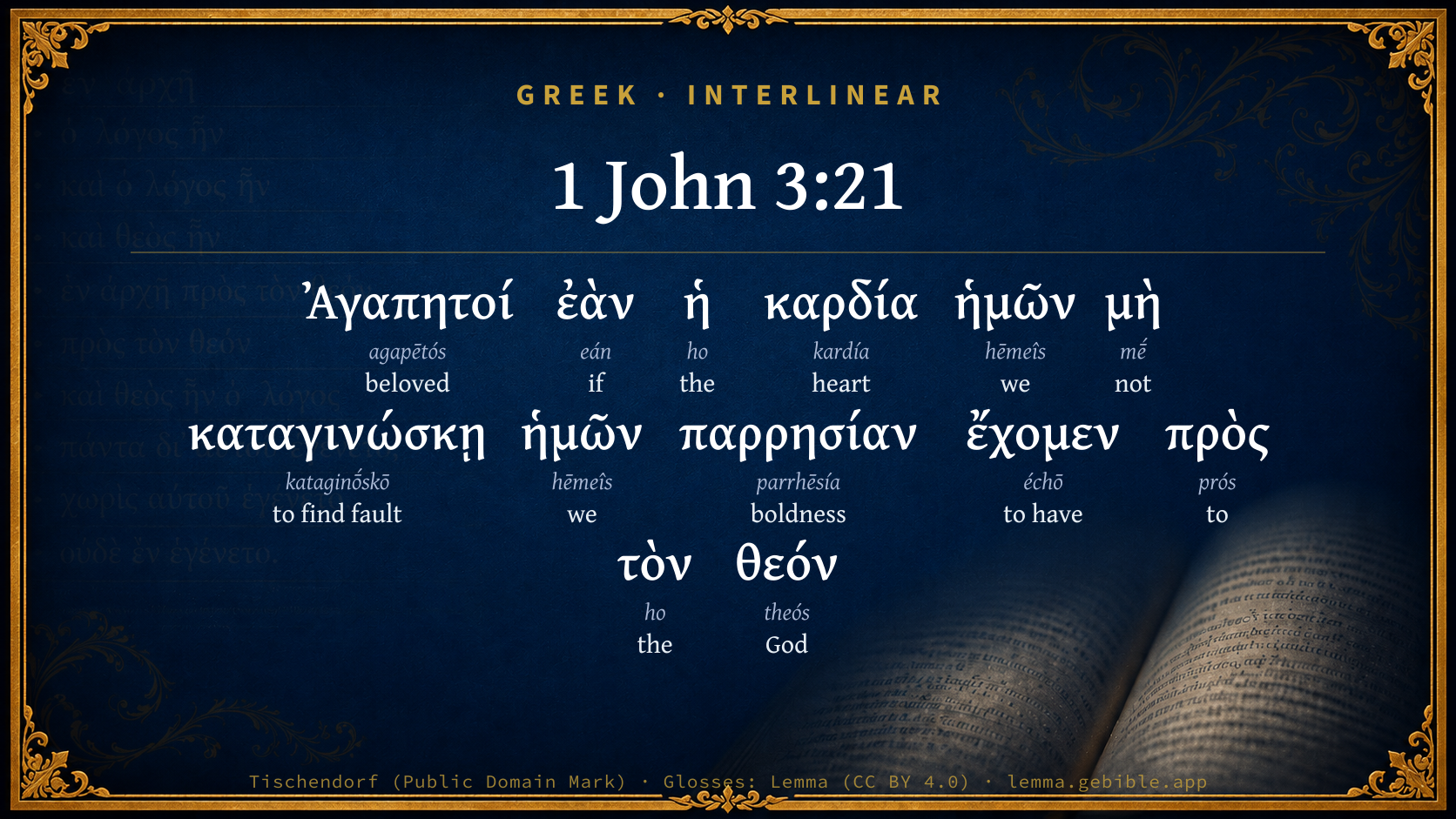
  1. Ἀγαπητοί agapētós G27 “beloved” Adjective, Vocative, Plural, Masculine
  2. ἐὰν eán G1437 “if” Conditional
  3. ἡ ho G3588 “the” Article, Nominative, Singular, Feminine
  4. καρδία kardía G2588 “heart” Noun, Nominative, Singular, Feminine
  5. ἡμῶν hēmeîs G2249 “we” Personal pronoun, 1st person, Genitive, Plural
  6. μὴ mḗ G3361 “not” Particle, Negative
  7. ἡμῶν hēmeîs G2249 “we” Personal pronoun, 1st person, Genitive, Plural
  8. παρρησίαν parrhēsía G3954 “boldness” Noun, Accusative, Singular, Feminine
  9. ἔχομεν échō G2192 “to have” Verb, Present, Active, Indicative, 1st person, Plural
  10. πρὸς prós G4314 “to” Preposition
  11. τὸν ho G3588 “the” Article, Accusative, Singular, Masculine
  12. θεόν theós G2316 “God” Noun, Accusative, Singular, Masculine

About this verse

These counts appear in no published source. They are computed here, from the morphology-tagged text and Lemma’s own curated glosses. What Lemma adds →

13
words
11
distinct lemmas
General Epistles
section

Notable vocabulary

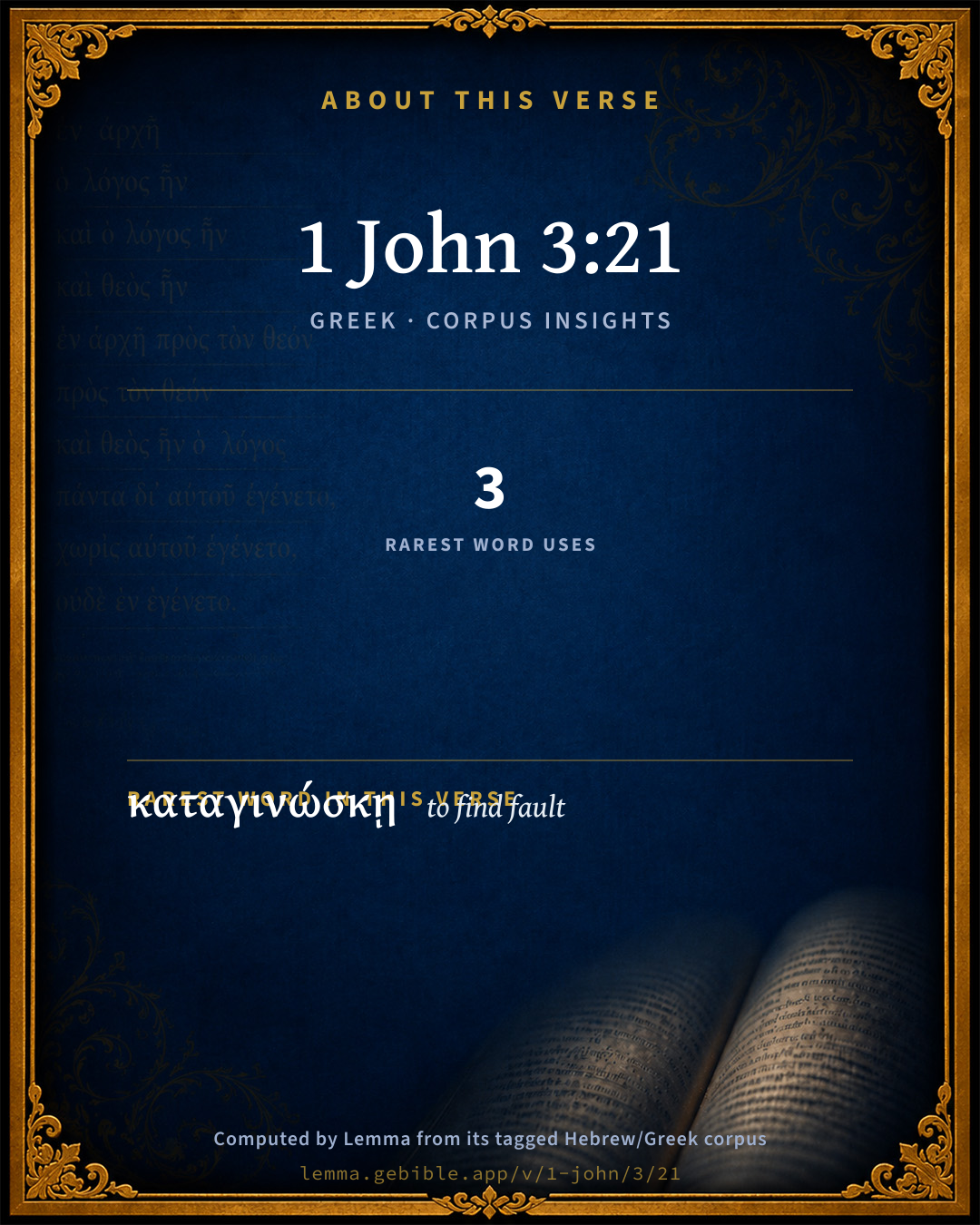
The rarest word here is καταγινώσκῃ to find fault G2607 — appearing just 3 times in the whole Greek New Testament.

Shared distinctive vocabulary

καταγινώσκῃ to find fault G2607 occurs in 3 verses of the Greek New Testament. Also found in:

Repetition

Words recur within this verse:

Cross-references

12

Topical passages linked to 1 John 3:21 in the Treasury of Scripture Knowledge — connected by theme and wording, ordered by reader-vote popularity; previews shown in the World English Bible.

  • 1 John 2:28 Now, little children, remain in him, that when he appears, we may have boldness, and not be ashamed before him at his coming.
  • Hebrews 4:16 Let us therefore draw near with boldness to the throne of grace, that we may receive mercy, and may find grace for help in time of need.
  • Psalms 101:2 I will be careful to live a blameless life. When will you come to me? I will walk within my house with a blameless heart.
  • 2 Corinthians 1:12 For our boasting is this: the testimony of our conscience, that in holiness and sincerity of God, not in fleshly wisdom but in the grace of God we behaved ourselves in the world, and more abundantly toward you.
  • Psalms 7:3–5 Yahweh, my God, if I have done this, If there is iniquity in my hands,
  • 1 John 5:14 This is the boldness which we have toward him, that, if we ask anything according to his will, he listens to us.
  • Job 22:26 For then shall you delight yourself in the Almighty, And shall lift up your face to God.
  • Hebrews 10:22 let's draw near with a true heart in fullness of faith, having our hearts sprinkled from an evil conscience, and having our body washed with pure water,
  • 1 John 4:17 In this love has been made perfect among us, that we may have boldness in the day of judgment, because as he is, even so are we in this world.
  • Job 27:6 I hold fast to my righteousness, and will not let it go. My heart shall not reproach me so long as I live.
  • 1 Corinthians 4:4 For I know nothing against myself. Yet I am not justified by this, but he who judges me is the Lord.
  • 1 Timothy 2:8 I desire therefore that the men in every place pray, lifting up holy hands without wrath and doubting.

Cross-references courtesy of OpenBible.info (CC BY 4.0).

Commentary

Notes on 1 John 3:21 from classic Christian and Jewish commentators (each source and its license shown beneath its notes). The classic Christian expositions comment on the surrounding passage and are grouped to its opening verse, so a note may address several verses; the Jewish commentaries on the Tanakh (Rashi and others) are per-verse, so they appear only where the commentator wrote on this verse.

Lemma curates 59 commentaries, every one of them public domain or Creative Commons licensed, each selected and text-cleaned for this edition rather than reprinted as found. About our sources →

Joseph Benson's Commentary

1Jn 3:21-22. Beloved, if our heart condemn us not — If our conscience, duly enlightened by the word and Spirit of God, and comparing all our thoughts, words, and works with that word, pronounce that they agree therewith; then have we confidence toward God — Our consciousness of his favour continues, with liberty of access to him, and intercourse with him; and we have this further blessing, that whatsoever we ask — According to his will; we receive of him — Or shall receive in the time, measure, and manner which he knows will be most for his glory and for our good. This general declaration must be limited by the conditions which in other passages of Scripture are represented as necessary in order to our petitions being granted by God: such as, that we ask things which his word authorizes us to ask, 1Jn 5:14-15; and that we ask them in faith, Jas 1:6; or in a full persuasion of, and reliance upon, his wisdom, power, and goodness; and with sincerity and resignation. Such prayers they who live in his fear and love, and comply with his will, as far as they know it, walking before him in holiness and righteousness, may expect will be heard and answered.

Joseph Benson's Commentary on the Old and New Testaments (1811–1818) — public domain. Text from a community e-Sword module.

Bengel's Gnomon

Johann Albrecht Bengel

1Jn 3:21. Μὴ καταγινώσκῃ, does not condemn) either as never injured, or as again appeased.—παῤῥησίαν, confidence) in asking. This is repeated, ch. 1Jn 5:14-15. This confidence far excels that tranquility which is expressed by the verb πείσομεν, we shall tranquilize.

Bengel's Gnomon of the New Testament — English translation (T&T Clark, Edinburgh, 1860) — public domain. Text from a community e-Sword module.

Meyer's Critical & Exegetical Commentary

Heinrich August Wilhelm Meyer

1Jn_3:21. In this verse the apostle states the case of our heart not accusing (or condemning) us. We can understand it thus, that what he previously observed has happened, namely, that in the consciousness that we are of the truth, we have induced our heart to refrain from its accusation against us. Then this thought does not stand to the preceding one in the relation of antithesis (as if in this verse a different case was contrasted with the case stated in 1Jn_3:20), but in that of continuation;[247] but it is more correct to suppose that the apostle is here speaking of a relationship which is different from that indicated in 1Jn_3:20, and that he is not regarding the question whether the non-condemnation has never taken place at all, or has been only brought about by persuasion. That two sentences may stand to one another in the relation of antithesis even without the antithetical particle, is proved by chap. 1Jn_1:8-9.

παῤῥησίαν ἔχομεν πρὸς τὸν Θεόν] states what occurs when the case exists which is mentioned by ἐάν; it is erroneous to explain παῤῥησίαν ἔχομεν = πείσομεν τὰς καρδίας ἡμῶν; the same expression in chap. 1Jn_2:28 and 1Jn_4:17, and construed with πρός, chap. 1Jn_5:14; the same construction in Rom_5:1 : εἰρήνην ἔχ. πρὸς τὸν Θεόν. As the calming of the heart, so also confidence toward God, which is the subject here, is based on the fact that God is greater than our heart, and knows all things.

[247] The objection of Ebrard to this interpretation, that ἐάν cannot serve the purpose of introducing a deduction from a premiss which is presupposed as already having actually occurred, is inappropriate, for ἐάν is not in this view at all taken as if, then, therefore, but is retained in its own proper meaning. Contrary to Braunes opinion, that with this interpretation not μή, but μηκέτι would have to be used, it is to be observed that it was not necessary to bring out the element which is contained in μηκέτι.

Meyer — Critical and Exegetical Commentary on the New Testament — English translation by Peter Christie, edited by Frederick Crombie (T&T Clark, 1880) — public domain. Text from a community e-Sword module.

Expositor's Greek Testament

ed. W. Robertson Nicoll

1Jn 3:21-22 . παρρησίαν , see note on 1Jn 2:28 . ὃ ἐὰν αἰτῶμεν λαμβάνομεν , though not always in the form we expect or desire; the answer may be different from but it is always better than our prayer. St. Augustine draws a distinction between the hearing of prayer “ad salutem” and “ad voluntatem,” comparing the experience of St. Paul (2Co 12:7-9 ): “Rogasti, clamasti, terclamasti: ipsum semel quod clamasti audivi, non averti aures meas a te; novi quid faciam; tu vis auferri medicamentum quo ureris; ego novi infirmitatem qua gravaris. Ergo iste ad salutem exauditus est, ad voluntatem non est exauditus.… Tu morbum confitearis, ille medicamentum adhibeat.” Cf. Juan de Avila: “Go to prayer rather to hearken than to speak. Bend humbly and lovingly before God, expecting.” τηροῦμεν , see note on 1Jn 2:3 .

The Expositor's Greek Testament, edited by W. Robertson Nicoll (1897–1910) — public domain. Text from a community e-Sword module.

Geneva Bible (1599)

Geneva Bible translators

A third effect also riseth out of the former, that in these miseries we are sure to be heard, because we are the sons of God, as we understand by the grace of sanctification which is proper to the elect.

Geneva Bible (1599) marginal notes — public domain. Text via Bolls.life.

Jamieson, Fausset & Brown

Robert Jamieson, A. R. Fausset & David Brown

Beloved--There is no "But" contrasting the two cases, Jo1 3:20-21, because "Beloved" sufficiently marks the transition to the case of the brethren walking in the full confidence of love (Jo1 3:18). The two results of our being able to "assure our hearts before Him" (Jo1 3:19), and of "our heart condemning us not" (of insincerity as to the truth in general, and as to LOVE in particular) are, (1) confidence toward God; (2) a sure answer to our prayers. John does not mean that all whose hearts do not condemn them, are therefore safe before God; for some have their conscience seared, others are ignorant of the truth, and it is not only sincerity, but sincerity in the truth which can save men. Christians are those meant here: knowing Christ's precepts and testing themselves by them.

Jamieson, Fausset & Brown — Commentary Critical and Explanatory on the Whole Bible (1871) — public domain (CC PDM 1.0). Text via the HelloAO Bible API.

Adam Clarke's Commentary

Verse 21. If our heart condemn us not] If we be conscious to ourselves of our own sincerity, that we practise not deceit, and use no mask, then have we confidence toward God-we can appeal to him for our sincerity, and we can come with boldness to the throne of grace, to obtain mercy, and find grace to help in time of need. And therefore says the apostle,

Adam Clarke's Commentary on the Bible (1810–1826) — public domain. Text from a community e-Sword/MySword module.

John Calvin's Commentaries

21 If our heart condemns not I have already explained that this refers not to hypocrites nor to the gross despisers of God. For how muchsoever the reprobate may approve of their own lives, yet the Lord, as Solomon says, weigheth their hearts. (Proverbs 16:2.) This balance of God, by which he tries men, is such, that no one can boast that he has a clean heart. The meaning, then, of the Apostle’s words is, that then only we come in calm confidence into God’s presence, when we bring with us the testimony of a heart conscious of what is right and honest. That saying of Paul is indeed true, that by faith, which relies on the grace of Christ, an access to God with confidence is opened to us, (Ephesians 3:12;) and also, that peace is given us by faith, that our consciences may stand peaceably before God. (Romans 5:1.) But there is not much difference between these sentences; for Paul shews the cause of confidence, but John mentions only an inseparable addition, which necessarily adheres to it, though it be not the cause.

Here, however, arises a greater difficulty, which seems to leave no confidence in the whole world; for who can be found whose heart reproves him in nothing? To this I answer, that the godly are thus reproved, that they may at the same time be absolved. For it is indeed necessary that they should be seriously troubled inwardly for their sins, that terror may lead them to humility and to a hatred of themselves; but they presently flee to the sacrifice of Christ, where they have sure peace. Yet the Apostle says, in another sense, that they are not condemned, because however deficient they may confess themselves to be in many things, they are still relieved by this testimony of conscience, that they truly and from the heart fear God and desire to submit to his righteousness. All who possess this godly feeling, and at the same time know that all their endeavors, how muchsoever they come short of perfection, yet please God, are justly said to have a calm or a peaceful heart, because there is no inward compunction to disturb their calm cheerfulness.

John Calvin's Commentaries (1540-1563) — public domain. Text from the Calvin Translation Society English edition (1840s-50s) via the Christian Classics Ethereal Library (ccel.org). Calvin's coverage is partial (roughly two-thirds of the Bible); uncommented books and verses are honest gaps, never fabricated. The 19th-century editor's footnotes and remarks are omitted so the notes are faithfully Calvin's own voice.

The Cambridge Bible for Schools and Colleges

gen. ed. J. J. S. Perowne

21. Beloved] See on 1Jn_3:2.

if our heart condemn us not] An argument à fortiori: if before God we can persuade conscience to acquit us, when it upbraids us, much more may we have assurance before Him, when it does not do so. It is not quite evident whether ‘condemn us not’ means ‘ceases to condemn us’, because we have persuaded it, or ‘does not condemn us from the first’, because it has had no misgivings about us. Either makes good sense. The same word for ‘condemn’ occurs Gal_2:11 of S. Peter’s dissimulation at Antioch: ‘I resisted him to the face, because he stood condemned’, and in Sir_14:2, ‘Blessed is he whose conscience hath not condemned him’ (οὐ κατέγνω).

then have we confidence towards God] ‘Then’, which is not in the Greek, may be omitted; we have boldness (see on 1Jn_2:28) toward God (1Jn_5:14). We approach to Him as children to a Father and not as criminals to a Judge. This is not the same as ‘persuading our heart’ (1Jn_3:19), but may be the result of it. Compare ‘to have peace toward God’ (Rom_5:1), i.e. in our relations to Him: both A. V. and R. V. render ‘have peace with God’, but the Greek is the same as here (πρὸς τὸν Θεόν).

The Cambridge Bible for Schools and Colleges (gen. ed. J. J. S. Perowne; Cambridge University Press, 1878–1918) — public domain. Text from a community e-Sword module.

John Gill's Exposition

And whatsoever we ask we receive of him,.... According to his promise, Mat 7:7; that is, whatever is asked according to the will of God, in the name of Christ, and for his sake, and in faith, nothing wavering, but believing in God, in his covenant and promises, for these are provisos in the case; and such as ask in this way may exercise an holy confidence that they shall receive; and indeed they do receive what they ask for; see Jo1 5:14;

because we keep his commandments; not that keeping the commands of God is the meritorious cause of receiving anything from him; for when men have done all they can, or are assisted to do, they are but unprofitable servants in point of merit: whatever is received from God, as it is in consequence of asking, so it is entirely owing to his own grace and favour, and for the sake of Christ; but keeping the commands of God is a necessary adjunct, or, as Calvin on the text calls it, an inseparable accident, or what necessarily belongs unto, and enters into the character of such, who are heard and answered by God, and receive at his hands; for there is a great deal of truth in what the Jews say to the blind man, Joh 9:31; and which may serve as a comment on these words:

and do those things that are pleasing in his sight; as keeping of his commandments is; not that these things ingratiate into the love and favour of God, or are the causes and conditions of it, for the love of God is prior to anything of this kind; nor are they the causes of men's acceptance with God, for the acceptance both of persons and services is only in Christ the beloved; but these things are what God approves of, when done in faith, from a principle of love, and with a view to his glory: and since he hears such persons that are worshippers of him, and do his will, and has promised good things to them; this is therefore a reason strengthening their confidence in him, that what they ask they shall receive.

John Gill's Exposition of the Whole Bible (1746–1763) — public domain (CC PDM 1.0). Text via the HelloAO Bible API.

Trapp's Complete Commentary

John Trapp

21 Beloved, if our heart condemn us not, then have we confidence toward God.

Ver. 21. Then have we confidence] Sincerity is the mother of serenity, Sine qua, tranquillitas omnis tempestas est, without which saith serenity is all a storm. Isidore. Uprightness hath boldness. It is not a peace, but a truce, that the wicked have; such a storm will befall them as shall never be blown over. Israel is the heir of peace, Gal 6:16; Isa 32:17.

John Trapp, A Commentary or Exposition upon All the Books of the Old and New Testament (1647–1656) — public domain. Text from a community e-Sword module.

Albert Barnes' Notes on the Bible

Beloved, if our heart condemn us not - If we so live as to have an approving conscience - that is, if we indulge in no secret sin; if we discharge faithfully every known duty; if we submit without complaining to all the allotments of Divine Providence.

Then have we confidence toward God - Compare the 1Jo 3:19; 1Jo 2:28 notes; Act 24:16 note. The apostle evidently does not mean that we have confidence toward God on the ground of what we do, as if it were meritorious, or as if it constituted a claim to his favor; but that we may so live as to have evidence of personal piety, and that we may look forward with a confident hope that we shall be accepted of him in the great day. The word here rendered “confidence” - παῤῥησίαν parrēsian - means properly “boldness;” usually boldness or openness in speaking our sentiments. See the notes at 1Jo 2:28. The confidence or boldness which we have toward our Maker is founded solely on the evidence that he will graciously accept us as pardoned sinners; not in the belief that we deserve his favor.

Albert Barnes' Notes on the Bible (1834–1885) — public domain. Text from a community e-Sword/MySword module.

Matthew Poole's English Annotations

But for their not condemning us, though the expression be merely negative, it must imply somewhat positive; for there are many whose hearts condemn them not, through ignorance of their rule, or oscitancy, self-indulgence, or neglect of themselves. But if after thorough search, with sincerity in the sight of God, our hearts do not condemn, but acquit us, as upright towards him, not willing to allow ourselves in any ill temper or practice, (such as, for instance, this of not loving, or neglecting, our brother),

then we have confidence (liberty of speech the word literally signifies, which well suits with what follows)

toward God; we have nothing to hinder or lie as a bar against us in our recourse to him.

Matthew Poole's English Annotations on the Holy Bible (1683–1685) — public domain. Text from a community e-Sword/MySword module.

Whedon's Commentary on the Bible

Daniel D. Whedon

21. Condemn us not—Our self-complacency may, indeed, deceive us, and we may think our heart does not condemn when the heart is itself beguiled. While our own hearts condemn us not, the hearts and consciences of others may justly condemn us. And in 1Jn_3:23-24 is given a test by which the assurance of the heart is tried. The love which is truth must wear the garb of deed and fulfilment of his commandments, otherwise vain is the appeal to our hearts.

Confidence toward God—We feel the full assurance of sin forgiven, of divine acceptance, of blessed communion, of a “title clear to mansions in the skies.”

Daniel D. Whedon (gen. ed.), Commentary on the Old and New Testaments (1874–1909) — public domain. Text from a community e-Sword module.

The Pulpit Commentary

Beloved, (1Jn_2:7 1Jn_3:2) there is a still more blessed possibility. If the consciousness of genuine love will sustain us before God when our heart reproaches us, much more may we have confidence towards him (1Jn_2:28) when it does not reproach us.

The Pulpit Commentary (1880–1919), ed. H.D.M. Spence-Jones & Joseph S. Exell — public domain. Text from a community e-Sword module.

John Wesley's Explanatory Notes

If our heart condemn us not - If our conscience, duly enlightened by the word and Spirit of God, and comparing all our thoughts, words, and works with that word, pronounce that they agree therewith. Then have we confidence toward God - Not only our consciousness of his favour continues and increases, but we have a full persuasion, that whatsoever we ask we shall receive of him.

John Wesley, Explanatory Notes Upon the Whole Bible (1754–1765) — public domain. Text via the GEBible commentary corpus.

The People's New Testament

B. W. Johnson

21. If our heart condemn us not, etc. Then we have a conscience void of offense before God and are assured that he will hear us.

B. W. Johnson's The People's New Testament with Notes (1889–1891) — public domain. Electronic text from the Christian Classics Ethereal Library (CCEL) ThML edition.

Cambridge Greek Testament for Schools and Colleges

21. With [674][675] omit ἡμῶν after καρδία. [676][677] omit ἡμῶν after καταγινώσκῃ.

[674] 5th century. Brought by Cyril Lucar, Patriarch of Constantinople, from Alexandria, and afterwards presented by him to Charles I. in 1628. In the British Museum. All three Epistles.

[675] 4th century. Brought to Rome about 1460. It is entered in the earliest catalogue of the Vatican Library, 1475. All three Epistles.

[676] 4th century. Brought to Rome about 1460. It is entered in the earliest catalogue of the Vatican Library, 1475. All three Epistles.

[677] 5th century. A palimpsest: the original writing has been partially rubbed out and the works of Ephraem the Syrian have been written over it. In the National Library at Paris. Part of the First and Third Epistles; 1Jn 1:1 to 1Jn 4:2; 3Jn 1:3-14. Of the whole N.T. the only Books entirely missing are 2 John and 2 Thessalonians.

21. ἀγαπητοί. See on 1Jn 3:2.

ἐὰν ἡ καρδία μὴ καταγ. An argument à fortiori: if before God we can persuade conscience to acquit us, when it upbraids us, much more may we have assurance before Him, when it does not do so. It is not quite evident whether ‘condemn us not’ means ‘ceases to condemn us,’ because we have persuaded it, or ‘does not condemn us from the first,’ because it had no misgivings about us. Either makes good sense. Καταγινώσκειν occurs elsewhere in N.T. Gal 2:11 only, ὅτι κατεγνωσμένος ἦν. Comp. Sir 14:2, ‘Blessed is he whose conscience hath not condemned him’ (οὐ κατέγνω).

παρρ. ἔχομεν. We have boldness: see on 1Jn 2:28. The ‘then’ of A.V. is not needed. With πρὸς τὸν Θεόν here comp. ἀπρόσκοπον συνείδησιν ἔχειν πρὸς τὸν Θεὸν καὶ τοὺς ἀνθρώπους (Act 24:16). We approach Him boldly as children, not fearfully as criminals. Comp. 1Jn 5:14. This is not the same as ‘persuading our heart before Him,’ but is a natural result of it. Comp. Rom 5:1.

Cambridge Greek Testament for Schools and Colleges (Cambridge University Press, 1896; 21 vols, various authors incl. Carr, Maclear, Plummer, Farrar, Lumby, Moule, M. R. James, Simcox) — public domain. Text from a community e-Sword module.

Vincent's Word Studies in the New Testament

Marvin R. Vincent

Beloved. The affectionate address is suggested by the preceding thought of tormenting self - accusation.

Confidence [παρρησιαν] . Rev., boldness. See on 2 28.

Marvin R. Vincent, Word Studies in the New Testament (1887–1900) — public domain. Text from a community e-Sword/MySword module.

Westcott on Hebrews & the Epistles of John

Brooke Foss Westcott

21. ᾿Αγαπητοί Carissimi V., Dilectissimt Aug. Comp.c.ii.7 note. The tender address follows naturally from the thought of the fears and hopes of Christians. The sense of misgiving (the condemnation of the heart) and the sense of duty done (the acquittal of the heart) severally involve special applications of the divine revelation. In the one case this revelation brings assurance, and in the other effectual prayer.

ἐὰν ἡ καρδία μὴ καταγ. | 8ὲ Cor nostrum non reprehenderiit V. (male senserit Aug.), if our heart condemn us not. This evidently is the converse case to ‘if our heart condemn us” It does not imply a claim to sinlessness, nor yet an insensibility to the heinousness of sin, but the action of a lively faith which retains a real sense of fellowship with God, and this carries with it confidence and peace.

The change in the order of the words in the parallel clauses marks a change of emphasis. In the first clause stress is laid on the fact of condemnation (ὅτι ἐὰν καταγινώσκῃ ἡ faculty which pronounces no condemnation (ἐὰν ἡ καρδία μὴ Karay.).

παρρησίαν ἔχομεν͵ἠ jfiduciam habemus V., we have boldness, so as to express without reserve all our wants. Compare Ο. v. 14 (ii. 28, iv. 17); John vii. 4 note. The thought here is of the boldness with which the son appears before the Father, and not of that with which the accused appears before the Judge.

πρὸς τ. θ.) ad Deum V., towards God. Compare Acts xxiv. 16; Rom. iv.

Brooke Foss Westcott (1825–1901), The Epistle to the Hebrews (1889) and The Epistles of St John (1883) — public domain (pre-1929). Text recovered from Internet Archive / Google Books OCR scans. Westcott’s Gospel of John commentary is not included (its OCR lost the chapter running-heads required for reliable verse-keying). Some Greek quoted in the Hebrews volume is imperfectly rendered by the OCR.

Lesson kit

Teaching starters — assembled from the data on this page, not authored interpretation. Every prompt links to the verse data it draws on. Edit before teaching.

1 John, in the General Epistles, opens this verse with 13 words (11 distinct Greek lemmas). Its most distinctive word is kataginṓskō (“to find fault”). A historical commentator’s framing appears above. Read the whole chapter for the surrounding context.

Discussion questions

  1. How does “to find fault” (kataginṓskō) shape what this verse is saying?
  2. Galatians 2:11 shares the word «to find fault» with this verse. How do the two illuminate each other?
  3. “the” occurs 2× in this one verse. What is the effect of the repetition?
  4. The translations on this page render this verse differently — a whole-verse word diff, not a word-by-word alignment. What might account for the different wordings?
  5. Reading how Joseph Benson's Commentary and Bengel's Gnomon read this verse, where do the two commentators agree and where do they part?

Things to notice

Reading settings

Reading text

Shown beneath each verse's original-language words.

Old Testament
Old Testament edition

Read the OT as the Masoretic Hebrew (MT) or the Greek Septuagint (LXX).

English shown for the Greek Septuagint (in the Hebrew ↔ Greek comparison).

Comparing translations? Open the Compare panel on any verse page to stack up to four side by side.