

1 Timothy 1:5
Greek (Tischendorf 8th ed.) 1 Timothy 1:5 appears in the Greek New Testament. The text above is from the Tischendorf 8th edition. Each word links to its Strong’s number and a concise gloss. Click any word for its full Thayer’s Greek Lexicon entry.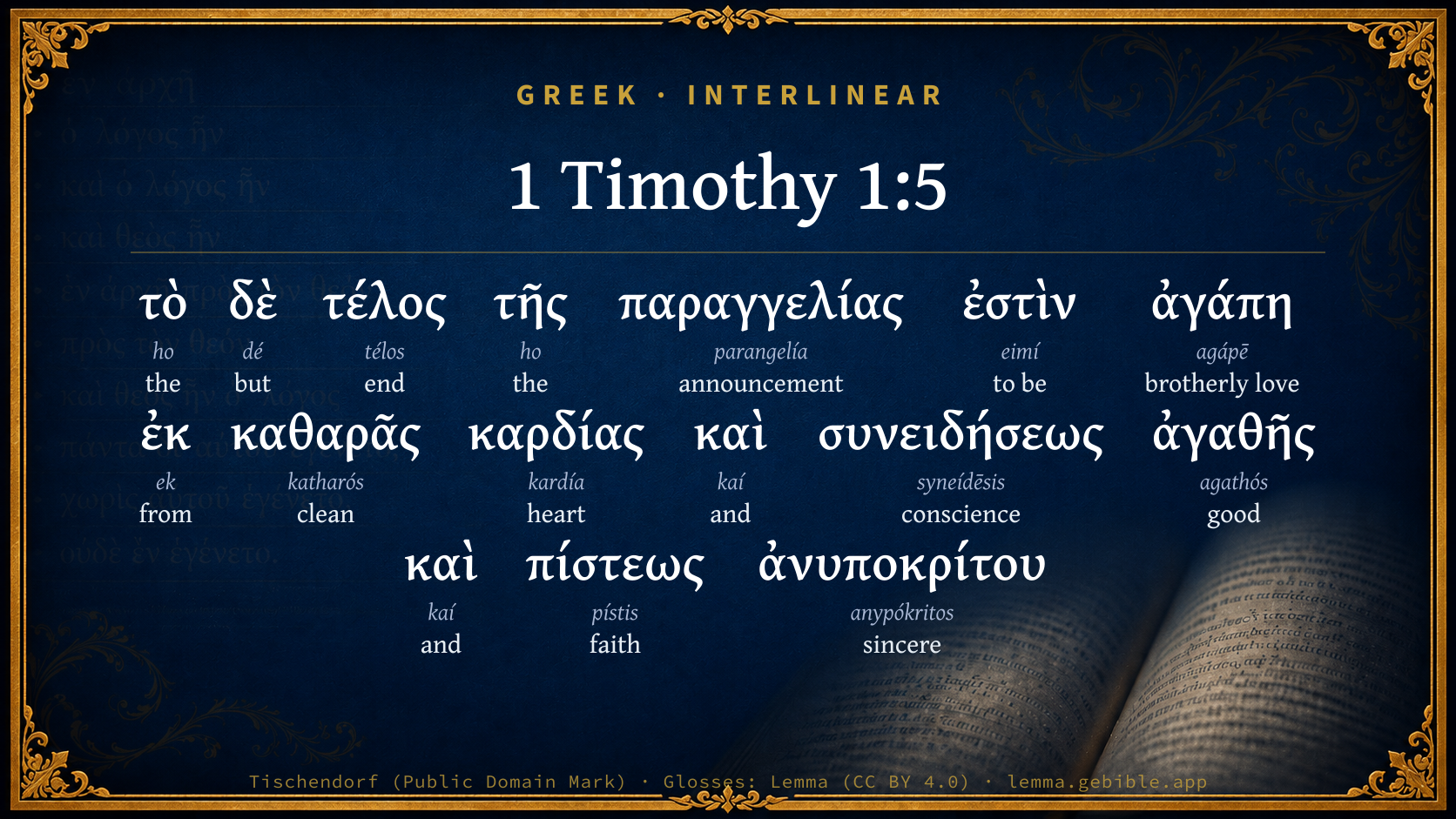
but the end of the charge is love, out of a pure heart and a good conscience and unfeigned faith;
Download a study sheet
One document with this verse’s original text, its word-by-word gloss line, the meaning frame, cross-references with their text, attributed commentary, and full source and license credits — printable, and it pastes into notes with its structure intact.
This verse Autodidact and up
A passage Seminary Student
Up to 50 verses in one chapter. A passage sheet keeps up to 6 commentary sources and 12 cross-references per verse, in the order this page ranks them, and says so on the sheet whenever that leaves anything out. Ask for a single verse and you get the Autodidact verse sheet above.
Everything on this page stays free to read, with no account — the sheet is a download of what is already on screen, not access to it.
Compare translations 3
The same verse in 3 English versions, stacked beneath the original-language interlinear above. Click any original word for its lexicon entry.
Each is an independent rendering of the whole verse — the interlinear is not word-aligned to these translations.
Highlighted words mark where these versions differ — a whole-verse word diff, not a word-by-word alignment.
-
World English Bible Public Domain
but the end of the charge is love, out of a pure heart and a good conscience and unfeigned faith;
-
King James Version Public Domain
Now the end of the commandment is charity out of a pure heart, and of a good conscience, and of faith unfeigned:
-
unfoldingWord Literal Text CC BY-SA 4.0
Now the goal of the command is love from a pure heart and a good conscience and a sincere faith,
unfoldingWord Literal Text — © unfoldingWord, licensed CC BY-SA 4.0. Word-aligned USFM3 via Door43 (git.door43.org/unfoldingWord/en_ult).
Show all 19 translations
Every available English version of this verse, each an independent rendering of the whole verse.
-
World English Bible Public Domain
but the end of the charge is love, out of a pure heart and a good conscience and unfeigned faith;
-
Berean Standard Bible Public Domain
The goal of our instruction is the love that comes from a pure heart, a clear conscience, and a sincere faith.
-
Majority Standard Bible Public Domain
The goal of our instruction is the love that comes from a pure heart, a clear conscience, and a sincere faith.
-
King James Version Public Domain
Now the end of the commandment is charity out of a pure heart, and of a good conscience, and of faith unfeigned:
-
American Standard Version (1901) Public Domain
But the end of the charge is love out of a pure heart and a good conscience and faith unfeigned:
-
Revised Version (1885) Public Domain
But the end of the charge is love out of a pure heart and a good conscience and faith unfeigned:
-
Geneva Bible (1599) Public Domain
For the end of the commandement is loue out of a pure heart, and of a good conscience, and of faith vnfained.
-
Douay-Rheims (1899) Public Domain
Now the end of the commandment is charity, from a pure heart, and a good conscience, and an unfeigned faith.
-
Young's Literal Translation Public Domain
And the end of the charge is love out of a pure heart, and of a good conscience, and of faith unfeigned,
-
Literal Standard Version CC BY-SA 4.0
And the end of the charge is love out of a pure heart, and of a good conscience, and of unhypocritical faith,
-
Unlocked Literal Bible CC BY-SA 4.0
Now the goal of the commandment is love from a pure heart, from a good conscience, and from a sincere faith.
-
unfoldingWord Literal Text CC BY-SA 4.0
Now the goal of the command is love from a pure heart and a good conscience and a sincere faith,
-
Darby Bible Public Domain
But the end of what is enjoined is love out of a pure heart and a good conscience and unfeigned faith;
-
World Messianic Bible Public Domain
But the goal of this command is love from a pure heart, a good conscience, and sincere faith,
-
Webster's Bible Public Domain
Now the end of the commandment is charity out of a pure heart, and of a good conscience, and of faith unfeigned:
-
Free Bible Version CC BY-SA 4.0
The reason why I insist on this is so we may have love that comes from a pure heart, from a clear conscience and sincere trust in God.
-
Bible in Basic English Public Domain
But the effect of the order is love coming from a clean heart, and a knowledge of what is right, and true faith:
-
Text-Critical English NT CC BY 4.0
The goal of our instruction is love from a pure heart, from a good conscience, and from sincere faith.
-
Tyndale New Testament (1534) Public Domain
for the ende of the commaundement is love that cometh of a pure herte and of a good conscience and of fayth vnfayned:
Literal Standard Version (2020), Covenant Press — licensed CC BY-SA 4.0. Text via the HelloAO Bible API (eBible.org). Unlocked Literal Bible (unfoldingWord) — licensed CC BY-SA 4.0. Text via the HelloAO Bible API (eBible.org). unfoldingWord Literal Text — © unfoldingWord, licensed CC BY-SA 4.0. Word-aligned USFM3 via Door43 (git.door43.org/unfoldingWord/en_ult). Free Bible Version, Dr. Jonathan Gallagher — licensed CC BY-SA 4.0. Text via the HelloAO Bible API (eBible.org).
Word by word
More ways to search: Search by grammar → Find every occurrence → Compare this word →
Practice this passage: Drill this verse → Learn its vocabulary →
- Appears 5× in the Greek New Testament
- First appears at Acts 5:28
- Part of Speech
- Noun
- Case
- Genitive
- Number
- Singular
- Gender
- Feminine
Full Thayer's Definition
- τὸ ho G3588 “the” Article, Nominative, Singular, Neuter
- δὲ dé G1161 “but” Conjunction
- τέλος télos G5056 “end” Noun, Nominative, Singular, Neuter
- τῆς ho G3588 “the” Article, Genitive, Singular, Feminine
- παραγγελίας parangelía G3852 “announcement” Noun, Genitive, Singular, Feminine
- ἐστὶν eimí G1510 “to be” Verb, Present, Active, Indicative, 3rd person, Singular
- ἀγάπη agápē G26 “brotherly love” Noun, Nominative, Singular, Feminine
- ἐκ ek G1537 “from” Preposition
- καθαρᾶς katharós G2513 “clean” Adjective, Genitive, Singular, Feminine
- καρδίας kardía G2588 “heart” Noun, Genitive, Singular, Feminine
- καὶ kaí G2532 “and” Conjunction
- συνειδήσεως syneídēsis G4893 “conscience” Noun, Genitive, Singular, Feminine
- ἀγαθῆς agathós G18 “good” Adjective, Genitive, Singular, Feminine
- καὶ kaí G2532 “and” Conjunction
- πίστεως pístis G4102 “faith” Noun, Genitive, Singular, Feminine
- ἀνυποκρίτου anypókritos G505 “sincere” Adjective, Genitive, Singular, Feminine
About this verse
These counts appear in no published source. They are computed here, from the morphology-tagged text and Lemma’s own curated glosses. What Lemma adds →
- 16
- words
- 14
- distinct lemmas
- Pauline Epistles
- section
Cross-references
38Topical passages linked to 1 Timothy 1:5 in the Treasury of Scripture Knowledge — connected by theme and wording, ordered by reader-vote popularity; previews shown in the World English Bible.
- 1 Timothy 1:19 holding faith and a good conscience; which some having thrust away made a shipwreck concerning the faith;
- Galatians 5:22 But the fruit of the Spirit is love, joy, peace, patience, kindness, goodness, faithfulness,
- Galatians 5:13–14 For you, brothers, were called for freedom. Only don't use your freedom for gain to the flesh, but through love be servants to one another.
- 2 Timothy 2:22 Flee from youthful lusts; but pursue righteousness, faith, love, and peace with those who call on the Lord out of a pure heart.
- 2 Timothy 1:5 having been reminded of the unfeigned faith that is in you; which lived first in your grandmother Lois, and your mother Eunice, and, I am persuaded, in you also.
- Mark 12:28–34 One of the scribes came, and heard them questioning together. Knowing that he had answered them well, asked him, "Which commandment is the greatest of all?"
- 2 Timothy 1:3 I thank God, whom I serve as my forefathers did, with a pure conscience. How unceasing is my memory of you in my petitions, night and day
- 1 Peter 1:22 Seeing you have purified your souls in your obedience to the truth through the Spirit in sincere brotherly affection, love one another from the heart fervently:
- 1 Peter 3:16 having a good conscience; that, while you are spoken against as evildoers, they may be disappointed who curse your good manner of life in Christ.
- Romans 10:4 For Christ is the fulfillment of the law for righteousness to everyone who believes.
- 1 Peter 3:21 This is a symbol of baptism, which now saves you-- not the putting away of the filth of the flesh, but the answer of a good conscience toward God, through the resurrection of Jesus Christ,
- 2 Peter 1:7 and in godliness brotherly affection; and in brotherly affection, love.
- Psalms 51:10 Create in me a clean heart, O God. Renew a right spirit within me.
- Romans 13:8–10 Owe no one anything, except to love one another; for he who loves his neighbor has fulfilled the law.
- 2 Corinthians 1:12 For our boasting is this: the testimony of our conscience, that in holiness and sincerity of God, not in fleshly wisdom but in the grace of God we behaved ourselves in the world, and more abundantly toward you.
- 1 Timothy 3:9 holding the mystery of the faith in a pure conscience.
- Titus 1:15 To the pure, all things are pure; but to those who are defiled and unbelieving, nothing is pure; but both their mind and their conscience are defiled.
- Acts 23:1 Paul, looking steadfastly at the council, said, "Brothers, I have lived before God in all good conscience until this day."
- 1 Peter 4:8 And above all things be earnest in your love among yourselves, for love covers a multitude of sins.
- 1 John 4:7–14 Beloved, let us love one another, for love is of God; and everyone who loves is born of God, and knows God.
- Psalms 24:4 He who has clean hands and a pure heart; Who has not lifted up his soul to falsehood, And has not sworn deceitfully.
- Matthew 5:8 Blessed are the pure in heart, For they shall see God.
- Matthew 12:35 The good man out of his good treasure brings out good things, and the evil man out of his evil treasure brings out evil things.
- Acts 15:9 He made no distinction between us and them, cleansing their hearts by faith.
- Acts 24:16 Herein I also practice always having a conscience void of offense toward God and men.
- Romans 9:1 I tell the truth in Christ. I am not lying, my conscience testifying with me in the Holy Spirit,
- Romans 14:15 Yet if because of food your brother is grieved, you walk no longer in love. Don't destroy with your food him for whom Christ died.
- 1 Corinthians 8:1–3 Now concerning things sacrificed to idols: We know that we all have knowledge. Knowledge puffs up, but love builds up.
- 1 Corinthians 13:1–14:1 If I speak with the languages of men and of angels, but don't have love, I have become sounding brass, or a clanging cymbal.
- Hebrews 10:22 let's draw near with a true heart in fullness of faith, having our hearts sprinkled from an evil conscience, and having our body washed with pure water,
- James 4:8 Draw near to God, and he will draw near to you. Cleanse your hands, you sinners; and purify your hearts, you double-minded.
- Galatians 5:6 For in Christ Jesus neither circumcision amounts to anything, nor uncircumcision, but faith working through love.
- Hebrews 9:14 how much more will the blood of Christ, who through the eternal Spirit offered himself without blemish to God, cleanse your conscience from dead works to serve the living God?
- Hebrews 13:18 Pray for us, for we are persuaded that we have a good conscience, desiring to live honorably in all things.
- 1 John 3:3 Everyone who has this hope set on him purifies himself, even as he is pure.
- 1 John 3:23 This is his commandment, that we should believe in the name of his Son, Jesus Christ, and love one another, even as he commanded.
- Jeremiah 4:14 Jerusalem, wash your heart from wickedness, that you may be saved. How long shall your evil thoughts lodge within you?
- Hebrews 11:5–6 By faith, Enoch was taken away, so that he wouldn't see death, and he was not found, because God translated him. For he has had testimony given to him that before his translation he had been well pleasing to God.
Cross-references courtesy of OpenBible.info (CC BY 4.0).
Lesson kit
Teaching starters — assembled from the data on this page, not authored interpretation. Every prompt links to the verse data it draws on. Edit before teaching.
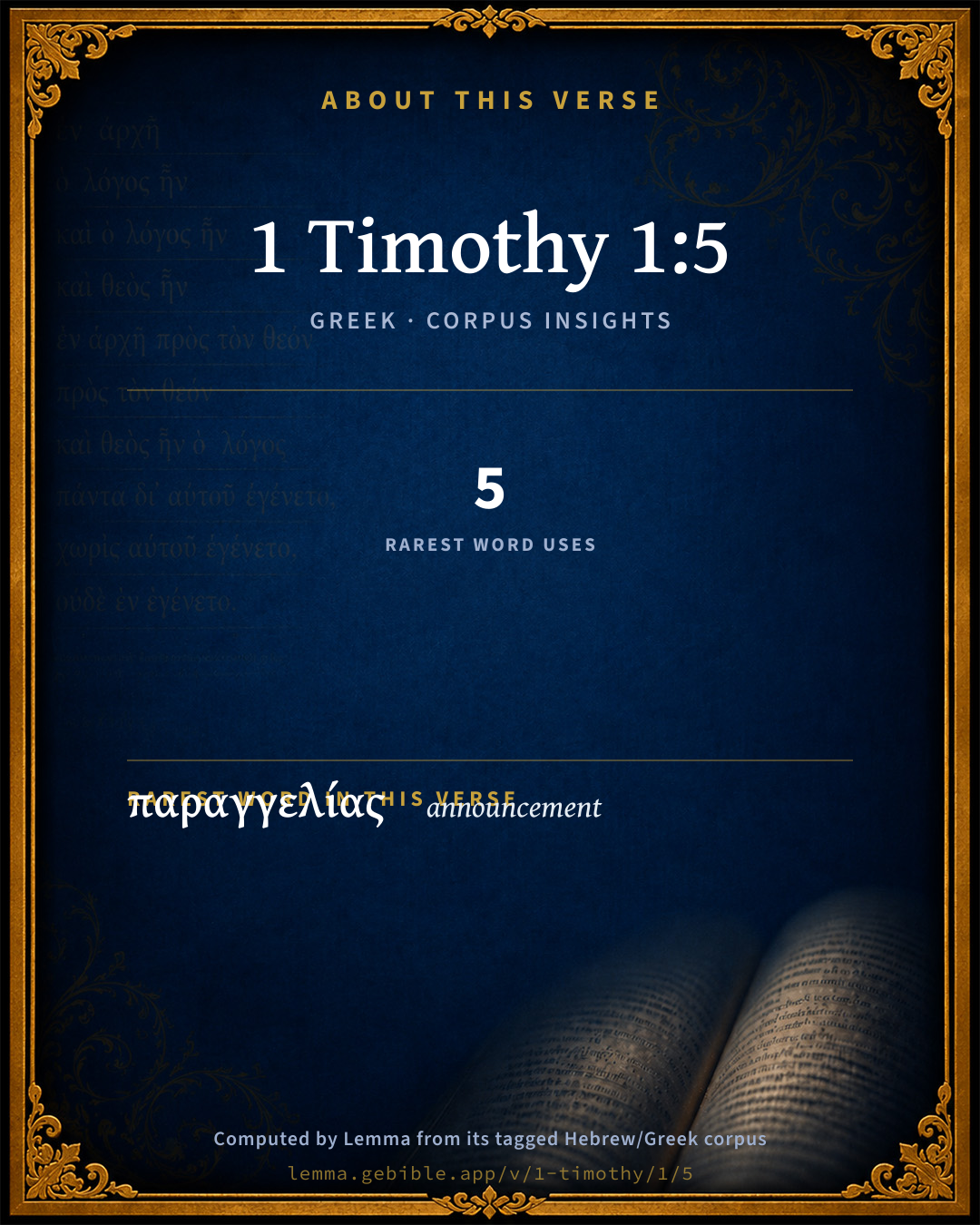
1 Timothy, in the Pauline Epistles, opens this verse with 16 words (14 distinct Greek lemmas). Its most distinctive word is parangelía (“announcement”). A historical commentator’s framing appears above. Read the whole chapter for the surrounding context.
Discussion questions
- What does “announcement” (parangelía) contribute to the verse as a whole?
- How does Acts 5:28, which shares the word «announcement», read alongside this verse?
- What does the repetition of “the” (2× in this one verse) do in this verse?
- These translations render this verse differently; the difference is in the English rendering, not the original. What questions does that raise?
- Compare how The Biblical Illustrator and Joseph Benson's Commentary read this verse. Where do they agree or differ?
Things to notice
- These translations choose different wording for 11 words in this verse.
- “the” occurs 2× in this single verse.
- 14 distinct Greek lemmas span 16 words in this verse.
Commentary
Notes on 1 Timothy 1:5 from classic Christian and Jewish commentators (each source and its license shown beneath its notes). The classic Christian expositions comment on the surrounding passage and are grouped to its opening verse, so a note may address several verses; the Jewish commentaries on the Tanakh (Rashi and others) are per-verse, so they appear only where the commentator wrote on this verse.
Lemma curates 59 commentaries, every one of them public domain or Creative Commons licensed, each selected and text-cleaned for this edition rather than reprinted as found. About our sources →
The Biblical Illustrator
Joseph S. Exell
The Biblical Illustrator, edited by Joseph S. Exell (c. 1880s–1900s) — public domain. Text from a community e-Sword module.
Joseph Benson's Commentary
Joseph Benson's Commentary on the Old and New Testaments (1811–1818) — public domain. Text from a community e-Sword module.
The Preacher's Complete Homiletical Commentary
Joseph S. Exell (gen. ed.)
The Preacher's Complete Homiletical Commentary (gen. ed. Joseph S. Exell; Funk & Wagnalls, c. 1892) — public domain (pre-1929). A full-Bible homiletical/sermon-outline anthology covering 65 of 66 books (2 John is absent from the source module). Text from a community e-Sword module.
Tyndale Open Study Notes
Tyndale Open Resources
Tyndale Open Study Notes — © Tyndale Open Resources, licensed CC BY-SA 4.0. Text via the HelloAO Bible API.
unfoldingWord translationNotes
Door43 World Missions Community
unfoldingWord translationNotes — © Distant Shores Media and the Door43 World Missions Community, licensed CC BY-SA 4.0. Source: git.door43.org/Door43/en_tn.
Bengel's Gnomon
Johann Albrecht Bengel
Bengel's Gnomon of the New Testament — English translation (T&T Clark, Edinburgh, 1860) — public domain. Text from a community e-Sword module.
Meyer's Critical & Exegetical Commentary
Heinrich August Wilhelm Meyer
Meyer — Critical and Exegetical Commentary on the New Testament — English translation by Peter Christie, edited by Frederick Crombie (T&T Clark, 1880) — public domain. Text from a community e-Sword module.
Cambridge Greek Testament for Schools and Colleges
Cambridge Greek Testament for Schools and Colleges (Cambridge University Press, 1896; 21 vols, various authors incl. Carr, Maclear, Plummer, Farrar, Lumby, Moule, M. R. James, Simcox) — public domain. Text from a community e-Sword module.
International Critical Commentary
International Critical Commentary — older volumes (1896–1929), various authors — public domain. Text from a community e-Sword module.
Geneva Bible (1599)
Geneva Bible translators
Geneva Bible (1599) marginal notes — public domain. Text via Bolls.life.
Matthew Henry's Commentary
Matthew Henry's Commentary on the Whole Bible (1708–1710) — public domain (CC PDM 1.0). Text via the HelloAO Bible API.
Jamieson, Fausset & Brown
Robert Jamieson, A. R. Fausset & David Brown
Jamieson, Fausset & Brown — Commentary Critical and Explanatory on the Whole Bible (1871) — public domain (CC PDM 1.0). Text via the HelloAO Bible API.
Adam Clarke's Commentary
Adam Clarke's Commentary on the Bible (1810–1826) — public domain. Text from a community e-Sword/MySword module.
John Calvin's Commentaries
John Calvin's Commentaries (1540-1563) — public domain. Text from the Calvin Translation Society English edition (1840s-50s) via the Christian Classics Ethereal Library (ccel.org). Calvin's coverage is partial (roughly two-thirds of the Bible); uncommented books and verses are honest gaps, never fabricated. The 19th-century editor's footnotes and remarks are omitted so the notes are faithfully Calvin's own voice.
Ellicott's Commentary for English Readers
A Bible Commentary for English Readers, edited by Charles John Ellicott (1878–1897) — public domain. Text from a community e-Sword module.
The Cambridge Bible for Schools and Colleges
gen. ed. J. J. S. Perowne
The Cambridge Bible for Schools and Colleges (gen. ed. J. J. S. Perowne; Cambridge University Press, 1878–1918) — public domain. Text from a community e-Sword module.
John Gill's Exposition
John Gill's Exposition of the Whole Bible (1746–1763) — public domain (CC PDM 1.0). Text via the HelloAO Bible API.
Trapp's Complete Commentary
John Trapp
John Trapp, A Commentary or Exposition upon All the Books of the Old and New Testament (1647–1656) — public domain. Text from a community e-Sword module.
Albert Barnes' Notes on the Bible
Albert Barnes' Notes on the Bible (1834–1885) — public domain. Text from a community e-Sword/MySword module.
Haydock's Catholic Bible Commentary
George Leo Haydock (1774–1849), Haydock's Catholic Family Bible and Commentary, 1859 edition — public domain. Excludes Psalms (Douay-Rheims chapter numbering differs from Protestant) and Deuterocanonical books (Catholic canon only).
Matthew Poole's English Annotations
Matthew Poole's English Annotations on the Holy Bible (1683–1685) — public domain. Text from a community e-Sword/MySword module.
Whedon's Commentary on the Bible
Daniel D. Whedon
Daniel D. Whedon (gen. ed.), Commentary on the Old and New Testaments (1874–1909) — public domain. Text from a community e-Sword module.
The Pulpit Commentary
The Pulpit Commentary (1880–1919), ed. H.D.M. Spence-Jones & Joseph S. Exell — public domain. Text from a community e-Sword module.
John Wesley's Explanatory Notes
John Wesley, Explanatory Notes Upon the Whole Bible (1754–1765) — public domain. Text via the GEBible commentary corpus.
Fairbairn on Ezekiel, Jonah & the Pastoral Epistles
Patrick Fairbairn
Patrick Fairbairn — An Exposition of Ezekiel (1851), Jonah (1849), and The Pastoral Epistles (1874) — public domain. Text from a community e-Sword module.
Burkitt's Expository Notes on the New Testament
William Burkitt
William Burkitt's Expository Notes on the New Testament (1700–1703) — public domain. Text from a community e-Sword module.
Godbey's Commentary on the New Testament
William B. Godbey
William B. Godbey, Commentary on the New Testament (1896–1900) — public domain. Text from a community e-Sword module.
The People's New Testament
B. W. Johnson
B. W. Johnson's The People's New Testament with Notes (1889–1891) — public domain. Electronic text from the Christian Classics Ethereal Library (CCEL) ThML edition.
Alford’s Greek Testament
Henry Alford
Henry Alford, The Greek Testament (1849–1861) — public domain. Text from a community e-Sword module.
Vincent's Word Studies in the New Testament
Marvin R. Vincent
Marvin R. Vincent, Word Studies in the New Testament (1887–1900) — public domain. Text from a community e-Sword/MySword module.